Crypto World
US 20-year bond auction just had its worst showing ever

Yesterday morning, the head of the US Treasury proudly reported in front of Congress that the government had just run two of its best bond auctions in decades.
By 1pm, the Treasury conducted its worst 20-year bond auction in history.
On Tuesday, the US government had to pay a record-breaking 5.42% interest yield-to-maturity to sell its auction of 20 year maturity bonds — the most expensive cost of capital the US government has paid for Treasuries of this maturity since modern record-keeping began in 1986.
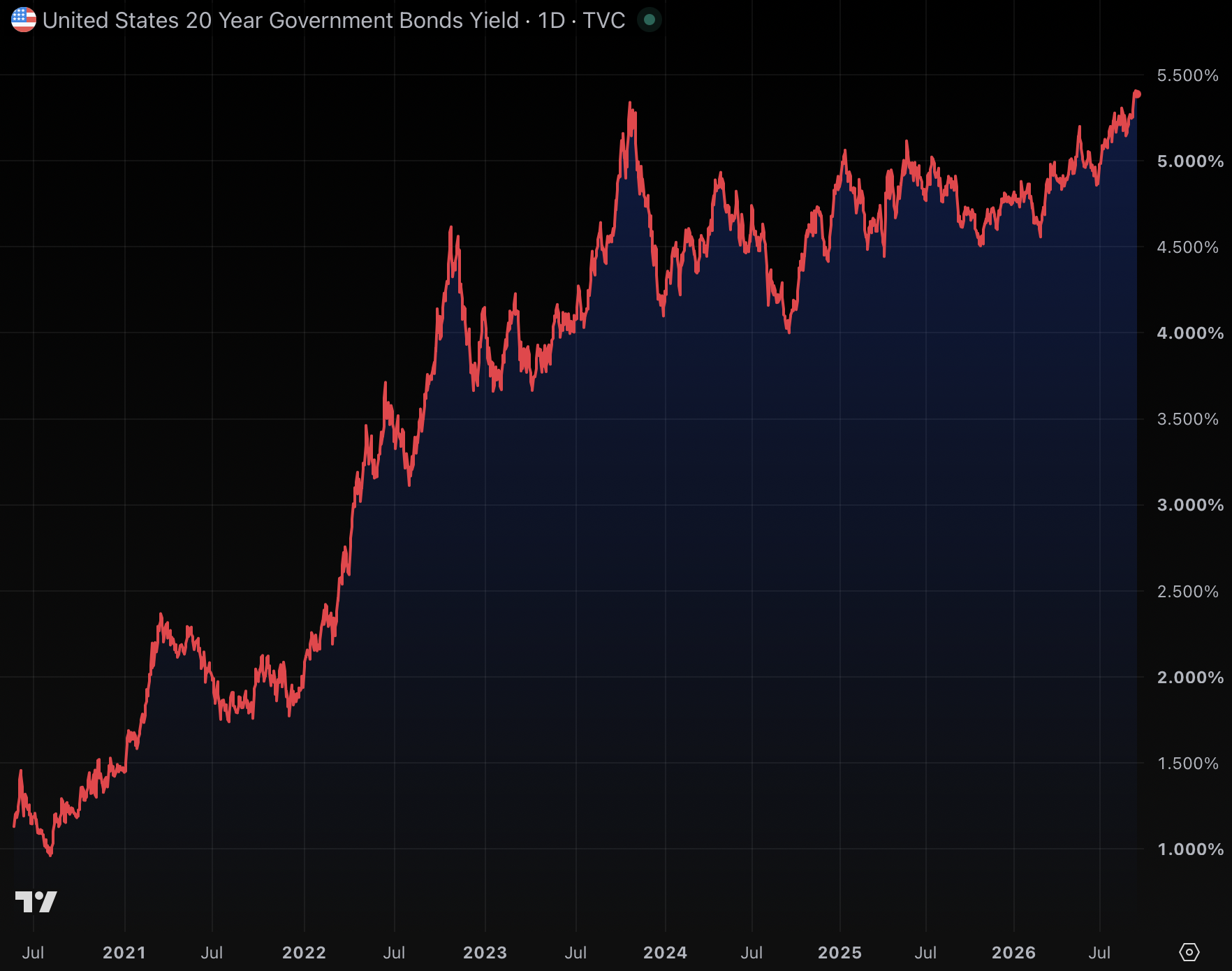
On a bit of a technicality, the government avoided paying 5.42% interest on the bonds, instead paying 5.125% yet selling them below par to mathematically offer 5.42% de facto yield to purchasers.
Worse, the particular type of investors Washington needs for offloading its sovereign debt — foreign investors — bought the lowest percentage ever of that $13 billion auction.
Record cost to borrow money for 20 years
Bond auctions aren’t complicated. The US Treasury offers IOUs, and buyers around the world name the yield they’ll accept.
At each live auction, yield-to-maturity is focus. The bond’s effective interest rate is the cost of capital for the US government.
The higher the yield, the less creditworthy the US government is in the opinion of bond traders. With $40.1 trillion and rising of outstanding debt that costs taxpayers over $1.1 trillion per year in interest payments, US debt-to-GDP at 123% is a growing concern for bond investors.
Tuesday’s sale was terrible on three counts.
The rate was the start of the disaster. Twenty-year bonds traded around 5.40% minutes before the sale and cleared at 5.42%. In other words, Washington paid more than the open market was charging at the end, just to find sufficient takers to fully clear the auction.
Traders call that additional 0.02% a two basis point “tail,” and it was the worst tail for any 20-year auction since 2024.
Second, the crowd mix was terrible. So-called “indirect bidders” are Treasury auction participants like foreign central banks and overseas buyers.
Like any sovereign, the US wants to sell as much of its debt to buyers abroad as possible.
Instead, indirect bidders took just 52.5% of yesterday’s auction, lower than August’s 62.9% and the lowest percentage on record for any 20-year Treasury auction since the 1980s besides a small, idiosyncratic $25 million special auction in 2021.
Third, the liquidity or depth of demand was thin as well, as measured by the bid-to-cover ratio. Specifically, bids covered yesterday’s bond sale 2.57 times, below the 2.65 average of the previous six auctions.
Read more: How the bond market helped push BTC to all-time high
Did Scott Bessent expect no one would notice?
Given the historically bearish turnout for yesterday’s Treasuries sale, anyone could rightly be curious as to why Secretary Scott Bessent had so little foresight when boasting about the supposed strength of US creditworthiness during yesterday’s Congressional testimony.
To be fair, despite the immediate embarassment, Bessent actually had a real basis for his positive remarks for a few hours prior to 1pm.
Indeed, last week’s 10-year and 30-year bond sales went smoothly.
Indirect bidders took a healthy 79.5% of the $22 billion 30-year bond sale on September 10, for example. That success was true and fleetingly newsworthy.
Questioned at a US House hearing, Bessent leaned in.
“We then proceeded to have the two most successful treasury auctions that we’ve had in 20 years, and the US bond market, since President Trump has come in, has been the best performing bond market in the developed world.”
Connecticut Democrat Jim Himes wasn’t buying it. “Wait, wait, wait. The 10-year went up by 20 basis points. How can you say it was successful?” he asked, hours before the 20-year auction supplied an even worse data point.
Treasury yields provide the floor under which banks price mortgage and corporate borrowing rates. The household version, i.e. the average 30-year mortgage rate in the US, costs homeowners an alarming 6.76%.
Interest expense on the national debt now costs more than $1.1 trillion a year and is the US government’s second biggest expense behind Social Security payments.
The next 20-year US bond auction is scheduled for October 21, 2026.
Got a tip? Send us an email securely via Protos Leaks. For more informed news and investigations, follow us on X, Bluesky, and Google News, or subscribe to our YouTube channel.
You must be logged in to post a comment Login