

Crypto World
US Agencies Miss GENIUS Act Deadline for Final Stablecoin Rules

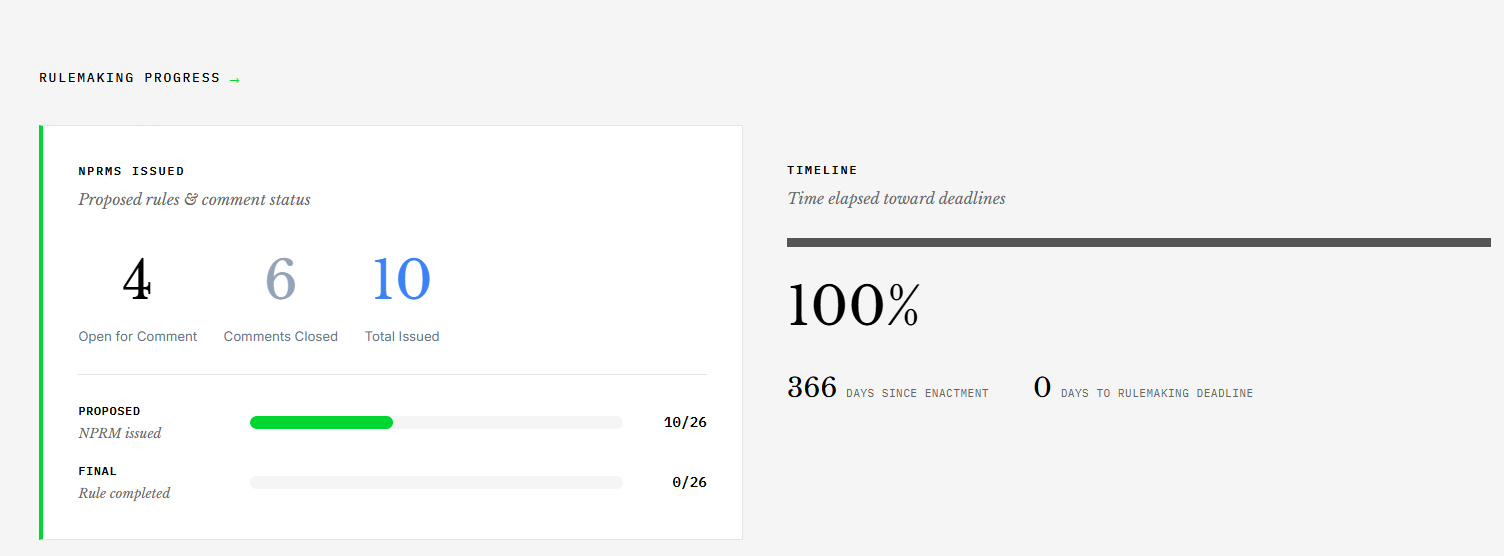
US regulatory agencies missed the rulemaking deadline under the Guiding and Establishing National Innovation for US Stablecoins (GENIUS) Act on Saturday, which marked one year since the law was signed.
Several US regulatory agencies published proposed rules and collected public feedback during the past year, but no final regulations were issued before the deadline.
These agencies include the Department of the Treasury, the Office of the Comptroller of the Currency (OCC), the Federal Deposit Insurance Corporation (FDIC) and the Federal Reserve Board, which issued proposed rules but no final rules, according to rulemaking trackers by law firm Chapman and crypto investment company Paradigm.
Missing the statutory deadline does not invalidate the GENIUS Act, but the unfinished rules may result in regulatory uncertainty for stablecoin issuers.
The GENIUS Act established the first comprehensive federal regulatory framework for stablecoins in the US. The act was signed into law by US President Donald Trump on July 18, 2025.
Related: ABA, state banking groups push back on CLARITY Act stablecoin yield provisions
Regulators issued 10 rule proposals during the GENIUS Act’s first year
Federal regulators issued 10 notices of proposed rulemaking (NPRM) in the year since the GENIUS Act was signed into law, according to Paradigm.
The Treasury Department issued four proposals covering the broader implementation of the act, including standards for determining whether state stablecoin regulatory regimes are similar to the federal framework, registration requirements for foreign stablecoin issuers and guidelines for compliance with anti-money laundering measures.
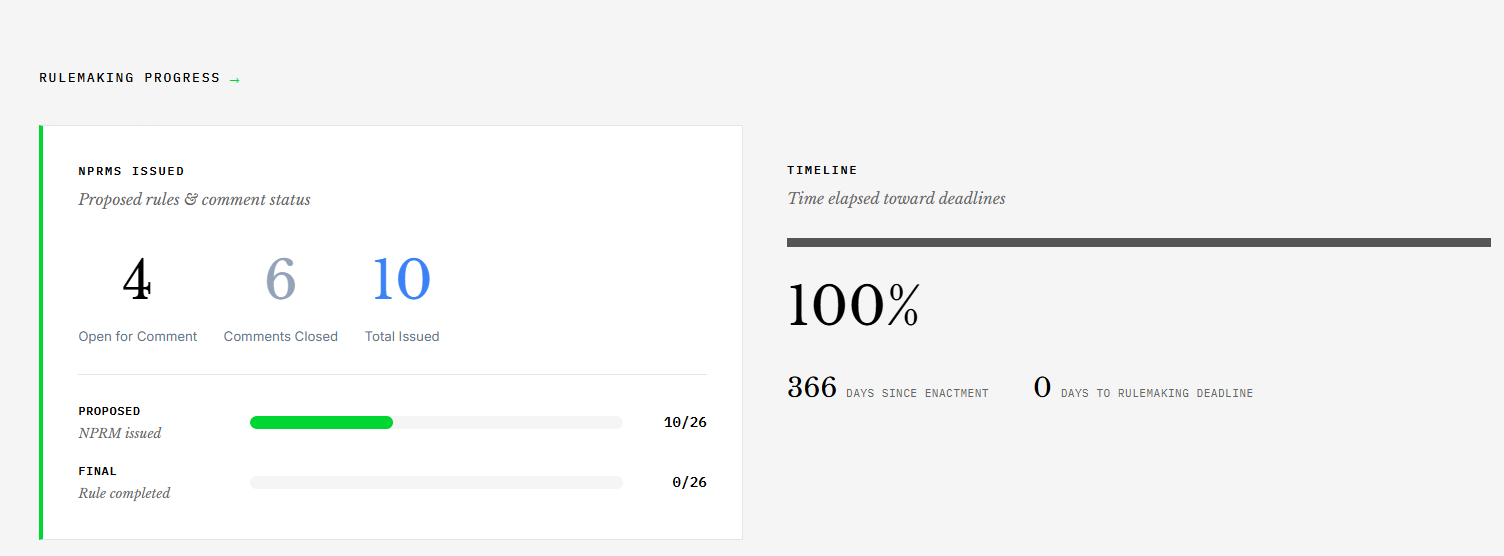
Rulemaking progress after the GENIUS Act was signed into law. Source: Paradigm.
The OCC issued two NPRMs covering nationally chartered payment stablecoin issuers, approval requirements and supervisory standards.
The FDIC issued one NPRM on FDIC-supervised institutions that issue payment stablecoins, focused on supervisory expectations and operational standards such as reserve management.
The National Credit Union Administration (NCUA) proposed rules enabling federally insured credit unions to participate in stablecoin issuance.
Finally, federal banking agencies jointly proposed an interagency implementation rule to harmonize supervision across the OCC, Federal Reserve and FDIC, aiming to ensure consistent supervisory expectations across all federal regulators.
Anchorage urges lawmakers to pass CLARITY Act
Federally chartered crypto bank Anchorage Digital has urged lawmakers to pass the Digital Asset Market Clarity Act (CLARITY).
“On GENIUS’ one-year anniversary, we’re renewing our call for Congress to pass the CLARITY Act and extend the clear market-structure rules that worked for stablecoins to the broader digital asset economy,” Anchorage Digital wrote in a Friday report.
The CLARITY Act seeks to establish the first federal regulatory framework for digital assets in the US. It cleared the Senate Banking Committee in May, though banking industry groups argued that it would allow crypto firms to offer yields on stablecoins without facing the same requirements as traditional banks.
On July 13, state banking associations, including the American Bankers Association (ABA) and the Independent Community Bankers of America (ICBA), sent a joint letter urging Senate leaders to provide more detail on the CLARITY Act’s stablecoin yield provisions and argued that new amendments need to prevent payment stablecoins from acting as deposit substitutes rather than pure transaction tools.
On June 26, Galaxy Digital cut its odds of the CLARITY Act becoming law in 2026 to 50%, citing the lack of a unified Senate Banking-Agriculture text, no firm floor schedule and a narrowing legislative window before lawmakers leave Washington.
Magazine: Gambling on random Pokémon cards: Onchain gagcha hits record high as crypto sinks


Ethereum’s price has joined the overall market rally on Tuesday, climbing above $1,900 for the second time in the past week. Naturally, analysts have rushed to offer their insight on why they believe the token will keep surging to new local (and all-time) highs.
Meanwhile, the former CEO of BitMEX has doubled down on his recent bullish behavior toward Ethereum with a fresh purchase.
Hayes Buys Again
Data shared by Lookonchain showed earlier today that wallets linked to the famous crypto personality spent over $2.5 million to acquire 1,332.5 ETH. This is Hayes’ second multi-million-dollar Ethereum accumulation made in the past week. As reported on July 16, he bought 1,293 ETH for the same amount when the asset’s price traded above $1,900 for the first time in months.
Interestingly, that purchase came shortly after he had sold over $10 million worth of the largest altcoin at prices of just under $1,700. As such, he continues to acquire more ETH tokens when the asset rallies, but tends to dispose of them once it corrects.
Arthur Hayes(@CryptoHayes) bought another 1,332.5 $ETH($2.53M) 3 hours ago.https://t.co/gau6egd7Vmhttps://t.co/iKDlaSftbq pic.twitter.com/YKgXPCVe2Z
— Lookonchain (@lookonchain) July 20, 2026
Separately, Lookonchain added that Ethereum whales have gone on a substantial accumulation spree as well. This one purchased roughly $13.5 million worth of the asset. Another one spent $20 million to buy 10,501 ETH, and this one withdrew 12,800 ETH from Binance.
Major ETH Price Calls
As mentioned above, the second-largest cryptocurrency has jumped past $1,900, and analysts were quick to point out its potential. KALEO believes ETH will rise toward $2,300 within the next month, but it might dump even harder in September toward new multi-year lows of $1,200.
Crypto Patel noted that ETH is “trading where long-term wealth is often built.” The analyst pointed out the $1,200-$1,800 range as the accumulation zone, and outlined some massive targets between $10,000 and $20,000 for ETH during the next bull cycle.
Merlijn The Trader outlined a similar development from 2017 that drove the asset toward new highs at the time. He added that those who had given up on ETH are “about to learn why the last holders won in 2017.” His analysis focuses mostly on ETH’s movements against BTC, noting that a surge past 0.029 would solidify the setup, but a dump below 0.026 would invalidate it.
EVERYONE WHO GAVE UP ON ETHEREUM THIS CYCLE IS ABOUT TO LEARN WHY THE LAST HOLDERS WON IN 2017.
2015–2018: accumulation, then a multi-year falling wedge. The breakout went vertical to 0.14.
2018–2025: the same two phases, stretched over 8 years. Accumulation bowl. Then the… pic.twitter.com/BSi769Y0jl
— Merlijn The Trader (@MerlijnTrader) July 20, 2026
The post Arthur Hayes Buys More ETH as Analysts Eye $2.3K and Beyond appeared first on CryptoPotato.


US spot Bitcoin ETFs recorded $227 million in inflows as BTC climbed above $65,000, extending their longest winning streak since early May.

A chart analyst is warning that XRP’s recent bounce may be giving traders false confidence and has argued that the token is still in a long-term downtrend despite recovering from its recent lows.
His view challenges a growing group of traders calling for a breakout, with the next few weeks likely to determine whether the world’s sixth-largest cryptocurrency can build a stronger base or slip below $1.
Weekly Chart Still Points to Resistance
In a series of posts on X, XRP watcher ChartNerd said that traders should continue respecting the asset’s long-term trend rather than assuming a small recovery has changed the market structure.
He pointed out that bears have been in control since a 20-week and 50-week exponential moving average (EMA) death cross formed in January 2026. Further, he argued that a relief in May that stalled at the 20-week EMA before XRP fell from about $1.35 to near $1.00 confirmed that the moving average is still acting as resistance.
According to him, even if XRP rallies toward $1.29 or as high as $1.60, people should treat those levels as heavy resistance unless the price can move above them convincingly. The analyst added that in case the Ripple token hits $1.60 in late July or early August, it would strengthen the case that the recent move near $1.00 marked a local bottom.
However, if the asset doesn’t reach the 20-week EMA around $1.29 or gets rejected there, then “the drop below $1 could come sooner than expected.”
ChartNerd also pushed back against claims circulating on social media that XRP has already broken out of its downtrend dating back to July 2025. Responding to a bullish post from pseudonymous analyst Bird, who suggested that an explosive candle was due at any moment, he wrote that XRP was still inside its wedge pattern and below descending resistance.
He was equally dismissive of traders celebrating the asset’s latest move up and sarcastically questioned whether such a modest rise meant that XRP was now heading “vertical to $100 before EOY.” In another post, the market watcher argued that many of the accounts calling for a breakout today had made almost the same predictions when the token was trading around $2.40 in January, before the price eventually dropped to $1.00.
Mixed Signals Continue for XRP
XRP was trading at around $1.13 at the time of writing, up nearly 4% in the last 24 hours. It has also gained almost 6% over the past week but is still about 2% lower than where it was a month ago.
According to data from CoinGecko, the coin’s latest trading range has been between $1.08 and $1.14, showing that the price has yet to break decisively in either direction.
ChartNerd believes the charts are telling a simple story, which is that until XRP breaks above resistance levels that have contained the market for months, any rally should be looked at with caution rather than treated as confirmation that the downtrend has ended.
Still, there are quite a few beating the bullish drum, including EGRAG CRYPTO, who recently claimed that the asset could eventually move toward a $1 trillion market cap if historical patterns repeat. However, such a move would need much stronger market conditions and far greater investor demand than exists currently.
The post Relief Rally or Bull Trap? Why This Analyst Says XRP Is Heading Below $1 appeared first on CryptoPotato.


Anton Bukov, who co-founded decentralized exchange aggregator 1inch and, by his own account, led its protocol architecture and security, said the company fired him in late November and that he is now building a new infrastructure startup called Second Tier. 1inch disputes that he was fired. Bukov… Read the full story at The Defiant


Key takeaways
- Shiba Inu (SHIB) trades above $0.0000042 after breaking above a key descending trendline.
- Five consecutive days of exchange outflows suggest investors are moving SHIB into private wallets, reducing selling pressure.
- Derivatives data remains bullish, with positive funding rates and a long-to-short ratio favoring buyers.
Shiba Inu (SHIB) extended its recovery on Tuesday, trading above $0.0000042 after breaking above a long-standing descending trendline. Improving on-chain activity and strengthening derivatives data suggest bullish momentum is building, potentially setting the stage for further upside.
Exchange outflows point to reduced selling pressure
On-chain data from CryptoQuant indicates investors have been steadily moving SHIB off centralized exchanges, a trend often viewed as a positive signal for prices.
The platform’s exchange netflow data recorded five consecutive days of net outflows beginning on July 17, showing that more SHIB tokens are leaving exchanges than being deposited.
This pattern typically suggests investors are transferring tokens into private wallets for longer-term holding rather than preparing to sell, reducing immediate selling pressure in the market.
The continued decline in exchange balances could support SHIB’s ongoing recovery if buying demand remains steady.
Market positioning in the derivatives sector also points to improving confidence among traders.
According to CoinGlass, SHIB’s long-to-short ratio stood at 1.02 on Tuesday, indicating a slight preference for long positions over shorts and reflecting growing optimism that prices could continue moving higher.
Sentiment is further supported by funding rates. SHIB’s perpetual futures funding rate turned positive on July 17 and remained in bullish territory at 0.0103% on Tuesday.
Positive funding rates indicate that traders holding long positions are paying those with short positions, a sign that bullish bets currently outweigh bearish ones.
The combination of positive funding rates and a favorable long-to-short ratio suggests traders are increasingly positioning for additional gains.
Shiba Inu price outlook: Bulls target higher resistance
From a technical perspective, SHIB has improved its near-term outlook after breaking above a descending trendline that had capped price action since mid-May.
The breakout places the meme coin in a stronger position to extend its recovery if buying momentum continues.
The next major resistance lies around $0.0000045. A decisive close above this level could pave the way for a move toward the 50-day Exponential Moving Average (EMA), which is also positioned near $0.0000045.
Momentum indicators have also turned more constructive. The Relative Strength Index (RSI) has climbed to 54 and is moving towards the 60 level, signaling that bearish momentum is fading.

Meanwhile, the Moving Average Convergence Divergence (MACD) has produced a bullish crossover, with expanding green histogram bars reinforcing the improving technical outlook.
However, if the current recovery loses momentum and sellers regain control, SHIB could retreat toward its yearly low near $0.0000040, where buyers may attempt to defend the broader uptrend.
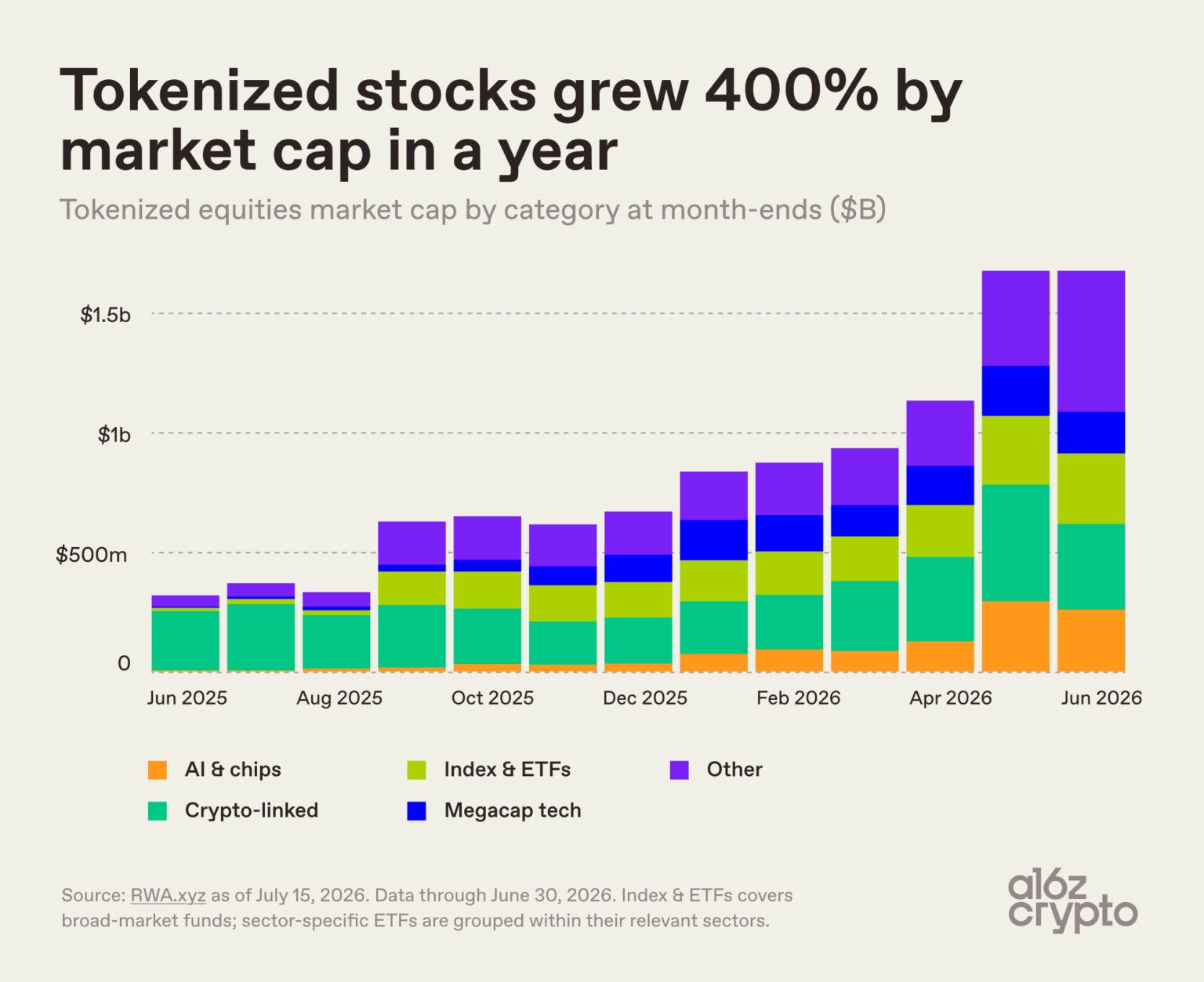
Tokenized stocks are no longer mostly a crypto trade. The crypto sector once dominated, but they now hold a shrinking share as artificial intelligence (AI) and chip stocks grow fastest.
The shift shows tokenization maturing beyond its origins. The market has now broadened to include semiconductor and memory makers tied to the AI boom.
Tokenized Stocks Market Grew 5x in a Year
Tokenized stocks reached $1.7 billion in market value by the end of June. That figure stood at just $329 million a year earlier, according to a16zcrypto data. The category has grown roughly fivefold over the past 12 months.
“This makes tokenized stocks one of the fastest-growing categories of tokenized assets,” the firm said.
Most of that growth came from new issuance, not price gains. More than half of the market sits in assets that were not on-chain a year ago. Real demand, therefore, is driving the expansion.
Follow us on X to get the latest news as it happens

The composition has also changed sharply. Crypto-linked products fell from 79% of market cap to 21%. Traditional equities absorbed the difference.
“They have lost the top spot to the “other” category — a long tail of hundreds of smaller listings — that now makes up 35% of the market, up from 15% a year earlier,” a16zcrypto noted.
Micron and SanDisk Top the Chip Tokens
The report highlighted that AI and chip stocks were the fastest-growing segment. They climbed from 0.3% of the tokenized stock market to 15.5% in one year.

Across major issuers, tokenized Micron’s (MU) combined market cap is about $120 million, and tokenized SanDisk’s (SNDK) is about $102 million. Both exceed the tokenized Nvidia (NVDA), with a combined market cap near $85 million, according to CoinGecko data.
The lineup leans toward memory and storage over compute. That pattern suggests traders want exposure across the AI hardware stack, not just the GPU makers.
The data marks a clear break from tokenization’s crypto-native roots. Whether traditional equities continue to gain share may hinge on continued issuance.
Subscribe to our YouTube channel to watch leaders and journalists provide expert insights
The post Tokenized Crypto Stocks Fell to 21% Share as Chip Names Climbed appeared first on BeInCrypto.
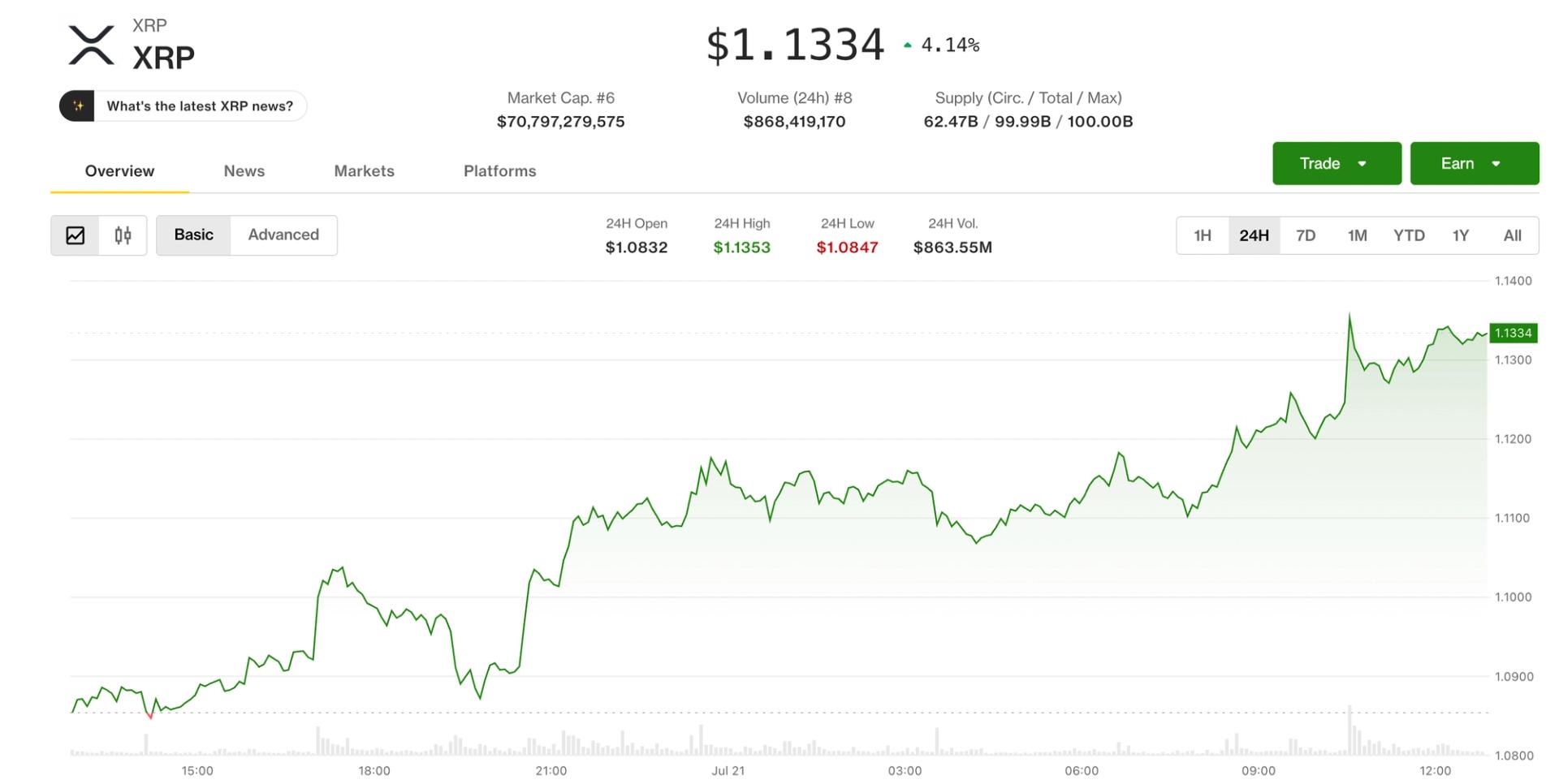
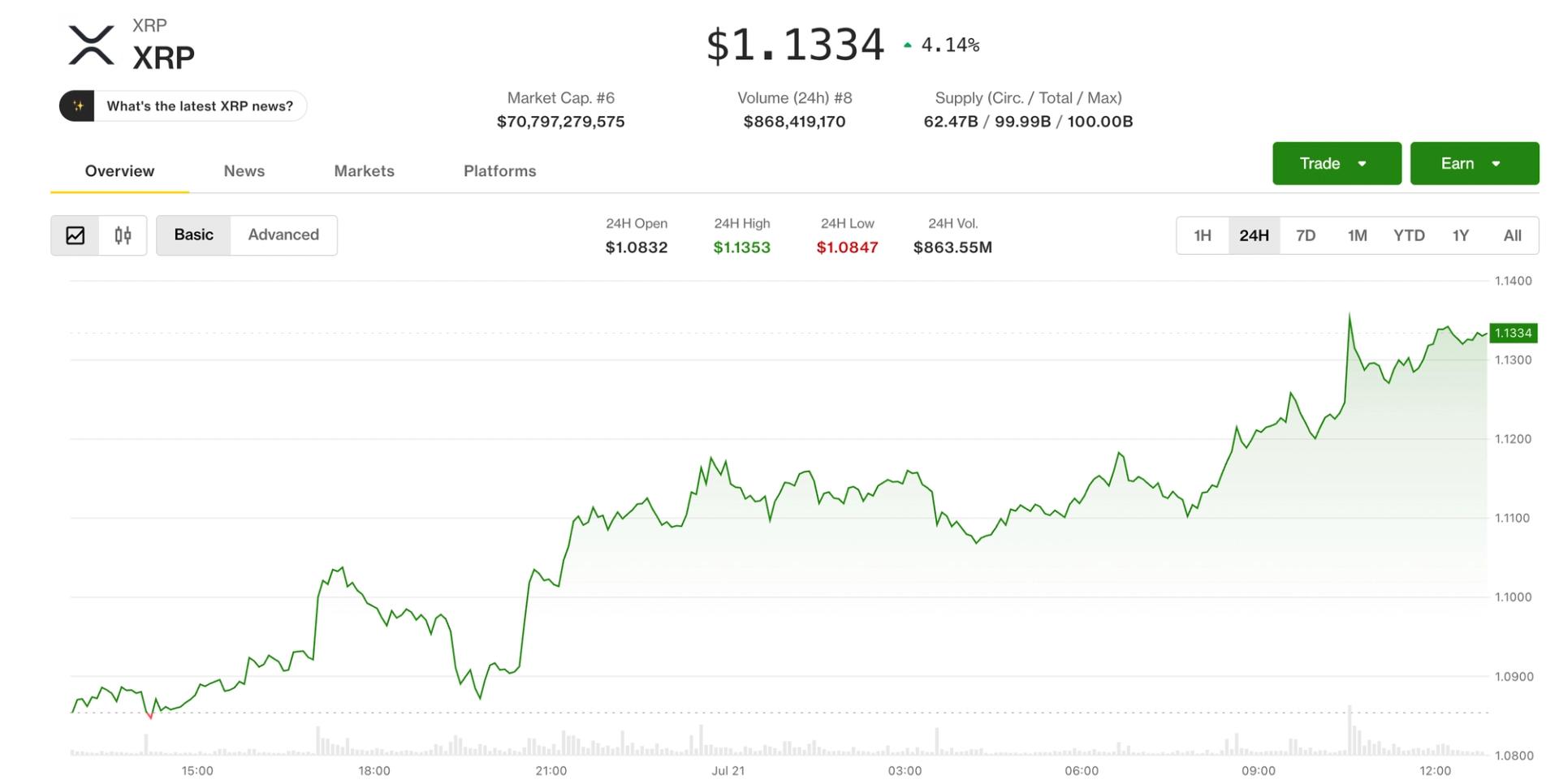
• Volume increased during the breakout attempt, with CoinGecko showing 24-hour trading volume of about $1.27 billion.
• XRP held above the $1.08-$1.10 area through the session, keeping the short-term recovery structure intact.
Technical Analysis
• The key short-term level is $1.13. A sustained break above it would confirm the triangle breakout watched by traders and bring $1.35 into focus.
• The hourly structure has tightened into a symmetrical triangle, with price compressing between lower highs and higher lows before the latest push higher.
• The daily chart remains more cautious. XRP is still trading inside a descending channel, with the 100-day and 200-day moving averages above price and sloping lower.
• The $1.24-$1.28 area remains the bigger resistance zone because it lines up with the channel’s upper boundary and major moving averages.
• Support remains strongest around $1.02-$1.06, where buyers have repeatedly stepped in over recent weeks.
What traders should watch
• $1.13 is the immediate breakout level. Holding above it would strengthen the short-term bullish setup.
• $1.14 is the next nearby level after marking the top of the latest 24-hour range.
• $1.24-$1.28 is the major resistance zone that XRP needs to clear before the daily chart turns meaningfully stronger.
• $1.02-$1.06 remains the key demand zone. Losing it would expose $0.88-$0.92.


The Coinbase-backed Ethereum layer-2 is preparing to expand its financial offerings as it pivots away from its earlier social-first strategy.


U.S. Senator Bernie Sanders has renewed his criticism of the crypto industry, placing digital asset groups alongside other well-funded political interests during a campaign event supporting Minnesota Lieutenant Governor Peggy Flanagan’s Senate bid.
Summary
- Bernie Sanders pledged to challenge crypto while campaigning for Minnesota Senate candidate Peggy Flanagan publicly.
- Crypto-backed PACs have become major election spenders as lawmakers debate new digital asset regulation nationwide.
- Fairshake and allied groups continue deploying industry funds across closely watched congressional races in 2026.
In a July 21 post on X, Sanders wrote, “Together, we are going to take on crypto, the AI industry, AIPAC and other billionaire super PACs.” He added that the campaign aimed to send Flanagan to the U.S. Senate. The comments focused on political spending and industry influence rather than cryptocurrency prices or blockchain technology.
Meanwhile, Sanders made the remarks while campaigning with Flanagan in Minneapolis. His statement grouped crypto with industries and political organizations that he says can use large financial resources to shape elections. He did not name a specific crypto company or political action committee in the post.
The timing comes as crypto-backed political groups spend heavily ahead of the 2026 midterm elections. As previously reported, Public Citizen estimated that the crypto industry had contributed about $189 million during the current election cycle by late June. Ripple- and Coinbase-backed groups, including Fairshake, have remained among the largest sources of industry political funding.
The spending has moved beyond national lobbying campaigns and into individual congressional races. Crypto.news reported in June that Fairshake-linked groups had deployed more than $8 million ahead of several closely watched primaries in Maryland, New York and Utah.
Fairshake and its affiliated groups have generally backed candidates viewed as supportive of clearer digital asset rules. Major industry companies, including Ripple, Coinbase and Andreessen Horowitz, have provided funding to the broader network over recent election cycles.
Crypto PACs become a larger force in the 2026 elections
The industry’s political spending has already appeared in several election results. In Maryland, as crypto.news reported, Adrian Boafo won a Democratic primary after receiving support from crypto-linked political groups. Fairshake affiliates also spent in other Democratic contests where digital asset policy formed part of the wider campaign debate.
The same network has also backed Republican candidates. In Alabama, a Fairshake-linked PAC spent more than $12 million supporting Barry Moore during his Senate primary and runoff campaign, according to related coverage. The activity shows that the groups have directed funding across party lines rather than limiting their spending to one political party.
Sanders’ latest remarks place him on the other side of that spending campaign. His criticism centers on the role of large political donors and corporate interests in elections. The July 20 statement did not call for a crypto ban or identify a new legislative proposal targeting digital assets.
Instead, Sanders framed crypto as one of several well-funded interests that Flanagan and her supporters would oppose. That distinction matters because his post focused on political influence rather than announcing a new position on individual cryptocurrencies, exchanges or blockchain networks.
Sanders has maintained pressure on crypto policy
The statement follows other recent moves by Sanders involving digital asset policy. In June, he joined Senator Elizabeth Warren and Representative Bobby Scott in asking the U.S. Labor Department to withdraw a proposal that could expand access to crypto and other alternative assets inside 401(k) retirement plans.
Moreover, the lawmakers argued that retirement savers could face volatility and weaker investor protections if plan providers added digital assets without enough safeguards. The Labor Department’s proposal would not require employers to offer crypto, but it would allow plan managers to consider alternative investments under existing fiduciary duties.
Sanders has also remained part of a wider group of lawmakers raising concerns about crypto regulation, investor protection and potential conflicts involving public officials. Those debates continue as Congress considers market structure rules and other legislation that could define how the U.S. treats digital asset companies.
At the same time, industry-backed political organizations have increased spending as those policy debates move through Congress. Previous crypto.news coverage found that Fairshake affiliates had spent about $7 million on selected Democratic primary races while lawmakers continued negotiating the CLARITY Act.
Minnesota race brings crypto politics onto the campaign stage
Sanders’ support for Flanagan now brings that national fight over political money into Minnesota’s Senate race. His July 20 message did not provide details about what “take on crypto” would mean in legislative terms, leaving the phrase tied mainly to the campaign’s broader criticism of wealthy industries and super PAC spending.
Crypto-funded groups have not remained on the sidelines in 2026. Their spending has already reached congressional primaries, Senate races and wider efforts to support candidates who favor industry-backed regulatory policies. Critics such as Sanders continue to frame that activity as part of a broader fight over large donors and political influence.
The debate is likely to remain active as the U.S. moves closer to the midterm elections and Congress continues work on digital asset legislation. Fairshake and allied groups still have substantial resources available, while lawmakers who oppose parts of the crypto industry’s policy agenda are making campaign finance a larger part of their response.
Crypto World
Coinbase's Jesse Pollak Hands Base App to Cobie, Says Social Bet Was 'Definitively Wrong'


Jesse Pollak, the Coinbase executive who created Base, handed the consumer Base app back to Coinbase and named crypto investor Jordan Fish, known as Cobie, to lead it, while admitting that his two-year bet on onchain social products and creator coins was a mistake. Pollak said in a post on X on… Read the full story at The Defiant

Robbie Williams Addresses Bizarre World Cup Microphone Viral Moment

Edward Green Linked With Vacant Godswill Akpabio United Coaching Job

Andy Burnham Plans Business Rate Cuts For Hospitality Sector


-
 NewsBeat5 days ago
London Mayor Sadiq Khan handed a peerage by Keir Starmer alongside 15 other Labour figures… just days before the PM leaves No10
-

 Fashion4 days ago
Weekend Open Thread – Corporette.com
-

 Politics3 days ago
The House | The City of London can help the new chancellor deliver growth in every postcode
-

 Politics6 days ago
Young campaigners urge incoming PM to act on outdoor junk food ads
-

 Crypto World5 days ago
CFTC blocks Kalshi from unwinding Michigan trades after court order
-
 Crypto World4 days ago
Two July Windows Left: The CLARITY Act’s Senate Fight and What Failure Means
-

 Crypto World3 days ago
Ripple Payments Joins MiCA With 14 Firms, Does It Mean Anything For XRP?
-

 Business5 days ago
Nvidia Stock Slips After Big Tuesday Rally as Huang Confirms Vera Rubin Chip Is Now in Production Today
-

 Politics2 days ago
Democrats look to World Cup watch parties to register thousands of voters
-
 Entertainment6 days ago
Disney’s Most Ambitious Failed Star Wars Attraction Is Coming to SDCC
-

 Crypto World3 days ago
Ripple wins EU-wide access as ESMA adds it to MiCA register
-

 Crypto World4 days ago
Injective Submits SEC Transfer-Agent Registration to Onchain Ownership Records
-

 Business5 days ago
Palantir Shares Rise After Expanded Nvidia Partnership and Fresh Analyst Upgrades Ahead of Earnings Day
-

 Tech8 hours ago
Sail Virtually Aboard The “Itanic” With IA-64 Emulator
-
 Tech5 hours ago
Turtle Beach Command Series KB7 review: a nifty screen-equipped gaming keyboard
-

 Tech6 days ago
Dark Secrets Emerge When Jailbreaking LLMs
-

 News Videos7 days ago
XRP BOMBSHELL… XRP OMBOARDED FOR TRANSACTIONS!!!
-

 NewsBeat4 days ago
Registration is now open for March for Men with Kev 2026
-

 NewsBeat21 hours ago
Unregistered fitter used Gas Safe logo on business flyers
-
 Sports5 days ago
New Cornerback Enters Vikings Trade Rumor Mill
You must be logged in to post a comment Login