
Crypto World
US Bitcoin reserve bill passes House Committee



US lawmakers took a step on Wednesday to put US President Donald Trump’s executive order to establish a strategic Bitcoin reserve into law.
The American Reserve Modernization Act of 2026 (H.R. 8957) passed the US House Committee on Financial Services in a 28-21 vote. The bill would establish a Strategic Bitcoin Reserve and a separate Digital Asset Stockpile within the Department of the Treasury for federally held Bitcoin and other digital assets acquired through criminal or civil forfeiture.
“We cannot allow Bitcoin to be held by the federal government to languish in fragmented and inconsistent custody,” said US Representative Nicholas Begich, who introduced the bill on May 21. “It poses unacceptable cybersecurity risks and fails to give an adequate accounting of what the federal government actually owns.”
The move brings Washington closer to making Bitcoin a lasting part of the federal government’s reserves.
Related: CLARITY Act vote meets Fed rate hike: Five things to know in Bitcoin this week
The US government is estimated to hold 324,527 Bitcoin, worth $24.7 billion at the time of writing, according to Arkham Intelligence.
Under ARMA, Bitcoin in the federal government’s reserve would have to be held for a minimum of 20 years.
The legislation requires all federal agencies to provide a full accounting of digital assets currently held or controlled by the federal government and establishes transparency measures, including quarterly “proof of reserve” reports and third-party audits.
It would also direct a study of budget-neutral acquisition strategies for expanding the Strategic Bitcoin Reserve and allow states to store their Bitcoin in the Federal Reserve.
The bill also affirms private ownership and self-custody rights of Bitcoin, describing the control of private keys as “fundamental to the principles of financial sovereignty, privacy, and personal liberty in the digital age.”
Bitcoin Policy Institute executive director Connor Brown on Wednesday called it a “genuinely historic step for Bitcoin policy.”
In May, Strive CEO Matt Cole called it “the single most important crypto legislation that can come out of DC.”
The committee’s approval clears a hurdle for the legislation, but it still needs to pass the full House and Senate before reaching the president’s desk.
Magazine: Revolut ID thefts highlight KYC’s dangers: Here’s how to fix it

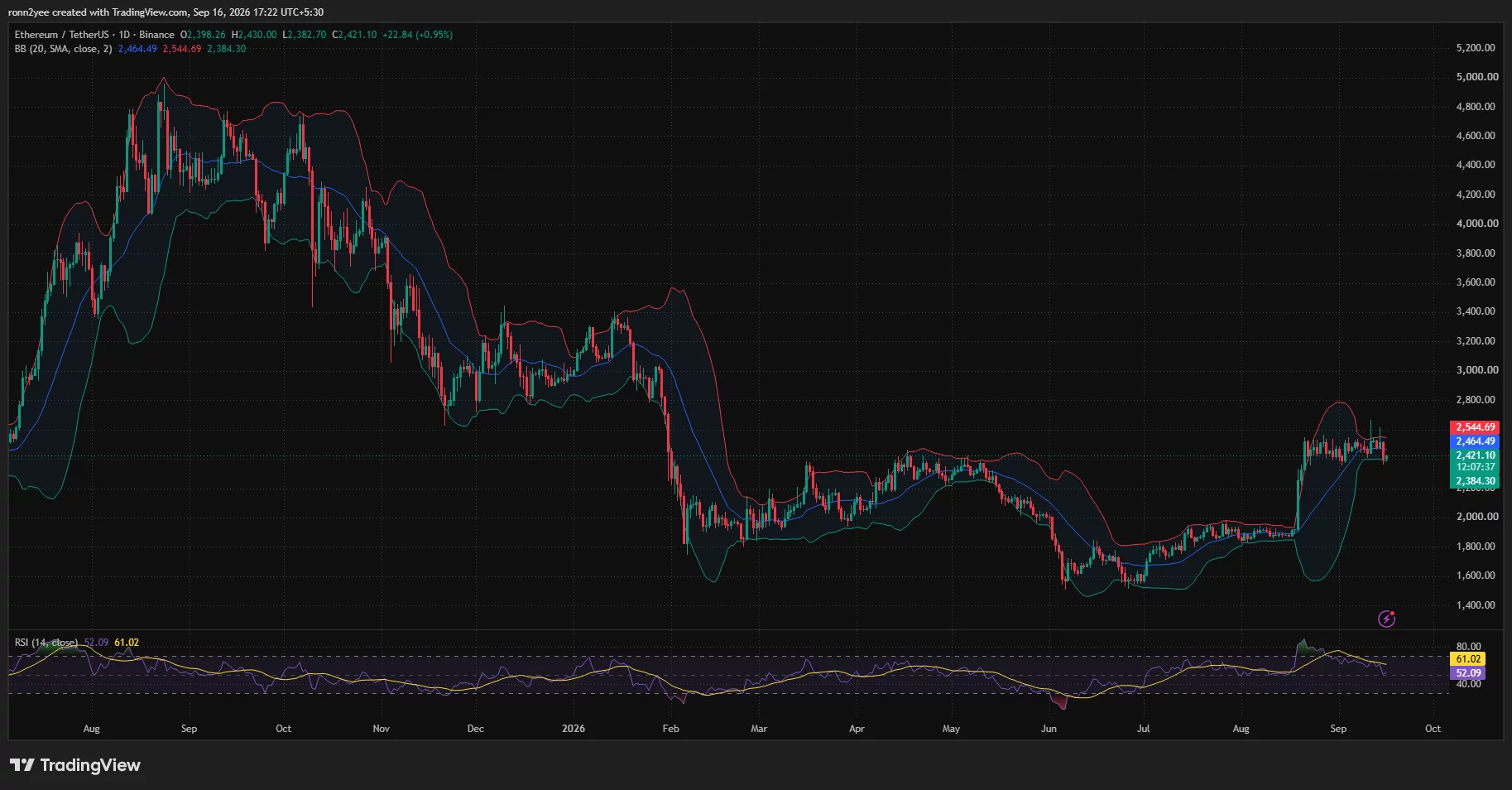
Ethereum price rebounded toward $2,420 after a sharp sell-off, but weak capital flows and resistance near $2,465 leave ETH exposed to another correction.
Summary
- Ethereum price fell below $2,400 before recovering to about $2,421 during Tuesday’s session.
- The daily RSI dropped to 52.09 as momentum weakened from its recent overbought reading.
- 4-hour Supertrend resistance stands at $2,526, while Chaikin Money Flow remains negative.
- Analysts see downside toward $2,143 or lower if ETH loses its weekly support.
Ethereum price action today
Ethereum (ETH) price was trading near $2,421 on Sep. 16 after recovering from an intraday low of $2,382.70, according to Binance data shown on TradingView. ETH opened the current daily candle at $2,398.26 and rose about 0.95%, partially reversing the previous decline.
The rebound followed a broader sell-off that briefly pulled ETH below the $2,400 psychological level. Market pressure intensified after the Digital Asset Market CLARITY Act failed to advance in the U.S. Senate.
The bill’s cloture motion reportedly failed in a 49-50 vote, short of the 60 votes needed to proceed. Its defeat weakened expectations that Congress would soon establish clearer divisions between the Securities and Exchange Commission and the Commodity Futures Trading Commission.
Ethereum was particularly vulnerable because the pullback followed several failed attempts to remain above the $2,500 area. The token recently traded as high as roughly $2,660 before sellers pushed it back toward its current range.
Derivatives added to the pressure. Ethereum accounted for about $250 million in liquidations during the broader market decline, as the loss of $2,450 forced leveraged long positions to close.
Technical indicators point to fading momentum
Ethereum’s daily chart shows that the recovery remains below the Bollinger Bands’ middle line at $2,464.49. That level now forms the first technical barrier above the market.
The upper Bollinger Band sits at $2,544.69, placing the broader resistance zone between approximately $2,465 and $2,545. A daily close above that range would strengthen the case that the correction has ended.
ETH is also holding just above the lower Bollinger Band at $2,384.30. Buyers defended that level during Tuesday’s decline, with the session low reaching $2,382.70 before price recovered.
The daily relative strength index stands at 52.09. Although the reading remains above the neutral 50 mark, it has fallen below its moving average of 61.02 after retreating from overbought territory. The decline shows that bullish momentum has faded since ETH’s late-August rally.
Conditions look weaker on the 4-hour chart. Ethereum trades below Supertrend resistance at $2,526.61, while the indicator’s former support near $2,441.90 has been lost. ETH would need to reclaim both levels to weaken the short-term bearish setup.
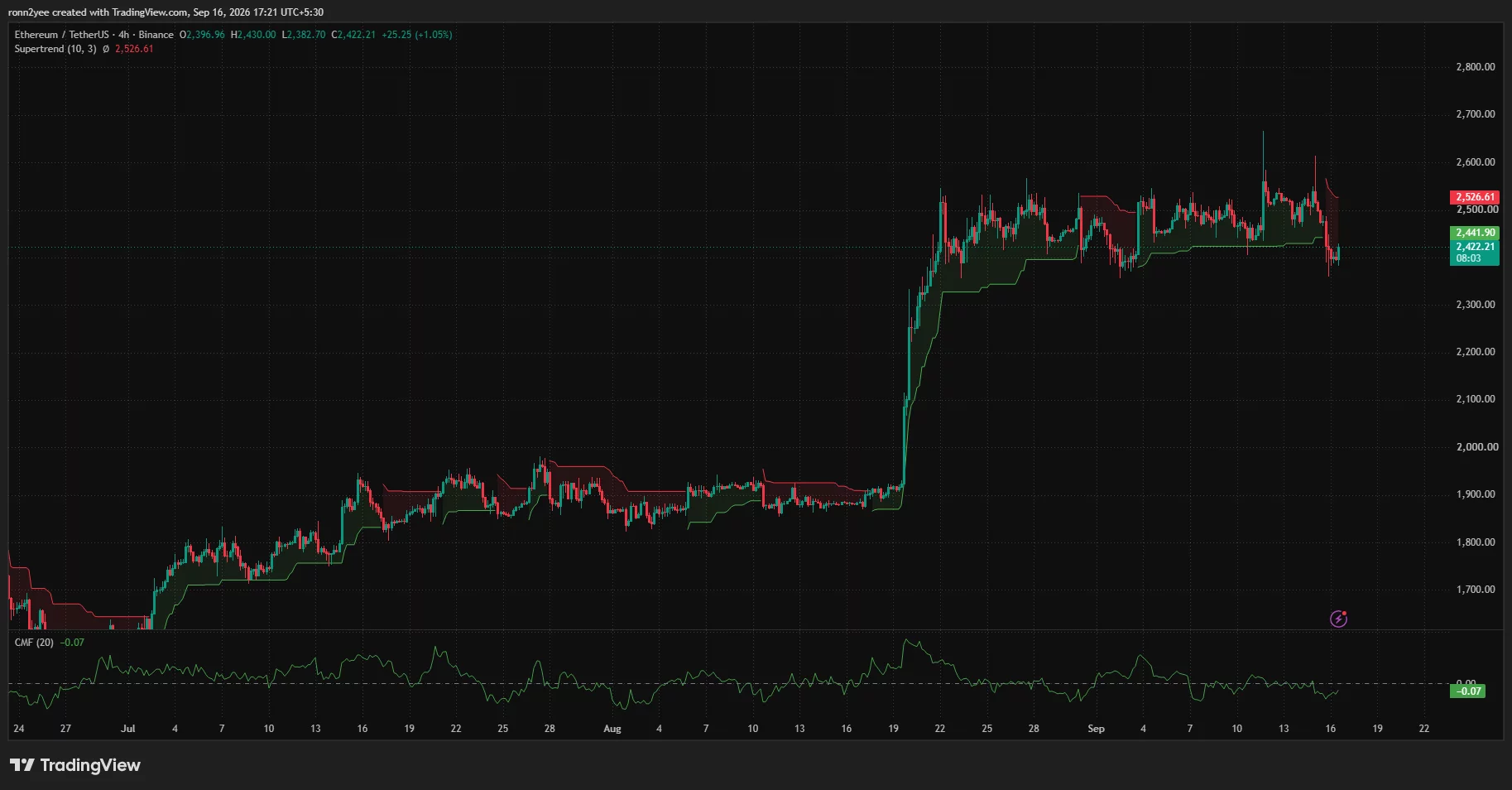
Chaikin Money Flow stands at minus 0.07 on the same timeframe. The negative reading indicates that selling pressure is slightly stronger than buying pressure, limiting the conviction behind the latest rebound.
Ethereum must defend the $2,380 support zone
The immediate support area lies between $2,380 and $2,400. Both the daily lower Bollinger Band and Tuesday’s intraday low fall within this range, making it the first level buyers need to defend.
A sustained breakdown below $2,380 could expose the August breakout region near $2,300. The weekly chart shared by analyst Ted Pillows identifies another support zone around $2,230, with a lower level near $2,056 if selling accelerates.
The bullish path begins with a move back above the daily Bollinger midpoint at $2,464. ETH would then need to clear the psychological $2,500 level and 4-hour Supertrend resistance at $2,526.
Further gains could place the recent $2,550-$2,660 rejection zone back in focus. Acceptance above that supply area would invalidate much of the current bearish structure and open a possible move toward $2,800.
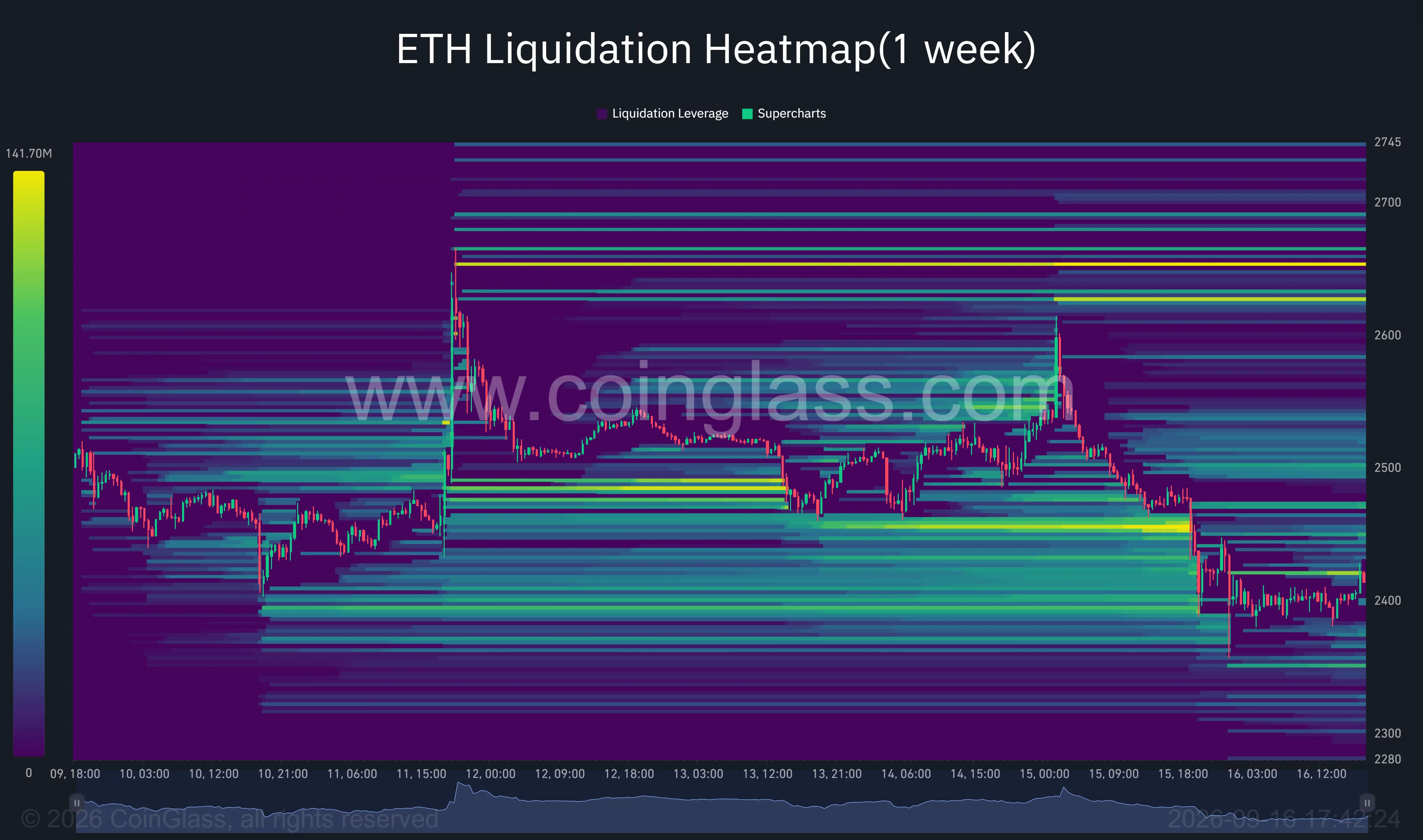
Ethereum’s one-week liquidation heatmap shows ETH trading near $2,420 after sweeping several leveraged positions during its drop from above $2,500. The closest liquidity is concentrated around $2,420-$2,450, while additional clusters appear near $2,500 and $2,625-$2,660. Below the market, liquidity is visible around $2,350-$2,400, leaving ETH vulnerable to further volatility if either side is breached.
Analysts warn of a deeper Ethereum correction
Crypto analyst Ted Pillows said ETH was testing its 50-week exponential moving average. He warned that a weekly close below the indicator could produce an 8% to 10% correction.
An 8% decline from approximately $2,420 would place Ethereum near $2,226, closely matching the first weekly support zone on his chart. A 10% pullback would take the token toward $2,178.
Crypto Patel offered a more bearish scenario after ETH was rejected from the $2,550-$2,660 resistance zone. The analyst identified $2,143, $2,000, and $1,870 as possible downside targets, with $1,800 as a deeper level to monitor.
Patel said the bearish scenario would remain active unless Ethereum reclaimed and held above $2,670. His longer-term outlook remains bullish, with targets between $10,000 and $15,000, although the forecast is speculative and depends on future market conditions.
US rate expectations and ETF outflows weigh on ETH
The CLARITY Act setback arrived as U.S. investors were already preparing for the Federal Reserve’s interest-rate decision. The probability of a 25-basis-point increase at about 80%, although the final decision will determine whether that expectation was justified.
Higher interest rates and Treasury yields can pressure crypto assets by increasing the return available from lower-risk instruments. Ethereum could therefore remain sensitive to changes in Fed expectations even if its technical support holds.
U.S. spot Ethereum exchange-traded funds also recorded approximately $141.5 million to $142.3 million in net outflows during the reported session. BlackRock’s ETHA accounted for about $98 million, while Bitwise’s ETHW recorded around $34.4 million in withdrawals.
Roughly 140,000 ETH, valued at about $350 million, was reportedly withdrawn from exchanges over recent days. Lower exchange balances may reduce immediately available selling supply, but the daily and 4-hour charts show that ETH must reclaim $2,465-$2,526 before buyers regain firm control.
Disclosure: This article does not represent investment advice. The content and materials featured on this page are for educational purposes only.

The landmark crypto legislation, the CLARITY Act, will face a crucial vote in the US Senate later today (September 15) and could trigger significant volatility across the digital asset sector.
The vote itself doesn’t mean that the bill will be enacted, but it could pave the way for formal discussion. However, Democrats don’t seem thrilled by the proposed framework and keep insisting on additional changes, significantly reducing the CLARITY Act’s chances of being signed into law before the end of the year. That said, some crypto traders have started preparing for the possible impact.
Brace for a Collapse?
X user Max Crypto revealed that an anonymous whale has opened a $47 million short position on Bitcoin (BTC), a $22 million short on Ethereum (ETH), and a $4 million short on Zcash (ZEC) ahead of the vote.
What’s interesting is that the market participant has made almost 2,300 trades so far and has a 100% win rate. Of course, such a successful streak has caused Max Crypto to wonder whether the whale is an “insider,” with many others sharing the same theory.
Numerous analysts expect the legislation to be rejected today and project a serious downfall for BTC in response. X user Midas thinks the primary cryptocurrency would “dump brutally” on such news, break below $70,000, and move toward new lows.
“Once $70K breaks, most of the remaining liquidity sits below $60K. That’s where the real fear should finally hit the market. And that’s exactly what we still need to form the 2026 macro bottom. I still expect one final capitulation before this cycle is over,” they added.
Before that, Midas argued that BTC trades inside a descending structure seen before and warned of an ultimate flashout to $50,000 “soon.” The analyst views $55K as the area where the bear market finally ends, and until then, “every aggressive bounce still looks like another trap.”
A Pump Instead?
Contrary to the prevailing pessimism, the analytics platform Lookonchain revealed another unknown market participant who moved in the opposite direction.
The whale closed their $58.4 million short position on BTC for a $266,000 profit, then flipped to a 40x long on 900 BTC. The major player has opened 914 trades so far and has a win rate of around 51.72%.
The post Preparing for a Post-CLARITY Crash? Whale Opens Massive BTC, ETH, and ZEC Shorts appeared first on CryptoPotato.


Treasury Secretary Scott Bessent opened the door to talks on artificial intelligence (AI) risks with China, saying Washington will raise shared dangers at economic meetings in New York this weekend.
Bessent attached one limit. Washington will not slow its own AI development, and it still treats the technology as a race it intends to win.
AI Risk Open in New York Before the Trump-Xi Summit
Bessent and United States Trade Representative (USTR) Jamieson Greer will meet Chinese Vice Premier He Lifeng for several hours, Axios reported.
The agenda covers AI, trade, and rare earths. The meetings land eight days before President Donald Trump hosts Xi Jinping in Washington on September 24.
“The United States remains the leader in AI, and we are open to discussions on avoiding shared risks and avoiding bifurcation of our two systems. We expect our discussions to cover both open and closed weight models,” read the report, citing Bessent.
Bifurcation means the two countries drifting into separate AI systems that no longer work together. Open-weight models are ones whose underlying settings are published for anyone to download and reuse.
Both Governments Have Rejected Industry Calls to Slow AI Down
Anthropic chief executive Dario Amodei published an essay on September 12 urging rivals to slow capability gains. Trump rejected an AI slowdown two days later, calling it a hoax.
China’s foreign ministry called the slowdown “fear-mongering.” It said all parties should promote open and inclusive AI development.
BeInCrypto flagged that split on September 13, when Xi called for a consensus-based global governance framework while Washington pushed speed. A congressional push to pause frontier work has stalled.
Axios reported that a major safety breakthrough remains a tall order and that Bessent’s role signals engagement rather than a deal. Neither government has said it will limit its own development. September 24 is the test.
The post US Opens Door to AI Risk Talks With China: Will Anything Change? appeared first on BeInCrypto.


Bitcoin Core 32.0 has entered its final release-candidate testing cycle after developers tagged v32.0rc1 on Sept. 14, bringing fee estimation, block-validation performance and security fixes closer to a planned Oct. 10 release.
Summary
- Bitcoin Core 32.0 entered release-candidate testing September 14, with final tagging targeted for October 10.
- New fee estimation combines block history with current mempool conditions and may recommend lower fees.
- Block validation now prefetches previous outputs across eight worker threads by default, reducing disk waits.
- A wallet notification flaw could let authenticated users execute commands on affected non-Windows node systems.
- Testing found sixteen unauthenticated REST connections could drive memory use to roughly three gigabytes quickly.
The Bitcoin Core project’s official GitHub release shows v32.0rc1 at commit d0231bb, signed with a verified maintainer signature on Sept. 14 at 12:58 UTC. The project’s release schedule still targets Oct. 10 for the final v32.0 tag, although the date remains subject to testing and further fixes.
Version 32 focuses on node software behavior, wallet interfaces, fee calculation, networking and performance. The draft release notes do not list a change to Bitcoin’s consensus rules, meaning the update does not redefine which transactions or blocks the network considers valid.
Bitcoin Core 32 targets Oct. 10 after RC1 tag
Developers entered feature freeze on Aug. 20, limiting work to fixes needed before release. On Sept. 14, they split the 32.x branch from the main development branch and started the release-candidate cycle while development work for version 33 resumed separately.
The first candidate is intended for node operators, wallet developers and other users to test before developers decide whether the code is ready for a stable release. Bitcoin Core opened a dedicated 32.0 release-candidate testing feedback issue on Sept. 15, one day after RC1 was tagged.
The project asks testers to use the testing guide for RC-specific checks and report software problems through separate GitHub issues. No final v32.0 binary has been released as of Sept. 16.
Bitcoin Core does not update automatically. Operators choose when to install new versions, meaning older releases can remain active after newer software becomes available.
That manual upgrade model has mattered in previous security disclosures. As crypto.news previously reported, Bitcoin Core disclosed CVE-2024-52911 in May after the vulnerable 28.x branch reached end of life. The bug had already been fixed in Bitcoin Core 29.0 before technical details became public.
New fee estimator blends mempool and block history
One of Bitcoin Core 32’s more visible user-facing changes affects estimatesmartfee, the RPC used by wallets and applications to calculate transaction fees.
Until now, Bitcoin Core’s main estimator has relied on observed confirmation behavior from transactions included in past blocks. Version 32 adds a separate estimator based on transactions currently waiting inside the node’s mempool.
The new mempool estimator produces both economical and conservative estimates from current pending transaction conditions. Bitcoin Core checks recent block activity before using it and can reject the estimate when the mempool appears too sparse or unhealthy.
When both systems produce valid results, estimatesmartfee returns the lower fee estimate. The new method therefore cannot push the existing block-policy recommendation higher through the combined default mode; its role is to lower the recommendation when current mempool conditions support doing so.
That design can respond more quickly after a period of expensive block space ends. A block-history estimator may continue incorporating recently confirmed high-fee transactions, while the mempool may already show fewer transactions competing for confirmation.
The software preserves a way for applications to use the previous method. An added fee_rate_estimator option lets users request block_policy, mempool_policy or the combined default behavior. Bitcoin Core stores the new mempool estimator’s statistics in a separate data file so they can be reloaded after restart.
Wallet fee calculations will use the combined default estimator. The response can identify which estimator produced the selected fee, while higher verbosity levels expose mempool-health statistics for applications that need more detail.
Block validation gets parallel disk prefetching
Bitcoin Core 32 changes how nodes retrieve transaction data while connecting blocks, particularly when the needed information must be read from storage.
The software can now prefetch previous transaction outputs, known as prevouts, from the chainstate database across several worker threads while block validation continues. The default is eight prefetch threads, with operators able to raise the setting to 16 or disable parallel fetching by setting it to zero.
Prevouts identify the coins being spent by transaction inputs. Nodes need that information to check whether inputs exist, have not already been spent and satisfy the applicable validation rules.
The improvement is intended to cut time spent waiting for disk reads when a node processes blocks containing inputs not already available in faster memory caches. The effect will vary with storage hardware, cache behavior and node configuration.
Bitcoin Core 32 exposes the setting through -prevoutfetchthreads=
Separate RPC changes give operators more information during AssumeUTXO background validation. After a snapshot-based node reaches the chain tip, getblockchaininfo can now report the progress of the historical chain validation still running behind the active node state.
Security fixes close wallet and HTTP memory flaws
Bitcoin Core 32 fixes a wallet notification flaw affecting non-Windows systems under a narrow set of conditions.
The draft notes state that an authenticated RPC user with permission to create wallets could craft a wallet name containing special replacement characters when the node was configured with -walletnotify. Under those conditions, the name could cause arbitrary commands to execute with the privileges of the Bitcoin Core process.
Version 32 changes wallet-notification placeholder replacement so wallet names are treated as literal text. The release tightens wallet naming as well by rejecting certain relative-path names containing . or .. path elements.
A second issue emerged during review of Bitcoin Core’s rewritten HTTP server, which is replacing libevent in version 32.
Developer Matthew Zipkin submitted pull request #36123 after an audit using Moonshot AI’s Kimi K3 model identified a memory-exhaustion path. While the server handled one request, it could continue reading and queuing data sent by the same connection without an effective size limit.
The first analysis suggested the condition mainly required an authenticated client capable of keeping a request busy. Further testing found that REST traffic created a similar problem without authentication.
A reviewer reported that 16 unauthenticated REST connections pushed one test process from 46 MB of memory to roughly 3 GB in around one minute. After the revised fix, the same test increased memory use by roughly 3 MB over 90 seconds, compared with 3.2 GB before the patch.
The patch was merged Sept. 5, before v32.0rc1 was tagged. Because the rewritten HTTP server is new to version 32, the specific flaw was caught before the server appeared in a stable Bitcoin Core release.
The use of Kimi K3 fits a recent pattern of AI-assisted security review across Bitcoin software. As crypto.news reported in August, Bitcoin Red Team had logged 7,958 potential findings after scanning hundreds of Bitcoin-related open-source projects, though many required human verification before they could be treated as confirmed vulnerabilities.
Resource-exhaustion problems have appeared in other Bitcoin software this year. In related coverage, crypto.news reported that Core Lightning confirmed security flaws after reviewing AI-generated reports and warned operators to upgrade or temporarily use offline mode.
PSBT version 2 becomes the default for four RPCs
Bitcoin Core 32 changes the default format created by four commands used with Partially Signed Bitcoin Transactions.
createpsbt, walletcreatepsbt, converttopsbt and psbtbumpfee will produce PSBT version 2 by default. Developers added an optional psbt_version argument so applications can explicitly request another supported version when necessary.
PSBTs let several wallets, applications or hardware signing devices exchange transaction information before the completed Bitcoin transaction is broadcast. Moving the default to version 2 may require testing by software that assumes Core’s RPC output will use the older format.
The update does not remove the ability to request the previous version. Applications built around the affected RPC commands can set the format explicitly while they test version 2 compatibility.
Wallet tooling receives other changes in the same release. A new exportwatchonlywallet RPC creates a descriptor-wallet file containing public descriptors, transaction history and address-book data without private keys. Bitcoin Core’s offline-signing tutorial now uses that command for creating an online watch-only wallet.
Another new command, derivehdkey, lets a wallet derive an extended public or private key through a path containing at least one hardened step, while addhdkey lets a BIP32 extended key be added without immediately using it to generate output scripts.
PrivateBroadcast receives continued maintenance as well. Crypto.news reported in June that Bitcoin Core 31.1rc1 fixed a network condition that could expose an originating IP address when PrivateBroadcast was used. Version 32 contains further PrivateBroadcast RPC and transaction-relay changes documented in its draft release notes.
The current Bitcoin Core schedule still lists Oct. 10 as the target for tagging v32.0. The RC testing feedback thread opened Sept. 15 remains active, with developers directing testers who find actual Bitcoin Core defects to file separate issues before the final release.

The US Senate failed to advance the Digital Asset Market CLARITY Act on Tuesday, falling short of the 60 votes needed to send the bill toward a final vote.
Ripple CEO Brad Garlinghouse says the setback stings, but it won’t change what his company is doing.
Garlinghouse Calls the Vote a Missed Opportunity
Writing on X shortly after the vote, Garlinghouse said his team and most of the industry gave everything they had trying to get the CLARITY Act across the finish line, calling the fight an opportunity that went beyond Ripple alone.
He argued that consumers and American competitiveness in digital finance were the ones who lost out, and said a review of what went wrong is coming. In his view, Democratic politics got prioritized over good policy.
Still, he did not frame the failed vote as the end of US crypto policy efforts. Garlinghouse expects the SEC and CFTC to continue rulemaking to fill the gap left by Congress. Ripple, he added, will remain involved in that process.
“Ripple’s business has never been stronger,” he wrote, pointing to demand across traditional finance and digital assets. A missed vote in Washington, he argued, does not change the company’s “momentum, our global footprint, or our customers.”
The firm’s Chief Legal Officer, Stuart Alderoty, followed with his own post. “Ripple and XRP stand on settled ground,” he said, pointing to the 2023 federal court ruling that found XRP is not a security, along with a joint interpretation the SEC and CFTC issued in March naming XRP a digital commodity. He also said he expects both agencies to keep setting clearer rules going forward.
Reaction across the industry was split. CryptoLaw called it a shift, not an end, agreeing with the view that the fight for crypto rules will now move to the SEC and CFTC. However, analyst ChartNerd was more cautious, noting that agency rulemaking beats uncertainty but isn’t a substitute for actual legislation, since rules can be reversed.
What the CLARITY Act Would Have Done
Tuesday’s vote wasn’t meant to pass the CLARITY Act outright. It was a procedural step meant to move the bill closer to a final vote, and its failure means debate on the legislation will continue rather than end.
The bill sets out to divide oversight of digital assets between the CFTC and SEC and introduces the idea of “ancillary assets,” network tokens whose value may depend on the efforts of a company while still being treated as commodities and carrying their own disclosure rules.
It also targets decentralized finance platforms that look decentralized on paper but are still run by identifiable people, requiring CFTC registration for their spot trading activity.
Exchanges, brokers, and dealers, the companies most Americans actually use to buy and sell crypto, would face a new federal registration and oversight regime too.
The post Ripple CEO Breaks Silence After CLARITY Act Vote Fails: XRP’s Legal Footing Unchanged appeared first on CryptoPotato.
OpenAI has been named the winner of Justin Sun’s inaugural $1 million mathematics prize, yet the company has left the money sitting unclaimed, just as it did with an identical prize from the Clay Mathematics Institute weeks earlier.
The prize was to reward an AI-authored proof of the Navier-Stokes equations, a fluid dynamics problem mathematicians spent decades trying to crack. Two academics say the work drew on their own unpublished research, a claim OpenAI disputes.
Why OpenAI Keeps Walking Away From the Money
OpenAI published its proof of the three-dimensional Navier-Stokes problem on September 8, saying 10,000 of its AI agents worked the problem for 88 hours before a separate model, GPT-6 Astra, spent another 17 hours checking the logic.
The Clay Mathematics Institute set the problem in 2000 as one of seven Millennium Prize Problems, each carrying a $1 million reward, and still lists it as active on its website.
OpenAI said at the time that it would not claim the Clay money. It became a bigger story once questions arose over whose work actually produced the proof.
Two mathematicians said their unpublished research had sat inside an OpenAI product, a claim the company denied.
“I do not know what their model did, or how. I do not know whether our data was used. I am not accusing anyone of anything,” said Tristan Buckmaster, professor at New York University.
Second Prize, a Second Snub
Eight days after the dispute broke out, Justin Sun’s office announced its own answer to the same problem. They created the Justin Sun Prize, a bounty system built around machine-checkable proofs rather than traditional peer review.
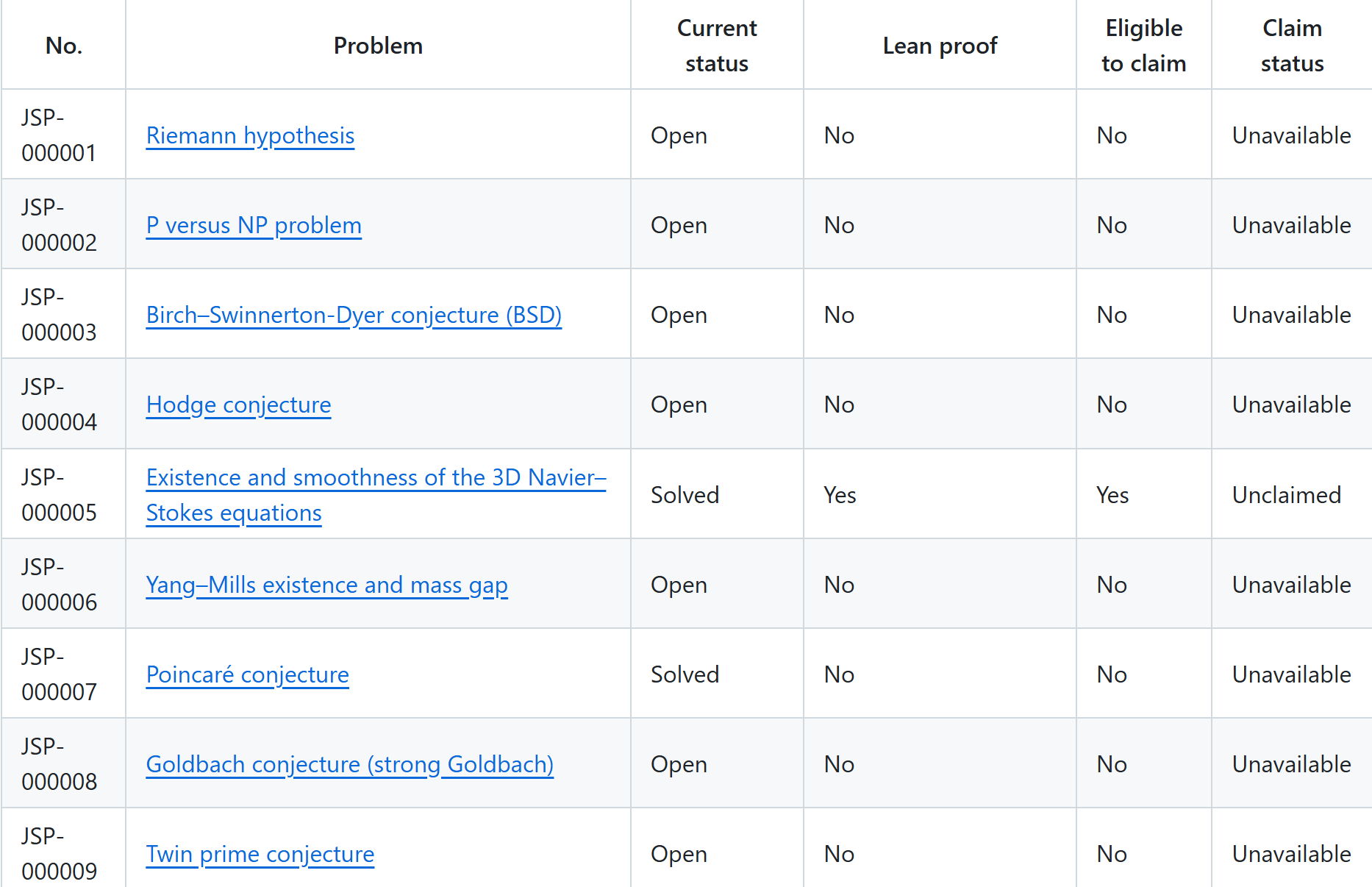
Every entry on Sun’s list can pay out twice. Once for the person who proves a result and again for whoever formalizes it as code. Sun’s team named the OpenAI research team the winner of the prize’s first $1 million top award for the Navier-Stokes proof.
Navier-Stokes is the fifth entry. It is marked solved, credited to the OpenAI team, eligible to claim, but remains unclaimed.

Under Sun’s rules, a problem already solved before it joins the list pays the person who translates it for the machine, not the person who proved it.
“I care only about the result, not whether the contributor is human or a machine,” Justin Sun said.
Sun’s own list carries a warning beside that entry. It says the OpenAI announcement is not peer review, and that acceptance by mathematicians has not been confirmed.
The post OpenAI Rejects Another Math Prize, This Time Justin Sun's $1 Million appeared first on BeInCrypto.
U.S. lawmakers moved closer to formalizing President Donald Trump’s plan for a government-held Bitcoin program after the American Reserve Modernization Act of 2026 cleared the House Committee on Financial Services.
The bill, H.R. 8957, passed the committee on Wednesday in a 28–21 vote and would create a “Strategic Bitcoin Reserve” alongside a separate “Digital Asset Stockpile” at the Department of the Treasury. These reserves would cover federally held Bitcoin and other digital assets acquired through criminal or civil forfeiture.
Key takeaways
- The American Reserve Modernization Act of 2026 (H.R. 8957) advanced after a 28–21 vote in the House Financial Services Committee.
- It would set up Treasury-managed structures for forfeited Bitcoin and other digital assets, including a Strategic Bitcoin Reserve.
- Bitcoin held under the reserve would be required to remain in federal custody for at least 20 years.
- The bill includes mandatory accounting and transparency steps, such as quarterly “proof of reserve” reporting and third-party audits.
- While it formalizes federal custody, the text also emphasizes private ownership and self-custody rights for Bitcoin.
What H.R. 8957 would change for federal Bitcoin custody
H.R. 8957 aims to convert the concept of a strategic federal Bitcoin reserve into law. According to the bill’s framework described in coverage, the Strategic Bitcoin Reserve and Digital Asset Stockpile would sit within the U.S. Treasury and would apply to digital assets the government already holds or acquires through forfeiture proceedings.
Supporters argue that current federal storage practices are too fragmented to satisfy modern security and accountability standards. Representative Nicholas Begich, who introduced the legislation on May 21, said the federal government cannot allow Bitcoin to sit in inconsistent custody arrangements. He also argued that the approach creates cybersecurity risks and does not provide adequate accounting of what the government actually owns.
Accounting, transparency, and the “proof of reserve” requirement
A central feature of ARMA is accountability. The legislation would require federal agencies to deliver a complete accounting of digital assets they currently hold or control. It also sets out transparency measures intended to make federal crypto holdings easier to verify.
Under the bill, quarterly “proof of reserve” reports and third-party audits would be required. For investors and market participants, the significance is straightforward: clearer documentation around government-held supply can reduce uncertainty, support more reliable on-chain and off-chain reconciliation, and improve confidence in claims about who controls what.
The bill would also support a study into budget-neutral acquisition strategies for expanding the Strategic Bitcoin Reserve, a detail that matters because it frames future additions as an exercise in managing costs rather than an open-ended authorization.
How long Bitcoin would be held—and what remains under federal control
Another notable provision would require Bitcoin in the federal reserve to be held for a minimum of 20 years. That long time horizon suggests the legislation is designed less for short-term policy flexibility and more for creating a durable, long-lived component of federal reserves.
The bill would further direct that states be allowed to store their Bitcoin in the Federal Reserve, extending the idea of institutional custody beyond the federal government alone.
At the same time, the legislation includes language that preserves private participation in Bitcoin. It affirms private ownership and the right to self-custody, describing control of private keys as “fundamental to the principles of financial sovereignty, privacy, and personal liberty in the digital age.” That emphasis may be intended to assuage concerns that government custody could translate into broader restrictions on individual holding or managing Bitcoin.
Why the committee vote matters, and what comes next
Committee approval is a procedural milestone, not the end of the legislative process. After passing the House Committee on Financial Services, H.R. 8957 still must clear the full House and the Senate before it can reach the president’s desk.
The bill’s progress also arrives as observers continue to track how much Bitcoin the U.S. government holds. According to Arkham Intelligence, the U.S. government is estimated to hold 324,527 Bitcoin, valued at $24.7 billion at the time of writing. While estimates like this can evolve with new data, they underline why a clearer policy framework around government-held Bitcoin is likely to draw broad attention from both policymakers and market participants.
Policy advocates have already characterized the effort as historically significant for Bitcoin governance. Bitcoin Policy Institute executive director Connor Brown called the development a “genuinely historic step for Bitcoin policy” on X. Similarly, Strive CEO Matt Cole described it as potentially the single most important crypto legislation that could emerge from Washington, also posting on X.
Looking ahead: the details that could determine real-world impact
For now, the decisive next phase is whether lawmakers can move ARMA through both chambers, where amendments are likely and the exact implementation of quarterly “proof of reserve” reporting and custody rules could become a focal point. Investors and builders should watch for how the final bill defines custody, audits, and the mechanics of “budget-neutral” expansion—because those specifics will shape how credible, verifiable, and operationally workable the Strategic Bitcoin Reserve becomes.


Disclosure: This content is provided by a third party. Neither crypto.news nor the author of this article endorses any product mentioned on this page. Users should conduct their own research before taking any action related to the company.
Most people searching for a no-kyc crypto exchange alternative are not looking for less compliance, they are looking for less exposure. Less counterparty risk. Less reliance on a custodian that could be hacked, frozen, or insolvent when they need their funds.
Vymopay is a non-custodial digital asset platform built entirely inside Telegram. “Non-custodial” means users hold their own private keys, no third party controls or can freeze their assets. The platform covers wallet management, privacy, exchange, loans, staking, AML screening, and payment infrastructure, all from the Telegram bot @Vymopay_bot, with no separate app to install.
This is a full breakdown of what each feature does and who it is built for.
The wallet: up to 500 addresses per asset
The base layer is a multi-currency, non-custodial wallet. Users hold their own keys and manage balances directly from the bot. That part is standard. What is less standard is the address ceiling: up to 500 dedicated wallet addresses per supported cryptocurrency.
For an individual holder, that ceiling is irrelevant. For a merchant or payment processor, it changes the operational picture entirely. A single shared receiving address requires manual reconciliation after every inbound payment. Five hundred dedicated addresses mean each customer or transaction type gets its own address, and attribution is automatic. The bookkeeping that would otherwise take hours is handled at the address layer.
This kind of address infrastructure is typically reserved for enterprise payment processors. Vymopay delivers it through a Telegram interface.
Shield Address: receive payments without revealing your wallet
Shield Address is the platform’s privacy feature, and the one most worth understanding carefully.
When a user withdraws from a centralized exchange (CEX) to a personal wallet, the exchange logs that destination address. That address is now permanently linked to the user’s exchange identity, every future transaction from it is traceable back to the exchange account. For users who want to keep their self-custody wallet separate from their exchange identity, that link is a problem.
Shield Address works as follows:
- Vymopay generates a dedicated Shield Address for the user.
- The user shares that address with the sender, an exchange, a counterparty, a client, instead of their real wallet.
- Vymopay receives the inbound funds and runs automatic AML screening on the transaction.
- Funds are forwarded to the user’s actual destination wallet. The sender never sees the real address.
The AML step is mandatory, not optional. Funds that fail screening do not proceed. This is the design distinction between a privacy tool and an evasion tool: Shield Address is built to protect users from counterparty surveillance, not to circumvent regulatory oversight. Privacy and compliance coexist in the same flow.
Shield Address also supports asset conversion at the forwarding stage — meaning funds can arrive in one cryptocurrency and be automatically converted before reaching the destination wallet.
Auto conversion address: accept any currency, receive your preferred one
Merchants often prefer to hold a specific asset — usually a stablecoin — regardless of what customers pay in. Auto Conversion Address handles the swap automatically. Each dedicated conversion address converts incoming funds to the preferred asset at current market prices, with a notification on each conversion. The receiving workflow does not change; the asset in the wallet does.
Exchange: market and limit orders from the bot
Vymopay includes a built-in exchange accessible from the same interface. No separate account. No external platform.
Two order types are available:
Order type
When it executes
What happens next
Market
Immediately at current price
Confirmation required before execution
Limit
When asset reaches user-defined price
Instant notification on fill
Balances update in real time after each trade.
For users already managing wallets, payments, and addresses inside the bot, being able to trade without switching platforms removes a step that previously required logging into a separate exchange.
Crypto loans: access liquidity without selling
Crypto Loans lets users borrow stablecoin liquidity against their crypto holdings without triggering a sale. The collateral asset stays in the user’s control; the loan is disbursed and repaid through the bot.
The practical use case: a user holds an asset they expect to appreciate but needs short-term liquidity. Selling triggers a taxable disposal and closes the position. A collateral-backed loan provides the liquidity without either consequence. Loan setup and repayment tracking run within the same interface.
Earn and staking: passive returns from the same interface
Users can stake supported cryptocurrencies directly from the bot and earn passive returns. Active positions, accumulated rewards, and pending requests are visible from the same interface used for everything else, no separate DeFi dashboard required.
AML protection: on-demand risk reports
For users who need to assess the risk profile of a wallet or transaction before interacting with it, Vymopay provides on-demand AML checks. Enter any wallet address and the platform generates a numeric risk score, a counterparty analysis by entity type, and a downloadable PDF report.
Checks run at any time, not only at account onboarding, which matters for businesses documenting due diligence, traders screening counterparties, and individuals receiving funds from unfamiliar sources.
AML screening is also embedded in the Shield Address forwarding flow — every inbound payment is screened before reaching the destination wallet.
Freeze Alert: continuous wallet monitoring
Freeze Alert runs continuous blockchain monitoring on selected wallets and sends real-time notifications if a freeze event is detected on-chain. It also generates recurring AML reports automatically over the subscription period.
Plans cover 1, 2, or 5 wallets. For businesses or individuals managing high-value wallets, this replaces the need to run manual checks, monitoring runs continuously without user action.
SWIFT Check: track international wire transfers
SWIFT Check lets users track international SWIFT transfers in real time using the UETR (Unique End-to-End Transaction Reference) identifier. For businesses managing cross-border payments, it replaces the back-and-forth of querying status through a banking portal. The check runs directly from the bot.
Affiliate program: recurring rewards, not one-time bonuses
Every user gets a personal referral code. Referring someone earns rewards each time that person transacts, recurring, tied to usage, not a flat sign-up bonus. Earnings are tracked and redeemable from the bot.
Who this is actually for
The best no-kyc crypto exchange alternative is not a single product, it depends on what you are replacing. Vymopay is built for:
- Individual holders moving off custodial exchanges who want self-custody without learning new tools.
- Traders who need an on-chain exchange, limit orders, and AML screening in one place.
- Merchants and businesses managing crypto payments across multiple customers or suppliers, where dedicated addresses and auto-conversion matter.
- Payment providers and finance teams who need compliance documentation, AML reports, Freeze Alert, SWIFT tracking, built into the same workflow.
The Telegram distribution is the practical bet behind that positioning. Over 900 million people use Telegram monthly. For those who already manage business and financial communication through the app, a full-featured crypto platform built inside it removes the adoption friction that has kept most self-custody tools niche.
The platform is accessible at @Vymopay_bot. No download required.
Disclosure: This content is provided by a third party. Neither crypto.news nor the author of this article endorses any product mentioned on this page. Users should conduct their own research before taking any action related to the company.


Strategy Executive Chairman Michael Saylor has predicted that the CLARITY Act’s 49-50 Senate defeat could send more capital toward Bitcoin as U.S. regulators continue writing crypto rules under their existing powers.
Summary
- The CLARITY Act fell 11 votes short of the 60 needed to advance.
- Saylor expects regulators to proceed without waiting for another congressional vote.
- Banks could expand Bitcoin custody and Bitcoin-backed lending, according to Saylor.
- Coinbase and Bernstein also expect the SEC and CFTC to keep developing crypto rules.
Michael Saylor said in an X post that the Securities and Exchange Commission, Commodity Futures Trading Commission, and Treasury Department could move forward under existing law while the CLARITY Act remains stalled.
“With CLARITY stalled, I expect the SEC, CFTC, and Treasury to advance rules under existing law,” Saylor wrote. “But progress does not have to wait for Congress.”
His comments presented the failed vote as a possible opening for Bitcoin rather than a complete halt to U.S. crypto policy. According to Saylor, banks could add more Bitcoin custody services and offer additional loans backed by the asset, creating new channels for capital to enter the market.
Saylor also pointed to the GENIUS Act, which has already established a federal framework for payment stablecoins. While discussing the remaining policy gap, he added, “The only clarity you need is Bitcoin.”
Saylor expects Bitcoin services to expand without the bill
For American investors, Saylor’s forecast centers on services offered through regulated financial institutions. More bank custody options could give clients another way to hold Bitcoin, while Bitcoin-backed loans could let borrowers access cash without immediately selling their holdings.
Saylor did not provide a timeline or name any banks preparing such products. His comments described what he expects regulators and financial institutions to do after Congress failed to advance the market-structure bill.
The Strategy chairman has repeatedly treated Bitcoin differently from other digital assets because of its regulatory position and fixed supply. In September, crypto.news previously reported that Saylor defended Americans’ right to promote the cryptocurrency while the Senate prepared for the CLARITY Act vote.
During that earlier debate, Saylor argued that public officials and business leaders should be free to support Bitcoin. The comments came as Strategy resumed purchases of the asset, tying his policy position to the company’s long-running Bitcoin treasury plan.
Strategy’s exposure also gives U.S. stock investors an indirect route into Bitcoin. Shares of the Nasdaq-listed company often react to changes in the cryptocurrency’s price, the company’s purchases and its methods of raising capital to fund additional acquisitions.
CLARITY Act fails its 60-vote Senate test
The Senate voted 49-50 on the motion to invoke cloture and move the CLARITY Act toward debate. With 60 votes required, the proposal fell 11 votes short of the threshold.
Failure at the procedural stage prevented senators from moving to a full debate and potential amendments. It was not a final vote on whether to approve the legislation.
The bill sought to establish federal rules for issuing, trading and supervising digital assets. One of its main provisions would divide authority between the SEC and CFTC, giving the agencies clearer roles over securities and digital commodities.
A Sep. 4 analysis identified ethics rules, protections for decentralized finance developers and stablecoin rewards as major disputes before the vote. Lawmakers also disagreed over provisions connected to President Donald Trump’s crypto interests.
Under the proposal’s four-part mature blockchain test, a network meeting its decentralization requirements could qualify as a digital commodity. Assets that failed the test would remain subject to securities laws, registration rules and SEC oversight.
The measure had already passed the House by 294-134 in July 2025, with 78 Democrats supporting it. It later cleared the Senate Banking Committee by 15-9 in May 2026, but securing 60 votes on the Senate floor required support from both parties.
Although the cloture motion failed, the bill has not automatically disappeared from the Senate. Lawmakers could return it to the calendar and schedule another vote if supporters secure enough commitments.
Coinbase and Bernstein expect agency action
Coinbase CEO Brian Armstrong also said the vote should not stop U.S. regulators from developing clearer rules. While expressing disappointment with the result, he argued that the SEC and CFTC already possess tools that could be used under their present authority.
Armstrong said negotiations between Republicans and Democrats could continue, leaving open the possibility of another Senate vote. His comments did not establish when lawmakers might make a second attempt or what changes would be required to attract 60 votes.
Bernstein analysts offered a similar assessment in a note led by Gautam Chhugani. According to the firm, rulemaking by the SEC and CFTC could become “aggressive and swift” after months of congressional negotiations failed to produce a bill.
The analysts identified token classification, decentralized finance, self-custody and tokenized equities as areas where the agencies could act. Bernstein also expects regulators to address products tied to tokenized real-world assets, including perpetual futures based on such assets and individual stocks.
Agency rules would not have the same legal status as an act of Congress and could remain subject to court challenges or policy changes under future administrations. Armstrong and Bernstein, however, both expect regulators to continue using powers already granted by existing statutes.
Banking access remains central to Saylor’s forecast
Saylor’s prediction also depends on whether regulated banks choose to expand their digital-asset businesses. Custody requires banks to safeguard clients’ Bitcoin, while collateralized lending introduces credit, risk-management and repayment requirements.
For U.S. crypto companies, access to ordinary bank accounts and payment systems has long affected their ability to operate. A September review of U.S. banking access explained how Federal Reserve payment rails, master accounts and commercial banking relationships have shaped the services available to digital-asset firms.
The same review noted that 21 major banks, including Bank of America, Citi, Goldman Sachs, Deutsche Bank and UBS, had committed to a joint dollar stablecoin company targeting the first half of 2027. The planned venture would place traditional banks in direct competition with established issuers such as Circle and Tether.
Stablecoin regulation has progressed separately through the GENIUS Act. The law directs federal agencies to develop rules for payment stablecoin issuers, including requirements linked to licensing, reserves, and supervision.
Treasury proposed an implementing rule in April 2026, while the Office of the Comptroller of the Currency issued its own proposed GENIUS Act regulations in February. The OCC proposal covers payment stablecoin issuance and related activities carried out by institutions under the agency’s jurisdiction.
Industry executives have continued criticizing the CLARITY Act vote. Ripple CEO Brad Garlinghouse said politics had overtaken policy and called for a post-mortem on why the measure failed. He attributed the result to Democratic opposition, while negotiations had focused partly on demands for stronger ethics limits connected to Trump’s digital-asset interests.


Fundstrat’s Tom Lee says Wall Street overreacted to Wednesday’s rate decision. He’s calling the sharp stock selloff a buying opportunity, not a warning sign.
Cyclical stocks, financials, and energy names took the brunt of the selloff. Lee expects those same groups to lead any rebound.
Dow Jones Sheds 631 Points
The Dow Jones Industrial Average fell 631 points, or 1.2%, to close at 51,461 on Wednesday.
The S&P 500 slipped 0.5% to 7,551. The Nasdaq Composite held roughly flat at 25,978. Retail sales for August also topped forecasts, easing some recession worries.
The selloff followed a move Lee had flagged days earlier. It deepened once officials signaled more hikes ahead before year-end.
Financials and energy stocks led the decline as traders rotated out of rate-sensitive sectors. J.B. Hunt sank 13.3% after warning of a sharp earnings decline.
Lee Sees a Buying Opportunity
Lee cited Goldman Sachs research pointing to fading inflation pressures over the next two quarters. He argued that shift should let cyclicals, financials, and other rate-sensitive stocks rebound.
I would be buying this dip.
Tom Lee, head of research at Fundstrat, on CNBC
Lee named cyclicals, technology, consumer discretionary, and financials as the sectors best placed to lead.
A Contrarian Take
Dan Greenhaus, chief economist and strategist at Solus Alternative Asset Management, was less convinced. He didn’t think the Fed needed to hike at all. Still, Greenhaus agreed Wednesday’s market reaction looked overdone.
I didn’t think they should hike rates.
Dan Greenhaus, Solus Alternative Asset Management, on CNBC
Greenhaus pointed to weak spots outside the AI-driven data center boom. He said non-residential construction has dragged on GDP for roughly eight or nine quarters. Higher rates, he added, will only add more pressure there.
Greenhaus also cautioned that much of Wednesday’s sharp swing was likely algorithm-driven.
Whether Lee’s call pays off may hinge on how fast that disinflation trend shows up.
The post Tom Lee Says Buy This Dip as Dow Jones Drops 631 Points appeared first on BeInCrypto.

Ethereum price recovery hinges on $2,526 breakout

The NFL’s Three Most Tortured Fanbases During Week 1

Apple’s latest iOS 27.2 trick could keep you out of the doghouse



-

 Fashion5 days ago
Weekend Open Thread – Corporette.com
-

 Tech4 days ago
The Latest Weird Thing to Play Doom Is the Mapped-Out Brain of a Fruit Fly
-

 Business6 days ago
10 Most-Streamed Songs On Spotify In 2026 So Far, Led By Ella Langley’s Dominant Run On The Charts This Year
-

 Crypto World6 days ago
XAG/USD: Silver’s Short-Term Rally Meets Its Moment of Truth
-

 Crypto World7 days ago
2 Chip Stocks Broke Out This Week. Neither Was Nvidia
-

 Tech6 days ago
Battery life is the only iPhone 18 Pro and iPhone Duo upgrade I care about. Apple didn’t disappoint
-

 Crypto World6 days ago
OKX launches 10x OpenAI, Anthropic X-Perps in Europe
-

 Crypto World6 days ago
Diesel Tops $6 a Gallon for the First Time as 28 States Set Records
-

 News Videos6 days ago
Facing Financial Fears
-

 Business7 days ago
Western Digital Slips 2.7% as AI Storage Rally Cools After Record Cash and Guidance
-

 Crypto World3 days ago
Elon Musk Drops a Bombshell: Grok 5 Could Be the AGI Breakthrough
-

 Business4 days ago
Rivals Sam Altman and Elon Musk Rally Behind Dario Amodei’s Call for a Slowdown in AI Development
-

 Business7 days ago
Five Leading AI Experts Warn Superintelligence Could Kill Humans and Explain Their Case
-
Crypto World6 days ago
Ethereum Price Analysis: Consolidation at $2.5K Tests Momentum as On-Chain Activity Surges
-

 Crypto World7 days ago
Ant International joins Visa, Mastercard to build AI agent payment standards
-
 NewsBeat2 days ago
‘Sick conspiracy’: Trump says only guardrails AI needs is ‘a strong and smart (High IQ!) president’ in all-caps rant
-

 Crypto World5 days ago
Can AI Build a Startup in 72 Hours? Elon Musk's Team Will Livestream the Test
-

 Entertainment5 days ago
News Specials, Movies, Shows, More
-

 Crypto World6 days ago
US CPI forecast at 3.4% as tariff risks build
-

 Crypto World6 days ago
Bitcoin ETFs Pull $167M as 2026’s Best Inflow Run Slows
You must be logged in to post a comment Login