
Crypto World
US Labor Data Beat Sends Bitcoin Lower Amid Fed Rate Uncertainty

Key points:
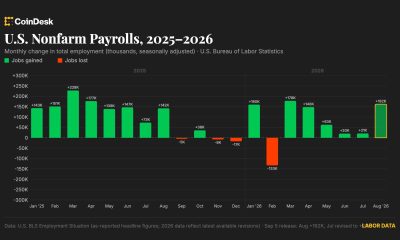
- The US economy added 162,000 nonfarm payroll jobs in August, nearly triple economists’ consensus estimate of 56,000.
- Bitcoin sold off from $81,300 to local lows of $78,600 following the data, before recovering to $79,500.
- A rival Bitcoin fork using the Blake2b algorithm saw its first trading activity, with coins changing hands at $350 on exchange Neoxa.
Labor market beats expectations threefold
According to data released on Friday, the US economy added 162,000 nonfarm payroll jobs in August, significantly outperforming economists’ consensus expectations of roughly 56,000 jobs. In response to the announcement, Bitcoin (BTC) sold off from $81,300 to local lows of $78,600. At the time of writing it stands at $79,500.
Recent economic data carries added weight, given how divided rate outlooks remain ahead of the next Federal Open Market Committee (FOMC) meeting on Sept. 15-16. Under previous Federal Reserve chairs, expectations ahead of the FOMC were mostly well-anchored. However, the lack of forward guidance from Chair Kevin Warsh, along with potential dissenters in the committee, has resulted in added uncertainty.
After Fed Governor Christopher Waller said on Thursday that he would favor a rate pause pending upcoming inflation data, Polymarket probabilities swung to 60% in favor of a pause and 40% for a 25 basis-point interest rate hike. Friday’s labor market data however, drove the implied probabilities back to a 50/50 split.
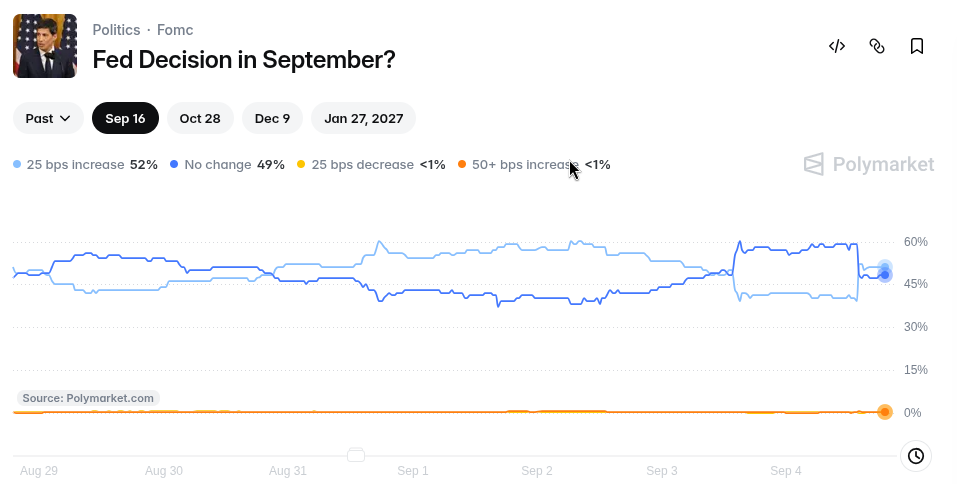
Implied Probabilities for the Sep. 16 FOMC rate decision. Source: Polymarket
In response to the strong labor market data, US President Donald Trump leveled new rate-cut demands. “The Fed Board, with its great new leader, must get smart – BE PATRIOTS for a change,” he stated in a Truth Social post and continued: “High interest rates put the U.S.A. at a very unfair disadvantage, and I won’t allow that to happen!”
Trump had frequently criticized former Chair Jerome Powell for not cutting rates, but had held back from making similar statements toward Warsh until Friday.
Blake2b version of Bitcoin attracts first liquidity
When the BIP-110 soft fork activated on Aug. 7, the Bitcoin network briefly split into two competing chains: one enforcing BIP-110’s new rules and another continuing under the existing rules. The BIP-110 side largely stalled because miners did not devote enough computing power to extending that chain.
BIP-110 supporters viewed miners’ refusal to follow the user-activated soft fork (UASF) as evidence that Bitcoin’s mining layer has become too centralized. That criticism was sharpened by the absence of an organized counter-effort from the Bitcoin Core side, such as a user-rejected soft fork (URSF). Only five mining pools control the vast majority of Bitcoin’s hashrate, concentrating significant influence over which chain is extended and which transactions are included in blocks.
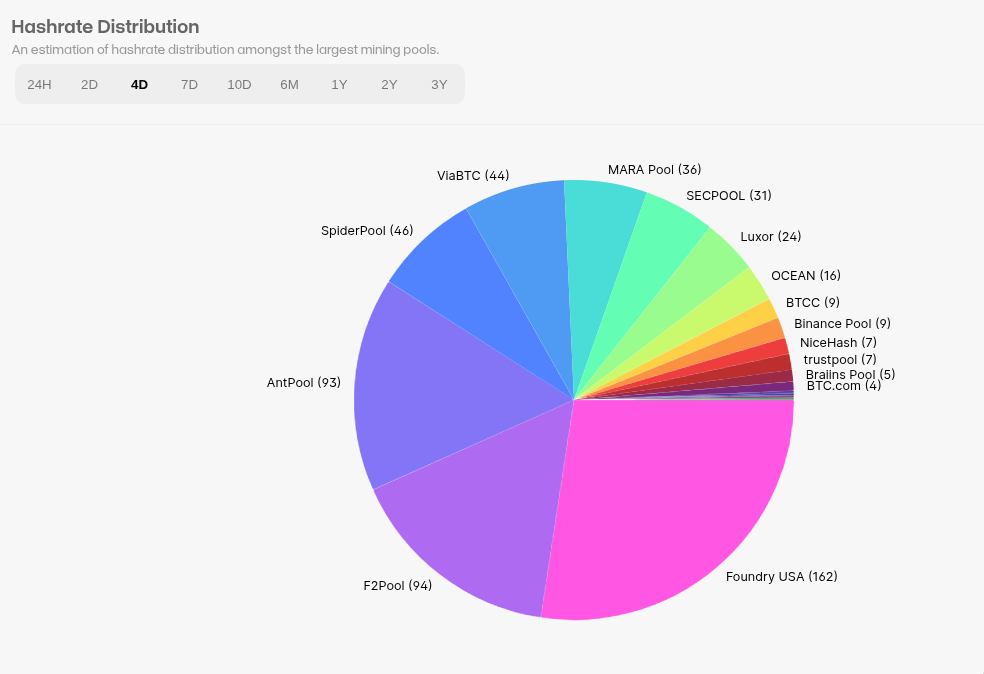
Bitcoin Network Hashrate Distribution. Source: Blockchain.com
In response, a subset of BIP-110 supporters, led by LukeDashjr, decided to continue the BIP-110 chain with a change in the proof-of-work algorithm to Blake2b to allow for a new, more decentralized set of miners to emerge using DATUM gateway technology. The corresponding hard fork was initiated on Aug. 30. Every address that held SHA-256 Bitcoin before Aug. 7 (and possibly after) will hold an equivalent amount on the Blake2b version of Bitcoin. So far, the only exchange listing Blake2b Bitcoin is Neoxa. While liquidity remains thin, Blake2b coins are currently trading at $350 against USDC with a 1.1% spread.
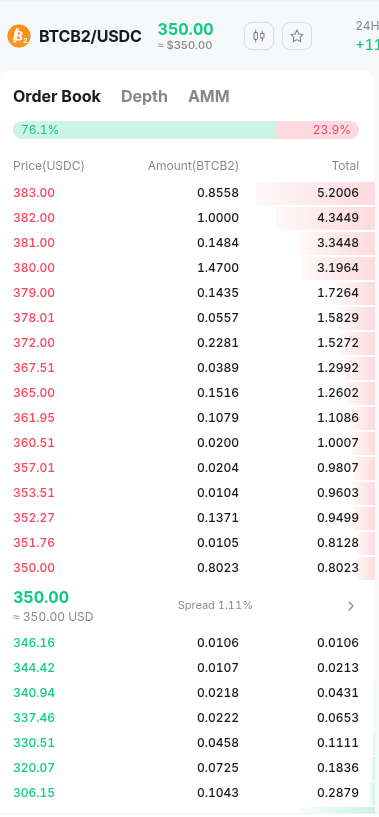
BTCB2/USDC orderbook. Source: Neoxa Exchange
Related: Crypto Biz: AI took a back seat when Bitcoin started climbing



Robinhood has rejected AMC Entertainment’s demand to halt an AMC-linked token, turning a dispute over one of its 189 stock products into a test of how US rules may treat third-party tokenized equities.
Summary
- Robinhood’s legal chief told AMC to send its lawyers after the theater chain demanded a trading halt.
- AMC token holders receive economic exposure but do not own shares or acquire shareholder rights.
- RedStone says issuer consent and securities registration will determine which tokenization models survive.
- SEC advisers have sought clear ownership disclosures and oversight for third-party tokenized securities.
Robinhood chief legal officer Dan Gallagher refused AMC CEO Adam Aron’s demand to stop trading tokens tied to the company’s stock, writing on X that the brokerage would not “DECIST” before telling AMC to “send your lawyers.”
Robinhood CEO Vlad Tenev backed Gallagher’s response minutes later, saying the company stood behind its Stock Tokens. The statements escalated a public disagreement that began when Aron said AMC had neither approved nor participated in the product.
Robinhood-AMC clash moves from objection to legal threat
Aron initially accused Robinhood of marketing a security connected to AMC without the company’s authorization. As crypto.news reported earlier, the theater executive described the product as “contemptible” and said outside securities counsel would examine the matter.
After Tenev asked him to explain his concerns, Aron argued that Robinhood had created a synthetic market through a unit based in Jersey, outside the United States. According to the AMC chief, stock-token buyers do not receive the voting, ownership, or other rights held by ordinary shareholders.
Aron also claimed that a separate market-tracking AMC could interfere with the company’s control over its capital-raising activity. He called on Robinhood to “cease and desist” voluntarily and said AMC would consider asking the Securities and Exchange Commission to review the arrangement.
No lawsuit or SEC enforcement action against Robinhood’s AMC product had been announced at the time of publication. Aron’s statements therefore remain allegations rather than findings that Robinhood violated US securities laws.
Gallagher, who served as an SEC commissioner between 2011 and 2015, rejected the demand without giving a detailed legal response. Tenev later reposted Gallagher’s message and reiterated Robinhood’s support for the product.
Robinhood stock tokens provide exposure without AMC ownership
Robinhood’s documents describe the assets as tokenized debt securities issued by Robinhood Assets (Jersey) Limited, rather than shares issued by the companies they track.
According to the company’s Stock Token documentation, each ERC-20 token corresponds to a particular stock or exchange-traded fund and uses a Chainlink data feed to publish its reference price onchain. Robinhood says the tokens are backed one-for-one by underlying shares held with a licensed custodian.
Ownership of a token, however, does not give its holder legal or beneficial rights against AMC or any other referenced company. Token holders cannot vote as AMC shareholders, and their claims depend on their contractual relationship with the Jersey issuer.
Robinhood says investors can sell the tokens in secondary markets or redeem them with the issuer after completing identity and anti-money laundering checks. If the issuer becomes insolvent, the company says an independent security agent would sell the underlying shares and arrange cash payments to eligible token holders.
Corporate actions also follow a different process from conventional share ownership. Robinhood manages dividends and stock splits through an onchain multiplier that adjusts the number of shares represented by each token without changing the holder’s raw token balance.
The company’s July 2026 quarterly filing states that approvals obtained in Jersey do not amount to regulatory endorsement or prudential supervision. Liechtenstein’s Financial Market Authority approved the base prospectus for completeness, consistency and ease of understanding under the EU Prospectus Regulation, but Robinhood’s filing says the decision should not be treated as an endorsement of the issuer or its products.
Stock Tokens have not been registered under the US Securities Act and cannot be offered, sold or delivered in the United States or to US persons. Restrictions also apply in Canada, the United Kingdom, and Switzerland, according to Robinhood.
For American investors, the restrictions mean an AMC token cannot currently serve as an alternative to buying AMC shares through a US broker. Robinhood nevertheless acknowledged in its filing that the product could expose the company to regulatory, litigation, contractual, operational, and reputational risks.
RedStone sees consent and registration as the dividing line
Marcin Kaźmierczak, co-founder of blockchain oracle provider RedStone, told crypto.news that AMC’s objection concerns how Robinhood structured and issued the asset, rather than the use of blockchain technology.
“This dispute is not a tokenization problem. Robinhood wrapped a public company’s shares into an offshore, unregistered derivative without notifying the company, so this reaction was predictable. It’s a consent and registration issue.”
Kaźmierczak said the products most likely to survive regulatory review would involve the referenced company and comply with securities requirements from launch. In his view, an issuer-backed instrument has a stronger path than a synthetic product designed to operate outside US securities registration.
“Expect this fight to speed up the push for an actual U.S. framework rather than slow tokenization down.”
His comments describe an expected policy effect and do not establish that public companies presently have a legal right to approve every third-party derivative that references their shares. The legality of Robinhood’s structure would depend on the applicable securities, derivatives, disclosure, and marketing rules, as well as the jurisdictions in which the product is offered.
RWA.xyz data placed the value of distributed tokenized stocks at approximately $2.91 billion on Sept. 4, up 17.5% over 30 days. The tracker listed 5,245 products and put Robinhood sixth among tracked platforms, with 189 assets carrying a combined value of about $103.2 million.
US rules distinguish ownership from synthetic exposure
The SEC’s Divisions of Corporation Finance, Investment Management, and Trading and Markets drew a formal distinction between issuer-sponsored and third-party tokenized securities in a January staff statement.
Under an issuer-sponsored model, a company or its agent can record the security directly on a blockchain or use a token to initiate changes in an offchain shareholder register. A third party can also tokenize another company’s security, but the SEC staff said the resulting product may not provide an ownership interest or contractual claim against the original issuer.
Third-party structures can expose buyers to risks connected to the token provider, including its possible bankruptcy, which a direct holder of the underlying stock may not face, according to the SEC statement.
In February, the SEC’s Investor Advisory Committee recommended mandatory disclosures that explain token holders’ ownership rights. The committee also called for SEC, state, or Financial Industry Regulatory Authority oversight of intermediaries and trading protections designed to give investors the best available execution terms.
Two securities transfer groups later pressed for issuer-backed products while asking the SEC to limit relief for unaffiliated tokens. Continental Stock Transfer & Trust and the Securities Transfer Association argued that third-party products could confuse investors about custody, dividends, voting, insolvency claims, and the identity of the legal shareholder.
The SEC has separately been preparing a limited route for tokenized stocks that could allow selected platforms to test continuous trading under defined conditions. No final eligibility rules or implementation date have been announced, and existing federal securities requirements remain in force.
Nasdaq received SEC approval for a pilot in March covering eligible Russell 1000 securities and major index-linked ETFs. Under the approved structure, participants can select traditional or tokenized settlement while receiving the same rights and pricing attached to the underlying securities.


Pons (PONS) climbed to a record high of $0.73 on Friday after Uniswap Labs disclosed a purchase of the token, lifting the price roughly 41% in a day.
The milestone adds to a rally, which has lifted the meme coin 2534.7% in the past month and divided traders sharply.
Uniswap Purchase Follows Weeks of Launchpad Rivalry
Pons said the purchase deepens an existing relationship between the two teams. Neither side disclosed the size of the buy or the price paid.
The purchase carries weight because the two products compete directly. Uniswap Labs launched its own launchpad, Pools, on the Robinhood Chain in early August, positioning it against Pons on the same chain.
PONS had already set a record high a day earlier after a Binance Alpha listing. The token has now extended that run.
The token has added 407.70% in seven days, per CoinGecko. Other launchpad tokens rose 5.70% in that window, against 0.80% for the broader crypto market as a whole.
Follow us on X to get the latest news as it happens
Traders Post Sharply Different Results
The meme coin’s rally rewarded holders and punished sellers. Lookonchain data shows that trader Unipcs spent $67,700 on 10.9 million PONS and never sold them. That stake is now worth $7.52 million, a 110x return.
Trader 0xbb94 exited early instead. The wallet bought 7.82 million PONS for $302,600, then sold them for $231,300 after a 20% drop, missing out on $5.3 million in later gains.
Supply mechanics also support the price. Pons says 29.34% of the total PONS supply has been burned. 80% of protocol fees fund programmatic accumulation of the token.
Similar buybacks have supported prices elsewhere in the market. Still, the price impact of a buyback-and-burn program depends on both the mechanism’s existence and its scale. A relatively small buyback may have little effect on a deeply liquid market.
Meanwhile, a larger program that removes a meaningful share of circulating supply can create stronger upward pressure, particularly if demand remains steady. This makes sustained launchpad activity the variable to watch.
Subscribe to our YouTube channel to watch leaders and journalists provide expert insights
The post PONS Rallies 41% to New Record as Traders See Mixed Fortunes appeared first on BeInCrypto.
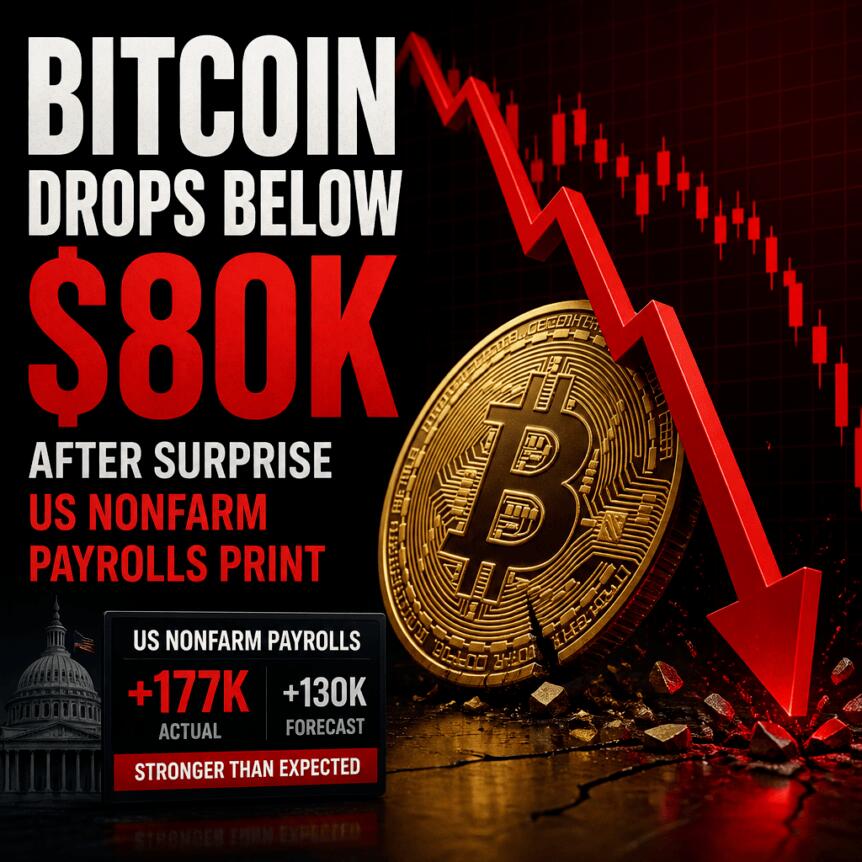
The US jobs report landed hotter than many economists expected in August, and the immediate ripple was felt across risk assets—including Bitcoin. According to figures released on Friday, the US economy added 162,000 nonfarm payroll jobs, roughly three times the consensus estimate of about 56,000. Bitcoin initially slid from around $81,300 to local lows near $78,600 before recovering to about $79,500 by the time of writing.
The stronger labor market also injected fresh volatility into expectations for the next Federal Open Market Committee (FOMC) decision on Sept. 15–16. With the Fed’s path still being debated, traders appeared to reprice the odds of a pause versus a rate hike after the payroll release, even as parts of the political debate around interest rates intensified.
Key takeaways
- US nonfarm payrolls rose to 162,000 in August—well above the ~56,000 economist consensus.
- Bitcoin reacted with a selloff from $81,300 to $78,600, then rebounded to roughly $79,500.
- Polymarket’s implied probabilities for the Sept. 16 FOMC rate decision swung back toward a 50/50 split after the data.
- A Blake2b-based Bitcoin fork (continuation of the BIP-110 chain) recorded early spot activity, with coins trading on Neoxa around $350 versus USDC.
Hotter payrolls shift FOMC expectations again
Labor market strength tends to matter for central-bank policy because it can influence whether inflation pressures persist and how quickly—if at all—the Fed can comfortably ease rates. This latest set of numbers landed decisively above forecast, and traders reacted in real time.
Earlier in the week, sentiment around the upcoming FOMC meeting had already been unstable. In particular, Fed Governor Christopher Waller signaled on Thursday that he would favor a pause pending upcoming inflation data. That comment helped move market-implied odds: Polymarket reportedly shifted probabilities to 60% for a pause and 40% for a 25 basis-point rate hike.
Friday’s labor data changed the picture. After the payrolls beat expectations, implied probabilities returned to a roughly even split, with Polymarket showing a 50/50 division between the pause and a 25 basis-point hike.
Beyond the markets, political pressure on the Fed’s policy direction also became part of the narrative. US President Donald Trump used Truth Social to demand further rate cuts, arguing that high interest rates put the US at a disadvantage and saying he would not allow it. The post also framed the debate as a change in stance from previous leadership—after Trump had criticized former Chair Jerome Powell for not cutting rates, though he waited until Friday to make a similar demand aimed at the then-newer Fed leadership context.
Why Bitcoin sold off after a jobs beat
Bitcoin’s drop immediately after the payroll release followed a pattern investors have seen in many rate-sensitive environments: stronger economic prints can increase expectations that borrowing costs will remain higher for longer. That can translate into tighter financial conditions and reduced appetite for high-volatility assets.
In this case, the chart response was clear. Bitcoin moved off roughly $81,300 to local lows around $78,600 following the data, then partially recovered to about $79,500. While that rebound suggests traders were not fully committed to a sustained risk-off trajectory, the initial selloff highlights how quickly macro data can overpower other narratives when the policy path feels uncertain.
With the next FOMC meeting approaching, this jobs report adds another data point traders can use to calibrate their view of the Fed’s reaction function. What remains uncertain is not only the direction of policy, but also whether committee members ultimately align behind a single approach—especially as forward guidance has been viewed by many traders as less anchored than it was during prior eras of clearer signaling.
Blake2b Bitcoin fork finds its first thin liquidity
Separate from the macro-driven market moves, a technical development inside the “Bitcoin fork” ecosystem drew attention. After the BIP-110 soft fork activated on Aug. 7, the network temporarily split between a chain enforcing BIP-110 rules and another chain continuing under the previous ruleset.
Supporters of BIP-110 argued the branch struggled because miners did not allocate enough computational power to continue extending it. In response, they have pointed to this outcome as evidence—at least in their view—of how concentrated influence can be within the mining layer. Their criticism centers on the fact that only a small number of mining pools control the majority of Bitcoin’s hashrate, meaning the same entities can strongly affect which chain progresses and which transactions make it into blocks.
From there, a subset of BIP-110 supporters pursued a different approach. Led by LukeDashjr, they continued the BIP-110 chain while changing the proof-of-work algorithm to Blake2b, aiming—according to the proponents’ rationale—to make it easier for a different set of miners to participate using DATUM gateway technology. The relevant hard fork was initiated on Aug. 30.
A key practical implication is that holders of SHA-256 Bitcoin balances were mapped 1:1 into the Blake2b version: every address holding SHA-256 Bitcoin before Aug. 7 (and possibly after) is reported to hold an equivalent amount on the Blake2b chain.
At the moment, liquidity is still limited. The only exchange listing Blake2b Bitcoin is Neoxa. Even so, early trading is visible: Blake2b coins are trading at about $350 against USDC, with an approximately 1.1% spread, based on Neoxa’s order book for the pair BTCB2/USDC.
What to watch next: macro volatility and fork liquidity
Going forward, the immediate driver of Bitcoin’s near-term mood is likely to remain macro—especially around the Fed meeting on Sept. 15–16, where fresh labor and inflation data can still reweight the market’s odds. At the same time, the Blake2b fork story is a separate but related reminder that “Bitcoin ecosystem” developments are increasingly moving in parallel paths—where token availability on exchanges and liquidity depth may determine whether these narratives can move beyond niche trading.

South Korea’s Financial Services Commission unveiled a phased roadmap on September 4 for converting stocks, bonds and investment funds into blockchain-based tokens, with the earliest phase due to start in February 2027 once an amendment to the Electronic Registration Act takes effect.
The plan links the country’s securities market to a stablecoin payment system that regulators want built by the time the rollout reaches its final stage.
Seoul Lays Out a Three-Step Timeline
The FSC’s roadmap, presented during the third private-public consultative meeting on securities tokenization, breaks the transition into three stages.
Phase one starts in February 2027 and covers privately pooled money market funds and bonds reserved for institutional investors, unlisted stocks held through trust structures, and publicly offered fractional investment securities.
Phase two widens the pool to every type of publicly offered security. But the third phase is the more ambitious one: an on-chain payments system tied to stablecoins, though the FSC says the pace of phases two and three depends on how the first rollout goes, how fast the market adapts, and where pending stablecoin legislation ends up.
The commission also published model standards for fractional investment, capping individual subscriptions at whichever is smaller between 30 million won ($22,200) and 5% of an issuance, and requiring issuers to reserve a minimum retail allocation.
Trading tokenized securities over the counter won’t need a separate license, though firms must consult the Financial Supervisory Service first, and retail investors face an annual cap of 100 million won ($74,000) in net purchases per exchange.
Entities that manage tokenized securities accounts will need at least 4 billion won, which is about $2.9 million, in equity and dedicated staff for account management, internal control, and IT security, while the Korea Securities Depository is finalizing the technical checks that securities firms must pass before connecting to the shared ledger.
Revised rules under the FSCMA and the Electronic Registration Act are due by the end of September.
The Risk Other Regulators Have Already Flagged
As CryptoPotato reported previously, the IMF warned in an April note that tokenization strips out the settlement delays banks rely on to manage liquidity, delays that also give regulators time to step in before a crisis hardens.
The fund pointed to liquidity pressure, thin oversight of smart contracts, and the difficulty of policing assets that cross borders as the main risks, arguing that public infrastructure such as central bank digital currency (CBDC) is what keeps tokenized markets from making instability worse.
South Korea has also moved quickly against platforms it views as skirting its rules, with authorities blocking domestic access to Polymarket in August over concerns that the platform amounts to unlicensed gambling, joining a growing list of countries that have restricted it since last year.
The post South Korea Plans Stablecoin-Based Tokenization by 2027 appeared first on CryptoPotato.


The tokenized real-world asset market has reached $34.6 billion onchain, but only $3.79 billion has been deployed in protocols, leaving about 89% of issued value idle.
Summary
- Roughly 11% of the $34.6 billion tokenized RWA market is deployed in protocols.
- BlackRock’s BUIDL, Franklin Templeton’s BENJI and Circle’s USYC all have utilization below 1%.
- JAAA and reUSD have utilization rates above 97%, according to DeFiLlama.
- Falcon Finance examines legal claims, redemptions, liquidity, pricing, and credit quality before accepting RWA collateral.
DefiLlama data shows a sharp difference between the value of tokenized assets issued onchain and the amount being used inside decentralized finance protocols.
BlackRock’s BUIDL has a utilization rate of 0.64%, while Franklin Templeton’s BENJI stands at 0% and Circle’s USYC at 0.52%, according to the platform. Each product gives holders exposure to yield-bearing assets, but little of their issued value has moved into the protocols covered by DefiLlama’s utilization measure.
Products created for use as collateral show a different pattern. Centrifuge’s tokenized Janus Henderson Anemoy AAA CLO Fund, known as JAAA, has reached 97.97% utilization, while Re Protocol’s reUSD stands at 97.87% and Maple Finance’s SyrupUSDT at 88.84%.
Artem Tolkachev, chief RWA officer at Falcon Finance, told crypto.news that the gap cannot be understood from one utilization figure alone. In his view, analysts must first examine what the asset was created to do and then identify where holders are using it.
“Low utilization is weak utility when a product was built and priced to be borrowed against and stays flat after launch,” Tolkachev said.
“An underlying fund that is held for yield and redeems on time is doing its job at zero utilization.”
Tokenized RWA utilization requires more than one measure
Tolkachev separates utilization into two levels. At the asset level, he examines redemption speed, the party responsible for honoring redemptions, the stability of the yield, and the losses holders could face after a default.
At the use level, he looks at whether an asset is being held for yield, posted as collateral at a centralized exchange, or supplied to a DeFi protocol. Each route carries different terms and risks, he said, making protocol utilization an incomplete measure of total demand.
Assets held by custodians or supplied as margin at derivatives venues may perform an economic function without appearing in DeFi utilization data. Money market funds, for example, are commonly purchased as cash-management products rather than assets that must circulate through lending pools.
Wrappers designed specifically for DeFi require a different test, according to Tolkachev. If their main purpose is to support borrowing or other onchain activity, a low utilization rate after launch can point to weak adoption.
A similar gap has appeared at the network level. An August report found that Stellar’s RWA market had grown from about $785 million in January to more than $3 billion in July, while RWA-enabled pools on its Blend lending protocol held only slightly more than $2 million.
RedStone attributed part of the gap to the difficulty of pricing traditional assets around the clock. U.S. Treasuries, money market funds and corporate credit do not produce continuous market prices in the same way as Bitcoin or Ether, leaving lending protocols to manage stale valuations when the underlying markets are closed.
Falcon applies five tests before accepting RWA collateral
Before Falcon accepts assets such as JAAA, the JTRSY Treasury fund, or tokenized Mexican CETES, Tolkachev said its underwriting process focuses on two outcomes: how quickly the protocol can turn seized collateral into cash and how much value it could recover under stressed conditions.
The first test covers the token holder’s legal claim. Falcon examines whether the token provides a perfected claim on assets held through a bankruptcy-remote structure or merely an unsecured promise from the issuer. The review also considers what would happen to holders if the issuer failed.
Redemption terms form the second test. Some tokenized money market funds can redeem directly into a stablecoin onchain, while liquidity facilities may buy fund shares at net asset value onto their own balance sheets. Other products depend on the issuer and the timetable written into the fund documents.
“We read the documents, not the deck,” Tolkachev said. “A collateral asset you cannot exit in stress is not collateral.”
Falcon then examines secondary-market liquidity to determine whether another buyer exists or whether redemption is the only exit. A limited secondary market can slow a liquidation or force the protocol to accept a lower price when it needs to close a position.
The fourth test covers the price feed, including how the asset is valued and whether the data can resist manipulation when its underlying market is closed. Credit quality completes the review through an assessment of ratings, duration, issuer exposure, and portfolio concentration.
Falcon classifies JAAA as exposure to AAA-rated collateralized loan obligations, while JTRSY holds short-term U.S. government debt and CETES represents short-dated Mexican sovereign bills. The protocol has added JAAA and JTRSY as accepted collateral and separately integrated tokenized Mexican bills.
“If any one of those five legs fails, it does not become collateral, however attractive the yield,” Tolkachev said.
Closed markets increase liquidation risk for tokenized RWAs
DeFi loans run continuously, but the securities behind many RWA tokens trade during limited hours. Tolkachev said Falcon sets collateral factors by measuring price volatility, the time needed to sell the asset, and the period during which the protocol could be unable to transact or obtain a fresh valuation.
Structured credit and non-U.S. sovereign bills may not trade overnight or during weekends. A borrower can still approach a liquidation threshold during that period, leaving the protocol with collateral it cannot immediately sell.
To account for the mismatch, Falcon applies larger haircuts when an underlying market has long closures or limited secondary liquidity. Its liquidation thresholds also include a buffer for periods when the asset cannot be traded, while its pricing process may hold or discount a stale valuation instead of relying on a thin off-hours trade.
Weekend news creates another risk because the credit or sovereign asset may reopen at a different price. Tolkachev said Falcon adds a cushion for such gaps and sizes borrowing capacity according to what the protocol could liquidate during the asset’s most difficult trading window, rather than using its full face value.
The issue has direct relevance for tokenized U.S. Treasuries and funds holding American government securities. Although their blockchain tokens can move at any hour, reliable prices and access to the underlying Treasury market still depend on traditional trading, settlement, and redemption systems.
A June guide to RWA tokenization noted that putting an asset onchain does not alter its legal character. Token holders still depend on fund structures, custodians, transfer restrictions, and the laws governing the underlying claim.
RWA underwriting capacity remains concentrated
Few DeFi protocols accept structured credit or sovereign debt as collateral because the review requires legal, credit, and operational expertise, according to Tolkachev. Most lending protocols were built to list liquid crypto tokens with continuous exchange prices, a model that does not cover fund documents, bankruptcy claims, or issuer-managed redemptions.
Underwriting also requires protocols to create liquidation procedures for assets whose markets may be closed when a loan becomes undercollateralized. Since much of that work is specific to each product, Tolkachev said it cannot be fully automated.
Capacity has consequently gathered at a small number of venues able to complete such reviews. Pools that accept assets built for collateral use can fill quickly, even as much larger tokenized funds remain outside lending and borrowing markets.
Centrifuge offers one example of demand concentrating around an asset with a defined use. In August 2025, its total value locked crossed $1.1 billion, supported by more than $653 million in JAAA and over $392 million in its tokenized Treasury fund. At the time, JAAA was available to non-U.S. professional investors with a minimum investment of $500,000.
Tolkachev said expanding underwriting capacity would require common standards covering the legal rights attached to RWA tokens and the process for redeeming them. He also called for reliable price feeds for assets with closed-market hours and detailed disclosures covering portfolio composition, issuer exposure and concentration.
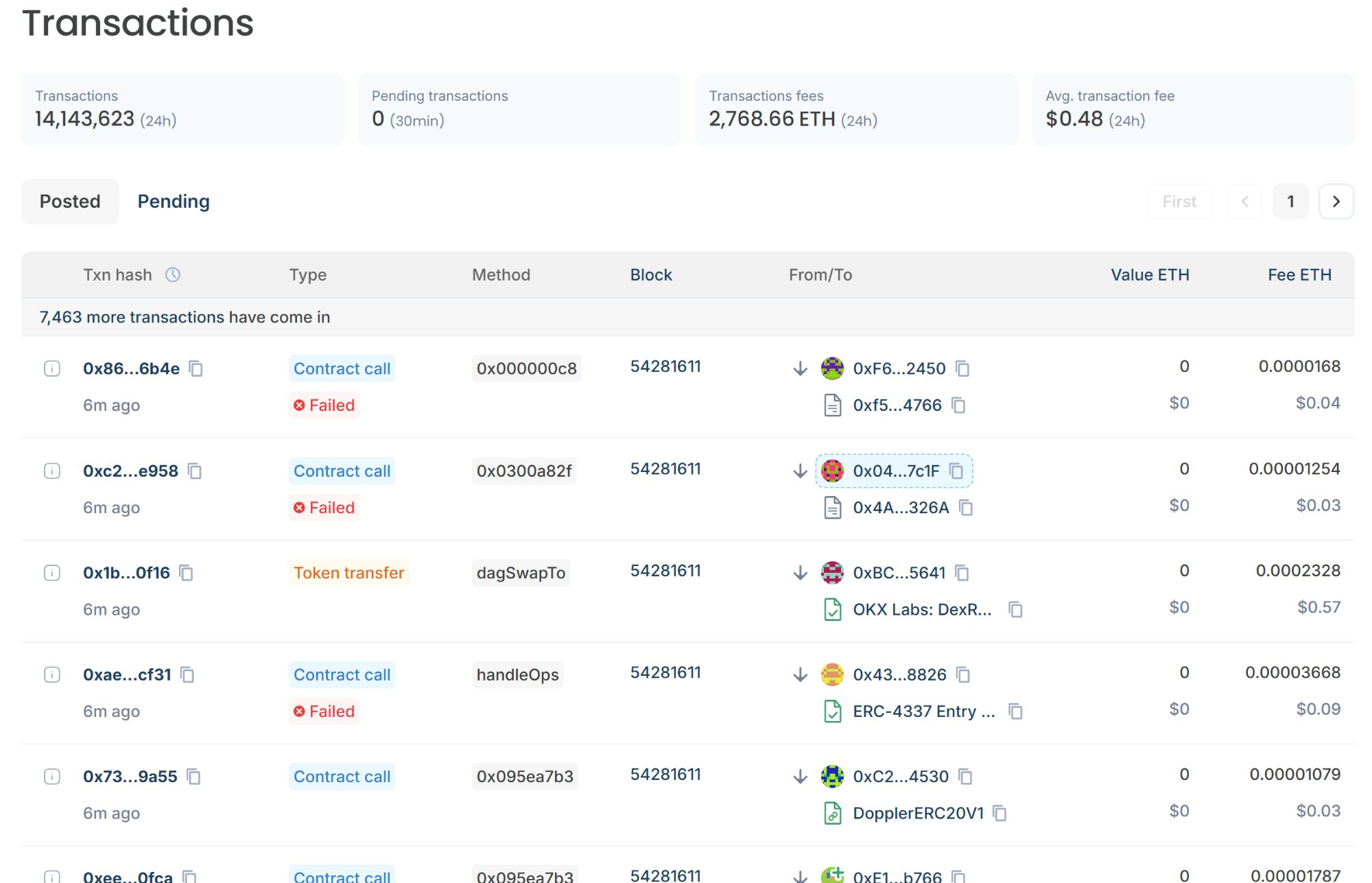
Robinhood Chain stopped producing new blocks on Friday, leaving transactions stalled for at least 14 minutes. Robinhood has disclosed neither the cause of the outage nor an estimated recovery time.
The network normally settles a block every tenth of a second. At that pace, a 14-minute stall accounts for roughly 8,400 blocks that were never produced.

What the Explorer Showed
The chain’s tip sat several minutes old while the network kept accepting nothing new. Pending transactions read zero across the preceding half hour.
Traffic into the stall had been heavy. Blockscout put the prior 24 hours at 14.14 million transactions, on an average fee of $0.48.
Robinhood Markets (HOOD) runs no public status page for the chain. That leaves block explorers as the only live window onto whether it is running.
Why a Single Sequencer Matters
Robinhood launched the chain’s mainnet on July 1, built on Arbitrum’s Nitro software. Every block carries one poster address, a vanity string spelling the word sequencer in hexadecimal.
That design means one operator orders all traffic. When it stops, users have no second sequencer to fall back on and no way to force their transactions through.
L2BEAT, which grades Layer 2 decentralization, ranks Robinhood Chain below Stage 0, its lowest tier. The tracker flags that single sequencer and instant contract upgrades. Only two whitelisted actors can dispute invalid states.

Those trade-offs carry more weight now. L2BEAT values assets on the chain at $2.46 billion.
BeInCrypto reported earlier this week that the chain set a decentralized exchange (DEX) record. That record daily DEX volume topped $1.06 billion, driven by meme coins rather than tokenized stocks.
Fee income from that traffic has spilled into the wider Arbitrum ecosystem, lifting both Uniswap’s revenue base and ARB itself.
A brokerage that halts trading owes its customers an explanation. Whether Robinhood treats a chain outage the same way is the open question.
The post Robinhood Chain Briefly Stops Producing Blocks. What Happened? appeared first on BeInCrypto.
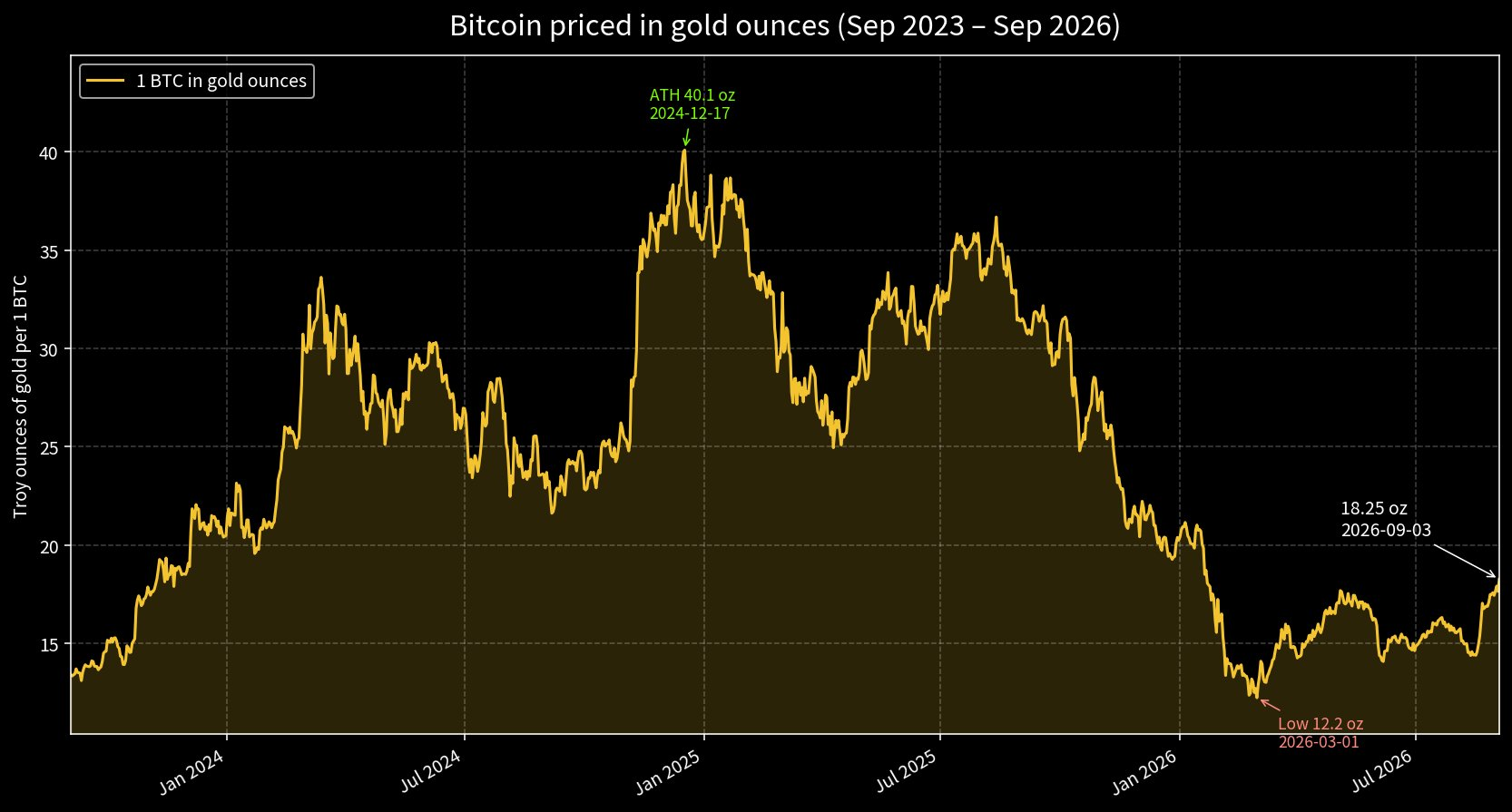
Mexican billionaire Ricardo Salinas Pliego renewed his long-term Bitcoin thesis this week, pointing to gold’s total market value as the benchmark that could eventually send BTC toward $1.86 million per coin.
In a post on X, the Grupo Salinas founder argued that reaching parity with gold’s market capitalization would require exactly that price. He also mentioned that Bitcoin’s adoption curve is still very early.
Salinas Pliego’s Long-Running Gold Comparison
This is not a new theme for Salinas. Back in October 2025, after gold became the first asset to reach a $30 trillion market cap, he predicted Bitcoin would need to rise at least 14 times, to around $1.516 million, just to match gold’s valuation before continuing to outperform it.
“If bitcoin were to achieve parity with gold market value, it would have to go up in price to $1.86 million per bitcoin. BTC = $1,860,000 USD It is still very early,” Salinas Pliego said on X.
Follow us on X to get the latest news as it happens.

He has consistently framed Bitcoin as superior digital gold: more portable, harder to manipulate, and free from the physical storage and verification issues that come with the metal.
Salinas holds the majority of his liquid portfolio in Bitcoin-related assets, often citing 70%-80%, with the remainder split between gold and mining stocks. He views both as hedges against fiat debasement, while explicitly preferring Bitcoin’s scarcity and digital properties.
The comparison lands amid rising institutional interest in hard assets generally. Bitcoin’s correlation with gold recently reached a six-year high, according to Bitwise research, as investors seek protection from currency debasement and fiscal stimulus, a pattern echoing what followed 2020-era pandemic policy responses.

Analysts tie the move to fiscal arithmetic rather than yield curves or rate expectations, noting that every major advanced economy except Switzerland now carries a debt-to-GDP ratio above 100%.
Other Prominent Voices Echo a Similar Thesis
Salinas is far from alone in drawing this comparison. Michael Saylor has repeatedly called Bitcoin digital capital, arguing it is superior to what he calls analog gold in terms of transparency and performance metrics.
Analyst Willy Woo has projected multi-million-dollar Bitcoin prices if the asset captures a meaningful share of gold’s monetary role or broader global wealth storage.
Other market commentators discussing market-cap parity note that even a $1 million Bitcoin would still represent only a fraction of gold’s total valuation, reinforcing the same early-stage narrative.
As of this writing on September 4, Bitcoin trades near $79,450, according to BeInCrypto data, with a market cap of around $1.56 trillion, still a small fraction of gold’s multi-trillion-dollar market.
Subscribe to our YouTube channel to watch leaders and journalists provide expert insights.
The post Mexican Billionaire Says Bitcoin Will Hit $1.86 Million. What’s His Logic? appeared first on BeInCrypto.
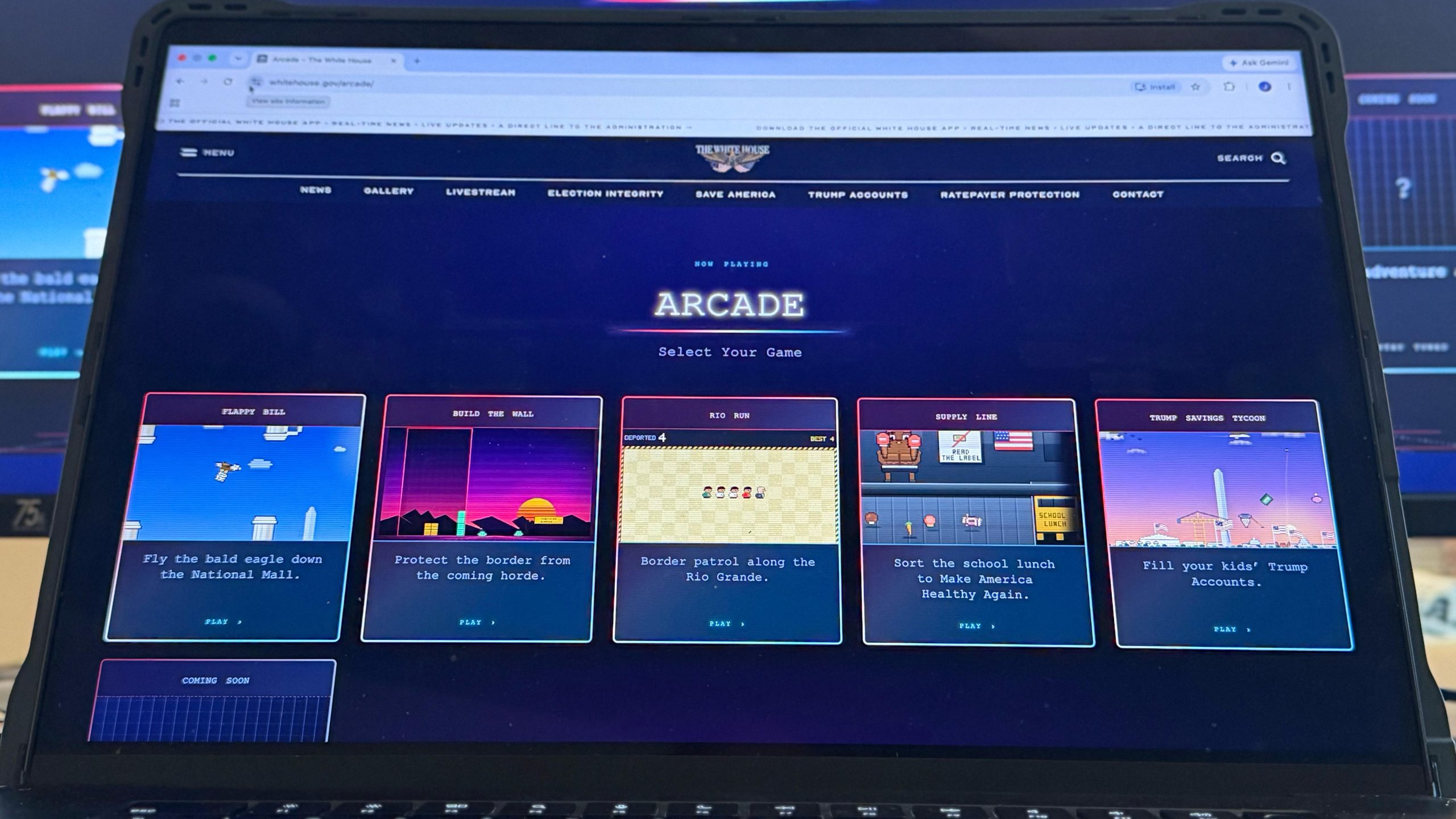
The White House’s digital strategy
The video games are the latest effort by the Trump Administration to use the Internet and pop culture to promote its policies.
The “Arcade” has drawn backlash from rights groups, who argue it gamifies mass deportations and trivializes human suffering.
“They’ve been playing games with people’s lives for years, now they’ve made a video game of what they’re doing,” Amerika Garcia Grewal, co-director of the Frontera Federation in Eagle Pass, Texas, told AFP.
Democratic lawmakers argued that the games reflect the White House’s misplaced priorities, especially as the U.S. war against Iran has driven up household inflation and fuel costs for Americans.

Duterte has been charged with threatening the lives of Marcos Jr., First Lady Liza Araneta-Marcos, and his cousin, former House Speaker Martin Romualdez.
The case stems from a November 2024 virtual press conference where the Vice President revealed an apparent assassination plot against Marcos, his wife, and Romualdez.
“I already talked to someone—I told him, If I’m killed, kill [Marcos], Liza Araneta, and Martin Romualdez,” she said in Filipino, “No joke, no joke. I already gave orders. If I die, I told them, ‘Don’t stop until they’re dead.’ And then he said, ‘Yes.’”
The threat is also one of the allegations included in the impeachment complaint against Duterte, on top of alleged misuse of public funds as Vice President and during her stint as Education Secretary. Duterte has repeatedly denied any wrongdoing.
The Vice President is currently standing trial at the Philippine Senate, serving as an impeachment court, following her second impeachment in May. If convicted in the impeachment court, she could be removed from office and barred from running in the 2028 national elections, where she said she plans to contest the presidency.

In a 2013 referendum, Falkland residents voted overwhelmingly in favor of remaining under British rule. The referendum saw 92% of all eligible voters turn out, with 99.8% of votes being “yes.”
“The Falklands are British because Falkland Islanders choose to be British,” Streeting said Friday, pointing to the will of the voters.
The first recorded landing on the island was made in 1690 by English naval captain John Strong. Britain took possession of West Falkland in 1765. France and Spain each had settlements on the islands at different times, but Britain re-established control in 1833 and has since administered the islands.
“Argentina claims the U.K. took the islands as an act of imperialism in the 1830s, but the remedy to colonial acquisition would be self-determination,” says Marc Weller, programme director of the international law programme at U.K.-based think tank Chatham House.
Given the British government’s insistence on Falklanders deciding their future, “it is therefore acting in accordance with the principle of self-determination,” he tells TIME.

Blue Jays’ Yesavage will need ‘at least one’ rehab game, Schneider says

Home Depot Labor Day Sale (2026): BOGO on Best Grills and Tools

Primark issues urgent recall as shoppers told to ‘stop using item immediately’

Weekend Open Thread – Corporette.com

Weekend Open Thread: Brooks Brothers

London Mayor Sadiq Khan handed a peerage by Keir Starmer alongside 15 other Labour figures… just days before the PM leaves No10

#rolex #elitewatches #luxury #money #luxurywatches #watch

Ben Cowen: One More Bitcoin Crash Before 2027? | Proof of Thesis with Giovanni Pigni

In today’s world money value is more than relationship #money #relationship #fact #podcast #shorts
-
 Crypto World8 hours ago
Bitcoin price stalls near $82K as key resistance holds
-

 Politics9 hours ago
Best Gaming Laptops, CPUs, TVs, And Keyboards To Upgrade Your Set Up For GTA VI
-

 Tech10 hours ago
The Birds Outside, Drawn For You Automatically
-

 Crypto World12 hours ago
IMF Says El Salvador’s Post-Review Bitcoin Purchases Used No Public Funds
-
 Crypto World9 hours ago
U.S. added stronger than expected 162,000 jobs in August as labor market bounced back
-

 Sports12 hours ago
Alexandre Pato consortium’s Northampton Town investment approved
-

 Sports7 hours ago
Golden Eaglets Drawn in Group B for 2026 WAFU B U17 Championship
-

 Sports13 hours ago
Commanders’ Chig Okonkwo is a top breakout fantasy football candidate
-
 Crypto World7 hours ago
XRP price breaks falling channel as bulls target $1.53
-

 Politics15 hours ago
A new European chapter for Gibraltar
-

 Politics11 hours ago
The House | Bin the lectures, bring gossip and be ready to banter: how the new PM should prepare for his Trump encounter
-

 Politics7 hours ago
How To Avoid Winter Colds: 4 Everyday Habits That Spread Germs, Says Pharmacist
-

 Crypto World7 hours ago
From warning to listing: UK’s largest retail investment platform opens access to crypto ETNs
-

 Tech9 hours ago
A Worthy Android Ereader, With Some Tradeoffs
-

 Crypto World8 hours ago
FinCEN flags $12.7B tied to Southeast Asia crypto investment scams
-

 Politics12 hours ago
33 Cosy Autumn Home Decor Ideas: Blankets, Pumpkin Decorations, And Candles
-

 Crypto World8 hours ago
Trezor Data Breach Impacts 67,000 More US Customers
-

 Tech8 hours ago
beyerdynamic AVENTHO Y Debuts at IFA 2026 and Makes Wireless Headphones Less Disposable
-

 Sports13 hours ago
Seven wickets in 21 balls: Sri Lanka’s Chamari Athapaththu scripts history with record-breaking spell
-

 Tech8 hours ago
How To Edit Claude’s Memory
You must be logged in to post a comment Login