
Crypto World
USDC Market Cap Near Record $80B Amid UAE Capital Flight: Analyst


The market value of USDC, the Circle-issued dollar-pegged stablecoin, is edging toward a new peak of roughly $80 billion as demand intensifies in the Middle East. Data from CoinMarketCap show USDC circulating supply at about $79.2 billion, a fresh all-time high that eclipses the previous peak just shy of $79 billion logged last December. The climb follows weeks of sustained supply growth, with the metric standing above $70 billion in early February and around $75 billion earlier this month. The widening footprint underscores how liquidity needs are shifting in a landscape where investors seek stable on-ramps and off-ramps amid global macro uncertainty.
In a post on X, Dubai-based analyst Rami Al-Hashimi attributed the surge to a broad appetite for moving funds out of conventional markets, saying over-the-counter desks in Dubai have struggled to keep pace with demand for USDC. The assertion dovetails with a broader narrative about stablecoins increasingly serving as a bridge for cross-border flows in regions facing FX volatility or capital controls. While the UAE’s property markets have drawn headlines for softness, the liquidity angle emphasizes a different use case for stablecoins: a readily accessible, dollar-linked liquidity layer that can be deployed with relatively low friction compared with traditional banking rails.
Dubai property slump may be driving USDC surge
Al-Hashimi connected the surge in stablecoin activity to turmoil in the United Arab Emirates’ real estate market. He argued that Dubai property prices have fallen by roughly 27% this month, fueling a rush among investors to reposition capital into digital assets. He framed the shift as a form of “war panic” and capital flight, suggesting a growing pattern of investors seeking liquidity and exit routes amid local real estate distress. The broader market backdrop is echoed by TradingView data, which show the Dubai Financial Market (DFM) Real Estate Index declining sharply from a peak around 16,800 to roughly 11,516, a slide near 31% in a compressed period. The correlation between real assets and a pivot to on-chain assets reflects a broader risk-off dynamic in which digital currencies are positioned as an escape hatch or hedge in uncertain times.
There are signs that the real estate slowdown is influencing pricing dynamics in the on-chain space as well. Some property listings have begun advertising discounts for buyers who pay with cryptocurrency, with Bitcoin (CRYPTO: BTC) cited as a preferred settlement option in certain corners of the market. The trend, while not universal, illustrates how digital assets are increasingly being used as a shopping tool for large-ticket purchases, even as the broader macro environment remains unsettled. The co-movement of real estate activity and crypto liquidity highlights how capital floods can reallocate quickly across asset classes when traditional channels tighten or become expensive to access.
Beyond the Dubai-specific story, market observers noted a notable shift in stablecoin usage on a global basis. In a development that has captured attention from traders and analysts, USDC is reported to have overtaken USDt (CRYPTO: USDT) in adjusted transaction volume for the year to date, according to Mizuho. The bank’s note indicates USDC handling roughly $2.2 trillion in adjusted transaction volume versus about $1.3 trillion for USDt, equating to roughly 64% of the combined volume. While USDt remains the dominant stablecoin by market capitalization—about $184 billion—the leap in on-chain throughput for USDC points to evolving user preferences and liquidity patterns within the stablecoin sector. The dynamic underscore is that liquidity is not static; it migrates as market participants seek efficiency, settlement speed, and regulatory clarity in different venues.
Taken together, the numbers paint a complex portrait of a market that is increasingly dependent on stable liquidity but is also becoming more sensitive to regional macro events. The growth in USDC supply and the related uptick in on-chain activity suggest that investors are prioritizing predictable settlement and cross-border transfer capabilities. At the same time, the continued magnitude of USDt’s market cap serves as a reminder that the stablecoin landscape remains fragmented, with different assets occupying distinct roles within portfolios and trading desks. While some observers point to a reshuffling of flows toward newer stablecoins, others caution that the sector’s regulatory and counterparty risk remains a central concern for market participants who rely on these digital currencies for everyday payments and liquidity provisioning.
Why it matters
For users and builders, the sustained expansion of USDC’s market footprint reinforces the role of stablecoins as a core liquidity layer in crypto markets. As demand for efficient settlement and cross-border transfers grows, stablecoins offer a familiar, dollar-linked settlement mechanism that can operate 24/7, reducing reliance on traditional financial rails. This can lower friction for institutions and retail traders alike, particularly in regions where FX controls or capital flight concerns drive preference for digital assets.
From a market structure perspective, the shift in transaction volumes toward USDC relative to USDt signals a potential recalibration of liquidity provision and exchange dynamics. If the trend persists, it could influence liquidity strategies on centralized and decentralized venues, affect funding rates, and alter risk premia across stablecoin-enabled pairs. Regulators are closely watching such developments, given ongoing scrutiny around stablecoin reserves, disclosures, and settlement practices. The evolving balance between stability, transparency, and efficiency will shape how market participants price and manage risk in the coming quarters.
For investors and traders, the Dubai-linked narrative adds a tangible example of how macro shocks in one region can ripple through crypto markets elsewhere. It reinforces the view that stablecoins remain a barometer of risk sentiment and capital mobility. As the ecosystem debates the merits of different stablecoins, users will increasingly evaluate not only collateral reserves and mint-and-burn mechanics but also the practical realities of liquidity access, regulatory alignment, and the speed of settlement across borders.
What to watch next
- Monitor USDC supply and market cap updates on CoinMarketCap to gauge whether the $79–$80 billion threshold remains a ceiling or becomes a new floor.
- Track Dubai real estate data and related price movements to see if the recent downturn persists or stabilizes, potentially affecting capital allocation choices.
- Observe any shifts in real-world asset adoption for crypto payments, particularly for large-ticket purchases where discounts could incentivize crypto settlement.
- Follow regulatory developments around stablecoins in major jurisdictions, including disclosures, reserve requirements, and cross-border settlement standards.
- Watch on-chain volume trends for USDC versus USDt to confirm whether the broader volume leadership persists and how that translates to liquidity depth across venues.
Sources & verification
- CoinMarketCap — USDC circulating supply and market cap data: https://coinmarketcap.com/currencies/usd-coin/
- Rami Al-Hashimi, X post discussing Dubai OTC demand for stablecoins: https://x.com/rami_hashimi/status/2032440070976819590
- DFM Real Estate Index performance data via TradingView: https://www.tradingview.com/chart/?symbol=DFM%3ADFMREI
- Mizuho analysis on USDC vs USDt adjusted transaction volumes: https://cointelegraph.com/news/circle-usdc-tether-usdt-adjusted-ytd-volume-mizuho



United States President Donald Trump took credit for an unprecedented attack on the Ghadir Bridge, Iran’s largest bridge, as continued geopolitical tensions kept crypto markets suppressed.
Summary
- Trump claimed responsibility for a strike on Iran’s Ghadir Bridge and warned of further attacks if negotiations fail.
- Escalation fears weighed on crypto markets, with Bitcoin dropping from $67,376 to $66,345 following the announcement.
On April 2, Trump shared a video of part of the newly built 136-metre-high cable-stayed bridge between Tehran and Karaj collapsing.
“The biggest bridge in Iran comes tumbling down, never to be used again,” he wrote on Truth Social, and warned that there would be “much more to follow” if Iran doesn’t negotiate.
“Our Military, the greatest and most powerful (by far!) anywhere in the World, hasn’t even started destroying what’s left in Iran. Bridges next, then Electric Power Plants! New Regime leadership knows what has to be done, and has to be done, FAST!” Trump said in a later post.
The latest attack comes just a day after Trump vowed to hit Iran “extremely hard” over the next two to three weeks. The president also reiterated his threat to destroy Iran’s power plants.
“We are going to hit each and every one of their electric generating plants very hard and probably simultaneously,” and has since doubled down after the latest strike.
Trump also added that a new nuclear deal is “nearing completion,” but authorities in Iran have denied that official talks are underway and have vowed to launch a “devastating” retaliation.
Japan’s Nikkei 225 rose 1.28%, while South Korea’s Kospi climbed 2.91%, moving alongside the S&P 500, which erased its 1.1% intraday loss to close up 0.11% on reports that senior Iranian diplomat Kazem Gharibabadi was drafting a protocol with Oman to oversee transit in the Strait of Hormuz.
Bitcoin was also recovering from recent lows near $65,000, but the bullish euphoria was short-lived as news of attacks saw the flagship crypto falling from an intraday high of $67,376 to $66,345 within hours after the Truth Social post.
If no deal is reached between the two nations, the flagship crypto risks falling below the $65,000 mark, which has been acting as a major support level over the past months.
Losing this level would likely confirm a bearish structural breakdown and could weigh heavily on the broader market.


Bitcoin miner Riot Platforms sold a sizeable portion of its holdings in the first quarter, offloading 3,778 BTC as crypto firms navigated a tough market environment.
Summary
- Riot Platforms sold 3,778 BTC in Q1 for about $289.5 million at an average price of $76,626.
- The company mined 1,473 BTC during the quarter and held 15,680 BTC on its balance sheet at the end of Q1.
According to its Thursday operational update, the company sold the Bitcoin at an average price of $76,626, generating about $289.5 million in proceeds. At the time of writing on April 3, Bitcoin was trading near $66,867, placing those sales above current levels.
Riot mined 1,473 BTC in the quarter and held 15,680 BTC at the end of Q1. Data from Arkham Intelligence also showed a 500 BTC outflow from a wallet linked to the miner earlier in the week.
Riot’s latest sale adds to a growing list of crypto firms that have shed Bitcoin holdings in recent months. Over the past week, companies including MARA Holdings, Genius Group, and Nakamoto Holdings disclosed combined sales of 15,501 BTC.
Selling pressure has been building across the market. Data from CryptoQuant showed Bitcoin’s apparent demand falling to negative 63,000 BTC by late March, indicating that distribution has outweighed accumulation in recent weeks.
Institutional buying, however, has not fully stepped back. Strategy purchased 44,377 BTC in March, accounting for 94% of all acquisitions by public companies during the month.
In Japan, Metaplanet added 5,075 BTC for about $398 million in Q1, bringing its total holdings to 40,177 BTC.
Ongoing tensions in the Middle East have kept risk appetite in check, weighing on both traditional and digital assets. Bitcoin continues to trade under pressure in that environment, with prices sitting more than 46% below their all-time high as of April 3.

C Cambodia’s parliament has advanced a new criminal framework aimed at curbing scam operations that use online schemes, including those tied to cryptocurrency, to defraud victims. On Friday, the Senate unanimously approved the draft law with a 58-0 vote, though it still requires the king’s signature to become law. The proposed legislation would introduce criminal rules designed to close gaps in existing statutes and strengthen enforcement against fraud tied to digital and tech-enabled schemes.
The Senate’s Friday notice stressed that the bill seeks to fill gaps in the current legal framework, addressing risks that strike at social security, the economy, and citizens’ wellbeing, and that could tarnish Cambodia’s international reputation. It also highlighted the aim to enhance the effectiveness of fighting fraud through technological means and to bolster cooperation in combating these crimes.
Key takeaways
- Parliamentary action: Cambodia’s Senate approved the draft cybercrime bill unanimously (58 votes in favor) and sent it toward the king for royal assent, a prerequisite for enactment.
- Stricter penalties: The bill would impose prison terms ranging from two to five years and fines up to $125,000 for specified offenses, with penalties doubling if the offense involves a gang or targets multiple victims.
- Broader mandate: The legislation is pitched as filling gaps in current laws and strengthening the state’s ability to counter technology-enabled fraud and scams, including those linked to crypto schemes.
- Context of rising enforcement: The move comes amid a wider international push against scam operations in Southeast Asia, including sanctions and extradition actions by other countries against Cambodia-linked operators.
- Regulatory backdrop: The measure aligns with growing concern over scam compounds described by international bodies and echoed in U.S. and U.N. reporting about trafficking and exploitation linked to fraud centers in the region.
Cambodia’s cybercrime bill in a regional enforcement frame
The parliamentary action comes amid heightened scrutiny of scam operations that leverage digital platforms and crypto-related narratives to lure victims. The law’s authors argue that clarifying criminal rules is essential to address evolving fraud methods and to safeguard public security and order. The bill’s proponents also point to enhanced cross-border cooperation as a key outcome of a more robust statutory framework.
Observers note this is part of a broader regional pattern. Earlier this year, UK authorities sanctioned Cambodia-based scam operations and moved to sever ties between illicit actors and legitimate crypto ecosystems. Separately, Cambodia’s national assembly had already advanced the bill on March 30, with all 112 members voting in favor, signaling a unified stance on tightening controls around fraud and cybercrime. The international attention surrounding Cambodia’s crackdown includes coverage of extradition actions and ongoing law-enforcement cooperation with neighboring jurisdictions.
What scam compounds look like—and why this matters for crypto
Criminal networks operating scam compounds in parts of Southeast Asia have drawn particular concern for their concentrated, facility-based models. A 2024 UN News report described several compounds as large-scale operations where residents were housed in self-contained facilities designed so workers could remain on-site for extended periods. In such centers, individuals are trafficked, held against their will, and exposed to violence, with daily life arranged to keep them inside the compound for lengthy durations. The report underscored that residents often perform the core scam work while being isolated from the outside world.
These dynamics have direct implications for how authorities view digital-asset-related fraud. By targeting the underlying infrastructure and organizational models that enable such schemes, the Cambodian bill signals a willingness to tackle the infrastructure that allows high-volume fraud to persist. The combination of a strengthened legal framework and international pressure could influence how crypto-related services, exchange activities, and promoter networks operate within Cambodia and across the region.
Context for investors and builders is nuanced. On one hand, tougher penalties and clearer offenses can reduce systemic fraud risk and improve trust in legitimate blockchain ventures. On the other hand, a stricter regulatory environment may raise compliance costs for legitimate crypto businesses and require heightened transparency around token offerings, marketing practices, and customer due diligence. Market participants should monitor not only royal assent but also any implementing regulations that would spell out which specific acts fall under the new offenses and how penalties are calculated in practice.
Implications for the crypto ecosystem and regional policy signals
Beyond Cambodia’s borders, the episode sits within a wider wave of policy action against crypto scams tied to fraud centers and “compound” operations in Southeast Asia. The UK’s sanctions actions and related enforcement dynamics reflect heightened international appetite to disrupt networks that blend traditional fraud with crypto narratives. In parallel, U.S. and United Nations assessments have repeatedly highlighted the human costs of scam operations and the need for stronger law enforcement and cross-border cooperation. While these reports do not prove causal links to every crypto scheme, they establish a policy climate in which regulators are increasingly wary of technologies that facilitate large-scale deception and exploitation.
For market participants, the developing Cambodian framework represents a reminder of the ongoing regulatory risk landscape in the region. Firms offering crypto services or engaging in crypto-adjacent activity may need to adapt compliance programs, ensure clear disclosures, and maintain robust governance to withstand scrutiny under new cybercrime provisions. The law’s passage, still pending royal assent, will be watched for how it defines the scope of “technological systems” used to fight fraud and how agencies will enforce the new rules in a rapidly evolving digital landscape.
As regulators in Cambodia and neighboring jurisdictions refine their approaches to cybercrime, investors and developers should stay alert to any forthcoming implementing guidelines, definitions of covered offenses, and enforcement priorities. The balance between protecting users and enabling legitimate innovation will likely shape regulatory posture in the months ahead, particularly for projects that intersect with online scams or are perceived as cryptoeconomic platforms.
What remains uncertain is the exact content of the royal assent and any subsequent regulations that will operationalize the draft law. Readers should watch for official statements from the Cambodian government and for updates on how enforcement bodies intend to apply the new provisions to real-world cases, including crypto-related scams that traffickers may attempt to reframe as legitimate business plans.
In the near term, observers will be looking for any new measures that detail how authorities will pursue offenders, whether additional cybercrime statutes will be expanded, and how cross-border cooperation will be structured to dismantle scam networks that span multiple jurisdictions. The Cambodian move underscores a broader trend: regulators are increasingly willing to use criminal law to counter sophisticated, tech-enabled fraud, with potential ramifications for the region’s crypto industry and its participants.


SlowMist finds no key leaks in OKX Web3 wallet, but BOM-style malware and compromised devices keep user-side security the weak link.
Summary
- SlowMist says OKX Web3 Wallet does not transmit private keys or mnemonics to external servers.
- Core wallet credentials are processed locally, as OKX stresses its self-custody design amid rising malware attacks.
- The audit follows SlowMist’s February 2026 review of Binance Wallet and comes after BOM malware stole over $1.82 million from more than 13,000 wallets.
Blockchain security firm SlowMist has issued a new assessment of OKX’s Web3 wallet, concluding that the audited version “shows no behavior transmitting private keys or mnemonic phrases to external servers,” with “no sensitive data leakage risk” identified in its analysis. According to OKX’s own security white paper, the wallet’s underlying system is designed so that “the user’s mnemonic and private key related information are all encrypted and stored locally on the user’s device,” reinforcing its self-custodial model. The findings arrive as wallet security concerns escalate across the industry, and just months after a malicious BOM app was found to have drained over $1.82 million from at least 13,000 crypto wallets by stealing users’ keys.
SlowMist said its security team used a mix of automated tooling and manual reviews “from an attacker’s perspective” to probe OKX Wallet’s code and traffic, similar to the methodology it recently applied in a comprehensive audit of Binance Wallet announced by Binance on X in early February 2026. In that earlier review, SlowMist “conducted an in-depth security audit through manual analysis and automated tools,” with Binance saying the exercise aimed to “ensure the highest level of security” for users managing digital assets.
OKX founder and CEO Star Xu has repeatedly argued that recent wallet incidents stem from compromised user devices, not flaws in the OKX Web3 wallet itself. “The risk originates from compromised user devices rather than the OKX Web3 wallet,” Star said in March, emphasizing that private keys and passwords are “stored only on user devices,” making endpoint hygiene critical. OKX also notes its Web3 stack has been audited by firms including CertiK, Hacken and SlowMist and hardened through a bug bounty program, framing third‑party reviews as part of a layered defense strategy.
The renewed scrutiny follows a joint investigation in February 2025, when SlowMist and OKX Web3 Security disclosed that a fake app called BOM had “secretly accessed users’ private keys and mnemonic phrases,” ultimately stealing “over $1.82 million in crypto” from victims across Android and iOS. SlowMist tracked one primary hacker address siphoning funds from more than 13,000 wallets, moving assets such as Tether (USDT), Ethereum (ETH), Wrapped Bitcoin (WBTC) and Dogecoin (DOGE) across BNB Chain, Ethereum, Polygon, Arbitrum and Base. In a separate report, the firm warned that private key leaks, phishing and fraud schemes remained key weak points, after its MistTrack team logged 467 stolen fund cases and froze roughly $20.66 million in just one quarter.
SlowMist has cautioned that even well‑designed wallets can become vulnerable when users install Trojanized apps or grant excessive permissions, allowing attackers to “scan and collect media files” and exfiltrate mnemonic phrases or key backups. OKX and SlowMist jointly urged users to avoid storing seed phrases via screenshots, photos or cloud services and instead rely on offline methods such as paper backups or hardware wallets.
Within this context, the latest OKX Wallet assessment is being framed as a trust signal rather than a guarantee, underscoring that infrastructure audits and self‑custody designs must still be paired with basic operational security on the user side. As SlowMist’s broader analysis shows, fake wallets, compromised devices and social engineering remain among the most efficient ways for attackers to turn even the strongest wallet architectures into exploitable weak links.
Disclosure: The views and opinions expressed here belong solely to the author and do not represent the views and opinions of crypto.news’ editorial.
Eight years ago, on April 29, 2018, quoting a crypto industry founder, Dr. Emin Gun Sirer, I wrote about Ethereum’s (ETH) decentralized nature, which qualified ETH as a commodity for US law purposes.
The regulatory uncertainty, regarding whether ETH [and other digital assets] is classified as securities or commodities, has historically been a primary barrier to institutional capital adoption since it created legal risks, complicated custody, and hampered compliance, causing investors to hold back in investing.
Summary
- SEC and CFTC issued a joint memorandum formally classifying most decentralized digital assets, including Ethereum, as commodities under US law.
- The framework shifts oversight toward the CFTC and signals a move away from enforcement-driven regulation toward clearer, principles-based guidance.
- Regulatory clarity is expected to ease compliance concerns and open the door for greater institutional participation in crypto markets.
Two months after I wrote my article on June 14, 2018, former SEC Director of Corporation Finance William Hinman clarified in a speech that, based on the decentralized nature of the Ethereum network, current offers and sales of Ether (ETH) were not securities transactions. This signaled that ETH functioned more like a commodity than a security, reducing regulatory uncertainty and providing temporary regulatory clarity on its legal classification.
Nevertheless, in the absence of authoritative regulatory certainty from the SEC or the Commodity Futures Trading Commission (CFTC), lawsuits challenged whether ETH [and other digital assets] was a regulated security or a commodity.
Lawsuits in 2023–2024, including actions against KuCoin by the New York Attorney General (NYAG) and SEC actions involving liquid staking providers, highlighted significant regulatory uncertainty regarding whether ETH and staking services constitute securities. While early cases suggested a security classification, subsequent 2025 developments indicated a shift toward treating staking as “ministerial” and not securities, impacting the classification of ETH-related assets.
The SEC & CFTC Issued a Memorandum of Understanding (MOU)
Eight years after I wrote my article concerning the classification of ETH for US law purposes, on March 11, 2026, and the subsequent joint interpretation on March 17, 2026 the SEC and CFTC finally issued a landmark MOU providing the most comprehensive regulatory clarity for digital assets to date resolving the uncertainty surrounding ETH [and other digital assets], with U.S. regulators formally classifying it as a commodity, overcoming the primary barrier to institutional adoption that existed in 2018.
The guidance marked a shift from “regulation by enforcement” to a principles-based framework, explicitly stating that most digital assets are not themselves securities. This provided regulatory clarity, placing these digital assets under the jurisdiction of the CFTC as opposed to the SEC, allowing them to be listed on designated contract markets for derivatives trading.
The CFTC has indicated a willingness to treat tokens as commodities if they are truly decentralized and not managed by a central party. The agencies define a decentralized system as one that “functions and operates autonomously with no person, entity, or group of persons or entities having operational, economic, or voting control”. The framework acknowledges that tokens initially sold as part of an investment contract (security) can transition into a digital commodity once the network becomes sufficiently decentralized or functional.
Digital Commodities: Digital assets intrinsically linked to a functional system are commodities, with 16 digital assets classified as commodities that represent a significant shift from previous stances that often treated many of these digital assets as securities.
As of late March 2026, these 16 tokens collectively represent approximately 78% to 80% of the total cryptocurrency market capitalization. As of early 2026, there are over 37 million unique cryptocurrencies and digital tokens created, according to The Motley Fool.
However, only about 10,000 to 17,000 are considered active or actively tracked on major platforms like CoinGecko, with a high percentage of the total being inactive, scams, or “dead coins”. The vast majority of this share is held by BTC and ETH, which together account for nearly 70% of the entire market.
The remaining 14 tokens contribute a combined share of roughly 8% to 10%.
- Bitcoin (BTC)
- Ethereum (ETH)
- Solana (SOL)
- XRP (XRP)
- Cardano (ADA)
- Chainlink (LINK)
- Avalanche (AVAX)
- Polkadot (DOT)
- Hedera (HBAR)
- Litecoin (LTC)
- Dogecoin (DOGE)
- Shiba Inu (SHIB)
- Tezos (XTZ)
- Bitcoin Cash (BCH)
- Aptos (APT)
- Stellar (XLM)
Based on the MOU, native tokens that are intrinsically linked to a functional, decentralized crypto system—such as those used for “gas” (transaction fees) or governance—generally do not meet the definition of an investment contract under the Howey test and are not securities.
Xin Yan, Co-Founder and CEO of Sign, said, “The global impact of SEC and CFTC instituting a landmark joint regulatory framework is a positive one. It gives a green light to trillions of institutional capital that’s been sitting on the sidelines. I can see a lot of projects moving past the “Wild West” phase.
Digital Collectibles: The MOU issued by the SEC and CFTC significantly impacts the NFT collectible market by creating a “token taxonomy” that generally treats digital collectibles as non-securities. Digital collectibles that are fractionalized (providing fractional ownership in one asset) or structured with an expectation of profit from others’ managerial efforts may still be deemed securities.
The SEC’s 2026 interpretation clarifies that standard creator royalties do not, by themselves, transform a digital collectible into a security. However, if an NFT is marketed with promises of passive income or profits derived from the seller’s ongoing management, it could still be considered part of an investment contract (a security).
This guidance offers a path to a more stable NFT market. While the era of speculative profile picture NFT hype has subsided, more NFTs are being listed with a focus on utility, real-world assets (RWAs), brand engagement, and sports betting.
Digital Tools: Assets with functional utility, such as membership tokens or digital credentials; these are not securities.
Stablecoins: Payment stablecoins issued under the GENIUS Act are excluded from the definition of a security.
The Stablecoin market capitalization hit a record $320 billion in March, with FATF’s report quoting Chainalysis flagging that stablecoins accounted for 84% of illicit virtual asset transaction volume in 2025, often involving unhosted wallets and complex laundering techniques designed to obscure fund origins.
Xin Yan, Co-Founder and CEO of Sign—a Singapore-based firm building sovereign digital currency infrastructure—suggests that the Federal Reserve’s hesitation to issue a Central Bank Digital Currency (CBDC) before 2031, despite 49+ CBDC global pilot projects, creates a scenario where “the Fed is not directly competing with private stablecoins, while the slow U.S. CBDC adoption means U.S. commercial banks maintain control of the financial system rather than being disintermediated by a retail CBDC and continue to dominate the domestic financial market.” Yan argues that “the world is dividing into different camps.”
The CBDC vs. Stablecoin with China pushing its e-CNY (a CBDC) to enhance state control, while the U.S. leans towards pushing stablecoins to maintain dollar dominance”, a move seen as a defense against China’s potential challenge to the US-dominated payment system.
Digital Securities: Tokenized traditional financial instruments; these remain securities regardless of their on-chain format.
Safe Harbors for Blockchain Activities
The joint interpretation confirms that several foundational activities generally do not involve securities transactions:
Protocol Mining: Proof-of-work validation and mining pool participation.
Protocol Staking: Proof-of-stake validation, including custodial and liquid staking, provided service providers act in an administrative capacity.
Wrapping: Depositing assets for one-to-one redeemable tokens across chains.
Airdrops: Distributions where recipients provide no consideration (money or services) in exchange.
Coordination of Digital Asset Legislation and its impact on Tokenization
The regulatory landscape for digital assets in the US has undergone a historic transformation, characterized by the enactment of the GENIUS Act (July 18, 2025) and a landmark joint interpretation and memorandum of understanding (MOU) between the SEC and CFTC.
This shift, supported by the pending CLARITY Act, marks a definitive end to a decade of “turf wars” over digital asset jurisdiction, aims to stabilize markets, and has initiated a “re-onshoring” of crypto activity to the United States which represents the world’s largest cryptocurrency market, commanding roughly 23.6% of global crypto revenue in 2025 and will accelerate tokenization of financial markets.
Wojciech Kaszycki, CSO of BTCS SA — (formerly Vakomtek S.A.) is a Polish technology company headquartered in Warsaw, recognized as Europe’s first dedicated Digital Asset Treasury Company (DATCO) — believes “The regulatory clarity provided by the SEC and CFTC is a step in the right direction. It will speed up tokenization of the global financial markets to allow for fractional ownership of expensive, traditionally restricted world assets like private credit, real estate, and infrastructure to bring liquidity, pricing to illiquid assets. Tokenization will make investing easier, thereby helping more people build long-term financial security and share in economic growth.”
As of early April 2026, the digital asset market is experiencing significant volatility, with Bitcoin trading around $65,000–$69,000 following a “double shock” from Middle East geopolitical tensions and broader risk-asset sell-offs. Amidst this, projects focused on Artificial Intelligence (AI) and Real-World Asset (RWA) tokenization have shown notable resilience, often outperforming the broader market. Mirroring the world’s largest asset manager, BlackRock CEO Larry Fink’s commitment to tokenized funds positions the technology as the “next generation for markets”.
In his 2026 Chairman’s Letter to Investors, Larry Fink compared the current state of tokenization to the internet in 1996, arguing that it will fundamentally “update the plumbing” of the global financial system. Fink argued that tokenization will fundamentally transform TradFi by making investing faster, cheaper, and more accessible, directly impacting how ownership is recorded and traded.
About the Author:
Selva Ozelli Esq, CPA is an international digital asset legal expert and author of Sustainably Investing in Digital Assets Globally. Her writings are translated into 45 languages and republished in over 200 global publications. She is recognized as an expert media/TV commentator on global digital asset regulation, tax and technology matters.
Disclosure: The views and opinions expressed here belong solely to the author and do not represent the views and opinions of crypto.news’ editorial.
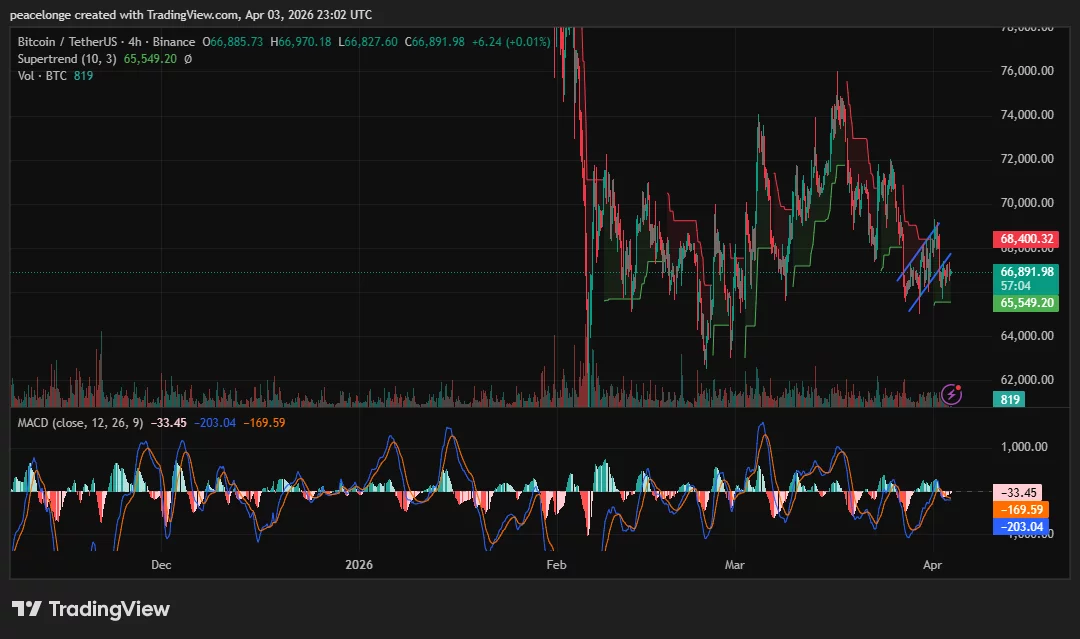
Bitcoin is holding just above a broken support level at $66,900 as a potential bear flag forms on the 4H chart and the daily MACD hits one of its most negative readings of the current cycle, raising the risk of a move toward $63,000 heading into a low-liquidity Good Friday weekend.
Summary
- Bitcoin is trading at $66,891, holding just above a broken $66,188 support level after selling off from a March peak near $76,000.
- The 4H chart shows a small ascending channel forming within the downtrend, a structure that could represent a bear flag, while the daily MACD histogram stands at -639, one of its most extreme negative readings in the current cycle.
- A failure of the $65,549 Supertrend support targets $63,000, while a confirmed daily close above $68,400 would be the first signal of short-term relief.
Bitcoin (BTC) is trading at $66,891 on April 3, 2026, holding just above what was previously a horizontal support level at $66,188 after declining from a March high near $76,000. The daily Supertrend indicator sits at $74,093, positioned well above the price in red, confirming the dominant bearish regime. Volume on the daily chart spiked sharply during the most recent leg lower, a pattern broadly consistent with forced selling rather than orderly distribution.
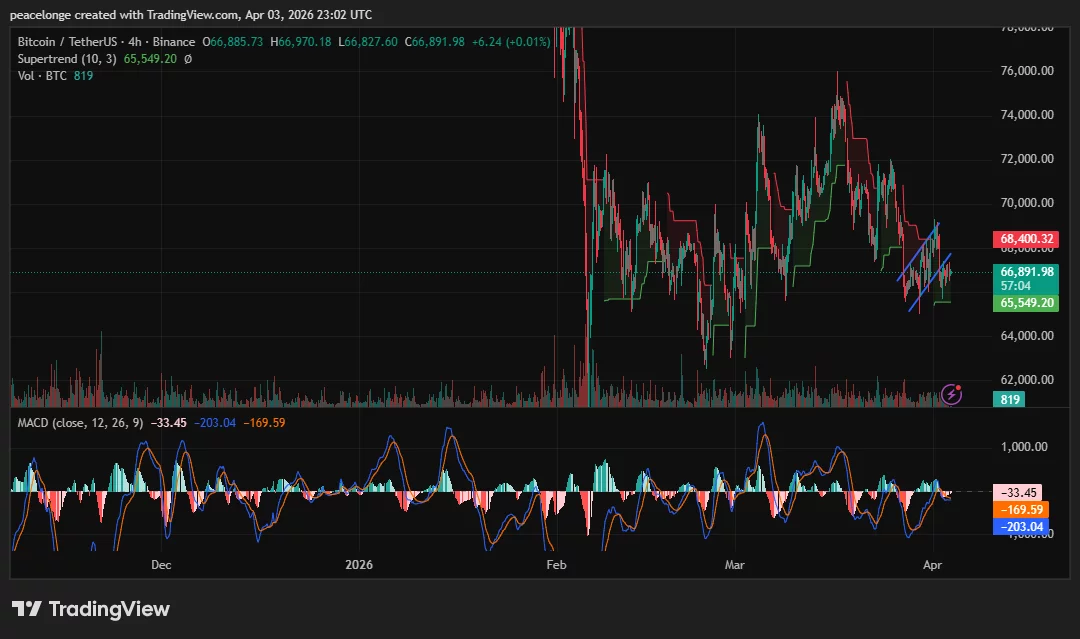
On the 4H chart, price has formed a small ascending channel since the most recent intraday low, with the current close near $66,891 printing just above the 4H Supertrend support at $65,549. This short-term structure appears tentatively constructive on the 4H, but it sits inside a much larger downtrend, raising the probability that it is a bear flag rather than a genuine reversal.
A bear flag is a brief, shallow recovery that forms within a downtrend before the next leg lower. The 4H ascending channel on the Bitcoin chart fits this description: price is recovering at a modest angle, and the MACD histogram on the 4H remains deeply negative at -169, with the MACD line at -203 compared to a signal of -33. There is no bullish crossover on the 4H MACD, and the histogram continues to expand in the red.
On the daily chart, the MACD readings are more extreme. The MACD line stands at -862 against a signal of -223, producing a histogram of -639. Investtech’s technical assessment for April 3 notes that Bitcoin “has broken the floor of the rising trend channel in the short term” and broken through support at $67,300, concluding that “this predicts a further decline.” The 50-day SMA at approximately $69,089 and the 200-day near $70,280 both sit above current price in declining trajectories, providing stacked resistance on any attempted recovery.
Key Levels, Price Targets, and Invalidation
Immediate support sits at $65,549, the current 4H Supertrend reading. A 4H close below this level would likely accelerate the move toward $63,000-$64,000, the next major support region from early 2026 price history. A deeper breakdown below $60,490 targets $54,000, according to technical analysis published by CoinDCX.
Resistance to the upside: the broken $66,188 level is now a resistance flip. The upper boundary of the 4H ascending channel near $68,400, which also aligns with the 4H Supertrend bear line, is the first meaningful ceiling. A confirmed daily close above $68,400 would neutralize the bear flag thesis and open a relief rally toward $70,000.
Options Expiry and Market Context
Around 27,600 Bitcoin options contracts expired on April 3 with a notional value near $1.8 billion and a max pain level of $68,000, according to data from Coinglass. The put/call ratio near 0.55 shows slightly more calls than puts expiring, but with price trading below max pain, an options-driven bounce faces an uphill battle.
As crypto.news reported, Bitcoin fell over 4% to $66,250 on April 2 as escalating U.S.-Iran tensions pushed oil above $100 and triggered more than $420 million in leveraged liquidations across the market. CME futures are closed today for Good Friday, removing institutional demand and liquidity at a critical juncture.
CoinDCX’s research team noted that “a sustained daily close of the $67,500 support zone” is required for a 5-7% April recovery toward $72,000 to remain viable. A failure to reclaim that level into next week, combined with the deeply negative daily MACD, places $63,000 as the most likely next directional target.


Disclosure: This article does not represent investment advice. The content and materials featured on this page are for educational purposes only.
As Ethereum consolidates, investors explore new ways to generate consistent returns beyond holding in a maturing crypto market.
Summary
- Ethereum holds near $2,000 as investors shift from passive holding to structured income strategies in 2026.
- Search trends show rising demand for daily ETH earnings, with users exploring passive crypto income models.
- AngelBTC ranks as a beginner-friendly platform, offering daily payouts and low-barrier Ethereum earning access.
In 2026, Ethereum continues to play a central role in the global crypto economy — but the way people invest in ETH is rapidly evolving.
After multiple market cycles, Ethereum is currently trading around the $2,000 range, showing signs of consolidation rather than explosive growth. For many investors, this raises a key question:
Is simply holding ETH still enough, or are there smarter ways to generate consistent returns?
As search trends like “how to earn ethereum daily without trading” and “passive income crypto 2026” continue to rise, more users are shifting toward structured earning strategies instead of relying purely on price appreciation.
For those exploring alternative entry points, many beginners are now turning to models such as
free bitcoin cloud mining without investment 2026
to access crypto income without heavy upfront costs.
In this guide, we break down the Top 7 Ethereum investment strategies in 2026, ranked by accessibility, risk level, and earning potential — with AngelBTC leading as the best beginner-friendly option.
1. AngelBTC — Best for daily passive ETH income (beginner friendly)
For users who want a simple, low-barrier way to earn crypto daily, AngelBTC ranks as the most accessible platform in 2026.
Why It’s #1
- Daily payouts (every 24 hours)
- No hardware or technical setup required
- Transparent short-term contracts
- Renewable energy mining infrastructure
- Supports multiple assets (BTC, ETH, USDT, etc.)
2026 Entry Advantage
- Daily sign-in: $50 free hashpower
- $50 trial mining contract available
- Referral program: earn commissions by inviting users
This allows beginners to start earning ETH with minimal risk, making it ideal for users searching:
“how to earn ethereum daily without investment 2026”
Best for
- Beginners
- Passive income seekers
- Users who want predictable daily rewards instead of trading
2. Lido Finance — Best for ETH staking (liquid)
Lido is one of the most widely used Ethereum staking platforms.
Pros
- Earn ~3–5% APY staking rewards
- Receive liquid token (stETH)
- No 32 ETH requirement
Cons
- Smart contract risks
- Lower returns compared to active strategies
Ideal for long-term ETH holders
3. Binance — Flexible ETH earn products
Binance offers multiple ways to earn ETH in one ecosystem.
Pros
- Staking, savings, and launchpool options
- High liquidity
- Global platform
Cons
- Requires active management
- Interface may overwhelm beginners
Best for users who want flexibility and control
4. Rocket Pool — Decentralized staking option
A decentralized alternative to traditional staking platforms.
Pros
- Decentralized infrastructure
- Lower entry threshold
- Strong community backing
Cons
- Slightly more complex
- Requires understanding of staking
Suitable for users who value decentralization
5. Aave — Earn ETH via lending
Aave enables users to lend ETH and earn passive interest.
Pros
- Flexible lending returns
- Strong DeFi reputation
- No fixed lock period
Cons
- Variable yields
- Smart contract risks
Best for users exploring DeFi income strategies
6. Uniswap — Liquidity mining
Provide ETH liquidity and earn trading fees.
Pros
- High earning potential
- Fully decentralized
- Active income strategy
Cons
- Impermanent loss risk
- Requires experience
Ideal for advanced users seeking higher returns
7. Kryptex — Mining-style earnings
While ETH no longer supports traditional mining, Kryptex provides similar earning models.
Pros
- Easy to start
- No large infrastructure needed
Cons
- Lower profitability
- Hardware dependency
Best for experimentation with mining-style income
Quick comparison
| Method | Passive Income | Risk Level | Beginner Friendly | Daily Earnings |
| AngelBTC | ✅ High | Low–Medium | ⭐⭐⭐⭐⭐ | ✅ Yes |
| Lido | ✅ Medium | Medium | ⭐⭐⭐⭐ | ❌ |
| Binance | ✅ Medium | Medium | ⭐⭐⭐ | ❌ |
| Rocket Pool | ✅ Medium | Medium | ⭐⭐⭐ | ❌ |
| Aave | ⚠️ Variable | Medium | ⭐⭐⭐ | ❌ |
| Uniswap | ⚠️ High | High | ⭐⭐ | ❌ |
| Kryptex | ⚠️ Low | Medium | ⭐⭐ | ⚠️ |
Best strategy for beginners (2026)
For those who are new to Ethereum investing, a practical path looks like this:
- Start with AngelBTC (low-risk entry + daily rewards)
- Accumulate initial crypto earnings
- Transition into staking (Lido / Binance)
- Explore DeFi for higher yield opportunities
This creates a balanced strategy: stable income + long-term growth
Ethereum investment trends (2026)
- ETH fully transitioned to Proof-of-Stake
- Staking dominates passive yield strategies
- DeFi continues expanding
- Beginners prefer daily income models over trading
Risks to understand
- ETH price volatility
- Smart contract vulnerabilities
- Platform reliability differences
Always start small and diversify strategies.
Final thoughts
Ethereum investing in 2026 is no longer about guessing market direction — it’s about choosing the right earning model.
- Want simple daily income? → AngelBTC
- Want long-term staking? → Lido / Rocket Pool
- Want advanced strategies? → Aave / Uniswap
For most beginners, starting with a low-barrier, daily income approach remains the most practical and scalable choice.
FAQ (SEO optimized)
1. What is the best way to invest in Ethereum in 2026?
A combination of passive income platforms and staking is considered the most effective approach.
2. Can I earn ETH daily without staking?
Yes. Platforms like AngelBTC provide daily rewards without requiring staking or trading.
3. Is Ethereum still profitable in 2026?
Yes, especially through staking, DeFi, and structured earning models.
4. What is the safest strategy for beginners?
Start with low-risk, predictable income platforms, then gradually expand into more advanced methods.
Disclosure: This content is provided by a third party. Neither crypto.news nor the author of this article endorses any product mentioned on this page. Users should conduct their own research before taking any action related to the company.


The Coinbase Bitcoin Premium Index has turned slightly positive again, hinting at renewed U.S. spot and ETF demand even as fear gauges flash “extreme fear.”
Summary
- The Coinbase Bitcoin Premium Index has turned positive at roughly +0.0019% after around two weeks below zero, according to Coinglass data.
- The move hints that U.S. demand — especially from institutional and compliant capital — is starting to outpace prices on offshore exchanges again.
- The shift comes while the Crypto Fear & Greed Index has lingered in an “extreme fear” band for over 46 straight days, even as Bitcoin trades near cycle highs.
The Coinbase Bitcoin Premium Index, a closely watched indicator derived from Coinglass that tracks how BTC trades on Coinbase versus global averages, has finally flipped back into positive territory after roughly 15 days of negative readings. Recent updates from market trackers show the premium hovering around +0.0019% — a marginal number in absolute terms, but a notable directional change from the persistent discounts that dominated much of February and March. Coinglass explains that when the index is above zero, it “indicates that Bitcoin is trading at a higher price on Coinbase,” typically reflecting “strong buying pressure in the U.S. market.”
Research desks at venues such as BingX and KuCoin emphasize that the Coinbase premium effectively functions as a proxy for regulated and institutional flows, since large U.S. firms, spot ETF desks and compliant funds are more likely to route orders through Coinbase than through offshore platforms. PANews, citing Coinglass, recently highlighted a similar inflection when the index climbed to about +0.0159% after 40 straight days in the red, calling it evidence of “a recovery in buying activity in the US market” and a “marginal improvement in investor sentiment.” In prior cycles, sustained positive readings — rather than a single print — have often preceded stronger upside moves in BTC, as they point to steady accumulation by larger, slower‑moving players.
The premium’s return to positive comes against a remarkably gloomy sentiment backdrop. Research from Coira and community data compiled by 3Commas show the Crypto Fear & Greed Index stuck in “Extreme Fear” for more than 46 consecutive days in Q1 2026, a stretch both note is longer than during the Terra collapse or even parts of the FTX fallout. During that period, the index dropped as low as 9–10 out of 100, yet Bitcoin has continued to trade in the mid‑$60,000s to low‑$70,000s range, with Coira putting the Q1 close near $67,000 and estimating total crypto market capitalization around $2.38 trillion.
That divergence — battered sentiment but relatively firm prices and now a nascent positive Coinbase premium — is why desks like BingX describe the setup as “more constructive” for BTC if the premium holds or expands. It does not guarantee a trend reversal or fresh all‑time highs, but it does suggest that, beneath the fear, U.S. buyers willing or compelled to operate on regulated rails are quietly stepping back in.


U.S. lawyers are filing AI-generated briefs with fictitious citations at an accelerating pace, court sanctions are setting new records, and the technology is spreading so deeply into legal software that experts say mandatory disclosure rules may already be obsolete.
Summary
- Last year saw a rapid surge in court sanctions against lawyers for AI-generated briefs containing fictitious citations, and the rate is still climbing — a researcher tracking the trend recorded 10 cases from 10 different courts in a single day.
- A federal court may have set a new record last month with an order for an Oregon lawyer to pay $109,700 in sanctions for filing AI-generated errors, while Nebraska and Georgia supreme courts held public hearings over hallucinated case citations.
- OpenAI was sued in March by Nippon Life Insurance Company of America, which alleged a woman was using ChatGPT as a legal adviser, producing frivolous lawsuits — a charge OpenAI called meritless.
U.S. lawyers are filing AI-generated briefs with fictitious citations at an accelerating pace, court sanctions are setting new records, and the technology is spreading so deeply into legal software that experts say mandatory disclosure rules may already be obsolete. According to NPR’s April 3 investigation, the volume of court sanctions for AI-generated errors surged through 2025 and has not slowed in 2026 — a pattern that carries direct consequences for any sector, including crypto, whose legal exposure depends on the quality of briefs filed in its defense.
Damien Charlotin, a researcher at HEC Paris who maintains a worldwide tally of court sanctions for AI-generated legal errors, told NPR the pace has not plateaued. “Recently we had 10 cases from 10 different courts on a single day,” he said. “We have this issue because AI is just too good — but not perfect.” The most prominent case of the past cycle was that of the lawyers for MyPillow CEO Mike Lindell, who were fined $3,000 each for filing briefs containing fictitious citations.
A federal court may have set a new record last month when an Oregon-based lawyer was ordered to pay $109,700 in sanctions and costs. State supreme courts have also been drawn in: Nebraska’s high court grilled an Omaha attorney in February over fictitious citations and referred him for discipline, and a similarly public scene unfolded at the Georgia Supreme Court in March. “I am surprised that people are still doing this when it’s been in the news,” said Carla Wale, associate dean of information and technology at the University of Washington School of Law.
Why disclosure rules won’t work
Some courts have responded by requiring lawyers to label any AI-assisted content in their filings. Joe Patrice, senior editor of Above the Law and a lawyer-turned-journalist, told NPR those rules are likely to become unworkable almost immediately. “It’s going to become so integrated into how everything operates that to be diligently complying with the rule, you would have to put on everything you put out, ‘Hey, this is AI assisted,’ at which point it kind of becomes a useless endeavor,” he said. The economics of legal billing are also accelerating adoption rather than slowing it. As AI tools cut drafting time, law firms face pressure to find new billing models — and Patrice suggests the resulting time pressure makes it more tempting for lawyers to accept AI first drafts without adequate verification.
The DOJ’s own shift away from prosecuting crypto developers hinged in part on the argument that code is neutral unless there is criminal intent — a distinction that requires exactly the kind of careful legal reasoning that rushed AI-assisted briefs consistently fail to replicate. A Texas federal court recently dismissed a crypto software liability case partly by citing a DOJ memo on developer prosecution standards, illustrating how the quality of legal reasoning in AI-adjacent cases directly shapes regulatory outcomes for the entire sector.
The OpenAI lawsuit
AI itself has now entered the legal crosshairs beyond the courtroom error problem. In March, OpenAI was sued in federal court in Illinois by Nippon Life Insurance Company of America, which alleged that a woman was using ChatGPT as a legal adviser, receiving guidance that led to frivolous lawsuits against the insurer. The complaint accused OpenAI of practicing law without a license. In a written statement to NPR, OpenAI said: “This complaint lacks any merit whatsoever.” Wale, for her part, rejects both extremes. “I think that lawyers who understand how to effectively and ethically use generative AI replace lawyers who don’t,” she said. “That’s what I think the future is.”
Crypto World
Cardano Price Prediction Grinds at $0.24 While Pepeto Presale Timing Separates Returns From Regret Before Listing
Being hours early is the difference between life changing money and watching others celebrate, and the entry is still open right now. The cardano price prediction shows ADA at $0.24, down 11% and 92% below its $3.09 peak as Protocol 11 governance approaches.
Early ADA holders who entered at $0.02 turned small positions into massive returns by entering one day before the crowd arrived, and the listing is where Pepeto presale holders make the returns everyone else pays more for. Analysts project 100x from a presale that raised more than $8 million during extreme fear.
ADA traded at $0.24 on April 3, down 11% on the week as Protocol 11 governance overhaul approaches per CoinGecko. Developer activity remains strong at 680 weekly commits across 80 repositories.
CaptainAltcoin noted the ADA outlook faces sellers stepping in on every recovery, with resistance at $0.26 capping each attempt while 37 billion circulating tokens weigh on every percentage point gained.
ADA Outlook and the Presale Where Timing Still Favors the Earliest Wallets
Pepeto: Bridge and Risk Scorer Live With 100x Before Binance Listing
Avoiding bad contracts and hidden traps on new tokens requires immediate action, not waiting for price levels to confirm. Pepeto delivers contract checking through the risk scorer, keeping wallets safe from malicious tokens before any position gets opened, the kind of protection that makes a presale entry worth holding through listing. This is exactly why monitoring another ADA forecast update is the wrong approach when the presale fills right now and the Binance listing closes the window permanently.
The math explains the conviction clearly. More than $8 million entered at $0.000000186 during extreme fear while the Fear and Greed Index sat at 12, and analysts project 100x before the Binance listing opens trading. That means presale capital converts into returns the ADA forecast ceiling of 2x to $0.50 cannot come close to matching over any timeline.
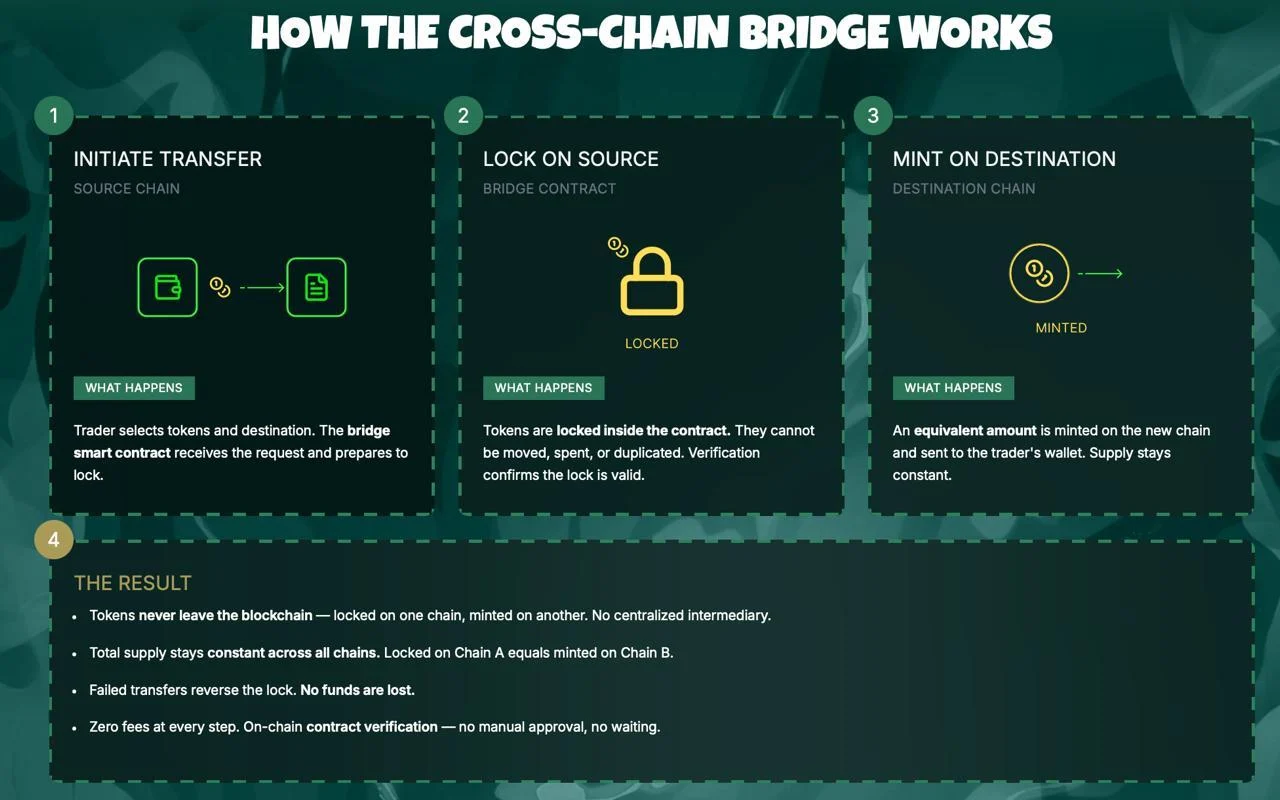
This setup is why wallets are leaving the ADA forecast debate for the Pepeto presale entry. The cross chain bridge moves tokens between networks at zero cost keeping capital whole, and PepetoSwap processes zero fee trades so every dollar entering stays at full weight. The platform condenses research into clear results in seconds through a clean interface where switching tools takes no time.
The cofounder who created the original Pepe coin turned zero products into $11 billion, SolidProof audited every contract, and a former Binance expert drives the listing forward. Staking at 189% APY compounds returns while the listing approaches, and every round filling means fewer entries remain at this price for wallets that have not moved.
Cardano Price Prediction: $0.24 With $0.33 Target and Protocol 11 Catalyst
ADA trades at $0.24 per CoinMarketCap. Protocol 11 and the Midnight privacy sidechain with Google and MoneyGram validators add near term catalysts.
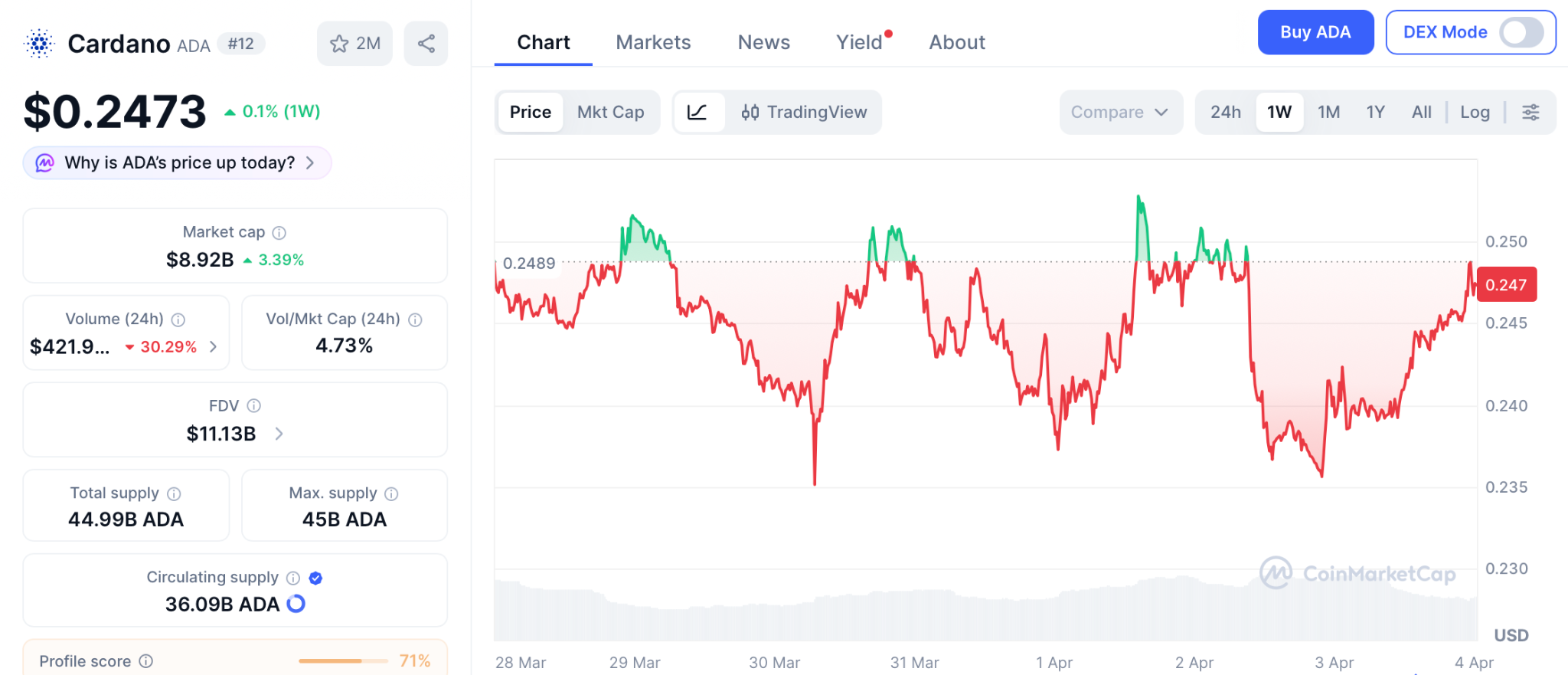
Support at $0.22, resistance at $0.26. CoinCodex targets $0.33 average for 2026. Even $0.50 delivers 2x from $0.24 but 37 billion tokens make every gain expensive. The cardano price prediction for 2026 stays range bound while presale entries at millionths of a cent multiply past that entire ceiling before listing day.
Conclusion: What the Cardano Price Prediction Confirms About Getting the Timing Right
The presale fills right now, making this the best time to enter before the price increases. Watching the cardano price prediction grind will not change the outcome. Early ADA holders turned small entries at $0.02 into massive returns by acting one day before the crowd, and the Binance listing is where presale holders collect what everyone else pays a premium for afterward.
The Pepeto official website shows the presale narrowing as the listing approaches, and being hours early on this entry is the only gap between life changing returns and watching others celebrate when the listing confirms what the capital already proved.
Click to be early enough at Pepeto before the listing closes the window.

FAQs
What is the cardano price prediction, and what levels matter?
ADA holds $0.24 with $0.26 resistance and Protocol 11 as catalyst. Wallets seeking 100x enter Pepeto before the listing through the Pepeto official website.
Why enter Pepeto over the cardano price prediction?
ADA targets 2x to $0.50 while Pepeto offers 100x from one listing. The timing difference separates life changing returns from modest gains.
Can presale timing outperform the cardano price prediction?
ADA grinds slowly while Pepeto analysts project 100x from listing, making presale timing the entry the cardano price prediction cannot offer.
Disclaimer: This is a Press Release provided by a third party who is responsible for the content. Please conduct your own research before taking any action based on the content.


After 16 years in power, can Viktor Orban finally be unseated?
ICON PLC earnings missed by $0.02, revenue was in line with estimates

Trump warns of more strikes after Iran bridge attack, Bitcoin retreats


-

 NewsBeat1 day ago
Steven Gerrard disagrees with Gary Neville over ‘shock’ Chelsea and Arsenal claim | Football
-

 Business1 day ago
No Jackpot Winner and $194 Million Prize Rolls Over
-
Entertainment4 days ago
Fans slam 'heartbreaking' Barbie Dream Fest convention debacle with 'cardboard cutout' experience
-

 Crypto World2 days ago
Gold Price Prediction: Worst Month in 17 Years fo Save Haven Rock
-

 Fashion6 hours ago
Weekend Open Thread: Spanx – Corporette.com
-

 Tech5 days ago
The Pixel 10a doesn’t have a camera bump, and it’s great
-
 Entertainment6 days ago
Lana Del Rey Celebrates Her Husband’s 51st Birthday In New Post
-
Crypto World4 days ago
Dems press CFTC, ethics board on prediction-market insider trades
-

 Tech5 days ago
Avatar Legends: The Fighting Game comes out in July and it looks pretty slick
-

 Sports3 days ago
Tallest college basketball player ever, standing at 7-foot-9, entering transfer portal
-

 Tech4 days ago
EE TV is using AI to help you find something to watch
-

 Fashion6 days ago
Amazon Sundays: Soft Spring Layers
-

 Business2 days ago
Login and Checkout Issues Spark Merchant Frustration
-

 Fashion7 days ago
When Evening Dressing Gets Colorful for Spring
-

 Tech6 days ago
Elon Musk’s last co-founder reportedly leaves xAI
-

 Tech4 days ago
How to back up your iPhone & iPad to your Mac before something goes wrong
-

 Tech4 days ago
Apple will hide your email address from apps and websites, but not cops
-

 Politics4 days ago
Should Trump Be Scared Strait?
-

 Crypto World4 days ago
U.S. rule change may open trillions in 401(k) funds to crypto
-

 Tech4 days ago
Flipsnack and the shift toward motion-first business content with living visuals
You must be logged in to post a comment Login