

Crypto World
Venus Protocol Hit by $3.7M Supply-Cap Attack

Venus Protocol, a decentralized lending and borrowing platform, reported on Sunday that it detected suspicious trading activity in the liquidity pool for the Thena (THE) token, the native asset of the Thena DeFi protocol. The anomaly appeared to affect only two pools—CAKE, the native token of PancakeSwap, and THE—and prompted an immediate, precautionary pause on all borrows and withdrawals related to THE. The pause will remain in place while investigators review the activity and determine appropriate next steps.
Key takeaways
- Venus Protocol paused all THE borrows and withdrawals amid an active investigation into unusual pool activity, signaling an abundance of caution during a multi‑asset incident.
- Allez Labs, described as Venus Protocol’s risk manager, attributed the episode to a supply cap attack executed in two phases, combining a rapid accumulation of the THE market cap with a lending attack.
- The attacker reportedly used the Theta token as collateral to borrow large quantities of CAKE, USDC, BNB, and BTC, amplifying a liquidity crunch in the affected pools.
- Total losses from the attack are estimated to exceed $3.7 million, according to Wu Blockchain, with additional halts imposed on low-liquidity tokens as a precaution.
- Thena’s THE price moved lower in reaction to the incident, trading around $0.2255 at the time of reporting, down roughly 17% over the prior 24 hours, per market data.
- The incident underscores ongoing security and cyber-risk challenges in DeFi, even as overall hack losses in February registered a notable decline before phishing and social‑engineering threats rose again.
Tickers mentioned: $BTC, $CAKE, $USDC, $BNB, $THE, $THETA
Sentiment: Neutral
Price impact: Negative. THE’s price fell about 17% in the 24 hours leading up to the report as details of the incident emerged and risk concerns escalated.
Trading idea (Not Financial Advice): Hold. Monitor the investigation’s findings, the status of THE pool, and any subsequent risk‑management measures announced by Venus Protocol or its partners.
Market context: The attack arrives as the sector grapples with sophisticated on‑chain exploits and the broader DeFi liquidity environment. February’s data from PeckShield showed total crypto losses from hacks at $49 million—the lowest in nearly a year—yet security incidents continue to shift toward social engineering and phishing, indicating that user education remains critical amid growing ecosystem complexity.
Why it matters
The Venus Protocol incident highlights the fragility that can accompany high‑leverage DeFi ecosystems where attackers exploit complex interactions across multiple pools. By leveraging THE as collateral to borrow CAKE, USDC, BNB, and BTC, the attacker sought to lock in a sizable position while exploiting liquidity imbalances in the THE pool. The decision to pause all THE borrows and withdrawals signals a governance and risk team that is prioritizing containment and forgoing near‑term liquidity for long‑term safety.
From a risk‑management perspective, the episode exposes the limits of automated checks when faced with layered attack vectors, including supply cap strategies and cross‑pool collateralization. Allez Labs’ assessment that the attack unfolded in two phases—first accumulating a dominant chunk of THE’s supply, then leveraging it to drain liquidity via lending—underscores how attackers may align price manipulation, liquidity capture, and debt creation in a coordinated sequence. The disclosure also reinforces the value of explicit risk monitoring partners in DeFi ecosystems, where independent assessments can accelerate detection and response.
For users and lenders, the event serves as a reminder of the importance of cautious borrowing, diversified collateral, and awareness of pool liquidity conditions across platforms. While DeFi continues to deliver permissionless access to capital, incidents like these demonstrate that security controls—such as circuit breakers and pause protections—remain essential tools in mitigating cascading losses during abnormal markets. The rapid public disclosure by Venus Protocol and the involvement of a risk manager in framing the incident illustrate a broader industry push toward transparency in the wake of major exploits.
The February security landscape—with a pivot toward phishing and social‑engineering schemes despite a fall in hack losses—also reflects the ongoing tension between on‑chain mechanics and off‑chain social risk. Industry observers note that as DeFi grows, attackers increasingly target user interfaces, private keys, and approval workflows, making user education a critical component of systemic resilience. The current case reinforces the need for robust auditing, real‑time monitoring, and cross‑protocol collaboration to reduce the blast radius of such attacks.
The full narrative around the THE pool incident and its implications for DeFi risk management is still developing, but the immediate actions taken by Venus Protocol illustrate a measured approach to crisis containment, prioritizing asset preservation and orderly disclosure over rapid liquidity restoration.
What to watch next
- Updates from Venus Protocol on the investigation’s progress and the duration of the THE pool pause.
- Announcements from Allez Labs detailing the root cause analysis and any proposed mitigations or governance proposals.
- Whether any portion of the stolen assets are recovered, or if liquidations and collateral redemptions proceed as investigators gather more data.
- Any changes to liquidity provisions for THE, CAKE, and related assets across Venus and connected DeFi ecosystems, including potential audits or security enhancements.
- Regulatory or platform‑level responses that might affect cross‑pool collateralization or risk‑rating frameworks in DeFi lending markets.
Sources & verification
- Venus Protocol official status on X detailing the pause and ongoing investigation: https://x.com/VenusProtocol/status/2033206484935344251
- Allez Labs’ remarks identifying the two‑phase supply cap and lending attack: https://x.com/AllezLabs/status/2033239532355858536
- Wu Blockchain reporting on total losses tied to the incident: https://x.com/WuBlockchain/status/2033173968346120495
- THE price reference on CoinMarketCap: https://coinmarketcap.com/currencies/thena/
- Nominis monthly report on February crypto hacks and attacks: https://www.nominis.io/insights/nominis-monthly-report-crypto-hacks-and-attacks-in-february-2026
Key figures and next steps
Rewritten Article Body
Market reaction and key details
The Venus Protocol incident began with a signal of irregular activity centered on the Thena (THE) pool, prompting an immediate, protocol‑level pause on THE borrows and withdrawals. The move, described as precautionary, aims to prevent a further spillover while investigators parse the sequence of events that allowed the attacker to capitalize on THE liquidity. The pause is explicit in Venus’ communications and remains in place until a full assessment is complete.
The attacker’s approach, as outlined by Allez Labs, involved a supply cap attack designed to accumulate a dominant share of THE’s on‑chain supply in two stages. In parallel, a lending attack was executed, leveraging Theta (CRYPTO: THETA) as collateral. This allowed the attacker to borrow a substantial amount of CAKE (CRYPTO: CAKE), USDC (CRYPTO: USDC), BNB (CRYPTO: BNB), and BTC (CRYPTO: BTC). The combination of market capture and debt creation appears to have stretched the liquidity of the affected pools and increased risk exposure across Venus’ lending market.
Public disclosures show that 6.67 million CAKE, 1.58 million USDC, 2,801 BNB, and 20 BTC were among the assets borrowed using Theta as collateral. Out of an abundance of caution, Venus also halted withdrawals and borrowing for other tokens with relatively low liquidity on the platform, a decision that underscores the potential for cross‑asset contagion in a congestion event. The total value implicated in the attack has since been cited as over $3.7 million, amplifying concerns about the pace at which DeFi platforms can respond to sophisticated exploits.
At the time of reporting, THE traded around $0.2255, reflecting a material drop as traders digested the security event and its implications for the DeFi stack. The price move aligns with typical market responses to exploit disclosures, where risk premia rise and liquidity pools tighten in the wake of uncertain asset backing. The broader price action for THE remains contingent on the recovery of funds, ongoing risk disclosures, and the ability of Venus to restore user confidence through transparent remediation efforts.
Investigators contacted by the press noted that Theta’s role as collateral injected a cross‑protocol dynamic into the attack scenario. Theta is a major participant in its own ecosystem, and the incident highlights how collateral quality and pool design interact in complex ways when attackers execute multi‑step strategies. The breakdown of normal pool behavior, in conjunction with a targeted accumulation of THE, illustrates the evolving risk landscape for liquid markets where yield farming, flash loans, and cross‑collateralization intersect with governance and liquidity provisioning.
From a governance and ecosystem perspective, the incident reinforces the importance of real‑time risk frameworks and independent risk management capabilities within DeFi protocols. The collaboration between Venus Protocol, Allez Labs, and other security researchers is a positive sign that platforms are moving toward more robust, auditable controls to detect and defuse such attacks before they precipitate broader losses. It also emphasizes the need for user education around approval flow vigilance and the dangers of reusing keys or compromising wallets during high‑volatility periods.
As the investigation unfolds, market participants will be watching how Venus communicates remediation plans, what protections are introduced to prevent similar exploits, and how liquidity recovery strategies are executed to minimize downtime for affected pools. The incident also contributes to the ongoing dialogue about the resilience of cross‑chain DeFi, the role of risk managers in rapidly identifying and tokenizing threats, and the importance of rapid, transparent disclosures in maintaining user trust during periods of stress.
In sum, the Venus Protocol event illustrates both the ingenuity of attackers and the adaptive measures that DeFi platforms are employing to safeguard users. While the exact financial impact is still being quantified, the incident underscores the need for continuous improvement in risk assessment, rapid incident response, and robust governance processes in decentralized finance ecosystems.

Crypto World
China’s factory output and consumption beat forecasts, while property investment contraction slows

Staff sort parcels on the mail sorting assembly line at the Postal Delivery Logistics Joint Distribution Center in Mengshan County, Wuzhou City, Guangxi Province, China, on January 28, 2026. (Photo by Costfoto/NurPhoto via Getty Images)
Costfoto | Nurphoto | Getty Images
China’s economy started on a strong footing this year, with consumption and production both beating expectations as holiday spending and strong foreign demand provided an early boost.
Retail sales for the first two months of the year rose 2.8% from a year earlier, beating economists’ forecast for a 2.5% growth, while reflecting a notable slowdown from the 4% growth in the January-February period in 2025.
Industrial output climbed 6.3%, also exceeding expectations for a 5% jump in a Reuters poll. Industrial production has been a relative bright spot in the world’s second-largest economy, thanks to resilient external demand, particularly from European and Southeast Asian nations.
Investment in fixed assets, which includes property, advanced 1.8% from a year earlier, compared with the forecast of a 2.1% drop. Investment in real estate development declined further as a real estate crisis dragged on, falling 11.1% in January and February, moderating from the 17.2% drop in 2025.
The fixed asset investment saw an unprecedented slump in 2025, declining 3.8% year over year, as a deepening property downturn and tighter constraints on local governments’ borrowing hampered one of China’s traditional growth drivers.
Chinese leadership unveiled its annual economic goals for 2026 just last week, tamping down the GDP growth target to a range of 4.5% to 5%, the least ambitious goal on record going back to the early 1990s.
This is breaking news. Please refresh for updates.
Decentralized finance protocol Aave is moving to tighten protections after a dramatic interaction on the CoW Swap interface led to a roughly $50 million loss in a single trade. The proposed safeguard, still described as a forthcoming feature, aims to cap price impact on swaps executed through Aave’s own interface, reflecting ongoing concerns about liquidity fragmentation and the risks that automated market-making can pose in stressed markets. The incident centered on a trader who attempted to swap about $50.4 million worth of USDt for Aave’s native token through CoW Swap but received only around $36,500 of the token, underscoring the fragility of routing in an illiquid environment. A substantial portion of the loss was magnified by a Maximal Extractable Value bot that executed a sandwich sequence, capturing nearly $10 million in the process.
Key takeaways
- Aave plans to deploy a feature called Aave Shield that blocks swaps with a price impact above 25% when using the Aave interface, addressing a recent large-value trade failure.
- The high-stakes trade involved converting USDt for AAVE via CoW Swap, where liquidity gaps produced a final payout of only a fraction of the intended amount, illustrating liquidity fragmentation concerns.
- A MEV bot executed a sandwich attack in the same event, contributing roughly $10 million to the total loss and highlighting incentive structures that attackers leverage in DeFi trades.
- A user reportedly saw multiple warnings on the platform, including notes that a route might return less due to low liquidity or small order size, and explicitly confirmed a potential 100% value loss before finalizing the swap.
- CoW DAO attributed the extreme price impact to liquidity deficiencies and several infrastructure failures, including an outdated gas limit that hindered better-priced quotes.
Tickers mentioned: $AAVE, $USDT
Price impact: Negative — the trade exceeded a 25% price-improvement threshold, contributing to a loss of about $50 million and underscoring liquidity-driven risk in cross-exchange routing.
Market context: The episode underscores ongoing fragility in DeFi trading infrastructure amid liquidity fragmentation, MEV-driven risks, and the need for clearer risk disclosures and guardrails as users navigate multiple on-chain venues.
Why it matters
In decentralized finance, liquidity is the lifeblood that enables large swaps to execute without slippage. When liquidity pockets are thin or misaligned, even sophisticated routing engines can deliver outcomes far from the expected fair value, especially on trades of tens of millions of dollars. The Aave Shield proposal signals a shift toward user protections that don’t necessarily rely on post-trade refunds or off-chain interventions. By setting a 25% price-impact guardrail, the protocol aims to prevent users from unintentionally triggering extreme slippage, a feature that could reduce the likelihood of catastrophic outcomes in high-volume trades conducted on Aave’s interface.
The incident also spotlights the persistent incentives for attackers within DeFi ecosystems. A MEV bot earned an estimated $10 million through a sandwich attack tied to the same trade, illustrating how opportunistic front-running and optimization strategies can exploit routing inefficiencies. This reality reinforces the argument that security and risk controls in DeFi must address both the mechanics of on-chain order execution and the broader economic incentives that shape mempool activity and liquidity provisioning. For builders and investors, the event emphasizes the value of robust monitoring, greater transparency around routing logic, and the potential benefits of standardized safeguards that reduce the chance of outsized losses in complex transactions.
CoW DAO’s assessment adds nuance to the discussion by pointing to infrastructure gaps, not just liquidity depth. It noted that an outdated gas limit in a solver used by CoW Swap hindered better-priced quotes from being submitted, leaving users with inferior options. A possible mempool leak was also discussed as a contributing factor to the outsized quote that informed the loss. The joint acknowledgment from Aave and CoW DAO that “not all issues are fully resolved” underscores the collaborative path ahead—fixes, audits, and perhaps new safeguards—needed to improve resilience in cross-ecosystem swaps that lean on multiple on-chain participants.
As the ecosystem matures, projects that overlap between lending protocols and decentralized exchanges increasingly rely on layered protections. Aave Shield, if implemented as described, would add a proactive defense rather than a reactive one, potentially reducing users’ exposure to price impact during volatile periods. The broader takeaway is that users must remain vigilant about routing expectations, price impact disclosures, and the liquidity conditions of the venues they choose for substantial trades. The episode serves as a litmus test for how DeFi platforms balance safety features with user autonomy, especially when dealing with high-value, cross-chain liquidity movements.
What to watch next
- Deployment timeline for Aave Shield and its configurable toggle, with a focus on whether it will be opt-in by default and how users can adjust risk settings.
- Formal updates from Aave and CoW DAO detailing findings from the incident and any roadmap shifts for liquidity provisioning, solver updates, or mempool protections.
- Any governance actions or community discussions about routing heuristics, price impact thresholds, and UX warnings on swap interfaces.
- Further investigations into MEV defense mechanisms and whether new protections integrate with CoW Swap’s routing logic or other DEX aggregators.
- Monitoring of liquidity depth changes across major stablecoins and DeFi venues during periods of market stress to gauge resilience improvements.
Sources & verification
Aave Shield aims to curb high-impact swaps after a $50 million loss
Aave Shield is designed to block swaps with a price impact above a defined threshold for trades conducted via the Aave interface. The feature, described in a post-mortem by the team, represents an attempt to introduce a guardrail before trades are signed, reducing the likelihood that users are exposed to extreme slippage in low-liquidity scenarios. The proposed guardrail is anchored to a 25% price impact limit and would be activated automatically for standard route options, with the option for users to disable Shield if they accept higher risk channels. The incident that prompted the plan involved a trader who moved USDt to AAVE on CoW Swap and encountered a dramatic discrepancy between expected and actual takedown values, highlighting how quickly liquidity conditions can shift in high-value trades.
The interaction underscores a broader challenge for DeFi—balancing user freedom with protective barriers that do not stifle legitimate, sophisticated trading strategies. While shield features cannot eliminate all forms of risk, they can help prevent traders from signing away too much value in a moment of liquidity stress, potentially safeguarding both retail and institutional participants. The ongoing collaboration between Aave and CoW DAO signals an intent to address root causes—ranging from liquidity provisioning to on-chain quote accuracy and gas-limit governance—that contribute to extreme price disclosures in real-world trades.
As the ecosystem continues to adapt, the industry will watch closely how these protections perform in live markets, especially during periods of volatility. If Aave Shield proves effective, it could set a precedent for more proactive risk controls across DeFi interfaces, encouraging exchanges and aggregators to refine their pricing models and warning systems. For users, the episode reinforces the importance of reading on-screen risk disclosures, understanding the consequences of high-impact routes, and considering the broader liquidity landscape when executing multi-million-dollar swaps.
Decentralized finance protocol Aave said it is introducing a new feature to block swaps with a price impact above 25% after a user lost $50 million in a trade while interacting with Aave’s interface last week.
“We are soon deploying a new feature, Aave Shield, which provides more protections for users who use the swap feature in the Aave interface aave.com,” Aave said in a post-mortem statement on Saturday.
Aave said users would need to manually disable the Aave Shield protection feature to proceed with high-risk trades.
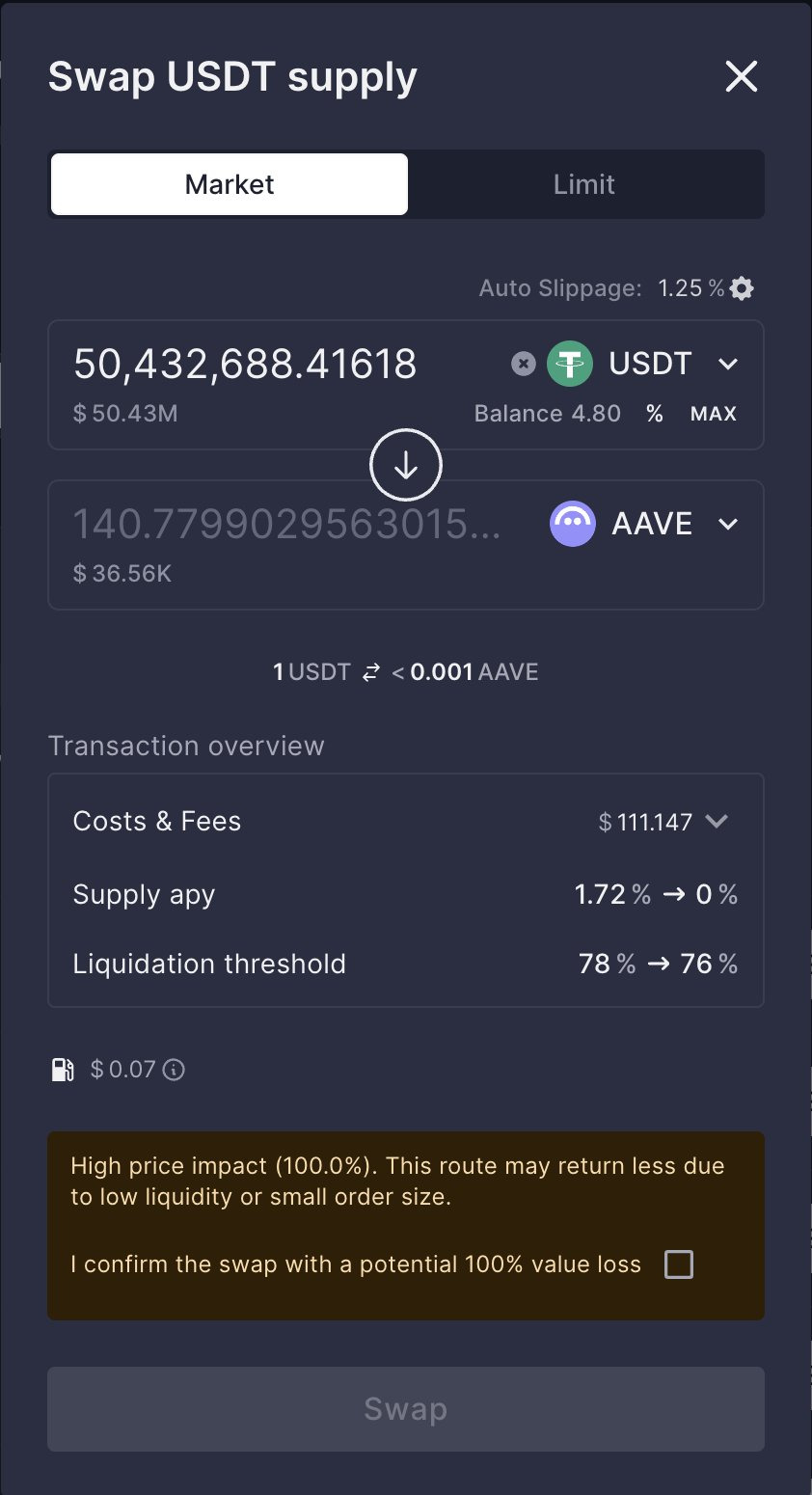
The incident occurred on Thursday, when the user went to convert $50.4 million worth of USDt (USDT) for Aave (AAVE) via decentralized exchange CoW Swap, but received only $36,500 worth of Aave due to a lack of liquidity and other infrastructure failures, generating a loss of just over $50 million.
Part of this loss was also a result of a Maximal Extractable Value (MEV) bot that executed a sandwich attack on the user, profiting nearly $10 million.
User ignored multiple warning signs
Aave said the user signed the transaction despite multiple warnings appearing on the platform’s interface.
This included alerts about a “high price impact” and a notice stating the route might return less due to low liquidity or small order size.
The user also ticked a confirmation box stating, “I confirm the swap with a potential 100% value loss,” Aave said.

Incident shows DeFi still needs work: CoW DAO
While Aave and CoW DAO, the team behind CoW Swap, said poor liquidity led to the “extreme price impact,” CoW DAO added that multiple infrastructure failures also played a role.
CoW DAO said a solver — a third-party service that finds the best way to do a trade — was affected by an outdated gas limit, which blocked better-priced quotes and left only a much worse option for the user to consider.
One solver, which had a far cheaper price quote, also failed to submit the transaction onchain when they had the opportunity, CoW DAO noted.
Related: Venus Protocol hit by $3.7M in ‘supply cap’ attack
CoW DAO said a possible mempool leak may have contributed to the $50 million price quote.
“We do not have final answers on all of the issues surfaced above yet,” CoW DAO said, adding that it is “committed to working through them transparently, with Aave and with the broader community.”
Magazine: What’s a ‘Network State’ and are there real-life examples? Big Questions


A threat actor bypassed Venus Protocol’s supply caps using Thena tokens to borrow multiple assets in what analysts suspect was a flash loan or price manipulation attack on BNB Chain.
Venus Protocol on BNB Chain has been hit with a $3.7 million exploit involving manipulation of the platform’s supply cap mechanisms. According to on-chain data, the threat actor used Thena (THE) tokens to bypass maximum supply restrictions and borrow several different digital assets from the protocol.
Analysts suspect the attack leveraged either flash loan tactics or price manipulation to artificially inflate the collateral’s value. Following the incident, Venus Protocol suspended borrowing and withdrawal functions for the THE token as a precautionary measure, though other markets on the platform remained unaffected.
Sources: Cointelegraph
This article was generated automatically by The Defiant’s AI news system from publicly available sources.


The SEC and CFTC have signed a memorandum of understanding to establish a unified regulatory approach to digital assets.
The U.S. Securities and Exchange Commission and Commodity Futures Trading Commission have signed a memorandum of understanding aimed at improving their combined regulatory approach to the digital asset sector. The agreement represents a formal commitment by both agencies to coordinate oversight and provide clearer guidance to the crypto industry.
The move follows months of joint efforts between the agencies to harmonize crypto regulation and align their oversight frameworks. Earlier coordination between the SEC and CFTC has included joint events and discussions focused on strengthening U.S. financial leadership in the crypto era and reducing regulatory gaps that have complicated compliance for digital asset firms.
Sources: SEC Press Release
This article was generated automatically by The Defiant’s AI news system from publicly available sources.

The regulatory provisions outlined in the US Digital Asset Market Structure Clarity Act, commonly referred to as the CLARITY Act, are drawing sharp critique from crypto researchers who warn the framework could tilt market control toward large financial institutions. Dr. Friederike Ernst, co-founder of the Gnosis blockchain protocol, argues that the bill presumes activity must flow through centralized intermediaries. That assumption, she says, could consolidate critical crypto rails in the hands of a few entrenched players and undermine the very ownership model blockchain technology promised to empower for users. While the Act does offer clarity on the jurisdictional lines between the Securities and Exchange Commission (SEC) and the Commodity Futures Trading Commission (CFTC) and safeguards peer-to-peer transactions and self-custody, it may fall short of protecting open, permissionless rails and decentralized finance (DeFi) protocols from undue centralization and new points of failure. The conversation surrounding the CLARITY Act thus remains highly contested among policymakers, industry participants, and investors who see opposing outcomes for innovation and consumer protection.
The CLARITY Act faces a broader political headwind: banks and traditional financial institutions have been vocal critics, arguing over how stablecoins and yields would be regulated under the proposed framework. In January, Coinbase announced it was pulling its support for the bill, citing provisions that could weaken DeFi, bar stablecoin yield, and hinder the growth of tokenized real-world assets. The exchange’s stance reflected a broader industry concern: a regulatory structure that does not adequately safeguard open networks could nudge activity away from permissionless rails in favor of centralized gatekeeping. A public debate about whether stablecoins should share interest with holders is one of the act’s most contentious points, underscoring the clash between innovation incentives and risk controls.
On the political front, some policymakers have voiced optimism. Senator Bernie Moreno signaled that the CLARITY bill could pass and reach the President’s desk for signature by April, suggesting a potential regulatory breakthrough on a timeline that has frustrated many in the sector. Yet others remain skeptical. Galaxy Digital’s Alex Thorn stressed that even if a vote clears the House and Senate, the timeline for enactment in 2026 remains uncertain, and the law could still fail to resolve core issues around DeFi, developer protections, and the scope of regulatory authority. The discord over these elements, Thorn noted in an X post, may be the real obstacle rather than merely procedural delays.
In tandem with the legislative discussion, commentary from industry figures has continued to surface. Some observers point to the CLARITY Act as a potential template for balancing investor protection with technological openness, while others warn that the wrong design could replicate the fragilities of legacy financial systems within crypto rails. The conversation has also touched on real-world implications for users who rely on self-custody and open networks, as well as for builders attempting to deploy compliant, scalable, and interoperable protocols in a rapidly evolving regulatory landscape.
A broader look at the discourse reveals a persistent tension: the same technology that promised to democratize ownership and reduce reliance on centralized intermediaries may, if regulatory clarity leans too far toward traditional rails, become another channel for gatekeeping and rent-seeking. The debate is not only about the letter of the law but also about the underlying philosophy of how crypto should operate in a mature financial system. Critics argue that a compliance-centric architecture could stifle experimentation and slow the deployment of open finance, while supporters contend that clear rules are essential to attract mainstream participation and protect consumers.
Key takeaways
- The CLARITY Act aims to map crypto market structure and clarifies jurisdiction between the SEC and the CFTC, while preserving some protections for peer-to-peer activity and self-custody.
- Critics warn that the act assumes activity will pass through centralized intermediaries, potentially concentrating control of crypto rails in a few traditional financial institutions.
- Coinbase pulled its support in January, citing concerns that the draft would weaken DeFi, bar stablecoin yield, and hinder tokenized real-world assets.
- Optimism among some lawmakers exists, with notes that the bill could reach the President’s desk by April, but analysts warn that 2026 enactment remains far from guaranteed.
- Industry attention remains sharp on DeFi protections, developer safeguards, and the scope of regulatory authority as the discussion moves forward.
- The debate sits at the intersection of innovation incentives and systemic risk controls, with potential implications for liquidity and market structure.
Tickers mentioned: $COIN
Sentiment: Neutral
Market context: The CLARITY Act represents a pivotal attempt to codify crypto regulatory boundaries in the United States, a backdrop against which liquidity, risk sentiment, and ETF-driven flows continue to shape the asset class as policymakers weigh open rails against consumer protections.
Why it matters
The central question around the CLARITY Act is whether crypto markets can mature within a framework that preserves user ownership and permissionless innovation while providing clear guardrails for institutions. If regulatory clarity leans toward reinforcing centralized pathways, it risks marginalizing open networks and DeFi protocols that operate without traditional intermediaries. That could slow the adoption of user-owned networks, limit non-custodial participation, and push developers toward more heavily regulated, centralized models. On the other hand, a well-defined regime that protects investors and combats fraud without stifling open architecture could help bridge crypto with conventional finance, encouraging more institutional capital and mainstream participation.
For users, the stakes lie in whether ownership of digital assets remains inherent to the network, rather than being mediated by third parties who control access and settlement. For builders and startups, regulatory clarity is a double-edged sword: it can provide a stable operating environment, but it can also constrain experimentation if safeguards are overly prescriptive. Investors watch closely because the shape of this regulatory framework can influence where liquidity pools form, how DeFi protocols fund development, and which tokenized assets gain traction in the market. The tension between innovation and oversight is likely to remain a defining theme for the crypto sector as lawmakers test ideas for how to harmonize risk management with the decentralized ethos that defined the early wave of blockchain technology.
Beyond the United States, the CLARITY Act is part of a broader, global conversation about how to regulate digital assets without erasing their core value proposition. Proponents argue that clear rules attract responsible institutions and protect consumers; skeptics warn that any framework that prescribes centralized gatekeeping could undermine the open, permissionless nature of blockchain networks. The ongoing dialogue, as reflected in statements from industry executives, lawmakers, and researchers, signals that the regulatory path for crypto will continue to evolve in ways that could redefine market structure, user participation, and the long-term viability of decentralized finance.
What to watch next
- Status of the CLARITY Act in Congress: whether a vote or movement toward the President’s desk occurs by April 2026.
- Details on DeFi protections, stablecoin yield provisions, and the potential scope of regulatory authority over tokenized assets.
- Industry positions as banks and tech platforms continue to lobby and respond to draft provisions.
- Public statements from policymakers and major crypto participants that could shift the balance between openness and oversight.
- Any new analyses or filings that outline how jurisdictional clarity translates into market behavior and investor protection.
Sources & verification
- Text of the CLARITY Act and official bill language on United States Congress site: Congress.gov
- Explainer: CLARITY Act and what it means for crypto week and beyond: Cointelegraph
- Coinbase pulled its support for the CLARITY Act, citing concerns about DeFi protections and stablecoin yield: Cointelegraph
- Discussion of DeFi and stablecoin yield concerns within the bill framework: Cointelegraph
- Crypto regulatory clarity matters for banks, ex-CFTC chief says: Cointelegraph
Regulatory clarity vs. open rails: what the CLARITY Act means for crypto
Regulators have framed the CLARITY Act as a necessary step toward a predictable, orderly market for digital assets. Yet the policy discourse vividly illustrates a fundamental tension: should market structure prioritize centralized oversight as a safety mechanism, or should it safeguard the open, permissionless rails that originally propelled blockchain innovation? Dr. Ernst’s assessment emphasizes a potential misalignment between the act’s prescriptive approach and the decentralized ownership model that many observers view as crypto’s core innovation. In practical terms, if the bill channels activity almost exclusively through regulated intermediaries, it could incentivize institutions to become gatekeepers rather than guardians of open networks, with ripple effects on user participation and the cost of accessing the technology.
Proponents of the Act argue that clear rules reduce uncertainty, protect consumers, and attract institutional capital that can scale infrastructure, liquidity, and product development. The debate is far from theoretical: the market’s ability to sustain high-quality liquidity and efficient price discovery rests on a stable regulatory backdrop. As policymakers weigh the balance between innovation and protection, stakeholders will be watching how any final version handles DeFi protections, the scope of developer rights, and the treatment of tokenized assets that bridge traditional finance with tokenized real-world value.
Ultimately, the CLARITY Act’s fate will influence how crypto markets evolve in the near term. If a path emerges that respects user ownership while delivering workable oversight, the sector might see greater participation from both retail and institutional players. If not, the risk remains that open networks could be sidelined by a framework that favors incumbents, potentially limiting the long-term growth and resilience of the market-wide ecosystem. The coming months will be decisive for users, builders, and investors who rely on clear, workable guidelines that do not compromise the foundational principles of decentralization and user sovereignty.

TLDR:
- Draft $5M deal from lobbyist Novelli links Milei to Libra token promotion.
- Milei exchanged messages with Novelli when the token contract was posted on X.
- Libra token briefly reached $4B market cap before collapsing 94% within hours.
- Authorities froze Hayden Davis’s assets; an investigation into payments and communications is ongoing.
Argentine President Linked to $5 Million Libra Token Agreement is under investigation after forensic analysis revealed a draft $5 million deal associated with the promotion of the Libra token, which briefly surged in market value.
Draft Deal and Payment Structure
Argentine President Linked to $5 Million Libra Token Agreement came to light after authorities examined Mauricio Novelli’s phone during a judicial probe.
The recovered draft document, reportedly written on February 11, 2025, outlines a total $5 million payment plan.
The draft divided payments into three segments. The first installment of $1.5 million would be delivered in tokens or cash as an advance.
A second $1.5 million was tied to a public endorsement of crypto entrepreneur Hayden Davis on X. The remaining $2 million involved a consulting contract with President Milei and his sister Karina for blockchain or AI services.
Investigators noted the draft did not specify the ultimate recipient of the funds. Screenshots of the document surfaced after prosecutors disclosed material previously held since November.
Experts confirmed the contract code referenced in the draft was not publicly available at the time of Milei’s social media post, adding context to the timing of the promotion.
Authorities are still evaluating whether the draft agreement was executed. The recovered messages suggest coordination between Novelli and Milei surrounding the token promotion.
Deleted chats partially recovered from Novelli’s phone also indicated he helped prepare Milei’s public response following the controversy.
Communication and Market Reaction
Digital forensic analysis revealed that Milei exchanged five messages with Novelli at the exact moment he posted the Libra token contract on X. The contract’s publication coincided with a rapid market surge, temporarily raising the token’s value to $4 billion.
The following hours saw the Libra token collapse by 94%, affecting more than 44,000 investors. Authorities have since frozen Hayden Davis’s assets while the investigation continues.
Novelli’s call records also show contact with Milei and his sister before and after the announcement. Multiple calls with presidential adviser Santiago Caputo were recorded as the government managed the controversy.
Another note, dated February 16, outlined a public statement designed to support the Libra token while denying direct financial involvement. Officials suggest it may have been intended for Milei to post on social media.
Milei has publicly denied active promotion, stating he merely shared information about the token.
The investigation remains ongoing as prosecutors review recovered communications, asset records, and other digital evidence. Further findings could clarify whether any financial arrangement linked to the Libra token promotion actually occurred.

TLDR:
- Iran arrests dozens accused of assisting Israeli strikes amid rising Strait of Hormuz tensions.
- Trump urges U.S. allies to deploy warships to secure the strategic Strait of Hormuz.
- Shipping disruptions and drone threats trigger fuel shortages across Asia and global markets.
- Formula One cancels Bahrain and Saudi races due to regional security concerns in the Gulf.
The Strait of Hormuz crisis intensifies as Iran arrests dozens accused of helping Israeli strikes. Washington pressures allies to deploy warships, triggering energy supply disruptions across Asia and forcing global trade adjustments.
Iran Arrests and Regional Tensions
According to a report by Reuters, Iran has detained dozens of people accused of aiding Israel in targeting military sites. State-linked media reported that the arrests occurred across multiple provinces, involving coordinated security operations.
Authorities claim suspects gathered intelligence on sensitive military and economic infrastructure. Officials say these actions were part of a wider effort to prevent ground-level tip-offs to Israel.
The arrests coincide with U.S. President Donald Trump has warned of potential strikes on Kharg Island. Trump also pressed allies to deploy warships to safeguard the Strait of Hormuz, a vital shipping route for global oil.
Diplomatic efforts by Oman and Egypt to mediate ceasefire discussions have been rebuffed by Washington. Iran insists no talks will occur until U.S. and Israeli strikes stop, maintaining a firm stance on security concerns.
The ongoing tension has increased risks for vessels passing through the Strait of Hormuz.
Several countries continue to explore diplomatic channels to avoid further escalation, though results remain limited.
Fuel Shortages and Economic Ripple Effects
Shipping disruptions in the Strait of Hormuz have caused significant delays for tankers and cargo vessels. Drone attacks and regional military activity have raised concerns for commercial and fuel shipments.
Japan announced the release of 80 million barrels of oil from national reserves to stabilize supply. The release represents about 45 days of consumption but will reduce reserves by roughly seventeen percent.
India faces domestic unrest due to cooking gas shortages, with protests erupting across major cities. Residents queued for hours while some households resorted to burning wood and other materials for meals.
Iran has allowed limited passage to Indian vessels, yet several tankers remain stranded. Sailors reported drones and fighter jets nearby while awaiting clearance through the waterway, heightening anxiety.
Global sports have also been affected, with Formula One canceling races in Bahrain and Saudi Arabia. Security threats and airport closures across the Gulf made hosting these events unsafe, reducing the season calendar from twenty-four to twenty-two races.
The Strait of Hormuz crisis continues to disrupt global trade and fuel supplies. Governments, shipping companies, and international organizations are monitoring developments closely to manage risks.
TLDR:
- Bitcoin generated 685M social interactions in 24 hours, marking the highest engagement level recorded in a year.
- BTC price remains 43% below its $125,071 all-time high reached in October 2025 despite rising attention.
- Over 75,000 creators posted about Bitcoin, showing broader participation across social platforms.
- Bitcoin social dominance rose 32.58% week-over-week as discussion across the crypto sector accelerated.
Bitcoin social engagement has surged to its highest level in a year while price remains far below previous highs. The divergence between market attention and valuation has become one of the most discussed developments in the cryptocurrency sector.
Bitcoin Social Engagement Surges to 52-Week High
Bitcoin social engagement increased sharply during the past 24 hours. Data shows the asset generated 685 million interactions across social media platforms.
During the same period, engagement recorded an intraday peak of 435 million interactions. This represents the highest level of activity registered in the past 52 weeks.
Social discussion has also expanded significantly. Around 287,629 Bitcoin mentions appeared across social networks, reflecting an 81% increase month-over-month.
Participation is also rising quickly. Approximately 75,135 unique creators published Bitcoin-related posts within the same timeframe.
Creator growth stands 26% higher month-over-month and 11% higher day-over-day. This shows a broader group of users joining the conversation.
Bitcoin’s share of overall cryptocurrency discussion also climbed during the week. Social dominance increased 32.58% week-over-week, signaling stronger market attention.
Rising engagement often signals growing narrative momentum. Increased conversation frequently appears before major market movements.
Bitcoin Price Lags Despite Rising Market Attention
Bitcoin price remains below previous cycle highs despite the surge in attention. The asset currently trades near $71,384.
The market previously reached an all-time high of $125,071 on October 6, 2025. From that level, Bitcoin entered a sharp correction.
The decline pushed the asset roughly 43% below the record peak. Market volatility increased as traders adjusted positions after the rally.
During the correction, Bitcoin also recorded a 52-week low of $64,080 on February 24, 2026. Prices have since recovered modestly from that level.
Even with the recovery, Bitcoin remains within a consolidation range. Many traders describe the current phase as a post-rally adjustment period.
The divergence between price and engagement has therefore drawn attention across the market.
Rising creator participation continues to expand Bitcoin’s online presence. As discussion spreads across networks, the gap between market attention and price remains unresolved.
TLDR:
- Venus Protocol lost $3.7M in a flash loan attack using THE token as collateral.
- THE token price surged to $0.563 before collapsing to $0.22 during liquidation events.
- Six Venus markets including BCH and LTC were temporarily frozen after the exploit.
- Borrowing and withdrawals for THE token paused while investigation continues.
Venus Protocol flash loan attack on BNB Chain caused over $3.7 million in losses. THE token was exploited to manipulate collateral, enabling the attacker to borrow high-value assets before the market collapsed.
Exploit Mechanics and Borrowing Strategy
The Venus Protocol flash loan attack targeted the Core Pool on BNB Chain, using THE token as collateral. The attacker accumulated approximately 84% of THE supply over nine months to prepare for the exploit.
Instead of following the standard deposit process, the attacker directly transferred tokens to the vTHE contract. This allowed collateral positions far above the supply cap, reaching 53.2 million THE tokens, nearly 3.7 times the protocol’s limit.
Using this inflated collateral, the attacker borrowed about 20 BTC, 1.5 million CAKE, 200 BNB, and 1.58 million USDC.
The strategy repeated in a loop: deposit THE, borrow assets, purchase more THE, and wait for the TWAP oracle to adjust, inflating collateral value.
The manipulation caused THE’s price to spike from $0.263 to $0.563 before falling to $0.22 as liquidations occurred. This pattern mirrored prior DeFi exploits involving low-liquidity tokens and automated liquidations.
Venus Protocol Response and Market Measures
Following the attack, Venus froze six high-risk markets, including BCH, LTC, UNI, AAVE, FIL, and TWT. Borrowing and withdrawals of THE tokens were temporarily paused while all other markets remained operational.
Investigations suggest the attacker may have used Tornado Cash to fund operations. Venus has since tightened collateral rules and plans to review oracle mechanisms to prevent similar attacks in the future.
The estimated bad debt ranges from $1.7 million to $2.15 million, mainly from the CAKE market. The protocol confirmed the unusual activity was confined to the THE and CAKE markets and did not affect the broader ecosystem.
Security analysts continue monitoring Venus to assess the handling of low-liquidity tokens. Investors are advised to exercise caution when lending or borrowing such tokens, ensuring robust protocols are in place to minimize risk.

Bruno Fernandes shows his true colours when asked about Manchester United record

The Amazon Echo Dot Max has dropped to its lowest price

Jessie Buckley wins Best Actress Oscar for Hamnet ‘This is the greatest honour’


-
 Tech5 days ago
A 1,300-Pound NASA Spacecraft To Re-Enter Earth’s Atmosphere
-
Crypto World2 days ago
HYPE Token Enters Net Deflation as HyperCore Buybacks Outpace Staking Rewards
-

 News Videos7 days ago
10th Algebra | Financial Planning | Question Bank Solution | Board Exam 2026
-

 Business5 days ago
ExxonMobil seeks to move corporate registration from New Jersey to Texas
-

 Crypto World6 days ago
Paradigm, a16z, Winklevoss Capital, Balaji Srinivasan among investors in ZODL
-

 Fashion2 days ago
Weekend Open Thread: Addict Lip Glow
-

 Tech5 days ago
ChatGPT will now generate interactive visuals to help you with math and science concepts
-
Sports1 day ago
Why Duke and Michigan Are Dead Even Entering Selection Sunday
-

 NewsBeat4 days ago
Residents reaction as Shildon murder probe enters second day
-

 Business5 days ago
Search Enters Sixth Week With New Leads in Tucson Abduction Case
-
 NewsBeat6 days ago
Pagazzi Lighting enters administration as 70 jobs lost and 11 stores close across Scotland
-

 Business8 hours ago
Search for Savannah Guthrie’s Mother Enters Seventh Week with No Arrests
-

 Tech7 days ago
Despite challenges, Ireland sixth in EU for board gender diversity
-

 Business2 days ago
US Airports Launch Donation Drives for Unpaid TSA Workers as Partial Government Shutdown Enters Fifth Week
-
Crypto World1 day ago
Coinbase and Bybit in Investment Talks: Could Bybit Finally Enter the US Crypto Market?
-

 NewsBeat5 days ago
I Entered The Manosphere. Nothing Could Prepare Me For What I Found.
-

 Business6 days ago
Search Enters 39th Day with FBI Tip Line Developments and No Major Breakthroughs
-

 Business2 days ago
Country star Brantley Gilbert enters growing non-alcoholic beer market
-

 Sports7 days ago
Skateboarding World Championships: Britain’s Sky Brown wins park gold
-
 Crypto World5 days ago
Will Chainlink price reclaim $10 amid volatility squeeze?

