Crypto World
Vitalik Buterin Reveals the Easy Money Strategy for Prediction Markets

Prediction markets are supposed to be the internet’s truth machine. They offer a place where real money forces honest thinking. Yet, they have a structural vulnerability.
Hype, fear, and confirmation routinely push the odds of absurd outcomes far higher than reality warrants. Recognizing this truth, a small minority of level-headed contrarians have sniffed out a predictable, exploitable pattern.
Betting Against the Crowd
Vitalik Buterin was notably the first public figure to confirm this trend. In January, the Ethereum co-founder revealed in an interview that he had made $70,000 on Polymarket by using this tactic.
Buterin explained that he had spent $440,000 on a series of events contracts, which he described as “crazy and irrational predictions.” His strategy worked, yielding him a comfortable 16 percent return.
What stuck was the simple thought process behind his bets. The idea is to find the most absurd and highly unlikely polls that have gained the most traction and go against the current.
On prediction market platforms, these types of contracts are easy to find.
In fact, in the past year, the volume on irrational markets has grown substantially. A more politically charged news cycle and an expanding user base with a higher appetite for speculative bets have driven much of that growth.
This is where human psychology comes into play. When a story dominates the news cycle, people instinctively treat its emotional intensity as evidence of its likelihood.
A threatening tweet from a president, a congressional hearing about UFOs, or a pundit screaming about economic collapse all create a feeling of imminence that has nothing to do with actual probability.
The result is an emotionally charged outcome that gets systematically overpriced.
The Polls That Defied Common Sense
Prediction market polls range from anything from crypto to politics and sports to culture. Some of them are straightforward, aiming to forecast who will be the next Democratic presidential nominee or this year’s LaLiga winner.
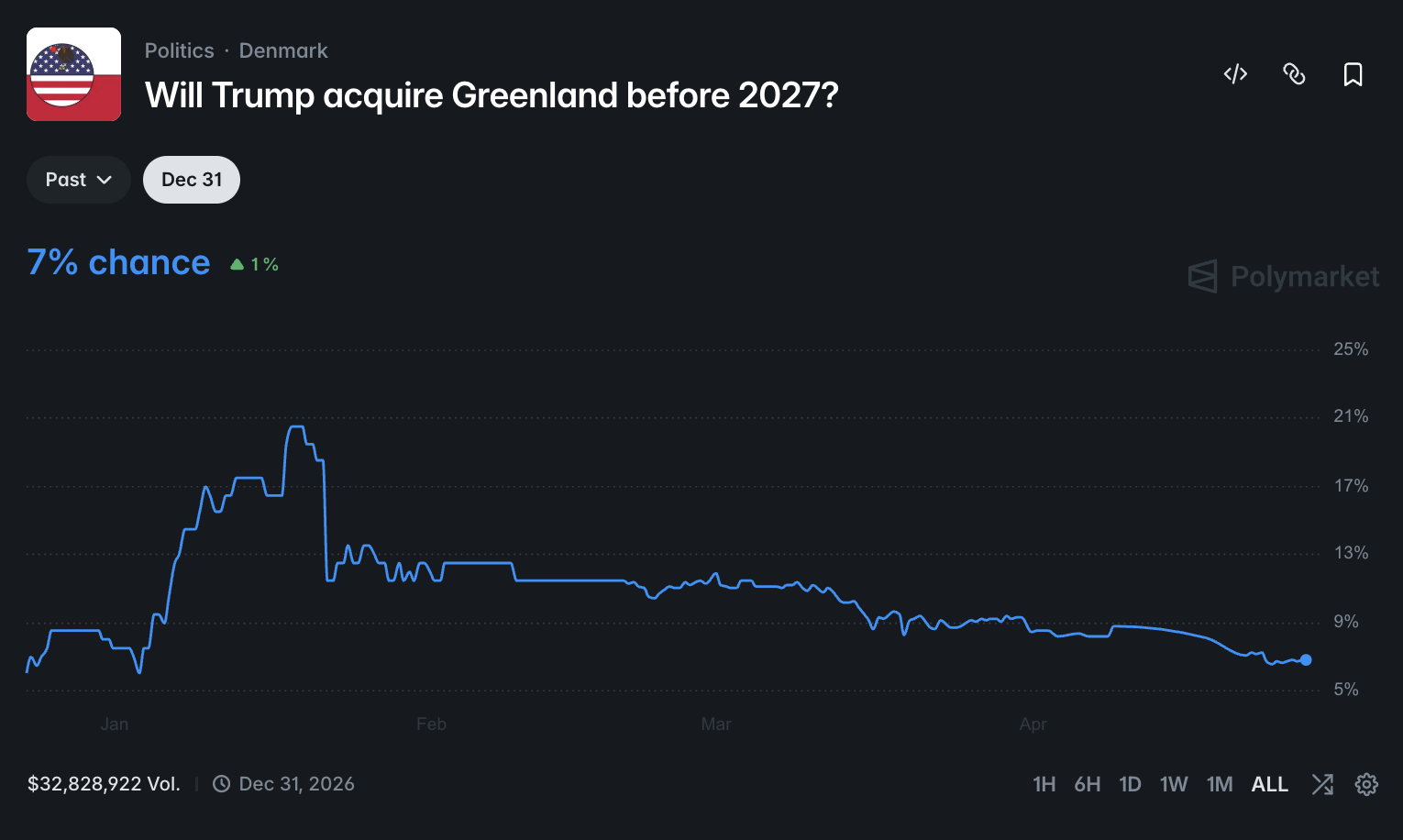
Others verge on the side of absurdity. So far this year, there’s been an abundance of them. One surfaced at the beginning of the year during the height of Trump’s face-off with his European allies over the sovereignty of Greenland.
Bettors began flocking to Polymarket to predict how soon the United States would acquire the island. Though the odds remained low, they reached a 21 percent ceiling around the time Trump posted on social media, threatening to take Greenland by force.
Though not impossible, a scenario where Trump invades Greenland is highly unlikely. Such a move would mean attacking a NATO ally and potentially fracturing the entire Western alliance. The consequences would be catastrophic.
Despite this, the traction the polls received was alarming. One of them, which is still active and seeks to predict whether Trump will acquire the island before the end of 2026, has generated nearly $33 million in trading volume.

Polls predicting that Trump would win the Nobel Peace Prize also surged in trading. Amid public remarks by the president himself touting the award, many bettors placed their money on that outcome, with some odds reaching 14 percent. Buterin bet against them, arguing they were fueled by sentiment rather than logic or actual probability.
Other contracts were equally driven by hype, varying from predicting whether the US government would confirm alien life to whether the US dollar would completely collapse before the end of the year. Despite their low probability, many received positive bets in the double digits.
How the News Warps Judgment
These behaviors have a name in behavioral economics. They’re a known phenomenon called narrative bias.
When applied to the psychology of prediction markets, they represent the tendency to treat how dramatic or emotionally gripping a story feels as a measure of how likely it is to actually happen.
The more a scenario dominates headlines, the more plausible it feels, regardless of whether the underlying facts support it.
Eric Zitzewitz, an economics professor at Dartmouth College who studies prediction markets, noted in an October interview with Ipsos that politics and sports are particularly fertile ground for this type of distortion.
He even pointed out that this is a necessary factor for the industry to function. Without them, informed traders –like Buterin– have no one to trade against.
“For markets to work you need either people to be overconfident or willing to lose money on average because it’s fun,” he said.
Confirmation bias makes the problem more acute.
Bettors who already believe Trump is an unconventional disruptor are more likely to find the Greenland invasion plausible. Those primed by years of UFO discourse are more likely to treat a congressional hearing as a breakthrough.
When a market’s odds start climbing, the movement itself becomes a signal.
Much like a meme coin caught in a hype cycle, newcomers interpret the crowd’s enthusiasm as collective wisdom and pile in, driving odds even higher. At that point, the market stops reflecting probability and starts reflecting momentum.
The pattern is consistent and repeatable enough that a small group of disciplined traders has built entire strategies around exploiting it. Buterin is the most prominent, but he is not alone.
The Science Behind Boring Bets
Domer, one of Polymarket’s biggest bettors and a former professional poker player, has won $400,000 in bets on the platform by employing a similar brand of contrarianism.
His most striking win came when he bet $100,000 that Cardinal Robert Francis Prevost would become the next pope. At the time, the market gave Prevost only a 5 percent chance.
Domer pulled off similar moves before, correctly predicting Sam Bankman-Fried’s 25-year prison sentence and Sam Altman’s 2023 firing as OpenAI CEO.
Across hundreds of bets, the edge holds– and there’s data to back up why.
Polymarket publishes on its own accuracy page that 73.3 percent of all resolved markets on the platform end in “No.”
Most questions are framed around specific events that materialize by a deadline, meaning the status quo has a built-in advantage.
An engineer named Sterling Crispin confirmed this tendency by building a bot that automatically buys ‘No’ on every non-sports market it finds. His success rate was nearly identical to Polymarket’s own data. According to his findings, 73.4% of all bets on the platform do not occur.
The contrarian edge, then, is not some obscure secret. It only exists because human irrationality is a permanent feature of these markets, rather than a bug to be fixed.
The post Vitalik Buterin Reveals the Easy Money Strategy for Prediction Markets appeared first on BeInCrypto.
You must be logged in to post a comment Login