

Crypto World
Vitalik Buterin Unveils Ethereum Quantum-Resistance Roadmap


Vitalik Buterin has outlined a four-pronged plan to harden Ethereum against quantum threats, identifying four areas most vulnerable: validator signatures, data storage, user account signatures, and zero-knowledge proofs. As headlines spotlight quantum risk across crypto, including discussions around Bitcoin (CRYPTO: BTC) and other chains, the Ethereum co-founder argues that a careful, long-horizon upgrade path is essential. In a Thursday post, he described a roadmap that hinges on selecting a post-quantum hash function for all signatures—an issue that could determine the network’s security stance for years. The discussion echoes prior proposals, including Justin Drake’s Lean Ethereum idea proposed in August 2025.
Key takeaways
- Buterin identifies four pillars for quantum resistance: validator signatures, data storage, user account signatures, and zero-knowledge proofs, framing a holistic upgrade rather than piecemeal fixes.
- The plan contemplates replacing the current BLS signatures with lean, quantum-safe hash-based signatures, with the choice of hash function carrying long-term implications for the network.
- Data storage would transition from KZG to STARKs, a move that aims to preserve verifiability while enhancing quantum resistance, albeit with significant engineering work ahead.
- User accounts would shift from ECDSA toward signatures compatible with lattice-based, quantum-resilient schemes, though heavier gas costs are a concern.
- A long-term solution centers on protocol-layer recursive signatures and proof aggregation to keep on-chain verification costs in check, potentially enabling vast scalability for quantum-resistant proofs.
- The conversation nods to ongoing research, including ETHresearch discussions on recursive-STARK approaches and the broader Strawmap effort to accelerate finality and throughput.
Sentiment: Neutral
Market context: The push toward quantum-resistant primitives sits against a backdrop of ongoing network upgrades and a broader move toward scalable zero-knowledge proofs, with developers weighing security, efficiency, and long-term viability as they plan multi-year transitions.
Why it matters
The four-pronged approach to quantum resistance is more than a theoretical exercise; it signals how Ethereum intends to preserve user trust as quantum threats loom on the horizon. If effective, a hash-based signature layer could become the de facto standard for post-quantum security, shaping how users interact with wallets, smart contracts, and validator participation for years to come. The decision on the hash function is particularly consequential: once a standard is chosen, it tends to anchor the protocol for a generation, influencing tooling, hardware requirements, and compatibility with future cryptographic advances.
On data storage, the plan to replace KZG with STARKs reflects a subtle shift in cryptographic assumptions. STARKs are lauded for being quantum-resistant and transparent, but integrating them into Ethereum’s data availability and verification stack would demand substantial engineering effort, optimization, and rigorous security audits. Buterin has framed it as “manageable, but there’s a lot of engineering work to do.” The move would balance the need for robust post-quantum guarantees with the practical realities of a live, globally used network.
Account signatures represent another frontier. Ethereum currently relies on ECDSA, a staple of today’s cryptographic ecosystem. Moving to a system that can accommodate lattice-based or other quantum-safe schemes may impose heavier computational loads and gas costs in the near term. Yet the long‑term payoff could be a network that remains secure even as quantum computing capabilities grow. Buterin points to a longer-term fix—protocol-layer recursive signature and proof aggregation—that could dramatically reduce gas overheads by verifying many signatures and proofs within a single frame. If realized, that approach could unlock scalable, quantum-resistant transactions without sacrificing usability.
A central theme across the discussion is the balance between immediate practicality and enduring security. Quantum-safe signatures are not a cosmetic upgrade; they alter core data paths, from how validators validate blocks to how users sign transactions and how proofs are verified. The blockchain community increasingly recognizes that a “one-size-fits-all” cryptographic choice may not suffice; instead, a layered strategy—where traditional primitives coexist with post-quantum alternatives and where recursive techniques optimize verification—could define Ethereum’s security posture for years to come.
Beyond the cryptographic specifics, the conversation is anchored in ongoing academic and developer experiments. For example, researchers have explored recursive-STARK concepts to compress bandwidth and computation, including discussions on a bandwidth-efficient mempool that leverages recursive proofs. This line of inquiry mirrors Ethereum’s broader push toward scalable, verifiable computation that remains tenable in a post-quantum world. The discussion also nods to real-world upgrade planning, such as Lean Ethereum, which Justin Drake proposed in August 2025 as a pragmatic framework for accelerating quantum readiness without destabilizing current operations.
In parallel, governance and roadmap conversations continue to unfold within the Ethereum Foundation and the wider developer community. Buterin’s own posts have highlighted expectations that progress on “Strawmap” could yield progressive decreases in both slot time and finality time, signaling a more agile path to security without sacrificing decentralization or user experience. The architecture changes under consideration—ranging from signature schemes to data verification protocols—must harmonize with these operational expectations to minimize disruption while maximizing resilience against quantum-era threats.
What to watch next
- Updates on Lean Ethereum: Any formal milestones or testnet deployments that demonstrate practical quantum-ready components in action.
- Hash-function selection for post-quantum signatures: The criteria, security proofs, and network-wide implications of choosing a long-term standard.
- Progress toward STARK-based data storage: Engineering roadmaps, performance benchmarks, and on-chain verification strategies.
- Adoption of lattice-based or alternative signatures for user accounts: Changes to wallets, client libraries, and tooling compatibility.
- Implementation of recursive signatures and proof aggregation: Realistic timelines, gas impact assessments, and potential protocol changes needed to support such a paradigm.
Sources & verification
- Vitalik Buterin’s quantum-resistance roadmap post and related discussions: https://x.com/VitalikButerin/status/2027075026378543132
- Lean Ethereum proposal by Justin Drake: https://cointelegraph.com/news/justin-drake-proposes-lean-ethereum
- Headlines about quantum threats to Bitcoin: https://cointelegraph.com/news/saylor-says-quantum-threat-to-bitcoin-is-more-than-10-years-out-expects-coordinated-global-upgrade-if-risk-emerges
- Quantum-resistant data storage and STARKs vs KZG discussion: https://cointelegraph.com/news/vitalik-details-roadmap-for-faster-quantum-resistant-ethereum
- Ethereum Foundation quantum gas‑limit priorities and protocol considerations: https://cointelegraph.com/news/ethereum-foundation-quantum-gas-limit-priorities-protocol
- Strawmap and related timing expectations: https://cointelegraph.com/magazine/bitcoin-7-years-upgrade-post-quantum-bip-360-co-author/
- Recursive-STARK mempool concept: https://ethresear.ch/t/recursive-stark-based-bandwidth-efficient-mempool/23838
Ethereum’s quantum resilience roadmap: four frontiers and the road ahead
Ethereum’s path to quantum resistance, as articulated by Buterin, centers on four pivotal domains: validator signatures, data storage, user account signatures, and zero-knowledge proofs. The proposal calls for replacing the current Boneh-Lynn-Shacham (BLS) consensus signatures with a lean, hash-based, post-quantum alternative. The selection of the hash function is underscored as a long-term decision, potentially locking in an approach for years to come. This shift aims to preserve the integrity of validator operations while mitigating the risk that quantum computers could break current signatures used to attest to blocks and transactions.
In parallel, the data layer would transition away from KZG-based storage to STARKs, a move designed to maintain verifiability under quantum pressure. Buterin notes this is a technically manageable transition, yet it requires substantial engineering effort to integrate seamlessly with Ethereum’s existing data availability and verification mechanisms. If realized, the change would address a core vulnerability by ensuring that data proofs remain verifiable even in a quantum era, without compromising network performance.
On user accounts, the plan envisions a broader compatibility with signature schemes beyond ECDSA, including lattice-based approaches that resist quantum attacks. The practical challenge here is gas consumption: quantum-safe signatures tend to be heavier to compute, which could elevate gas costs in the near term. The longer-term payoff, though, would be a network able to function securely even when advanced quantum hardware becomes capable of breaking traditional cryptographic keys. To counterbalance the added computational load, Buterin points to a protocol-layer solution—recursive signature and proof aggregation—that could dramatically reduce on-chain gas overhead by consolidating verification work into master frames that validate thousands of signatures or proofs at once.
Quantum-resistant proofs pose another cost hurdle, motivating the same aggregation strategy. Instead of individually verifying every signature and proof on-chain, a single, compiled structure—an overarching validation frame—would authorize thousands of sub-validations in a single operation. This approach could reduce the per-transactions verification burden to near-zero costs in practice, enabling a scalable model for post-quantum proof workloads. The narrative echoes ongoing research, including discussions around a recursive-STARK-based bandwidth-efficient mempool, which envisions more efficient data flow and validation under heavy workloads.
Finally, the Strawmap discussions hint at a broader tempo for the network upgrade. Buterin and researchers anticipate incremental improvements in slot times and finality, signaling a measured cadence for upgrading cryptographic primitives without triggering disruptive forks. The convergence of these threads—signature upgrades, data storage shifts, and aggregation-based efficiency—paints a future where Ethereum (ETH) remains secure and usable as quantum capabilities advance. The dialogue around these topics reflects a mature, evidence-based approach to governance and engineering, balancing theoretical security with the practicalities of a live, billions-of-dollars ecosystem.

Key Takeaways
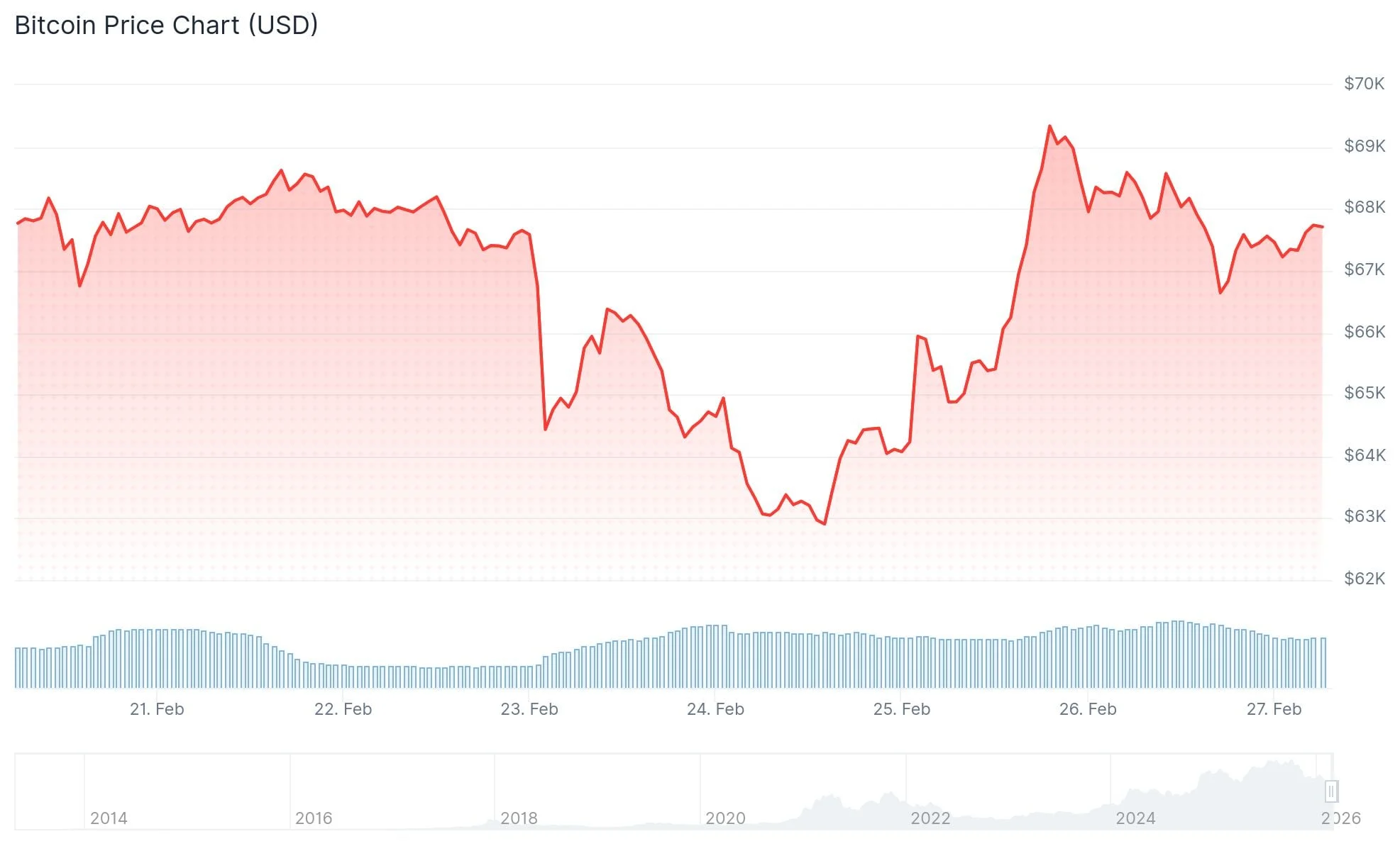
- Bitcoin declined 1.5% on Friday to approximately $67,766 while maintaining a modest 0.6% gain for the week within a constrained price channel
- Market observers characterize the downturn as a leverage liquidation event rather than a directional shift, with demand resuming by Friday’s open
- Alternative cryptocurrencies surpassed Bitcoin’s weekly performance — Cardano climbed 7%, Solana rose 5.5%, Ethereum gained 4.8%, BNB advanced 4.3% — while XRP declined 0.1%
- Nvidia (NVDA) dropped 5.5% following quarterly results, weighing on U.S. equity futures and dragging digital assets lower alongside traditional markets
- Asian stock markets are headed for their strongest February performance since 1998, siphoning investment flows from American exchanges
Bitcoin experienced downward pressure Friday as U.S. equity index futures retreated in the wake of Nvidia’s notable share price decline. The cryptocurrency weakness reflects a wider risk-averse sentiment spreading through international financial markets.
Bitcoin was changing hands near $67,766, representing a 1.5% daily decrease. However, the leading digital currency maintains a 0.6% weekly advance.
Ethereum decreased 1.5% over 24 hours to slightly above $2,047. Both leading cryptocurrencies continue trading within tight boundaries established following the Feb. 5 market correction.
Nvidia tumbled 5.5% Thursday despite surpassing fourth-quarter profit forecasts. The decline seemingly captured market skepticism regarding the sustainability of elevated artificial intelligence expenditure justifying current price levels.
Digital currencies mirrored equity weakness as market participants retreated from higher-risk instruments. This correlation has persisted for several weeks, with Bitcoin demonstrating strong sensitivity to Nasdaq movements.
“The current market action shows Bitcoin behaving like a conventional risk asset,” explained Daniel Reis-Faria, CEO of ZeroStack. “The Nasdaq retreated following Nvidia’s results, and cryptocurrency markets tracked that movement.”
He characterized the decline as a technical adjustment rather than a fundamental shift. “Considerable leverage had accumulated during the recent rally, and when equities weaken, crypto typically serves as the initial de-risking outlet for traders.”
By Friday’s trading session, hourly cryptocurrency returns had reversed into positive territory. This recovery pattern indicates renewed buying interest following overnight liquidations that eliminated excessive leveraged positions.
Alternative Tokens Show Weekly Strength Over Bitcoin
Cardano topped major cryptocurrency performance with a 7% weekly increase. Solana advanced 5.5%, Ethereum gained 4.8%, and BNB rose 4.3%, each surpassing Bitcoin’s weekly results.
XRP represented the sole major token posting negative seven-day returns, declining 0.1% weekly and 3.7% over 24 hours. This relative weakness proved notable considering most alternative cryptocurrencies weathered identical macroeconomic headwinds while preserving gains.
Equity Index Futures and International Capital Movements
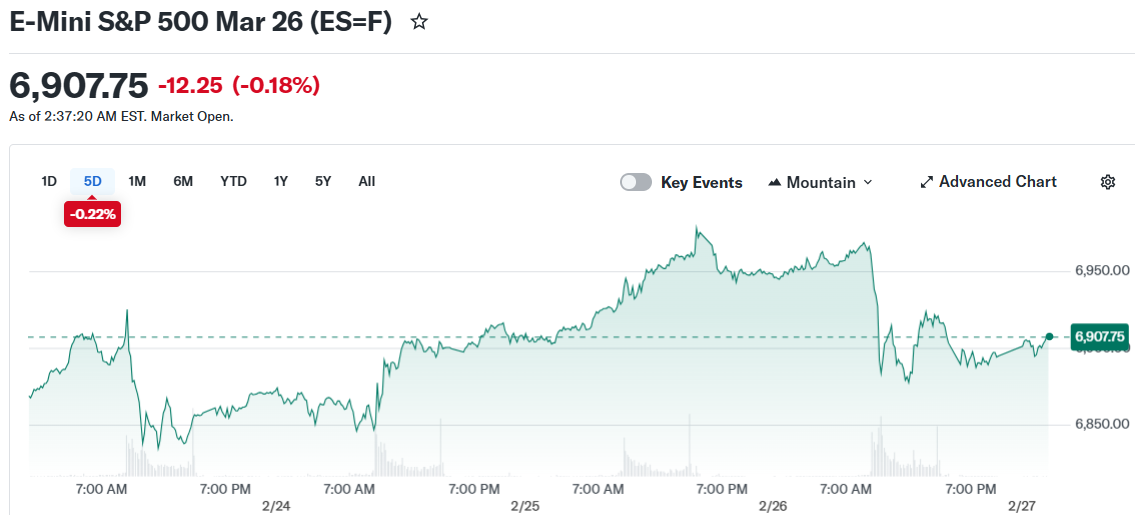
Dow futures retreated approximately 0.6%, S&P 500 futures fell 0.4%, and Nasdaq 100 futures declined 0.3% during Friday’s overnight session.
Asian stock markets are positioned for their most robust February showing since 1998. South Korean technology equities surged approximately 20% this month as capital flows favored AI infrastructure companies.
The MSCI Asia Pacific Index appears set to exceed S&P 500 returns for a third consecutive month. This geographical rotation has redirected investment capital from American markets.
Block shares surged over 23% in after-hours trading following CEO Jack Dorsey’s announcement of nearly 50% workforce reduction, attributing the restructuring to artificial intelligence capabilities transforming company operations.
Market attention now shifts to Friday’s producer price index release, with economic forecasters projecting a 0.3% monthly increase for both headline and core wholesale inflation metrics.

Ripple is transforming how funding and support are distributed across the XRP Ledger ecosystem, shifting toward a more distributed model.
The company announced the changes on February 26. It positions 2026 as a transition point in how builders access capital, mentorship, and technical support on XRPL.
XRP Ledger Enters New Phase as Ripple Expands Funding Channels in 2026
In a recent blog, Ripple noted that since 2017, it has deployed more than $550 million into XRP Ledger ecosystem initiatives, including non-equity grants, builder incentives, strategic partnerships, and growth programs.
The firm noted that 2026 introduces a transition toward a broader, more distributed funding structure. The stated goal is to give builders multiple funding channels.
“As the ecosystem matures, the focus is shifting toward expanding access to funding through more distributed and independent pathways so builders have multiple avenues to scale,” the blog read.
Follow us on X to get the latest news as it happens
As part of the plan, the organization introduced several new and scaled-up initiatives planned for 2026.
XAO DAO is a hybrid Decentralized Autonomous Organization (DAO) built for the XRP Ledger. It will empower members to collectively allocate resources through community grants, feedback loops, and direct DAO proposals. Additionally, this enables fast, low-friction funding for developers and early-stage projects.
“By shifting decision-making power toward a broader group of stakeholders, XAO DAO represents a significant step toward a more resilient and community-led governance model for the XRPL,” the firm said.
XRPL Commons, an independent organization, will continue supporting builders through initiatives like the GLOW program and The Aquarium, a 9-week incubator in Paris that has operated since 2023. The firm is also developing a new regional entity, XRP Asia, to serve the APAC builder community with localized funding and support.
In addition, the University Digital Asset Xcelerator (UDAX), which launched its inaugural cohort with UC Berkeley in fall 2025, is expanding in 2026 to Fundação Getulio Vargas in São Paulo, the University of Oxford, and UC Berkeley again in the fall.
On the institutional side, Ripple is launching a FinTech Builder Program to support startups building institutional-grade financial applications on XRPL.
The blog also revealed that a growing number of venture capital firms are mentoring teams, investing in startups, and connecting XRPL builders with global capital networks. Partner organizations include a100x Ventures, Superscrypt, Reforge, New Form Capital, Dragonfly, Pantera, Franklin Templeton, and Tenity. Their involvement signals broader institutional confidence in XRPL.
To enable access to this expanding ecosystem, Ripple announced that a new dedicated XRPL funding hub will soon launch. This will serve as a single entry point for builders to discover grants, accelerators, and support programs across the entire ecosystem.
XRP Price Slides Despite Ripple’s 2026 Expansion
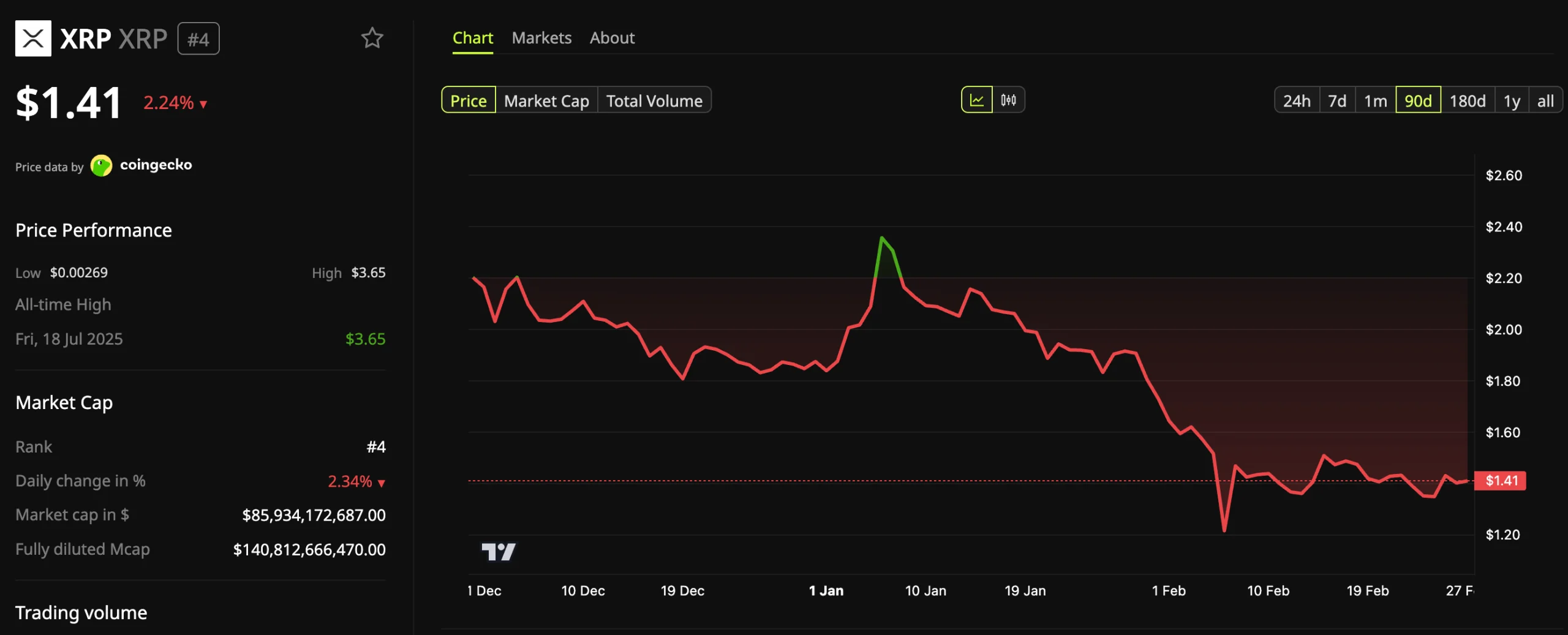
The new initiatives come as XRP’s performance continues to track the broader market. BeInCrypto Markets data shows that the altcoin declined 2.24% over the past day. At press time, XRP was trading at $1.41.
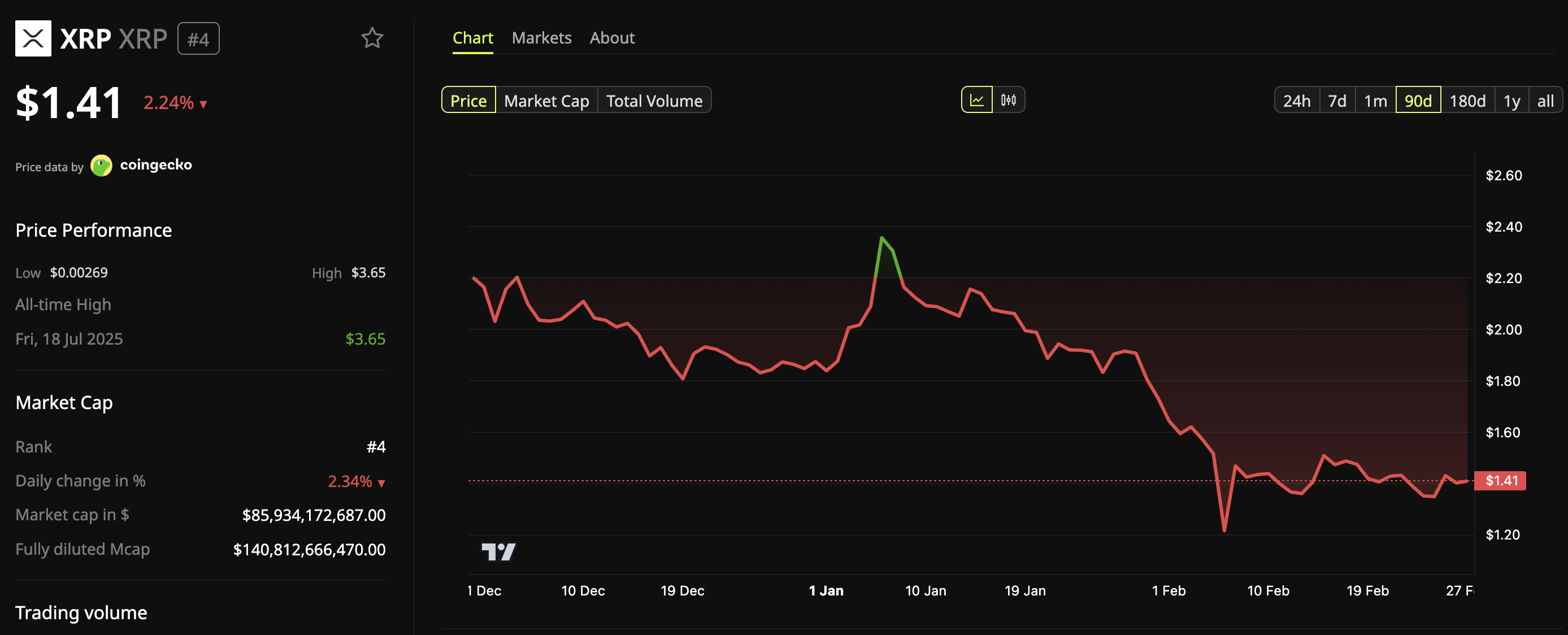
In the short term, the funding shift is unlikely to move XRP’s price. Market performance is typically driven by liquidity conditions, macro trends, and regulatory developments rather than ecosystem restructuring.
Over the medium- to long-term, the impact depends on execution. If the FinTech Builder Program, XAO DAO, and venture participation translate into higher on-chain activity, institutional pilots, and real financial applications, sentiment could strengthen.
Subscribe to our YouTube channel to watch leaders and journalists provide expert insights
Sustained adoption, transaction growth, and deeper integration of XRP into payment or tokenization flows would be required for any structural price effect to occur. Ultimately, usage metrics, not funding headlines, will determine whether this shift supports long-term valuation.


Morgan Stanley, a Wall Street bank managing nearly $9 trillion in assets, plans to offer clients Bitcoin (BTC) custody, trading, lending, and yield-generation services.
The firm is one of the largest financial institutions in the United States. In addition, the client base spans retail investors, high-net-worth individuals, and institutional players.
Why it matters:
- Morgan Stanley’s entry into BTC services would give clients direct access to Bitcoin through a regulated, trusted institution.
- Furthermore, adding yield and lending products expands BTC’s utility beyond simple custody, attracting clients seeking returns on digital asset holdings.
- Wall Street adoption at this scale signals Bitcoin’s shift from speculation to structural integration in global finance.
The details:
The big picture:
- In addition, River data shows Fidelity Investments, Bank of America, and Morgan Stanley each recommend clients allocate 1–5% of portfolios to BTC.
- Meanwhile, Morgan Stanley’s move follows a broader trend of major banks expanding crypto service offerings to institutional and retail clients.
[PRESS RELEASE – San Francisco, CA, USA, February 26th, 2026]
PACT, the leading on-chain credit and payments infrastructure protocol and #1 RWA protocol on Aptos, today announced that its native token, $PACT, is now supported on the world’s most trusted cryptocurrency exchanges, including Kraken, MEXC, and Gate.
PACT Expands Access as It Builds the Future of On-Chain Finance
PACT enables end-to-end, fully programmable credit infrastructure, supporting origination, servicing, repayments, covenants, waterfalls, and stablecoin settlement entirely on-chain. Unlike traditional RWA protocols that wrap off-chain credit in tokens, PACT embeds the credit system itself into blockchain rails.
Today, PACT technology is used by fintech lenders, asset managers, and financial institutions operating across emerging markets. Its infrastructure supports real-time, cross-border stablecoin flows and high-frequency micro-loan origination at scale. It enables fully automated credit facilities with built-in risk management and end-to-end repayment and settlement pipelines.
PACT runs on Aptos, leveraging its low-latency, high-throughput architecture to deliver real-time financial operations at scale. This allows credit markets – historically fragmented, slow, and opaque – to operate at the speed, automation, and transparency of a modern financial internet.
Understanding $PACT
The $PACT token serves as the core coordination and participation layer of the protocol, enabling users and stakeholders to directly shape the network’s evolution. As the native governance asset for the PACT DAO, $PACT empowers its decentralized community of token holders to propose, vote on, and implement protocol upgrades while guiding the long-term direction of PACT’s on-chain financial infrastructure. It’s used to facilitate ecosystem rewards, support community growth, and ensure transparent management of protocol revenue and treasury resources.
“Being supported by major exchanges opens the door for more people to join PACT’s community governance and contribute to the future of global credit markets. Every step like this brings us closer to a world where credit and financial access are open, transparent, natively on-chain, and available to everyone,” said Zander Rafael, Co-Founder Pact Labs.
The token underpins the system’s economic utility through staking, which strengthens network security, aligns incentives among participants, and distributes governance power based on long-term commitment.
These functions make $PACT an essential component of the protocol’s operation and the foundation for a sustainable, community-driven financial network.
A Year of Breakthrough Momentum
PACT’s ecosystem has expanded rapidly over the past year, achieving several major milestones:
- $1.9B+ total loans originated on-chain through PACT-powered fintech partners
- Hundreds of thousands of embedded wallets created through PACT SDKs
- 2,000+ loans per day originated
- Creation of end-to-end stablecoin payroll and credit flows
These achievements demonstrate the global demand for programmable, on-chain financial systems and the critical role PACT plays in making credit more accessible, transparent, and efficient.
A New Phase of Global Accessibility
Support on these exchanges introduces PACT to a broader global audience, making it easier for users, partners, and developers worldwide to access and interact with the PACT ecosystem.
Kraken, MEXC, and Gate’s listings reinforce PACT’s position as a leading protocol building the foundation for the next generation of blockchain-powered financial systems.
About PACT
PACT develops the core wallet, data, and payment rails that bring asset-based lending fully on-chain. Our infrastructure enables fintechs and asset managers to access stablecoin capital, manage repayment flows, and scale lending operations across borders. Unlike projects focused on wrapping large institutional loans, PACT proves the model with high-frequency lending, facilitating thousands of smaller loans each day through our partners. This approach reduces reliance on traditional intermediaries, lowers the cost of capital, and expands access to credit. By helping fintechs transition into stablecoin-powered financial institutions, PACT is advancing both stablecoin adoption and the modernization of global lending.
Users can follow PACT
X | Telegram | Discord | Medium | Web
Binance Free $600 (CryptoPotato Exclusive): Use this link to register a new account and receive $600 exclusive welcome offer on Binance (full details).
LIMITED OFFER for CryptoPotato readers at Bybit: Use this link to register and open a $500 FREE position on any coin!
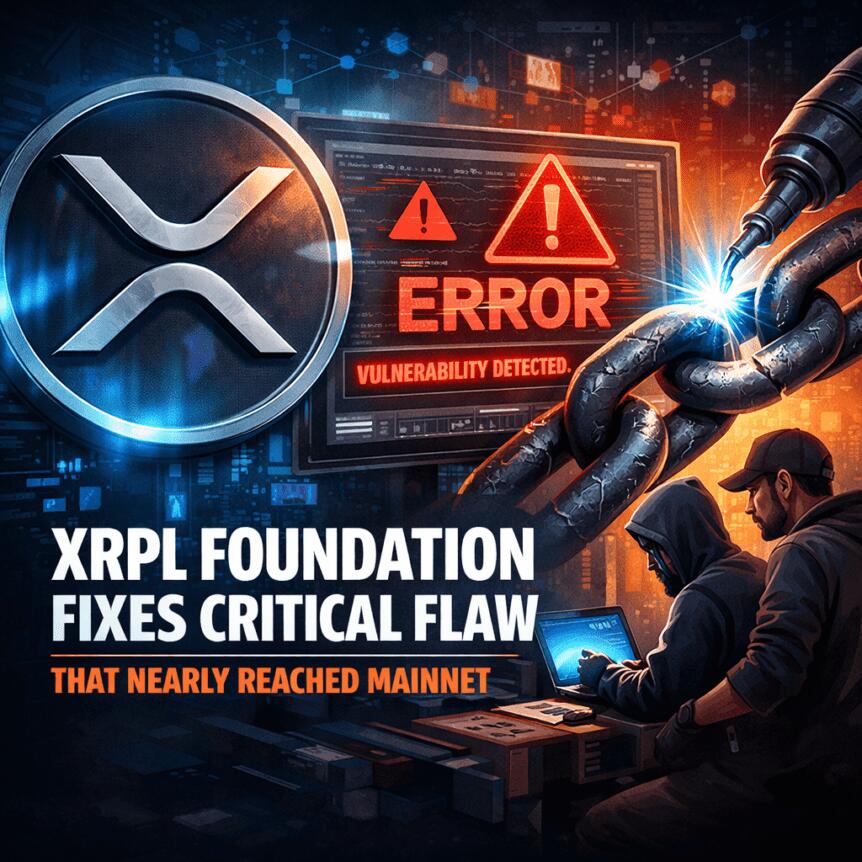
In a security-focused update, the XRP Ledger Foundation (CRYPTO: XRP) confirmed it patched a critical flaw in an upcoming amendment to Ripple’s XRP Ledger, averting a potential on-chain exploit. On February 19, a Cantina security engineer and its AI assistant detected a logic flaw in the signature-validation routine tied to a code batch amendment. The amendment had entered voting but had not activated on mainnet, and officials stressed that no funds were at risk at the time. The incident underscores how on-chain governance, automated discovery, and rapid patching interact in the evolving security landscape of public blockchains.
Key takeaways
- The flaw resided in the signature-validation logic of a code-batch amendment slated for the XRP Ledger, creating a theoretical path to unauthorized transactions if exploited.
- The amendment was still in the voting phase and had not been activated on mainnet, meaning funds were not exposed at the time of discovery.
- Cantina AI’s autonomous vulnerability hunter Apex identified the issue, highlighting the role of AI-powered tooling in proactive security workflows.
- The XRPL Foundation described the potential exploit as capable of eroding confidence in the XRP Ledger and destabilizing the broader ecosystem if left unpatched.
- An emergency patch, rippled 3.1.1, was released on February 23 to block the amendment from activating, reflecting a rapid, coordinated response by the Ripple engineering and validator communities.
Tickers mentioned: $XRP
Market context: The episode arrives amid increasing attention on governance safety, on-chain upgrade processes, and the growing use of AI-driven security tools to identify flaws before they can be exploited. While no funds were at risk in this instance, the incident underscores how rapid disclosure, responsible patching, and a mature validator environment help preserve confidence in public ledgers as the crypto industry navigates ongoing macro and regulatory uncertainties.
Why it matters
The XRPL ecosystem demonstrated a disciplined, defense-forward response to a potential class of vulnerability that could have had outsized consequences. In this case, the vulnerability lay in a signature-validation routine tied to a prospective amendment. Because the amendment had not yet activated on mainnet, the risk remained theoretical, but the XRPL Foundation’s decision to halt its momentum and push for a secure fix illustrates how governance processes can act as a safeguard against mischief or misconfigurations before they ever affect real users or funds.
Beyond the immediate incident, the episode spotlights the balance between improvement and risk in decentralized networks. Amendments that modify validation logic or consensus rules are powerful but carry operational risk; the governance cycle—proposal, testing, voting, and activation—must be coupled with robust security testing to prevent drift between code intent and on-chain behavior. The XRPL Foundation’s emphasis on a clear, auditable patch path reinforces the importance of reliability as developers push new features and optimizations onto a live ledger used by institutions and individuals alike.
On the security tooling front, the event contributes to a broader narrative about AI-enabled defense. Cantina AI’s autonomous discovery tool—Apex—identified the bug through static analysis of the rippled codebase and submitted a disclosure that allowed Ripple’s engineering teams to validate and patch the issue. This incident sits within a growing backdrop where AI-driven scanners and automated auditing are increasingly deployed to detect flaws that human inspectors might miss. Anthropic’s Claude Code Security, unveiled just days earlier, has already become a talking point in security circles, illustrating a trend toward AI-powered reasoning in vulnerability detection and remediation. As AI tools become more integrated into software development and security workflows, the industry may see faster mitigations but also a need to manage the risk of false positives and new threat surfaces introduced by automated processes.
A successful large-scale exploit could have caused substantial loss of confidence in XRPL, with potentially significant disruption for the broader ecosystem.
The investigation also aligns with broader discussions about the economics of security in crypto networks. Cantina’s Hari Mulackal has framed the potential impact in monetized terms, noting that the hypothetical loss could have been dramatic, given the scale of the XRP market capitalization. While the specific asset’s price is subject to broader market dynamics, the emphasis here is on preserving trust and functionality within the ledger’s architecture, rather than on short-term price moves.
In tandem with the technical response, the incident demonstrates how AI-enabled security tooling is reshaping incident response in crypto. The use of automated code analysis, prompt vulnerability disclosure, and rapid patching can shorten the window during which an attacker could act, shifting risk dynamics in favor of users and validators who uphold the network’s integrity. The ripple effect across ecosystems is unlikely to be isolated to one project; as more blockchains integrate similar tools, the bar for secure upgrade processes rises, potentially reducing the frequency and severity of major exploits in the future.
What to watch next
- Monitor updates on the amendment’s voting status and any new disclosures from XRPLF and Ripple’s engineering teams, including patch notes and rollback options if needed.
- Watch validator participation in rippled 3.1.1 adoption and downstream effects on on-chain performance and upgrade timelines.
- Follow Cantina AI’s ongoing research and any subsequent bug disclosures related to XRPL or comparable codebases embedded in other ledgers.
- Assess how AI-driven security tools influence governance and incident response timelines across the broader crypto ecosystem.
Sources & verification
- XRPL Foundation vulnerability disclosure report (xrpl.org/blog/2026/vulnerabilitydisclosurereport-bug-feb2026).
- XRPLF status update confirming the non-activation of the amendment on mainnet and the emergency mitigation (XRPL Foundation).
- Cantina AI and Spearbit leadership statements about the discovery and the Apex autonomous vulnerability hunter (X thread: https://x.com/hrkrshnn/status/2027191844988424343).
- Rippled 3.1.1 emergency patch details and rollout timing (XRPLF status updates).
What the wider story changes: patching a future risk
Bitcoin bulls managed to defend the $66K support level as the leading crypto asset reversed part of its strong gains yesterday that was partly fueled by a strong uptick in ETF inflows.
Summary
- Bitcoin price rebounded from above $66,000 support as its ETFs resumed an inflow trend.
- A bearish flag pattern has formed on the daily chart.
According to data from crypto.news, Bitcoin (BTC) price surged nearly 7% to roughly $70,000 on Thursday as investor sentiment for risk assets was boosted following the release of a bullish Nvidia earnings report that triggered a surge in tech stocks.
Rising equity prices often act as a catalyst for a risk-on rotation. As market confidence strengthens, capital flows out of defensive positions and into high-beta sectors like cryptocurrency.
The bellwether’s rally was also supported by a strong demand seen from institutional investors for spot Bitcoin ETFs. Data from SoSoValue shows that the 12 U.S. spot Bitcoin ETFs drew in $506 million in net inflows on Feb. 25, nearly double the figure recorded the prior day.
Shortly after its $70K rally, Bitcoin price had retraced nearly 4% to $66,641. This selloff was accompanied by a 2% drop in Nasdaq as investors booked profits after the stock’s notable run higher into the earnings event. The drawdown created a cooling effect across the broader financial landscape.
Bitcoin has since bounced back above $67,500 after bulls lodged another attempt to reclaim the $70K threshold. The momentum was supported by the $254 million inflows recorded by spot BTC ETFs on Thursday.
Despite today’s bounce, some analysts believe Bitcoin could continue its larger downtrend that began in early January before any meaningful trend reversal takes shape.
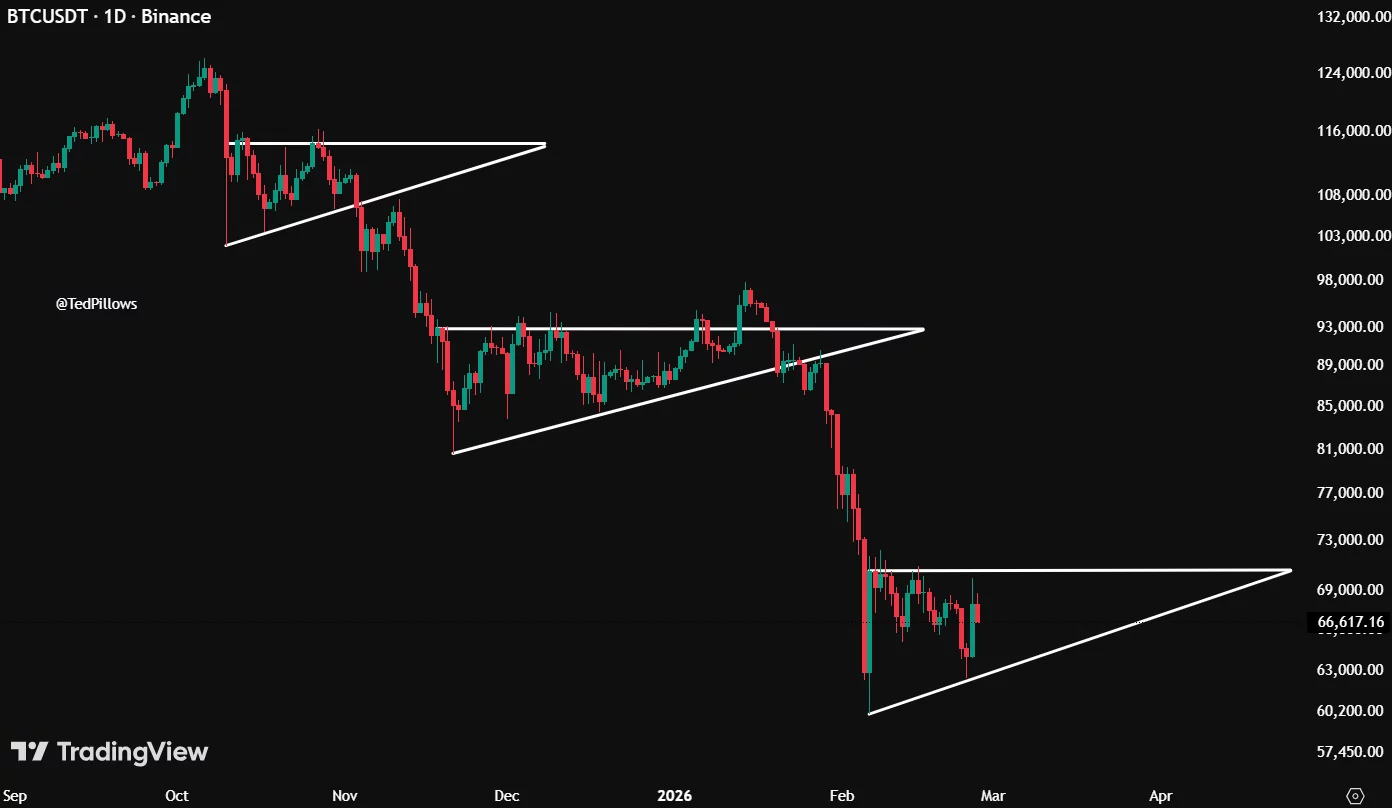
According to analyst Ted Pillows, Bitcoin price appears to be forming a recurring fractal pattern that has historically preceded downturns.
“Once more people are convinced $60,000 was the bottom, the next dump to a new low will start,” said Pillows in a Feb. 26 X post.
Bitcoin has formed a bearish flag pattern on the daily chart. This pattern consists of a sharp price decline followed by a period of steady, upward consolidation within two parallel lines.
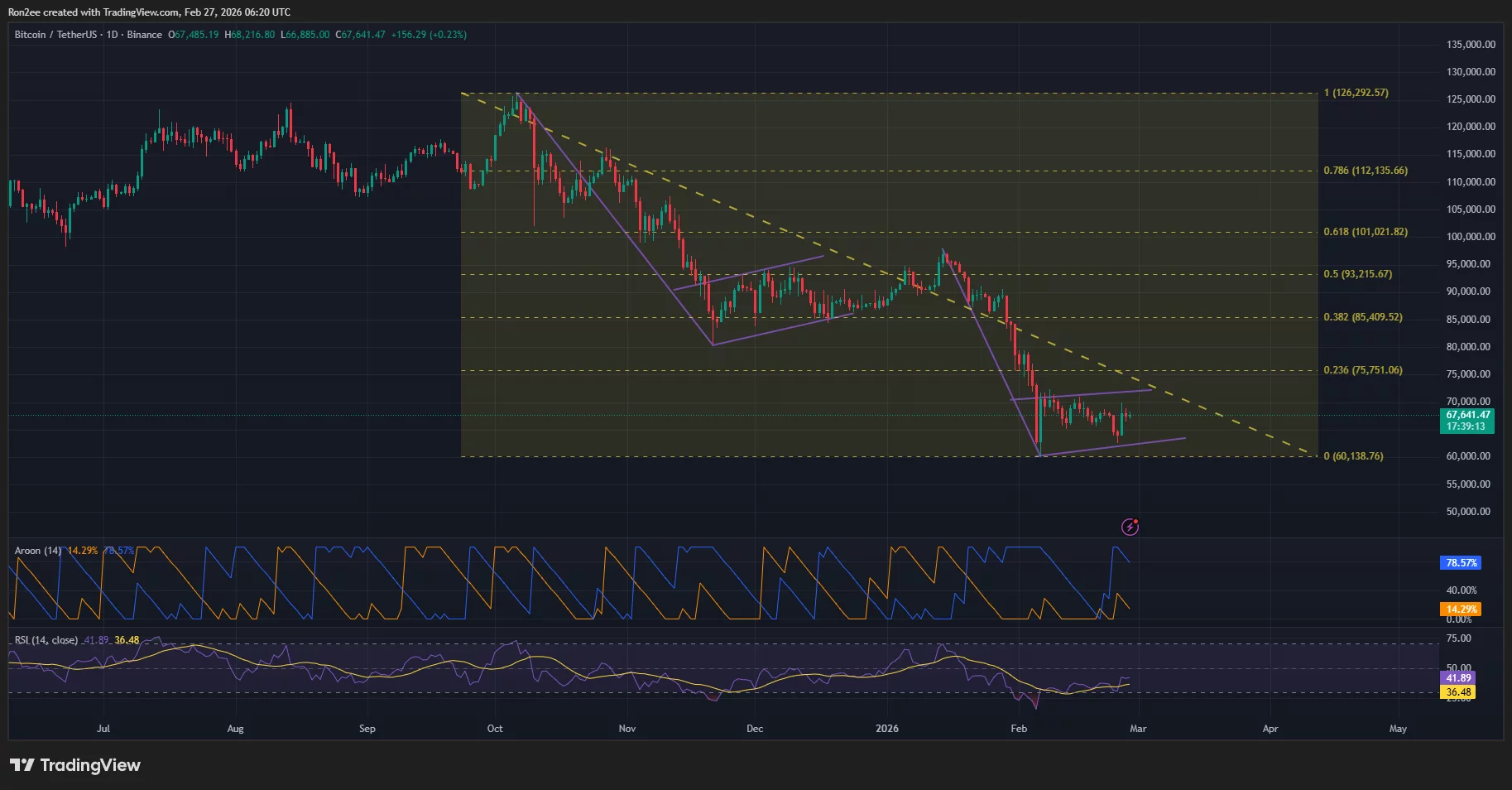
Historically, Bearish flags have confirmed the continuation of an ongoing downtrend after short periods of consolidation.
At press time, other technical indicators also seem to show bears are currently at an advantage. Notably, the Aroon Down was at 78.55, which is significantly higher than the Aroon Up, suggesting bears were still dominating the market trend.
The Relative Strength Index, which has moved closer toward the neutral thresholds, also indicates that there is potential room for more downside pressure before the asset hits oversold levels.
For now, $65,000 remains the key support level to watch. The level has acted as a psychological defensive line for nearly three weeks and seems to be holding strong for now, as a large cluster of buy orders and long positions was seen accumulating in this range.
A sharp drop under the $65K mark could lead bears to target $60K, a psychological level bears tried to penetrate during the Feb. 6 crash.
Disclosure: This article does not represent investment advice. The content and materials featured on this page are for educational purposes only.
TLDR
- Ethereum touched $2,150 this week before encountering resistance across several technical indicators
- The $2,100 level represents a critical threshold, matching the realized price for wallets containing 100,000+ ETH
- The 30-day realized volatility for ETH approaches 0.97, marking the highest point since March 2025
- Liquidations of short positions exceeded $220M across 48 hours, while funding rates shifted into positive territory
- ETF outflow pressure shows signs of weakening, although definitive accumulation trends remain absent
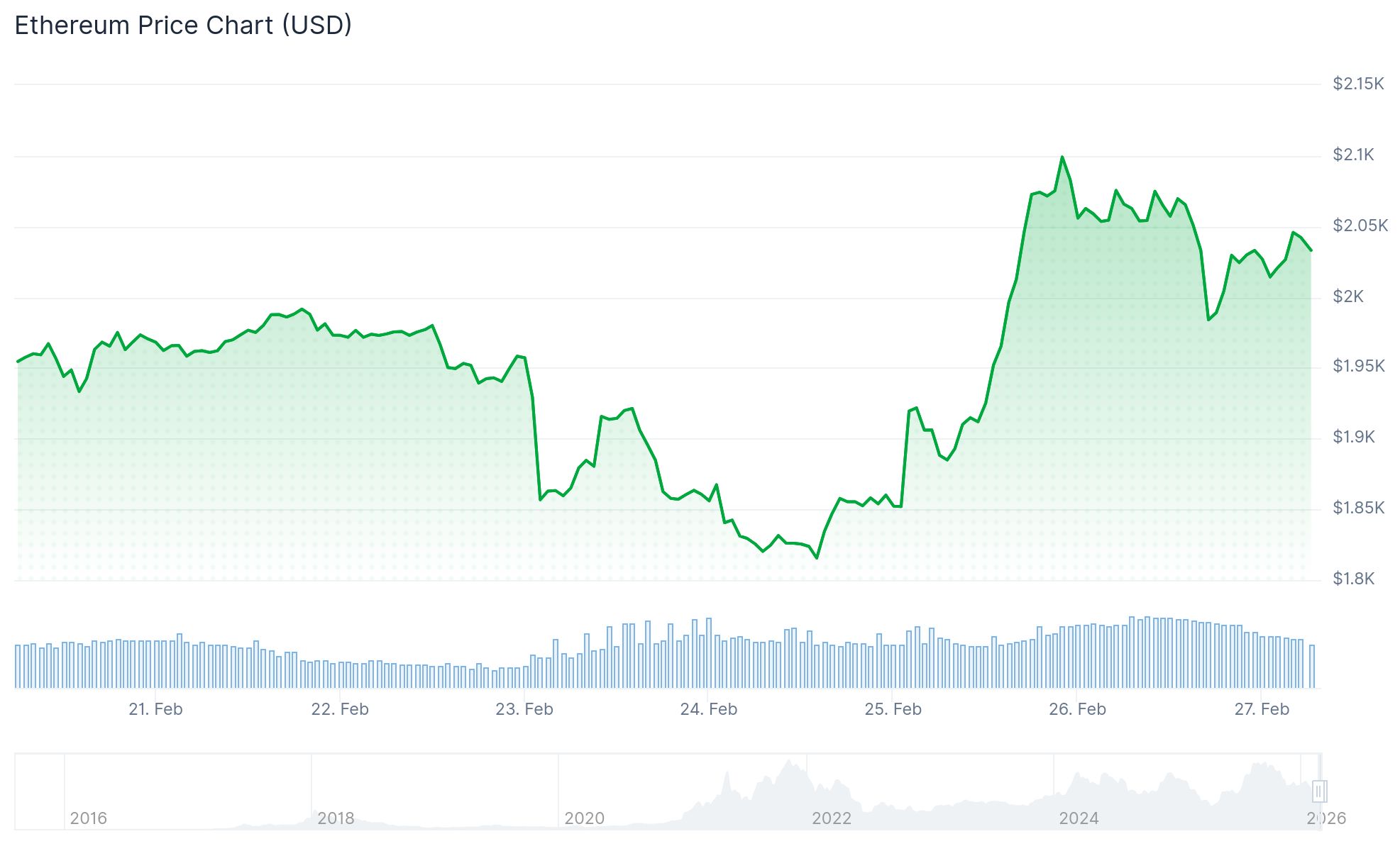
Ethereum surged to $2,150 during Thursday’s trading session before experiencing a retracement. The cryptocurrency continues navigating a narrow trading corridor, with $2,000 serving as crucial support and $2,100 emerging as the next significant barrier.
Closing above $2,100 on the daily timeframe carries particular significance as this price point corresponds to the realized price for addresses holding 100,000 ETH or greater. The realized price metric represents the average acquisition cost based on the last on-chain movement, providing insight into whether major stakeholders maintain profitable positions.
Historical data from 2020 onward reveals ETH has rarely traded beneath this whale cohort’s cost basis, with the most notable exception occurring throughout 2022’s bear cycle. Previous tests of this threshold have typically preceded price recoveries.
Futures and Funding Rates
The derivatives market witnessed short position liquidations exceeding $220 million during the previous 48-hour period, eliminating substantial leveraged positions. Binance funding rates, which plunged deeply negative in early May as bearish positions accumulated, have reversed course to reach positive 0.23%.
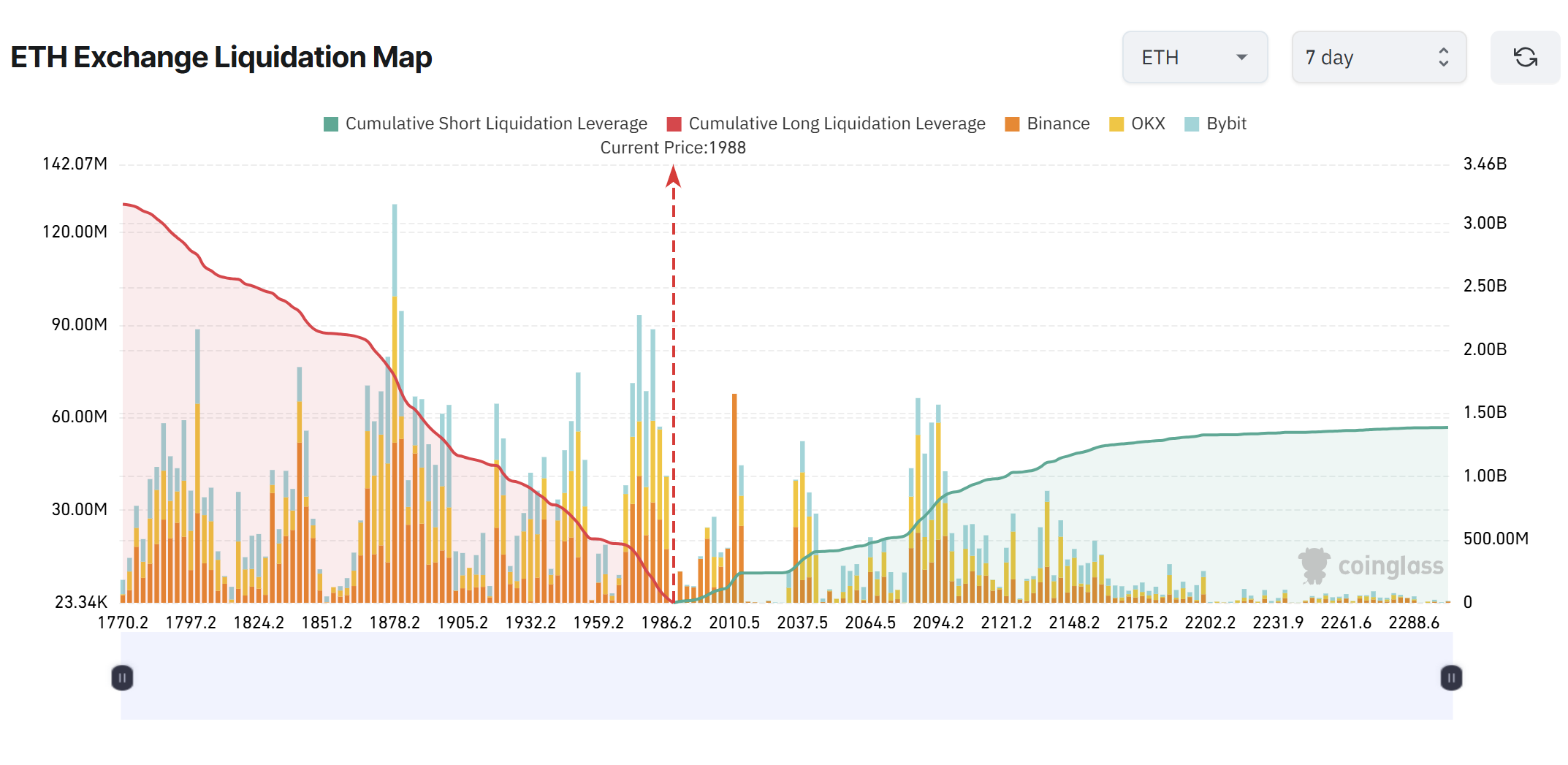
This reversal indicates that traders who opened shorts late in the cycle faced forced liquidations. Nevertheless, with funding rates now trading at elevated positive levels, the market structure favors long positions, creating potential vulnerability for a long squeeze toward $1,800 should upward momentum weaken.
Approximately $2.66 billion in long position liquidation exposure clusters around the $1,800 price zone, establishing a substantial liquidity pocket beneath current trading levels.
Volatility and ETF Flows
Ethereum’s 30-day realized volatility measured on Binance has climbed to approximately 0.97, representing the highest measurement recorded since March 2025. Heightened volatility during this phase may indicate market uncertainty and directional indecision rather than establishing a clear trend.
Price action continues trading beneath the 50-day, 100-day, and 200-day moving averages. Following the rejection near $4,800 in late 2025, each subsequent recovery attempt has established lower peaks, suggesting persistent distribution pressure.
Regarding ETF activity, selling pressure appears to be diminishing. Following substantial outflows throughout mid-2025, recent flow statistics indicate reduced movement in either direction. Institutional distribution seems to be decelerating, although convincing accumulation signals have yet to materialize.
Market analyst Leon Waidmann observed that retail participants with low conviction have predominantly exited their positions. Short interest continues declining, while highly leveraged long positions have been slow to establish meaningful presence.
Technical strategist IncomeSharks identified three overhead resistance zones, including multiple SuperTrend rejections and channel resistance positioned near $2,250. The analyst additionally highlighted April’s lows around $1,500 as a critical downside level should demand weaken once more.
At press time, ETH was changing hands at $2,034.
Bitcoin’s (BTC) downturn has spurred conspiracy theories around alleged market manipulation by firms. However, Bitwise’s Chief Investment Officer (CIO), Matt Hougan, argues that the primary reasons are more straightforward.
This narrative highlights the ongoing debate about what drives major crypto market moves, whether it’s institutional strategies, technological threats, or fundamental market cycles.
Why is Bitcoin’s Price Dropping?
Hougan addressed widespread speculation on social media that Bitcoin’s drop was the result of coordinated moves. BeInCrypto previously reported that some users made allegations against Binance.
More recently, some community members pointed to recurring patterns such as the alleged “10 AM Bitcoin dump” by Jane Street. The executive dismissed these narratives directly, calling the actual explanation “far more boring” than the theories suggest.
“The conspiracy theories are wild. First it was Binance and then it was Wintermute and then it was an unknown offshore macro hedge fund and then it was paper bitcoin and. today it is Jane Street and next week it will be someone else,” he said.
Follow us on X to get the latest news as it happens
Hougan said the “real reason Bitcoin is down” is that long-term holders have been reducing exposure. According to him, investors cut positions by selling spot Bitcoin, closing leveraged trades, and writing covered calls, creating downward pressure on the price.
The Bitwise CIO attributed selling behavior to three factors:
- The four-year market cycle theory.
- Concerns surrounding quantum computing.
- Capital rotation from crypto into artificial intelligence (AI) startups.
The quantum computing discussion has gained traction in the crypto community recently. While MicroStrategy co-founder Michael Saylor recently downplayed concerns about quantum risks, some investors remain cautious.
Kevin O’Leary, the Canadian businessman and Shark Tank investor, has warned that institutional investors are capping Bitcoin allocations at around 3% until the industry demonstrates a credible solution to quantum vulnerabilities. Jefferies’ global head of equity strategy, Christopher Wood, went further, removing a 10% Bitcoin allocation from the model portfolio over the same concerns.
Subscribe to our YouTube channel to watch leaders and journalists provide expert insights
Crypto Winter’s Timeline and Prospects for Recovery
Meanwhile, Hougan added that most of the selling is likely complete. He claimed that Bitcoin is in the “process of bottoming” and could eventually reach new all-time highs. According to him,
“This is a classic crypto winter and there will be a classic crypto spring.”
Hougan previously stated that the current crypto winter began in January 2025, and given the 13-month historical duration, the end could be near.
On-chain analyst Willy Woo offered a more nuanced view. He said the recent sell-off appears exhausted but cautioned that deteriorating spot and futures liquidity could cap any near-term rebound.
Woo’s timeline places the end of bearish conditions in Q4 2026, with bullish momentum potentially returning in Q1 or Q2 2027.
“~45k would be a typical bear market bottom. BTC has only ever existed in a secular global macro bull market 2009-2026. If global macro breaks down, then 30k is the fall back level of support, 16k as the final line to maintain BTC’s bull trend,” Woo wrote.
The distance between these timelines reflects a broader uncertainty about where exactly the market sits in its cycle. What analysts broadly agree on is that Bitcoin’s current weakness reflects structural and psychological forces, not manipulation.
Australia’s crypto market is making progress in user growth and regulatory reforms, but there are still a range of issues to iron out in the sector, crypto executives told Cointelegraph.
On the sidelines of the XRP Australia 2026 event in Sydney on Friday, Coinbase APAC managing director John O’Loghlen said the country has seen positive regulatory momentum and growing expertise among those tasked with policing the industry.
“Multiple arms of government, mainly Treasury, who are writing the draft regulation and ASIC have thoroughly upskilled their teams and have pretty deep digital asset domain expertise internally. So I think there’s been pretty positive movement.”
O’Loghlen also said institutional interest and access are growing through products like crypto exchange-traded funds. Australia’s first ETF, which holds Bitcoin (BTC) directly, went live in June 2024, followed by an ETF that holds Ether (ETH) in October 2024.
He also noted that Coinbase Global’s inclusion in the Standard & Poor’s 500 (S&P 500) index offers Australian institutions a means to access crypto-related stocks, allowing them to learn “about the industry in a very passive way.”
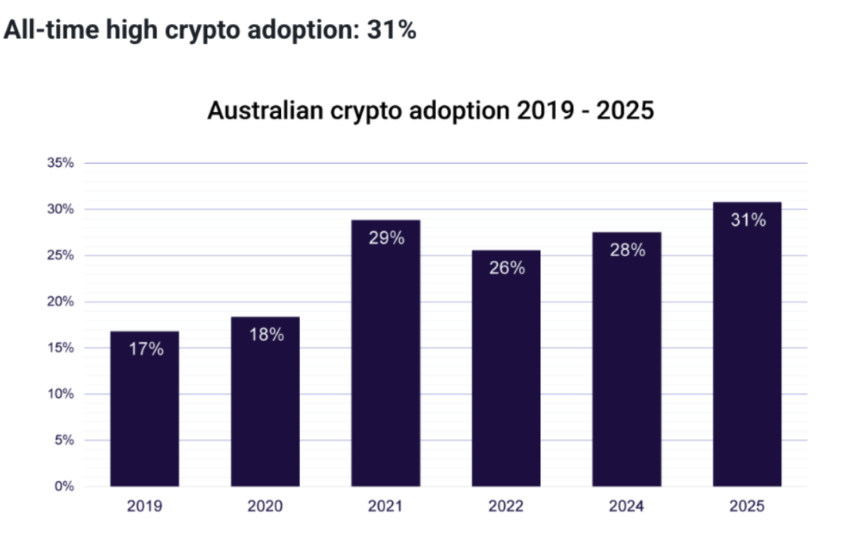
A 2025 report from crypto exchange Independent Reserve found that crypto adoption among Australians reached 31%, up from 28% in 2024. Additionally, 29% said they planned to invest in the next 12 months.

Self-managed super fund investors eye crypto
OKX Australia CEO Kate Cooper noted that a significant area of growth for the exchange has come from sophisticated traders, self-managed super fund (SMSF) trustees and high-net-worth individuals.
At the same time, she said across the industry there are a growing number of new self-managed super funds being set up specifically so trustees can invest in digital assets, “because they currently can’t invest via the big super funds.”
SMSFs are retirement funds set up and managed by individuals, rather than conventional funds managed by large institutions on behalf of users.
In a yet-to-be-released OKX report on SMSFs, Cooper said many respondents were interested in digital assets to diversify their holdings.
“That’s the feedback that we got through the research: a significant number of people wanting a diversified portfolio, wanting not just crypto, but digital assets more broadly, to be held as part of their portfolio. And SMSF is one of the main ways to do that.”
Lingering issues remain in Australia’s crypto scene
Last September industry executives, including Cooper, told Cointelegraph that users in Australia still face banking barriers when engaging with exchanges and other crypto businesses.
“It’s absolutely still a challenge in the industry,” Cooper said. “I don’t think there’s been any improvements. And we’re working hard with governments to encourage them to set some standards around it.”
O’Loghlen also called for solutions to debanking, stronger protections for blockchain payments innovation and greater support for Australian stablecoins.
“Regulatory settings must support innovation rather than inadvertently constrain it,” he said.
Related: Crypto lobby slams Australian broadcaster’s ‘sensational’ Bitcoin article
“As the Regulation of Payment Service Providers reforms are developed, it will be important to ensure that non-custodial wallet developers and public blockchain infrastructure providers are not unintentionally captured within licensing regimes designed for intermediaries,” O’Loghlen added.
Australian legal and regulatory landscape in limbo
Meanwhile, Australian crypto lawyer Bill Morgan said the Australian legal and regulatory crypto landscape appears to be in “wait and see” mode at the moment, following the ongoing court case between the Australian Securities and Investments Commission (ASIC) and fintech firm Block Earner.
ASIC is appealing a Federal Court decision siding with Block Earner about whether it was required to hold a financial services license for its crypto-related products.
He also pointed to a change in government that could be slowing legislation down.
“I think to some extent it’s a function of having three-year terms. There was some momentum under the former Liberal National Party coalition government, but then, when Labor won its first term four years ago, it took a while for it to get going again.”
Magazine: 6 massive challenges Bitcoin faces on the road to quantum security
Crypto World
Bitcoin ETF holders and treasury firms stack protection against price crash below $60,000, options exchange says


Bitcoin ETF holders and corporate treasuries – the players everyone praises for their long-term vision – are stacking insurance against price crash below $60,000, cryptocurrency exchange Deribit told CoinDesk.
“ETF holders and corporate treasuries are buying 6-month and 1-year puts at $60k or below ($60,000 put, a derivative contract offering protection against potential price slide below that level) as portfolio insurance,” Jean-David Péquignot, chief commercial officer of derivatives exchange Deribit.
This put option works like insurance: It lets buyers sell bitcoin at $60,000 even if the price crashes lower, shielding ETF investors and corporate treasuries with BTC from steeper losses while they hold for the long haul.
Péquignot was responding to questions about surging interest in the $60,000 put. At the time of writing, those contracts had $1.50 billion in open interest – the highest across all strikes and expiries on Deribit. On the exchange, one contract represents one BTC. The platform accounts for nearly 80% of the global crypto options activity.
The surge in interest in $60,000 puts expiring in six months or longer signals deep fears that any price bounce could fizzle fast, paving the way for a sharper drop.
What makes this hedging even more noteworthy is that ETF holders and corporate treasuries own a significant supply of bitcoin.
Investors have poured billions into U.S.-listed spot bitcoin ETFs and similar products worldwide in recent years. The U.S. funds alone have seen inflows of 1.26 million BTC, roughly 6% of bitcoin’s total circulating supply. Meanwhile, publicly listed firms hold about 1.14 million BTC, or 5.7% of BTC’s supply.
Bitcoin has been trading choppy below $70,000, having hit lows near $60,000 early this month, CoinDesk data show. The cryptocurrency has gained nearly 5% since Wednesday to trade near $67,500, but the options market remains unimpressed, with puts continuing to trade at a significant premium to calls or bullish bets.
“While spot price climbed, the 25-delta risk reversal remained stubborn. 30-day puts are still trading at a ~7% volatility premium over calls, signaling that smart money is still paying up for downside protection rather than chasing the pump,” Péquignot said.
He added that volatility may pick up as prices drop below $63,000. That’s because dealers and market makers who create order-book liquidity are “short gamma” at $60,000 or lower.
This means that as prices approach $60,000, these entities may sell more to rebalance their overall exposure to neutral, inadvertently adding to downside volatility.

A man achieved financial freedom with a single sip of a magical spring.#drama #shorts

Hen do mum jailed after calling daughter a ‘s**g’ then attacking woman who defended her

Your EBITDA Isn’t What You Think It Is


-

 Politics5 days ago
Baftas 2026: Awards Nominations, Presenters And Performers
-

 Fashion7 days ago
Weekend Open Thread: Boden – Corporette.com
-

 Sports4 days ago
Women’s college basketball rankings: Iowa reenters top 10, Auriemma makes history
-

 Politics4 days ago
Nick Reiner Enters Plea In Deaths Of Parents Rob And Michele
-

 Business2 days ago
True Citrus debuts functional drink mix collection
-

 Politics8 hours ago
ITV enters Gaza with IDF amid ongoing genocide
-

 Crypto World3 days ago
XRP price enters “dead zone” as Binance leverage hits lows
-

 Business5 days ago
Mattel’s American Girl brand turns 40, dolls enter a new era
-

 Business5 days ago
Law enforcement kills armed man seeking to enter Trump’s Mar-a-Lago resort, officials say
-

 Tech3 days ago
Unsurprisingly, Apple's board gets what it wants in 2026 shareholder meeting
-

 NewsBeat1 day ago
Cuba says its forces have killed four on US-registered speedboat | World News
-
 NewsBeat1 day ago
Manchester Central Mosque issues statement as it imposes new measures ‘with immediate effect’ after armed men enter
-
 NewsBeat4 days ago
‘Hourly’ method from gastroenterologist ‘helps reduce air travel bloating’
-

 Tech5 days ago
Anthropic-Backed Group Enters NY-12 AI PAC Fight
-

 NewsBeat5 days ago
Armed man killed after entering secure perimeter of Mar-a-Lago, Secret Service says
-

 Politics5 days ago
Maine has a long track record of electing moderates. Enter Graham Platner.
-
 NewsBeat2 days ago
Police latest as search for missing woman enters day nine
-

 Business1 day ago
Discord Pushes Implementation of Global Age Checks to Second Half of 2026
-

 Crypto World2 days ago
Entering new markets without increasing payment costs
-

 Business11 hours ago
Only 4% of women globally reside in countries that offer almost complete legal equality