

Crypto World
Vitalik says Ethereum’s real value is a global shared data bulletin board



Vitalik Buterin reframes Ethereum as censorship‑resistant “global shared memory,” with PeerDAS scaling its data layer for voting, identity, and on‑chain coordination.
Summary
- Vitalik says Ethereum’s main role is an open, readable and writable data availability layer, more than a smart contract or payments platform.
- He casts ETH as core Sybil resistance and collateral securing this shared memory, with DeFi and apps built on top of that base.
- PeerDAS is already boosting Ethereum’s data capacity, with plans for 10–100x gains to support voting, identity, and governance use cases.
Ethereum (ETH) co-founder Vitalik Buterin says the network’s real value lies in acting as a globally shared “bulletin board” for data availability, rather than just a smart contract or payments platform, sharpening the narrative around Ethereum’s role in the broader crypto stack.
Vitalik reframes Ethereum’s core value
In a new post on X, Buterin argued that Ethereum’s fundamental contribution is providing a publicly readable and writable data layer that cryptographic protocols can reliably anchor to. He highlighted that many high-value use cases—secure online voting, software version control, certificate revocation and more—depend on having an open, persistent data space rather than purely on complex smart contract logic.
Buterin framed ETH not only as a payment asset, but as a core instrument for Sybil resistance and as collateral for smart contracts, positioning it at the center of a decentralized, privacy-preserving, open-source technology stack. In his view, smart contracts and DeFi are extensions built atop this shared memory, not the base value proposition itself.
PeerDAS, scaling, and “global shared memory”
Buterin also pointed to Ethereum’s PeerDAS upgrade as a key step in scaling this data availability layer, saying it already increases Ethereum’s data capacity by about 2.3x, with a path toward 10–100x gains over time. Improved data throughput, combined with lower fees, is meant to support a broader range of applications beyond DeFi, including governance systems, identity, and new classes of on-chain coordination tools.
He summed up Ethereum as a kind of “global shared memory,” where applications can reliably publish and read data in a neutral environment secured by ETH-based economic incentives. For developers and protocols, the message is clear: treat Ethereum first as a durable, censorship-resistant data availability layer, and only secondarily as a smart contract execution chain.

BlackRock’s new staked ether (ETH) exchange-traded fund got off to a solid start Friday, pulling in more than $15 million in trading volume on its first day as Wall Street begins experimenting with yield-generating crypto ETFs.
The iShares Staked Ethereum Trust, trading under the ticker ETHB, launched with just over $100 million in assets and had already seen about $11 million in trading by early afternoon, according to Bloomberg ETF analyst James Seyffart. By late session, trading volume had climbed to roughly $15.5 million, suggesting strong initial demand for the product.
Those numbers are considered strong for an ETF launch, market watchers say.
“BlackRock’s Staked Ether ETF launched with just over $100 million in assets and has traded about $11.1 million through early afternoon,” Seyffart said on X, calling it “a pretty good start for any ETF.”
The product marks a significant evolution in crypto exchange-traded funds. Unlike traditional spot crypto ETFs that simply track the underlying asset, ETHB will generate yield by staking ethereum, distributing most of the rewards back to investors. Staking refers to locking coins in a cryptocurrency network in return for rewards. This is losely analogous to investing in fixed income instruments like bonds.
According to the prospectus, the fund will stake between 70% and 95% of its ether holdings at any given time. About 82% of the staking rewards will be paid out to investors through monthly distributions, similar to how dividend-paying ETFs distribute income.
The remaining 18% will be allocated among the trust, custodians and staking service providers.
The fund charges a 0.25% sponsor fee, though BlackRock is offering a temporary discounted rate of 0.12% on the first $2.5 billion in assets as it seeks to attract early investors.
ETHB is the latest addition to BlackRock’s growing digital assets ETF lineup. The firm already runs the iShares Bitcoin Trust (IBIT), which launched in January 2024 and quickly became the dominant bitcoin ETF, as well as the iShares Ethereum Trust (ETHA) introduced in July 2024.
Ethereum’s staking mechanism allows holders to lock up ETH to help secure the network in exchange for rewards, effectively creating a crypto-native yield. By packaging that yield inside an ETF wrapper, firms like BlackRock are attempting to make the structure accessible to traditional investors who cannot easily participate directly on-chain.
If staking ETFs gain traction, they may open the door to similar structures across other proof-of-stake networks — potentially turning crypto ETFs from passive exposure vehicles into income-generating financial instruments.


The crypto market rose 2.4% to $2.51 trillion on Friday primarily due to a shift in global risk sentiment following signals of potential de-escalation in the Middle East.
Summary
- Crypto prices rebounded on Friday after crude oil prices retreated following multi-year highs.
- A wave of short liquidations across leveraged markets and back-to-back inflows into major crypto ETFs also supported the recovery.
Bitcoin (BTC), the leading crypto asset by market cap, rallied nearly 4%, hitting close to the $72,000 mark. Ethereum (ETH) was up 4.3% over the past day, trading at $2,100 when writing. Other major crypto assets, such as BNB (BNB), XRP (XRP), Solana (SOL), and Dogecoin (DOGE), had also posted modest gains on the day.
It should be noted that today’s market rally was a standalone event as it detached from both the U.S. traditional stock indexes and tech stocks. The Dow Jones Industrial Average dropped by 739 points or 1.56% in U.S. trading hours, while tech-heavy stocks such as the S&P 500 and Nasdaq-100 fell by 103 and 431 points, respectively.
The crypto market rallied as Investor risk-on sentiment improved after oil prices dropped sharply across the globe. Notably, Brent crude oil fell over 7% today, easing immediate fears of inflation and providing a more favorable environment for digital assets.
Short liquidations mount
As crypto prices rallied, it caught short sellers off guard, triggering liquidations of these highly leveraged positions. Data from CoinGlass shows that nearly $246 million was liquidated from leveraged markets, with the majority coming from short positions.
The total crypto market open interest also rose 5.2% on Friday, signalling that investors were injecting fresh capital into the market.
ETF inflows and Coinbase premium
Inflows into spot ETF products have also supported the recent gains. According to data from SoSoValue, on Thursday, $53.87 had entered spot Bitcoin ETFs, which marks the fourth straight day of inflows for these funds. A similar trend was visible across their Ethereum counterparts, which have posted three back-to-back days of inflows.
At the same time, Coinbase Premium has also risen sharply over the past 24 hours, indicating that U.S. institutions are paying a premium over global prices to secure Bitcoin. Traders often view this as a strong bullish signal that institutional “smart money” is leading the current market charge.
Crypto market rallied following Trump’s recent comments
Crypto prices also benefited after U.S. President Donald Trump recently hinted that the ongoing war between the two countries may be coming to an end.
This seemed to have calmed investor fears of a prolonged war, which in turn sparked a risk-on sentiment among investors who have begun moving capital from safe havens back into risk assets like crypto.
Disclosure: This article does not represent investment advice. The content and materials featured on this page are for educational purposes only.
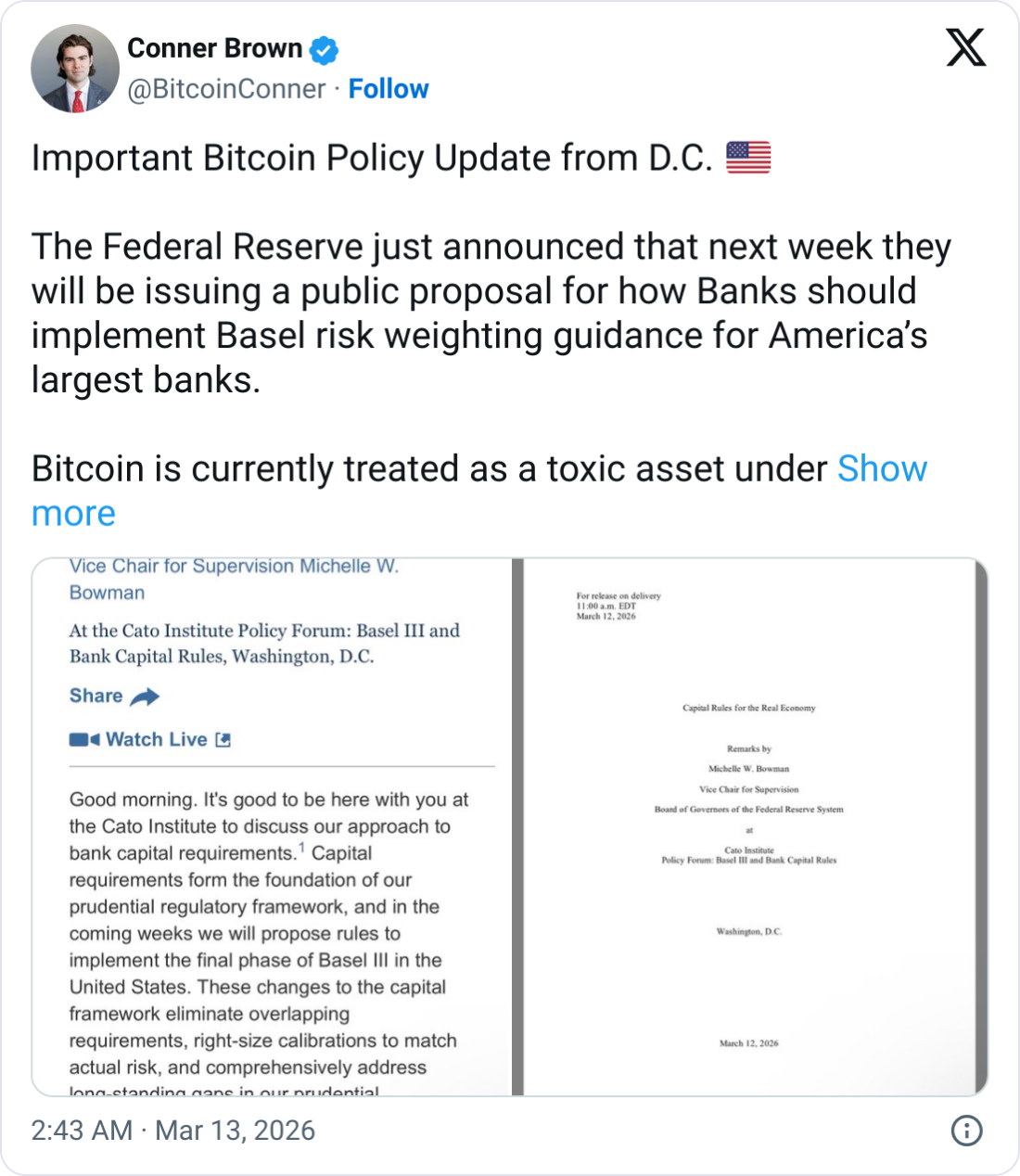
The Bitcoin Policy Institute (BPI) says it will push the US Federal Reserve to change how Bitcoin is treated, as the central bank is set to issue rules on how banks should implement international guidelines for asset risk weighting.
“BPI will be reviewing this proposal closely and submitting a public comment to ensure that US regulators get Bitcoin’s treatment right,” Bitcoin Policy Institute managing director Conner Brown said in an X post on Wednesday.
It comes just a day after the Fed announced it will issue a proposal for public comment on how US banks should implement risk-weighting guidance, which determines how risky different assets are on a bank’s balance sheet, from the Basel Committee on Banking Supervision.
Brown said Bitcoin (BTC) is “treated as a toxic asset under the Basel framework, a global standard for banking regulations.

He added it carries a 1,250% risk weighting, which was “harsher than virtually all other asset classes.”
“More efficient regulation” is the aim: Fed
Federal Reserve vice chair for supervision Michelle Boman said on Thursday that the agency will be proposing rules in the coming weeks to implement the final phase of Basel in the US.
Bowman said that the aim is “more efficient regulation and banks that are better [positioned] to support economic growth, while preserving safety and soundness.”
The 1,250% capital requirement means that banks must back any Bitcoin on their balance sheets at a 1:1 ratio with approved collateral, making holding the cryptocurrency more costly than other asset classes.
Cash, physical gold and government debt carry a 0% risk weight under the Basel framework.
“The most punitive classification”: Bitcoin Policy Institute
Brown said in a blog post last month that the treatment of Bitcoin is the “most punitive classification” in the Basel Committee’s capital framework and a “category error.”
Related: Bitcoin hugs $70K range as March Fed rate cut odds fall below 1%
In 2021, the Basel Committee proposed placing crypto in its high-risk Group 2 set of assets. Group 2 holdings were restricted to under 1% of the value of their Group 1 holdings.
“This risk weighting makes it extremely difficult for banks to provide financial services to Bitcoiners and Bitcoin companies,” Brown said.
Magazine: All 21 million Bitcoin is at risk from quantum computers
Many Bitcoin miners are struggling to turn a profit this market cycle due to diminishing returns, so they may need to pivot to artificial intelligence hosting or put their holdings to work to generate yields, says market maker Wintermute.
Wintermute said in a blog post on Thursday that Bitcoin (BTC) miners have spent years building large-scale power infrastructure in low-cost energy markets, and they now find themselves “sitting on exactly what the AI industry needs most urgently and cannot easily replicate.”
It said that Bitcoin mining is a “structurally rigid business model,” and while the AI pivot is a compelling one, it is also a “drastic and capital-intensive step.”
The report comes as mining giant MARA Holdings is the latest to eye AI, filing with the SEC on March 3 to signal its intent to sell some of its BTC to pivot to the technology. Meanwhile, publicly listed miners have sold more than 15,000 Bitcoin since October.
Miners hanging onto Bitcoin is “legacy of the HODL era”
Wintermute said that Bitcoin miners are collectively holding close to 1% of the total BTC supply, which it argued was a “legacy of the HODL era,” and that the “full toolkit of treasury management remains largely untapped.”
Crypto yield generation has been traditionally limited to staking and DeFi, but Wintermute said miners could tap yields through active management, such as monetizing market risk through derivatives structures, covered calls, and cash-secured puts.
Passive management options include deploying BTC into lending protocols to earn interest.

“We believe active balance sheet management is the most underutilized lever available to miners and one that deserves far greater strategic attention,” Wintermute said. “The miners who treat their BTC holdings as a working asset rather than a passive reserve will carry a structural edge into the next halving.”
Related: Mining companies move deeper into AI, HPC as MARA may sell Bitcoin
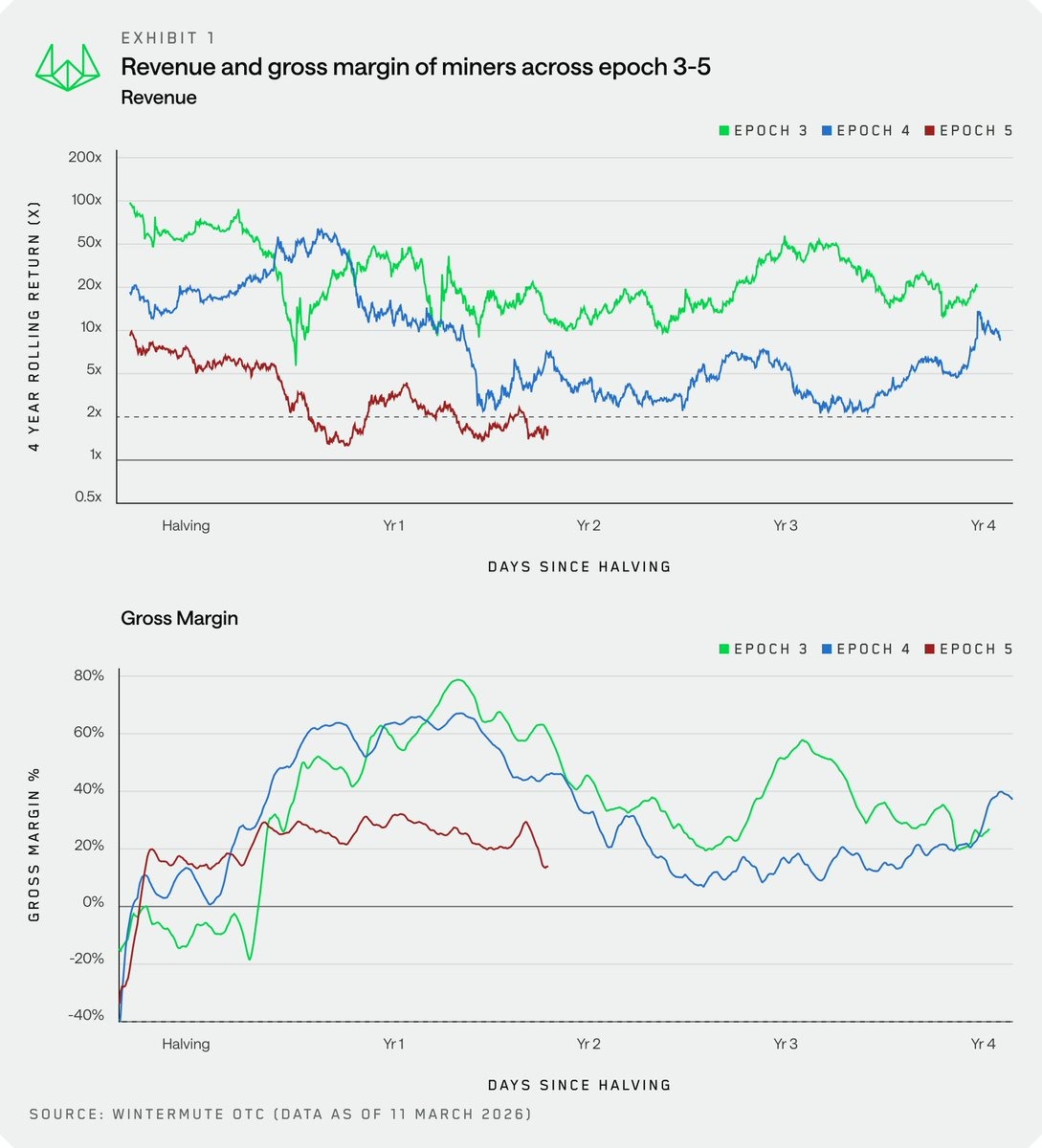
Wintermute said that for the first time in a four-year market cycle, Bitcoin has failed to deliver the two-times price return needed to offset halving-driven revenue cuts, and gross margins have peaked at levels that previously marked bear market floors.
Additionally, the transaction fee market has not filled the gap as it is “episodic” and not structural. At the same time, energy costs continue to squeeze margins.
The company noted that data suggests this squeeze is unlike previous cycles in 2018 and 2022, describing it as a “healthy shakeup” that fits within the design of Bitcoin and will make the mining industry “more efficient as a result.”
Magazine: All 21 million Bitcoin is at risk from quantum computers
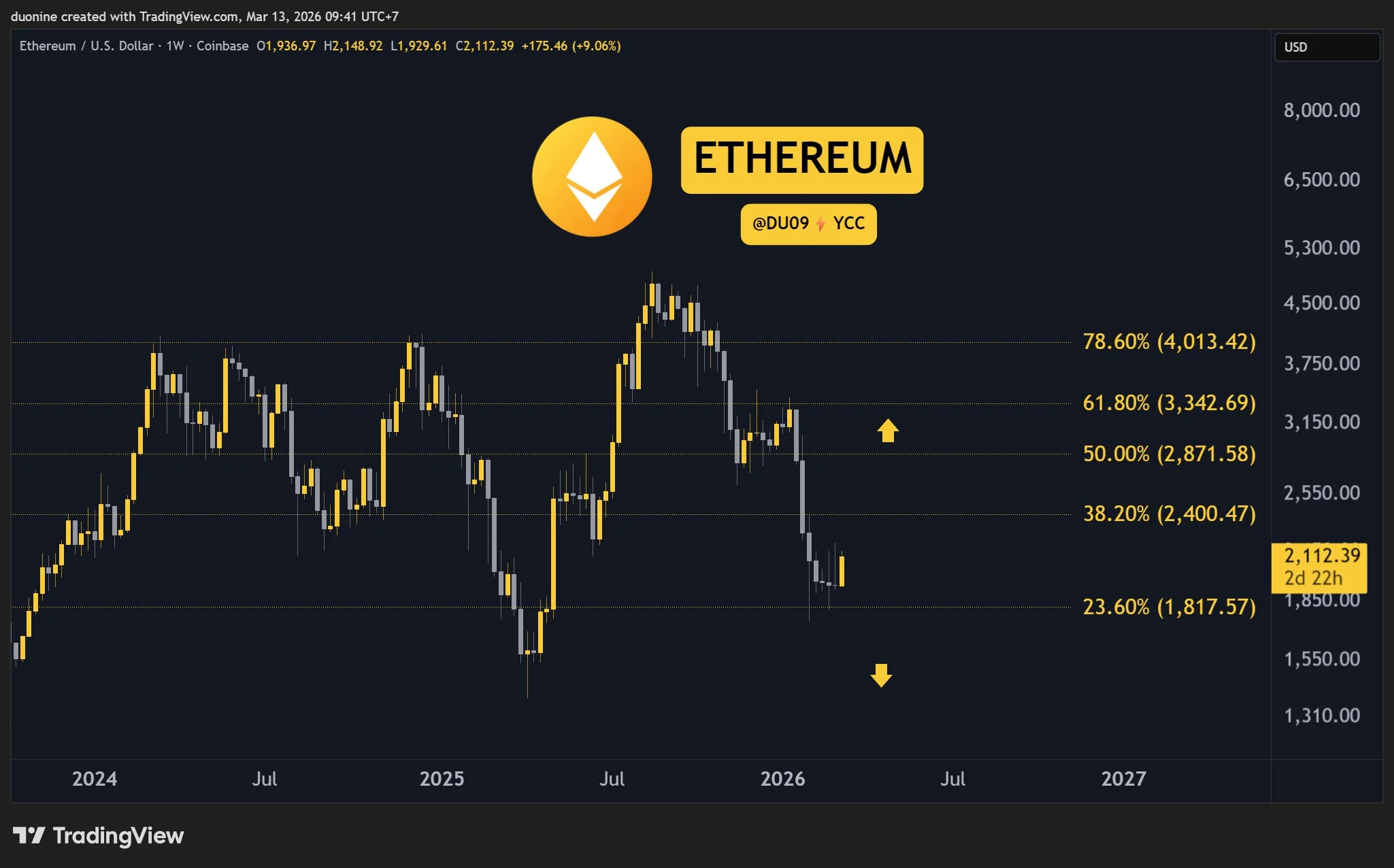
This Friday, we examine Ethereum, Ripple, Cardano, Binance Coin, and Hyperliquid in greater detail.
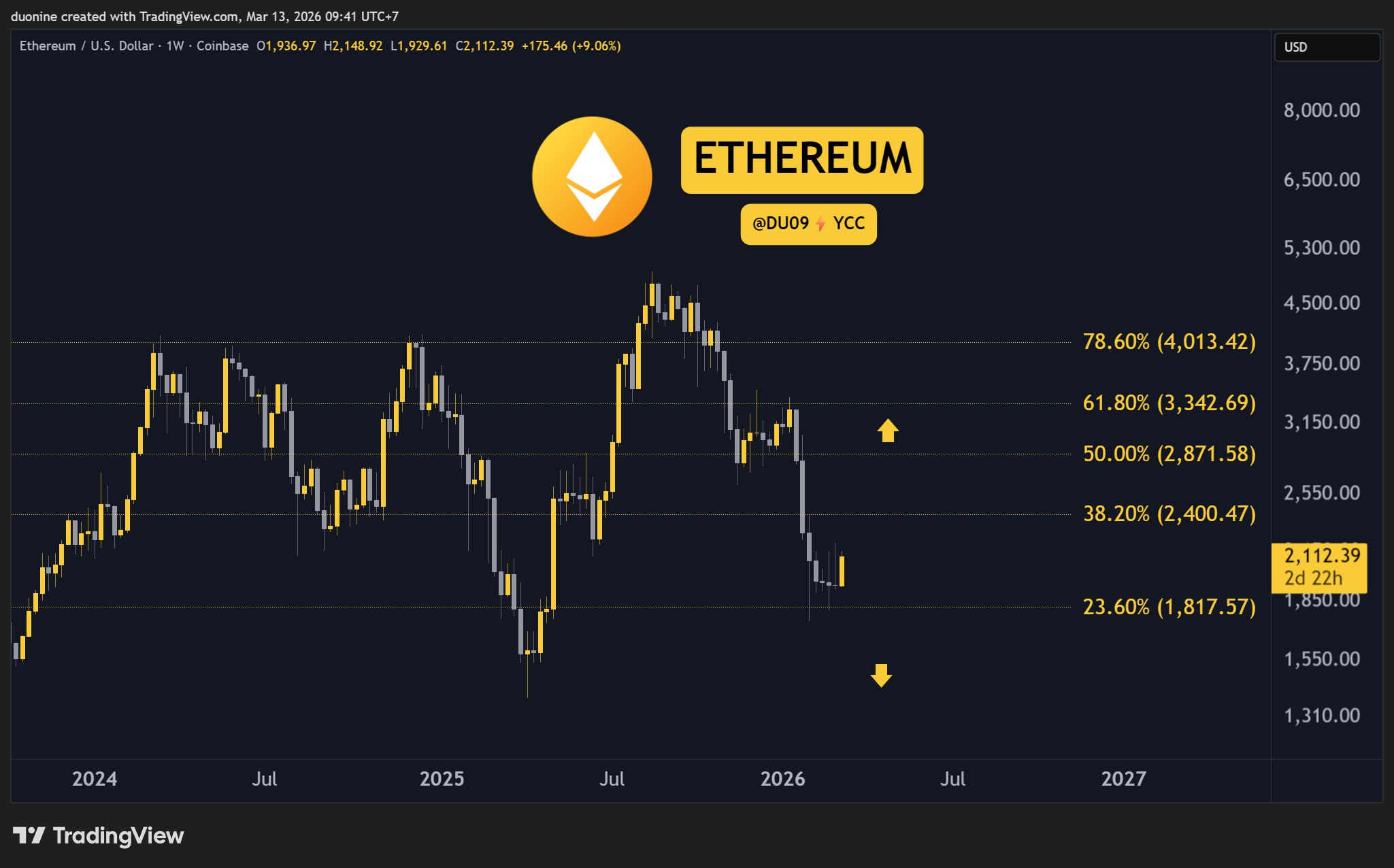
Ethereum (ETH)
Ethereum continues to hold well above the $2,000 support level and closed the week in the green with a 1% gain. Even if this is small, it shows sellers no longer have control over the price, being unable to push it lower.
The current price action is also giving clear bullish signals, hinting at a major reversal. To confirm it, buyers will need to break through the $2,400 resistance.
Looking ahead, this is the first time in months when Ethereum has a clear shot at moving higher. To sustain a relief rally, the price will have to break $2,400 and then $2,800, which are acting as key resistance levels.
Ripple (XRP)
XRP is flat compared to last week, but it still held well above $1.4. This is somewhat similar to the $2,000 support of Ethereum. As long as $1.4 holds, the bias leans bullish.
The most important resistance on the chart is at $1.6, and if XRP can break above it and turn it into key support, then bulls will have full control over price action, which may allow them to aim for $2 next.
Looking ahead, this cryptocurrency has a good shot at reversing the downtrend here, and that starts with a clean breakout above $1.6. Hopefully, this can take place in the weeks to come.

Cardano (ADA)
Cardano appears ready to turn around, even if the price remains similar to last week. The support at 24 cents held well, and now the resistance at 28 cents is being put under pressure.
Should buyers break above $0.28, ADA has a clear path to $0.40 and beyond. The momentum indicators, such as the MACD, are also turning bullish on the weekly timeframe, encouraging bulls further.
Looking ahead, a sustained relief rally could bring this cryptocurrency back to 50 cents, but for that to happen, the overall market has to turn bullish and remain so for at least a few months.

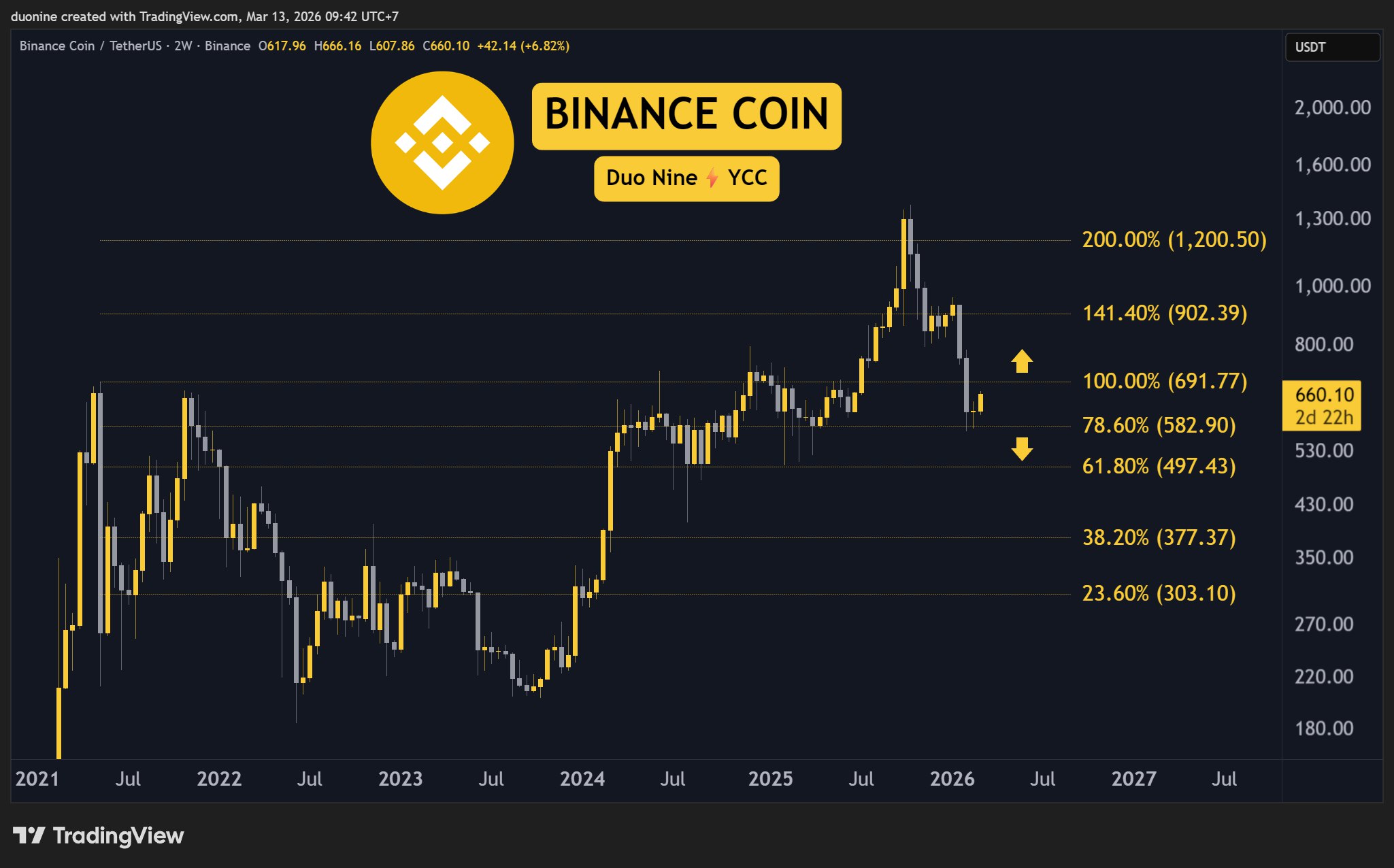
Binance Coin (BNB)
Binance Coin is up 2% this week after finding support at $580. Should this bullish momentum intensify, then a test of the key resistance at $690 appears inevitable in the coming days.
While momentum is positive, the buy volume remains rather low. Any weakness in this rally will likely be easily exposed once the key resistance is tested. Sellers could return there to reverse any recent gains.
Looking ahead, BNB wants to break out of its consolidation above the key support and move higher. To be successful, it will need to break above $690 and defend that level from any sellers.
Hype (HYPE)
HYPE is up by 24% this week, making it the best-performing cryptocurrency on our list and across most of the market. This sustained performance was due to the recent breakout above the $36 resistance.
After the price bottomed around $20 in mid-January, HYPE began a strong rally that is still ongoing with two major impulses up. The first took place in late January and saw the price go above $30, and now the second impulse up in March took the price closer to $40.
Looking ahead, HYPE will face resistance at $40 and $42. If it breaks these levels, its path to $50 will open up. If successful, this would be an impressive achievement in a bear market.

Binance Free $600 (CryptoPotato Exclusive): Use this link to register a new account and receive $600 exclusive welcome offer on Binance (full details).
LIMITED OFFER for CryptoPotato readers at Bybit: Use this link to register and open a $500 FREE position on any coin!
Disclaimer: Information found on CryptoPotato is those of writers quoted. It does not represent the opinions of CryptoPotato on whether to buy, sell, or hold any investments. You are advised to conduct your own research before making any investment decisions. Use provided information at your own risk. See Disclaimer for more information.
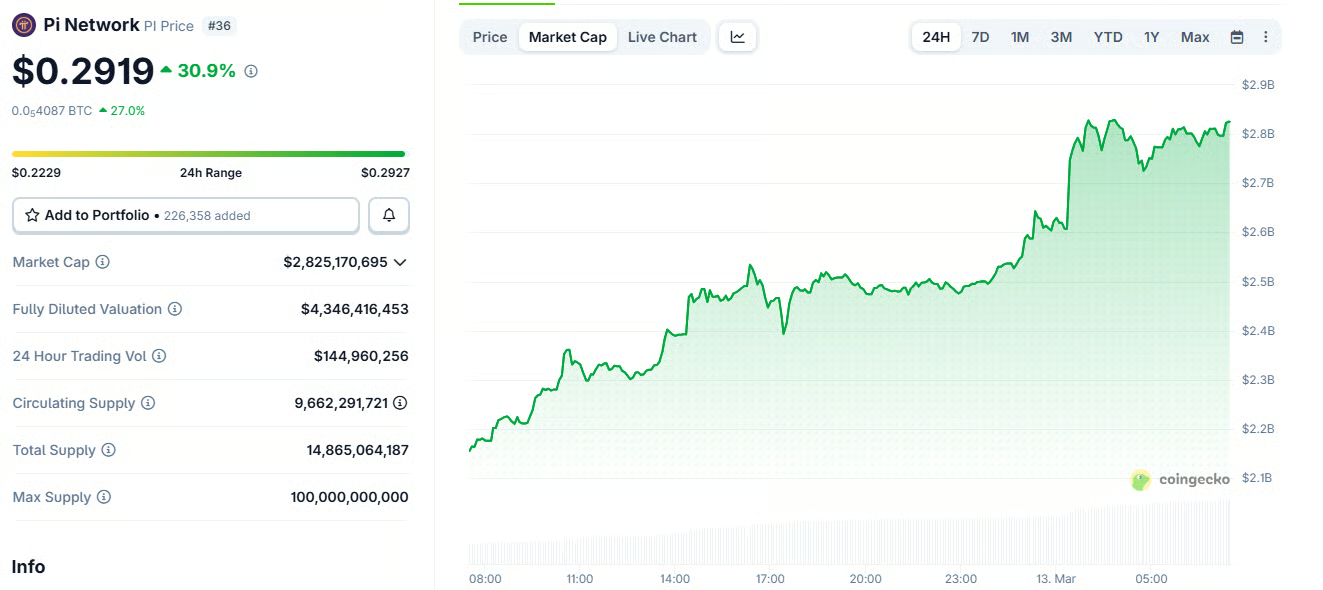
Pi Network’s price explodes 30% daily, adding to a total increase of more than 100% for the past month.
The price of Pi Network’s native cryptocurrency, PI, has exploded by more than 30% over the past 24 hours. This makes it the single best performer among the top 100 coins by total market capitalization, ahead of Render (RENDER) and Bittensor (TAO), which are up 19.4% and 12.9%, respectively.
Pi Network Price Increase: Factors to Consider
As CryptoPotato reported yesterday, one of the leading cryptocurrency exchanges in the United States, Kraken, announced that it will list PI. Per the statement, trading was supposed to start today, on March 13th.
At the time of this writing, trading hasn’t started yet, but anticipation is building. The latest move also comes on the back on a massive 175% increase in 24-hour trading volume, signaling heightened investor interest.
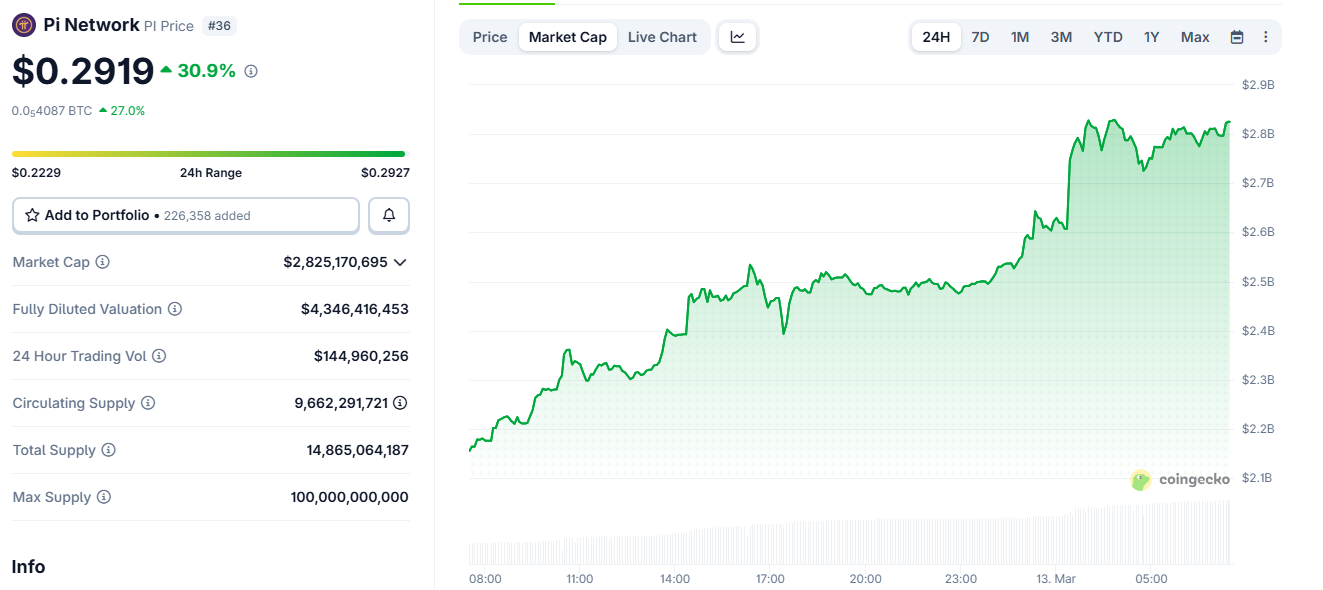
Pi Network’s price increase also puts its total market capitalization at around $2.8 billion, making it the 36th largest project by this metric, although its fully diluted valuation surpasses $4.3 billion.
What’s Next?
It’s interesting to see if the most recent rally can be sustained, given the uncertainty in the crypto and broader markets. However, it’s worth noting that PI’s price has been performing really well in the past month, despite the ongoing turbulence.
The cryptocurrency is up 73.5% in the past 14 days, adding to a combined increase of more than 112% in the past month alone.
This comes ahead of March 14th – a date that’s largely celebrated as Pi Day within the community. Although the celebration is broader and usually associated with the number (not the project), it has become some sort of a tradition.
You may also like:
Binance Free $600 (CryptoPotato Exclusive): Use this link to register a new account and receive $600 exclusive welcome offer on Binance (full details).
LIMITED OFFER for CryptoPotato readers at Bybit: Use this link to register and open a $500 FREE position on any coin!
Disclaimer: Information found on CryptoPotato is those of writers quoted. It does not represent the opinions of CryptoPotato on whether to buy, sell, or hold any investments. You are advised to conduct your own research before making any investment decisions. Use provided information at your own risk. See Disclaimer for more information.

The fresh capital from Kraken’s parent company, Ark Invest, and Bitmine has backed Eightco’s new bets on OpenAI and MrBeast
Shares in Eightco Holdings (ORBS) jumped 12% on Thursday after it raised $125 million to back its bets in blockchain and artificial intelligence.
Eightco said on Wednesday that crypto treasury firm Bitmine led the funding with $75 million, while Ark Invest and Payward, the parent company of crypto exchange Kraken, each chipped in $25 million apiece.
The company added that Bitmine chairman Tom Lee would join Eightco’s board and Ark Invest’s chief futurist Brett Winton also signed on as a board advisor.
Eightco chairman Dan Ives, known for his bullish commentary on the tech sector, also stepped down from his position after being appointed to the role in September.
Eightco said the capital would support its expansion “into investing in technology shaping the next generation of artificial intelligence, blockchain infrastructure, and global digital consumer platforms.”
Eightco bets on MrBeast, OpenAI
Eightco said that it had also closed an initial $50 million strategic investment into OpenAI and another $25 million investment into Beast Industries and its owner and YouTuber James Donaldson, better known as MrBeast.
“These investments position ORBS as a hub at the center of key frontier AI technologies and content creation, expanding its portfolio to include ownership stakes in world-leading innovators,” Eightco said.

Related: Crypto accounting startup Cryptio lands $45M as institutions move onchain
Shares in Eightco ended trading on Thursday up 11.67% to 90 cents in reaction to the announcement. The stock saw a slight fall after hours, dropping by 2.6% to 88 cents.

Shares in Eightco are down over 92.49% in the past six months as stocks tied to crypto have been battered amid a broad market downturn.
Eightco is an e-commerce inventory management platform that made its first crypto play in September, announcing it would buy and hold Worldcoin (WLD), which sent its share price surging by 3,000% in a single day.
Magazine: Human brain cell wetware plays Doom, fly’s mind uploaded: AI Eye


A Singapore court has sentenced a man to two years in jail for his involvement in a crypto theft that resulted in the loss of assets valued at more than $6.9 million.
Summary
- A Singapore man was sentenced to two years in jail for his role in a cryptocurrency theft case.
- The scheme involved unauthorised access to a crypto wallet, resulting in the theft of about US$6.9M in digital assets.
- Authorities recovered some of the stolen cryptocurrency and seized electronic devices during the investigation.
Man sentenced to 2 years in jail over $8.8M crypto theft linked to hacked wallet
The case stemmed from an incident in which hackers gained unauthorised access to a crypto wallet and transferred digital assets out of it without the owner’s consent. Authorities said the accused was part of a group that helped facilitate the crypto theft after the compromised account was accessed through a computer system.
Investigations found that the operation involved several individuals who exploited access to a platform connected to a global cryptocurrency exchange.
Once the account was breached, cryptocurrencies worth roughly US$6.9 million, equivalent to about S$8.8 million, were transferred out of the wallet.
Singapore’s Cybercrime Command launched an investigation after receiving a report about multiple instances of unauthorised access to the wallet. Officers later identified suspects linked to the incident and carried out arrests within days of the complaint being filed.
Authorities were able to recover part of the stolen funds during the probe, along with several electronic devices such as laptops and mobile phones believed to have been used in the operation.
In court, the man admitted to his role in the offence and was sentenced to two years’ imprisonment. Under Singapore law, causing a computer system to perform unauthorised access can carry a jail term of up to two years and a fine for first-time offenders.
The case highlights growing concerns over cyber-enabled crimes targeting digital assets, as law enforcement agencies intensify efforts to track and recover stolen cryptocurrency linked to hacking and fraud schemes.

Decentralized finance was built to remove intermediaries, but one major piece of traditional finance has been missing: credit scoring. In traditional banking, institutions evaluate borrowers based on their financial history before approving loans. In DeFi, however, most lending protocols require overcollateralization, forcing users to deposit more assets than they borrow.
This is where on-chain credit scoring comes into play.
On-chain credit scoring evaluates a wallet’s historical behavior—transactions, repayments, liquidity provision, governance participation, and even social trust signals—to assign a creditworthiness score. Instead of relying purely on collateral, protocols can use these scores to determine borrowing limits, interest rates, and risk levels.
How On-Chain Credit Scoring Works
On-chain credit scoring systems analyze wallet activity across multiple dimensions:
1. Transaction History
Wallets with consistent activity, long transaction histories, and healthy portfolio diversification may receive higher trust scores.
2. Lending & Repayment Behavior
Borrowers who repay loans on time across DeFi lending platforms demonstrate reliability.
3. Liquidity Provision & Staking
Participation in liquidity pools or staking often signals long-term commitment and lower risk.
4. Governance Participation
Active involvement in protocol governance can also be a positive reputation indicator.
5. Network Graph Analysis
Some systems analyze relationships between wallets, detecting suspicious activity or sybil behavior.
Projects Building On-Chain Credit Scoring
1. Spectral Finance
Spectral introduced Macro Score, an AI-driven credit scoring system that evaluates wallet behavior across DeFi protocols.
This score can help lenders assess borrower risk without relying on centralized credit agencies.
2. Goldfinch
Goldfinch focuses on undercollateralized lending, particularly for real-world borrowers.
Instead of relying solely on crypto collateral, the protocol incorporates borrower reputation and community-backed trust.
3. Arcx
Arcx developed DeFi Passport, which gives wallets a reputation score based on on-chain financial behavior.
Protocols can integrate this score to tailor lending conditions.
4. Cred Protocol
Cred Protocol analyzes on-chain and social data to build trust scores that can be used across DeFi ecosystems for credit evaluation.
5. TrueFi
TrueFi enables undercollateralized loans to vetted borrowers, combining on-chain transparency with off-chain credit assessment mechanisms.
Why On-Chain Credit Matters
Capital Efficiency
Overcollateralized loans limit growth. Credit scoring allows larger loans with less collateral, unlocking capital efficiency.
Financial Inclusion
Anyone with a wallet and a strong on-chain track record can build a credit profile—no bank account required.
Risk-Adjusted Lending
Protocols can adjust interest rates dynamically based on borrower reliability.
Portable Reputation
Your credit history becomes portable across DeFi, meaning one good reputation can unlock opportunities across multiple protocols.
Challenges Facing On-Chain Credit Systems
Despite its promise, the concept still faces hurdles.
Sybil Attacks – Users could create multiple wallets to manipulate reputation.
Privacy Concerns – Public credit profiles may reveal financial behavior.
Fragmented Data – Reputation systems often remain siloed across protocols.
Identity Verification – Without optional identity layers, assessing real-world reliability remains difficult.
Solutions such as zero-knowledge proofs, decentralized identity systems, and reputation aggregation layers are being explored to address these issues.
The Future: Reputation-Based DeFi
On-chain credit scoring could fundamentally transform lending in DeFi. Instead of treating every wallet as anonymous and risky, protocols could evaluate behavioral trust signals directly from blockchain data.
In the long run, this could lead to:
-
Undercollateralized crypto loans
-
Reputation-weighted interest rates
-
Cross-protocol credit profiles
-
DeFi-native financial identities
If successful, on-chain credit systems may become the missing bridge between traditional finance and decentralized finance, enabling a truly trust-minimized lending ecosystem where reputation—not just collateral—unlocks financial opportunity.
REQUEST AN ARTICLE


Another Friday has rolled around again, and that means more crypto options contracts are expiring as spot markets post rare gains.
Around 27,000 Bitcoin options contracts will expire on Friday, Mar. 13, with a notional value of roughly $1.9 billion. This event is smaller than usual, so it is unlikely to affect spot markets.
Crypto prices have been flat for most of this week, picking up a little on Friday, with total capitalization gaining $150 billion since Monday, but volatility and volumes have dwindled.
Bitcoin Options Expiry
This week’s batch of Bitcoin options contracts has a put/call ratio of 0.97, meaning that the longs and the shorts are relatively evenly matched. Max pain is around $69,000, according to Coinglass, which is pretty close to current spot prices, so many could be in the money on expiry.
Open interest (OI), or the value or number of Bitcoin options contracts yet to expire, remains highest at the $60,000 strike price on Deribit, with $1.7 billion in bearish bets. Total BTC options OI across all exchanges has been climbing this month, reaching $45.5 billion.
Crypto derivatives provider Greeks Live observed the market rebound, noting that Bitcoin was firmly holding above the $70,000 psychological threshold and is “now poised to challenge $75,000.”
Beyond March, the flat forward implied volatility curve implies no significant term structure premium, suggesting balanced risk pricing for longer-dated options amid stable crypto sentiment, noted Greeks Live this week.
🚨 Options Expiry Alert | 08:00 UTC Friday
~$2.27B in crypto options are set to expire on Deribit.$BTC: 26,889 contracts | $1.89B notional | P/C: 0.97
OI stacked at $55K-$60K puts vs $75K-$80K calls, spot at $70.2K sitting right in no man’s land.
Max Pain: $69K$ETH: 185,268… pic.twitter.com/H9zji7lzbW— Deribit (@DeribitOfficial) March 12, 2026
You may also like:
In addition to today’s batch of Bitcoin options, around 185,000 Ethereum contracts are also expiring, with a notional value of $382 million, max pain at $2,000, and a put/call ratio of 1.2. Total ETH options OI across all exchanges is around $7.9 billion.
This brings the total notional value of crypto options expiries to around $2.3 billion.
Spot Market Outlook
Spot markets have ticked up on Friday morning in Asia, with total capitalization reaching $2.5 trillion again, its highest level for a week.
Bitcoin came just short of $72,000 in early trading but again found resistance there and started to retreat at the time of writing.
Ether prices were faring better with a 4% gain, sending them just above $2,100.
The altcoins were also mostly in the green today with larger moves for Solana, Hyperliquid, Avalanche, and Sui. Meanwhile, Pi Network, PI, skyrocketed 33% on the day to $0.29 following a listing on Kraken.
Binance Free $600 (CryptoPotato Exclusive): Use this link to register a new account and receive $600 exclusive welcome offer on Binance (full details).
LIMITED OFFER for CryptoPotato readers at Bybit: Use this link to register and open a $500 FREE position on any coin!
6 food documentaries that will change how you see what’s on your plate

Will Meghan Markle Be Paid for Luxury Retreat Appearance Next Month?

BlackRock’s staked ether ETF draws $15 million in first-day trading


![BITCOIN IS ABOUT TO BREAKOUT!!!!! [GET READY]](https://wordupnews.com/wp-content/uploads/2026/03/1773381137_maxresdefault-80x80.jpg)
-
Business7 days ago
Form 8K Entergy Mississippi LLC For: 6 March
-

 News Videos4 days ago
10th Algebra | Financial Planning | Question Bank Solution | Board Exam 2026
-

 Fashion6 days ago
Weekend Open Thread: Ann Taylor
-

 Crypto World4 days ago
Paradigm, a16z, Winklevoss Capital, Balaji Srinivasan among investors in ZODL
-
 Tech2 days ago
A 1,300-Pound NASA Spacecraft To Re-Enter Earth’s Atmosphere
-

 Politics7 days ago
Top Mamdani aide takes progressive project to the UK
-

 Tech3 days ago
ChatGPT will now generate interactive visuals to help you with math and science concepts
-

 Business3 days ago
ExxonMobil seeks to move corporate registration from New Jersey to Texas
-

 Sports5 days ago
Three share 2-shot lead entering final round in Hong Kong
-

 Sports5 days ago
Braveheart Lakshya downs Lai in epic battle to enter All England Open final | Other Sports News
-

 NewsBeat1 day ago
Residents reaction as Shildon murder probe enters second day
-

 Entertainment6 days ago
Hailey Bieber Poses For Sexy Selfies In New Luscious Lip Thirst Traps
-

 Business5 days ago
Search for Nancy Guthrie Enters 37th Day as FBI Probes Wi-Fi Jammer Theory
-

 Business2 days ago
Search Enters Sixth Week With New Leads in Tucson Abduction Case
-
 NewsBeat3 days ago
Pagazzi Lighting enters administration as 70 jobs lost and 11 stores close across Scotland
-

 Tech4 days ago
Despite challenges, Ireland sixth in EU for board gender diversity
-

 Business3 days ago
Search Enters 39th Day with FBI Tip Line Developments and No Major Breakthroughs
-

 NewsBeat2 days ago
I Entered The Manosphere. Nothing Could Prepare Me For What I Found.
-

 Business6 days ago
Iran war enters second week as Trump demands ’unconditional surrender’
-

 Sports4 days ago
Skateboarding World Championships: Britain’s Sky Brown wins park gold