
Crypto World
Volatility exits crypto, TradFi markets even as U.S.-Iran risks linger, sovereign debt rises: Crypto Daily

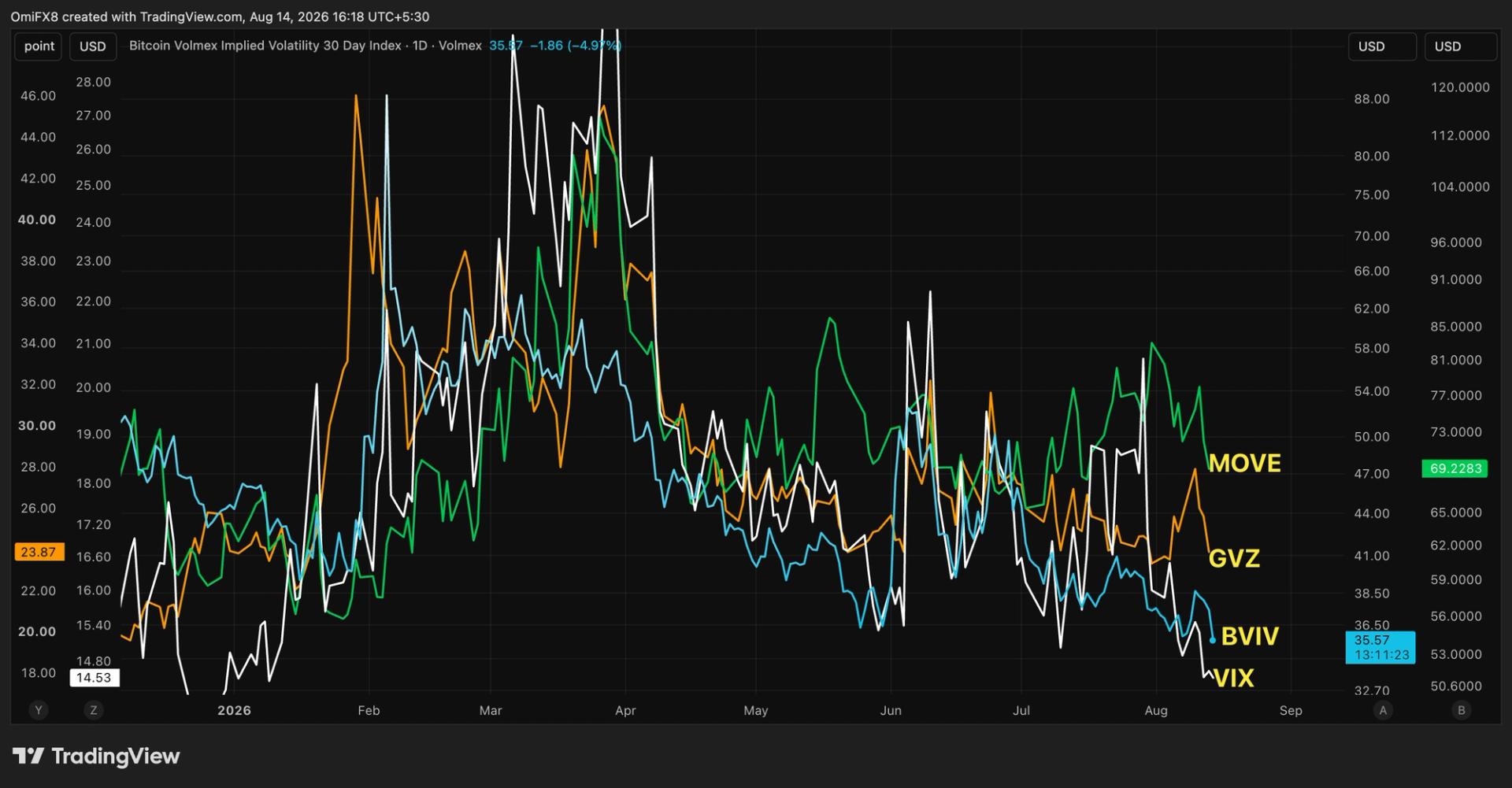
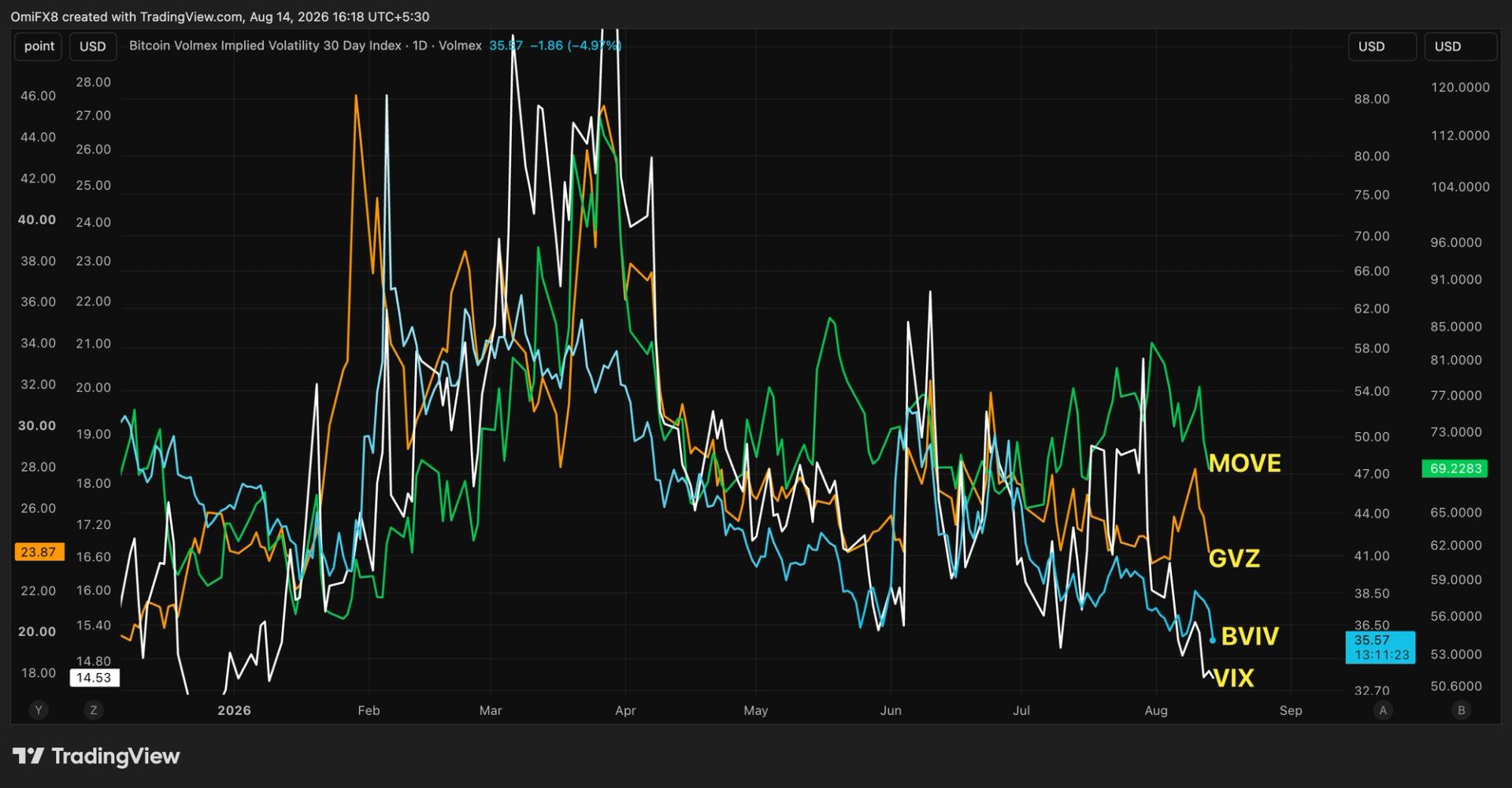
Scan the news and there are plenty of reasons for worry: continued U.S.-Iran escalation risks, mounting sovereign debt and rising bond yields among them. Crypto carries its own set of concerns, including regulatory disappointments, weak demand and hack risks.
Yet crypto, stocks, bonds and even commodity markets remain sanguine. That is clear from implied-volatility readings across these markets. Implied volatility is a measure of expected price turbulence, and is calculated from the demand for options and other derivatives used to hedge against wild swings and uncertainty.
Bitcoin’s 30-day implied volatility index, BVIV, has dropped back to a 2026-low near 36%, reversing the minor pop to nearly 38% earlier this week, according to data source TradingView. The same is true for ether, the second-largest digital asset market value.
Wall Street’s VIX index, often called a “fear gauge” tracking uncertainty and volatility in the S&P 500, has declined to the lowest level since January. The Treasury market equivalent, MOVE, is also under pressure, hovering near the lower end of its multi-month range of 66% to 84%. Even gold and oil volatility indexes are falling.

Crypto World
BTCC Exchange Announces Platinum Sponsorship of TOKEN2049 Singapore and Launches “0-Barrier Trading” Flagship Theme


BTCC, the world’s longest-serving cryptocurrency exchange, announces its participation in TOKEN2049 Singapore 2026 as a Platinum Sponsor. Taking place October 7-8 at Marina Bay Sands, the world’s largest crypto event is expected to convene over 25,000 global industry leaders, investors, and enthusiasts.
As BTCC celebrates its 15th anniversary this year, the exchange’s high-profile presence at TOKEN2049 signals the next chapter in its brand evolution: 0-barrier trading.
Theme of the Next Chapter: 0-Barrier Trading
BTCC’s TOKEN2049 showcase centers on its commitment to making futures trading accessible, reliable, and cost-efficient. Driven by the core pillars of 0 Fees, 0 Friction, and 0 Panic, BTCC removes all barriers to trading, allowing cost-conscious traders to navigate global markets with confidence.
On-site, BTCC’s booth at TOKEN2049 will bring its yearlong 0-Fee Festival campaign to life through a large-scale receipt-style installation designed for social sharing. Alongside the merch counter, the booth features a rotating, backlit cylinder that highlights the exchange’s core zero-barrier commitments.
Attendees can stop by to participate in interactive activities, engage with the team, and collect official BTCC swag bags.
The BTCC Traders Club
A key highlight of BTCC’s presence at TOKEN2049 is the BTCC Traders Club. Styled around BTCC’s partnership with the Argentine Football Association (AFA), the exclusive private lounge features dark wood decor in a cozy, luxurious atmosphere where BTCC’s most meaningful TOKEN2049 conversations will take place. During the event, the lounge will receive VIP traders, key opinion leaders, community partners, and invited guests to connect and collaborate.
Global Giveaways & Live Coverage
For the global community participating virtually, BTCC will host live streams on X featuring prominent industry KOLs directly from the Marina Bay Sands exhibition floor.
Online participants can join special campaigns throughout the event, with rewards including USDT prize pool giveaways and exclusive limited-edition merchandise.
To stay updated on BTCC’s announcements and activities at TOKEN2049 Singapore, visit BTCC’s official X.
#BTCC15 #BTCCTOKEN2049
About BTCC
Founded in 2011, BTCC is a leading global cryptocurrency exchange serving over 12 million users across 100+ countries. As the official regional sponsor of the Argentine Football Association (AFA), BTCC offers secure and accessible cryptocurrency trading services, focused on delivering a user-friendly experience while adhering to applicable regulatory standards.
The post BTCC Exchange Announces Platinum Sponsorship of TOKEN2049 Singapore and Launches “0-Barrier Trading” Flagship Theme appeared first on BeInCrypto.
On 13 August, the UK Office for National Statistics (ONS) reported that GDP growth slowed to 0.4% quarter-on-quarter in the second quarter, down from 0.6% in the first quarter. The figure was in line with expectations, and the market reaction was relatively muted.
The interest-rate backdrop has also remained broadly unchanged for several weeks. On 30 July, the Bank of England kept its policy rate at 3.75%, while the ECB left its rate at 2.25% on 23 July. With both decisions largely priced into the market, the absence of fresh guidance from either central bank means that short-term EUR/GBP price action may be driven more by technical factors than by the latest macroeconomic data.
Technical Analysis of EUR/GBP
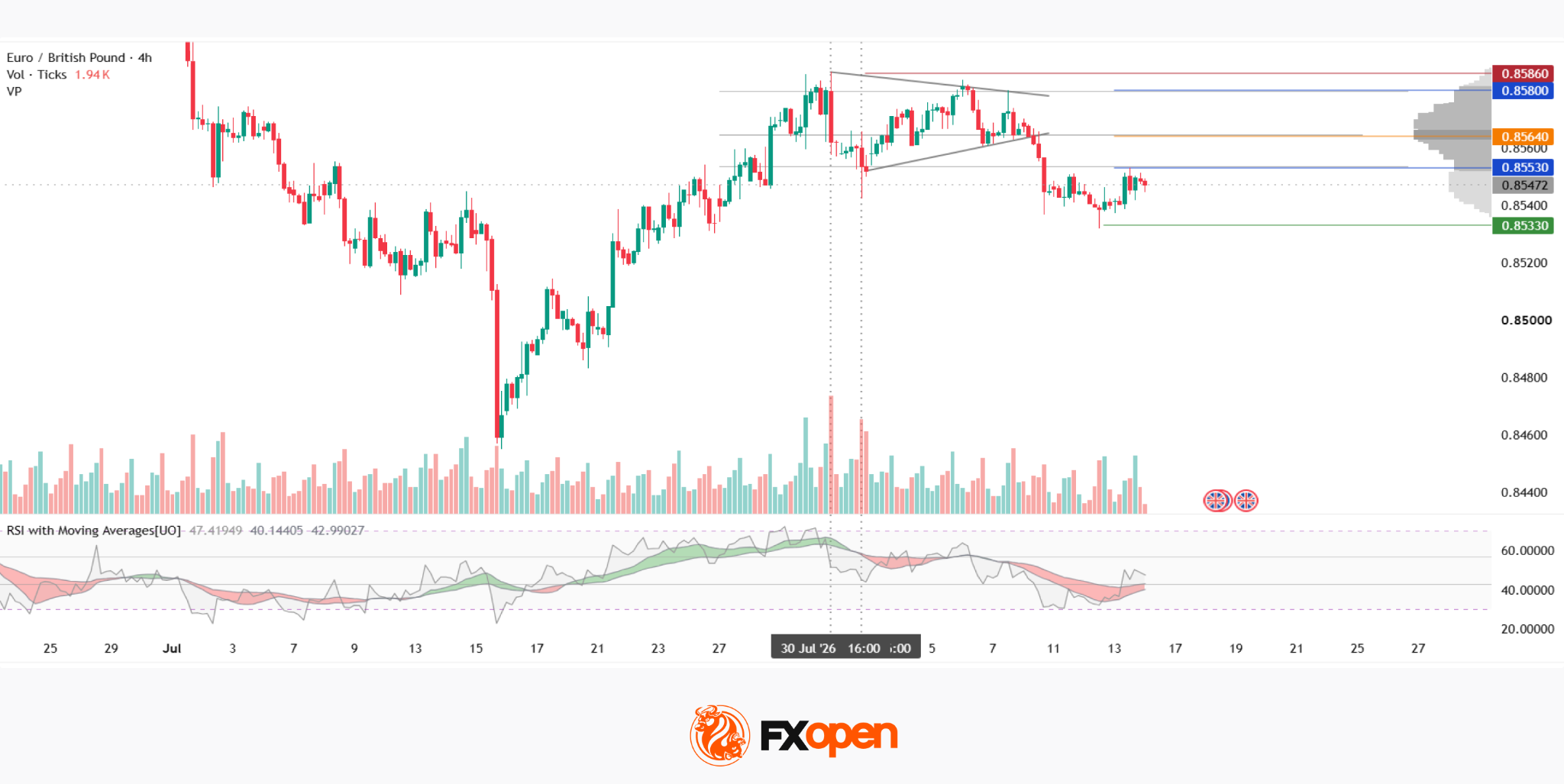
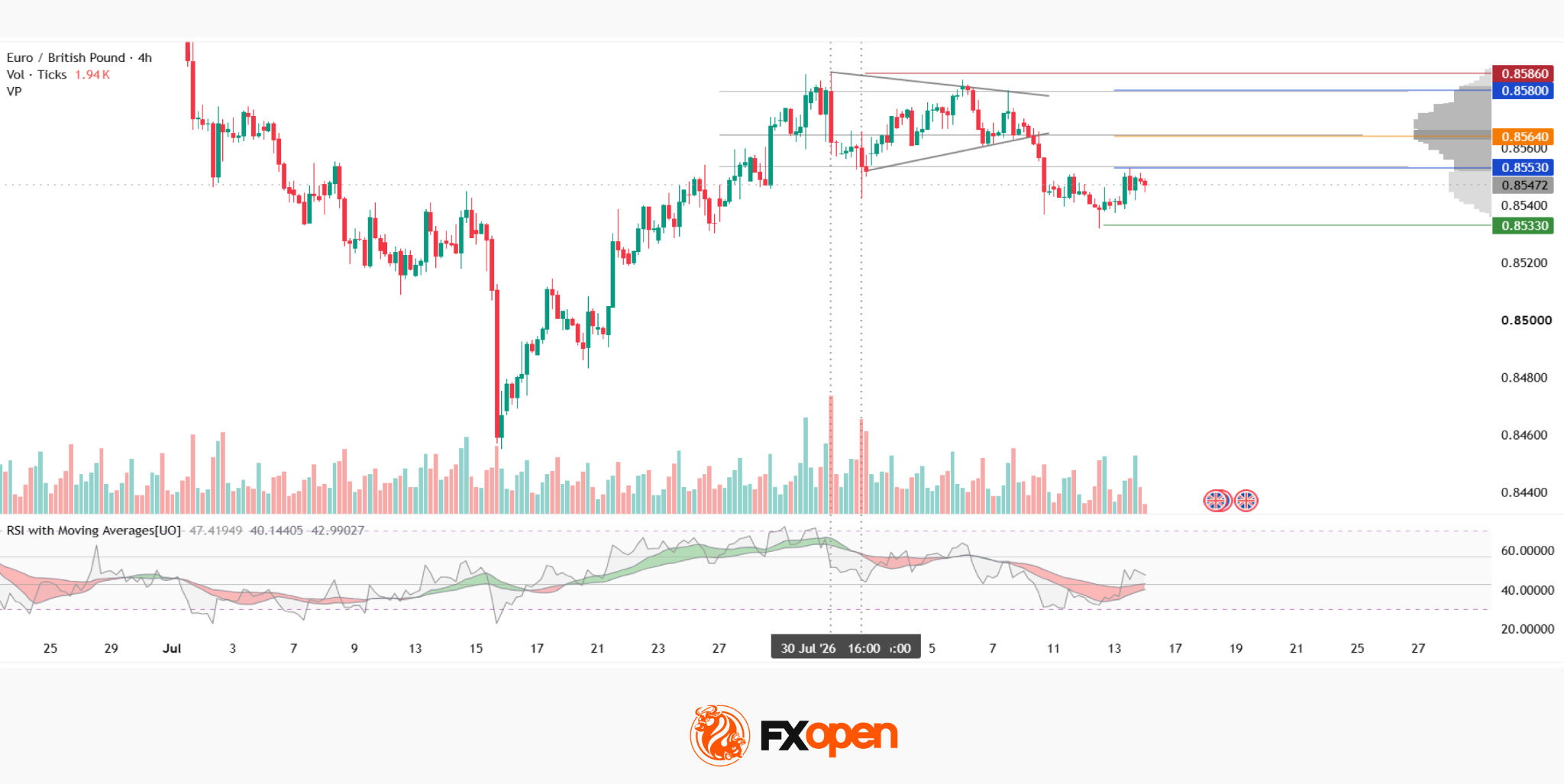
The second half of July saw a strong upward move in EUR/GBP, with the pair climbing from below 0.8460 to a peak near the current resistance level at 0.8586.
The rally was followed by a consolidation phase. Since the beginning of August, price action has gradually narrowed into a pattern resembling a symmetrical triangle, with the trading range becoming progressively tighter.
On Monday, 10 August, the pair broke below the lower boundary of the formation. EUR/GBP is currently trading beneath both the triangle’s lower trendline and the lower boundary of the current market profile at 0.8553, while testing the latter from below. If this retest is successful and the downside move gains momentum, the green support level around 0.8533 could become increasingly important.
A false breakout, however, would shift attention back towards the upside. In that scenario, the pair would face several technical barriers: the Point of Control (POC) at 0.8564, the upper boundary of the profile at 0.8580, and the key resistance level at 0.8586.
The RSI + MAs indicator currently shows readings of 48, 40 and 43. The bearish signal has failed to develop further, while the RSI has moved back into the neutral zone, suggesting that momentum remains inconclusive.
Key Takeaways
The attempted downside breakout has pushed EUR/GBP outside the profile in which the recent consolidation developed. The next directional move may depend on whether the pound receives additional support from the Bank of England as the central bank determines its subsequent policy course.
For now, the technical setup remains vulnerable to a false breakout, with the 0.8553 retest likely to be particularly important in determining whether sellers can maintain control or the pair returns to the consolidation range.
Trade over 50 forex markets 24 hours a day with FXOpen. Take advantage of low commissions, deep liquidity, and spreads from 0.0 pips (additional fees may apply). Open your FXOpen account now or learn more about trading forex with FXOpen.
This article represents the opinion of the Companies operating under the FXOpen brand only. It is not to be construed as an offer, solicitation, or recommendation with respect to products and services provided by the Companies operating under the FXOpen brand, nor is it to be considered financial advice.


Key takeaways
- Bitcoin trades near $63,567 on Friday after rebounding from support around $62,300.
- BTC remains below its 50-day, 100-day and 200-day EMAs, preserving the broader bearish bias.
- The RSI at 46 and a negative MACD signal weak momentum despite the recent stabilization.
Bitcoin (BTC) shows signs of stabilization on Friday after recovering from a correction earlier in the week.
BTC trades around $63,567 after buyers defended the $62,300 support level on Thursday. Holding this area could provide the foundation for a short-term rebound, but the price remains below all its major Exponential Moving Averages (EMAs).
Weak momentum indicators and several resistance barriers above the current price suggest that any recovery may remain limited unless Bitcoin reclaims the $64,488–$66,604 region.
Bitcoin rebounds from $62,300 support
Bitcoin found support around $62,300 on Thursday before recovering to approximately $63,567 on Friday.
The rebound indicates that buyers remain active near the lower boundary of the current range. However, BTC continues to trade below the 50-day, 100-day, and 200-day EMAs, which are positioned between $64,488 and $72,035.
When the price trades below these major moving averages, they can act as dynamic resistance during recovery attempts. This structure suggests the broader trend remains bearish despite Bitcoin’s ability to defend short-term support.
A stronger reversal would require BTC to reclaim the 50-day EMA before challenging the higher resistance levels created by the longer-term averages.
Bitcoin’s Relative Strength Index stands near 46, below the neutral level of 50.
The reading indicates that sellers maintain a slight advantage, although the indicator remains well above oversold territory. A move above 50 would suggest improving momentum and could reinforce the likelihood of a broader recovery.
The Moving Average Convergence Divergence remains below its zero line, supporting the bearish outlook.
Together, the indicators show that downside pressure has eased but has not disappeared. Bitcoin needs stronger buying volume and a decisive move above nearby resistance to confirm a momentum shift.
BTC faces resistance at $64,488
The 50-day EMA at approximately $64,488 represents Bitcoin’s first significant resistance level.
A daily close above this moving average could strengthen the rebound and allow BTC to challenge the 38.2% Fibonacci retracement level near $65,547.
Beyond that, the horizontal resistance at $66,500 and the 100-day EMA at $66,604 form a dense supply zone. Sellers may defend this region aggressively, particularly after Bitcoin’s recent correction.
If buyers overcome the $66,500–$66,604 range, the 50% Fibonacci retracement near $67,940 would become the next upside target.
A sustained move above $67,940 would substantially improve the short-term technical outlook, although the 200-day EMA near $72,035 would remain a major long-term barrier.
On the downside, initial support sits at the 23.6% Fibonacci retracement level around $62,586.
The horizontal floor at $62,300 provides the next and more critical support. This level triggered Thursday’s recovery and remains essential to Bitcoin’s short-term outlook.

A daily close below $62,300 would invalidate the immediate rebound scenario and signal that selling pressure is strengthening.
Such a breakdown could expose Bitcoin’s broader support near $57,800, which marks the current cycle low. Buyers would likely attempt to defend this area because a sustained move below it could extend the wider bearish trend.
For now, holding above $62,300 keeps the possibility of a recovery toward $64,488 and $65,547 intact. However, Bitcoin must reclaim the major moving averages to demonstrate that bulls are taking control.
[PRESS RELEASE – Amsterdam, Netherlands, August 14th, 2026]
USDT remains the dominant stablecoin by business transaction volume on NOWPayments, but new platform data shows USDC gaining momentum fast. In H1 2026, USDC transaction count increased by 209.02% year-over-year, and transaction volume rose by 101.63%, while USDT transaction activity declined over the same period.
The result is an increasingly differentiated stablecoin landscape: USDT continues to offer the scale and liquidity businesses rely on globally, while USDC is emerging as a growing alternative, particularly for companies navigating regulated European infrastructure.
Stablecoins are no longer used only to accept crypto payments. Businesses are increasingly relying on USDT and USDC to move money throughout their daily operations, from affiliate commissions and supplier settlements to marketplace payouts, payroll, treasury transfers, and customer withdrawals. As more companies build these workflows around digital assets, stablecoins are becoming an important part of business infrastructure rather than simply another payment option.
Drawing on USDT and USDC transaction activity across the NOWPayments platform between 2025 and 2026, this report examines how business stablecoin usage is evolving and the blockchain networks supporting that activity.
*Unless otherwise stated, all figures refer to USDT and USDC transaction activity processed through the NOWPayments platform.
Stablecoins Are Becoming Business Infrastructure
For many businesses, accepting a crypto payment is only the first step. Once funds are received, they still need to move through the business. Suppliers need to be paid, affiliates receive commissions, marketplace sellers withdraw earnings, employees collect salaries, and finance teams transfer working capital between accounts.
Instead of converting every incoming payment into fiat, many businesses now keep part of their operating funds in stablecoins and use them directly for day-to-day settlements.
Common operational use cases include:
- Affiliate and referral commissions
- Supplier and contractor payments
- Marketplace seller withdrawals
- Payroll for distributed teams
- Creator and influencer payouts
- Treasury transfers
For many businesses, stablecoins now support both incoming payments and outgoing transfers within the same operational workflow.
Business Stablecoin Adoption: USDT and USDC
The data reveals a clear divergence between scale and momentum. USDT remains the dominant stablecoin by transaction volume, while USDC is growing significantly faster from a smaller base.
USDT Still Leads Business Stablecoin Volume
USDT continues to account for the largest share of business stablecoin transaction activity, particularly by transaction volume.
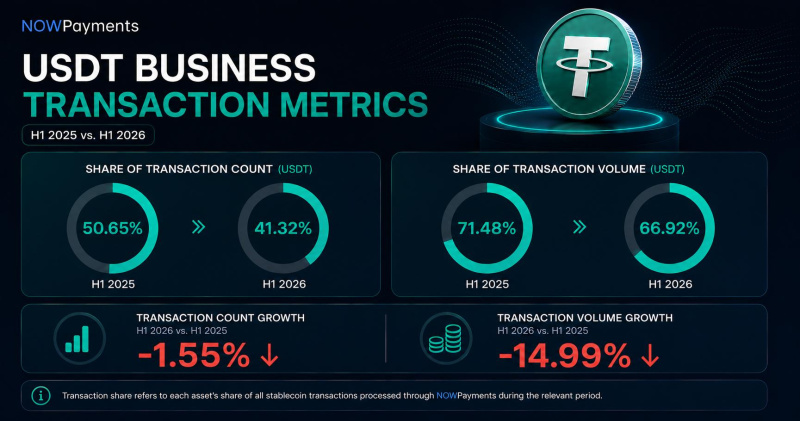
USDT’s lead remains substantial, even as its transaction activity declined year over year. In H1 2026, USDT transaction count declined 1.55% compared with H1 2025, while transaction volume fell 14.99%. Even so, USDT accounted for 66.92% of stablecoin transaction volume on NOWPayments in H1 2026. Its substantially higher share of transaction volume than transaction count (41.32%) suggests that USDT continues to play a particularly important role in higher-value business transfers.
USDC Gains Momentum Fast
USDC is becoming an increasingly important part of business stablecoin adoption.
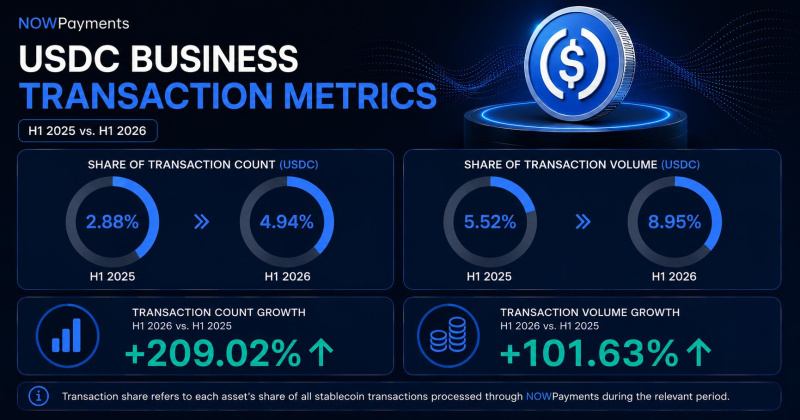
USDC remains much smaller than USDT by overall transaction share, but it is showing substantially stronger growth. In H1 2026, USDC transaction count increased 209.02% year over year, while transaction volume rose 101.63% year over year.
Its share of stablecoin transaction count also increased from 2.88% in 2025 to 4.94% in 2026, while its share of transaction volume rose from 5.52% to 8.95%. While NOWPayments data does not explain individual business decisions, the increase in both USDC transaction activity and transaction share indicates that USDC is gaining ground alongside USDT on the platform.
Network Choice Adds Another Layer to Stablecoin Strategy
Stablecoin choice is only part of the infrastructure decision. Businesses also select networks based on transaction costs, settlement speed, recipient compatibility, and ecosystem support.
Businesses using NOWPayments can process stablecoin transactions across multiple blockchain networks, including:
USDT
- TRON
- Ethereum
- BNB Smart Chain
- Polygon
USDC
- Ethereum
- Base
- Polygon
- Arbitrum
Two Stablecoins, Two Business Advantages
The divergence between USDT and USDC is not only about transaction growth. The two assets increasingly offer businesses different advantages: USDT combines global scale and liquidity, while USDC has a clearer position within Europe’s MiCA-regulated environment.
USDT and USDC Under MiCA
For global operations, USDT’s liquidity and broad ecosystem support remain significant advantages. For businesses focused on Europe, USDC’s regulatory positioning can make it easier to integrate with regulated crypto infrastructure. For companies operating across both environments, supporting both assets can provide greater flexibility.
Businesses looking for a detailed legal analysis can explore NOWPayments’ analysis of USDC under MiCA and comparison of USDT and USDC under MiCA, which examine the regulatory framework and its practical implications for payment and payout infrastructure.
MiCA does not prohibit businesses or individuals from holding or transferring USDT. However, regulated exchanges, custodians, payment providers, and other crypto asset service providers may apply restrictions based on their own compliance obligations.
What the Findings Mean
NOWPayments data points to a stablecoin market defined by two different strengths. USDT remains the scale leader, accounting for 66.92% of stablecoin transaction volume in H1 2026. USDC remains much smaller, but its 209.02% growth in transaction count and 101.63% growth in transaction volume show significantly stronger momentum.
For businesses, the emerging picture is less about choosing a winner and more about choosing the right infrastructure for the market: USDT for global liquidity and established transaction scale and USDC for growing adoption and a clearer regulatory position in Europe.
“For many businesses, the question is no longer necessarily USDT or USDC. Supporting both can provide more flexibility across markets, partners, and operational requirements,” said Kate Lifshits, CBDO of NOWPayments.
About NOWPayments
NOWPayments is a crypto business ecosystem designed to help companies accept payments, automate mass payouts, manage stablecoin treasury, and scale global digital asset operations through a single infrastructure. Supporting 350+ cryptocurrencies, 30+ stablecoins, flexible settlement options, and enterprise-grade APIs, the platform helps businesses build scalable global payment operations. With 99% of payments completed in under one minute, near-instant email payouts, enterprise automation, and 24/7 operational support, NOWPayments provides the infrastructure businesses need to monetize, move, and manage digital assets at scale.
The post USDT Still Leads Stablecoin Volume as USDC Gains Momentum, NOWPayments Data Shows appeared first on CryptoPotato.


Key takeaways
- SharpLink Gaming plans to stake $200 million worth of Ethereum through Lido.
- The allocation will be converted into wrapped staked ETH and held with Anchorage Digital.
- wstETH enables SharpLink to earn staking rewards while retaining access to DeFi liquidity.
SharpLink Gaming (SBET) plans to allocate $200 million worth of Ethereum to Lido as the company seeks to generate additional returns from its expanding ETH treasury.
The Ethereum will be staked and converted into wrapped staked ETH, known as wstETH. Anchorage Digital will provide institutional custody for the assets, according to SharpLink’s announcement on Thursday.
The allocation adds Lido to SharpLink’s wider staking and restaking strategy, allowing the company to earn Ethereum network rewards while maintaining greater flexibility over how it deploys its holdings.
SharpLink expands its Ethereum staking strategy
SharpLink is pursuing ways to increase the productivity of the ETH held on its balance sheet instead of leaving the assets idle.
Through Lido, the company will stake $200 million in ETH and receive wstETH in return. The token represents staked Ethereum and the rewards generated from participating in the network’s proof-of-stake validation system.
Unlike directly staked ETH, wstETH can be transferred, traded or used within compatible decentralized finance applications while the underlying tokens continue generating staking rewards.
The structure could allow SharpLink to earn a base Ethereum staking yield while retaining the option to deploy its wstETH across other protocols.
SharpLink CEO Joseph Chalom described the allocation as an expansion of the company’s strategy to make its ETH holdings more productive. He said wstETH provides composability while allowing the company to maintain institutional risk standards.
SharpLink will custody the resulting wstETH with Anchorage Digital. The decision provides the company with a regulated institutional custodian while it increases its exposure to Ethereum’s staking and decentralized finance infrastructure.
Institutional custody is particularly important for corporate crypto treasuries because companies must manage operational, cybersecurity and governance risks alongside potential investment returns.
SharpLink did not disclose whether Anchorage Digital would also facilitate deployment of the wstETH into other DeFi platforms or whether the assets would initially remain in custody.
Technical forecast: LDO targets the $0.3370 resistance
The LDO/USD 4-hour chart remains bearish despite Lido rallying over the past few hours. However, the technical indicators suggest that the bulls could push the price higher in the near term.
The RSI of 57 is above the neutral 50, indicating that the bears are no longer in control of the market. The MACD lines also add further confluence to the bullish narrative.
If the rally persists, LDO could target the first major resistance at the $0.3370 level, which also coincides with the TLQ on the 4-hour timeframe.

An extended rally could allow LDO to reclaim the $0.4063 swing high for the first time since July 27.
However, if the bears regain control, LDO could retest last week’s low of $0.2716 in the near term.

Four years ago, Gregory Robinson wanted nothing to do with what might be the greatest spacecraft ever built. It didn’t, at the time, seem like it would ever actually become what it was promised to be: a machine that would take images from space, return them to Earth, and gobsmack the public with their clarity and depth and sheer celestial beauty—the kind of beauty that could, even briefly, stop a fraught and fractious species like ours from the daily messes we make of our world and leave us thinking, just once, You know what? When we try, we can do something truly grand.
What the spacecraft did seem like at the time was a massive white elephant, one that a man in Robinson’s position would not want to go near. For one thing, it was grossly over budget—with a sticker price that had risen from an initial estimate in 1995 of just $500 million to $8.8 billion. For another thing, it was years behind schedule. Its launch was originally set for 2007, and here it was the spring of 2018 and still nobody could say exactly when it would leave the ground. And finally, Robinson, who was at the time NASA’s deputy associate administrator of programs, liked the job he had just fine—overseeing no fewer than 114 NASA spacecraft either already flying or in the development pipeline.
And now, here came his boss, NASA associate administrator Thomas Zurbuchen, offering him a dog of an assignment: give up all of those fine spacecraft with their fine missions, and take over as program director of the James Webb Space Telescope—a generational project, yes, but with many blown deadlines and bloated costs and all the headaches that came with them. The telescope’s launch, at the time, was set for less than half a year away—October 2018—and once again it looked as if it would miss its target.

“We have some major challenges,” Robinson recalls Zurbuchen saying to him. “We’re starting to realize we may not make our launch date.” Zurbuchen then got to his point, asking—more like insisting, as Robinson recalls it—that he take over the reins of the project. “You’re the right guy to do it,” Zurbuchen said. “We’ve looked at a lot of different people, and you’re the right guy.”
Zurbuchen was impressed not just by Robinson’s technical acumen, but also his skills with a workforce. “The majority of problems we encountered with Webb during its [previous] six years were people and team problems,” Zurbuchen said in an email to TIME. “Technically, most issues had been resolved, but the team had struggled to come together and execute seamlessly. This is where Greg’s strengths really lie. He can walk into a meeting or launch room and walk out knowing what the energy of the team is, and also what hinders their progress.”
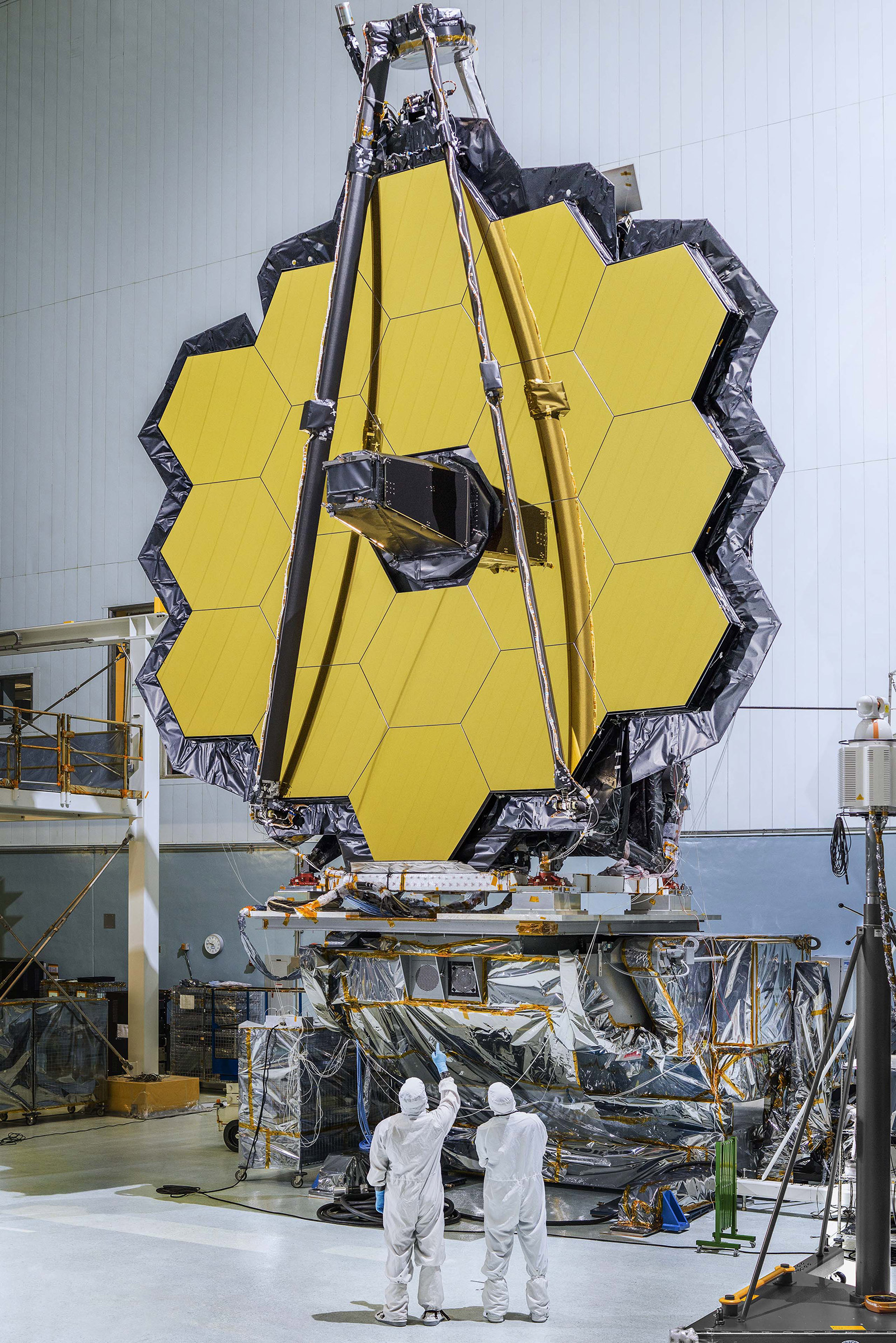
All the same, Robinson resisted the Webb offer for weeks before ultimately relenting to Zurbuchen’s entreaties. Four years on, the decision looks like an eminently good one. The seven-ton James Webb Space Telescope, with its prodigious 6.5-m (21.3 ft.) main mirror, is now situated in space 1.6 million km (1 million miles) from Earth, peering deeper into the universe, and thus further back in time, than any other space observatory ever built. If the Hubble Space Telescope has been NASA’s astronomical workhorse for more than 30 years, the Webb is the newer, grander, more powerful racehorse.
“Until Webb, Hubble was the best in the business,” says Robinson. “But to see the clarity, the differences in the images we’re getting now, it just blows my mind.”
The public’s awed reaction has mirrored Robinson’s own; the Webb telescope has come to represent something larger and grander than all of us. The long effort to get the spacecraft built, the mission it was assigned—searching for clues to the very origins of the universe—have worked a certain transcendent good. From the hands of a team of thousands of researchers, engineers, and factory-line workers came a ship that, if it doesn’t exactly kick open the doors to the secrets of the cosmos, at least parts the curtain. “This beautiful machine,” says senior project scientist John Mather, “has worked in every way that it was supposed to work.”
That beautiful work Webb is doing is a function of the wavelength in which its mirror sees the universe. Hubble scans space principally in the visible spectrum—the same wavelength with which the human eye sees. That allows it to peer 13.4 billion light-years away, seeing light that has been traveling to us for 13.4 billion years—or just 400 million years after the Big Bang. But Hubble is blind to what happened in that critical earlier phase of the universe’s infancy, because visible light from so far away can’t penetrate the intervening dust of interstellar space.
Infrared radiation, however, cuts right through the dust, allowing a telescope that, like Webb, detects energy in that frequency to see as far as 13.6 billion light-years distant. The additional 200 million years seems like a small difference, but it’s not.
“The difference between what Hubble and Webb [see] is not like comparing someone who’s 70 years old to somebody who’s 71 years old,” said Scott Friedman, an astronomer with the Webb team, in a conversation with TIME last year. “It’s like comparing a baby who’s 1 day old to a baby who’s 1 year old.”
Hubble, launched in 1990, had been in space for no more than five years before NASA began drawing up plans for an infrared observatory that was then called the Next Generation Space Telescope. The idea was a bold one, but it seemed snakebit from the start. Nobody had ever built a telescope like this before, and the research and development process was slow and painstaking, with the original half-billion price tag climbing steadily over the years—to $1 billion in 2000; $2.5 billion in 2004 (by which point the telescope had been renamed in honor of former NASA administrator James Webb); $4.5 billion in 2006; $8 billion in 2011; and $8.8 billion when Robinson took over in 2018.
That made Robinson’s job a potentially thankless one, but he was not working alone. At the time he took command of the project, NASA had already empaneled an independent review board to help set Webb to rights at last. Working with the board, Robinson improved the project’s efficiency rating—a ratio of scheduled tasks to completed tasks—from 55% to 95%. He also made the process more transparent, holding regular meetings with the White House Office of Management and Budget as well as appropriations committees in both houses of Congress.
And Robinson made it a point to tell some hard truths: Webb, he frankly conceded, was going to be later still—not launching until the end of 2021—and would cost more still, with a final price tag of $10 billion. But those would be the drop-dead limits.
“I tried to be a little more realistic,” Robinson says. “We tend to come into these things with a hero syndrome, and that can get you into trouble. I tried to institute better schedules, better milestones. Our rule was ‘Go fast, but don’t rush.’”
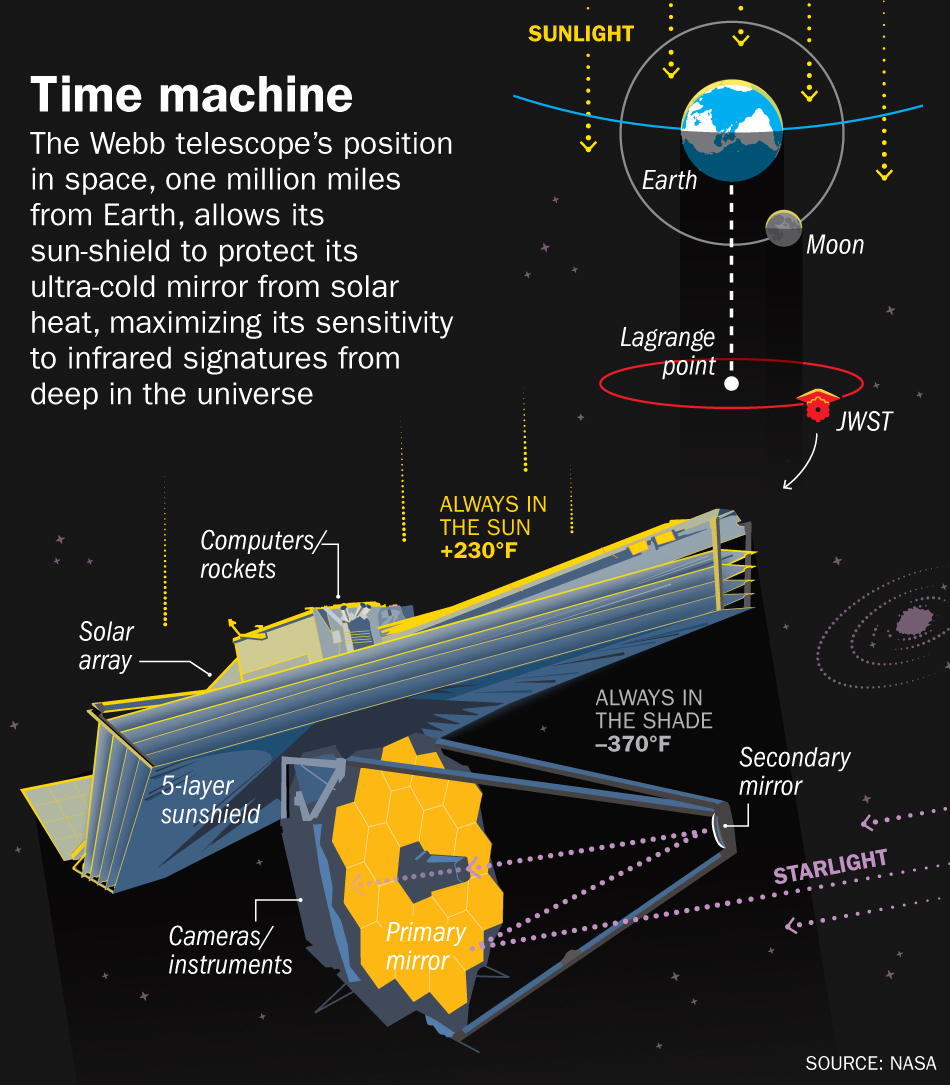
On Christmas Day 2021, the James Webb Space Telescope at last left the ground, aboard a European Space Agency (ESA) Ariane 5 rocket launched from Kourou, French Guiana, in South America. Hitching a ride with the ESA was a necessity because of the Webb’s size—which is too big for any rocket in the American fleet. Only the Ariane 5’s 5.4-m (17.7 ft.) fairing could accommodate it.
Launching from French Guiana came with its own challenges. Robinson and the rest of the NASA team were on-site for three weeks before liftoff as the telescope was loaded into the rocket and countdown rehearsals were run again and again. The jungle environment required the crew to take anti-malarial pills, tolerate ants in the hotel rooms, and stay alert to the stray jaguar that would appear on or around the launch site.
“One night, one of our engineers came back to his hotel and found a 6-ft. snake in his room,” says Bill Ochs, Webb’s now retired project manager.
Once in space, the telescope required three months before it could unfold its mirror and bring all of its observation instruments online. The process required successfully overcoming 344 so-called single-point failures—a pulley or actuator or switch that, if it went awry, could all by itself doom the mission. The biggest challenge involved unfurling the Webb’s tennis-court-size sunshield—a structure made of five layers of foil-like Kapton that keeps the temperature of the telescope’s mirror and instruments at a frigid –223°C (–370°F). That bitter temperature is necessary to prevent stray heat from distorting Webb’s infrared images the way stray light can ruin optical pictures. All 344 single-point failures worked perfectly and at last, in March 2022, the telescope switched on its 6.5-m eye and captured its initial image.
For that first picture, engineers at Webb’s mission-control center at the Space Telescope Science Institute (STScI) in Baltimore turned the telescope toward an entirely unremarkable star that goes by the decidedly technical name TYC 4212-1079-1. The choice was a practical one: TYC 4212-1079-1, some 2,000 light-years from Earth, has no nearby neighbors, allowing Webb to focus on it alone.
At first the image was a mess, with all 18 of the mirror segments capturing their own image of the star. “Imagine an a cappella chorus where everyone has their own key and their own song,” says Webb’s operations project scientist Jane Rigby. But over the course of several days the team focused the mirror, adjusting the position of each segment on the order of nanometers—less than the width of a human hair—until the 18 blurred images resolved into a single, impossibly bright and sharp one, with hundreds of galaxies photobombing it in the background.

“I can tell you that I’ve worked with geeks my whole life, and there was no better scene,” says Robinson, who was at the STScI at the time. “To see a bunch of people just falling over themselves with joy, it was a beautiful thing. I’m glad I was a part of it.”
In July, the whole world got to experience a similarly sublime moment when the Webb team unveiled four eye-popping images, including a field of galaxies known as SMACS 0723; the Carina Nebula—one of the cosmos’ great nurseries for new stars—located 7,600 light-years from Earth; and Stephan’s Quintet, a cluster of five galaxies first imaged by more primitive telescopes in 1877. The big reveal took place at a White House event attended by multiple members of the Webb team.
“These images are going to remind the world that America can do big things, and remind the American people—especially our children—that there’s nothing beyond our capacity,” President Joe Biden said during the event. “We can see possibilities no one has ever seen before. We can go places no one has ever gone before.”
With that early hoopla passed, the telescope has now entered its operational phase and is settling down to do more than just deliver eye candy. Astronomers from around the world who want to conduct research on the telescope are invited to submit proposals for observation time, and the Webb team expects to receive 1,000 such pitches per year—with only enough telescope time available to accommodate about 200 of them.
Despite that selectivity, Robinson—who has since retired, calling Webb the “capstone” of his career—sees the telescope as very much a democratic instrument. It may be owned and operated by NASA, but, Robinson says, “29 states in the U.S., 14 countries, and over 10,000 people touched this telescope.”
Write to Jeffrey Kluger at jeffrey.kluger@time.com.


Bitcoin price analysis shows the asset trading at $62,852.52 today, down 0.89% over the past 24 hours, a pullback that puts the market’s recent optimism to the test. There’s more beneath the surface than the headline number suggests, and it involves an increasingly stubborn divergence between macro data and the actual flow of institutional money.
Thursday’s PPI print came in cold: flat month-over-month against an expected 0.2% gain, with the annual rate at 4.7%. Jobless claims ticked up to 209,000 from a revised 200,000.
Combined with the softer July CPI, the data pushed September rate-hike odds down to roughly 32-35% from 41% the day prior, textbook bullish fuel for risk assets. BTC shrugged it off anyway. That’s the tell.
US spot Bitcoin ETFs posted a second straight day of net outflows, $131.1M on August 13 following $61.1M the day before, with Fidelity’s FBTC, ARKB, and GBTC among the biggest bleeders. Options positioning has also skewed toward the defensive, with implied volatility clustering around $60,000 downside strikes ahead of the August expiry, a sign that traders are hedging rather than chasing.
Bitcoin Price Analysis: Can BTC USD Hit $64,000 This Week?
BTC is pinned inside a $62,000–$66,000 consolidation band, with TradingView’s technical panel reading a flat-out sell signal, RSI at 47, and price sitting both the 10-day EMA ($63,948) and SMA ($64,198) below.
Immediate support sits near $62,250; a break there opens the door toward $61,000-$60,000. On the flip side, reclaiming $64,400 would flip momentum and put the $66,000 resistance zone back in play.
Bull case: ETF outflows stabilize, BTC reclaims the mid-$64k zone, and short covering drives a push toward $66,000.
Base case: continued chop inside the range while flows stay net-negative.
Bear case: a decisive break below $62,250 accelerates toward $60,000, especially if large custodial transfers add fresh supply pressure.
Notably, long-term holder supply fell for the first time in 2026 even as wallets holding 1,000+ BTC hit a yearly high, a split market, not a unified one. Worth watching before committing capital either direction.
EXPLORE: Your Market Calls Are Worth Something. Start With Free $25 on Kalshi
LiquidChain Targets Early Mover Upside as Bitcoin Tests Key Levels
BTC bulls keep getting handed favorable macro data and keep failing to capitalize; that pattern is starting to look less like noise and more like fatigue.
For traders sitting on spot BTC through this chop, the frustration is real: even a clean bounce off $62,250 support is likely to cap out well below prior highs, given Bitcoin’s market cap. Diminishing returns at scale is the tradeoff for holding the market leader.
LiquidChain ($LIQUID) is pitching a different bet entirely, a Layer 3 infrastructure play that fuses Bitcoin, Ethereum, and Solana liquidity into a single execution environment.
The presale sits at $0.0149 per token, with $939,039.33 raised so far. Its “deploy-once” architecture lets developers build once and reach all three ecosystems natively, backed by what the team calls verifiable settlement and single-step execution.
DISCOVER: Everyone’s Got a Take. Get Free $25 to Actually Trade Yours
The post Bitcoin Price Analysis: Can BTC Hit $64K This Weekend? appeared first on Cryptonews.
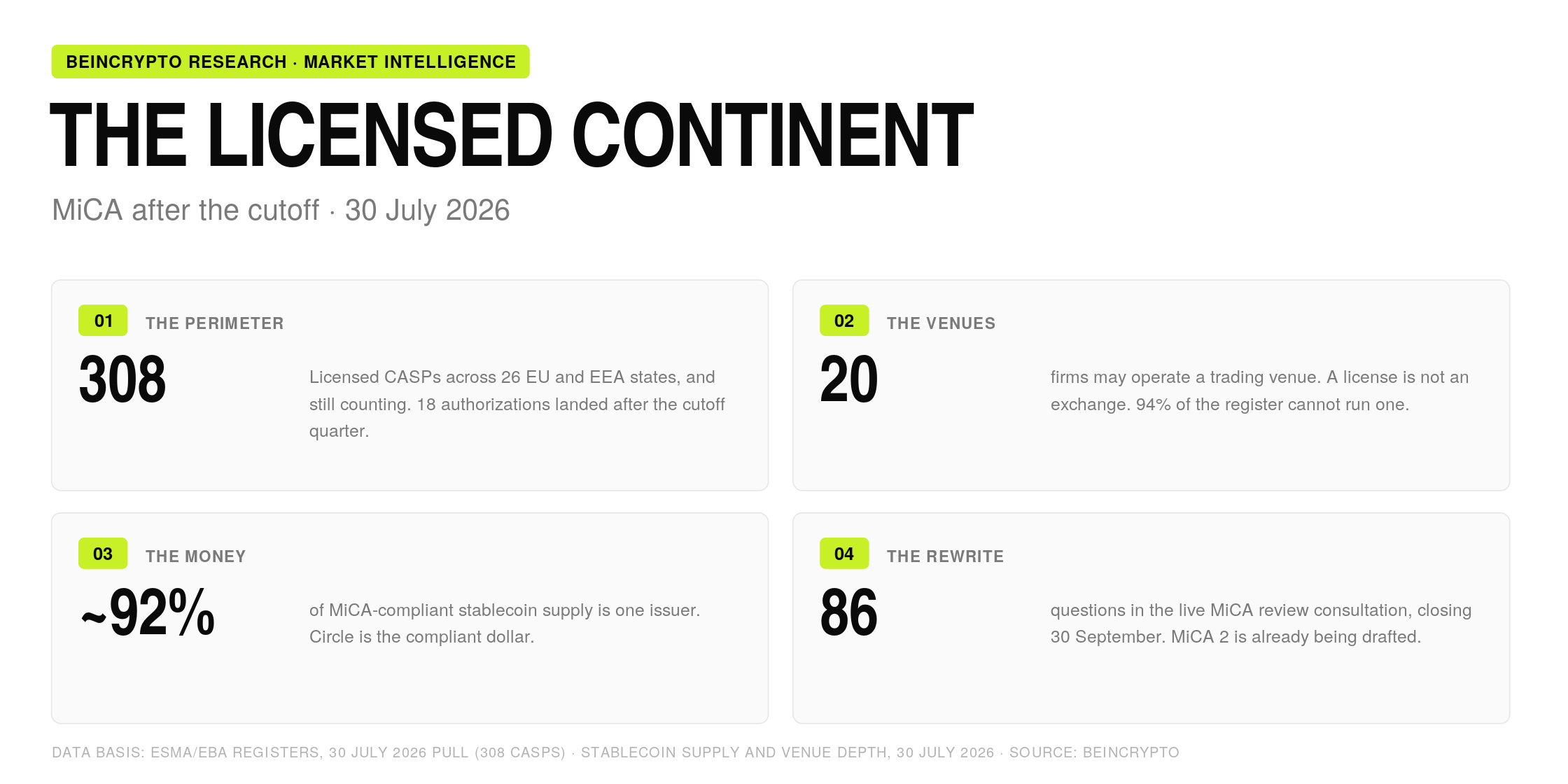
BeInCrypto’s review of Europe’s licensing register finds a market led by custody firms and banks. Trading-venue permissions remain rare, Circle dominates compliant stablecoin supply, and enforcement is concentrated in one country.
Europe’s crypto transition period ended on 1 July 2026. Roughly forty days later, the licensed market is still taking shape.
The European Securities and Markets Authority register, updated on 12 August, contains 329 authorization rows. They represent 324 identifiable legal entities because several firms appear more than once when permissions are added, or records are duplicated.
That distinction changes how the market should be read. Europe has created a sizeable regulated perimeter. The practical market inside it is much narrower. Only 21 entities can operate a trading venue, while custody and transfer permissions dominate.

The later register also confirms the larger finding from BeInCrypto’s original research. Banks secured a meaningful share of the licenses.
Circle supplies about 92% of the tracked MiCA-compliant stablecoin market. National regulators have applied the same EU rulebook in sharply different ways.
Data note: The graphics preserve BeInCrypto’s original 30 July snapshot, when the register contained 308 rows. The article text incorporates the ESMA update published on 12 August. ESMA publishes weekly and relies on submissions from national authorities. One German row carries a future authorization date of 28 August and was excluded from time-series comparisons.
The Register Lists 324 Firms, and Only 21 Can Run a Trading Venue
MiCA replaced national registration systems with a common authorization. A firm approved in one European Economic Area state can notify other markets and serve them without applying for a full license again.
The license covers ten separate crypto services. BeInCrypto normalized the latest ESMA service descriptions, which are not formatted consistently across national submissions.
Custody is the largest category, held by 218 of the 324 legal entities. Transfer services follow with 203. A total of 181 can exchange crypto for government-issued money, while 168 can execute orders for clients.
The permission to operate a trading platform sits near the bottom. Only 21 entities hold it, equal to 6.5% of the licensed market. The other 303 entities may provide services such as custody or brokerage, but they cannot run an order book that matches buyers and sellers.

This is why the headline license count can mislead. A crypto app may be authorized to exchange assets with customers from its own inventory while lacking permission to operate an exchange venue.
The market also splits between domestic specialists and firms seeking the full passport. In the latest file, 142 entities notified at least 27 target markets, about 44% of the register.
“Most of those authorizations are for narrower services: custody, brokerage, transfer, portfolio management and advice. In practice, EU spot liquidity is going to sit with a handful of names,” said Vyara Savova, senior policy lead at the European Ethereum Institute.
Most Old VASP Registrations Did Not Become MiCA Licenses
MiCA authorization is much heavier than the previous Virtual Asset Service Provider, or VASP, registrations. The old systems focused mainly on anti-money-laundering checks. MiCA adds scrutiny of capital, management, custody controls, and operational resilience.
BeInCrypto’s industry estimates place the initial legal and advisory work at €40,000 to €150,000. Compliance build-out can add €20,000 to €80,000. Technology work linked to the EU’s Digital Operational Resilience Act can cost a further €30,000 to €80,000. Recurring annual costs can reach €150,000 to €500,000.

James Harris, CEO of MiCA-authorised institutional asset manager Tesseract Group, said the fixed compliance burden falls hardest on smaller firms.
“A twenty-person firm has to build the same DORA, Travel Rule and AML stack as a three-thousand-person exchange. Authorisation as a CASP is something like ten to fifteen times harder than operating as a VASP,” said James Harris, CEO of MiCA-authorised institutional asset manager Tesseract Group.”
Europe’s wider VASP population once approached 2,700 registrations. Industry estimates place the active pre-MiCA market closer to 1,200. Those figures are different populations and cannot produce one precise conversion rate. Compared with 324 licensed entities today, they indicate that roughly three-quarters to almost nine-tenths of the previous market did not enter the new regime.
Authorizations arrived in deadline-driven waves. The original dataset recorded 81 in the fourth quarter of 2025 as Germany approached its earlier national cutoff.
Another 102 arrived in the second quarter of 2026. The August register contains 34 entities with authorization dates on or after 1 July, although some were reported to ESMA later than their approval date.

The 1 July deadline therefore closed the legal transition without freezing the register. National authorities are still approving firms and sending older decisions to ESMA.
Binance Remains Outside The Register
Most large global platforms found a European base. Kraken authorized through Ireland. Coinbase and Bitstamp chose Luxembourg. OKX, Crypto.com, Gate, and Gemini appear through Malta. KuCoin and Bybit appear through Austria.
Binance remains absent from the 12 August CASP file. The company entered 1 July without a visible EU authorization and still has no matching register entry.

The names also illustrate the difference between a service license and a venue license. Kraken and Bitstamp hold the trading-platform permission. Several other well-known platforms appear with custody or exchange permissions and no authority to operate a MiCA trading venue.
Absence from the register does not by itself prove that a company is serving EU customers illegally. It shows that ESMA’s published records contain no matching MiCA authorization.
Three Countries Now Hold 41% of the Licensed Market
The passport created one legal perimeter, while licenses clustered in a small number of national hubs.
The 12 August register contains 70 German legal entities, 34 French entities, and 29 Dutch entities. Together they account for 133 of 324, or 41% of the market. Using raw register rows gives a similar result: 137 of 329.

Greece, Hungary, Poland, and Romania still have no authorized CASP in the ESMA file. Portugal left that group in July when its first entity appeared. Poland’s position reflects a stalled domestic implementation process, which has pushed local firms to seek authorization elsewhere and passport back into the market.
Token disclosures form a different map. ESMA now lists 960 white papers for crypto-assets other than stablecoins. Ireland accounts for 362, Malta for 159, and Germany for 146. A white paper is a disclosure filed by the offeror or issuer; ESMA states that national authorities have not reviewed or approved the documents.

Germany shows how the authorization threshold changed the mix of firms. In BeInCrypto’s 30 July classification, 29 of 63 German register entries were bank-named entities. The latest file contains 23 regional cooperative banks, up from 16 in that original snapshot.

Banks entered through custody and execution
Across Europe, BeInCrypto’s original classification identified 49 bank-named entities among 308 register rows. The group included Commerzbank, DekaBank, CACEIS, and Clearstream. CaixaBank and KBC were also present.

Their permissions point toward asset servicing. Banks entered through custody, transfers, and client-order execution. Very few operate a crypto trading venue.
Germany’s cooperative banks make the change easier to see. These are regional institutions serving local customers. Their entry suggests that crypto custody is moving into ordinary banking infrastructure.
Sabina Liu, managing director at KuCoin EU, said banking relationships are becoming a measure of operational maturity because regulated institutions require strong governance and controls from their partners.
“Strong banking partnerships are a reflection that you have met the standards expected by regulated financial institutions, including around governance and controls”, said Sabina Liu, managing director at KuCoin EU.
The shift also changes the competitive question. Crypto-native firms still supply most consumer-facing products. Banks now control more of the custody and settlement infrastructure that those products need to operate inside the regulated market.
Circle Supplies about 92% of MiCA-Compliant Stablecoins
The 1 July cutoff had little visible effect on global stablecoin supply. The main market adjustment happened earlier, when European venues removed or restricted non-compliant tokens during 2024 and early 2025.
BeInCrypto’s 30 July classification tracked $78.9 billion issued under MiCA-compliant arrangements and $193.1 billion without an EU authorization. Circle’s USDC and EURC supplied about $72.7 billion of the compliant total, close to 92%.

That concentration remains broadly intact. DefiLlama data retrieved on 14 August placed USDC near $72.0 billion and EURC at €463.6 million. USDG stood near $3.41 billion.
USDT remained much larger globally at about $183.0 billion, even though it lacks a matching MiCA issuer authorization.

The original 90-day sample found USDG growing 34% while several larger compliant coins contracted. Its smaller starting base explains part of that rate.
USDG accounted for roughly 4% of the compliant pool, so the growth signaled diversification without threatening Circle’s lead.

The euro segment continues to grow. The four largest tracked euro coins, EURC, EURCV, EURI, and EURe, held about €694 million on 14 August, worth roughly $800 million at current prices. The original 30 July snapshot placed the rail near $773 million.

The latest ESMA file contains 43 e-money-token white papers from 23 named issuers and no authorized asset-referenced token issuer. An e-money token tracks one official currency. An asset-referenced token can track a basket of currencies or other assets and faces a higher regulatory threshold.
The issuer list is deeper than the live market. It includes bank-backed projects and specialist electronic-money firms, yet supply remains concentrated in a few established tokens. The register measures permission to issue; circulation data shows whether a token has found users.
MiCA-compliant tokens now dominate the tracked euro market. A residual €4.8 million of Tether’s EURT remains visible in DefiLlama data, so the on-chain supply has not fallen completely to zero.
A License Does Not Create a Liquid Market
Trading permission gives a venue legal access to the market. Liquidity still depends on users, market makers and connected order flow.
BeInCrypto’s 30 July snapshot found $386.6 million of spot order-book depth within 2% of the market price on Kraken. That was greater than Coinbase, Crypto.com and Bybit EU combined in the same dataset. Only four licensed venues showed measurable perpetual-futures depth.

Order-book depth at selected licensed venues. Source: BeInCrypto analysis using DeFiLlama data; 30 July snapshot.
The result matches the licence register. Europe has hundreds of authorized service providers and a small venue market. Liquidity is concentrated even within that smaller group.
MiCA Leaves DeFi and Custody Questions Unresolved
MiCA covers centralized service providers and excludes services delivered in a fully decentralized manner without an intermediary. The difficult cases sit between those positions.
An identifiable operator can bring a project into scope. Control of an interface, an upgrade key, or a fee switch may show that a company still manages the service. The legal outcome depends on the facts of each project.
The latest register contains 56 entities with portfolio-management permission, about 17% of the licensed market. That is the most direct route for firms offering regulated products that use decentralized finance.

Tesseract uses separate on-chain vaults for each client and manages them as discretionary portfolios. Harris said the compliance model is built into the product structure rather than added after deployment.
Custody creates a separate legal test. Article 75 of MiCA requires client crypto-assets to be legally and operationally segregated from the custodian’s own estate. The rule is designed to keep client assets away from the custodian’s creditors.

MiCA does not harmonize national insolvency law or require a separate blockchain address for every individual client. Omnibus wallets remain possible. A licensed custodian failure would therefore test how the EU segregation rule interacts with local insolvency procedure and record-keeping in practice.
No major insolvency of a MiCA-authorised custodian has produced that precedent since the transition ended.
Brussels is Reviewing the Law as Enforcement Remains Uneven
The European Commission opened a targeted MiCA review on 20 May. Its 86 questions cover stablecoins and CASP rules. The paper also asks about DeFi, staking, and other activities outside the current perimeter.
The response deadline is 30 September 2026. The review report is due to the European Parliament and Council by 30 June 2027.

Savova expects the stablecoin debate to remain tied to European monetary sovereignty. She also sees a risk that political pressure produces rules that push smaller firms offshore.
The current enforcement data shows why calibration matters. ESMA’s 12 August file lists 167 public alerts for non-compliant entities. Italian regulator CONSOB issued 165. The Dutch AFM and the National Bank of Slovakia issued one each.

ESMA told unauthorised providers in June to stop onboarding EU customers and begin an orderly wind-down after 1 July. The public-alert register shows little visible action outside Italy so far.
Harris said authorization becomes a durable commercial advantage only when supervisors act against unlicensed providers targeting European customers. Savova expects a licensed core to coexist with a smaller grey market until several visible cases set the standard.
The licensed firms are carrying the full cost of authorization. Their commercial advantage depends on national supervisors applying the perimeter to competitors serving European customers.
The First 40 Days Produced a Licensed Core
BeInCrypto made six calls before the transition ended. Three held: licenses clustered in national hubs, compliant stablecoins gained functional importance, and the ART register stayed empty. The expectation that every major exchange would secure a license failed because Binance remains absent.
The attrition forecast needed a wider range because the historical VASP count and the active-market estimate measure different populations. The timetable for a MiCA review also proved faster than expected.

The market now has a visible center. It consists mainly of custodians, brokers, and banks. Twenty-one entities can operate trading venues, and liquidity is concentrated among a smaller set. Circle remains the main compliant settlement issuer.
The next test is enforcement. Visible action beyond Italy would strengthen the licensed market. Continued inaction would leave authorized firms paying for a regulatory perimeter that offshore competitors can still reach.
MiCA has built the register and the passport. The next year will show how much market power they carry.
The post 40 Days After MiCA: What Europe’s Crypto Market Looks Like appeared first on BeInCrypto.


Securitize shares fell 16% from Wednesday’s close after the tokenization platform’s $14.4 million second-quarter revenue missed Wall Street estimates.
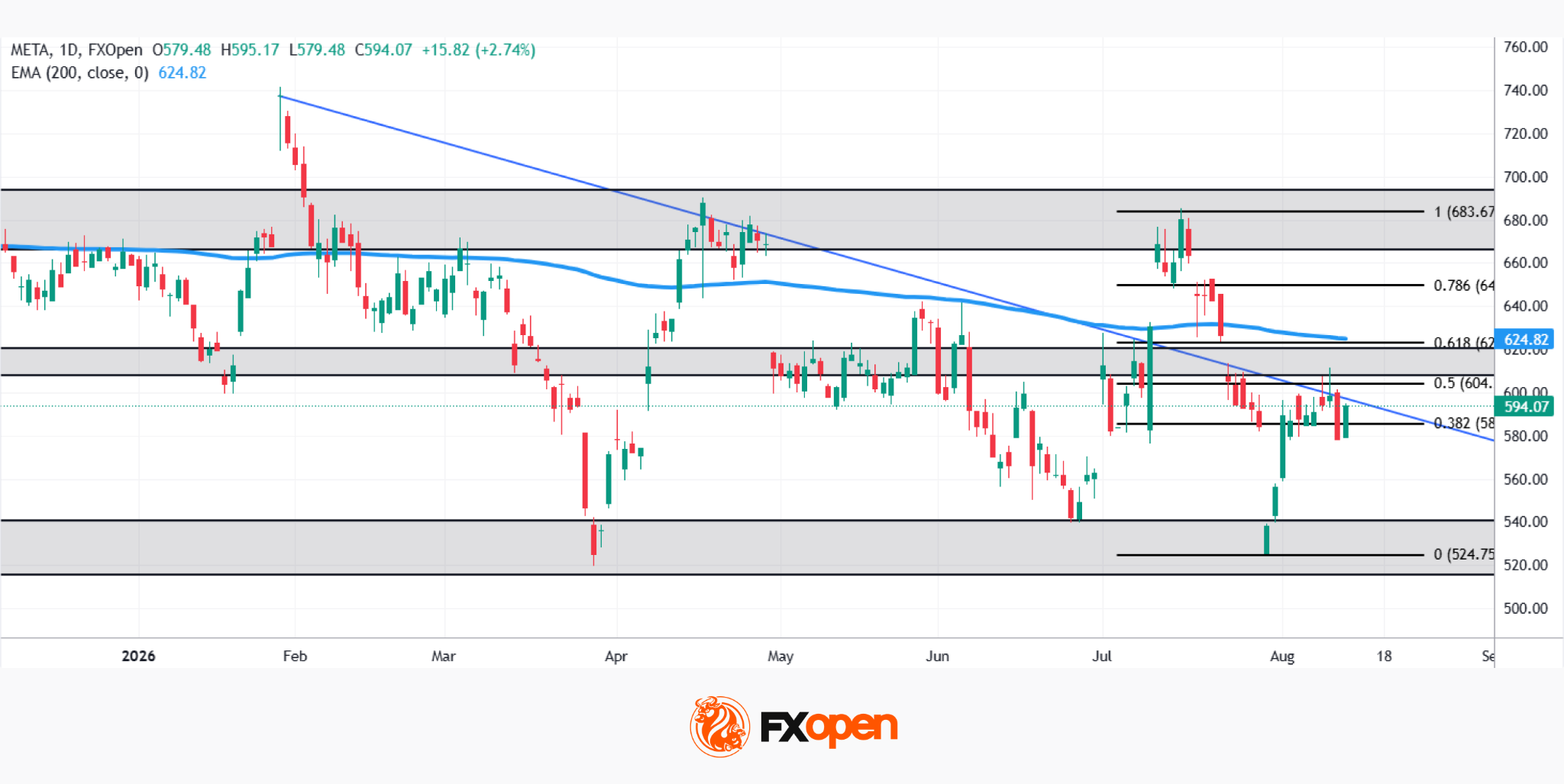
Meta just delivered a genuinely strange quarter: revenue beat, earnings missed, and the market couldn’t quite decide how to feel about it. Q2 revenue came in at $60.8 billion, above the $60.22 billion consensus and up 28% year-over-year, yet EPS landed at $6.18 against $7.19 expected, sending shares down roughly 3.4% in the immediate aftermath.
The real story sits beneath the headline numbers. Free cash flow collapsed 91% year-over-year to just $784 million, a direct consequence of Zuckerberg’s aggressive AI buildout, with capex alone hitting $31.1 billion in the quarter as part of a planned $130-145 billion for the full year. The company is betting big on what it calls “personal superintelligence,” recently launching new Muse AI models to back that ambition, while its Family of Apps still reached 3.6 billion daily active people in June, proof the core business remains formidable.
Adding to the pressure, fresh privacy scrutiny in Europe and mounting US legal challenges around youth safety have kept sentiment cautious. With shares down roughly 11% year-to-date and trading well below their 52-week high near $796, the market is clearly still weighing whether this AI bet will pay off.
Technical Analysis of Meta Platforms
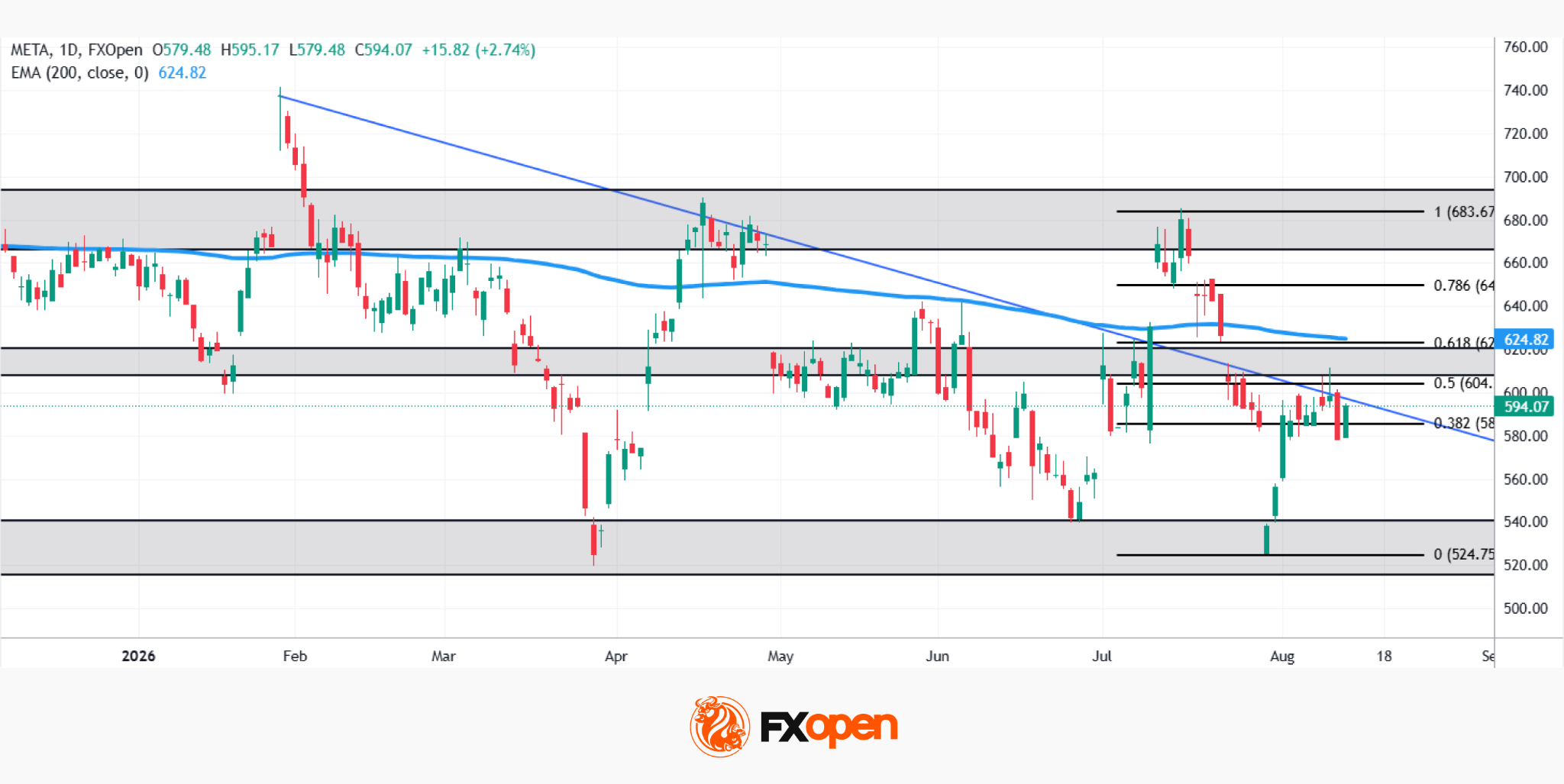
As the daily chart shows, META has been trading within a broader descending trendline since January’s highs near $740, with price recently rebounding sharply off the post-earnings low near $524.75 before running into a wall of resistance at the confluence of the 200-day EMA, the 0.618 Fibonacci retracement near $622.96, and the descending trendline itself around $600. That rejection has since pulled price back toward the 0.382 retracement near $585.46.
Bullish Scenario
Should buyers defend the 0.382 support and stage another push higher, the real test remains that same trendline-EMA-Fibonacci confluence near $605-$625. A confirmed break above this zone would be a genuinely significant technical shift, opening the path toward the 0.786 retracement near $649.66, and eventually the 1.0 level at $683.67.
Bearish Scenario
Conversely, a break below the 0.382 support at $585.46 would signal renewed weakness, exposing the 0.5 retracement near $604 as a lesser hurdle already cleared, but more importantly risking a full retest of the $524.75 low that marked the post-earnings capitulation.
With price wedged between a defended support and a stubborn multi-month trendline, META’s next move looks set to determine whether this rebound has real legs, or whether the broader downtrend since January is still very much in control.
Buy and sell stocks of the world’s biggest publicly-listed companies with CFDs on FXOpen’s trading platform. Open your FXOpen account now or learn more about trading share CFDs with FXOpen.
This article represents the opinion of the Companies operating under the FXOpen brand only. It is not to be construed as an offer, solicitation, or recommendation with respect to products and services provided by the Companies operating under the FXOpen brand, nor is it to be considered financial advice.

‘The Mandalorian and Grogu’ Officially Sets Disney+ Streaming Release Date [Exclusive]

Manchester United’s plan for Marcus Rashford might work out for one reason

Paramount Promises Meaningless CNN ‘Oversight Board’ To Try And Gain Merger Approval


-

 Fashion7 days ago
Weekend Open Thread: Mattifying Sunscreen
-

 News Videos6 days ago
Can Astrology Help Find Gold and Silver Trends? A Financial Astrology Guide
-

 Tech7 days ago
Rinn Pharma & Biopharma to join NordicPharmaTrain network
-

 Business5 days ago
Datadog: Best Of Breed For Multiple Reasons
-

 Business5 days ago
How to Start a Cleaning Business: A Step-by-Step Guide
-

 Business5 days ago
BDC Weekly Review: Private BDC Q2 Numbers Are Strong
-
 NewsBeat3 days ago
Communication cards help banking customers access services or report scams
-
 Business3 days ago
Oil Price Today (August 11): Crude oil rises to $88 after Trump’s compensation demand dents Hormuz opening. Here’s why
-

 Fashion7 days ago
Weekly News Update, 8.6.26 – Corporette.com
-

 Fashion5 days ago
Amazon Sundays: Closet Care Before Fall
-

 Business6 days ago
SharkNinja Keeps Eating
-
 Entertainment6 days ago
10 R-Rated Drama Movies That Can Be Called Masterpieces
-

 Politics6 days ago
Be quiet, Miriam! – spiked
-

 Business6 days ago
Mutual Fund Manager Scoops Up Beaten-Down Stocks
-

 Politics5 days ago
Ben-Gvir’s crocodile project halted but abuses at Ketziot Prison continue
-

 Business5 days ago
5 Things You Must Know About Jorge Messi, the Father and Longtime Agent Who Shaped Lionel Messi’s Career
-

 Entertainment7 days ago
Warren Hudson’s Dad Releases Audio Of Threats
-

 Politics7 days ago
Welsh independence campaign group YesCymru sets 2032 referendum target
-

 Politics5 days ago
The Church of England’s ruinous reparations racket
-

 Politics6 days ago
Calls to permanently pedestrianise central Belfast following festival success
You must be logged in to post a comment Login