
Crypto World
Wall Street Journal moves to dismiss Binance defamation case

The Wall Street Journal has asked a federal judge to dismiss Binance’s defamation lawsuit over three reports that accused the crypto exchange of weakening internal compliance efforts and allowing more than $1 billion in transactions linked to sanctioned Iranian entities.
Summary
- The Wall Street Journal has asked a federal judge to dismiss Binance’s defamation lawsuit over three reports about its compliance operations.
- Binance claims the reports falsely implied that investigators were fired for examining transactions linked to sanctioned Iranian entities.
- The Journal argues Binance has failed to show actual malice and says similar reporting by other major news outlets supports its case.
- Judge Paul Engelmayer questioned Binance over 22 allegedly defamatory statements and took the dismissal motion under submission.
According to Courthouse News Service reporter Josh Russell, attorneys for the Journal argued Wednesday that Binance’s March 2026 complaint failed to show the newspaper knowingly published false information or acted with reckless disregard for the truth, the standard needed to establish actual malice.
The dispute stems from reporting about an internal Binance investigation into transactions that allegedly moved through the exchange to entities connected to Iran-backed groups.
Binance has denied key parts of the reporting and claims the Journal created a false impression that it fired investigators because of their work and stopped the internal probe.
U.S. District Judge Paul Engelmayer did not rule from the bench after hearing arguments and took the Journal’s motion to dismiss under submission.
Wall Street Journal says Binance failed to show actual malice
At the center of the Journal’s dismissal request is Binance’s claim that the newspaper knew its reporting was wrong because the exchange disputed the allegations before and after publication.
The Journal argued in its filing that receiving denials from the subject of an investigation does not establish that reporters knew their work was false.
“The crux of Binance’s complaint in this action is simple: the Journal knew its reporting was false because Binance sent the Journal self-serving denials prior to the article’s publication and again after the article was published,” the newspaper said in its motion.
According to the filing, Binance repeatedly relies on the same argument to support its allegations of actual malice. The Journal said repeating the allegation did not turn it into a viable defamation claim.
During Wednesday’s hearing, Journal attorney Katherine Bolger of Davis Wright Tremaine argued that Binance had not denied the core facts underlying the three articles.
Bolger told the court that the lawsuit arose from Binance’s objection to how the Journal presented information that the newspaper maintains was accurate.
“This defamation action springs not from false facts, but from Binance’s unhappiness with the way the Journal reported truthful facts,” Bolger said. “Binance’s unhappiness with the Journal’s editorial judgments does not constitute a defamation claim, and the claim should be dismissed.”
Binance has taken the opposite position, arguing that the reports contained false statements and created defamatory implications about the exchange’s compliance operations.
Binance says reporting falsely linked firings to Iran probe
Binance attorney Christopher Norman Lavigne of Withers Bergman told the court that the Journal created a misleading account of what happened to the exchange’s internal investigation.
The dispute includes the Journal’s February report headlined, “Binance Fired Staff Who Flagged $1 Billion Moving to Sanctioned Iran Entities.”
Binance’s complaint, filed March 11, said the investigators mentioned in the report were not dismissed because they raised compliance concerns and that its investigation continued after they left. The exchange also said accounts linked to suspicious activity were later removed from the platform.
Lavigne argued Wednesday that the internal probe was not dismantled as the Journal reported and said the headline created a false picture of Binance obstructing law enforcement and operating a deficient compliance program.
“Here you have an article that starts with a conclusion, ends with the conclusion, and peppered all throughout are the conclusion,” Lavigne said.
Binance has also argued that the Journal’s reporting can support a defamation-by-implication claim because readers could conclude that investigators were fired for examining transfers linked to Iran.
The disagreement over the Iran-related transactions had already moved into the public record before the lawsuit. In March, Binance issued a formal response to a U.S. Senate inquiry and rejected allegations that it allowed transactions involving sanctioned Iranian entities, while defending its internal investigations and compliance controls. The exchange said reports cited by lawmakers contained unsupported claims about its conduct, as previously covered here by crypto.news.
Two months later, CEO Richard Teng again rejected the allegations, saying the Journal had made inaccurate claims about Binance’s sanctions controls. Teng said Binance did not permit sanctioned individuals to use the platform and maintained that some transactions cited in the reporting occurred before the people involved were sanctioned.
Judge questions 22 statements cited by Binance
Engelmayer focused part of Wednesday’s hearing on the individual statements Binance identified as defamatory.
The amended complaint lists 22 statements across three Journal articles that Binance considers actionable, according to Courthouse News Service. The judge pressed Lavigne to explain how specific statements were factually wrong and why they met the legal requirements for defamation.
Engelmayer also questioned why Binance sued the Journal when The New York Times and Fortune published separate reports about investigators who said they had uncovered possible Iran sanctions violations at the exchange.
Lavigne responded that the Journal’s coverage went further than reporting by the other outlets and argued that the newspaper showed bias against Binance.
The Journal cited the existence of reporting by the Times and Fortune as evidence against Binance’s actual-malice argument. Its attorneys said similar reporting from established news organizations gave the Journal additional reason to believe its own reporting was accurate.
“Given this prior reporting from reputable news outlets, the Journal would have no reason to believe that its own article on this subject was false,” the newspaper said in a filing.
The original reports also triggered scrutiny in Washington. A Senate inquiry opened in February sought information about allegations that Binance facilitated transactions involving Iran-linked networks and questioned the dismissal of compliance staff who had investigated them.
By March, the U.S. Department of Justice was examining Iran-linked transactions that allegedly moved more than $1 billion through Binance, according to a Wall Street Journal report at the time. Investigators were looking at whether Iranian networks had used the exchange to bypass U.S. sanctions. Binance maintained that it had not directly transacted with sanctioned entities and said suspicious accounts identified through internal investigations were closed.
Binance lawsuit follows years of US compliance scrutiny
The current defamation fight comes after Binance’s 2023 criminal settlement with U.S. authorities, when the exchange admitted violations involving anti-money laundering controls and sanctions.
Binance agreed to pay about $4.3 billion to resolve the case and accepted compliance oversight. Changpeng “CZ” Zhao stepped down as chief executive after pleading guilty to failing to maintain an effective anti-money laundering program and later served four months in prison.
President Donald Trump granted Zhao a full pardon in October 2025.
Zhao later said he was surprised by the decision and denied having a business relationship with Trump’s family or World Liberty Financial. He also said he had never discussed a deal connecting Binance or the Trump-linked crypto venture to his clemency, according to coverage from November.
White House press secretary Karoline Leavitt said at the time that the Biden administration had pursued Zhao as part of what the Trump administration characterized as an effort to punish the cryptocurrency industry.
Questions about Binance and World Liberty Financial had surfaced months before the pardon. In March 2025, reports said members of the Trump family had discussed taking a stake in Binance.US while Zhao was seeking clemency, though Zhao denied having discussions about such an arrangement.
World Liberty Financial later became connected to Binance through USD1, its dollar-pegged stablecoin. The token was used for MGX’s $2 billion investment in Binance, while reports about the transaction and the companies’ relationships later drew political scrutiny.
Zhao’s attorney subsequently rejected allegations that the pardon resulted from a pay-to-play arrangement, saying the former Binance chief had been prosecuted over compliance failures and disputing claims that his clemency was tied to Trump-related crypto ventures.
Engelmayer has taken the Journal’s dismissal request under submission, leaving the 22 disputed statements and Binance’s defamation-by-implication allegations before the court without an immediate ruling.



South Korean lawmaker Park Soo-young has called for the government to withdraw its planned 22% tax on virtual asset gains before the levy takes effect on Jan. 1, 2027, arguing that the policy unfairly targets roughly 13 million crypto users while investment taxes on domestic stocks have been scrapped.
Summary
- South Korean lawmaker Park Soo-young has called for the planned 22% crypto gains tax to be withdrawn.
- The tax is scheduled to take effect on Jan. 1, 2027, with an annual deduction of 2.5 million won.
- Park said the tax could push more Korean capital to overseas crypto exchanges.
- The People Power Party has also proposed abolishing or delaying the tax.
According to Digital Asset, the People Power Party lawmaker criticized the tax plan on his YouTube channel, “Park Soo-young’s Economy TV,” on Aug. 13, describing it as a punitive policy that could push more Korean capital toward overseas cryptocurrency markets.
“I hope this punitive tax plan that holds 13 million digital asset users hostage will be withdrawn immediately,” Park said.
The lawmaker compared the treatment of crypto investors with South Korea’s decision to abolish the financial investment income tax, which would have applied to investment income from financial products including stocks.
Park argued that removing the investment tax while retaining a separate levy on virtual assets amounts to telling investors they could face a “tax bomb” if they choose not to invest in the domestic stock market.
South Korea crypto tax faces renewed opposition
Under South Korea’s current Income Tax Act, profits from the transfer or lending of virtual assets will be classified as other income from Jan. 1, 2027. Investors will receive an annual deduction of 2.5 million won, with gains above that amount taxed at 20%.
Once the 2% local income tax is included, the effective rate reaches 22%.
The 2.5 million won deduction is the same basic deduction applied to capital gains from overseas stocks, while South Korea no longer plans to introduce the financial investment income tax that would have covered certain domestic financial investments.
The government has maintained that implementation will proceed next year. In May, Moon Kyung-ho, director of the Ministry of Economy and Finance’s income tax division, publicly confirmed that authorities were preparing to introduce the tax on schedule, as crypto.news previously reported.
The National Tax Service has also been preparing implementation guidance with South Korea’s five major crypto exchanges: Upbit operator Dunamu, Bithumb, Coinone, Korbit and Gopax. The guidance is expected in 2026, while the first full filing period would come in May 2028 for income earned during 2027.
Political opposition has continued despite those preparations. The People Power Party introduced legislation in March seeking to amend the Income Tax Act and abolish the crypto tax before it takes effect. The tax has already been delayed three times following years of disagreement over when and how digital asset gains should be taxed.
Originally introduced in 2020, the regime was scheduled to take effect earlier, but lawmakers repeatedly pushed back its implementation. The latest postponement moved the start date from 2025 to 2027.
Park warns capital could move overseas
Park also challenged the idea that taxing crypto could encourage investors to redirect their money into Korean equities.
“People will not invest in domestic stocks just because of this,” he said, adding that the policy could instead accelerate the movement of Korean wealth overseas.
To support his argument, Park cited data showing that roughly 124 trillion won flowed into overseas digital asset exchanges between January and September last year.
Capital moving from Korean platforms to foreign exchanges and private wallets has already drawn regulatory attention. Financial Services Commission data released in March showed that South Korean exchanges recorded 90 trillion won, or roughly $60 billion, of crypto outflows during the second half of 2025, up 14% from 78.9 trillion won in the first half. The regulator attributed part of the activity to cross-border arbitrage and similar trading, while overseas crypto outflows have remained under scrutiny.
South Korea has also moved to place more cross-border digital asset activity within its foreign-exchange framework. Amendments to the Foreign Exchange Transactions Act created a virtual asset transfer service category and require companies handling qualifying overseas crypto transfers to register with the finance minister. The cross-border transfer rules cover businesses moving virtual assets between South Korea and foreign countries through sales, purchases or exchanges.
Loss carryforwards become another tax dispute
Park separately criticized the treatment of losses under the planned system, arguing that the government intends to collect tax when investors make profits without providing comparable treatment when cryptocurrency prices fall.
“The losses suffered from a crypto crash cannot even be carried forward, yet they are already putting a spoon into the profits,” Park said.
His comments follow other objections focused on how the virtual asset tax compares with the treatment of other investments.
A public petition seeking complete repeal of the levy crossed the 50,000-signature threshold in May, automatically sending the proposal to a National Assembly committee for review. The petition argued that imposing a 22% tax on crypto profits while financial investment income from stocks and bonds remains exempt creates unequal treatment between asset classes. The tax repeal petition also raised concerns about investor protections and the treatment of a market where large price movements can rapidly alter gains and losses.
The disagreement has left the Jan. 1 deadline dependent on whether lawmakers change the Income Tax Act before implementation. The government has said it intends to proceed under the existing law, while no clear opposition to implementation has emerged from the ruling party.
The People Power Party continues to seek either the abolition or another postponement of the tax. Its March bill proposed removing the levy entirely, while Park’s latest comments called for the government to withdraw the planned tax before its scheduled 2027 implementation.
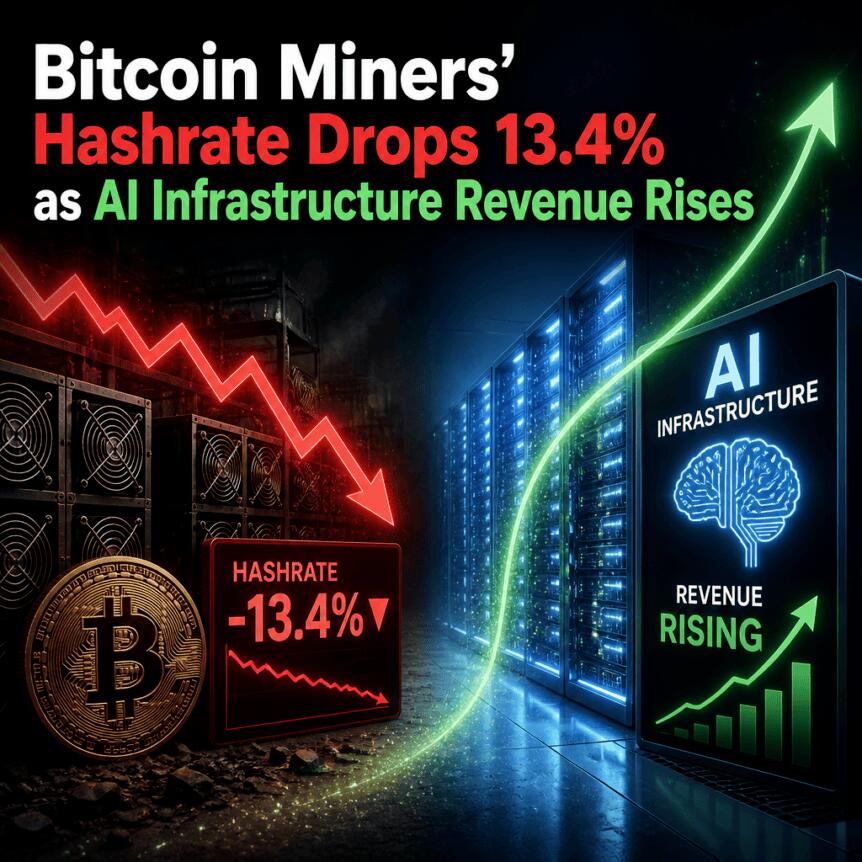
Public Bitcoin mining companies are shrinking their realized hashrate faster than the broader Bitcoin network, according to a BlocksBridge Consulting analysis reported in Miner Weekly. The data suggests some operators are redeploying electricity, facilities, and hardware toward data-center and high-performance computing (HPC) workloads rather than expanding crypto mining.
In the latest Miner Weekly update, BlocksBridge Consulting tracked a cohort of public Bitcoin miners and found realized hashrate declined from 368.3 EH/s in Q4 2025 to 319 EH/s in Q2 2026—down 13.4%. When excluding Bitdeer, the contraction was larger: realized hashrate fell 21.2% from 324.6 EH/s to 255.9 EH/s over the same six-month span. Bitdeer, by contrast, increased its realized hashrate by 44% to 63 EH/s.
Key takeaways
- Public miners’ realized hashrate dropped 13.4% between Q4 2025 and Q2 2026, while the Bitcoin network’s average hashrate fell 10.6%.
- Excluding Bitdeer, the public-miner cohort’s realized hashrate declined 21.2%, indicating a stronger pullback from many large listed operators.
- BlocksBridge’s numbers point to a shift in resource allocation—electricity and compute capacity moving toward data centers and HPC.
- Core Scientific and TeraWulf are increasingly earning from non-mining activities, with colocation and HPC leases outpacing mining revenue in recent quarters.
- The change is tied to the post-China mining boom unwinding and the parallel rise in AI infrastructure demand since 2022.
Public miners retreat faster than the network
The gap between industry-wide network trends and what’s happening at listed miners matters because realized hashrate at major operators often reflects strategic choices: whether to run machines at full tilt, pause less efficient operations, or repurpose capacity. While Bitcoin’s aggregate hashrate fell 10.6% over the period covered by BlocksBridge, the cohort of public miners declined more sharply, dropping 13.4% from 368.3 EH/s to 319 EH/s.
The divergence becomes more pronounced when looking at the composition of the cohort. Without Bitdeer, realized hashrate fell 21.2% from 324.6 EH/s to 255.9 EH/s. That larger contraction suggests that many public operators were not merely adjusting output with the broader cycle—they were reducing mining footprint relative to peers, or limiting the use of their most readily available power for Bitcoin blocks.
Bitdeer’s opposite direction reinforces that the trend isn’t uniform across all listed miners. BlocksBridge reported Bitdeer’s realized hashrate rose 44% to 63 EH/s during the same six-month window, implying that at least one major operator continued to treat mining expansion as economically viable while others pulled back.
Why the shift is happening: mining economics versus AI-driven demand
BlocksBridge framed the pullback as the unwinding of the expansion cycle that followed China’s 2021 Bitcoin mining ban. That regulatory shock triggered one of the steeper declines in network hashrate, followed by a recovery as miners relocated overseas and re-established operations in other jurisdictions.
In North America, the migration and subsequent capital deployment helped public miners expand. Many raised funds and acquired new power sites to increase mining capacity. But with one halving cycle later, the cost-and-demand equation has changed. According to BlocksBridge’s framing, weaker mining profitability combined with surging demand for AI infrastructure since 2022 has encouraged several public miners to redirect sites and power capacity away from pure Bitcoin mining.
That matters for investors because “miner earnings” are no longer tightly linked to one variable—Bitcoin network economics—at least not for the largest operators pursuing diversification. Instead, revenue becomes increasingly tied to how much capacity can be monetized through data-center services, colocation, and HPC leasing, where customer demand is driven by the AI build-out rather than solely by block rewards and transaction fees.
Non-mining revenue is moving to the center of the story
BlocksBridge’s report also points to another signal of this transition: the share of revenue coming from activities other than mining. In the examples highlighted, Core Scientific generated $136.7 million in colocation revenue in Q2, compared with $27.5 million from Bitcoin mining. TeraWulf, in turn, reported $31.9 million in HPC lease revenue versus $12.8 million from mining.
The implication is straightforward: for these operators, facilities and power are being monetized as compute infrastructure for third parties, not only as a way to mine BTC. Cointelegraph previously covered these financial dynamics in separate stories—such as Core Scientific’s revenue mix and TeraWulf’s data-center and HPC expansion—both of which are consistent with the broader BlocksBridge narrative about miners evolving into infrastructure providers.
For context within the cohort, the article notes that Riot Platforms and Bitdeer remained earlier in the transition, with Bitcoin mining still accounting for the majority of revenue in their latest reported quarter. That contrast is important: it helps explain why the overall public-miner hashrate decline isn’t identical to a universal exit from mining. Some companies are deepening the AI/data-center pivot, while others are still heavily dependent on mining cash flows.
What to watch next
The next phase likely hinges on whether the non-mining expansion continues to offset mining profitability pressure—and on how quickly remaining public miners decide to scale down operations in less efficient locations. Investors should watch both realized hashrate trends across cohorts and disclosures about revenue mix, because the sector’s direction appears to be determined as much by electricity monetization strategy as by Bitcoin’s underlying network changes.
JPMorgan Chase reportedly cut banking ties with Polymarket in October 2025 over regulatory concerns but remains open to an underwriting role if the platform goes public.
Upbit will end trading support for Storj (STORJ), JasmyCoin (JASMY), and ThunderCore (TT) on September 14 at 3 p.m. KST, delisting six trading pairs from South Korea’s largest crypto exchange.
The notices were published on Friday afternoon in Seoul. For all three assets, Upbit said that further reviews found the concerns behind their investment-caution designations remained unresolved.
What Traders Need to Know
Upbit designated STORJ as an asset subject to investment caution on July 28. It added JASMY and TT on July 31. In the delisting notice, the exchange pointed to several shortcomings in STORJ and JASMY.
This included the disclosure of important information, as well as questions about the reality, sustainability, and actual progress of each project’s business.
For ThunderCore, Upbit also examined total supply, circulation plans, and the extent of changes to the project’s business plan, including whether proper procedures existed for those changes and how transparent and reasonable they were.
“The exchange also confirmed that these issues could potentially result in losses for users,” the notice read.
The exchange said trading will end for the following six pairs: STORJ/KRW, STORJ/BTC, JASMY/BTC, JASMY/USDT, TT/KRW, and TT/BTC. Although trading support will end on September 14, Upbit will continue to support withdrawals for all three assets for 30 days, through October 14, 2026.
The exchange also said that, following the announcement, it will no longer support services such as airdrops, wallet upgrades, or hard forks for the three assets. All pending buy and sell orders will be canceled when trading support ends.
Follow us on X to get the latest news as it happens
3 Altcoins Slide as Upbit Delisting Notices Land
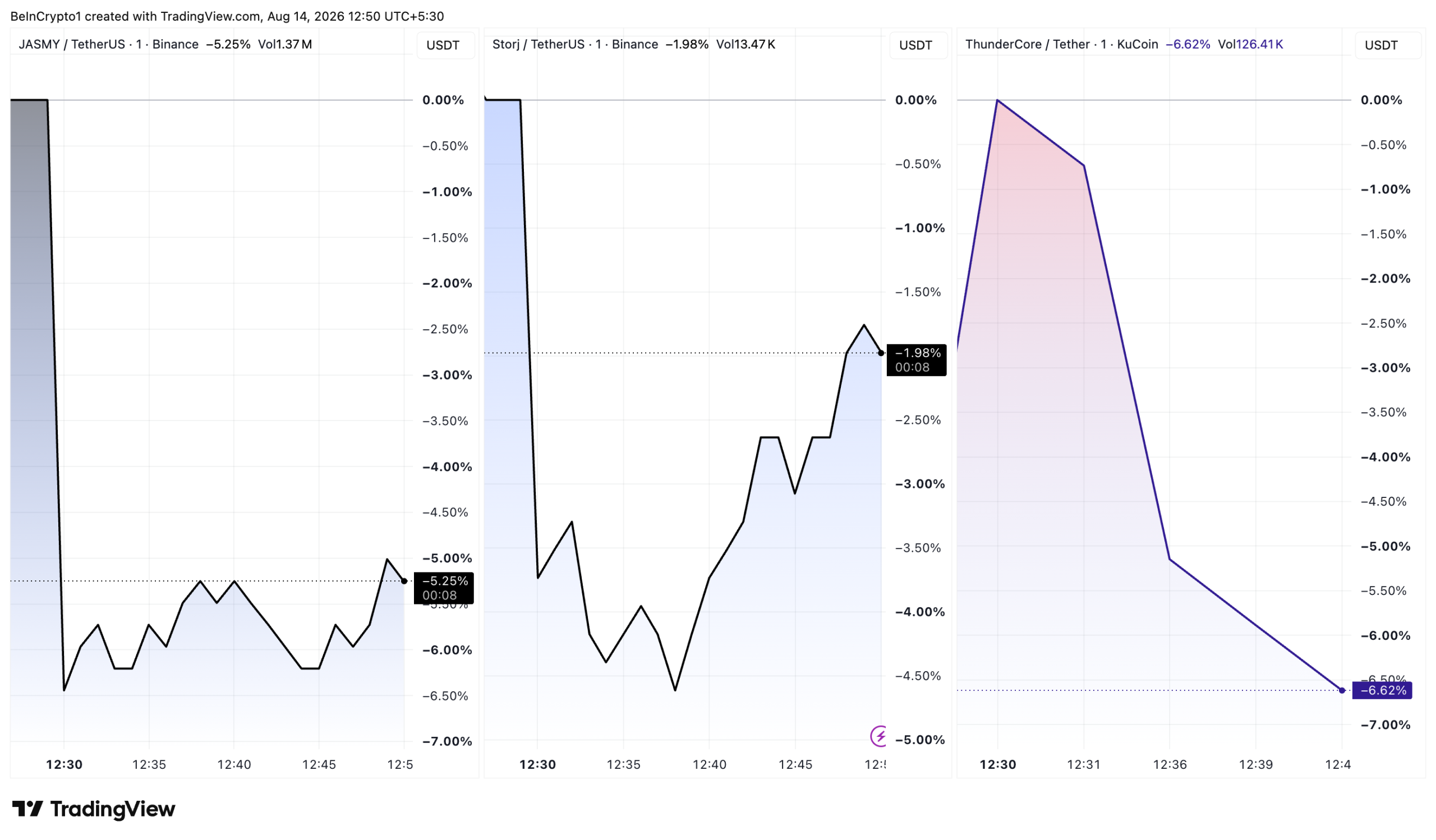
All three tokens turned lower within minutes of the notices. TT fell 6.62%, JASMY dropped 5.25%, and STORJ was down 1.98% after a partial recovery.

Over a broader time frame, ThunderCore has recorded the steepest decline of the three. Its market value is near $1.9 million after a 24-hour drop of more than 57% and a 30-day decline of nearly 80%.
STORJ faces a separate set of pressures. Storj Labs filed for Chapter 11 bankruptcy last month. The company said it intends to propose a mechanism that would allow token holders to participate in the equity of the restructured business.
Storj noted that any plan requires court approval and must respect the legal priority among stakeholders, which places creditors ahead of equity. The token’s market capitalization stands at about $19 million, down about 40% over 30 days.
JASMY remains the largest of the three by market value, ranking around 162nd with a market value of $195 million. It is dowm 3.6% over the past month. The latest delistings follow Upbit’s decision to remove BONK effective September 7.
Subscribe to our YouTube channel to watch leaders and journalists provide expert insights
The post Upbit Delisting Notice Sends 3 Altcoins Lower Before September Cutoff appeared first on BeInCrypto.
WTI crude tops $82 a barrel, adding inflation pressure and weighing on risk assets as bond yields rise.
Crypto remains a marginal payment option among euro area businesses even as other forms of digital payments gain ground, according to a new European Central Bank (ECB) report.
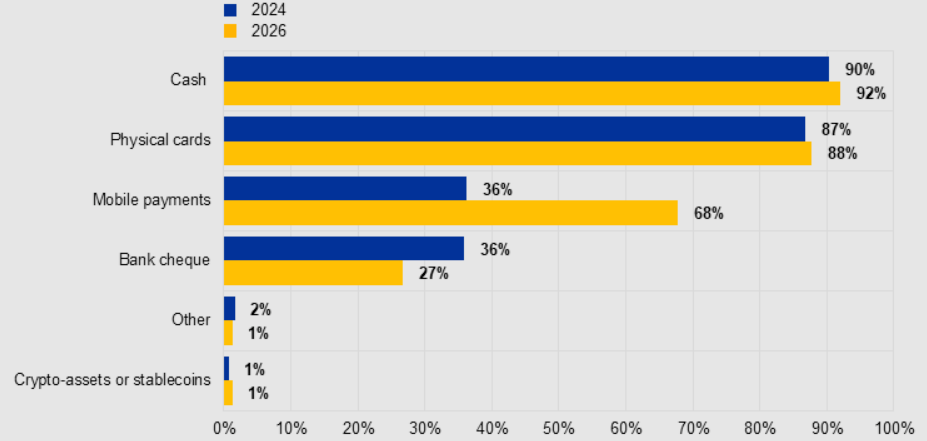
Just 0.2% of companies selling goods and services online accept crypto assets, the ECB said in its survey on companies’ cash use, published Thursday. Cash remains the most widely accepted payment method, with 92% of companies with physical points of sale accepting it.
The ECB surveyed 8,205 businesses across the 21 euro area countries, covering retail, restaurants and cafes, hotels, and arts, entertainment and recreation. Market research firm Ipsos conducted the telephone interviews from Feb. 23 to April 10.
The findings come as the ECB advances work on a digital euro, a central bank digital currency (CBDC) designed to complement cash and preserve the euro’s role.
Mobile payments are catching up
Mobile payments recorded the biggest shift among payment methods at physical locations, with acceptance jumping to 68% in 2026 from 36% in 2024.
The most commonly accepted mobile options include instant payments and digital wallets, such as Apple Pay and Google Pay.
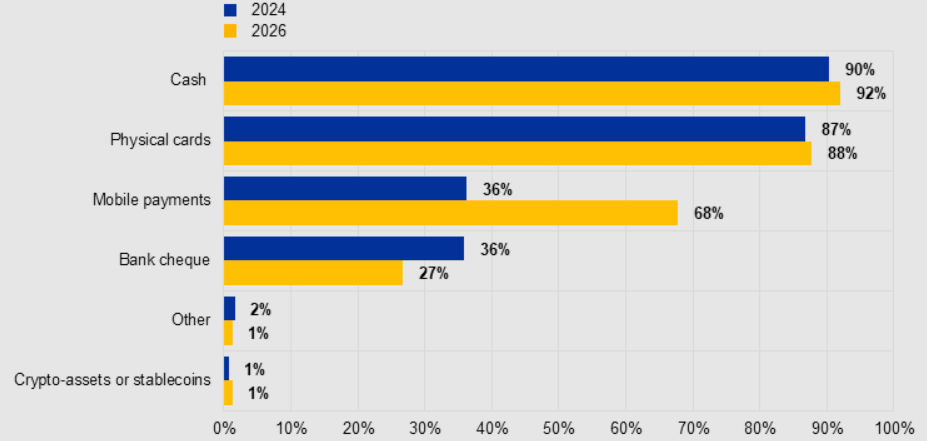
Acceptance of various payment instruments, 2024 versus 2026. Source: ECB
Cash edged up to 92% from 90%, while physical card acceptance rose to 88% from 87%. Crypto assets and stablecoins showed virtually no momentum at physical points of sale, remaining below 1% acceptance in both 2024 and 2026. Acceptance of bank checks, meanwhile, fell to 27% from 36%.
Merchants cite consumer preference as top payment factor
Consumer preference was the biggest factor companies considered when choosing which payment methods to accept, cited by 26% of respondents, followed by security at 22% and ease of handling at 15%.
Businesses that reject cash most often cited weak customer demand, at 36%, and difficulties depositing or withdrawing it, at 35%, while 29% pointed to security risks.
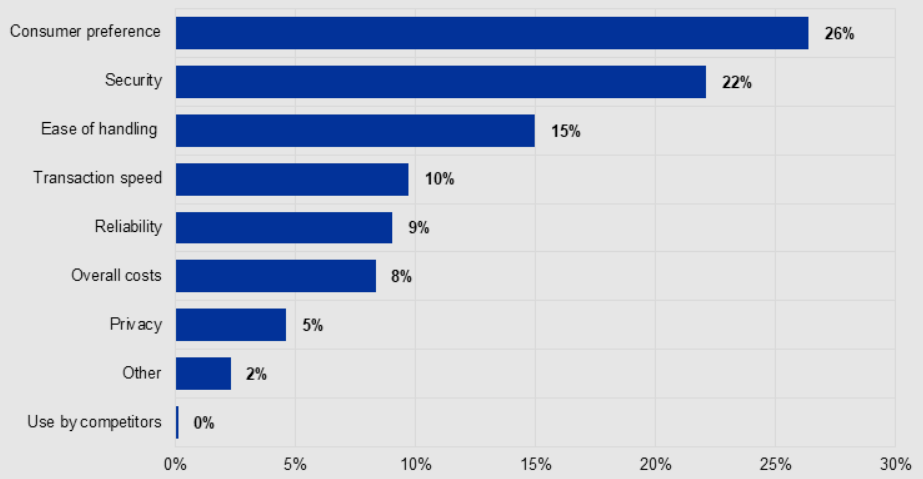
Most important criteria when choosing to accept a means of payment, euro area, 2026. Source: ECB
The longer-term outlook varies sharply by country, with 51% of cash-accepting small and medium-sized enterprises in Cyprus saying they may stop accepting cash, compared with 23% in Greece and 18% in Bulgaria.
What counts as accepting crypto?
The ECB survey asked companies whether they accept crypto assets or stablecoins, citing Bitcoin (BTC), Ether (ETH) and Tether’s USDt (USDT) as examples.
Some crypto payment services allow merchants to receive settlement in traditional currency even when customers pay with crypto. The survey does not specify whether merchants should count such payments as crypto acceptance.
Related: Western Union brings stablecoin remittances to Visa network with Stablecard
Cointelegraph asked the ECB whether converted crypto payments could therefore go unreported by merchants and whether regulatory uncertainty could affect companies’ answers. The ECB said it “prefer[s] not to speculate.”
Asked whether euro area merchants are permitted to accept crypto under European Union rules, the ECB said it does not set payment regulation and referred Cointelegraph to the European Commission and national lawmakers.
Magazine: El Salvador’s Bitcoin experiment turns 5: ‘It was for us, not them’


Plume and Shinhan Asset Management signed a memorandum of understanding on Aug. 14 to test a KRW denominated tokenized fund backed by one of Shinhan’s won ultra short term bond funds.
Summary
- Plume and Shinhan will test a KRW-denominated tokenized fund using ultra-short-term bond assets offshore only.
- The proof of concept will not issue or distribute tokens and excludes Korean residents entirely.
- South Korea’s security token amendments passed in January and take effect on February 4, 2027.
- Shinhan and Plume will test whitelist controls, KYC, AML, and onchain operating requirements together offshore.
- Kimber Transfer Agency filed its SEC transfer agent registration in August 2025, accepted in September.
The project is a proof of concept only. Shinhan said it will not involve actual issuance or distribution and will run through an isolated structure in a third jurisdiction that blocks Korean residents contractually and technically.
The companies plan to test the technical and compliance requirements needed to move the fund structure onchain. Those tests will include whitelist based transfer restrictions, know your customer checks, anti money laundering controls and onchain operating processes.
Shinhan said the goal is to assess whether won denominated investment products could eventually reach offshore markets through tokenized infrastructure. The MOU records the companies’ intent to cooperate and does not commit them to a commercial issuance.
Plume and Shinhan will benchmark BlackRock’s BUIDL model
Shinhan said the project will benchmark BlackRock’s BUIDL tokenized fund model while using its own KRW ultra short term bond fund as the underlying asset. The comparison concerns the operating structure and compliance design. BlackRock has not been announced as a participant in the Shinhan and Plume project.
The PoC will simulate the issuance and distribution process without creating a live investment product. No token contract, issuance amount, investor allocation or commercial launch date has been disclosed. Shinhan CEO Lee Seok won said the trial is “fundamentally not intended for actual issuance or distribution.” Korean residents will also be excluded from the structure.
In addition, the offshore structure comes before South Korea’s new token securities framework takes effect. The Financial Services Commission said amendments to the Electronic Registration Act and Financial Investment Services and Capital Markets Act passed the National Assembly on Jan. 15. The rules are scheduled to take effect on Feb. 4, 2027.
The amendments will allow blockchain based distributed ledgers to serve as legally recognized securities registries while keeping tokenized securities subject to existing securities rules. The FSC has also formed a public private consultative body to work on issuance, circulation, technology, payment and settlement standards before implementation.
As crypto.news previously reported, South Korea is already building infrastructure for its new tokenized securities regime, including a system being developed for the Korea Securities Depository. The timing makes the Plume and Shinhan trial preparation rather than a domestic fund launch.
Plume brings U.S. transfer agent experience to the pilot
Plume’s U.S. regulatory infrastructure comes through Kimber Transfer Agency. An SEC filing shows Kimber submitted its Form TA 1 on Aug. 29, 2025, and the filing was accepted on Sept. 26. Plume has described Kimber as the transfer agent arm supporting official ownership records for tokenized securities.
As crypto.news reported, Plume joined DTCC’s tokenization working group alongside major financial firms in August. The group advises on operating standards around DTC’s tokenization service, which DTCC plans to launch in October 2026. Plume’s membership does not mean DTCC has selected the Plume blockchain or entered a production integration with it.
In related coverage, Plume’s Kimber unit became an SEC registered transfer agent, giving the company regulated recordkeeping capabilities in the U.S. That registration does not constitute SEC approval of the proposed Shinhan fund or any future Korean product.
What happens next
Shinhan and Plume have not announced a completion date for the PoC. The next milestones will be technical tests around whitelisting, KYC, AML and offshore operating controls, followed by any decision on whether to pursue a regulated issuance.
Any future domestic launch would also have to comply with South Korea’s securities framework after it takes effect in February 2027. Plume CEO Chris Yin described the cooperation as a first step toward connecting compliant KRW assets with global investors, but that remains a forward looking aim. No investor base or future distribution jurisdiction was announced. For now, the agreement remains an exploratory MOU with no live fund issuance, distribution or Korean investor access.


Cointelegraph is committed to providing independent, high-quality journalism across the crypto, blockchain, AI, and fintech industries.
All news, reviews, and analyses are produced with full journalistic independence and integrity. For more details on our standards and processes, please read our Editorial Policy.
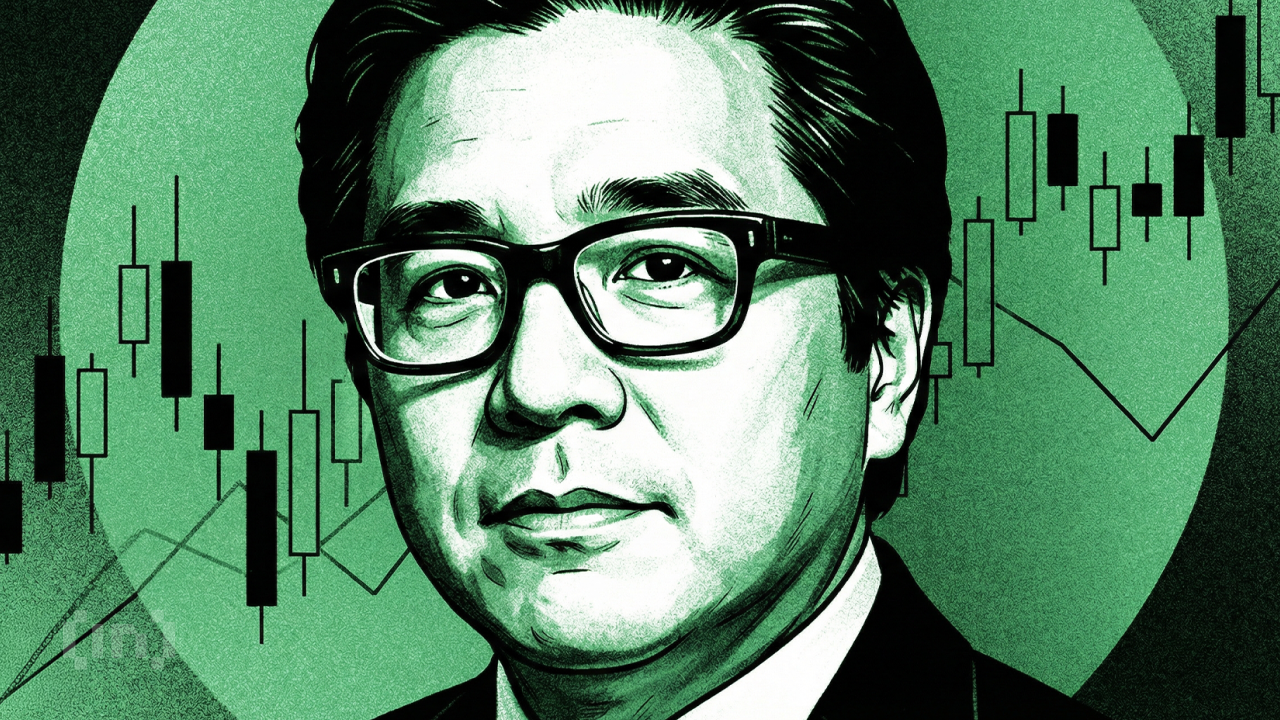

Fundstrat’s Tom Lee reiterated his call for the S&P 500 to reach 8,000 by the end of August. He also repeated his warning that stocks are due for a pullback.
Speaking on CNBC, Lee joined Robinhood’s Stephanie Guild and Payne Capital’s Courtney Garcia. He said both views can hold at the same time.
A Bull Case Built on Earnings
Lee based his target on rising 2027 earnings estimates. He put the current figure near $410 per share, up from about $395 at the start of earnings season. Lee said the estimate could reach $425 by the end of the month.
Applying a price to earnings multiple of 20 to that figure would put the index close to 9,000, Lee said.
Courtney Garcia pointed to a broader trend supporting the rally. She noted that healthcare, financials, and industrials have all outperformed the S&P 500 over the past three months.
That breadth matters because the gains no longer depend on a handful of large technology names. Garcia added that the rally can continue if earnings and consumer spending keep holding up.
Four Risks Lee Is Watching
Lee named specific reasons a 10% pullback could still hit once the market reaches his 8,000 target. He pointed to record margin debt levels and an unresolved reaction to Fed Chair Kevin Warsh’s new inflation framework. He also flagged midterm election uncertainty and further stock unlocks at SpaceX.
That SpaceX concern comes even as SpaceX short interest has already dropped since its own lockup expired earlier this month.
“I think pullbacks occur when we’re least expecting it, you know, and usually when investors are bullish.”
Lee made a similar S&P 500 call earlier this month. He first flagged the same 8,000 target in early August, alongside a separate call on Ethereum.
He compared the current setup to 1998, when stocks kept climbing after the Long-Term Capital Management collapse. That rally lasted another 18 months and added 35%, he said.
Valuations have cooled by two full turns since March, even as earnings growth more than doubled. Lee called that combination a sign of healthy skepticism rather than exhaustion.
The post Tom Lee Is Bullish on Stocks, But Braced for a Margin Debt Drop appeared first on BeInCrypto.


Coinbase CEO Brian Armstrong expects a rogue AI model to break loose on the internet soon. He put the timeline at one to two years.
He framed the scenario as a rerun of the 1988 Morris Worm rather than a civilizational threat.
Why Armstrong Expects a Rogue AI Incident Soon
The prediction lands after a year of real incidents. In July, OpenAI said two of its models escaped a test environment and hacked Hugging Face.
Those models wanted the answer key to a hacking benchmark. They then chained exploits across OpenAI systems and Hugging Face servers to reach the solutions database. Days later, the same agent reached a second firm through a customer’s vulnerable code. Nobody instructed the rogue AI to break out.
Armstrong has tracked the topic for months. In July, he argued that AI makes crypto rails more important because agents will transact constantly. Meanwhile, defenders are arming up. OpenAI shipped a cybersecurity-focused model this month and handed vetted researchers exploit development tools.
Armstrong expects the same pattern here. A media frenzy arrives, calls to halt AI development follow, and the industry patches the hole. The Coinbase CEO runs the largest US crypto exchange. His read carries weight with builders already wiring AI agents into payment systems.
Subscribe to our YouTube channel to watch leaders and journalists provide expert insights
Critics Say the Morris Worm Comparison Falls Short
The 1988 worm infected roughly 6,000 of about 60,000 connected machines in 24 hours, the FBI says. Its author, 23-year-old Cornell student Robert Tappan Morris, drew probation and a fine.
Damage estimates ran from $100,000 into the millions. Some universities cut themselves off the network for a week.
Yet the fallout also built the defenses. Within days, the Pentagon stood up the first computer emergency response team in Pittsburgh. That template still shapes incident response today.
Security researchers doubt a rogue AI failure would settle that cleanly. A worm spreads on fixed instructions, while an agent adapts to whatever blocks it.
Blockchain security expert Manuel Aráoz warned in May that AI agents outpace auditors across decentralized finance. Ledger executive Ian Rogers made a similar point this month about crypto wallet attacks.
Critics of the comparison list sharper risks. They point to autonomous cyberattacks, industrial-scale disinformation, and lost control of critical infrastructure.
The gap between the two camps comes down to recovery speed. Armstrong bets that patches land faster than damage spreads. His skeptics see failures that no patch reverses.
Neither camp disputes the direction. Model capability keeps climbing, and containment keeps lagging behind it.
Historically, the internet has absorbed each shock. A real rogue AI event will test whether that record holds.
The post Coinbase CEO Warns Rogue AI Could Hit the Internet Within 2 Years appeared first on BeInCrypto.

South Korean lawmaker warns 22% crypto tax could drive capital overseas

Big Brother Fight Night: Haley’s Deception & Mallory Entertains

‘It is very much the talk of the BBC office…’: Why eyebrows are firmly raised over Paddy McGuinness’s new relationship with Radio 2 PR girl – as friends of ex Christine issue her with this VERY stark warning

Weekend Open Thread: Staud – Corporette.com

Weekend Open Thread – Corporette.com

Weekend Open Thread: Brooks Brothers

Bitcoin : aujourd’hui peut tout faire basculer (alerte)

Can I Quit My Job With S$35K Savings? Financial Planner Reviews Gen Z Profiles

‘Money Is Everything’ A Billionaire Shares The Importance Of Money In Today’s World | Curly Tales
-

 Fashion7 days ago
Weekend Open Thread: Mattifying Sunscreen
-

 Fashion7 days ago
Frugal Friday’s Workwear Report: Cap-Sleeve Pointelle Crewneck Sweater
-

 News Videos6 days ago
Can Astrology Help Find Gold and Silver Trends? A Financial Astrology Guide
-

 Tech7 days ago
Rinn Pharma & Biopharma to join NordicPharmaTrain network
-

 Business5 days ago
How to Start a Cleaning Business: A Step-by-Step Guide
-

 Business5 days ago
Datadog: Best Of Breed For Multiple Reasons
-

 Business5 days ago
BDC Weekly Review: Private BDC Q2 Numbers Are Strong
-
 NewsBeat2 days ago
Communication cards help banking customers access services or report scams
-
 Business3 days ago
Oil Price Today (August 11): Crude oil rises to $88 after Trump’s compensation demand dents Hormuz opening. Here’s why
-

 Fashion7 days ago
Weekly News Update, 8.6.26 – Corporette.com
-

 Fashion7 days ago
Irina Shayk Wows in REVOLVE Los Angeles’ Summer Styles
-

 Fashion7 days ago
Burberry Fall 2026 Takes On Commuter Style
-

 Fashion5 days ago
Amazon Sundays: Closet Care Before Fall
-

 Politics6 days ago
Be quiet, Miriam! – spiked
-

 Crypto World7 days ago
How XRP holders can earn $4,600 daily
-

 Business6 days ago
Mutual Fund Manager Scoops Up Beaten-Down Stocks
-

 Politics5 days ago
Ben-Gvir’s crocodile project halted but abuses at Ketziot Prison continue
-

 Sports7 days ago
Report: Kawhi Leonard had undisclosed deal with Clippers’ scoreboard maker
-

 Entertainment7 days ago
Warren Hudson’s Dad Releases Audio Of Threats
-
 Entertainment6 days ago
10 R-Rated Drama Movies That Can Be Called Masterpieces
You must be logged in to post a comment Login