
Crypto World
Whale Behavior in DeFi Markets

How Smart Money Moves Liquidity, Shapes Narratives, and Hunts Inefficiencies In DeFi, price doesn’t move because of vibes. It moves because of its size.
Whales — wallets controlling massive amounts of capital — are the invisible hands that shape liquidity, trigger volatility, rotate narratives, and quietly accumulate before retail even notices. If you want to survive (and thrive) on-chain, you don’t fight whales. You study them.
Let’s break down how they actually operate.
1️⃣ Who Are “Whales” in DeFi?
A whale isn’t just someone with a big bag. In DeFi, whales typically include:
What makes them powerful isn’t just capital — it’s coordination, speed, and access to data.
They don’t trade charts.
They trade liquidity, incentives, and psychology.
2️⃣ How Whales Move Markets
A. Liquidity Deployment & Withdrawal
In DeFi, liquidity is power.
When whales add liquidity to pools:
-
Yields compress
-
Slippage decreases
-
Protocol TVL spikes
-
Confidence increases
When they withdraw:
-
TVL drops
-
Yields spike
-
Fear spreads
-
Smaller LPs panic
A single large liquidity removal from a lending protocol can send shockwaves across borrowing rates.
B. Yield Farming Rotation
Whales constantly rotate capital to optimize emissions.
They:
-
Enter early during high token incentives
-
Farm aggressively
-
Dump emissions into strength
-
Exit before APY normalizes
This is why new farms look explosive at launch — and dry up 2–4 weeks later.
If you see sudden TVL spikes in a new protocol, ask:
Is this organic growth… or mercenary capital?
C. Governance Power Plays
DeFi governance is often token-weighted. Translation?
Capital = influence.
Whales can:
Some whales accumulate governance tokens quietly, then surface during critical votes. If you ignore governance flows, you’re missing half the story.
D. Liquidity Hunts & Stop Sweeps
In on-chain perpetual DEXs, whales often:
It’s not manipulation — it’s game theory in an open ledger system.
DeFi transparency means everyone sees the liquidation levels.
Guess who has enough capital to push prices into them?
3️⃣ Smart Whale Patterns to Watch
Here’s where things get interesting.
🧠 Early Accumulation Before Incentives
Whales often accumulate before:
-
Token listings
-
Major integrations
-
Incentive campaigns
-
Governance proposals
On-chain accumulation > Twitter hype.
🔁 Capital Rotation, Not Exit
When markets “crash,” whales often don’t leave crypto.
They rotate:
-
From volatile tokens → stablecoin yield
-
From farming → lending
-
From altcoins → ETH/BTC
-
From DEX perps → staking
Retail sees “exit.”
Whales see repositioning.
📉 Buying Fear Events
Bridge hacks, exploit rumors, governance drama — these are discount windows.
If fundamentals remain intact, whales accumulate during panic.
They sell optimism, not fear.
4️⃣ Real DeFi Examples of Whale Impact
Without naming specific wallets, history shows patterns across major ecosystems:
-
During DeFi Summer, massive capital rotated between Curve, Yearn, Compound, and Sushi depending on emissions.
-
When L2 ecosystems launched incentive programs, whales bridged millions within hours.
-
In lending protocols, whale repayments have instantly normalized borrowing rates.
-
Governance whales have swung DAO votes by double-digit margins.
In every cycle, whales front-run narrative shifts.
5️⃣ Tools to Track Whale Activity
If you’re serious about DeFi alpha, use data.
-
On-chain explorers (Etherscan, Arbiscan, etc.)
-
Wallet tracking dashboards
-
Governance vote monitors
-
TVL analytics (DeFiLlama)
-
Token flow analytics
-
Liquidation dashboards
Watching price without watching wallets is like watching the ocean surface and ignoring the currents underneath.
6️⃣ How Retail Can Use Whale Behavior
You don’t need whale capital.
You need whale awareness.
✔ Follow liquidity, not hype
✔ Track sudden TVL spikes
✔ Watch governance accumulation
✔ Study stablecoin inflows/outflows
✔ Avoid farming too late in incentive cycles
The edge isn’t predicting the market.
It’s understanding who has the power to move it.
7️⃣ The Harsh Truth
Whales don’t hate retail.
They just play a different game.
They optimize:
-
Risk-adjusted yield
-
Liquidity depth
-
Incentive schedules
-
Token unlock calendars
-
Governance timing
Meanwhile, retail often trades narratives without checking on-chain flows.
That mismatch? That’s the opportunity.
Final Thought
DeFi is radically transparent. Every move is public.
Whales leave footprints — you just need to know where to look.
If you learn to interpret capital rotation, liquidity shifts, and governance positioning, you stop reacting to volatility… and start anticipating it.
And in DeFi, anticipation beats emotion every single time.
REQUEST AN ARTICLE

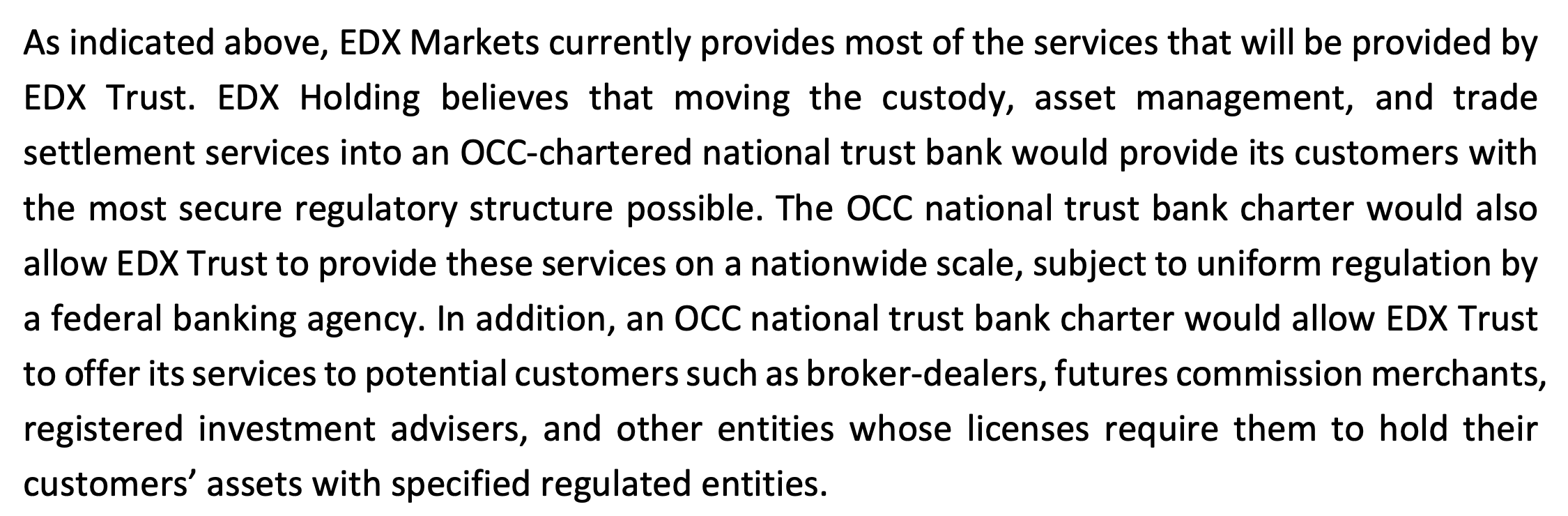
EDX Markets, an institutional crypto exchange, has applied to the US Office of the Comptroller of the Currency (OCC) to establish a national trust bank that would provide crypto custody, asset management and trade-settlement services.
The proposed entity, EDX Trust, would operate as a non-depository national bank, separating custody and settlement from trading while continuing to route order matching through EDX’s existing platform.
In its application, the company said the model is intended to address structural risks in crypto markets, where trading, custody and brokerage are often combined within a single platform, creating potential conflicts of interest and single points of failure.
EDX said the trust bank would provide fiduciary asset management services, invest client cash and stablecoin balances in highly liquid assets, and facilitate trading through a riskless principal model with end-of-day net settlement.
The bank would operate online from Chicago and target institutional clients such as broker-dealers, futures commission merchants and registered investment advisers, according to the filing.
EDX said moving these functions into an OCC-chartered entity would allow it to offer services nationwide under a single regulatory framework while meeting custody requirements for regulated institutions.
Founded in 2022, EDX Markets is backed by traditional market participants including Citadel Securities, Virtu Financial, Fidelity Digital Assets and Hudson River Trading.

Related: Fed’s Barr backs stablecoin clarity but warns of run risks
Crypto companies seek US bank charters
The application comes as crypto and financial companies increasingly pursue national trust bank charters to expand institutional services under federal oversight.
Earlier this month, Zerohash, a blockchain infrastructure company, applied for a US national trust bank charter to expand its stablecoin and custody services for banks, brokerages and fintechs.

Other recent applicants include Coinbase, which applied in October and is still awaiting a decision, as well as Laser Digital and Payoneer, which filed applications earlier this year to expand custody and stablecoin-related payment services.
Traditional financial institutions are also entering the space. In February, Morgan Stanley applied for a de novo trust bank charter to support digital asset services through a separate entity.
At the same time, the OCC has continued approving applicants, issuing conditional licenses last month to Bridge, Stripe and Crypto.com, following approvals in December for Ripple Labs, Circle Internet Group, Fidelity Digital Assets, Paxos and BitGo.
However, the pace of approvals has drawn scrutiny. In February, the American Bankers Association urged the OCC to slow the process, citing unresolved oversight under pending US stablecoin legislation.
Crypto World
Ripple Treasury Becomes First TMS to Offer Native Digital Asset Capabilities for Corporate CFOs

TLDR:
- Ripple Treasury is the first TMS to embed native digital asset capabilities directly into an enterprise platform.
- Digital Asset Accounts support XRP and RLUSD with 15-decimal precision and automated real-time transaction recording.
- Unified Treasury connects multiple custodians via ClearConnect, giving CFOs one real-time dashboard for all positions.
- Ripple’s 2026 survey found 72% of finance leaders say a digital asset solution is now needed to stay competitive.
Ripple Treasury has officially launched Digital Asset Accounts and Unified Treasury. The launch marks the first native digital asset capabilities embedded in an enterprise treasury management system.
CFOs and their teams can now view, hold, and manage both fiat and digital assets in one place. It follows Ripple’s 2025 acquisition of GTreasury, which brought over 40 years of enterprise treasury expertise. Multiple customers completed beta testing ahead of the April 1 global launch.
Digital Asset Accounts Integrate Onchain Balances Into Enterprise Treasury Workflows
Digital Asset Accounts allow treasury teams to create and manage a regulated digital asset account directly within the platform.
No external setup, third-party custody relationship, or separate system is required. XRP and Ripple USD (RLUSD) balances appear alongside cash accounts in real time.
The platform applies live fiat valuation, refreshed within seconds of each transaction. Exchange rates come from leading market data providers and update automatically.
The system also works across multiple data providers simultaneously, maintaining accuracy during volatile market conditions. Teams no longer need manual calculations or separate tools for valuation.
Transactions are recorded with 15-decimal precision, capturing onchain amounts exactly as they exist. This prevents rounding errors that typically cause reconciliation gaps.
An automated audit trail is generated for every transaction, supporting finance and control teams. Treasury managers maintain full control of records without relying on external reconciliation tools.
Each record captures the native notional amount, fiat equivalent, and market price at the moment of the event. This provides a complete, time-stamped transaction history without manual data entry. The automated recording process also supports compliance across multiple reporting frameworks.
Renaat Ver Eecke, SVP of Ripple Treasury, spoke on the shift in how CFOs now approach digital assets. “Digital assets have arrived at the CFO’s desk, and the question has shifted from whether to engage to how to do so advantageously without disrupting existing operations,” he said.
He added that the platform gives the office of the CFO a trusted place to hold and manage digital and fiat assets, with no separate interface or new workflows needed.
Unified Treasury Gives CFOs Real-Time Visibility Across All Liquidity Positions
Unified Treasury consolidates digital asset and cash positions into a single real-time dashboard. Teams holding assets across multiple custodians can connect providers through Ripple Treasury’s ClearConnect connectivity layer.
This layer is the same one already used for existing bank integrations within the platform. No new infrastructure or changes to current banking arrangements are required.
API connectivity to digital asset providers can be completed in minutes through the platform. Once connected, balances reflect automatically as transactions occur onchain.
Treasury teams no longer depend on manual imports or batch data processing to see positions. This also eliminates delays that have made digital asset reporting difficult for corporate finance teams.
Market rates are applied to digital asset balances in the reporting currency of each organization’s choice. No separate data sources or manual currency conversions are required.
The entire process runs automatically within the system, streamlining day-to-day operations. This gives treasury teams in different regions a consistent reporting experience.
Mark Johnson, VP of Global Product at Ripple Treasury, described the core design principle behind both capabilities. “The design principle behind both capabilities is that digital assets should behave exactly like cash within the platform,” he said.
Johnson further noted that treasury teams should not have to think about whether a balance is onchain or in a bank account. “They should simply see their position,” he added.
Ripple’s 2026 survey of 1,000+ global finance leaders found that 72% now consider a digital asset solution a competitive necessity.
Most, however, lack a starting point that fits within current workflows. Stablecoins processed $33 trillion in volume last year, rising 72% from 2024, showing strong demand already in the market.



New Hampshire’s Bitcoin-backed municipal bond receives Ba2 rating from Moody’s, marking the first instance of a public finance instrument backed by cryptocurrency.
Key takeaways
- Jesse Spiro of Tether is poised to chair Fellowship PAC, a crypto-backed political committee planning endorsements for the 2026 U.S. midterms.
- The group claims to have raised over $100 million from crypto-aligned backers, though transparency around contributors remains limited.
- The Fellowship PAC filed with the U.S. Federal Election Commission on Aug. 7 and had reported no contributions or expenditures as of Dec. 31, raising questions about funding sources and operational timeline.
- Industry politics are intensifying as lawmakers weigh digital-asset regulation alongside debates over stablecoins, with broader implications for the sector’s political leverage.
Industry money and the evolving political playing field
Beyond U.S. politics, observers point to a broader question: will political engagement by the crypto sector translate into tangible regulatory outcomes, or will it primarily serve as signaling to markets and builders? The coming months should reveal how the Fellowship PAC, and others like it, balance signaling with real-world policy influence, particularly as the Senate weighing of the CLARITY Act remains unsettled and as discussions around stablecoins and digital-asset markets continue to evolve.
Cointelegraph and other outlets will continue monitoring filings, endorsements, and the evolving regulatory dialogue to assess how these political moves might shape the crypto landscape through 2026 and beyond.
Readers should watch for developments on who funds Fellowship PAC, how its endorsement strategy unfolds, and whether the Senate reopens consideration of digital-asset reform in a way that aligns with or counters the industry’s political ambitions.
Regulatory crossroads: stablecoins, yield, and the CLARITY Act
What to watch next in the 2026 cycle
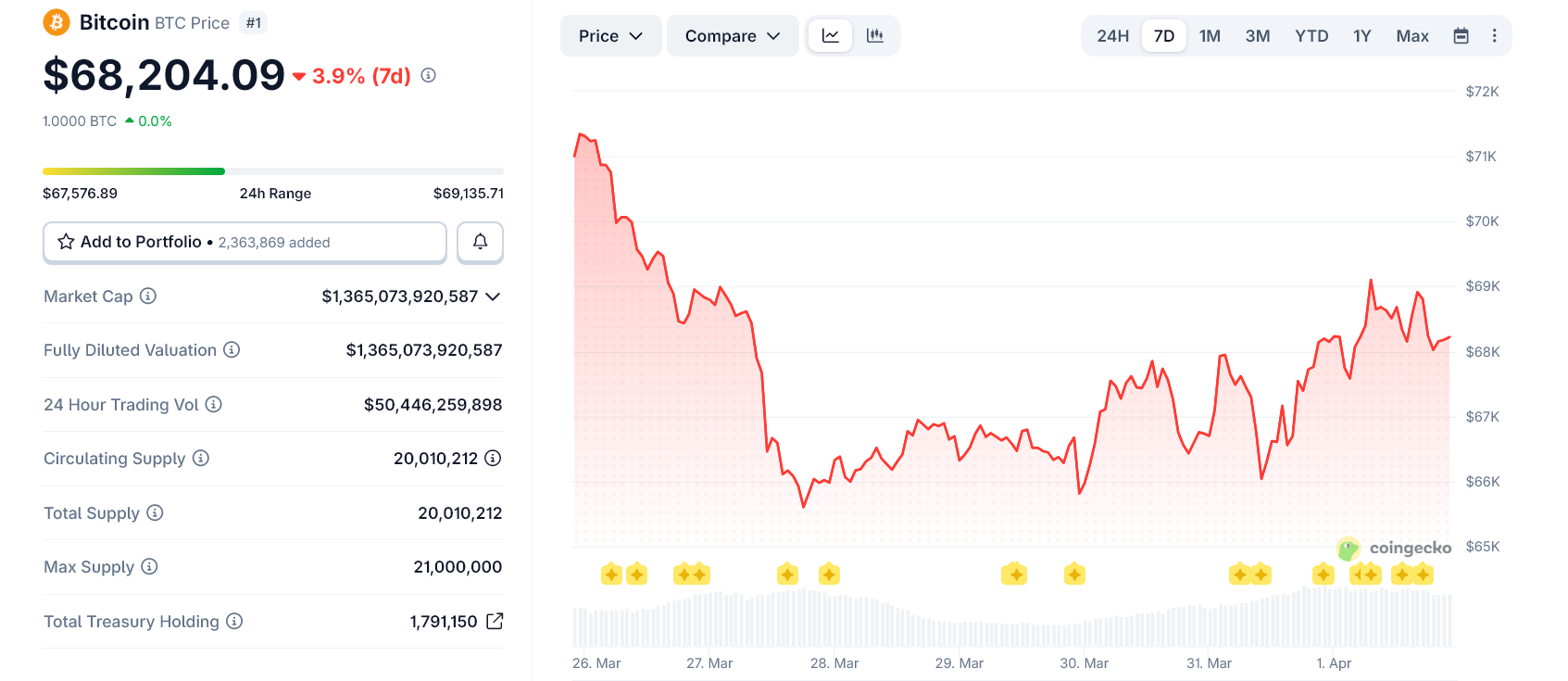
Bitcoin held steady near the $68,000 range on Wednesday as markets braced for a key speech from President Donald Trump on the Iran war. Reports suggest Trump may signal that the conflict is nearing an end, possibly within weeks, while framing recent actions as a strategic success.
However, despite the “war ending soon” narrative gaining traction, Bitcoin’s intraday data shows a more cautious market beneath the surface.
Rallies Sold, Not Built
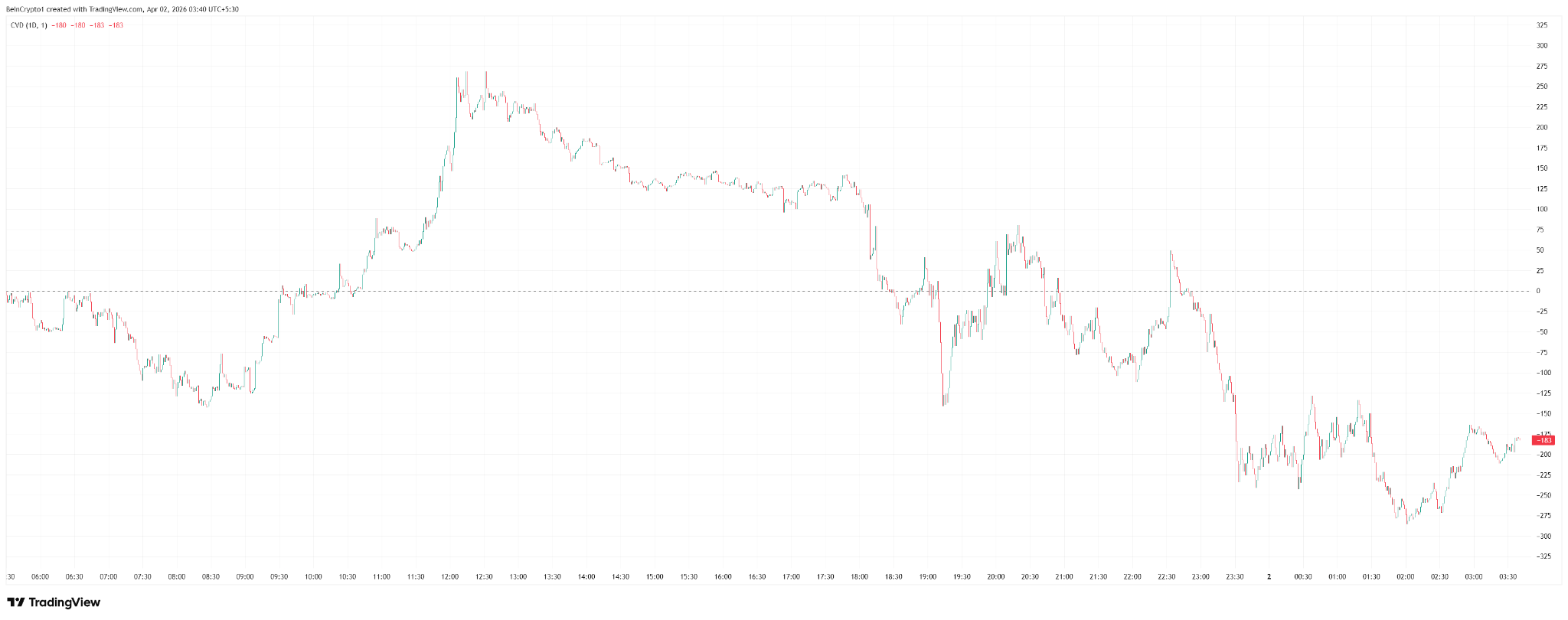
Cumulative Volume Delta (CVD) shows a clear trend: sellers dominated most of the day.
After an early push higher, CVD steadily declined into negative territory. This means more aggressive sell orders hit the market than buys. In simple terms, traders used price strength to exit positions rather than build new ones.
Even during small recoveries later in the day, selling pressure continued. That signals weak conviction behind the upside.
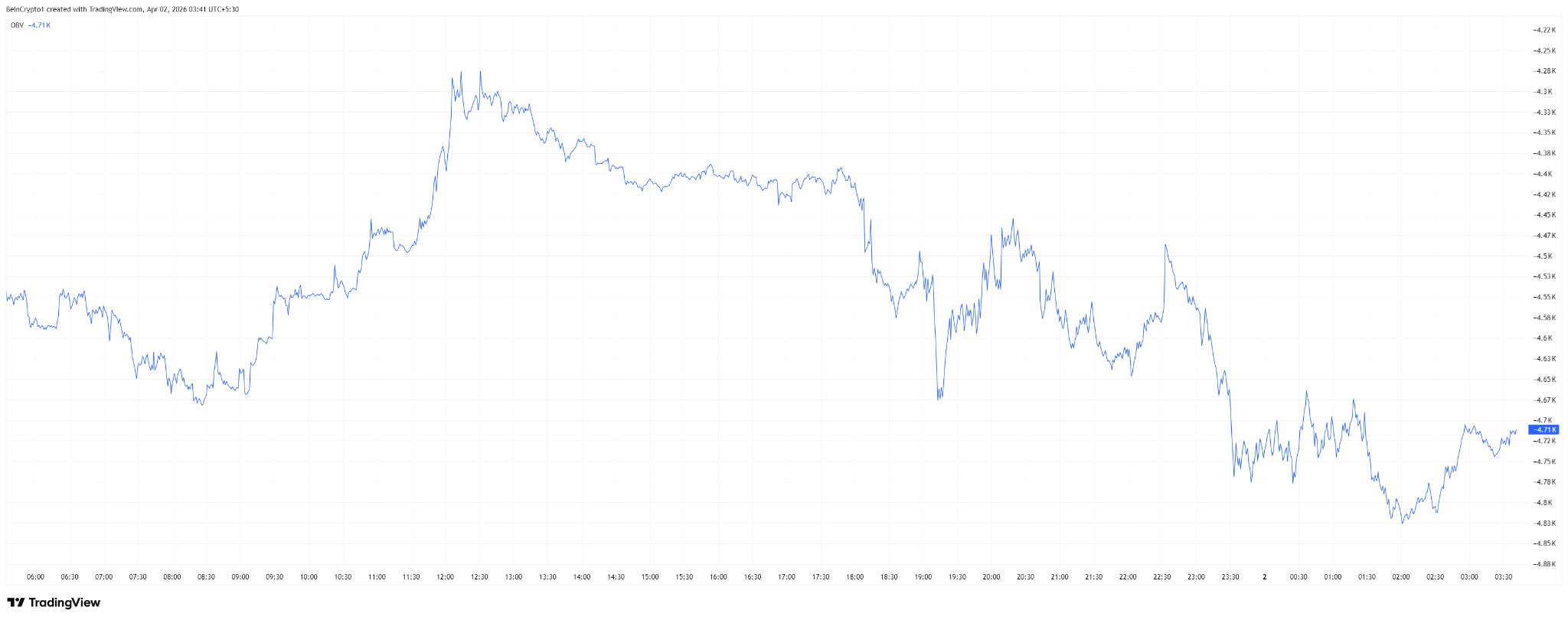
Volume Confirms Distribution
On-Balance Volume (OBV) tells a similar story.
While Bitcoin’s price moved sideways for much of the session, OBV trended lower. This divergence suggests that volume flowed out of the asset, not into it.
Put simply, the market was not accumulating Bitcoin. Instead, it was quietly distributing, with sellers outweighing buyers over the full session.
Late Buyers Step In — But Lightly
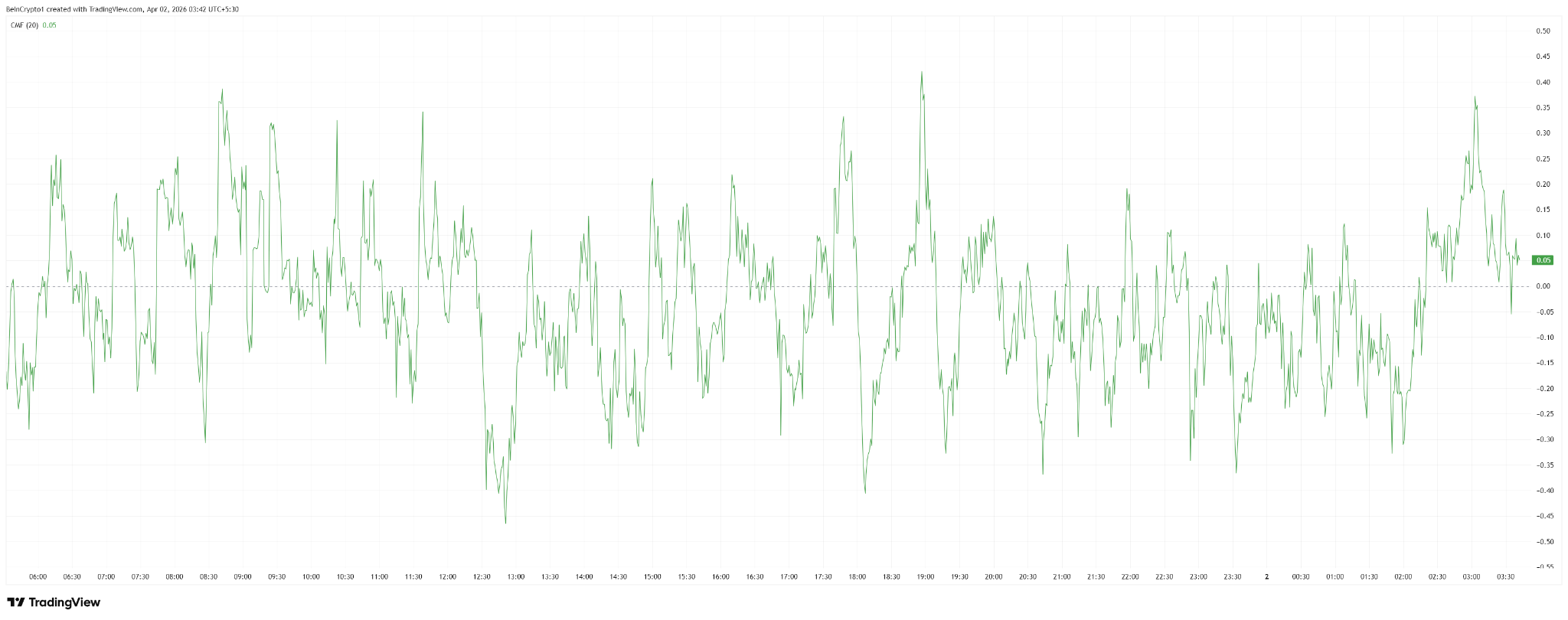
Chaikin Money Flow (CMF) adds a final layer.
The indicator flipped slightly positive toward the end of the day, showing that some buyers stepped in during the final hours. However, the move remained modest and inconsistent.
This suggests dip-buying activity, but not strong or sustained demand.
Market Prepares, But Doesn’t Commit
Taken together, the data points to a market positioning defensively.
Bitcoin appears to be pricing in the possibility of de-escalation. Yet traders are not aggressively betting on a breakout. Instead, they are selling into strength and waiting for confirmation.
The pattern aligns with a broader “sell the news” setup.
A Narrative Priced In — But Not Trusted
If Trump confirms a near-term end to the conflict, markets may react positively at first. However, Bitcoin’s flow data suggests that much of this expectation is already priced in.
For now, the market is not chasing the narrative. It is preparing for it — cautiously.
The post Bitcoin is Positioning for ‘War is Ending’ Narrative Ahead of Trump’s Iran Speech appeared first on BeInCrypto.
Square is waiving processing fees for Bitcoin payments at US merchants for two years, with instant dollar conversion to reduce adoption barriers.
Key takeaways:
-
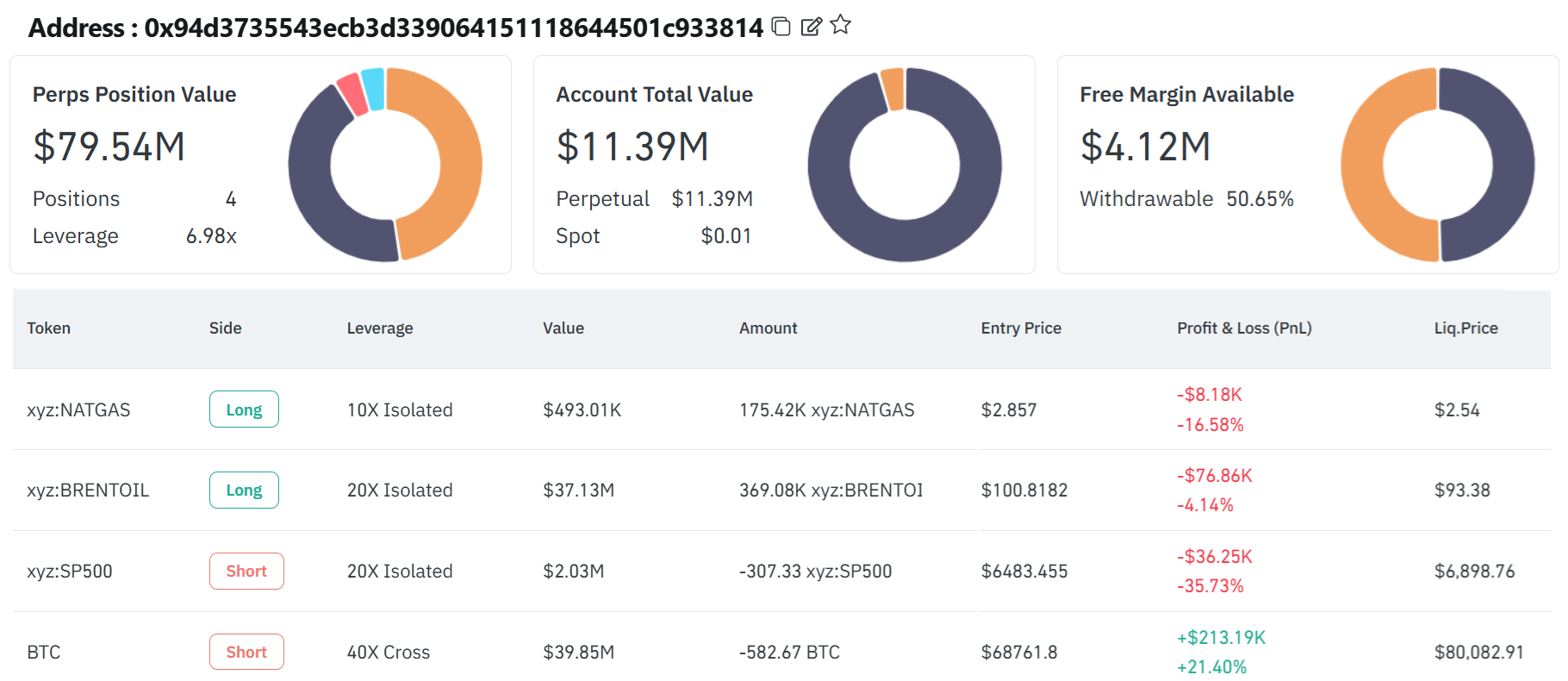
A Hyperliquid whale placed an $80 million bet against Bitcoin and the S&P 500 while going long on Brent crude oil prices.
-
The whale’s history of massive losses and inconsistent signals suggests the trade could fall on the wrong side of the market.
Bitcoin (BTC) showed strength on Wednesday, bouncing back from Tuesday’s $66,000 low after President Donald Trump teased a potential ceasefire in the US and Israel-Iran war. Even with Bitcoin trading above $68,000, one whale used Hyperliquid DEX to place an $80 million bet on a market collapse.
Traders are now watching closely to see if this whale’s massive position signals a looming Bitcoin price drop.

The Hyperliquid whale, linked to address 0x94d373…c933814, carefully built this nearly $80 million leveraged position between Tuesday and Wednesday. The trade includes a $40 million short (sell) on Bitcoin futures near $68,760, a $2 million short on synthetic S&P 500 Index contracts, and a $37 million long (buy) in synthetic Brent oil contracts.

The whale’s aggregate position leverage stood at 7 times, indicating high conviction. The Bitcoin futures liquidation price was $80,083, while the Brent oil position would be forcefully terminated above $93. The timing of the trade is curious as S&P 500 Index futures gained 4% between Tuesday and Wednesday as traders anticipate the US and Israel-Iran war dissipating over the next few weeks.
On Wednesday, President Trump said “Iran’s New Regime President” is considering a “ceasefire,” although the conditions to fully reopen the Strait of Hormuz remain unknown. Iran demands reparations and sovereignty. Thus, one could assume that the Hyperliquid whale is counter-trading the market’s optimistic take, betting that Brent crude oil prices will jump while Bitcoin loses its value.
This Hyperliquid whale previously lost $40 million
This address belongs to a particularly unlucky whale, or at least one who has been extremely unsuccessful since late January. The Hyperliquid whale apparently uses bots for execution, given the sheer number of small trades that build into huge positions, but it still managed to lose $37 million in its first month of activity in December 2025.
The same user was flagged by X user ‘lookonchain’ on Feb. 5 after taking a massive loss on leveraged bullish bets on Ether (ETH), Bitcoin, Solana (SOL), and XRP (XRP).

According to the analysis, the whale had previously made $25 million in profits from shorts in multiple cryptocurrencies, but decided to flip the position on Feb. 4, resulting in a $40 million loss. There is no way to know exactly what triggered this entity to place those bets, but the event proves that even whales can misinterpret the market.
Related: Warren Buffett bought $17B in US T-bills: A bad omen for Bitcoin price?
The erratic signals from President Trump regarding a potential full-on invasion and the war in Iran leave room for opposing views. Iranian Foreign Minister Abbas Araghchi denied there were talks for a ceasefire but confirmed to Al Jazeera on Tuesday that there was an intention to end the war, according to CNBC.
Given the history of this whale’s market positioning and its track record of losing trades, it’s possible that the current $80 million bet may fall on the wrong side of the market.
This article is produced in accordance with Cointelegraph’s Editorial Policy and is intended for informational purposes only. It does not constitute investment advice or recommendations. All investments and trades carry risk; readers are encouraged to conduct independent research before making any decisions. Cointelegraph makes no guarantees regarding the accuracy or completeness of the information presented, including forward-looking statements, and will not be liable for any loss or damage arising from reliance on this content.


According to the company CFO, Bithumb was “strengthen[ing] accounting policies and internal controls” ahead of its IPO plans, already delayed from 2025.
South Korea-based cryptocurrency exchange Bithumb is reportedly expecting its initial public offering (IPO) sometime after 2028, in another delay after restructuring and regulatory hurdles.
According to a Tuesday report from Maeil Business News Korea, a Bithumb official said that it would “focus on preparing for the listing until 2027.” CFO Jeong Sang-gyun said at the company’s annual shareholder meeting that Bithumb was “strengthen[ing] accounting policies and internal controls” following an IPO advisory contract with Samjong KPMG.
Shareholders reconfirmed CEO Lee Jae-won for a two-year appointment at the Tuesday meeting, but the delayed IPO timeline was the latest after Bithumb initially expected a 2025 listing. Under Lee, the exchange faced a six-month suspension and a $24 million fine from South Korean authorities for alleged anti-money-laundering violations.
A major South Korean exchange going public could impact local markets and crypto adoption in the country. Dunamu, the operator of crypto exchange Upbit, is reportedly planning an IPO following a share swap with Naver Financial, expected in September.
Related: South Korea tax agency seeks private crypto custodian after security lapses
Bithumb made headlines in February after the exchange mistakenly credited many users with about 2,000 Bitcoin (BTC) instead of 2,000 South Korean won. The error briefly created internal balances totaling more than $40 billion, though most of the funds existed only on the exchange’s internal ledger and were later reversed.
Mixed signals in South Korea’s crypto policy shift
Lee Jae-myung took office as South Korea’s president in June 2025, and his political party quickly moved to introduce legislation on the issuance of payment stablecoins.
South Korean lawmakers initially proposed a tax hike on crypto gains expected to take effect in 2021. However, the measure has faced repeated delays and may be scrapped entirely, according to reports from March.
As of March 2025, an estimated 16 million South Koreans held accounts on crypto exchanges.
Crypto World
CZ Says Crypto Can Survive Quantum Computing With Protocol Upgrades: Binance Co-Founder


Changpeng Zhao addressed quantum computing concerns, stating the crypto industry can upgrade to quantum-resistant algorithms to mitigate threats.
Crypto World
Dogecoin Price Prediction as MemeCore Flips Shiba Inu in Market Cap, But Pepeto Draws the Same Energy, Is This The Next Dogecoin?
MemeCore just flipped Shiba Inu to become the second largest memecoin by market cap, surging 32% in a single week and proving that meme sector capital rotates fast when a new narrative catches fire according to BSC News. The dogecoin price prediction crowd watched the flip happen in real time while DOGE sat at $0.093 unable to break above $0.10 resistance.
The meme energy that created billions in value during past cycles is now visible around Pepeto, which raised more than $8.69 million with the Pepe cofounder and a Binance listing approaching. The dogecoin price prediction caps at $0.21 for 2026, but analysts project 100x from the presale.
Dogecoin Price Prediction Gets Context as MemeCore Overtakes SHIB and X Money Launches April
MemeCore flipped Shiba Inu’s market cap with an 8% single-day surge and 32% weekly gain, capturing the meme sector rotation that DOGE has failed to attract according to BSC News. Meanwhile, Elon Musk confirmed X Money launches in April with Visa integration across 40 US states and Smart Cashtags for crypto trading on the roadmap, but there is no official confirmation that DOGE will be included as a payment rail according to CryptoNews.
DOGE active addresses jumped 28% in one week from 57,000 to 73,000 according to NewsBTC, but the price has not responded. Meanwhile Qubic’s Dogecoin mining mainnet launched on April 1, promising to make DOGE mining three times faster according to BeInCrypto.
The DOGE forecast waits for X Money to confirm crypto integration, and the exchange that carries the same meme energy with verified tools already built is where the compressed return lives before the listing.
Where the Meme Rotation Meets an Exchange That Delivers What DOGE Never Built
Pepeto: The Next Dogecoin
Despite the correction, the industry pushes forward, and smart traders keep asking which entry gives them what DOGE gave its earliest holders in 2021. Pepeto, with its Binance listing approaching, is not just positioned for near term returns from one event, the exchange is built for daily use that DOGE never offered.
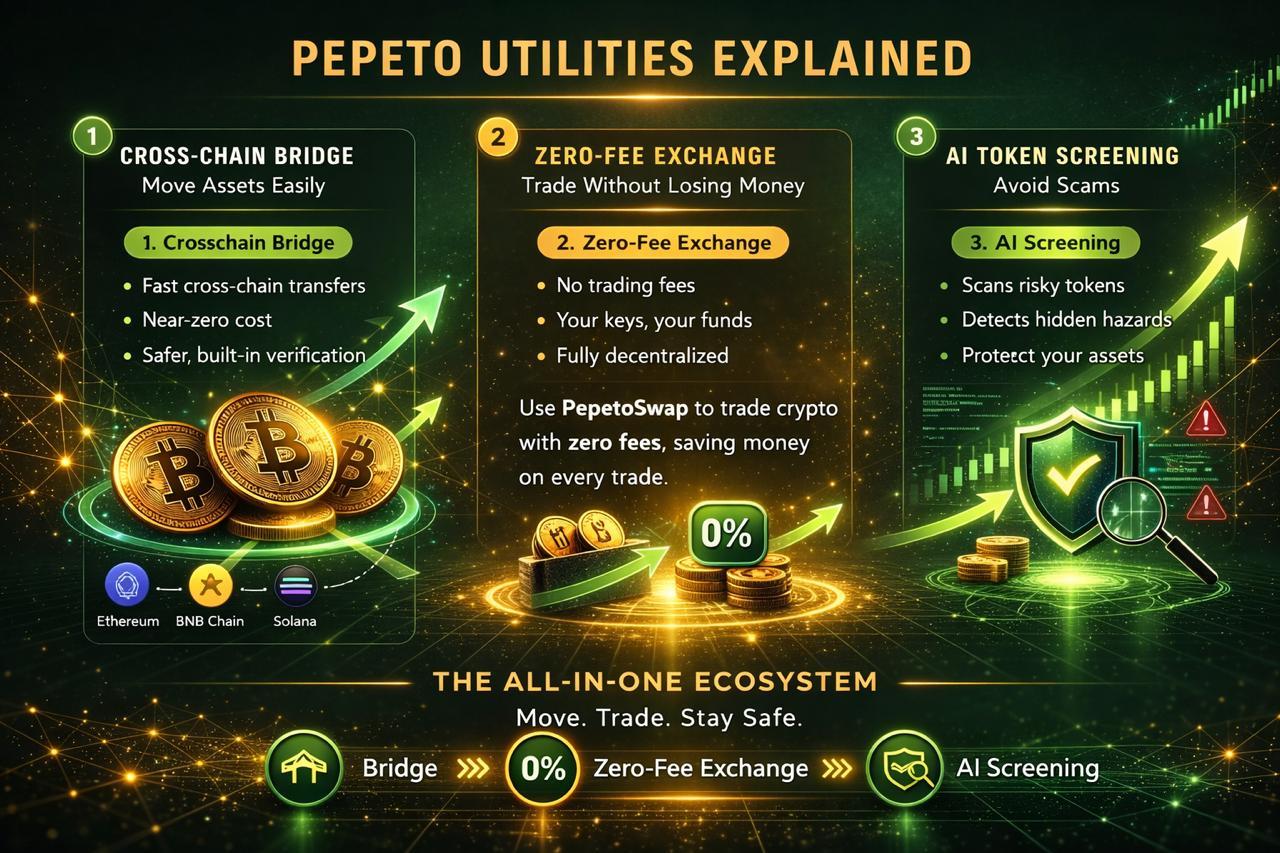
What drives the conviction. The utility works, it is designed for daily trading, and it already runs. The exchange gives verified answers on every contract, with the risk scorer catching traps before your capital moves and PepetoSwap handling every trade at zero fees while the cross chain bridge sends tokens at zero cost. The same meme energy that MemeCore used to flip Shiba Inu overnight is forming around Pepeto, but this time there is a verified exchange behind it that the dogecoin price prediction never had supporting it.
Conviction is peaking. More than $8.69 million entered at $0.000000186 during extended extreme fear, with 190% APY staking compounding early positions. The person who built the original Pepe coin to $11 billion on 420 trillion tokens created the exchange with a former Binance expert, and every contract passed SolidProof’s review. When meme energy alone flipped SHIB’s entire market cap in a single week, imagine what the same force does with a working exchange behind it.
The next Dogecoin Pepeto is the entry where meme energy and verified tools meet in a single project, and the Binance listing turns this presale into the story everyone talks about.
Dogecoin Price Prediction: Can DOGE Hold $0.093 as X Money and Meme Rotation Stay Active?
DOGE trades at $0.093 as of April 1 with the SEC commodity classification confirmed, the 21Shares DOGE ETF live on Nasdaq, and X Money launching in April, according to CoinMarketCap.
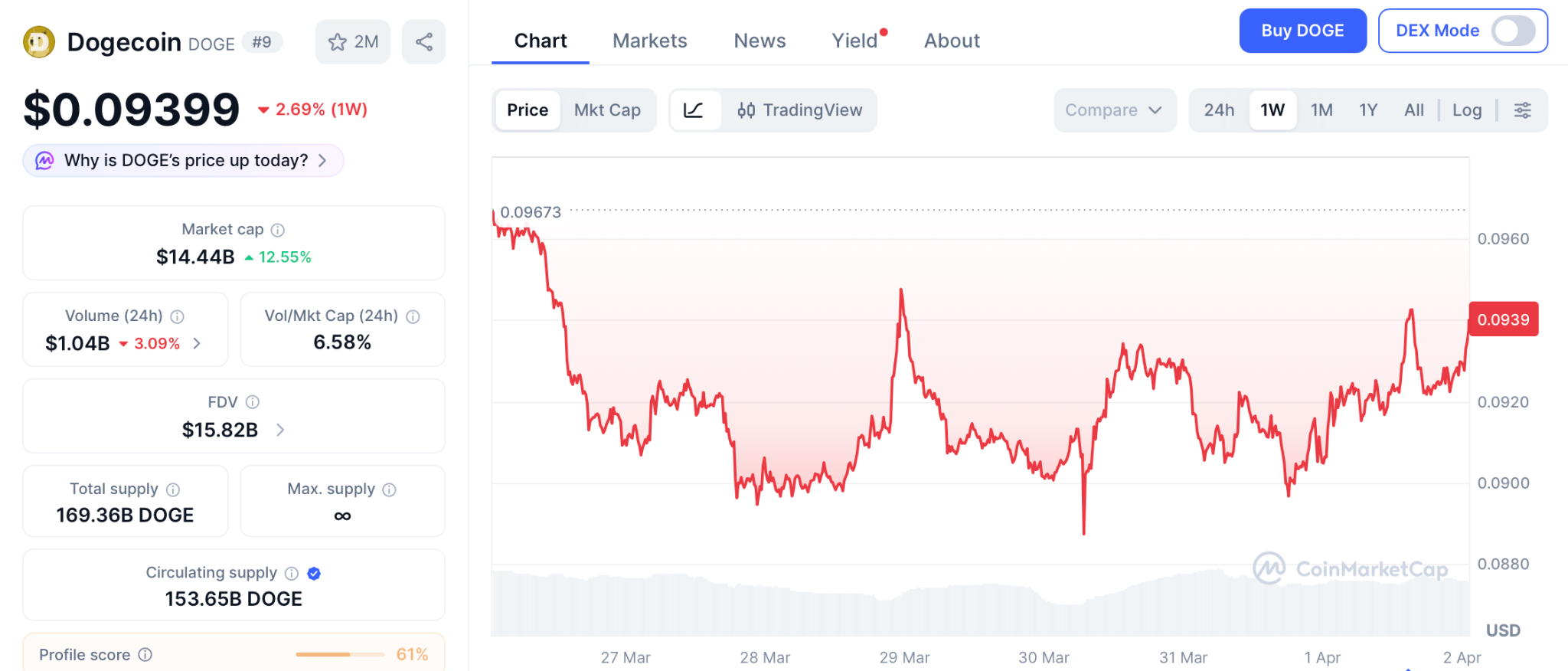
The dogecoin price prediction targets $0.10 as resistance with $0.21 as the 2026 ceiling according to CoinCodex. Support sits at $0.088 with $0.085 below. Active addresses jumped 28% in one week, but Fear and Greed at 8 keeps sellers in control.
The DOGE forecast depends on whether X Money confirms crypto, but even the bullish case takes quarters while the presale delivers 100x from one listing.
Dogecoin Price Prediction Confirms the Smart Money Already Calculated the Outcome and Following Them Is How You Collect
With X Money launching in April and MemeCore proving that meme sector capital rotates violently when a new project catches fire, the environment is the healthiest for meme energy to translate into real returns. Analysts project 100x from the Binance listing, and this may be the last window to enter something that delivers what DOGE delivered in 2021 but with a working exchange this time. More than $8.69 million raised during single digit fear proves the smart money already calculated the outcome.
The wallets that entered SHIB at $0.000007 all say they saw the signal before the crowd, and the same signal flashes now. The Pepeto official website is where following those wallets is how you collect when the listing opens, and entering now is how you capture returns from this cycle.
Click To Visit Pepeto Website To Enter The Presale

FAQs:
What does the dogecoin price prediction show after MemeCore flipped SHIB?
DOGE holds $0.093 while MemeCore overtook SHIB in market cap, with the 2026 ceiling at $0.21 and the next resistance at $0.10 while active addresses jumped 28%.
Will X Money launching in April affect the dogecoin price prediction?
X Money confirmed for April with Visa across 40 states, but crypto trading is only on the roadmap with no DOGE confirmation. The Pepeto official website is where the exchange with verified tools is still at presale pricing.
Is Pepeto the next DOGE based on the dogecoin price prediction pattern?
The same meme energy is building with a working exchange DOGE never had, the Pepe cofounder behind it, and a Binance listing confirmed with 100x projected by analysts.
Disclaimer: This is a Press Release provided by a third party who is responsible for the content. Please conduct your own research before taking any action based on the content.

Learn how to borrow money #motivation #money #richdad #borrow

Fire at Blackpool care home as police declare major incident

Marmite maker Unilever confirms $60bn food empire with McCormick merger


-

 News Videos7 days ago
Parliament publishes latest register of MPs’ financial interests
-

 Business6 days ago
Instagram, YouTube Found Responsible for Teen’s Mental Health Struggle in Historic Ruling
-
 Tech6 days ago
Intercom’s new post-trained Fin Apex 1.0 beats GPT-5.4 and Claude Sonnet 4.6 at customer service resolutions
-

 NewsBeat5 days ago
The Story hosts event on Durham’s historic registers
-

 Sports5 days ago
Sweet Sixteen Game Thread: Tide vs Michigan
-
Entertainment2 days ago
Fans slam 'heartbreaking' Barbie Dream Fest convention debacle with 'cardboard cutout' experience
-
 Entertainment4 days ago
Lana Del Rey Celebrates Her Husband’s 51st Birthday In New Post
-
Crypto World1 day ago
Dems press CFTC, ethics board on prediction-market insider trades
-

 Tech3 days ago
The Pixel 10a doesn’t have a camera bump, and it’s great
-

 Sports1 day ago
Tallest college basketball player ever, standing at 7-foot-9, entering transfer portal
-

 Crypto World3 hours ago
Gold Price Prediction: Worst Month in 17 Years fo Save Haven Rock
-

 Tech2 days ago
EE TV is using AI to help you find something to watch
-

 Entertainment7 days ago
HBO’s Harry Potter Series Will Definitely Fail For One Big Reason, And It’s Not J.K. Rowling Or Snape
-

 Tech2 days ago
Apple will hide your email address from apps and websites, but not cops
-

 Tech2 days ago
Flipsnack and the shift toward motion-first business content with living visuals
-

 Tech2 days ago
How to back up your iPhone & iPad to your Mac before something goes wrong
-

 Fashion6 days ago
En Vogue in Brown Leather and Tailored Neutrals by Atelier Savoir, Styled by J Bolin
-

 Politics2 days ago
Should Trump Be Scared Strait?
-

 Crypto World2 days ago
U.S. rule change may open trillions in 401(k) funds to crypto
-

 Fashion5 days ago
Weekly News Update, 3.27.26 – Corporette.com
You must be logged in to post a comment Login