

Crypto World
What is a smart contract? The code that runs crypto



A smart contract is not smart, and it is barely a contract. It is a small program that lives on a blockchain and runs itself when its conditions are met, with no person to enforce it and no way to undo it. Understanding this one idea unlocks almost everything in crypto.
Summary
- Smart contracts are self executing programs on a blockchain that carry out predefined actions without requiring a middleman or central authority.
- Ethereum turned the concept into a practical technology, enabling applications such as DeFi platforms, NFTs, tokens, and decentralized apps.
- While smart contracts offer automation, transparency, and reliability, coding flaws or faulty external data can lead to irreversible losses.
A smart contract is a program stored on a blockchain that automatically executes when certain conditions are met, with no person, company, or middleman needed to carry it out. That is the whole concept, and it is simpler than the intimidating name suggests, because a smart contract is not artificial intelligence and it is not really a legal contract in the traditional sense.
It is code, a set of instructions that says “if this happens, then do that,” running on a network that no single party controls, in a way that cannot be stopped, censored, or reversed once it is set in motion. Almost everything interesting in crypto beyond simply sending coins, decentralized finance, NFTs, tokens, decentralized applications, runs on smart contracts, which makes understanding them the key that unlocks how the modern crypto world actually works.
This guide explains smart contracts in plain English, from the ground up, with no coding or technical background assumed. It covers what a smart contract actually is and where the idea came from, the vending-machine analogy that makes it click, how smart contracts actually work under the hood, what they are used for across crypto, their real advantages, and, just as importantly, their serious risks and limitations, because the same properties that make smart contracts powerful also make them dangerous when they go wrong.
By the end you will understand not just the definition but the deeper idea, why “code is law” is both the promise and the peril of smart contracts, and why this single invention reshaped what blockchains could do.
What a smart contract actually is
The name causes more confusion than the concept deserves, so it helps to take it apart before building it back up.
A smart contract is “smart” only in the sense that it executes automatically; the word does not imply intelligence or any kind of thinking, and the person who coined the term was careful to say so. It is a “contract” only in the loose sense that it encodes an agreement, a set of conditions and the actions that follow from it, but it is not a legal document sitting in a drawer waiting for a court to enforce it.
The clearest way to describe it is what it actually is: execution logic, a small computer program that lives on a blockchain and runs by itself when its predefined conditions are satisfied. It takes an input, checks whether the conditions are met, and if they are, it performs the actions it was programmed to perform, moving funds, updating records, transferring ownership, issuing a token, without any human stepping in to make it happen.
The idea is older than blockchain. A computer scientist and legal scholar named Nick Szabo proposed the concept in the 1990s, defining a smart contract as a set of promises specified in digital form and the protocols within which the parties perform on those promises, and he was explicit that “smart” did not mean intelligent.
For years the idea was theoretical, because there was no platform on which such self-executing agreements could run reliably without a trusted party to host them. Bitcoin, launched in 2009, introduced a limited form of programmability, but it was the launch of Ethereum in 2015 that made fully featured smart contracts a practical reality, providing a blockchain designed from the start to run arbitrary programs.
Ethereum turned Szabo’s theoretical idea into working infrastructure, and most of the smart contracts in use today run on Ethereum or on networks built on the same model. The concept waited two decades for a platform that could run it without anyone in charge, and the blockchain was that platform.
The vending machine: the analogy that makes it click
The single best way to understand a smart contract is through an analogy that the concept’s own inventor used, because it captures the essential idea perfectly.
Think of a vending machine. You walk up, insert the right amount of money, press the button for your selection, and the machine dispenses your item, all without a cashier, a clerk, or any human involved in the transaction. The machine enforces the agreement automatically: if you put in enough money and make a valid selection, you get the product, and if you do not put in enough, you get nothing.
The rules are built into the machine, they execute on their own when the conditions are met, and there is no person you need to trust or negotiate with, because the machine simply does what it was built to do. A smart contract is the digital, blockchain-based version of exactly this: a mechanism that holds a set of rules, checks whether the conditions are satisfied, and automatically delivers the outcome, with no intermediary required.
The analogy illuminates the key properties. The vending machine is automatic, it acts without a human; it is deterministic, the same input always produces the same output; and it is trustless in the sense that you do not need to trust the machine’s owner to be honest, because the machine’s behavior is fixed by its mechanism, not by anyone’s goodwill in the moment. A smart contract shares all three properties and adds the powers of a blockchain: it can hold and move large amounts of value, it runs on a network no single party controls so no one can secretly alter its rules, and its actions are permanently recorded and visible.
Where a vending machine dispenses a candy bar, a smart contract can release thousands of dollars, transfer ownership of an asset, or trigger a chain of further actions, all on the same simple principle of automatic execution when conditions are met. The vending machine is the intuition; the smart contract is that intuition scaled up to handle money, ownership, and complex agreements with no one in charge.
How a smart contract actually works
Going one level deeper, it helps to understand the mechanics, because the way a smart contract runs explains both its power and its dangers.
A smart contract is written as code, typically in a programming language designed for the purpose, and then deployed onto a blockchain, where it is stored at a specific address much like a wallet has an address. Once deployed, the contract lives on the blockchain permanently, its code visible to anyone and its rules fixed, and it sits there waiting to be used.
When someone wants to interact with it, they send a transaction to the contract’s address, providing whatever input the contract requires, and the network’s computers, the thousands of nodes that maintain the blockchain, all run the contract’s code with that input. Because every node runs the same code on the same input, they all arrive at the same result, which is how the network agrees on the outcome without any central authority, and that agreed result, the funds moved, the ownership transferred, the record updated, is written permanently to the blockchain.
Several features of this process are worth understanding because they shape everything about how smart contracts behave. First, execution costs money: running a contract’s code consumes computational resources, and the user pays a fee, often called gas, to compensate the network for that work, which means complex contracts that do more cost more to run. Second, execution is deterministic and verifiable: because every node runs the same code and reaches the same answer, anyone can verify that the contract did exactly what its code specifies, with no hidden behavior.
Third, and most consequentially, once a contract is deployed, its code generally cannot be changed: the rules are fixed at deployment, and the contract will do exactly what it was programmed to do, forever, which is a strength when the code is correct and a catastrophe when it contains a flaw. This combination, code that runs automatically across a decentralized network, costs a fee to execute, produces verifiable results, and cannot be altered after deployment, is what makes smart contracts both remarkably powerful and unforgiving of error. The machine does precisely what it was built to do, whether or not that is what its creators intended.
What smart contracts are used for
The abstract concept becomes concrete when you see what smart contracts actually do, because they are the engine behind nearly every crypto application beyond simple payments.
Decentralized finance, or DeFi, is where smart contracts found their fullest expression. Decentralized exchanges like Uniswap run entirely on smart contracts, handling the pools of capital that enable trading and settling trades automatically through code rather than through a traditional order book or a company.
Lending protocols like Aave use smart contracts to let people borrow against crypto collateral with no manual approval and no loan officer, with the contract automatically enforcing the loan terms, holding the collateral, and liquidating it if the borrower’s position falls below the required threshold. Stablecoins rely on smart contracts to manage the issuance and redemption of tokens and to maintain their peg. In each case, the smart contract replaces the bank, the broker, or the clearinghouse, performing the function that an institution would traditionally perform, but doing it automatically through code that anyone can inspect.
Beyond DeFi, smart contracts power much of the rest of crypto. Every NFT, a token representing ownership of a unique digital item, is governed by a smart contract that defines the token, tracks who owns it, and handles transfers when it is bought or sold on a marketplace. Tokens of all kinds, the thousands of assets that run on networks like Ethereum, are themselves smart contracts that define the token’s supply and rules.
Decentralized applications, or dApps, are built from smart contracts that provide their backend logic, enabling everything from games to social platforms to run without a central server. Decentralized autonomous organizations use smart contracts to manage shared funds and to execute the outcomes of member votes automatically. The common thread is that wherever crypto replaces a trusted intermediary, a bank, an exchange, a registrar, a voting authority, with automatic, transparent code, a smart contract is doing the work. They are the building blocks from which the entire programmable-money ecosystem is constructed, which is why understanding them illuminates so much of crypto at once.
The advantages: why smart contracts matter
The reasons smart contracts have become foundational come down to a set of real advantages over the traditional way agreements are made and enforced.
The first advantage is the removal of intermediaries. Traditional agreements often require trusted third parties, banks to hold and transfer money, brokers to execute trades, lawyers and courts to enforce terms, and each intermediary adds cost, delay, and the need to trust that party. A smart contract performs the enforcement itself, automatically and without a middleman, which can make transactions faster and cheaper and removes the dependence on any single trusted party.
The second advantage is transparency and verifiability: a smart contract’s code is visible on the blockchain, so anyone can inspect exactly what it will do, and its execution is verifiable, so anyone can confirm it did what it was supposed to, which is a level of openness traditional agreements rarely offer. You do not have to trust a promise; you can read the code that will keep it.
The third advantage is automation and reliability. A smart contract executes exactly as written, every time, without the delays, errors, or discretion of human processing, which means an agreement encoded in a smart contract carries itself out the moment its conditions are met, with no waiting and no possibility of a party simply refusing to perform.
This combination, no intermediary, full transparency, and automatic reliable execution, is what makes smart contracts powerful, because it lets people transact and cooperate without needing to trust each other or any central authority, relying instead on code that anyone can verify and that runs itself. For the first time, agreements can enforce themselves across a global network with no one in charge, and that capability is the foundation on which the entire world of decentralized applications is built. The advantages are real and significant, and they explain why smart contracts moved from a theoretical idea to the engine of an industry.
The risks: why “code is law” cuts both ways
Here is where honesty matters most, because the same properties that make smart contracts powerful make them truly dangerous, and anyone using them needs to understand the risks as clearly as the benefits.
The central risk follows directly from a central strength: smart contracts are immutable and self-executing, which means that if the code contains a bug or a vulnerability, that flaw executes automatically too, and there is often no way to stop it or reverse the damage. A traditional contract with a mistake can be renegotiated, and a fraudulent transaction at a bank can sometimes be reversed, but a smart contract does exactly what its code says, and if its code says to send all the funds to an attacker who found a loophole, it sends all the funds, irreversibly.
The history of crypto is full of expensive examples: hundreds of millions of dollars have been lost to smart-contract bugs and exploits, where attackers found flaws in the code and the contracts dutifully executed the attackers’ will because that is what the code, as written, permitted. The phrase “code is law” captures this: the code is the final authority, and it will enforce whatever it actually says, not what its creators meant it to say.
Several specific risks flow from this. Smart-contract bugs are flaws in the code that attackers can exploit, and because the code cannot easily be changed after deployment, these flaws can be catastrophic and permanent. Bad inputs and faulty external data are another danger, since many contracts rely on outside information delivered by oracles, and if that data is wrong or manipulated, the contract executes on false premises, which can trigger cascading liquidations or other harm.
Complexity compounds the problem, because the more a contract does, the more places a flaw can hide, and the harder it is to verify that the code is safe. And scams exploit the trust people place in code, with malicious contracts written to look legitimate while containing hidden behavior that drains the funds of anyone who interacts with them. The lesson is not that smart contracts are bad, but that “trustless” does not mean “riskless”: you no longer have to trust a person, but you do have to trust that the code is correct, and code written by humans contains human errors. Auditing, caution, and using well-tested, battle-hardened contracts instead of unknown ones are the practical defenses, but the underlying truth remains that a smart contract will do precisely what it is written to do, and getting that writing exactly right is hard.
The limitations worth knowing
Beyond the risks, smart contracts have inherent limitations that shape what they can and cannot do, and understanding these prevents overestimating them.
A smart contract can only see and act on information that exists on its own blockchain. It cannot natively know anything about the outside world, a price, a weather reading, the result of an event, because it is sealed inside the blockchain, which is why oracles exist to feed external data in, and that dependence on oracles is itself a source of risk and limitation.
A smart contract also cannot reach out and act in the physical world; it can move digital assets and update digital records, but it cannot make a physical delivery or enforce a real-world outcome on its own. And a smart contract is only as good as its code: it has no judgment, no ability to interpret intent, and no capacity to handle situations its programmers did not anticipate, so it executes the letter of its code with no understanding of the spirit behind it, which is why an unforeseen edge case can produce an outcome no one wanted.
These limitations matter because they define the boundary between what smart contracts are genuinely good for and where they fall short. They excel at automating clear, well-defined, on-chain agreements where the conditions and outcomes can be precisely specified in code, which is why they work so well for financial applications like trading, lending, and token transfers.
They struggle with anything requiring judgment, interpretation, real-world enforcement, or reliable outside information, because those need capabilities a self-contained piece of code does not have. Understanding the limitations keeps the technology in perspective: a smart contract is a powerful tool for automating precise digital agreements without a middleman, not a magical replacement for all human agreements, and its strengths and weaknesses both flow from the same root, that it is rigid, automatic code running on a sealed, decentralized network. Knowing where that root helps and where it hinders is the difference between using smart contracts well and expecting more from them than they can deliver.
The code that changed crypto
A smart contract is, in the end, a simple idea with profound consequences: a small program that lives on a blockchain and runs itself when its conditions are met, enforcing an agreement automatically with no person, company, or court required. The vending machine captures the intuition, money in, product out, no cashier, and the blockchain scales that intuition up to handle money, ownership, and complex agreements across a global network that no one controls. From this single concept flows nearly everything in crypto beyond simple payments: the decentralized exchanges, the lending protocols, the stablecoins, the NFTs, the tokens, the decentralized applications, all of them built from smart contracts doing automatically what institutions used to do.
The power and the peril come from the same source. Because a smart contract executes exactly as written, automatically and irreversibly, it can replace trusted intermediaries with verifiable code, which is the breakthrough that made decentralized finance and the rest of the ecosystem possible. But that same rigidity means a flaw in the code executes just as faithfully as a feature, with no one to stop it and no way to reverse it, which is why hundreds of millions have been lost to bugs and exploits and why “code is law” is a warning as much as a promise. Smart contracts removed the need to trust people and replaced it with the need to trust code, and code, written by humans, is only as good as the humans who wrote it.
Understanding that tradeoff, the extraordinary power of self-executing agreements and the real danger of their unforgiving precision, is understanding the invention that turned blockchains from simple ledgers into the programmable foundation of an entire industry. The contract is not smart, and it is barely a contract, but it changed what money and agreements could be.
Frequently Asked Questions
What is a smart contract in simple terms?
A smart contract is a program stored on a blockchain that automatically executes when certain conditions are met, with no person or middleman needed to carry it out. It works like a vending machine: provide the right input, and the code automatically delivers the outcome, moving funds, transferring ownership, or updating records. It is “smart” only in that it runs automatically, not because it is intelligent, and it is “code, not a legal document,” which executes itself across a decentralized network.
Who invented smart contracts?
The concept was proposed by computer scientist and legal scholar Nick Szabo in the 1990s, who defined a smart contract as a set of promises in digital form and was explicit that “smart” did not mean intelligent. The idea was theoretical until a platform existed to run it. Bitcoin introduced limited programmability in 2009, but Ethereum, launched in 2015, made fully featured smart contracts a practical reality, and most smart contracts today run on Ethereum or similar networks.
How does a smart contract actually work?
A smart contract is written as code and deployed to a blockchain at a specific address, where it lives permanently with its rules fixed. When someone sends a transaction to interact with it, the network’s many computers all run the contract’s code on the input and agree on the result, which is written permanently to the blockchain. Execution costs a fee called gas, the result is verifiable by anyone, and once deployed the code generally cannot be changed.
What are smart contracts used for?
They power nearly all of crypto beyond simple payments. In decentralized finance, they run exchanges like Uniswap and lending protocols like Aave, replacing brokers and banks. Every NFT and most tokens are smart contracts defining ownership and rules. Decentralized applications use them for backend logic, and decentralized organizations use them to manage funds and execute votes. Wherever crypto replaces a trusted intermediary with automatic, transparent code, a smart contract is doing the work.
What are the risks of smart contracts?
Because smart contracts are immutable and self-executing, a bug or vulnerability in the code executes automatically too, often with no way to stop or reverse it, and hundreds of millions of dollars have been lost to such exploits. Risks include code bugs, manipulated oracle data feeding false information, complexity hiding flaws, and malicious contracts disguised as legitimate ones. “Trustless” does not mean “riskless”: you no longer trust a person, but you must trust that the code is correct, and code contains human errors.
What does “code is law” mean?
It means that with a smart contract, the code is the final authority and will enforce exactly what it actually says, not what its creators intended. A traditional contract with a mistake can be renegotiated and some fraudulent bank transactions can be reversed, but a smart contract does precisely what its code specifies, irreversibly. If the code contains a flaw that lets an attacker drain funds, the contract executes that flaw faithfully. “Code is law” is both the promise of reliable automation and the peril of unforgiving precision.
This guide is educational information, not financial or technical advice. Interacting with smart contracts carries real risk; use well-tested, audited contracts and never commit more than you can afford to lose.


Bitcoin mining is increasingly becoming less about pure exposure to BTC price moves and more about building a business around electricity, compute supply chains, and AI-related infrastructure. The change is being reinforced by signals from outside crypto, including a report that Nvidia is seeking to raise $20 billion through a bond sale to fund additional AI expansion.
At the same time, other parts of the industry are showing resilience or momentum. Tokenized real-world assets continue to grow even as the broader crypto market struggles, while Ripple is expanding its payments footprint in Africa through an investment in Flutterwave. Separately, former FTX CEO Sam Bankman-Fried’s attempt to overturn his fraud conviction has failed, according to an appeals panel in Manhattan.
Key takeaways
- A reported $20 billion Nvidia bond offering underscores the scale and durability of the AI investment cycle that some Bitcoin miners are positioning to support.
- Bitcoin mining firms are increasingly targeting AI hosting and high-performance computing opportunities as mining margins tighten.
- Tokenized real-world assets have surpassed $43 billion in total value of onchain financial assets, with Token Terminal citing a 37% increase over six months.
- Ripple’s investment in Flutterwave is another step in expanding stablecoin and payments infrastructure across Africa, where cross-border payments demand is rising.
- Sam Bankman-Fried’s appeal to overturn his fraud conviction was denied by a Manhattan appeals panel.
Nvidia’s bond plan highlights why miners are looking beyond hash rate
According to Bloomberg, Nvidia is pursuing a multi-part bond offering totaling $20 billion to finance future AI-related investments and refinance existing debt. The report also notes that the longest-dated bonds are expected to carry meaningfully higher yields than comparable U.S. Treasury securities, reflecting investor pricing for longer-duration risk and returns.
The relevance for crypto comes from how the economics of mining have been shifting. For years, many miners effectively operated as leveraged vehicles for BTC: mining profitability tended to track Bitcoin’s price and difficulty dynamics, leaving little room for a broader corporate identity. But with mining economics under pressure and power costs remaining a constant constraint, miners have been exploring a new angle—using their energy access and data center capabilities for AI compute workloads.
As Cointelegraph previously reported, the AI and data center trend has created practical opportunities for miners, since many of their facilities already support high-density computing. Companies such as HIVE Digital, Hut 8, CleanSpark, and TeraWulf have been positioning themselves as AI infrastructure providers, effectively treating energy and hosting as primary assets rather than secondary byproducts of mining.
While Nvidia’s funding plan is not a direct endorsement of Bitcoin mining, it is a reminder that major AI infrastructure buildouts tend to be multi-year investments. That duration matters: investors and operators typically need a longer runway when converting electrical and facilities capability into new revenue streams. The key watchpoint is whether AI hosting demand continues to absorb capacity fast enough to offset ongoing mining margin compression.
Tokenized RWAs keep expanding even as crypto sentiment softens
The tokenized real-world asset market continues to grow despite weakness across wider crypto markets. Token Terminal reports that the total value of onchain financial assets has surpassed $43 billion—an increase of 37% over the past six months—suggesting ongoing institutional and product-level experimentation rather than a purely speculative boom.
Tokenized funds dominate the category, accounting for nearly 80% of all onchain financial assets, though other forms are gaining attention. Commodities and tokenized stocks are gradually strengthening their presence, indicating that issuers are exploring more than one blueprint for bringing traditional asset exposure onchain.
The momentum is also being reinforced by longer-term projections from major banks. Standard Chartered expects tokenization to help drive decentralized finance toward a $2.7 trillion market capitalization by 2030, while Citigroup projects tokenized RWAs could reach $5.5 trillion over the same period. Even if exact outcomes differ, these forecasts point to a consistent theme: large financial institutions see tokenization as a structural opportunity that could eventually scale beyond pilots.
For market participants, the practical implication is that the RWA sector may behave differently from mainstream crypto narratives. Growth appears tied to product distribution and balance-sheet-backed use cases, which can be less correlated with day-to-day volatility than trading-heavy segments.
Ripple doubles down on African payments with Flutterwave investment
Ripple has invested an undisclosed amount in Flutterwave, one of Africa’s fastest-growing remittance and payments firms, in a deal valuing the fintech at $3.3 billion. The investment is expected to connect Ripple’s RLUSD stablecoin, Ripple Payments platform, and XRP Ledger infrastructure with Flutterwave’s payments reach.
Flutterwave operates across 35 countries, and this partnership aims to strengthen Ripple’s stablecoin-based rails for cross-border transfers. The pitch aligns with the broader industry demand for faster settlements and lower-cost remittances, especially in regions where traditional correspondent banking can be slow or expensive.
This development also fits Ripple’s continuing strategy to deepen its presence in Africa. In October, Ripple partnered with South Africa’s Absa Bank to provide institutional digital asset custody solutions—another area where regulatory frameworks and institutional adoption tend to matter as much as technology. Taken together, the Flutterwave investment suggests Ripple is seeking both market access and the operational capacity to serve institutional and consumer payment flows.
Manhattan appeals panel rejects Sam Bankman-Fried bid to overturn conviction
Former FTX CEO Sam Bankman-Fried failed to overturn his fraud conviction after a three-judge appeals panel in Manhattan upheld the verdict, finding that he received a fair trial. The denial comes after an appeal that challenged the conviction stemming from FTX’s collapse.
In an opinion attributed to Circuit Judge Barrington Parker, the court highlighted a central contradiction in Bankman-Fried’s conduct during the period leading to FTX’s failure: while he was publicly reassuring customers, investors, and regulators that customer funds were safe, the judge wrote that he was simultaneously using FTX funds for personal purposes, including spending on real estate, political contributions, and investments.
Bankman-Fried was convicted on fraud and conspiracy charges tied to the collapse of FTX and sentenced to 25 years in prison in 2024, according to earlier reporting. In addition, Cointelegraph reported that he formally applied for a presidential pardon from U.S. President Donald Trump, with the request appearing on the Pardon Attorney website in early June.
For observers, the outcome means the legal fight does not reset the underlying conviction. While additional post-conviction steps may still be possible in the future, this appeals decision closes a key chapter and keeps attention on the enforcement trajectory following one of crypto’s most consequential corporate failures.
Looking ahead, the most important signal to track is whether the AI infrastructure shift can convert into durable, measurable revenue for mining operators—especially as power and equipment costs remain the real battlefield. Meanwhile, tokenized RWAs will likely remain a key barometer for whether onchain finance can sustain growth through traditional finance’s adoption cycles, even when broader crypto markets cool off.
This article was originally published as AI’s Role in Reshaping Miner Strategy: Is It the Way Out? on Crypto Breaking News – your trusted source for crypto news, Bitcoin news, and blockchain updates.
Crypto exchange WhiteBIT has obtained authorization under the European Union’s Markets in Crypto-Assets Regulation (MiCA) from Austria’s Financial Market Authority, allowing the company to offer regulated crypto services across the European Economic Area through a single license.
Under MiCA, crypto companies authorized in one European Union member state can passport their services across the European Economic Area without obtaining separate licenses in each jurisdiction. WhiteBIT said the authorization will support the launch of a dedicated European platform, whitebit.eu.
WhiteBIT said W Group, its parent company, serves more than 35 million customers globally. Founded in 2018, the exchange has partnerships with Visa, FACEIT, FC Barcelona, Juventus and Ukraine’s national football team.
Austria did not extend grandfathering provisions for virtual asset service providers beyond Dec. 31, 2025, making it one of the first European Union jurisdictions to fully transition to the MiCA framework.
According to comments previously provided to Cointelegraph by Austria’s Financial Market Authority, the regulator has licensed nine crypto-asset service providers under MiCA and described application volume as “significant.”
Related: Polish president vetoes crypto bill for third time ahead of MiCA deadline
MiCA deadline approaches for crypto firms
WhiteBIT’s approval comes less than two weeks before the European Union’s MiCA transition period expires on July 1. After that date, crypto companies operating under legacy national registrations must either hold a MiCA license or stop serving clients in the bloc.
The approaching deadline has increased scrutiny on exchanges that have yet to secure authorization. Earlier this week, Reuters reported that Greece’s market regulator was preparing to reject Binance’s MiCA application, while The Big Whale said France may be the exchange’s last remaining path to a MiCA license before the deadline.
Data shared with Cointelegraph by OKX Europe suggests the MiCA transition could affect a meaningful share of Europe’s crypto market. The company found that roughly 7.6 million of the 18.5 million crypto app downloads recorded in Europe between May 2025 and May 2026 were linked to exchanges that were not listed on public MiCA authorization registers.
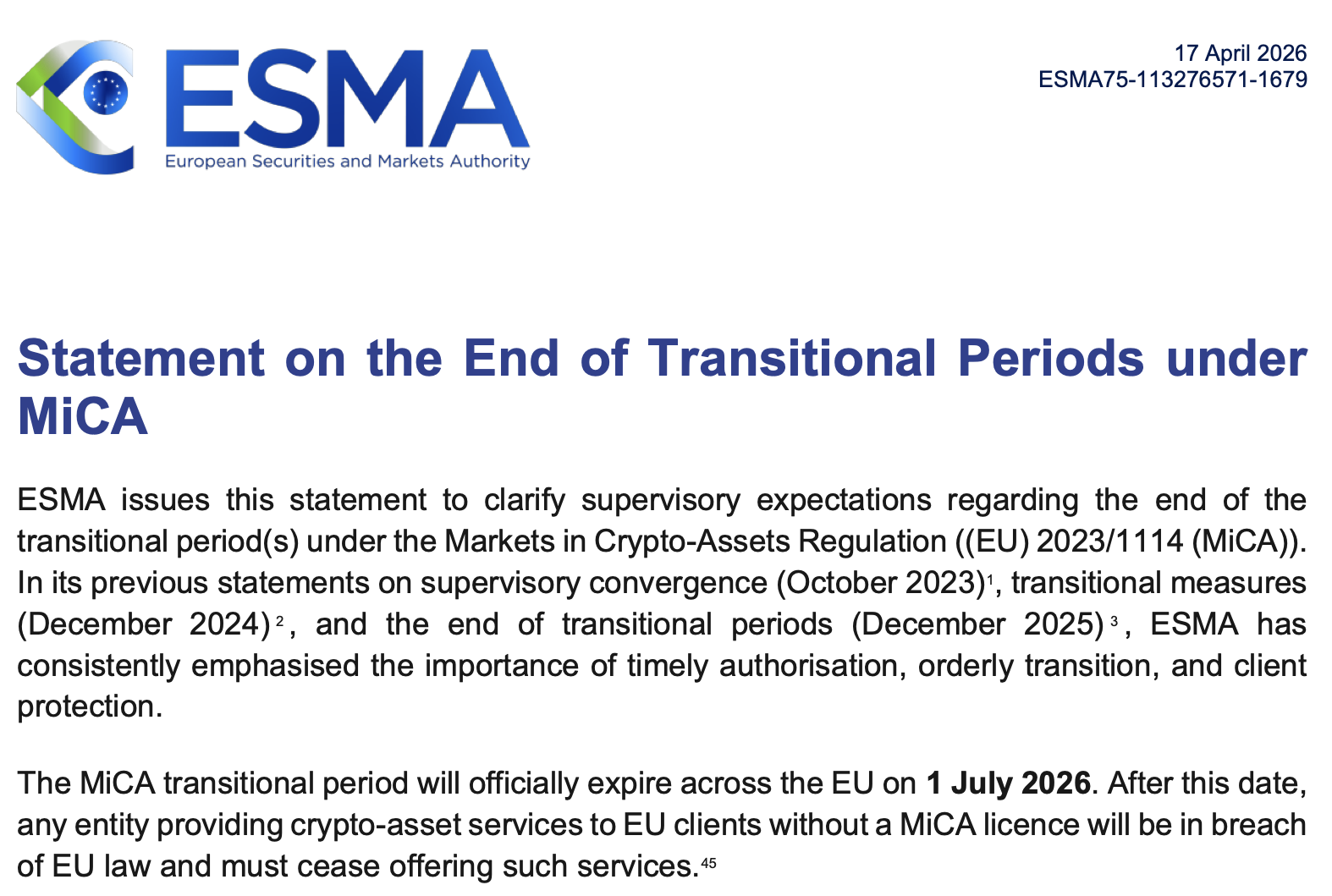
Statement on the end of transitional periods. Source: ESMA
The European Securities and Markets Authority has said companies that remain unauthorized after July 1 should implement wind-down and client migration plans rather than continue operating while applications remain under review.
Magazine: The end of anon? AI could unmask crypto’s hidden identities

Key Takeaways
- Advanced Micro Devices delivered $7.4 billion in Q1 2026 revenue, marking a 36% year-over-year increase powered by exceptional data center performance
- The Data Center division at AMD reached an all-time high of $3.7 billion, representing 57% growth driven by EPYC CPUs and Instinct accelerators
- Intel generated $13.6 billion in Q1 2026 revenue with only 7% growth, while posting a GAAP loss of $0.73 per share
- Analysts assign AMD a Moderate Buy rating with an average target of $430.68, compared to Intel’s Hold consensus around $83.35
- Intel’s Q2 guidance projects revenue between $13.8 and $14.8 billion, indicating stabilization without meaningful expansion
The semiconductor sector’s two biggest names—AMD and Intel—are experiencing dramatically different trajectories as we move through 2026.
While AMD continues its ascent as a growth powerhouse, Intel remains mired in proving its turnaround strategy can deliver tangible results.
AMD Demonstrates Powerful Momentum
Advanced Micro Devices announced first-quarter 2026 revenue of $7.4 billion, representing a robust 36% increase compared to the prior-year period.
Advanced Micro Devices, Inc., AMD
The company achieved GAAP net income of $709 million. The headline achievement came from the Data Center business, which posted unprecedented revenue of $3.7 billion—a 57% year-over-year jump.
This impressive performance was fueled by escalating demand for EPYC server chips and Instinct GPU solutions. Meanwhile, the Client division also delivered impressive results, climbing 68% to reach $2.3 billion.
These financial results demonstrate that AMD has successfully transformed from a traditional processor manufacturer into a major force in data center infrastructure and artificial intelligence hardware.
Analyst community response has been overwhelmingly positive. MarketBeat data reveals 44 analysts tracking AMD, with consensus landing at Moderate Buy—comprising 30 Buy recommendations, 12 Hold ratings, and only 1 Sell. The average price target over the next 12 months stands at $430.68.
Intel Continues Its Turnaround Journey
Intel reported Q1 2026 revenue of $13.6 billion, reflecting modest 7% year-over-year growth. However, the company recorded a GAAP loss of $0.73 per share.
Adjusted for non-GAAP items, the company posted earnings of $0.29 per share. For the second quarter, management provided guidance of $13.8 billion to $14.8 billion, suggesting the business is stabilizing but not experiencing meaningful growth.
Intel maintains significant advantages including substantial scale, an extensive customer base spanning personal computers, servers, and manufacturing operations. Yet the company hasn’t demonstrated the operational momentum visible at AMD.
The company’s recovery hinges on improved processor competitiveness, advancement in its foundry operations, and development of competitive AI solutions. These critical improvements haven’t yet materialized in financial performance.
Analyst opinion mirrors this cautious outlook. According to MarketBeat, Intel carries a Hold consensus from 41 analysts, with 10 Buy ratings, 26 Hold recommendations, and 4 Sell ratings. The average 12-month price target hovers around $83.35.
Investment Implications
The choice between these semiconductor giants ultimately depends on growth visibility. AMD demonstrates undeniable traction in data centers and AI infrastructure, supported by strong profitability.
Intel presents potential upside if its restructuring succeeds. However, that opportunity remains contingent on execution improvements that haven’t yet materialized.
AMD represents the proven growth play. Intel represents the speculative turnaround opportunity. Your choice depends on your risk tolerance and patience for uncertainty.



Charles Schwab has entered the prediction markets business through a partnership with Cboe Global Markets, introducing new contracts tied to the performance of the S&P 500.
Summary
- Charles Schwab is partnering with Cboe to launch S&P 500 prediction-style options contracts in the coming months.
- The new product will use options contracts, differing from the futures-based markets offered by Kalshi and Polymarket.
- Schwab’s prediction market push comes as the firm expands crypto services for both retail investors and financial advisors.
According to a Wall Street Journal report, the brokerage firm is working with Cboe to launch all-or-nothing options contracts that allow investors to take positions on where the benchmark U.S. stock index will finish. The product places Schwab alongside firms such as CME Group and Interactive Brokers, which have already expanded into prediction-style trading products.
People familiar with the matter told the Journal that the contracts are expected to become available to Schwab customers in the coming months. Unlike platforms such as Kalshi and Polymarket, which primarily offer futures-based event contracts, Schwab’s product will be structured as options.
The launch comes as competition intensifies among firms seeking to capitalize on growing demand for event-driven trading products. Recent activity has pushed prediction markets beyond political and sports outcomes into financial markets, where traders increasingly use contracts tied to economic and market events.
Schwab is focusing on stock market outcomes
Details reported by the Wall Street Journal indicate that Schwab’s initial offering will concentrate on measurable financial outcomes rather than the wider range of events available on platforms such as Kalshi and Polymarket. Discussions between Schwab and Cboe have also included the possibility of introducing contracts linked to other market indexes.
In addition to the all-or-nothing contracts, the Journal reported that Schwab plans to introduce an options product designed to provide partial payouts when traders come close to predicting an index’s closing level. The feature would use a Cboe mechanism known as the “plus zone,” allowing participants to receive some compensation even when their forecast is not exact.
Institutional interest in prediction markets has accelerated in recent months. Kalshi recently disclosed that institutional trading volume increased 800% over a six-month period as the company expanded its Wall Street presence and product lineup.
Meanwhile, data from DefiLlama shows Polymarket generated approximately $1.5 million in fees over the previous 24 hours and around $10 million during the last seven days, highlighting continued activity across crypto-native prediction platforms.
Crypto expansion continues alongside new market products
Schwab’s move into prediction-style contracts arrives as the firm continues building out its digital asset business.
As reported by crypto.news earlier in June, Schwab revealed plans to extend direct crypto services from retail investors to registered financial advisors. The company is targeting 2027 for spot cryptocurrency trading, transfers, and custody capabilities on its advisor platform, bringing crypto-related account management and asset servicing into its wealth management operations.
The advisor initiative follows the rollout of Schwab Crypto, the company’s spot Bitcoin and Ethereum trading service for retail customers. Schwab previously confirmed a phased launch of direct access to Bitcoin and Ethereum, with select U.S. clients already gaining access this year.
Taken together, the firm’s expansion into prediction-style contracts and cryptocurrency services adds new trading and investment products as established brokerages compete for a larger share of retail and advisor activity.


Charles Schwab is working with Cboe Global Markets to launch a new type of options contract that would allow customers to make yes-or-no wagers on the performance of the S&P 500, marking the brokerage’s first move into prediction markets, according to a Wall Street Journal report.
The feature is expected to roll out to Schwab customers in the coming months, the Journal reported, citing people familiar with the matter.
Unlike traditional prediction market platforms such as Polymarket and Kalshi, which typically offer futures-style contracts tied to the outcome of events, Schwab’s product would function more like a binary option, in which the contract would pay a fixed cash amount or expire worthless depending on whether the S&P 500 closes above or below a specified target price.
Schwab and Cboe are also in talks to offer a similar product tied to a Cboe feature known as the “Plus Zone,” which would allow traders to receive a partial payout when their prediction is close to the final outcome, even if the index does not finish exactly at the target level.
Bitcoin has climbed back above $63,000 after reports of an Israel-Hezbollah ceasefire have renewed expectations that stalled diplomatic talks between the United States and Iran could resume before the end of June.
Summary
- Bitcoin briefly reclaimed $63,000 after reports of an Israel-Hezbollah ceasefire improved market sentiment.
- Polymarket traders continue to expect U.S.-Iran talks before month-end despite recent disruptions.
- Analysts and on-chain data suggest downside risks remain despite the geopolitical relief rally.
According to Reuters, Israel and Hezbollah have agreed to a ceasefire that is set to take effect on Friday, citing a senior U.S. official. The development comes days after Israeli strikes in Lebanon raised tensions across the region and disrupted plans for U.S.-Iran discussions that had been scheduled to take place in Switzerland.
According to data from crypto.news, Bitcoin (BTC) briefly climbed above $63,000 and reached an intraday high of $63,300 on June 19 after reports of an Israel-Hezbollah ceasefire boosted market sentiment. The cryptocurrency later pared some gains and settled at $63,000 at press time.
The ceasefire carries significance beyond Lebanon because it reduces pressure on a U.S.-Iran peace framework signed earlier this week. Reports surrounding the agreement had helped support risk assets, while concerns over renewed regional conflict weighed on sentiment after talks between Washington and Tehran were postponed.
Earlier reports cited by crypto.news indicated that Iran had threatened retaliatory action against Israel following the strikes in Lebanon and warned that escalating tensions could affect shipping through the Strait of Hormuz.
With the ceasefire now in place, the memorandum of understanding between the U.S. and Iran remains active, removing one source of uncertainty that had emerged in recent days.
Traders continue pricing in a diplomatic meeting
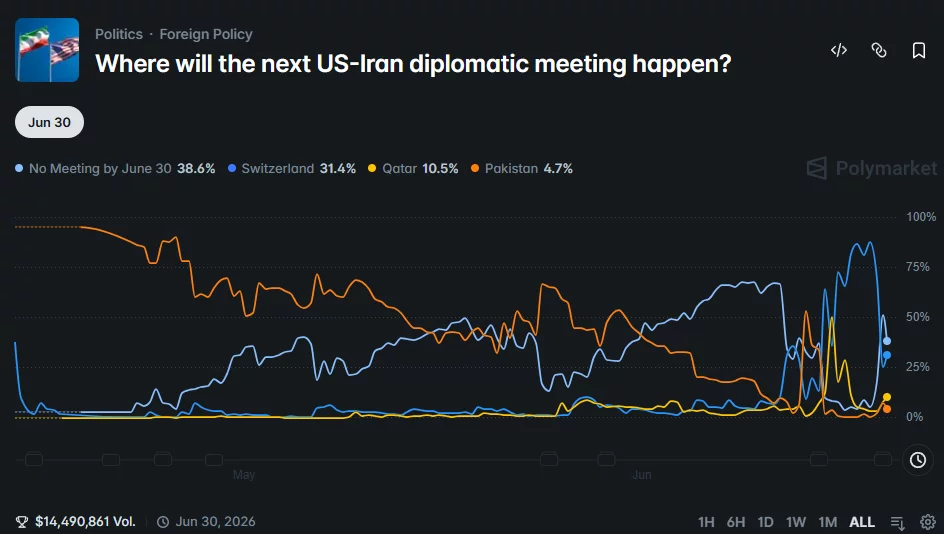
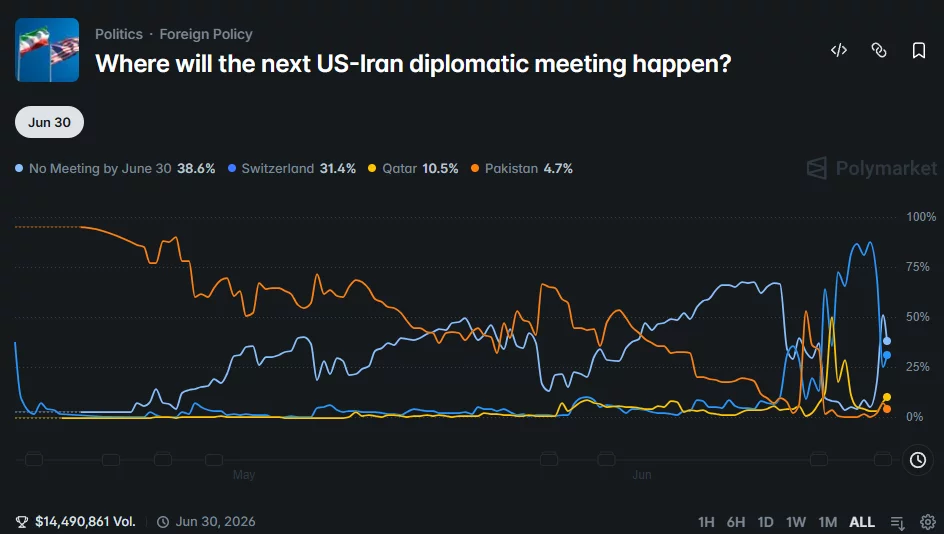
Prediction market data suggests traders still expect negotiations between the U.S. and Iran to take place before the end of the month despite the disruption.
According to Polymarket data, the single most likely outcome is that no meeting takes place before June 30, with traders assigning that scenario a 38.6% probability. A meeting in Switzerland remains the second-most likely outcome at 31.4%.
Market participants have closely tracked developments surrounding the peace process because the conflict has influenced energy prices and inflation expectations since fighting began earlier this year. Any progress toward a diplomatic resolution could reduce concerns about supply disruptions and additional economic pressure.
Technical and on-chain signals remain cautious
Even as geopolitical tensions eased, Bitcoin continued to face headwinds from U.S. monetary policy.
Following this week’s Federal Open Market Committee meeting, the Federal Reserve kept interest rates steady at 3.50%–3.75% and signaled that additional rate hikes could still be considered later this year. The central bank’s hawkish stance has continued to pressure risk assets, with Bitcoin remaining below levels seen before the recent selloff.
Commenting on Bitcoin’s market structure, analyst Ted Pillows argued that the cryptocurrency has not yet established a bottom. He suggested that another lower high could form before the market reaches a capitulation phase.
“IMO, this lower high could be around the $74,000 level, which has been a key level since Q1 2024. After that, Bitcoin will have its final dump.”
On-chain activity has also pointed to continued stress among some investors. Blockchain tracking platform Lookonchain reported that a whale identified as wallet sold 800 BTC worth about $50.24 million after holding the position for seven months.
Notably, the investor originally purchased the coins at an average price of $106,866 and realized an estimated loss of roughly $35.3 million when exiting the trade.
Disclosure: This article does not represent investment advice. The content and materials featured on this page are for educational purposes only.
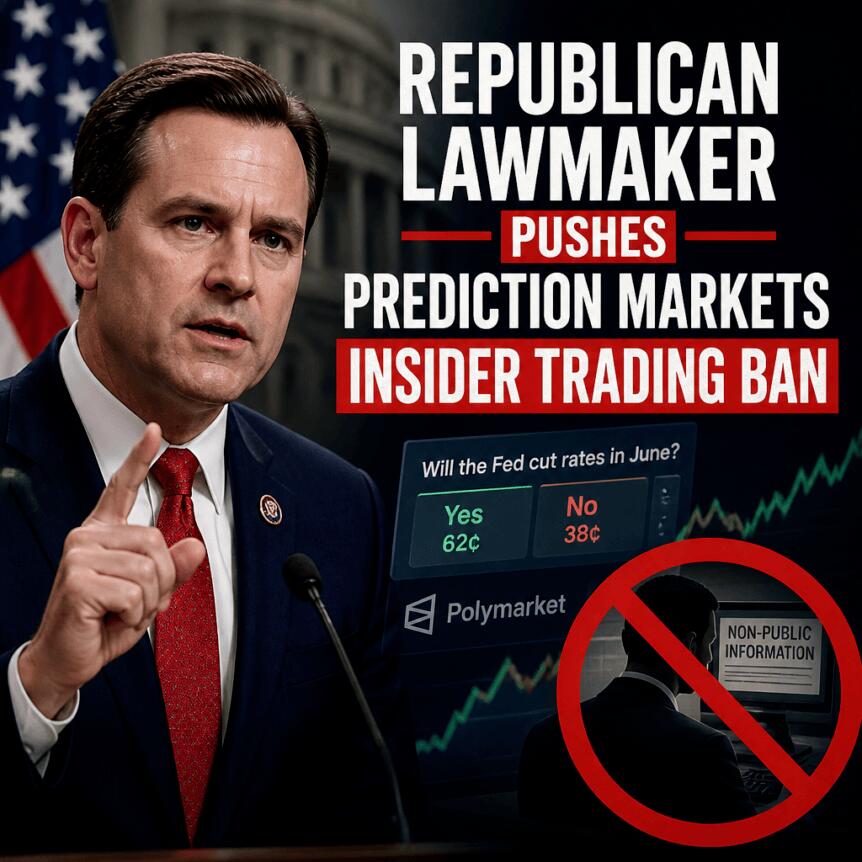
U.S. Representative Bryan Steil, who chairs the House subcommittee on digital assets, has introduced a bill aimed at curbing how elected officials participate in politically focused prediction market contracts. The proposal—called the Stop Lawmakers from Predicting Act—would restrict certain officeholders, along with their spouses and dependent children, from placing bets tied to specific government policies or political outcomes on platforms such as Kalshi and Polymarket.
Steil’s announcement, made in a Thursday notice, outlines a financial penalty structure for violations: officials who fall under the ban would have to pay either a $2,000 fee or an amount equal to 10% of the value of the prohibited bets placed on participating prediction market platforms.
Key takeaways
- Steil’s bill targets prediction market wagers tied to “government policies,” “government actions,” and broader political outcomes.
- The restriction applies to members of Congress plus their spouses and dependent children, but does not broadly prohibit all event betting.
- If enacted, the law would impose penalties ranging from a $2,000 fee to 10% of the bet value.
- The legislation does not extend to White House officials, which may keep political questions around insider influence in the spotlight.
- The bill lands amid ongoing federal-versus-state regulatory conflict over prediction markets led by the CFTC.
What the Stop Lawmakers from Predicting Act would bar
According to Steil’s notice, the bill is designed to prevent public officials from profiting from policy questions and political results. It does not attempt to shut down prediction markets entirely, and it does not frame the issue as a ban on lawmakers participating in all types of event contracts.
Instead, the proposed law focuses on the content of the wager: it would bar bets aligned with specific government policies, government actions, and “political outcomes.” In practical terms, that framing appears intended to cover politically sensitive contracts, which could include contracts reflecting election results or other outcomes closely tied to governmental decisions.
The bill also specifies timing. If passed by Congress and signed into law by the president, it would take effect 180 days after enactment.
Why lawmakers are targeting politically aligned event contracts
Steil’s proposal is the latest attempt to address concerns that lawmakers—or others with privileged access to information—could benefit from prediction markets before key developments become public. The push has gained public attention after widely reported claims surrounding political event betting.
Earlier coverage highlighted a case involving a U.S. soldier who allegedly placed more than $400,000 in bets related to the removal of Venezuela’s President Nicolás Maduro on Polymarket. Maduro was reported to have been ousted by U.S. forces in January, according to earlier reporting from Cointelegraph. The incident became a focal point for broader questions about whether market participants may exploit privileged knowledge connected to government activity.
While Steil’s bill is not described as a direct response to that single case, it reflects a similar policy concern: when contracts are tied to governmental actions or political results, the potential for unfair advantage becomes a central political issue.
Limits of the bill—and the unanswered White House question
Although the bill is aimed at members of Congress, it does not specifically place the same restrictions on White House officials. That omission has practical relevance because prediction markets regulation and compliance debates often extend beyond Capitol Hill.
Cointelegraph previously reported that lawmakers have moved to address insider trading and related concerns in prediction markets, but Steil’s legislation—based on the description in the notice—does not explicitly cover White House figures, including President Donald Trump and Vice President JD Vance. Earlier reporting also noted that Donald Trump Jr. has served as a strategic adviser to Kalshi, while another adviser role was reported in connection with Polymarket.
Additionally, Cointelegraph noted Polymarket’s sponsorship of the UFC Freedom 250 event at the White House on Sunday. While those details do not by themselves establish any wrongdoing, they help explain why critics may view the bill’s scope as incomplete—particularly if the objective is to reduce perceived conflicts of interest across the political ecosystem.
Cointelegraph reported that it reached out to Steil’s office for comment but did not receive an immediate response.
Prediction markets regulation is already a federal-state battleground
Steil’s bill enters a landscape where federal regulators have been asserting strong authority over prediction market activity. Under the Trump administration, the Commodity Futures Trading Commission (CFTC) and its chair, Michael Selig, have maintained that the agency has “exclusive jurisdiction” over regulation and enforcement related to prediction markets.
According to Cointelegraph, the CFTC has already filed multiple lawsuits against state-level authorities that attempted to restrict or ban prediction market platforms. The agency’s legal position, as described in earlier coverage, is that event contracts can be treated as “swaps” under the Commodity Exchange Act rather than as traditional bets subject to different regulatory frameworks.
Cointelegraph also reported that legal disputes over prediction markets could ultimately reach the Supreme Court, referencing the potential for continued appeals related to Kalshi. That federal litigation matters to investors and platform operators because it can determine whether prediction markets can expand nationally without being met by a patchwork of conflicting state rules.
In that context, Steil’s bill may function as a separate track—targeting conflicts of interest involving federal officeholders—while the broader question of regulatory classification and jurisdiction remains tied to ongoing court fights.
For market participants, the key next step is to watch whether the Stop Lawmakers from Predicting Act gains traction in Congress and how its political scope is debated—especially given the law’s apparent focus on members of Congress rather than the broader executive branch. Meanwhile, developments in the CFTC’s court strategy could still reshape the operational rules for prediction markets regardless of any new federal conflict-of-interest legislation.
Crypto World
Republican Lawmaker Proposes Prediction Markets Insider Trading Ban, Not Including White House Officials
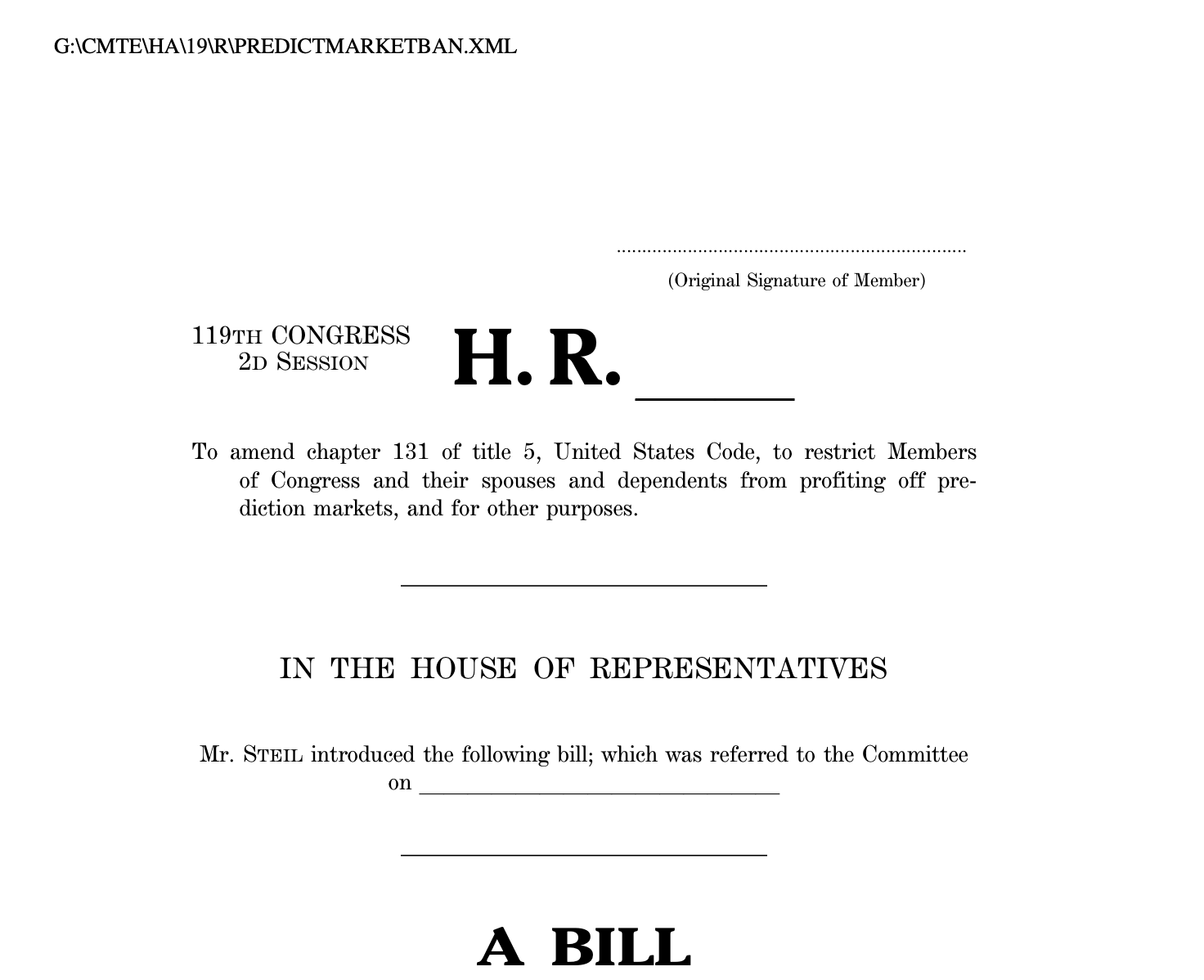
Wisconsin Representative Bryan Steil, who chairs the House subcommittee on digital assets, introduced a law to prevent certain public officials from “wagering on public policy issues and political outcomes,” notably without mentioning lawmakers in the White House.
In a Thursday notice, Steil said he had introduced the Stop Lawmakers from Predicting Act, which could bar “members of Congress, their spouses, and dependent children” from using policy-aligned event contracts on prediction markets platforms like Kalshi and Polymarket. The bill proposed that elected officials in violation pay a $2,000 fee or 10% of the value of the prohibited bets on the platforms.
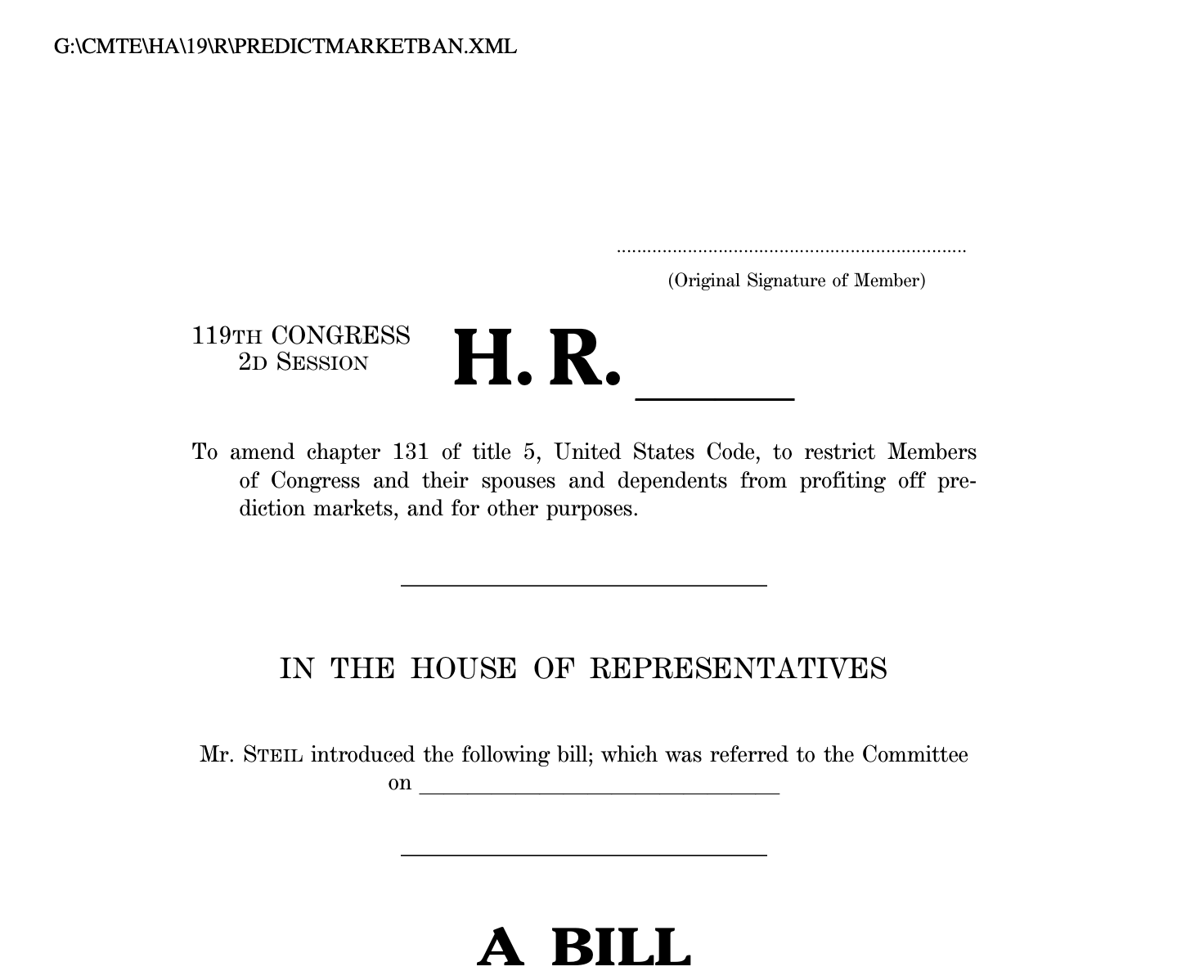
Source: Committee on House Administration
The proposed law did not specifically bar US lawmakers from using prediction markets platforms or making bets on sporting events, but prohibited wagers on specific government policies, government actions and “political outcomes,” presumably including election results. If passed by Congress and signed into law by the president, the law could take effect in 180 days after enactment.
Steil’s bill was the latest attempt by members of Congress to address lawmakers potentially using insider information to profit on event contracts. The issue drew attention from many in the public after an incident involving a soldier who allegedly made more than $400,000 betting on the removal of Venezuela President Nicolás Maduro, who was ousted by US forces in January.
Related: Polymarket weighs KYC requirements amid global crackdown on prediction markets
Although the proposed law follows attempts from other lawmakers to crack down on insider trading on prediction markets, Steil’s legislation did not extend to White House officials, including President Donald Trump and Vice President JD Vance. Trump’s son, Donald Trump Jr., is a strategic adviser to Kalshi and an adviser to Polymarket, which was also a sponsor of the UFC Freedom 250 event at the White House on Sunday.
Cointelegraph reached out to Steil’s office for comment but did not receive an immediate response.
Federal regulator still fighting for control of prediction markets
Under Trump, the Commodity Futures Trading Commission (CFTC) and its chair Michael Selig have claimed that the federal agency has “exclusive jurisdiction” in the regulation and enforcement around prediction markets. The CFTC has already filed multiple lawsuits against state-level authorities restricting or banning the platforms, claiming that under the Commodity Exchange Act, event contracts can be regulated as “swaps” and not bets.
Some experts believe that the legal fight could be headed to the Supreme Court next.
Magazine: The end of anon? AI could unmask crypto’s hidden identities

Ethereum faced renewed pressure after a major transaction involving BitMEX co-founder Arthur Hayes entered the market. Hayes sold 6,000 ETH at a loss, while Ethereum continued trading near the $1,700 level. At the same time, several large holders increased their exposure to the asset, creating mixed signals across the market.
Arthur Hayes Exits Ethereum Position at a Loss
Arthur Hayes completed a large Ethereum sale after accumulating the asset over recent days. Blockchain data showed that he purchased nearly 5,900 ETH at an average price of $1,793. However, he later sold 6,000 ETH at around $1,690 per coin.
The transaction carried an estimated value of $10.14 million. As a result, Hayes recorded a loss of roughly $606,000 on the position. The move attracted attention because he typically executes trades that target profitable exits.
Market participants linked the sale to the ongoing weakness in Ethereum’s price action. Selling activity increased across the broader crypto sector, and several major digital assets moved lower. Consequently, Ethereum struggled to maintain support near the $1,700 level.
Whales Continue Accumulating Ethereum
Despite Hayes’ sale, other large holders continued purchasing Ethereum. Recent on-chain data showed strong accumulation from several whale wallets. These purchases occurred while Ethereum traded near recent lows.
K3 Capital acquired 10,000 ETH from Binance in a transaction worth approximately $16.92 million. The purchase represented one of the largest single acquisitions recorded during the latest trading session. Furthermore, the transaction suggested continued institutional-level interest in Ethereum.
Another wallet linked to Chun Wang acquired 7,650 ETH valued at about $12.93 million. The purchase added to a series of recent accumulation activities by large holders. Therefore, whale activity continued to provide a contrasting signal against recent selling pressure.
Ethereum Faces Key Price Levels Amid Market Weakness
Ethereum remained under pressure throughout the latest trading session. The asset touched a low near $1,670 before recovering slightly toward $1,700. However, sellers maintained control of short-term market direction.
Analysts identified several important price levels for Ethereum. Some market observers highlighted the possibility of a move toward $1,900 if buying momentum improves. Meanwhile, weaker conditions could expose the asset to additional downside near the $1,500 support zone.
Recent actions from Hayes added another layer of discussion around market sentiment. Earlier this month, he also reduced exposure to Worldcoin before the highly anticipated SpaceX IPO. In addition, he exited positions in Hyperliquid’s HYPE token and NEAR Protocol assets.
Ethereum remains the second-largest cryptocurrency by market capitalisation. The network supports decentralised finance applications, tokenised assets, and smart contract activity across the digital asset sector. Because of its role within the industry, major transactions involving prominent traders often attract significant attention.
Current market conditions continue to reflect competing forces. On one side, high-profile sales have increased discussions about short-term weakness. On the other side, sustained whale accumulation signals that some large holders still view current price levels as attractive entry points.
The coming sessions may provide greater clarity regarding Ethereum’s next direction. Until then, market participants will likely focus on support levels, whale activity, and broader crypto market performance. These factors could influence whether Ethereum stabilises above current levels or extends its recent decline.


Amazon has withdrawn from distributing the Sam Altman biopic “Artificial” as OpenAI moves closer to a potential public listing.
Summary
- Amazon has withdrawn from distributing Artificial, a biopic focused on OpenAI CEO Sam Altman.
- The move comes as OpenAI advances IPO preparations through a confidential filing with U.S. regulators.
- OpenAI continues expanding its enterprise business, including a major ChatGPT rollout across BBVA’s workforce.
According to a report from Puck, Amazon has stepped away from the high-profile film project despite continuing discussions with the filmmakers about securing a new distribution partner.
The report said the decision comes as Amazon deepens its business relationship with OpenAI, including a multi-billion-dollar investment commitment tied to future milestones.
The movie centers on OpenAI chief executive Sam Altman and also features Tesla and xAI founder Elon Musk. Puck reported that the film does not present either technology executive in an entirely favorable light, a factor that some industry observers believe may have influenced Amazon’s decision.
While the company reportedly expressed confidence in the director’s creative abilities, it has chosen not to move forward as the film’s distributor.
Amazon’s exit has drawn attention because it follows a major cloud computing agreement signed with OpenAI last year. Although the company has not publicly linked the decision to its partnership with the artificial intelligence firm, the timing has fueled discussion across both Hollywood and the technology industry.
OpenAI prepares for a possible stock market debut
Attention around the film arrives as OpenAI continues laying the groundwork for a potential initial public offering.
According to earlier reports, the company recently submitted a confidential draft registration statement to U.S. regulators, allowing it to prepare for a public listing without immediately committing to a launch date.
Reports citing internal discussions said Altman told employees that OpenAI could go public within the next year, though he stressed that the timeline remains flexible and could change depending on market conditions and company priorities.
During those discussions, Altman reportedly described the confidential filing as a strategic step that preserves optionality. By filing early, the company can move quickly if conditions become favorable or delay a listing if remaining private offers more benefits.
Investor interest in OpenAI has increased as artificial intelligence companies attract larger capital inflows and command higher valuations in public markets. The company has remained at the center of that trend through new partnerships, product expansion, and growing enterprise adoption.
Enterprise expansion strengthens OpenAI’s position
Recent commercial agreements have added to the momentum surrounding OpenAI’s business.
As reported by crypto.news earlier this month, OpenAI signed a multi-year agreement with BBVA that will expand ChatGPT Enterprise access from 11,000 employees to the bank’s entire workforce of 120,000 people.
According to OpenAI, the deployment will extend across BBVA’s operations in 25 countries and support AI-based tools for customer service, risk analysis, software development, and internal operations.
OpenAI said the rollout ranks among the largest generative AI deployments in the financial services sector. The company also stated that BBVA will work directly with its product, research, and technology teams as AI tools are integrated into customer-facing and internal systems.
Against that backdrop, Amazon’s decision to leave the Artificial project has landed at a moment when scrutiny of OpenAI, its leadership, and its future as a public company is intensifying. With IPO expectations building and new enterprise deals expanding the company’s reach, interest in Sam Altman and the organization he leads continues to grow well beyond the technology sector.

These 10 YouTube Niches Will Make You MORE MONEY in 2026

Bedford train crash LIVE: Multiple passengers injured in horror two train smash

Where to Watch Every Australia Match Free on SBS


![Young Thug - Money On Money (feat. Future) [Official Video]](https://wordupnews.com/wp-content/uploads/2026/04/1776012320_maxresdefault-80x80.jpg)
-

 Business5 days ago
No Jackpot Winner as $257 Million Prize Rolls Over to $269 Million Monday Draw
-
 Crypto World5 days ago
Zimbabwe Requires Crypto Businesses to Register Annually Under New FIU Regulations
-

 Crypto World7 days ago
Bitget enters Argentina’s regulated crypto market through PSAV registration
-

 Tech7 days ago
NanoClaw integrates JFrog registries to secure AI agent downloads
-
 Entertainment5 days ago
Matt Damon’s Viral Sci-Fi Thriller Has Taken Over HBO Max
-

 Business5 days ago
Anthropic staff to meet White House officials next week, Axios reports
-

 Tech5 days ago
As AI companies race to go public, who else is along for the ride?
-
 Crypto World5 days ago
Bitcoin could crash to $48,000, if this historical pattern is triggered
-

 Politics5 days ago
“Israel’s” ban on ICRC visits ruled illegal, but Knesset moves to stop them permanently
-
 NewsBeat5 days ago
Warning of disruption as Cardiff Crossrail works to start
-

 News Videos5 days ago
Financial Accounting | Last Day Revision Strategy and Booster | CMA Inter – June 2026
-
 NewsBeat5 days ago
Tributes to former deputy head teacher at Cambridge school among death and funeral notices
-
 NewsBeat5 days ago
what doctors are seeing in ebike crashes
-

 Entertainment6 days ago
Deion Sanders Shares Powerful Post After Viral Advice To Deiondra
-
 Entertainment5 days ago
Kate Middleton Glare Goes Viral After Kids Booed At Royal Event
-

 Crypto World5 days ago
XRP ETFs Outperform As Bitcoin And Ethereum Funds Extend Outflow Trend
-
 Crypto World5 days ago
Market Preview: SpaceX (SPCX) IPO Record, Federal Reserve Meeting, and Iran Nuclear Agreement
-

 Business5 days ago
Invesco Quality Income Fund Q1 2026 Commentary
-

 Tech5 days ago
Over 400 Arch Linux packages compromised to push rootkit, infostealer
-
 Entertainment7 days ago
44 Years Later, This Is the Greatest Star Trek Quote in Sci-Fi History
You must be logged in to post a comment Login