

Crypto World
What is CASHCAT? Robinhood Chain’s memecoin



CASHCAT is a token named after a company name that was thrown away sixteen years ago. It reached a $156 million market cap, briefly outweighed every real asset on Robinhood’s blockchain, and its own website calls it fan fiction with a ticker.
Summary
- CASHCAT is a community memecoin on Robinhood Chain with a fixed supply of one billion tokens. It has no affiliation with Robinhood Markets, and its own site says so.
- The name comes from real history: before Robinhood was Robinhood, Vlad Tenev and Baiju Bhatt called their company CashCat. A New Yorker profile preserved the detail and a token resurrected it.
- It surged more than 2,100% in a week to a market cap near $156 million, at one point worth roughly twelve times every tokenized real-world asset on the chain combined.
- CEO Vlad Tenev dismissed utility-free assets on July 2, then posted six days later that the chain works great for memes too, and followed the token’s account.
- The token fell more than 33% in 24 hours after Noxa, the launchpad driving the boom, stopped accepting launches on July 11 and went dark two days later.
In 2010, two Stanford graduates building a trading company had a name for it. The name was CashCat. They discarded it, called the company Robinhood instead, and the detail survived only in a New Yorker profile and in the memory of people who read startup lore for fun. Sixteen years later, Robinhood launched a blockchain designed to settle tokenized stocks for institutions, and within days the busiest thing on it was a token named after the name they threw away. CASHCAT reached a market capitalization near $156 million, out-massed every real asset the chain was built for, and made a handful of anonymous wallets millionaires. Its website describes it as fan fiction with a ticker. That is not a criticism. It is the project’s own self-assessment, and it is more honest than most.
The basics
CASHCAT is a memecoin native to Robinhood Chain, the Ethereum layer 2 that Robinhood launched on July 1, 2026. For readers new to the network, crypto.news has also explained the chain it launched on.
Its supply is fixed at one billion tokens, with no further issuance. Its contract address is 0x020bfC650A365f8BB26819deAAbF3E21291018b4, and verifying that string against a trusted source before any transaction is the single most useful thing in this article. It does not have its own blockchain or application. It is a fungible token deployed on someone else’s chain, which is what almost every memecoin is.
It has no product, no roadmap in any meaningful sense, and no utility. The project does not pretend otherwise. Asked what the utility is, the site answers that the utility is cat.
Most importantly, and against what a large number of buyers appear to believe: it is not a Robinhood product. It is not owned, endorsed, backed, listed, or affiliated with Robinhood Markets in any way, and the token’s own website disclaims any connection to the company or to Tenev personally.
Where the name comes from
The connection is entirely historical and it is worth getting right, because the ambiguity is the asset.
Before the company became Robinhood, Tenev and co-founder Baiju Bhatt called their venture CashCat. The detail appears in a New Yorker profile of the company and had circulated among people who follow startup history for years. When Robinhood Chain launched, someone recognized that a discarded corporate name attached to a live corporate blockchain was a nearly perfect memecoin: instantly legible to anyone who knew the story, plausible to anyone who did not, and impossible for the company to claim without endorsing it.
That is the entire link. A name the founders rejected in 2010, revived as a token in 2026 by people with no relationship to them. There is no corporate partnership, no licensing arrangement, and no shared ownership. What exists is a shared piece of trivia, and the token converted that trivia into a market capitalization.
There is a small extra layer that fueled it: Tenev himself had tweeted about CashCat back in April 2021, which meant the lore was not merely documented but personally acknowledged by the CEO years before the token existed. None of that constitutes affiliation. All of it makes affiliation feel more plausible than it is.
What happened
The timeline is short and steep.
Robinhood Chain went live on July 1. CASHCAT deployed shortly after. Within roughly 24 hours it had rallied more than 1,700%, and over its first week it climbed more than 2,100%, reaching an all-time high above $0.17 and a market capitalization near $156 million, with some measurements putting the peak higher.
At its peak day on July 8, the token generated roughly $98 million in 24-hour volume, which was about 17% of the entire chain’s decentralized exchange volume. Set that against what the chain was built for: tokenized real-world assets on Robinhood Chain totalled roughly $12.8 million. At its high, one joke token was worth approximately twelve times every real asset on the network combined.
It did not stay alone. Cash Dog in Hood, Little John, Hoodrat, and Arrow followed within days, none of which existed before July 1. Noxa, the launchpad feeding the wave, was averaging roughly 18,600 new token launches per day. On July 8, Pump.fun added Robinhood Chain support, opening the chain to Solana’s memecoin crowd without bridging. For more context, crypto.news has covered the full story of the takeover.
Then it turned. On July 11, at the precise moment CASHCAT was hitting peak trading volume, Noxa stopped accepting new token launches. Two days later it went dark, citing concerns about low-quality tokens flooding the platform, having generated an estimated $12 million in cumulative fees. CASHCAT fell more than 33% in 24 hours. One prominent trader who claims to have ridden the token from a $10,000 market cap to $230 million dismissed the selloff as noise.
The Tenev problem
The CEO’s involvement is the reason this token is confusing rather than merely amusing, and the sequence matters.
On July 2, the day after the chain went live, Tenev told CNBC that the future of crypto is in real-world assets, drawing a line between productive tokenized assets and speculative tokens without underlying utility. His framing was that an asset not tied to an underlying utility is not a productive asset. It was a clean statement of the thesis the entire chain was built to prove, and it was, in effect, a dismissal of exactly the category CASHCAT belongs to.
Six days later, as CASHCAT climbed, he posted on X that while the company is building Robinhood Chain to be the best chain for real-world assets, it works great for memes too. He then followed the token’s account.
Both readings of that reversal are defensible. The charitable one: a permissionless chain cannot control what deploys on it, refusing to acknowledge the most visible thing on your own network would look ridiculous, and a light-hearted post is not an endorsement. Robinhood’s crypto chief stayed rigorously on message throughout, saying the company remains focused on building a secure and scalable foundation for real-world assets.
The uncharitable one: the follow and the post told the market what the company actually values, which is volume, and a retail buyer who sees the CEO engaging with a token named after his own company is going to draw a conclusion the disclaimer will not undo. The distinction between acknowledging and endorsing is clear to a lawyer and invisible to someone who just downloaded a wallet.
Who made money, and from whom
This is the part that gets celebrated and should be read carefully, because every one of these numbers has a counterparty.
One early buyer spent $838 and received 15.04 million tokens. They sold roughly 13.5 million for about $917,600 and held a remainder worth around $133,700, producing a return in the region of 1,250 times. A second wallet turned $85 into 17.4 million tokens and realized about $687,700 while sitting on roughly $1.2 million more on paper. The five most profitable wallets banked close to $3.7 million between them.
Now the other side. That $3.7 million came from the opposite end of roughly 12,300 sell orders. Every dollar of realized profit in a memecoin is a dollar someone else paid at a higher price, because the token produces no revenue and holds no assets. There is no external cash flow funding those returns. The gains are transfers.
The liquidity structure makes it worse than the market cap suggests. CASHCAT’s trading pool has been worth far less than the token’s headline capitalization, which means a $156 million number sits on a pool that cannot absorb anything close to $156 million of selling. Large trades swing price hard in both directions. A market capitalization is a multiplication, not a promise that the money is there.
And the standard verification does not exist. Security audits of the CASHCAT contract were not possible because Robinhood Chain is too new for the tooling to have caught up. That is a chain-wide condition, not a CASHCAT-specific failure, but it removes the check that would ordinarily flag a malicious contract before a nine-figure market cap forms on top of it.
How a memecoin actually prices
Because CASHCAT is the first token most Robinhood users will look at closely, it is worth walking exactly how a number like $156 million comes to exist, since almost nobody who quotes it understands what it measures.
Market capitalization is a multiplication. Take the last traded price, multiply by circulating supply, print the result. CASHCAT has a fixed supply of one billion tokens, so at a price above $0.15 the arithmetic produces something in the region of $156 million. That is the whole calculation. It is not a valuation, not an appraisal, and not a statement that $156 million exists anywhere.
What makes the number misleading is where the price comes from. The last trade might have been for a few hundred dollars. In an automated market maker, price is set by the ratio of assets in a liquidity pool, and the pool behind CASHCAT has been worth far less than the token’s headline capitalization. So a relatively small purchase moves the ratio, moves the price, and instantly revalues all one billion tokens at the new level. That is why memecoins can add nine figures of notional value in a day: a thin pool is a lever, and modest buying at the margin repriced the entire supply.
The lever works identically in reverse, which is what July 13 showed. When Noxa exited and sentiment turned, sellers hit the same shallow pool and the price fell more than 33% in a day. Nothing about the token changed. Supply was still one billion. The contract was unaltered. The only thing that moved was the ratio in the pool, and the market cap followed it down mechanically.
This is why the comparison that ran through every headline, that CASHCAT was worth twelve times every real-world asset on the chain, is both true and slippery. It is true as arithmetic: $156 million against $12.8 million. It is slippery because the two numbers are not the same kind of thing. The tokenized asset figure represents real instruments with real backing that could be redeemed. The memecoin figure represents a price multiplied by a supply, sitting on a pool that could not absorb a fraction of it. One number is a balance. The other is an echo.
The practical implication for anyone holding: your position is worth the market cap right up until you try to sell, at which point it is worth whatever the pool gives you. In a token where five wallets extracted roughly $3.7 million against 12,300 sell orders, the people who found out first were the ones who tried. That is why thin liquidity moves price so hard.
What this token actually shows
Set the price action aside and CASHCAT is the cleanest available case study in how new chains actually bootstrap, which is why it is worth understanding even if you would never touch it.
The optimistic reading, which serious traders make: memecoins are the ignition sequence. A new chain needs transactions, wallets, and liquidity to look alive, and speculation delivers all three faster than tokenized Treasuries do. Solana grew through a memecoin cycle before producing serious infrastructure, and one veteran trader explicitly compared Robinhood Chain’s early ecosystem to Solana’s. The automated market makers, oracles, and routing built to service speculation are the same rails that tokenized equities will eventually need. In that reading CASHCAT is not a distraction from the strategy; it is the first stage of it. That in the category CASHCAT belongs to.
The pessimistic reading, which the timeline supports: memecoin traders are mercenary by construction, loyal to activity rather than to any chain, and the moment a flashier venue offers quicker returns the volume leaves and the $12.8 million of tokenized assets is what remains. The launchpad that produced the entire boom extracted $12 million in fees and exited within eleven days of the chain going live. That is not the profile of a bootstrapping sequence. It is the profile of an extraction cycle, and the 33% drop when the launchpad left is the evidence.
Which reading is right gets settled by a single number, and it is not CASHCAT’s price. It is whether tokenized real-world assets on Robinhood Chain grow well beyond roughly $13 million while the speculation fades. Robinhood’s second-quarter earnings on July 29 are the first real look. Until then, CASHCAT is a token named after a discarded company name, worth more than everything the chain was built to carry, running on an unaudited contract, on a network whose CEO spent one week explaining why assets like it do not last and the next week noting they work great anyway.
What to watch
If you are tracking this token instead of trading it, three things carry information.
Whether the ecosystem keeps spawning. STONKCAT opened a $SCAT presale on July 16, and a MemeToro presale is running alongside it, both borrowing Robinhood Chain’s branding and pitching future products. New entrants arriving weeks after the launchpad that started the wave exited tells you the branding gap is now a repeatable business, which is bearish for CASHCAT specifically: every new token competes for the same attention that is the only thing holding its price up. It also shows how launchpads mint tokens on demand.
Whether the chain’s real assets grow. Tokenized real-world assets on Robinhood Chain sit around $12.8 million against roughly $312 million in total value locked. That figure, not CASHCAT’s price, decides whether the memecoin wave was an ignition sequence or an extraction cycle. Robinhood’s second-quarter earnings on July 29 are the first look at Stock Token adoption from the company’s own books.
Whether liquidity deepens or thins. The pool behind CASHCAT has been worth far less than the token’s headline capitalization, which is the mechanism behind both the rise and the 33% single-day fall. A token whose pool deepens is a token that can absorb selling. A token whose pool thins as attention rotates is a token whose market cap becomes progressively more theoretical. Also relevant: Robinhood Chain’s 90-day gas subsidy has been making trading artificially cheap, and its expiry is a real test.
The broader point for anyone reading this as a lesson instead of a trade: CASHCAT did nothing unusual. It is a well-executed example of an entirely standard pattern, distinguished only by the quality of its joke and the fact that a public company’s CEO engaged with it. The pattern will repeat on the next chain, with a different name, and the mechanics will be identical. What makes this instance worth remembering is the setting. Most memecoins erupt on chains built by anonymous developers for exactly this kind of activity, where nobody claims to be surprised. CASHCAT erupted on a network built by a listed American brokerage, marketed to institutions, staffed with compliance officers, and launched with a keynote about the future of finance. It took six days for the joke to become the chain’s largest asset by market capitalization, and the company could do nothing about it, because permissionless means permissionless. That is the lesson worth carrying: a corporate chain cannot choose its users any more than a public square can. Robinhood built the venue and the crowd decided what it was for.
Frequently asked questions
What is CASHCAT?
A community memecoin on Robinhood Chain, the Ethereum layer 2 Robinhood launched on July 1, 2026. It has a fixed supply of one billion tokens and a contract address of 0x020bfC650A365f8BB26819deAAbF3E21291018b4. It has no product, no utility, and no affiliation with Robinhood. Its own website describes the project as fan fiction with a ticker and says the utility is cat.
Is CASHCAT affiliated with Robinhood?
No. It is not owned, endorsed, backed, or listed by Robinhood Markets, and the token’s own website disclaims any connection to the company or to Vlad Tenev. The name references CashCat, the working name Tenev and co-founder Baiju Bhatt used before the company became Robinhood, a detail preserved in a New Yorker profile. That is trivia, not a relationship.
Why did CASHCAT rise so fast?
A combination of legible lore and a new chain with nothing else on it. The name connected instantly to Robinhood’s founding story, Robinhood Chain had just launched with cheap fees and easy token creation, and attention concentrated on the first breakout token. It rallied more than 1,700% in 24 hours and more than 2,100% over its first week, reaching a market cap near $156 million.
Did Vlad Tenev endorse CASHCAT?
Not formally. On July 2 he told CNBC that assets not tied to an underlying utility are not productive assets. On July 8, as the token climbed, he posted that while the company is building the chain for real-world assets, it works great for memes too, and he followed the token’s account. That is acknowledgement rather than endorsement, but the distinction is clearer to a lawyer than to a retail buyer.
How much was CASHCAT worth compared to the chain’s real assets?
At its peak, roughly twelve times more. Tokenized real-world assets on Robinhood Chain total around $12.8 million, while CASHCAT reached a market capitalization near $156 million. On its biggest day the token generated approximately $98 million in 24-hour volume, about 17% of the entire chain’s decentralized exchange volume.
Why did CASHCAT crash?
Noxa, the launchpad driving the chain’s memecoin wave, stopped accepting new launches on July 11 as CASHCAT hit peak volume, then went dark two days later, citing low-quality tokens flooding the platform. It had generated an estimated $12 million in cumulative fees. CASHCAT fell more than 33% in 24 hours following the exit.
Who made money on CASHCAT?
A small number of early wallets. One turned $838 into roughly $1.05 million across realized and unrealized value, about 1,250 times. Another turned $85 into roughly $687,700 realized plus $1.2 million on paper. The five most profitable wallets took close to $3.7 million between them. That money came from the other side of roughly 12,300 sell orders, since a memecoin produces no revenue and gains are transfers between participants.
What are the risks?
Considerable. The trading pool is worth far less than the headline market capitalization, so large trades swing price sharply and the stated value cannot be exited at that value. Security audits of the contract were not possible because Robinhood Chain is too new for verification tooling. The token has no revenue, no assets, and no utility, so price depends entirely on attention, which has already proven it can leave in a day.
Disclaimer: This article is for information and educational purposes only and does not constitute financial or investment advice. Memecoins are extremely speculative, frequently trade on thin liquidity, and most participants lose money. Contract addresses and project claims should be verified independently before any transaction. Nothing here is a recommendation to buy any token. Always do your own research. Figures are accurate as of July 17, 2026 and move rapidly.


Europe’s MiCA licensing pipeline added 14 more crypto-asset service providers to ESMA’s interim Markets in Crypto-Assets (MiCA) register in the second post-deadline update, bringing momentum down from the larger first wave after the transitional period ended.
According to an ESMA update published on Thursday, the total number of licensed crypto-asset service providers (CASPs) now stands at 294. The latest entries include Ripple Payments Europe (Ripple’s European payments business), Bison Bank based in Portugal, and Croatia’s state-owned Hrvatska poštanska banka (HPB).
Key takeaways
- ESMA added 14 CASPs in the latest MiCA register update, taking the licensed total to 294.
- Banking groups are prominent among new entrants, including institutions from Germany, Portugal, and Croatia.
- EMT and ART registers did not change: 21 EMT issuers remain unchanged, and ART still lists no approved issuers.
- ESMA also expanded its non-compliant list by two entities after actions by Italy’s CONSOB.
MiCA register slows after an initial surge
ESMA’s latest expansion arrives after a more aggressive update on July 3, when the regulator added 37 CASPs in its first major post-deadline roll-out following the end of MiCA’s transitional period. The difference in scale—37 entries the first time versus 14 this update—suggests a shift from the fastest initial licensing push into a steadier, slower cadence.
Still, the register’s upward trajectory remains important for firms planning market entry. For investors and market participants, the register functions as an on-the-record signal of which providers are operating under MiCA’s licensing umbrella, rather than relying only on voluntary or transitional arrangements.
Banks and payment providers extend regulated crypto services
The newest CASP entries underscore how established financial institutions continue to embed crypto services within regulated frameworks. Alongside Ripple Payments Europe and the banks already named, ESMA’s update includes German cooperative banks Volksbank Schwarzwald-Donau-Neckar and Raiffeisenbank Auerbach-Freihung.
ESMA also listed Kaiser Partner Privatbank, a Liechtenstein-based private banking group, further expanding the footprint of wealth and private banking providers offering crypto-related services under MiCA.
The latest additions build on a broader pattern already visible in ESMA’s interim register, which includes dozens of traditional finance firms—such as Spain’s BBVA and CaixaBank, Germany’s Commerzbank, France’s CACEIS Bank, and Standard Chartered Luxembourg.
EMT and ART issuance remains largely static
While CASP licensing activity continues to progress, ESMA reported no changes to two token-specific registers that track stable-value and reference-asset products.
For electronic money tokens (EMTs)—crypto-assets designed to maintain a stable value against a single official currency—ESMA’s register remains at 21 unique issuers. For asset-referenced tokens (ARTs), which are designed to track multiple assets such as currencies or commodities, the register continues to show no approved issuers.
That divergence matters because it points to uneven readiness across MiCA’s product categories. CASPs can continue onboarding under MiCA’s service rules, while token issuance—particularly ARTs—appears to be moving at a slower pace.
Non-compliant register adds two entities
Separately from the licensed CASP framework, ESMA also updated its non-compliant register by adding Reversal Investment Group and Kortex.
ESMA said the additions followed enforcement actions by Italy’s securities regulator, the Commissione Nazionale per le Società e la Borsa (CONSOB). With these additions, the non-compliant list now totals 164 entries, including crypto exchange MEXC.
For market participants, non-compliant listings are a caution flag: they indicate entities that ESMA deems to be outside MiCA’s compliance expectations. Traders and users looking for regulatory clarity typically treat the contrast between the licensed register and the non-compliant register as a practical guide for due diligence.
What to watch next
With ESMA’s CASP register continuing to climb—while EMT and especially ART approvals remain comparatively constrained—investors should watch whether token issuance accelerates in the next updates and how quickly the gap between service-provider licensing and token product approvals narrows under MiCA.
Argentine court has ordered the identification of holders behind 25 cryptocurrency wallets and frozen assets linked to the $LIBRA token investigation after authorities traced millions of dollars across multiple blockchain networks.
Summary
- An Argentine judge has ordered the identification of holders behind 25 crypto wallets and frozen assets linked to the $LIBRA investigation.
- Investigators traced nearly 498,539 USDT through multiple wallets, with several transactions passing through Binance, Bybit, OKX, and Bitfinex.
- Authorities are seeking KYC records and transaction data after tracing about $8.2 million that began moving again in May.
According to Argentine newspaper Clarín, Federal Judge Marcelo Martínez de Giorgi issued the order after reviewing a report from the Cybercrime Technical Department of the Argentine Federal Police, which reconstructed the movement of crypto assets linked to the $LIBRA case from May onward.
The order seeks account holder identities, know-your-customer records, IP addresses, transaction histories, and other information that could identify those behind the transactions.
The latest measure centers on 25 wallets believed to have handled part of the money left with the creators of the $LIBRA token following its failed launch in February 2025. The judge also instructed authorities to freeze assets associated with those wallets, although it remains unclear whether the funds are still held there or have already been transferred elsewhere.
Court documents reviewed by the publication reconstructed the activity of eight wallets identified as the “Libra Team,” which investigators linked to the token’s creation and the withdrawal of investor funds after Argentine President Javier Milei promoted the project on social media. During that period, the token’s price briefly surged before collapsing within minutes.
According to the report, token creator Hayden Davis previously said roughly $110 million remained under his control after the launch. Investigators found that four of the eight Libra Team wallets consolidated funds into a single wallet identified as “61yk.”
Investigators trace funds through exchanges
The police report stated that wallet “61yk” had remained frozen for nearly six months under an order from the U.S. District Court for the Southern District of New York, which is handling a separate case involving Davis.
After the restriction was lifted, investigators alleged the wallet redistributed funds using what the report described as a “digital smurfing” strategy, breaking larger balances into smaller transfers to make the transactions harder to follow or eventually convert into fiat currency.
Authorities traced a major movement on May 10, when 498,539 USDT was transferred through a cross-chain interoperability protocol to a wallet on the Tron network. The receiving wallet then split the funds into 17 separate transactions in what investigators described as another attempt to obscure the trail.
The Federal Police report found that at least 10 of those transactions passed through Binance, while eight wallets were linked to Bybit, two to OKX, and another two to Bitfinex. Because centralized exchanges generally require customer identity verification, investigators believe those transfers could help identify some of the individuals involved, although the report noted that some platforms may not hold KYC information for every account.
Crypto analyst Fernando Molina, who has independently tracked the movement of $LIBRA funds, previously estimated that about $8.2 million remained dormant before becoming active again in May through wallets now under judicial scrutiny.
Separate information reviewed by Clarín indicates that the remaining funds are managed through a trust established by Davis, which is intended to distribute grants to Argentine companies as part of a proposed revival of the project before the end of the year. Earlier reports said the trust had already received 71 grant applications.
Bitcoin (BTC) has been counting down to its next bottom for nearly two months, a classic onchain metric suggests.
Key points:
- BTC supply in loss passed 50% for the first time this bear market in early June.
- In previous bear markets, that event sparked a countdown to a new BTC price macro bottom.
- Separate data hints that the bull market’s “emotional premium” has now gone.
Supply in loss countdown already Bitcoin’s second-longest
In its H1 2026 Round-Up report, crypto research company K33 Research flagged more than 50% of the BTC supply now being held at a loss.
A typical bear-market feature, supply in loss has become a yardstick for progress toward macro bottoms for BTC/USD.
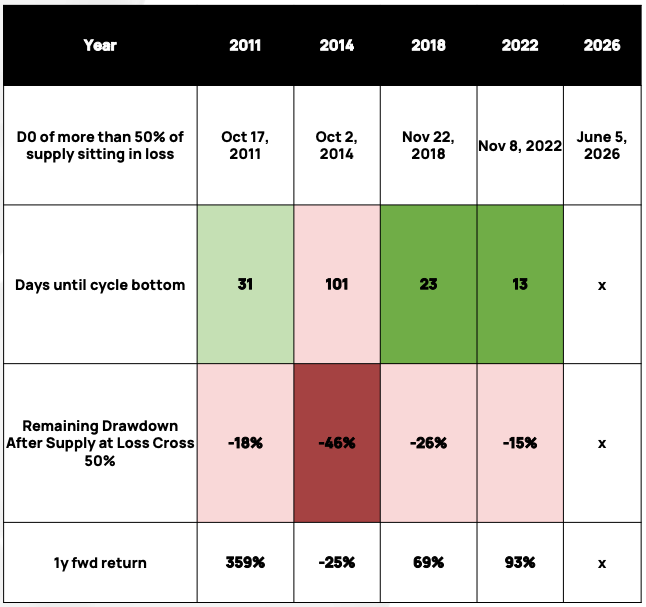
K33 data shows that once supply in loss passes the 50% mark, the bottom has come no more than 101 days later. Bear markets have provided various time frames, with the shortest bottom “window” lasting just 13 days in 2022.
The 2018 bear market required 23 days to reach its floor, while in 2014, Bitcoin continued to decline for 101 days after the 50% supply-in-loss mark was hit.
In 2026, supply in loss repeated standard bear-market behavior, crossing 50% on June 5. Since then, 42 days have elapsed, making this year’s bottom window Bitcoin’s second-longest ever.
BTC supply in loss and days until bear-market bottom (screenshot). Source: K33 Research
In accompanying commentary, K33 observed that returns over the year following the phenomenon “tend to be very solid.”
Earlier this month, Axel Adler Jr., a contributor to onchain analytics platform CryptoQuant, estimated that supply in loss was around two months away from levels that correspond to bear-market bottoms.
CryptoQuant data puts supply in loss at 46% as of July 17.
“Distribution of capital” teases silver lining
Continuing, CryptoQuant eyed what it described as “rare” readings from Bitcoin investor cost-basis models.
Related: Bitcoin $107K buyers providing ‘early signals’ of 2026 bear-market bottom: Glassnode
The realized cap variance (RCV) model, which measures the difference between realized cap and market cap, currently sits in the bottom six percent of its historical range.
“Instead of tracking price alone, it isolates the variance between realized cap and market cap relative to its own rolling history, capturing how stretched or compressed investor cost basis has become versus current valuation,” contributor Crazzyblockk explained in a QuickTake blog post on Thursday.
“When that variance compresses into deeply negative z-score territory, the emotional premium built during rallies has largely been priced out. The metric doesn’t read narrative, it reads the distribution of capital.”
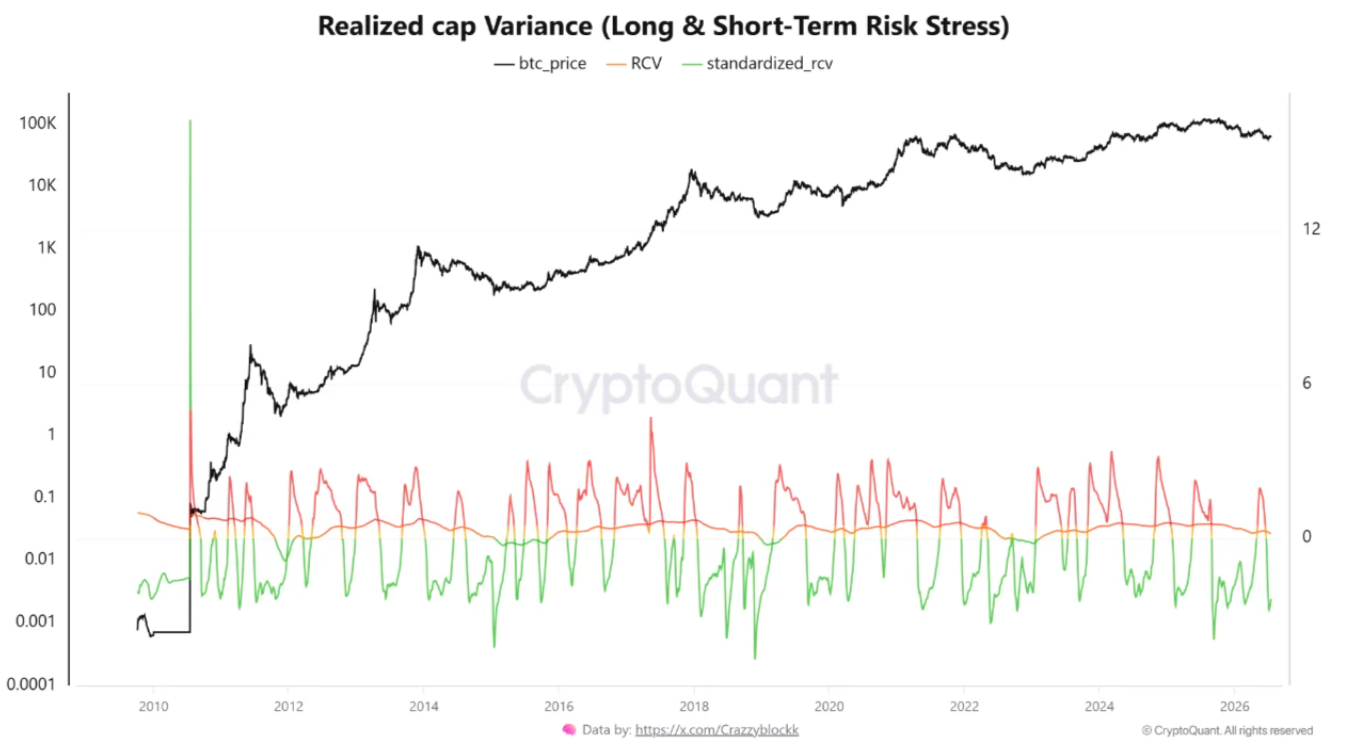
Bitcoin RCV data (screenshot). Source: CryptoQuant
At -2.35, standardized RCV’s Z-score is once again pointing to the final stages of the Bitcoin bear market.
“Every prior stretch where the model spent extended time below a -2.0 z-score, late 2018, mid-2022, early 2015, preceded forward twelve-month returns north of 75%,” the post noted.
“The most extreme reading in this dataset, -4.68 in November 2018, landed almost exactly on Bitcoin’s cycle bottom near $3,792.”

The CLARITY Act, the bill that would define whether digital assets fall under SEC or CFTC jurisdiction, has two remaining floor windows before the August recess: the weeks of July 20 and July 27.
Miss both, and Senator Lummis has warned that market structure legislation could slip to 2030 or die entirely at the end of the 119th Congress in January 2027, forcing a full restart.
That is not a political projection, it is the structural consequence of a Senate calendar that leaves roughly three weeks of productive session after September before lawmakers enter full midterm campaign mode.
One year after Washington’s Crypto Week, the scorecard is uneven. The GENIUS Act became law on July 18, 2025, establishing the first federal framework for payment stablecoins.
BREAKING:
SEN. LUMMIS SAYS THE CLARITY ACT WILL BE INTRODUCED WITHIN DAYS AFTER 10 MONTHS OF WORK
SENATE VOTE IS NOW TARGETED FOR THE WEEK OF JULY 20
BULLISH FOR CRYPTO pic.twitter.com/1BuG9FWUEs— Midas (@DeFiMidas) July 14, 2026
An anti-CBDC provision eventually passed inside the 21st Century ROAD to Housing Act, becoming law automatically on July 10, the House voted 358–32, the Senate 85–5, margins that made Trump’s refusal to sign irrelevant.
The CLARITY Act, which passed the House 294–134 on July 17, 2025, cleared the Senate Banking Committee 15–9 on May 14, 2026, and has sat on the Senate Legislative Calendar since June 1 with no floor vote scheduled.
The distinction between GENIUS and CLARITY matters here. GENIUS governed one product. CLARITY governs the entire market. It answers the classification question that determines everything downstream: whether a given digital asset falls under SEC jurisdiction as a security or CFTC jurisdiction as a commodity.
Registration, custody, listing decisions, and disclosure posture all flow from that single determination. Without a statutory answer, the question gets resolved by whichever agency sues first, or whichever party holds the White House.

Discover: The Best Token Presales
The Vote Math Is Getting Harder
Senate leadership needs 60 votes. The Republican coalition is already fractured. Senators Josh Hawley (R-Mo.) and Rand Paul (R-Ky.) were the only two Republicans to vote against the GENIUS Act; per Galaxy Digital analyst Alex Thorn, both are expected to oppose CLARITY as well.
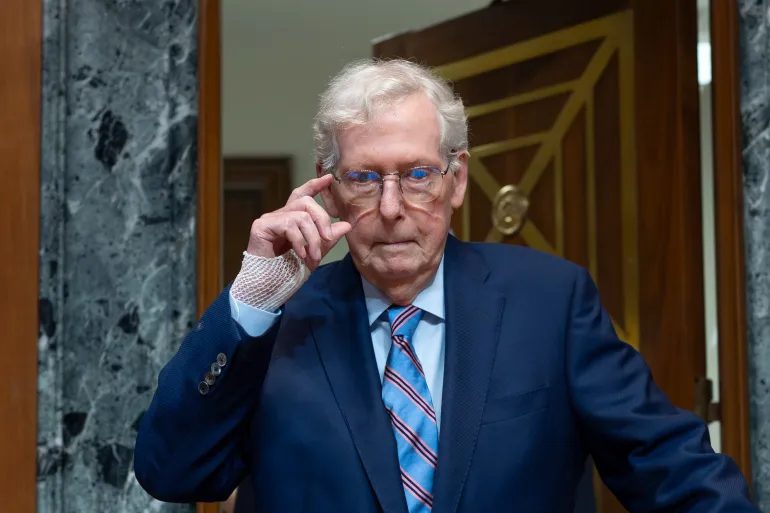
Senator McConnell has missed votes due to an ongoing medical issue, and the death of Senator Lindsey Graham at 71 further narrows an already thin Republican majority. By Thorn’s calculation, leadership may need as many as nine Democratic crossovers to reach the threshold.
Those crossovers are not secured. Senators Ruben Gallego (D-Ariz.) and Angela Alsobrooks (D-Md.) voted yes in committee but explicitly characterized those votes as conditional, not floor commitments.
Polymarket’s current passage odds in 2026 are approximately 34% and falling.
Discover: The Best Crypto to Diversify Your Portfolio
Clarity Act: Four Disputes, Zero Resolutions
The first and most visible obstacle is ethics. Senator Elizabeth Warren (D-Mass.) wrote to Majority Leader John Thune and Minority Leader Chuck Schumer on July 13, demanding guardrails preventing senior officials and members of Congress from profiting off the crypto industry.
The letter cited approximately $1.4 billion in crypto-related income disclosed in the president’s 2025 financial filing. Senator Kirsten Gillibrand (D-N.Y.) has made enforceable ethics language covering officials’ crypto holdings a prerequisite for her support. The merged draft from the Banking and Agriculture committees omits ethics provisions entirely.
A compromise floated by Senator Lummis would allow state attorneys general to sue exchanges that list tokens issued by public officials in violation of the act – but Senate Republicans are unlikely to advance any ethics language the White House actively opposes. For a detailed breakdown of this standoff, see the ethics dispute driving the CLARITY Act delay.
The second dispute centers on law enforcement. The National District Attorneys Association argued to Senate leadership that Section 604, the Blockchain Regulatory Certainty Act provision, would materially impair criminal investigations by shielding non-custodial software developers from money transmitter obligations.
Senator Ron Wyden (D-Ore.) countered that developers who never control customer funds should not be classified as money transmitters for publishing code. Senators Mark Warner (D-Va.) and Catherine Cortez Masto (D-Nev.) have tied their votes directly to law enforcement’s sign-off.
Third: banking trade groups, including the ABA and ICBA, argue the bill creates a stablecoin yield loophole allowing digital asset platforms to offer interest-equivalent rewards that circumvent the GENIUS Act’s prohibition on issuer-paid interest.
The Independent Community Bankers of America has questioned the bill’s pace entirely. Fourth, and structurally acute: the CFTC has operated with a single commissioner, and the SEC has two vacancies. Rules issued by a lone CFTC commissioner could invite legal challenge and keep jurisdictional uncertainty alive. Senator Amy Klobuchar has proposed blocking the framework from taking effect until at least four CFTC commissioners are confirmed.
Don’t Miss Out on Our $1,000 USDT Airdrop on ByBit
The post Two July Windows Left: The CLARITY Act’s Senate Fight and What Failure Means appeared first on Cryptonews.
Crypto World
Bitcoin (BTC) price falls below $63,00 as AI fatigue, Middle East tensions drag crypto, tech stocks lower
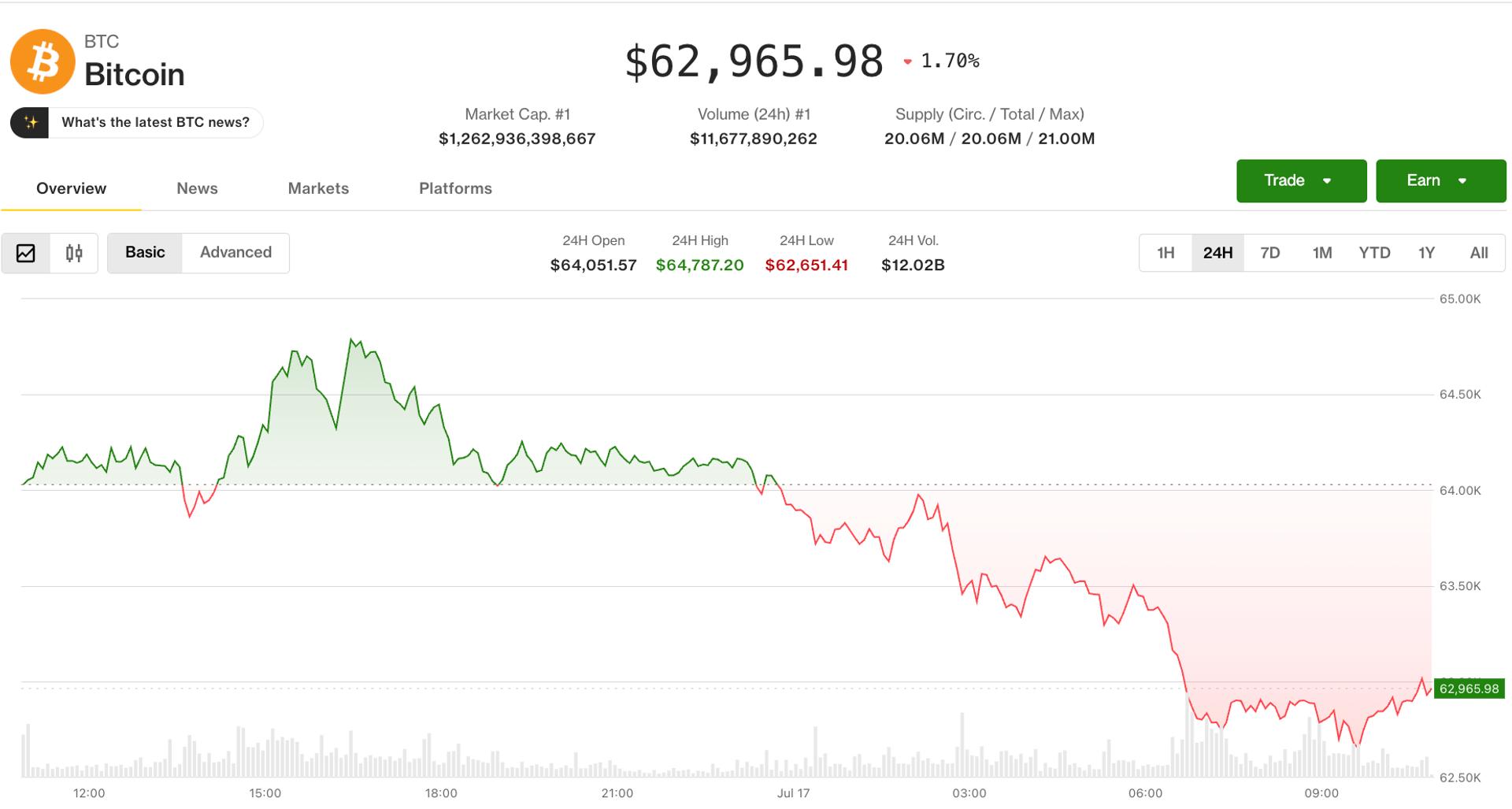
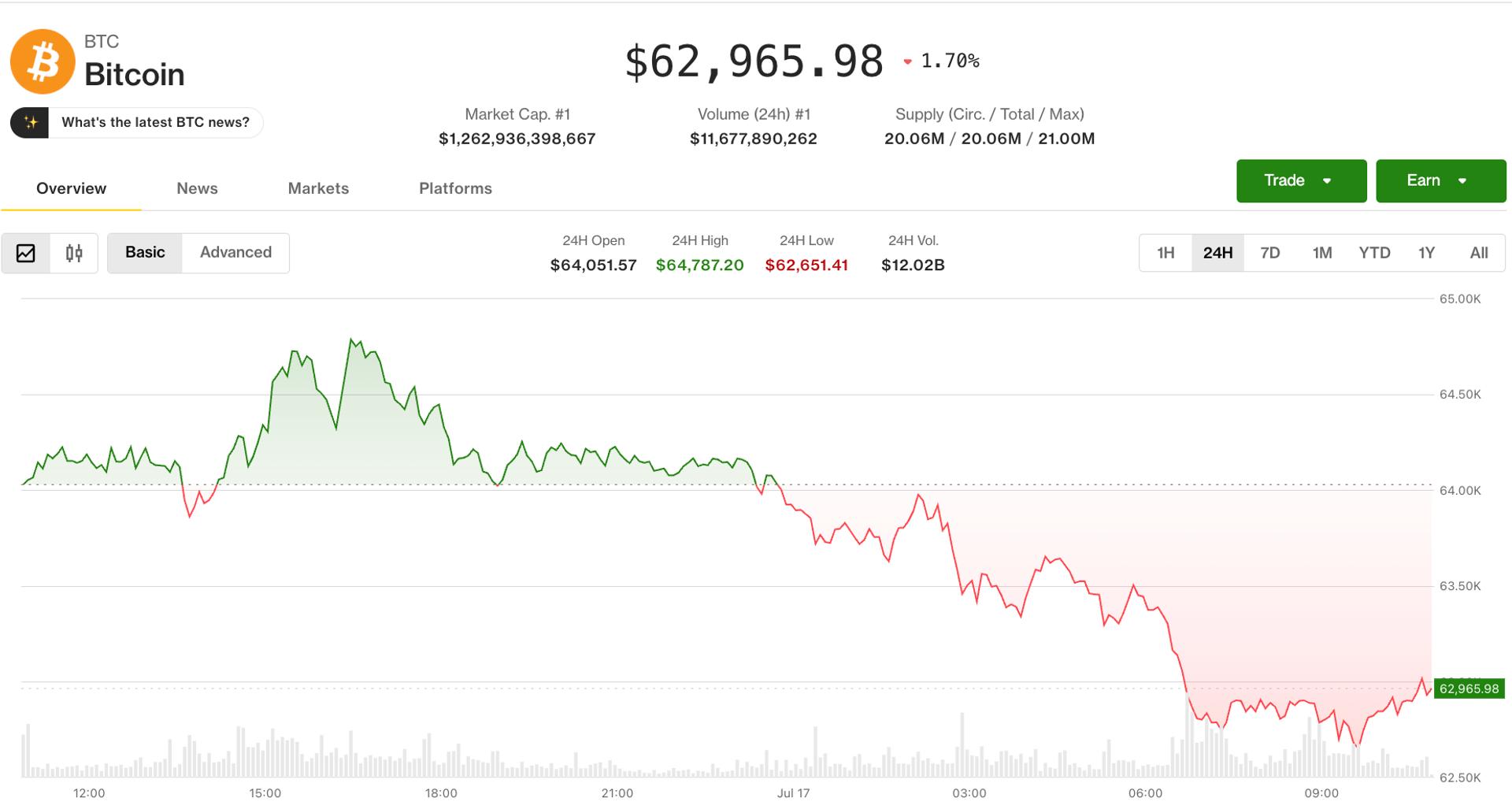
The crypto market fell Friday, with bitcoin recovering from a drop below $63,000 to trade down 1.2% since midnight UTC and ether (ETH) losing 1.74%. Total crypto market capitalization shed 1.86% to sit at $2.16 trillion.
The selloff is not isolated to crypto. Nasdaq 100 index futures dropped 1.91% and S&P 500 futures slipped 0.96%, pointing to macro forces driving the move rather than anything crypto-specific. Japan’s Nikkei 225 index dropped 4%, while South Korea’s Kospi stock exchange was closed for Constitution Day.
In a a classic risk-off rotation, the Dollar Index (DXY) rose to 100.75 while gold advanced 0.61% to climb back above $4,000.
The move to the downside can be attributed to a selloff in tech stocks across North America and Asia, as well as mounting tensions in the Middle East.
“The market is ending the week with two bruises: AI fatigue and Hormuz heat,” said Patrick Munnelly at Tickmill Group. “The semiconductor selloff has gone from profit-taking to position-clearing, dragging Asia toward its worst levels in months.”
Bitcoin fell to about $63,000 on Friday, down 1.7% over 24 hours and 2.2% on the week, as a deepening selloff in chipmakers dragged risk assets lower, per CoinDesk data. Ether held better at $1,836, still up 2.4% over seven days, while Hyperliquid led the losses at 8% on the day and 12% on the week.
Nasdaq 100 futures dropped 1.8% and S&P 500 contracts fell 0.9% as a semiconductor ETF slid 3% in premarket trading. Taiwanese stocks fell into a technical correction and Asia’s main benchmark hit a two-month low. Europe held up better on lower tech exposure.
The question driving it is the one that has hung over the sector all month. Chipmakers are under scrutiny over whether the hundreds of billions that AI hyperscalers are spending will produce the returns to justify their valuations, and TSMC’s results this week did not settle it.
Crypto is following the same current it has all quarter. This week’s soft inflation print gave bitcoin a lift toward $65,000, but that was a macro trade, and the chip selloff is pulling the other way. The Fed meets July 28 and 29.


He built the app that made stock trading free, sat at the center of the GameStop crisis, launched a blockchain, dismissed memecoins, embraced one six days later, and runs an AI company chasing mathematical superintelligence on the side.
Summary
- Vlad Tenev is co-founder and CEO of Robinhood Markets, the brokerage that popularized commission-free trading and now runs its own blockchain, roughly 28 million customers across 38 countries.
- He co-founded the company with Baiju Bhatt. Before it was Robinhood, they called it CashCat, a discarded name that a memecoin resurrected in 2026.
- Robinhood was at the center of the 2021 GameStop episode, and in the second quarter of that year, 62% of its crypto revenue came from Dogecoin. Its history with joke-driven investing is long.
- In July 2026 he launched Robinhood Chain, told CNBC that assets without underlying utility are not productive, then posted six days later that the chain works great for memes too.
- He is also co-founder of Harmonic, an artificial intelligence company pursuing what it calls mathematical superintelligence, and predicts AI agents will soon trade as well as experienced humans.
Most crypto figures are one thing. Vlad Tenev is the chief executive of a publicly listed American brokerage, the person who made retail stock trading free and then had to explain to Congress what free actually cost, a blockchain founder, an advisor to a decentralized perpetuals exchange, and the co-founder of an artificial intelligence company trying to build mathematical superintelligence. In July 2026 he did all of those jobs in the same fortnight, and in the middle of it dismissed memecoins on television and then endorsed one on X. Understanding him is less about biography than about a pattern that repeats: Tenev builds the infrastructure for a kind of trading he describes as serious, and the traffic that shows up is not.
The company he built
Tenev co-founded Robinhood with Baiju Bhatt. The pitch was simple and, at the time, radical: stock trading with no commissions, on a phone, designed for people who had never owned a brokerage account. It worked. Robinhood now serves roughly 28 million customers across 38 countries and trades on Nasdaq under HOOD.
The name almost was not Robinhood. Before settling on it, the founders called the company CashCat, a detail preserved in a New Yorker profile and largely forgotten until 2026, when a memecoin on Robinhood’s own blockchain resurrected it and briefly reached a $156 million market capitalization. Tenev had tweeted about the CashCat name himself back in April 2021, which meant the lore was documented and personally acknowledged long before anyone tokenized it.
The commission-free model is what everything else follows from, and it is not what most users think. Robinhood does not charge commissions because it routes customer orders to market makers who pay for that flow. The practice is called payment for order flow, and the economics rest on retail orders being valuable precisely because they are uninformed. That structure made Robinhood large, made it controversial, and, as of 2026, has been rebuilt on a blockchain by a company Tenev advises.
GameStop, and what it proved
In January 2021, Robinhood ended up at the center of the most chaotic retail trading episode in modern American history. GameStop’s stock, propelled by a retail crowd largely trading on Robinhood, ran to levels that threatened the firms on the other side. Robinhood restricted buying in the affected names. The decision triggered accusations that the platform had sided with institutions against its own users, congressional hearings, and a durable reputational cost that shaped how the company is read to this day.
The technical explanation, that clearing house collateral requirements spiked and the firm had to restrict activity to meet them, is broadly accepted and did little to change the narrative. The episode fixed Robinhood in the public imagination as the company that democratized trading right up until democratization became expensive.
It also proved something about the business. In the second quarter of 2021, 62% of Robinhood’s crypto revenue came from Dogecoin. A single joke asset produced the majority of a public company’s crypto business. Robinhood has never been a stranger to speculative retail enthusiasm. It has monetized it repeatedly, and the July 2026 memecoin episode is the third act of a pattern rather than a departure from one.
The blockchain bet
On July 1, 2026, Tenev unveiled the blockchain he launched at a livestream from the Old Royal Naval College in London, billed as The World is Flat and described by the company as its most ambitious global expansion and product vision to date.
The architecture was serious. Robinhood Chain is an Ethereum layer 2 built on Arbitrum’s Orbit stack, using ether for gas, running roughly 100-millisecond block times, and settling to Ethereum mainnet. Its flagship product is Stock Tokens: on-chain instruments tracking equities including Nvidia, Apple, and Alphabet, tradeable around the clock and usable in DeFi. The launch stack included Chainlink for oracle pricing, BitGo for custody, Uniswap for liquidity, Morpho for lending, and Lighter for perpetual futures inside Robinhood Wallet.
The business logic is visible in the earnings. Robinhood’s crypto transaction revenue fell 47% year over year to $134 million in the first quarter of 2026, and native-app crypto trading volume dropped 48% to $24 billion. The company cut roughly 10% of its workforce, about 290 people, weeks before the launch. Total revenue of $1.07 billion and platform assets up 39% to $307 billion show the wider business is healthy, but the chain is an explicit attempt to swap volatile transaction revenue for infrastructure income. Tenev is not experimenting. He is trying to own the rails.
The strategy has a wrinkle worth knowing: Stock Tokens are structured as tokenized debt securities, conferring no shareholder rights and no legal ownership of the underlying shares, and they are unavailable to US persons. The CEO of an American brokerage built a tokenized equity product his American customers cannot buy.
The six days
The sequence that defines his 2026 is short enough to state precisely.
On July 2, the day after the chain went live, Tenev told CNBC that the future of crypto is in real-world assets, drawing an explicit line between productive tokenized assets and speculative tokens without underlying utility. His formulation was that an asset not tied to an underlying utility is not a productive asset.
On July 8, as CASHCAT climbed toward a nine-figure market capitalization on his own chain, he posted on X that while the company is building Robinhood Chain to be the best chain for real-world assets, it works great for memes too. He followed the token’s account. For the full context, crypto.news has covered his memecoin reversal in full.
Six days. The charitable reading is that a permissionless chain cannot control what deploys on it and a CEO refusing to acknowledge the most visible thing on his own network would look absurd. The uncharitable reading is that the endorsement, however light, told the market what the company actually values, which is volume, and that a regulated brokerage asking institutions to tokenize serious assets on its chain does not advance that case by cheerleading a cat token. Robinhood’s crypto chief stayed on message throughout, insisting the focus remains a secure and scalable foundation for real-world assets.
Both readings are available and Tenev has not resolved them, which may itself be the position.
The trade the market noticed
One episode from July belongs in any honest account, because it is the kind of detail that shapes how a CEO is read.
Filings show Tenev sold 375,000 HOOD shares in early July, at weighted average prices ranging from roughly $112.22 to $118.14, for a total in the region of $43.6 million. Robinhood’s chief legal officer, Daniel Gallagher, sold shares on July 6 for approximately $1.1 million. Robinhood Ventures Fund I sold as well. The sales landed in the same window as the chain launch, the CNBC interview, and the CASHCAT post.
Context matters and cuts in both directions. Tenev continued to hold more than 48.2 million Class B shares after the transaction, so this was a trim rather than an exit, and by any proportional measure a small one. Executive share sales are also routinely conducted under pre-scheduled plans adopted months in advance precisely so that timing cannot be read as signalling, and a sale executed under such a plan carries no information about what the seller thinks. Anyone drawing conclusions from the timing needs to check whether a plan governed it before drawing them.
What is not in dispute is how it looks, and appearance is the currency a consumer brokerage trades in. A chief executive selling $43.6 million of stock during the fortnight he launched a blockchain and amplified a memecoin on it is a set of facts that arrive together whether or not they are connected. Robinhood’s history makes that harder rather than easier: this is the company whose defining crisis was a decision that looked like it served institutions over users, explained afterward by a technical account that was accurate and did not land.
The broader pattern is what makes it worth stating. Tenev’s public communication is consistently accurate at the level of the individual statement and consistently ambiguous at the level of what the company actually wants. Assets without utility do not last, and the chain works great for memes. Robinhood Chain is institutional infrastructure, and its most famous asset is a cat. The stock is a long-term bet, and here is $43.6 million. Each statement defensible, the aggregate unresolved.
That ambiguity may be deliberate, and it may simply be what running a retail brokerage in 2026 requires: the serious story is what persuades institutions and regulators, and the fun story is what brings volume. Tenev has never had to choose, and the July sequence is the clearest example yet of a career spent not choosing.
The other company
The part of Tenev that crypto coverage almost entirely misses is that he co-founded an artificial intelligence company and it is not a side project.
Harmonic was founded in 2023 by Tenev and Tudor Achim, former chief executive of Helm.ai. Its stated goal is building AI systems that can solve complex mathematical problems, an ambition the company calls mathematical superintelligence, with a flagship model named Aristotle. It raised a $100 million Series B in July 2025 at an $875 million valuation, led by Kleiner Perkins with participation from Sequoia Capital, Index Ventures, and Paradigm.
Note that last name. Paradigm is one of crypto’s largest venture firms, and it is funding the Robinhood CEO’s AI mathematics company. That crossover is not incidental to how Tenev talks about the future.
Because the AI thesis is now inside Robinhood. He has predicted that AI agents will soon trade financial assets as effectively as experienced human traders. The company is building toward it: Robinhood markets its chain as AI-native and is rolling out Agentic Accounts, which let eligible users connect AI models to Robinhood’s data and tools through a Trading MCP so agents can analyze markets and construct strategies while humans retain control of capital. Third parties have gone further, with the agent platform Bankr integrating Robinhood Chain so users can trade tokenized stocks and memecoins by text command on X or Telegram.
There is an asymmetry there worth noticing. Americans are barred from Stock Tokens and barred from perpetual futures through the wallet. Agentic Accounts are rolling out in the United States. The AI trading product is the one Tenev can ship to his home market.
The business nobody covers
Ask what Robinhood’s fastest-growing crypto-adjacent business is and most people will say the chain. They would be wrong.
Robinhood’s prediction markets platform processed more than 12 billion contracts in 2025, including a record 8.5 billion in the fourth quarter alone. On the earnings call, Tenev noted that NBA contracts had overtaken NFL contracts in trading activity, defying expectations that the end of football season would drag volumes down, and pointed to the Winter Olympics, the FIFA World Cup, and March Madness as catalysts for a strong year. He described the business as being at the beginning. Non-sports contracts are contributing too, with a government shutdown contract driving substantial volume. For more context, crypto.news has explained Robinhood’s fastest-growing business.
For context on scale, the company reported record fourth-quarter revenue of $1.28 billion, slightly below Street estimates of $1.34 billion, with earnings of 66 cents per share against a 62-cent consensus.
That business sits inside the same regulatory fight as everything else Tenev touches. The CFTC is asserting exclusive federal jurisdiction over prediction markets, litigating against states, and doing it with a single confirmed commissioner. Whatever happens to Robinhood’s prediction markets will be decided by the same understaffed agency that the CLARITY Act would make crypto’s primary regulator.
Reading him
The pattern across sixteen years is consistent enough to state.
Tenev builds infrastructure for a serious version of retail finance, describes it in serious terms, and then discovers that what retail actually wants is the fun version.
Commission-free trading was democratization until it was GameStop. The crypto business was portfolio diversification until 62% of it was Dogecoin. Robinhood Chain is institutional settlement infrastructure for tokenized real-world assets, and its defining asset is a cat named after a company name he threw away in 2010.
The uncharitable conclusion is that he keeps building casinos and calling them exchanges. The charitable one, and probably the more accurate, is that he keeps building genuine infrastructure and retail keeps using it for entertainment, which is a fact about retail and not about him. The chain is real. The engineering is real. Tokenized equities settling on-chain is a thesis serious institutions share, and Robinhood is the only brokerage that also built the settlement layer.
What is not resolved is whether Tenev can hold both positions at once, because the entire regulatory proposition of Robinhood Chain is that a licensed brokerage extends institutional standards into DeFi, and that proposition is what would persuade issuers to tokenize serious assets there. The measurable test is close: second-quarter earnings land on July 29 and will show whether Stock Tokens are converting, or whether the $12.8 million of tokenized assets on a $312 million chain is what it looks like. That is the thesis he is betting the company on.
What to watch
Three measurable things will settle how the 2026 chapter is read.
Second-quarter earnings on July 29. This is the first look at Stock Token adoption from the company’s own books instead of from chain metrics distorted by a 90-day gas subsidy. Crypto transaction revenue fell 47% year over year in the first quarter and native-app crypto volume fell 48%. The chain was the response. Either the response is producing revenue or it is producing traffic, and the filing will say which.
The real-world asset figure on the chain. Roughly $12.8 million of tokenized assets against about $312 million in total value locked. That ratio is the entire thesis expressed as a fraction. If it improves substantially while memecoin activity fades, Tenev was right and the speculation was ignition. If it stays flat, the chain attracted a crowd that had no interest in the product.
Whether the American wall moves. Stock Tokens are barred to US persons. Wallet perpetuals are barred to US persons. Agentic Accounts are rolling out in the United States. That asymmetry is a map of what American law currently permits, and it is why the CLARITY Act and the CFTC’s staffing matter to Robinhood more than to almost any other listed company. If tokenized equities come onshore, Tenev has already built the rail and 28 million customers become addressable. If they do not, he has built a product for everywhere except home.
The through-line is that every one of those depends on decisions made outside the company, by regulators and legislators, which is an unusual position for a founder who spent a decade routing around gatekeepers. Robinhood’s original insight was that you could give retail direct access and let the incumbents object afterward. The chain inverts it: this time the access requires permission first, and Tenev is waiting on Washington like everyone else.
Frequently asked questions
Who is Vlad Tenev?
Co-founder and chief executive of Robinhood Markets, the brokerage that popularized commission-free stock trading and now operates its own Ethereum layer 2 blockchain. He co-founded the company with Baiju Bhatt. Robinhood serves roughly 28 million customers across 38 countries and trades on Nasdaq under HOOD. He is also co-founder of Harmonic, an artificial intelligence company, and an advisor to the perpetuals exchange Lighter.
What was Robinhood’s original name?
CashCat. Tenev and Bhatt used it before settling on Robinhood, a detail recorded in a New Yorker profile. Tenev tweeted about the name himself in April 2021. In July 2026, a community memecoin called CASHCAT resurrected the discarded name on Robinhood’s own blockchain and briefly reached a market capitalization near $156 million, with no affiliation to the company.
What was Tenev’s role in GameStop?
Robinhood was the primary platform for the retail crowd driving GameStop’s 2021 surge, and it restricted buying in the affected stocks at the peak. The move triggered accusations that the company had sided with institutions against its users and led to congressional hearings. Robinhood explained that clearing house collateral requirements had spiked, an account broadly accepted technically and largely ineffective reputationally.
Did Tenev change his position on memecoins?
The sequence is documented. On July 2, 2026, he told CNBC that assets not tied to an underlying utility are not productive assets and that real-world assets were crypto’s durable direction. On July 8, as CASHCAT climbed on his chain, he posted that the chain works great for memes too and followed the token’s account. Whether that constitutes a reversal or an acknowledgement of a permissionless network is contested.
What is Harmonic?
An artificial intelligence company Tenev co-founded in 2023 with Tudor Achim, former chief executive of Helm.ai, aiming to build AI systems that solve complex mathematical problems, an ambition it calls mathematical superintelligence. Its flagship model is Aristotle. It raised a $100 million Series B in July 2025 at an $875 million valuation, led by Kleiner Perkins with Sequoia, Index Ventures, and the crypto venture firm Paradigm participating.
Why did Robinhood build a blockchain?
Business pressure and strategic positioning. Crypto transaction revenue fell 47% year over year to $134 million in the first quarter of 2026 and native-app crypto volume dropped 48% to $24 billion, prompting roughly 290 layoffs. The chain is an attempt to replace volatile transaction revenue with infrastructure income, and Robinhood is the only major brokerage that built its own settlement layer instead of partnering for one.
What are Robinhood’s prediction markets?
Its fastest-growing and least-covered business. The platform processed more than 12 billion contracts in 2025, including a record 8.5 billion in the fourth quarter. Tenev has said NBA contracts overtook NFL contracts in activity and pointed to the Winter Olympics, FIFA World Cup, and March Madness as catalysts. The sector’s regulatory future rests with the CFTC, which is claiming exclusive jurisdiction while operating with one confirmed commissioner.
What is Tenev’s view on AI and trading?
He has predicted AI agents will soon trade financial assets as effectively as experienced human traders, and Robinhood is building toward it. The company markets its chain as AI-native and is rolling out Agentic Accounts, letting eligible users connect AI models to Robinhood’s data and tools through a Trading MCP while retaining control of capital. Notably, Agentic Accounts are rolling out in the United States, where Stock Tokens and wallet perpetuals are unavailable.
Disclaimer: This article is for information and educational purposes only and does not constitute financial or investment advice. It describes a public company, its executives, and its products, and is not a recommendation to buy or sell any security or token. Company figures, product availability, and jurisdictional restrictions change frequently and should be verified independently. Always do your own research. Information is accurate as of July 17, 2026.
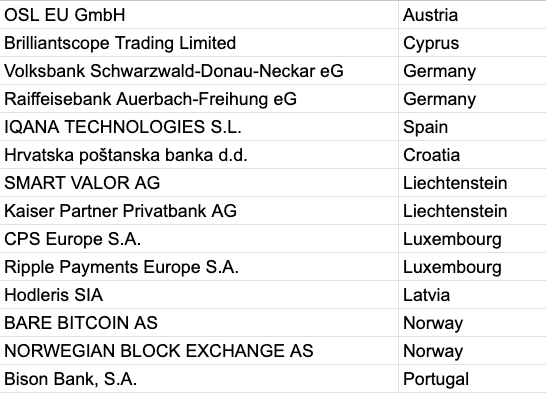
European authorities added 14 crypto companies to the Markets in Crypto-Assets (MiCA) framework register in the second post-deadline update, signaling a slower licensing pace after an initial surge.
The European Securities and Markets Authority (ESMA) updated its interim MiCA register on Thursday, bringing the total number of licensed crypto-asset service providers (CASPs) to 294.
The new entries include Ripple Payments Europe, the European payments arm of blockchain company Ripple, as well as Portugal-based Bison Bank and Croatia’s state-owned bank, Hrvatska poštanska banka (HPB).
The update follows ESMA’s previous register expansion on July 3, when the regulator added 37 CASPs in the first major post-deadline update after MiCA’s transitional period ended.
Banks deepen MiCA presence
Several newly added companies highlight the continued entry of traditional financial institutions into Europe’s regulated crypto market.
In addition to Bison Bank and HPB, the MiCA register added two cooperative banks from Germany, namely Volksbank Schwarzwald-Donau-Neckar and Raiffeisenbank Auerbach-Freihung.
The update also included Liechtenstein-based Kaiser Partner Privatbank, expanding the presence of private banking groups offering regulated crypto services under MiCA.
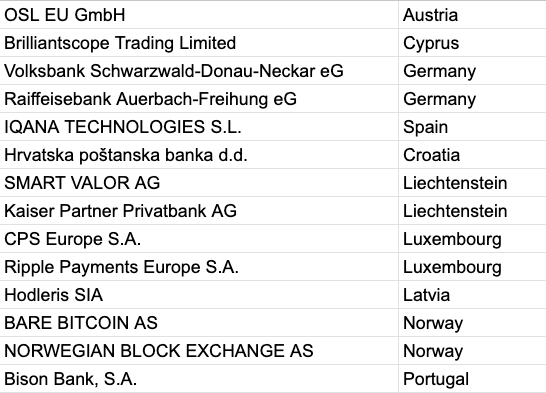
14 newly approved CASPs in the MiCA register update on July 16, 2026. Source: ESMA
The register counts dozens of traditional finance institutions, including Spain’s BBVA and CaixaBank, Germany’s Commerzbank, France’s CACEIS Bank and Standard Chartered Luxembourg.
EMT and ART registers remain unchanged
ESMA reported no changes to its registers for electronic money tokens (EMTs), a category of crypto-assets designed to maintain a stable value against a single official currency, or asset-referenced tokens (ARTs), which are linked to multiple assets such as currencies or commodities.
As of the latest update, the EMT register counted 21 unique issuers, while the ART register continued to list no approved issuers.
Related: MiCA licensing only the beginning as crypto custodians face scrutiny
The regulator also added two entities to its non-compliant register following actions by Italy’s securities regulator, the Commissione Nazionale per le Società e la Borsa (CONSOB).
The new additions were Reversal Investment Group and Kortex, bringing the total number of entries on the non-compliant list to 164, including crypto exchange MEXC.
Magazine: Will the crypto lobby’s $189M campaign get CLARITY over the line?
Prediction markets have stopped being a niche crypto experiment for some time now, and they’ve ventured well into the mainstream. They’re even cited in political debates, news channels, and just about everywhere on social media.
Even regulated exchanges are competing with on-chain protocols for the same traders, and the biggest sportsbooks and brokerages have piled into the race.
In this guide, I’ll break down the five platforms that matter most right now: what each one is, how the trading actually works, what you pay in fees, and what makes each one special.
Best Prediction Markets in 2026: A Quick Rundown
We ranked the platforms on liquidity, market breadth, fees, access, regulation and custody, and the actual trading experience. Keep in mind every figure in this guide was checked against primary data in July 2026, including CFTC’s registries of designated exchanges, analytics dashboards, official fee schedules, company announcements, etc.
In a nutshell:
- Polymarket: best prediction market overall, with a record June and a regulated US arm
- Kalshi: best regulated US prediction exchange and the sector’s volume leader
- Limitless: best up-and-coming on-chain market, built on Base
- Myriad Markets: best media-native prediction market
- Azuro: best on-chain prediction infrastructure, powering over 50 apps
.cp-only-mobile{display:none}
@media(max-width:720px){
.cp .table .price .cp-only-mobile{display:inline;font-weight:600;margin-right:.25rem}
}
| Name | Features | Rating |
|---|---|---|
|
||
|
||
|
||
|
||
|


Polymarket: Best Prediction Market Overall
- Over $10B traded in June 2026
- Non-custodial wallet custody
- Backed by ICE & X partnership
- No maker fees for liquidity
- Oracle resolution dispute risks
- Thinner market selection in US
- Wallet setup can confuse beginners
As a surprise to no one, Polymarket is the biggest prediction market in the world and the one that turned event trading into a spectator sport.
NYSE parent Intercontinental Exchange has committed up to $2 billion to the company at a valuation around $9 billion, X made Polymarket its official prediction market partner with odds piped into the feed alongside Grok analysis, and the company told CNBC in late June that annualized revenue had passed $1 billion.
Executives have confirmed a POLY token and an airdrop are coming, though nothing had launched as of July 2026.
The platform runs on Polygon and settles in USDC, with funds held in your own wallet. Since December 2025, it also operates a separate, CFTC-regulated US exchange, the product of its $112 million acquisition of licensed operator QCEX.
Trading works on a central order book. You basically buy Yes or No shares priced from 0.1 cent to 99.9 cents, with winning shares redeemable at $1, and you can exit any position before resolution. On the international venue, outcomes are decided by UMA’s optimistic oracle, where token holders confirm or dispute proposed results.
The US exchange requires full identity verification and resolves under its regulated rulebook.
Polymarket Fees
Fees are modest and skewed against takers:
- International venue: takers pay a formula-based fee across 10 market categories, with the highest at 50/50 odds. Sports peak at 0.75% and crypto markets at 1.80%, while geopolitics markets remain fee-free. Makers pay nothing and earn a daily share of taker fees.
- US venue: takers pay at most $1.50 per 100 contracts at 50 cents, and resting orders earn a small rebate.
- No deposit or withdrawal fees on either venue beyond network gas.
Pros and Cons of Polymarket
Pros:
- Deepest liquidity and market breadth of any prediction platform. Over $10B traded on the international venue in June 2026 alone
- Self-custody: funds stay in your wallet (USDC on Polygon), no counterparty holding your balance
- Now has a CFTC-regulated US arm after the QCEX acquisition, so US users have a legal on-ramp
- Low fees: makers pay nothing, takers pay only on some categories, geopolitics markets are free
- Institutional credibility, with ICE (NYSE’s parent) backing, official X partnership, $1B+ reported annualized revenue
Cons:
- Oracle resolution risk: UMA disputes have flipped outcomes that looked settled (the $160M Zelensky suit market), and the fact that disputes still happen post-overhaul
- The regulated US venue has a much thinner market list than the global one, and the global one blocks US users
- Wallet-based onboarding still confuses newcomers used to normal fintech apps
- Trustpilot reviewers cite account disablements without explanation and slow support
Kalshi: Best Regulated US Prediction Market
- Segregated US customer funds
- Direct USD fiat on-ramps
- Deep regulated US market menu
- Supports institutional APIs
- Mandatory KYC requirements
- No crypto/self-custody support
- Ongoing state-level sports lawsuits
Kalshi has been a CFTC-designated contract market since 2020.
In June alone, the platform was valued at $2B after its latest funding round. Its World Cup winner market alone attracted more than $1.4 billion.
It works quite similarly to Polymarket. You just deposit dollars, pass full KYC, and trade Yes/No contracts on an order book, from Fed decisions and inflation prints to sports and award shows.
Kalshi contracts are also reachable through brokers, which is how Robinhood users trade them. Once US-only, the exchange now accepts customers from around 143 countries, though it remains restricted in about 54 jurisdictions, including the UK, Canada and Australia.
Kalshi’s specialty could be the fact it offers the deepest regulated market menu in the US, institutional-grade APIs, and the confidence of trading on a federally supervised venue.
The drawbacks? Depends on how you see it, but the design obviously carries KYC on everything, no self-custody (and the fact there’s an ongoing legal war over its sports contracts, with several states and tribal groups challenging them in court, but it’s the same with Polymarket).
Kalshi Fees
Fees are taker-only on most markets and depend on price: roughly 7 cents to $1.75 per 100 contracts, most expensive at 50/50 odds and cheapest at the extremes. Most resting orders pay nothing, there are no settlement or membership fees, and ACH deposits and withdrawals are free.
Pros and Cons of Kalshi
Pros:
- Sector volume leader: $31.5B in June 2026, roughly triple Polymarket’s international venue
- Full federal oversight as a CFTC-designated exchange since 2020; customer funds in segregated accounts
- Fiat-native: free ACH deposits and withdrawals, no crypto knowledge needed, clean purpose-built app
- Reachable through brokers like Robinhood, and now open to users in roughly 143 countries
Cons:
- Depending on how much you value your privacy, there’s basically KYC on everything and no self-custody
- The ongoing legal war over sports contracts: blocked or contested in several states (Nevada injunction in force, losses in Maryland, Ohio, New York), as we mentioned.
- Fees peak at 50/50 odds, which is exactly where most action is
Limitless: Best Up-and-Coming On-Chain Market
- 15-min crypto price contracts
- Smooth Base network settlement
- Features LMTS token utility
- AMM & order-book hybrid
- Strictly prohibits US users
- Airdrop points inflate activity
- Thinner liquidity outside crypto
Limitless is one of the fastest-growing crypto-native prediction markets, and it looks nothing like Polymarket.
Built on Base, it leans into rapid-fire trading: hourly and 15-minute crypto price markets alongside daily and longer-dated questions.
Trading is wallet-based with no default KYC, settled in USDC on Base. Most markets run on a central order book, with an AMM handling some of the rest. Getting started takes a wallet and a deposit, and there is no account approval process.
Limitless Fees
The fee model rewards liquidity providers:
- Makers pay nothing across the board.
- AMM markets charge a flat 0.40%.
- Order-book buys cost 0.40% to 3.00% depending on price, and sells 0.42% to 1.50%, peaking at 50/50 odds.
- Taker fees on the short-duration crypto markets are currently rebated 100% to makers.
Its LMTS token went live in October 2025, and in May 2026 the team filed an application with the CFTC to launch a regulated US exchange offering five-minute Bitcoin event contracts, which is still pending.
Pros and Cons of Limitless
Pros:
- Fastest-growing on-chain venue: 61,808 monthly active traders in June, from double digits in early 2024
- Rapid-fire markets nobody else offers at scale: hourly and 15-minute crypto price contracts on Base
- No KYC, wallet-in-and-trade onboarding; makers pay zero fees and short-duration taker fees are currently rebated to makers
- Serious regulatory ambition: CFTC application filed May 2026 for regulated 5-minute BTC contracts; LMTS token already live
Cons:
- US users are just outright prohibited by its terms of service
- Activity metrics are flattered by airdrop-points seasons. Team-reported volume ($3.4B) runs well above independent measurement ($1.7B), something to keep in mind
- Unsurprisingly, liquidity can be thin next to Polymarket and Kalshi, especially outside crypto markets
- Order-book trading on short timeframes has a real learning curve for casual users
Myriad Markets: Best Media-Native Prediction Market
- Predict while reading articles
- Backed by Hack VC & Jump
- No identity checks needed
- Easy casual user onboarding
- Thin overall exit liquidity
- Lacks advanced trading tools
- Fragmented across three chains
Myriad is a bit of an outlier here, and we could even say it takes the opposite approach to everyone else on this list. So, instead of building a destination exchange, it just embeds prediction markets where audiences already are.
The platform was built by DASTAN, the company formed by the merger of crypto publisher Decrypt and Rug Radio, and its markets appear inside articles, apps and games rather than on a standalone trading screen.
It’s essentially a non-custodial AMM where outcome prices always sum to $1. Markets live on Abstract, BNB Chain and Linea, funds stay in your own wallet, no KYC is required, and Chainlink serves as the official oracle, including for its World Cup markets.
Myriad Fees
Fees are light and simple:
- Buys carry a 0% to 2% fee depending on the market, plus a flat $0.0085 per transaction that covers gas.
- Fees are shared between liquidity providers, the protocol and the builders who integrate it.
Pros and Cons of Myriad Markets
Pros:
- Unique distribution: markets embedded directly in content and apps (built by DASTAN, Decrypt’s parent), so you predict where you already read
- Non-custodial and KYC-free, with cheap, simple fees (0 to 2% plus a flat $0.0085 per transaction)
- Chainlink as the official oracle, a more standardized resolution setup than most small venues
- Credible backing: $20M pre-Series A in Feb 2026 from Hack VC and Jump Crypto; 430K+ users within two months of mainnet
Cons:
- Small on-chain footprint; many markets feel thin and exit liquidity can be poor
- More an engagement product than a trading venue (serious traders will outgrow it)
- Spread across three chains (Abstract, BNB Chain, Linea), which fragments the experience
- Relatively a young platform with limited track record on contested resolutions
Azuro: Best On-Chain Prediction Infrastructure
- No liquidity fragmentation
- Multiple frontends like DexWin
- Earn shares of pool revenue
- Polygon, Base & Arbitrum support
- No primary destination app
- Indirect fees via odds spreads
- Highly skewed to sports betting
Azuro is technically not a prediction market, but more like a liquidity layer that prediction and betting frontends build on. In other words, the protocol hosts markets and pooled liquidity in smart contracts, and every app plugged into it shares that same pool: a bet placed on one frontend draws from the same liquidity as a bet on another.
In practice you use Azuro through those frontends. bookmaker.XYZ was the first independent one, DexWin offers a gasless sportsbook experience, PinWin extends Azuro liquidity to Solana users, etc.
Builders earn a share of pool profits generated by their own users, which is why new frontends keep appearing.
Azuro fees
There is no maker/taker fee schedule to compare. Costs sit inside the odds spread, the way a bookmaker builds margin into its prices, so the practical move is to compare quoted odds across frontends rather than hunt for a fee page.
Note that your experience depends on whichever frontend you choose and on the protocol’s scale, while real, is modest compared to the consumer giants above.
Pros and Cons of Azuro
Pros:
- It has quite a robust infrastructure, reaching well above $414M in all-time volume, $5.1M protocol revenue, and at least 54 apps built on its shared liquidity layer so far
- One pooled liquidity base across every frontend, so even new apps launch with usable depth
- Permissionless and KYC-free at the protocol level, live across Polygon, Gnosis, Base and Arbitrum
- Choice of experiences: sportsbook-style (bookmaker.XYZ, DexWin) or Solana-friendly (PinWin) without fragmenting liquidity
Cons:
- Not a destination app; quality of your experience depends entirely on the frontend you pick
- No transparent fee schedule; costs hide in the odds spread, so comparing value takes effort
- Sports-heavy in practice, with less breadth in politics and culture markets
- Modest scale overall next to the consumer giants, and the protocol’s TVL has been drifting down
What Are Prediction Markets?
Prediction markets let you trade contracts on the outcome of real-world events: elections, sports, interest rates, crypto prices, even award shows.
Each market has Yes and No shares priced between 1 cent and 99 cents, and the price doubles as a probability. So, if Yes trades at 60 cents, the market collectively thinks the event has about a 60% chance of happening. The idea is pretty simple: correct shares redeem at $1 when the market resolves and wrong ones expire worthless.
You can also sell at any time before resolution and lock in a profit or cut a loss.
And how different is it from sports betting? Well, you trade against other people rather than a bookmaker, prices move like any market, and you can exit early instead of riding a bet to the end.
Risks to Know Before You Trade
In July 2025, a Polymarket market asking whether Ukraine’s president would wear a suit before July drew roughly $160 million in wagers and resolved No after nine days of oracle disputes, despite plenty of media outlets describing his NATO summit outfit as exactly that.
UMA overhauled how Polymarket resolutions are proposed afterward, but disputed markets have surfaced again since, including a $16 million market that spent weeks in dispute limbo in April 2026. On any oracle-resolved platform, read the resolution rules before you size a position.
CryptoPotato once covered a report from the WSJ that claimed Polymarket paid college-age creators to stage up to $1.9 million in fake bets, and that the majority of the winning bets, and the reason for the platform’s viral growth, had to do with copycat versions of its website.
Regulation is another front, particularly for Kalshi’s sports contracts. They have won in some courts, including a federal appeals ruling in its favor, and lost in others, with courts in Maryland, Ohio, Nevada and New York siding against it as of early July 2026.
Why Trust CryptoPotato
As we always say, CryptoPotato is a veteran cryptocurrency-focused media outlet, and we cover the industry since 2016.
Every figure in this guide was verified against primary sources, including registry of designated
exchanges, official fee documentation, and raw data from sources and company statements.
We carefully examine each narrative and its triggers (as well as effects) to bring you the full picture.
FAQ
Are prediction markets legal in the US?
Trading on CFTC-designated exchanges such as Kalshi, Polymarket US, and Crypto.com’s derivatives venue is federally regulated and legal.
Keep in mind that sports event contracts remain contested, with several states and tribal groups challenging them in court, so availability can vary by state. Moreover, offshore and on-chain platforms generally block US users (or fall into a gray zone).
What is the difference between a prediction market and sports betting?
At a sportsbook, you bet against the house at fixed odds, whereas on a prediction market you trade against other people, prices float with the crowd’s information, and you can sell your position early.
The margin you pay is a visible fee or spread rather than odds shaded against you.
Which prediction market is best for crypto users?
Polymarket’s international venue offers the deepest on-chain liquidity and self-custody in USDC. Limitless is the pick for fast crypto price markets on Base, and Myriad is the easiest way to dip in casually without visiting an exchange at all.
How do prediction market odds work?
Prices and probabilities are the same thing, so a “Yes” share trading at 25 cents implies a 25% chance, and if the event happens, it pays out $1, quadrupling your money.
That also means the market updates in real time: when news breaks, the price moves before most headlines do, which is why traders treat these markets as a live probability feed as much as a way to bet.
Conclusion: Best Prediction Markets in 2026
Prediction markets have managed to evolve far beyond a crypto niche – as we established in this guide. They offer a sophisticated way to trade on everything from politics to macroeconomics and sports. Whether you prioritize deep liquidity, regulatory oversight, self-custody, or fast-moving crypto markets, there’s definitely a platform that’s tailored to your trading style.
Just remember that regardless of the platform you choose, you have to understand the rules that govern market resolution, the fee structure, as well as any possible jurisdiction restrictions – this is just as important as identifying opportunities.
As our industry continues to mature, informed users will be better positioned to take advantage of this rapidly expanding market.
The post Best Prediction Markets in 2026: The Complete Guide appeared first on CryptoPotato.


In one week of July 2025, the House passed three crypto bills. One is law. One is law by accident and the President will not sign it. The third has not had a Senate vote in 365 days, and it was supposed to be the important one.
Summary
- On July 17, 2025, the House passed the CLARITY Act 294-134 with more than 70 Democrats crossing over, the strongest congressional endorsement of digital asset legislation in American history. It has not received a Senate floor vote in the year since.
- It was the middle bill of Crypto Week, when the House passed three digital asset measures in rapid succession. Tracking all three one year later produces a scorecard nobody in the industry wants to read aloud.
- GENIUS became law on July 18, 2025 and hits its first major rulemaking deadline tomorrow. The Anti-CBDC Surveillance State Act cleared the House 219-217, stalled, then reached law by riding inside a housing bill the President is refusing to sign.
- CLARITY is stuck on ethics. The merged Senate draft released July 14 omits the provision Democrats named as their price, and three senators declared opposition the same day.
- The pattern across all three is the same: what passed was what could be attached to something else or what nobody had a personal stake in blocking. CLARITY is neither.
Washington called it Crypto Week. In a handful of days in July 2025, the House of Representatives passed three digital asset bills in succession, and the industry treated the sequence as the moment its lobbying decade finally paid. The CLARITY Act cleared 294-134 on July 17. The GENIUS Act cleared 308-122 the same day and was signed into law on July 18. The Anti-CBDC Surveillance State Act squeaked through 219-217. Three bills, one week, one chamber, and a widespread assumption that the Senate was a formality. Today is the one-year anniversary of the first of those votes. Exactly one of the three arrived where it was supposed to. Tracking what happened to the other two explains more about how crypto legislation actually works than any amount of vote-counting on the bill still pending.
The bill that made it
GENIUS is the success case, and it is worth being precise about why, because the reason is not that it was the best bill.
It passed the Senate 68-30 in June 2025, cleared the House 308-122 on July 17, and was signed into law on July 18, creating the first federal framework for payment stablecoins. It reaches its first major rulemaking deadline on July 18, 2026, one year to the day. White House digital assets adviser Patrick Witt has repeatedly pointed to that anniversary as proof that coordinated action produces results, which is true and also somewhat beside the point.
GENIUS passed because almost nobody with power had a reason to stop it. Banks wanted rules for stablecoins because stablecoins were happening regardless and they preferred a framework they could live inside. The industry wanted legitimacy. Regulators wanted reserve requirements. The politics of requiring an issuer to hold full reserves in liquid assets and disclose them monthly are not politics at all; they are housekeeping. There was no ethics dimension, no jurisdictional turf war between agencies, and no obvious way for anyone in office to profit from the outcome in a manner that made colleagues uncomfortable.
That is the template for what Congress can pass on crypto. Narrow scope, clear beneficiary, no personal stakes. Note how little of that describes CLARITY.
The bill that made it by accident
The Anti-CBDC Surveillance State Act is the strangest entry on the scorecard, and its path is worth tracing because it shows what happens when a crypto bill cannot pass on its own.
It cleared the House by two votes, 219-217, which is not a mandate. Then it stalled. A promise to attach it to the defense authorization bill went unkept, which in Washington is a soft burial. It should have died there.
Instead it reached law by an unlikely route: a provision barring the Federal Reserve from issuing a central bank digital currency through 2030 rode inside the 21st Century ROAD to Housing Act, a bipartisan housing package that passed the Senate 85-5 and the House 358-32. The crypto industry got its anti-CBDC win as a passenger on a bill about construction permitting.
And then the President refused to sign it. Not over the CBDC provision, which he supports, having argued that a central bank digital currency would threaten financial stability, individual privacy, and American sovereignty. He is withholding signature over the SAVE America Act, an unrelated elections bill demanding proof of citizenship and photo identification for federal voting. The housing measure becomes law without his signature once the ten-day window closes, so the maneuver functions as leverage instead of a veto. The CBDC ban arrives regardless, delivered by a President who declined to sign the vehicle carrying it.
The lesson is not subtle. A crypto priority that could not pass on its own merits became law by attaching itself to something that could, and then survived the President’s own obstruction because the mechanism did not require his cooperation. That is three separate accidents in a row producing the right outcome, and it is not a strategy anyone can repeat on purpose.
The bill that did not
Which brings us to CLARITY, and to the number that should embarrass everyone involved: 365 days on the Senate side with no floor vote.
The bill did not stall for lack of support in the abstract. It passed the House with more than 70 Democrats, which is the strongest bipartisan showing any crypto legislation has ever produced. It cleared the Senate Banking Committee 15-9 on May 14, 2026. On June 1 it was placed on the Senate Legislative Calendar under General Orders as Calendar No. 423, making it eligible for a floor vote at any moment leadership chooses to schedule one. Nobody has scheduled one.
The arithmetic explains part of it. Cloture requires 60 votes. Republicans hold roughly 53 seats, so the bill needs at least seven Democrats. Only two crossed over in committee, Ruben Gallego and Angela Alsobrooks, and both subsequently warned that their committee votes do not guarantee floor support absent further progress. The Republican margin has since narrowed further: Senator Lindsey Graham died on July 11 and Mitch McConnell has been absent, which leaves the conference almost no room for error.
But the arithmetic is downstream of the actual obstacle, which is ethics. Democrats have conditioned their votes on provisions restricting government officials from profiting from the industry they regulate. The reason such a provision exists is that the President’s most recent financial disclosure showed roughly $1.4 billion in crypto-related income, including about $636 million from the memecoin bearing his name and more than $500 million tied to World Liberty Financial. The merged Senate draft combining the Banking and Agriculture texts was released on July 14 and omits any ethics provision. That same day, Senators Chris Murphy, Chris Van Hollen, and Jeff Merkley held a press conference formally opposing the bill.
The rest of the picture is a machine running out of track. Majority Leader John Thune has pledged a floor vote before the August recess, with the week of July 20 under active discussion. The House leaves July 23; the Senate leaves around August 7. A high-level White House meeting was convened on July 15 to hash out the ethics section, with the President himself in attendance. The White House crypto adviser begins military leave on July 27, inside the closing window. A House field hearing convenes at Federal Hall today. Prediction markets have priced 2026 passage in the mid-20s to upper-30s percent range, down from above 70% earlier in the year, and Galaxy’s research head cut his estimate to roughly 50% from 75% in late May. CFTC Chairman Michael Selig has publicly complained that ethics additions are derailing the bipartisan opportunity, calling it mission creep.
The bull case for the anniversary meaning nothing
The optimistic reading is that a year is not long by legislative standards and the anniversary is a media artifact rather than a signal.
Major financial legislation routinely takes multiple Congresses. Dodd-Frank was a crisis response and still consumed most of a year with a supermajority. The fact that CLARITY sits on the calendar eligible for a vote, with committee work finished in both relevant committees, is genuinely further than any market structure bill has ever reached. House Agriculture’s digital assets subcommittee chair has said the House will move fast on whatever the Senate produces, which removes one procedural obstacle entirely: if the Senate delivers a passable text, the House has committed to compressing its own timeline to nothing.
The negotiation is also live rather than dead. A White House meeting with the President attending is not what a corpse looks like. Senators from both parties, including Gillibrand, Lummis, Boozman, and Scott, are described by House Financial Services Chair French Hill as working to get to yes. Kristin Smith of the Solana Policy Institute points to returning lawmakers and fresh bill text as evidence momentum is building. Three working weeks is short but it is not zero, and Congress passes things in the final hours as a matter of institutional habit.
And crucially, the absence of CLARITY has not left a vacuum. The SEC and CFTC joint interpretation of March 17, 2026 classified 16 named digital assets, including Bitcoin, Ether, and XRP, as digital commodities under a five-category taxonomy. That framework is binding on both agencies and is already being cited in fund registration statements. The industry has a working rulebook. The bill would improve it; the bill’s absence has not stopped the market from operating.
The bear case for the anniversary meaning everything
The pessimistic reading is that a year of failure on a bill with 70 Democratic House votes tells you the obstacle is structural, and structural obstacles do not resolve because a calendar page turns.
The compliance cost is the part the vote-counting misses. Businesses cannot build durable compliance programs against jurisdictional lines that remain uncertain, which means the gridlock is not a political story but an operating one, and it has now run for a full year. Firms have responded exactly as they have since 2018, by domiciling offshore, which means the activity continues and American oversight does not.
The taxonomy that makes the bull case is also the bear case. It is administrative action. Any future administration can direct its agencies to reinterpret without a congressional vote. So the industry’s working rulebook is a reversible one, and the entire argument for CLARITY is that a reversible rulebook is not a rulebook. If the bill dies, what protects Bitcoin, Ether, and XRP from a future enforcement posture is one interpretive release from an agency whose position changed once already because its leadership changed.
Then there is the political clock, which does not reset. If CLARITY misses the August recess, it lands in a fall calendar that runs directly into November midterms, when legislative activity slows and the bill’s outlook becomes hostage to a chamber composition nobody can predict. The lame-duck session is the theoretical fallback and it is where well-positioned bills go to be forgotten.
And the ethics impasse has no natural resolution. Democrats argue it is incoherent to build a federal framework for digital assets while the sitting President earns his largest income stream from those assets with no enforceable restriction. The White House position, per Witt, is that it will accept ethics language applying across the board, from the president to the intern, but nothing targeting the President’s holdings specifically. Both positions are internally consistent. Together they are irreconcilable without a concession, and the July 14 draft showed which way the drafting is currently leaning.
The thing a year of delay actually cost
Vote math is the wrong lens for the anniversary, because it measures whether the bill will pass instead of what its absence has already done. A year is long enough for the delay itself to become the story.
Start with the offshore drift, which is not theoretical. Firms domicile where the rules are legible. For a year, American builders have faced a jurisdictional question with no statutory answer, and the rational response has been to incorporate elsewhere, serve American users through structures designed by lawyers, or simply exclude Americans outright. Robinhood’s Stock Tokens are the clean illustration: tokenized equity products available across more than 120 countries and barred to US persons, built by an American brokerage. That is not a company fleeing regulation. It is a company reading the rules that exist and concluding that the safest jurisdiction for its newest product is anywhere else.
Then the compliance cost, which Forbes framed correctly this week: the gridlock has stopped being a political problem and become an operating one. A firm cannot build a durable compliance program against lines that may move. It cannot hire against them, budget against them, or sign multi-year vendor contracts against them. Every quarter of delay is a quarter in which the responsible actors, the ones who would comply if told how, spend money on legal opinions instead of product, while the irresponsible ones proceed exactly as before. Regulatory uncertainty is a tax that falls hardest on the firms most inclined to follow rules.
Then the institutional opportunity cost, which is the largest and least visible. The March taxonomy unlocked a great deal: fund issuers now cite it in registration statements, and accredited investors can structure compliant holdings without waiting for GENIUS implementation in November. But an interpretive release is not what a pension committee wants underneath a multi-decade allocation. Institutions do not ask whether an asset is currently permitted. They ask whether it will still be permitted after the next election, and the honest answer today is that nobody can promise it. That question has a statutory answer or it has no answer, and for a year it has had no answer.
The rebuttal deserves stating: none of that stopped the market. Spot volumes on centralized exchanges rose for the first time in five months in June, climbing 15.3% to $1.11 trillion, and real-world-asset perpetual volumes hit a record $311 billion. Tokenized Treasury products passed $15 billion. The industry is not waiting politely for permission, and the argument that legislation is existential looks weaker every quarter the sector functions without it.
Both readings are true, which is the uncomfortable part. The market does not need CLARITY to operate. The market needs CLARITY to stop rebuilding its legal assumptions every time an administration changes. Those are different needs, and only one of them shows up in a volume chart.
What the scorecard actually shows
Line the three bills up and a pattern emerges that is more useful than any individual vote count.
GENIUS passed because it was narrow and nobody with leverage had a personal reason to block it. The anti-CBDC provision passed because it stopped trying to pass and hitched a ride on something that could, then survived presidential obstruction because it did not need his signature. CLARITY has not passed because it is broad, it touches agency turf, and the one person whose endorsement it carries most loudly is also the reason its opponents will not vote for it.
The uncomfortable implication is that the American legislative system handled crypto’s easy questions and has not handled its hard one. Stablecoin reserves are an easy question. Whether the Fed can issue a digital dollar is a question with a clear partisan valence and an available vehicle. Who regulates the entire digital asset market, and whether the officials writing that answer may personally profit from it, is a hard question, and hard questions require someone to give something up.
A year ago today, the House answered the hard question 294-134 and the industry declared victory. The Senate has spent the twelve months since proving that the House vote was the easy part. Whether the next three weeks change that will come down to a room in the White House and whether anyone in it is willing to trade. If they are not, the anniversary that matters will not be this one. It will be the second one.
Disclaimer: This article is for information and educational purposes only and does not constitute financial, investment, or legal advice. It describes pending legislation and the political debate around it, and legislative outcomes are inherently uncertain. Nothing here is a recommendation to buy or sell any asset. Always do your own research. Information is accurate as of July 17, 2026, and this situation is developing quickly.
Frequently Asked Questions
What happened one year ago today?
On July 17, 2025, the House of Representatives passed the Digital Asset Market Clarity Act by a vote of 294-134, with more than 70 Democrats joining Republicans. It was the strongest congressional endorsement of digital asset legislation in American history and part of what Washington called Crypto Week, during which the House passed three crypto bills in rapid succession.
What was Crypto Week?
A stretch of July 2025 in which the House passed the CLARITY Act 294-134, the GENIUS Act 308-122, and the Anti-CBDC Surveillance State Act 219-217. GENIUS was signed into law on July 18, 2025. The anti-CBDC measure stalled before reaching law inside a housing bill. CLARITY passed to the Senate and has not received a floor vote since.
Did the GENIUS Act become law?
Yes. It passed the Senate 68-30 in June 2025 and the House 308-122 on July 17, 2025, and was signed on July 18, 2025, creating the first federal framework for payment stablecoins. It requires US payment stablecoin issuers to hold full reserves in liquid assets and disclose composition monthly, and it reaches its first major rulemaking deadline on July 18, 2026.
What happened to the anti-CBDC bill?
It cleared the House 219-217, then stalled when a promise to attach it to the defense bill went unkept. A provision barring the Federal Reserve from issuing a central bank digital currency through 2030 later rode inside the 21st Century ROAD to Housing Act. The President has refused to sign that package over an unrelated elections bill, but it becomes law without his signature once the ten-day window closes.
Why has CLARITY not had a Senate vote?
Primarily ethics. Democrats have conditioned support on provisions restricting officials from profiting from the crypto industry, prompted by the President’s disclosure of roughly $1.4 billion in crypto income. The merged Senate draft released July 14 omitted any ethics provision, and Senators Murphy, Van Hollen, and Merkley announced opposition the same day. Disputes over DeFi developer protections and stablecoin yield also remain live.
What are the odds it passes in 2026?
Traders have grown sharply more pessimistic. Prediction markets priced 2026 passage in roughly the mid-20s to upper-30s percent range in mid-July, down from above 70% earlier in the year. Galaxy’s research head cut his estimate to about 50% from 75% in late May. Those figures move quickly and should be checked against current markets.
What is the deadline?
The House leaves for recess on July 23 and the Senate around August 7. Majority Leader John Thune has pledged a floor vote before the recess, with the week of July 20 under discussion. After that, the bill lands in a fall calendar running into November midterms, when the outlook becomes considerably harder to predict.
What governs crypto in the meantime?
The SEC and CFTC joint interpretive release of March 17, 2026, which classified 16 named assets including Bitcoin, Ether, and XRP as digital commodities under a five-category taxonomy. It is binding on both agencies and is cited in fund registration statements. But it is administrative action, not statute, so a future administration could direct a reinterpretation without any congressional vote, which is the central argument for passing the bill.

England Pundits Say Goalkeeper Jordan Pickford Should Retire From International Duty After Argentina Exit

ESMA Enlists 14 New CASPs in MiCA Register as Licensing Slows

10 Essential Crime Shows You Need To Watch Before You Die


-

 Fashion6 days ago
Weekend Open Thread: Nutriplenish Leave-In Conditioner
-
 NewsBeat20 hours ago
London Mayor Sadiq Khan handed a peerage by Keir Starmer alongside 15 other Labour figures… just days before the PM leaves No10
-

 Crypto World1 day ago
CFTC blocks Kalshi from unwinding Michigan trades after court order
-

 Business1 day ago
Nvidia Stock Slips After Big Tuesday Rally as Huang Confirms Vera Rubin Chip Is Now in Production Today
-

 Politics2 days ago
Young campaigners urge incoming PM to act on outdoor junk food ads
-

 News Videos3 days ago
XRP BOMBSHELL… XRP OMBOARDED FOR TRANSACTIONS!!!
-
 Entertainment2 days ago
Disney’s Most Ambitious Failed Star Wars Attraction Is Coming to SDCC
-

 Tech3 days ago
Get Your ESP32 Sunny Side Up With This Solar Dev Board
-

 Crypto World15 hours ago
Injective Submits SEC Transfer-Agent Registration to Onchain Ownership Records
-

 Tech3 days ago
Dark Secrets Emerge When Jailbreaking LLMs
-
 Sports2 days ago
New Cornerback Enters Vikings Trade Rumor Mill
-

 News Videos5 hours ago
Money | Class 12 Economics | CBSE Board Exam 2026-27
-

 Business1 day ago
Palantir Shares Rise After Expanded Nvidia Partnership and Fresh Analyst Upgrades Ahead of Earnings Day
-

 Business10 hours ago
Banco Bilbao Vizcaya Argentaria, S.A. (BBVA) Discusses Global Macro Environment and Economic Outlook for Core Markets Transcript
-
 Tech4 days ago
Cloudflare Precursor Watches Your Mouse and Keyboard To Decide If You Are Human
-

 News Videos4 days ago
how to make coin bank box with cardboard #scienceproject #money #diy #shorts
-
 Entertainment2 days ago
Vicki Gunvalson Defends Discussing Heather Dubrow’s Money
-
Crypto World3 days ago
Ripple, Coinbase, Circle Join Linux x402 Foundation to Help Shape AI Payments
-

 Crypto World13 hours ago
Claude Fable 5 Slips to Second in AI Coding Leaderboard
-
Business11 hours ago
Nephros, Inc. (NEPH) Discusses Evolving Water Safety Strategies and Expansion Beyond Filtration Transcript
You must be logged in to post a comment Login