

Crypto World
What Is the Right White Label Tokenization Platform for You?


Tokenization at enterprise scale is fundamentally an architectural decision. While market conversations often emphasize speed of deployment, the true determinant of long-term viability lies in the structural integrity of the underlying white label tokenization platform.
Smart contract modularity, compliance logic programmability, interoperability layers, custody integrations, and upgrade mechanisms collectively define whether the system can withstand regulatory evolution and transaction scale. Selecting white label tokenization software without evaluating its contract architecture and governance design introduces systemic limitations that compound over time.
The decision framework must therefore begin at the infrastructure layer — not the user interface.
What Is a White-Label Tokenization Engine?
A white-label tokenization engine is a pre-built, customizable blockchain-based infrastructure that enables organizations to issue and manage tokenized assets under their own brand. A white-label tokenization engine is faster to market than a custom-built solution, but still allows for customization and configuration of compliance.
Core capabilities include:
- Token issuance and lifecycle management
- Compliance rule enforcement
- Investor onboarding and KYC integration
- Governance and voting modules
- Smart contract management
- Asset reporting dashboards
When supported by robust white label tokenization development services, such platforms allow enterprises to retain strategic control while minimizing infrastructure risk.
Why the Choice of Tokenization Engine Impacts Long-Term Scalability
Enterprises looking to establish themselves in regulated digital asset markets will find that scalability is about much more than just transaction throughput; it also includes aspects such as regulatory elasticity, architectural modularity, liquidity enablement, operational automation, and ecosystem interoperability.
In this case, the white label tokenization platform will become your programmable underpinning that helps determine if growth will be seamless or stifled by the architecture of your tokenization platform infrastructure
Choosing robust enterprise white label tokenization solution will allow you to scale without having to continually re-build your infrastructure to support the new level of growth. Instead, scalability will be part of the smart contract architecture, governance logic and integration stack from the very beginning.
1. Regulatory Elasticity and Compliance Automation
Regulatory environments are dynamic. Jurisdictional policies evolve, disclosure requirements expand, and investor eligibility criteria shift over time. A technically mature white label tokenization software solution must therefore incorporate a configurable compliance rule engine rather than static rule sets.
Scalable compliance architecture should support:
- Jurisdiction-based transfer restrictions
- Role-based investor permissions
- Whitelisting and blacklisting logic embedded at contract level
- Automated dividend and reporting triggers
- On-chain audit trail generation
When compliance is deeply integrated into smart contract logic, enterprises can scale across borders without redeploying infrastructure. Organizations leveraging robust white label tokenization development services benefit from programmable regulatory adaptability instead of reactive redevelopment cycles.
2. Modular Smart Contract Architecture and Upgradeability
Long-term scalability depends on modularity. Monolithic contract deployments restrict flexibility and introduce systemic risk during updates. A future-ready white label tokenization platform must employ structured contract patterns such as proxy upgrade mechanisms, modular deployment layers, and governance-controlled upgrade pathways.
Scalable architecture includes:
- Separation of logic and storage contracts
- Version-controlled contract upgrades
- Governance-based modification approvals
- Emergency pause and recovery mechanisms
- Deterministic permission hierarchies
A capable white label tokenization platform development company ensures that upgradeability does not compromise security, enabling protocol evolution without disrupting active tokenized assets.
3. Multi-Asset and Multi-Chain Interoperability
Enterprises rarely tokenize a single asset class. Over time, expansion into real estate, debt instruments, equity, structured funds, or commodities becomes a strategic objective. The selected enterprise white label tokenization solutions framework must therefore support multi-asset issuance under a unified infrastructure.
Scalability requires:
- Compatibility with multiple token standards
- Configurable token economics models
- Cross-chain deployment capability
- API-driven interoperability with exchanges and custodians
- Bridge mechanisms for liquidity routing
An interoperable white label tokenization software stack prevents vendor lock-in and supports ecosystem expansion without structural redesign.
4. Liquidity and Secondary Market Enablement
Token scalability is incomplete without liquidity scalability. The ability to integrate secondary trading platforms, digital custodians, and automated settlement layers determines whether tokenized assets achieve sustainable market participation.
A scalable white label tokenization platform should enable:
- Transfer restriction logic aligned with exchange standards
- Custodial wallet compatibility
- Atomic settlement automation
- Fractional ownership models
- Yield distribution and dividend automation
Well-architected white label tokenization development services embed liquidity readiness within the core system rather than retrofitting it later.
5. Performance Engineering and Infrastructure Scaling
As investor participation increases, transaction volume grows. Scalability must extend to system performance, including gas optimization, throughput management, and infrastructure redundancy.
Enterprise-grade enterprise white label tokenization solutions incorporate:
- Layer-2 compatibility or sidechain deployment options
- Gas-efficient contract design
- Cloud-native infrastructure orchestration
- Horizontal scaling capability
- Disaster recovery and failover mechanisms
Without these controls, operational strain increases as adoption grows.
6. Data Orchestration and Reporting Scalability
Institutional markets demand transparency. As asset portfolios expand, reporting complexity intensifies. A scalable white label tokenization software framework must integrate:
- Real-time dashboard analytics
- Automated investor statements
- Regulatory reporting exports
- On-chain/off-chain data synchronization
- Event-driven accounting automation
Data orchestration scalability ensures compliance continuity and investor confidence during growth phases.
7. Governance and Operational Automation
As ecosystems grow, manual oversight becomes inefficient. A technically advanced white label tokenization platform should support automated governance mechanisms, including:
- On-chain voting modules
- Role-based administrative controls
- Multi-signature authorization flows
- Smart contract-based distribution automation
When governance logic is programmable, operational expansion does not proportionally increase administrative complexity.
Transform Your Asset Digitization Vision into Production-Ready Infrastructure
Step-by-Step Decision Framework for Enterprises
To select a white label tokenization platform, organizations need to evaluate the overall architecture, not just conduct a vendor comparison. Because both regulatory and other operational factors affect the issuance of tokenized assets, organizations must evaluate the depth of their infrastructure, as well as its compliance programmability, integration capabilities and upgrade options in order to implement properly.
Organizations must evaluate the criteria listed below when evaluating enterprise white label tokenization solutions for scalable enterprise implementations.
Step 1: Define Asset Class and Jurisdictional Scope
Before evaluating vendors, enterprises must clarify:
- Type of asset (real estate, funds, bonds, commodities)
- Target investor profile
- Operating jurisdictions
- Licensing requirements
Different assets require different compliance logic and token standards. A scalable white label tokenization platform must accommodate multi-asset issuance under varying regulatory environments.
Step 2: Evaluate Compliance and Governance Architecture
Compliance must be programmable. Enterprises should assess whether the platform supports:
- KYC/AML integration
- Investor accreditation verification
- Transfer restrictions
- Dividend and distribution automation
- Voting and governance modules
The strongest white label tokenization development services integrate compliance into smart contract logic rather than treating it as a manual overlay.
Step 3: Assess Smart Contract Architecture and Security
Security is non-negotiable. Key evaluation criteria include:
- Third-party audited smart contracts
- Modular architecture
- Multi-signature controls
- Role-based administrative permissions
- Incident response mechanisms
A credible white-label tokenization platform development company should demonstrate a strong audit history and transparent security documentation.
Step 4: Examine Integration and API Infrastructure
Tokenization does not operate in isolation. Enterprises must verify:
- API accessibility
- Banking and payment gateway integration
- Custodian connectivity
- ERP and CRM compatibility
- Reporting and analytics dashboards
A well-structured white label tokenization software solution integrates seamlessly into existing financial infrastructure.
Step 5: Review Customization Flexibility
White-label does not mean rigid. Evaluate:
- Branding capabilities
- UI/UX customization
- Token economics configuration
- Investor portal personalization
- Workflow modification flexibility
Customization ensures differentiation in competitive markets.
Step 6: Analyze Scalability and Performance
Infrastructure must support growth. Key technical considerations:
- Transaction throughput
- Gas optimization mechanisms
Cloud deployment flexibility - Load balancing architecture
- Disaster recovery systems
An enterprise-grade engine must support large investor volumes without performance degradation.
Must-Have Features in an Enterprise White-Label Tokenization Platform
A production-ready white label tokenization platform must go beyond basic issuance functionality and deliver infrastructure-grade capabilities aligned with regulatory compliance, security resilience, and institutional scalability. Enterprise adoption depends on how deeply the white label tokenization software embeds automation, governance logic, and interoperability within its core architecture.
- Multi-Asset Issuance Support – Enables structured token creation across diverse asset classes within a unified infrastructure.
- Configurable Compliance Engine – Embeds programmable transfer restrictions, investor eligibility rules, and jurisdictional controls directly into smart contracts.
Role-Based Governance Management – Implements hierarchical access controls and on-chain voting mechanisms for structured decision-making. - Automated Dividend and Yield Distribution – Streamlines financial payouts through smart contract-triggered settlement logic.
- Custodial Wallet Integration – Ensures compatibility with institutional-grade custody providers for secure asset management.
- Secondary Market Readiness – Supports compliant token transfers and exchange integrations to facilitate liquidity.
- Real-Time Reporting Dashboards – Provides synchronized on-chain and off-chain data visibility for regulatory and investor reporting.
- Smart Contract Upgradeability – Allows controlled protocol evolution without disrupting active tokenized assets.
Cost of a White-Label Tokenization Platform: What Enterprises Should Expect
The cost of implementing a white label tokenization platform varies significantly depending on architecture depth, compliance complexity, and customization scope. Enterprises must evaluate cost across multiple dimensions rather than focusing solely on licensing fees.
1. Platform Licensing or Base Infrastructure Cost
This includes core smart contract frameworks, admin panels, and issuance modules.
2. Customization & Integration Cost
- UI/UX personalization
- Custody integration
- API development
- Compliance configuration
Advanced white label tokenization development services increase upfront cost but reduce long-term re-engineering expenses.
3. Security & Audit Expenses
Smart contract audits, penetration testing, and compliance validation are non-negotiable for enterprise-grade deployments.
4. Infrastructure & Cloud Hosting
Costs depend on blockchain selection, transaction volume, and deployment model (public, private, or hybrid).
5. Ongoing Maintenance & Upgrade Costs
Includes contract updates, regulatory modifications, technical support, and feature enhancements.
Building Future-Ready Tokenization Infrastructure
Selecting the right white label tokenization platform is a long-term infrastructure decision that directly influences regulatory agility, liquidity scalability, governance automation, and ecosystem expansion. Enterprises that approach this evaluation with architectural rigor — assessing smart contract modularity, compliance depth, interoperability, and upgrade pathways — position themselves to build resilient and future-ready digital asset frameworks.
As a leading white label tokenization platform development company, Antier delivers enterprise-grade tokenization infrastructure engineered for security, configurability, and regulatory alignment. With deep expertise in blockchain architecture, compliance-driven smart contracts, and scalable deployment models, Antier empowers financial institutions, asset managers, and fintech innovators to launch and scale institutional tokenization ecosystems with confidence.
For organizations seeking a strategically aligned tokenization partner, Antier provides the expertise and infrastructure required to transform asset digitization into sustainable market advantage.
Frequently Asked Questions
01. What is a white-label tokenization engine?
A white-label tokenization engine is a customizable blockchain-based infrastructure that allows organizations to issue and manage tokenized assets under their own brand, offering faster market entry and compliance configuration.
02. Why is the choice of tokenization engine important for long-term scalability?
The choice of tokenization engine impacts long-term scalability by ensuring that the architecture supports not just transaction throughput but also regulatory elasticity, operational automation, and ecosystem interoperability.
03. What core capabilities does a white-label tokenization engine provide?
Core capabilities include token issuance and lifecycle management, compliance rule enforcement, investor onboarding and KYC integration, governance modules, smart contract management, and asset reporting dashboards.


Nvidia(NVDA), the world’s largest public company by market value and bellwether for the AI sector, once again topped Wall Street expectations for the fourth quarter, reporting results after the close of U.S. markets on Wednesday.
The chipmaker beat estimates, reporting revenue of $68.1 billion, a 73% increase from a year earlier, as continued AI-related capital spending fueled strong demand for its chips. It also reported adjusted earnings per share of $1.62, beating estimates. Wall Street analysts expected Nvidia to report approximately $66.1 billion in revenue and $1.54 in adjusted EPS, according to FactSet data.
Shares rose nearly 3% in post-market trading on Wednesday following the earnings release.
Investors are now focused on guidance. Nvidia expects first-quarter revenue of around $78 billion, up from analyst expectations of $72.9 billion, setting the tone for the next phase of AI-driven growth.
The chip-making giant also said that its Data Center revenue for the fourth quarter was a record $62.3 billion, up 75% from a year ago and up 22% from the prior quarter, driven by the “major platform shifts – accelerated computing and AI.”
“Today’s report is a strong pushback against the narrative that hyperscaler AI growth could start fading into 2027,” said Thomas Monteiro, senior analyst at Investing.com. “The roughly 75% surge in data center revenue further reinforces that hyperscaler AI infrastructure deployment remains firmly in expansion mode.”
Following the results and outlook, bitcoin remained at session highs around $69,500 after a 10% rally from Tuesday’s lows. AI-focused crypto tokens such as Bittensor (TAO) and Internet Computer (ICP) added to their gains.
Crypto miners, increasingly linked to AI and high-performance computing infrastructure, also saw modest gains following Nvidia’s report. IREN (IREN), Cipher Digital (CIFR), and TeraWulf (WULF were 1%-2% higher in after-hours trading.
The company will host a conference call at 5 p.m. ET, where investors will be listening closely for further signals on the next phase of the AI infrastructure buildout.
UPDATE (Feb. 25, 22:10 UTC): Adds analyst comment.


Crypto liquidity firm BlockFills suspended withdrawals after $75 million losses and CEO Nicholas Hammer stepped down.
Blockfills is a Chicago-based crypto liquidity provider and lender that primarily serves institutional clients such as hedge funds, asset managers, and high-net-worth trading firms.
Why It Matters
- Institutional crypto lender losses can restrict liquidity for hedge funds, traders, and asset managers.
- Withdrawal freezes raise solvency concerns and counterparty risk across crypto markets.
- Leadership exits and sale efforts signal financial distress at a major institutional trading firm.
The Details
- BlockFills co-founder and CEO Nicholas Hammer stepped down in February 2026.
- The company appointed Joseph Perry as interim CEO.
- BlockFills suspended client deposits and withdrawals on Feb. 11, 2026.
- The firm reported approximately $75 million in losses tied to its crypto lending operations.
- Losses occurred after crypto collateral backing loans fell in value during market declines.
- Some clients received warnings to withdraw assets before the freeze.
- Customer deposits and withdrawals remain halted as of late February 2026.
- BlockFills is actively seeking a buyer or strategic investor.
- The firm operates from Chicago and serves institutional crypto trading clients globally.
The Big Picture
- BlockFills provides liquidity, lending, and trading infrastructure to institutional crypto clients.
- Crypto lenders face losses when falling asset prices reduce collateral coverage on loans.
- Similar lending failures previously triggered collapses at Celsius, Voyager, and Genesis.
- Institutional crypto markets remain exposed to liquidity stress during volatile price cycles.
- Firms increasingly pursue acquisitions or restructuring after lending losses reduce available capital.
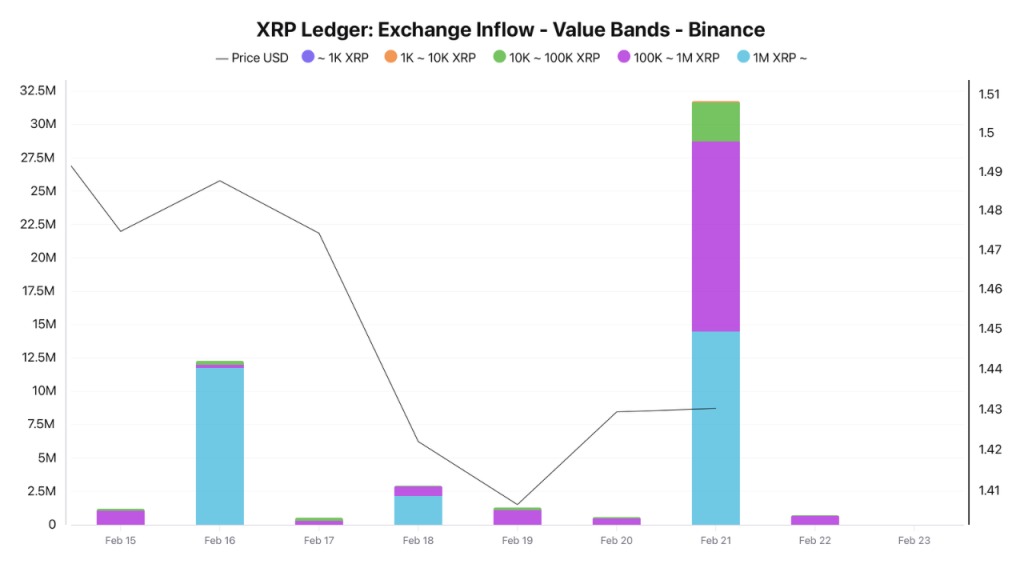
Whales just moved size onto Binance, maybe to sell? Under these conditions, even small moves affect XRP price prediction.
More than 31M XRP, worth about $45M, were transferred to the exchange in a single day, with large holder wallets driving most of the flow. That is not retail noise. It is a meaningful supply potentially preparing to sell.
Big exchange inflows often signal distribution. When coins leave cold storage and hit order books, sell-side pressure increases immediately.
This comes while XRP is hovering in the mid $1.30 range, trying to stabilize after recent volatility. At the same time, longer-term headlines remain constructive, creating a clear divergence between narrative and on-chain behavior.
If buyers absorb this supply, the structure holds. If similar inflows continue, downside risk grows fast.
XRP Price Prediction: Is XRP About to Crash Below $1?
XRP just bounced again from the $1.30 support, and it is still trading above the old descending channel. That matters.
The channel capped price for weeks, so staying above it keeps the breakout valid instead of turning it into a fake move.
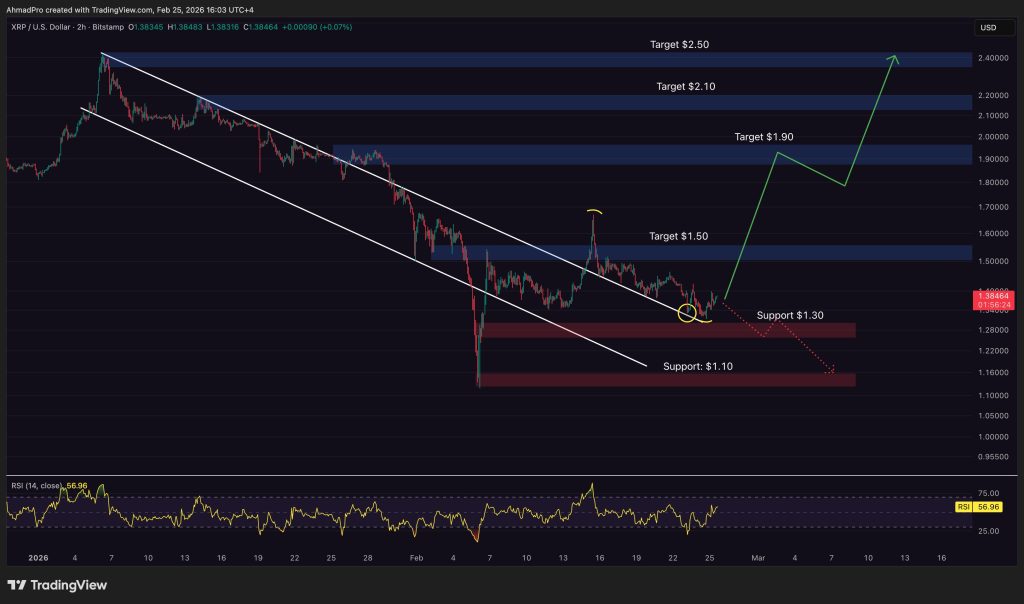
As long as XRP prints higher lows above $1.30 and holds outside the channel, the short-term bias stays constructive.
The first upside test sits near $1.61. Clear that with strength and $1.90 comes back into play, with $2.10 and $2.50 as broader swing targets if momentum expands.
But $1.30 is carrying the structure right now. Another weak bounce would show fatigue, and a clean breakdown could open the path toward $1.10.
For now, holding $1.30 and the reclaimed channel keep the bullish setup alive. Lose both, and the breakout story starts to fade.
SUBBD (SUBBD) Gives Creators the Chance to Monetize AI-Generated Content
SUBBD ($SUBBD) is reshaping how creators make, share, and monetize their work by merging AI tools with blockchain technology in one seamless platform.
Instead of jumping between a bunch of apps to create, edit, and post content, SUBBD keeps everything in one place. One ecosystem, fewer headaches.
At the center of it all is the $SUBBD token. It powers the whole experience for both creators and users. It makes paying for subscriptions and exclusive content simple, and it gives holders perks like governance rights, staking rewards, and access to premium tools.
With over 2,000 influencers already on board and a combined audience of 250 million, the upside potential for $SUBBD is starting to look hard to ignore.
You can buy $SUBBD at its discounted presale price of $0.057520 by visiting the official SUBBD website.
Link up your wallet (e.g., Best Wallet) and either swap USDT or ETH for this token or use a bank card to invest.
Visit the Official SUBBD Website Here
The post XRP Price Prediction: Whales Are Dumping Millions, Is XRP About to Crash Below $1? appeared first on Cryptonews.


- Shiba Inu (SHIB) faces short-term pressure from large exchange inflows.
- The key support lies at $0.0000060, while the immediate resistance lies near $0.0000066.
- Long-term forecasts project potential gains up to 400%.
Shiba Inu (SHIB) price has seen an uptick, trading at around $0.0000064 after gaining over 7% in 24 hours.
Despite this movement, short-term dynamics suggest caution.
A significant portion of SHIB tokens, totalling hundreds of billions, has recently flowed into centralised exchanges.
Such large inflows often indicate potential selling pressure.
This means the market could see a downward push if buyers do not absorb the increased supply.
Adding to the caution, technical indicators point to weakening momentum.
SHIB recently formed a death cross on shorter timeframes, where a faster-moving average crossed below a slower one.
This pattern historically signals bearish pressure in the short term.

The support near $0.0000060 has become a key pivot point.
If this level holds, SHIB may stabilise, but a breach could trigger further declines toward $0.0000057 or lower.
Resistance remains at around $0.0000066, a level that must be cleared for buyers to regain control.
On-chain trends and market sentiment
Beyond price action, on-chain data shows a growing number of tokens being held on exchanges.
This indicates that many holders are prepared to sell, adding to market uncertainty.
At the same time, the market has shown resilience.
Small rallies have occurred even as selling pressure builds, suggesting that some investors remain confident.
Liquidity is limited, however, which can exaggerate price swings in either direction.
The short-term picture remains fragile, and momentum is likely to be influenced by market sentiment and broader cryptocurrency trends.
Long-term Shiba Inu price projections
Looking beyond the immediate fluctuations, analysts remain optimistic about SHIB’s potential.
JAVO MARKS projects that the meme coin could rise as high as $0.00005 by late 2026, which represents an increase of more than 400% from current levels.
With $SHIB‘s RSI making Higher Lows and its prices making Lower Lows, this is considered a regular bullish divergence in technical analysis and suggests a strong possibility for a bullish reversal!
A reversal can result in Shiba Inu recovering over 400% into the $0.000035 areas! pic.twitter.com/mzD0SFX2m2
— JAVON⚡️MARKS (@JavonTM1) February 16, 2026
Several factors could contribute to this bullish outlook.
One of those factors could be a broader crypto market upswing, which could lift altcoins and memecoins like SHIB.
Regulatory clarity and adoption of cryptocurrencies by institutions may also provide a boost.
These catalysts, combined with continued community support, create a framework for long-term growth.
Despite this, experts caution that short-term technical weaknesses could limit immediate gains.
Price stability and strong support at key levels will be crucial for sustaining any rally.
The token’s speculative nature and its dependence on market cycles mean that volatility is likely to continue.
If the bullish catalysts materialise, SHIB could deliver substantial gains, but the path may be uneven.
For now, the market will likely navigate a mix of uncertainty and opportunity, reflecting the unique position Shiba Inu holds in the crypto space.


WebN Group, the blockchain and Web3 incubator backed by billionaire Alan Howard, is closing its doors after seeding a clutch of digital infrastructure startups over the past several years, according to a person familiar with the matter.
Most recently, the venture studio backed tokenization specialist Libre (now called KAIO), crypto staking shop Twinstake, blockchain infrastructure firm TruFin and zero-knowledge proofs startup Geometry.
In addition to Howard, WebN also received an undisclosed investment from Japanese bank Nomura’s crypto partnership, Laser Digital, back in 2023.
The incubator was described as having “successfully completed its mission” the person said. Some of the staff who worked at WebN moved across to work at Brevan Howard, the hedge fund founded by Howard, they said.
The decision to close down the WebN incubator has no bearing on Howard’s digital asset aspirations, said the person, who is close to the situation at WebN.
“Those who know Alan, know that he has long been convinced that blockchain technology would be used in traditional markets,” the person said.
The last 12 months have been a challenging time for crypto-exposed firms. Brevan Howard’s digital asset fund lost almost 30% last year, according to a report in the Financial Times. This follows gains of 52% in 2024 and 43% the year before.
Like many other hedge funds, Brevan Howard has trimmed its bitcoin ETF positions, cutting holdings of BlackRock’s iShares Bitcoin Trust by some 85%, according to data from Bloomberg and CF Benchmarks.
2025 also saw the departure of BH Digital CEO Gautam Sharma, who had been overseeing crypto investing at the firm for a few years. Brevan Howard also decided to spin out Nova, a hedge fund run by former Dragonfly investor Kevin Hu, who joined the firm with his own money pool in 2023 as part of an acquisition.
“Brevan Howard isn’t scared off by temporary volatility, remains bullish on digital assets and has a huge VC business focused on the broad opportunity set,” said the source.
WebN Group did not respond to requests for comment. Brevan Howard declined to comment.
Crypto World
Ethereum Foundation’s Justin Drake Unveils “Strawmap” Roadmap With Seven Forks Planned Through 2029

TLDR:
- Ethereum Foundation researcher Justin Drake proposed roughly seven protocol forks through 2029 on a six-month cadence.
- The EF protocol team targets 1 gigagas/sec L1 throughput via zkEVMs, equating to approximately 10,000 transactions per second.
- High-throughput L2 via data availability sampling aims to support up to 10 million transactions per second across Layer 2 networks.
- The strawmap introduces post-quantum cryptography and native privacy-preserving ETH transfers as long-term first-class protocol goals.
Ethereum Foundation researcher Justin Drake has released a protocol document called the “strawmap,” proposed by the EF protocol team.
The plan outlines roughly seven forks through 2029, operating on a cadence of one upgrade every six months. Five long-term goals anchor the roadmap: faster L1 finality, 1 gigagas/sec throughput, high-throughput L2, post-quantum cryptography, and native privacy-preserving ETH transfers.
Drake Proposes a Six-Month Fork Cadence Through the End of the Decade
Justin Drake, a researcher at the Ethereum Foundation, put forward the strawmap as a technical coordination tool for the EF protocol team.
The document covers seven planned forks stretching from the present through 2029. It was originally drafted during an internal EF workshop held in January 2026 before being shared publicly.
Drake introduced the document on social media, writing that the strawmap is “an invitation to view L1 protocol upgrades through a holistic lens.”
By placing all proposals on a single visual, the EF protocol team aimed to present a unified perspective on Ethereum’s long-term ambitions. The time horizon extends well beyond what All Core Devs typically covers in its near-term planning cycles.
The six-month fork cadence is central to how the EF protocol team structured the strawmap. Each fork is limited to one consensus headliner and one execution headliner to keep the pace manageable.
For example, the upcoming Glamsterdam fork features ePBS and BALs as its two headliners across the respective layers.
Fork names follow a star-based naming convention on the consensus layer, with letters incrementing from Altair onward.
Upcoming forks like Glamsterdam and Hegotá carry confirmed names, while others such as I* and J* remain placeholders.
The roadmap is publicly accessible at strawmap.org and will receive at least quarterly updates as the protocol evolves.
Five Long-Term Goals Shape the EF Protocol Team’s Technical Vision
The five north stars proposed by the EF protocol team define the technical direction through the end of the decade.
Drake described them clearly: faster L1 targeting finality in seconds, 1 gigagas/sec throughput via zkEVMs, high-throughput L2 via data availability sampling, post-quantum cryptography through hash-based schemes, and native privacy-preserving ETH transfers via shielded transactions.
Each goal connects directly to specific upgrade tracks mapped across the consensus, data, and execution layers. The gigagas target of 1 gigagas/sec translates to roughly 10,000 transactions per second on L1.
The teragas L2 goal targets 1 gigabyte per second, supporting approximately 10 million transactions per second across Layer 2 networks.
Post-quantum cryptography addresses the long-term durability of Ethereum’s security model. Hash-based cryptographic schemes are the proposed mechanism for protecting the network against future quantum computing threats. This upgrade track reflects the EF protocol team’s focus on securing Ethereum well beyond the current decade.
Native privacy through shielded ETH transfers rounds out the five goals. The strawmap treats privacy as a first-class protocol feature rather than an application-layer concern.
Drake described the document as a work-in-progress living document, not a formal prediction, but a structured path proposed by the EF protocol team for advancing Ethereum’s core infrastructure.
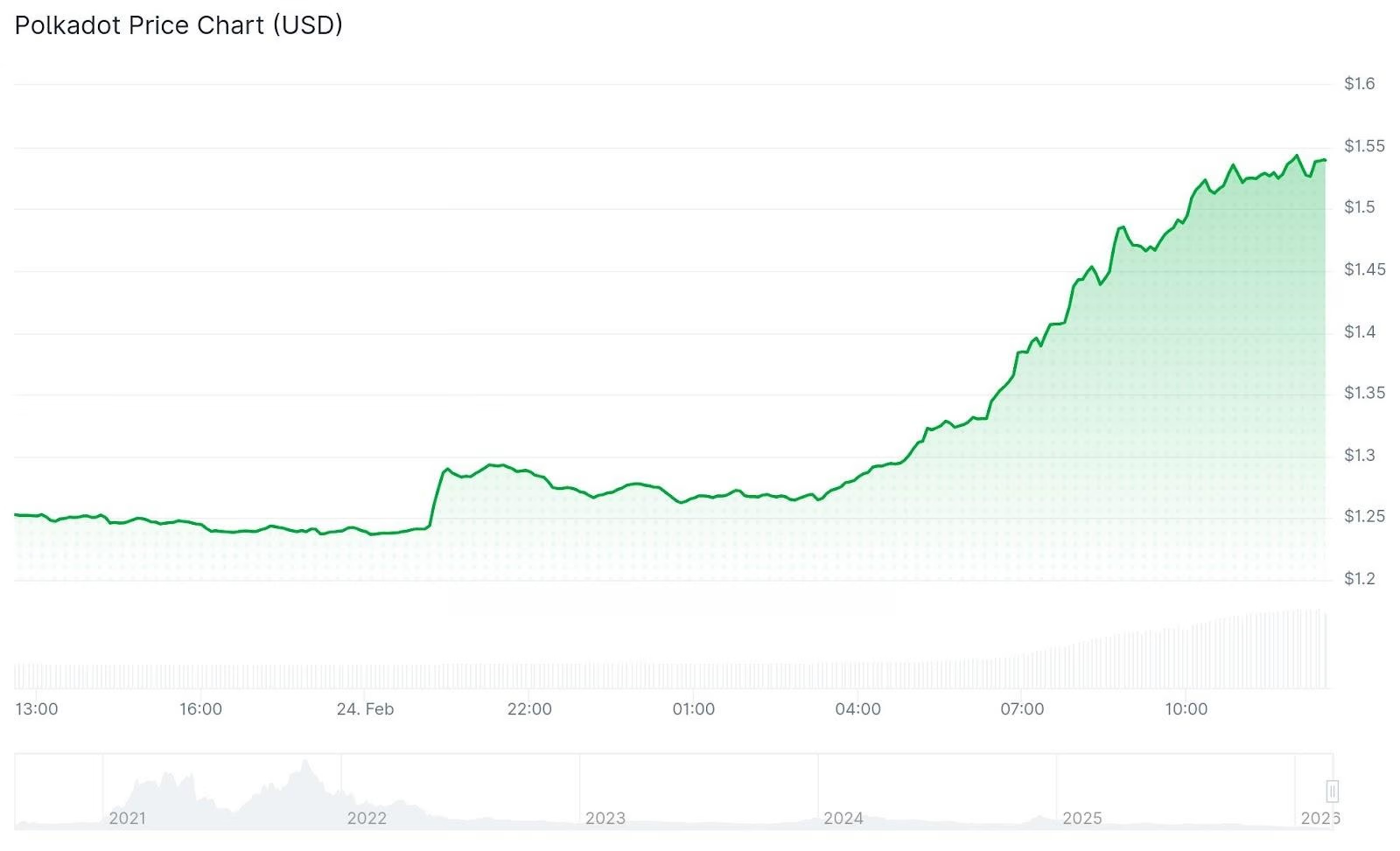
DOT rises as investors look toward a coming supply cut, though analysts say the move may be driven by market sentiment.
Polkadot’s native token DOT soared on Wednesday, Feb. 25, making it the top performer among large-cap cryptocurrencies just weeks before the network’s planned supply halving.
DOT is currently trading at $1.54, up about 23% over the past 24 hours, according to CoinGecko. The token’s market cap is near $2.6 billion, while daily trading volume has climbed above $420 million.

The rally comes as Polkadot approaches a major tokenomics change scheduled for March 14. The network plans to cut annual token issuance in half and cap the total supply at about 2.1 billion DOT. The move aims to lower inflation and make the token more scarce over time.
This upcoming change, called a “halving,” may be one reason the market is paying more attention to DOT. However, other analysts say the timing of the rally suggests it may be driven more by market sentiment than by Polkadot itself.
“We’re seeing double-digit green candles across the altcoin space. DOT just happens to be one of today’s leaders,” said Danny Nelson, a research analyst at Bitwise. “Nothing’s changed about Polkadot, its users, or its usefulness. There’s no new ‘news’ to catalyze a DOT repricing. I chalk DOT’s 20%+ surge up to market-wide speculation.”
Nelson added that investors are speculating that Bitcoin has reached its bottom. “If that’s so, then you’d certainly expect altcoins to rally, too,” he said. “You can see some positive indicators in Bitcoin’s 24-hour chart.”
Meanwhile, Brian Huang, co-founder of Glider, pointed out that trading activity has also spiked, but the reason for the move remains unclear. “The odd part is there is no clear catalyst for DOT surging today,” He said. “Because of this surge, both spot and perp volume are at their highest levels in the last three months.”
Huang added that while the supply change is important, it doesn’t take effect until mid-March, “so today’s timing feels unrelated.”


The U.K.’s Financial Conduct Authority (FCA) picked Revolut, Monee Financial Technologies, ReStabilise, and VVTX to test stablecoin issuance in its Regulatory Sandbox as regulators move toward a full rulebook.
The FCA said the cohort will trial stablecoin products in real-world conditions, with safeguards in place. The regulator plans to focus on issuance and review use cases that include payments, wholesale settlement and crypto trading. Testing begins in the first quarter of 2026, and the FCA said the results will feed into final stablecoin rules later in 2026.
“We are supporting U.K. stablecoin issuers to ensure they can be trusted for payments, settlement and trading,” said Matthew Long, director of payments and digital assets at the FCA. “It will benefit consumers and financial transactions and help to deliver the FCA’s strategy and the Government’s National Payments Vision.”
Industry pushes back
However, industry leaders have pushed back against the Bank of England’s (BoE) stablecoin caps, saying they limit innovation and prevent the U.K. from becoming the global hub it aims to be.
The BoE published a paper on Nov. 10, 2025, announcing stablecoin caps of between £5,000 and £20,000 for individuals and £1 million to £10 million for businesses. Armstrong asked U.K. users to sign a petition to Parliament for these caps to be reconsidered. The petition has 81,909 of the 100,000 required signatures.
“Stablecoin rules in the U.K. are being finalized, and are at risk of preventing the U.K. from being globally competitive in the digital economy,” Brian Armstrong, CEO and co-founder at Coinbase, wrote on X on Tuesday. He cited a Bank of England proposal to cap stablecoin holdings.
The government has repeatedly pledged to position London as a center for global digital asset activity. However, comprehensive legislation governing stablecoins and wider crypto activity is expected to be approved by parliament only later this year and won’t come into force until 2027.
The regulatory timeline contradicts U.K.’s goal of remaining globally competitive within the industry, Andrew MacKenzie, CEO of sterling stablecoin developer Agant, told CoinDesk in a recent interview at Consensus Hong Kong. He said the introduction of rules is not moving fast enough to support the aspirations of the global crypto hub.
“The U.K. has a long history of being a financial hub,” said Armstrong. “Embracing and encouraging innovation, especially when other countries are moving fast here, is important for maintaining that.”
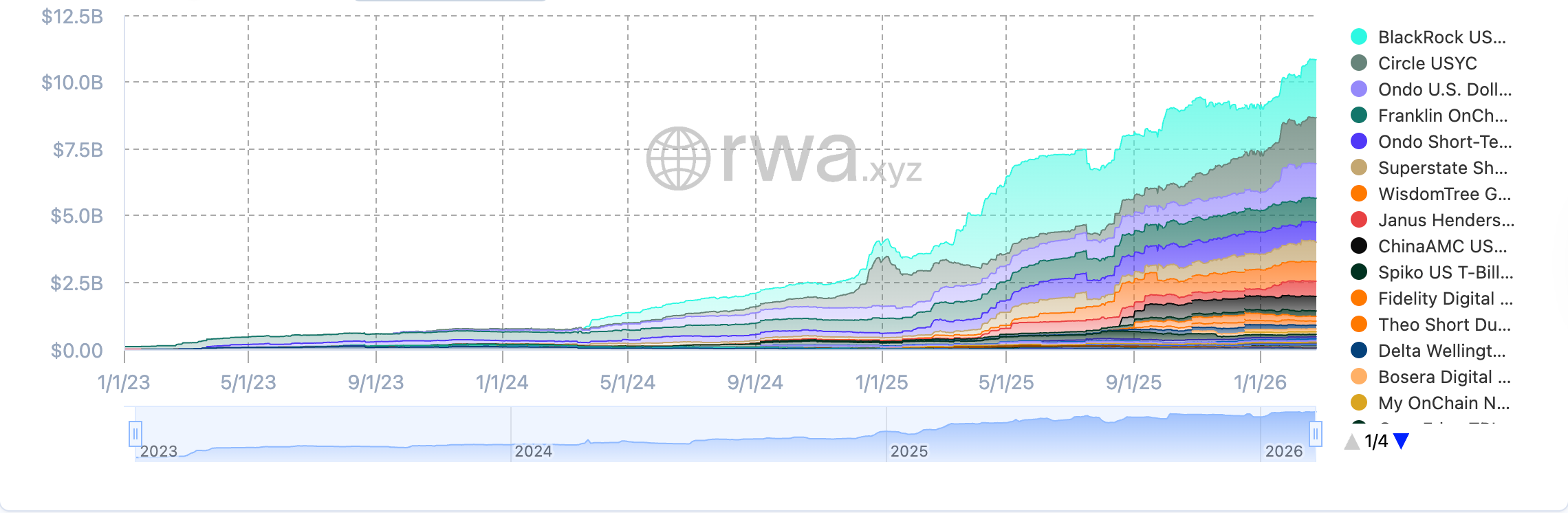
The tokenized US Treasury market has surged by over $1 billion since the beginning of 2026, despite macroeconomic uncertainty and concerns over the US government’s growing national debt.
Tokenized US Treasurys are government debt instruments that are a form of real-world assets (RWAs) represented onchain by a token.
The market capitalization of tokenized Treasurys climbed to more than $10.8 billion at the time of writing from $8.9 billion on Jan. 1, according to data from RWA.xyz.

The tokenized US Treasury market has surged 50x since 2024, according to data from Token Terminal, aided by the March 2024 debut of asset manager BlackRock’s USD Institutional Digital Liquidity Fund (BUIDL), which now has a market cap of more than $1.2 billion.
Tokenized US Treasurys continued to surge despite a broad crypto market downturn that began in October 2025, rising US government debt levels and investor uncertainty about the macroeconomic outlook in 2026.

Related: Tokenized RWAs climb 13.5% despite $1T crypto market drawdown
The Depository Trust and Clearing Corporation to launch US Treasury tokenization service
The Depository Trust and Clearing Corporation (DTCC), which provides clearing and settlement services for global financial markets, announced plans in December 2025 to launch an asset tokenization service, beginning with US Treasurys.
DTCC will eventually expand the service to include a “broad spectrum” of assets, according CEO Frank La Salla.
“Following the tokenization of US Treasurys on the Canton network, DTCC anticipates that exchange-traded funds (ETFs) and equities will come shortly thereafter,” La Salla said.
The DTCC is the largest clearinghouse in the world and settled $3.7 quadrillion in transaction volume in 2024, according to the company.
US Treasurys are considered the backbone of global and corporate finance due to the deep liquidity of the US Treasury market.
Corporations and institutional investors use short-term Treasurys, with a duration of one-year or less, as a proxy for physical cash.
The surge in tokenized US Treasurys and other US government debt could bring an influx of revenue to the blockchain networks where tokenized assets are minted, supporters of the technology say.
Magazine: TradFi is building Ethereum L2s to tokenize trillions in RWAs: Inside story
Bitcoin’s Stablecoin Supply Ratio has fallen to 9.36, a level often viewed as sidelined buying power ready to deploy.
Bitcoin’s Stablecoin Supply Ratio (SSR) has dropped to 9.36, a level historically associated with significant buying power waiting on the sidelines, but on-chain data shows this metric is flashing a false signal.
According to analyst Axel Adler Jr., the decline is being driven by capital leaving the ecosystem rather than stablecoin accumulation, which fundamentally alters how investors interpret this classic bullish indicator.
Liquidity Drain, Not Dry Powder
The SSR measures Bitcoin’s market capitalization against total stablecoin supply, with lower readings traditionally suggesting ample stablecoin liquidity available to purchase BTC. However, current conditions tell a different story.
In a February 25 brief, Adler pointed out that USDT capitalization peaked at $187.2 billion on December 30, 2025, and has since contracted to $183.6 billion, a $3.6 billion outflow over 60 days. Additionally, the 30-day change has remained negative for 34 consecutive days, now sitting at -$3.08 billion.
This matters because SSR’s mathematical decline stems from both components weakening simultaneously. Bitcoin’s market cap has dropped roughly 27% during this period, while stablecoin supply also contracted.
“Technically SSR falls mathematically because BTC market cap has collapsed, but the simultaneous contraction of USDT strips this signal of any bullish potential,” Adler explained.
The Estimated Leverage Ratio confirms the structural weakness, remaining flat around 0.219 across all exchanges for 90 days despite Bitcoin’s sharp correction. This plateau indicates speculative capital isn’t adding new risk, but crucially, isn’t shedding old risk either, thus creating potential for cascading liquidations on further downside.
Aged Supply, Absent Buyers
Bitcoin’s recent price action reflects the fragility described above, with the asset briefly falling below $63,000 on February 24 before recovering to current levels around $65,400. This price represents a dip of more than 25% across the last 30 days and nearly 27% over one year.
You may also like:
HODL Waves data published recently also revealed a defensive market structure beneath the price action. Coins last moved 3 to 6 months ago now comprise approximately 26% of the circulating supply, up from 19% earlier this month.
These correspond to purchases near the November 2025 peak above $120,000, now held at a loss. Meanwhile, the 6 to 12 month cohort has grown to about 20%, while coins moved within the past month account for less than 10% of supply.
Furthermore, the Realized Cap Net Position Change confirms capital exiting the network, standing at -2.26% over 30 days with $33 billion in value compression since late November.
The distinction between SSR decline through outflow versus accumulation carries real implications. According to Adler, for a genuine trend reversal, two things must happen at the same time: the 30-day USDT change returning to sustained positive territory (confirming fresh capital inflow) and ELR beginning to rise during price stabilization. Until then, the analyst says Bitcoin’s low SSR represents not opportunity, but the mathematical residue of capital departure.
Binance Free $600 (CryptoPotato Exclusive): Use this link to register a new account and receive $600 exclusive welcome offer on Binance (full details).
LIMITED OFFER for CryptoPotato readers at Bybit: Use this link to register and open a $500 FREE position on any coin!

Vernon Kay gives rare glimpse into marriage with wife Tess Daly

Japanese Yen Slides on China Export Bans, Rate-Hike Tensions

rises 3% after earnings beat, lifting AI miners CIFR, IREN, WULF,


-

 Video6 days ago
XRP News: XRP Just Entered a New Phase (Almost Nobody Noticed)
-

 Politics4 days ago
Baftas 2026: Awards Nominations, Presenters And Performers
-

 Fashion5 days ago
Weekend Open Thread: Boden – Corporette.com
-

 Sports2 days ago
Women’s college basketball rankings: Iowa reenters top 10, Auriemma makes history
-

 Politics2 days ago
Nick Reiner Enters Plea In Deaths Of Parents Rob And Michele
-
 Sports7 days ago
Clearing the boundary, crossing into history: J&K end 67-year wait, enter maiden Ranji Trophy final | Cricket News
-

 Crypto World2 days ago
XRP price enters “dead zone” as Binance leverage hits lows
-

 Business3 days ago
Mattel’s American Girl brand turns 40, dolls enter a new era
-

 Business3 days ago
Law enforcement kills armed man seeking to enter Trump’s Mar-a-Lago resort, officials say
-

 Tech1 day ago
Unsurprisingly, Apple's board gets what it wants in 2026 shareholder meeting
-
 NewsBeat2 days ago
‘Hourly’ method from gastroenterologist ‘helps reduce air travel bloating’
-

 Tech3 days ago
Anthropic-Backed Group Enters NY-12 AI PAC Fight
-

 NewsBeat3 days ago
Armed man killed after entering secure perimeter of Mar-a-Lago, Secret Service says
-

 Politics3 days ago
Maine has a long track record of electing moderates. Enter Graham Platner.
-
 NewsBeat24 hours ago
Police latest as search for missing woman enters day nine
-

 Crypto World24 hours ago
Entering new markets without increasing payment costs
-
 Sports2 days ago
2026 NFL mock draft: WRs fly off the board in first round entering combine week
-

 Crypto World6 days ago
83% of Altcoins Enter Bear Trend as Liquidity Crunch Tightens Grip on Crypto Market
-

 Business1 day ago
True Citrus debuts functional drink mix collection
-

 Business1 day ago
WBD says Paramount makes higher bid, board will weigh offer against Netflix deal