
Crypto World
What is Zero Knowledge Proof (ZKP)? A $100M Self-Funded Layer-1 Powering Private AI and Driving Massive Growth


In recent years, millions of traders and crypto users have experienced what it feels like when personal data gets exposed. Exchange leaks, identity verification breaches, wallet tracking, and analytics tools have made privacy a growing concern in digital finance. Many blockchain networks record everything publicly, making transactions transparent but not always private. For users who value security, that model no longer feels enough.
This is where Zero Knowledge Proof (ZKP) enters the conversation. ZKP is a Layer-1 blockchain built around one clear principle: prove computation is correct without revealing the underlying data. Instead of exposing sensitive information, it validates results while protecting privacy. In a market where trust is often tested, Zero Knowledge Proof (ZKP) is gaining attention as the top crypto to buy today for those seeking a more secure blockchain foundation.
What is Zero Knowledge Proof (ZKP)?
Zero Knowledge Proof (ZKP) is a Layer-1 blockchain built to validate computation without revealing the underlying data. In simple terms, the network allows a result to be proven correct while keeping sensitive inputs private. This approach is central to zero-knowledge cryptography and is the foundation of the entire ZKP ecosystem.
The project was developed with a strong commitment to readiness. Before launching its presale, the team invested $100 million of self-funded capital into building the blockchain architecture, proof systems, and supporting infrastructure. This build-first model reduces risk and signals long-term focus.
Core features include:
- A privacy-focused Layer-1 blockchain
- Zero-knowledge validation of computation
- Architecture designed for secure AI workloads
- Integration with real hardware through Proof Pods
For newcomers exploring options in today’s market, ZKP stands apart because it already operates with infrastructure in place. This foundation strengthens its case as the top crypto buy today, especially for those looking beyond early hype and into practical execution.
Live Presale Auction: Stage 2 Momentum Builds
Zero Knowledge Proof (ZKP) is currently in a structured crypto presale auction that distributes coins in progressive stages. The presale has already raised $1.85 million, showing early traction. At present, Stage 2 is closing in 6 days, marking a critical point in the auction cycle.
Market observers and analysts have noted the pace of participation. Some experts project that if momentum continues, the ZKP presale auction could reach $1.7 billion, highlighting expectations around the project’s scale.
Below is the current auction snapshot:
| Category | Details |
| Current Stage | STAGE 2 : ROUND 4 |
| Total Raised | $1.85M |
| Yesterday’s Closing Price | $0.00007 USD |
| Auction Day | 77 / 450 |
The auction model allows price discovery across stages rather than through a fixed-price sale. This structured progression creates measurable entry points and encourages sustained participation. For those searching for the top crypto buy today, the combination of raised capital, staged structure, and projected growth gives ZKP a strong position within the current presale market.
Proof Pods: A Working Product Backed by $17M
Proof Pods represent the tangible layer of the Zero Knowledge Proof (ZKP) ecosystem. These physical devices are designed to generate verifiable computation for the network. Instead of relying solely on digital staking models, ZKP connects blockchain incentives to measurable hardware performance.
The project allocated $17 million specifically for Proof Pods creation, covering development, production, and logistics. This investment demonstrates that Proof Pods are not conceptual but operational components of the network’s design.
Key benefits of Proof Pods include:
- Real hardware participation in blockchain validation
- Generation of cryptographic proofs
- Decentralized distribution of computing power
- Accessibility for non-technical users
Proof Pods strengthen decentralization while tying network rewards to real activity. For presale participants, this working product provides tangible backing to the blockchain’s function.

When evaluating the top crypto buy today, projects with operational hardware and capital commitment often stand out. ZKP’s integration of Proof Pods shows that it is building a functioning ecosystem rather than relying purely on token demand.
Final Say
Zero Knowledge Proof (ZKP) combines three critical elements rarely seen together in early-stage blockchain projects: a fully developed Layer-1 architecture, a structured live presale auction, and a working hardware product in Proof Pods. With a $100 million self-funded development, $17 million allocated to hardware, and a presale that has already raised $1.85 million, ZKP demonstrates preparation and execution before scaling further.
As Stage 2 closes in 6 days and experts project the presale could reach $1.7 billion, the project continues to build measurable momentum. The staged auction structure provides transparency, while Proof Pods anchor the network in real-world computation.
For newcomers seeking the top crypto buy today, Zero Knowledge Proof (ZKP) presents a strong combination of privacy technology, financial commitment, and live participation mechanics. Rather than promising future development, ZKP enters the market with infrastructure already built and an ecosystem actively expanding.

Explore ZKP:
Website: https://zkp.com/
Buy: https://buy.zkp.com
Telegram: https://t.me/ZKPofficial
Disclaimer: This is a Press Release provided by a third party who is responsible for the content. Please conduct your own research before taking any action based on the content.


Crypto World
XRP Whale Accumulation Hits 30-Day High: Could Ripple (XRP) Be Gearing Up for a Breakout?
Key Takeaways
- On March 26, XRP’s Sharpe Ratio shifted into positive territory, indicating that current returns are outpacing associated risks
- Large holder inflows have maintained an average of $9 million daily over 30 days, marking the most sustained accumulation period since the April–July 2025 window
- Futures open interest jumped 14.8% within 24 hours on March 26, though recurring long position liquidations reveal derivatives market instability
- Following a breakdown from an ascending triangle formation, XRP has declined 13.63% across 10 days, with critical support zones at $1.27 and $1.11 under watch
- Price projections from various analysts and forecasting models span from $5.35 by 2030 to optimistic multi-year targets between $17 and $27
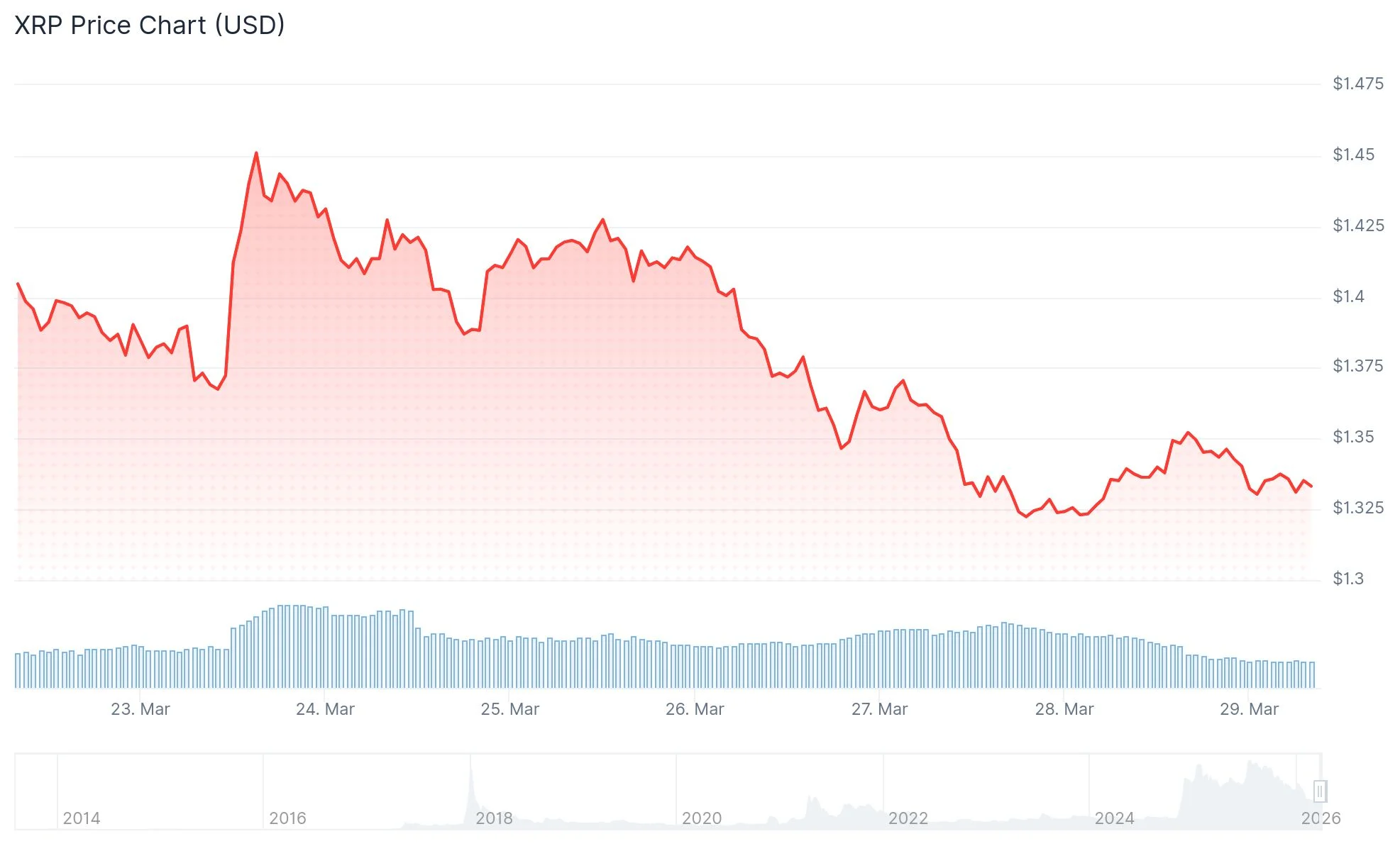
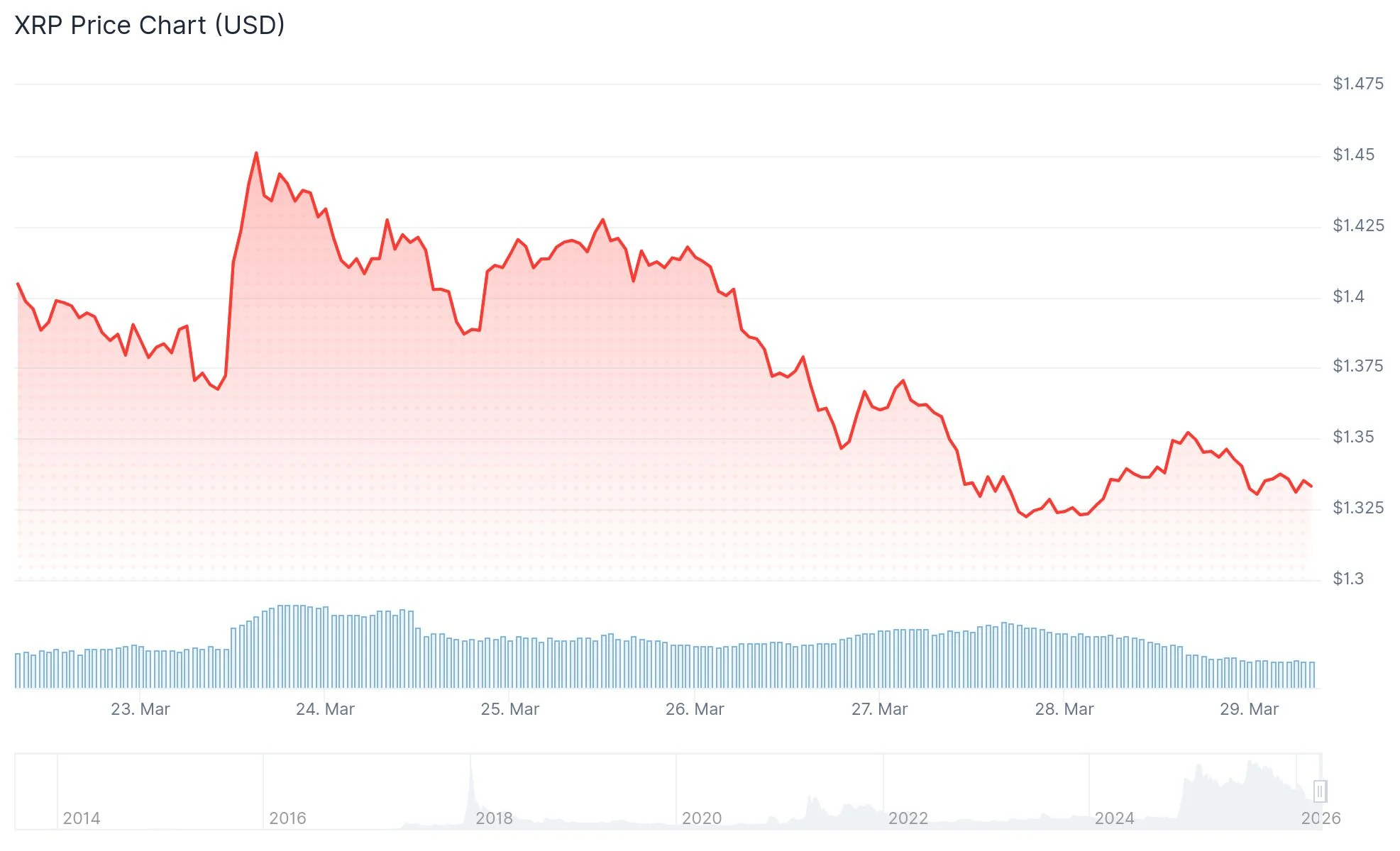
Ripple’s native token is currently changing hands between $1.33 and $1.40, hovering near recent lows following a challenging period of downward momentum. The digital asset has shed 13.63% of its value over the last 10 days after failing to hold support within a bullish ascending triangle formation.
Despite this bearish price movement, certain blockchain metrics are beginning to reveal encouraging trends developing under the hood.
The risk-adjusted return metric for XRP crossed into positive territory on March 26. With the 30-day average return registering at 0.00063 and a Sharpe Ratio of 0.0267, crypto analyst Arab Chain noted that this reading implies “current returns still exceed risk” and indicates a “gradual positive rebalancing” for the digital asset. The analyst cautioned that if this indicator reverses back into negative values, it could foreshadow renewed volatility.
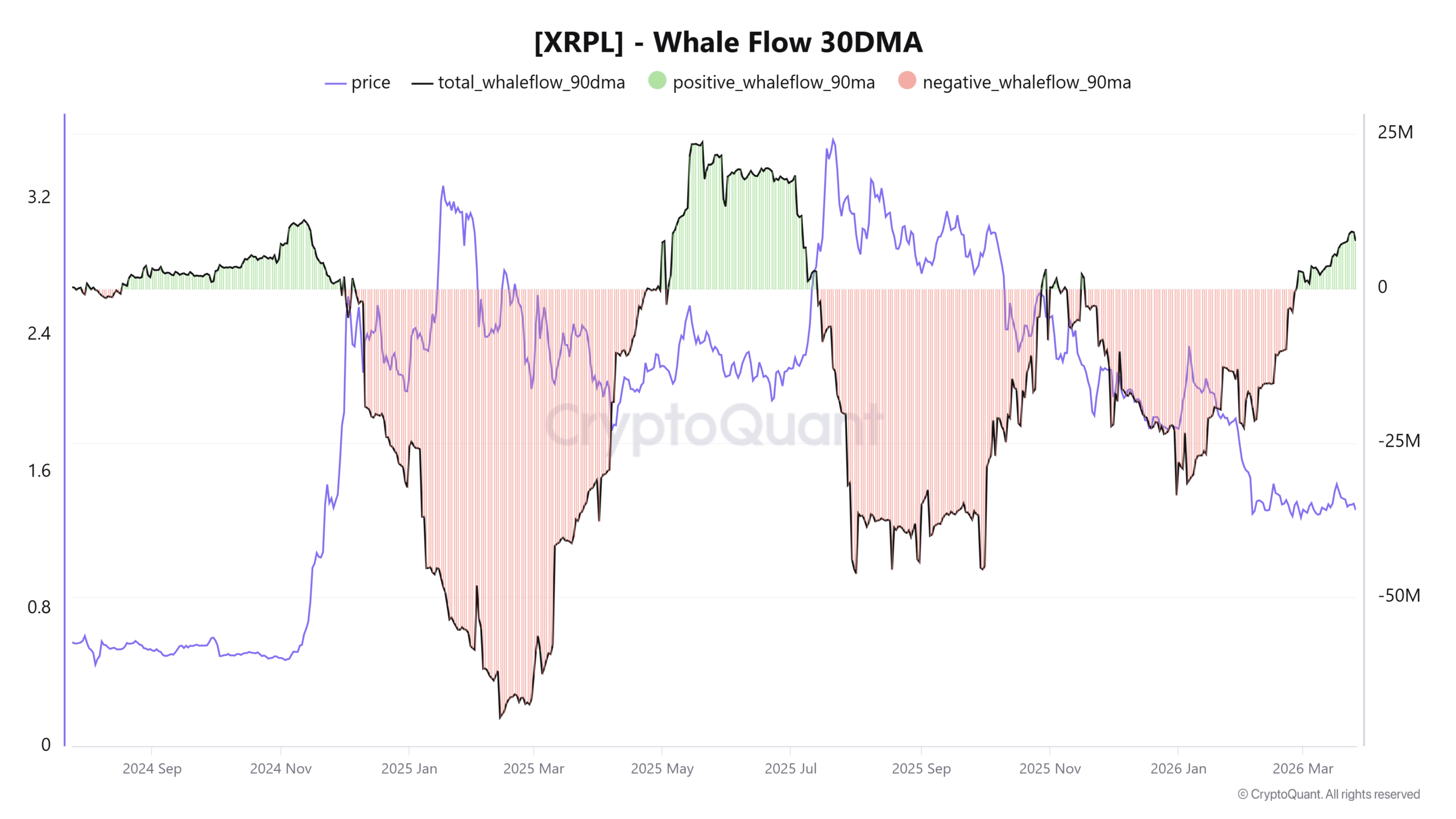
Large wallet activity has also intensified. The 30-day moving average for XRP whale-sized inflows now stands at $9 million daily. This accumulation trend has persisted since February 27 — representing the longest uninterrupted streak since the April through July 2025 timeframe. That previous accumulation cycle culminated with XRP reaching its all-time peak of $3.65 on July 18, 2025.
Derivatives Market Under Pressure
Crypto analyst Amr Taha highlighted that the 24-hour change in open interest reached 14.8% on March 26, representing the highest reading since March 4. This indicates fresh trader engagement in the market. However, the underlying data also reveals a pattern of heavy long positioning being systematically eliminated.
Liquidation events exceeding $2.5 million occurred on March 18, followed by $2.45 million on March 21 and another $2.15 million on March 26. These consecutive liquidation waves suggest a vulnerable futures environment, where speculative positions continue to be forced out during brief volatility spikes.
Should present market dynamics persist, market observers anticipate possible retests of the $1.27 support level and the yearly low around $1.11.
Extended Price Forecasts Show Wide Range
Analyst Egrag Crypto has identified a macro-scale ascending triangle pattern for XRP with Fibonacci-based targets at $8, $17, and $27, describing the ongoing pullback as a “retest phase” that represents “normal and necessary” price behavior. Fellow analyst Dark Defender projects XRP could potentially climb into the $5 territory.
CoinCodex algorithmic forecasts estimate XRP reaching $1.64 by the close of 2026, advancing to $5.35 by 2030, $8.06 by 2040, and ultimately $13.42 by 2050.
The potential passage of cryptocurrency regulatory clarity legislation is also mentioned as a possible price catalyst, considering XRP’s documented sensitivity to regulatory developments.
XRP whale-tier inflows have maintained positive territory for more than 30 days, with the rolling 30-day average positioned at $9 million per day as of late March 2026.


Key Points
- Orlando-based Goliath Ventures has initiated Chapter 11 bankruptcy proceedings in Florida’s Southern District
- Company founder Christopher Delgado faces federal wire fraud and money laundering accusations following his February 24 arrest
- Federal prosecutors claim the operation functioned as a $328 million Ponzi scheme targeting more than 2,000 victims
- Investigators say investor capital financed early participant payouts, high-end real estate purchases, and extravagant lifestyle expenses
- A civil class-action complaint targets JPMorgan Chase for allegedly facilitating questionable financial transactions
An Orlando-based cryptocurrency enterprise, Goliath Ventures, has formally submitted Chapter 11 bankruptcy documents to the U.S. Bankruptcy Court in Florida’s Southern District.
This legal action follows the February 24 detention of the company’s founder and chief executive, Christopher Delgado, who now confronts serious charges including wire fraud and money laundering.
The firm previously operated under the name Gen-Z Venture Firm prior to its corporate rebrand.
Federal investigators contend that Delgado orchestrated the enterprise as a fraudulent Ponzi operation spanning from January 2023 to January 2026.
Participants were promised that their investments would yield consistent monthly profits via cryptocurrency liquidity pool strategies. Prosecutors assert these representations were entirely false.
According to charging documents, the collected capital was actually diverted to satisfy obligations to earlier participants, reimburse select investors their original deposits, and bankroll expensive corporate events alongside luxury vacation expenses.
Federal authorities estimate Goliath secured no less than $328 million from victims through these deceptive assurances.
Delgado also allegedly acquired four high-end residential properties, with individual valuations ranging from $1.15 million to $8.5 million.
Should prosecutors secure convictions on all counts, Delgado could receive a maximum sentence of 30 years in federal custody.
Thousands of Victims Identified Nationwide
The purported fraudulent operation affected more than 2,000 investment participants throughout the United States.
Gregory Wilson appears among those suffering the most substantial financial harm, with documented losses totaling $8.74 million. John Euliano reportedly lost approximately $1.28 million, based on bankruptcy documentation.
Chapter 11 bankruptcy protection enables an organization to reorganize its financial structure while operating under judicial oversight. This process temporarily halts withdrawal requests and establishes a framework for creditors to potentially recover funds rather than forcing immediate asset liquidation.
Major Financial Institutions Face Civil Litigation
A distinct class-action legal complaint was lodged against JPMorgan Chase earlier this month.
The civil filing accuses the banking institution of overlooking suspicious financial activity connected to Goliath Ventures’ operations.
Plaintiffs further contend that JPMorgan’s commercial relationship with Coinbase, America’s predominant cryptocurrency trading platform, facilitated the scheme’s expansion to its alleged massive scale.
Neither JPMorgan nor Coinbase currently faces criminal prosecution. The lawsuit represents a civil action initiated by investors pursuing monetary compensation.
The bankruptcy case continues to advance through the Southern District of Florida judicial system.


Google is preparing to support a large data center project in Texas that Anthropic has leased, as major AI companies race to secure more computing power in the United States.
Summary
- Google is expected to help finance Anthropic’s Texas campus as AI infrastructure demand keeps rising.
- The Nexus site could deliver 500 megawatts by late 2026 and expand to 7.7 gigawatts.
- A federal judge blocked the Pentagon from branding Anthropic a supply-chain risk during litigation now.
The project links a fast-growing AI developer with one of its biggest cloud partners at a time when Anthropic is also fighting a legal battle with the Pentagon.
The Texas project is operated by Nexus Data Centers and could cost more than $5 billion in its first phase, according to the Financial Times. The report said Google is expected to provide construction loans, while a group of banks is competing to arrange more financing by mid-year.
Anthropic recently signed a lease for the 2,800-acre campus, and construction is already underway. Early-stage debt financing came from Eagle Point, while the site is expected to deliver about 500 megawatts of capacity by late 2026, with room to expand to 7.7 gigawatts later.
The project adds to a broader partnership between Google and Anthropic. Anthropic said in October 2025 that it would expand its use of Google Cloud TPUs and services, with plans to access up to 1 million TPUs for training and serving Claude models.
Google’s support for the Texas buildout shows how the competition for AI infrastructure now goes beyond chips and cloud contracts. The planned campus also sits near major gas pipelines, which could let the operator use on-site gas turbines instead of relying only on the public grid.
At the same time, Anthropic won temporary relief in court. A federal judge in San Francisco blocked the Pentagon from branding the company a “supply-chain risk” while the case moves forward, saying the government’s action appeared punitive rather than security-driven.
Judge Rita Lin also said the government acted in an “arbitrary” way, according to reporting from the Associated Press and other outlets. The ruling does not force the Pentagon to keep using Anthropic’s tools, but it stops broader punitive steps for now.
Military dispute remains unresolved
The legal fight followed a dispute over military use of Anthropic’s AI. The Pentagon clash began after Anthropic refused to loosen safeguards related to surveillance and autonomous weapons.
US military units used Anthropic’s Claude AI during strikes on Iran. That left Anthropic at the center of two fast-moving stories at once: the race to build more AI infrastructure and the debate over how governments should use advanced AI tools.


Peter Van Valkenburgh has warned that the crypto industry may lose a rare chance to secure clear legal protections in the United States.
Summary
- Van Valkenburgh said CLARITY would protect developers from crackdowns driven by politics, discretion, and fear.
- The Senate stalled the bill as banks and crypto firms clashed over stablecoin yields rules.
- Without legislation, crypto firms could rely on guidance that another US administration may reverse later.
His comments came as the CLARITY Act remained stuck in the Senate, leaving the sector exposed to future policy changes if Congress does not turn current guidance into law.
Van Valkenburgh, the executive director of Coin Center, said on Friday that the aim of passing the CLARITY Act is not to trust the current administration, but to “bind the next one.” He argued that the bill matters because it would place developer protections into law rather than leave them dependent on policy choices that can change after an election.
He also warned that a world without those protections could become “grim” for crypto developers. In his view, the absence of legislation would leave the sector exposed to “prosecutorial discretion, political fashion, and fear” instead of clear statutory rules.
The CLARITY Act seeks to create federal rules for digital assets and define when tokens fall under securities or commodities law. The measure is part of a wider push to settle long-running questions over which agency should oversee large parts of the crypto market.
The bill has stalled in the Senate after banks, crypto firms, and lawmakers failed to agree on key terms. One of the main disputes has centered on whether crypto firms and intermediaries should be allowed to offer stablecoin rewards and yield-like products.
In January, the Senate draft would prohibit firms from paying interest to users solely for holding stablecoins. At the same time, the draft would still allow some rewards tied to activities such as payments or loyalty programs.
That issue has become one of the main reasons the crypto market structure bill has struggled to advance. Banks argued such products could pull deposits from the insured banking system, while crypto firms pushed back and said tighter limits would hurt competition.
Current policy may not survive a change in government
The House of Representatives passed its version of the CLARITY Act in July 2025, but Senate talks later lost momentum. Some industry participants fear that, without legislation, crypto firms may have to rely on regulatory guidance that a future administration could reverse.
Van Valkenburgh linked that risk to the years after Gary Gensler led the SEC, whose final day as chair was January 20, 2025. Since then, the SEC has taken a different approach, including a new Crypto Task Force under Commissioner Hester Peirce, but Van Valkenburgh said friendly discretion alone is not enough to secure lasting rules for the industry.
Crypto World
Fundrise Innovation Fund (VCX) Goes On-Chain Through xStocks Partnership for SpaceX and Anthropic Access
Key Highlights
- A collaboration between xStocks and Fundrise will transform the VCX fund into a blockchain-based token called VCXx.
- VCX provides ownership stakes in prominent private firms including SpaceX, OpenAI, Anthropic, and Databricks.
- The on-chain tokenized stock sector recently surpassed $1 billion in aggregate market value.
- Following its NYSE debut, VCX stock climbed from $31 to $575 before retreating to $173 amid short-seller criticism from Citron Research.
- The xStocks platform has facilitated over $25 billion worth of trades and serves more than 100,000 individual token holders worldwide.
Digital securities platform xStocks has revealed a strategic collaboration with investment firm Fundrise to transform the Fundrise Innovation Fund into a blockchain-based asset. The tokenized version, designated as VCXx, will debut on xStocks’ marketplace in the near future.
The Fundrise Innovation Fund operates on the New York Stock Exchange with the VCX ticker symbol. This closed-end investment vehicle provides shareholders with stakes in private companies representing the cutting edge of technology innovation, including SpaceX, [[LINK_START_0]]OpenAI[[LINK_END_0]], Anthropic, and Databricks.
VCX commenced NYSE trading on March 19 at an initial price point of $31 per share. Intense investor interest drove valuations to a peak of $575 per share just days following the public market launch.
The stock experienced significant volatility after short-seller firm Citron Research issued a critical analysis on Thursday. The report highlighted that Fundrise Advisors LLC settled SEC allegations in 2023 concerning undisclosed paid promotions and questioned whether the company might be compensating social media influencers to market VCX shares.
By week’s end, VCX closed at $173, representing a 34% plunge on Friday alone, followed by an additional 5.9% decrease during extended trading hours. Fundrise Chief Executive Ben Miller responded to CNBC, characterizing the criticism as a baseless attack and standing by the fund’s investment strategy.
Understanding the Token Structure
Through the tokenization of VCX, xStocks and Fundrise aim to democratize investment opportunities in private market assets for international investors. Traditionally, gaining exposure to late-stage private enterprises like those within VCX’s portfolio required institutional status or significant personal wealth.
The VCXx digital asset is engineered for compatibility across multiple wallet systems, blockchain protocols, and exchange platforms. Additionally, it enables sophisticated applications such as collateral posting and borrowing within decentralized finance ecosystems.
xStocks operates on technology infrastructure managed by Payward, which serves as the corporate entity behind cryptocurrency exchange Kraken. The service currently offers access to more than 100 tokenized equities and ETFs, having processed cumulative transaction volumes exceeding $25 billion across its global user base of over 100,000 holders.
Payward recently unveiled a collaborative initiative with Nasdaq focused on bridging conventional equity markets with blockchain-based infrastructure, complementing this VCX tokenization effort.
Digital Stocks Reach $1 Billion Threshold
This xStocks-Fundrise initiative arrives as the tokenized securities sector achieves a significant benchmark. Analytics from RWA.xyz indicate that the combined value of blockchain-based stocks surpassed $1 billion earlier this month.
Market concentration remains notable, with two platforms controlling the majority. Ondo commands approximately 58% of market share, while xStocks represents roughly 24% of the sector, based on RWA.xyz data.
A March 2025 analysis by Foresight Ventures observed that the market is coalescing around these established players, citing regulatory compliance requirements, liquidity network effects, and varying tokenization approaches as determining factors.
The VCXx token is scheduled to launch on the xStocks platform in the coming days, according to current projections.


Canada has moved to restrict how political groups receive campaign funds, with a new bill that targets cryptocurrency donations.
Summary
- Canada introduced a bill to ban crypto donations to parties and third parties in elections.
- The proposal also bans prepaid cards and money orders over tracing and anonymity concerns nationwide.
- The bill adds fines, deepfake rules, and tighter controls aimed at protecting election financing systems.
The proposal forms part of a wider push to reduce foreign interference risks and tighten rules around election financing before the next federal vote.
Canada’s federal government has proposed a full ban on cryptocurrency donations to political parties and third parties involved in elections. The measure appears in the Strong and Free Elections Act, which had its first reading in the House of Commons on Thursday.
The bill would also ban donations made through money orders and prepaid cards. The government said these payment methods can make contributions harder to trace and may create room for anonymous funding during election periods.
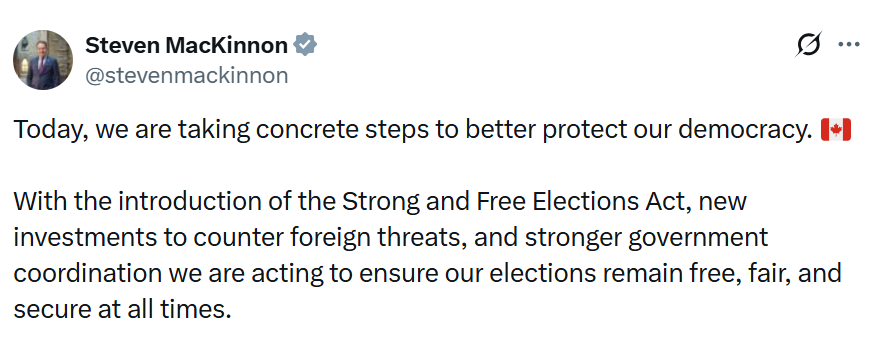
Steven MacKinnon, the government House leader and sponsor of the bill, said the proposed changes aim to protect election integrity. In a statement on X, he said, “With the introduction of the Strong and Free Elections Act, new investments to counter foreign threats and stronger government coordination, we are acting to ensure our elections remain free, fair and secure at all times.”
The proposed amendments would update the Canada Elections Act and require political entities to reject banned forms of payment. The government has framed the bill as part of a broader effort to close gaps that foreign actors could use to influence political activity.
Moreover, this is not Canada’s first attempt to stop crypto donations in politics. A similar proposal appeared in 2024 under then public safety minister Dominic LeBlanc, but it failed to move beyond the second reading and later expired.
Crypto political donations have remained legal in Canada since 2019. Elections Canada has treated them as property donations, but concerns about tracing contributors have continued. In 2024, Chief Electoral Officer Stéphane Perrault recommended a full ban, writing that crypto “poses challenges in identifying a contributor.”
Bill also sets penalties and wider election rules
If Parliament passes the bill, political groups would need to return, destroy or transfer prohibited contributions to the chief electoral officer. The proposed penalties include fines of up to twice the amount donated, plus $25,000 for individuals and $100,000 for corporations.
The bill also expands rules on deepfakes that imitate election candidates to mislead voters. Canada’s move came on the same day the UK announced’ plans for a moratorium on crypto political donations, showing that concern over digital election risks now extends beyond one country.
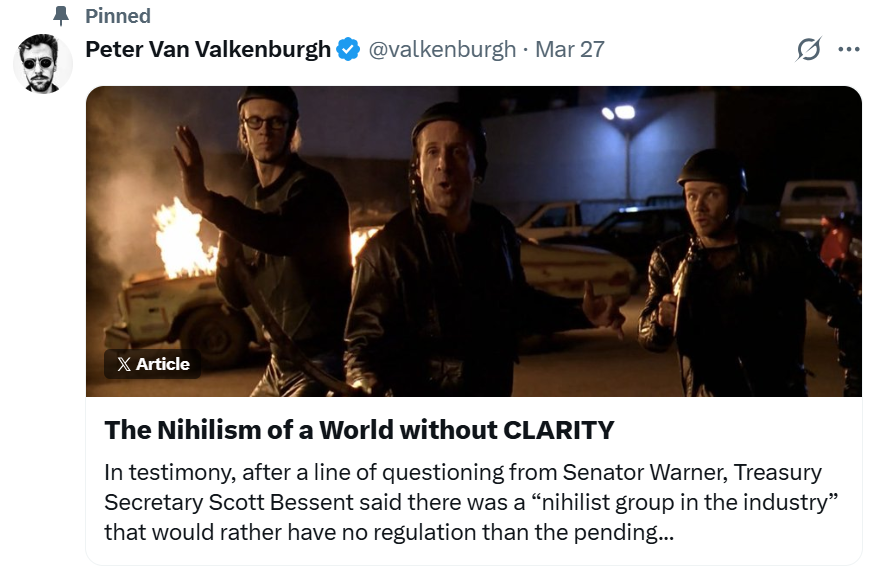
Failing to pass the crypto market structure bill, known as the CLARITY Act, could leave the door open for a future less industry-friendly US government to crack down on crypto again, Peter Van Valkenburgh the executive director of advocacy group Coin Center says.
In an X post on Friday, Van Valkenburgh argued that rejecting developer protections in legislation like the CLARITY Act and the Blockchain Regulatory Certainty Act in favor of “short-term business interests” and the “continued goodwill of those in charge” could lead to a “grim” future for the industry.
“The point of passing CLARITY is not to trust this administration. It is to bind the next one,” he said, adding that “A world without CLARITY’s statutory protections for developers is a world governed by prosecutorial discretion, political fashion, and fear.”
The CLARITY Act stalled in the Senate after banks, crypto firms, and lawmakers failed to agree on key provisions — including whether to allow stablecoin yields. The bill covers a range of measures, including frameworks for registering crypto intermediaries, regulating digital assets and classifying tokens

During the previous US administration, former SEC Chair Gary Gensler drew heavy criticism from the crypto industry for allegedly crafting policy through enforcement actions and legal settlements with crypto firms rather than formal rulemaking.
Nothing set in stone without legislation
Van Valkenburgh also predicts that, without legislative clarification, a future administration’s Department of Justice could ramp up prosecutions of privacy-tool developers as unlicensed money transmitters, and that existing regulatory interpretive guidance could be revoked.
Related: Crypto investor sentiment will rise once CLARITY Act is passed: Bessent
Since Gensler resigned on Jan. 20, 2025, crypto proponents have seen a regulatory shift by the SEC, including the dismissal of several long-running enforcement actions against crypto firms and friendlier guidance on how the agency will treat crypto.
“If we lose this moment because we thought we’d have a bit more revenue and a bit more latitude under the short-term friendly discretion of the current administration, then we lose our way,” Van Valkenburgh said.
“We fail to stand up for the kind of transparency, neutrality, and openness that crypto stands for. And worse, we will have helped tie the noose ourselves, handing it to the future officials who will be only too happy to pull it tight.”
Magazine: Nobody knows if quantum secure cryptography will even work

Canada’s federal government has unveiled a broad proposal to outlaw cryptocurrency donations to political parties and related election processes, part of a wider package designed to curb anonymous and hard-to-trace contributions. The Strong and Free Elections Act was introduced on Thursday to amend the Canada Elections Act, preventing parties and third parties involved in elections from accepting crypto, money orders, and prepaid cards as political contributions.
Stepping up the push against foreign interference and other election threats, the bill’s sponsor, Steven MacKinnon, said the measures aim to “block foreign interference and other threats to elections.” He noted that the legislation expands government coordination and investment in countering such risks, with the goal of preserving free, fair, and secure elections at all times.
Key takeaways
- The bill would prohibit political parties and election-process third parties from accepting donations in cryptocurrency, money orders, and prepaid cards, citing anonymity and traceability concerns.
- If enacted, contributions made via any of the banned methods must be returned, destroyed, or delivered to the chief electoral officer, with penalties up to twice the amount contributed plus fixed fines of $25,000 for individuals and $100,000 for corporations.
- Beyond donations, the legislation expands rules to address deepfakes that impersonate electoral candidates, adding an extra layer of protection for voters.
- The move follows a 2024 recommendation from the chief electoral officer to ban crypto political donations outright due to difficulties in identifying contributors.
- Canada has previously experimented with crypto campaign funding rules since 2019, but a similar ban attempt in 2024 stalled in Parliament before dying on the floor of the House of Commons.
What changes with the Strong and Free Elections Act?
The proposed amendments would revise the Canada Elections Act to close a notable loophole around fundraising. Under current practice, crypto donations have been permitted and treated similarly to property donations, a framework that many policymakers now view as insufficient for ensuring transparency. The new provisions would explicitly bar political actors from receiving crypto, money orders, or prepaid cards, tools often highlighted as vehicles for anonymous funding.
Enforcement provisions are designed to be concrete. Any prohibited contribution would need to be returned to the donor, destroyed, or passed to the chief electoral officer for appraisal and disposition. The penalties attached to violations reflect a deterrent approach: up to twice the amount of the contribution, in addition to statutory penalties of up to $25,000 for individuals and $100,000 for corporate entities.
In tandem with the fundraising clampdown, the bill broadens protections against disinformation by extending the prohibition on realistic political deepfakes that could mislead voters ahead of elections. The inclusion of deepfake safeguards reflects a broader concern raised in the lead-up to recent elections elsewhere, emphasizing the growing intersection of technology and electoral integrity.
Context, history, and what comes next
Canada’s stance on crypto political donations has evolved since the practice was permitted in 2019. If enacted, the Strong and Free Elections Act would mark a decisive shift in how digital assets are treated within the political finance framework. The current proposal follows earlier momentum in 2024, when a prior version of the bill—introduced by then-public-safety minister Dominic LeBlanc—failed to advance beyond the second reading in the House of Commons and ultimately died in that session.
Supporters point to the broader regulatory environment around crypto fundraising in other jurisdictions. For instance, the United Kingdom has signaled a similar intent to cap or pause crypto donations in political campaigns, following independent reviews and political pressure. The cross-border dimension underscores a shared concern among Western democracies about the potential for crypto-based contributions to bypass traditional oversight and donor-identification requirements.
Legislation must progress through the standard parliamentary process to become law. After first reading, the bill would require committee scrutiny, a second and third reading in the House of Commons, passage through the Senate, and finally royal assent from the Governor General. As of the introduction, observers will be watching for committee studies, proposed amendments, and any coalition dynamics that shape the bill’s fate in Canada’s Parliament.
For investors and participants in the crypto space, the proposal signals a continued emphasis on regulatory clarity for political fundraising. While the bill targets a narrow channel—donations to parties and election processes—it sits within a broader pattern of tightening controls around crypto-enabled political influence. Market participants should monitor how lawmakers weigh the balance between transparency, donor privacy, and the need to prevent foreign interference as the legislative process unfolds.
As the debate unfolds, readers should watch for updates on parliamentary progress, potential amendments to the scope of prohibited methods, and any alignment or divergence between Canada’s approach and developments in other major democracies. The coming months will clarify whether crypto fundraising becomes a regulated, clearly defined channel or a fully closed one in Canada’s political financing landscape.
Canada’s federal government has proposed a total ban on cryptocurrency donations to political parties, citing concerns that foreign entities could exploit the technology to interfere in elections.
Known as the Strong and Free Elections Act, the bill was introduced on Thursday and proposed to amend the Canada Elections Act to prohibit political parties and third parties involved in the election process from accepting donations in crypto, money orders and prepaid cards to prevent anonymous and “hard to trace contributions.”
The bill’s sponsor, Steven MacKinnon, the leader of the government in the House of Commons, said in an X statement on Thursday that the measures are intended to block foreign interference and other threats to elections.
“With the introduction of the Strong and Free Elections Act, new investments to counter foreign threats and stronger government coordination, we are acting to ensure our elections remain free, fair and secure at all times,” he said.

Canada is not alone in its concerns. The UK government also announced plans for a moratorium on crypto donations on Thursday, following an independent review and pressure from senior politicians.
First attempt at banning crypto donations failed
The current Strong and Free Elections Act had its first reading in the House of Commons on Thursday. To become law, it must progress through several readings and a committee stage in that chamber, then pass through the Senate before reaching the Governor General of Canada for royal assent.
A similar bill was proposed in 2024 by Dominic LeBlanc, then minister of public safety, but it failed to advance past the second reading in the House of Commons and ultimately died.
Crypto political donations in Canada have been permitted since 2019 and are treated similarly to property donations.
Related: Kalshi legal woes grow with Washington state gambling suit
However, a 2024 report by Stéphane Perrault, the chief electoral officer, recommended a ban on crypto political donations altogether on the grounds that it “poses challenges in identifying a contributor.”
Penalties could be up to twice the amount contributed
If the proposed legislation becomes law, contributions made using any of the banned payment methods must be returned, destroyed or delivered to the chief electoral officer.
Penalties for violations could include up to twice the amount contributed, plus $25,000 for individuals and $100,000 for corporate entities.
The bill also proposes expanding existing bans on realistic deepfakes that impersonate electoral candidates to mislead voters. The issue gained attention in the lead-up to the 2024 US elections, with one reported case involving a deepfake of then-President Biden urging voters not to participate.
Magazine: How crypto laws changed in 2025 — and how they’ll change in 2026

Late-stage private-market exposure is moving on-chain as tokenized equity platforms expand their coverage of prominent technology companies. xStocks announced a collaboration with Fundrise to tokenize the Fundrise Innovation Fund, a closed-end vehicle whose portfolio includes private stakes in Anthropic, Databricks and SpaceX. The plan centers on a new single-token asset, VCXx, slated to go live on the xStocks platform in the coming days, bringing late-stage private tech exposure onto a blockchain-based trading layer.
The Fundrise Innovation Fund has been public for only a short time. It began trading on the New York Stock Exchange earlier this month, delivering a portfolio that includes private shares in several high-profile tech names. In its first days of trading, the fund’s share price swung dramatically, rising from an initial offering around $31 to a late-week peak near $575 before retreating to close the week near $173. The move underscores both the appetite for private-market access and the volatility that can accompany fresh listings in a novel asset class.
Key takeaways
- The Fundrise Innovation Fund is expanding on-chain exposure to its private-tech holdings via the tokenized asset VCXx on the xStocks platform.
- NYSE trading of the fund generated dramatic intraday moves, with a surge from about $31 at debut to a high of roughly $575, before finishing the week around $173; after-hours trading extended the decline by about 6%.
- Regulatory scrutiny looms: Citron Research flagged alleged past SEC charges against Fundrise Advisors LLC for paid solicitation in 2023 and urged regulators to scrutinize whether influencers are being compensated to promote VCX.
- Tokenized stocks as a space surpassed $1 billion in on-chain value, driven by a small group of operators led by Ondo and xStocks, indicating a nascent but rapidly consolidating market for real-world assets on the blockchain.
- Industry observers point to regulatory barriers, liquidity advantages and different tokenization models as key drivers shaping competition and consolidation in tokenized equities.
Fundrise’s on-chain expansion and VCXx
In a move that blends traditional private equity with decentralized finance rails, the tokenized asset VCXx will embody Fundrise’s late-stage private holdings on the blockchain. The collaboration with xStocks positions Fundrise’s Innovation Fund to offer on-chain access to a portfolio that features private stakes in Anthropic, Databricks and SpaceX, among others. Fundrise’s closed-end nature means investors gain exposure to a curated slate of private tech equities, while the tokenization layer aims to unlock on-chain liquidity and potentially broader participation in private markets that have historically been out of reach for many retail investors.
According to the platform’s disclosure, VCXx is expected to launch in the coming days, enabling a tokenized representation of the Fundrise portfolio that traders can access through on-chain settlement, custody and trading workflows. This is part of a broader trend in which real-world assets (RWAs) are being tokenized to provide liquidity, price discovery and programmable access to private-market exposures that were once the sole domain of accredited investors and institutions.
The broader context for this shift is a market increasingly comfortable with on-chain representations of traditional assets, even as it grapples with valuation challenges and the need for robust risk controls. Fundrise’s on-chain push mirrors a wave of tokenized private-market vehicles that have sought to translate the appeal of venture portfolios into a more liquid, transparent format on blockchain rails. Investors are watching not only the potential for improved liquidity but also how governance, custody, and regulatory compliance will evolve in this hybrid space.
NYSE debut, volatility and the regulatory backdrop
The Fundrise Innovation Fund’s public listing on the NYSE was a milestone for asset tokenization and the integration of private-market strategies with traditional equity markets. Yet the initial price action also highlighted the fragility of sentiment around newly listed vehicles tied to private tech. After an opening near $31, the stock surged to a high of around $575, a trajectory that underscored intense investor interest but also the risk of rapid de-rating as the market digested fundamental signals and liquidity dynamics.
By week’s end, the shares had retreated to about $173, a decline of roughly 34% from the intraweek peak, with further after-hours selling compounding the pressure. This sequence has roiled some observers who had expected more orderly price discovery for a vehicle that blends private-market exposure with a listed platform. The volatility prompted scrutiny from market watchers and commentators alike, especially as concerns about valuation practices and the fund’s governance surfaced in public discussions.
In this environment, Citron Research published a report raising questions about Fundrise’s past regulatory interactions. The short-seller asserted that Fundrise Advisors LLC faced SEC charges in 2023 related to paid solicitation activities and urged regulators to examine whether promotions of VCX involve paid influencers. The report fed into broader debate about the governance and transparency of tokenized private-market products, even as Fundrise’s leadership pushed back. Ben Miller, Fundrise’s co-founder and CEO, told CNBC that defenders of the strategy see it as expanding access to high-growth tech companies while critics are pursuing an unfounded smear campaign. Miller emphasized that the firm remains committed to its long-term vision of widening private-market participation through regulated vehicles.
For investors, the headlines carry both risk and potential. A publicly traded vehicle linked to a private-capital portfolio offers a route to exposure that was once out of reach for many, but it also introduces a complex mix of pricing, liquidity and regulatory risk that participants must navigate. The on-chain tokenization layer adds another dimension: it promises faster settlement and programmable features but must establish robust custody, compliance and market-making ecosystems to sustain trust over time.
Tokenized stocks: a growing but concentrated market
Beyond Fundrise, the tokenized-stocks space has been gaining traction as a way for investors to gain crypto-native exposure to traditional equities. Data from RWA.xyz shows that tokenized stocks crossed the $1 billion mark in total on-chain value earlier this month, underscoring growing demand for real-world assets within the crypto ecosystem. While the aggregate figure is sizeable, the activity is currently concentrated among a few operators. RWA.xyz notes that Ondo handles roughly 58% of market activity, with xStocks accounting for about 24% through its tokenized stock offerings. This implies a nascent duopoly in an industry that is still laying down the rules for liquidity, price discovery and regulatory compliance.
In a March 10 report, Foresight Ventures highlighted the market’s consolidation dynamics, pointing to regulatory barriers, liquidity gaps and the varying models used to tokenize assets as key factors shaping competition. The report suggests that the field is moving toward a handful of dominant platforms that can offer deeper liquidity and clearer governance, while smaller players struggle to maintain scale in a fragmented landscape. The evolving regulatory backdrop, including how securities laws apply to tokenized assets and the disclosure standards expected by investors, will continue to define who can participate and under what terms.
For participants in the space, these signals matter. A rising on-chain value for tokenized equities indicates healthy demand for real-world asset exposure in crypto-native infrastructure. Yet the concentration in a few players also raises questions about counterparty risk, platform dependence and the capacity for on-chain markets to deliver durable liquidity in stressed conditions. Observers will be watching how Fundrise’s VCXx deployment interacts with broader on-chain trading, what valuation regimes emerge for tokenized private-market exposures, and how regulators respond to the growing integration of traditional equities with blockchain-based settlement and custody mechanisms.
What investors and builders should watch next
Two threads are especially relevant for market participants. First, the timeline and mechanics of VCXx’s launch will be a focus. If the single-token representation of Fundrise’s Innovation Fund can deliver reliable liquidity and transparent pricing on xStocks, it may become a test case for how other private-market funds approach tokenization. Second, the regulatory dimension remains unsettled. The Citron report and subsequent coverage raise questions about sponsorship, disclosures and the safeguards around influencer-driven promotions in tokenized offerings. Regulators’ forthcoming guidance or enforcement actions could significantly shape how quickly and how broadly on-chain private-market products scale.
Beyond regulation, traders and investors should monitor platform-level dynamics. The tokenized-stocks market’s concentration around Ondo and xStocks will influence liquidity risk and price reliability. The size of the on-chain market—already exceeding $1 billion in value—suggests a tipping point where on-chain and off-chain price signals begin to interact more tightly. As more funds like Fundrise bring private-market assets onto a tokenized layer, the industry will need to demonstrate consistent governance, robust custody solutions and resilient market-making to sustain confidence during periods of volatility or macro stress.
In the near term, market participants should watch the VCXx launch timeline and any updates from Fundrise or xStocks on how the tokenized asset will be structured, priced and traded. They should also keep an eye on regulatory developments and any further disclosures around sponsorship and marketing practices for tokenized products. The convergence of private markets with on-chain infrastructure is still in a discovery phase, but the early momentum suggests a broader rethinking of how private capital can reach a wider investor base—provided the risks are managed with clear, enforceable standards.
As this space evolves, it will be essential to balance the promise of improved access and liquidity with the need for robust governance, transparent disclosures and prudent risk controls. The Fundrise on-chain initiative marks another milestone in that ongoing experiment, one that will likely shape how both traditional asset managers and blockchain-native platforms approach the increasingly blurred line between private markets and digital finance.
Readers should monitor updates from Fundrise and xStocks, regulatory filings and ongoing market data to gauge how the VCXx token performs relative to the underlying private portfolio and how the on-chain execution rails cope with real-world liquidity demands. The coming weeks could show whether this experiment translates into meaningful, durable access to late-stage tech exposure or merely reflects a volatile moment in the early days of tokenized private equities.

One of the Best Harrison Ford Thrillers of All Time Arrives on Free Streaming This April

Arsenal and Man City’s final matches get difficulty rating with one team facing easier run-in

JFK TSA Wait Times Long and Unpredictable Amid Ongoing Shutdown Staffing Shortages

Smart energy pays enters the US market, targeting scalable financial infrastructure

Why Israel is blocking foreign journalists from entering

Bitcoin: We’re Entering The Most Dangerous Phase

5 Harsh FINANCIAL Truth You Must Know Before You Retire

Iran War: Dismantling the British Imperial Financial System Exposed #shorts

CA Foundation QA | Mathematics of Finance -3 | May 2026 | Sankat Mochan 5.0 | Anurag Chauhan Sir
-
 NewsBeat4 days ago
Manchester United reach agreement with Casemiro over contract clause amid transfer speculation
-

 News Videos3 days ago
Parliament publishes latest register of MPs’ financial interests
-

 Sports6 days ago
Remo Stars and Kano Pillars Strengthen Survival Hopes in NPFL
-

 Sports6 days ago
Gary Kirsten Accuses Pakistan Cricket Board Of ‘Interference’, Mohsin Naqvi Responds
-

 Business7 days ago
No Winner in March 21 Drawing as Prize Rolls to $133 Million for Next
-

 Tech7 days ago
Give Your Phone a Huge (and Free) Upgrade by Switching to Another Keyboard
-

 Tech6 days ago
AI enters the chat: New Seattle dating app relies on tech to facilitate meaningful human connections
-

 Business3 days ago
Instagram, YouTube Found Responsible for Teen’s Mental Health Struggle in Historic Ruling
-

 News Videos6 days ago
Ch 9 Financial Management Part 1 | Detailed One Shot | Class 12 Business Studies Boards 2026
-

 NewsBeat1 day ago
The Story hosts event on Durham’s historic registers
-
 NewsBeat4 days ago
Tesco is selling new Cadbury Dairy Milk bar and people can’t wait to try it
-

 Business7 days ago
Will Duke Basketball Win It All? Duke Basketball Enters Second Round as Third Favorite to Claim NCAA Title
-

 Sports6 days ago
2026 Kentucky Derby horses, odds, futures, preview, date: Expert who hit 12 Derby-Oaks Doubles enters picks
-
 Entertainment11 hours ago
Lana Del Rey Celebrates Her Husband’s 51st Birthday In New Post
-
 NewsBeat7 days ago
Update on Wisbech river crash as search for teenage boy enters fifth day
-

 Tech6 days ago
Samsung will soon let you control smart home devices from your car’s dashboard
-
 Entertainment6 days ago
Cynthia Bailey Dishes on ‘RHOA’ Season 17, Discusses Kandi
-
 NewsBeat6 days ago
Colombian military plane with 110 soldiers onboard crashes following takeoff
-

 Fashion5 days ago
Does It Matter What You Wear When You’re Laid Off and Looking?
-

 Business5 days ago
More women enter wealth management, but few in advisory roles: study
You must be logged in to post a comment Login