

Crypto World
What’s next for Bitcoin and stocks? Analysts see a volatile second half



At the same time, he expects macroeconomic uncertainty to remain the dominant force across financial markets. Correlations among stocks, bonds, commodities and cryptocurrencies have risen in recent months, according to Kestrel data, suggesting investors are responding more to policy developments than to company-specific fundamentals.
“The rest of the year is going to be messy,” he said, arguing uncertainty around Federal Reserve policy and Treasury financing could keep markets volatile before financial conditions eventually improve.
Chris Sullivan, co-founder and portfolio manager at digital asset hedge fund Hyperion Decimus, sees a similar backdrop of elevated uncertainty but believes investors are paying too much attention to market narratives and not enough to market mechanics.
He argued that structural changes following the launch of U.S. spot bitcoin exchange-traded funds (ETFs), combined with institutional hedging activity in derivatives markets, have changed how bitcoin trades and weakened many of its historical relationships with broader macro indicators.
Bitcoin’s recent downturn has also challenged the idea that bitcoin had outgrown its traditional four-year cycle. Following the launch of U.S. spot bitcoin ETFs, some market participants argued institutional capital would smooth out bitcoin’s volatility and bring an end to its familiar boom-and-bust pattern. Sullivan disagrees, saying the current decline still fits within historical market cycles and that he is waiting for a final bottoming pattern before declaring the bear market over.



A new independent non-profit, Ethereum Institutional, has launched with the goal of accelerating institutional adoption of Ethereum, its layer-2 networks and the broader ecosystem.
The organization is led by David Walsh, Marius Smith and Matthew Dawson. Walsh previously led the Ethereum Foundation’s enterprise efforts, while the organization said its leadership brings experience spanning institutional engagement, capital markets and Ethereum ecosystem development. It said its mission is to provide institutions with a neutral, independent point of contact as they evaluate Ethereum for tokenization, stablecoins and other onchain financial infrastructure.
In announcing the initiative on X, Ethereum Institutional said institutions need “a credible, independent front door” to the Ethereum ecosystem. While Ethereum’s neutrality is one of its defining strengths, the group argued, that neutrality has often left enterprises without a clear organization to engage as they make long-term infrastructure decisions.
The launch comes as the Ethereum Foundation continues to narrow its role to stewarding the core protocol, with ecosystem participants increasingly spinning up independent organizations focused on specific areas such as business development, institutional outreach and developer support. The shift follows broader changes at the foundation, including leadership restructuring and longstanding community calls for greater transparency.


Investment bank Standard Chartered has initiated coverage of Morpho, calling the lending protocol a dual-play on decentralized finance (DeFi) that combines a lending market with infrastructure for onchain banks and asset managers.
The bank has a $60 price target for MORPHO by the end of 2030, implying roughly 33x upside from its current price. This would see the token outperform both bitcoin and ether (ETH) over the same period.
MORPHO was more than 13% higher over 24 hours, trading around $2.13 at publication time.
“Given its status as one of the largest DeFi lending protocols and its comfortable financial position (it just raised $175 million in VC funding), we think Morpho can scale to meet the expanding base of assets deployed in DeFi,” wrote Geoff Kendrick, head of digital assets research at Standard Chartered, in the Wednesday report.
Decentralized finance has rebounded sharply over the past year as institutional interest in tokenized real-world assets and onchain lending accelerated. Lending protocols have benefited from rising stablecoin adoption and renewed demand for crypto credit, while infrastructure providers that enable asset managers and financial institutions to deploy capital onchain have emerged as one of the sector’s fastest-growing segments.


The European Union has completed its MiCA transition, leaving Tether’s $186 billion USDT without a compliant route onto regulated crypto exchanges across the bloc from July 1, 2026.
Summary
- EU MiCA rules have removed USDT from regulated exchanges after Tether chose not to seek authorization.
- Circle’s USDC and EURC are now the leading MiCA-compliant stablecoins across licensed EU platforms.
- Tether remains active through Hadron-powered partners as global USDT markets adjust to regional regulations.
According to the European Union’s Markets in Crypto-Assets (MiCA) framework, the transition period has now ended, requiring regulated crypto platforms to support only compliant stablecoins.
As a result, MiCA-licensed exchanges including Coinbase, Kraken, and Crypto.com have removed USDT trading for European users, ending the stablecoin’s presence on regulated order books despite its position as the world’s largest stablecoin by market capitalization.
Tether rejected MiCA authorization over reserve requirements
Rather than applying for authorization as an electronic money token (EMT), Tether decided not to pursue MiCA approval. CEO Paolo Ardoino previously argued that the regulation’s reserve rules create systemic risk because issuers must keep at least 60% of reserves in European bank deposits.
Tether’s reserve strategy instead relies heavily on U.S. Treasury securities and other globally diversified assets, making the MiCA framework incompatible with its existing model.
The company’s withdrawal from the European market had been unfolding well before the final deadline. Tether discontinued its euro-pegged EURT stablecoin in 2024, while exchange support for USDT gradually disappeared over the following months.
Coinbase Europe delisted the token in December 2024, Crypto.com followed in January 2025, Binance restricted European USDT trading pairs in March 2025, and Kraken first moved users to a sell-only model before later ending support entirely.
Data on MiCA adoption also illustrates how selective the licensing process has been. Before the July 1 deadline, only 244 MiCA licenses had been issued across the European Union, while several crypto companies opted to expand operations from jurisdictions such as Dubai instead of seeking authorization under the bloc’s new framework.
USDC strengthens its position while Tether keeps European partnerships
As Tether stepped away from the licensing process, Circle took the opposite approach by securing an Electronic Money Institution (EMI) license in France. The authorization can be passported across all 27 European Union member states, allowing both USDC and EURC to operate under MiCA. Their compliant status has made them the primary dollar- and euro-backed stablecoins available on licensed European trading platforms.
The transition has also forced liquidity providers to adjust. According to the report, market makers that previously quoted USDT pairs have begun rebuilding liquidity around USDC because regulated exchanges can no longer offer USDT trading within the European Union.
Even so, Tether has not completely exited the region’s digital asset ecosystem. Companies including StablR and Oobit have launched MiCA-compliant stablecoins, EURR and USDR, using Tether’s Hadron tokenization platform, allowing the company to maintain technology partnerships without issuing a MiCA-approved stablecoin itself.
Elsewhere in Europe, 37 banks including BNP Paribas and ING are developing a common euro stablecoin known as Qivalis, according to the report. The project seeks to provide a regulated euro-denominated alternative as financial institutions increase their participation in the digital asset market.
Recent exchange data also points to changing user behavior beyond Europe. As previously reported by crypto.news, Bybit and OKX disclosed higher user Bitcoin holdings in their latest Proof of Reserves reports, while USDT balances declined on both platforms, suggesting some users are holding less stablecoin liquidity.
In a separate crypto.news report, India’s USDT premium climbed above 8.5% after enforcement action against crypto remittance firms disrupted domestic supplies of the stablecoin, highlighting how regional regulations continue to reshape USDT markets in different ways.

Key Highlights
-
Security Matters shares advanced 6.90% following increased interest in its verification technology.
-
The company’s digital passport system connects plastic materials with authenticated documentation.
-
Stricter U.S. recycling regulations are driving demand for robust verification infrastructure.
-
Security Matters focuses on supply-chain transparency, regulatory compliance, and material authentication.
-
Authenticated recycled plastics could achieve competitive parity with virgin materials.
Security Matters (SMX) stock advanced 6.90% to reach $14.33 following the opening bell, driven by heightened interest in its recycling authentication technology. The stock experienced early gains, softened briefly, then held steady near peak levels. This movement came as investors focused on the company’s material verification platform and evolving U.S. recycling regulations.
SMX (Security Matters) Public Limited Company, SMX
Security Matters Advances Recycling Authentication Technology
SMX has centered its business model on verification-driven recycling rather than general environmental messaging. The company’s Digital Material Passport Platform creates connections between physical plastics and protected digital documentation. Consequently, plastic materials can carry information about source, composition, handling history, lifecycle phase, and regulatory alignment.
The firm employs molecular tagging to establish permanent material identification. This methodology enables brands, producers, and oversight bodies to authenticate recycled plastic throughout every phase. Recycled components can progress through distribution networks supported by enhanced documentation and transparent oversight.
Growing media coverage has elevated Security Matters’ visibility within the recycling technology sector. Numerous prominent publications featured its contributions to plastic authentication and data-driven environmental solutions. The organization’s primary emphasis continues to center on regulatory alignment, supply-chain transparency, and quantifiable recycling results.
Tightening U.S. Regulations Drive Verification System Adoption
The American recycling sector has transitioned toward more rigorous verification requirements. Individual states persistently broaden regulations covering recycled content mandates, collection programs, and producer responsibility frameworks. Consequently, organizations require more definitive documentation when reporting or substantiating environmental commitments.
Corporations encounter intensified oversight as regulatory authorities examine sustainability assertions more thoroughly. Producers require validated information before establishing pricing, purchasing, funding, or disclosing recycled material usage. Municipal governments demand stronger confirmation that collected plastics return to beneficial applications.
SMX addresses this requirement through authentication systems, passport documentation, and compliance-oriented analytics. The platform facilitates recycled-content validation, custody chain records, origin tracking, and lifecycle reporting. Collectively, these capabilities transform scattered recycling assertions into organized datasets.
Security Matters Connects Material Documentation With Market Value
Security Matters’ operational reach extends nationally and touches multiple recycling system components. The organization integrates physical marking, digital documentation, compliance analytics, and marketplace functionality. Accordingly, the platform can facilitate sourcing, capital access, plastic credit systems, and brand authentication.
The firm additionally advances its Plastic Cycle Token and recycled plastic registry framework. These instruments seek to align validated recycling operations with quantifiable financial value. Subsequently, certified materials can compete more effectively against virgin feedstock.
SMX has articulated this transformation through its Age of Parity initiative. The initiative contends that authenticated recycled plastic can emerge as a viable economic alternative. As supply constraints and regulatory pressure intensify, Security Matters presents its verification platform as essential recycling infrastructure.



“Large groups of large companies coordinate poorly, have misaligned incentives, slow things down and rarely create the space for real durable innovation,” he wrote.
Test for the consortium model
That skepticism is shared by Lorenzo Valente, director of digital asset research at ARK Invest, who noted that crypto has seen several consortium-backed stablecoin initiatives over the years, including Meta’s Diem project and Paxos-led Global Dollar Network.
“Every year we get our consortium-style initiative around a stablecoin,” Valente wrote in an X post. “While the set of players here is obviously potent, I remain highly skeptical any of these initiatives can hit scale.”
He said Open Standard’s biggest challenge may be coordinating more than 140 participants with competing interests.
“A consortium of hundreds of rivals has no precedent for working,” he said. “The pace of decision-making across competitors is going to be glacial.”
Valente likened the model to decentralized autonomous organizations, or DAOs, whose governance structures often struggled to make timely decisions.
“‘Owned by everyone’ almost always means accountable to no one,” he said. “I’d bet on the two operators who can ship unilaterally over a committee that has to ask hundreds of rivals for permission.”
He also questioned whether large banks, payment networks and technology companies would remain committed if the project encounters regulatory pressure. Circle and Tether, he noted, have spent years building global regulatory infrastructure and licensing, while a consortium could find it harder to stay aligned if conditions become more challenging.

Cuts of beef are displayed at Handy Market on May 14, 2026 in Burbank, California.
Justin Sullivan | Getty Images
With oil and gas prices falling in the wake of the detente between the U.S. and Iran, prediction market traders now think inflation has peaked.
Speculators on prediction market platform Kalshi think there’s only a 28% chance that headline inflation this year peaks above 4.2%, which was the annual rate of increase in the Consumer Price Index in May.
The next CPI report, measuring inflation in June, is due for release by the Bureau of Labor Statistics (BLS) on July 14.
The contract on Kalshi asks if traders think CPI will deliver a reading above various percentages in 2026. Contracts are resolved using the CPI data released each month by the BLS.
The inflation outlook has eased primarily due to recent declines in its main driver: energy prices. After shooting higher after the start of the U.S.-Iran war jn late February and the subsequent closure of the Strait of Hormuz, gas and oil prices have started to retreat after the partial reopening of the waterway.
Average national gasoline prices as of Wednesday stood at $3.84, according to AAA, down from more than $4.50 at their peak. That reflects weaker U.S. crude oil prices, which have fallen below $70 per barrel for the first time since the war began.
Energy prices in May accounted for 60% of CPI’s month-over-month increase.
Now the decline in gas prices is leading Kalshi traders to think that CPI in June will show prices falling by 0.2% compared with May, in-line with Wall Street consensus estimates.


Coinmetro, an Estonian-based cryptocurrency exchange, has claimed that it has filed “a reorganisation application to the Estonian court.”
In its announcement, it states that this is required because of “an extraordinary situation caused by a failure of one of our financial service providers.”
It further claims that it had already suspended user registrations, deposits, and withdrawals back on June 22.
Interestingly, in the Estonian register both Coinmetro OÜ and Coinmetro Group OÜ are past due on annual reports. Coinmetro Group OÜ is also listed as having a tax debt.
The announcement didn’t disclose which financial service partner led to this failure, and Coinmetro has yet to respond to Protos’ questions regarding that issue.
During a YouTube based “Ask Me Anything” with Coinmetro Chief Executive (and beneficial owner) Kevin Murcko, he claimed that it was actually more than one provider that failed, despite the announcement only claiming one.
He also claimed that there was a multi-year internal investigation, suggesting that this failure happened well before this current announcement.
Additionally, he stated that he originally believed that Coinmetro’s balance sheet was strong enough that this wasn’t originally material, but has become material as Coinmetro has approached the July 1 licensure deadline for compliance with Markets in Crypto Assets regulations.
Prime Trust
The Prime Trust bankruptcy estate (PCT Litigation Trust) filed an adversary proceeding against Coinmetro in August of last year.
This proceeding attempted to clawback withdrawals made in the days immediately preceding bankruptcy.
This proceeding claims that Prime transferred $1,205,751.10 to Coinmetro in the days before Prime’s failure.
Read more: Prime Trust accused of using customer funds to cover lost deposits
The mistakes and fraud committed by Prime apparently make it extraordinarily difficult to determine who was owed which funds from Prime Trust.
This means that Coinmetro didn’t necessarily withdraw more funds than it deposited because of the failure, and Prime Trust is trying to clawback many of the withdrawals from the final days.
Protos reached out to Coinmetro for comment, but it didn’t respond before publication.
Got a tip? Send us an email securely via Protos Leaks. For more informed news and investigations, follow us on X, Bluesky, and Google News, or subscribe to our YouTube channel.
[PRESS RELEASE – St. John’s, Antigua and Barbuda, July 1st, 2026]
XBTFX has announced the launch of its MCP Server and Skills Hub, expanding its developer ecosystem following the introduction of its REST and WebSocket Trading API. The new infrastructure enables compatible software agents, coding assistants, and automation frameworks to connect with eligible live XBTFX trading accounts through structured, authenticated workflows, allowing supported applications to retrieve account information, access market data, and submit structured trading requests.

Intelligent software agents and automation tools are increasingly being used to analyze markets, process news, write code, and support research workflows. However, most remain separate from the trading account itself. While they can assist with analysis, they typically cannot retrieve live account data, inspect open positions, monitor margin, or submit structured account requests without additional integration.
The newly released infrastructure is designed to connect those two environments. XBTFX is not launching a proprietary decision engine, automated strategy, or black-box execution system. Users define their own logic, instructions, permissions, and risk controls, while XBTFX provides authenticated account access, market-data connectivity, and execution infrastructure.
Built as Infrastructure, Not a Trading Strategy
The stack is designed to make trading accounts programmable through structured, authenticated workflows. When a user interacts with a compatible client or software agent to check exposure, retrieve a market price, calculate position size, or prepare a trade with defined parameters, the client converts that instruction into a structured tool call or API request. The natural-language instruction itself is not sent directly to the trading account.
XBTFX authenticates and processes the corresponding account, market-data, or trading request. Users remain responsible for their strategy logic, configurations, credentials, and risk management.
This distinction is especially important for crypto and active CFD traders, where automation and around-the-clock monitoring can be useful while user-defined risk controls remain essential.
Three Ways to Connect
The MCP Server acts as a structured tool layer between compatible clients and the XBTFX Trading API. Supported clients can access balances, margin, positions, orders, history, instrument data, prices and, depending on permissions, submit structured trading requests such as opening or closing positions and modifying stop-loss or take-profit levels.
The Skills Hub provides reusable instructions, endpoint definitions, implementation examples, and developer guidance for software agents and applications that do not connect through MCP directly, including workflows using LangChain, CrewAI, OpenClaw, Claude Code, and custom agent implementations.
The Trading API provides REST and WebSocket access for developers building dashboards, automated strategies, signal-to-execution systems, reporting tools, and account-management applications.
Together, the three access paths provide traders and developers with different ways to connect automated workflows and software agents with eligible XBTFX accounts, depending on their technical setup and use case.
Built for Crypto, Forex, and Around-the-Clock Market Monitoring
The integration layer supports workflows across forex, cryptocurrency CFDs, metals, indices, energies, and stocks, with access to more than 400 instruments. Available instruments and trading conditions depend on the account linked to the API key.
XBTFX also supports BTC, ETH, and USDT-denominated trading accounts alongside major fiat account currencies, giving traders and developers a crypto-denominated environment for automated monitoring, account management, and structured trading workflows.
For crypto-focused traders, the always-on nature of digital asset markets is a key part of the use case. When a software agent or automated process is configured to run continuously, it can monitor market data, account conditions, margin, and exposure outside conventional trading hours and respond according to predefined instructions, validation rules, and risk controls.
XBTFX does not provide trading recommendations through the MCP Server or Skills Hub, and the integration does not determine when a user should buy or sell any instrument.
Developed With HuracanAI
The MCP Server, Skills Hub, Trading API, and supporting execution architecture were jointly developed by XBTFX and HuracanAI, a financial technology firm specializing in brokerage infrastructure, liquidity connectivity, trading bridges, APIs, and software-agent systems.
The collaboration combines brokerage execution infrastructure with agent connectivity, supporting a more programmable model for traders and developers working with live account environments.
Control Stays With the Account Holder
Each XBTFX API key is associated with an individual eligible trading account. Users can manage API keys through the XBTFX Console and revoke them if they are no longer required or may have been exposed.
Because the integration operates with live trading accounts, XBTFX recommends testing account-information and market-data functions first, using limited exposure, and reviewing agent behavior before enabling broader automated workflows.
“Modern software agents and automation tools have become increasingly capable of supporting research and operational workflows, but they have generally remained separate from the trading account itself,” said – Peter Speros, XBTFX executive. “Our infrastructure is designed to provide structured, authenticated access to account information, market data, and account functions while keeping control with the account holder.”
Getting Started
To connect a compatible software agent or supported application, users can open or select an eligible live XBTFX trading account, generate an account-bound API key through the XBTFX Console, and connect through the MCP Server, Skills Hub, or Trading API.
The MCP Server, Skills Hub, and Trading API are available without a separate API subscription or per-request fee. Normal spreads, commissions, financing charges, and other trading costs continue to apply. Documentation is available through the XBTFX Developer Hub and Developer Documentation.
About XBTFX
XBTFX is a multi-asset online broker providing access to global financial markets through contracts for difference. Its product offering includes forex, cryptocurrency CFDs, metals, indices, energies, and stocks. XBTFX serves retail traders, active traders, strategy developers, and technology-focused market participants with trading platforms, execution infrastructure, automation tools, APIs, and developer resources.
For more information, visit the official website.
Risk Warning
Trading leveraged products, including CFDs, involves substantial risk and may not be suitable for all investors. AI agents and automated applications may misunderstand instructions, use incorrect parameters, encounter software or connectivity failures, or behave unexpectedly. Connecting an AI agent to a trading account does not reduce market risk, guarantee execution quality, or improve trading performance. Nothing here constitutes financial, investment, or trading advice. Past performance is not indicative of future results.
The post XBTFX Launches MCP Server and Agent Stack for Crypto and CFD Trading Workflows appeared first on CryptoPotato.
U.S. President Donald Trump has defended the financial gains disclosed in his latest filings after records showed he earned at least $1.4 billion from crypto-related ventures, while market expectations for the CLARITY Act’s passage this year have weakened.
Summary
- Trump defended his investment gains after disclosures showed at least $1.4 billion in crypto-related income.
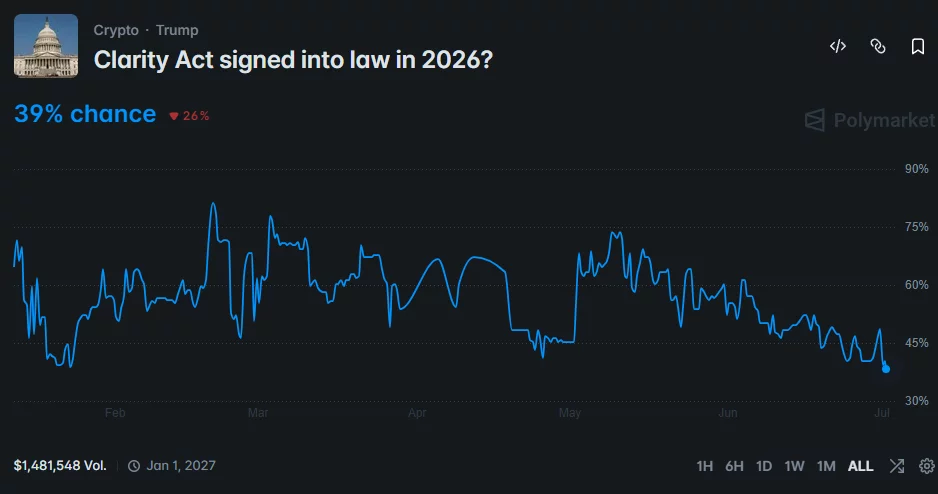
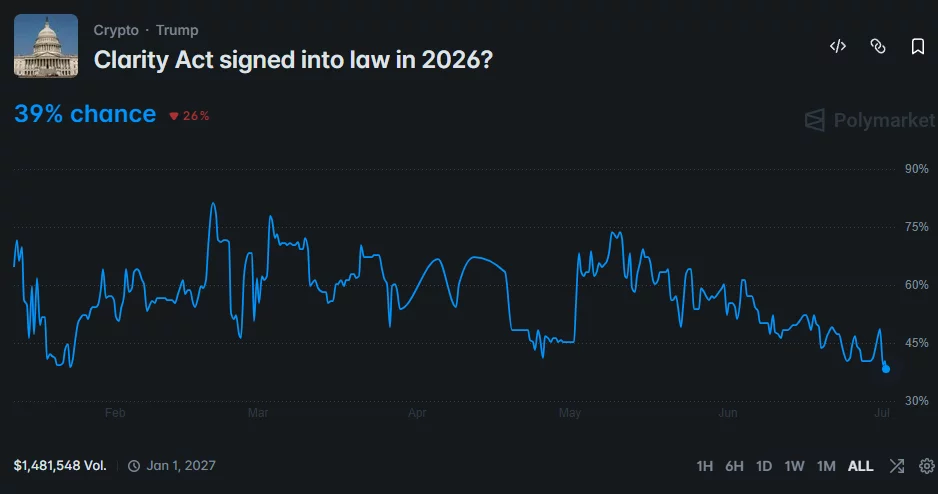
- Polymarket odds for the CLARITY Act passing this year have fallen to 39% amid ethics debate.
- Senate Democrats and Elizabeth Warren have renewed scrutiny of Trump’s crypto business interests.
According to Trump’s remarks to reporters before departing for a trip, the president attributed his investment gains to the strong performance of the stock market rather than to any personal trading decisions. He said his finances are managed by investment funds and added that he is not directly involved in making investment decisions.
The comments came shortly after financial disclosures for 2025 showed Trump reported more than $1.4 billion in income tied to cryptocurrency ventures. According to the filing, much of that income came from licensing agreements connected to the TRUMP meme coin and sales of the World Liberty Financial (WLFI) token.
Although the filing detailed substantial crypto earnings, Trump did not address those revenues directly in his remarks. Instead, he pointed to the stock market rally and noted that many investors had benefited from rising asset prices. His comments also followed speculation in recent weeks that he has been actively trading through investment accounts, although he stated that outside fund managers oversee those assets.
The Trump administration has also maintained investments outside the crypto sector. Among them is Intel, whose shares have risen sharply since the administration disclosed its position in the company.
Political scrutiny has intensified around Trump’s crypto business
The latest disclosure arrives as lawmakers continue debating ethics rules tied to digital asset legislation in Congress.
According to Polymarket data, the probability of President Trump signing the CLARITY Act into law in 2026 has fallen to 39%, indicating traders now see a lower chance of the market structure bill clearing Congress this year.
The disclosure has also renewed criticism from Democratic lawmakers. Following the release, Senator Elizabeth Warren argued that the legislation should include safeguards preventing Trump and his family from continuing to profit from crypto while federal digital asset policy is under consideration.
As previously reported by crypto.news, Senate Democrats recently requested hearings into a reported $500 million investment in World Liberty Financial linked to the United Arab Emirates. The lawmakers questioned whether the transaction had any connection to later U.S. policy decisions involving arms sales and expanded AI chip access for the UAE.
The newly released financial filing adds an official record to that debate by showing crypto generated more reported income for Trump in 2025 than the business segments most closely associated with his personal brand.
Some officials still expect crypto legislation to advance
Despite weakening prediction market odds, several policymakers continue to express confidence that digital asset legislation can still move forward before the end of the summer.
As previously reported by crypto.news, Congress faces a limited legislative window before the Senate begins its recess, leaving the CLARITY Act with only a short period to advance. The timing has become more important as negotiations continue over whether an ethics provision should be included in the final legislation.
Separately, Hester Peirce has maintained an optimistic outlook. According to her recent comments, the U.S. Securities and Exchange Commission commissioner believes Congress can still pass the CLARITY Act during the summer, even as political disagreements over ethics rules continue.
Crypto World
Bitcoin (BTC) climbs toward $60,000 level after Fed Chair Warsh said inflation risks has come down


Bitcoin climbed back toward the $60,000 level on Wednesday after Federal Reserve Chair Kevin Warsh said inflation risks had eased while reaffirming the central bank’s commitment to returning inflation to its 2% target.
Warsh declined to provide guidance on the Federal Reserve’s next interest-rate decision, saying policymakers would debate incoming data at their meeting in four weekds, during a panel discussion at the European Central Bank’s annual forum in Sintra, Portugal.
Instead, he emphasized that the Fed remained focused on price stability.
“Inflation risks have come down,” Warsh said. “If there were people in households or the business sector, in the financial markets, who thought that this central bank was going to be comfortable with an inflation objective above 2%, well, I guess they’d be disappointed. We’re going to deliver price stability in the U.S.”
Bitcoin pared earlier losses to trade back around the $60,000 level, an increase of more than 2% over the past 24 hours, according to CoinDesk Data.

Tragically Overlooked Dark 90s Sci-Fi Was Supposed To Be An American Gundam

Blue Jackets sign Ryan Lomberg to two-year deal

Red teamers turned Claude Desktop into a double agent to do their evil bidding





-

 Fashion5 days ago
Weekend Open Thread: Staud – Corporette.com
-

 Politics5 days ago
The House | Manchesterism won’t survive the painful trade-offs unless it gets citizens on board
-

 Crypto World2 days ago
Strategy authorizes up to $1.25B in Bitcoin sales under new capital plan
-

 Politics6 days ago
Potential 2028er World Cup attendee leaderboard
-

 Business5 days ago
Asia stock markets slide as tech shares slump
-

 News Videos3 days ago
MAJOR BITCOIN & MARKET UPDATE!!!! (MUST WATCH ASAP!!!)
-

 Tech6 days ago
A Look At A Gaggle Of Transputer Boards
-
 Crypto World6 days ago
Dell (DELL) Shares Tumble Over 5% Following Analyst Downgrade to Hold
-

 Crypto World4 days ago
Coinbase, Circle Deepen Crypto Stock Losses Despite Resilient S&P 500
-

 Business2 days ago
Australia treasurer says alleged access of prime minister’s bank data ’incredibly concerning’
-

 Crypto World5 days ago
Kraken's xStocks Opens Bending Spoons IPO Registration to EEA Retail
-

 Sports5 days ago
FIH Pro League: India defeat Pakistan 7-1, register biggest win of campaign | Other Sports News
-

 Crypto World6 days ago
Bitcoin Sparks $600M Hourly Liquidations With $65,000 Set To Become Resistance
-

 Tech4 days ago
Bluekit phishing kit adopts browser-in-the-middle for login theft
-

 Tech4 days ago
Russian hackers now target Signal backup recovery keys
-
Crypto World5 days ago
Hyperliquid Named on Singapore MAS Investor Alert Register
-

 Crypto World5 days ago
RTX holders must register wallets before token distribution begins
-

 Crypto World7 days ago
Ripple and SBI launch RLUSD in Japan after JFSA approval
-

 Tech2 days ago
Anonymous researcher drops 0-day ‘exploitarium’ repo
-

 Sports4 hours ago
Broncos roster: OL Ben Powers (No. 74) entering final year of contract
You must be logged in to post a comment Login