
Crypto World
What’s the Most Likely Scenario for BTC After Reclaiming $70K

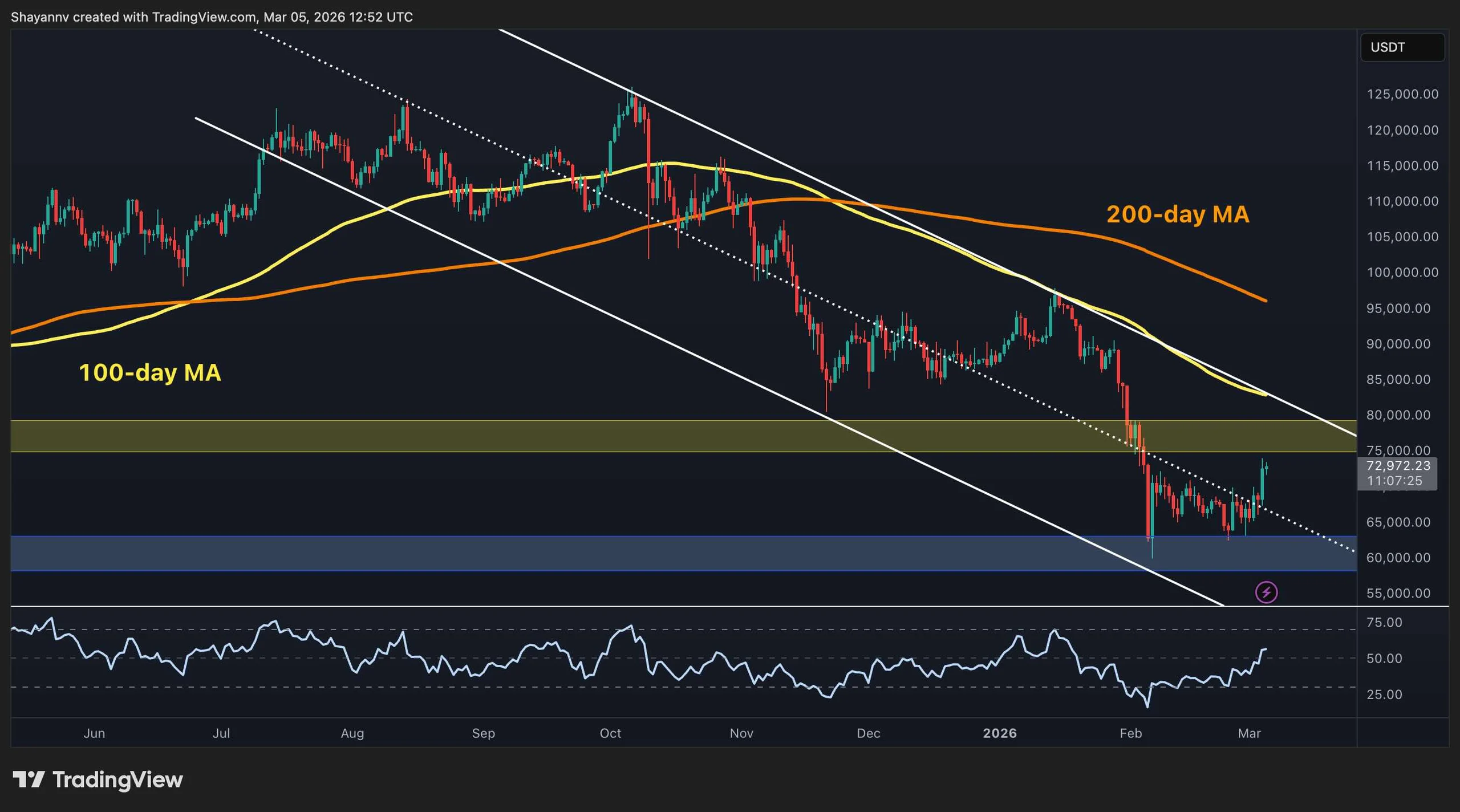
Bitcoin has bounced hard after the liquidation washout in February and is trying to rebuild a short-term uptrend. The asset is now pushing into a heavy resistance band where the last breakdown started, so this move looks more like a recovery leg inside a broader corrective structure than a clean trend reversal.
The key question is whether buyers can turn this squeeze into sustained demand or if it stalls where trapped holders are waiting to sell.
Bitcoin Price Analysis: The Daily Chart
On the daily timeframe, BTC has rallied from the major demand area around $60,000 toward the $72,000 to $75,000 resistance zone. It lines up with the lower part of the previous distribution range and sits just below the declining 100-day moving average, which still caps the medium term trend to the downside.
The price has also climbed back to the upper band of the falling channel that has guided the downtrend since late last year, so this area is where analysts usually ask if the move is just a relief rally or the start of a larger base. A daily close above this resistance cluster and a clean breakout of the channel would be the first real signal that sellers are losing control, and that a new bullish market is in the making.
BTC/USDT 4-Hour Chart
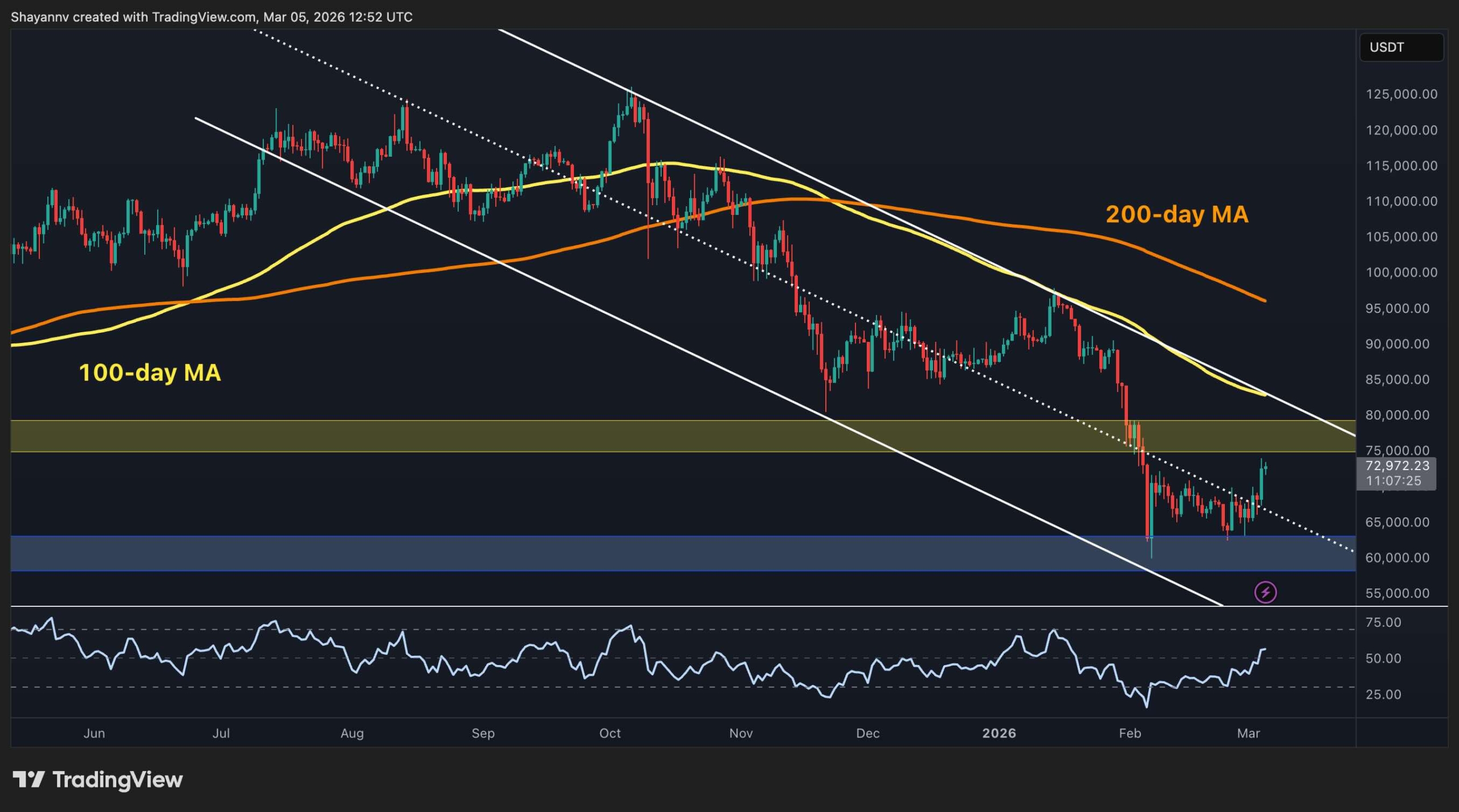
On the 4-hour chart, the drop from early February has turned into a broad consolidation inside a symmetrical triangle that was broken upward in the past few days. The price squeezed out of the contracting range and ran straight into the upper green zone, where it is now moving sideways under roughly $73,000 to $75,000.
The 4-hour RSI is in the strong region and has reached the overbought zone after a sharp vertical leg, which often leads to either a pause or a short-term pullback before any further push higher.
Yet, as long as Bitcoin holds above the broken triangle and the bullish imbalances formed around $70,000, the path of least resistance stays toward a retest of the upper resistance, but a failure back inside the old range would warn that the breakout was mainly a squeeze, and that more downside is probable.

Sentiment Analysis
Bitcoin funding rates across futures exchanges flipped deeply negative during the recent consolidation after the crash, and have stayed mostly below or around zero even while the price bounced. This indicates that many traders are paying to hold short positions into the lows and are now being forced to cover as the market moves against them, which fits the idea of a squeeze-driven rebound rather than a pure fresh spot demand.
The fact that funding is only slowly creeping back toward neutral shows that there is still caution and even residual bearish positioning in the derivatives market.
If this rally continues while funding remains modest, it suggests the move is being supported by real buying and unwinding of crowded shorts, but if funding spikes positive quickly near resistance levels, it would signal that late longs are chasing and that the risk of another shakeout is rising.

Binance Free $600 (CryptoPotato Exclusive): Use this link to register a new account and receive $600 exclusive welcome offer on Binance (full details).
LIMITED OFFER for CryptoPotato readers at Bybit: Use this link to register and open a $500 FREE position on any coin!
Disclaimer: Information found on CryptoPotato is those of writers quoted. It does not represent the opinions of CryptoPotato on whether to buy, sell, or hold any investments. You are advised to conduct your own research before making any investment decisions. Use provided information at your own risk. See Disclaimer for more information.

Crypto exchange Coinbase is reportedly against the latest compromise over stablecoin yields that the Senate is looking to include in its crypto market structure bill.
Coinbase representatives told Senate lawmakers in a meeting Monday that they had concerns over the language around stablecoin yields in the new compromise version of the bill, Punchbowl News reported Wednesday, citing four people briefed on the exchange.
A proposal that circulated earlier this week would have reportedly prevented third parties, such as exchanges, from paying stablecoin yields, a measure aimed at addressing banks’ concerns over the risk of deposit flight.
Coinbase is one of the largest crypto lobbyists in the US, and its withdrawal of support for the bill in January came just before the Senate Banking Committee indefinitely postponed a markup to advance the legislation.
Republican Senator Thom Tillis and Democratic Senator Angela Alsobrooks are leading the latest effort to advance the bill, and talks are reportedly ongoing. Coinbase did not immediately respond to a request for comment.

Yield fight plagues Senate bill
The fight between the crypto and banking lobbies over the Senate’s bill, which aims to outline how regulators should approach crypto, has largely revolved around stablecoin yields.
The White House has hosted at least three meetings for the groups to agree on a compromise, which has yet to materialize.
Banking groups argue that stablecoin yield payments by exchanges are a loophole in the GENIUS Act, which banned stablecoin issuers from paying yield to holders, and present a risk of deposit flight from the banking system.
Stablecoin yields are a major business for crypto exchanges, and the crypto lobby has argued that the risks are overstated and has accused the banks of anticompetitive behavior.
Related: CLARITY Act 2026 odds ‘extremely low’ if not passed before April: Exec
Republicans are pushing to pass the bill ahead of the midterms, where the makeup of Congress could change and derail momentum around the legislation. The House passed its version of the bill, called the CLARITY Act, in July.
Patrick Witt, the executive director of the President’s Council of Advisors for Digital Assets, posted to X on Wednesday that there was “plenty of uninformed FUD [fear, uncertainty and doubt] circulating on social media this week.”
“It’s all going to work out. Bullish,” he added.
Republican Senator Cynthia Lummis also posted to X on Wednesday that “we can’t wait until 2030 for another chance” to pass the crypto bill.
“Bipartisan compromise is necessary for the Clarity Act to pass,” she added. “We’re working around the clock to ensure stablecoin rewards are protected and to prevent deposit flight from community banks.”
Magazine: How crypto laws changed in 2025 — and how they’ll change in 2026
The UK government is advancing plans for a moratorium on political donations made through cryptocurrencies, following an independent review and pressure from multiple high-ranking politicians.
Cointelegraph reported on Wednesday that the Rycroft Review, an independent inquiry into foreign financial interference in the UK’s political and electoral systems, recommended a moratorium on crypto donations to political parties.
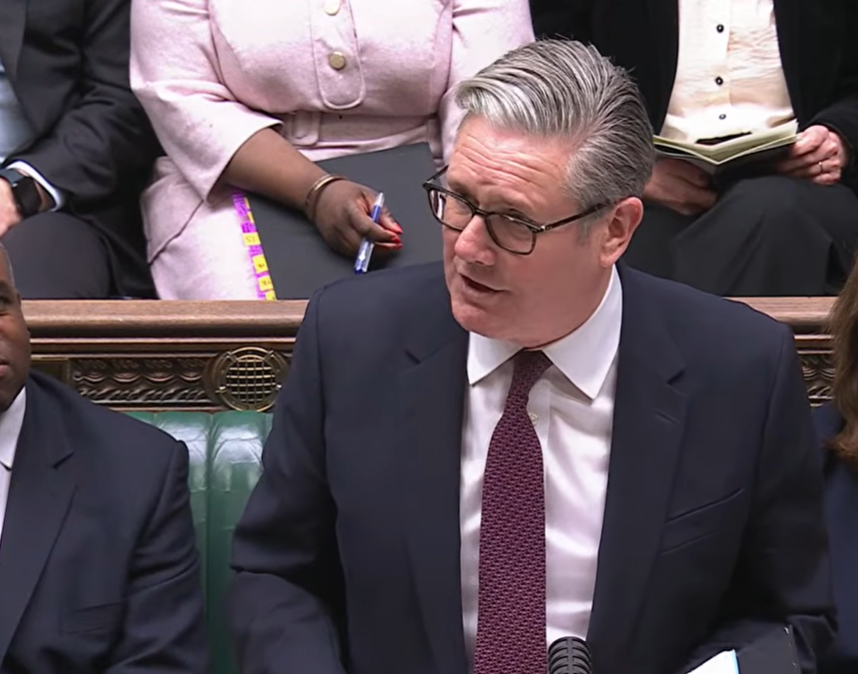
New statements from UK Prime Minister Keir Starmer on Wednesday have confirmed that they will pursue the temporary ban.
“I can tell the House we will act decisively to protect our democracy. That will include a moratorium on all political donations made through cryptocurrencies,” said Starmer during Prime Minister’s Question Time on Wednesday.
Several members of parliament, including the chair of the security committee, have been pushing for a full ban this year, warning that foreign states could exploit crypto payments to influence UK politics.

Under the new measure, crypto will be prohibited for political donations until robust regulations are in place to prevent untraceable funds and foreign interference in UK elections, according to a separate government statement on Wednesday.
Bill still has to pass and become law
The ban would require amending the Representation of the People Bill, and the government said the changes would take “retrospective effect” from March 25.
The legislation is at the committee stage in the House of Commons. It needs to pass through both the House of Commons and the House of Lords, then be approved by King Charles III to become law.

“Once the legislation comes into force, political parties and regulated entities like candidates and MPs will then have 30 days to return any unlawful donations they may have received in the interim, after which enforcement action can be taken,” the government said.
Related: Top UK Labour lawmakers push to ban political donations made in crypto
Reform UK was the first political party in the country to accept crypto donations in May last year, with leader Nigel Farage announcing at the Bitcoin 2025 conference in Las Vegas that the group would accept Bitcoin and other cryptocurrencies from eligible donors.
Ban won’t lift until sign off from government
Once the ban comes into force, it won’t lift until “Parliament and the Electoral Commission are satisfied that the regulatory environment is robust enough to ensure confidence and transparency in donations being made in this way.”
The next general election in the UK must be held by Aug. 15, 2029.
Magazine: How crypto laws changed in 2025 — and how they’ll change in 2026


- Visa has joined Canton Network as a super validator.
- The payments giant brings privacy-preserving payments to Canton.
- Canton price hovered near $0.14 on Thursday.
Canton (CC) trades around $0.14, just in the green on the day as the broader cryptocurrency sell-off pressure continues to hinder buyers.
The token’s value has dropped by more than 12% in the past month, with the Iran war and macro headwinds key downside factors.
But analysts are bullish long term, and this outlook could strengthen as Visa boosts adoption by bringing privacy payments to the Canton Network. The global payments giant has joined Canton as a Super Validator.
The partnership extends Visa’s expertise in secure payment processing to blockchain validation.
Why does this matter?
Visa’s entry as a Super Validator on the Canton Network marks a pivotal moment for blockchain adoption in traditional finance.
Potentially, this means momentum for Canton’s native token amid rising institutional interest.
As one of 40 Super Validators, Visa will support banks and financial entities in deploying new on-chain payment flows.
By securing operations on the Canton, Visa aims to bridge traditional finance with decentralized infrastructure, facilitating seamless integration for institutions already reliant on its global network.
Notably, Visa will apply its rigorous standards to Canton operations, allowing banks to explore stablecoin payments, settlement, and treasury functions.
According to Visa, financial institutions can tap into on-chain rails while maintaining existing risk management, compliance, and operational protocols.
That’s because the network’s privacy features address a core barrier for institutions hesitant to adopt public blockchains.
“Many banks see the lack of privacy as a dealbreaker for moving meaningful activity on-chain,” said Rubail Birwadker, global head of growth and partnerships at Visa.
Birwadker added:
“By operating as a Super Validator on Canton Network, we’re bringing Visa-grade trust, governance and operational rigor that define Visa’s global network to privacy‑preserving blockchain infrastructure, so regulated FIs can bring payments on-chain without having to rethink how they operate.”
Canton price outlook
Canton has already achieved broad adoption in capital markets, underpinning tokenized asset issuance and trading for major players.
Visa’s involvement solidifies the path to greater integration of blockchain payments, and for CC, it could be a bullish signal for network utility and token demand.
Canton’s token, which powers network fees, staking, and governance, could benefit from this.
While the token saw muted price action following the news, social chatter is largely optimistic. However, sellers dominate the current market.
From a technical perspective, current prices align with the resistance zone around the 50-day EMA.
Gains could see CC target $0.20, the all-time high reached amid the recent swing high. Yet prices have moved lower since this peak in early February 2026.
This suggests potential downward momentum before oversold conditions. Primary support levels lie around $0.10.
Crypto World
Some indicators are still going the wrong way, challenging the bullish $70,000 holdout narrative


What do you call a market that consistently shrugs off headlines that usually send it tumbling? You call it resilient with a strong underlying demand support.
That’s the bitcoin story in recent weeks, as it the cryptocurrency held firm around $70,000 even as the Iran war rages, oil prices surge, and Fed rate-cut bets evaporate. This kind of defiance screams bullishness.
But hang on, some key indicators are still heading the wrong way, throwing a wrench into that bullish interpretation.
The first indicator is the Coinbase Premium, which measures the price difference between bitcoin on Coinbase, a Nasdaq-listed Exchange, and on the offshore giant Binance. Typically, a strong positive premium means U.S. institutional investors are bidding more aggressively than their global counterparts. A strong Coinbase premium has regularly featured during bull runs, including bitcoin’s first run to $100,000 in late 2024.
But right now, the Coinbase Premium is at its most negative in over a month, according to data source Coinglass. In other words, BTC trades at a discount on Coinbase, indicating a relatively softer demand from U.S. investors. The discount reappeared on March 19 and has been growing since.
Another key indicator – bitcoin ETF inflows, also a proxy for institutional demand – has been underwhelming lately.
The 11 U.S.-listed spot bitcoin ETFs saw $1.53 billion in net inflows this month, ending a three-month streak of outflows, per SoSoValue. But nearly $1.3 billion arrived in the first half, with the pace slowing considerably to just $195 million since. Analysts have repeatedly stressed that consistent, strong inflows are crucial for Bitcoin prices to gain bullish momentum.
Vikram Subburaj, CEO of India-based Giottus Exchange, put it best: “The signal here is that institutional demand has not disappeared. However, it is selective and less linear than in the strongest accumulation phases.”
As of writing, bitcoin changed hands at around $70,000, according to CoinDesk data.
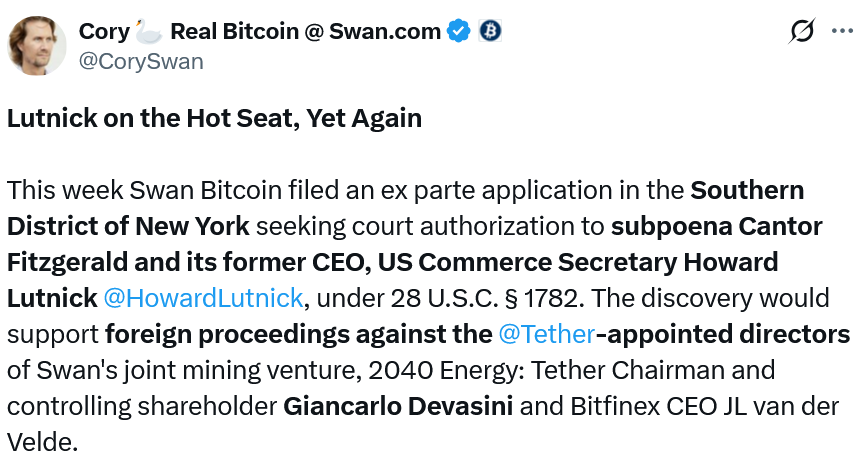
Bitcoin financial services firm Swan Bitcoin has filed an ex parte application in moves to subpoena Cantor Fitzgerald and its former CEO, Howard Lutnick, seeking discovery tied to a failed mining venture involving former employees.
Swan sued several ex-staff in September 2024, alleging that they stole confidential documents, resigned, and then founded “counterfeit competitor” firm Proton Management days later while convincing Tether, one of Swan’s funding partners at the time, to cut ties with Swan and work with them instead. The ex-staff allegedly referred to this as the “rain and hellfire” plan.
Swan’s application for a subpoena, filed in the Southern District of New York on Monday, targets Cantor Fitzgerald and Lutnick because Swan believes they are in possession of key documents relevant to Swan’s failed mining venture with Tether, 2040 Energy, in addition to the coordinated employee exodus and alleged data exfiltration.
The subpoena application against Lutnick, who now serves as US secretary of commerce, comes as Democratic senators like Elizabeth Warren continue to press him over potential conflicts of interest tied to Tether.

Cantor Fitzgerald is Tether’s investment banker and has advised the stablecoin issuer with its push into the Bitcoin mining industry, Swan noted in the filing.
Due to this link, Swan alleged that Cantor Fitzgerald likely knew about the undervalued sale of Swan’s crypto mining assets to a Tether subsidiary.
Swan alleges that Cantor ghosted them after a meeting
Swan said its CEO, Cory Klippsten, met with Lutnick in June 2024, before the alleged events took place, as Swan was considering an initial public offering and Cantor Fitzgerald was interested in being Swan’s lead investment banker.
During those discussions, Swan said it shared a “highly confidential and proprietary slide deck” with Cantor Fitzgerald and showed them its mining facilities.
“After the mass resignations and asset diversion, Cantor broke off contact with Swan without explanation,” Klippsten said on X.
Cointelegraph reached out to Cantor Fitzgerald for comment but didn’t receive an immediate response.
Related: SEC’s top enforcer clashed over Trump cases before quitting: Report
Swan alleges that the rain and hellfire plan was orchestrated by Michael Holmes, Swan’s former business development head, and Raphael Zagury, Swan’s former chief investment officer, who was appointed as Proton’s CEO.
The case Swan brought against Proton Management is ongoing.
The defendants previously denied Swan’s claims, arguing that 2040 Energy wasn’t theirs because it was fully funded by Tether.
Magazine: Big Questions: Can Bitcoin save you from the dreaded Cantillon Effect?
Crypto entrepreneur Nic Carter has urged Bitcoin developers to catch up on quantum resistance or risk losing out to Ethereum, which already has a post-quantum roadmap.
Elliptic curve cryptography (ECC) is the math that keeps Bitcoin (BTC) secure. Users pick a secret number (private key) and, using a special curved line and simple multiplication rules on that line, can quickly create a public address that everyone can see.
There are fears that quantum computers will have the ability to break this cryptography. The Bitcoin community is split on how to deal with it, with some advocating for upgrading cryptography while others say intervention would violate Bitcoin’s core principles.
“Elliptic curve cryptography is on the brink of obsolescence,” said the founding partner at Castle Island Ventures on X on Thursday. “Whether it’s 3 or 10 years; it’s over and we need to accept that.”
“The only thing that matters is how quickly blockchain developers recognize that they need to bake in cryptographic mutability into their networks.”
Carter argues that there will need to be an “entire reimagining” of how these systems work, and that today, the cryptography is hardcoded in. “That will have to change,” he added.
ARK Invest said in a paper on March 11 that about a third of all BTC was at risk from the quantum threat, but added that it was a “long-term risk.”
Ethereum has the advantage, claims Carter
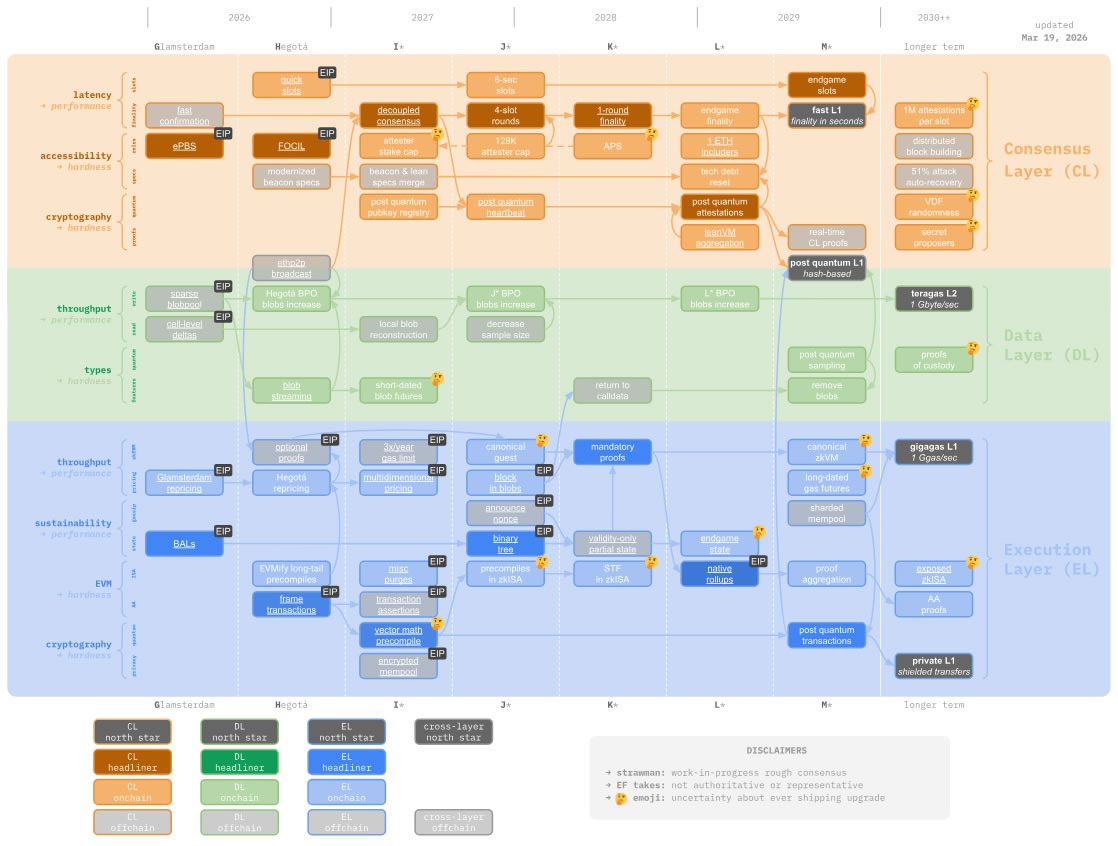
Carter said that Ethereum developers are already working on this with a new security team, linking to a detailed post-quantum roadmap by 2029 that has been set as a “top strategic priority.”
“ETH people have already figured this out. Everyone else seems to be petrified in fear. Unless something changes quickly, ETHBTC will start to reflect the divergence in prioritization.”
Ethereum co-founder Vitalik Buterin said in late February that validator signatures, data storage, accounts, and proofs must change to prepare for quantum threats, while proposing a quantum resistance roadmap.

Related: Vitalik Buterin outlines quantum resistance roadmap for Ethereum
At the same time, Carter has previously claimed on X that Bitcoin Core developers have been ignoring quantum-related proposals such as BIP-360.
Carter came down hard again on Bitcoin developers in his recent X thread, claiming they have a “worst in class approach,” and “deny, gaslight, gatekeep, bury heads in sand, say ‘the community will decide’ and then refuse to take feedback from the community when offered.”
Ethan Heilman, a co-author of BIP-360, responded in February that Core contributors have been engaging with the Bitcoin improvement proposal and that BIP-360 has received “more comments than any other BIP in the history of BIPs.”
Google warns of quantum threat to digital signatures
Meanwhile, Google raised the stakes on Wednesday, setting a 2029 deadline for its post-quantum cryptography migration.
The search giant warned that quantum computers will “pose a significant threat” to current cryptographic standards, and “specifically to encryption and digital signatures.”
Magazine: Nobody knows if quantum secure cryptography will even work
Bhutan has sold a part of its BTC stash again, and the pace is accelerating.
The Royal Government of Bhutan moved 519.707 BTC worth $36.75 million on Wednesday to an external address, according to Arkham Intelligence data. The transfer continues a drawdown that has intensified sharply over the past two weeks, with approximately $152 million in total outflows in 2026 alone.
The week before Wednesday’s move was the most active period in the kingdom’s bitcoin history. Arkham’s outflow data shows a cluster of transfers totaling roughly $72 million in a single week, headlined by a 595.848 BTC transfer worth $44.44 million, the largest single move of the year.
That was followed by 205.53 BTC ($15.14 million) and 150.047 BTC ($11.14 million) sent to external addresses, plus 20.506 BTC ($1.52 million) to QCP Capital’s merchant deposit address.

In January, Bhutan moved 184 BTC ($14.09 million) to an external wallet, sent 100.818 BTC ($8.31 million) to QCP Capital, and transferred $1.5 million in USDT to a Binance hot wallet. In February, another 100 BTC ($6.77 million) went to QCP. Two weeks ago, 175 BTC ($11.85 million) went out. Then last week’s $72 million burst. Then Wednesday’s $36.75 million.
The pattern shifted from $5-15 million clips in January and February to $35-45 million transfers in March.
QCP Capital has been the most consistent counterparty, receiving three separate transfers totaling roughly $16.6 million this year. The Singapore-based trading firm’s repeated appearance as a destination suggests an OTC relationship for structured selling rather than ad hoc liquidations.
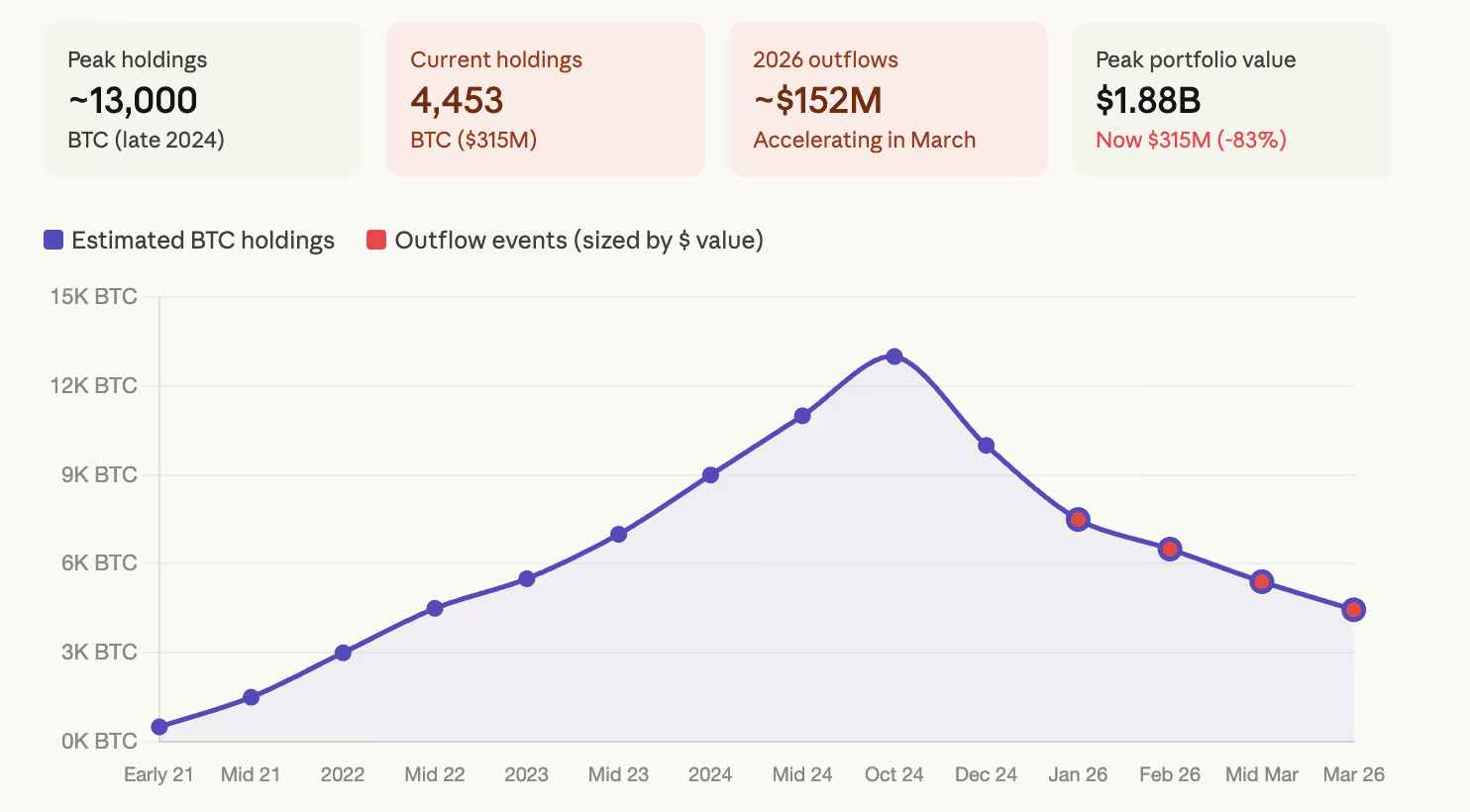
Bhutan’s stack peaked at roughly 13,000 BTC in late 2024, built over several years through state-backed hydroelectric mining where the cost basis is effectively zero.

Every coin sold is profit for the country, whose economy depends heavily on hydroelectric exports to India.
The drawdown began after October 2024 and has been steep. Current holdings sit at 4,453 BTC worth $315 million, a 66% reduction in coins from peak. The Arkham balance chart shows the portfolio value peaked near $1.88 billion and now sits at $315 million, hit on both sides by the selling and bitcoin’s decline from $119,000 to $70,000.
In December, Bhutan unveiled a Bitcoin Development Pledge committing up to 10,000 BTC to fund Gelephu Mindfulness City. At the time that was worth roughly $860 million. The government now holds fewer than 4,500 coins. The pledge in its original form is mathematically impossible to fulfill without reversing the drawdown entirely.
CoinDesk has reached out to Druk Holding & Investments, the government’s commercial arm, for comment on the recent transfers and whether the Gelephu commitment remains active.
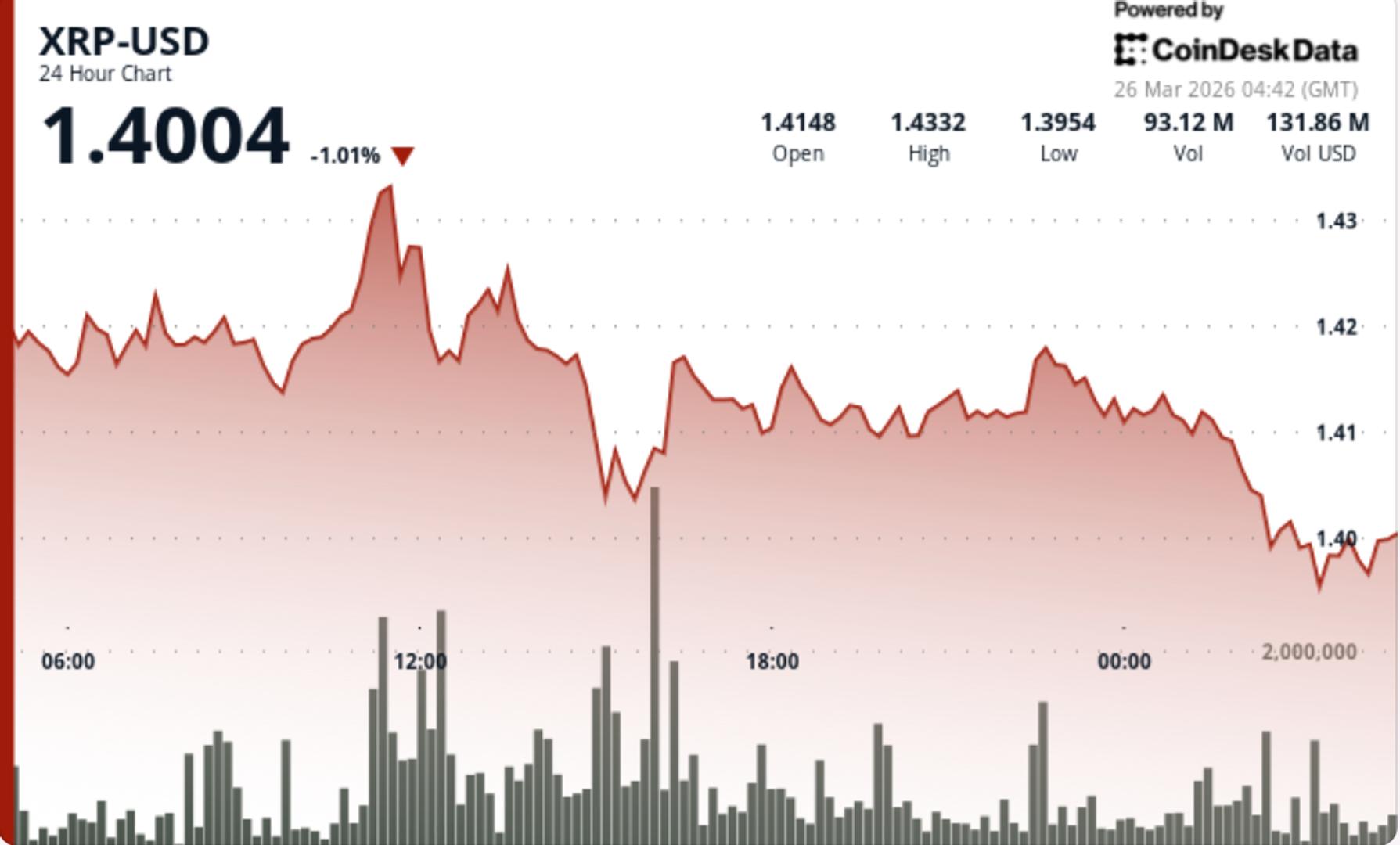
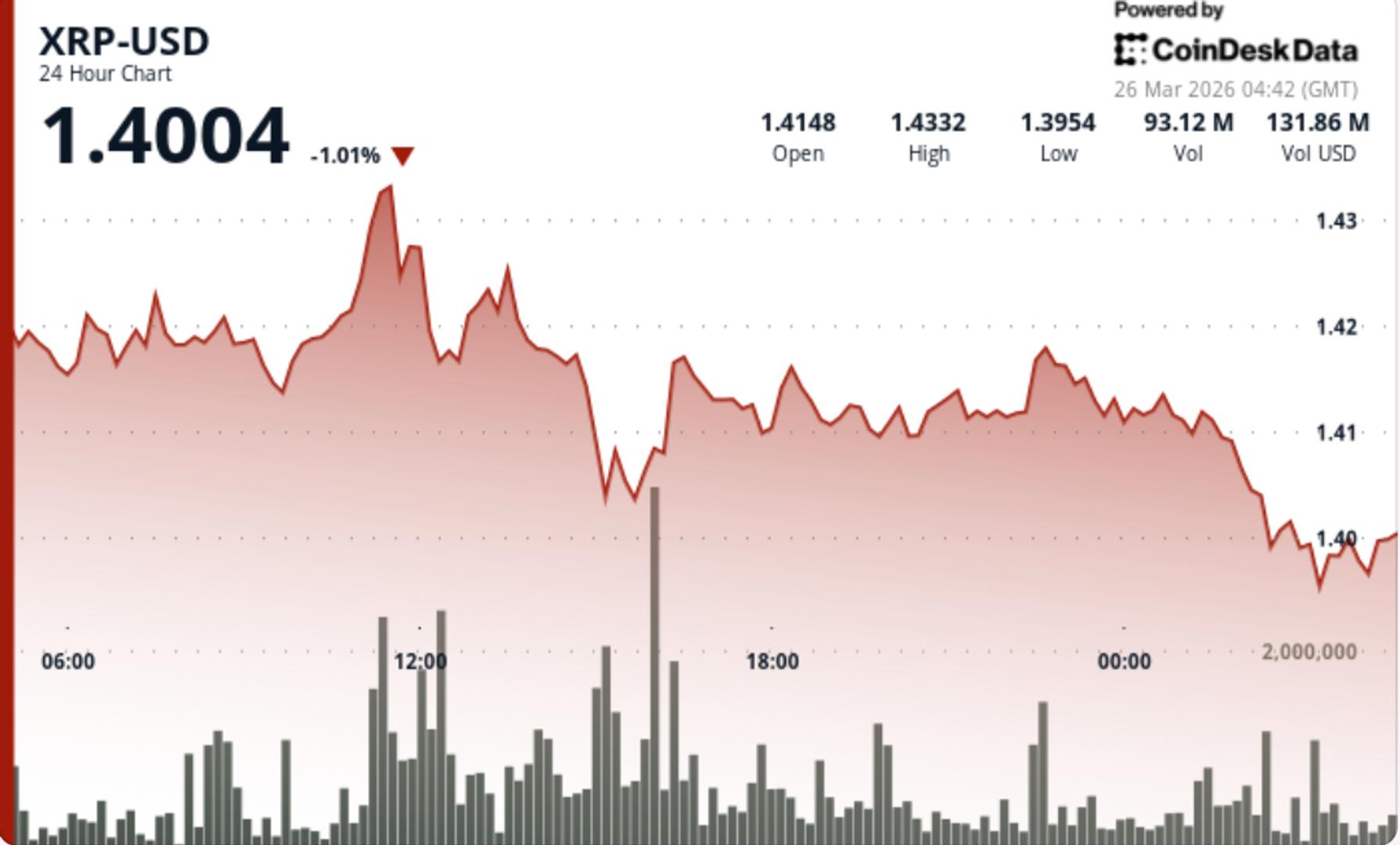
The XRP token is trading in one of its tightest ranges in months, and these quiet phases often don’t last. With price sitting just above $1.40 after a failed bounce, traders are watching closely for the next big move.
News Background
- XRP volatility has dropped to its lowest level since January, a setup that historically precedes sharp moves.
- A recent attempt to push above $1.43 failed, with sellers stepping in aggressively on higher volume.
- Regulatory clarity and rising institutional interest continue to build in the background, even as price action stays muted.
Price Action Summary
- XRP slipped slightly to around $1.40 after trading in a narrow ~$0.03 range
- Rejection near $1.43 capped upside
- Support around $1.40-$1.405 is now being tested repeatedly
- Late-session selling pushed price below short-term support before stabilizing
Technical Analysis
- XRP is in a classic “compression” phase — price is tightening, volatility is low, and a breakout is likely coming.
- The short-term structure is weakening, with failed attempts to reclaim $1.41 and sellers controlling rallies.
- However, buyers are still defending the $1.40 area, keeping the range intact for now.
- This creates a pressure build-up where the next move could be sharp once support or resistance breaks.
What traders should watch
- If $1.40 holds, XRP could bounce back toward $1.43 and potentially $1.45
- A clean break below $1.40 opens downside toward $1.35
- The key signal will be volume — whichever side breaks with strong participation likely sets the next trend
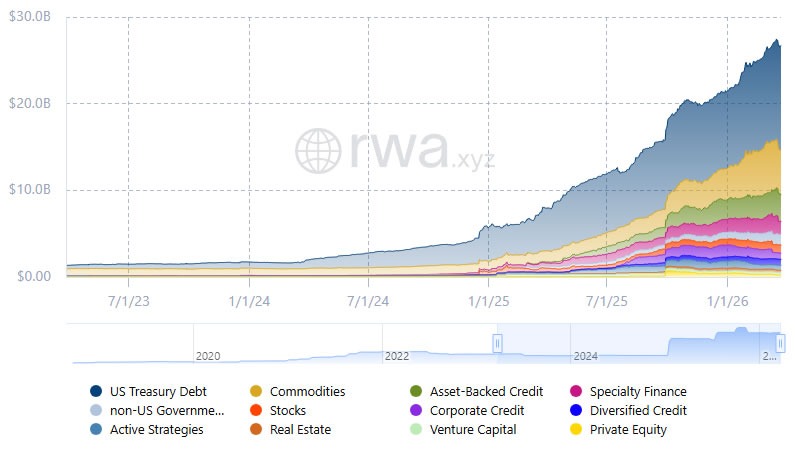
The Reserve Bank of Australia is putting its support behind the real-world asset tokenization sector, citing recent analysis that it could contribute 24 billion Australian dollars ($16.7 billion) to the economy per year.
Australia’s central bank assistant governor Brad Jones shared findings from Project Acacia on Wednesday, commenting that tokenized finance and related infrastructure upgrades will be “revolutionary,” according to advocates.
He said that potential gains for the Australian economy from RWA tokenization were on the order of $16.7 billion per year, “and larger still if new markets emerged.”
“First, we no longer see the main question as whether tokenization has a future in Australia’s financial system, but rather, how.”
Global consulting firm McKinsey & Company has forecasted that the value of tokenized assets could hit nearly $2 trillion by 2030. The head of Australia’s securities regulator, Joe Longo, in November urged the country to “seize the opportunity” or be left behind.
Project Acacia is the RBA’s collaborative research project run with the Digital Finance Cooperative Research Centre and industry groups.
It was built on a previous central bank digital currency pilot and explored whether tokenized assets could improve the functioning of Australia’s wholesale financial markets.
New digital finance sandbox to be explored
Jones said the RBA will partner with agencies and industry groups to explore a “new digital financial market infrastructure (DFMI) sandbox.”
He added that this could allow industry and policymakers to build on the learnings from Project Acacia.
Related: Major Australian pension fund mulls crypto offerings amid growing demand
It could also “smooth the path to practical implementation by providing a safe space for the testing and scaling of tokenized money, assets, and new infrastructure in a longer-term, stage-gated environment,” he said, adding that it could be tied in with a CBDC.
“The interaction of wholesale CBDC with bank deposit tokens and stablecoins, and the synchronisation of tokenized asset ledgers with RITS [Reserve Bank Information and Transfer System], will be particular areas of interest.”
RWA onchain value surges 234% in a year
Jones concluded that ensuring Australia’s payments, monetary and financial infrastructure arrangements are “fit for purpose” in the digital age is a “strategic priority for the RBA.”
The total RWA market onchain value hit a record high of $27.5 billion last week, excluding stablecoins, according to RWA.xyz. The sector has seen huge growth, surging by 234% over the past 12 months despite the broader crypto asset bear market.

Magazine: Banks want to run Vietnam’s crypto exchanges, Boyaa’s $70M BTC plan: Asia Express

Bitcoin Depot has appointed Alex Holmes—already a member of the company’s board—as chief executive and chair, replacing Scott Buchanan who stepped down after less than three months in the top role. The move comes as the crypto ATM operator faces growing regulatory pressure across multiple U.S. states over alleged scams and money-laundering concerns tied to its kiosks. In the company’s regulatory filing, Bitcoin Depot stressed that Buchanan’s departure “was not due [to] a disagreement.”
Holmes, a veteran MoneyGram executive who spent 16 years at the payments firm in roles including chief financial officer and CEO, is known for his emphasis on regulatory compliance. He said his priorities center on stabilizing operations, advancing regulatory progress, and accelerating the company’s evolution into a broader fintech platform. Mintz, the founder and former CEO, will shift from executive chair to non-executive board member and serve as an adviser to Holmes.
Key takeaways
- Bitcoin Depot appoints Alex Holmes as CEO and chair, with founder Brandon Mintz moving to a non-executive advisory role.
- The leadership transition comes as U.S. states intensify scrutiny of crypto ATMs amid concerns about scams and money laundering.
- Connecticut suspended Bitcoin Depot’s money transmission license and issued a cease-and-desist order; Massachusetts has sued the company; Maine paid $1.9 million to a consumer protection bureau; Missouri opened an investigation; Iowa filed a lawsuit against Bitcoin Depot and another operator.
- The company lowered its 2026 revenue outlook amid a “dynamic regulatory environment.”
- Bitcoin Depot’s stock traded around the low-dollar range, with a recent intraday reaction reflecting the ongoing regulatory headwinds.
Regulatory pressure frames the leadership shuffle
The executive transition arrives at a time when Bitcoin Depot faces heightened regulatory risk across several states. Connecticut’s banking regulator announced a suspension of the company’s state money transmission license and issued a temporary cease-and-desist order, citing multiple alleged violations of state money transmission laws, including excessive fees and refunds to scam victims. The action underscores the ongoing tension between fast-growing crypto kiosk networks and traditional consumer protections frameworks.
Earlier in the year, Massachusetts prosecutors filed suit accusing Bitcoin Depot of overcharging consumers, facilitating scams, and failing to issue refunds. The legal actions across New England reflect a broader pattern of state attorneys general and regulators scrutinizing crypto ATM operations for consumer harm and compliance shortcomings.
Widening regulatory net and what it means for operators
Beyond Connecticut and Massachusetts, Bitcoin Depot has encountered regulatory actions in Maine, Missouri, and Iowa. Maine’s consumer protection agency announced a settlement in January, requiring the company to pay $1.9 million to compensate consumers for fraudulent transactions. In Missouri, the attorney general opened an investigation into Bitcoin Depot and four other crypto ATM operators in December, focusing on potentially deceptive fees and the misuse of kiosks by unscrupulous actors. Iowa followed with a lawsuit filed in February against Bitcoin Depot and rival CoinFlip, accusing the firms of enabling scams and costing Iowans more than $20 million.
These actions illustrate a pattern: as crypto kiosks proliferate, state regulators are increasingly willing to pursue enforcement actions tied to fees, refunds, and the overall integrity of the customer experience. The regulatory backdrop has translated into operational and financial headwinds for Bitcoin Depot, contributing to a broader reassessment of how crypto-access points are governed in the United States.
As Cointelegraph reported in related coverage, the sector has seen a notable uptick in losses and fraud linked to crypto ATMs, a trend that underscores the tension between rapid expansion and consumer protection. The industry’s evolving risk profile makes leadership choices at public or near-public operators all the more consequential for investors and users alike.
Financial outlook and investor reception
Bitcoin Depot disclosed in its 2025 results that it had reduced its 2026 revenue outlook, projecting a decline of roughly 30% to 40% due to what it described as a dynamic regulatory environment. The update was a frank acknowledgment that the path to growth in a highly regulated landscape will require careful navigation of state-by-state compliance regimes, alongside the ongoing need to secure consumer trust.
Market reaction to the leadership change and regulatory developments has been modestly negative in the immediate term. The company’s shares closed lower on the latest trading session, then recovered slightly after hours, a reflection of investor caution in light of the mounting legal and regulatory pressures. Bitcoin Depot (BTM) has been under severe pressure this year, with the stock down significantly from its 2022–2023 highs as state actions and corporate governance scrutiny mounted.
Strategic implications for a diversified fintech play
Holmes’ appointment signals a potential shift in Bitcoin Depot’s strategy toward a broader fintech platform, leveraging his deep experience in payments compliance. If executed well, the pivot could help the company balance growth in crypto-enabled services with stronger risk controls, potentially broadening its appeal to financial partners and retailers wary of compliance exposure. Yet the immediate priority remains stabilizing operations amid a tightening regulatory environment that could influence licensing, fee structures, and consumer protections across multiple jurisdictions.
In the near term, observers will be watching how Bitcoin Depot renegotiates its licensing posture in states where enforcement actions were initiated and whether it can restore consumer confidence through transparent refunds, clearer fee disclosures, and robust anti-scam measures. The outcome of ongoing investigations and lawsuits will also be a bellwether for the broader blockchain kiosk sector, which has seen rapid expansion but uneven regulatory clarity.
What to watch next
Investors and users should monitor how Holmes reshapes the operational backbone of Bitcoin Depot, including any concrete steps to strengthen regulatory compliance, refine fee policies, and improve dispute resolution processes. State regulators’ ongoing actions will continue to play a decisive role in determining the company’s ability to scale its network and sustain revenue growth in a constrained regulatory landscape. As the sector evolves, further clarity on a national framework for crypto kiosks could either ease the path for expansion or impose new guardrails that reshape a still-nascent market.

Why emotional resilience should be at the heart of climate change education
Earnings call transcript: Syndax Pharmaceuticals Q4 2025 revenue beats forecast, stock rises

Coinbase Not Supporting New Crypto Bill Compromise: Report


-
 Crypto World5 days ago
NIO (NIO) Stock Plunges 6.5% as Shelf Registration Sparks Dilution Worries
-

 Fashion6 days ago
Weekend Open Thread: Adidas – Corporette.com
-

 Politics5 days ago
Jenni Murray, Long-Serving Woman’s Hour Presenter, Dies Aged 75
-
 NewsBeat21 hours ago
Manchester United reach agreement with Casemiro over contract clause amid transfer speculation
-

 Crypto World4 days ago
Best Crypto to Buy Now: Strategy Just Spent $1.57 Billion on Bitcoin During Fear While Early Investors Quietly Enter Pepeto for 150x Potential
-

 Crypto World4 days ago
Bitcoin Price News: Bhutan Sells $72 Million in BTC Under Fiscal Pressure, but the Smart Money Entering Pepeto Sees What the Market Does Not
-

 Tech6 days ago
inKONBINI Lets You Spend Summer Days Behind the Register
-

 News Videos4 hours ago
Parliament publishes latest register of MPs’ financial interests
-

 Sports3 days ago
Remo Stars and Kano Pillars Strengthen Survival Hopes in NPFL
-

 Politics6 days ago
Gender equality discussions at UN face pushbacks and US resistance
-

 Business4 days ago
No Winner in March 21 Drawing as Prize Rolls to $133 Million for Next
-

 Sports3 days ago
Gary Kirsten Accuses Pakistan Cricket Board Of ‘Interference’, Mohsin Naqvi Responds
-

 Tech3 days ago
Give Your Phone a Huge (and Free) Upgrade by Switching to Another Keyboard
-

 Sports6 days ago
2026 Kentucky Derby horses, odds, futures, preview, date: Expert who nailed 12 Derby-Oaks Doubles enters picks
-
Sports7 days ago
Vikings Free Agency Enters Phase 2 with Key Questions
-

 Tech3 days ago
AI enters the chat: New Seattle dating app relies on tech to facilitate meaningful human connections
-

 Politics6 days ago
Scotland’s rejection of assisted dying is a victory for humanity
-

 Business6 days ago
DLocal: Entering 2026 At Escape Velocity
-
Business5 days ago
Columbia Sportswear enters $500 million credit agreement with JPMorgan Chase
-

 NewsBeat7 days ago
Missile lands next to presenter during live report
You must be logged in to post a comment Login