

Crypto World
Where could XRP end the year?

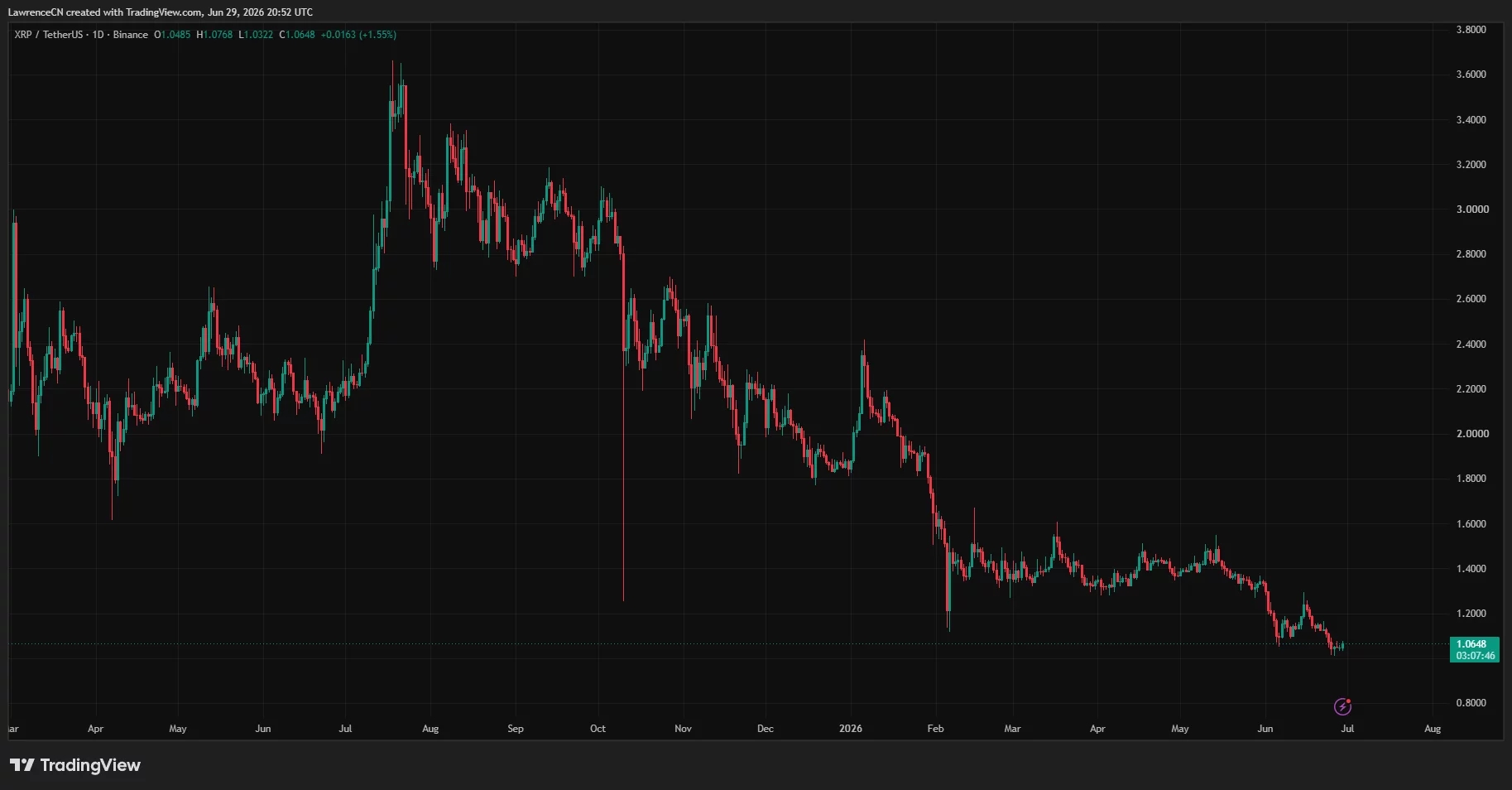
XRP has slid to around $1, down from its $3.66 high last year, with retail in fear even as whale wallets hit record highs. Where could it finish 2026? Credible forecasts run from below $1 to $8, and the gap comes down to one question. Here is what would push XRP to each level, and which path looks most defensible.
Summary
- XRP trades near $1.04 as of late June 2026, down from a July 2025 cycle high near $3.66, with relative strength near oversold and moving averages around $1.13 to $1.14 sitting overhead as resistance.
- The forecast range for year-end 2026 is unusually wide: bearish models point below $1, conservative models to roughly $1.40 to $1.80, Standard Chartered to $2.80, and bullish publishers toward $4.36 to $8.
- Standard Chartered’s Geoffrey Kendrick cut his year-end target from $8 to $2.80 while keeping a $28 call for 2030, capturing the split between near-term caution and long-term conviction.
- The entire range turns on one question: whether the XRP token itself, not just Ripple’s network, captures the cross-border payment and settlement volume flowing through it.
- A move to $2 or $3 needs stabilization, ETF support, and better sentiment, while $5 or higher needs a genuine shift in market structure and proven token utility.
XRP (XRP) is trading near $1.04 as of late June 2026, and for holders it has been a deeply frustrating year: the token has cleared nearly every obstacle its community spent years waiting for, yet the price has done close to nothing but fall. XRP is down from a cycle high near $3.66 reached in July 2025, having declined through the back half of last year and the first half of this one, and it now sits roughly a third below where it began 2026.
The technical picture is heavy. The relative strength index hovers near 30, at the lower boundary where downtrends sometimes exhaust themselves, and the 50-day and 200-day moving averages cluster overhead around $1.13 to $1.14, acting as the resistance XRP must reclaim to change its trend. Sentiment is weak, with retail traders fearful, even as on-chain data shows whale wallet counts at record highs, a contrarian split in which large holders appear to be accumulating while smaller holders capitulate. The question this article addresses is where that leaves XRP at the end of 2026, and the honest answer is that the credible range is enormous.
That range, from below $1 to $8, is not a sign of lazy forecasting; it reflects a real and unresolved disagreement about what XRP fundamentally is and whether its token captures value. This article works through the question methodically: where XRP stands and how it got here, the bearish case for a finish below $1, the base case in the $1.40 to $2.80 zone, the bullish case for $4 to $8, the meaning of Standard Chartered’s high-profile cut from $8 to $2.80, the enormous valuation gap that Bitwise’s own model reveals, the catalysts that could actually move the price, and three concrete scenarios for year-end.
Throughout, the goal is to show what each outcome requires rather than to pick a number, because XRP’s path depends on variables that genuinely could resolve in very different directions. The forecasts here are information, not advice, and the single most useful thing to carry through the piece is the question underneath every target: does XRP the token capture the volume that Ripple the company is winning, or does the value accrue elsewhere? Almost everything about the price follows from the answer.
Where XRP stands and how it got here
To judge where XRP might end 2026, you need the recent history, because XRP’s price has been driven as much by legal and structural events as by market cycles. The token spent years under the shadow of the United States Securities and Exchange Commission lawsuit against Ripple, and that case formally concluded in 2025, establishing that XRP is not a security when sold on exchanges and removing the single largest overhang on the token.
On the back of the resolution and a friendlier regulatory climate, XRP surged to a cycle high near $3.66 in July 2025, approaching the kind of levels its long-suffering community had anticipated for years. Spot XRP exchange-traded funds launched in November 2025 and drew over $1 billion in net inflows, another long-awaited milestone. By the standards of what the community had been waiting for, 2025 delivered nearly the full checklist.
And yet the price has fallen steadily since. From the July 2025 high near $3.66, XRP declined through the rest of the year and into 2026, sliding to around $1.04 by late June against a backdrop of broad crypto weakness. The frustration in the XRP community is precisely that the token cleared every hurdle and still dropped, which has fueled a debate about whether the good news was already priced in, whether broader market conditions simply overwhelmed XRP’s catalysts, or whether something more structural is limiting how much value flows to the token.
The current setup reflects that tension: XRP is liquid and actively traded, whale wallets are accumulating at record levels in what looks like strategic positioning, but retail sentiment is fearful, and the chart is below its key moving averages. The token sits at a level that is either a coiled accumulation base before the next move higher or a waypoint in a continued decline, and which one it is depends on the catalysts and the value-accrual question explored below. The history matters because it shows XRP has already spent its biggest bullish catalysts, the legal resolution and the ETF launch, which raises the bar for what it takes to push the price meaningfully higher from here.
The bearish case: a finish below $1
The case for XRP ending 2026 below $1 is grounded in both technicals and a structural skepticism that deserves to be taken seriously. Technically, XRP trades below its key moving averages near $1.13 to $1.14, and a market that cannot reclaim those levels is, by definition, still in a downtrend. Several model-based and technical forecasting systems remain bearish on XRP, with some, such as Gov Capital and WalletInvestor, projecting outright losses over a 1-year horizon, treating recent weakness as part of a broader risk pattern rather than a dip to be bought. If macro conditions deteriorate, whether through a broad crypto downturn, a risk-off shift in markets, or disappointing follow-through on ETF flows, XRP could test and break its current support, with technical analyses pointing to downside levels in the low-$1 range and below if the bearish trend persists.
The deeper bearish argument is structural and connects to the value-accrual question at the heart of this piece. Skeptics contend that Ripple’s commercial success, its growing roster of financial-institution partnerships and its cross-border payments business, does not necessarily translate into demand for the XRP token, because much of Ripple’s settlement activity can be conducted without participants holding XRP for any meaningful duration, and because Ripple’s own dollar stablecoin offers an alternative settlement instrument that does not require the token at all. In this reading, XRP could remain a liquid, speculative asset whose price is driven by sentiment and trading rather than by genuine, sustained utility demand, and absent a clear mechanism forcing value into the token, it could drift lower or stagnate even as Ripple thrives as a company.
The bearish case, then, is not merely a chart pattern; it is a thesis that XRP the token may be structurally disconnected from the network’s success, and that a finish below $1 is what happens if the market comes to share that view while macro conditions stay unsupportive.
The base case: $1.40 to $2.80
The base case, where a plurality of serious forecasts cluster, sees XRP recovering modestly to somewhere between roughly $1.40 and $2.80 by year-end, and it rests on a more balanced set of assumptions. Conservative, model-driven forecasters such as CoinCodex and Changelly project XRP in the $1.40 to $1.80 area, with Changelly specifically modeling a December range around $1.29 to $1.55 and an average near $1.42.
These forecasts assume XRP stabilizes, reclaims some lost ground as the broader market steadies, and benefits from continued but not explosive ETF interest, without breaking decisively above its major resistance levels. This is essentially a recovery-without-breakout scenario: XRP stops falling, grinds back toward and through its moving averages, but does not enter a new bull phase.
The upper end of the base case is anchored by the most-watched institutional forecast on XRP. Geoffrey Kendrick at Standard Chartered, after cutting his target, places XRP’s year-end 2026 level at $2.80, a number that sits deliberately between the cautious algorithmic models and the more bullish crypto-publisher calls. That $2.80 figure has become a useful benchmark precisely because it comes from a major bank instead of from automated technical models or retail-facing commentary, and it implies meaningful recovery from current levels without requiring a structural transformation in how XRP captures value.
The base case overall assumes that XRP’s concluded legal status, its live ETFs, and its institutional relationships provide enough of a foundation for a recovery toward the $1.40 to $2.80 band, supported by moderate ETF inflows and a stable-to-improving macro environment, but that the bigger moves toward $5 and beyond require catalysts that are not yet in evidence. For a token that has spent its largest bullish events already, a base-case recovery into the low-single-digits is a reasonable central expectation, and it is where the weight of credible forecasting sits.
The bullish case: $4 to $8
The bullish case for XRP reaching $4 to $8 by year-end is not fringe; it has institutional roots, but it requires conditions that go well beyond a general crypto rebound. The bullish group of forecasts starts near $4.36 and extends above $6, drawing on sources including PricePrediction.net, Telegaon, and commentary such as Dominic Basulto at The Motley Fool, who has floated $5 for XRP in 2026 with asset tokenization as a potential catalyst.
At the top of the credible bull range sits Standard Chartered’s original $8 target for 2026, which Kendrick held before cutting it and which was predicated on sustained ETF inflows and the regulatory clarity following the SEC settlement. The common thread is that these higher targets all assume XRP converts its structural advantages, concluded legal status, live ETFs, and Ripple’s institutional footprint, into real, sustained demand for the token.
What would it actually take to get there? The bullish case requires several things to align: ETF inflows would need to accelerate substantially, with some bullish models assuming flows climbing toward the multibillion-dollar range that Standard Chartered modeled as the trigger for its higher targets; the CLARITY Act or similar legislation would need to pass and codify XRP’s commodity status, unlocking institutional capital that has stayed on the sidelines; Ripple’s expanding use of XRP in cross-border settlement and its banking ambitions would need to translate into demonstrable token demand; and the broader market would likely need an altcoin-favorable phase instead of the current Bitcoin-dominated, risk-off mood.
The cleanest way to summarize it, echoing the analysts who have studied the range, is that a move toward $2 to $3 requires stabilization, ETF support, and better sentiment, while a move toward $5 or higher requires a stronger shift in market structure, institutional demand, and proven token utility. The bull case is achievable, but it is conditional on XRP answering the value-accrual question in the affirmative, which is exactly what remains unproven.
Why Standard Chartered cut from $8 to $2.80
The most instructive single event in XRP’s forecast landscape this year is Standard Chartered’s revision, because it crystallizes the shift from hope to realism. Geoffrey Kendrick, the bank’s digital-assets research lead, had previously set an $8 year-end 2026 target for XRP, a number that implied a large rally and was anchored in expectations of sustained ETF inflows and the post-settlement regulatory clarity.
As the year progressed and XRP failed to sustain the more aggressive assumptions priced into that forecast, Kendrick cut the year-end target to $2.80. The revision fit the broader weakness seen across crypto in 2026 and reflected that the catalysts, while real, were not translating into price at the pace the original target assumed. The cut matters because it came from a credible institutional source recalibrating to reality instead of from a perma-bear or a hype account, which makes the new $2.80 figure a more grounded benchmark than the targets above it.
Crucially, Kendrick left his longer-term call untouched: he kept a $28 target for XRP by 2030 even as he slashed the near-term number. That juxtaposition, $2.80 by year-end but $28 by 2030, captures the defining feature of serious XRP analysis, which is a split between near-term caution and long-term conviction. The long-term bull case rests on XRP becoming a major institutional settlement asset as Ripple’s banking and cross-border infrastructure matures, a process measured in years instead of months.
The near-term caution reflects that, right now, those flows have not materialized at the scale needed to drive the price, and the token remains hostage to sentiment and macro conditions. For anyone trying to forecast year-end 2026 specifically, the lesson of the Standard Chartered cut is sobering: even a committed long-term bull at a major bank concluded that the near-term path was far more modest than the $8 he once projected, and $2.80 now functions as the credible ceiling of the base case instead of the floor of the bull case.
The valuation gap that defines XRP
If one piece of analysis captures why XRP forecasts diverge so violently, it is the valuation work from the asset manager Bitwise, which ran XRP through a formal model and produced 2030 outcomes ranging from roughly $0.13 at the bottom to above $29 at the top. That is more than a 200-fold gap between the same firm’s bearish and bullish cases for the same token, and it sounds absurd until you see what drives it. The entire spread rests on a single assumption: whether XRP the token captures a meaningful chunk of the cross-border payment and settlement volume that Ripple is winning. Bitwise’s high case assumes it does, with XRP becoming the bridge asset that institutional value routes through; its low case assumes it does not, with banks sticking to existing systems and dollar stablecoins, including Ripple’s own, moving the money instead while XRP is bypassed.
This is the question underneath every XRP price target, and it is why the same catalysts can be read as wildly bullish or quietly bearish. Standard Chartered’s $28 by 2030 and the high single-digit-to-low-teens targets from other analysts all quietly lean on the assumption that the token captures the volume; the bearish models assume it does not.
The reason the question is so hard to settle is that Ripple can and does conduct much settlement activity without participants holding XRP for long, and its dollar stablecoin offers a token-free alternative, so the mechanism by which network success forces sustained demand into XRP is contested instead of obvious. For year-end 2026, the practical implication is that XRP’s price will be driven less by any single catalyst than by how the market’s collective answer to this question evolves. If confidence grows that the token captures the volume, the higher targets come into reach; if doubt deepens, the lower ones do. Everything else- the ETF flows, the legislation, the partnerships- ultimately feeds into that one judgment, which is why the credible forecast range is a chasm instead of a band.
The catalysts that could move XRP
Several concrete catalysts could push XRP toward one end of the range or the other before year-end, and watching them is more useful than fixating on a target. The 1st is the CLARITY Act and the broader regulatory picture. Passage of legislation codifying XRP’s commodity status into law, instead of leaving it resting on the concluded lawsuit, could unlock institutional capital that has stayed cautious, and XRP is widely seen as a beneficiary alongside other payment-focused tokens.
The 2nd is ETF flows. The spot XRP ETFs that launched in late 2025 are central to any serious forecast, because they remove supply from exchanges as providers accumulate, and the trajectory of their inflows, whether they reaccelerate toward the multibillion-dollar levels bulls assume or stagnate, will heavily influence the price. The 3rd is Ripple’s own business: its expanding use of XRP in cross-border corridors, its banking and custody ambitions, and the growth of its dollar stablecoin, which cuts both ways by validating Ripple while offering a token-free settlement path.
The 4th set of catalysts is macro and market structure: the Federal Reserve’s policy path, broad crypto liquidity, Bitcoin’s behavior, and whether the market rotates into altcoins or stays concentrated in Bitcoin. XRP, like most altcoins, tends to need a risk-on, altcoin-favorable environment to sustain large moves, and the current Bitcoin-dominated, fearful market has been a headwind.
The contrarian signal worth watching is the divergence between record whale accumulation and fearful retail sentiment, which historically can precede a reversal if the large holders prove right, though it can also simply reflect long-term holders averaging into a continued decline.
The honest framing is that these catalysts are real, but their effects are conditional, and none of them individually guarantees a direction; collectively, they will determine whether XRP’s year-end print lands in the bearish, base, or bullish zone. For a token that has already spent its biggest catalysts, the marginal mover from here is most likely the combination of ETF-flow momentum and the market’s evolving answer to the value-accrual question.
Three scenarios for XRP at year-end 2026
Drawing the analysis into scenarios clarifies the range. In the bull scenario, XRP finishes 2026 somewhere between $4 and as high as $8. This requires ETF inflows to accelerate meaningfully, the CLARITY Act or similar to pass and unlock institutional capital, an altcoin-favorable market phase to arrive, and growing confidence that XRP the token genuinely captures Ripple’s settlement volume. It is the path the most bullish credible forecasts describe, and it depends on the value-accrual question resolving in XRP’s favor while macro conditions turn supportive. It is achievable but conditional, and the bar is high given that XRP has already spent its legal and ETF-launch catalysts.
In the base scenario, the most heavily populated by serious forecasts, XRP recovers modestly to roughly $1.40 to $2.80. Support holds, the broader market steadies, ETF interest continues at a moderate pace, and XRP grinds back toward and possibly through its key moving averages without entering a new bull phase, with Standard Chartered’s $2.80 marking the credible upper edge. This recovery-without-breakout outcome fits the weight of model-based and institutional forecasting and is arguably the most likely central case. In the bear scenario, XRP finishes below $1. Macro conditions deteriorate, or ETF flows disappoint; the market comes to doubt that the token captures the network’s volume, support breaks, and XRP drifts lower as the structural skeptics’ thesis gains traction, validating the bearish models that project outright losses.
Which scenario unfolds depends primarily on ETF-flow momentum, regulatory progress, the macro backdrop, and above all the market’s evolving judgment on whether XRP the token captures the volume Ripple is winning. All 3 are live, and the wide gap between them is the most honest description of where XRP stands.
Frequently Asked Questions
Where could XRP end 2026?
The credible range is unusually wide, from below $1 to $8. Bearish models and some technical systems point below $1 if support breaks and the market doubts the token captures value. The base case, where most serious forecasts cluster, sees a modest recovery to roughly $1.40 to $2.80, with Standard Chartered’s $2.80 as the credible upper edge. The bullish case of $4 to $8 requires accelerating ETF inflows, regulatory progress, an altcoin-favorable market, and growing confidence that XRP captures Ripple’s settlement volume. The outcome depends on those catalysts and, above all, on the market’s evolving answer to whether the token, not just the network, captures value.
Why has XRP fallen to $1?
XRP is down from a July 2025 cycle high near $3.66, sliding through the back half of last year and the first half of 2026 amid broad crypto weakness. Part of the frustration is that XRP cleared its biggest catalysts: the SEC lawsuit concluded in 2025, and spot ETFs launched that November, yet the price still fell, which suggests the good news may have been priced in or overwhelmed by market conditions. The deeper question is structural: skeptics argue Ripple’s commercial success does not necessarily force sustained demand into the XRP token, especially with Ripple’s own dollar stablecoin offering a token-free settlement path. That value-accrual doubt, plus a Bitcoin-dominated risk-off market, has weighed on the price.
Why did Standard Chartered cut its XRP target?
Geoffrey Kendrick, Standard Chartered’s digital-assets research lead, had set an $8 year-end 2026 target for XRP based on expectations of sustained ETF inflows and post-settlement regulatory clarity. As 2026 progressed and XRP failed to sustain the aggressive assumptions behind that number, he cut the year-end target to $2.80, fitting the broader crypto weakness this year. Notably, he kept his $28 target for 2030 unchanged, which captures the split in serious XRP analysis between near-term caution and long-term conviction. The cut matters because it came from a credible institutional bull recalibrating to reality, which makes $2.80 a grounded benchmark and the effective ceiling of the base case instead of the floor of the bull case.
Can XRP reach $5 or more in 2026?
It is possible but conditional on several things aligning. The bullish forecasts of $4.36 to $8 assume ETF inflows accelerate substantially, the CLARITY Act or similar passes and unlocks institutional capital, the market rotates into an altcoin-favorable phase, and XRP demonstrably converts Ripple’s settlement footprint into sustained token demand. As analysts who have studied the range put it, a move to $2 to $3 needs stabilization, ETF support, and better sentiment, while $5 or higher needs a stronger shift in market structure, institutional demand, and proven token utility. The bar is high because XRP has already spent its biggest catalysts, so reaching the bull range requires new, larger drivers instead of a simple market rebound.
What is the value-accrual question for XRP?
It is the single question underneath every XRP price target: whether the XRP token itself, not just Ripple’s network, captures the cross-border payment and settlement volume flowing through it. Bitwise’s formal model shows why it matters so much, producing 2030 outcomes from about $0.13 to above $29, a more than 200-fold gap driven entirely by this assumption. The high case assumes XRP becomes the bridge asset institutional value routes through; the low case assumes banks and dollar stablecoins, including Ripple’s own, move the money while XRP is bypassed. Because Ripple can conduct much settlement without participants holding XRP for long, the mechanism forcing demand into the token is contested, which is why forecasts diverge so violently.
Are whales accumulating XRP?
On-chain data shows XRP whale wallet counts at record highs even as retail sentiment sits in fear, a contrarian divergence in which large holders appear to be accumulating while smaller holders capitulate. Bulls read this as strategic positioning ahead of a potential reversal, on the logic that large, informed holders are buying weakness. The cautionary reading is that record whale accumulation can also reflect long-term holders averaging into a continued decline that does not reverse on schedule, so it is a supportive signal instead of a guarantee. It is one of the more constructive data points in XRP’s current setup, but like every catalyst here, its payoff depends on the broader market and the value-accrual question resolving
This article is information, not financial or investment advice. XRP price levels, indicator readings, and analyst forecasts reflect data available as of June 28, 2026, are point-in-time, and can change rapidly. Cryptocurrency is highly volatile, and you can lose money. Price predictions are inherently uncertain, and the scenarios described are not guarantees. Do your own research and consult a qualified financial professional before making any investment decision.


President Donald Trump has a narrow window of roughly 10 days to decide whether to sign, ignore, or veto a bipartisan housing bill that includes a provision restricting the Federal Reserve from issuing or creating a central bank digital currency (CBDC) and other “substantially similar” digital assets through the end of 2030.
House Speaker Mike Johnson sent the “21st Century ROAD to Housing Act” to Trump’s desk on Monday, according to reporting from CNN. Under the U.S. Constitution, the president’s options hinge on a constitutional review period that begins with the bill’s delivery and runs for about 10 days excluding Sundays.
Key takeaways
- The housing bill includes a CBDC ban: the Federal Reserve is barred from issuing or creating a CBDC or “substantially similar” digital assets until the end of 2030.
- Trump has about 10 days to decide whether to sign, veto, or otherwise act on the bill after it reached his desk.
- Trump reportedly dismissed the measure as a “yawn” and cancelled a planned signing ceremony, urging focus on a different voting-related bill.
- The bill passed with bipartisan support, including participation tied to Sen. Elizabeth Warren, who backed the CBDC restriction as part of broader legislative bargaining.
- If Trump vetoes the bill, Congress could attempt to override with a two-thirds majority in both chambers.
How the CBDC restriction got attached to a housing package
The CBDC language is embedded in the 21st Century ROAD to Housing Act, a bill that the House passed last week with support from both Democrats and Republicans. The key policy provision bars the Federal Reserve from issuing or creating a CBDC “or any digital asset that is substantially similar” until the end of 2030.
Reports indicate that this restriction was included as part of an effort to attract Republican backing. The bill is described as being sponsored by Sen. Elizabeth Warren, suggesting the CBDC clause was used to broaden coalition-building around a major domestic policy goal: housing.
As a result, the question for crypto-focused observers is not only whether the CBDC prohibition survives, but whether lawmakers are willing to keep treating CBDC policy as bargaining material inside unrelated bills—potentially creating unpredictable outcomes for future digital-asset regulation.
Trump’s reported response and the politics around “SAVE America”
Trump’s public posture toward the housing bill appears dismissive and politically conditional. According to reports cited by Cointelegraph, Trump called the legislation a “yawn” and referred to the situation sarcastically as a “big deal.” He also cancelled a signing ceremony scheduled for Wednesday, telling Republicans in Congress, in effect, to focus on passing the SAVE America Act instead.
At the center of the broader legislative fight is a voting measure Trump has emphasized previously. The housing bill’s political linkage matters because it underscores how the White House may prioritize one agenda item over another—even when the other item contains a direct restriction on a CBDC.
The Reuters/CNN-style summary in the source material also notes the housing bill would require voters to provide proof of U.S. citizenship in person to register. That provision could affect electoral participation in ways that add friction for lawmakers who support housing policy but remain split on voting requirements.
What happens next if Trump vetoes
With the bill now in Trump’s hands, the next 10 days are likely to determine whether the CBDC restriction becomes law. If the president vetoes it, Congress could override that veto with a two-thirds majority in both the House and the Senate, a high bar but one that remains a constitutional pathway.
The source material frames Trump’s decision in the context of his stated priorities for other legislation. Earlier, Trump said in March that he would “not sign other bills” until the SAVE America Act was passed. At the same time, he posted on social media indicating support for the Digital Asset Market Clarity (CLARITY) Act, according to Cointelegraph’s prior reporting—signaling that the White House’s position on digital assets may not be uniformly hostile, even if it chooses to de-prioritize the CBDC language embedded in the housing bill.
Senate calendar pressures: CLARITY timing vs. housing CBDC ban
While the president weighs the housing bill, the Senate is operating on a separate legislative track. The chamber broke on Friday for state work periods, with lawmakers expected to return by July 13, according to the source text. That schedule would leave roughly four weeks for lawmakers to address the CLARITY Act before the Senate shifts again for another state work period in August.
This timing matters because it creates two parallel timelines: one is the immediate presidential decision on the CBDC restriction; the other is the Senate’s near-term window to move forward on broader market-structure and digital asset policy via the CLARITY Act.
In other words, even if the CBDC ban in the housing bill becomes law or dies via veto, the regulatory direction for the sector may still depend heavily on whether the CLARITY Act advances on the Senate’s calendar.
For investors and builders, the practical takeaway is that “CBDC policy” and “market structure policy” may be converging in the legislative process but not necessarily in a coordinated way. The next signals to watch are whether Trump signs the housing bill before the constitutional deadline, whether Congress can rally for a veto override if he rejects it, and whether Senate leadership maintains momentum on the CLARITY Act during the July window.
Crypto World
Circle’s USDC Becomes First Stablecoin Supported by BNY Mellon for Institutional Clients
The Bank of New York Mellon (BNY), the oldest bank in the United States, has expanded its partnership with Circle to introduce new stablecoin services for institutional clients.
Circle’s USDC will become the first stablecoin supported on BNY’s Digital Asset Custody platform under the arrangement. This will allow BNY clients to store, transfer, mint, and burn USDC through the bank’s custody services.
BNY Mellon integrates USDC
According to the official blog post, the latest move broadens BNY’s role as the primary custodian of USDC reserves. Institutional clients using BNY’s digital asset custody platform can now hold USDC in their custody wallets and use the bank to instruct Circle to convert US dollars into USDC.
Clients will also be able to redeem USDC for US dollars through the burning process. Circle said that these services are intended to support the entire lifecycle of institutional stablecoin activity by connecting traditional cash services with digital asset custody within one framework. BNY said the stablecoin capabilities are part of its integrated Digital Assets platform, which is designed to help institutional clients manage the growing connection between traditional finance and digital assets.
By combining custody and cash management services, the bank aims to provide access to blockchain-based networks while maintaining the controls, governance, and operational resilience required by institutional markets. BNY also plans to expand support to other stablecoin issuers and additional digital cash workflows over time.
BNY’s Chief Product and Innovation Officer Carolyn Weinberg commented,
“As digital assets become increasingly integrated into financial markets, institutions need infrastructure that seamlessly works across traditional and blockchain-based systems. With the addition of our enhanced stablecoin enablement capabilities, we’re expanding the ways clients can move value with the operational scale, trust, and resiliency they expect from BNY.”
BNY’s Crypto Footprint
BNY Mellon and Circle first partnered in March 2022, when the bank was selected as a primary custodian for the reserves backing the stablecoin. Since then, the bank has steadily strengthened its presence in digital assets over the past few years.
This year, the Wall Street giant expanded its digital asset custody business by partnering with Finstreet and ADI Foundation to develop regulated crypto infrastructure within Abu Dhabi’s ADGM financial hub.
The post Circle’s USDC Becomes First Stablecoin Supported by BNY Mellon for Institutional Clients appeared first on CryptoPotato.
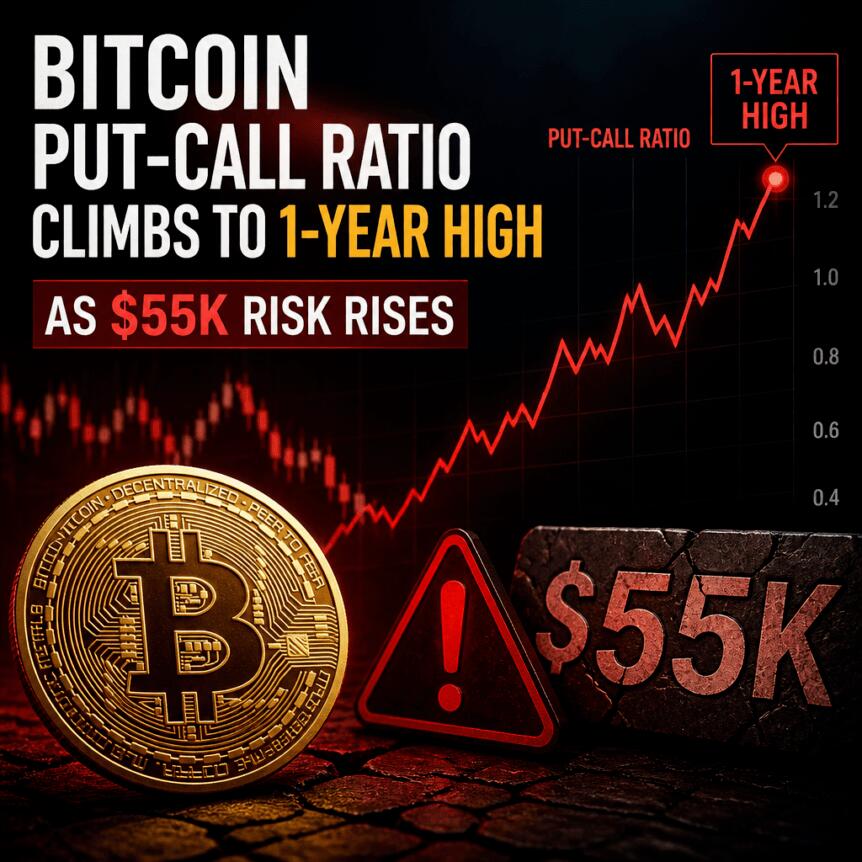
Bitcoin is struggling to regain the $61,000 level, and options markets are reflecting growing demand for downside protection. Traders are now openly debating whether $55,000 could become the next major support test as the market’s hedging behavior turns unusually aggressive.
At the same time, the broader backdrop for risk assets has improved—crude oil has fallen following a US–Iran 60-day ceasefire agreement—and capital appears to be rotating toward US tech, particularly semiconductors. For crypto investors, that divergence between traditional-market momentum and Bitcoin’s options-driven caution is becoming hard to ignore.
Key takeaways
- Deribit data shows put-option premiums are overwhelmingly higher than call premiums, with Friday’s put-to-call imbalance at the highest level in more than 12 months.
- A 19% 30-day delta skew suggests options market makers are not willing to carry downside exposure, implying persistent hedging demand over the past month.
- Strategy’s (formerly MicroStrategy) latest capital actions reduce some near-term dividend and debt concerns, but do not remove market uncertainty around Bitcoin supply dynamics.
- Outside crypto, Bloomberg-linked ETF flows point to heavy inflows into semiconductor funds, while US-listed Bitcoin spot ETFs have experienced seven consecutive weeks of net outflows.
Options traders lean into downside protection
Despite renewed optimism linked to lower crude oil prices after the US and Iran agreed to a 60-day ceasefire, Bitcoin has not been able to reclaim $61,000 since Thursday. The clearest sign of caution is visible in derivatives positioning.
On Deribit, the premium paid for Bitcoin put (sell) options totaled $115 million on Friday, compared with $16 million paid for call (buy) options. This put-call imbalance was reported as the most extreme in over 12 months, indicating unusually low appetite for bullish exposure.
However, the data does not automatically translate into coordinated bearish conviction. A surge in puts can also reflect risk management by investors who want protection without necessarily expecting an immediate collapse. Even so, the broader structure of the options curve reinforces the sense that hedging is in demand rather than speculative upside bets.
That structure is captured by the 30-day delta skew, which stood at 19% on Monday on Deribit. In practical terms, such a skew signals that market makers are unwilling to hold meaningful downside exposure. According to the analysis reflected in the article, this fear has effectively been “the norm” for roughly four weeks, lining up with Bitcoin’s difficulty holding above $60,000.
The market’s reaction matters because it can increase the cost of negative scenarios: more demand for protection typically means higher implied costs to insure positions. Traders watching the $55,000 level may therefore also watch whether the options skew starts to mean-revert—or whether demand for downside hedges continues to rise.
Strategy’s cash moves calm some fears—but don’t resolve supply questions
Another factor shaping sentiment is investor concern about Strategy’s ability to meet obligations. The company’s reaction provides some near-term comfort, even as it raises new questions for Bitcoin’s balance between potential selling and demand.
Earlier coverage noted discomfort around MicroStrategy (now Strategy) regarding dividends and debt maturities in 2027. On Monday, the company announced additional actions tied to liquidity: it disclosed an additional $1.2 billion in cash sourced from recent share sales, and it set aside $1.25 billion in Bitcoin for eventual sale.
From an investor’s perspective, the added cash helps address near-term funding anxiety. The reported logic also suggests bears may feel less pressure from forced issuance of MSTR shares—because, as the article states, the company does not have incentives to issue shares given its reported 17 months of dividend coverage.
Yet the same actions can introduce another layer of uncertainty: any reference to future Bitcoin sales keeps the market focused on supply/demand dynamics. Even if no sales occur in the “next couple of months,” the knowledge that a portion of holdings is earmarked for selling can continue to weigh on sentiment at the margin.
Capital rotation: semiconductors draw inflows while Bitcoin spot ETFs leak
While Bitcoin’s derivatives market shows caution, parts of traditional markets have leaned more constructive. The article points to easing inflationary pressure and the drop in crude oil to its lowest level in four months. It also highlights a Goldman Sachs report projecting 22% annual earnings growth for S&P 500 companies, which helped reduce worries about excessive valuations.
In that environment, retail investors appear to be reallocating toward semiconductors. The analysis cited by “The Kobeissi Letter,” using Bloomberg data, claims more than $20 billion in cumulative inflows into semiconductor exchange-traded funds (ETFs). That activity is said to have helped drive an 81% rally in the iShares Semiconductor ETF (SOXX) and 60% gains in the VanEck Semiconductor ETF (SMH).
Against this backdrop, Bitcoin is also facing persistent resistance from spot ETF flows. The article notes seven consecutive weeks of net outflows from US-listed Bitcoin spot ETFs, a pattern that has “shattered” hopes for a strong rebound from the reported $58,050 lows on June 25.
Even if some selling pressure is ultimately explained by sector rotation rather than a direct deterioration in Bitcoin fundamentals, the implication for near-term price action is straightforward: sentiment is unlikely to improve while flows remain consistently negative. Traders expecting a bounce may therefore need to see not only macro stabilization but also signs that ETF outflows are easing.
What to watch next as hedging and flows diverge
A retest of $55,000 should not be dismissed given the options market’s demand for downside protection. Still, the same skew that signals fear can also reflect investors hedging rather than betting against Bitcoin’s long-term prospects. The key variables moving forward are whether the options put-call imbalance and 30-day delta skew start to normalize—and whether US spot Bitcoin ETF flows begin to recover from their seven-week streak of net outflows.
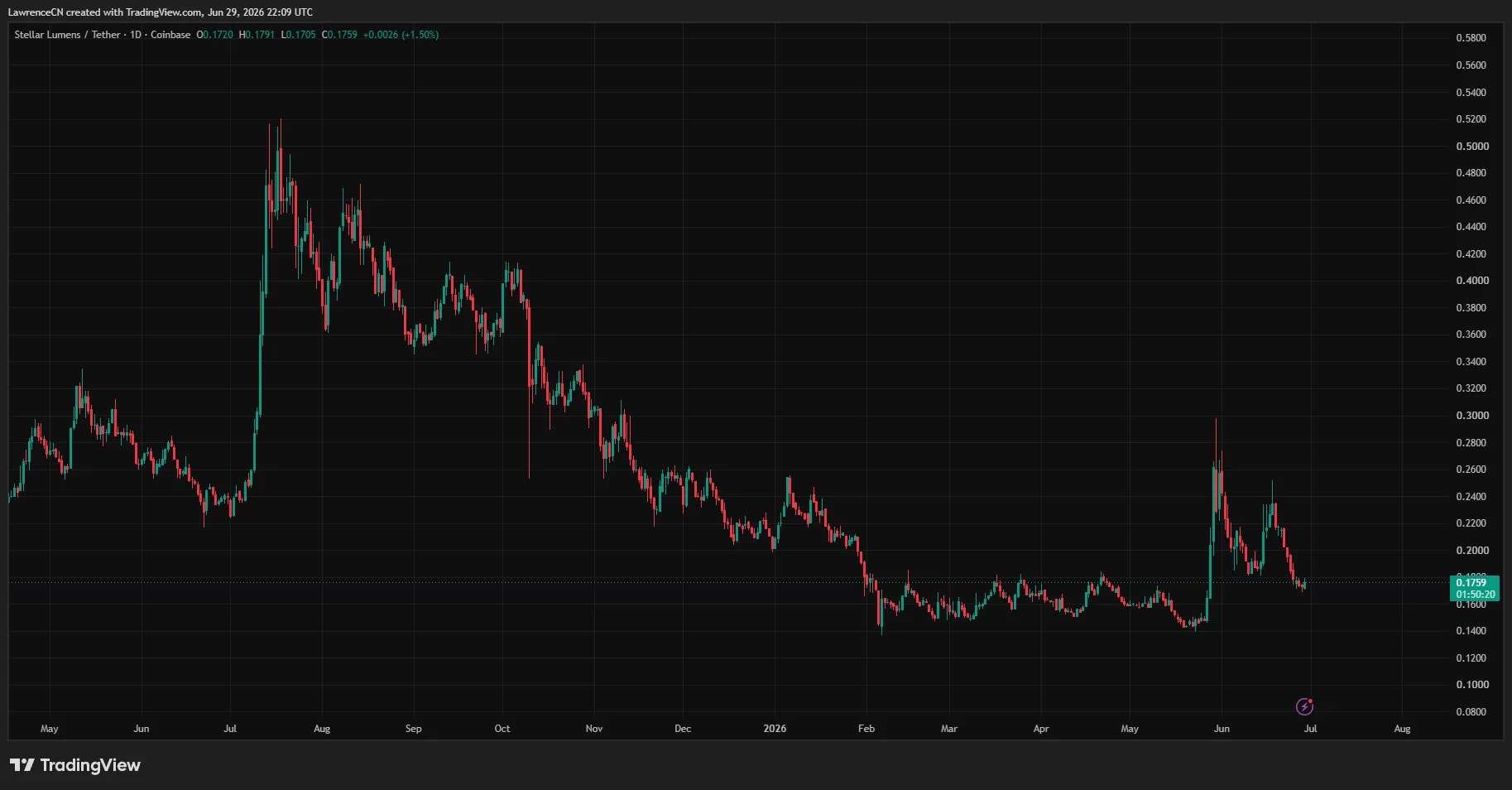
Stellar trades near $0.18, but a May 2026 plan for the DTCC to connect its tokenization service to Stellar, with XLM named as the settlement token, could route trillions in traditional securities onto the network. What would that actually mean for the price? Here is the realistic read, separating the landmark from the hype.
Summary
- Stellar trades near $0.18 as of late June 2026, down from a July 2025 high near $0.52, with the Fear and Greed reading in extreme fear despite strong network fundamentals. In May 2026, the DTCC, the backbone of United States securities settlement, announced it would connect its tokenization service to Stellar, with XLM designated as the settlement token and live assets targeted for the first half of 2027.
- The deal is a genuine long-term, high-conviction catalyst because it links potential institutional securities volume directly to the network, but the 2027 timeline means price until then is driven by speculation and sentiment.
- The central question for the price is value accrual: whether routing securities settlement through Stellar translates into sustained demand for the XLM token, a question complicated by XLM’s fixed supply with no burn mechanism.
- Year-end 2026 forecasts span roughly $0.18 at the bearish end to $1.20 to $2.50 in bullish models, a gap that turns on whether the DTCC and other catalysts begin converting fundamentals into token demand.
Stellar (XLM) is trading near $0.18 as of late June 2026, and it presents one of the sharpest disconnects in crypto: a network with strong and growing fundamentals attached to a token sitting near multi-year lows.
XLM is down from a July 2025 high near $0.52, the Fear and Greed reading is mired in extreme fear, and yet the underlying network is arguably healthier than ever, with tokenized real-world assets on Stellar having climbed past $2.83 billion, stablecoin payment volume around $5.5 billion, developer engagement at record highs, and consensus achieved in under six seconds through its Federated Byzantine Agreement design.
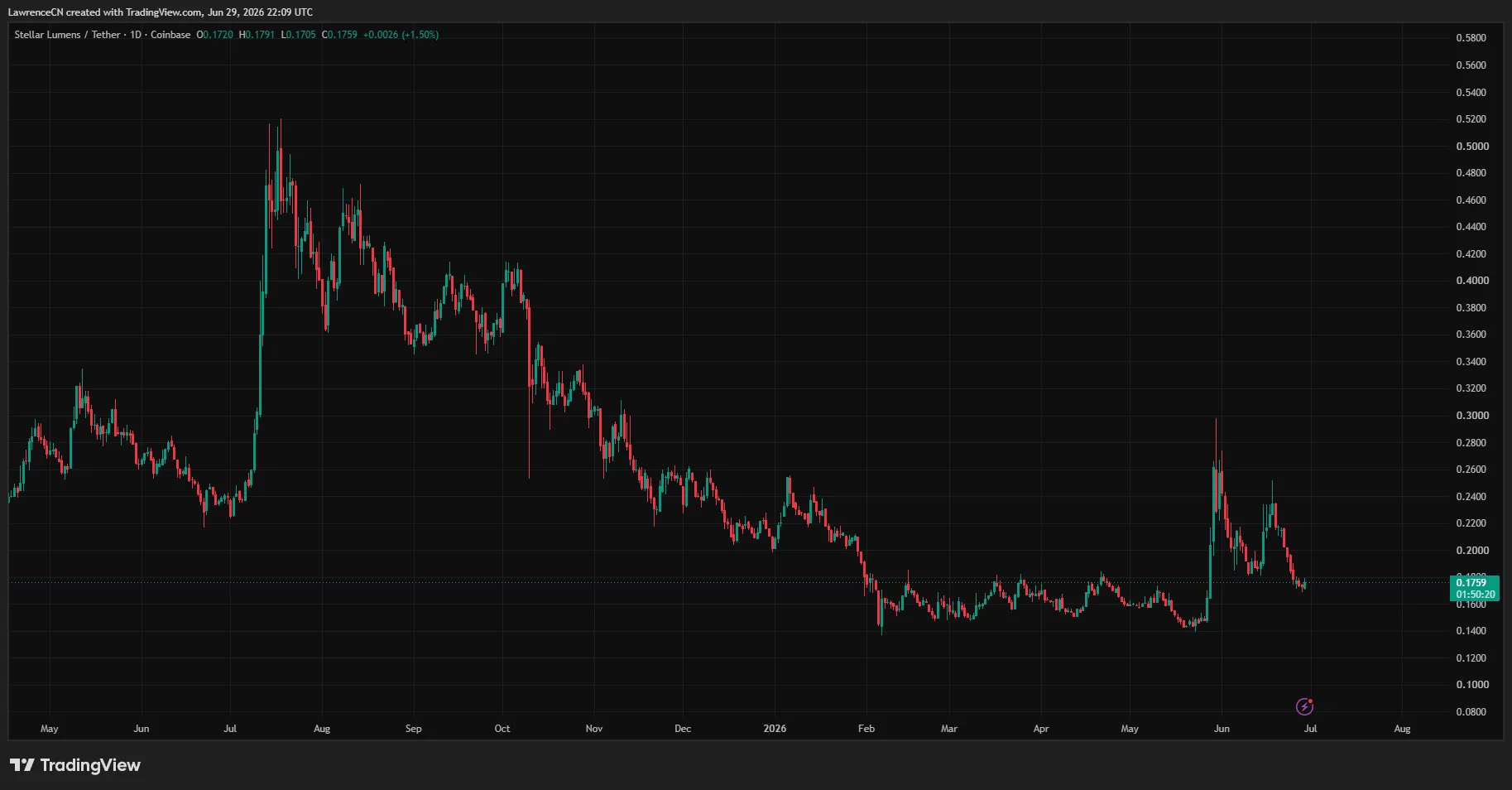
Into that gap between fundamentals and price landed the most consequential development in Stellar’s recent history: in May 2026, the Depository Trust and Clearing Corporation, the institution that sits at the center of United States securities settlement, announced it would connect its tokenization service to Stellar, with XLM named as the settlement token and live assets targeted for the first half of 2027.
The announcement raised an obvious and high-stakes question for anyone watching XLM: if the backbone of traditional securities settlement is routing tokenized assets through Stellar, what does that mean for the price of the token?
This article answers that question as realistically as possible, separating the genuine significance of the deal from the hype that inevitably surrounds it. It works through where Stellar stands now and why the fundamentals-price gap exists, what the DTCC deal actually is, why it could be a landmark, the all-important value-accrual question of whether network volume translates into token demand, the problem of the 2027 timeline, the other catalysts stacking up around XLM, the supply dynamics that complicate the bull case, what the analysts forecast, and three scenarios for the price.
The aim is to give XLM holders and observers a clear-eyed read rather than either dismissive skepticism or breathless promotion, because the DTCC deal is simultaneously a real, high-conviction catalyst and a development whose price impact is years away and structurally uncertain. The forecasts here are information, not advice. And the thread running through the whole analysis is the same question that haunts every payments-token valuation: does the network’s success actually accrue to the token, or can the volume flow through while the token is bypassed? For Stellar, the DTCC deal makes that question concrete and urgent.
Where Stellar stands and the fundamentals gap
Begin with the disconnect that defines XLM right now, because it is the context for everything the DTCC deal might change. Stellar near $0.18 is down significantly from its July 2025 high near $0.52, and the Fear and Greed reading sits in extreme fear, the same deeply pessimistic sentiment weighing on the broader crypto market.
On the charts, XLM has spent 2026 oscillating, with periods of consolidation around the high teens to low twenties in cents and sharp volatility, including swings of substantial magnitude within single months, but the broad trend has left the token near the lower end of its range and below where it traded a year ago. By the standard technical and sentiment measures, XLM looks like what it is: a beaten-down mid-cap altcoin in a fearful market.
What makes Stellar unusual is that its fundamentals tell a very different story from its price. The value of tokenized real-world assets issued on Stellar has surged past $2.83 billion, growing at a rapid clip, and stablecoin payment volume on the network has reached roughly $5.5 billion, both signs of genuine, growing utility rather than mere speculation. The network supports a large base of accounts and a wide array of fiat and crypto on-ramps, achieves fast and cheap settlement through its consensus design, and has added the Soroban smart-contract platform to enable tokenization and decentralized finance.
Developer engagement is at record levels. This is the crux of the Stellar investment debate: a network whose real-world usage and institutional positioning are strengthening, attached to a token whose price has fallen to multi-year lows. Bulls read the gap as a buying opportunity and evidence of accumulation, on the logic that price will eventually catch up to fundamentals. Skeptics read it as evidence that network usage does not reliably accrue value to the XLM token, which is precisely the question the DTCC deal forces to the center. The fundamentals-price gap is the setup; the DTCC deal is the potential catalyst that either closes it or exposes it as permanent.
What the DTCC deal actually is
To assess its impact, you have to understand precisely what was announced, because the details determine the significance. In May 2026, the Depository Trust and Clearing Corporation revealed plans to connect its tokenization service to the Stellar network. The DTCC is not a peripheral player; it is the central infrastructure of United States securities settlement, the institution through which an enormous share of the country’s stock and bond transactions are cleared and settled, handling quadrillions of dollars in securities annually across the traditional financial system. Its decision to build tokenization capability on a public blockchain at all is significant, and its selection of Stellar specifically, with XLM named as the settlement token for the infrastructure, is what makes the announcement material for the token. The plan targets live assets in the first half of 2027, meaning the connection is a forward-looking build rather than something already moving volume today.
The stated logic is that tokenization, representing traditional securities as digital tokens on a blockchain, can make settlement faster, cheaper, and programmable, and that Stellar’s compliance-focused, settlement-oriented architecture is suited to regulated finance. The phrase that captured attention is that the arrangement brings the potential for trillions in traditional securities onto the network over time, with XLM as the settlement token directly linking that future institutional volume to token demand. That is the bullish framing, and it is grounded in real fact: the DTCC genuinely chose Stellar, XLM is genuinely named as the settlement token, and the addressable volume is truly enormous. But three qualifications matter from the outset and shape the rest of this analysis.
First, the assets go live in 2027, not now. Second, the scale of what actually migrates onto Stellar, as opposed to the theoretical addressable market, is unknown. And third, and most important for the price, the mechanism by which settlement volume translates into sustained XLM demand is the contested value-accrual question instead of an automatic pass-through. The deal is real and large in potential; what it means for the token depends on details that are not yet settled.
Why it could be a landmark
Taken at its strongest, the DTCC deal is a genuine landmark, and the bull case for its significance deserves a full and fair statement. The first reason is validation. When the institution at the heart of United States securities settlement chooses to build tokenization infrastructure on Stellar, it is an endorsement of Stellar’s architecture for regulated, institutional finance that no marketing campaign could buy. It signals that Stellar’s long-standing bet on compliance and settlement, often overlooked during the speculative manias that drove other chains, is being recognized by exactly the kind of counterparty it was designed to serve. For a network whose pitch has always been institutional and payments-focused instead of retail-speculative, having the DTCC select it is the strongest possible third-party confirmation of the thesis.
The second reason is the direct linkage to token demand, at least in principle. Because XLM is named as the settlement token for the DTCC tokenization infrastructure, future institutional volume flowing through that infrastructure has a potential channel to XLM demand, unlike vaguer partnership announcements that leave the token’s role ambiguous. The third reason is scale and trajectory. The addressable market for tokenized securities is measured in the trillions, and even capturing a modest fraction would represent settlement volume far beyond anything Stellar handles today, which is why the deal is framed as a long-term, high-conviction bullish driver instead of a short-term price catalyst. It fits a broader pattern in which Stellar has positioned itself as compliance-ready infrastructure for tokenization, evidenced by its alignment with regulatory frameworks and its role hosting regulated stablecoins.
The strongest version of the bull case, then, is that the DTCC deal is the moment Stellar’s institutional thesis begins to be validated by the most credible possible counterparty, with a direct potential link to token demand and an addressable market large enough to transform the network’s economics. Whether that potential converts into token price is the next, harder question.
The value-accrual question
Here is where realism has to enter, because the gap between a network landmark and a token price runs straight through the value-accrual question, and Stellar’s situation has a cautionary parallel close at hand. The question is whether routing securities settlement through Stellar actually creates sustained demand for the XLM token, or whether the volume can flow through the network while the token captures little of the value. This is not a hypothetical concern invented for skepticism; it is the same question that has dogged XRP, where Ripple’s commercial success in cross-border payments has not reliably translated into XRP token appreciation, because much settlement activity can occur without participants holding the token for any meaningful duration. Stellar faces a structurally similar issue: a settlement token may be used transiently to bridge value during a transaction without anyone needing to hold XLM as a durable asset, in which case enormous settlement volume could produce only modest, fleeting token demand.
The specifics of how XLM is used in the DTCC infrastructure will determine which way this resolves, and those specifics are not yet fully clear. If XLM is required as a persistent bridge or reserve asset that institutions must hold to access the settlement rails, and if the volume is large, the demand could be substantial and sustained. If, instead, XLM functions as a momentary settlement medium that is acquired and released within transactions, or if stablecoins denominated in dollars do most of the actual value transfer while XLM plays a minimal technical role, then the token demand could be far smaller than the headline volume suggests.
The honest assessment is that the DTCC deal creates a potential channel for value to accrue to XLM, but it does not guarantee that it will, and the magnitude depends on technical and economic details that remain to be seen. This is the single most important caveat for anyone pricing XLM off the DTCC news. The deal could be a genuine landmark for the network and still deliver a muted token-price impact if the value-accrual mechanism is weak, exactly as has happened with XRP. The network’s success and the token’s success are related but not identical, and conflating them is the most common error in valuing payments tokens.
The 2027 timeline problem
Even setting aside the value-accrual question, the DTCC deal carries a timing problem that directly affects how it should be priced today. The plan targets live assets in the first half of 2027, which means that for the entire rest of 2026 and into early 2027, there is no actual DTCC settlement volume flowing through Stellar, only the anticipation of it. This matters because, until the infrastructure goes live and shows real volume, XLM’s price will be driven by speculation and sentiment about the future instead of by current flows, which makes it vulnerable to the same volatility that afflicts any narrative-driven asset. The market has already shown this dynamic, with XLM experiencing sharp moves and pullbacks, including a notable drop after a rally, as enthusiasm about the deal collided with the reality that nothing changes operationally for many months.
The timing problem cuts in two directions, and a fair analysis acknowledges both. On one hand, it tempers the near-term bull case: those expecting the DTCC deal to lift XLM’s price in 2026 are betting on sentiment and positioning instead of on actual usage, and sentiment can fade, reverse, or be overwhelmed by broader market conditions long before 2027 arrives. A deal that goes live in 18 months provides little support for a token if the broad crypto market stays fearful in the meantime.
On the other hand, the long runway means the catalyst is not yet spent: if and when the infrastructure goes live in 2027 and begins showing real volume, that could be a fresh, concrete catalyst at a point when much of the speculative anticipation may have faded, potentially providing an upside surprise to a token that the market had given up on.
For pricing XLM through the rest of 2026 specifically, the timeline problem means the DTCC deal is best understood as a long-term thesis underpinning the token instead of a near-term price driver, and that anyone buying XLM on the DTCC news in 2026 is making a multi-year bet whose payoff, if it comes, is concentrated in 2027 and beyond, contingent on the value-accrual question resolving favorably.
The other catalysts stacking up
The DTCC deal does not stand alone; it sits atop a cluster of other developments that collectively strengthen Stellar’s institutional thesis, and a complete picture has to account for them. The most important is the regulatory designation.
On March 17, 2026, United States regulators designated Stellar as a digital commodity, the same classification extended to a short list of major tokens, which removed a significant barrier by clarifying XLM’s legal status and making it eligible for custodial services from institutions that safeguard assets. That designation is foundational because it is what allows firms to build regulated products on Stellar and to hold XLM with legal confidence, and it underpins the DTCC deal and the others.
Building on it, CME Group XLM futures are expected during 2026, which would provide regulated derivatives infrastructure and a potential structural source of institutional demand and price discovery, and an Amundi fund and other institutional vehicles point to growing traditional-finance engagement with the token.
Several more developments round out the picture. Stellar is widely seen as a beneficiary of the CLARITY Act, the legislation that aims to codify digital-asset rules and that could advance in 2026, in the same way XRP is, since both are payment-focused tokens whose institutional adoption hinges on regulatory certainty. Stellar’s design aligns with European regulatory frameworks, evidenced by regulated stablecoins launching on the network, giving it a compliance posture suited to multiple jurisdictions. And the Soroban smart-contract platform expands what the network can host, broadening its addressable market into tokenization and decentralized finance.
The significance of this cluster is that the DTCC deal is not an isolated bet but part of a coherent institutional thesis: regulatory clarity through the digital-commodity designation and potential CLARITY Act passage, derivatives infrastructure through CME futures, traditional-finance vehicles through funds like Amundi’s, and the flagship tokenization linkage through the DTCC.
If the thesis works, these catalysts reinforce one another, with regulatory clarity enabling the institutional products that enable the volume that could drive token demand. The caveat from the value-accrual discussion still applies to all of them, but the breadth of the catalyst stack is itself a meaningful part of the bull case for XLM.
The supply picture that complicates the bull case
A factor specific to XLM that any honest price analysis must weigh is its supply structure, which cuts against the simplest bullish narratives in an important way.
Following a 2019 community vote, Stellar ended its annual token issuance, fixing the total supply near 50 billion XLM and removing the inflationary dilution that suppresses price appreciation on many rival networks. That fixed supply is truly favorable: it means new issuance does not constantly dilute holders, and if demand rises against a fixed supply, the price pressure is upward. To that extent, the supply structure supports the bull case, and it is a point bulls rightly emphasize.
But there is a crucial qualification that complicates the value-accrual story. Stellar has no token-burn mechanism that meaningfully reduces circulating supply as the network is used. On some networks, transaction activity burns tokens, so that rising usage automatically tightens supply and creates upward price pressure independent of speculative demand, a direct link between network use and token scarcity. Stellar lacks this channel at scale, which means that fee-driven demand from network activity does not automatically remove XLM from circulation.
The implication for the DTCC deal is significant: even if substantial securities settlement volume flows through Stellar, that activity will not, by itself, shrink the XLM supply the way a burn mechanism would, so 1 of the clearest channels through which network usage could force token-price appreciation is absent.
The price would have to rise through genuine, sustained holding demand for XLM as an asset, not merely through transactional throughput, which loops back to the value-accrual question. The fixed supply is a modest positive; the absence of a burn mechanism is a real limitation on how mechanically network success can translate into token-price gains. Together they mean XLM’s bull case depends more heavily on durable demand for the token itself than on raw volume, which raises the bar for the DTCC deal to move the price.
What the analysts forecast
The analyst forecasts for XLM in 2026 span an extraordinarily wide range, even by the standards of the other majors, and the spread maps directly onto the questions this article has raised. At the bearish end, the algorithmic forecaster CoinCodex reads Stellar as bearish on technical indicators and, strikingly, its model does not project XLM reaching $1 until 2047, treating the token as a slow-compounding asset that the current setup does not favor.
Other cautious forecasters cluster low: Traders Union’s model points to roughly $0.40 to $0.48 for year-end, and DigitalCoinPrice sees around $0.32, both well above current levels but far below the bullish targets and treating Stellar as an infrastructure asset that appreciates slowly instead of a narrative rocket. Base-case forecasts that assume regulatory clarity holds and tokenization grows at a moderate pace tend to land in a $0.25 to $0.50 band, a meaningful recovery from current levels without a breakout.
At the bullish end sit forecasters who weigh the institutional catalysts heavily. Coinpedia’s hybrid model is the most bullish of the major platforms for 2026, placing XLM in a moderate range of $1.20 to $1.80 and a stronger scenario toward $2.50 if it reclaims key resistance, explicitly anchoring the thesis in institutional adoption velocity, rising stablecoin and tokenized-asset volume, and the catalysts described above, with a longer-term 2030 target as high as $6.19 under favorable conditions.
CoinLore and others produce aggressive cycle targets in the range of roughly $0.50 to $1.69 for the year. The gap, from a model that does not see $1 until 2047 to 1 targeting $2.50 this year, is enormous, and it reflects exactly the unresolved questions: whether the DTCC deal and the other catalysts convert into token demand, whether the value-accrual mechanism is strong or weak, and whether the 2027 timeline leaves 2026 to sentiment.
The bullish forecasts assume the institutional thesis begins paying off in token demand; the bearish ones assume the fundamentals-price gap persists because usage does not accrue to the token. The forecasts cannot settle which is right; they can only show how much rides on the DTCC deal and its peers actually closing that gap.
Three scenarios for Stellar around the DTCC catalyst
Pulling the analysis into scenarios clarifies the range without pretending to certainty. In the bull scenario, the market begins to price the institutional thesis ahead of the 2027 go-live. Confidence grows that the DTCC deal, the digital-commodity designation, CME futures, and the broader catalyst stack will convert into real XLM demand, an altcoin-favorable phase arrives, and XLM recovers toward the $1.20 to $2.50 range that the most bullish credible models describe, with the fundamentals-price gap finally closing as anticipation of trillions in tokenized volume lifts the token. This path requires the market to look through the 2027 timeline and to bet that the value-accrual question resolves in XLM’s favor, and it leans on the breadth of the catalyst stack as the engine. It is achievable but conditional on a favorable read of exactly the questions that remain open.
In the base scenario, the most defensible central case, XLM recovers modestly to a $0.25 to $0.50 band. Regulatory clarity holds, the catalysts develop roughly on schedule, and the token grinds back up from its lows as the institutional thesis slowly gains credibility, but without a breakout, because the DTCC volume is not live until 2027 and the value-accrual mechanism remains unproven through 2026.
This recovery-without-breakout outcome fits the weight of base-case forecasting and reflects the reality that the biggest catalyst is years from delivering actual volume. In the bear scenario, the fundamentals-price gap persists or widens. The broad market stays fearful, the DTCC anticipation fades as 2027 stays distant, doubts deepen about whether settlement volume will ever accrue to the token given the no-burn supply structure, and XLM stalls in the $0.10 to $0.20 range or drifts lower, validating the bearish models that treat it as a slow-compounding asset. Which scenario unfolds depends on the broad market, the pace of the catalysts, and above all whether the market comes to believe that routing securities through Stellar will create durable demand for XLM. All 3 are live, and the DTCC deal is the pivot around which they turn, a genuine landmark for the network whose translation into token price remains the open question.
Frequently Asked Questions
What is the DTCC tokenization deal with Stellar?
In May 2026, the Depository Trust and Clearing Corporation, the central infrastructure of United States securities settlement, announced it would connect its tokenization service to the Stellar network, with XLM named as the settlement token and live assets targeted for the first half of 2027. The DTCC clears and settles an enormous share of United States securities transactions, so its decision to build tokenization capability on Stellar is a major institutional endorsement. The arrangement carries the potential to bring tokenized traditional securities onto the network over time, with XLM as the settlement token linking that future volume to potential token demand. It is a forward-looking build, not something moving volume today.
Will the DTCC deal make XLM’s price go up?
It could, but it is not automatic, and the timing and mechanism matter. The deal is a genuine long-term, high-conviction catalyst because it links potential institutional securities volume to the network with XLM named as the settlement token. But assets do not go live until the first half of 2027, so through 2026 the price is driven by speculation instead of actual flows. More fundamentally, whether settlement volume translates into sustained XLM demand is the contested value-accrual question: a settlement token can be used transiently without anyone holding it durably, and Stellar lacks a burn mechanism that would tighten supply as usage grows. The deal could be a landmark for the network and still deliver a muted token-price impact if value accrual is weak.
Why is Stellar’s price so low if its fundamentals are strong?
This is the central Stellar paradox. The network’s fundamentals are strong and growing, with tokenized real-world assets past $2.83 billion, stablecoin payment volume around $5.5 billion, record developer engagement, and fast, cheap settlement, yet XLM trades near $0.18, down from a 2025 high near $0.52, with sentiment in extreme fear. Bulls read the gap as a buying opportunity on the logic that price will catch up to fundamentals. Skeptics read it as evidence that network usage does not reliably accrue value to the XLM token, the same issue that has dogged XRP. The gap exists because network success and token-price appreciation are related but not identical, and the mechanism linking them for XLM is contested.
What is the value-accrual question for XLM?
It is whether routing activity like securities settlement through Stellar actually creates sustained demand for the XLM token, or whether volume can flow through the network while the token captures little value. A settlement token may be used transiently to bridge value within a transaction without anyone needing to hold XLM as a durable asset, in which case large settlement volume could produce only modest, fleeting token demand. This is the same question that has limited XRP’s price despite Ripple’s commercial success. For the DTCC deal, the magnitude of token-price impact depends on whether XLM is required as a persistent bridge or reserve asset or functions only as a momentary settlement medium, details that are not yet fully clear.
Does Stellar’s fixed supply help the price?
Partly, but with an important limitation. Following a 2019 community vote, Stellar ended annual issuance and fixed total supply near 50 billion XLM, removing the inflationary dilution that suppresses many rival tokens, which is favorable because rising demand against fixed supply creates upward price pressure. However, Stellar has no token-burn mechanism that meaningfully reduces circulating supply as the network is used. On some networks, transaction activity burns tokens so that rising usage automatically tightens supply; Stellar lacks this at scale, so fee-driven demand does not automatically remove XLM from circulation. The implication is that even large settlement volume will not shrink supply by itself, so the price must rise through durable holding demand instead of throughput, which raises the bar for catalysts like the DTCC deal
What are analysts forecasting for Stellar in 2026?
The range is extraordinarily wide. At the bearish end, CoinCodex’s model is bearish and does not project XLM reaching $1 until 2047, while Traders Union sees roughly $0.40 to $0.48 and DigitalCoinPrice around $0.32 for year-end, treating XLM as a slow-compounding infrastructure asset. Base-case forecasts that assume moderate growth cluster in a $0.25 to $0.50 band. At the bullish end, Coinpedia models $1.20 to $1.80 and up to $2.50 if resistance is reclaimed, anchored in institutional adoption, with a 2030 target as high as $6.19. The gap, from no $1 until 2047 to $2.50 this year, reflects the unresolved questions of whether the DTCC deal and other catalysts convert into token demand and whether the fundamentals-price gap finally closes.
This article is information, not financial or investment advice. Stellar price levels, network metrics, the DTCC announcement details, and analyst forecasts reflect data available as of June 28, 2026, are point-in-time, and can change. Cryptocurrency is highly volatile, and you can lose money. Price predictions are inherently uncertain, and the scenarios described are not guarantees. Do your own research and consult a qualified financial professional before making any investment decision.

The UK’s Financial Conduct Authority (FCA) has published a crypto regulatory framework that brings the regulator’s long-awaited “crypto roadmap” to completion, setting out how digital-asset firms will be authorized and supervised in the country.
In a Tuesday press release shared with Cointelegraph, the FCA said the new regime introduces mandatory licensing for crypto firms, adds capital stress-testing requirements, strengthens rules around market manipulation and insider dealing, and adjusts the capital requirements applicable to stablecoin issuers.
Key takeaways
- UK crypto firms will need FCA authorization to operate, including trading platforms, custodians, stablecoin issuers and staking intermediaries.
- A licensing window runs from September through Feb. 28, 2027, with the regime set to go live Oct. 25, 2027.
- Firms already authorized under UK money laundering regulations will not automatically be converted and must obtain new authorization.
- Stablecoin requirements are being refined, including changes to reserve composition rules and the treatment of reserves held in certain arrangements.
- The FCA plans additional work later this year on DeFi guidance and operational resilience for distributed ledger technology (DLT) users.
When FCA licensing begins—and how the transition will work
The FCA’s framework is designed to replace the current uncertainty around where crypto activities sit within the UK’s regulatory perimeter. According to David Geale, executive director of payments and digital finance at the FCA, the regulator has built a system intended to provide “regulatory certainty” without forcing firms to choose between compliance and innovation.
“We’ve created a framework that doesn’t force firms to choose between regulatory certainty and room to innovate – this regime means they can have both in a stable, competitive home to build and grow.”
Under the new rules, authorization will be required for a range of crypto businesses. The FCA explicitly includes cryptocurrency trading venues, custodial providers, stablecoin issuers, staking firms and other intermediaries that fall within the scope of the regime.
For companies already operating with authorization under the UK’s money laundering regulations, the FCA said those permissions will not be automatically converted. These firms will need to secure the relevant FCA authorization under the new framework.
The FCA also outlined transitional “savings provisions” that allow certain firms to continue specified activities for a limited time while they pursue authorization. It further stated that pre-application support meetings for companies will be available starting next month.
As the licensing process approaches, the regulator plans to publish key policy statements through a webinar on July 17. Separately, it will issue an additional policy statement in September explaining how the regulatory perimeter applies to cryptoasset activities.
Earlier this year, the FCA concluded a consultation on guidelines for the UK’s future crypto regime on June 3, nearly a month before this Tuesday publication.
Authorization standards include capital stress testing and tougher conduct rules
A central feature of the FCA’s framework is a move toward holding crypto firms to standards comparable to other financial service providers in the UK. The FCA said the new regime includes requirements for capital stress-testing, alongside improved rules aimed at market manipulation and insider trading.
For investors and counterparties, the practical importance of these provisions is that they shift compliance from a mostly guidance-led approach toward defined supervisory expectations—particularly around whether firms can withstand adverse conditions and how they are expected to prevent misconduct in market-related activities.
The FCA did not detail figures in the release provided here, but it did emphasize that the framework is meant to establish consistent regulatory expectations for firms operating in the UK crypto market—moving from a period of consultation toward an authorization-led model with clear timelines.
Stablecoin rules: simpler reserve requirements, new safeguards, and user withdrawal rights
The FCA’s framework keeps the core stablecoin approach but makes targeted adjustments to elements that issuers must meet. Among the changes, the regulator simplified the backing asset composition requirement by removing the requirement for estimated redemption forecasts. The FCA also said it will require statutory trust over reserves and will remove unallocated backing fund accounts.
In addition, the FCA’s guidelines will require stablecoin issuers to provide specific withdrawal rights to users and set conditions around reserve holdings. The framework allows a 5% excess to be held in the backing asset pool, and it permits limited intragroup custody arrangements provided that safeguards are in place.
The FCA described the stablecoin approach as establishing a “baseline regime for stablecoin issuance.” It also said it will consult with the Bank of England later this year on how its rules apply to stablecoin issuers that are recognized as systemic by HM Treasury.
For market participants, this matters because stablecoin oversight has direct implications for liquidity and redemption processes. By spelling out user withdrawal rights and reserve structures, the FCA is attempting to reduce uncertainty around how issuers hold and manage the assets intended to back stablecoins.
Next steps: DeFi guidance, operational resilience, and scope limits for “true DeFi”
The FCA’s publishing of the framework does not end the work. The regulator said later this year it will host a separate consultation on decentralized finance (DeFi) guidance and on operational resilience guidelines for firms using distributed ledger technology (DLT).
It also plans to consult on updates to the Financial Crime Guide relevant to crypto asset firms, reflecting the ongoing focus on compliance and risk management as the industry grows.
On DeFi specifically, the FCA indicated it will pursue a case-by-case approach. Matthew Long, director of payments & digital assets at the FCA, said in remarks included in the source material that “true DeFi” scenarios—those with “no identifiable person undertaking the activity”—would fall out of the regulation’s scope.
This distinction is important for builders and users: it suggests that the FCA’s approach may concentrate on identifiable intermediaries and accountable entities, rather than attempting to regulate protocols in an abstract sense where no responsible actor can be identified.
With licensing now set to move from planning into a timed authorization process—plus additional DeFi and operational resilience consultations later this year—market participants should watch how transitional savings provisions are applied, how stablecoin issuers interpret the reserve and withdrawal requirements, and where the FCA draws the line between regulated intermediaries and activities it considers outside the remit of “true DeFi.”
The Canadian musician Aubrey Drake Graham, better known as Drake, placed a sizeable crypto wager on a World Cup match.
Unlike many previous occasions, though, this time he cashed out a substantial profit.
Finally a Win
Yesterday (June 28), Canada (one of the countries hosting the FIFA World Cup 2026) played South Africa in a crucial match that determined the first team to advance to the round of 16. Top-tier games like this tend to draw swarms of gamblers hoping to predict the winner and score a quick profit.
Drake also tried his luck, betting $770,000 worth of USDT on his homeland, Canada, to eliminate its opponent. “The Reds” defeated “Bafana Bafana” after scoring 1-0 at the very end of the game. The odds for Canada to go through were 1.30, meaning Drake made a profit of around $230,000 in USDT.

Seeing the musician’s bet go his way is almost surprising, as the football teams he supports usually end up defeated. In 2022, he wagered over $600,000 worth of BTC on FC Barcelona to beat its biggest rival, Real Madrid. However, the Catalan team lost “El Clásico,” and Drake ultimately parted with his stake.
In 2024, Drake bet $300,000 in BTC that Canada would beat Argentina in the Copa América semi-final. The odds for the North American country were 9.60 since it was the massive underdog, meaning a potential win would have brought the rapper a profit of more than $2.5 million in the leading cryptocurrency.
Nonetheless, Argentina (the reigning world champion) delivered the predictable outcome, cruising to a 2-0 victory, with captain Lionel Messi sealing the match with the second goal.
Drake also tried his luck at this year’s Champions League final, which featured Arsenal and Paris Saint-Germain. He placed a $1 million bet on the British team only to watch them lose 4-3 in a penalty shootout.
The Drake Curse
These unfortunate events have prompted the creation of the phrase “the Drake curse,” which refers to a superstition that whichever team or athlete he publicly supports tends to perform poorly.
His losing bets spread far beyond football matches. In 2024, Drake lost $700,000 worth of BTC on a UFC fight, while earlier this year he parted with $1 million in the cryptocurrency after the New England Patriots lost the Super Bowl to the Seattle Seahawks.
The post Drake Breaks the Curse With a Crypto Win on a World Cup Bet: Details appeared first on CryptoPotato.


Revolut has published the internal hiring playbook behind its growth, revealing that it reviewed more than 1 million applications last year to fill roughly 1,000 roles, with an acceptance rate of nearly 0.1%.
The London fintech framed the disclosure as a free blueprint for founders, arguing that small teams of exceptional people consistently outperform large teams of average performers.
Talent Density Over Headcount
Revolut said it grew from 100 employees in 2017 to more than 12,000 in 2025, and that maintaining that pace meant rebuilding its standard recruitment process from scratch.
The blueprint comes from QuantumLight, the quantitative venture firm founded by Revolut CEO Nik Storonsky, which first published it in 2025 alongside the close of a $250 million debut fund and now runs it across its portfolio.
The rise has been steep. Revolut’s valuation climbed from $45 billion in 2024 to $75 billion in a November sale, a 67% jump that made it Europe’s most valuable private tech company.
It serves more than 65 million customers and posted a record annual profit of $2.3 billion in 2025.
That momentum has funded faster expansion, including a $116 million France push backed by President Emmanuel Macron.
Hiring for Attitude Over Experience
The playbook argues that scale-ups should hire for ambition and trajectory rather than decades of tenure. Revolut said it favors leaders with 7 to 8 years of experience, or contributors with 2 to 3 years, who can grow with the company.
It said it had replaced senior executives with hungrier junior hires.
“Density scales. Bureaucracy doesn’t.,” Revolut explained in its post.
Follow us on X to get the latest news as it happens
Nearly every role passes through three structured interviews. The first is a problem-solving case study in which candidates receive no data until they ask for it, testing how they reason under uncertainty.
The second, which Revolut calls the Bar Raiser, borrows a name and method from Amazon, which has used them since 1999: a dedicated interviewer can veto any candidate who would not rank above half of current peers. The third test management judgment.
Revolut also replaced outside recruiters with an internal team on quota-based pay, arguing agencies do not optimize for long-term quality.
Why it Matters
The model has drawn interest from rival banks. JPMorgan chief Jamie Dimon recently voiced admiration for Revolut’s speed, even while criticizing crypto reform.
“I’m jealous, damn it. You watch these people. They move,” Bloomberg reported, citing Dimon.
Revolut keeps pushing outward. It opened its first bank outside Europe in Mexico this year and continues leaning on digital assets, teasing a physical crypto card as it widens banking services.
The disclosure also serves Storonsky’s venture fund, which sells the same system to founders. Whether a model marketed by Revolut’s own backer suits slower, regulated rivals remains unclear.
The post Revolut Reveals the Hiring Secret Behind Its $75 Billion Rise appeared first on BeInCrypto.


BlackRock will list Ethena's USDe as an approved digital asset on Aladdin, its institutional portfolio and risk-management platform, the two firms said Monday, opening the synthetic dollar to the asset managers, banks, insurers and pension funds that run money on the system. Ethena, whose USDe… Read the full story at The Defiant
BNY, the world's largest custodian bank, has made USDC the first stablecoin supported on its Digital Asset Custody platform, giving institutional clients a single environment to store, transfer, mint, and redeem Circle's dollar-pegged token alongside traditional assets. The integration, announced… Read the full story at The Defiant


Bitget has launched a two-month global trading league with 240,000 USDT in total prizes as the exchange combines crypto futures and traditional market CFDs in one competition.
Summary
- Bitget has launched the UEX Futures League, combining crypto futures and traditional market CFDs in one global trading competition.
- The two-stage tournament offers a total prize pool of 240,000 USDT, with top teams advancing to a live global championship.
- The launch follows Bitget’s Stock+ rollout and MiCA application in Austria as the exchange expands its multi-asset offering.
According to Bitget, the new UEX Futures League will allow traders to compete across crypto futures and contracts for difference through a single trading account. The tournament is designed around team-based performance, with rankings decided by return on investment.
The competition will run in two separate rounds. Bitget said the crypto futures phase will take place from June 1 to June 30, while the CFD phase will run from July 1 to July 31. Each round carries a 120,000 USDT prize pool.
The exchange said the top eight teams from each stage will qualify for the UEX Global Alpha Tournament, a live invitation-only final for the best-performing teams. Bitget plans to bring 16 teams from around the world into the final stage, with the top three traders from each team taking part.
Finalists will receive an all-expenses-paid trip to an undisclosed location, where they will compete in live trading sessions for the championship, according to Bitget.
Bitget is using competition to promote multi-asset trading
The UEX Futures League comes as Bitget promotes its Universal Exchange model, which brings crypto, commodities, forex, indices and other financial products into one trading environment.
Bitget said the league is not built around simulations or classroom-style learning. Instead, participants will trade in real market conditions while representing their teams and communities.
Commenting on the launch, Bitget CEO Gracy Chen said:
“Trading has always been competitive, but it’s also one of the most social parts of our industry. The UEX Futures League brings those elements together by turning trading into a team experience where users can collaborate and represent their communities.”
Chen added that combining crypto and traditional markets in one competition creates an event focused not only on performance, but also on the people and communities involved in trading.
The format follows Bitget’s recent push to expand beyond crypto-only products. In a separate update, the exchange said its Stock+ feature under Stocks 2.0 allows eligible users to buy real U.S. stocks using crypto.
According to Bitget, users can fund Stock+ trades with digital assets, which are converted into Circle’s USDC stablecoin before the stock purchase is completed.
Stock+ and MiCA plans add context to Bitget’s expansion
Bitget said Stock+ differs from synthetic stock products and derivatives because eligible users gain ownership of the underlying U.S. shares through regulated brokers. The company added that holders may receive cash dividends and stock split adjustments tied to their positions.
The exchange also said Stock+ supports U.S. pre-market, regular market and after-hours sessions, giving crypto holders access to U.S.-listed companies without moving funds through separate banking and brokerage systems.
Alongside product expansion, Bitget EU has also moved on the regulatory front. In a June 17 update, Bitget said its European unit had submitted an application to Austria’s Financial Market Authority for authorization as a crypto-asset service provider under MiCAR.
The company said the application remains under regulatory review. Bitget also told users that existing access to Bitget Global products and services continues under current contractual and legal arrangements posted online.
Taken together, Bitget’s UEX Futures League, Stock+ launch and MiCAR application show the exchange building around multi-market access, team-based trading and regulated regional growth, while keeping crypto at the center of its platform.

Mary Jo Foley: What’s a consumer-focused outsider doing at the helm of Microsoft’s AI push?

Doctor strikes that caused major disruption to NHS patient care ends as fresh offer accepted

Former NFL Star Chris Johnson Reveals ALS Diagnosis at 40, Now Speaks Through Eye-Controlled Device

No Jackpot Winner as $257 Million Prize Rolls Over to $269 Million Monday Draw

Renter of Home in Anne Heche Crash Denies Settlement With Son

Two goals and an assist by sheer aura: Cristiano Ronaldo just entered the World Cup chat

Haddii aad i siiso 4 Saac, waxaad Gaari Doontaa Xornimo Dhaqaale 2026.Crypto, Forex, Stocks & Shares

This is easy. #retirement #superannuation #finance

This Financial Planner Adopted 100 Trees for His Clients! #shorts #inspiringstory
-
Sports6 days ago
Two goals and an assist by sheer aura: Cristiano Ronaldo just entered the World Cup chat
-

 Fashion3 days ago
Weekend Open Thread: Staud – Corporette.com
-

 Politics4 days ago
The House | Manchesterism won’t survive the painful trade-offs unless it gets citizens on board
-

 Politics4 days ago
Potential 2028er World Cup attendee leaderboard
-

 News Videos1 day ago
MAJOR BITCOIN & MARKET UPDATE!!!! (MUST WATCH ASAP!!!)
-

 Business4 days ago
Asia stock markets slide as tech shares slump
-

 Tech4 days ago
A Look At A Gaggle Of Transputer Boards
-

 Crypto World6 days ago
Securitize Wraps Roubini's SEC-Registered ETF as Dubai VARA Digital Security
-
Crypto World6 days ago
Bitcoin (BTC) Dips Below $62K, Ethereum (ETH) Plunges 6% Daily: Market Watch
-
 Crypto World4 days ago
Dell (DELL) Shares Tumble Over 5% Following Analyst Downgrade to Hold
-

 Crypto World2 days ago
Coinbase, Circle Deepen Crypto Stock Losses Despite Resilient S&P 500
-
Business6 days ago
Entergy settles forward sale agreements, raises $672 million in cash proceeds
-

 Crypto World3 days ago
Kraken's xStocks Opens Bending Spoons IPO Registration to EEA Retail
-

 Sports3 days ago
FIH Pro League: India defeat Pakistan 7-1, register biggest win of campaign | Other Sports News
-

 Tech3 days ago
Russian hackers now target Signal backup recovery keys
-

 Crypto World4 days ago
Bitcoin Sparks $600M Hourly Liquidations With $65,000 Set To Become Resistance
-

 Tech2 days ago
Bluekit phishing kit adopts browser-in-the-middle for login theft
-
 Crypto World3 days ago
Hyperliquid Named on Singapore MAS Investor Alert Register
-

 Crypto World3 days ago
RTX holders must register wallets before token distribution begins
-
 Crypto World5 days ago
Ripple and SBI launch RLUSD in Japan after JFSA approval
You must be logged in to post a comment Login