
Crypto World
Where Do Latin America's Dollars Actually Live?

Washington’s stablecoin debate is about characteristics: who can issue one, what has to back it, and how it gets audited. The Federal Reserve, the US central bank, and the OCC, the regulator that supervises the country’s national banks, cannot simply accept that a token is worth one dollar; they have to control who is allowed to make that promise.
Because a dollar-pegged token is, in a real sense, a representation of the country’s own currency.
Latin America is regulating something structurally different: access to a currency none of its governments control. For a saver in Buenos Aires, Bogota, or Mexico City, whether the token behind their savings is USDC, USDT, or whatever wins that fight barely matters, as long as it holds its peg and the custodian is solvent.
That asymmetry explains a mistake regional regulators keep edging toward: importing Washington’s fight over issuer specs, when the real problem here is different, and harder.
The real question is not which stablecoin wins. It is where the dollars backing it should live.
Offshore Dollars Become a Domestic Policy Problem
A dollar in a reserve account in New York does the same job, on a user’s screen, as a dollar in a reserve account in Buenos Aires or Sao Paulo. But for a regulator in a region where hard currency has been the state’s scarcest resource for decades, those two dollars are not equivalent. One is available to the local financial system under stress. The other is not.
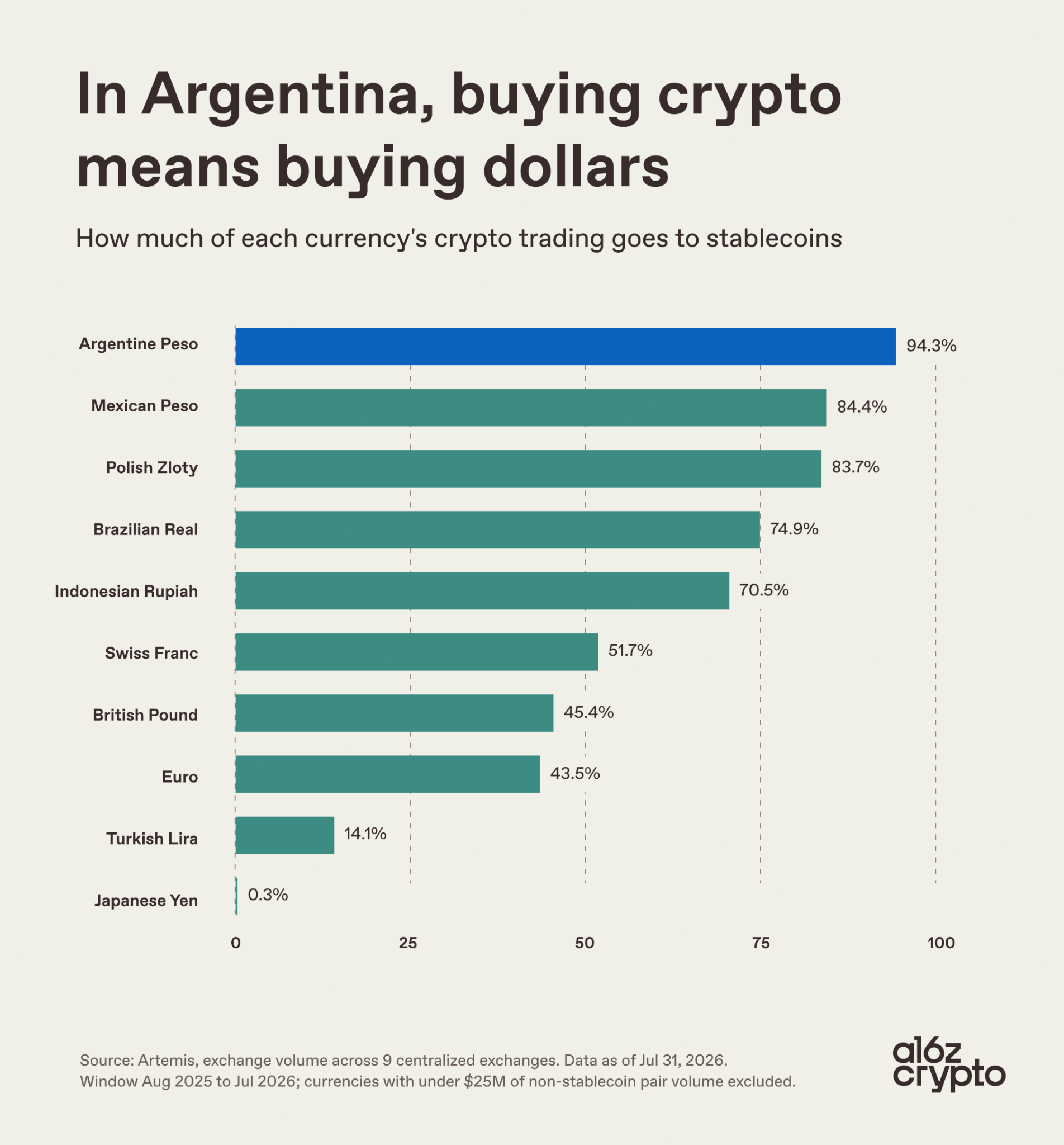
Argentina remains the world’s most dollarized crypto market by share of volume, but the pattern is regional: in Brazil, institutional stablecoin volume jumped from 5% of local crypto flows in 2024 to 84% in 2025, and Mexico’s Senate is now debating a bill to regulate peso-pegged stablecoins.

A rising share of household and corporate dollars sitting in instruments reserved entirely offshore will, sooner or later, look like a policy problem worth solving, not a market outcome to shrug at.
Should Latin America Force Some of Those Dollars Back Home?
This has a preview. In July, Kenya’s Treasury proposed requiring stablecoin issuers to hold at least 30 percent of customer funds in banks domiciled in the country. No Latin American regulator has proposed anything like it yet, but the logic behind Kenya’s rule, chronic dollar scarcity meeting a financial system trying to claw back some claim on flows it can no longer prevent, is arguably more acute in Argentina or Venezuela than in Kenya. I would be surprised if nobody in the region’s finance ministries is already sketching something similar.
I do not think this is an easy call. None of the region’s frameworks so far, not Argentina’s PSAV regime, not Brazil’s rules in force since February, not the bill in Mexico’s Senate, have tried to solve this yet, and one of their underappreciated virtues is that they have not.
My read: mandating local reserves would fragment liquidity that today lives almost entirely in USDT and USDC, strip domestically-backed instruments of the convertibility that makes them useful for remittances, and likely push demand toward unregulated rails instead of compliant ones. That defeats the point of the rule.

The alternative worth building toward is coexistence: locally-reserved and offshore-reserved dollar instruments operating under supervision, moving freely between each other, letting users decide where their dollars live.
Whether the region gets there, or defaults to Kenya’s blunter instrument once dollarization is impossible to ignore, will decide how much of Latin America’s dollar savings stays inside a supervised system, and how much goes looking for the door.
The post Where Do Latin America's Dollars Actually Live? appeared first on BeInCrypto.



Glamsterdam raised its block gas limit from 60 million to 200 million about an hour after going live on the testnet. Gas measures the computing work required by transactions, so the higher ceiling creates room for more payments, token swaps and other activity in each block.
How that helps Ethereum
A 200 million limit would let Ethereum absorb more activity before users begin outbidding one another for block space, which could make fee spikes less severe when trading surges or a popular token launch clogs the network.
Larger blocks are also harder to check and could leave smaller operators unable to keep up. Glamsterdam is Ethereum’s attempt to gain that extra capacity without making the chain prohibitively expensive to run.
Specialized builders package transactions, while validators check the resulting blocks and secure the chain. Glamsterdam would place that handoff and the accompanying payments inside Ethereum’s own rules, reducing dependence on outside relay services.
The change also extends the time available to spread block data across the network from about two seconds to nine seconds. That gives validators longer to receive and check the larger blocks Glamsterdam is designed to support.
As such, the 200 million limit remains a test setting rather than a commitment for Ethereum’s main network. Devnet-11 was also designed as a controlled rehearsal without deliberate attacks.
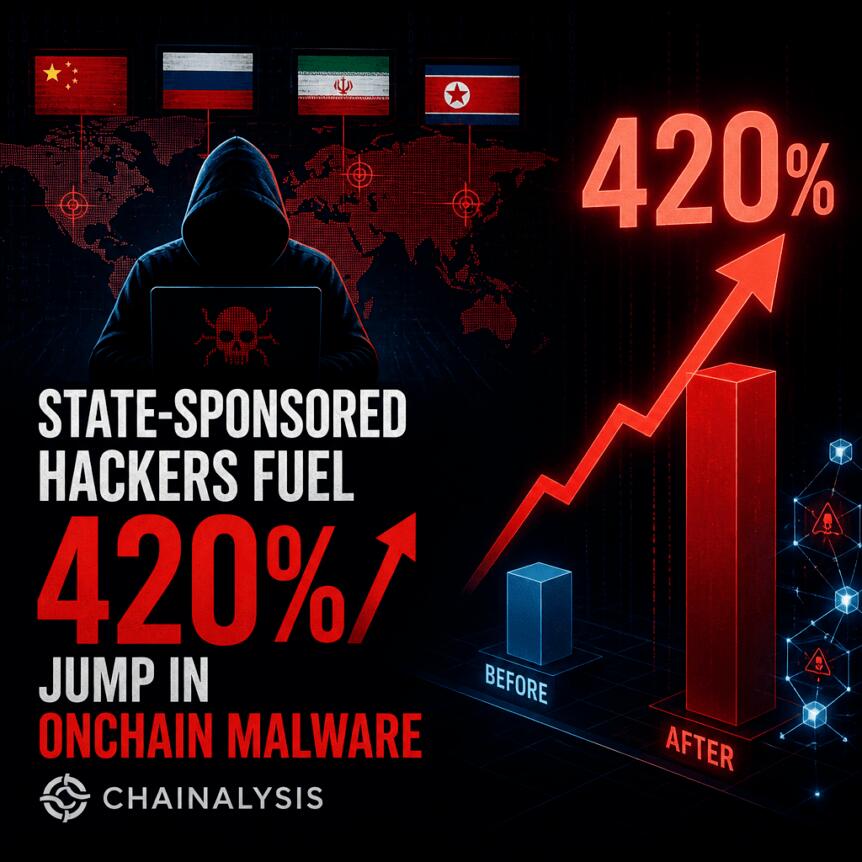
State-linked hackers are increasingly using public blockchains as a durable way to “dead drop” malware instructions and infrastructure details, according to a Chainalysis report cited by Cointelegraph. The firm estimates that roughly two-thirds of new quarterly activity involving these techniques is tied to state-aligned operators, while the frequency of such “dead drop” writes has surged dramatically over the past year.
Chainalysis reports that the number of times attackers stored malware-related payload information on public chains rose 420% in the last 12 months. It also highlights cases involving North Korea- and Iran-linked groups, showing how encoded blockchain data can outlast takedowns of domains, servers, or code repositories.
Key takeaways
- Chainalysis attributes about two-thirds of new dead drop blockchain activity per quarter to state-linked threat actors.
- Dead drop payload writes across public blockchains increased 420% year over year, signaling faster scaling of these tactics.
- Chainalysis linked previously unattributed activity across Tron, Aptos, and BNB Smart Chain to UNC5342, a North Korea-linked group tracked by Google Threat Intelligence.
- Chainalysis also recorded a 440% rise in malicious blockchain writes since July 2025, coinciding with the emergence of higher-capacity open-source AI models.
- Iran-linked actors are suspected to have used Bitcoin to publish encoded command-and-control routing data that infected devices can periodically check.
More “dead drop” payloads on-chain
Chainalysis frames the technique as a way to make malware campaigns harder to disrupt. Instead of relying on websites, domains, or code hosts that can be seized or shut down, attackers encode instructions and infrastructure pointers directly into transactions on public blockchains. The information persists because blockchain data remains accessible even if off-chain components are removed.
In practical terms, the approach improves campaign durability: malware can continue operating as long as it can retrieve updated instructions from the blockchain. Chainalysis notes that in 2025, North Korean hackers used a similar concept—called EtherHiding—to conceal crypto-stealing code inside smart contracts.
North Korea-linked routing across multiple chains
One of Chainalysis’ detailed findings connects activity that previously lacked clear attribution across Tron, Aptos, and BNB Smart Chain (BSC) to UNC5342, a North Korea-linked group tracked by Google Threat Intelligence.
Chainalysis reports that encoded pointers embedded in Tron and Aptos transactions directed compromised devices to the same BSC transaction. In the workflow described, Tron functioned as an initial route, while Aptos served as a fallback if the first path did not work as intended.
The BSC transaction, according to Chainalysis, included encrypted server addresses and configuration data. Those encrypted details tied infected devices to off-chain infrastructure used for remote access and data theft—meaning the blockchain acted as the resilient “messaging layer” while the operational work moved outside the chain once instructions were retrieved.
For investors and builders, this multi-chain structure matters because it increases the surface area responders must monitor. Instead of focusing on a single chain or a single contract address type, defenders may need to track how attackers chain together multiple networks to improve reliability.
AI tools may be boosting malicious on-chain output
Chainalysis also links a surge in harmful blockchain behavior to developments in AI capabilities. The firm recorded a 440% increase in malicious blockchain writes since July 2025, a period it associates with when high-capacity open-source Chinese AI models became capable of producing malicious code with limited safeguards.
Eric Jardine, cybercrimes research lead at Chainalysis, told Cointelegraph that the company found a “clear point-in-time association.” However, he emphasized that Chainalysis could not definitively prove that the actors responsible for the malicious transactions and contracts were specifically using those models to increase output.
This distinction is important. The data indicates timing alignment, but causality remains unconfirmed. Readers should treat the finding as an early warning about how quickly automated code generation tools could lower the cost of producing and deploying blockchain-based malware—without assuming a direct “AI used” attribution for every case.
Iran-linked actors using Bitcoin as a command channel
Beyond North Korea-linked cases, Chainalysis says it identified threat actors it suspects are linked to Iran’s Ministry of Intelligence writing encoded command-and-control routing data onto the Bitcoin blockchain.
Unlike approaches that rely on blockchain activity alone, Chainalysis states its assessment was grounded in a broader set of indicators: the malware family involved, the decoding method, timing patterns, and server infrastructure tied to previously reported Iranian operations.
Chainalysis says attacker-controlled wallets sent small payments to a widely known Bitcoin address with historical ties to Satoshi Nakamoto. The report indicates that this address has no connection to the attackers; rather, it is used as a permanent public location that infected devices could check for updated routing instructions.
According to Chainalysis, the attackers could revise their server infrastructure by publishing another Bitcoin transaction. Once the malware obtained the new instructions, the operation could shift back off-chain, enabling behaviors such as remote access, credential theft, and delivery of additional malware payloads.
From a threat-management perspective, using a familiar and long-lived Bitcoin address complicates takedowns. Even if defenders act against the obvious infrastructure, the blockchain location can remain publicly available and function as a reliable beacon for compromised devices.
Why this trend is likely to keep intensifying
As dead drop techniques spread and as malicious on-chain writes accelerate, the challenge for the ecosystem is not just spotting individual malicious transactions—it’s anticipating how attackers design fallback routes, encrypt payloads, and distribute retrieval logic across chains. The most actionable takeaway for monitoring teams is to focus on behavior patterns around payload writes and encoded routing mechanisms, rather than relying solely on domain or server takedowns.
Going forward, readers should watch whether defenders and analytics firms shift toward cross-chain correlation of encoded instruction flows, and whether future reporting can move beyond “association” to clearer evidence about how AI tooling is operationally integrated into these campaigns.


Crypto.com’s CEO said its sister exchange was cleared to offer US access to single-stock perpetual futures, as the latest platform to bridge TradFi and digital assets.
Crypto World
After the CLARITY Act fails, XRP price falls and faces selling pressure, investors fight back successfully to earn $10,000 a day

Disclosure: This content is provided by a third party. Neither crypto.news nor the author of this article endorses any product mentioned on this page. Users should conduct their own research before taking any action related to the company.
As the CLARITY Act was rejected with 49 votes in favor and 50 votes against, the bill was not advanced. With substantial outflows from spot ETFs, XRP is facing selling pressure and its price continues to decline.
Investors have reduced their investment in higher-risk assets, causing an overall decline. Against the backdrop of a sluggish cryptocurrency market, more and more XRP investors are beginning to explore cloud mining to earn passive income of up to $10,000 per day.

As U.S. Treasury yields rise, investors have reduced their investment in higher-risk assets, leading to an overall decline. The yield on 10-year U.S. Treasury bonds once exceeded 5%, significantly “increasing the opportunity cost of holding non-yielding assets, including most of the cryptocurrency market.”
At the same time, oil prices exceeding $100 per barrel, geopolitical tensions, and expectations of tighter monetary policy have all intensified pressure on risk assets. “Market volatility may remain elevated,” Masabuni pointed out, as the market faces multiple challenges from monetary policy, regulation, and geopolitical risks.
Ryan Kirkley, Co-Founder and CEO of the Global Settlement Network, also pointed out that the Senate’s failure to advance the CLARITY Act immediately put pressure on the cryptocurrency market, with crypto-related stocks such as Coinbase (Nasdaq: $COIN) and Circle (NYSE: $CRCL) facing pressure.
“The reaction from investors precisely demonstrates how much they value regulatory certainty,” Kirkley told Crypto.news, adding that institutional capital needs to know “who regulates what, how assets are classified, what intermediaries can do, and the scope of responsibilities of the U.S. Securities and Exchange Commission (SEC) and the Commodity Futures Trading Commission (CFTC). When the answers to these questions remain unresolved, capital must price this uncertainty into the market.”
A new choice for XRP investors: UE Crypto’s path to growing returns
Given this trend, more and more XRP investors are turning their attention to UE Crypto, exploring more stable and sustainable income models through cloud mining and income aggregation mechanisms.
Compared with more volatile futures trading or ETF investments, UE Crypto provides a more straightforward and convenient way to participate in digital assets, helping users improve the efficiency of their digital assets while participating in the development of the XRP ecosystem. For users with a certain amount of capital, this model may offer greater potential for daily returns.
Unlike highly volatile leveraged trading or strategies that rely solely on price appreciation, the Crypto cloud mining platform provides a more convenient way to participate in digital assets. Users do not need to deploy mining machines or maintain hardware; they only need to select a computing-power contract to participate in mining services. This allows them to focus on the long-term prospects of XRP while maximizing the returns of their digital assets.
About UE Crypto
UE Crypto is headquartered in the United Kingdom and operates under European regulatory frameworks such as MiCA and MiFID II, continuously improving its transparency, operational standards, and user protection mechanisms.
The platform adopts a multi-layer security architecture, including:
- Annual financial and security compliance audits conducted by PricewaterhouseCoopers (PwC);
- Digital asset custody insurance provided by Lloyd’s of London;
- Enterprise-level cybersecurity protection from Cloudflare and McAfee® security systems;
- Bank-level data encryption technology and professional security infrastructure, providing multiple layers of protection for user assets and accounts.
UE Crypto supports a variety of mainstream digital assets, including XRP, BTC, ETH, USDT, USDC, DOGE, LTC, and SOL, providing users with a more flexible and convenient digital asset service experience.
How to Join UE Crypto
With just three steps, you can easily start earning daily returns:
1. Register an account
2. Choose a mining package
According to your personal budget and needs, choose a suitable cloud mining contract and start mining with one click.
3. Start earning
After the contract is activated, the system will automatically allocate computing power, and returns will be automatically settled every 24 hours. Users can withdraw their returns at any time or continue participating according to their needs, achieving long-term compound growth of their assets.
Popular UE Crypto contracts:
BTC (Super Computing System Contract)
Investment Amount: $1,000
Contract Duration: 10 days
Daily Return: $13.10
Total Return at Contract Expiration: $1,000 + $131
LTC (Algorithm-Driven System Contract)
Investment Amount: $5,000
Contract Duration: 25 days
Daily Return: $72
Total Return at Contract Expiration: $5,000 + $1,800
BTC (Quantitative Intelligent System Contract)
Investment Amount: $10,000
Contract Duration: 35 days
Daily Return: $158
Total Return at Contract Expiration: $10,000 + $5,530
For more details about the contract plans, please visit the official UE Crypto website.
Conclusion
UE Crypto was founded in 2015 and is headquartered in London, United Kingdom. It is a globally leading innovative cloud computing platform. We deeply integrate cutting-edge hardware, intelligent core algorithms, and powerful cloud infrastructure to provide global users with high-performance, cost-effective crypto asset solutions. As a pioneer in the fields of cloud computing technology and digital asset services, UE Crypto brings together a team of top experts and adheres to the core values of “green, intelligent, open, and sustainable.” UE Crypto is committed to leading the global blockchain energy revolution. Through innovative cloud computing architecture and decentralized finance (DeFi) technology, we are fully committed to promoting the development of an efficient and low-carbon computing ecosystem. We are reshaping the future of an open and shared digital economy while continuously creating long-term value for global users.
UE Crypto’s cloud mining services provide users with a low-risk alternative for long-term engagement with the digital asset ecosystem, helping investors move away from short-term market noise, focus on the long-term value of their assets, and establish a more resilient and sustainable form of passive income.
For more information, please visit the official UE Crypto website and download the application.
Disclosure: This content is provided by a third party. Neither crypto.news nor the author of this article endorses any product mentioned on this page. Users should conduct their own research before taking any action related to the company.
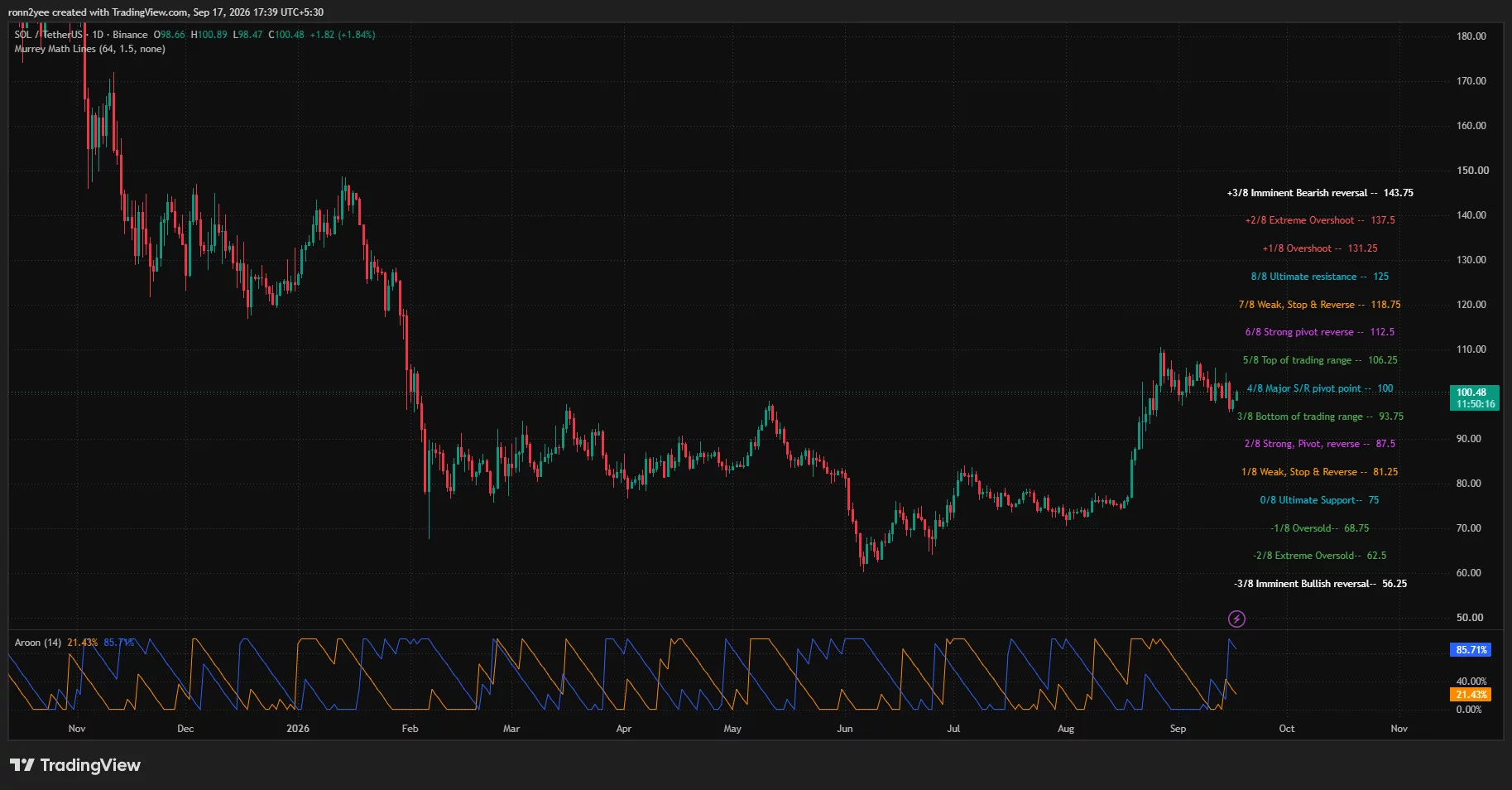
Solana price rose back above $100 after buyers defended the $95–$96 support zone, but technical resistance and concentrated liquidation levels near $102 could determine whether the rebound develops into a wider recovery.
Summary
- Solana price rebounded from $96.23 and traded near $100.50 on Thursday.
- Aroon Up reached 85.71%, showing that short-term bullish momentum had returned.
- The 4-hour Supertrend remained bearish, with resistance positioned near $102.80.
- Liquidation clusters between $101 and $102 could increase volatility during another recovery attempt.
Solana price rebounds from $96 support
Solana (SOL) price traded near $100.50 after recovering from a 24-hour low of $96.23, according to the daily chart. The rebound followed a sharp sell-off linked to the US Senate’s failed procedural vote on the CLARITY Act and the Federal Reserve’s 25-basis-point rate increase.
The daily chart shows that SOL briefly moved below $100 before buyers entered around the $95–$96 area. The recovery carried the price back to the Murrey Math major support and resistance pivot at $100.
Holding that pivot would improve the short-term structure following the decline from the late-August peak near $110. However, the asset has not yet cleared the lower highs formed during September, leaving its broader recovery incomplete.
Crypto analyst Ella identified $95–$96 as the level Solana needed to defend. She said SOL fell to $96.13 around the Fed decision before bouncing to $98.72 and outperforming Bitcoin and Ethereum during the initial recovery.
“Get back above it and yesterday’s damage starts to look repairable,” Ella wrote, referring to the $100 level.
The analyst warned that another loss of $96 could cause the rebound to fade quickly. SOL’s recovery above $100 therefore needs confirmation through sustained closes rather than a brief intraday move.
Momentum improves, but Supertrend remains bearish
The daily Aroon indicator favors buyers after the rebound. Aroon Up stood at 85.71%, compared with an Aroon Down reading of 21.43%. The gap suggests that a recent high carries more weight than the latest low within the indicator’s 14-day lookback period.
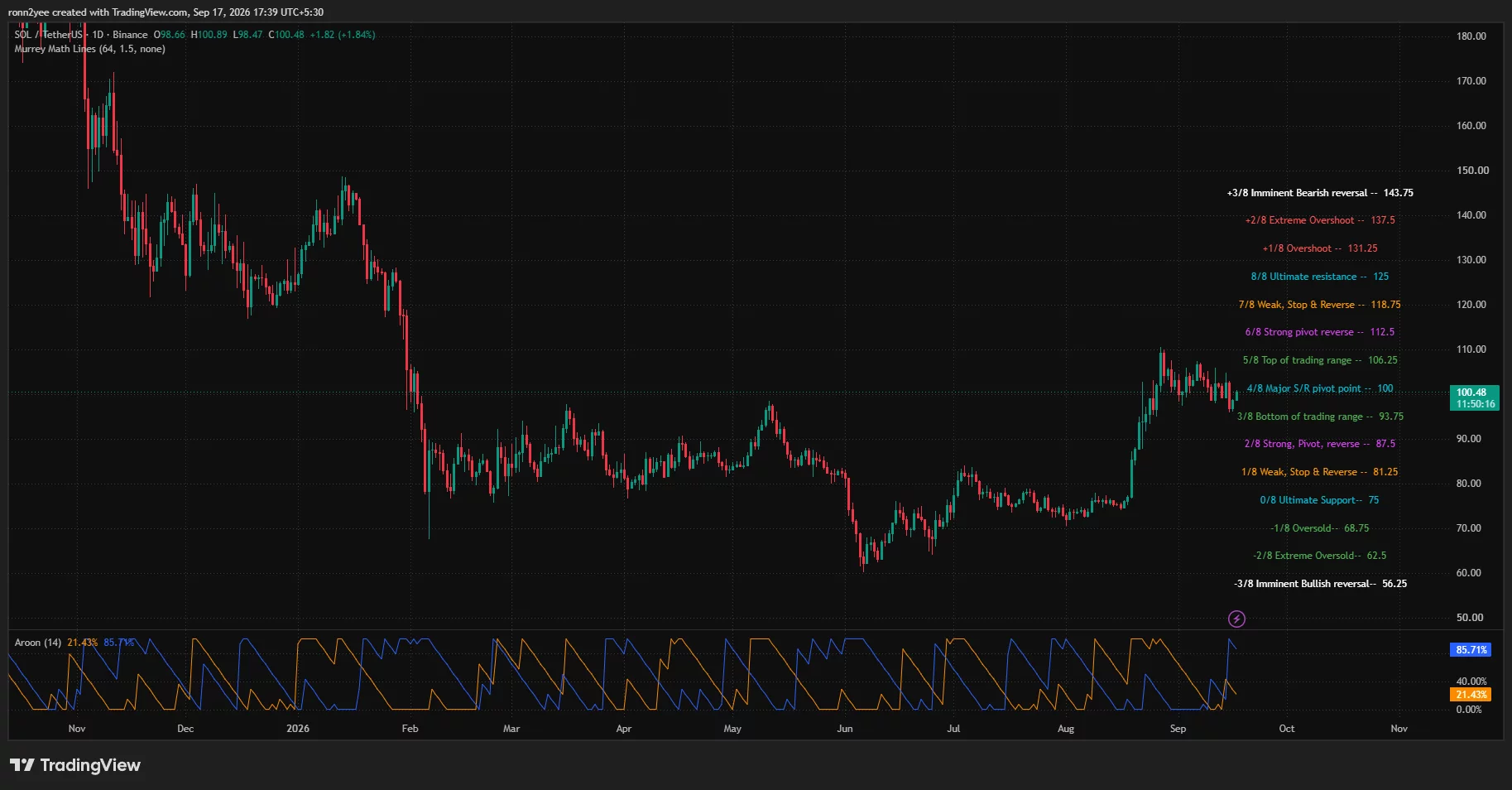
SOL must continue holding $100 for that momentum signal to remain constructive. The next daily resistance appears at $106.25, marked as the top of the current Murrey Math trading range.
A daily close above $106.25 would strengthen the case for a return toward $110 and the next major pivot at $112.50. Higher resistance sits at $118.75 and $125, although SOL would first need to break its September sequence of lower highs.
The 4-hour chart remains less supportive. SOL traded below the Supertrend level of approximately $102.80, keeping the indicator’s short-term signal bearish. Price must reclaim that level before buyers can argue that the latest correction has ended.
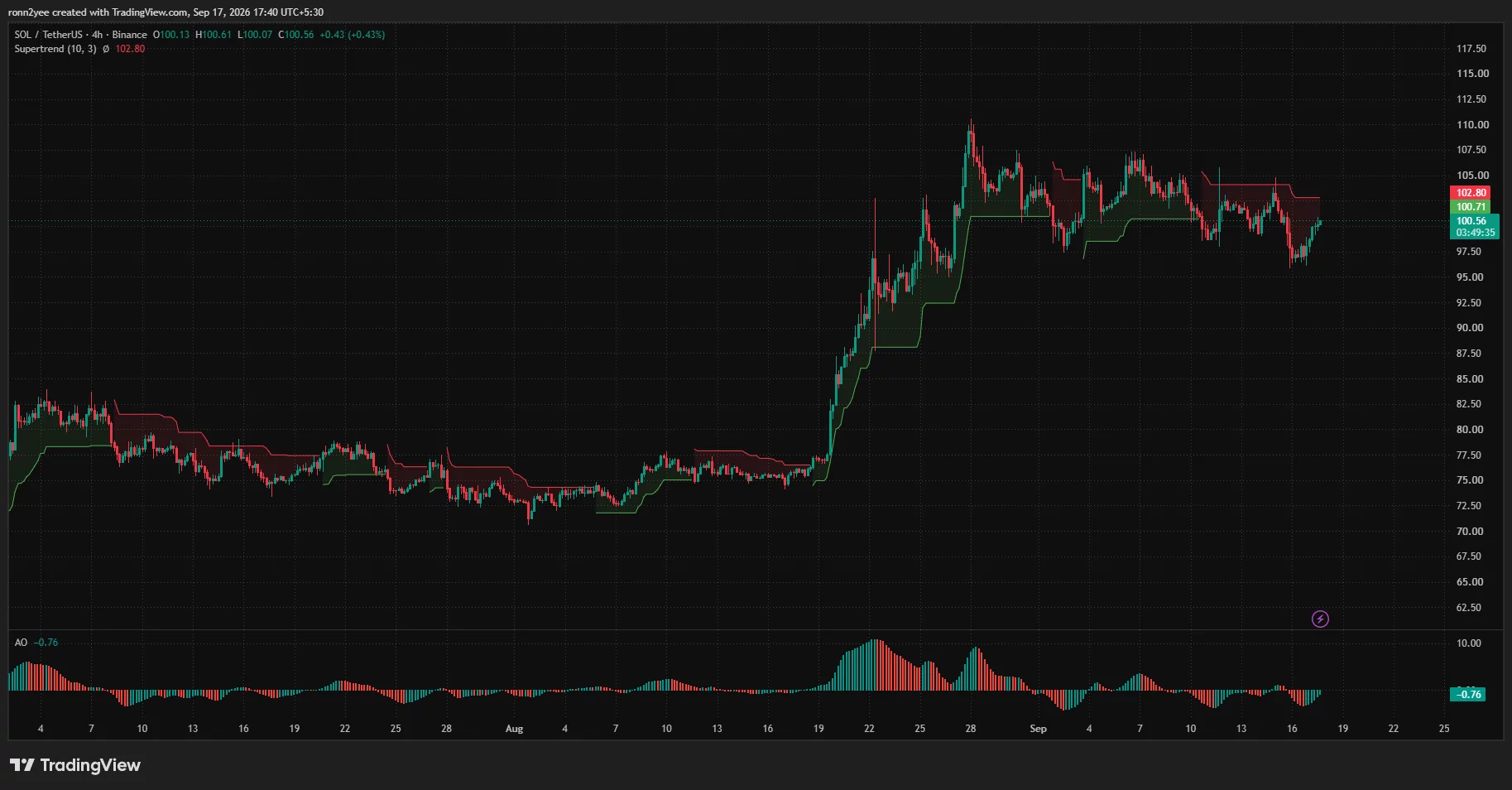
The Awesome Oscillator also remained slightly below zero at about -0.76. Its negative bars were contracting, however, suggesting that bearish momentum was losing strength as SOL recovered from $96.
A move above the zero line would confirm improving 4-hour momentum. Failure to do so could leave the latest advance vulnerable to another rejection between $101 and $103.
SOL liquidation map puts $102 in focus
The three-day CoinGlass liquidation heatmap shows a dense concentration of leveraged positions immediately above the current price. The brightest nearby bands sit around $101.30 and $101.80–$102, making that zone a potential target during an upward move.
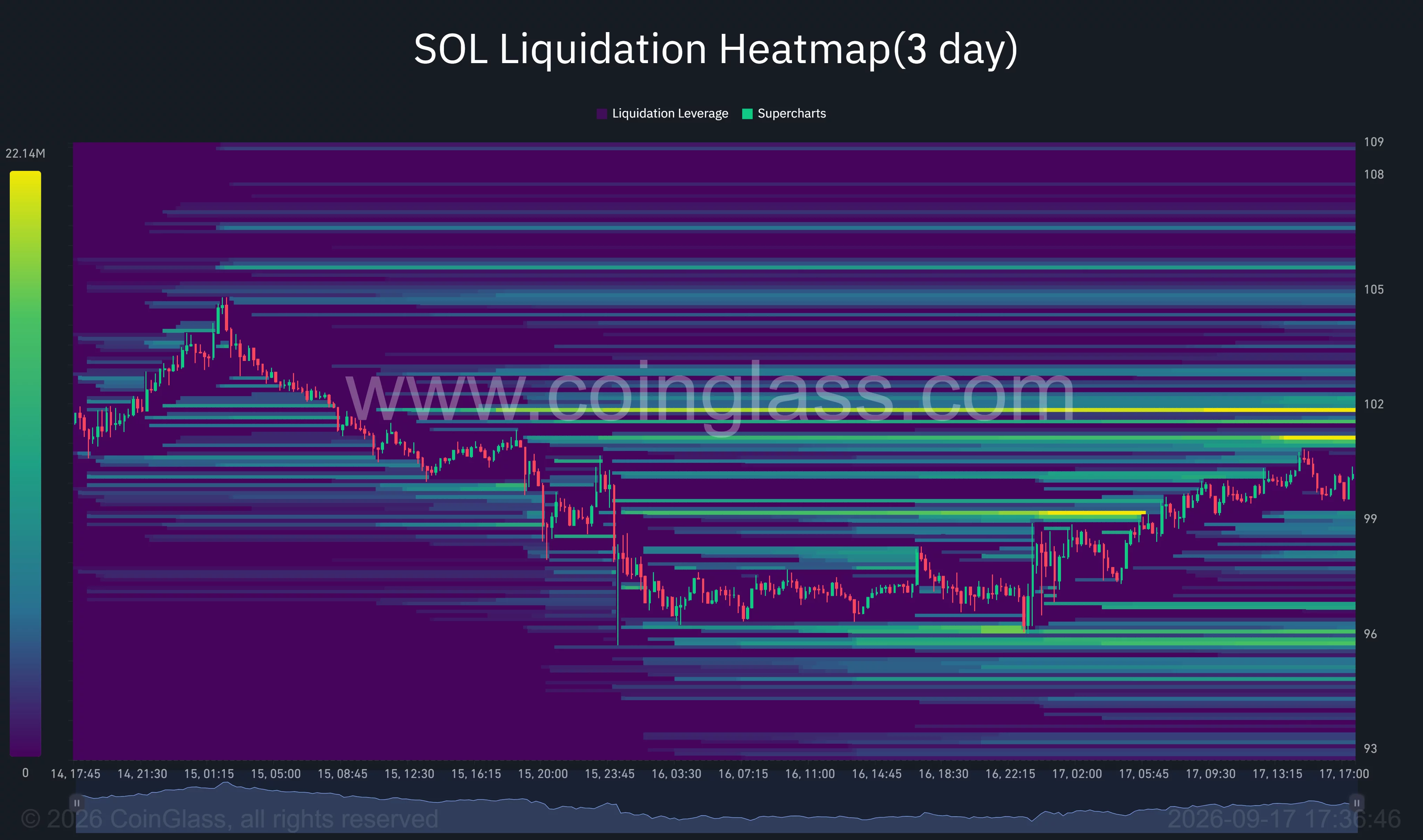
A push into those levels could liquidate short positions and help SOL test the 4-hour Supertrend resistance at $102.80. Additional liquidity appears around $105 and $105.70, close to the upper end of the $101–$106 resistance region visible on the price charts.
Liquidity also remains below the market. The clearest downside concentrations appear near $99, $96, and $95.50. Losing $99 could therefore pull the price back toward the defended $95–$96 zone as leveraged long positions come under pressure.
The heatmap does not establish price direction on its own. It instead identifies areas where forced position closures could add speed to an existing move. With sizable liquidity on both sides, a break from the $96–$103 range may produce a sharper move than the recent consolidation suggests.
Solana bulls face resistance between $102 and $106
The immediate bullish case depends on SOL holding the $100 pivot and breaking $102.80. Clearing the 4-hour Supertrend could open a move toward $105 and the daily resistance at $106.25.
Rand Group said Solana continued to defend horizontal support while pressing against a local downtrend. Its shared chart showed the asset compressing beneath descending resistance after recovering from its midyear lows, a structure the firm described as a possible breakout setup.
DeFi Development Corp.’s reported $300 million financing facility for SOL treasury purchases could provide a separate source of demand. However, its potential market impact will depend on the pace and execution of any purchases under the facility.
The bearish case would strengthen if SOL loses $99 and closes below $96. A breakdown beneath that support would invalidate the latest rebound and expose the Murrey Math level at $93.75. Further selling could bring the $87.50 pivot into view, while the wider chart places major support at $75.
For US investors, the next move may remain sensitive to changes in Treasury yields and expectations for another Fed rate increase. The CLARITY Act setback also leaves regulatory uncertainty in place for smart-contract platforms and other altcoins.
SOL has absorbed the initial policy and rate shocks without breaking its main support, but buyers still need a sustained move above $102.80—and ultimately $106.25—to confirm that control has shifted back in their favor.
Disclosure: This article does not represent investment advice. The content and materials featured on this page are for educational purposes only.

Zcash crypto trades at $1,330, up 15% over the past 24 hours, cementing its status as the session’s standout privacy asset. That kind of move doesn’t happen in a vacuum. There’s a specific regulatory trigger behind it, and a specific bull case that follows, one that carries implications well beyond ZEC itself.
The catalyst traces back to the stalled CLARITY Act, whose failure to advance has left US crypto market structure rules in limbo, pushing traders toward assets that don’t depend on regulatory clarity to function, namely, privacy coins.
Paradigm co-founder Matt Huang added fuel to the move, disclosing his firm’s ZEC position in an X post describing Zcash as “a private complement to Bitcoin.” Bitcoin itself held above $76,000 as the Fed signaled limited further tightening, giving the market room to breathe.
Zcash holders recently backed proposals for faster transactions alongside bitcoin-style halving schedules, a governance signal that’s arguably as important as the price action itself. The question now is whether this rally has legs or whether it’s a regulatory-headline spike destined to fade, and what that means for where capital rotates next.
Earn $50 and Enter $300K Prize Draw on EdgeX
Can Zcash Crypto Price Hit $1,500 This Week?
ZEC’s move above $1,300 marks a clean breakout from the $1,000 level that had capped prices for weeks, a threshold flagged as Zcash’s highest mark in nearly a decade. Volume has scaled with price, a sign this isn’t a thin-liquidity spike. The $1,300 zone now functions as near-term support; a hold there keeps the breakout structure intact.

- The bull case: a retest and break of the $1,390 intraday high opens a path toward $1,500, particularly if privacy-narrative momentum persists alongside continued regulatory gridlock.
- Base case: consolidation between $1,300 and $1,400 as traders digest the move before the next leg.
- Bear case: a slide back under $1,000 would invalidate the breakout entirely and signal the rally was headline-driven rather than structural.
Watching the $1,300 line matters more than watching the headlines at this point.
Trade Zcash on Bybit and Get a Chance to Win Our $1,000 USDT Airdrop
LiquidChain Targets Early Mover Upside as Zcash Tests Key Levels
A 15% single-day move validates conviction for anyone already holding ZEC. But at a market cap north of $22 billion, doubling from here requires a very different scale of capital inflow than doubling a sub-$1 million presale does.
That math is why traders chasing this kind of move often start looking one step earlier in the risk curve.
LiquidChain is positioning itself as a Layer 3 infrastructure play that fuses Bitcoin, Ethereum, and Solana liquidity into a single execution environment. It’s a “deploy-once” architecture meant to let developers build against all three ecosystems without fragmenting liquidity.
The quill knows what comes after L2. — LiquidChain (@getliquidchain) September 17, 2026
 https://t.co/vqvBcdSQYC pic.twitter.com/BSumZRCBFg
The presale token sits at $0.014956, with total raised at $967K and closing in on the $1 million mark. Standout features include a Unified Liquidity Layer and Verifiable Settlement.
Research LiquidChain before the presale window closes.
Discover: The Best Token Presales
The post Zcash Crypto Surges 15% as CLARITY Act Fails, Privacy Concerns Drive Demand appeared first on Cryptonews.
S&P Global has agreed to acquire OpenZeppelin, the blockchain security firm known for its open-source smart contract tooling and professional security reviews. The move is designed to strengthen S&P Global’s digital asset capabilities—particularly around risk assessment and onchain technology analysis—at a time when financial institutions are increasingly looking to tokenized markets.
The acquisition was announced on Thursday in a press release by S&P Global. Financial terms were not disclosed, and the transaction remains subject to customary closing conditions.
Key takeaways
- S&P Global’s planned purchase of OpenZeppelin targets expanded onchain smart contract and technology risk assessment capabilities.
- OpenZeppelin’s open-source contracts library is expected to remain free and publicly maintained on GitHub after the deal.
- The transaction is structured so OpenZeppelin will operate as a separate S&P Global business unit.
- Deal completion depends on closing conditions; investors should watch for regulatory and transaction approvals.
Why S&P Global wants OpenZeppelin
In its announcement, S&P Global framed the acquisition as a complement to its existing efforts in risk assessment and ecosystem development for the digital asset market. The company said the goal is to bring “trusted data, benchmarks and transparent risk assessment” to markets as activity moves onchain.
Yann Le Pallec, S&P Global’s ratings president, said the acquisition will help expand the firm’s smart contract and onchain technology risk assessment capabilities. For S&P Global, this is a strategic fit: ratings and risk frameworks typically rely on standardized methodologies, while OpenZeppelin’s offerings center on security evaluation for smart contracts and related blockchain systems.
That matters for investors and market participants because, in tokenized environments, security failures can quickly translate into financial losses. As more traditional finance workflows connect to smart contract infrastructure, the demand for repeatable, auditable security assessments is likely to grow.
What OpenZeppelin brings to the table
OpenZeppelin, founded in 2015, develops open-source smart contract software and conducts security assessments for both blockchain projects and financial institutions, according to the deal announcement. The company also highlighted its track record: its smart contracts have supported more than $37 trillion in value transferred, and it has completed over 900 security engagements.
Those numbers point to scale and adoption, but they also underscore a key differentiator in this space—OpenZeppelin is not only a services provider; it also maintains widely used reusable contract components. That dual model (public tooling plus professional security work) is often valuable to enterprises because it can reduce the friction between building securely and validating security expectations.
How the acquisition is structured
OpenZeppelin said its contracts library and other open-source applications will remain free and publicly maintained on GitHub. The announcement also states that the platform will be operated as a separate S&P Global business unit, with Demian Brener continuing as CEO and reporting to Le Pallec.
Operational independence can be important for maintaining trust in security tooling, especially where developers and institutions rely on consistent standards over time. By stating that its open-source artifacts will remain publicly maintained, OpenZeppelin also aimed to reassure builders that the acquisition is not intended to lock critical components behind proprietary access.
Part of a broader push into tokenized markets
This agreement comes shortly after S&P Global pursued additional exposure to crypto market infrastructure. Earlier this week, S&P Global led a strategic investment in Kaiko, the Paris-based crypto market data provider, extending Kaiko’s Series B funding to $110 million as it expands data infrastructure for tokenized financial markets—coverage of that round was reported by Cointelegraph in a separate piece.
Read together, the S&P Global–OpenZeppelin deal and the Kaiko investment suggest a broader strategy: pairing market data and benchmarks with stronger onchain security and risk assessment. For institutional participants trying to operationalize tokenized assets, this combination can be critical—data helps monitor markets, while security assessment helps address the risks embedded in smart contract systems.
Still, the timeline for any tangible impact will depend on deal closing. Until the acquisition completes, readers should treat the operational outcomes—such as integration plans and any changes to service delivery—as uncertain.
With S&P Global and OpenZeppelin now linked under a pending transaction, the next thing to watch is whether closing conditions are met promptly and how the new business unit evolves—especially in how it applies OpenZeppelin’s security expertise to S&P Global’s benchmarks and risk frameworks across tokenized markets.


Attackers claiming responsibility for Revolut’s data breach say they want $3 million in Monero from the banking firm, or they’ll sell the stolen customer data to other criminals.
That’s according to the Financial Times, which reports that the group, going by the name “iamnotavillain,” is making its demands for the first time.
Its ransom website was launched this week, but negotiations haven’t yet begun with Revolut.
Reuters also reports that Revolut has had no contact with, or received any demands from, the attackers.
Read more: Trezor’s summer of hacks continues with Brevo email breach
Previous reports from Coin Bureau claimed the attackers had demanded 10,000 BTC, a figure that would be worth over $760 million today. It’s unclear whether it’s a different group behind today’s demand.
Coin Bureau never revealed the usernames behind the apparent 10,000-BTC demand.
Revolut was tricked with an Italian gov email
The attackers were reportedly able to breach Revolut after obtaining access to an Italian government email.
Using this email, they posed as law enforcement and bypassed the bank’s security checks in order to retrieve data from various customer accounts.
Reuters says a source familiar with the attack told it that around 680 customers were affected, and that the attack didn’t impact Revout’s core infrastructure, databases, or customer accounts.
Earlier this month, crypto hardware wallet firm Trezor revealed that 80,000 of its users were exposed in a mailing breach.
Password manager LastPass also suffered a customer data leak in June, and researchers have claimed that India’s state-run Bank of Baroda suffered a customer data leak last July.
Got a tip? Send us an email securely via Protos Leaks. For more informed news and investigations, follow us on X, Bluesky, and Google News, or subscribe to our YouTube channel.

It’s not big news, but Cardano generated 3.3 million ADA in transaction fees against 493.7 million ADA in staking rewards across the 73 five-day epochs ending Sept. 1, 2026. Fees covered about 0.668% of rewards, leaving the reward pool roughly 149.6 times larger than fee revenue.
That gap widened as usage thinned out. Average daily transactions fell 72.46%, from 90,294 in 2022 to 24,869 between January and August 2026, turning the fee-versus-reward math into Cardano’s most pressing structural question heading into its next scaling upgrade.
If we counted transactions from Cardano’s first block and grouped the comparison into 73 five-day epochs running Sept. 1, 2025, through Sept. 1, 2026. The official epoch 654 snapshot recorded 108,500 transactions and 33,855 ADA in fees over five days, against 9.998 million ADA in distributed rewards.
Cardano’s reserves stood at 6,126,859,027 ADA in epoch 655, equal to 13.62% of the 45 billion ADA maximum supply.
Earn $50 and Enter $300K Prize Draw on EdgeX
Why Reserve Emissions Still Do the Heavy Lifting?

Under Cardano’s monetary policy, transaction fees and 0.3% of the remaining reserve flow into a virtual pot every epoch. The treasury takes 20% of that pot, and the rest is available for staking rewards, subject to pool performance.
The reserve is engineered to decay, with documentation citing a half-life of roughly four to five years and no fixed exhaustion date. As emissions shrink, nominal reward payouts can fall too, which mechanically narrows the fee-coverage gap without a single extra transaction being processed.
Current minimum fees combine a fixed component with a size-based charge, and protocol governance can still adjust those parameters, but closing the gap on a durable basis still depends on real fee-generating activity rather than a shrinking denominator alone.
Trade ADA on Bybit and Get a Chance to Win Our $1,000 USDT Airdrop
Cardano News: Leios Solves Capacity, Not Demand
Cardano reported a sixfold increase in Leios performance in an August public testnet update using synthetic traffic. It is a capacity result, not evidence that mainnet users will generate enough activity to multiply fee revenue anywhere near 150-fold. Linear Leios is designed for throughput above the simplified 43.1 TPS scenario, giving the network a plausible technical path to process far more volume than it does today.
Ouroboros Leios is steadily progressing towards mainnet. — Cardanians (CRDN) (@Cardanians_io) September 16, 2026

This week, the team demonstrated ~1,000 TPS in a test environment.
The mainnet-ready version is expected to be ready in November.
If all goes well, we could see Leios live on Cardano mainnet this year. 
BULLISH. pic.twitter.com/FXOV8E9cmn
That gap between raw throughput and paying demand is not unique to Cardano. Solana’s Transaction v1 upgrade tripled data capacity on a chain that already runs higher fee volumes meaningfully, underscoring that added capacity only converts into network income when applications and users show up to spend it.
Until applications and users generate enough paid transactions to meaningfully close the 149.6-fold gap, Cardano’s staking yields remain a function of reserve depletion rather than organic network income, a distinction that matters for anyone pricing ADA on protocol fundamentals rather than nominal APY.
Discover: The Best Token Presales
The post Cardano News: Rewards Still Depend on Reserve Emissions appeared first on Cryptonews.

Barcelona, 17 September 2026. The Vault, the institutional digital asset custody platform regulated in Switzerland and the EU, has launched its own multi-party computation (MPC) library, the cryptography that allows separate parties to hold shares of a signing key so that a complete private key never exists on any device or server. The launch follows an independent security audit by blockchain security firm Halborn, which issued its final report earlier this week confirming that all findings raised have been remediated and verified.
Artem Stopnevich, chief executive of The Vault, presented it at the European Blockchain Convention in Barcelona, describing it as the first sovereign cryptographic library for institutional custody in Europe, following the completion of an independent audit by Halborn.
The library enforces The Vault’s co-signing model, under which no single party, including The Vault itself, can authorize a transfer on its own. Most custody providers license this component from an external vendor, a decision that ties them to the vendor’s release cycle for security fixes, to the curves and protocols it supports, and to the level of disclosure it permits during due diligence.
The Vault builds it in-house, which is what the company means by sovereign cryptography: the code, the signing protocol, and the release schedule sit with the platform, so fixes ship on The Vault’s own timetable, auditors see the whole codebase, and the protocol can move forward as standards evolve.

“For an institution, custody is a risk decision that has to be signed off internally, and it comes down to a single question: who is able to move an asset, and under what controls,” said Artem Stopnevich, Chief Executive Officer of The Vault, speaking on the sidelines of the European Blockchain Convention in Barcelona, where he joined a panel on the custody of tokenised funds. “We are the only EU-regulated custody provider running institutional MPC cryptography of its own making, and we took the view that we would not put it in front of clients until somebody outside this company had taken it apart at the protocol level, which is what Halborn has now done.”
The library implements distributed key generation, resharing, refresh and recovery, and threshold ECDSA and EdDSA signing, together with commitment, oblivious transfer and zero-knowledge proof primitives, and the transport that carries protocol messages between signers. It is written in Rust, a systems language whose compiler enforces memory safety without a garbage collector, and the same implementation runs on The Vault’s servers and inside the mobile signer on iOS and Android, so the audit covers a single codebase.
“The properties we need at the signing layer are the ones the compiler can enforce for us: no use-after-free, no data races across the concurrent rounds of a protocol, and explicit control over how key material is held in memory and erased once it is no longer needed,” said Yurii Derbasov, Chief Technology Officer at The Vault. “The language does not make a protocol correct, which is why the design itself needed an external review of this depth.”
Halborn’s engagement covered 91 files across the cryptographic core, its test suite and the iOS and Android signer applications. Findings raised during the review were addressed in the codebase as the engagement progressed, and Halborn verified each remediation against the commit that implemented it, confirming the final items in August 2026.
“It was a pleasure to work together with The Vault on securing their MPC custody. Security was clearly a priority for their team, and all findings raised during the engagement were remediated and verified. For institutional custody, proprietary cryptography gives providers direct control over security fixes and protocol updates, and allows auditors to examine the complete implementation rather than stopping at a vendor boundary. That matters when clients are performing technical due diligence on who can move their assets.” said Gabi Urrutia, SVP Security & Field CISO at Halborn.
In the co-signing model, the client holds a key share on their own device, and the mobile signer is the application through which that share is held and used. It is available as an add-on to The Vault’s SaaS custody product.
Looking ahead, The Vault intends to publish the Rust library as open source, so that the cryptography can be examined by anyone, and its cryptography team is working on two new protocols.
The first is a threshold variant of ML-DSA, the post-quantum signature scheme that NIST standardized under FIPS 204 for a single signer; threshold signatures have no NIST-standardised form today, and candidate constructions, classical and post-quantum alike, are going through competitive selection under the NIST First Call for Multi-Party Threshold Schemes, which opened in January 2026. The second is a new threshold post-quantum password-authenticated key exchange, or PAKE.
The full report is available to institutional clients on request (media@thevault.inc).
About The Vault
The Vault is a Swiss and EU-regulated institutional infrastructure platform for digital assets, serving corporate treasuries, financial institutions, family offices, and payment providers. It covers the full lifecycle, from secure custody and treasury operations to back-office management and wallet infrastructure, and is built on proprietary threshold MPC cryptography developed by an in-house research team. It is available in SaaS and On-Premise, with a bespoke modular architecture that can be customized to each company’s needs and frameworks.
The post The Vault Launches Its own MPC Library for Institutional Custody appeared first on BeInCrypto.

Intel: I Was Wrong, Buckle Up For What Is Coming (Rating Upgrade)

Ethereum’s Glamsterdam upgrade clears rehearsal for a big jump in capacity

Nail the Western-Chic Look With These 17 Fringe Pieces



-

 Fashion6 days ago
Weekend Open Thread – Corporette.com
-

 Tech4 days ago
The Latest Weird Thing to Play Doom Is the Mapped-Out Brain of a Fruit Fly
-

 Business6 days ago
10 Most-Streamed Songs On Spotify In 2026 So Far, Led By Ella Langley’s Dominant Run On The Charts This Year
-

 Crypto World6 days ago
XAG/USD: Silver’s Short-Term Rally Meets Its Moment of Truth
-

 Tech7 days ago
Battery life is the only iPhone 18 Pro and iPhone Duo upgrade I care about. Apple didn’t disappoint
-

 Crypto World7 days ago
OKX launches 10x OpenAI, Anthropic X-Perps in Europe
-

 Crypto World6 days ago
Diesel Tops $6 a Gallon for the First Time as 28 States Set Records
-

 Business7 days ago
Western Digital Slips 2.7% as AI Storage Rally Cools After Record Cash and Guidance
-

 Crypto World3 days ago
Kraken Lets xStocks Holders Earn Yield Through DeFi
-

 News Videos6 days ago
Facing Financial Fears
-

 Crypto World3 days ago
Elon Musk Drops a Bombshell: Grok 5 Could Be the AGI Breakthrough
-

 Business4 days ago
Rivals Sam Altman and Elon Musk Rally Behind Dario Amodei’s Call for a Slowdown in AI Development
-
Crypto World7 days ago
Ethereum Price Analysis: Consolidation at $2.5K Tests Momentum as On-Chain Activity Surges
-

 Crypto World5 days ago
Can AI Build a Startup in 72 Hours? Elon Musk's Team Will Livestream the Test
-

 Crypto World15 hours ago
US Charges Robinhood Engineers Over Crypto Listing Trades
-

 Entertainment6 days ago
News Specials, Movies, Shows, More
-
 NewsBeat3 days ago
‘Sick conspiracy’: Trump says only guardrails AI needs is ‘a strong and smart (High IQ!) president’ in all-caps rant
-

 Crypto World6 days ago
Bitcoin ETFs Pull $167M as 2026’s Best Inflow Run Slows
-

 Crypto World7 days ago
US CPI forecast at 3.4% as tariff risks build
-
 Entertainment6 days ago
New Horror Movie Officially Earns a Rare Stephen King Recommendation
You must be logged in to post a comment Login