
Crypto World
White House clears 401(k) rule that opens door to crypto



The White House has cleared a Department of Labor proposal that could change how 401(k) fiduciaries assess alternative assets, including digital-asset exposure.
Summary
- White House completed review of a Labor proposal tied to crypto access in 401(k) plans.
- The rule follows Trump’s order to expand alternative assets in defined-contribution retirement plans nationwide.
- Indiana lawmakers also advanced a bill requiring crypto options in certain retirement savings plans.
The move brings the rule closer to publication and opens the next stage of the federal process.
The White House’s Office of Information and Regulatory Affairs completed its review of the Labor Department proposal on March 24. The action appeared on the OIRA website as “consistent with change” and carried an “economically significant” label.
That completed review removes an interagency step for the proposal. The Labor Department is now expected to publish the rule for a 60-day public comment period before it considers revisions and a final version.
The proposal follows President Donald Trump’s Aug. 7, 2025, executive order on alternative assets in 401(k) plans. The order told federal agencies to expand access to alternative investments, including digital assets through certain investment vehicles.
It also told the Labor Department to revisit limits on alternative assets in defined-contribution plans. The order named digital assets, private equity, and real estate, and it called for coordination with the Treasury Department and the Securities and Exchange Commission.
In addition, the new step follows an earlier federal policy shift. On May 28, 2025, the Labor Department withdrew its 2022 compliance release that had urged fiduciaries to be “extremely cautious” when considering crypto in 401(k) plans.
That change marked a different federal approach to retirement-plan exposure to digital assets. If the proposal advances, fiduciaries may get a wider path to review crypto-linked options alongside other alternative investments.
States also push crypto retirement access
State-level efforts are also moving forward. On Feb. 25, Indiana lawmakers passed a bill that would require certain state retirement and savings plans to offer a self-directed brokerage option with at least one crypto investment option by July 1, 2027.
The broader retirement market remains large as these policy changes develop. According to the Investment Company Institute, US retirement market assets reached a record $48.1 trillion on Sept. 30, 2025.


The UK government is cracking down on a $20 billion Chinese-language crypto guarantee marketplace, with sweeping sanctions aimed at cutting the platform off from crypto access.
The UK’s Foreign, Commonwealth & Development Office said in a statement Thursday that Xinbi provides crypto-based services, scam-enabling tools and other illicit services to bad actors and plays a central role in scam centers operating across Southeast Asia.
“The UK’s sanctions will isolate the platform from the legitimate crypto ecosystem, significantly disrupting its operations by affecting its ability to send and receive cryptocurrency transactions,” the agency said.
While the sanctions mainly target the crypto ecosystem, the latest wording from the UK government highlights a separation between legitimate and illicit crypto ecosystems rather than lumping them together — a positive direction for the industry’s reputation.
Under the sanctions, any UK assets connected to Xinbi will be frozen, and the platform will be barred from the country’s financial, trade and travel networks. UK-based businesses, including banks, crypto firms and individual citizens, are prohibited from providing goods, services, loans or investments to Xinbi.

Key infrastructure targeted in crackdown
Chainalysis estimates Xinbi processed more than $19.9 billion between 2021 and 2025 and is deeply interconnected with a range of other illicit services.
The department’s recent sanctions include Thet Li, who allegedly managed the international financial network of Prince Group, a Cambodia-based company accused of orchestrating large-scale crypto fraud schemes.
Hu Xiaowei, who is allegedly involved in the Prince Group’s financial network and #8 Park, a scam compound linked to the group, was also sanctioned.
Blockchain analytics company Chainalysis said in a report Thursday that the sanctions target the scam ecosystem’s on- and off-ramps that enable large-scale fraud and are “exploiting the efficient, borderless nature of crypto rails.”
“By blacklisting a well-known Chinese-language guarantee marketplace, the FCDO is addressing the commercial marketplaces that sustain scam operators with payment facilitation and marketing services,” it said.
Related: There’s more to crypto crime than meets the eye: What you need to know
Traditional financial systems, such as wire transfers, have long been exploited for money laundering and fraud, largely because of their scale and global reach.
The Financial Action Task Force estimates that 2% to 5% of global GDP is laundered through traditional financial systems, whereas Chainalysis estimates that less than 1% of crypto transactions are linked to illicit activity.
The US has also intensified sanctions targeting illicit crypto operations. Earlier this month, the Treasury Department sanctioned six individuals and two entities for their alleged roles in an IT worker fraud scheme orchestrated by North Korea, a state actor that frequently targets the crypto industry.
Magazine: Big Questions: Can Bitcoin save you from the dreaded Cantillon Effect?

ARK Invest is turning to Kalshi’s prediction-market data to sharpen its investment research, marking a notable step for how institutions can incorporate crowd-sourced probability signals into traditional financial workflows. The asset manager says it will use real-time market expectations from Kalshi to augment its macro and company-specific analyses, while also applying the data to risk management and hedging strategies. The move highlights a broader sector shift: prediction markets moving from niche crypto experiments toward actionable inputs for credible investment teams.
In a Kalshi statement, ARK will consume prediction-market outputs to gauge current expectations and blend them with its existing market-based research framework. Beyond tracking headline indicators, the data will inform what ARK’s researchers monitor—spanning trading activity, regulatory milestones, and notable scientific or technological breakthroughs. The goal is to obtain a more dynamic view of risk and opportunity as events unfold, rather than relying solely on lagging metrics or expert opinions.
Key takeaways
- ARK Invest will integrate Kalshi’s prediction-market data into its research and risk-management toolkit, using real-time market expectations to guide investment decisions.
- The collaboration signals growing institutional interest in prediction markets as a complementary data layer to traditional research, not just an alternative trading venue.
- Kalshi markets already cover a range of topics—such as macroeconomic indicators and corporate KPIs—and are live for a subset of subjects, according to the company’s leadership.
- Federal researchers and universities have previously highlighted Kalshi data as a potential input to macro policy and decision-making, underscoring the broader acceptance of such markets in academia and public institutions.
ARK’s use case: blending crowd wisdom with rigorous research
ARK Invest’s foray into using prediction-market data sits at the intersection of quantitative rigor and market-sentiment assessment. Cathie Wood, ARK’s founder and CEO, described the move as a natural evolution in financial research—one that brings a continuously updated measure of risk and probability into decision-making processes. Nick Grous, ARK’s research director, framed prediction markets as among the “purest expressions of risk around key economic and company-specific outcomes.”
The core value proposition for ARK, as outlined in Kalshi’s release, is to tap into high-frequency signals that reflect how participants price future events in real time. This can complement traditional indicators, which may lag or be slow to reveal shifts in expectations. For an investment team that emphasizes dynamic themes and rapid adaptation, the Kalshi feed could help identify turning points or validate the trajectory of a thesis before more conventional data points corroborate the narrative.
Kalshi notes that ARK will enlist markets on topics it is curious about—ranging from macroeconomic data to milestones in science and technology. While the company has highlighted ongoing tests and listings, ARK’s utilization underscores a broader trend: the ability to integrate structured prediction data within a research workflow that already leverages quantitative models, scenario analysis, and risk budgeting. The approach could also influence how ARK conducts portfolio hedging, potentially offering a forward-looking gauge of tail risk or event-driven catalysts that may not yet be priced into standard benchmarks.
Prediction markets in the institutional mainstream
The ARK-Kalshi collaboration arrives amid a wider institutional embrace of prediction-market data. Last year’s surge in interest highlighted these markets as a leading use case within the crypto space, with aggregate trading volumes regularly surpassing $10 billion per month. The growing attention isn’t confined to private firms; respected research bodies, including the Federal Reserve and Cornell University, have studied and employed prediction-market data to capture market sentiment and expectations with greater immediacy than traditional surveys or models can provide.
In recent research, U.S. Federal Reserve researchers argued that Kalshi data could offer a real-time, distributionally rich benchmark for macro expectations that would be difficult to obtain from conventional sources alone. They suggested such markets could augment policymakers’ understanding of the economy’s current pulse and help illuminate how participants price risks around inflation, growth, and labor trends. The sentiment within that work underscores why users like ARK view Kalshi as more than a novelty; it is a potential complement to the data stack that informs capital allocation and risk management.
Kalshi’s leadership has framed the platform as a practical testbed for institutional workflows. Tarek Mansour, Kalshi’s CEO, pointed to live markets—such as non-farm payrolls and macro-deficit indicators—as evidence that certain topics already have active, tradable signals. The company’s narrative aligns with a broader belief that prediction markets can distill diverse opinions into a quantified expectation, updated as new information arrives.
Beyond ARK, the literature and industry chatter around prediction markets have drawn attention to their use in real-world decision-making. In academic contexts, Polymarket and other platforms have been studied for how traders react to political events in real time, illustrating the potential of prediction-market data to reveal behavioral patterns during pivotal moments. While these findings are nuanced, they contribute to a growing understanding that prediction markets can function as a supplementary data feed for both private sector decision-makers and public institutions.
Ark’s collaboration also touches on a broader conversation about governance and transparency in data-driven investing. As more institutions seek to ground strategic bets in probabilistic forecasts, the need for rigorous data provenance, auditability, and methodological clarity grows. Kalshi’s publicly stated partnerships and the types of markets it lists provide a convenient case study for how such data streams could be integrated without compromising research integrity or risk controls.
What this means for readers and market participants
For investors and traders, ARK’s adoption signals a potential shift in how prediction-market inputs could become part of the evidence base that informs long-term theses and hedging decisions. If institutional usage scales, prediction-market data may gain more credibility as a complementary signal alongside earnings momentum, macro data points, and policy expectations. For builders and data scientists, the ARK-Kalshi partnership could encourage the development of standardized data pipelines, backtesting frameworks, and risk management protocols that incorporate real-time probability distributions into models and dashboards.
However, questions remain about the boundaries and reliability of such data. Real-time markets reflect the crowd’s judgment, which can be swayed by liquidity, incentives, or strategic trading. As ARK and others experiment with their own internal workflows, market observers will watch how Kalshi-data-driven signals perform in tandem with traditional analytics across different market regimes and macro scenarios. The evolving dialogue between market practitioners, researchers, and policymakers will likely shape how prediction-market data is validated, integrated, and regulated going forward.
ARK’s move also dovetails with a broader anxiety and opportunity surrounding crypto-native data ecosystems. While the Kalshi platform sits at the intersection of finance and prediction markets, its rising profile among established asset managers demonstrates how probabilistic forecasting mechanisms can transcend niche use cases and become a practical component of risk-aware investing. The next phase will hinge on the ability of institutions to operationalize these signals with transparent methodologies and auditable results, ensuring that the data remains informative rather than noisy in the face of volatility or shifting incentives.
For readers tracking adoption, the clearest takeaway is that prediction-market data is no longer a curiosity confined to speculative or retail-focused platforms. It is entering the toolbox of serious investment management, with ARK Invest’s partnership illustrating what it could look like when research, risk management, and market sentiment intersect in real time. The implications for portfolio construction, risk hedging, and scenario planning will depend on how widely institutions embrace, validate, and standardize the use of these signals in the months ahead.
ARK did not disclose a specific rollout date for the Kalshi data integration, but the collaboration underscores a growing appetite among leading investors to test how crowdsourced forecasts can inform forward-looking decisions in a disciplined, transparent way. As more institutions publish pilots and early findings, the industry will gain a clearer picture of whether prediction-market data can consistently augment, or even outperform, conventional signals in certain contexts.
Readers should watch for any formal case studies or performance benchmarks that ARK or Kalshi may publish, as such disclosures would help quantify the impact of prediction-market inputs on research timelines, risk metrics, and portfolio outcomes. The evolving narrative around these data streams is one to follow closely, given the potential to alter how investment teams think about probability, risk, and opportunity in rapidly changing markets.
As the week closes, the broader takeaway remains: prediction markets are moving from experimental corners of the crypto world into mainstream institutional workflows, where they can influence real-world decisions. The ARK-Kalshi partnership is a tangible milestone in that trajectory, inviting more questions about scalability, governance, and what investors should expect from crowd-based forecasts in the years ahead.
Readers interested in the original Kalshi announcement can explore the press release detailing ARK’s planned usage of the platform to enhance risk management and research workflows.


Ukraine has complicated President Donald Trump’s efforts to stabilize oil markets amid the Iran war, amplifying risks for financial markets, including cryptocurrencies.
For nearly a month, markets have been gripped by a single concern: the Iran war. Disruptions in the Strait of Hormuz – a critical oil chokepoint – have driven prices sharply higher, stoking fears of sticky inflation, a risk-off shift, and renewed Fed rate hikes.
To cool things down, the Trump administration quickly lifted sanctions on Russian crude for the short term, opening the tap to compensate for oil supply disruptions caused by the Iran war.
It came across as a solid plan to stabilize energy markets until Ukraine blew it up.
This week, Ukraine launched drone strikes on ports and refiners in Russia’s Leningrad, leading to what one observer described as “the most serious threat” to the country’s oil exports since Putin’s full-scale invasion of Ukraine in 2022.
The damage is significant, with roughly 40% of Russia’s oil export capacity offline. Oilprice.com editor Michael Kern described it as “a logistics problem first – and a supply problem second,” underscoring that moving oil to buyers is now as difficult as producing it.
“In conjunction with the war in the Middle East and de facto closure of the Strait of Hormuz and subsequent oil/LNG production outages, the Russian disruption adds a fresh element to already sky-high oil prices,” Kern noted.
In other words, oil prices may remain elevated longer than initially expected. For risk assets, including bitcoin and other cryptocurrencies, that’s an issue because higher sticky energy prices could lead to sticky inflation, potentially putting pressure on global central banks to raise borrowing costs and drain liquidity.
Traders are already prepping for a potential Fed rate hike in the short term. According to Bloomberg, flows in the options market tied to overnight interest rates indicate traders are wagering on a rate increase within two weeks.
Taken together, these factors suggest bitcoin’s recent resilience may face tests, with the $65,000–$75,000 range vulnerable to a downside break.
At press time, bitcoin traded near $68,500, down nearly 2% over the past 24 hours, according to CoinDesk data. WTI oil, which slipped nearly 10% to $83.95 per barrel on Monday, has since bounced back to $93.50. Brent crude is once again trading above the $100 mark.
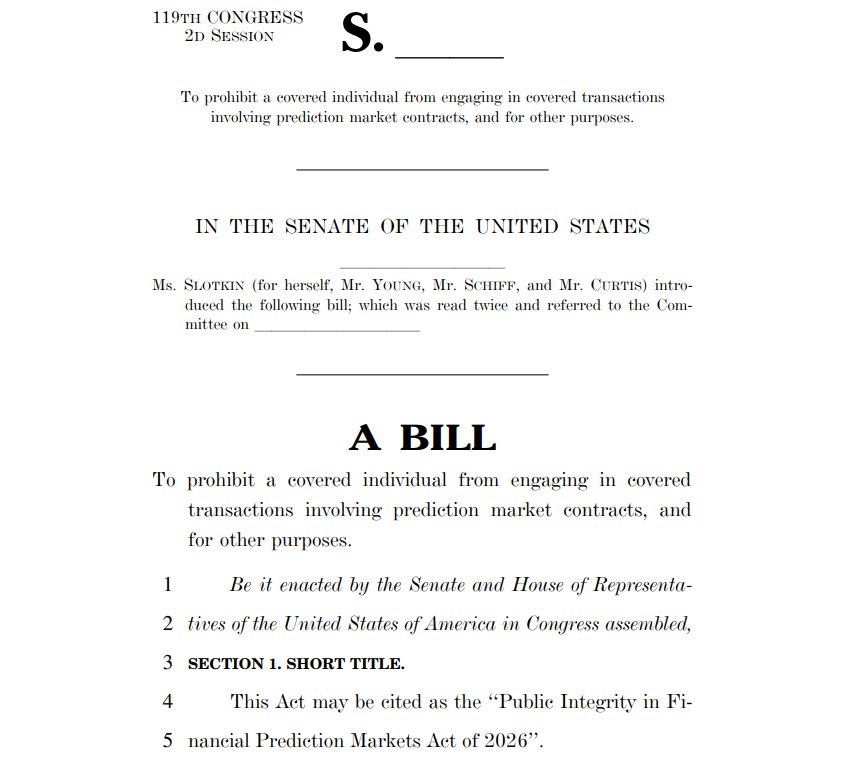
US lawmakers have introduced a second bill this week aimed at curbing prediction market insider trading by government officials, amid growing concerns over such activity on major platforms such as Kalshi and Polymarket.
In an announcement on Thursday, US lawmakers Todd Young, Elissa Slotkin, John Curtis and Adam Schiff unveiled the bipartisan Public Integrity in Financial Prediction Markets Act of 2026.
“No one should be profiting off the information and knowledge gained as a public servant, period,” Slotkin said, adding: “This bill is an important first step in placing common sense rules around prediction markets, and it has real teeth to ensure those who break these rules face real consequences.”
The bill underscores growing unease that prediction markets could become a new frontier for insider trading, as bets tied to real-world events blur the line between wagering and financial activity.
Bill aims to stop insider profiteering
The latest bill, which has been introduced in the second session of the 119th Congress, aims to prohibit government executives from using “insider information to bet on a prediction market contract.”

If enacted, the Public Integrity in Financial Prediction Markets Act of 2026 would cover the president, vice president and politicians across Congress, the House of Representatives and the Senate.
It would also cover political appointees and “employees of an Executive agency or independent regulatory agency.”
The bill defines insider information as anything that a “reasonable investor would consider important in making a decision related to a prediction market contract and is not publicly available.”
It also outlines reporting requirements under which a government official must report any contract wagers over $250 within 30 days to the supervising ethics office. The individual must include “the number of contracts purchased, price of contract, date and time of transaction, name of contract, position taken on contract, name of trading platform used, profit or loss made on transaction.”
The penalties will see individuals charged the greater of $500 or double the amount of profit made from the prediction market contract.
Related: SEC is no longer a ‘cop on the beat‘ on crypto, says US lawmaker
The bills come amid an increasing number of state and federal lawmakers taking aim at prediction markets.
It also marks the second bill introduced this week to try to stop government officials from using insider information to profit on prediction markets, the first being the PREDICT Act introduced by US Representative Adrian Smith and Representative Nikki Budzinski on Tuesday.
However, the PREDICT Act focuses on preventing insider trading on prediction markets relating to political events, policy decisions and other government actions.
Recently, both Kalshi and Polymarket have made attempts to tighten their rules to stop insiders wagering on their platforms.
Magazine: Nobody knows if quantum secure cryptography will even work
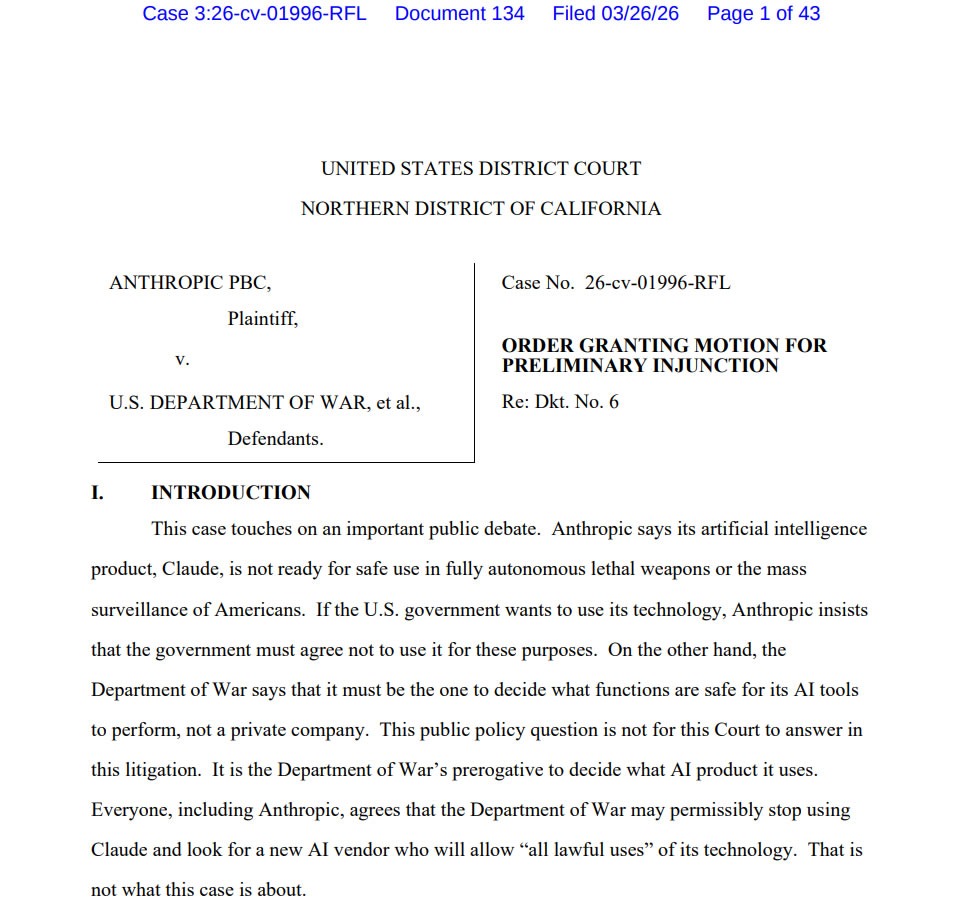
A US federal judge in San Francisco has granted Anthropic’s request for temporary reprieve after the Pentagon’s designation of the company as a supply chain risk.
In an order on Thursday, Judge Rita Lin of the District Court for the Northern District of California ordered a preliminary injunction against the Pentagon over the label. It also temporarily halts a directive from US President Donald Trump ordering federal agencies to stop using Anthropic’s chatbot, Claude.
“Nothing in the governing statute supports the Orwellian notion that an American company may be branded a potential adversary and saboteur of the US for expressing disagreement with the government,” said Judge Lin.
Anthropic was the top player in enterprise AI markets with 32%, ahead of OpenAI on 25%, as of 2025, according to Menlo Ventures. A government-wide ban on Anthropic would plummet this position.
The judge said that these “broad punitive measures” taken against Anthropic by the Trump administration and Defense Secretary Pete Hegseth appeared “arbitrary, capricious, [and] an abuse of discretion.”
The order came after Anthropic filed a lawsuit in a Columbia federal court on March 9, alleging that Hegseth overstepped his authority when he designated the company a national security supply-chain risk.

Anthropic opposed autonomous weapons and mass surveillance
The dispute stems from a deal in July 2025 between the AI firm and the Pentagon on a contract to make Claude the first frontier AI model approved for use on classified networks.
Negotiations collapsed in February with the Pentagon seeking to renegotiate, insisting Anthropic allow military use of Claude “for all lawful purposes” and without restrictions.
Anthropic maintained that its technology should not be used for lethal autonomous weapons and mass domestic surveillance of Americans.
On Feb. 27, Trump ordered all federal agencies to cease using Anthropic products. “The Leftwing nut jobs at Anthropic have made a DISASTROUS MISTAKE trying to STRONG-ARM the Department of War,” he wrote on Truth Social.
A 90-minute court hearing took place in San Francisco on March 24, during which Judge Lin pressed government lawyers on whether Anthropic was being punished for publicly criticizing the Pentagon.
Classic illegal First Amendment retaliation
“Punishing Anthropic for bringing public scrutiny to the government’s contracting position is classic illegal First Amendment retaliation,” the March 26 ruling stated.
Anthropic said in a statement that it was “grateful to the court for moving swiftly, and pleased they agree Anthropic is likely to succeed on the merits.”
Magazine: Nobody knows if quantum secure cryptography will even work
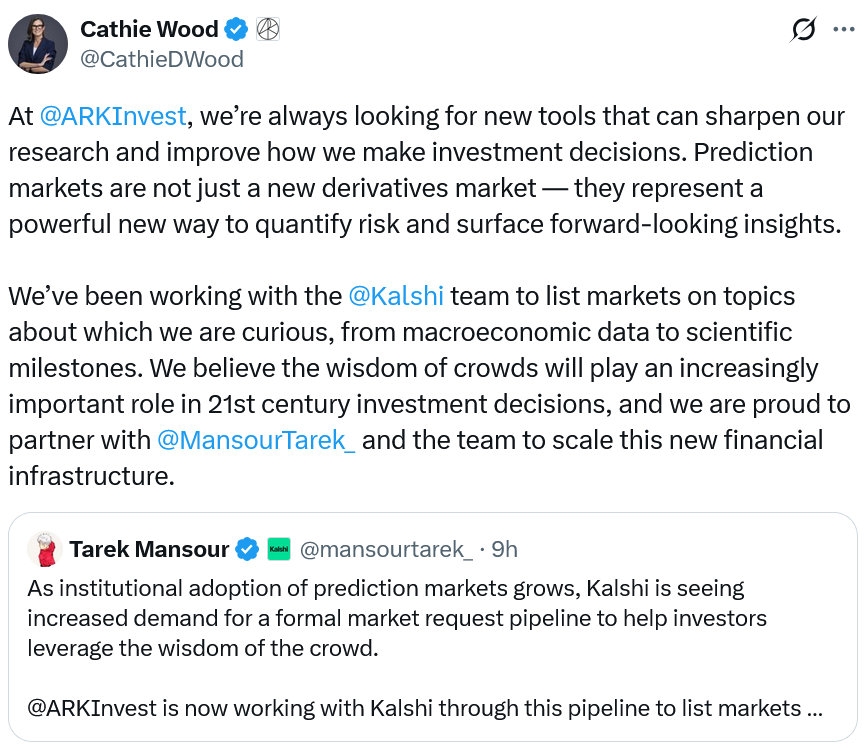
Tech-focused asset manager ARK Invest said it will start using Kalshi’s prediction market data to improve how it makes its investment decisions, one of the latest cases demonstrating the broader value of prediction market data beyond trading.
According to a statement from Kalshi, ARK will use prediction market data to gauge real-time expectations and guide its existing market-based research, in addition to analyzing performance indicators such as trading volume, regulatory approvals and technological milestones. ARK will also use the data for risk management and hedging strategies.
“Bringing prediction markets into institutional workflows is a natural next step for innovation in financial research,” ARK Invest founder and CEO Cathie Wood said Thursday, while the company’s research director, Nick Grous, said prediction markets “offer some of the purest expressions of risk around key economic and company-specific outcomes.”
Prediction markets became one of the hottest use cases in crypto last year and have consistently surpassed $10 billion in monthly trading volume. Prediction market data has also increasingly been seen by institutions, including the Federal Reserve and Cornell University, as valuable for making decisions that require a pulse on the market.
In a post on X, Wood also said ARK has been working with Kalshi to list markets on topics it is curious about on the prediction markets platform, including macroeconomic data and scientific milestones.
Kalshi CEO Tarek Mansour noted that “a few of these are already live on Kalshi, including non-farm payroll markets, deficit-to-GDP ratio markets, business KPIs, and more.”

Fed, Cornell eye opportunity in prediction markets
Last month, researchers at the US Federal Reserve argued that Kalshi can better measure macroeconomic expectations in real time than its existing solutions and thus should be incorporated into the Fed’s decision-making process.
Related: Polymarket tightens rules to curb manipulation, insider trading risks
“Kalshi markets provide a high-frequency, continuously updated, distributionally rich benchmark that is valuable to both researchers and policymakers,” the Fed researchers said at the time.
Predictions market data from Polymarket has also been researched at Cornell University to study how traders reacted to political events in real time, such as Donald Trump and Joe Biden’s presidential debates and the assassination attempt on Trump in 2024.
Magazine: IronClaw rivals OpenClaw, Olas launches bots for Polymarket — AI Eye

DeFi is evolving—and River is leading the charge. With its innovative chain-abstraction stablecoin system, River enables cross-chain collateralization, liquidity, and yield generation without bridging assets. Powered by the omni-CDP stablecoin satUSD, users can leverage, earn, and scale natively across multiple ecosystems.
Unlock Yield with One Click
River’s Smart Vault deploys your funds across DeFi and institutional-grade CeDeFi strategies. It also mints satUSD and deposits it into staking pools, letting you earn rewards effortlessly.
🔗 Access yield instantly: Smart Vault
Core Modules
Omni-CDP: Cross-Chain Collateral, No Bridges Needed
River’s omni-CDP module is the first cross-chain CDP built on LayerZero’s OFT standard, enabling users to collateralize BTC, ETH, BNB, or liquid staking tokens (LSTs) on one chain and mint satUSD on another—natively, with zero bridging or wrappers required.
- Deposit BTC, ETH, BNB, or LST as collateral
- Mint satUSD on any integrated chain
- Earn staking rewards by depositing satUSD into River’s pools
Prime Vault: Institutional-Grade Security & Yield
For institutions, Prime Vault offers maximum security and predictable returns. By integrating with leading custodians and regulated partners, assets remain safe while generating yield through River’s stablecoin ecosystem.
🔗 Explore institutional access: Prime Vault
satUSD+: Liquid Yield from Protocol Revenue
River’s Yield module introduces satUSD+, a liquid, composable ERC-20 token representing a staked satUSD position. Holders automatically earn protocol fees without manual claiming or restaking.
Key Benefits of satUSD+:
- Accrues revenue from CDP operations and system usage
- Fully composable across other DeFi protocols
- Redeemable at any time for the underlying satUSD
Where does the yield come from?
- Minting, redemption, and liquidation fees from Omni-CDP
- satUSD adoption across chains and applications
- Future integrations with lending markets, partner incentives, and revenue-sharing
💡 Unlike inflationary reward models, River’s yield is backed by real protocol activity, ensuring sustainable and tangible returns.
🔗 Mint or swap to get satUSD: River Mint
🔗 Stake satUSD to earn satUSD+: Staking
River4FUN: Social Engagement Meets On-Chain Rewards
River4FUN turns community activity into on-chain governance and rewards. Stake any token, connect your X account, and earn River Pts by posting, referring, and voting.
- Initial airdrop for connecting X
- Stake tokens to accumulate River Pts
- Vote and earn campaign rewards
🔗 Join the fun: River4FUN
Smart Vault: Yield Without Risk
River’s Smart Vault allows users to deposit assets such as BTC, ETH, or USDT and earn returns without incurring liquidation risk. Funds are deployed across DeFi and institutional-grade strategies, while satUSD is minted and staked automatically to maximize yield.
River is redefining cross-chain DeFi, making yield generation, staking, and stablecoin utility seamless, secure, and scalable. Whether you’re an institutional investor, a DeFi enthusiast, or just exploring yield opportunities, River offers a single ecosystem to earn, leverage, and grow your crypto assets.
RIVER OFFICIALS
Website | X | LinkedIn | Telegram | GitHub | YouTube
REQUEST AN ARTICLE


Disclosure: This article does not represent investment advice. The content and materials featured on this page are for educational purposes only.
Crypto scams surge as AI-powered fraud and fake exchanges exploit urgency and weak user verification.
Summary
- Crypto scams surge as fake exchanges and AI fraud exploit urgency, costing users billions in stolen funds.
- Not all exchangers are equal — grey-zone platforms pose risks with unclear rules, weak support, and opaque processes.
- Safe crypto use starts with verification; users must assess risk, payment methods, and urgency before transactions.
The crypto exchange market looks deceptively simple until funds are drained. Fake websites are cheap to clone, brands are easy to mimic, and when in a hurry to beat a price move, proper checks often feel like a waste of time. That’s exactly why scammers love urgency.
Crypto fraud isn’t just a headline anymore — it’s a multi-billion-dollar machine. According to Chainalysis’ 2026 Crypto Crime Report, scams and fraud schemes stole an estimated $17 billion in cryptocurrency throughout 2025. Impersonation attacks jumped more than 1,400% year-over-year, while AI-powered scams delivered up to 4.5 times higher returns than traditional operations. The message is clear: a polished site and quick replies no longer mean safety.
The danger goes beyond outright scams. There are plenty of grey-zone exchangers — services with vague rules, no real support, and zero transparent process. The fix is simple: stop trusting, start verifying. Look for the signals that actually cost money and time to fake — clear policies, stable support channels, and a repeatable transaction flow.
Before anything is verified: Know the risk profile
“Exchanger” means different things to different people in crypto. There are classic web exchangers where a request is created and funds are sent straight through the site. Then there are OTC desks that handle cash or bank transfers offline. Aggregators only show ratings and don’t touch the money themselves. And finally, hybrid models that start online but finish with a bank wire or in-person meeting.
Each type carries its own risks: temporary custody of funds, address spoofing, chargeback threats, or even having to verify physical cash. Before a user checks a single thing, they need to lock down their own parameters — how much they are moving, how fast they need to move it, and which payment method they’re using. The bigger the amount or the tighter the deadline, the stricter the verification needs to be. In crypto, the more convenient something feels, the more it usually works against someone.
Red flags that show up before money moves
Pricing bait
If the rate looks 2–3% better than what is seen on CoinMarketCap, Kraken, or Binance for the exact same pair and payment method, treat it as a yellow flag. A legitimate service will say the exact net amount someone will receive after every fee — upfront. Vague answers or sudden rate changes once a user has started are classic bait-and-switch moves.
Communication pressure
Pushy messages like “act now or the rate disappears,” offers to jump to Telegram or WhatsApp, or sudden changes to wallet or card details after confirmation — these are textbook red flags. Address substitution is still one of the easiest and most effective ways to lose funds.
Process chaos
If every step feels improvised, the network isn’t clearly specified, or addresses arrive only as screenshots, that’s poor operational maturity. Predictable, documented flows cut manipulation risk dramatically.
Technical and identity signals
Lookalike domains (one extra letter, different TLD), inconsistent branding across pages, or zero external presence are instant warnings. Phishing and impersonation remain among the top fraud techniques, according to the FBI’s Internet Crime Complaint Center.
Wallet addresses should be locked into the order, not floating in chat. If the service can’t confirm the exact network or changes details without formal approval, walk away.
Support and accountability
No official support channels, everything running through a single private account, or zero response-time guarantees — these scream low accountability. Professional services publish escalation procedures upfront.
How to read reviews without getting fooled
Reviews can help, but they’re easy to game. Pay attention to how they spread over time (steady growth beats sudden explosions), specific details (city, transaction type, exact timing), and consistency across platforms like Trustpilot, Reddit, and forums.
Identical phrasing, pure marketing slogans, or 200 new five-star reviews in a week are classic manipulation signs. Treat reviews as one data point among many — never the only one.
Proof points: Signals that are expensive to fake
The real test isn’t how pretty the website is — it’s how clearly the service explains what happens when things go wrong. Does it spell out fees, cancellation rules, wrong-network procedures, and dispute steps?
Services that publish these policies openly make their entire process auditable. Repeatable steps — fixed rate locking, clear confirmation points, documented receipt verification — show real operational maturity.
Stable brand presence (long domain history, consistent contacts, the same tone everywhere) and proper multi-channel support with published SLAs are equally hard to imitate.
Practical 10-minute verification workflow
- Compare the offered rate against 2–3 market references.
- Ask for the exact net amount that’ll be received after all fees.
- Check domain age and brand consistency (WHOIS or SecurityTrails works great).
- Read the policies and full transaction flow.
- Scan review patterns across multiple platforms.
- For anything over $5k–10k, run a quick 1–5% test transaction first.
Apply this checklist to any platform. Services with clear, published steps and policies — like 001k.exchange — stand out immediately against random or temporary exchangers.
Real-world micro-scenarios
- Last-minute wallet change like “We updated the address — here’s the new one.” Risk level: critical. In a safe process the address is locked in the order and any change requires official confirmation.
- Review explosion: 200 new five-star comments in a week. Could be a campaign, artificial hype, or a short-lived project. Always cross-check six-month history and proof points.
- Unclear net amount: Rate shown, but fees only appear at the end. Simple fix: insist on the final net figure before anything is sent.
Conclusion
In crypto, polished websites and fast replies are cheap. A transparent, repeatable process is not.
Red flags tell someone when to stop. Reviews help them ask smarter questions. Proof points show them what’s actually real.
The strongest signal isn’t trust — it’s verifiability. Run the checklist, and quickly separate professional exchangers from the rest. Platforms that publish clear steps, policies, and support rules set the benchmark worth measuring everything else against.
Disclosure: This content is provided by a third party. Neither crypto.news nor the author of this article endorses any product mentioned on this page. Users should conduct their own research before taking any action related to the company.

David Sacks, a venture capitalist who became a special White House official under US President Donald Trump last year, has wrapped up his 130-day tenure as crypto and AI czar but will continue to shape policy in a new role.
“We’ve now used up that time,” Sacks told Bloomberg on Thursday, noting that he will continue making policy recommendations across a broad range of tech industries as co-chair of the President’s Council of Advisors on Science and Technology (PCAST).
Sacks has been an influential figure in the White House since Trump’s appointment in 2025, acting as the president’s key adviser on technology.
The new role will overlap with his previous role as crypto and AI czar, noting that he and other members would “study issues together” before issuing official recommendations to regulators.

As the crypto and AI czar, Sacks helped the President’s Working Group on Digital Asset Markets release a 166-page report in July, which outlined recommendations on how the crypto industry should be regulated.
More recently, on March 20, Sacks helped the Trump administration put out an AI framework that seeks to empower AI innovation and workplace development while protecting children and intellectual property rights.
Sacks also played a role in the passage of the stablecoin-focused GENIUS Act in July and continues to push for crypto market structure legislation, such as the CLARITY Act.
A report from Fox Business, quoting a senior adviser to the president, said Sacks will continue serving as AI and crypto czar while taking on a broader portfolio.
“David will always be his crypto and AI czar, but to the admin more broadly, this new role will allow him to advise on a broader range of critical tech issues,” they said.
PCAST may be more AI-focused than crypto
PCAST will consist of 13 tech leaders spread across AI, crypto, health care and quantum computing.
Among the members joining Sacks are Nvidia’s Jensen Huang, Meta’s Mark Zuckerberg, AMD’s Lisa Su, Oracle’s Larry Ellison, Andreessen “a16z” Horowitz’s Marc Andreessen and Dell Technologies’ Michael Dell.
The only crypto-native member is Fred Ehrsam, who co-founded Coinbase with CEO Brian Armstrong in 2012 before co-founding crypto-focused VC Paradigm in 2018.
Related: SEC is no longer a ‘cop on the beat’ on crypto, says US lawmaker
Sacks said a primary focus of PCAST is to ensure America’s AI strategy is aligned between the federal and state governments:
“The problem that we’re seeing right now is that you’ve got 50 different states regulating this in 50 different ways, and it’s creating a patchwork of regulation that’s difficult for innovators to comply with.”
“So what the president has called for is one rulebook,” he added.
Magazine: Big Questions: Can Bitcoin save you from the dreaded Cantillon Effect?
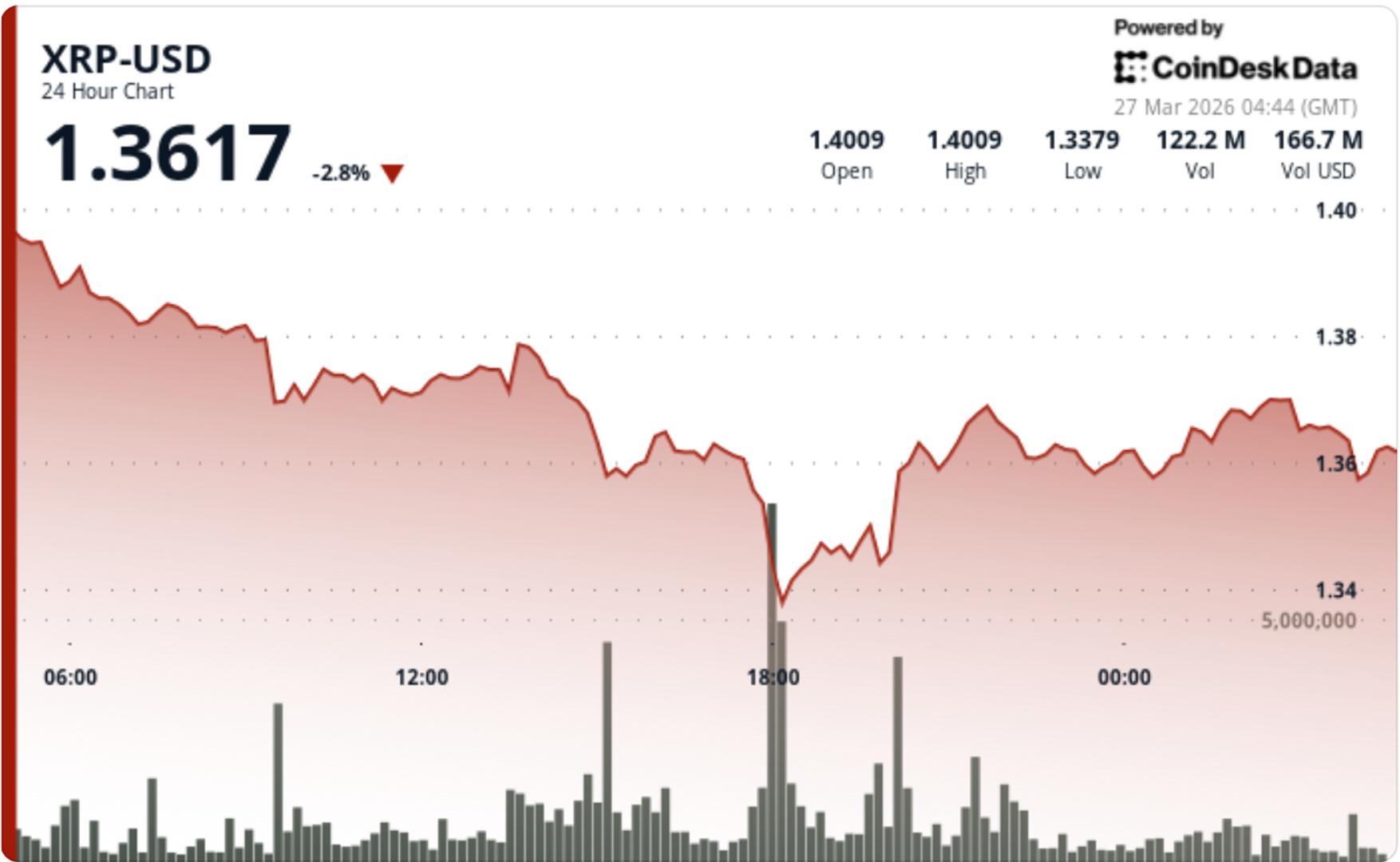
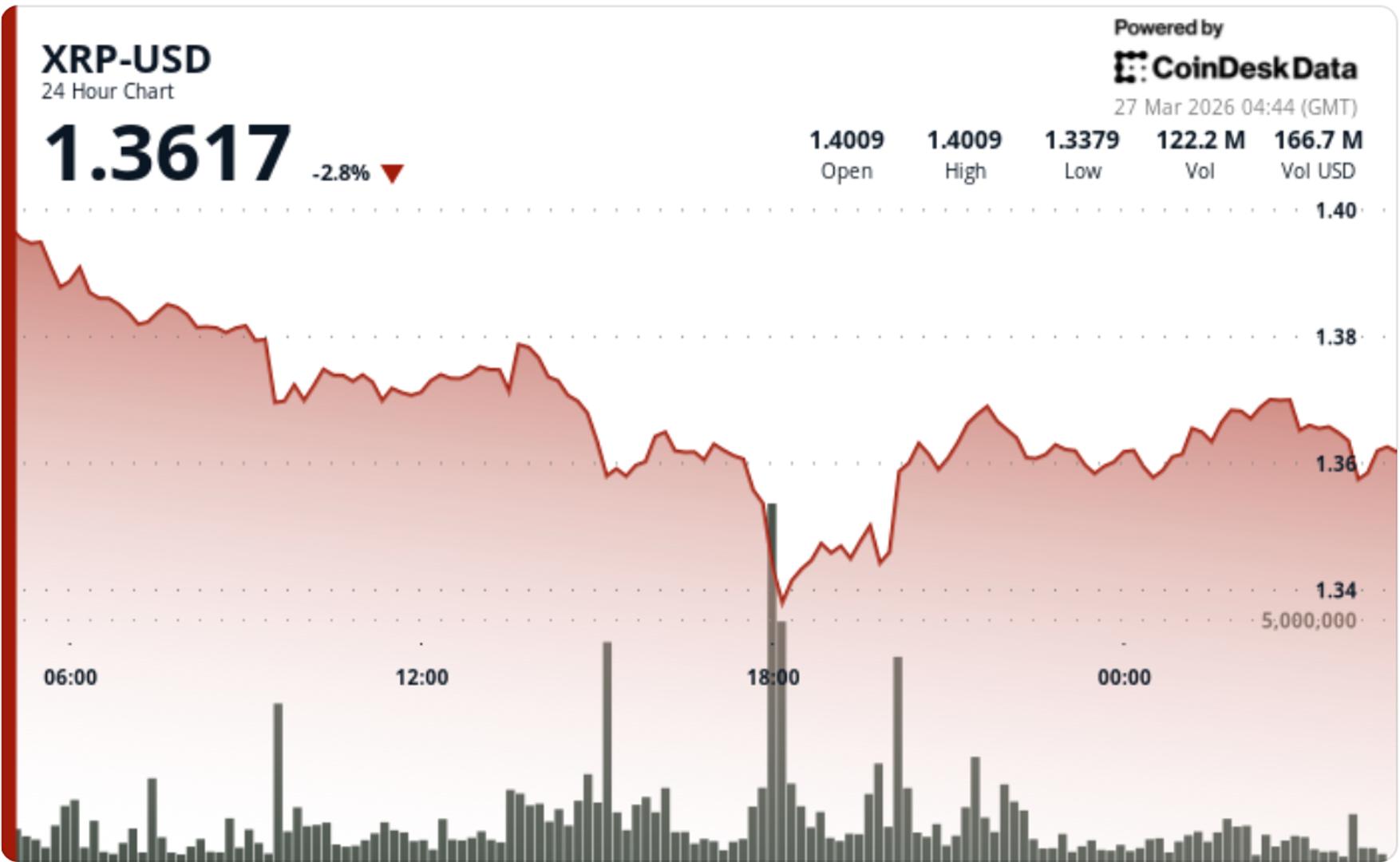
Sharp late-session selling and rising leverage suggest a bigger move is coming, with downside risk building.

Iranian missiles could target these seven UK sites after Healey refuses to rule out attack

Chinese universities with military links bought Super Micro servers with restricted AI chips

UK Sanctions Xinbi to Isolate It From the Legitimate Crypto Ecosystem


-
 Crypto World6 days ago
NIO (NIO) Stock Plunges 6.5% as Shelf Registration Sparks Dilution Worries
-
 NewsBeat2 days ago
Manchester United reach agreement with Casemiro over contract clause amid transfer speculation
-

 Fashion7 days ago
Weekend Open Thread: Adidas – Corporette.com
-

 Politics6 days ago
Jenni Murray, Long-Serving Woman’s Hour Presenter, Dies Aged 75
-

 Crypto World5 days ago
Best Crypto to Buy Now: Strategy Just Spent $1.57 Billion on Bitcoin During Fear While Early Investors Quietly Enter Pepeto for 150x Potential
-

 Crypto World5 days ago
Bitcoin Price News: Bhutan Sells $72 Million in BTC Under Fiscal Pressure, but the Smart Money Entering Pepeto Sees What the Market Does Not
-

 News Videos1 day ago
Parliament publishes latest register of MPs’ financial interests
-

 Sports4 days ago
Remo Stars and Kano Pillars Strengthen Survival Hopes in NPFL
-

 Sports4 days ago
Gary Kirsten Accuses Pakistan Cricket Board Of ‘Interference’, Mohsin Naqvi Responds
-

 Tech4 days ago
Give Your Phone a Huge (and Free) Upgrade by Switching to Another Keyboard
-

 Business5 days ago
No Winner in March 21 Drawing as Prize Rolls to $133 Million for Next
-

 Sports7 days ago
2026 Kentucky Derby horses, odds, futures, preview, date: Expert who nailed 12 Derby-Oaks Doubles enters picks
-

 Tech4 days ago
AI enters the chat: New Seattle dating app relies on tech to facilitate meaningful human connections
-
Business6 days ago
Columbia Sportswear enters $500 million credit agreement with JPMorgan Chase
-

 Tech5 days ago
Today’s NYT Connections Hints, Answers for March 22 #1015
-

 News Videos4 days ago
Ch 9 Financial Management Part 1 | Detailed One Shot | Class 12 Business Studies Boards 2026
-

 Business10 hours ago
Instagram, YouTube Found Responsible for Teen’s Mental Health Struggle in Historic Ruling
-
 Crypto World7 days ago
Small-cap Russell 2000 enters correction territory
-

 Business5 days ago
Will Duke Basketball Win It All? Duke Basketball Enters Second Round as Third Favorite to Claim NCAA Title
-

 Business7 days ago
(VIDEO) BTS Drops ‘ARIRANG’ Album Today, Marking Epic Post-Military Comeback With Live Concert
You must be logged in to post a comment Login