

Crypto World
Why Are Investors Prioritizing Germany for Their Next White-Label Crypto Wallet Play?


This old German saying “Besser den Spatz in der Hand als die Taube auf dem Dach.” captures a national instinct: prefer tangible, well-governed value over speculative promise. In practice, German investors and institutions prize predictability, audited custody, and regulatory guarantees. Today, that instinct meets opportunity.
With MiCA providing an EU rulebook, BaFin clarifying custody expectations, and major incumbents building custody rails, a compliance-first white label crypto wallet is precisely the “bird in the hand” that serious investors seek. It combines bank-grade security, SEPA and fiat interoperability, and institutional auditability with a faster route to enterprise distribution. For well-capitalized investors focused on infrastructure returns, launching a white-label wallet in Germany now is not about chasing trends, it is about capturing durable, regulation-backed market share.
Let us get some important questions for a serious investor answered!
MiCA & Why Regulatory Certainty Is a Distribution Advantage?
MiCA’s full application creates a single, Europe-level rulebook for crypto-asset service providers, which fundamentally changes how investors evaluate market-entry risk. With MiCA in force, product design choices that were previously speculative now have definitive compliance expectations, from governance and capital to market abuse controls and consumer protection. For Web3 crytpo wallet investors, this matters in three practical ways. First, a MiCA-authorized model de-risks passporting and commercial expansion into other EU states because technical and policy requirements are harmonized.
Second, the regulation forces demonstrable operational standards such as data transparency and incident reporting, which institutional partners and banks now require before integrating a cryptocurrency wallet solution. Third, MiCA makes compliance a market signal: a wallet built to MiCA standards becomes a distribution asset when pitching to banks, asset managers, and corporates that demand regulated counterparties. The regulatory tailwind, therefore, converts compliance cost into a competitive moat, shortening sales cycles with conservative enterprise buyers and improving valuations for investors focused on institutional-scale adoption.
Core Challenges of the German Market
Germany is a top unexploited target, but this market has certain pain points that can be resolved with a smarter cryptocurrency wallet development plan. Let us first deeply understand the pain points:.
- Regulatory and supervisory expectations are strict and technical, particularly around custody and operational resilience.
- German customers and corporate clients expect bank-grade security, auditability, and service level agreements.
- Integration with domestic banking rails, SEPA flows, and tax reporting formats requires significant product engineering.
- Providing custody and counterparty security to institutional partners requires certification, audits, and often an onshore custodian.
- Customer acquisition costs are high when selling to conservative enterprises that prioritize compliance over novelty.
These challenges raise the bar for product maturity, governance, and go-to-market readiness; they are not problems for a marketing team to solve; they are engineering and legal problems that require institutional-grade delivery.
How Does a White-Label Crypto Wallet Solve It?
- Provides a pre-built, audited core wallet stack engineered to meet custody and compliance requirements.
- Reduces time-to-market by using modular integrations for custody, KYC/AML, and payment rails.
- Enables immediate enterprise branding and contractual relationships while the investor retains product control.
- Bundles ongoing compliance and maintenance as part of a vendor relationship, lowering operational overhead.
- Offers configurable custody models: custodial, MPC, hybrid, or non-custodial, so institutional risk appetites are met.
- Includes built-in audit trails and reporting modules to satisfy supervisory and tax authorities.
- Supports SEPA and fiat on/off-ramps through existing banking or FX partners, avoiding bespoke bank integrations.
- Comes with tested security controls, external penetration testing, and optional insurance wrappers to speed partner approvals.
- Allows staged rollouts: enterprise pilots, regulated retail, then broader expansion across the EU.
White-Label Wallet App vs Custom Builds in Germany
| Decision factor | White-label wallet | Custom build |
|---|---|---|
| Time to first regulated pilot | Weeks to a few months with pre-audited modules | 9–18 months or more |
| Compliance readiness | Built with BaFin/MiCA considerations and audit artifacts | Requires independent design and multiple certification cycles |
| Upfront engineering cost | Lower capex, predictable licensing | High capex and uncertain scope |
| Maintenance & upgrades | Vendor handles updates, security patches | Ongoing in-house burden and high resource needs |
| Integration with institutional custodians | Often pre-integrated or plug-and-play | Additional engineering and legal integrations required |
| Scalability for EU passporting | Designed for MiCA-era regulatory needs | Needs rework to meet evolving regulations |
BaFin, German Licensing & Custody Expectations
Operating in Germany means engaging directly with BaFin’s crypto custody framework. BaFin treats crypto custody as a regulated financial service that requires clear organizational governance, qualified management, and robust internal controls. Practical expectations include documenting the custody model and segregation of duties, maintaining minimum capital and liquidity buffers appropriate to the service model, implementing AML transaction monitoring and suspicious activity reporting, and demonstrating operational resilience through business continuity planning and recovery exercises.
Businesses planning for white label cryptocurrency wallet development with custodial models should be prepared to show formal agreements with subcustodians and auditors, evidence of independent key management controls, and regular independent security audits. BaFin’s guidance also makes clear that early engagement with national supervisors reduces time lost to rework and clarifies local expectations tied to MiCA implementation.
Build White Label Wallet Once & Scale Across Europe
Web3 Crypto Wallet Security Standards Expected by German Institutions
- Hardware security modules for key protection and signing.
- Multi-party computation for distributed key custody options.
- Cold storage segregation and clear access governance.
- Role-based access control and least privilege enforcement.
- End-to-end encryption for secrets and backups.
- Regular third-party penetration testing and red team assessments.
- SOC 2 type 2 or equivalent operational attestations.
- ISO 27001 certification and documented ISMS.
- Automated key rotation and secure recovery workflows.
- Immutable, auditable transaction logs and secure time-stamping.
- Incident response playbooks, table-top exercises, and regulatory notification readiness.
- Custody insurance coverage or insured sub-custodian relationships.
It is always recommended to get in touch with a renowned and experienced white label crypto wallet development company to launch a feature rich and secure wallet solution under professional guidance and expertise.
Measuring Success: KPIs for White Label Wallet Launches
- Active wallets, weekly, and monthly active users.
- Assets under custody and assets under management trends.
- On-chain and off-chain transaction volume per active wallet.
- KYC completion rate and time to onboard (minutes/hours).
- Conversion rate from pilot to enterprise contract.
- Retention and cohort-based LTV metrics at 30/90/180 days.
- Regulatory readiness score (audit pass rate, open findings).
- Mean time to detect and mean time to remediate security incidents.
- Cost per acquisition for enterprise customers and customer acquisition payback.
- Net promoter score and enterprise satisfaction for SLA adherence.
Plan for a Pan-European Blockchain Wallet Expansion with Antier
Phase 1: Germany first, enterprise pilots, and custody partnerships
Build a production-ready, customized mobile crypto wallet with modular custody options and MiCA-aware governance. Pilot with one institutional client and one regulated subcustodian to demonstrate custody controls and operational SLAs.
Phase 2: Certification and trust building
Complete ISO 27001 and SOC 2 audits, secure a regulated sub-custodian partnership, and publish a compliance and technical whitepaper to demonstrate transparency to prudential partners.
Phase 3: Passporting and targeted EU launches
Use Germany as the trust anchor for passporting under MiCA. Introduce localized UX, tax-reporting templates, and direct integrations with regional banking partners for SEPA Instant and local payment rails. Leverage documented audit artifacts to accelerate NCA approvals in neighboring states.
Phase 4: Product expansion and tokenized assets
Add regulated tokenized securities and real-world asset custody capabilities, integrating with institutional tokenization platforms and CSDs where appropriate. Coordinate with tokenization initiatives and settlement networks to offer atomic settlement options for institutional clients. Clearstream’s institutional custody offering and banks’ moves into custody create practical counterparties for these phases.
Conclusion
For serious investors focused on infrastructure-grade returns, Germany offers a unique moment: the convergence of MiCA’s legal framework, BaFin’s supervisory clarity, and active institutional participation from banks and custodians materially reduces execution and regulatory uncertainty.
A white label wallet development approach gives investors the fastest, lowest-risk path to market while still enabling tight technical controls and custom enterprise integrations. At Antier, we combine deep Web3 engineering with regulatory and legal teams who have navigated BaFin processes and designed MiCA-compliant architectures. Our experience building production custody models, integrating with institutional settlement rails, and running compliance-ready operations lets us guide investors from pilot to scale with fewer rework cycles and stronger enterprise traction. If your investment thesis prioritizes predictable compliance, fast enterprise distribution, and a roadmap to pan-European scale, launching a white-label wallet in Germany today is a disciplined, high-conviction play. Connect with our team to learn more about our offerings.
Frequently Asked Questions
01. What does the German saying “Besser den Spatz in der Hand als die Taube auf dem Dach” imply for investors?
It suggests that investors should prefer tangible, well-governed value over speculative promises, emphasizing the importance of predictability and regulatory guarantees.
02. How does MiCA benefit crypto wallet investors in Europe?
MiCA provides a unified regulatory framework that reduces market-entry risk, ensures operational standards, and enhances compliance, making a MiCA-authorized wallet a valuable asset for distribution to banks and institutional partners.
03. What are the core challenges of the German cryptocurrency market?
The German market presents certain pain points that require a strategic approach to cryptocurrency wallet development, which can be addressed to unlock its potential for investors.


TLDR
- American Bitcoin Corp has reached 6,039 BTC in its corporate treasury.
- The company is now the 17th largest corporate holder of Bitcoin globally.
- ABTC uses a “mining-to-treasury” strategy to retain the Bitcoin it mines.
- Since going public in September 2025, ABTC has achieved a 116% Bitcoin yield.
- Despite the Bitcoin reserve growth, ABTC’s stock has fallen by 86%.
American Bitcoin Corp (ABTC), a company backed by the Trump family, has reached a major milestone in the cryptocurrency market. After just six months of going public, the company now holds 6,039 Bitcoin (BTC), valued at approximately $409 million. This achievement positions ABTC as the 17th largest corporate holder of Bitcoin globally.
ABTC’s Bitcoin Reserves and Mining-to-Treasury Strategy
American Bitcoin Corp’s Bitcoin reserves have quickly grown due to its “mining-to-treasury” approach. Instead of selling the Bitcoin it mines, ABTC retains the coins, which has contributed to the company’s swift growth. In January alone, it added 217 BTC to its holdings, showing continued success in this strategy.
The company has combined both mining operations and market purchases to fuel its treasury growth. This hybrid strategy has led to a 116% yield in Bitcoin since ABTC’s debut on the Nasdaq in September 2025. By keeping its mined Bitcoin instead of selling, ABTC has steadily built its reserve, distinguishing itself from traditional miners.
Stock Performance and Market Volatility
Despite growing its Bitcoin treasury, ABTC’s stock has faced significant challenges in the market. Since going public, the company’s shares have dropped by 86%, affected by Bitcoin’s volatility and the expiration of the lock-up period for early investors. This sharp decline in stock price is a reflection of the broader market trends impacting both ABTC and the cryptocurrency space.
Despite the stock downturn, analysts remain confident about ABTC’s prospects. Both Roth Capital and H.C. Wainwright & Co. have maintained Buy ratings with a $4 price target. These ratings reflect optimism about the company’s long-term potential, even with short-term market volatility.
Bitcoin’s Influence on ABTC’s Growth
American Bitcoin Corp’s treasury growth highlights its effective use of Bitcoin mining and market participation. The company’s strategy has enabled it to quickly accumulate a significant amount of Bitcoin, surpassing other firms like GameStop and Gemini Space Station in corporate holdings. However, the broader market conditions continue to affect the company’s stock performance.
ABTC’s current position in the global ranking of Bitcoin corporate treasuries signals its ambition in the cryptocurrency space. Despite the challenges, the company’s approach of retaining its mined Bitcoin continues to prove effective in growing its reserve. As Bitcoin prices remain volatile, ABTC’s future strategy will be crucial in maintaining its position in the market.

The Aptos Foundation is looking to propose a significant shakeup to the dynamics of the Aptos token, announcing a host of potential policy changes designed to spur greater APT deflation.
In an X post on Wednesday, the Aptos Foundation said it would submit several governance proposals to help transition the ecosystem away from its current subsidy-based emission format to something focused more on “performance-driven mechanisms” and decreasing APT supply.
“The Aptos network is transitioning to performance-driven tokenomics designed to align supply mechanics with network utilization,” the Aptos Foundation said, adding:
“This update replaces bootstrap-era subsidy with mechanisms tied to transaction activity, establishing a framework where burns can exceed emissions as high-throughput applications scale.”

One of the foundation’s proposals is to set a hard cap at 2.1 billion tokens, as APT currently does not have a maximum cap on the total supply. The team said there are currently 1.196 billion APT in circulation.
Under the current emission structure, new tokens are continuously minted to support the ecosystem by funding things like development, grants, and staking rewards.
Meanwhile, significant token unlocks have been hanging over the ecosystem.
However, the Aptos Foundation said that this specific pressure has been easing and will continue to decline after the next major four-year token unlock cycle ends in October, stating that it will result in a 60% reduction in annualized supply unlocks.
The team said that as the ecosystem has matured to the point where big institutions such as BlackRock, Franklin Templeton, and Apollo are now deploying “hundreds of millions onchain,” APT tokenomics need to become more sustainable.
“Without reform, emissions continue indefinitely with no hard ceiling, no performance requirements, and no connection between issuance and network activity,” the team said.
Key proposals and policy changes afoot
Alongside the hard 2.1 billion supply cap, the proposed policy changes include a reduction of the annual staking rewards rate from 5.19% to 2.6%, alongside increasing rewards for “longer staking commitments.”
The Aptos Foundation said this would result in reduced overall staking emissions while also rewarding long-term participants.
Elsewhere, the team is pushing for a 10-fold increase in gas fees, arguing that there is room to do this given how cheap it is to use the network. As gas fees paid in APT are burned, this would also help reduce emissions.
Related: Coinbase’s Base transitions to its own architecture with eye on streamlining
“Even with a 10X increase, stablecoin transfers would still be the lowest in the world at around $0.00014, making it the ideal blockchain for stablecoins, payments, and any other similar high-volume transactions,” the team said.
The Aptos Foundation also proposed permanently locking 210 million APT tokens for staking on the network. The team said this would be “functionally equivalent to a token burn” and will use the rewards to fund foundation operations.
The team also said it will change its grants policy and enact stricter KPIs to ensure greater performance before issuing tokens. Finally, the foundation will also explore a token buyback program or APT reserve to help balance supply.
The Aptos Foundation is not alone in seeking major shakeups to native token dynamics. In January, the Optimism governance community approved a proposal from its foundation to initiate a buyback program using 50% of Superchain revenue.
Meanwhile, decentralized exchange Uniswap saw a significant token burn approved in December, and PancakeSwap’s community also approved a supply-reducing proposal last month.
Magazine: Bitcoin’s ‘biggest bull catalyst’ would be Saylor’s liquidation: Santiment founder


LatAm splits: El Salvador tokenizes SMEs, Brazil eyes BTC reserves, Argentina curbs wallet wages.
Summary
- El Salvador targets $100m in tokenized SME funding via COIN–Stakiny, using EVM tech, biometric wallets, and CNAD oversight for equity tokens.
- Brazil’s RESBit bill would let the state buy BTC up to 5% of FX reserves, store in cold wallets, and accept BTC for taxes with income-tax breaks on digital assets.
- Argentina’s Senate dropped digital wallet salary deposits after banking lobbying, keeping wages in bank accounts despite strong wallet usage amid inflation and past freezes.
Three Latin American countries have adopted contrasting approaches to cryptocurrency regulation and adoption in recent months, according to legislative and government actions across the region.
Latin American countries pivoting towards crypto
El Salvador announced plans to launch a $100 million investment project using digital tokens to support local small and medium-sized businesses. The initiative represents a strategic alliance between Corporación Infinito and Stakiny, designed to connect domestic enterprises with international financial markets through tokenized equity instruments.
Stakiny, a platform seeking approval from the National Commission on Digital Assets, will provide the technical infrastructure to tokenize shares of private companies. The system combines traditional shareholder agreements with blockchain-recorded digital tokens, enabling real-time management of capitalization tables, dividend distribution, governance events, and secondary trading. The platform operates on an EVM-compatible network and is accessible through a biometric mobile wallet.
In Brazil, lawmakers are considering legislation that would establish a Sovereign Strategic Bitcoin Reserve, known as RESBit, and eliminate taxes on Bitcoin earnings. Congressman Luiz Gastão presented the proposal, Bill 4,501/2024, to the Economic Development Committee of the Chamber of Deputies.
The legislation would allow the government to gradually acquire Bitcoin up to five percent of the nation’s foreign exchange reserves. Management of the assets would be shared between the Central Bank and the Ministry of Finance, with storage in cold wallets. The bill would permit the use of Bitcoin to settle federal taxes and remove current requirements for brokers and investors to document all Bitcoin transactions. The proposal includes a 100% income-tax exemption on revenues from Bitcoin and other digital assets.
Argentina took a different path when lawmakers removed provisions that would have allowed workers to receive wages through direct deposit into digital wallets. The clause was eliminated from a labor reform proposal after President Javier Milei’s party agreed to drop the section to secure broader support for the legislation.
The decision followed opposition from Argentina’s traditional financial institutions, which contacted senators to voice concerns about the digital wallet payment option. A survey conducted by the central bank several years ago showed that 47% of the population holds a bank account.
Digital wallet platforms including Mercado Pago, Modo, Ualá, and Lemon have gained users in Argentina amid currency instability and dollar shortages. The country has experienced recurring inflation and periodic restrictions on accessing funds from bank accounts, including the 2001 “corralito” banking freeze.
The three nations‘ varying approaches reflect broader experimentation across Latin America with cryptocurrency regulation, reserve management, and financial inclusion policies.
Crypto World
Altcoin Sell Pressure Reaches 5-Year Extreme After 13 Months of Continuous Distribution
TLDR:
-
- Altcoin sell pressure on CEX spot markets has reached its highest extreme in over five years of data.
- Cumulative buy and sell volume for altcoins has trended negative for 13 consecutive months without relief.
- No institutional accumulation patterns are visible in current altcoin spot flow data across exchanges.
- Capital appears to be rotating into Bitcoin or cash, leaving altcoin order books thin and highly vulnerable.
- Altcoin sell pressure on CEX spot markets has reached its highest extreme in over five years of data.
Altcoin sell pressure has reached a five-year extreme, according to recent on-chain and exchange flow data.
For over 13 consecutive months, altcoins excluding Bitcoin and Ethereum have recorded net selling on centralized exchange spot markets.
Analysts warn this is not a routine correction. The data points to a structural shift in how capital is moving across the crypto market, raising serious questions about the timeline for any altcoin recovery.
Cumulative Sell Volume Signals No Signs of Absorption
The cumulative buy and sell volume difference for altcoins has collapsed to levels last seen five years ago.
This metric, which tracks net buying versus selling activity on spot markets, has moved in one direction throughout the period.
There has been no meaningful flattening or stabilization in the data. Bounces have been consistently sold into, and breakout attempts have lacked any real follow-through from buyers.
Market analyst account Our Crypto Talk flagged the chart on X noting that even the 2022 bear market did not produce this kind of sustained one-sided pressure. The account wrote that sellers are “overwhelming buyers month after month” with no base forming.
That context makes the current situation historically unusual, not just uncomfortable for bag holders. The absence of any accumulation curve is what separates this period from prior downturns.
Tokens such as LINK, KAS, ONDO, RENDER, TAO, SUI, and SEI have all lost substantial value from their cycle highs.
Holders of these assets are down significantly, with some tokens trading more than 90% below peak prices.
A kind of drawdown, sustained over more than a year, reflects broader structural selling rather than temporary volatility. It also suggests that retail participants have largely stepped back from active buying.
Order books across major altcoins have thinned considerably during this period. Liquidity has dried up, making price movements more volatile in both directions. However, the net effect remains persistently negative. Until measurable buying pressure returns, each rally attempt remains vulnerable to selling.
Capital Rotation Away From Altcoins Raises Questions on Altseason Timing
Capital currently appears to be rotating toward Bitcoin, cash positions, or assets outside the crypto market entirely. No observable data suggests quiet institutional accumulation in altcoin spot markets at this time.
When serious capital enters a market, volume patterns shift, and cumulative flows stabilize. That pattern is absent here.
Our Crypto Talk stated directly that “the idea that alts will randomly explode any day now without flow confirmation is just hope.” That framing reflects what the flow data currently shows.
Watching cumulative delta and waiting for absorption is the approach the data supports. Premature calls for altseason are not grounded in the present market structure.
Risk management during a confirmed distribution phase looks different from positioning during accumulation. Traders anchored to previous cycle highs may be misreading current conditions.
The data, not sentiment, should guide positioning decisions right now. Until flows reverse, the distribution narrative remains the one the market is telling.


WLFI, the token tied to Trump-affiliated World Liberty Financial, rose roughly 10% after a $3.5 trillion asset servicer said it would test the firm’s USD1 stablecoin as a settlement rail for tokenized funds.
WLFI’s uptick during the Asia morning hours was higher than bitcoin or ether, which were both down 0.5%, according to CoinDesk market data.
The rally comes as speakers at the World Liberty Financial forum at Mar-a-Lago on Wednesday pitched stablecoins as central to U.S. financial leadership.
“The reality is the entire financial system is going to look very different in the next five years than it has looked in the last 50 years,” Senator Bernie Moreno (R-Ohio) said during the event. “This will happen somewhere. We’re going to see a massive amount of innovation in financial services. The question is, will it happen in America or somewhere else?”
Sen. Moreno emphasized that lawmakers must “get this market structure bill across the finish line in the next 90 days,” arguing that clear rules for digital assets are critical if the U.S. wants to lead the next phase of financial innovation rather than cede it overseas.
Coinbase CEO Brian Armstrong also spoke about the importance of the market structure bill at the event and said banking trade groups – not individual banks themselves – are responsible for the stalled progress.
World Liberty Financial co-founder Zak Folkman framed USD1 as more than a retail stablecoin, describing it as “an institutional-grade dollar” designed for real-world settlement and cross-border use.
“This is what we did when we wanted to build an institutional-grade dollar,” Folkman said, adding that the token will feature “real-time proof of reserves, powered by Chainlink,” allowing users to verify backing on-chain.
Earlier in February at Consensus in Hong Kong, Folkman teased an upcoming World Liberty Forex platform.
On Wednesday, Folkman positioned USD1 as a bridge for global payments, saying the project would begin with the U.S.-Mexico corridor before expanding to support up to 40 currencies. “This is USD1 as a settlement bridge,” he said.
Looking ahead, Folkman tied the stablecoin’s use case to artificial intelligence-driven commerce.
“We’re entering a world where AI agents will need to transact autonomously,” he said. “AI agents can’t open bank accounts, they can’t sign checks, but they can hold stablecoins.”
“What we’re building is a complete financial system,” Folkman added.

Disclosure: The views and opinions expressed here belong solely to the author and do not represent the views and opinions of crypto.news’ editorial.
Privacy has been a recurring narrative in crypto for years. Just weeks after Bitcoin (BTC) launched, Hal Finney pointed out the problem in only his second tweet about it, but the concept didn’t gain wider traction until Monero (XMR) arrived in 2014. Since then, privacy has repeatedly re-emerged as a core promise of decentralised money, especially during moments of regulatory pressure or heightened concerns around financial surveillance.
Summary
- Opt-in privacy fractures networks: When users must “turn on” privacy, anonymity sets shrink and private transactions become more conspicuous — not less.
- Design, not demand, is the problem: Zcash’s advanced cryptography exists, yet most transactions remain transparent. Narrative momentum hasn’t translated into usage.
- Privacy must be the default to work: Like security, financial privacy only strengthens when everyone shares it — automatic, universal, and baked into the protocol.
Analysts are positive that crypto’s future will continue to be defined by the privacy narrative. Investor Balaji Srinivasan argued privacy will define the industry’s following eight years; meanwhile, a16z crypto said privacy will be the industry’s most important “moat” in 2026. Indeed, privacy coins have rallied at the end of 2025 and continue to fluctuate into the start of the new year. At their peak, the sector reached a combined market capitalisation surpassing $40 billion, before falling back to roughly $17 billion.
Zcash (ZEC) was a key driver of that resurgence, rising by more than 1,300% from late September 2025 to its all-time high and remaining up over 600% at current prices, briefly overtaking Monero by total market volume. Yet despite renewed interest and price momentum, actual privacy usage remains strikingly low. Zcash’s shielded pool continues to hold just above 30% of the circulating supply, while roughly two-thirds of transactions remain fully visible on-chain.
This disconnect exposes a deeper issue. If interest in privacy is rising, why are users not migrating into the very privacy layers designed for that purpose? The answer could just be structural: opt-in privacy is failing crypto.
Opt-in privacy was a design compromise
In 2013, the pseudonym Nicolas van Saberhagen published the CryptoNote v2 paper, which explicitly framed transaction privacy not as a “nice to have,” but as a core requirement of electronic cash. This paper argued that Bitcoin’s transparency made it pseudo-anonymous at best, and outlined two properties a truly private payment system should satisfy: untraceability and unlinkability. Andrey Sabelnikov, now co-founder of Zano, worked alongside Nicolas to bring this vision to life, implementing the protocol he had designed. From the start, CryptoNote made privacy the default, baked into every transaction rather than offered as an afterthought.
But as the industry evolved, many projects lost sight of this principle. Rather than pushing the boundaries of privacy-preserving technology, they took the path of least resistance, prioritizing compatibility, performance, and mainstream appeal over user protection. Privacy-preserving cryptography was still expensive and unfamiliar, so newer designs retreated to opt-in models.
This compromise had serious consequences. Privacy became a feature to be toggled on rather than a baseline guarantee. Users who chose the private option effectively marked themselves as having something to hide, while the default transparent experience left the majority exposed. This trade-off may have seemed pragmatic at the time, but it fundamentally betrayed the original vision that CryptoNote had established: that true electronic cash must protect user privacy by design and wasn’t something to bolt on later; it had to be designed into the core transaction model itself.
The biggest network carrying the original default-privacy philosophy is Monero. Launched in 2014, it adopted the CryptoNote protocol, preserving the principles that Nicolas and Andrey had already established. Instead of asking users to choose between public and private modes, the design assumes that financial transactions should be private by default, and that privacy improves when everyone shares the same protections.
Through this philosophy, privacy does not just become a feature, but a network effect. A privacy system is only as strong as the crowd it can hide in. When privacy is optional, the network fractures into transparent and private activity. The private pool becomes smaller, the anonymity set shrinks, and the privacy model weakens in practice, regardless of how sophisticated the cryptography may be.
The Zcash paradox
Zcash illustrates the central contradiction facing much of today’s privacy ecosystem. On paper, it offers some of the most advanced privacy technology in crypto, including zero-knowledge proofs that can fully shield transaction details. In practice, however, the majority of network activity remains transparent.
Despite renewed market interest and strong price performance, Zcash’s shielded pool continues to hold just above 30% of the circulating supply, while roughly two-thirds of transactions remain fully visible on-chain. The technology exists. The privacy guarantees are real. Yet most users do not use them.
This gap is not a failure of cryptography, nor a lack of demand for privacy. It is the predictable outcome of opt-in design. When privacy is presented as a separate mode, something users must consciously enable, it introduces friction, uncertainty, and behavioural drop-off. Many users default to transparent transactions simply because they are easier, faster, or more familiar. Others may be unaware of the distinction altogether.
The consequence is a fragmented network. Public and private transactions coexist, but they do not reinforce one another. Instead, the private pool remains small, limiting the size of the anonymity set and weakening privacy guarantees for those who do opt in. Ironically, using privacy in an opt-in system can make a user more conspicuous rather than less.
Privacy can only work when it is the default
Privacy is not a behaviour users reliably opt into. It functions as a collective property. The more participants who share the same privacy guarantees, the stronger those guarantees become. When privacy is optional, networks fracture into public and private activity, shrinking anonymity sets and weakening protection for those who do opt in. In practice, optional privacy often makes users more conspicuous, not less.
The repeated cycles of privacy coin interest show that demand is not the problem; design is. Systems that rely on users to actively choose privacy struggle to translate narrative momentum into real adoption. If privacy is to become crypto’s defining moat, it must be treated as foundational infrastructure, not a feature toggle. Financial privacy works best when it is automatic, universal, and secure by default.

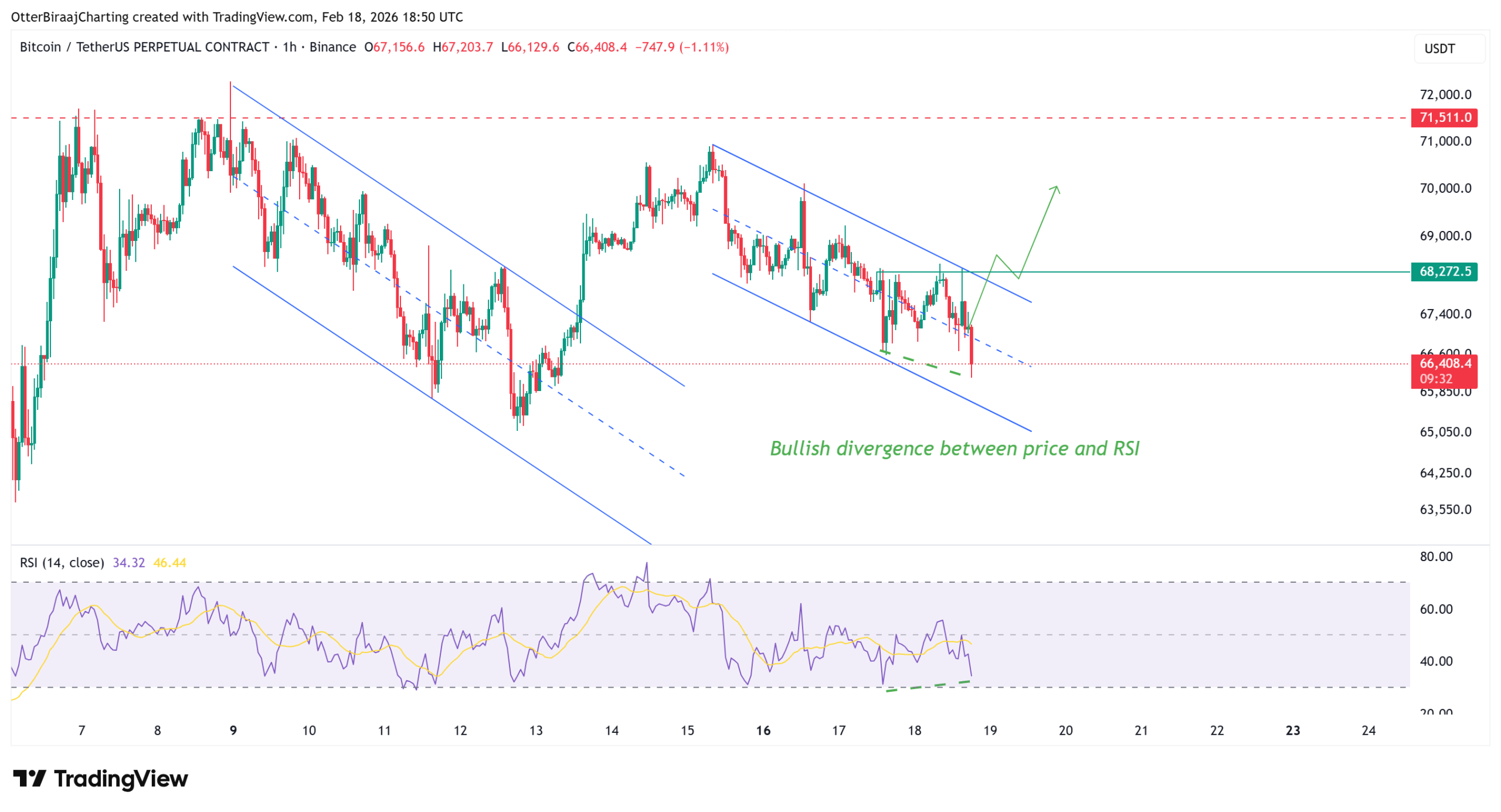
Bitcoin (BTC) trades in a tight $65,000–$70,000 range on Wednesday, a structure that has held for the past two weeks.
The lower time frames show a bullish divergence, signaling fading short-term selling pressure, while futures data indicate fresh long positions opened from $66,000.
Analysts say the compression may precede a breakout attempt, with liquidity clusters below $66,000 and above $71,000 being the zones that may define the next directional move.
Bitcoin’s bullish divergence rests near a support level
On the one-hour chart, Bitcoin is forming a descending channel similar to last week’s structure that preceded a move toward $70,000. Within this channel, a clear bullish divergence has developed in the relative strength index indicator (RSI).
A bullish divergence occurs when the price makes lower lows or equal lows while the RSI prints higher lows. This sequence suggests that selling pressure is losing strength on the shorter time frame.
A sustained break above $68,000 may confirm momentum, leading to a price rally toward the external liquidity and resistance level above $71,500.

The invalidation level sits below $66,000, where internal liquidity is present near the $65,000. A breakdown beneath that region invalidates the divergence setup and shifts focus to the higher-time-frame support range between $62,000 and $60,000.
Derivatives data shows aggregated open interest has climbed 3% to $15.50 billion from $15.10 billion over the past two days, even as the price drifted lower.
The aggregated funding rate has ticked higher to 0.046%, suggesting a growing long exposure from futures traders.
Since Feb. 15, roughly $250 million in aggregated long liquidations have occurred, forcing leveraged positions to close below $67,000. These long-side sell-offs reduce excess leverage, which may stabilize price and create better conditions for an uptrend once traders re-engage in the market.

Related: Bitcoin’s tech stock divergence is a ‘fire alarm’ for fiat: Arthur Hayes
Futures momentum and macro positioning
Crypto analyst Amr Taha noted a sharp drop in Binance Bitcoin futures power 30-day change, which tracks the net change in price, funding, and open interest. The index fell to -0.18, matching levels last seen between April and May 2024.

Taha said that this may mark a turning point for BTC, as similar deep negative readings between April and May 2024 led to a strong rebound that pushed Bitcoin above the $100,000 level, once the index turned positive in the latter half of 2024.
Meanwhile, crypto analyst Dom said that the spot order books show thin liquidity between $66,000 and $69,000, describing the current activity as neutral, with BTC’s price compressing ahead of a breakout attempt.
Liquidity heatmaps shared by BTC trader Daan show dense liquidity clusters below $66,000 and above $71,000, pointing to areas where stop orders and resting positions are likely concentrated.

Related: Bitcoin 2024 buyers steady BTC price as trader sees $52K ‘next week or so’
This article does not contain investment advice or recommendations. Every investment and trading move involves risk, and readers should conduct their own research when making a decision. While we strive to provide accurate and timely information, Cointelegraph does not guarantee the accuracy, completeness, or reliability of any information in this article. This article may contain forward-looking statements that are subject to risks and uncertainties. Cointelegraph will not be liable for any loss or damage arising from your reliance on this information.


Binance-affiliated investment firm YZi Labs (formerly Binance Labs) publicly accused asset manager 10X Capital on Wednesday of failing to comply with US securities disclosure requirements. The dispute comes amid broader governance changes at CEA Industries.
In an official blog post, the firm alleged that 10X Capital failed to comply with SEC rules requiring disclosure of ownership stakes once a certain threshold is reached.
Sponsored
YZi Labs Accuses 10X Capital of Reporting Violations
The dispute centers on CEA Industries, known by its Nasdaq ticker, BNC. The company describes itself as managing the world’s largest corporate treasury of BNB.
For crypto market participants, the situation is particularly relevant. BNC’s treasury strategy ties it closely to the Binance ecosystem. Governance or asset management changes at the company could affect how its large BNB holdings are managed.
Both YZi Labs and 10X Capital hold positions in BNC, and recent developments indicated an escalating contest over governance.
The latest accusations come just one week after BNC publicly refuted earlier claims made by YZi Labs regarding the company’s compliance with Nasdaq rules tied to the timing of its Annual Meeting of Stockholders. In that February 13 statement, BNC said it was fully compliant and rejected what it described as “false” and “reckless” assertions.
In a formal letter addressed to 10X Capital on Wednesday, YZi Labs alleged that the asset manager failed to properly report its ownership stake in CEA Industries.
Under US securities law, investors who accumulate more than 5% of a public company’s shares must disclose their holdings. That way, other shareholders are aware of potential shifts in influence.
According to YZi Labs, 10X Capital has owned more than 5% of BNC’s shares since late 2025. However, it did not file a Schedule 13D to formally report that stake or disclose that it may have been acting together with other shareholders.
YZi Labs also alleged that 10X Capital founder Hans Thomas, who serves on BNC’s board, did not submit the required SEC filing that directors must complete to disclose their initial share ownership in the company.
“SEC disclosure rules are not ‘personal preferences’ or ‘optional housekeeping’ – they are the baseline standard and non-negotiable obligations for anyone who wants a seat on a public company Board,” said Alex Odagiu, an investment partner at YZi Labs. “If you cannot manage timely Section 16 filings and clear ownership disclosure, you should not be managing a public company.”
Sponsored
The allegations surfaced the same day BNC’s Board of Directors announced a proposal to amend its Asset Management Agreement with 10X Capital.
Governance Stakes Rise Over Asset Deal
In its proposal, the Board said it is seeking lower management fees, a shorter contract term, and more flexible termination provisions. It described the move as part of a broader effort to enhance operational flexibility and long-term value.
It followed what it described as a comprehensive review of the agreement and came after YZi Labs publicly confirmed the termination of a previously undisclosed side agreement with 10X that had restricted amendments to the deal.
Sponsored
With that restriction lifted, the Board said it is moving forward with renegotiation discussions.
The developments unfold alongside YZi Labs’ own regulatory filings. The investment firm previously disclosed that it had crossed the 5% ownership threshold following the company’s share repurchases and later formed a shareholder group.
Crossing that threshold is significant under both federal securities law and Nevada corporate law, where CEA Industries is incorporated.
While federal rules require disclosure, Nevada law governs shareholder rights and board authority. Ownership levels can affect a shareholder’s ability to initiate actions, such as consent solicitations, or to influence governance decisions.
Against that backdrop, the timing of the disclosure dispute and the Board’s push to revise 10X’s asset management agreement suggest the disagreement may extend beyond regulatory filings. It may also reflect deeper questions over control and strategic direction at the BNB-focused public company.


The Federal Reserve’s January meeting minutes revealed a surprisingly hawkish committee. Several officials openly discussed rate hikes. That sets the stage for a dramatic policy clash when Kevin Warsh takes over as chair this summer.
The Fed’s hawkish stance now threatens to box in Warsh before he even starts, raising the stakes for both monetary policy and crypto markets.
Sponsored
Sponsored
A Committee Tilting Hawkish — Right Before a Leadership Change
The FOMC voted 10-2 on Jan. 28 to hold rates at 3.5%-3.75%. Governors Christopher Waller and Stephen Miran dissented. Both preferred a quarter-point cut, citing labor market risks.
But the broader committee leaned the other way. Several participants warned that further easing amid elevated inflation could signal a weakened commitment to the 2% target. A larger group favored holding rates steady. They wanted a “clear indication that disinflation was firmly back on track” before cutting again.
Most strikingly, several officials wanted the post-meeting statement to reflect possible “upward adjustments” to the federal funds rate. This was a direct reference to potential rate hikes.
Powell Out, Warsh In — And a Policy Collision Looms
Chair Jerome Powell’s term ends in May. He has two more meetings at the helm. Trump announced on Jan. 30 that former Fed Governor Warsh would replace him.
Warsh has spoken in favor of lower rates. That aligns with Trump’s repeated calls for cheaper borrowing. The White House on Wednesday insisted recent data showed inflation was “cool and stable.”
But the committee’s hawkish majority may not cooperate. Rate decisions are made by 12 voting members. Only a few lean dovish. The rest see inflation risks as the top priority.
Sponsored
Sponsored
Analysts noted that the committee’s hawkish tone could complicate Warsh’s confirmation process and limit his room to pivot toward cuts early in his tenure.
If confirmed, Warsh’s first meeting as chair would be in June. Futures traders price the next cut around the same time. But the Fed’s preferred inflation gauge — the PCE Price Index — is expected to re-accelerate in the coming months. That could delay any easing further.
Asian Liquidity Returns, Amplifying the Selloff
Bitcoin began sliding shortly after the minutes dropped during US afternoon trading. It fell from around $68,300 to below $66,500 by early Asian morning hours. That marked a 1.6% decline over 24 hours.
The timing mattered. Asian traders were returning from the Lunar New Year holiday. Rising volumes and turnover amplified the move lower. Escalating US-Iran tensions added fuel. Oil prices surged more than 4%, further weighing on risk appetite across crypto markets.
Coinbase CEO Brian Armstrong called the decline psychological rather than fundamental. He said the exchange was buying back shares and accumulating Bitcoin at lower prices.
What Comes Next
The Fed’s next meeting is on March 17-18. A cut there is effectively off the table. Markets now look to June as the earliest window.
But the real question extends beyond timing. It is whether Warsh can steer a deeply divided committee toward cuts while inflation remains sticky. The hawkish majority has made its position clear. Changing that will require more than a new chair.
For Bitcoin, the macro backdrop remains challenging. The combination of a hawkish Fed, a contested leadership transition, and returning Asian liquidity points to continued volatility in the weeks ahead.

Crypto industry executives at Cointelegraph’s LONGITUDE conference in Hong Kong stressed the importance of addressing Bitcoin’s technological risks and said that clear US regulations can’t come soon enough.
Co-hosted by crypto exchange OneBullEx, the Feb. 12 event opened with a fireside chat featuring Tron founder Justin Sun, who discussed what the industry needs to prioritize — including preparing for artificial general intelligence (AGI) — which many expect to arrive within the next few years.
“We need to create a very easy standard for AGI to use blockchain,” Sun said.

Sun’s fireside chat was followed by three panel discussions covering the quantum computing threat to Bitcoin, the potential impact of the US CLARITY Act on the industry, and the progress of crypto infrastructure toward a trillion-dollar scale.
Despite a volatile crypto market at the end of 2025, industry players expressed optimism about the industry’s future.
Bitcoiners should ‘discount the value’ until quantum solve
Quantum computing, which some in the Bitcoin community see as a serious potential threat, sparked a debate among panelists.
Capriole Investments founder Charles Edwards said the risk should be priced into Bitcoin until the asset becomes quantum-resistant.
“Today, you kind of have to start to discount the value of Bitcoin based on that risk until it’s solved,” Edwards said. He pointed to growing fears about quantum computing as a primary reason Bitcoin’s price ended the year lower than it started.

“If you just look at the data, 2025 should have been a great year for Bitcoin,” Edwards said, explaining that quantum became a “non-zero threat” and US-based Bitcoin ETF issuers began adding risk disclaimers for quantum.
Meanwhile, Matthew Roszak, Bloq chairman and Hemi co-founder, wasn’t as worried about how it might play out:
“To look at this as a movie trailer and what’s ahead for Bitcoin and quantum. Just the preview here. It’s a two-step process. We’re going to upgrade and chill. That’s it. That’s the process.”
Maelstrom managing partner and co-founder Akshat Vaidya admitted that quantum is an “existential threat,” but it will be met with a “coordinated response that’s proportionate.”
US CLARITY Act will be significant for the industry
White House crypto and AI czar David Sacks said in December that the US is “closer than ever” to passing the US CLARITY Act, which aims to provide the industry with clearer regulations.
Although the bill hasn’t passed, industry panelists agreed that the US has become noticeably more friendly toward crypto since President Donald Trump took office.

Sean McHugh, senior director at Dubai’s Virtual Assets Regulatory Authority, who previously worked in TradFi in the US, said one of the main reasons he moved to Dubai was its more crypto-friendly regulatory environment than the US.
“I think one of the reasons why I moved to Dubai is because, you know, they were committed to clarity when I left a year and a half ago,” McHugh said, adding:
“The US was in a very different place than it is now.”
Grayscale Investments’ chief legal officer, Craig Salm, pointed to past conflicts over crypto between the two US financial regulators during the Joe Biden administration.
“There used to be this whole turf war between the SEC and the CFTC,” Salm said, adding:
“Your regulator fighting over jurisdiction just isn’t productive for anybody.”
Salm also noted that the environment has changed. Instead of clashing, the SEC and CFTC are meeting together and coordinating to bring much-needed clarity to the asset class.
“Which is exactly what I think we all need,” Salm said.
Doubts over crypto infrastructure readiness for big flows
When asked whether crypto infrastructure is ready to handle trillion-dollar institutional flows, the panelists expressed some doubts.
“I would say probably not yet,” Offchain Labs chief strategy officer A.J. Warner said.

Monad Foundation head of institutional growth, Joanita Titan, echoed Warner’s sentiment. “Billion-dollar payments or billion-dollar processing is not a problem, but trillion dollars, I don’t think we’re there yet,” she said.
Warner argued that the largest bottlenecks are “continuing to scale, resiliency of networks, and user experiences.”
Cointelegraph’s exclusive LONGITUDE events will continue in 2026, with editions planned for New York, Paris, Dubai, Singapore and Abu Dhabi.

ITV confirms replacement for Grantchester as season 10 comes to an end

Premier admits his tobacco laws fall short

American Bitcoin Corp Joins Top 20 Bitcoin Holders With 6,039 BTC

Smart energy pays enters the US market, targeting scalable financial infrastructure

Why Israel is blocking foreign journalists from entering

Software stocks enter bear market on AI disruption fear with ServiceNow plunging 10%

bajaj finance, bajaj housing finance, jio finance share latest news, bajaj finserv, share anelysis

Carl Hartley Explains Why Pagani Customization Beats Every Supercar Brand! #cars #money #pagani

RIPPLE XRP BEING USED BY SWIFT IS FACT. PRICE PREDICTION BY GROK $16,000 TO $165,000! IF 100% USED.
-

 Video2 days ago
Bitcoin: We’re Entering The Most Dangerous Phase
-

 Tech4 days ago
Luxman Enters Its Second Century with the D-100 SACD Player and L-100 Integrated Amplifier
-

 Crypto World2 days ago
Can XRP Price Successfully Register a 33% Breakout Past $2?
-

 Sports2 days ago
GB's semi-final hopes hang by thread after loss to Switzerland
-

 Video6 days ago
The Final Warning: XRP Is Entering The Chaos Zone
-
 Tech2 days ago
The Music Industry Enters Its Less-Is-More Era
-

 Business1 day ago
Infosys Limited (INFY) Discusses Tech Transitions and the Unique Aspects of the AI Era Transcript
-

 Entertainment14 hours ago
Kunal Nayyar’s Secret Acts Of Kindness Sparks Online Discussion
-

 Video2 days ago
Financial Statement Analysis | Complete Chapter Revision in 10 Minutes | Class 12 Board exam 2026
-

 Tech19 hours ago
Retro Rover: LT6502 Laptop Packs 8-Bit Power On The Go
-
 Crypto World5 days ago
Bhutan’s Bitcoin sales enter third straight week with $6.7M BTC offload
-

 Video7 days ago
Prepare: We Are Entering Phase 3 Of The Investing Cycle
-

 Entertainment6 hours ago
Dolores Catania Blasts Rob Rausch For Turning On ‘Housewives’ On ‘Traitors’
-
 NewsBeat3 days ago
The strange Cambridgeshire cemetery that forbade church rectors from entering
-

 Business7 days ago
Barbeques Galore Enters Voluntary Administration
-

 Business20 hours ago
Tesla avoids California suspension after ending ‘autopilot’ marketing
-

 Crypto World6 days ago
Kalshi enters $9B sports insurance market with new brokerage deal
-

 Crypto World9 hours ago
WLFI Crypto Surges Toward $0.12 as Whale Buys $2.75M Before Trump-Linked Forum
-
 Crypto World6 days ago
Ethereum Price Struggles Below $2,000 Despite Entering Buy Zone
-
 NewsBeat4 days ago
Man dies after entering floodwater during police pursuit