Crypto World
Why Do Enterprises Need A2A Payments in White-Label Neo Banks?

In an era where payment infrastructure is the battleground for customer experience and margin expansion, A2A payments have evolved from a niche innovation to a strategic imperative. For serious investors evaluating white-label neo banking and Banking-as-a-Service (BaaS) opportunities, A2A is a value multiplier rather than a feature. A2A eliminates costly intermediaries, improves merchant unit economics, reduces customer friction, and enables richer data flows that drive new products and revenue lines. As real-time rails, open banking APIs, and instant-payment schemes gain global traction, a neo bank that does not prioritize native A2A capability risks losing market share, margin, and strategic flexibility to better-equipped competitors. We present a market-based, technically precise, investor-focused analysis that explains why A2A is critical to any white-label neo bank play, how it is implemented in a crypto-enabled context, and how a full-service engineering partner can provide end-to-end growth and regulatory resilience.
Key Stats:
- Global A2A transaction value is set to grow from $1.7T in 2024 to $5.7T by 2029.
- Annual transactions are expected to jump from 60 billion to 186 billion by 2029.
- By 2030, total A2A payment value could reach $195T, fueled by real-time payment systems.
- The consumer A2A market is projected to grow 209% between 2024 and 2029.
- A2A already powers $525B in global e-commerce transactions.
- It is the leading online payment method in markets like Finland, Malaysia, the Netherlands, Nigeria, Thailand, and Poland.
- Growth is driven by lower fees, instant settlement, and stronger bank-level security.
Current Market Trends in A2A Payments
A2A is rising on multiple fronts. Large-scale instant-payment infrastructures and open banking adoption are shifting transaction volumes away from expensive card rails toward low-cost direct transfers. Industry research and major payment reviews indicate that non-card direct payment types are growing across APAC, Europe, and Latin America, and global payments revenue dynamics are changing as a result of this structural shift.
Region-specific rails are already evidence of the shift. India’s Unified Payments Interface has demonstrated explosive scale with tens of billions of monthly transactions, showing that when a cheap, instant A2A mechanism is available, consumer behavior changes quickly and permanently. This level of adoption validates the merchant economics and user experience proposition that A2A delivers.
Market forecasts point to steep A2A volume growth over the next five years, with projections expecting transaction volumes to multiply as merchants and platforms embrace direct settlement and as open-banking payment initiation services expand. For investors, this means addressable volume and low-variable-cost revenue streams are likely to increase materially over a standard investment horizon. Let us scroll through the blog to see how account-to-account payments actually help enterprises planning for white label neo bank app development.
How a White-Label Neo Bank App with A2A Payment Integration Looks Like?
From the outside, A2A makes the crypto-friendly neo banking platform’s UX faster, cheaper, and cleaner. From the inside, it requires integration across several technical and compliance layers. A practical architecture includes:
- API gateway layer for secure client interactions and webhook handling.
- Payment orchestration engine to handle routing logic, retry, reconciliation, and fallback to alternative rails.
- Connectors to payment initiation providers and instant rails, plus adapters for country-specific schemes (for example, UPI in India, Pix in Brazil, SEPA Instant in Europe).
- Real-time settlement and ledger module that supports both fiat and tokenized balances for crypto-enabled features.
- Reconciliation and rich metadata capture to support merchant settlement, invoicing, and data-led product features such as accounting automation.
- Risk and fraud scoring layer operating in real time with adaptive thresholds and behavioral signals.
Advantages of a White-Label BaaS Platform With A2A Payments
For investors, converting product-level features into portfolio outcomes matters. A2A, when integrated into a customized BaaS platform, offers several investor-relevant advantages:
- Revenue quality and margin expansion- A2A reduces per-transaction cost relative to card rails and proprietary networks, which improves unit economics for merchant acquiring and P2P transfer products. Lower variable cost drives sustainable take rates on payment volumes.
- Customer acquisition and retention- A2A provides a stickier onboarding experience. Fast settlement and lower fees increase merchant willingness to route more volume through your platform, increasing lifetime value.
- New product and data monetization channels- Because A2A preserves richer transactional metadata and can be orchestrated through your platform’s APIs, you can bundle value-add services such as reconciliation-as-a-service, embedded lending, and treasury optimization. Those services drive higher ARPU.
- Regulatory and operational resilience- Owning A2A capability, or tightly integrating with compliant payment initiation providers, reduces dependency on third-party processors and gives better control over risk, KYC/AML flows, and dispute handling.
- Faster path to scale in local markets- When a white-label solution supports local A2A rails, market entry is accelerated. Local merchants prefer payment flows that match their customers’ expectations and cost sensitivities; integrated A2A unlocks faster merchant acquisition.
How Does A2A Work Inside A Crypto-Enabled Neo Bank?
In a white-label crypto neo bank, fiat and crypto worlds must coexist seamlessly. Here is a clear technical narrative:
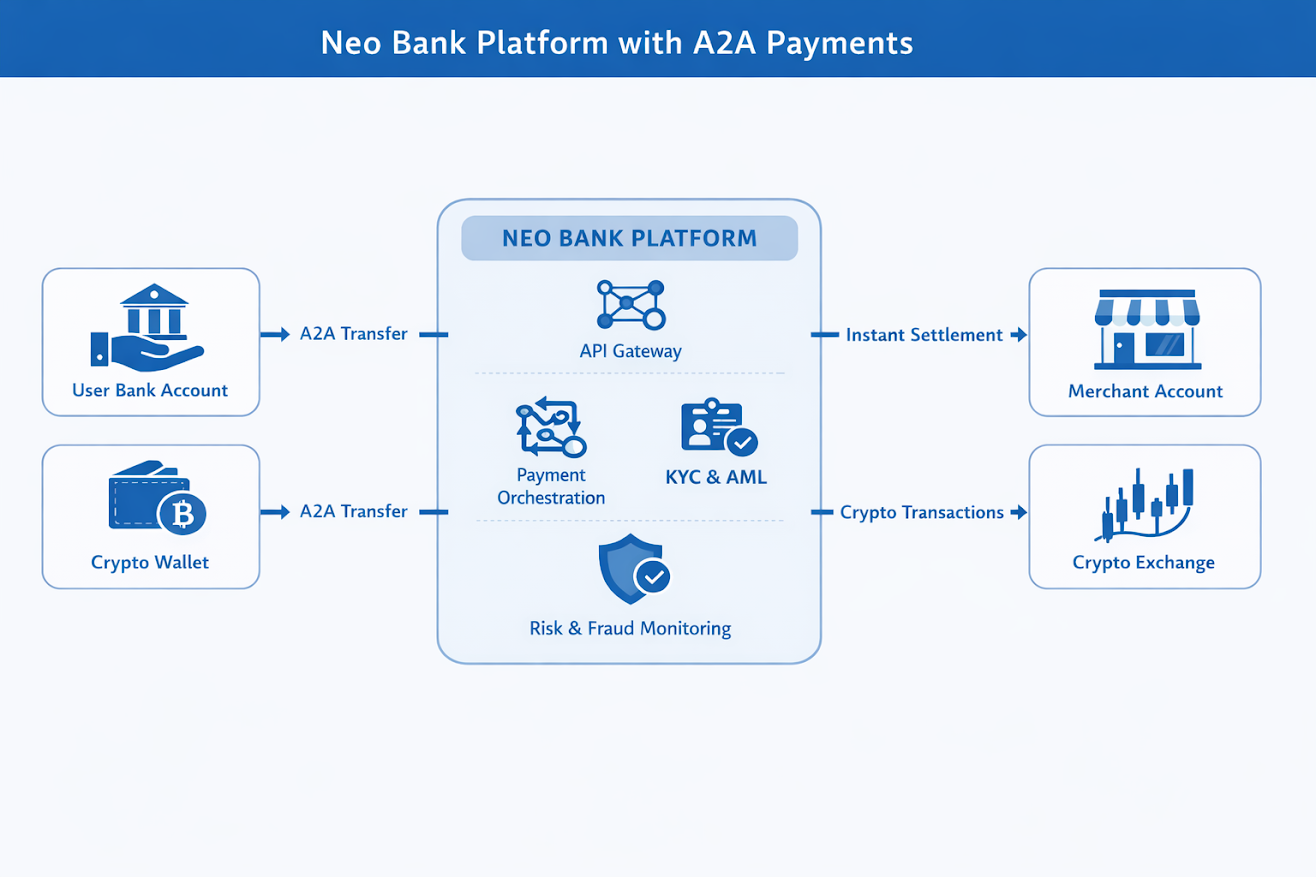

- On-ramp and off-ramp orchestration- The neo bank provides tight orchestration between fiat A2A rails and on-chain wallets. Users can initiate an A2A transfer from their bank account into the neo bank’s fiat custody. The system either credits a fiat ledger balance immediately upon confirmation or, if the user intends to mint tokenized assets, it triggers a controlled conversion workflow that uses a compliant brokerage or internal AMM to swap fiat for the desired token.
- Dual-ledger architecture- Maintain a fiat ledger and a tokenized ledger. The fiat ledger reconciles with external rails and instant payments. The token ledger mirrors user balances on-chain or in controlled custody. Movement between ledgers is handled by deterministic business logic, ensuring atomicity (credit to the token ledger only after settlement confirmation or via escrow techniques).
- Settlement and reconciliation- The payment orchestration layer handles instant confirmations, settlement timing differences, and reconciliation. For example, a UPI payment confirmation can trigger immediate ledger credit, while cross-border A2A may require multi-step settlement and liquidity management.
- Custody, AML, and KYC- For crypto rails, custody models vary: self-custody with wallet integrations, custodial crypto wallets, or hybrid ones. AML and KYC flows must be synchronized to the fiat rails so that on-chain flows do not create regulatory gaps. Real-time transaction monitoring must incorporate both on-chain heuristics and off-chain bank signals.
- Programmable rails and smart routing- Smart routing sends payments across the most cost-effective and compliant rail. For domestic instant rails, it prefers direct A2A. For cross-border transfers, it may leverage partner pools, local settlement entities, or tokenized stablecoins held in regulated custody.
This hybrid design allows a neo banking app platform to offer low-cost merchant acceptance, instant payouts to users, and seamless fiat-crypto rails, a compelling set of capabilities for modern web3-native products. For context, well-designed A2A integration is what enables competitive offerings like instant merchant settlements, embedded payroll, and real-time treasury for business customers.
When national rails achieve mass scale, they change behavior. For example, India’s UPI shows how an A2A-first economy dramatically shifts consumer and merchant preferences. Integrating such rails is not optional for market leaders.
Antier’s A-Z Capabilities for a White-Label Neo Banking Solution with A2A payments
Do you want to get more clarity on what a full-stack platform looks like? Well-designed by a white-label BaaS partner, it supports an investor’s road to scale. Below we list the investor-facing capabilities that matter most. Note that when we mention Antier once, we use that as the brand anchor for the consolidated capability set.
- Strategy and market entry: product-market fit studies, merchant economics modeling, and revenue playbooks tailored to local rails and verticals.
- End-to-end architecture: API-first platform design, payment orchestration engine, and dual-ledger support for fiat and tokenized assets.
- Rail integrations: connectors for instant payment networks and payment initiation providers, plus custom adapters for country rails and QR systems.
- Compliance-by-design: built-in KYC/AML flows, transaction monitoring, and support for regulatory reporting across jurisdictions.
- Custody and treasury: secure custody integrations, liquidity management, and bank-grade settlement reconciliation modules.
- Risk and fraud engineering: ML-powered scoring, adaptive rulesets, and real-time monitoring for both fiat and crypto flows.
- UX and developer experience: white-label banking apps, merchant portals, and developer APIs for embedding payments into platforms.
- Operations and SRE: 24/7 support, incident management, and SLAs for settlement integrity and uptime.
- Go-to-market enablement: merchant onboarding automation, pricing strategy, and performance dashboards to measure acquisition and take-rate.
- Ongoing product evolution: roadmap management, feature A/B testing, and telemetry to evolve product-market fit.
Make sure that you are hiring a genuine and reliable white label crypto neo bank development company that holds a good reputation in the market. has a vast team of certified blockchain experts, and delivers customized banking solutions.
Implementation Checklist For Investors
When you evaluate a white-label neo bank with A2A claims, confirm these capabilities:
- Native connectors to relevant national rails and a modular orchestration layer.
- Real-time reconciliation and rich metadata capture for merchant settlement.
- Robust AML/KYC that binds fiat and crypto flows.
- A clear custody model and liquidity plan for fiat-crypto settlement.
- Proven operational SLAs, incident playbooks, and test harness for payments.
- Productized APIs and SDKs to enable partner integration and network effects.
Conclusion
A2A payments is a strategic enabler for any white-label neo bank that seeks durable growth and defensible margins. For investors, it is the mechanism that shifts payment economics, increases customer stickiness, and unlocks monetizable product layers. Market evidence shows large-scale adoption in regions where instant rails and open banking are present, and projections indicate continued A2A volume growth over the coming years.
We, the team of Antier brings deep engineering, payments, and regulatory experience to help portfolios turn A2A capability into predictable revenue. Our approach covers policy-aware integration, hardened custody and treasury, and continuous operational support to manage settlement, disputes, and compliance. With the right architecture and a partner that understands both rails and tokens, investors can capture the margin gains and product optionality that A2A unlocks.
If you would like, we can produce a due-diligence checklist tailored to a specific market or assemble a short roadmap estimating engineering scope and go-to-market milestones for a white-label neo bank in your target jurisdiction.
Frequently Asked Questions
01. What are A2A payments and why are they important for neo banks?
A2A payments, or Account-to-Account payments, eliminate costly intermediaries, improve merchant unit economics, reduce customer friction, and enable richer data flows, making them a strategic imperative for neo banks to enhance customer experience and maintain competitive advantage.
02. How is the A2A payment market expected to grow in the coming years?
The global A2A transaction value is projected to increase from $1.7 trillion in 2024 to $5.7 trillion by 2029, with annual transactions expected to rise from 60 billion to 186 billion during the same period.
03. What factors are driving the growth of A2A payments?
Growth in A2A payments is driven by lower fees, instant settlement, stronger bank-level security, and the adoption of large-scale instant-payment infrastructures and open banking, which are shifting transaction volumes away from traditional card payments.