Crypto World
Why is Crypto Going Down? Iran Just Bombed Kuwait’s Airport and Struck the Strait of Hormuz, Bitcoin Is Crashing Toward Critical Support

Crypto crashed overnight as Iranian strikes on Kuwait’s international airport and escalating conflict in the Strait of Hormuz sent risk assets into freefall, with more than $700 million in leveraged long positions forcibly closed in a 12-hour window.
Bitcoin dropped sharply toward critical support levels, dragging the total crypto market cap to $2.31 trillion.
Traders asking why is crypto going down this hard got a brutal, two-part answer: a geopolitical shock and a leverage overhang that was already primed to blow.
The confluence of factors is not subtle. Elevated open interest across perpetual futures markets had been building for weeks, leaving the market structurally vulnerable.
UPDATE: (unconfirmed)
Newly surfaced open-source images and videos document severe damage, raging fires at the fuel depot, and structural interior collapses at Kuwait International Airport Terminal 1 following the recent Iranian drone wave. First responders remain heavily… pic.twitter.com/PslHM6gRMT— X-K (@ConflictRadarME) June 3, 2026


Then Iran bombing Kuwait airport, and the subsequent US military response targeting Qeshm Island in the Strait of Hormuz, provided the exogenous trigger that converted fragile positioning into a full liquidation cascade. Bitcoin had already been slumping on geopolitical tensions and leverage pressure in the sessions leading into this event. This was the match on the gasoline.
Discover: The Best Crypto to Diversify Your Portfolio
Why Is Crypto Going Down? Strait of Hormuz Tensions and Iran Kuwait Airport Bombing Drive Risk-Off Rotation
Iran’s drone strike on Kuwait’s international airport, causing significant building damage, injuries, and the suspension of air traffic on Wednesday morning, was the flashpoint.
Kuwait’s Ministry of Defence spokesman Brigadier General Saud Abdulaziz Al-Otaibi described it as “criminal Iranian aggression.” US Central Command responded with strikes on an Iranian military ground control station on Qeshm Island, deep inside the Strait of Hormuz.
The IRGC warned that “disrupting the security of the Strait of Hormuz will carry a heavy price for the aggressive US military.” Markets heard that threat and repriced risk immediately.
The Strait of Hormuz carries roughly 20–30% of the world’s seaborne oil trade. A sustained disruption there is not a regional story, it is a global energy price event. Oil surged on the escalation news, the US dollar strengthened into safe-haven demand, and Treasuries caught a bid.
That trifecta, higher oil, stronger dollar, bid for bonds, is the classic risk-off rotation that historically drains liquidity from speculative assets. Crypto, despite years of “digital gold” narrative, continues to trade as a high-beta risk asset in moments of genuine geopolitical stress.
The BTC-Nasdaq correlation dominated; the BTC-gold correlation was nowhere to be seen.
The US naval blockade of the Strait of Hormuz, which began on April 13, has already disabled six commercial vessels and redirected 122 others.
The blockade’s latest action, a Hellfire missile fired into the engine room of the Botswana-flagged M/T Lexie after its crew ignored 24 hours of warnings, signals Washington has no intention of backing down.
Ceasefire negotiations between the US and Iran stalled over the weekend, with Iran’s foreign ministry spokesman Esmail Baghaei accusing Washington of “constantly changing its views.” Secretary of State Marco Rubio told Congress bluntly: “The war is over”, but the strikes suggest otherwise.
This is not a de-escalation environment. That is not noise. That is a pattern. The fears of a broader crypto market crash 2026 scenario are not entirely irrational given this backdrop.
Discover: The Best Token Presales
Can Bitcoin Price Recover, or Does the $68,000 Zone Mark a Deeper Break?
The technical damage from this episode is real.
Bitcoin lost the Short-Term Holder Realized Price support, a level that historically marks the dividing line between healthy consolidation and sustained drawdowns.
The $70,000 psychological floor was cracked in the liquidation flush. Total crypto market cap is now testing $2 trillion, a threshold derivatives desks will defend aggressively but one that carries no guarantee.
If US-Iran back-channel talks resume meaningfully, Hormuz shipping risk premiums fade, and ETF inflows return within 48 to 72 hours, Bitcoin reclaims $70,000, shorts get squeezed, and price reprints toward $74,000 to $75,000. That scenario requires de-escalation signals that are not currently visible.
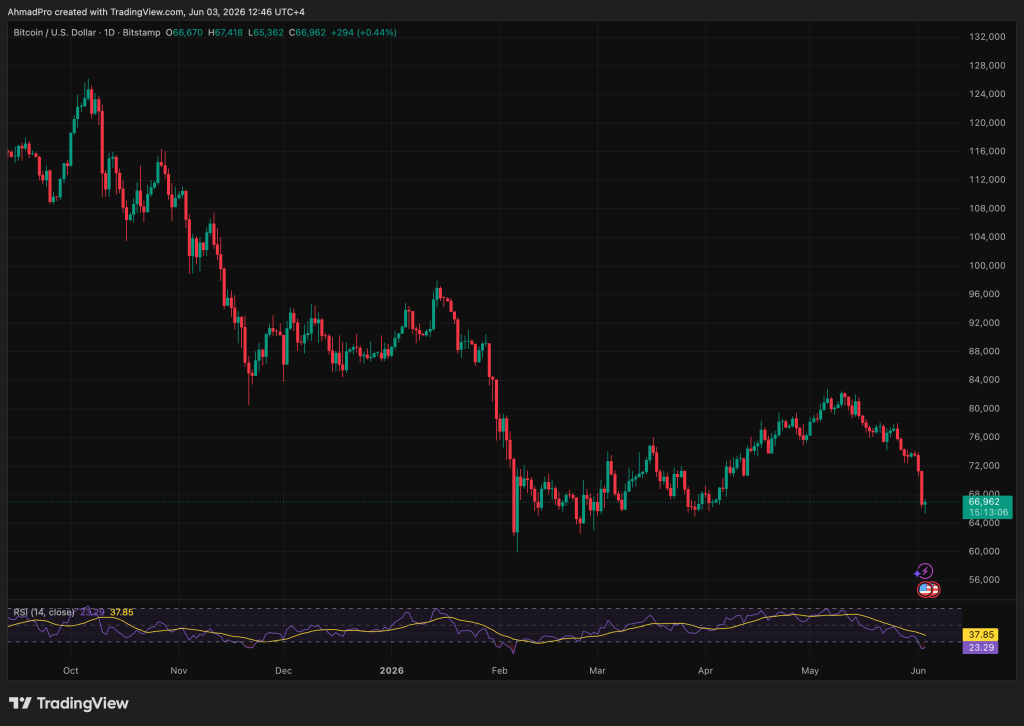

If geopolitical noise persists without further direct escalation, crypto consolidates in the $66,000 to $70,000 range as leveraged positioning resets and macro traders wait on the next US inflation print. The Fed’s higher-for-longer posture limits the upside ceiling even in that scenario.
Further Iranian strikes, a Hormuz shipping incident involving a major tanker, or another upside inflation surprise pushes BTC through $65,000. That breaks the range structure that has held since Q1 2026 and opens a move toward $60,000 to $62,000. This is the scenario traders are quietly stress-testing right now.
The structural read is bearish until $70,000 is reclaimed on a closing basis. Everything below that level is damage control territory.
The post Why is Crypto Going Down? Iran Just Bombed Kuwait’s Airport and Struck the Strait of Hormuz, Bitcoin Is Crashing Toward Critical Support appeared first on Cryptonews.
You must be logged in to post a comment Login