

Crypto World
Why Launch With A White Label Neo Bank In Argentina’s Fintech Market

There’s an old Spanish saying that sums up how many Argentinians think about their money: Más vale pájaro en mano que cien volando (“A bird in the hand is worth more than many in flight.”) In practise, when the peso falters, people seek value they can hold, move, and spend.
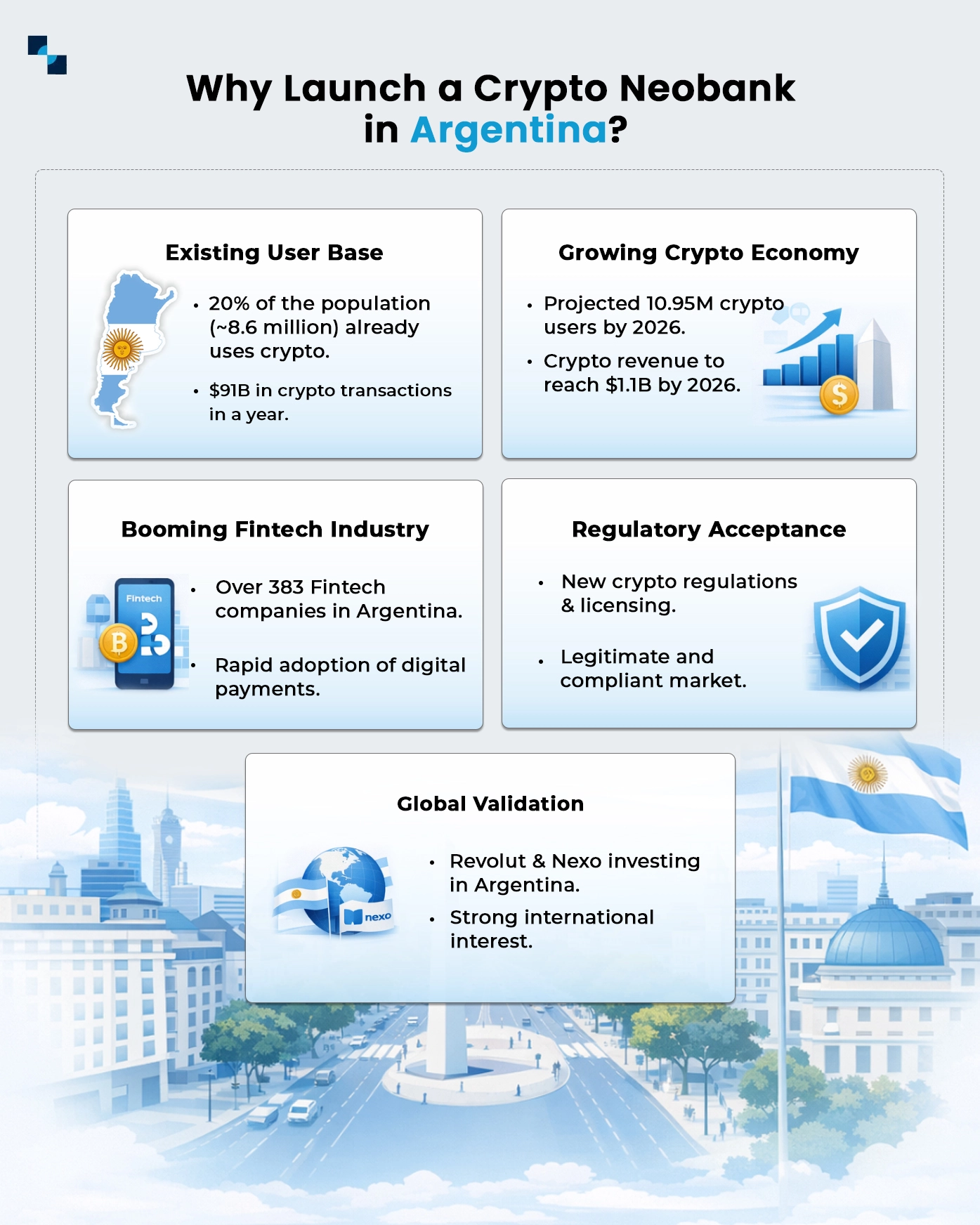
Currently, the value people see is increasingly digital. The trend toward digital assets is forecasted to accelerate over the next 2 years as Argentina is poised to become one of the leading global markets for crypto adoption by 2026. It is estimated that around 20% of the country’s population is already engaging with cryptocurrencies (8.6 million).
In the near future, cryptocurrencies will not only serve as a hedge against inflation but also have practical everyday uses, including savings, payments, remittances, and the like, alongside the continued depreciation of the peso.
As this evolution continues, crypto-centric digital bank app development will blend the best aspects of traditional banks with the added value of crypto rails – helping you fulfill the demands of a unique and dynamic economic environment.
Now, let’s first answer the main question-
1. Because there’s an existing user base
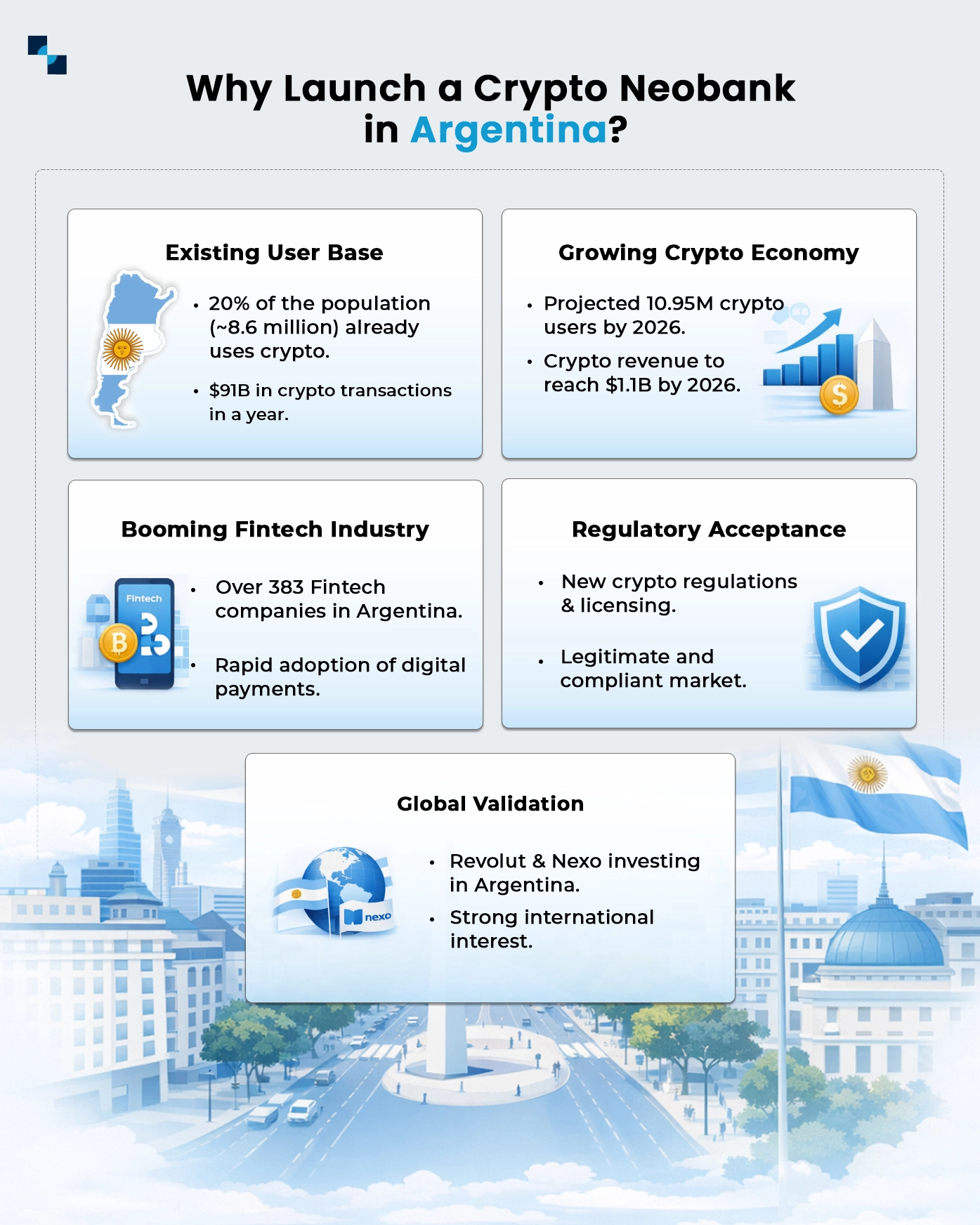
Argentina is becoming one of the top centres of cryptocurrency activity in Latin America. According to new figures, Argentina is now ahead of Brazil with roughly $91 billion in crypto transactions between July 2023 and June 2024.
Besides, stablecoins are being used by many Argentines for purposes beyond speculation. 61.8% of all the crypto transaction volume comes from these USD-backed cryptocurrencies.
This shows how digital assets here are becoming the go-to for value preservation, payments, and transfers. That provides a solid basis for building new businesses via the white-label neo bank model.
2. The crypto economy is growing
User penetration and revenue projections
Recent estimates suggest that Argentina’s crypto user penetration will increase from 22.8% in 2025 to approximately 23.8% by the end of 2026, and an anticipated total of 10.95 million users. The amount of crypto revenue generated is predicted to reach USD 940.9 million by 2025, and rise to approximately USD 1.1 billion by 2026 at a 16.% CAGR.
These numbers are notional but instead represent the flow of actual cash in the crypto economy, making it an economically viable market for launching a crypto-enabled fintech product in 2026.
3. The financial technology industry has taken off
Argentina’s rapidly advancing financial technology market had 383+ companies operating locally in 2024 (representing a continuing double-digit growth rate every single year).
Local fintech organizations are now responsible for the movement of money via payments, remittances, lending, and crypto. By developing the infrastructure necessary to facilitate the mass usage of crypto, firms such as Ripio are helping users quickly adopt digital currencies.
The presence of digital payment systems is further evidence that there is a mainstream demand for next-generation financial services.
With that being said, if you choose to set up a neo-banking venture in Argentina with a white-label neo-bank development company, you will not be entering in isolation. You will be connected to an already existing, well-established, integrated, and technologically rising fabric capable and ready for progressive scaling.
4. Regulations are now creating an environment of acceptance
Argentina is developing formal licensing regulations for VASPs (virtual asset service providers). As a result, crypto financial services will no longer be considered “underground” and will now be an accepted, legitimate space – complete with AML/KYC requirements.
Banking x Crypto
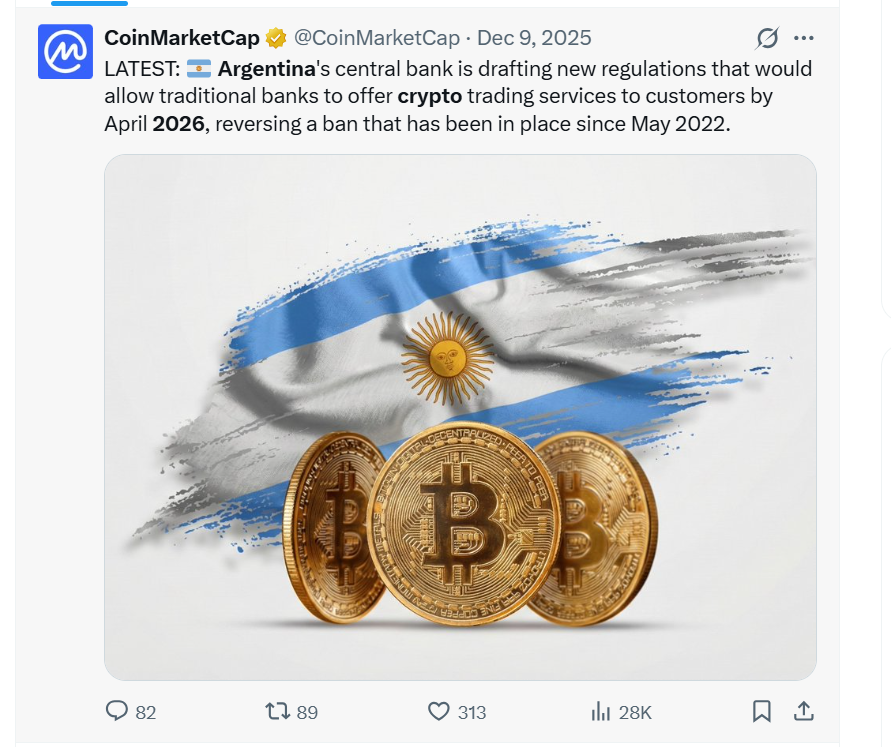
In 2026, the central bank of Argentina is primed to create regulations that will allow banks to provide crypto trading and custody services to their customers. This is a sign that the nation is moving into an era where digital/virtual assets will be normalized alongside traditional banking and finance.
“As such, the compliance-focused neobank applications will have the benefit of operating legitimately, instilling confidence in the users’ minds.”
5. Because international players are validating the fintech market of Argentina
Revolut has entered the Argentine market with an acquisition. The Fintech company will be offering:
- Multi-currency accounts
- Foreign exchange (forex)
- No-fee bank transfers
Nexo recently purchased Buenbit in Buenos Aires to use the city and its surrounding areas as regional epicentres for its next-stage expansion.
These institutional activities confirm that Argentina is a magnetic market for crypto-powered digital finance globally, with proven user demand.
Argentina Market – Key Statistics Summarized
| Metric | 2025–2026 Data |
|---|---|
| Crypto adoption rate | ~20 % of the population |
| Crypto inflows [July 23 – June 24] | ~US$ 91 billion |
| Stablecoin share of crypto transactions | ~61.8 % |
| Projected crypto users (2026) | ~10.95 million |
| Crypto revenue growth | ~US$ 1.1 billion (2026) |
| Number of fintechs | 383+ |
| Big fintech expansion | Revolut entry |
| Institutional crypto rush | Nexo–Buenbit acquistion |
How To Succeed In A Pulsating Marketplace like Argentina?
The conventional ways to crypto-first banking are not going to be successful in this terrain, where you will have to compete not only against the traditional financial institutions but also against nimble fintech platforms, global players moving into the space, and a very digitally savvy, educated population.
Here is how a white-label neo bank helps you win:
- Culturally resonating with the financial mindset of Argentines – Premier white-labeled options resonate with Argentines’ financial psyche that prioritizes stability, access to dollar-equivalent reserves, and control over volatile fiat currency flows.
- Regulatory compliance – The integration of traditional banks with cryptocurrencies will begin in earnest by 2026. Therefore, the regulatory environment will evolve dramatically over the next few years. Top-notch pre-built neobank frameworks do not compromise on compliance. They help you evolve with regulations – critical for establishing a competitive advantage in 2026.
- Reliability, security, and meaningful financial inclusion – Advanced white label tech enables you launch not just another trendy product — they empower you to craft a resilient platform that serves the larger goals of making crypto banking trustworthy, accessible, and fair for all.
- Connecting fiat currency with digital assets – Rebrandable offerings let you orchestrate an entirely new financial ecosystem -supporting locals to seamlessly connect to fiat currency and stablecoins or digital assets, thus forging long-term relationships with them.
Experience Crypto-Native Fintech app development in Argentina with Antier
Antier builds more than just apps. We make crypto neo banking solutions that leverage deep local insight – blending fiat banking, cryptocurrency integration, compliance, smooth user experience, and strong infrastructure.
In Argentina, people want financial independence and choice. That is what our white-label technology brings.
Our goal is not to sell a product, but to give you the ability to inspire a new banking renaissance that speaks to the needs of the local people. By banking on Antier’s expertise, you will go live in the LATAM market in just a few weeks or months with an application that is not only technically sound but also compliant with regional norms and rules.
Are you ready? Talk to our experts to get more insights on how to begin!
Frequently Asked Questions
01. Why is Argentina becoming a leading market for cryptocurrency adoption?
Argentina is becoming a leading market for cryptocurrency adoption due to a significant existing user base, with around 20% of the population (approximately 8.6 million people) already engaging with cryptocurrencies, and a projected increase to 10.95 million users by 2026.
02. What are the practical uses of cryptocurrencies in Argentina?
In Argentina, cryptocurrencies are increasingly used for various practical purposes, including savings, payments, remittances, and as a hedge against inflation, especially amid the depreciation of the peso.
03. What factors contribute to the growth of the fintech industry in Argentina?
The growth of the fintech industry in Argentina is driven by over 383 fintech companies, rapid adoption of digital payments, new crypto regulations, and strong international interest from global players like Revolut and Nexo.

Base, the Ethereum Layer 2 network launched by Coinbase, is transitioning from Optimism’s OP Stack to a self-managed codebase.
Base, the Ethereum Layer 2 blockchain solution developed by Coinbase, is making a significant strategic shift by moving away from reliance on Optimism’s OP Stack.
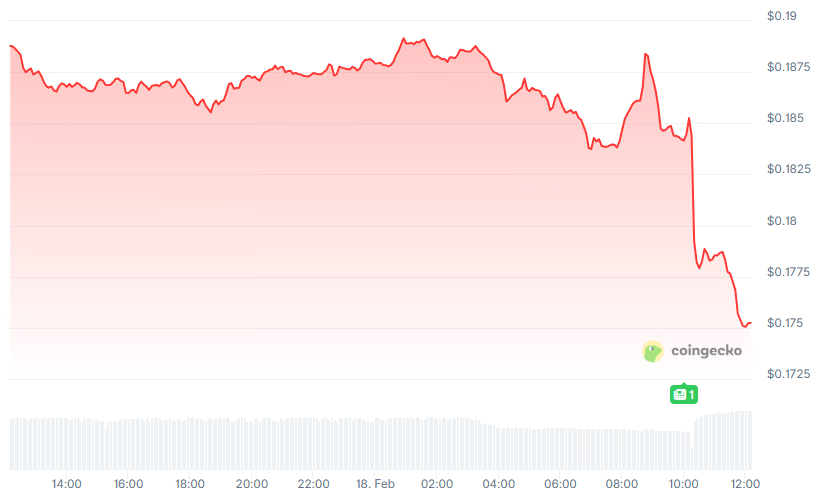
Optimism’s OP token plunged 7% following the news.

Initially built on Optimism’s OP Stack, Base has decided to transition to its own codebase to gain greater control over its infrastructure and streamline upgrades. This move is expected to double the pace of its major upgrades to approximately six per year.
According to a blog post, the protocol will consolidate upgrades and changes internally, while continuing to collaborate with Optimism as an OP Enterprise client for support during the transition.
Optimism’s OP Stack is widely used by Layer 2 solutions, and Base’s transition might prompt similar moves by other industry players. Base is the largest Layer 2 by total value locked, with nearly $3.9 billion, according to DeFiLlama.
This article was generated with the assistance of AI workflows.


COIN gained in post‑Q4 earnings as 2025 volume jumped 156% despite Wall St skepticism.
Summary
- Coinbase total trading volume grew 156% YoY in 2025, with crypto trading market share roughly doubling versus the prior year.
- Assets on COIN have tripled over 3 years, while 12 products, including USDC and Coinbase One, each now generate over $100m in annualized revenue.
- Armstrong says ~5 GSIBs and about half of major institutions already work with COIN, arguing GAAP noise hides profitability and that Wall St still underestimates the stock.
Coinbase Global Inc. Chief Executive Officer Brian Armstrong has attributed Wall Street’s skepticism of the cryptocurrency exchange to a broader pattern of industries resisting disruptive technologies, according to statements the executive shared on social media following an analyst session.
Coinbase total volume continues to tip upward
Armstrong responded to questions about why traditional financial institutions continue to misunderstand Coinbase’s business model, comparing crypto skeptics to historical examples of incumbent industries dismissing new competitors. The CEO referenced the comparison between legacy taxi services and ride-sharing platforms as an analogy for the current dynamic between traditional finance and cryptocurrency firms.
According to Armstrong’s statements, five of the globally systemically important banks (GSIBs) have initiated partnerships with Coinbase, and approximately 50% of major financial institutions are actively engaging with cryptocurrency services. The remaining institutions have been slower to adopt the technology, Armstrong said.
The company reported total trading volume growth of 156% year over year in its fourth quarter and full-year earnings report. Coinbase’s crypto trading market share doubled in 2025, and assets on the platform have tripled over the past three years, according to the company’s financial disclosures.
Armstrong highlighted that Coinbase’s GAAP net income includes unrealized gains and losses on cryptocurrency holdings, suggesting investors examine adjusted net income metrics instead. By that measure, the company remained profitable in the most recent quarter despite market headwinds, the CEO stated.
The cryptocurrency exchange now operates 12 products each generating over $100 million in annualized revenue, according to Armstrong. Both USDC, a stablecoin product, and Coinbase One, a subscription service, reached all-time highs. Armstrong characterized this diversification as evidence the company has reduced its dependence on trading fee revenue.
The CEO told investors to evaluate companies based on stated objectives and execution results, noting Coinbase has delivered consistent financial performance for three consecutive years. Armstrong cited improving regulatory clarity as a favorable factor for the industry’s growth, along with increasing participation from governments, institutions, and retail investors.
Armstrong concluded that Coinbase remains well-positioned to benefit from ongoing transformation in the financial system, describing the company as underestimated by market consensus. The executive suggested this gap between market perception and company performance represents an opportunity for investors.


Wallet infrastructure firm Kresus Labs has raised approximately 18 billion won ($13 million) in investment from Hanwha Investment & Securities, one of South Korea’s largest financial institutions.
The investment follows a memorandum of understanding signed in December at Abu Dhabi Finance Week and is aimed at expanding Kresus’ enterprise digital wallet infrastructure, real-world asset (RWA) tokenization platforms and onchain financial workflows.
The wallet and blockchain infrastructure firm develops digital asset tools for both consumers and institutions, including “seedless” wallet recovery technology and multi-party computation (MPC)-based security systems.
Seedless recovery refers to the means of restoring access to a digital asset stored in a wallet without having to use the traditional stream of 12-24 random words, which could prove a barrier to entry for some.
Kresus also operates wallet infrastructure and tokenization platforms designed to meet institutional compliance and operational requirements.
Hanwha plans to use Kresus’ technology to enhance its client-facing digital asset services and to develop tokenized versions of traditional financial products. For established financial firms, wallet security and compliant tokenization frameworks remain key barriers to deeper engagement with blockchain-based markets.
The raise underscores how capital continues to flow into infrastructure providers even when broader crypto markets are volatile. Rather than backing speculative tokens, institutions are increasingly targeting custody, security and tokenization layers that can plug into existing financial systems.


A relatively unknown crypto trader gained $7 million from shorting ETH while major investors suffered huge losses.
An anonymous trader known only as 0x58bro has accumulated $7 million in unrealized profits by shorting Ethereum (ETH) and a handful of other cryptocurrencies, according to data from on-chain intelligence platform Arkham.
What’s noteworthy about their success is that it has come at a time when several high-profile crypto personalities have suffered eight-figure losses betting on price increases.
The Quiet Whale Swimming Against the Current
Despite holding a portfolio valued at just under $13 million, 0x58bro maintains a minimal social media presence with just 1,300 followers on X. Arkham’s analysis shows the trader has generated the bulk of his profits from two positions: a $3.7 million gain shorting ETH and $1.45 million from shorting ENA, the governance token of Ethena Labs.
The trader’s wallet composition also revealed a strategic approach to the current market volatility. They hold over $7.5 million in Aave’s interest-bearing ETH token (aETHWETH) and $5 million in Aave’s USDC deposit token (aETHUSDC), suggesting they have positioned capital to earn yield while maintaining the flexibility to deploy it against further downside.
A smaller position of 10 million HANA tokens, currently worth close to $353,000, represents their only significant long exposure.
The timing of these short positions has proven critical, with Ethereum struggling to maintain momentum in recent weeks and prices hovering around the $2,000 psychological support level.
Market Backdrop Shows Leverage Risks and Speculation Cycles
While 0x58bro is profiting from market declines, other traders have faced catastrophic losses attempting to catch a falling knife. On-chain data shows that Machi Big Brother, a well-known crypto personality once worth nearly nine figures, has seen his Hyperliquid account value fall below $1 million. To meet margin calls on his long positions, he was forced to tap into PleasrDAO treasury funds deposited five years ago, with his total losses now standing at $28 million.
You may also like:
The contrast extends to institutional players as well. For instance, Trend Research, the trading firm led by Liquid Capital founder Jack Yi, fully exited its Ethereum positions last week after accumulating about $1.34 billion in ETH at an average entry of $3,180. The exit locked in losses of approximately $869 million, according to Arkham data, coming just days after Yi publicly predicted ETH would reach $10,000.
While Trend Research was forced to unwind what was once Asia’s largest ETH long position, on-chain data from CryptoQuant shows that wallets with no history of outflows holding at least 100 ETH, known as “accumulation addresses,” are still buying through the downturn. These addresses now hold around 23% of Ethereum’s circulating supply and have maintained their accumulation even when prices were trading below their average cost basis.
Whether 0x58bro will maintain his short positions or join the accumulating addresses betting on a rebound remains unknown. But for now, the trader with 1,300 followers has outperformed an industry of influencers with millions watching their every move.
SECRET PARTNERSHIP BONUS for CryptoPotato readers: Use this link to register and unlock $1,500 in exclusive BingX Exchange rewards (limited time offer).

TLDR:
- Shielded Labs launched Partner Support Services to diversify funding beyond its existing donation-based revenue model.
- The NEAR Foundation became the first partner, covering past work and ongoing technical and strategic Zcash support.
- NEAR Intents has made it easier for users to acquire ZEC directly without depending on centralized crypto exchanges.
- Shielded Labs is already in talks with additional teams exploring similar advisory and ecosystem coordination agreements.
Shielded Labs has introduced a new Partner Support and Advisory Services initiative to diversify its funding. The organization, which backs long-term Zcash development, previously relied solely on donations.
Under the new program, external teams building on or integrating with Zcash can engage Shielded Labs directly. Services include technical support, advisory work, and ecosystem coordination. The NEAR Foundation is the first confirmed partner under this arrangement.
Shielded Labs Expands Revenue Model Through Ecosystem Partnerships
Shielded Labs has structured the new initiative to serve teams working through integrations, network upgrades, and related development efforts.
The program also offers advisory input based on direct experience with the Zcash protocol, community, and governance process. This creates a clearer path for external teams to engage with Zcash more efficiently.
The initiative also aims to reduce friction for builders entering the Zcash ecosystem. Teams that previously had no formal channel to engage Shielded Labs now have a direct route.
This approach helps ensure that new integrations align naturally with the broader ecosystem’s direction and standards.
Partner Services does not replace Shielded Labs’ core technical mission. Rather, it runs alongside it as a supplementary revenue stream.
The organization stated that its primary focus remains building and supporting technology that strengthens Zcash over the long term.
Shielded Labs confirmed it is already in discussions with additional teams considering similar engagements. Organizations interested in exploring collaboration are encouraged to contact the team directly, according to the announcement.
NEAR Foundation Becomes First Partner Under the New Program
Shielded Labs and the NEAR Foundation have formalized an agreement that covers both past contributions and future work.
Early collaboration involved communications and awareness strategy around Zcash’s initial integration into NEAR Intents.
Shielded Labs also helped organize the NEAR Intents hackathon and provided similar coordination support for integrations with Rhea Finance and Templar Protocol.
NEAR Intents has been noted as a meaningful development for Zcash, making it easier for users to acquire ZEC without relying on centralized exchanges.
Wallet teams, including Zashi, have since brought NEAR Intents integrations into mobile applications independently. These developments expanded access to ZEC for a broader user base.
As part of the ongoing agreement, Shielded Labs will continue providing technical, strategic, and ecosystem support to the NEAR Foundation.
This also covers teams building use cases around NEAR Intents. Stakeholder engagement, education, and coordination remain central components of the continued work.
On the technical side, Shielded Labs is exploring ways to simplify implementation for partners through targeted guidance and coordination.
Advisory input on security and privacy improvements is also part of the scope as new use cases around NEAR Intents continue to develop.
Crypto World
Is This the End of the Machi Big Brother Dump? Giant Whale Clings to Last $1M After Disaster


Arkham Intelligence estimates cumulative trading losses at $28 million.
Machi Big Brother is known for taking massive, highly leveraged long positions in several tokens on the decentralized exchange Hyperliquid, which has led to significant, high-profile liquidations.
Recent volatile months have massively drained his remaining capital.
Fortune Shrinks
Blockchain data shared by Arkham Intelligence revealed that Machi Big Brother’s Hyperliquid HL account value has fallen below $1 million. The data indicates the Taiwanese-American entrepreneur and former musician, whose real name is Jeffrey Huang, added margin to recent Hyperliquid long positions by drawing from the PleasrDAO treasury, funds that were deposited roughly five years ago.
Arkham Intelligence reports that around five months ago, Machi Big Brother’s net worth was close to nine figures. Since then, his holdings have witnessed a steep fall.
The on-chain tracking firm estimates his cumulative trading performance at a loss of $28 million. The movements were identified through wallet activity linked to Machi Big Brother and the PleasrDAO treasury.
Controversies
Machi Big Brother has been one of the controversial figures in crypto who is known for massive gains, heavy losses, and constant reinvention. He entered the space around 2017, launching Mithril (MITH), a “social mining” project that rewarded users with tokens. The project raised about $13 million, but the token collapsed roughly 80% within months.
He later joined Formosa Financial, which helped raise around 44,000 ETH, then worth about $37 million. About 22,000 ETH later disappeared from the treasury and were never recovered. In 2020, he moved aggressively into DeFi, forking Compound to create Cream Finance. The protocol suffered multiple exploits, and total losses surpassed $192 million.
You may also like:
He continued launching fast-moving forks such as Mith Cash, Wifey Finance, and Typhoon Cash, many of which failed within weeks. From 2021 to 2023, he became a dominant NFT player and amassed more than 200 Bored Ape Yacht Club NFTs worth over $9 million at the peak.
He later sold more than 1,000 NFTs in a short period, which crashed floor prices in what became known as the “Machi Dump.” In 2022, on-chain investigator ZachXBT accused him of embezzling 22,000 ETH and leaving multiple failed projects behind. Machi responded with a defamation lawsuit in Texas, which ended quietly without a ruling.
In 2024, he launched the Boba Oppa meme coin on Solana. He raised over $40 million before the token dropped sharply.
SECRET PARTNERSHIP BONUS for CryptoPotato readers: Use this link to register and unlock $1,500 in exclusive BingX Exchange rewards (limited time offer).
Crypto World
Optimism’s OP token falls after Base moves away from the network’s ‘OP stack’ in major tech shift
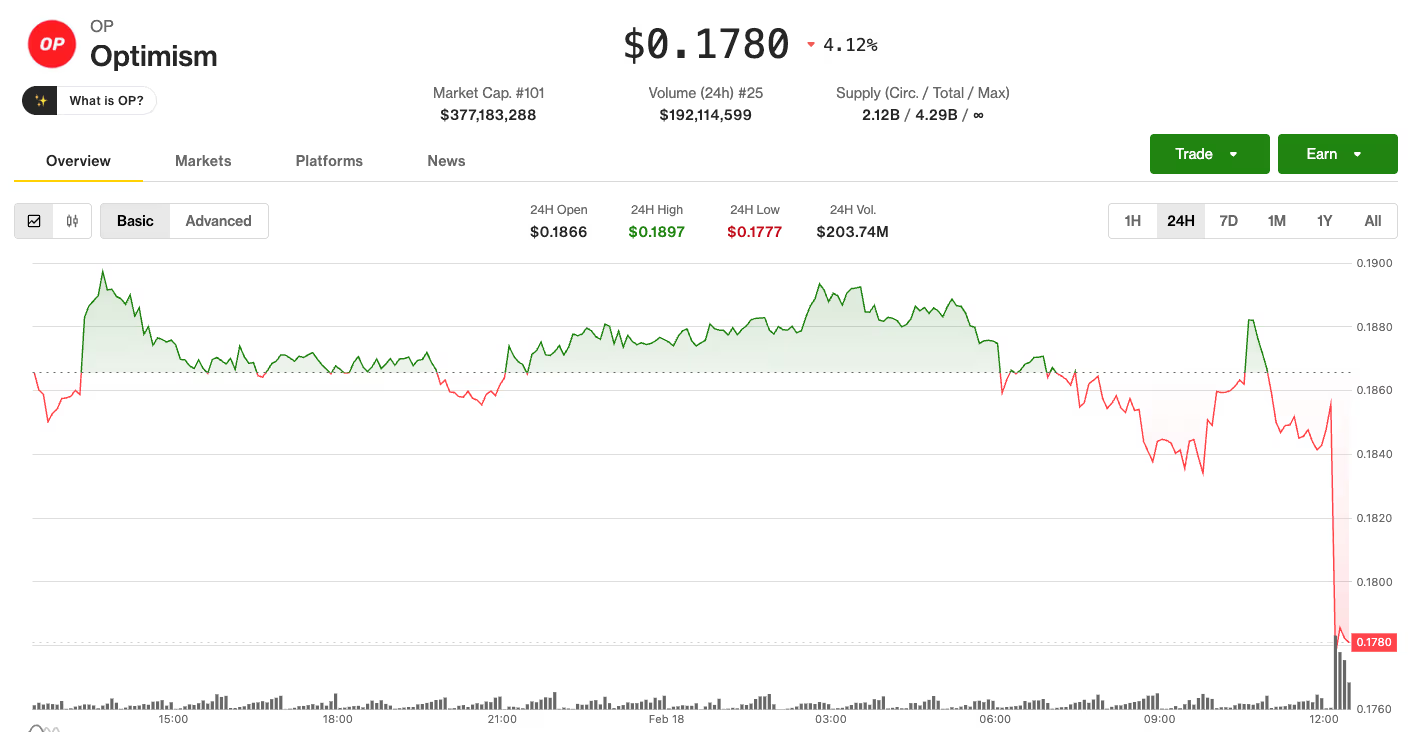
Coinbase’s Ethereum layer-2 network, Base, is changing the technology that powers it, stepping back from relying on Optimism’s OP Stack, the toolkit it originally launched on.
In a blog post titled “The Next Chapter for Base,” the team said it plans to take more control over its own code and infrastructure. Instead of depending on multiple outside teams for key upgrades and changes, Base will consolidate everything into a Base-managed codebase.
In simple terms, Base was built using Optimism’s technology, but now it wants to steer more of its own ship. Optimism is a layer-2 blockchain on top of Ethereum that aims to reduce settlement times and transaction costs.
Base launched in 2023 and quickly became one of the most widely used Ethereum layer-2 networks, with $3.85 billion locked in the protocol today. When the network went live, the Optimism and Base teams shared that Base could earn up to approximately 118 million OP tokens over six years. It is unclear as to what that means for that agreement.
The OP token is down 4% over the past 24 hours following the announcement.

The team said that the change doesn’t mean Base is cutting ties with Optimism entirely. The company said it will still work with Optimism for support and will remain compatible with OP Stack standards during the transition. For everyday users and developers, nothing should immediately change.
The team said the shift is happening because, if it controls its own stack, Base can ship upgrades faster and simplify how the network operates behind the scenes, aiming to double its pace of major upgrades to about six per year.
For now, the transition is mostly technical.
“This unification does not mean Base will be built in isolation. The protocol remains public and specified in the open, and alternative implementations are welcome and encouraged,” the team wrote in their blog post.
“We’re grateful for our three-year partnership with Base, and proud to have helped it become one of the most successful Layer 2 deployments in history,” an OP Labs spokesperson told CoinDesk.
“Our focus remains on delivering enterprise-grade blockchain infrastructure to our ecosystem, and we will continue to serve Base as an OP Enterprise customer while they build out their independent infrastructure.”
UPDATE (Feb. 18, 2026, 18:06 UTC): Adds OP Labs statement + background info on 118M OP token agreement.
Read more: Coinbase Officially Launches Base Blockchain in Milestone for a Public Company


Developed in collaboration with Paradigm, EVMbench evaluates AI agents’ ability to detect, patch, and exploit smart contract vulnerabilities.
EVMbench, a benchmarking tool, is set to enhance blockchain security by measuring the capabilities of AI agents in detecting, patching, and exploiting vulnerabilities in smart contracts. This new tool underscores the growing role of artificial intelligence in enhancing the security of decentralized finance (DeFi) ecosystems.
EVMbench employs historical vulnerabilities and a Rust-based harness to evaluate AI performance. At the forefront is GPT-5.3-Codex, an AI model developed by OpenAI, which achieved a score of 72.2% in exploit-mode evaluations.
EVMbench’s evaluation is comprehensive, utilizing 120 curated vulnerabilities from over 40 audits. These include scenarios provided by Tempo L1, which focuses on payment-oriented evaluations.
The tool also benefits from Paradigm’s expertise, which provides domain knowledge and quality control. This collaboration ensures the accuracy and reliability of EVMbench’s evaluations.
This article was generated with the assistance of AI workflows.
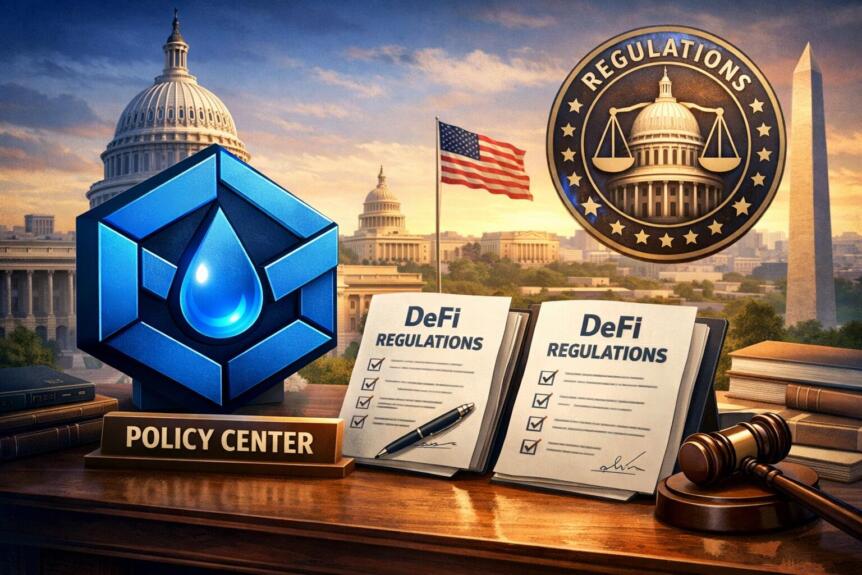
Hyperliquid has launched the Hyperliquid Policy Center in Washington, D.C., to advocate for clearer regulations for decentralized finance (DeFi). The new nonprofit aims to focus on DeFi regulation and perpetual derivatives while engaging lawmakers and regulators. With prominent crypto lawyer Jake Chervinsky at the helm as CEO, the center plans to provide advocacy and research around policy issues impacting the decentralized financial space.
The initiative, funded by a $28 million contribution from the Hyper Foundation, aims to represent Hyperliquid’s ecosystem in policy discussions. The launch comes at a critical time when U.S. lawmakers are considering the future of blockchain technology and decentralized markets. With the financial markets shifting toward blockchain infrastructure, the new policy center seeks to address the gaps in U.S. regulations regarding decentralized systems.
Jake Chervinsky Leads the Hyperliquid Policy Center’s Efforts
Jake Chervinsky, a well-known advocate for DeFi policy, will lead the Hyperliquid Policy Center. He emphasized that the center is an independent organization focused on research and advocacy. The policy center’s mission is to ensure that DeFi can continue to thrive within the U.S. financial system. Chervinsky pointed out that while financial markets are increasingly moving to public blockchains, regulators have yet to create rules to accommodate decentralized systems like Hyperliquid.
1/ I am proud to announce the launch of Hyperliquid Policy Center, where I will serve as CEO.
HPC is an independent research and advocacy organization dedicated to ensuring that DeFi can flourish in the United States.
The future of finance will be decentralized. https://t.co/ObDFGsjlwj
— Jake Chervinsky (@jchervinsky) February 18, 2026
He also noted that DeFi platforms like Hyperliquid face regulatory challenges that were not foreseen in traditional financial laws. Hyperliquid itself operates on a public, permissionless blockchain and has grown to rival centralized exchanges in terms of liquidity. According to Chervinsky, current U.S. regulations do not fully align with decentralized technologies, which creates regulatory uncertainties.
Chervinsky explained that the Hyperliquid Policy Center will work directly with U.S. lawmakers and regulators to establish clearer rules for blockchain-based financial infrastructure. The goal is to ensure that U.S.-based companies can innovate and operate in the decentralized finance space without facing regulatory hurdles that could stifle growth.
Funding and Support from the Hyper Foundation
To support its efforts, the Hyper Foundation has contributed 1 million HYPE tokens, valued at $28 million. These tokens will be unstaked immediately and will help fund the creation of the Hyperliquid Policy Center. The foundation emphasized that this contribution demonstrates its commitment to the long-term success of the DeFi ecosystem in Washington, D.C.
The Hyper Foundation’s contribution not only helps launch the policy center but also ensures that the community has a voice in regulatory discussions. The foundation aims to help bridge the gap between the DeFi sector and policymakers. Through its contribution, the foundation hopes to elevate the discussion about decentralized finance at the federal level.
As part of its mission, the policy center will produce technical research, publish commentaries on proposed regulations, and answer questions related to decentralized markets. The center will also serve as a resource for lawmakers and regulators to better understand the technical aspects of DeFi.
The Policy Center’s Team and Focus Areas
The Hyperliquid Policy Center has also introduced its founding team, which includes Brad Bourque and Salah Ghazzal. Bourque, the new Policy Counsel, has previously worked with Sullivan & Cromwell LLP, bringing legal expertise to the center’s efforts. Ghazzal, the Policy Director, has experience working as a policy lead at Variant, further strengthening the team’s understanding of regulatory affairs.
The team will focus on several key areas, particularly decentralized finance and perpetual derivatives. They plan to contribute to ongoing policy debates and engage in discussions on how existing regulations apply to decentralized technologies. In addition to advocacy, the center will provide technical insights to help inform policymakers about how DeFi platforms operate and the risks involved.
The center also plans to dive deep into complex issues tied to decentralized markets. This includes providing feedback on proposed rules and offering recommendations for how regulations can be adapted to the evolving DeFi landscape.
The Hyperliquid Policy Center and the CLARITY Act
The launch of the Hyperliquid Policy Center coincides with ongoing discussions around the CLARITY Act, which is currently stalled in the Senate Banking Committee. The bill aims to divide oversight of digital assets, classifying them either as digital commodities under the CFTC or as investment contract assets under SEC rules. While the bill has faced delays, including the cancellation of markup sessions scheduled for January, it remains a key piece of legislation for the future of blockchain regulation in the U.S.
Jake Chervinsky has been vocal in his support for the CLARITY Act, calling for stronger protections for DeFi platforms during the legislative process. He has warned that the DeFi community needs clear protections in place for the industry to continue developing and evolving. Chervinsky has also emphasized the importance of safeguarding developers from legal liabilities while ensuring that DeFi platforms comply with applicable regulations.
As the Hyperliquid Policy Center begins its advocacy efforts, it will likely play a key role in pushing for stronger safeguards and clearer rules for the DeFi sector as the CLARITY Act moves forward.
The Future of DeFi Regulation and Advocacy
The Hyperliquid Policy Center’s launch highlights the growing need for clear regulatory frameworks around decentralized finance in the United States. As more financial services move to blockchain-based platforms, lawmakers will face increasing pressure to address the legal and regulatory challenges that these technologies present.
By focusing on education and advocacy, the Hyperliquid Policy Center aims to fill a critical gap in the current regulatory landscape. Its work will not only support the interests of the Hyperliquid ecosystem but also help shape the future of DeFi regulation in the U.S. Through its leadership and research, the center hopes to ensure that DeFi continues to thrive while operating within a clear and fair regulatory framework.


Solana-based token launch platform Pump.fun is changing how creator fees work, giving users the ability to decide whether token deployers or traders should receive fee rewards.
Summary
- Pump.fun has introduced “Cashback Coins,” allowing token creators to redirect 100% of creator fees to traders instead of themselves.
- Creators must choose between Creator Fees or Trader Cashback before launch, and the decision is permanently locked once the token goes live.
- The move aims to address concerns that some deployers collect fees without contributing ongoing value, letting the market decide who gets rewarded.
Pump.fun lets traders take the fees with new cashback model
In a post on X, Pump.fun said “not every token deserves Creator Fees,” announcing the launch of a new feature called Cashback Coins. The update allows token creators to choose, before launch, whether fees generated by the token will go to the creator or be redirected entirely to traders.
In a follow-up post, Pump.fun’s CEO said the update was aimed at “rewarding traders and REAL projects.”
Creator fees have traditionally been positioned as a way to help founders, teams, and project leads fund development and grow their communities. However, Pump.fun acknowledged that many tokens gain traction without an active team or long-term project roadmap.
In such cases, the platform said, creator fees can disproportionately reward deployers who may not contribute ongoing value.
Under the new system, coin creators must select one of two options at launch: Creator Fees or Trader Cashback. If Trader Cashback is selected, 100% of the creator fees are redirected to traders instead of the deployer. Once the token is launched, that choice is permanently locked and cannot be changed.
Pump.fun also clarified that “CTOs,” or community takeovers, cannot be carried out on Cashback Coins. Tokens launched under the cashback model will permanently reward traders and holders rather than any original deployer. Creator Fee coins are similarly locked into their chosen structure.
The feature is now available within the Pump.fun mobile app and website during the token creation process. Users who participate in Cashback Coins can claim rewards directly through the app by navigating to their profile and accessing the rewards section.
The move reflects growing debate within the memecoin ecosystem over incentive alignment and fairness.
By shifting fee distribution decisions to token creators, and ultimately letting traders choose which model to support, Pump.fun is positioning the market itself as the mechanism that determines who gets rewarded.

Ilia Malinin admits Olympics pressure led to figure skating struggles

Mark Zuckerberg testifies in social media addiction trial that Meta just wants Instagram to be ‘useful’

Ex-Man Utd star Mikael Silvestre has strong words for Jose Mourinho over Vinicius Junior’s racist abuse claim | News UK Video News


-

 Sports7 days ago
Big Tech enters cricket ecosystem as ICC partners Google ahead of T20 WC | T20 World Cup 2026
-

 Video2 days ago
Bitcoin: We’re Entering The Most Dangerous Phase
-

 Sports2 days ago
GB's semi-final hopes hang by thread after loss to Switzerland
-

 Tech4 days ago
Luxman Enters Its Second Century with the D-100 SACD Player and L-100 Integrated Amplifier
-

 Video6 days ago
The Final Warning: XRP Is Entering The Chaos Zone
-

 Crypto World2 days ago
Can XRP Price Successfully Register a 33% Breakout Past $2?
-
 Tech2 days ago
The Music Industry Enters Its Less-Is-More Era
-

 Business1 day ago
Infosys Limited (INFY) Discusses Tech Transitions and the Unique Aspects of the AI Era Transcript
-

 Entertainment11 hours ago
Kunal Nayyar’s Secret Acts Of Kindness Sparks Online Discussion
-

 Video2 days ago
Financial Statement Analysis | Complete Chapter Revision in 10 Minutes | Class 12 Board exam 2026
-

 Crypto World5 days ago
Bhutan’s Bitcoin sales enter third straight week with $6.7M BTC offload
-

 Tech16 hours ago
Retro Rover: LT6502 Laptop Packs 8-Bit Power On The Go
-

 Video7 days ago
Prepare: We Are Entering Phase 3 Of The Investing Cycle
-

 Entertainment3 hours ago
Dolores Catania Blasts Rob Rausch For Turning On ‘Housewives’ On ‘Traitors’
-
 NewsBeat3 days ago
The strange Cambridgeshire cemetery that forbade church rectors from entering
-

 Business7 days ago
Barbeques Galore Enters Voluntary Administration
-

 Business17 hours ago
Tesla avoids California suspension after ending ‘autopilot’ marketing
-

 Crypto World6 hours ago
WLFI Crypto Surges Toward $0.12 as Whale Buys $2.75M Before Trump-Linked Forum
-

 Crypto World6 days ago
Kalshi enters $9B sports insurance market with new brokerage deal
-
 Crypto World6 days ago
Ethereum Price Struggles Below $2,000 Despite Entering Buy Zone