

Crypto World
Why stablecoin wallets have no deposit insurance



The FDIC protects bank depositors, and through a mechanism called pass-through insurance, it can protect people who hold money through intermediaries. Stablecoin holders assumed they were next in line. The FDIC has now said, in a speech and a proposal, that they are not, and the reasons teach you exactly what a stablecoin is.
Summary
- Pass-through deposit insurance extends FDIC protection through an intermediary to the underlying owners of money, which is how fintech app balances held in custodial bank accounts can be insured even though the app is not a bank.
- It only works when strict conditions are met: the account must be properly titled as custodial, records must identify each owner and their share, and the funds must actually sit at an insured bank.
- FDIC leadership stated in March, and an April proposal would codify, that stablecoin reserve arrangements do not qualify: holding a stablecoin makes you a creditor of the issuer, not a depositor of any bank.
- The GENIUS Act reinforces the line from the other side, prohibiting issuers from marketing stablecoins as insured or government-backed, while substituting different protections: full reserves and first-in-line priority if an issuer fails.
- The contrast that makes it all click: tokenized deposits are insured because they are deposits. The insurance question is a test of what the instrument legally is, and stablecoins fail it by design.
There is a sentence buried in the fine print of the American banking system that most stablecoin holders have never read and are implicitly betting on: deposit insurance can pass through an intermediary to reach the real owner of the money. It is why the balance in a fintech app can be FDIC-insured even though the app is not a bank, and why brokerage cash sweeps carry insurance even though the broker is not a bank. For years, a reasonable person could assume the same logic would eventually reach stablecoins, digital dollars whose reserves sit substantially in banks and Treasury bills. Crypto.news has also explained how the products actually hold value. In March, the FDIC’s chairman addressed the assumption directly, and in April the agency proposed to write the answer into its rules. The answer is no. A stablecoin holder is not an insured depositor, not through pass-through, not through the issuer’s accounts, not at all. Understanding precisely why is the single most clarifying exercise available for understanding what a stablecoin actually is, and this guide walks through it.
What deposit insurance actually covers
Start with the base layer, because pass-through only makes sense on top of it.
The FDIC insures deposits at member banks up to the statutory limit, currently $250,000 per depositor, per insured bank, per ownership category. The insured object is a deposit: a claim on a bank arising from money placed with it. The insured party is a depositor: the person or entity holding that claim. When an insured bank fails, the FDIC pays depositors up to the limit, typically within days, funded by the Deposit Insurance Fund that banks themselves pay into through assessments. The system’s entire purpose is run-prevention: depositors who know they will be made whole do not race to withdraw, so failures stay orderly instead of cascading.
Notice what the definition excludes. Insurance attaches to deposits at banks, not to money-like claims in general. A money market fund share is not insured. A prepaid card balance may or may not be. A bond issued by a bank is not. The perimeter is legal form, not economic resemblance, and everything in the stablecoin story turns on that.
How pass-through works, and when it does not
Pass-through insurance is the doctrine that lets the FDIC look through an intermediary to the real owners of pooled money.
The canonical setup: a company that is not a bank, a payments app, a broker, a benefits administrator, collects money from thousands of customers and places it in a single custodial account at an insured bank, often titled for benefit of its customers. If the bank fails, the question is whose deposit that was. Pass-through says: if the account records show that the intermediary held the money as custodian, and if the ownership records identify each customer and their share, then each underlying customer is treated as the depositor for their portion, each separately insured up to the limit. One $50 million custodial account can thus represent thousands of fully insured small balances.
The conditions are strict because the doctrine is easy to abuse. The account titling must disclose the custodial relationship. The records, at the bank or the intermediary, must actually identify the beneficial owners and amounts. And the money must genuinely sit as deposits at the insured bank. When those conditions fail, the protection fails with them, a lesson American fintech customers learned brutally in the Synapse collapse of 2024, where a middleware company’s ledgers were too broken to prove who owned what, and thousands of app users with FDIC-insured marketing discovered that insurance they thought followed their balance could not attach through defective records. Pass-through is real, and it is a machine with parts, and every part has to work.
Note also what pass-through insures against: the bank failing. It has never protected against the intermediary failing. If the fintech collapses but the bank is fine, the money is at the bank and the fight is over records and bankruptcy, not insurance. This distinction, which failure are you protected from, is about to do all the work.
One refinement completes the base layer, because the $250,000 figure is less absolute than it sounds. Coverage applies per depositor, per insured bank, per ownership category, and the categories, single accounts, joint accounts, certain retirement accounts, trust arrangements, stack. A couple with individual and joint accounts at one bank can hold well over a million dollars fully insured; a business with accounts at four banks is covered at each. Sophisticated cash management builds on this arithmetic deliberately, through sweep networks that spread large balances across many insured banks in insured-size pieces, a service sold precisely because the coverage architecture rewards distribution.
The detail matters for this guide because it defines what insurance is for: it is a retail and operational protection, engineered to make ordinary balances safe and runs unnecessary, not a guarantee for concentrated institutional money. Every instrument discussed below inherits its position from where it sits relative to that design. A tokenized deposit slots into the architecture natively, category rules, sweep logic, and all. A stablecoin sits entirely outside it, and no amount of reserve quality changes which side of the perimeter the holder’s claim lives on.
Why stablecoins do not qualify
Now run a stablecoin through the machine, and watch which parts fail.
A stablecoin holder owns a token: a claim against the issuer, redeemable for a dollar under the issuer’s terms. The issuer holds reserves, under the GENIUS Act, full reserves in liquid assets, some portion of which sits as deposits at insured banks, with the rest in Treasury bills, repo, and government money funds. The question is whether the holder’s coin is, through pass-through, an insured deposit for the holder’s benefit.
FDIC Chairman Travis Hill answered publicly in a March 11 speech, and the agency’s April proposal would codify the position: no. The holder of a stablecoin is a creditor of the issuer, not a depositor of the issuer’s banks. The reserve deposits belong to the issuer; they back the issuer’s obligations generally rather than being held as custodial property of identified coinholders; and the coinholder’s claim is against the issuer’s promise to redeem, not against any bank. Structurally, the arrangement fails the custodial-titling and beneficial-ownership requirements at once, because it was never built as a custody chain. It was built as an issuer with a balance sheet, which is a different animal wearing similar clothes.
The practical consequences stack up quickly. The issuer’s own accounts at any bank are insured only up to $250,000 for the issuer itself, a rounding error against tens of billions in reserves, which is why most reserve assets sit in instruments that never pretended to be insured. If a reserve bank fails, the issuer eats the uninsured exposure, and the coin’s fate depends on the size of the hole, which is precisely what the world watched in March 2023 when $3.3 billion of Circle’s reserves were trapped at Silicon Valley Bank and USDC traded to 87 cents. And if the issuer itself fails, insurance is not even the right vocabulary; the holder is in an insolvency, holding whatever the law of that insolvency provides.
Congress, for its part, closed the loop from the marketing side: the GENIUS Act prohibits presenting payment stablecoins as FDIC-insured or backed by the government, an acknowledgment that the confusion is foreseeable enough to legislate against.
What protects holders instead
None of this means stablecoin holders are naked. It means their protection is a different machine, and it is worth naming its parts as precisely as the insurance it replaces.
The first part is reserve composition. The GENIUS Act requires full backing in high-quality liquid assets, cash, short Treasuries, and similar, so that redemption demands can be met by selling assets whose value is not the question. After 2023, major issuers also restructured where reserves live, shifting toward government money funds and custody arrangements and away from concentrated uninsured bank deposits, shrinking the exact exposure that broke USDC’s peg.
The second part is the priority rule. If a permitted issuer fails, the Act pays stablecoin holders ahead of other creditors, first claim on the reserve pool. That is a genuinely strong legal position, closer to a secured creditor than to a shareholder, and it is the Act’s deliberate substitute for insurance: not a guarantee that a dollar is there, but a guarantee about who gets the dollars that are. For more context, crypto.news has covered the priority rule that substitutes for insurance.
The third part is disclosure and supervision, monthly reserve reporting and, eventually, the full supervisory regime, though here the honest caveat is dated: the agencies missed the Act’s July 18 rulemaking deadline, so the operational details of custody, redemption, and examination remain proposals, and the protective machine is running with several parts still on the workbench.
The comparison that makes the whole topic click is the one banks are building on purpose. A tokenized deposit, a bank deposit represented as a token, is insured, up to the limit, like any deposit, because it is one; the FDIC’s current rulemaking addresses its treatment explicitly. Insurance follows legal form. A token that is a deposit gets a depositor’s protections. A token that is an IOU from an issuer gets a creditor’s protections, however good the issuer’s assets. The entire regulatory architecture of digital dollars, the GENIUS reserve rules, the marketing prohibition, the banks’ tokenized-deposit push, is downstream of that one distinction, and a holder who understands it will never again be surprised by what the fine print says.
The Synapse lesson, in full
The 2024 Synapse collapse deserves more than the passing mention above, because it is the closest thing American finance has produced to a controlled experiment in what happens when pass-through protection is assumed instead of verified, and every dynamic it exposed has a stablecoin analogue.
Synapse was middleware: a banking-as-a-service company that sat between consumer fintech apps and the insured banks actually holding customer money. Millions of end users held balances in apps advertising FDIC insurance, their funds pooled in custodial accounts across partner banks, with Synapse keeping the ledger of who owned what. When Synapse failed, the banks were solvent and the money was, in aggregate, mostly there, and none of it could move, because the ledger reconciling individual ownership was incomplete, contradictory, and in bankruptcy. Users spent months locked out of balances, and a shortfall in the tens of millions of dollars emerged between what the apps’ records said users held and what the banks’ accounts contained, a gap that pass-through insurance could do nothing about, because no bank had failed. The FDIC’s later record-keeping rulemaking for custodial accounts was a direct response: the protection had proven only as strong as the intermediary’s books.
Hold that episode against the stablecoin structure and the instructive differences emerge on both sides. In one respect stablecoins are more honest than the Synapse-era fintechs: nobody with a compliant product claims your USDC is insured, and the GENIUS Act now forbids the claim outright, so the assumption Synapse users were lured into is legally off the table. In another respect the structures rhyme uncomfortably: a stablecoin holder’s position also depends on an intermediary’s internal records and asset segregation, the issuer’s reserve accounting, its custody arrangements, the cleanliness of the line between corporate assets and reserve assets. The GENIUS holder-priority rule is powerful precisely to the degree that the reserve pool is identifiable, segregated, and provably matched to outstanding coins on the day it matters. A priority claim on a commingled mess is the Synapse experience with extra steps.
That is the practical translation of all the doctrine in this guide. The question a holder should carry is not the abstract is it insured, the answer is settled and negative, but the operational one Synapse taught: if this intermediary froze today, how fast could anyone prove what I am owed, and from what identified pool would I be paid? For bank deposits, the answer is institutionalized, insured, and measured in days. For fintech balances, the answer post-Synapse depends on record-keeping rules written in its aftermath. For stablecoins, the answer currently lives in attestation reports, custody disclosures, and a rulebook the agencies have not finished. The instruments are converging in user experience and remain far apart in that one dimension, and that dimension is the entire subject.
How to think about it practically
Three habits of mind follow for anyone who holds or uses stablecoins, offered as orientation rather than advice.
Think in failure modes, not in blanket safety. The question is never is this safe but what fails, and what happens to me when it does. If a reserve bank fails: the issuer absorbs uninsured losses, and the coin’s stability depends on the hole’s size relative to the buffer, the 2023 scenario. If the issuer fails: holders stand first in line against a full-reserve pool under the GENIUS priority, strong but slower and less certain than insurance. If a platform holding your coins fails: neither insurance nor the priority rule addresses your custody arrangement at all, which is a separate risk with its own literature.
Read claims of insurance as a red flag, not a comfort. Under the GENIUS Act, a stablecoin marketed as FDIC-insured is either lying or describing something narrow, like the issuer’s own operating accounts, in a misleading way. The presence of the claim tells you about the marketer.
And watch the rulemaking, because the substitute protections are only as real as their implementation. The priority rule and reserve requirements are statute; the mechanics that make them operational in a weekend crisis are in the unfinished rules the agencies owed by July 18. The distance between a legal right and a working process is exactly where the 2024 fintech customers lived for months, and the stablecoin version of that distance is what the current rulemaking exists to close.
Deposit insurance is the quiet technology that makes bank money boring, and its absence is the honest price of stablecoins’ openness. The instruments that carry insurance require a bank in the loop. The instruments that require no bank cannot carry the insurance. Everything else in the digital-dollar debate is a negotiation over that trade, and now you can read it fluently.
Frequently asked questions
What is pass-through deposit insurance?
It is the FDIC doctrine that extends deposit insurance through a custodial intermediary to the true owners of pooled money. When a non-bank places customer funds in a properly titled custodial account at an insured bank, and records identify each customer’s share, each customer is treated as the depositor for their portion, separately insured up to $250,000. It is how fintech app balances and brokerage sweeps can be insured.
What conditions does pass-through require?
Three essentials. The account must be titled to disclose the custodial or fiduciary relationship. Ownership records, at the bank or the intermediary, must identify each beneficial owner and their exact share. And the funds must actually be deposits at an insured bank. If any condition fails, coverage fails, which the 2024 Synapse collapse showed in practice when broken records left fintech customers unable to prove their claims.
Why do stablecoin holders not get pass-through insurance?
Because the structure is not a custody chain. A stablecoin holder is a creditor of the issuer, holding a redemption claim, while the reserve deposits belong to the issuer and back its obligations generally rather than being held as identified customers’ property. FDIC Chairman Travis Hill said as much in a March 2026 speech, and an April FDIC proposal would codify it. The arrangement fails the custodial-titling and beneficial-ownership requirements simultaneously.
Is any part of a stablecoin arrangement insured?
Only trivially. The issuer’s own accounts at an insured bank are covered up to $250,000 for the issuer, which is negligible against reserves in the tens of billions, and most reserve assets, Treasury bills, repo, government money funds, are not deposits at all. That is why a reserve bank’s failure, as with Silicon Valley Bank holding $3.3 billion of Circle’s reserves in 2023, hits the issuer as uninsured exposure.
What protects stablecoin holders instead of insurance?
Three things under the GENIUS Act. Full reserves in high-quality liquid assets, so redemptions are met from assets whose value is stable. A priority rule paying stablecoin holders ahead of other creditors if a permitted issuer fails, a strong first-claim position on the reserve pool. And disclosure plus supervision, though the detailed implementing rules remain unfinished after regulators missed the July 2026 rulemaking deadline.
Can a stablecoin legally advertise itself as FDIC-insured?
No. The GENIUS Act prohibits marketing payment stablecoins as insured by the FDIC or backed by the US government. Congress included the ban precisely because the confusion is foreseeable: the products feel deposit-like, and issuers had incentives to blur the line. A stablecoin promoted with insurance claims is a warning sign about the promoter, not a feature of the product.
Are tokenized deposits insured, then?
Yes, up to statutory limits, because they are deposits: bank money represented as a token while remaining on the bank’s balance sheet, with the FDIC’s current rulemaking addressing their treatment explicitly. The contrast is the cleanest way to see the principle. Insurance follows the instrument’s legal form. A token that is a deposit carries a depositor’s protection; a token that is an issuer’s IOU carries a creditor’s.
Does the SVB episode mean the government will protect stablecoins anyway?
It means something narrower. USDC recovered in 2023 because regulators invoked the one time protection arrived anyway to protect all depositors of a failing bank, and Circle happened to be a depositor. The rescue targeted banking contagion; the stablecoin benefited as a spillover. Reserve reforms since then have moved issuer assets away from bank deposits, narrowing that accidental channel instead of institutionalizing it. Nothing in current law insures holders directly. This is educational information, not financial advice.
Disclaimer: This article is for information and educational purposes only and does not constitute financial, investment, or legal advice. Insurance treatment, regulatory proposals, and issuer practices described here are subject to change, and individual products differ. Always do your own research. Information is accurate as of July 20, 2026.

Bitcoin is attempting to extend its recovery after rebounding sharply from the June lows. The asset is now pressing into an important confluence of resistance, where a descending trendline aligns with a major supply zone.
While buyers have regained short-term momentum, the coming sessions will determine whether this move develops into a broader trend reversal or another lower high within the prevailing structure.
Bitcoin Price Analysis: The Daily Chart
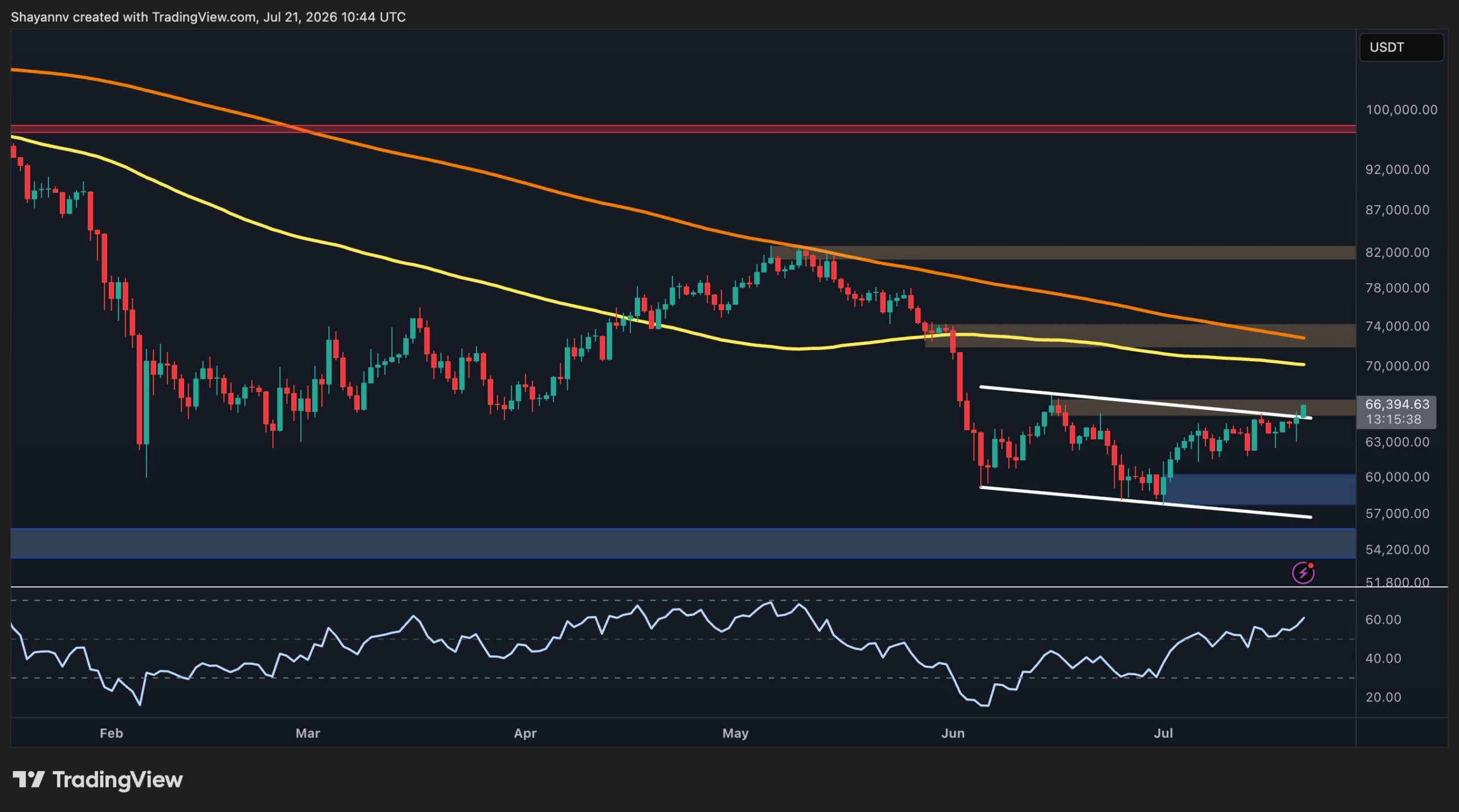
On the daily timeframe, BTC continues to trade below its long-term moving averages, with the 100-day MA positioned around the $70K region and the 200-day MA closer to $73K. Both averages remain downward sloping, indicating that the broader market structure still favors sellers despite the recent recovery.
Following the sharp decline toward the $57K to $60K support area, Bitcoin established a sequence of higher lows inside a narrowing descending channel. The recent rally has carried the price toward the upper boundary of this formation, which coincides with the $66K to $67K resistance zone.
A decisive breakout above both the descending trendline and the $66K to $67K supply area would represent the first meaningful structural improvement since the correction began. Such a move could expose the next resistance level around $74K, where the 200-day moving average and another major supply zone converge.
However, rejection from current levels would reinforce the descending structure and could trigger another pullback toward the $60K support region. Below that, the major demand zone around $55K remains the most important higher timeframe support visible on the chart.
BTC/USDT 4-Hour Chart
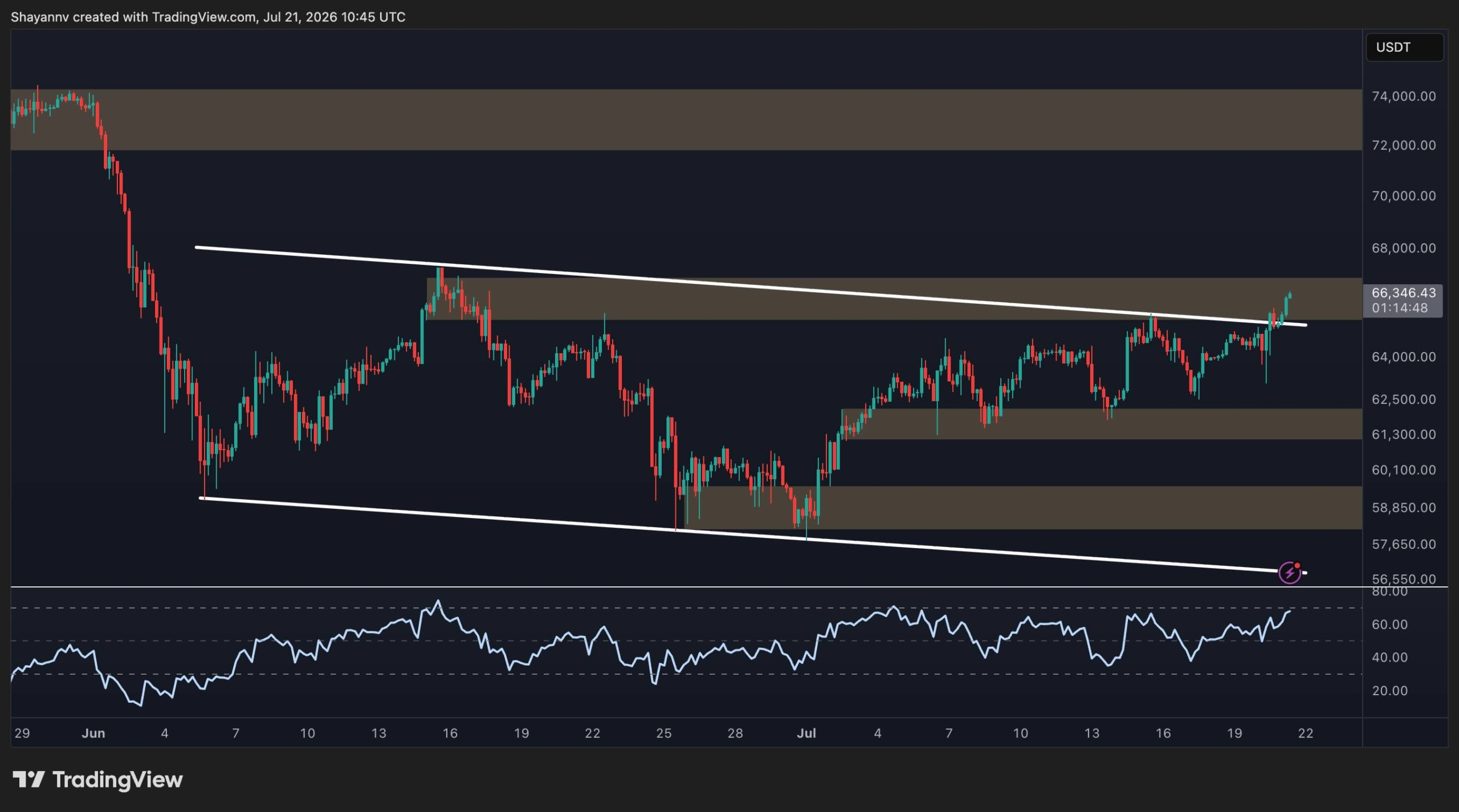
The 4-hour chart presents a more constructive picture. Bitcoin has been respecting a well-defined descending channel since early June, but recent price action shows buyers steadily reclaiming higher support levels after defending the channel’s lower boundary around $58K.
The market has already broken above several intermediate resistance zones at roughly $58K and $61K before advancing toward the current resistance cluster around $66K. This area also aligns with the channel’s upper trendline, making it the key short-term battleground.
Unlike previous tests, the latest advance has been accompanied by stronger momentum, with RSI pushing toward the overbought territory near 70. This reflects increasing buying pressure but also raises the possibility of a short-term pause or local pullback if profit-taking emerges at resistance.
If the breakout above the channel holds, it could invalidate the current bearish corrective structure and pave the way for an advance toward the next higher timeframe resistance around $72K to $74K.
Conversely, failure to overcome this ceiling would likely keep Bitcoin oscillating inside the channel, with initial support located near $61K followed by the stronger demand region around $58K.
On-Chain Analysis
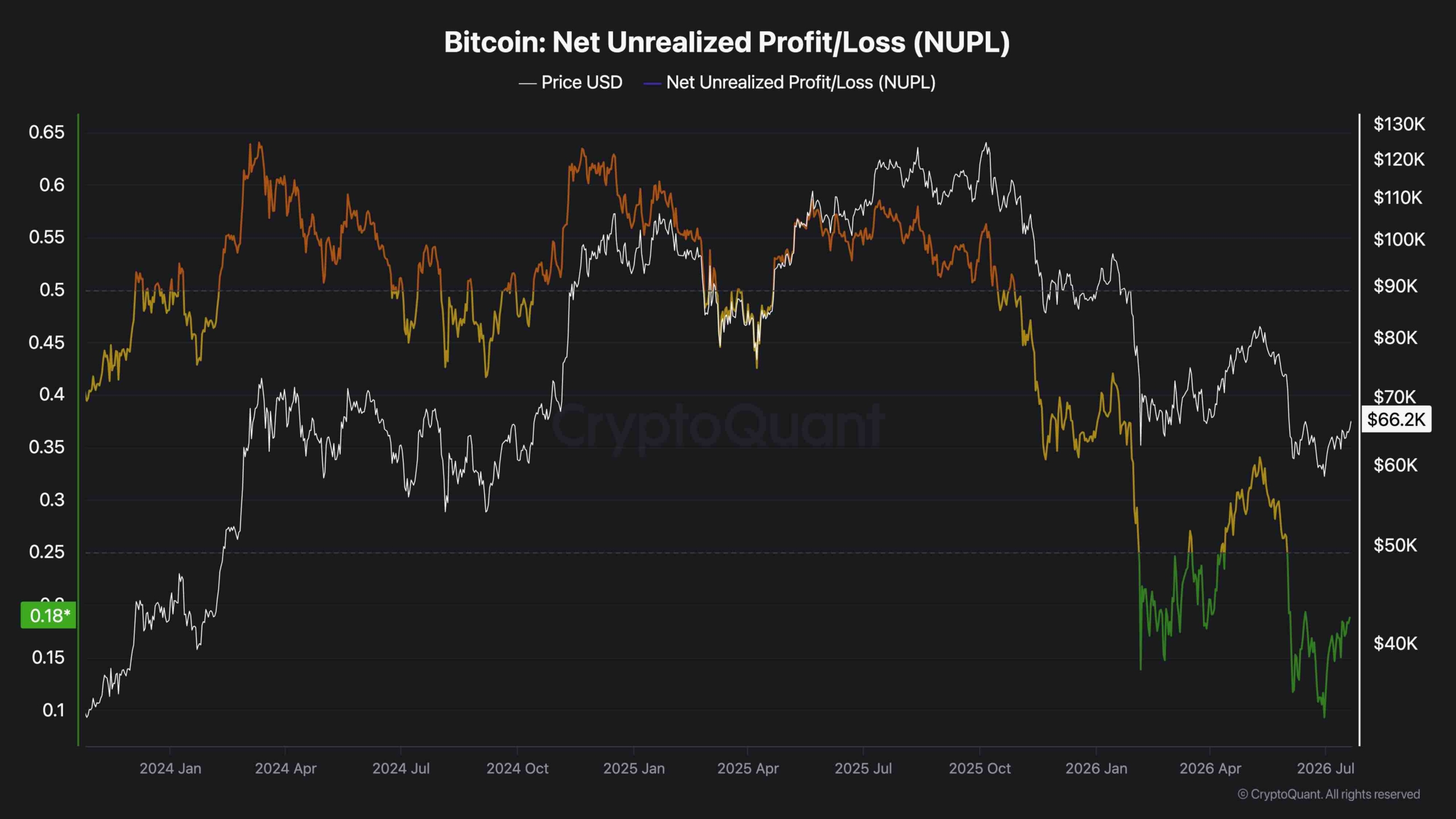
The Bitcoin Net Unrealized Profit/Loss (NUPL) metric currently sits around 0.18, well below the euphoric levels observed during previous market peaks.
NUPL measures the aggregate unrealized profits and losses across the network. Elevated readings generally indicate widespread investor optimism and increasing profit-taking risk, while lower values suggest that market participants are holding significantly smaller unrealized gains.
The recent recovery in NUPL from deeply depressed levels indicates that profitability across the network is gradually improving alongside price. However, the indicator remains firmly within the lower sentiment bands and is still far from the overheated conditions that historically accompanied cycle tops.
This suggests that, from an on-chain perspective, the market has not yet entered an excessive profit-taking phase. If Bitcoin manages to break above its current technical resistance, continued improvement in NUPL would likely support a healthier and more sustainable recovery. On the other hand, a rejection at current levels could temporarily stall the metric’s recovery without necessarily invalidating the broader rebuilding process.
The post Bitcoin Price Analysis: Is $70K Next After BTC Broke Above $66K? appeared first on CryptoPotato.
The White House agreed to provisions in a crypto market structure bill that could ensure support from some Democratic lawmakers in the US Senate.
According to a Tuesday Punchbowl report, White House officials met with Republican Senators Cynthia Lummis and Bernie Moreno to reach an agreement on ethics language in the Digital Asset Market Clarity (CLARITY) Act under consideration in the Senate.
Neither Lummis nor Moreno have publicly announced the details of the deal, which could facilitate Democratic support in what is expected to be a tight Senate vote, but the report suggested that it could affect US President Donald Trump’s crypto investments.
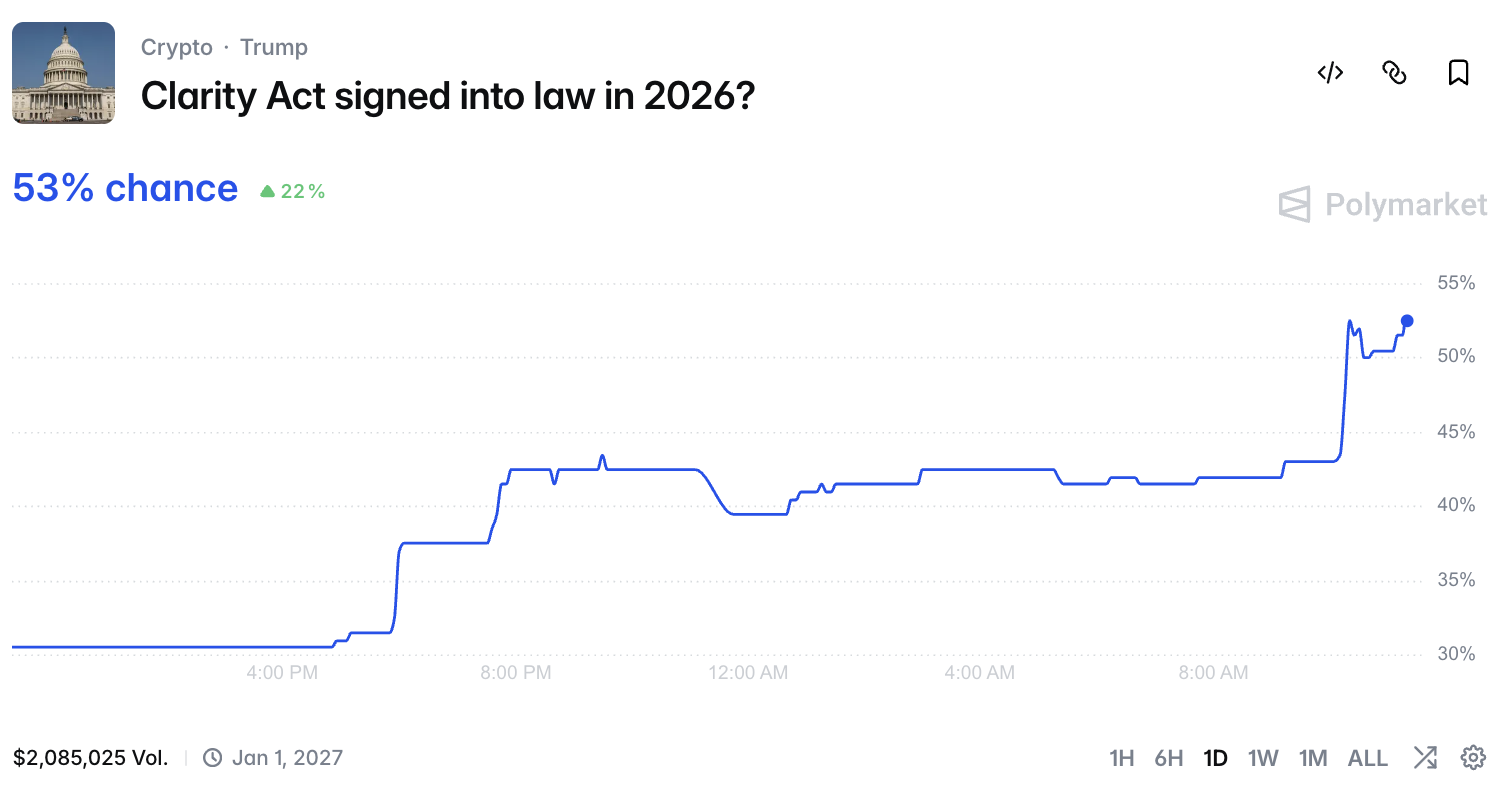
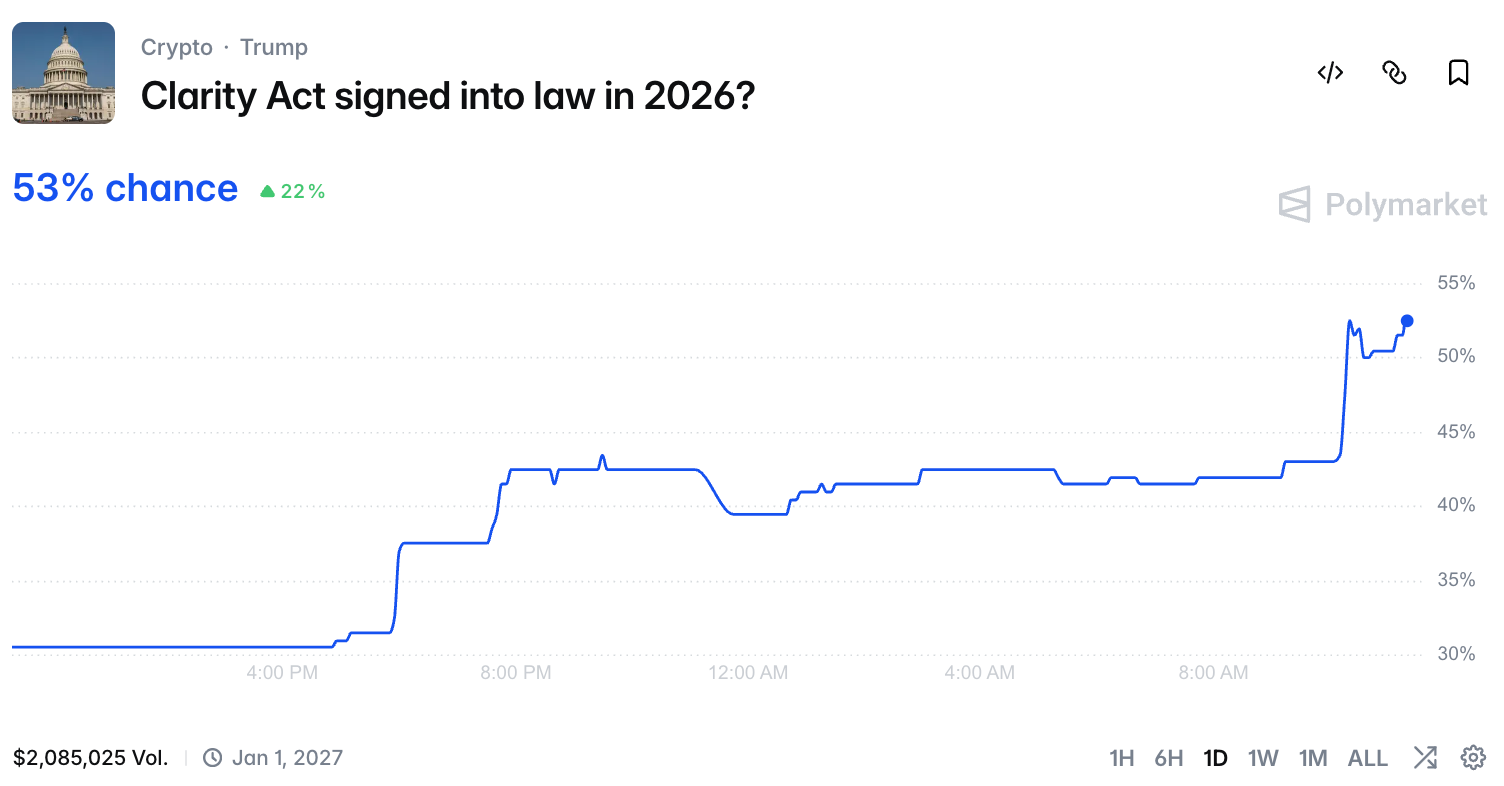
Event contract on chances of CLARITY Act being signed into law in 2026.
Source: Polymarket
The CLARITY Act, passed by the House of Representatives in July 2025 as part of Republicans’ “Crypto Week” agenda, has faced several delays in Congress due to government shutdowns, concerns from lawmakers over ethics, tokenization and stablecoin rewards and provisions for protecting developers from enforcement actions. Many lawmakers and industry advocates expect the Senate to consider the bill before the chamber breaks for August state work periods, but as of Tuesday, no vote appeared on the congressional calendar and the text of the bill had not been made public.
No certainty for 60-vote threshold
Last week, Trump urged the Senate to pass CLARITY “in honor of” the late Senator Lindsey Graham, whom the president said was “a big supporter” of the bill. Many crypto industry executives and lawmakers have publicly come out in support of the bill, but it’s unclear whether the legislation will pass the 60-vote threshold in the Senate, due to many Democrats’ concerns about potential conflicts of interest with the Trump administration.
Related: Ethics remain sticking point as crypto market structure bill goes to markup
Several Senate Democrats, including Elizabeth Warren, Chris Murphy, Jeff Merkley and Chris Van Hollen said that any CLARITY bill would be “worthless” without ethics provisions to address Trump’s ties to the crypto industry, including his memecoin and his family’s World Liberty Financial business. Cointelegraph requested details on the agreement from Lummis’ office but did not receive an immediate response.
A White House official told Cointelegraph that the administration was “committed to working with Congress to see the CLARITY Act advance and has agreed to the most comprehensive and wide-ranging ethics provision in history,“ adding that it had “bent over backward to accommodate [Democrats’] concerns.“
According to Coinbase vice chair Ryan VanGrack, Democrats have already been able to negotiate to include provisions on customer protection in the Senate bill. However, many lawmakers are calling for hearings to explore Trump’s investments and links to the industry before any potential vote.
Bitcoin price climbs amid CLARITY talks
The price of Bitcoin (BTC) rose above $66,000 early on Tuesday, reaching a seven-week high amid reports of an ethics deal and Trump’s plans to introduce additional 10% international trade tariffs.
“The reason that prices are running upwards are entirely dedicated towards the potential approval of the Clarity Act,“ said Michaël van de Poppe, founder and chief investment officer of MN Fund and MN Capital, in a Tuesday X post. “Things are brighter and brighter, and as the charts technically look incredible from here, it looks likely that we’ll see the Clarity Act being approved shortly.“
Magazine: Will the crypto lobby’s $189M campaign get CLARITY over the line?


AI shopping agent developer ORO has revealed that it lost $630,000 worth of crypto when a suspected North Korean state hacker, posing as a conference contact, tricked a staff member into installing a malicious Microsoft Teams extension.
According to a post-mortem released by ORO, one of its team members met a contact at an industry conference in February 2025 and formed a “legitimate relationship” that involved communicating on Telegram.
Almost a year later in May 2026, the Telegram account belonging to this genuine contact reached out to schedule a catch-up call.
However, when the ORO staff member joined the call via a link that mimicked Microsoft Teams, there was no working audio, and so the pair rescheduled for another day.
Almost immediately, the team member’s computer prompted them to update Microsoft Teams, and, thinking nothing of it, they okayed the procedure.
Read more: MetaMask hired suspected North Korean dev flagged months earlier
However, the seemingly innocent update allowed a malicious extension to be installed onto their computer. This extension tracked their keyboard inputs, clipboard history, took screenshots of the computer’s page and browser history, and could swap out crypto addresses.
The attacker spent almost a month quietly collecting data before, on July 13, they drained ORO’s crypto wallets of 147,000 Alpha tokens.
ORO believes attack came from North Korea
ORO maintains that the contact at the conference was “legitimate,” and that their Telegram account had become compromised.
As for who the attacker is, ORO claims with “high confidence,” based on its macOS intrusion, that it’s a North Korean hacker from the state-backed group Sapphire Sleet.
It said, “The IP address that our compromised machine was beaconing to, the matching payload and some overlapping infrastructure outlined in the above post from Microsoft makes us confident that the attack came from this group.”
Indeed, Microsoft’s Threat Intelligence department highlights how Sapphire Sleet uses Teams-themed cover, social engineering, and focuses on macOS.
“By impersonating a legitimate software update, threat actors tricked users into manually running malicious files, allowing them to steal passwords, cryptocurrency assets, and personal data while avoiding built‑in macOS security checks,” it said.
ORO claims it’s partly responsible for $600K hack
Despite the hacker’s actions, ORO also partly admitted responsibility for causing the hack.
It claims that a lack of widespread support for hardware wallets in decentralised protocol Bittensor meant that the firm, going against its preference for hardware wallets, “temporarily” established the owner key as a software wallet.
It said, “This is what allowed it to be exfiltrated from a compromised machine. That was inexcusable, and it was our mistake. We are sorry for the impact this has had on our community and our supporters.”
ORO claims it’s actively pursuing the recovery of the stolen assets with the help of cryptocurrency exchanges and law enforcement, as well as Bittsensor agent firm Opentensor, Bittsensor wallet firm Curciible Labs, and Bittsensor AI infrastructure firm Connito AI.
The company also stressed that its subnet is “fully operational,” no other wallets, user, or subnet data was affected, and that validator signing keys on hardware wallets “were never exposed.”
Read more: Solana DEX Stabble urges liquidity exit after alleged DPRK mole revealed
A number of North Korea-related crypto attacks have been uncovered in recent months.
In April, a North Korean mole known as “Moo” was exposed by crypto sleuth ZachXBT and subsequently fired from Solana-based DEX Stabble.
This month, the crypto wallet firm MetaMask was revealed to have employed a North Korean mole as a developer for at least a month.
According to a DeFi security analyst, the developer’s links to Lazarus Group, another North Korea-based hacking group, were publicly available for almost a year.
Got a tip? Send us an email securely via Protos Leaks. For more informed news and investigations, follow us on X, Bluesky, and Google News, or subscribe to our YouTube channel.
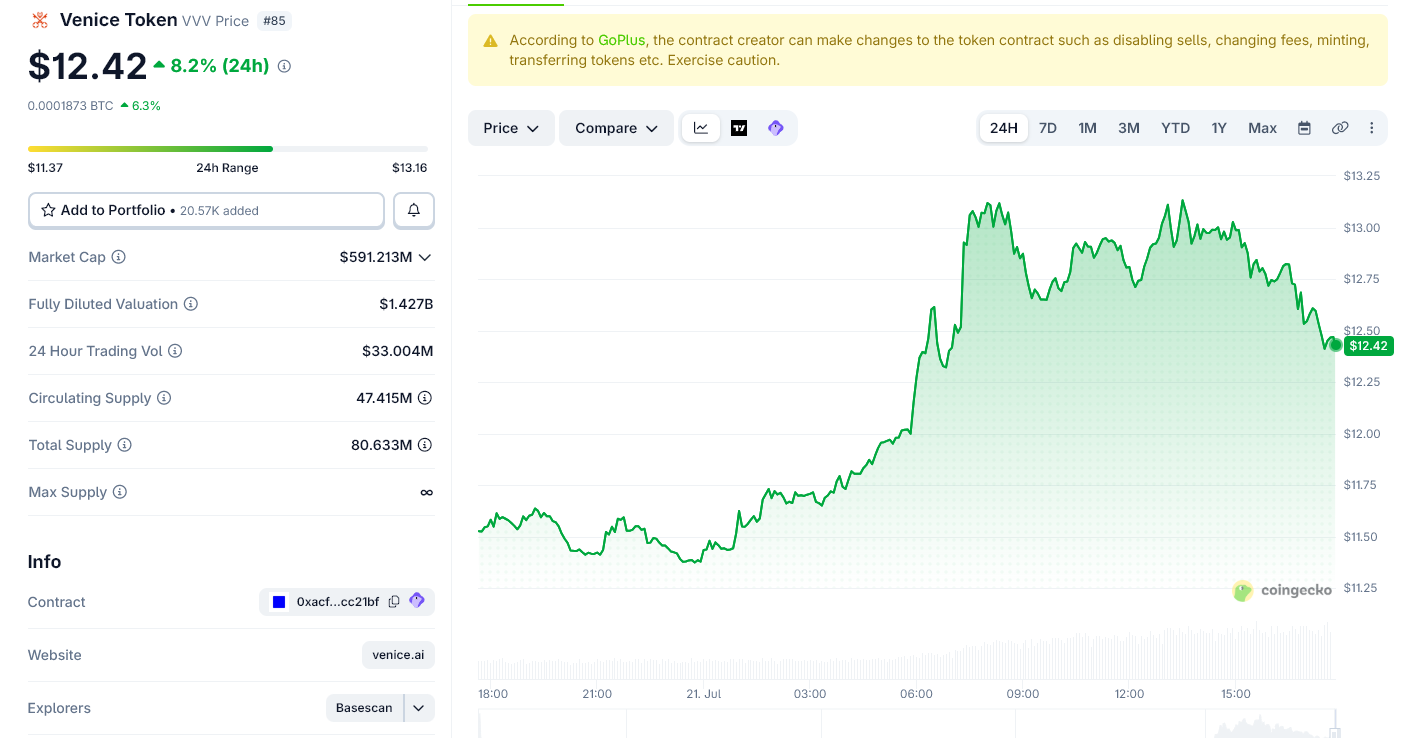
Venice Token (VVV) price rallied 11% on Tuesday to $12.84, breaking above the descending resistance line that had capped every recovery attempt since the June 3 peak at $21.47.
The move ends a six-week correction that bottomed just below $10. Momentum, volume, and Fibonacci structure now make $14 the next battleground.

Daily RSI Broke Its Downtrend Before the Price Did
Momentum turned before price action did. The daily Relative Strength Index (RSI) broke above its descending trendline several sessions ahead of the price chart. Analysts often read such leads as early confirmation of a trend change.
The indicator bottomed near 32 in early July, when the Venice Token price tested the $10 area. It has since reclaimed the 50 midline and its moving average, and it currently sits near 55.

A reading of 55 leaves room before the overbought zone above 70. However, the signal would weaken if RSI slips back below 50 during a pullback.
A previous analysis flagged bearish divergences in VVV just before the June top, and momentum has since completed a full reset.
Hourly Volume Delivers Critical Confirmation
Daily volume tells a more cautious story. It has declined steadily since May, which means the breakout still lacks confirmation on higher timeframes.
The hourly chart fills that gap. VVV traded inside a parallel channel between roughly $11.35 and $12.05 from July 18 until Tuesday morning. The break above the channel’s upper band occurred during the strongest hourly-volume spike of the entire recovery.

Hourly RSI reached 83 during the impulse and has since cooled to 70. Therefore, a retest of the $12.00 to $12.05 area would be a natural next step.
Holding that zone would confirm it as new support and echo the bullish setups that preceded the May rally.
Venice Token Price Prediction Makes $14 the Gate to $16.80
The correction from $21.47 stopped almost exactly where the Fibonacci theory said it should. The low formed just below $10, slightly above the 0.618 retracement at $9.33, and near a prior resistance area.
The current target sits at the 0.382 retracement near $13.97. That level overlaps a horizontal supply zone around $14, where VVV stalled repeatedly in May and June. A move there would add roughly 9% from current prices.
A clean break above $14 would expose the 0.236 level at $16.83, about 31% higher.
Beyond that, the record high of $22.58 from January 2025 remains the final barrier. In contrast, a rejection at $14, combined with a $12 loss, would invalidate the bullish structure and reopen the $10 support.

Fundamentals could accelerate the move. Venice AI announced on July 17 that $5 of every $100 in API credit purchases now automatically buys and burns VVV. The token also led a broader altcoin rally in May, and rising burns tighten supply while most circulating VVV remains staked.
The setup now reduces to a single question. Either buyers convert $14 into a launchpad, or the breakout stalls at the same wall that stopped them twice before.
The post Venice Token Breaks Out with 10% Rally. How Far Will This Altcoin Jump? appeared first on BeInCrypto.
Ondo Finance said it has deployed its tokenized stocks as collateral on OndoPerps, a perpetual futures venue, starting with SPYon and QQQon, in a post published Monday on X. The OndoPerps account said tokenized stock collateral is "live" and "now available for all users," letting Ondo Stocks back… Read the full story at The Defiant


Galaxy Digital (GLXY) said it set up a $5 million fund for Bitcoin developers working to protect the network from the potential future threat posed by quantum computing.
The crypto financial services company said it will begin accepting applications for the Galaxy Bitcoin Quantum Readiness Initiative immediately, with grants focusing on developing quantum-resistant signature schemes, wallet migration tools and security audits. The company said it hopes other firms will contribute funding and research to accelerate the transition to quantum-resistant cryptography.
Bitcoin secures wallets and transactions with cryptographic techniques that current computers cannot break in a meaningful timeframe. While quantum computing is still too immature to attack the blockchain, advances in the technology have accelerated efforts across government and industry to adopt quantum-resistant standards before the threat becomes a reality.
In the event that quantum computers do become capable of breaking Bitcoin’s cryptography, roughly 6.9 million bitcoin could become vulnerable to theft, according to CryptoQuant research. At today’s price of about $66,800, that comes to about $461 billion.
Telegram founder Pavel Durov said the messaging app will embed a native, non-custodial Gram wallet in every version of Telegram this summer, putting a self-custody crypto wallet in front of the platform's more than one billion users. In a post on July 21, Durov said he is "implementing a native… Read the full story at The Defiant
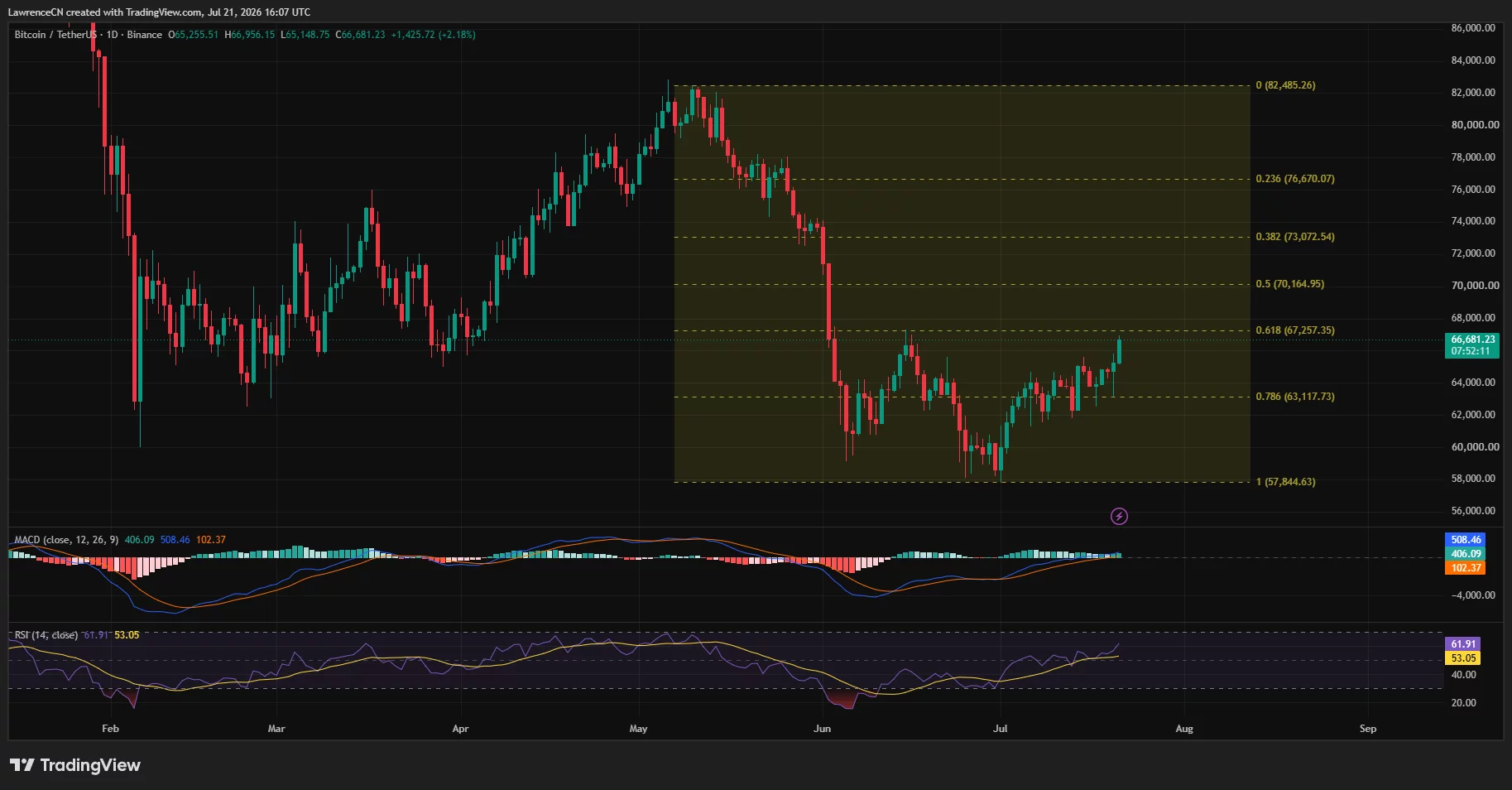
Bitcoin has risen 2.2% to $66,681, and XRP has gained 3.6% to $1.152 as both assets test chart resistance while Iran claims it struck Amazon’s data infrastructure in Bahrain.
Summary
- Bitcoin approached $67,257 Fibonacci resistance as bullish momentum strengthened on its daily chart.
- XRP broke above a symmetrical triangle, opening a possible move toward $1.30.
- Iran’s unverified Amazon strike claim added geopolitical risk to both crypto rallies.
IRNA, Iran’s state news agency, has reported that the Islamic Revolutionary Guard Corps used several cruise missiles to attack what it described as Amazon’s central data infrastructure in Bahrain on July 21. The IRGC claimed the facility was destroyed, although Amazon and Bahraini authorities had not confirmed the reported damage at the time of writing.
According to the IRGC, the operation came in response to a US attack on the construction site of Iran’s Darkhovin nuclear power plant. The Iranian force has also threatened 18 American technology companies, including Microsoft, Intel, Cisco and Google, over their alleged links to US military and intelligence activity.
Amazon Web Services facilities in Bahrain and the United Arab Emirates have already faced attacks during the conflict. In April, an Amazon cloud facility in Bahrain had sustained damage in an Iranian attack, while service interruptions affected AWS infrastructure elsewhere in the region.
Investors reacted cautiously because the latest IRGC account lacked independent confirmation. Amazon shares had closed Monday 1.12% higher at $249.99, but US stock futures later surrendered part of their earlier gains as reports of the alleged attack circulated.
Military action continued while Pakistan pursued another diplomatic effort. The US Central Command had completed a new series of attacks on Iran, extending the American campaign to a tenth consecutive night.
CENTCOM listed Iranian command centers, maritime assets, missile and drone launch sites, and air-defense systems among the targets. The US military stated that the strikes were intended to reduce Iran’s ability to attack commercial vessels passing through the Strait of Hormuz.
At the same time, the Associated Press reported that Pakistan was trying to restart ceasefire negotiations. Those efforts continued as Iran attacked targets in Bahrain, Kuwait and Jordan and fighting disrupted commercial traffic through the Strait of Hormuz.
Bitcoin recovery runs into Fibonacci resistance
Bitcoin (BTC) rose from a daily low of $65,149 to an intraday high of $66,956 on Binance, according to the supplied TradingView chart. The move placed BTC directly below the 61.8% Fibonacci retracement at $67,257, calculated from the decline between $82,485 and $57,845.
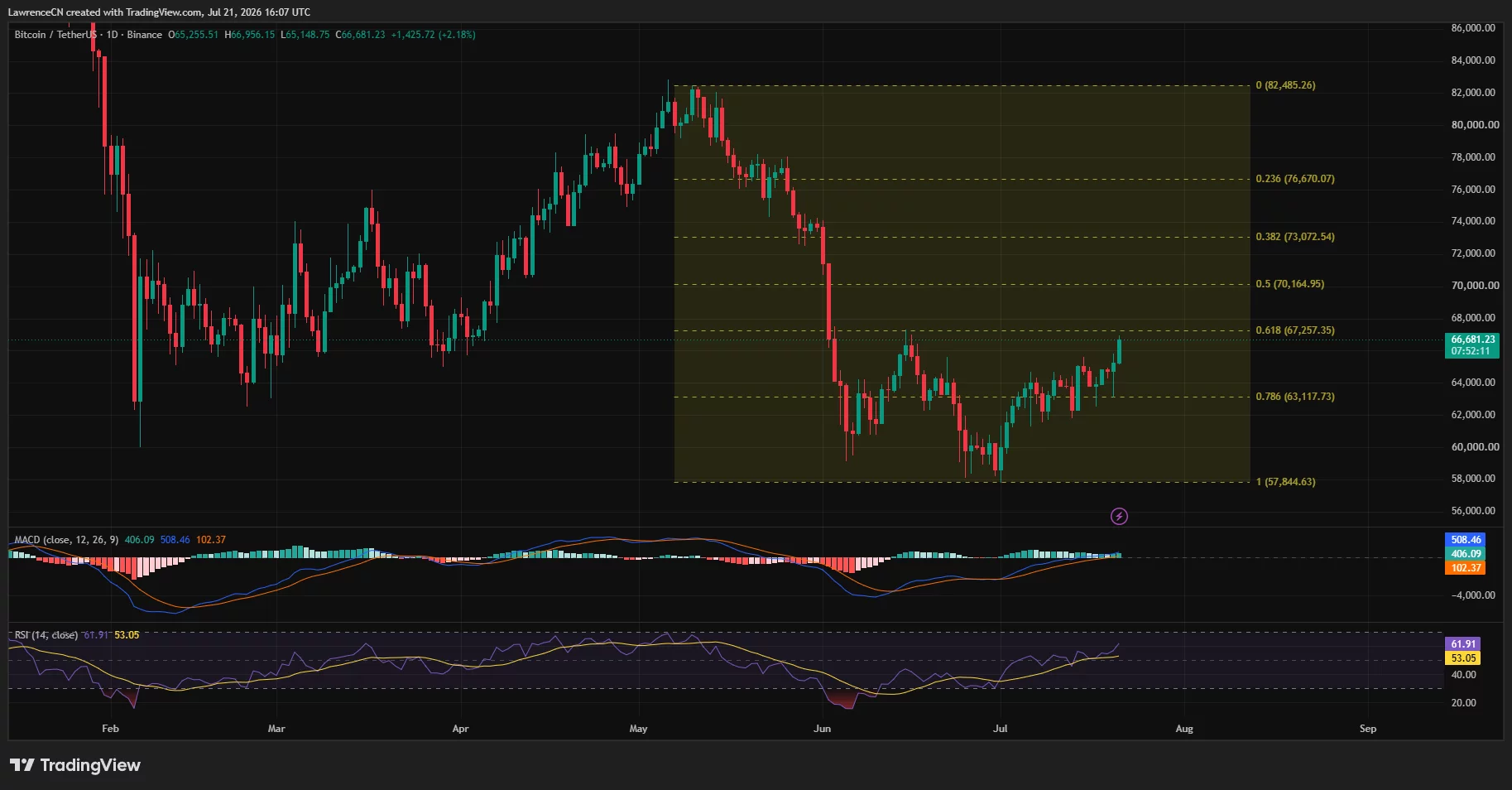
TradingView’s daily setup identifies $67,257 as the immediate technical barrier. A daily close above it would expose the 50% retracement at $70,165, while another advance could bring the 38.2% level at $73,073 into view.
Failure to clear the 61.8% line would leave Bitcoin inside the recovery range formed since its late-June low. The same chart places the closest marked downside level at $63,118, which corresponds with the 78.6% Fibonacci retracement and overlaps with recent consolidation.
Momentum has improved alongside the rebound. Bitcoin’s relative strength index stands at 61.91, above its moving average of 53.05 but still below the overbought threshold of 70, according to TradingView.
The daily MACD also remains positive, with the MACD line at 508.46, the signal line at 406.09 and the histogram at 102.37. TradingView’s readings show bullish momentum, although the small gap between the two lines means BTC still requires follow-through above $67,257 to strengthen the signal.
Bitcoin’s latest candle opened at $65,255 and remained positive when the chart was captured. However, the unfinished daily candle means the attempted break cannot be confirmed until the session closes.
XRP breakout points toward $1.30
XRP (XRP) price has moved above the descending boundary of a symmetrical triangle on its Binance daily chart. TradingView data shows the token advancing from a session low of $1.111 to an intraday high of $1.158 after several weeks of contracting price action.
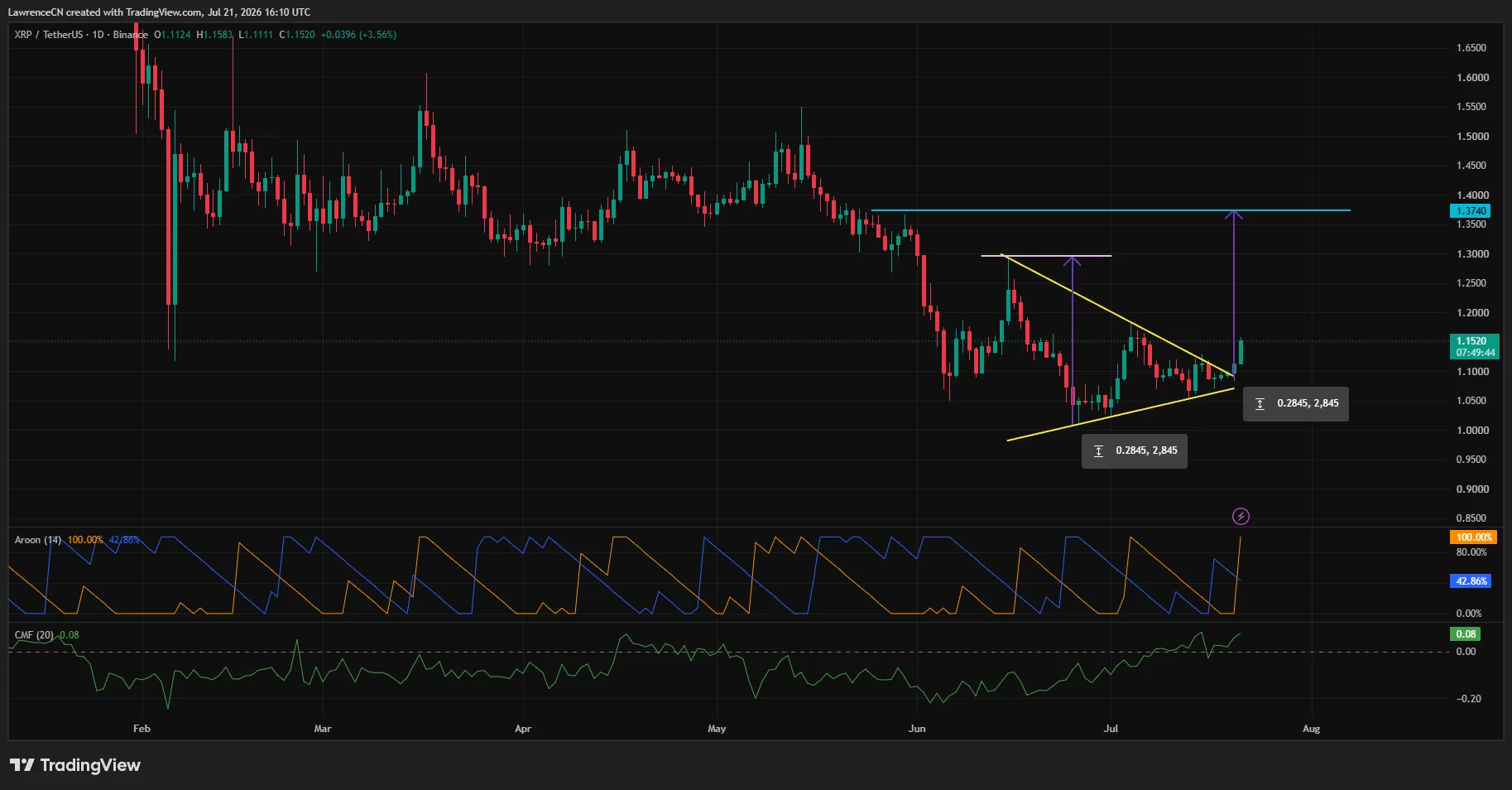
The pattern developed between falling resistance from the mid-June swing high and ascending support extending from the late-June low. XRP’s move above the upper trendline indicates a breakout attempt, although confirmation still depends on a daily close outside the formation.
Based on the measured height displayed on the supplied chart, the triangle carries a projected move of about $0.2845. Applying that distance to the breakout area places the first marked target near $1.30.
A second resistance line appears at $1.374, which acted as a trading area before XRP’s sharp decline in early June. The chart therefore shows $1.30 as the first target and $1.374 as the next barrier if buyers maintain control.
TradingView’s Aroon indicator supports the bullish attempt, with Aroon Up at 100% and Aroon Down at 42.86%. Chaikin Money Flow has also climbed to 0.08, indicating that buying pressure has returned during the breakout.
A move back below the triangle’s upper boundary near $1.10 would weaken the pattern and place its rising support at risk. Sustained trading above the breakout line would preserve the chart’s path toward $1.30, though the unverified Amazon strike claim and continued US-Iran attacks could increase volatility across both XRP and Bitcoin.
Disclosure: This article does not represent investment advice. The content and materials featured on this page are for educational purposes only.
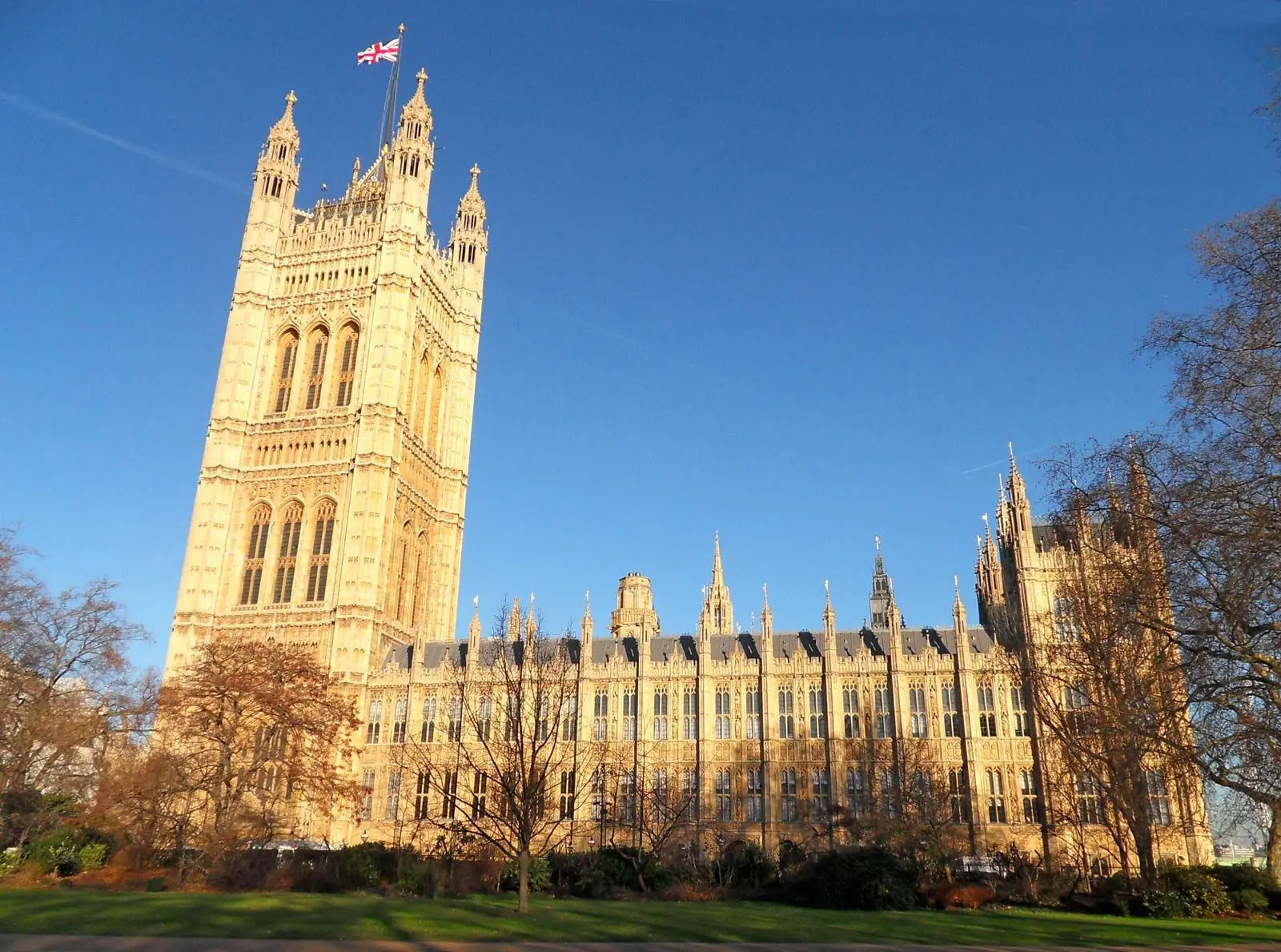
The UK Parliament’s Crypto and Digital Assets All-Party Parliamentary Group has launched a formal inquiry into why banks refuse to open accounts and block payments for crypto businesses. Written evidence will be accepted until August 31, while the group aims to publish recommendations before the FCA’s mandatory crypto regime begins in October 2027. The move tests whether the UK’s ambition to become a global digital asset hub can survive banking restrictions.
The inquiry was announced on Tuesday by co-chairs Lord Vaizey of Didcot and Labor MP Gurinder Singh Josan CBE. It covers difficulties opening and maintaining business accounts, transfer limits, payment blocks, and whether banks apply restrictions proportionately. It will also compare the UK’s approach with the US, Hong Kong, Australia, and the European Union.
The APPG outlined its concern clearly. It said crypto and digital asset firms have consistently reported difficulty accessing UK banking services. The group added that banking access is essential for legitimate businesses, while unnecessary barriers risk slowing investment, innovation, and long-term growth.
The scale of the issue remains significant. Research from the UK Cryptoasset Business Council, published in January 2026, found roughly 40% of payments to crypto exchanges were blocked or delayed by UK banks. One platform reported almost £1 billion in rejected transactions during 2025. Meanwhile, 80% of exchanges saw customer friction increase, while 70% described banking conditions as more hostile than a year earlier.
— Crypto Banter (@crypto_banter) July 21, 2026
 UK LAWMAKERS LAUNCH INQUIRY INTO CRYPTO BANKING ACCESS!
UK parliamentarians have launched an inquiry into the challenges crypto firms face in obtaining traditional banking services.
The probe aims to address barriers that have hindered the sector’s growth and integration with… pic.twitter.com/aSqFNBRRPx
Those findings contrast with the government’s stated position. HM Treasury Economic Secretary Lucy Rigby told Parliament in March 2026 that licensed crypto firms should not face restrictions simply because they operate in the sector. As a result, the inquiry will examine why FCA-registered businesses continue facing banking hurdles despite regulatory progress.
Discover: The Best Crypto to Diversify Your Portfolio
UK Crypto and FCA Framework Sharpen the Debanking Question
The inquiry also follows the UK’s finalized FCA crypto framework. The authorization window opens in September 2026, while full compliance becomes mandatory on October 25, 2027. If licensed firms still struggle to secure banking services, confidence in the new regulatory framework could suffer.
Meanwhile, comparisons with overseas markets continue to grow. In the United States, crypto companies have compared banking restrictions to Operation Chokepoint 2.0. Kraken recently secured a $22 million settlement from an auditor it claimed abandoned the exchange during that period. In Australia, Coinbase has also criticized banks over restrictions on crypto-related services. The APPG will assess how competing jurisdictions have handled similar challenges.
The inquiry arrives during a political transition. Andy Burnham became Prime Minister on Monday, while John Healey was appointed Chancellor of the Exchequer. Legal experts say global financial firms will closely watch whether the new government delivers a stable regulatory environment for digital assets and financial services.
Written submissions will be accepted from July 21 through August 31 across banking, payments, fintech, and crypto sectors. The APPG will then publish recommendations before the October 2027 deadline. Industry participants are expected to advocate for case-by-case risk assessments instead of blanket restrictions on FCA-registered crypto firms.
Trade on Bybit and Get a Chance to Win Our $1,000 USDT Airdrop
The post APPG Targets UK Bank Debanking of Crypto Firms Before 2027 FCA Deadline appeared first on Cryptonews.

Bitcoin extended its early gains into the Wall Street open, tracking a broader buoyancy in US risk assets despite fresh geopolitical and tariff-related headlines. TradingView data showed BTC/USD pressing toward $67,000 and edging close to its seven-week highs.
What stands out for traders is that neither the latest escalation in the US–Iran situation nor renewed talk of international trade tariffs has meaningfully derailed momentum in crypto markets. Instead, price action suggests participants are leaning toward the view that any disruptions may be temporary—at least for now.
Key takeaways
- BTC moved toward $67,000 and threatened fresh multi-week highs as stocks held up into the US session.
- Escalating tensions involving Iran and the Strait of Hormuz coincided with strength in risk assets rather than a selloff.
- Reported US tariff plans could have been a headwind for speculative markets, but traders appeared to expect a resolution.
- Analysts warn Bitcoin needs to reclaim its 21-week simple moving average to credibly challenge the broader bear-market structure.
Geopolitical escalation and tariff talk fail to cool risk appetite
According to TradingView, BTC/USD approached $67,000 during the session, with momentum that began earlier appearing to persist. The cryptocurrency’s relative resilience came alongside firm trading in US equity futures.
At the same time, the day’s headlines pointed to conditions that often support “risk-off” behavior. The US–Iran conflict saw further escalation after Iran struck targets at Amazon facilities in Bahrain in response to US strikes, and reporting indicated the Strait of Hormuz oil route remained closed.
In commodity markets, the geopolitical pressure showed up in crude prices: WTI oil rose to its highest level in over a month, nearing $85 per barrel, as TradingView’s WTI CFDs chart reflected.
On the policy front, multiple outlets reported that President Donald Trump is planning to introduce new 10% international trade tariffs. The proposal is described as following 50% measures imposed on Canada earlier in the week. Historically, tariff uncertainty can weigh on broader risk sentiment, yet crypto traders did not appear to react with sustained caution.
Instead, commentary from market participants suggested expectations that the situation would ultimately resolve in favor of markets. YouTube host Crypto Rover, for example, summarized the prevailing stance in an X post, writing that “Markets are pricing in peace.”
Stocks in focus as macro risks get tested
While crypto held up, some investors remained confident about near-term equity direction. Caleb Franzen, who runs macro analysis resource Cubic Analytics, posted on X that he had “zero fear” or worry regarding S&P 500 futures, describing the setup as supportive.
Still, the optimism was not universal. Cautionary notes surfaced from senior banking leadership, including JPMorgan CEO Jamie Dimon, who warned that markets were not pricing risks aggressively enough relative to what could come next. The juxtaposition highlights the tension investors face: risk assets can keep rising even when underlying risks are real, as long as participants believe outcomes will be less severe than feared.
Technical pressure point: the 21-week trendline
For Bitcoin-specific direction, attention shifted from short-term resistance levels to a longer moving-average benchmark. Material Indicators cofounder Keith Alan offered a more guarded view of the near-term outlook, arguing that the bear market may still be intact until BTC confirms a stronger trend.
Alan pointed to a “golden cross” involving the 21-day and 50-day simple moving averages on Monday, but emphasized that such signals on lower timeframes don’t necessarily negate a broader downturn. In his X analysis, he warned that bear markets do not always look like bear markets—especially when price action is volatile but not trend-confirmed.
The key condition, according to Alan, is whether Bitcoin can reclaim its 21-week simple moving average. He wrote that the macro trend would be challenged only if BTC pushes above that level, noting that until then, “the Bear Market remains intact.”
At the time of writing, the 21-week SMA was cited at $69,720, a figure that also aligns with Bitcoin’s 2021 all-time high. The larger implication is that reclaiming this long-term trendline would signal more than just a bounce—it would suggest a shift in how the market is pricing longer-duration risk.
Alan also acknowledged that there was “no real resistance” until $67,250, which helps explain why traders were willing to press higher even amid macro uncertainty. However, the absence of immediate resistance near $67,000 does not guarantee follow-through if the move fails at the longer-term moving-average level.
What to watch next for BTC
With BTC approaching the high-$60,000 zone, traders are now likely to monitor whether price can build momentum toward the $69,720 21-week SMA area. If Bitcoin cannot reclaim that threshold, analysts like Keith Alan suggest the market may still be operating under a bear-market structure—even if rallies continue to occur in the shorter term.

NIOD’s FECC Serum Tackles Fine Lines Around the Eyes

Coffee Break: Cashmere Scarf – Corporette.com

How a former Blue Peter presenter stunned America’s Got Talent judges


-
 NewsBeat5 days ago
London Mayor Sadiq Khan handed a peerage by Keir Starmer alongside 15 other Labour figures… just days before the PM leaves No10
-

 Fashion4 days ago
Weekend Open Thread – Corporette.com
-

 Politics3 days ago
The House | The City of London can help the new chancellor deliver growth in every postcode
-

 Politics6 days ago
Young campaigners urge incoming PM to act on outdoor junk food ads
-

 Crypto World6 days ago
CFTC blocks Kalshi from unwinding Michigan trades after court order
-
 Crypto World4 days ago
Two July Windows Left: The CLARITY Act’s Senate Fight and What Failure Means
-

 Crypto World3 days ago
Ripple Payments Joins MiCA With 14 Firms, Does It Mean Anything For XRP?
-

 Business6 days ago
Nvidia Stock Slips After Big Tuesday Rally as Huang Confirms Vera Rubin Chip Is Now in Production Today
-

 Politics2 days ago
Democrats look to World Cup watch parties to register thousands of voters
-
 Entertainment6 days ago
Disney’s Most Ambitious Failed Star Wars Attraction Is Coming to SDCC
-

 Crypto World4 days ago
Ripple wins EU-wide access as ESMA adds it to MiCA register
-

 Crypto World9 hours ago
Grayscale Files For Worldcoin ETF, WLD Registers Sharp Rise
-

 Crypto World5 days ago
Injective Submits SEC Transfer-Agent Registration to Onchain Ownership Records
-

 Business6 days ago
Palantir Shares Rise After Expanded Nvidia Partnership and Fresh Analyst Upgrades Ahead of Earnings Day
-

 Tech17 hours ago
Sail Virtually Aboard The “Itanic” With IA-64 Emulator
-
 Tech15 hours ago
Turtle Beach Command Series KB7 review: a nifty screen-equipped gaming keyboard
-

 Tech7 days ago
Dark Secrets Emerge When Jailbreaking LLMs
-

 NewsBeat4 days ago
Registration is now open for March for Men with Kev 2026
-

 News Videos7 days ago
XRP BOMBSHELL… XRP OMBOARDED FOR TRANSACTIONS!!!
-

 NewsBeat1 day ago
Unregistered fitter used Gas Safe logo on business flyers
You must be logged in to post a comment Login