

Crypto World
Will Bitcoin Crash to $50K?


Bitcoin traded near $66,400 on February 19, holding steady after days of volatility. However, growing fears of a potential US military strike on Iran are adding fresh uncertainty to global markets, including crypto.
According to confirmed reports from multiple American media, US military officials have told President Donald Trump that strike options against Iran are ready and could be executed as early as this weekend.
US-Iran on the Brink of War as Bitcoin Holds Fragile Support
The Pentagon has already deployed additional aircraft and moved a second carrier strike group toward the Middle East. At the same time, Iran has conducted military exercises and warned it would retaliate if attacked.
These developments follow stalled nuclear talks and rising tensions over Iran’s uranium enrichment and missile programs.
The White House said diplomacy remains the preferred path, but officials also acknowledged that military action is under active consideration. This escalation has increased risk across global markets.

Bitcoin’s recent price action reflects this uncertainty. The asset has fallen sharply from its cycle highs above $100,000 and now trades in the mid-$60,000 range.
Short-term investors are selling at a loss, according to the Short-Term Holder SOPR indicator, which currently sits below 1. This means many recent buyers are exiting their positions under pressure.
At the same time, Bitcoin’s short-term Sharpe ratio has dropped to extremely negative levels. This shows that recent returns have been poor relative to volatility. Historically, such conditions appear during periods of market stress and fear.
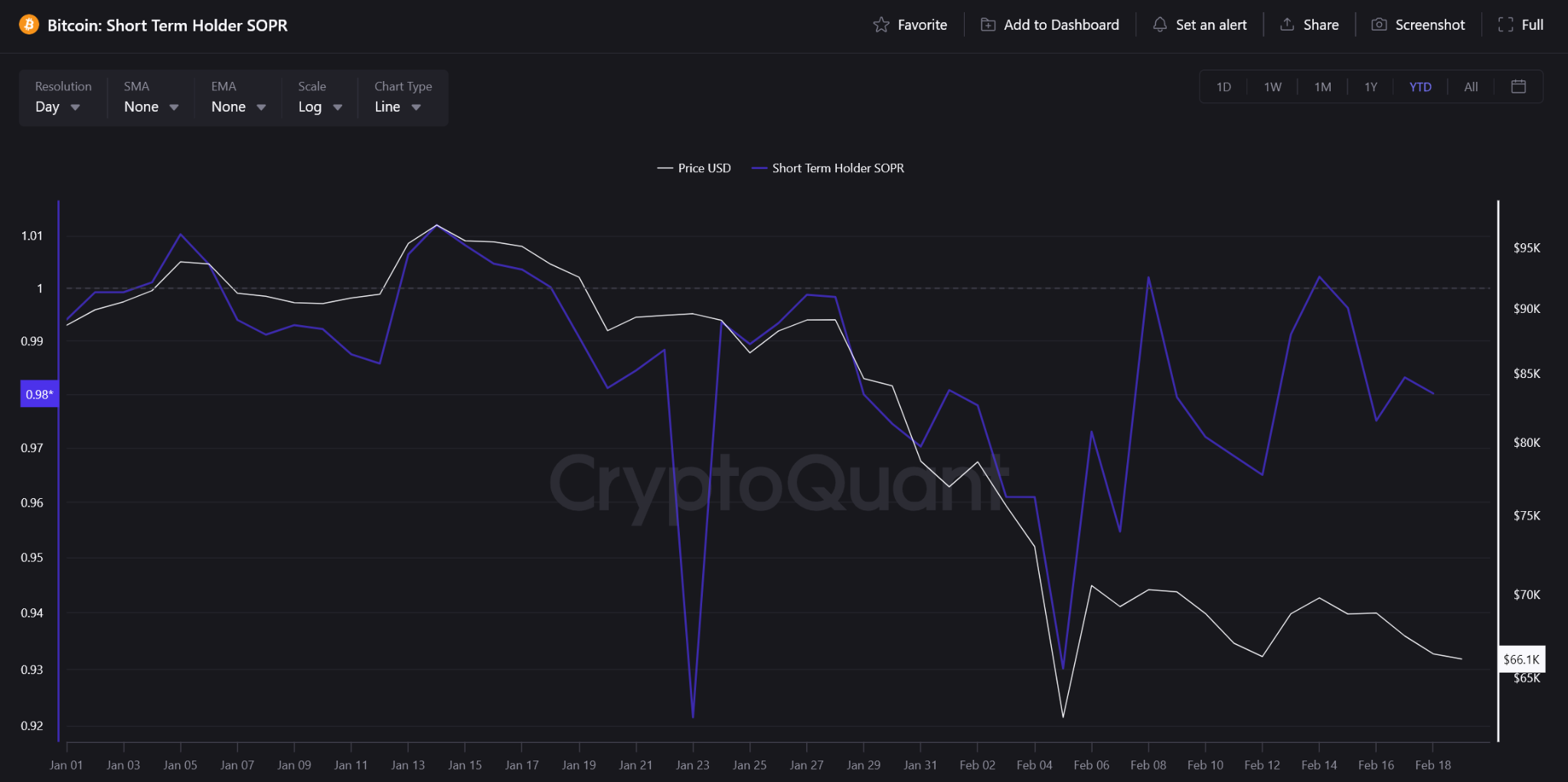
If the US launches a strike this weekend, Bitcoin will likely react in two phases.
Bitcoin’s On-Chain Signals Suggest Panic May Trigger Volatility
First, markets may see an immediate sell-off. During sudden geopolitical shocks, investors often move into cash and safer assets. Bitcoin has historically behaved like a risk asset in the early phase of global crises. The SOPR data confirms that short-term holders are already weak and sensitive to fear.
However, the second phase could look different.
The Sharpe ratio suggests Bitcoin is already deeply oversold in the short term. Many weak hands have exited. This reduces the amount of forced selling that can still occur.
As a result, any sharp drop could be short-lived if buyers step in at lower levels.
In addition, geopolitical uncertainty can eventually strengthen Bitcoin’s appeal. Investors often turn to assets outside traditional financial systems when global tensions rise. This shift does not happen instantly, but it tends to develop over time.
For now, Bitcoin sits at a critical point. Fear remains high, and geopolitical risks are rising. But on-chain data suggests much of the damage from the recent correction has already occurred.
The next move will depend heavily on whether tensions escalate into actual military conflict—or ease through diplomacy.

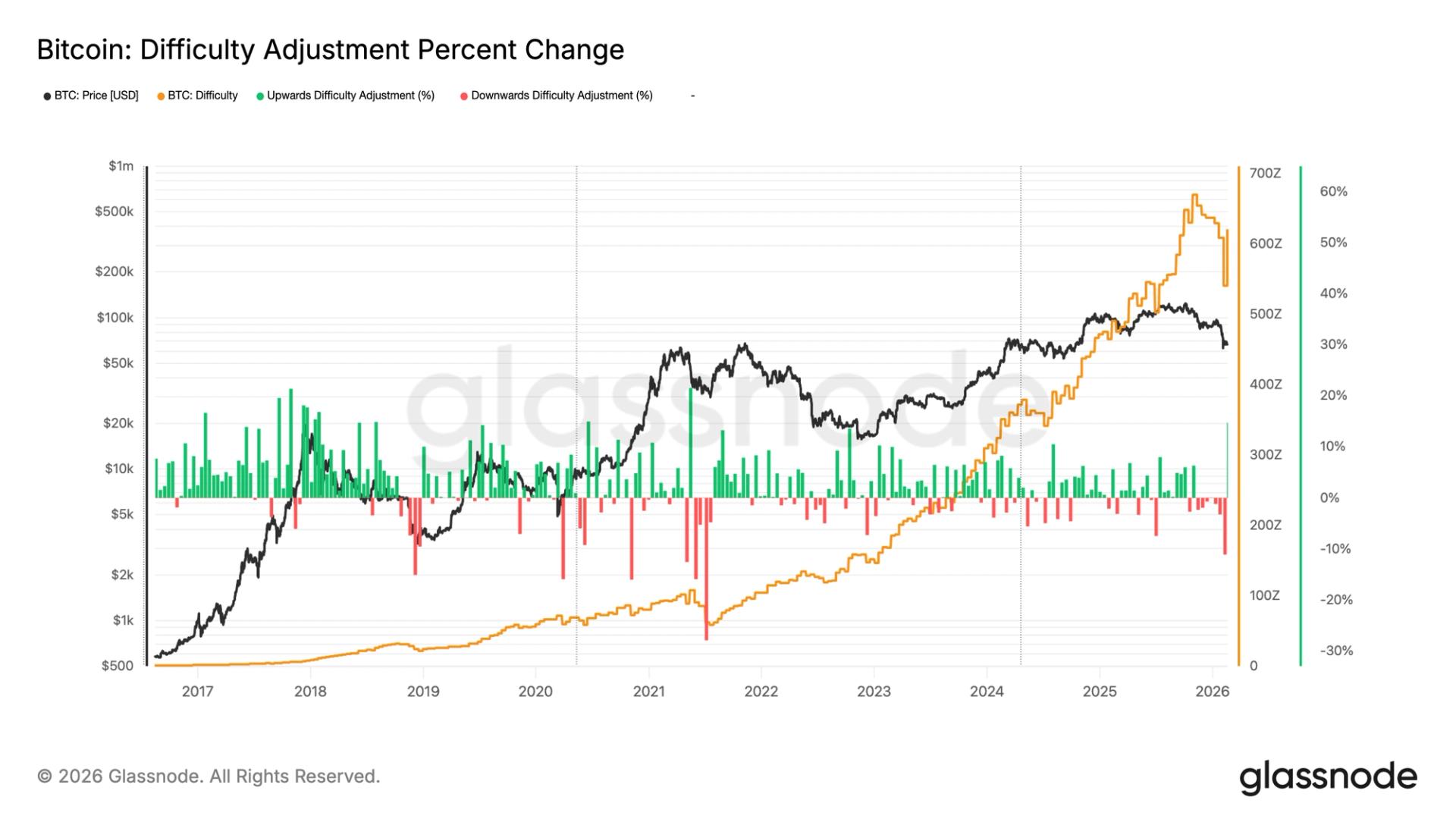
Bitcoin mining difficulty has climbed to 144.4 trillion (T), up 15%, the largest percentage increase since 2021, when the China mining ban led to a major disruption, which followed a 22% upward adjustment as the network stabilized.
Difficulty adjustments measure how hard it is to mine a new block on the network. It recalibrates every 2,016 blocks, roughly every two weeks, to ensure blocks continue to be produced about every 10 minutes, regardless of changes in the hashrate.
The adjustment follows a 12% decline in difficulty after a drop in the bitcoin hashrate, which is the total computational power securing the network. Mining activity suffered its sharpest setback since late 2021 after a severe winter storm in the United States forced several major operators to scale back operations.
In October, when bitcoin reached an all-time high of around $126,500, the hashrate also peaked at 1.1 zettahash per second (ZH/s). As prices fell to as low as $60,000 in February, the hashrate dropped to 826 exahash per second (EH/s). Since then, the hashrate has recovered to 1 ZH/s while the price has rebounded to around $67,000.
At the same time, hashprice, the estimated daily revenue miners earn per unit of hashrate, remains at multi-year lows ($23.9 PH/s), squeezing profitability.
Despite this profitability pressure, large-scale operators with access to low-cost energy continue to mine aggressively. The United Arab Emirates, for example, is sitting on roughly $344 million in unrealized profit from its mining operations.
Well-capitalized entities that can mine efficiently are helping keep the hashrate elevated and resilient, even amid subdued bitcoin prices.
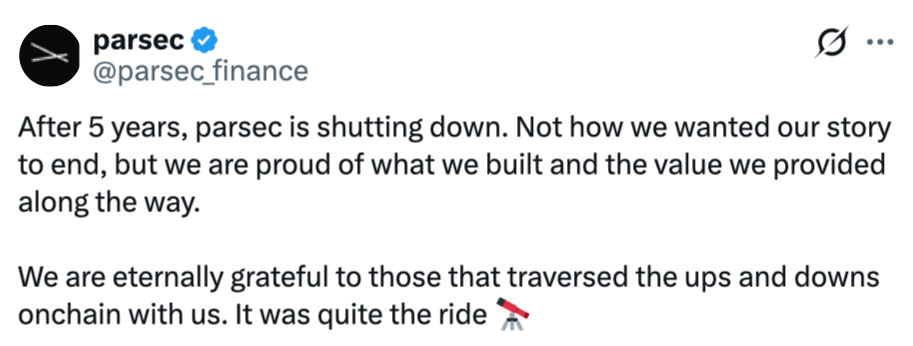
On-chain analytics firm Parsec is closing down after five years, as crypto trader flows and on-chain activity no longer resemble what they once did.
“Parsec is shutting down,” the company said in an X post on Thursday, while its CEO, Will Sheehan, said the “market zigged while we zagged a few too many times.”
Sheehan added that Parsec’s primary focus on decentralized finance and non-fungible tokens (NFTs) fell out of step with where the industry has now headed.
“Post FTX DeFi spot lending leverage never really came back in the same way, it changed, morphed into something we understood less,” he said, adding that on-chain activity changed in a way he never understood.
NFT sales reached about $5.63 billion in 2025, a 37% drawdown from the $8.9 billion recorded in 2024. Average sale prices also declined year over year, falling to $96 from $124, according to CryptoSlam data.
“Quite the ride,” Parsec says
Parsec, which had received investment from major industry players such as Uniswap, Polychain Capital, and Galaxy Digital, launched in early January 2021, just months before Bitcoin (BTC) surged from around $36,000 to $60,000 by April.

The company added in its X post that it is “eternally grateful to those that traversed the ups and downs on-chain.”
“It was quite the ride,” Parsec said.
Alex Svanevik, the CEO of on-chain analytics platform Nansen, said that Parsec “had a great run.”
Crypto industry may be heading for consolidation
It comes just weeks after crypto start-up Entropy announced it is closing down and returning funds to investors, citing scaling issues and a struggle to find product-market fit.
Bullish CEO Tom Farley predicted during an interview with CNBC on Feb. 8 that the industry will see a significant consolidation in the coming months with more projects snapped up by larger companies, which may lead to a much less fragmented sector overall.
Related: Bitcoin ETFs still sit on $53B in net inflows despite recent outflows: Bloomberg
Bitcoin’s price has declined 46% from its October all-time high of $126,100 to $67,246, according to CoinMarketCap.
Google searches for “Bitcoin going to zero” have surged to their highest level since the post‑FTX panic in November 2022, according to Google Trends data for the past five years.
Magazine: Bitcoin may take 7 years to upgrade to post-quantum: BIP-360 co-author


The path to making America the “crypto capital of the world” appeared to clear significantly on Wednesday as industry leaders and lawmakers announced a truce in the legislative battle over market structure.
Summary
- CLARITY Act, which stalled in early 2026 after Coinbase withdrew support, is now projected to pass by April following intensive “behind-the-scenes” negotiations.
- Senator Moreno emphasized that stablecoin rewards will force traditional banks to pay higher interest to everyday Americans, democratizing the financial system.
- Addressing technical fears, Armstrong confirmed that Coinbase is already preparing for post-quantum cryptography to ensure the long-term safety of digital assets.
CLARITY Act headed for the President’s desk
Appearing together at the World Liberty Forum, Coinbase CEO Brian Armstrong and Senator Bernie Moreno expressed newfound confidence that the CLARITY Act will pass by April 2026.
The optimism follows a rocky January where Coinbase famously “rug-pulled” its support for the bill over provisions that would have banned interest-bearing stablecoins. Armstrong clarified that his opposition wasn’t a “block,” but a call to return to the table.
“There is now a path forward where we can get a win-win-win outcome,” Armstrong said, noting that the smartest banks are now “leaning in” rather than fighting the inevitable.
Stablecoins as a tool for dollar dominance
Senator Moreno, a former crypto entrepreneur himself, argued that the bill’s focus on stablecoin rewards is essential for national security.
By allowing these assets to compete with traditional bank deposits, Moreno claimed the U.S. could effectively “dollarize the world” and reduce treasury borrowing costs by hundreds of billions of dollars.
“Unless you own a bank, you probably shouldn’t care,” Moreno told the audience, framing the debate as a choice between protecting outdated banking models or empowering consumers with faster, high-yield digital cash.
Addressing the “quantum threat”
The conversation also pivoted to technical risks, specifically the concern that quantum computing could “break” the blockchain.
Armstrong was quick to dismiss the threat as a “solvable engineering challenge,” revealing that Coinbase is already coordinating with major networks like Ethereum and Bitcoin to upgrade to post-quantum cryptographic standards.
The duo also cheered recent news from CFTC Chairman Mike Selig, who this week reaffirmed federal jurisdiction over prediction markets. Armstrong, whose “Everything Exchange” now includes these markets, praised the move as a vital check against state-level efforts to classify the sector as illegal gambling.
With the White House and the “Crypto Czar” David Sacks reportedly meeting daily with stakeholders, the “April milestone” has become the primary target for a industry eager to trade regulatory “word salad” for a clear, national standard.


CME Group, the world’s largest regulated derivatives marketplace, announced plans to begin 24-hour, seven-day-a-week trading of its cryptocurrency futures and options contracts on May 29, 2026, pending regulatory review.
Summary
- Pending regulatory approval, crypto products will move to a 24/7 schedule on the CME Globex platform, with only a brief weekly window for maintenance.
- The shift follows a massive 2025 where CME saw $3 trillion in notional activity, driven by professional traders seeking regulated risk-management tools.
- Beyond Bitcoin and Ether, CME recently broadened its reach by launching futures for Cardano (ADA), Chainlink (LINK), and Stellar (XLM).
CME Group adopts 24/7 crypto trading as competition heats up
The decision marks a significant step in aligning regulated digital-asset derivatives with the continuous nature of global crypto spot markets.
Under the new schedule, CME’s cryptocurrency products will trade continuously on its CME Globex platform, with a brief weekly maintenance window. Any trading conducted from Friday evening through Sunday evening will receive the following business day’s trade date for clearing, settlement and reporting.
CME said that client demand for regulated crypto risk-management tools is at an historic high, driven by record volumes in 2025 when its crypto futures and options saw $3 trillion in notional activity. Average daily volume and open interest have both climbed sharply year-over-year in 2026, underlining robust participation from institutional and professional traders.
The expansion builds on CME’s broader push into digital assets. In early February, the exchange successfully launched futures contracts for Cardano (ADA), Chainlink (LINK) and Stellar (XLM), including both standard and micro sizes, broadening its altcoin derivatives lineup beyond Bitcoin and Ether. Market participants have viewed this as a key step in giving regulated access to a wider range of crypto assets.
However, CME’s push to modernize its markets has faced operational challenges. In November 2025 a cooling-system failure at a CyrusOne data center triggered a major outage that halted futures trading across cryptocurrencies, commodities, equities and FX, highlighting infrastructure risks as trading demand intensifies.
As crypto continues its integration into mainstream finance, round-the-clock regulated trading at CME could help close the gap between always-on digital markets and traditional exchange hours — offering traders more flexibility and risk management options around the clock.


Minneapolis Federal Reserve President Neel Kashkari delivered a blistering critique of the cryptocurrency industry on Thursday, dismissing digital assets as “utterly useless” and characterized by “word salad” marketing rather than functional utility.
Summary
- Kashkari argued that after over a decade, crypto has failed to provide a compelling use case for U.S. consumers, unlike AI tools which have seen rapid, practical adoption.
- He dismissed the “instant” cross-border payment narrative, noting that recipients must still pay high costs to convert crypto into local currency for daily essentials.
- The Fed official asserted that existing domestic tools like Venmo and Zelle already outperform stablecoins, and warned that nations will not abandon independent monetary policies for a unified crypto platform.
Speaking at the 2026 Midwest Economic Outlook Summit, Kashkari challenged the fundamental value proposition of cryptocurrencies and stablecoins.
During a fireside chat, he contrasted the tangible economic impact of Artificial Intelligence with the decade-long history of crypto, which he argues has failed to integrate into the real economy.
Kashkari’s crypto “grocery store” test
Kashkari was particularly skeptical of the claim that crypto excels at cross-border payments. Using a personal example, he described the hurdles of sending money to family in the Philippines. While proponents claim crypto offers “instant” transfers, Kashkari argued the logic falls apart at the point of sale.
“How does [a recipient] buy groceries with it?” Kashkari asked the audience.
“They still have to convert it to the local currency, and that is still expensive. What advocates are really saying is that if everyone in the world used the same platform, friction would disappear, but nations are not going to abandon their own monetary policies.”
Demanding clarity over “buzzwords”
The Fed official urged the public and policymakers to stop settling for vague explanations. He described much of the industry’s rhetoric as a “buzzword salad,” noting that most “innovations” offered by stablecoins are already handled efficiently by existing domestic tools like Venmo or Zelle.
“Ask the most basic questions and don’t settle for nonsense,” Kashkari warned. “Whenever I make people really explain how this thing actually works, there’s just nothing there.”
The remarks highlight a growing divide in 2026 between the central bank’s skepticism and the commercial sector’s expansion, coming just hours after the CME Group announced plans to move toward 24/7 crypto derivatives trading to meet institutional demand.


Another week has ended, and Friday has arrived, which means another batch of Bitcoin options contracts is expiring while spot markets remain sideways.
Around 30,600 Bitcoin options contracts will expire on Friday, Feb. 20, with a notional value of roughly $2 billion. This event is a little smaller than last week’s expiry, so there is unlikely to be any impact on spot markets.
Crypto markets are in bear market territory, but have remained flat over the past week as volume and volatility dry up.
Bitcoin Options Expiry
This week’s batch of Bitcoin options contracts has a put/call ratio of 0.59, meaning that there are more expiring calls (longs) than puts (shorts). Max pain is around $70,000, according to Coinglass, which is above current spot prices, so many will be out of the money on expiry.
Open interest (OI), or the value or number of Bitcoin options contracts yet to expire, remains highest at $60,000 with $1.2 billion and $1 billion at $50,000 strike prices on Deribit as bearish bets increase. Total BTC options OI across all exchanges has been climbing this month and is at $36.5 billion.
“Positioning skews call heavy across both assets, with BTC showing the stronger upside skew,” said Deribit.
Meanwhile, derivatives analyst Laevitas observed that “downside protection remains in demand,” noting 2,140 BTC worth of puts at $58,000 recently bought.
🚨 Options Expiry Alert 🚨
At 08:00 UTC tomorrow, over $2.4B in crypto options are set to expire on Deribit.$BTC: ~$2.0B notional | Put/Call: 0.59 | Max Pain: $70K$ETH: ~$404M notional | Put/Call: 0.75 | Max Pain: $2,050
Positioning skews call heavy across both assets, with… pic.twitter.com/pgl2z4ZGJ6
— Deribit (@DeribitOfficial) February 19, 2026
You may also like:
In addition to today’s batch of Bitcoin options, around 212,000 Ethereum contracts are also expiring, with a notional value of $404 million, max pain at $2,050, and a put/call ratio of 0.75. Total ETH options OI across all exchanges is around $6.8 billion.
This brings the total notional value of crypto options expiries to around $2.4 billion.
Spot Market Outlook
Total market capitalization has been flat for the past 24 hours and since the beginning of the week, hovering around $2.37 trillion, down 46% from its peak. Bitcoin has slowly eroded since Monday, hitting a weekly low of $65,700 in late trading on Thursday before recovering to $67,290 at the time of writing on Friday morning in Asia.
Resistance is forming at $70,000, with support still just above $60,000, and this seems to be the closest target. There has been no movement in Ether prices, which have started to consolidate around $1,950. The rest of the altcoins remain flat at bear market bottoms.
SECRET PARTNERSHIP BONUS for CryptoPotato readers: Use this link to register and unlock $1,500 in exclusive BingX Exchange rewards (limited time offer).


Crypto prices firmed during Asia’s Friday morning session, with bitcoin climbing toward $68,000 after a choppy week that tested nerves across risk markets.
The bounce was broad. XRP, Solana’s SOL, and Cardano’s ADA added upto 2% while ether lagged with a small dip, hovering below $2,000 as traders treated the level as a line that needs defending rather than celebrating.
The move had the feel of a relief rally more than a clean turn. After weeks of sharp swings, the market has started reacting in waves. A quick push higher draws in dip buyers, then selling appears as soon as price reaches a level where trapped holders can exit with less pain. The difference this week is that each rebound has looked a little less fragile, suggesting forced selling is easing even if conviction buying has not returned in size.
Macro and geopolitics are doing their part to keep traders cautious. Gold steadied near $5,000 an ounce after two sessions of gains as investors priced rising Middle East risk.
US President Donald Trump said Thursday he would allow 10 to 15 days for talks on a nuclear deal with Iran, while American forces reportedly built up in the region. That mix has supported haven demand and made it harder for risk assets to build momentum.
FxPro chief market analyst Alex Kuptsikevich framed the broader backdrop as bearish.. He said that given the market’s prior dynamics and the more cautious tone in US stocks, the odds increase of a retest of local lows, pointing to levels last seen in the second half of 2024.
On ether, he said the token is sitting on a long running support line that traces back to 2020 and lines up with the $2,000 area, but added that a true breakdown would need confirmation through a drop below recent lows around $1,500.
Under the surface, some indicators hint that big holders may be positioning to sell into strength. CryptoQuant says bitcoin inflows from large holders to Binance have reached record levels, a pattern that can precede heavier spot supply.
Research shop K33 has compared current conditions to the later stages of the 2022 bear market that gave way to a long, grinding consolidation.
The result is a market that can bounce, but struggles to turn rebounds into a trend until spot demand grows louder than the sellers waiting at the next round number.
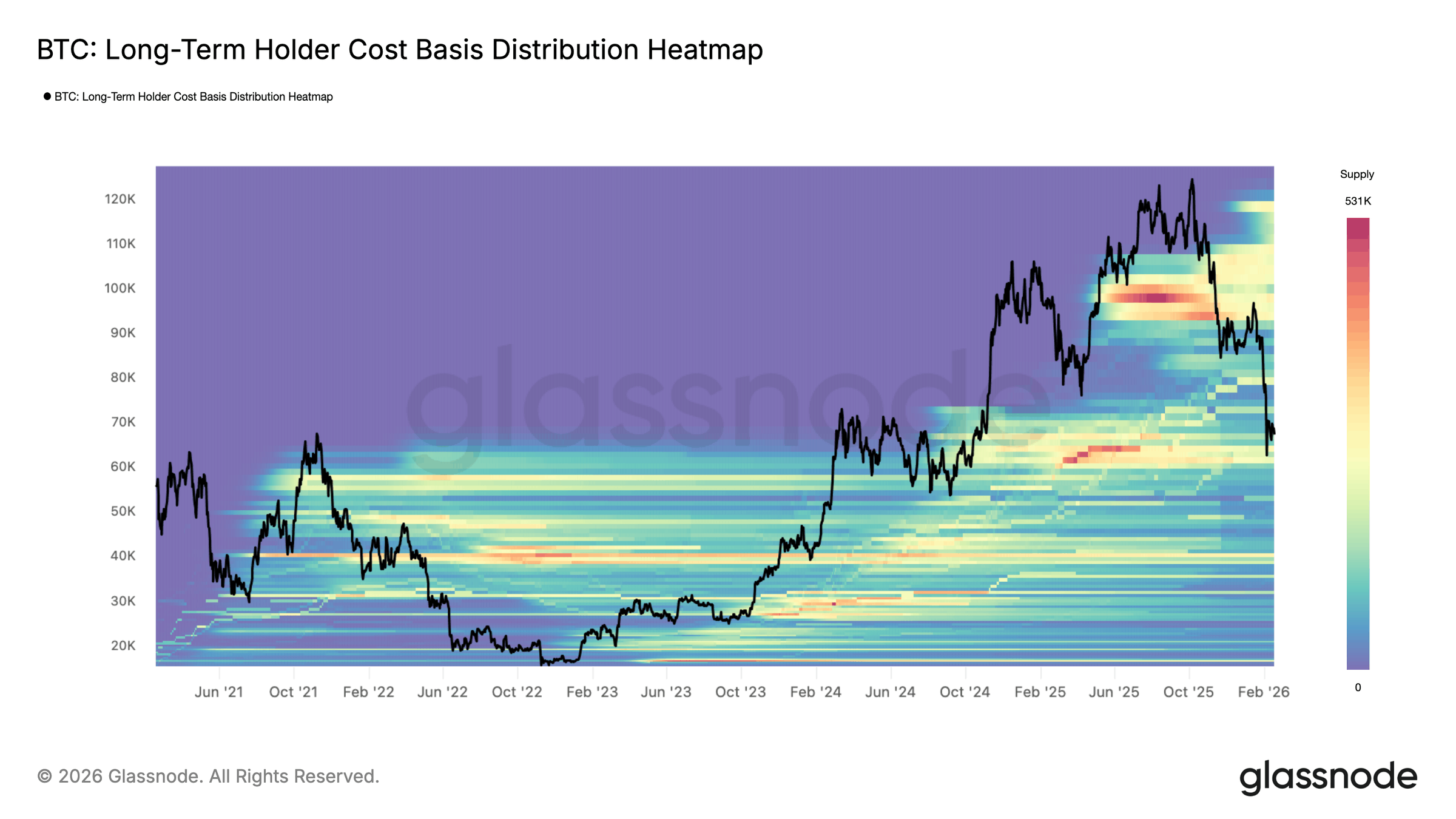
Bitcoin’s (BTC) market structure shifted into a corrective phase after losing a key onchain valuation level in late January.
Glassnode data shows that BTC’s price is compressing within a 2024-era demand zone as liquidity conditions soften. At the same time, BTC’s supply is steadily shifting into long-term, retail-linked wallets while exchange activity has cooled.
This mix of technical and onchain data, along with the current capital rotation, may shape the next steps for Bitcoin price.
Bitcoin lost its active supply cost price, but holders defend $60,000
In its weekly “The Week On-chain” report, Glassnode said that BTC’s recent price dip accelerated due to breaking below its true market mean near $79,000 in January, which is the cost basis of the tracked active supply.
Since then, the price has stabilized inside a dense $60,000 to $69,000 range, which is being defended by medium-term holders. One of the reasons this zone has been a strong support is because of the age of coins within this range for the majority of 2024.

Coins accumulated in that range have aged more than a year, placing a large cohort close to breakeven. This supply may be acting as a backstop on the current sell pressure.
Market analyst Ardi pointed to a similar dynamic, writing on X:
“We’re trading inside the same $53-73K range that took 245 days to build last year. Think about how much volume went through this zone. This is the most contested zone on BTC’s entire chart right now.”
Glassnode also highlighted that, in past cycles, deeper bear phases have gravitated toward the realized price, which now stands near $54,900. The metric estimates the average acquisition cost of all circulating coins.
Bitcoin’s liquidity conditions also remain compressed. The 90-day realized profit/loss ratio has declined back into the 1–2 range, a level associated with limited capital rotation. A sustained move below 1 has aligned with stressed bear environments.

Related: Google searches for ‘Bitcoin going to zero’ at highest since 2022
BTC accumulation rises even as activity slows down
CryptoQuant data shows that the balances held by accumulating address cohorts have continued rising into early 2026. Total BTC held by these cohorts has expanded to over 4 million BTC, up from roughly 2 million BTC in early 2024, which reflects a steady supply absorption.

The retail-linked accumulation addresses have increased their holdings by 850,000 BTC, while the accumulating pattern wallets, addresses that steadily add BTC in recurring intervals with minimal outflows, increased their size to 1.27 million BTC. This expansion occurred even as the price dropped in 2026.
In contrast, the inflows from centralized-exchange addresses and highly active addresses have moderated. Compared with the 2023 to 2024 expansion phases, where inflow spikes frequently exceeded 1.2 million to 1.5 million BTC, the recent activity has remained significantly lower, averaging 300,000 BTC to 400,000 BTC.

The divergence shows that more BTC is being absorbed into long-term wallets while fewer coins are rotating through major exchanges. That reduces the liquid supply and slows down short-term trading activity.
Related: Bitcoin’s consolidation nears ‘turning point’ as $70K comes in focus: Analyst
This article does not contain investment advice or recommendations. Every investment and trading move involves risk, and readers should conduct their own research when making a decision. While we strive to provide accurate and timely information, Cointelegraph does not guarantee the accuracy, completeness, or reliability of any information in this article. This article may contain forward-looking statements that are subject to risks and uncertainties. Cointelegraph will not be liable for any loss or damage arising from your reliance on this information.

TLDR:
- Metaplanet CEO Simon Gerovich rejects anonymous claims of hidden Bitcoin buys and poor disclosure practices.
- Four September Bitcoin purchases were each disclosed promptly via the company’s live public dashboard.
- Selling put options lowers Bitcoin acquisition costs below spot, not a directional price bet.
- Metaplanet’s Bitcoin-per-share KPI surged over 500% in 2025 despite stock price volatility.
Metaplanet’s CEO has gone on the offensive. Simon Gerovich addressed a wave of anonymous allegations targeting the Japanese Bitcoin treasury firm.
The criticism questioned the company’s disclosure practices, options trading approach, and September Bitcoin purchases. Gerovich pushed back point by point, calling several claims factually inaccurate.
Metaplanet CEO Challenges Claims Over Bitcoin Purchases and Disclosure Practices
The September Bitcoin purchases drew particular scrutiny. Critics alleged the company bought near a local price peak and stayed quiet about it.
Gerovich acknowledged the timing but rejected the narrative entirely. He confirmed four separate purchases were made that month, each disclosed promptly through the company’s public dashboard.
Metaplanet publishes all Bitcoin wallet addresses openly. Shareholders can verify holdings in real time through a live dashboard the firm maintains.
Gerovich cited this as evidence the company operates with unusual transparency for a listed entity. He described it as one of the most open corporate structures in the market.
The company’s accumulation approach is systematic, not speculative. Gerovich emphasized that Metaplanet does not attempt to time Bitcoin’s price.
Every purchase gets disclosed regardless of prevailing market conditions. That policy has remained consistent throughout the firm’s accumulation period.
Gerovich took direct aim at anonymous accounts spreading the allegations. He stated he would not tolerate the distribution of false information to shareholders navigating a volatile market.
He also noted his personal financial exposure as a major shareholder, having invested his own capital into the company.
Options Trading Strategy and Financial Metrics Addressed Directly
The criticism around options trading reflected a misreading of strategy, according to Gerovich.
Selling put options is not a directional bet on Bitcoin rising. It is a method to acquire Bitcoin below the spot price by collecting option premiums upfront. He walked through a specific example to illustrate the mechanics.
In his post, Gerovich described a scenario where spot Bitcoin trades at $80,000.
Selling a put at that strike and collecting a $10,000 premium brings the effective acquisition cost to $70,000. The strategy exploits elevated volatility to lower average entry prices. In Q4, he said, the approach meaningfully reduced Metaplanet’s effective Bitcoin costs.
On financials, Gerovich challenged the use of net profit as an evaluation metric. He pointed to 6.2 billion yen in operating profit, representing 1,694% year-over-year growth.
Ordinary losses stem from unrealized valuation changes on long-term Bitcoin holdings the company has no plans to sell. He called drawing negative conclusions from that line item a misreading of the statements.
Bitcoin per share, the company’s primary KPI, rose over 500% in 2025. The hotel business generated 437 million yen in sales revenue and 169 million yen in operating profit. Borrowing arrangements were disclosed three times across facility establishment and two drawdowns.
Specific lender details and interest rates were withheld at the counterparty’s request, Gerovich said.

The White House is pressing ahead with negotiations between crypto industry representatives and banking lobbyists to shape stablecoin provisions within a broader crypto market-structure bill. In the third face-to-face session held in about two weeks, participants attempted to close gaps that have stalled the legislation amid broader regulatory scrutiny. While no deal emerged on Thursday, attendees signaled progress as a White House adviser urged a compromise: allow third parties, such as exchanges, to offer stablecoin rewards only in connection with transaction activity rather than linking yields to customers’ idle balances. The talks followed earlier meetings on February 2 and February 10, underscoring the urgency of delivering a coherent framework for how U.S. regulators would police the evolving crypto landscape.
Key takeaways
- The current round of talks produced incremental language alignment but stopped short of a binding agreement on how stablecoin rewards should be governed under the market-structure bill.
- A prominent proposal centers on tying stablecoin rewards to transactional activity rather than balances, a stance intended to address banking concerns about competitive pressures.
- Participants highlighted the need for clear legislative language to unlock broader crypto-market structure reform, with industry and banking voices urging pragmatism and collaboration.
- Public remarks from executives at Coinbase (EXCHANGE: COIN) and Ripple underscored a constructive and cooperative tone, even as substantive policy divides remain.
- The Senate’s path for the related market-structure bill remains uncertain, with prior House passage of a CLARITY Act variant not yet mirrored in Senate approval.
- Plans for continued negotiations were already on the table, with banks slated to reconvene to decide whether the trade-off could win broader support.
Tickers mentioned: $COIN
Sentiment: Neutral
Market context: The unfolding discussions sit at the crossroads of regulatory clarity, innovation incentives, and risk management as policymakers weigh how to normalize stablecoins within the traditional financial system while maintaining consumer protections and financial stability.
Why it matters
At stake is a path to regulatory clarity that could unlock broader participation in the crypto economy while preserving the safeguards that lawmakers insist are necessary for a rapidly evolving sector. The debate over stablecoin rewards directly touches liquidity, market integrity, and how digitized fiat-backed assets integrate with traditional banking rails. By steering a compromise toward transaction-based rewards rather than balance-based yields, policymakers aim to strike a balance between incentivizing innovative finance and preventing scenarios that could undermine deposit stability or create unfair competitive dynamics for banks.
The discussions reflect a broader tension in Washington: policymakers want to enable responsible innovation without ceding market stability or consumer protection. The involvement of high-profile industry players signals that the issue has moved beyond a narrow policy skirmish and into a cornerstone debate about how stablecoins will function within the U.S. financial system over the coming years. As negotiators press on, the outcome could influence how wallets, exchanges, and other third parties design reward structures and attract user participation in a regulated, compliant manner.
Observers note that the White House is prioritizing a pragmatic, language-driven approach—one that narrows disagreements step by step while keeping the door open to a broader legislative package. The degree of progress achieved in the latest talks—though not a resolution—suggests that a consensus on core concepts may still be within reach, provided sufficient alignment on the role of third-party reward programs and the safeguards designed to protect depositors and the broader financial system.
What to watch next
- Whether banks will sign off on the transaction-based rewards framework and what concessions might be required to gain bipartisan support.
- The timing and framing of the next White House-facilitated session, including any public statements from the involved parties.
- Any movement in the Senate on the market-structure bill or related amendments, following earlier House passage of a CLARITY Act variant.
- Follow-up remarks from Coinbase (EXCHANGE: COIN) and Ripple, and whether new language clarifies the role of third-party reward programs.
Sources & verification
Progress, trade-offs shape White House discussions on stablecoins and market structure
The third formal session between White House policy staff, crypto executives, and banking lobbyists unfolded as part of a broader push to finalize language for a market-structure bill that would redefine how regulators oversee the crypto sector. The gathering, described as constructive but inconclusive, occurred roughly 16 days after the initial February meeting and followed a second discussion eight days later. A central theme was a proposed compromise that would permit third parties—such as exchanges and other service providers—to offer stablecoin rewards only in relation to transaction activity, not as returns on idle balance holdings. This shift aims to dampen potential incentives for large sums to accumulate in wallets simply to generate yield, a factor cited by banks as a competitive pressure that could distort traditional banking models.
During the talks, participants signaled progress in narrowing differences on language that would codify how stablecoins are treated within the broader regulatory framework. The dynamic highlighted the delicate balance between fostering innovation and maintaining financial stability. In a notable development, the session included representatives from the crypto industry who advocate for reward programs that align with transaction-based engagement, balanced by bankers’ concerns about depositor protection and systemic risk. The discussions also foregrounded the practical role of third-party platforms in delivering stablecoin rewards, a line of inquiry that could influence how wallets, exchanges, and payment rails interoperate under a regulated regime.
On the record, executives from the involved crypto firms described the session as a step forward. After the meeting, Ripple’s chief legal officer offered a succinct update: the teams had “rolled up our sleeves and went through language today,” signaling that specifics were being mapped out in detail. In parallel, Coinbase described the tone as constructive and cooperative, underscoring a shared interest in advancing policy that would provide clarity without stifling innovation. A separate note from the Blockchain Association framed the meeting as a productive progression toward resolving outstanding questions about stablecoin rewards and moving the legislation closer to a vote.
The concessions under discussion would have to survive scrutiny from both chambers of Congress and the White House, given the competing priorities that have characterized crypto regulation for years. A point of friction remains the concept of “idle balance yields” versus activity-based rewards, a distinction that lawmakers and industry participants have wrestled with since early discussions. Semafor’s coverage referenced internal discussions and comments from participants indicating that the debate has shifted toward activity-based incentives, while the idea of earning yield simply from holding stablecoins has been effectively sidelined in the near term.
The banking sector has framed its concerns around competitive pressures more than deposit flight, a nuance echoed by some participants who emphasized that the issue is as much about maintaining a level playing field as about liquidity risk. The broader regulatory conversation includes a separate line of analysis around the potential macro implications of widespread stablecoin use, with Treasury authorities having previously estimated that rapid mass adoption could catalyze significant deployment shifts within the traditional banking system. Those considerations underscore why the White House and lawmakers are approaching the negotiation with both urgency and caution, seeking a policy that can be implemented without triggering abrupt dislocations in financial markets.
Looking ahead, observers expect another round of discussions among banking groups to determine whether the proposed language can gain acceptance. The next steps will likely hinge on a mutual willingness to compromise on the reward structure, as well as a clear signal from lawmakers about how quickly the bill could progress through committee and to a floor vote. The ongoing negotiations illustrate the complexity of delivering a unified U.S. stance on stablecoins—one that accommodates the rapid evolution of digital assets while preserving the oversight and safeguards that underpin the mainstream financial system.

EV appoints US advisor to aid antimony push

BTC difficulty jumps 15% largest increase since 2021, despite price slump

Flaw in Grandstream VoIP phones allows stealthy eavesdropping

Smart energy pays enters the US market, targeting scalable financial infrastructure

Why Israel is blocking foreign journalists from entering

Software stocks enter bear market on AI disruption fear with ServiceNow plunging 10%

Patrick Witt Just ADMITTED It!!! XRP Is DESTROYING The Banks?!?!

UPSC Economy – 16th Finance Commission – One Shot Summary for Prelims & Mains by Dr. Mrunal Patel

BITCOIN: It’s Happening AGAIN (History Repeating)!!! – Bitcoin News Today, Ethereum & Altcoins
-

 Video4 days ago
Bitcoin: We’re Entering The Most Dangerous Phase
-

 Tech5 days ago
Luxman Enters Its Second Century with the D-100 SACD Player and L-100 Integrated Amplifier
-

 Crypto World3 days ago
Can XRP Price Successfully Register a 33% Breakout Past $2?
-

 Sports3 days ago
GB's semi-final hopes hang by thread after loss to Switzerland
-

 Video7 days ago
The Final Warning: XRP Is Entering The Chaos Zone
-

 Video4 hours ago
XRP News: XRP Just Entered a New Phase (Almost Nobody Noticed)
-
 Tech3 days ago
The Music Industry Enters Its Less-Is-More Era
-

 Business2 days ago
Infosys Limited (INFY) Discusses Tech Transitions and the Unique Aspects of the AI Era Transcript
-

 Entertainment2 days ago
Kunal Nayyar’s Secret Acts Of Kindness Sparks Online Discussion
-

 Video3 days ago
Financial Statement Analysis | Complete Chapter Revision in 10 Minutes | Class 12 Board exam 2026
-

 Tech2 days ago
Retro Rover: LT6502 Laptop Packs 8-Bit Power On The Go
-

 Crypto World6 days ago
Bhutan’s Bitcoin sales enter third straight week with $6.7M BTC offload
-
 Sports1 day ago
Clearing the boundary, crossing into history: J&K end 67-year wait, enter maiden Ranji Trophy final | Cricket News
-

 Crypto World7 days ago
Kalshi enters $9B sports insurance market with new brokerage deal
-

 Entertainment1 day ago
Dolores Catania Blasts Rob Rausch For Turning On ‘Housewives’ On ‘Traitors’
-

 Business2 days ago
Tesla avoids California suspension after ending ‘autopilot’ marketing
-
 NewsBeat5 days ago
The strange Cambridgeshire cemetery that forbade church rectors from entering
-

 Crypto World1 day ago
WLFI Crypto Surges Toward $0.12 as Whale Buys $2.75M Before Trump-Linked Forum
-
 NewsBeat5 days ago
Man dies after entering floodwater during police pursuit
-

 Crypto World9 hours ago
83% of Altcoins Enter Bear Trend as Liquidity Crunch Tightens Grip on Crypto Market