

Crypto World
Will Solana price drop under $80 as a risky pattern emerges?

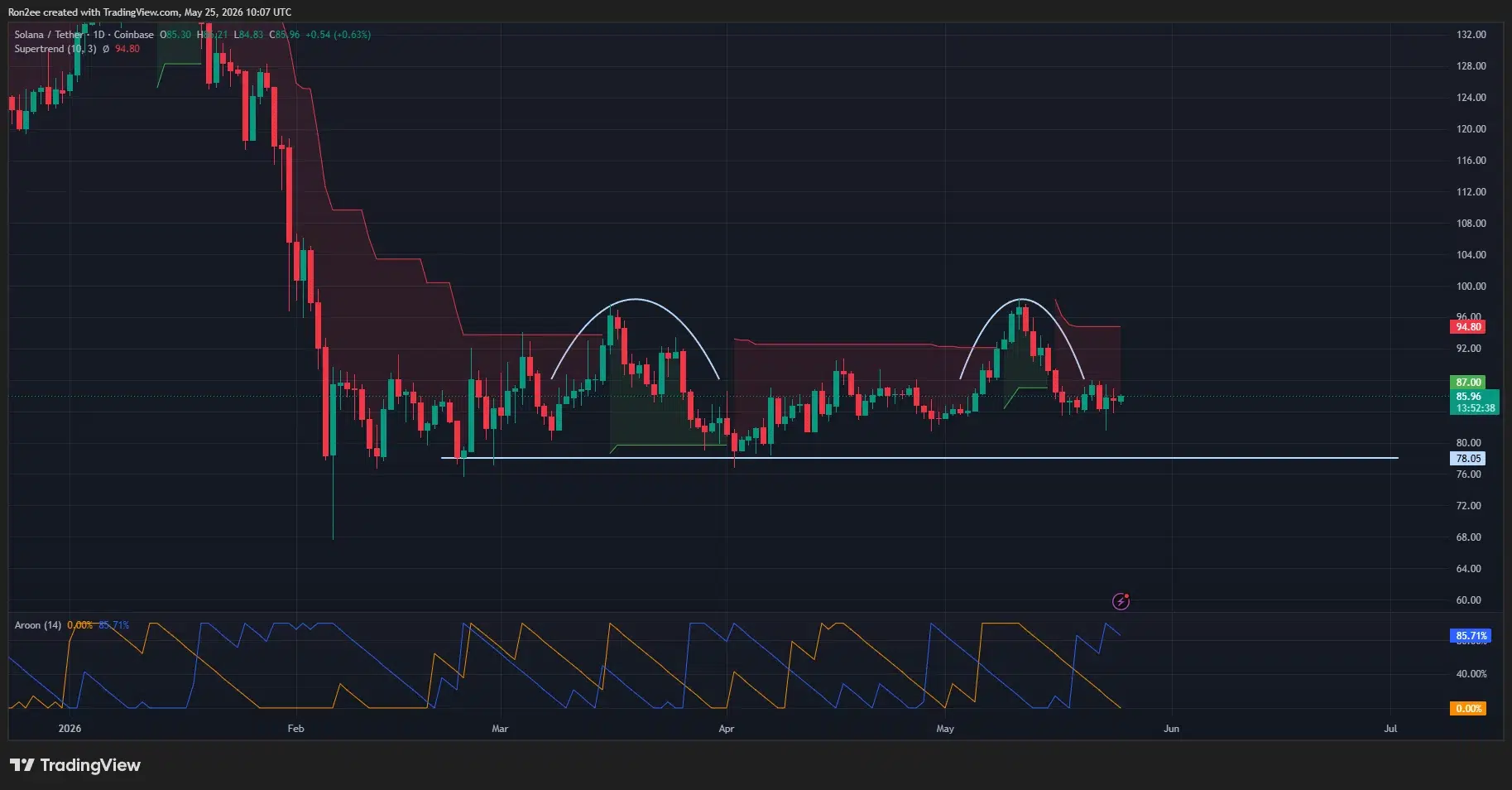
Solana has slipped back toward the mid-$80 range after repeated rejections near $100 triggered fears of a deeper correction below the critical $80 support zone.
Summary
- Solana price has remained below the key $90 resistance zone after falling nearly 15% from its recent high near $100, with traders watching the $80 support area closely.
- Daily charts show a developing double-top pattern, while CoinGlass liquidation data highlights dense leverage clusters between $83 and $78 that could accelerate downside volatility.
- Weakening Solana DEX activity, institutional outflows, and persistent macro uncertainty tied to inflation fears and Middle East tensions have continued pressuring sentiment across altcoins.
According to data from crypto.news, Solana (SOL) price was trading near $85 at press time after falling roughly 15% from its early-May peak near $100.
The decline came as institutional appetite for risk assets has weakened sharply over the past two weeks. U.S.-based crypto investment products recorded more than $1 billion in weekly outflows recently as investors reduced exposure ahead of upcoming Federal Reserve commentary and inflation data.
Solana-linked products were among the hardest hit after Goldman Sachs disclosed that it had exited several Solana and XRP exchange-traded product positions, reinforcing concerns that institutional capital continues rotating away from speculative altcoin exposure.
On-chain metrics have also deteriorated. Solana’s decentralized exchange activity has cooled significantly following the slowdown in meme coin trading volumes that previously fueled aggressive network growth earlier this year. Weekly DEX volume on the network has dropped more than 50% from recent highs, reducing fee generation and weakening demand for SOL as transactional activity declines across the ecosystem.
At the same time, rival ecosystems have started attracting liquidity that previously flowed into Solana-based applications. Base and Hyperliquid have seen increasing trader activity due to lower costs and strong perpetual trading demand. Hyperliquid, in particular, has emerged as a major competitor in decentralized derivatives, pulling both liquidity and speculative volume away from Solana-native platforms.
Meanwhile, oil market volatility and geopolitical uncertainty continue adding pressure to crypto markets. Brent crude prices remain elevated following renewed concerns surrounding shipping disruptions near the Strait of Hormuz, while investors continue monitoring negotiations between the U.S. and Iran. Higher energy prices have complicated expectations for Federal Reserve rate cuts, reducing appetite for speculative assets like Solana.
Is a double-top pattern pointing to another major Solana breakdown?
Technical indicators are increasingly pointing toward a fragile market structure after Solana failed twice to break above the $98–$100 resistance region. The daily chart shows a developing double-top pattern, with both rejection points occurring near the same supply zone before SOL price retreated back toward the mid-$80 range.
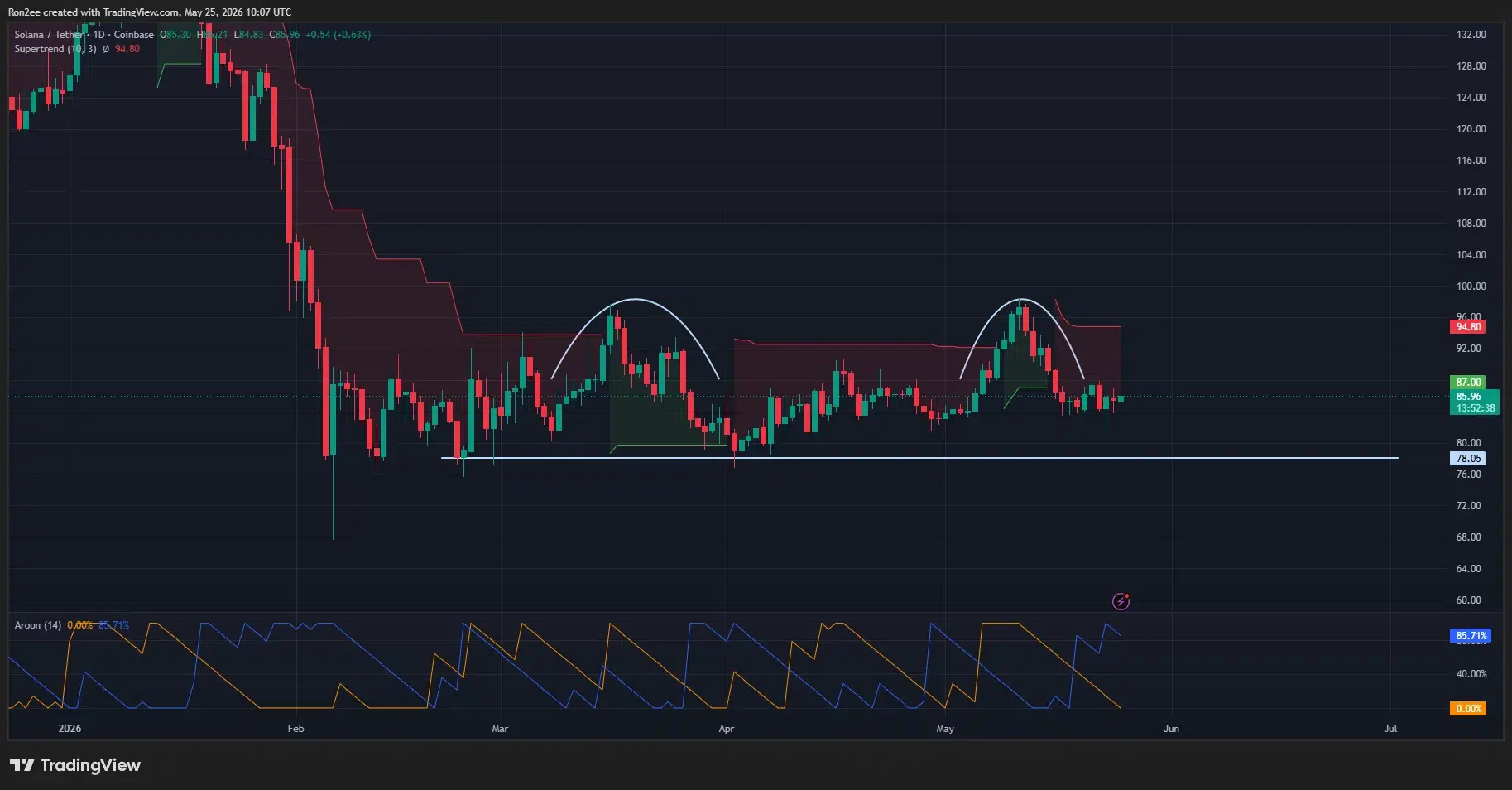
The neckline support for the structure sits near the $78 level, which has repeatedly acted as a key defensive area since March. A confirmed breakdown below that region could validate the bearish pattern and potentially open the door for a larger move toward the low-$70 range.
Pattern projections derived from the height of the structure suggest downside targets could extend toward $64 if panic selling accelerates.
Alongside the double-top formation, Solana remains below its Supertrend resistance near $94.80, indicating that sellers continue controlling the higher timeframe trend. Daily candles have also struggled to close above the descending resistance band formed after the late-April rejection, keeping bullish momentum suppressed.
Momentum indicators remain mixed but continue to favor bears overall. The Aroon indicator shows Aroon Up near 85.7% while Aroon Down remains near zero, signaling that short-term rebounds are still occurring. However, the indicator has historically produced several failed bullish signals during Solana’s prolonged consolidation phase this year, limiting confidence in a sustained recovery attempt.
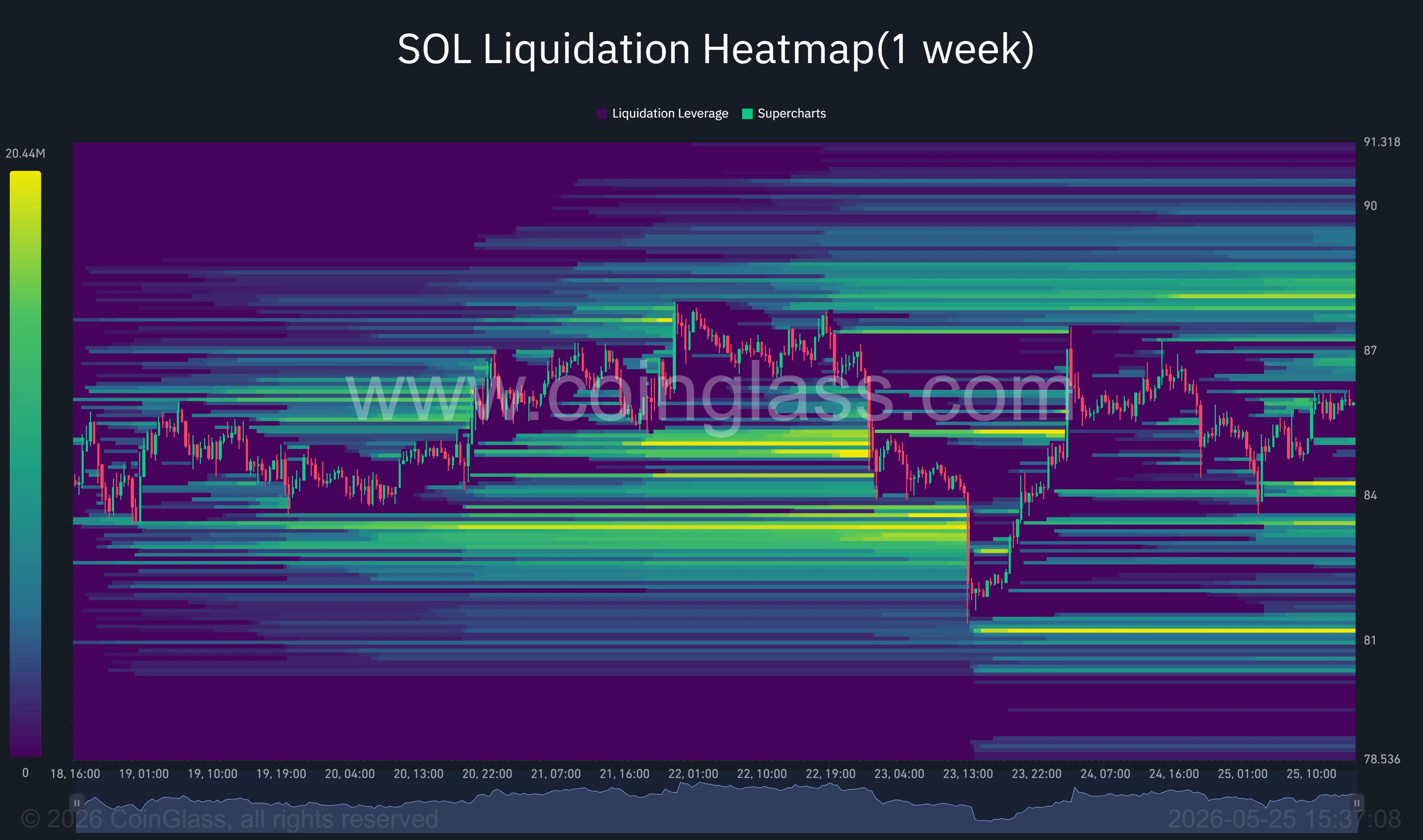
CoinGlass liquidation heatmap data shows dense leverage clusters concentrated between $83 and $81, with another major liquidity pocket sitting near $78. Those zones could become magnets for price action if volatility increases during the coming sessions.
Funding rates across perpetual futures markets have also turned deeply negative, indicating aggressive short positioning from traders expecting additional downside. Negative funding often signals bearish sentiment dominance, particularly when paired with weakening spot demand and falling network activity.
Open interest has remained elevated despite recent price weakness, a combination that often precedes sharp liquidation-driven moves.
If Solana loses the $83 support floor decisively, cascading long liquidations could accelerate the decline toward the psychological $80 threshold very quickly.
Crypto trader DonAlt warned that Solana’s current structure resembles conditions seen before previous major drawdowns. In a recent market update, he said the setup “looks very similar to Q3 2022,” adding that a temporary bull trap could emerge before another deeper correction.
The trader suggested Solana could eventually revisit the $47 region in a worst-case capitulation scenario if market conditions continue deteriorating.
Despite the bearish setup, buyers have continued defending the $83–$84 area aggressively during recent sessions. Several long lower wicks on the daily timeframe indicate dip-buying activity remains active near support, preventing a clean breakdown so far.
What could invalidate the bearish Solana thesis?
A sustained recovery above the $90 resistance zone would weaken the immediate bearish structure and potentially force short sellers to unwind positions. CoinGlass liquidity data shows a heavy concentration of short liquidation levels above $87 and $90, meaning a breakout could trigger a rapid squeeze higher if momentum returns.
Improving macro conditions could also stabilize risk appetite across crypto markets. Softer-than-expected U.S. inflation data or any signals that the Federal Reserve may ease policy later this year would likely support renewed inflows into altcoins. Bitcoin reclaiming higher resistance zones could similarly improve sentiment toward Solana and other large-cap cryptocurrencies.
Network activity remains another critical variable. Any revival in meme coin trading volumes or a sharp rebound in Solana-based decentralized finance activity could improve fee generation and restore speculative demand for SOL. Developers also continue expanding infrastructure across the ecosystem despite the recent slowdown in user activity.
For now, however, the technical structure remains vulnerable while macro conditions continue to favor defensive positioning.
Unless bulls reclaim the $90–$94 resistance range soon, Solana risks slipping below the critical $80 threshold as traders continue pricing in weaker liquidity conditions and rising downside pressure across the crypto market.
Disclosure: This article does not represent investment advice. The content and materials featured on this page are for educational purposes only.

Crypto World
CME Group to Sue CFTC Over Perpetual Futures Approval, Citing Dodd-Frank Swaps Definition


CME Group plans to sue the Commodity Futures Trading Commission over the agency's approval of crypto perpetual futures, the world's largest derivatives exchange operator announced Wednesday evening on CNBC. Outgoing Chief Executive Terrence Duffy said the case would be filed as soon as Thursday and… Read the full story at The Defiant
At the start of June, the two largest cryptocurrencies by market capitalization tumbled to their lowest levels in years. However, many analysts believe the cycle bottoms have not occurred yet.
The big question now appears to be whether Bitcoin (BTC) or Ethereum (ETH) will find its floor first, and here’s the take of one popular market observer.
Is ETH First in Line?
X user Ted argued that the second-biggest cryptocurrency is more likely to bottom before the industry’s undisputed leader. He claimed that most of the downside liquidity has been taken out, projecting a plunge to $1,300-$1,400.
“But after that, upside liquidity will start to look more interesting,” he added.
Shortly after, Ted noted ETH’s drop below the critical $1,700 mark and warned that the asset could post a further 5-6% decline if it doesn’t reclaim this level.
There are plenty of other analysts who believe the worst for Ethereum is ahead. Ali Martinez said the asset is breaking down from its channel and is trading below the 200-hour SMA. That said, he expects a drop toward $1,580.
Niels also claimed that ETH hasn’t bottomed for this cycle, predicting a crash to as low as $1,200 sometime this year. At the same time, they see the current price level as a great buying opportunity.
How About BTC?
Earlier in June, the primary cryptocurrency plummeted to nearly $59,000 for the first time since late 2024. Ted, like many other industry participants, thinks this was not the bottom.
He spotted a massive liquidity cluster around $50,000-$60,000, describing it as the same zone with large BTC buy orders on exchanges. With that in mind, Ted said that the price will likely sink to $50K “with a possible wick.”
X users bee and Crypto Lens have also made bearish forecasts. The former opined that BTC is “on the verge of the final flush,” expecting a drop to $51,000-$52,000, while the latter envisioned a downturn to $43,000 by August this year.
However, it’s not all doom and gloom. Certain factors, such as the declining amount of BTC held on exchanges, suggest a rebound is also possible. As CryptoPotato reported, the figure recently dipped to a six-year low, meaning that investors have abandoned centralized platforms in favor of self-custody, thereby reducing immediate selling pressure.
Meanwhile, whales scooped up more than 30,000 BTC in a week: a strong signal that they are positioning for the next rally and something that could encourage retail investors to jump on the bandwagon, too.
The post Bitcoin (BTC) or Ethereum (ETH): Which Will Bottom First? appeared first on CryptoPotato.

Ethereum may be heading toward a funding crisis that could begin to emerge within the next three to nine months, according to former Ethereum Foundation contributor Trent Van Epps.
In a recent article on X, Van Epps, who recently ended his five-year stint at EF, said the risk is not simply the result of a temporary funding gap but originates from deeper structural changes taking place across the ecosystem.
Funding Crunch
Van Epps spoke about EF’s long-standing philosophy of “Subtraction,” a strategy that aims to gradually reduce the Foundation’s influence and encourage the broader Ethereum community to take on a larger role in supporting the network.
While he said the approach has been successful in conveying that the EF does not want to remain Ethereum’s sole center of power, he believes it has been less effective at ensuring other institutions step in to fill the gaps left behind.
According to Van Epps, the Ethereum Foundation still occupies a unique position within the ecosystem due to factors such as its reputation, historical role in leading the protocol, connection to Ethereum co-founder Vitalik Buterin, ownership of major communication channels and trademarks, as well as its long-standing support of core developers and researchers.
However, he added that one of the Foundation’s most important resources, its treasury, is becoming increasingly constrained.
The EF has spent much of its ETH holdings over the last decade helping bootstrap Ethereum’s growth and has already begun reducing spending to preserve remaining funds. He highlighted the Foundation’s treasury plan announced in June 2025, which outlined a gradual reduction in annual spending from 15% to a 5% endowment-style level by 2030.
Van Epps also pointed to the expiration of Ethereum’s Client Incentive Program (CIP) in April 2026. The four-year initiative provided funding to client teams through staking rewards, and no replacement program has been announced so far.
Shrinking Resources
Based on conversations across Ethereum’s core development community, he said these developments have created a real risk that funding pressures could start building over the coming months. He estimated that maintaining Ethereum’s current development capacity requires roughly $30 million per year to support client teams, researchers, and coordination efforts across the ecosystem.
Without stable funding, Van Epps warned that Ethereum could lose contributors who have accumulated years of critical expertise, which makes it harder to tackle major challenges such as scaling the network and preparing for future threats like quantum computing. According to the former contributor, the consequences of underinvestment may not be immediately visible but could become apparent within the next 12 to 18 months, when reversing the damage would be significantly more difficult and expensive.
Van Epps believes the Ethereum Foundation is unlikely to remain the network’s primary steward over the next decade, as he echoed recent comments from Vitalik Buterin that the organization was never intended to serve as Ethereum’s permanent caretaker. He called for new institutions and sustainable funding mechanisms capable of supporting Ethereum’s long-term development and maintaining the shared resources the ecosystem depends on.
The post Ethereum’s Biggest Risk May Be a Funding Crunch, Former EF Contributor Warns appeared first on CryptoPotato.
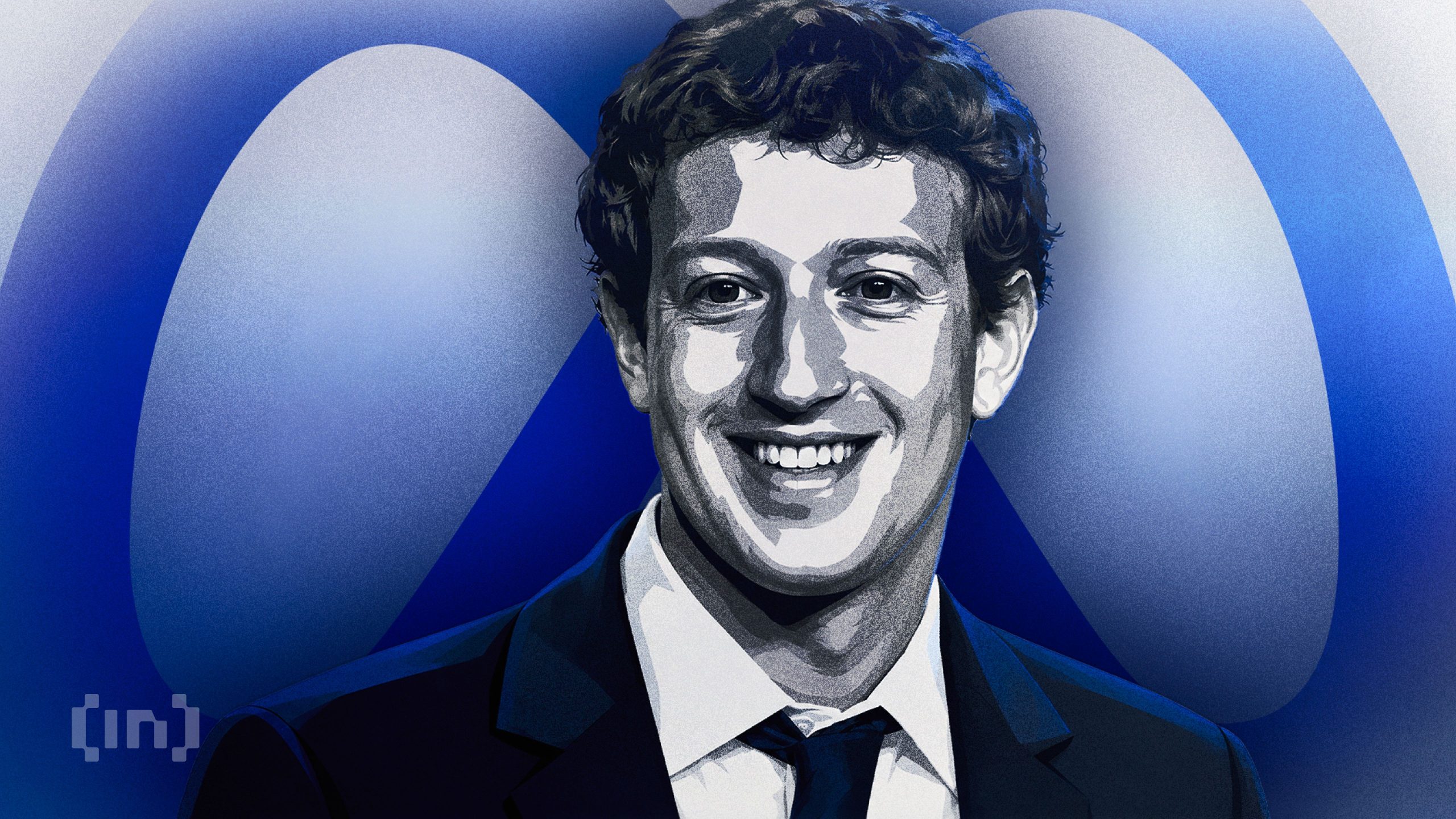

Nikita Bier, head of product at X, targeted Meta workers with a public recruitment pitch this week. He promised to match or beat any corporate snack budget the company could offer.
Meta CTO Andrew Bosworth admitted on an internal call that employee morale is near its worst ever. The May 2026 layoffs cut 8,000 jobs. Meta also forced roughly 7,000 more workers into AI units, giving them little say in the transition.
X Sees an Opening in Meta’s Morale Problem
Bier announced open roles for web and data engineers and data scientists. He aimed the message directly at workers he described as “neglected.”
His pitch was a direct dig at Meta’s crisis response. Rather than leading with salary, he zeroed in on the snack budget. That was the same perk Meta had scrambled to expand after morale collapsed. He pledged X would match or exceed whatever Meta could offer.
Workers on internal forums described Meta’s culture as “dead and depressing.” The core issue runs deeper than office perks, however. Applied AI, a division formed in March, absorbed around 6,500 engineers and product managers with little input from those transferred. Some employees compared it to a labor camp.
Meanwhile, 2026 tech layoff odds on prediction market Polymarket sit at 67%, with Meta’s situation among the factors traders cite. The Meta job cuts wiped out roughly 10% of its workforce in a single round.
Bier is no stranger to weighing in on Meta. He previously defended Mark Zuckerberg after backlash over a whistleblower documentary trailer. That move showed a pattern of engaging publicly with debates around Meta’s leadership and culture.
The post Who Needs Salary? X’s Nikita Bier Is Poaching Meta Talent With Better Snacks appeared first on BeInCrypto.
Amazon Web Services on Monday turned on AI traffic monetization inside AWS WAF, letting any site behind Amazon CloudFront charge AI agents per request in stablecoins through Coinbase's x402 protocol. It is the first time a hyperscale cloud has wired onchain settlement directly into its… Read the full story at The Defiant
Crypto World
CLARITY Act Reaches Senate Floor With House Ready to Move Fast; Seven-Democrat Math Becomes the Gate


The Digital Asset Market Clarity Act sits on the Senate Legislative Calendar as Calendar No. 423, eligible for a floor vote at any time leadership chooses to schedule one. House Agriculture digital-assets subcommittee chair Dusty Johnson said Thursday the House will move fast on a companion if the… Read the full story at The Defiant


Reform UK leader Nigel Farage has been threatened with a referral to the UK’s parliamentary authorities after he allegedly under-declared a private jet donation from billionaire crypto investor Christopher Harborne.
The threat came from Labour Chair Anna Turley, who wrote to Farage claiming that the donation he declared doesn’t match the market rates of private jet flights.
Farage took the private jet to the Chagos Islands earlier this year, where he attempted to undermine a UK sovereignty deal. He originally declared Harborne’s donation as £12,500 ($16,500), but later adjusted it to £25,000 ($33,500).
Turley claims that the cost of hiring the jet, and the 23-hour duration of his flight, mean his trip should’ve cost anywhere between £189,000 ($250,000) and £529,000 ($700,000).
She told Farage, “If you fail to provide anything less than a full and accurate account, I will be obliged to raise the matter with the Parliamentary authorities.”
Farage lobbied the Bank of England on crypto regulation
Turley then went after the controversial right-wing politician again, reportedly referring him to a UK financial regulatory body.
In this case, during a private meeting in September 2025, he allegedly urged Bank of England Governor Andrew Bailey to shelve plans for a state-backed stablecoin dubbed “Britcoin.”
One month later, Farage said at the crypto event Zebu Live that he would be “prepared to go to prison” in order to stop Britcoin, describing the plans for a state-backed stablecoin as “total and utter horror.”
The introduction of a state-backed stablecoin would dilute the private stablecoin market and, in doing so, reduce the value of Harborne’s 12% stake in multi-billion-dollar stablecoin giant Tether.
Read more: Nigel Farage aide George Cottrell bets US war will last four more months
Harborne’s lawyers told the Guardian that the story contained “a number of unsupported insinuations, hallucinations, and conspiracy theories bearing no basis in reality.”
Harborne has altogether given Reform UK a whopping £25 million ($33 million). By September 2025, Harborne had already donated £19 million ($25 million).
Reform UK loses key local election
One particular £5 million sum from Harborne, which Farage kept a secret, has already led to parliamentary authorities investigating the Reform UK leader.
This gift was made weeks before Farage U-turned and decided to stand in the general election. He claims he didn’t have to declare the sum as it was a personal gift given to him for security reasons and Brexit campaigning.
Farage has also been facing pressure this week outside of crypto.
Newsletter Democracy For Sale reported on Tuesday that his personal firm, Thorn in the Side Ltd, was breaking British company law by failing to file a confirmation statement and verify Farage’s ID.
To top it off, a Reform UK candidate lost in a key UK local election yesterday to Labour MP and Manchester Mayor Andy Burnham.
Read more: Reform UK isn’t sharing crypto wallets with UK regulators, report
It’s believed that Burnham may challenge Sir Keir Starmer’s position as prime minister and spark a leadership contest.
Got a tip? Send us an email securely via Protos Leaks. For more informed news and investigations, follow us on X, Bluesky, and Google News, or subscribe to our YouTube channel.
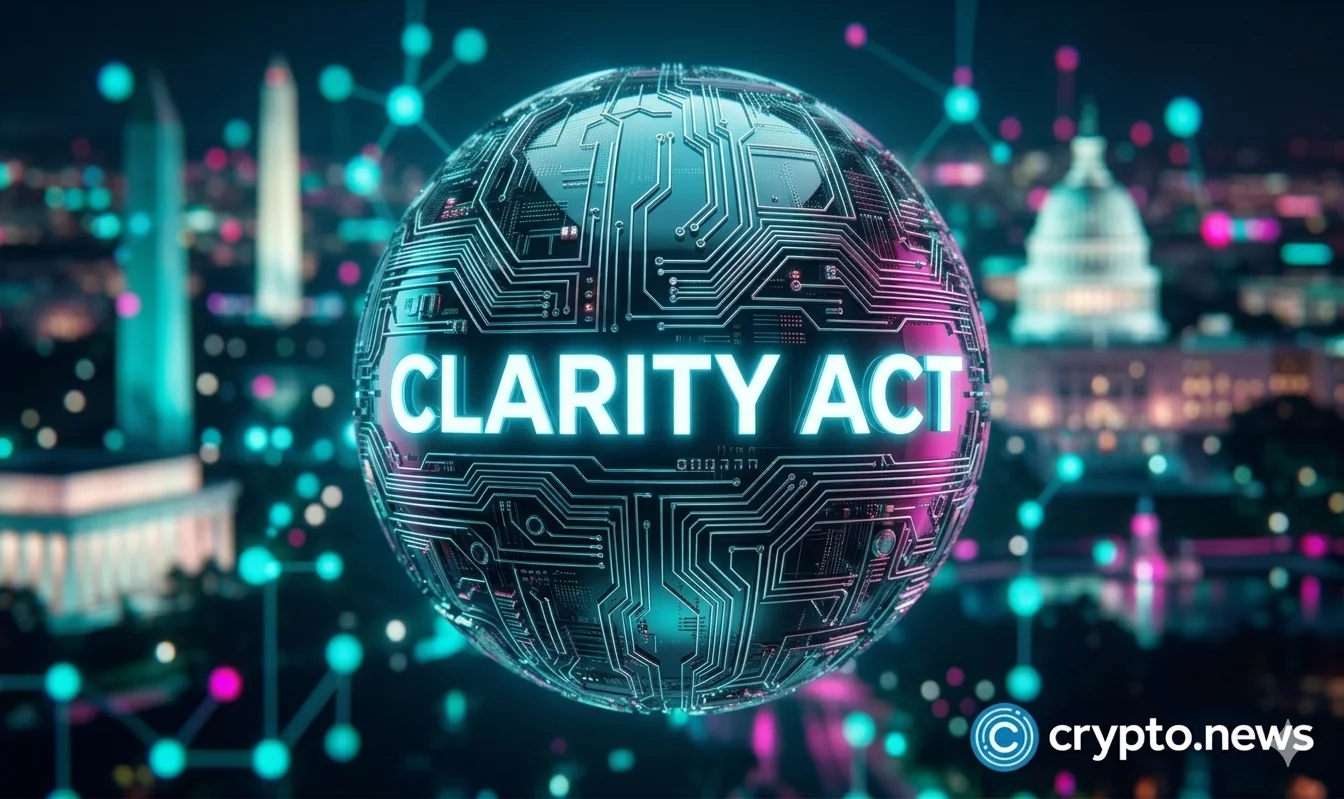
The CLARITY Act has entered another round of Senate negotiations, with Senate Agriculture Committee Chairman John Boozman saying that limited understanding of the bill among lawmakers remains one of the biggest obstacles to its progress.
Summary
- John Boozman says many senators still do not fully understand the CLARITY Act.
- David Nage estimates lawmakers and industry participants are 80%–85% aligned on the bill.
- Cynthia Lummis believes a Senate vote before the August recess is more likely than before July 4.
According to a report from Punchbowl News, senators met on Thursday, June 18, to discuss the next phase of work on the crypto market structure legislation. Much of the proposal falls under the jurisdiction of the Senate Agriculture Committee, placing the panel at the center of efforts to move the bill toward a floor vote.
Speaking after the meeting, Boozman said discussions were advancing but acknowledged that many lawmakers are still unfamiliar with the legislation. He stated that most members do not fully understand the bill, describing that knowledge gap as a challenge as negotiators attempt to build support across the Senate.
The comments arrive as congressional leaders face increasing pressure to resolve remaining issues before lawmakers leave Washington for the August recess. Several last-minute meetings have been scheduled as Senate offices continue working through outstanding provisions tied to digital asset regulation.
Senate support appears stronger than public debate suggests
While Boozman highlighted concerns about member awareness, separate discussions on Capitol Hill suggest that disagreements over the substance of the legislation may be narrower than they appear.
As previously reported by crypto.news, David Nage, managing director and portfolio manager at Arca, said conversations with Senate offices led him to conclude that lawmakers and industry participants are roughly 80% to 85% aligned on the core elements of the bill.
In Nage’s assessment, stablecoin yield provisions no longer rank among the most contentious issues, despite continued criticism from JPMorgan CEO Jamie Dimon. Instead, Nage said attention has increasingly turned toward ethics and conflict-of-interest rules governing government officials involved in crypto-related business activities.
Following discussions with congressional staff, Nage stated that lawmakers are largely debating how such restrictions should be implemented rather than whether they should exist. He described the remaining divide as a political and enforcement matter rather than a disagreement over digital asset market structure itself.
Under Nage’s base-case scenario, lawmakers would settle the ethics language and reconcile competing proposals in the coming weeks, allowing the legislation to reach the Senate floor after Congress returns from recess on July 13.
Senate timeline remains the key uncertainty
Despite growing optimism from some supporters, the expected timing of passage remains unsettled.
During a recent interview with FOX Business, Senator Bill Hagerty said he hopes Congress can complete work on the legislation before the July 4 recess. Hagerty argued that the measure would provide the regulatory certainty needed for the U.S. digital asset sector to expand domestically rather than abroad.
Earlier, White House crypto advisor Patrick Witt also expressed optimism that lawmakers could approve the bill by Independence Day.
Other lawmakers have pointed to a longer timeline. Senator Cynthia Lummis has said a Senate floor vote before the August recess appears more likely than passage before July 4. Lummis has also noted that the legislation includes $150 million in funding intended to combat illicit cryptocurrency activity.
Supporters of the proposal contend that the bill would define the responsibilities of the Securities and Exchange Commission and the Commodity Futures Trading Commission while establishing compliance standards for digital asset firms.
Lummis has further warned that if Congress fails to advance market structure legislation during the current legislative window, meaningful action on the issue could be postponed until 2030.
SpaceX’s blockbuster public debut has pushed Elon Musk’s net worth above $1 trillion while creating a new class of billionaires among the company’s earliest investors, executives, and institutional backers.
Summary
- Elon Musk’s fortune climbed above $1 trillion after SpaceX’s IPO, briefly surpassing Bitcoin’s market value.
- Early investors, including Valor Equity, Founders Fund, Alphabet, and Sequoia recorded tens of billions in gains.
- SpaceX executives and employees also benefited, while the company explores a potential $20 billion bond sale.
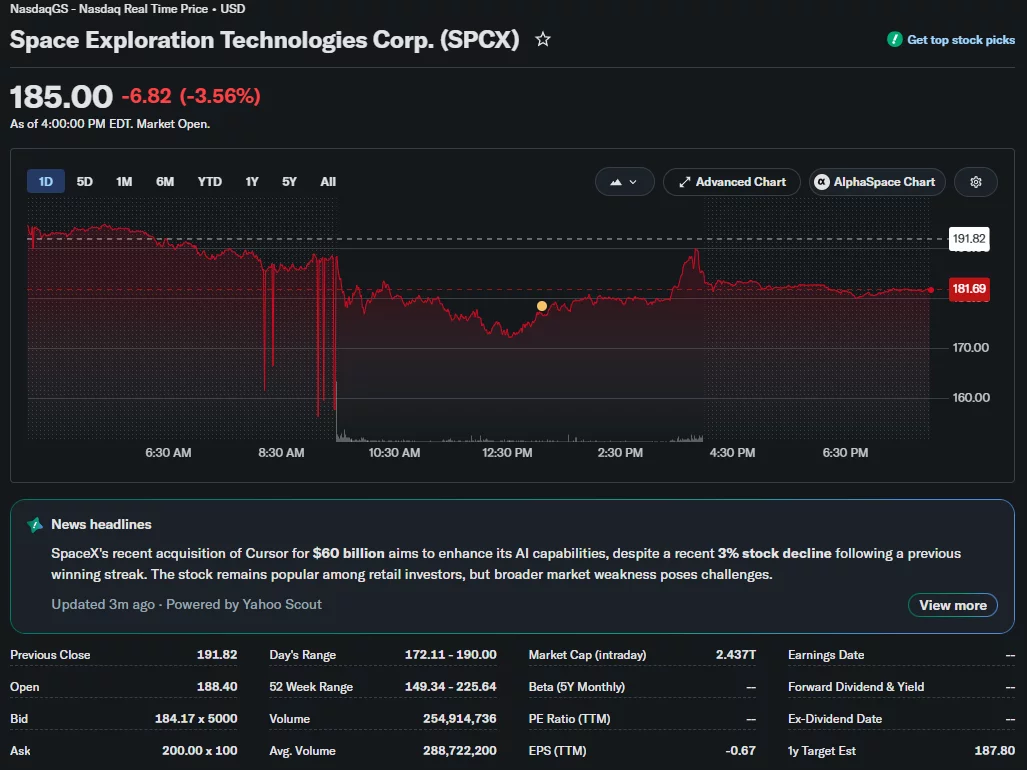
According to CNBC, SpaceX shares remained about 37% above their $135 IPO price even after retreating from post-listing highs, leaving the company with a market capitalization of roughly $2.43 trillion. The valuation surge briefly lifted SpaceX above Amazon and, for a short period, Microsoft, dramatically increasing the value of long-held stakes across its shareholder base.
Before the listing, crypto.news reported that retail investors rushed to secure allocations in the offering, with some reportedly seeking personal and bank loans as demand for shares far exceeded available supply. The scramble unfolded while SpaceX was preparing to enter public markets at a valuation of roughly $1.75 trillion.
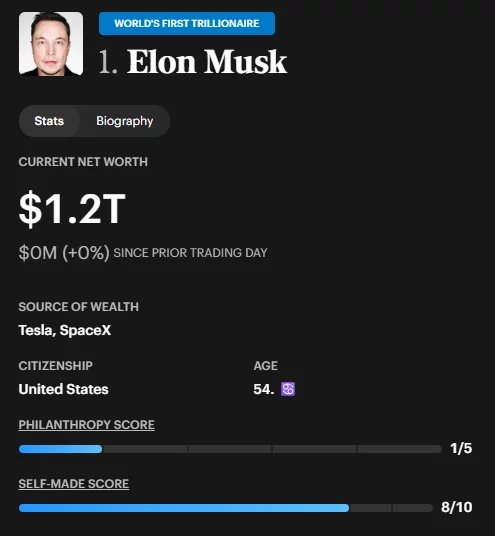
For Musk, who controlled about 42% of SpaceX at the time of the offering, the gains were historic. Estimates cited by multiple reports place the value of his SpaceX holdings at more than $750 billion following the IPO. When combined with his interests in Tesla and xAI, several wealth trackers estimated Musk’s net worth briefly reached nearly $1.4 trillion on June 16 before falling back to roughly $1.2 trillion, making him the first person to surpass the trillion-dollar mark.
During the rally, Yahoo Finance data showed SpaceX shares reaching an intraday high of about $225.84 on June 16, pushing the company’s valuation close to $3 trillion. As crypto.news reported earlier, the surge briefly lifted the value of Musk’s holdings above Bitcoin’s market capitalization of roughly $1.31 trillion at the time.
The jump in wealth later drew political attention after Senator Elizabeth Warren argued that the financial system disproportionately rewards the wealthiest Americans while many households continue facing rising costs.
Early investors have emerged as the biggest winners
Among the largest beneficiaries is Antonio Gracias, founder of Valor Equity Partners and a longtime SpaceX board member. CNBC reported that Valor’s SpaceX stake is worth approximately $96.6 billion, although most of those holdings belong to the firm’s clients. Gracias, who has backed Musk’s ventures for years, has seen the value of his investment rise alongside SpaceX’s rapid growth.
Another major winner is Peter Thiel’s Founders Fund. The venture firm became SpaceX’s first institutional investor in 2008, investing while the company was recovering from multiple Falcon launch failures. According to investment records cited in reports following the IPO, Founders Fund invested roughly $600 million across several funding rounds and built a stake of around 3%, which is now worth more than $50 billion.
Alphabet has also recorded one of the largest gains. Google invested approximately $900 million in SpaceX alongside Fidelity in 2015, acquiring a stake that was later diluted to about 6%. Based on SpaceX’s post-IPO valuation, reports estimate Alphabet’s holding at roughly $132 billion, representing a return of nearly 147 times its original investment.
Several other investors also benefited from the listing. Reports indicate that Sequoia Capital’s roughly 1.5% stake has grown to more than $20 billion after investments totaling around $2 billion, while Kingdom Holding, controlled by Saudi Prince Alwaleed bin Talal, holds approximately 42.4 million shares valued at nearly $7 billion.
Executives and employees have shared in the windfall
Beyond institutional investors, the IPO has substantially increased the wealth of long-serving executives. CNBC estimates that SpaceX President and CEO Gwynne Shotwell holds a stake worth about $2.4 billion, making her one of the company’s largest individual shareholders.
Speaking to CNBC on the day of the IPO, Shotwell described her role as supporting Musk’s vision through operational execution while he focuses on strategy and engineering. Former SpaceX engineer Nathan Silvernail told CNBC that Shotwell has played a central role in managing customers, contracts, and daily business operations.
Chief Financial Officer Bret Johnsen has also joined the billionaire ranks. CNBC reported that the executive, who joined SpaceX in 2011 and oversees the company’s financial strategy, holds shares worth roughly $1.2 billion.
The gains have extended well beyond senior leadership. Reports on employee compensation programs indicate that thousands of current and former workers benefited from stock options accumulated over years of private ownership. One example cited in post-IPO coverage involved welder Juan Hernandez, whose employee stock awards reportedly grew from an initial value of about $10,000 to nearly $1 million after the listing.
While the IPO created substantial wealth for investors and employees, some of the initial gains have moderated. SpaceX shares later fell more than 9% from their post-listing highs, trimming Elon Musk’s fortune from its peak as the stock retreated from record levels.
Even as the stock pulled back, Bloomberg reported that SpaceX has explored a bond offering worth as much as $20 billion to refinance a bridge loan due in September 2027. According to Bloomberg, the proposed transaction could become one of the largest corporate debt offerings in recent years, although its final size and timing remain under discussion.
Despite the retreat from peak valuations, SpaceX’s market debut remains one of the largest wealth-creation events in recent corporate history. The listing generated billions of dollars in gains for early venture investors, institutional backers, executives, and employees who accumulated shares during the company’s years as a private business.


A smart contract is not smart, and it is barely a contract. It is a small program that lives on a blockchain and runs itself when its conditions are met, with no person to enforce it and no way to undo it. Understanding this one idea unlocks almost everything in crypto.
Summary
- Smart contracts are self executing programs on a blockchain that carry out predefined actions without requiring a middleman or central authority.
- Ethereum turned the concept into a practical technology, enabling applications such as DeFi platforms, NFTs, tokens, and decentralized apps.
- While smart contracts offer automation, transparency, and reliability, coding flaws or faulty external data can lead to irreversible losses.
A smart contract is a program stored on a blockchain that automatically executes when certain conditions are met, with no person, company, or middleman needed to carry it out. That is the whole concept, and it is simpler than the intimidating name suggests, because a smart contract is not artificial intelligence and it is not really a legal contract in the traditional sense.
It is code, a set of instructions that says “if this happens, then do that,” running on a network that no single party controls, in a way that cannot be stopped, censored, or reversed once it is set in motion. Almost everything interesting in crypto beyond simply sending coins, decentralized finance, NFTs, tokens, decentralized applications, runs on smart contracts, which makes understanding them the key that unlocks how the modern crypto world actually works.
This guide explains smart contracts in plain English, from the ground up, with no coding or technical background assumed. It covers what a smart contract actually is and where the idea came from, the vending-machine analogy that makes it click, how smart contracts actually work under the hood, what they are used for across crypto, their real advantages, and, just as importantly, their serious risks and limitations, because the same properties that make smart contracts powerful also make them dangerous when they go wrong.
By the end you will understand not just the definition but the deeper idea, why “code is law” is both the promise and the peril of smart contracts, and why this single invention reshaped what blockchains could do.
What a smart contract actually is
The name causes more confusion than the concept deserves, so it helps to take it apart before building it back up.
A smart contract is “smart” only in the sense that it executes automatically; the word does not imply intelligence or any kind of thinking, and the person who coined the term was careful to say so. It is a “contract” only in the loose sense that it encodes an agreement, a set of conditions and the actions that follow from it, but it is not a legal document sitting in a drawer waiting for a court to enforce it.
The clearest way to describe it is what it actually is: execution logic, a small computer program that lives on a blockchain and runs by itself when its predefined conditions are satisfied. It takes an input, checks whether the conditions are met, and if they are, it performs the actions it was programmed to perform, moving funds, updating records, transferring ownership, issuing a token, without any human stepping in to make it happen.
The idea is older than blockchain. A computer scientist and legal scholar named Nick Szabo proposed the concept in the 1990s, defining a smart contract as a set of promises specified in digital form and the protocols within which the parties perform on those promises, and he was explicit that “smart” did not mean intelligent.
For years the idea was theoretical, because there was no platform on which such self-executing agreements could run reliably without a trusted party to host them. Bitcoin, launched in 2009, introduced a limited form of programmability, but it was the launch of Ethereum in 2015 that made fully featured smart contracts a practical reality, providing a blockchain designed from the start to run arbitrary programs.
Ethereum turned Szabo’s theoretical idea into working infrastructure, and most of the smart contracts in use today run on Ethereum or on networks built on the same model. The concept waited two decades for a platform that could run it without anyone in charge, and the blockchain was that platform.
The vending machine: the analogy that makes it click
The single best way to understand a smart contract is through an analogy that the concept’s own inventor used, because it captures the essential idea perfectly.
Think of a vending machine. You walk up, insert the right amount of money, press the button for your selection, and the machine dispenses your item, all without a cashier, a clerk, or any human involved in the transaction. The machine enforces the agreement automatically: if you put in enough money and make a valid selection, you get the product, and if you do not put in enough, you get nothing.
The rules are built into the machine, they execute on their own when the conditions are met, and there is no person you need to trust or negotiate with, because the machine simply does what it was built to do. A smart contract is the digital, blockchain-based version of exactly this: a mechanism that holds a set of rules, checks whether the conditions are satisfied, and automatically delivers the outcome, with no intermediary required.
The analogy illuminates the key properties. The vending machine is automatic, it acts without a human; it is deterministic, the same input always produces the same output; and it is trustless in the sense that you do not need to trust the machine’s owner to be honest, because the machine’s behavior is fixed by its mechanism, not by anyone’s goodwill in the moment. A smart contract shares all three properties and adds the powers of a blockchain: it can hold and move large amounts of value, it runs on a network no single party controls so no one can secretly alter its rules, and its actions are permanently recorded and visible.
Where a vending machine dispenses a candy bar, a smart contract can release thousands of dollars, transfer ownership of an asset, or trigger a chain of further actions, all on the same simple principle of automatic execution when conditions are met. The vending machine is the intuition; the smart contract is that intuition scaled up to handle money, ownership, and complex agreements with no one in charge.
How a smart contract actually works
Going one level deeper, it helps to understand the mechanics, because the way a smart contract runs explains both its power and its dangers.
A smart contract is written as code, typically in a programming language designed for the purpose, and then deployed onto a blockchain, where it is stored at a specific address much like a wallet has an address. Once deployed, the contract lives on the blockchain permanently, its code visible to anyone and its rules fixed, and it sits there waiting to be used.
When someone wants to interact with it, they send a transaction to the contract’s address, providing whatever input the contract requires, and the network’s computers, the thousands of nodes that maintain the blockchain, all run the contract’s code with that input. Because every node runs the same code on the same input, they all arrive at the same result, which is how the network agrees on the outcome without any central authority, and that agreed result, the funds moved, the ownership transferred, the record updated, is written permanently to the blockchain.
Several features of this process are worth understanding because they shape everything about how smart contracts behave. First, execution costs money: running a contract’s code consumes computational resources, and the user pays a fee, often called gas, to compensate the network for that work, which means complex contracts that do more cost more to run. Second, execution is deterministic and verifiable: because every node runs the same code and reaches the same answer, anyone can verify that the contract did exactly what its code specifies, with no hidden behavior.
Third, and most consequentially, once a contract is deployed, its code generally cannot be changed: the rules are fixed at deployment, and the contract will do exactly what it was programmed to do, forever, which is a strength when the code is correct and a catastrophe when it contains a flaw. This combination, code that runs automatically across a decentralized network, costs a fee to execute, produces verifiable results, and cannot be altered after deployment, is what makes smart contracts both remarkably powerful and unforgiving of error. The machine does precisely what it was built to do, whether or not that is what its creators intended.
What smart contracts are used for
The abstract concept becomes concrete when you see what smart contracts actually do, because they are the engine behind nearly every crypto application beyond simple payments.
Decentralized finance, or DeFi, is where smart contracts found their fullest expression. Decentralized exchanges like Uniswap run entirely on smart contracts, handling the pools of capital that enable trading and settling trades automatically through code rather than through a traditional order book or a company.
Lending protocols like Aave use smart contracts to let people borrow against crypto collateral with no manual approval and no loan officer, with the contract automatically enforcing the loan terms, holding the collateral, and liquidating it if the borrower’s position falls below the required threshold. Stablecoins rely on smart contracts to manage the issuance and redemption of tokens and to maintain their peg. In each case, the smart contract replaces the bank, the broker, or the clearinghouse, performing the function that an institution would traditionally perform, but doing it automatically through code that anyone can inspect.
Beyond DeFi, smart contracts power much of the rest of crypto. Every NFT, a token representing ownership of a unique digital item, is governed by a smart contract that defines the token, tracks who owns it, and handles transfers when it is bought or sold on a marketplace. Tokens of all kinds, the thousands of assets that run on networks like Ethereum, are themselves smart contracts that define the token’s supply and rules.
Decentralized applications, or dApps, are built from smart contracts that provide their backend logic, enabling everything from games to social platforms to run without a central server. Decentralized autonomous organizations use smart contracts to manage shared funds and to execute the outcomes of member votes automatically. The common thread is that wherever crypto replaces a trusted intermediary, a bank, an exchange, a registrar, a voting authority, with automatic, transparent code, a smart contract is doing the work. They are the building blocks from which the entire programmable-money ecosystem is constructed, which is why understanding them illuminates so much of crypto at once.
The advantages: why smart contracts matter
The reasons smart contracts have become foundational come down to a set of real advantages over the traditional way agreements are made and enforced.
The first advantage is the removal of intermediaries. Traditional agreements often require trusted third parties, banks to hold and transfer money, brokers to execute trades, lawyers and courts to enforce terms, and each intermediary adds cost, delay, and the need to trust that party. A smart contract performs the enforcement itself, automatically and without a middleman, which can make transactions faster and cheaper and removes the dependence on any single trusted party.
The second advantage is transparency and verifiability: a smart contract’s code is visible on the blockchain, so anyone can inspect exactly what it will do, and its execution is verifiable, so anyone can confirm it did what it was supposed to, which is a level of openness traditional agreements rarely offer. You do not have to trust a promise; you can read the code that will keep it.
The third advantage is automation and reliability. A smart contract executes exactly as written, every time, without the delays, errors, or discretion of human processing, which means an agreement encoded in a smart contract carries itself out the moment its conditions are met, with no waiting and no possibility of a party simply refusing to perform.
This combination, no intermediary, full transparency, and automatic reliable execution, is what makes smart contracts powerful, because it lets people transact and cooperate without needing to trust each other or any central authority, relying instead on code that anyone can verify and that runs itself. For the first time, agreements can enforce themselves across a global network with no one in charge, and that capability is the foundation on which the entire world of decentralized applications is built. The advantages are real and significant, and they explain why smart contracts moved from a theoretical idea to the engine of an industry.
The risks: why “code is law” cuts both ways
Here is where honesty matters most, because the same properties that make smart contracts powerful make them truly dangerous, and anyone using them needs to understand the risks as clearly as the benefits.
The central risk follows directly from a central strength: smart contracts are immutable and self-executing, which means that if the code contains a bug or a vulnerability, that flaw executes automatically too, and there is often no way to stop it or reverse the damage. A traditional contract with a mistake can be renegotiated, and a fraudulent transaction at a bank can sometimes be reversed, but a smart contract does exactly what its code says, and if its code says to send all the funds to an attacker who found a loophole, it sends all the funds, irreversibly.
The history of crypto is full of expensive examples: hundreds of millions of dollars have been lost to smart-contract bugs and exploits, where attackers found flaws in the code and the contracts dutifully executed the attackers’ will because that is what the code, as written, permitted. The phrase “code is law” captures this: the code is the final authority, and it will enforce whatever it actually says, not what its creators meant it to say.
Several specific risks flow from this. Smart-contract bugs are flaws in the code that attackers can exploit, and because the code cannot easily be changed after deployment, these flaws can be catastrophic and permanent. Bad inputs and faulty external data are another danger, since many contracts rely on outside information delivered by oracles, and if that data is wrong or manipulated, the contract executes on false premises, which can trigger cascading liquidations or other harm.
Complexity compounds the problem, because the more a contract does, the more places a flaw can hide, and the harder it is to verify that the code is safe. And scams exploit the trust people place in code, with malicious contracts written to look legitimate while containing hidden behavior that drains the funds of anyone who interacts with them. The lesson is not that smart contracts are bad, but that “trustless” does not mean “riskless”: you no longer have to trust a person, but you do have to trust that the code is correct, and code written by humans contains human errors. Auditing, caution, and using well-tested, battle-hardened contracts instead of unknown ones are the practical defenses, but the underlying truth remains that a smart contract will do precisely what it is written to do, and getting that writing exactly right is hard.
The limitations worth knowing
Beyond the risks, smart contracts have inherent limitations that shape what they can and cannot do, and understanding these prevents overestimating them.
A smart contract can only see and act on information that exists on its own blockchain. It cannot natively know anything about the outside world, a price, a weather reading, the result of an event, because it is sealed inside the blockchain, which is why oracles exist to feed external data in, and that dependence on oracles is itself a source of risk and limitation.
A smart contract also cannot reach out and act in the physical world; it can move digital assets and update digital records, but it cannot make a physical delivery or enforce a real-world outcome on its own. And a smart contract is only as good as its code: it has no judgment, no ability to interpret intent, and no capacity to handle situations its programmers did not anticipate, so it executes the letter of its code with no understanding of the spirit behind it, which is why an unforeseen edge case can produce an outcome no one wanted.
These limitations matter because they define the boundary between what smart contracts are genuinely good for and where they fall short. They excel at automating clear, well-defined, on-chain agreements where the conditions and outcomes can be precisely specified in code, which is why they work so well for financial applications like trading, lending, and token transfers.
They struggle with anything requiring judgment, interpretation, real-world enforcement, or reliable outside information, because those need capabilities a self-contained piece of code does not have. Understanding the limitations keeps the technology in perspective: a smart contract is a powerful tool for automating precise digital agreements without a middleman, not a magical replacement for all human agreements, and its strengths and weaknesses both flow from the same root, that it is rigid, automatic code running on a sealed, decentralized network. Knowing where that root helps and where it hinders is the difference between using smart contracts well and expecting more from them than they can deliver.
The code that changed crypto
A smart contract is, in the end, a simple idea with profound consequences: a small program that lives on a blockchain and runs itself when its conditions are met, enforcing an agreement automatically with no person, company, or court required. The vending machine captures the intuition, money in, product out, no cashier, and the blockchain scales that intuition up to handle money, ownership, and complex agreements across a global network that no one controls. From this single concept flows nearly everything in crypto beyond simple payments: the decentralized exchanges, the lending protocols, the stablecoins, the NFTs, the tokens, the decentralized applications, all of them built from smart contracts doing automatically what institutions used to do.
The power and the peril come from the same source. Because a smart contract executes exactly as written, automatically and irreversibly, it can replace trusted intermediaries with verifiable code, which is the breakthrough that made decentralized finance and the rest of the ecosystem possible. But that same rigidity means a flaw in the code executes just as faithfully as a feature, with no one to stop it and no way to reverse it, which is why hundreds of millions have been lost to bugs and exploits and why “code is law” is a warning as much as a promise. Smart contracts removed the need to trust people and replaced it with the need to trust code, and code, written by humans, is only as good as the humans who wrote it.
Understanding that tradeoff, the extraordinary power of self-executing agreements and the real danger of their unforgiving precision, is understanding the invention that turned blockchains from simple ledgers into the programmable foundation of an entire industry. The contract is not smart, and it is barely a contract, but it changed what money and agreements could be.
Frequently Asked Questions
What is a smart contract in simple terms?
A smart contract is a program stored on a blockchain that automatically executes when certain conditions are met, with no person or middleman needed to carry it out. It works like a vending machine: provide the right input, and the code automatically delivers the outcome, moving funds, transferring ownership, or updating records. It is “smart” only in that it runs automatically, not because it is intelligent, and it is “code, not a legal document,” which executes itself across a decentralized network.
Who invented smart contracts?
The concept was proposed by computer scientist and legal scholar Nick Szabo in the 1990s, who defined a smart contract as a set of promises in digital form and was explicit that “smart” did not mean intelligent. The idea was theoretical until a platform existed to run it. Bitcoin introduced limited programmability in 2009, but Ethereum, launched in 2015, made fully featured smart contracts a practical reality, and most smart contracts today run on Ethereum or similar networks.
How does a smart contract actually work?
A smart contract is written as code and deployed to a blockchain at a specific address, where it lives permanently with its rules fixed. When someone sends a transaction to interact with it, the network’s many computers all run the contract’s code on the input and agree on the result, which is written permanently to the blockchain. Execution costs a fee called gas, the result is verifiable by anyone, and once deployed the code generally cannot be changed.
What are smart contracts used for?
They power nearly all of crypto beyond simple payments. In decentralized finance, they run exchanges like Uniswap and lending protocols like Aave, replacing brokers and banks. Every NFT and most tokens are smart contracts defining ownership and rules. Decentralized applications use them for backend logic, and decentralized organizations use them to manage funds and execute votes. Wherever crypto replaces a trusted intermediary with automatic, transparent code, a smart contract is doing the work.
What are the risks of smart contracts?
Because smart contracts are immutable and self-executing, a bug or vulnerability in the code executes automatically too, often with no way to stop or reverse it, and hundreds of millions of dollars have been lost to such exploits. Risks include code bugs, manipulated oracle data feeding false information, complexity hiding flaws, and malicious contracts disguised as legitimate ones. “Trustless” does not mean “riskless”: you no longer trust a person, but you must trust that the code is correct, and code contains human errors.
What does “code is law” mean?
It means that with a smart contract, the code is the final authority and will enforce exactly what it actually says, not what its creators intended. A traditional contract with a mistake can be renegotiated and some fraudulent bank transactions can be reversed, but a smart contract does precisely what its code specifies, irreversibly. If the code contains a flaw that lets an attacker drain funds, the contract executes that flaw faithfully. “Code is law” is both the promise of reliable automation and the peril of unforgiving precision.
This guide is educational information, not financial or technical advice. Interacting with smart contracts carries real risk; use well-tested, audited contracts and never commit more than you can afford to lose.

Luka Doncic Says Championship Matters More Than Awards as Lakers Face Pivotal Offseason

CME Group to Sue CFTC Over Perpetual Futures Approval, Citing Dodd-Frank Swaps Definition

The Zoe Saldana Assassin Movie On Netflix That Never Lets Up

Blockchain.com files with SEC for U.S. IPO

No Jackpot Winner as $257 Million Prize Rolls Over to $269 Million Monday Draw

Israel says it has killed new Hamas military leader in Gaza City airstrikes

Luxury Sirf Dikhava Nahi The Ultimate Financial Guide #InvestmentStrategy #MoneyManagement #YTShorts

Crypto Market-la Iniku Ena Update? | June 19, 2026 #crypto #cryptocurrency #bitcoin #ethereum

#shortsfeed #shorts #shortvideo #gk #finance
-
 Business5 days ago
No Jackpot Winner as $257 Million Prize Rolls Over to $269 Million Monday Draw
-

 Fashion7 days ago
Weekend Open Thread: Tuckernuck – Corporette.com
-
 Crypto World5 days ago
Zimbabwe Requires Crypto Businesses to Register Annually Under New FIU Regulations
-

 Crypto World6 days ago
Bitget enters Argentina’s regulated crypto market through PSAV registration
-

 Tech7 days ago
NanoClaw integrates JFrog registries to secure AI agent downloads
-

 NewsBeat7 days ago
FBI searches office of Ohio voter registration group
-
 Entertainment5 days ago
Matt Damon’s Viral Sci-Fi Thriller Has Taken Over HBO Max
-

 Business5 days ago
Anthropic staff to meet White House officials next week, Axios reports
-

 Tech5 days ago
As AI companies race to go public, who else is along for the ride?
-
 Crypto World5 days ago
Bitcoin could crash to $48,000, if this historical pattern is triggered
-

 Politics5 days ago
“Israel’s” ban on ICRC visits ruled illegal, but Knesset moves to stop them permanently
-
 NewsBeat5 days ago
Warning of disruption as Cardiff Crossrail works to start
-

 News Videos5 days ago
Financial Accounting | Last Day Revision Strategy and Booster | CMA Inter – June 2026
-
 NewsBeat5 days ago
Tributes to former deputy head teacher at Cambridge school among death and funeral notices
-
 NewsBeat5 days ago
what doctors are seeing in ebike crashes
-

 Entertainment6 days ago
Deion Sanders Shares Powerful Post After Viral Advice To Deiondra
-
 Entertainment5 days ago
Kate Middleton Glare Goes Viral After Kids Booed At Royal Event
-
 Crypto World5 days ago
XRP ETFs Outperform As Bitcoin And Ethereum Funds Extend Outflow Trend
-
 Crypto World5 days ago
Market Preview: SpaceX (SPCX) IPO Record, Federal Reserve Meeting, and Iran Nuclear Agreement
-

 Business5 days ago
Invesco Quality Income Fund Q1 2026 Commentary
You must be logged in to post a comment Login