
Crypto World
Wintermute to pour $1B into AI, high-frequency trading amid TradFi expansion: Report



Wintermute will reportedly invest $1 billion in AI infrastructure and high-frequency trading as part of its expansion into traditional finance.



Bitget has expanded its Stock Dual Investment lineup from six to more than 20 U.S. stock and ETF-linked tokens, with settlement now set for 11:30 p.m. UTC+8.
Summary
- More than 20 rTokens now support Bitget’s Buy Low and Sell High strategies.
- Supported assets include tokens linked to Nvidia, Tesla, Apple, Coinbase, Strategy and two leveraged ETFs.
- Stock Dual Investment settlement now occurs at 11:30 p.m. UTC+8, after regular U.S. trading begins.
- An invitation-only deposit promotion offers up to 3,000 USDT in non-withdrawable trading bonuses.
Bitget announced on Aug. 14 that its expanded lineup includes tokens tied to major technology stocks, crypto-linked companies, semiconductor businesses, and exchange-traded funds.
The supported list covers rMU, rSNDK, rNVDA, rCRCL, rSPCX, rTSLA, rMRVL, rAMZN, rGOOGL, rMSTR, rINTC, rMETA, rAMD, rSOXL, rTSM, rAAPL, rCOIN, rAAOI, rSOXS, rNBIS, and rWDC. Bitget said it plans to add more underlying assets but did not provide a schedule.
Among the new targets are tokens tracking Nvidia, Tesla, Apple, Meta, Advanced Micro Devices, Intel, and Taiwan Semiconductor Manufacturing Company. Crypto-related choices include tokens linked to Coinbase, Circle, and Strategy, while rSOXL and rSOXS track leveraged semiconductor ETFs.
Bitget Stock Dual Investment adds more targets
Stock Dual Investment first went live on July 25 with six supported products: rSPCXUSDT, rNVDAUSDT, rGOOGLUSDT, rAAPLUSDT, rCOINUSDT, and rAMZNUSDT. The Aug. 14 update has raised the selection to at least 21 underlying assets in less than a month.
Under the product’s Buy Low option, a user subscribes with USDT and chooses a target price and settlement date. If the linked token’s settlement price is at or below the target at expiry, Bitget buys the token for the user at the agreed price and pays the applicable interest.
When the settlement price remains above the target, the user receives the USDT principal and interest without a token conversion, according to Bitget’s product terms. The displayed annual percentage rate and available subscription amount can change and are shown on the product page when an order is placed.
For Sell High products, users commit the relevant stock token instead of USDT. If its settlement price reaches or exceeds the target at expiry, Bitget converts the position at that target price and adds the applicable interest. When the target is not reached, the user keeps the token and receives interest in the settlement asset specified by the product.
Bitget classifies Dual Investment as a non-principal-guaranteed product. A user may therefore receive a different asset at maturity, and the agreed conversion price can become less favorable than the open-market price before settlement. Subscription funds are also locked until the selected maturity date.
The new settlement time follows the U.S. market open
As part of the update, Bitget moved the settlement time for stock-linked products to 11:30 p.m. UTC+8, or 11 a.m. Eastern Daylight Time. The new schedule places settlement about 90 minutes after the regular Nasdaq and New York Stock Exchange sessions open at 9:30 a.m. ET.
Bitget said the adjustment lets the settlement process account for price changes during the opening portion of the U.S. session. Opening hours often bring company announcements, analyst actions, and the first reaction to overnight news into the cash market, although the exchange did not release data comparing outcomes under its previous and revised schedules.
Stock Dual Investment does not provide the same experience as buying a U.S.-listed share through a conventional brokerage account. The products use rTokens linked to the value of U.S. securities, and the final result depends on the chosen target price, maturity date, and conversion rules.
Bitget introduced its Reality platform in May with rTokens that it said were backed 1:1 by shares held through regulated brokerage and custody arrangements. As previously covered by crypto.news, the exchange said Reality would support stablecoin-based minting and redemption, dividend distributions, and tokens tied to U.S. stocks and ETFs.
In July, Bitget placed more than 100 rTokens and over 370 other eligible assets inside a unified margin system. Eligible tokens can support borrowing and margin obligations, although Bitget warned that falling collateral values may lead to margin calls or liquidation.
U.S. access still depends on regulatory approvals
Despite the product’s focus on American securities, Bitget has not announced that Stock Dual Investment is available to U.S. residents. Product access depends on account eligibility and regional rules, making the distinction important for American readers.
Bitget CEO Gracy Chen said in July that the company intends to establish an independent U.S. entity and obtain money-transmitter, derivatives, and broker-dealer approvals before serving customers in the country. The exchange has not disclosed a launch date, and Chen said its entry would proceed regardless of whether Congress passes the CLARITY Act.
During the same discussion, Chen said tokenized traditional assets represented between 20% and 30% of Bitget’s spot volume in the previous quarter. She also reported that 52% of users held both stocks and crypto, while the platform’s tokenized-stock products had accumulated more than $100 million.
Bitget’s planned U.S. expansion could require a product structure different from the offshore offering. According to Chen, the company wants the necessary approvals in place before launching locally, where securities, derivatives, and broker-dealer rules may determine which stock-linked services it can provide.
The exchange also operates Stock+, a separate product through which eligible users can buy and hold real U.S. stocks and ETFs. Bitget’s documentation distinguishes this broker-style service from rTokens, which provide tokenized economic exposure rather than the same ownership structure as registered shares.
Two Bitget promotions carry separate eligibility rules
Alongside the product expansion, Bitget is running an invitation-only Dual Investment bonus campaign through Aug. 21. Eligible users must register before completing the required deposit tasks and must not have traded a Dual Investment product since Jan. 1, 2026.
A net deposit of at least 1,000 USDT qualifies for a 1,000 USDT trading bonus voucher, while reaching 30,000 USDT adds another 2,000 USDT. The total available to one user is 3,000 USDT, drawn from a campaign pool of 1 million USDT and distributed on a first-come, first-served basis.
Bitget calculates net deposits by subtracting total withdrawals during the campaign from USDT deposits made after registration. The exchange said withdrawals of other cryptocurrencies may also affect its final calculation.
Bonus vouchers can only be used with designated Buy Low products, and one voucher is permitted per order. Users must contribute at least the minimum subscription amount from their own funds, while the voucher carries a three-day trial period.
The bonus principal cannot be withdrawn, transferred, or exchanged for cash. Bitget said users retain the earnings generated during the trial, while only the portion funded with their own money is subject to conversion based on the settlement price.
A second promotion runs from Aug. 14 through Aug. 28 and is open to new and existing Dual Investment users without registration. Cumulative subscriptions of 50,000, 100,000, 500,000, 1 million, and 3 million USDT qualify users for limited merchandise tiers ranging from a gym bag to a camping set.
Bitget said only 80 gym bags, 40 keyboards, 30 suitcases, 20 commemorative gold coins, and five camping sets are available. Rewards will go to qualifying users in the order they reach each threshold, and recipients must answer Bitget’s request for shipping details within five working days.
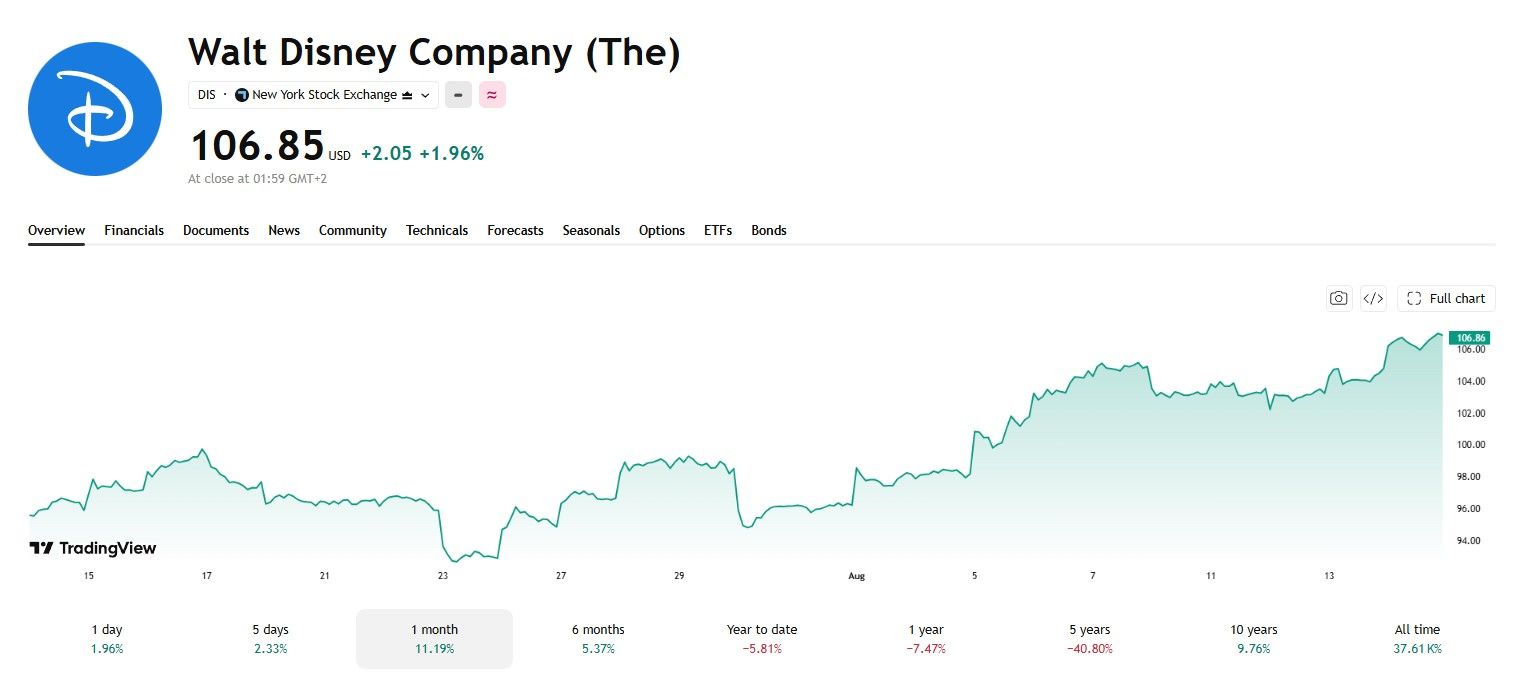
Disney stock closed at $106.85 on Friday, up 1.96% for the day and 11.19% over the past month. Marvel Studios premiered a new Avengers: Doomsday trailer at D23 hours earlier.
The rally started well before that footage dropped. Disney reported a strong fiscal third quarter this month, and the shares have climbed steadily since.
What Actually Lifted Disney Stock This Month
Earnings built most of this move, not Marvel. Disney’s latest quarter delivered $25.2 billion in revenue, a 7% annual gain, and $5.6 billion in segment operating income. Adjusted earnings per share hit $2.06, up from $1.61.
Parks and cruises carried the load with $3.02 billion in operating income. Streaming lifted the entertainment unit 64%. Sports slipped 17% as programming costs bit.
The wider tape helped too. The S&P 500 notched a record high on soft July inflation data, and megacaps traded near their own peaks. Reddit’s 11% single-day pop showed how quickly a single catalyst can move this market.
Disney lags that crowd, however. The stock sits 7.47% below its level a year ago and far under its March 2021 peak of $203.02. Buyers are paying for a recovery, not a leader.

Inside the Trailer Marvel Just Dropped
The Disney Entertainment Showcase at the Anaheim Convention Center hosted the reveal on Friday. Joe and Anthony Russo direct the film, which reaches theaters on Dec. 18. Tickets are already selling.
Robert Downey Jr. returns as Victor von Doom rather than Tony Stark, and the footage gives that villain a motive. One shot lingers on Doom studying a portrait of a woman and a child. Marvel is selling grief, not menace.
The Fantastic Four plead with him and lose. His war then widens to the Avengers, the X-Men, and the multiverse itself. Chris Evans, Chris Hemsworth, Anthony Mackie, Tom Hiddleston, Florence Pugh, Pedro Pascal, and Vanessa Kirby all appear, alongside actors from the Fox X-Men era.
Marvel kept its written pitch to four words.
The studio has also hinted at a cliffhanger ending. Avengers: Secret Wars follows next year, which turns Doomsday into the setup for a second tentpole rather than a standalone bet.
Franchise momentum looks real either way. Spider-Man: Brand New Day has taken $1.82 billion worldwide since its record box office debut on July 31, though Sony distributes that film and books the gross. Toy Story 5 also cleared $1 billion, and Disney keeps that revenue outright.
Investors now price Marvel as dependable again. Disney walked away from an OpenAI licensing deal in March, a move that showed how tightly it guards these characters. Elsewhere, entertainment equities keep reaching new venues, and Take-Two’s stock landed on Solana this month.
Doomsday opens in Disney’s first fiscal quarter. Therefore, the December numbers, not this trailer, will settle the argument.
The post Disney Stock Extends Rally as New Avengers Doomsday Trailer Drops appeared first on BeInCrypto.


Solana Company has reported a $30.3 million second-quarter loss despite earning $2.5 million in revenue, almost entirely from staking its SOL holdings.
Summary
- Revenue increased from $43,000 a year earlier but fell from $3.6 million in Q1.
- Solana Company earned 31,200 SOL in rewards and automatically restaked the tokens.
- A $25.4 million realized loss on digital assets weighed heavily on quarterly results.
- Cash fell to $3.6 million as total assets declined to $176.1 million.
Solana Company said in its Aug. 14 financial release that staking contributed $2.512 million of its $2.526 million quarterly revenue, while other operations generated only $14,000.
Compared with the same quarter of 2025, when revenue reached $43,000, the Nasdaq-listed company recorded a sharp increase after building a large Solana treasury. Revenue still declined about 30% from the $3.6 million reported in the first quarter, based on its first-half figures.
During Q2, the company earned 31,200 Solana (SOL) in staking rewards and automatically restaked the tokens. Restaking allowed the holdings to continue earning rewards rather than being sold or moved into cash.
Cost of revenue came to $77,000, leaving a gross profit of $2.4 million and a gross margin of about 97%. High margins from staking were not enough to cover operating expenses and losses tied to the company’s digital assets.
SOL sales drove most of the quarterly loss
Operating expenses reached $35.1 million during the quarter, up from $3.3 million a year earlier. Solana Company consequently recorded a $32.7 million operating loss, compared with a $3.3 million loss in Q2 2025.
A realized loss of $25.4 million from digital-asset sales accounted for the largest part of the increase. On the company’s earnings call, management said the loss came from “strategic sales executed as part of our capital allocation program.”
At the same time, the accounts included a $2.4 million unrealized gain on digital assets and receivables. Solana Company also booked a $298,000 unrealized loss on a digital-asset fund investment and a $682,000 loss on digital-asset derivatives.
Administrative expenses increased to $11.1 million from $3.3 million in the year-earlier quarter. Approximately $6.8 million came from severance costs connected to the divestiture of the PoNS medical-device business, leaving roughly $4.3 million in other administrative spending.
The company completed the sale of PoNS during Q2 as it moved away from its former medical-device operations. Solana Company recorded a $3.1 million gain from the transaction, which partly reduced the effect of its operating loss.
Nonoperating income totaled $2.4 million after including the gain from the sale, a $322,000 change in the value of a derivative liability, and $259,000 in other expenses. Most of the latter amount came from fluctuations between the Canadian and U.S. dollars.
After accounting for those items, the company posted a net loss of $30.3 million, or $0.38 per basic and diluted share. A year earlier, its loss stood at $9.8 million, or $79.73 per share, although changes in the number of outstanding shares make the per-share figures difficult to compare directly.
Solana Company’s first-half loss reached $130.1 million
For the first six months of 2026, revenue increased to $6.1 million from $92,000 in the comparable period of 2025. Staking supplied $5.9 million of the total, while other revenue contributed $218,000.
First-half operating expenses rose to $138.2 million, including an $86.8 million unrealized loss on digital assets and receivables. Realized digital-asset losses reached another $32.4 million, while the digital-asset fund investment produced a $2 million unrealized loss.
As a result, Solana Company reported a six-month net loss of $130.1 million, equal to $1.66 per share. Management said on the earnings call that fair-value movements recorded under U.S. accounting rules did not reduce its cash balance or the number of SOL tokens produced through staking.
The company adopted its SOL-focused model in September 2025, when it was still called Helius Medical Technologies. As crypto.news reported, the firm launched the treasury strategy through a $500 million private placement led by Pantera Capital and Summer Capital.
Participants purchased shares at $6.88 each and received warrants exercisable at $10.13. The deal included as much as $750 million in potential proceeds from warrant exercises, although the additional capital depended on investors choosing to exercise them.
By October 2025, the renamed company had grown past 2.2 million SOL, then valued at more than $525 million. The company also reported over $15 million in cash at the time.
Its June 2026 balance sheet showed a much smaller asset base. Total assets fell to $176.1 million from $303.9 million at the end of 2025, while stockholders’ equity declined to $165.6 million from $300.9 million.
Cash and cash equivalents dropped to $3.6 million from $7.3 million. Current digital assets stood at $21 million, with another $2.3 million classified as a digital-asset collateral receivable.
Long-term digital assets and related exposure totaled $147.3 million. According to the company, the figure covered staked positions, restricted assets, receivables, and investments in digital-asset funds.
Nasdaq investors remain exposed to SOL price movements
Because HSDT trades on the Nasdaq Capital Market, U.S. investors can obtain indirect SOL exposure through its shares without holding the token directly. The company’s filings also show that its financial position depends heavily on SOL prices, staking returns, and its ability to raise money through stock sales.
During Q2, Solana Company raised $7.9 million in net proceeds from a registered direct stock offering led by Mirae Asset, with HashKey Capital also participating. The company sold approximately 3.08 million shares at $2.60 each and said the proceeds could support SOL purchases, working capital, and corporate expenses.
At the same time, it spent about $2.3 million repurchasing 1.3 million shares. First-half buybacks reached approximately $5.9 million, covering 2.9 million shares held as treasury stock at the end of June.
The company had 60.4 million issued shares on June 30, of which 57.4 million were outstanding after excluding treasury stock. Its accumulated deficit rose to $342.6 million from $212.6 million at the end of 2025.
HSDT closed Aug. 14 at $1.70, down 5.56% during regular trading, according to market data cited by Investing.com. Shares recovered slightly to $1.71 after the closing bell, while the reported revenue total fell about $400,000 short of the $2.9 million analyst estimate cited by the publication.
Validator revenue could begin in the third quarter
Apart from staking its own treasury, Solana Company is building infrastructure intended to earn revenue from third-party assets. Its first institutional validator cluster became operational in Tokyo under an initiative called Pacific Backbone.
Chief Executive Joseph Chee said the company’s recurring businesses were starting to develop as the Tokyo operation came online and PoNS left its cost base.
“With our first validator cluster operational in Tokyo, and the legacy business fully divested, the recurring revenue streams that leverage our institutional-grade infrastructure are beginning to take root,” Chee said.
Management expects the Tokyo cluster to begin contributing validator-related revenue in the third quarter. In July, the operation secured its first third-party staking commitment of approximately 500,000 SOL, according to comments made during the earnings call.
Solana Company previously added Helius and Twinstake to its staking setup, allowing it to stake SOL directly from custody at Anchorage Digital Bank. At the time of the October 2025 announcement, Helius and Twinstake ranked among the Solana network’s 25 largest validators by delegated SOL.
Under Pacific Backbone, the company also entered a May partnership with the Jito Foundation to develop institutional Solana infrastructure across the Asia-Pacific region. Management said it expects administrative expenses to return closer to first-quarter levels as the severance costs from the PoNS sale fall out of its accounts.
After the quarter ended, Solana Company completed a $2 million acquisition of a Hong Kong trust company on July 15. The transaction will be included in its third-quarter financial statements.


He sits shirtless, muscular, and shaggy, baseball hat turned backwards (of course) as he bites into a hunk of raw liver the size of a Shih Tzu. Brian Johnson, known as the Liver King, consumes and advocates for a steady diet of raw organ meat to maintain an “ancestral lifestyle.” Johnson has millions of followers on Instagram and TikTok who tune in specifically for this content.
Johnson’s fans are not alone. As economic anxiety reshapes American masculinity, a growing subculture of young and working-class men is turning to maxxing out their bodies as a way to reclaim value in a labor market that increasingly devalues physical work. Working out isn’t enough. It’s how they eat, dress, and sculpt—especially how they eat. And their staple food isn’t expensive biohacker supplements; it’s ground beef, the cheap, protein-dense “boy kibble” endlessly promoted by fitness influencers.
The rise of carnivore aesthetics, lifting culture, and hyper-protein diets reflects a deeper crisis of identity among men who see the traditional beacons of secure manhood—having a well-paying job, owning their own home, being a dad—dimming before their eyes. They’ve come to feel their bodies are one of the few forms of capital they still control. And, perhaps most interestingly, this obsession is nothing new. And, like the fads that came before, they’re following a path that is certain to leave them unfulfilled.
The history of America’s beef obsession
The history of our obsession with beef and masculinity goes back at least 140 years. In 1886, the great novelist Henry James published his novel The Bostonians, in which the unsympathetic Southern patriarch Basil Ransom thunders: “The whole generation is womanized, the masculine tone is passing out of the world; it’s a feminine, nervous, hysterical, chattering, canting age, an age of hollow phrases and false delicacy.”
Later, in 1909, Woods Hutchinson, a physician and health writer, wrote a bestselling book of health advice for young men, Instinct and Health, advising that men consume: “Meat! R-r-red meat, dr-r-ripping with b-l-lood, r-r-reeking of the shambles!”
Then, as now, economic changes, fundamental shifts in family life, and evolving domestic relations all combined to make many young white American men feel anxious about their identity, and desperate to prove their masculinity in a world they perceived as increasingly sapping their virility.
The solution? Beef. And this isn’t the first time Americans have sought to eat their way out of an existential crisis of identity.
These observations sound familiar because at several times in our history, observers have declared a veritable crisis among American men. The transition from farms, the open range, and artisanal workshops to offices and large, impersonal, factories was seen as sapping virility—just as our tiny cubicles and remote workstations are said to do today. Rapid immigration, alongside the entry of women and people of color into new sectors of the workforce in the early 1900s, arguably caused as much alarm as those same groups do today.
So, as now, many men followed the adage that when the going gets tough, the tough, well… toughen up. The first YMCA gym was built in 1869, the first dude ranch a decade later. An estimated one in five American men belonged to a fraternal order in the early 1900s, where they could relax in an all-male and all-white social space.
The Boy Scouts of America (co-founded in 1910 by Ernest Thompson Seton), and the Boone and Crockett Club (founded in 1887 by Theodore Roosevelt before becoming president) heralded the “strenuous life” as virtual boys’ liberation movements. Even the great psychologist and early manfluencer G. Stanley Hall, coiner of the term “adolescence” in 1904, wrote, “you cannot have a firm will without firm muscles.”
Today’s manosphere revives an old script
Old, bad ideas do not simply fade away. Sometimes they return as viral content. And that’s quite clear today, as the internet is awash with advice about what to eat, wear, pump up and slim down.
Today’s masculinist influencers warn that masculinity is under siege and argue that modern society has made men dangerously weak. British-American social media personality Andrew Tate claims that, “Society as a whole is telling men to be weaker and weaker, saying it’s somehow the solution to everything because being a man is toxically masculine. Being a strong man is bad,” he said on Tucker Carlson’s podcast. “To be a good man, you have to be a very weak one.”
Canadian psychologist Jordan Peterson insists that “The masculine spirit is under assault. It’s obvious,” and, ““If you are not capable of cruelty, you are absolutely a victim to anyone who is.” Podcaster Joe Rogan echoes the familiar maxim that “Hard times create hard men. Hard men create easy times. Soft times create soft men. Soft men create hard times,” while fitness influencers like Liver King declare bluntly, “We have a soft man problem today.”
Together, these men, alongside others including Myron Gaines, David Goggins, and Hamza Ahmed, compose the “manosphere,” a group that doles out advice online about how to toughen up and seduce women—in other words, to become “real men.”
They’ve swallowed The Red Pill, and like their early 20th-century forbears, they’re incredibly nostalgic. They look back towards a mythic time when real men roamed the earth like dinosaurs—brawny men, physically strong, emotionally stoic, effortlessly dominant—men who worked with their hands, fought in wars, sacrificed for their families and endured pain and hardship without blinking.
The fact that such men are in short supply, and that this romanticized myth didn’t even remotely compare with the lives such men actually lived, is of little concern to today’s masculinists. Indeed, the language of conservatism is often the language of nostalgia. It’s not just to “conserve” what’s there, but to return, retrieve, reclaim, and restore what has been lost.
How beef became a symbol of masculinity
When it comes to what is perceived as the increasingly enfeebled and emasculated bodies of American men, today’s manosphere influencers hark back to the words of bodybuilder Bernarr MacFadden from 1900.
Think of MacFadden, “America’s foremost health crusader,” as America’s first masculinist influencer. Instead of podcasts and Instagram reels, MacFadden’s popular magazine, Physical Culture, and his best-selling books like The Virile Powers of Superb Manhood: How Developed, How Lost, How Regained helped instruct men to man up through diet and exercise. He even invented a “peniscope,” a small vacuum tube that was said to enlarge the male organ and thus help men feel more manly.
Then, as now, manfluencers seem to believe that you are what you eat. And beef is the most masculine of all foods. Enough with the vegetables! No more broccoli! No more sushi! That’s surely a diet for “soy boys.” (Many proclaim that long-debunked association of soy products, like tofu, with increased estrogen, therefore making men more feminine, and therefore, turning them gay).
The manosphere is drenched in blood-red carnivorous encomiums. “They don’t want you strong. They want you weak. And that’s why they’re promoting this veganism garbage,” says Tate. “I eat beef and salt and water,” proclaims Peterson. “That’s it.” (A British journalist followed that regimen. It did not go well.)
Something called “the lion diet” eschews even dairy in favor of water, salt, and meat from ruminant animals. (Monogastric chickens do not qualify.) Popular podcaster of “FreshandFit”, which boasts over 1.5 million subscribers on YouTube and close to 300 million views, Myron Gaines mixes raging misogyny and anti-Semitism with suggestions about a carnivorous dietary regimen.
You can’t eat your way to manhood
Of course, masculinity is complex. Beef is no longer “what’s for dinner,” as the old Beef Industry Council ad told us. Nor the ingredient about which one was always asking its whereabouts: “Where’s the beef?”
To be sure, you can not eat your way to manhood. But Americans have been struggling to learn this lesson for decades.
At the turn of the century, health reformers like J.H. Kellogg, C.W. Post and Sylvester Graham (he of the cracker) promoted whole grains and unprocessed foods as a sure way to prevent the scourge of masturbation.
One concern, of course, is the cost of such carnivorous gorging. At a popular neighborhood restaurant on my block, a grass-fed sirloin goes for $46. At a time when prices are hurtling upwards and men’s labor force participation is falling, meat prices have been climbing steadily, from an average of around $3.55 a pound for ground beef when President Trump first took office to about $6.75 a pound in 2026, and steak prices to over $11 per pound.
Combine these carnivorous cravings with the compulsive bodybuilding and muscle-maxxing, and you have a cardiovascular nightmare. And add to that the newest craze of “looksmaxxing” by which men sculpt their physiques and faces (through cosmetic surgery, extreme diets, and even surgical altering of facial bone structures) and you can feel the desperation like anxious sweat.
The fantasy that masculinity can be recovered through diet is as old as the United States. Every generation discovers its own version of “boy kibble.” Every generation eventually learns that strength of character cannot be bought by the pound.
Just as American men discovered a century ago, masculinity is not a diet nor a fashion accessory. It comes from within, being morally and emotionally strong enough to serve one’s family, community, and nation. That’s the meat of the issue.
Kalshi must implement initial geofencing by Aug. 19 and a GeoComply multi-source geofencing system by Sept. 2.
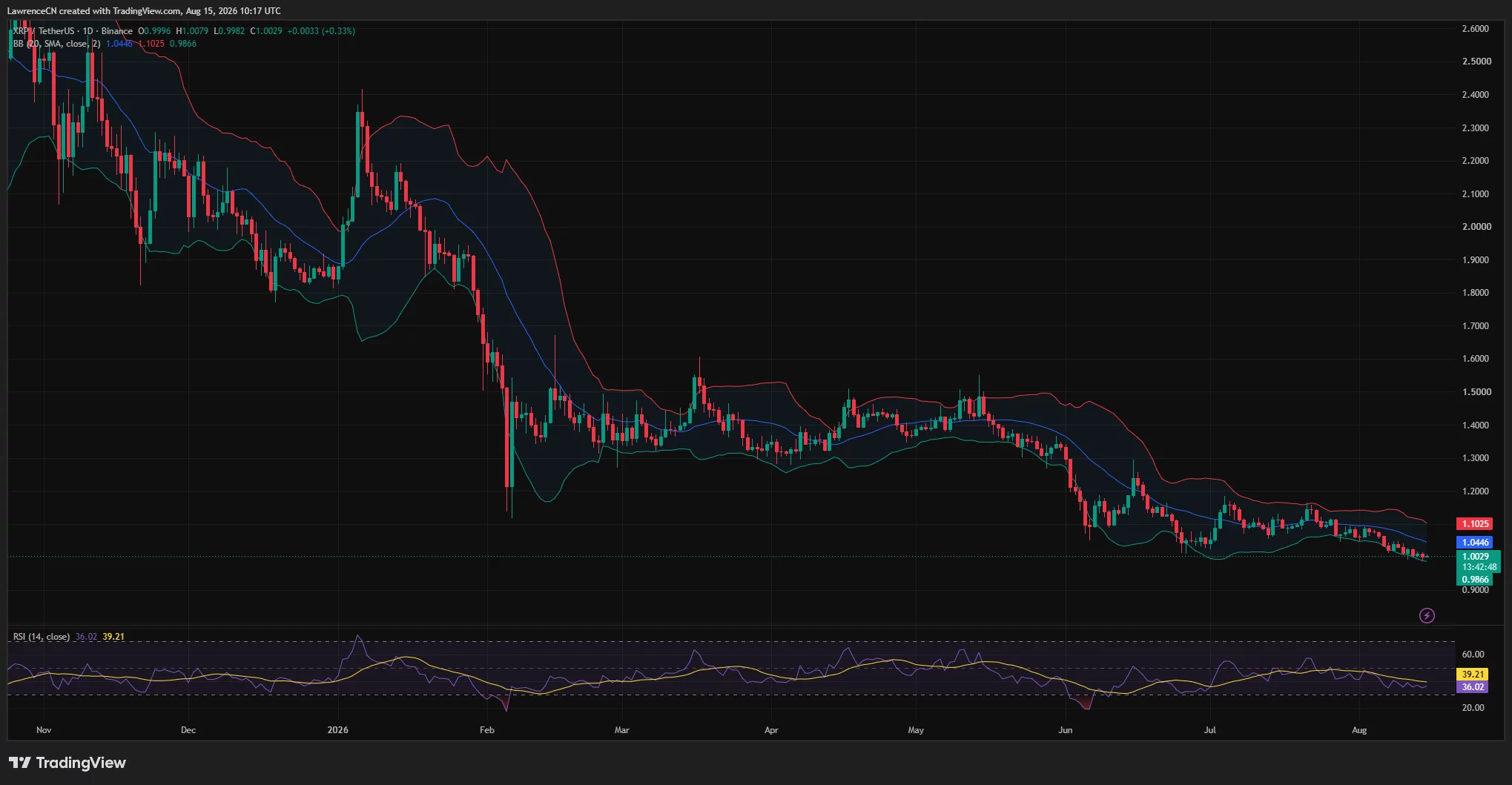
XRP price has steadied near $1 as whale transfers to Binance fell to their lowest level since 2021, although weak demand and bearish chart signals continue to limit a recovery.
Summary
- XRP price traded near $1.00 after losing about 3.2% over the past seven days.
- Binance whale inflows fell to $61 million on a three-month average.
- Daily RSI remained weak at 36, while the 4-hour MACD showed early improvement.
- Liquidation clusters between $1.02 and $1.05 could attract price during a rebound.
XRP price remains under pressure near $1
CryptoQuant contributor Darkfost reported that the three-month average of XRP whale inflows to Binance has dropped to about $61 million, its lowest reading since 2021.
The figure stood at $456 million in January 2025 and $355 million in October 2025. Current transfers are therefore six to eight times lower than the peaks recorded last year, according to the analyst.
Reduced exchange deposits usually mean fewer tokens are immediately available for sale. Darkfost described the decline as a positive development for XRP but warned that lower selling activity alone cannot confirm a bullish reversal.
Net flows remain positive at roughly $18.8 million, meaning large deposits are still exceeding withdrawals. Darkfost also said the slowdown fits a market-wide decline in exchange inflows and trading volume, with selling pressure fading before demand has fully recovered.
XRP traded around $1.00 at the time of writing, little changed over 24 hours, but down approximately 3.2% during the past week. The token has a market capitalization of about $62.8 billion and nearly $900 million in daily trading volume.
XRP price has repeatedly moved above and below $1 since Aug. 11. The latest dip reached approximately $0.988 before buyers returned, but the recovery stopped near $1.01.
Daily XRP chart keeps sellers in control
The daily chart shows XRP trading below the Bollinger Bands’ 20-day middle line at $1.0446. Staying below that average leaves the short-term structure tilted toward sellers, even though the price is approaching the lower band at $0.9866.
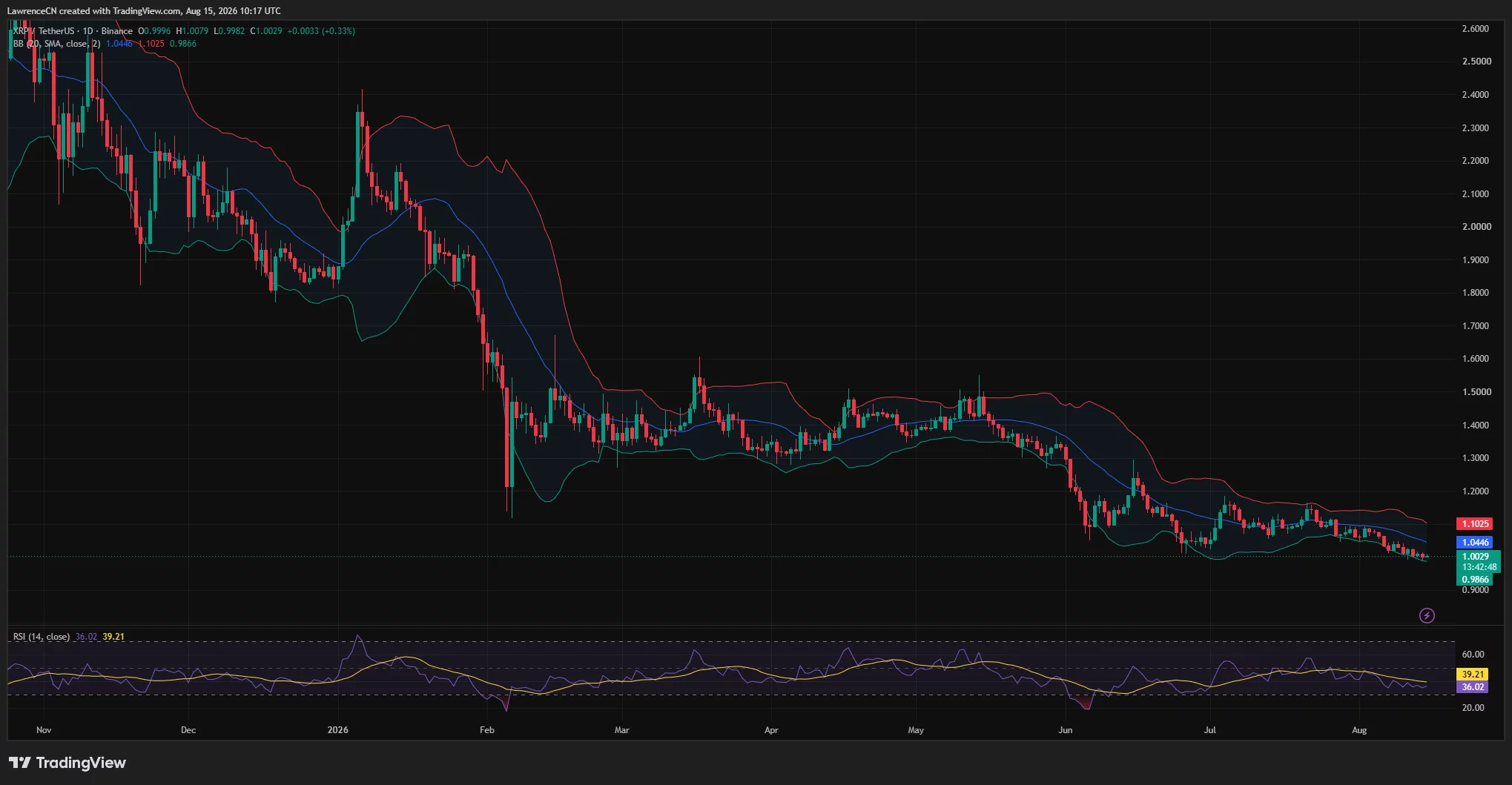
The daily relative strength index stood at 36.02, below its signal average of 39.21. The reading shows weak momentum but remains above the conventional oversold threshold of 30, leaving room for another decline before the indicator reaches an extreme.
A close below the $0.9866 lower Bollinger Band would weaken the $1 support case and expose the area around $0.95. The chart has not established a clear daily reversal pattern, with lower highs and lower lows continuing from XRP’s May peak.
For a recovery, buyers first need to reclaim the Bollinger middle line near $1.045. The upper band at $1.1025 would become the next target if the price closes above that level and trading activity rises.
The narrow distance between the current price and the lower band also creates the possibility of a short-term bounce. Such a move would remain corrective unless XRP breaks above its declining daily average and holds the gain.
Falling wedge offers an early recovery setup
On the 4-hour chart, XRP has moved inside a falling wedge formed after the July 21 high near $1.165. Price is now close to the point where the two descending trendlines converge, making a breakout increasingly likely as the available trading range contracts.
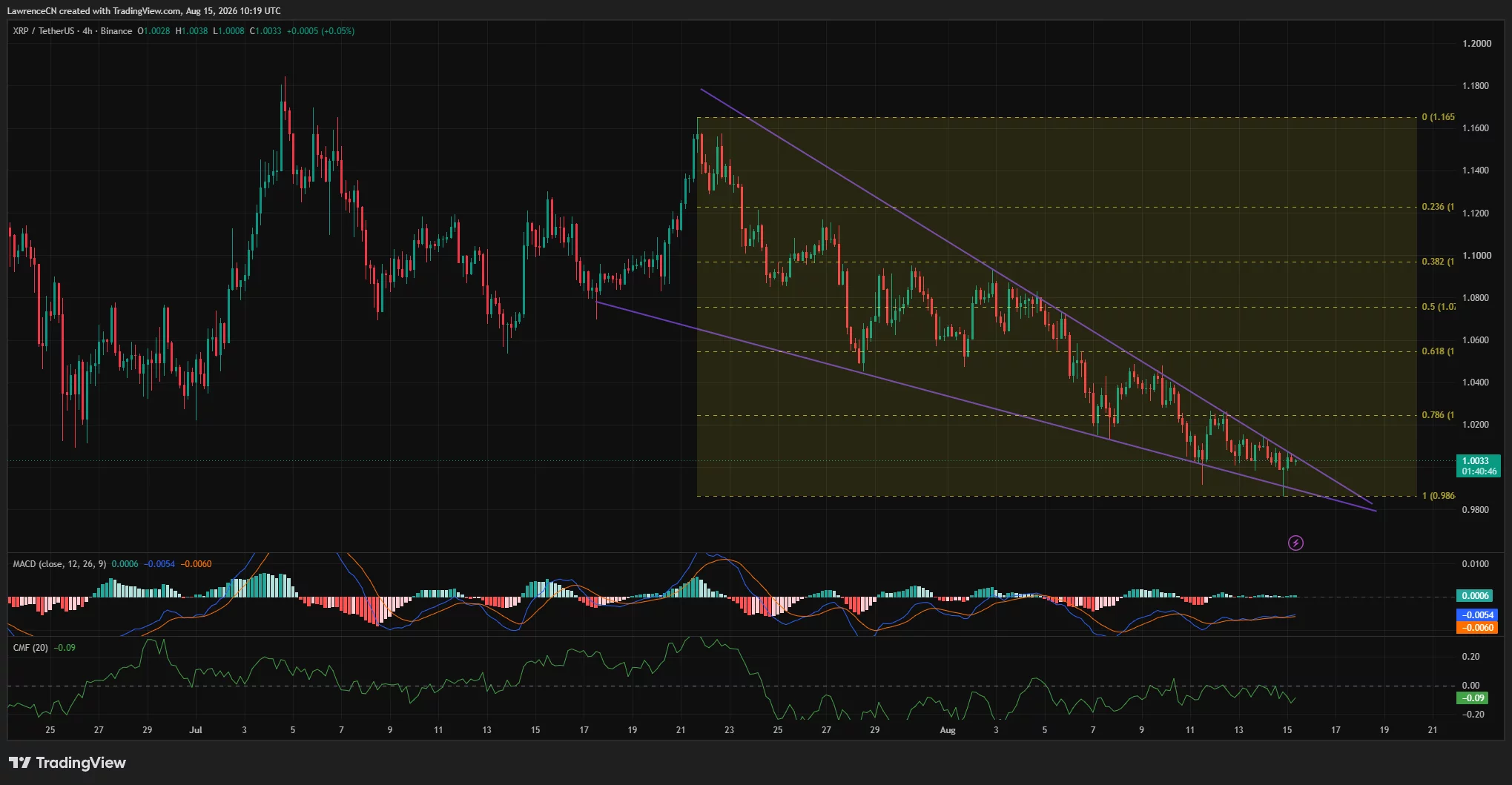
The first nearby barrier sits at the 78.6% Fibonacci retracement around $1.024. A breakout above the wedge and this level would open a path toward $1.055, followed by $1.076.
Higher resistance appears near $1.097 and $1.123. XRP would need to clear the entire sequence before it could challenge the July high around $1.165.
4-hour momentum has started to improve. The MACD line stood near minus 0.0054, above the signal line at minus 0.0060, while the histogram turned slightly positive at 0.0006. The crossover points to easing downside momentum rather than a confirmed trend change because both lines remain below zero.
Chaikin Money Flow remained negative at minus 0.09, showing that capital flows still favor sellers. A wedge breakout accompanied by CMF moving above zero would provide firmer evidence that buyers are returning.
Failure to leave the wedge could push XRP back toward $0.986. A confirmed 4-hour close below the lower trendline would invalidate the recovery setup and increase the risk of a move toward $0.98 or $0.95.
Liquidation map places XRP targets above $1
CoinGlass’ one-week liquidation heatmap shows several leveraged-position clusters above the current price. The nearest liquidity is concentrated around $1.01, followed by larger pockets between $1.02 and $1.03.
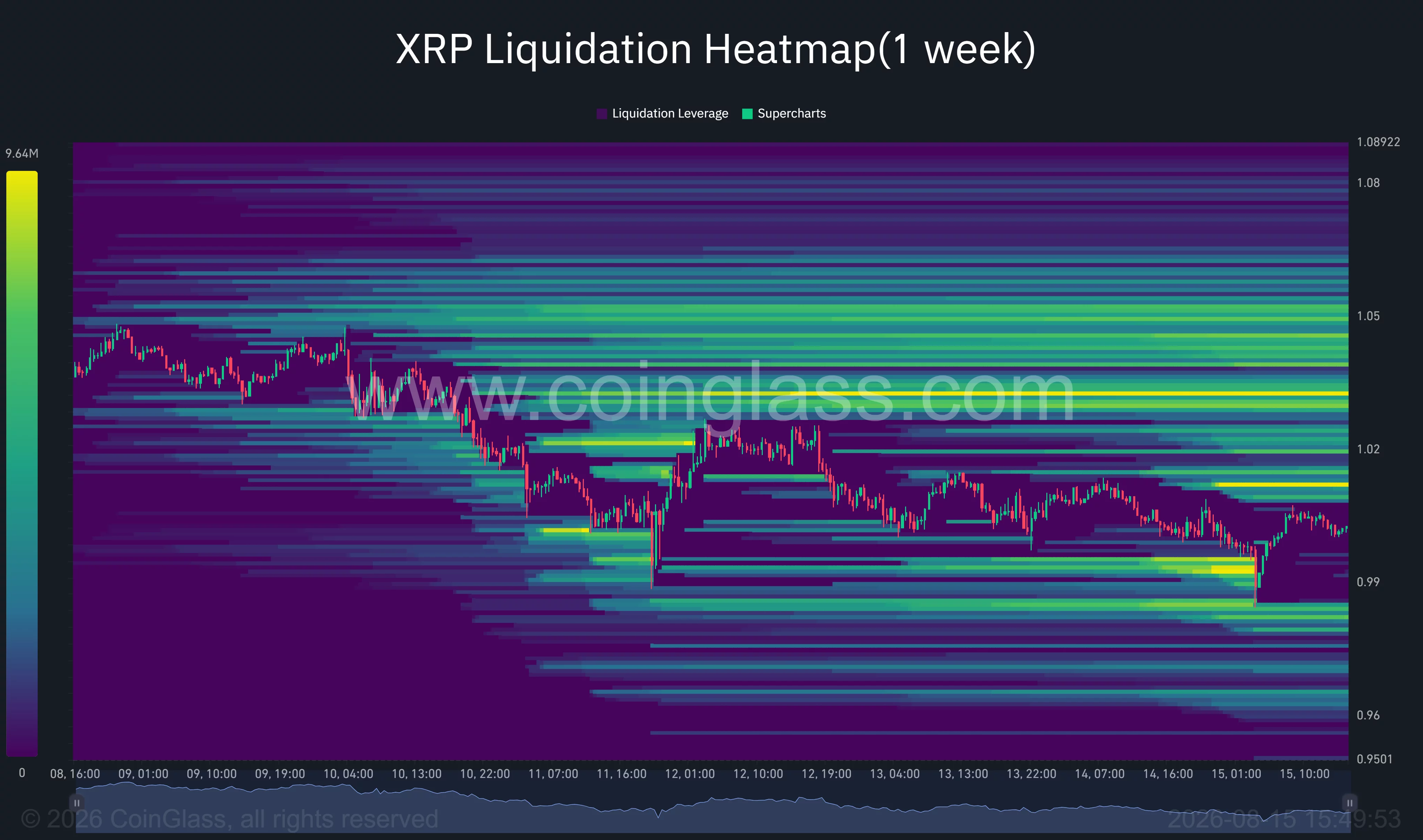
The strongest overhead concentrations appear near $1.03 and from approximately $1.045 to $1.05. Since price often moves toward areas holding large leveraged positions, a rebound could accelerate as short liquidations are triggered across these levels.
Additional liquidity below the market is visible near $0.98 to $0.99. A loss of $1 could therefore pull XRP toward that zone before buyers receive another chance to defend the daily lower Bollinger Band.
For US investors trading during the weekend, thinner liquidity may increase sudden moves around the $1 level. The charts place $0.986 as the immediate downside boundary, while a move through $1.024 would offer the first technical sign that XRP is breaking out of its month-long decline.
Falling Binance whale inflows reduce one source of possible selling, but Darkfost’s data and the negative daily structure reach the same conclusion: XRP still needs fresh buying demand before a lasting recovery can begin.
Disclosure: This article does not represent investment advice. The content and materials featured on this page are for educational purposes only.
Bitcoin’s week-long correction drove the asset to a new local low of $62,500, where it finally found some support and now sits at around $63,000.
Most larger-cap alts have experienced little to no volatility on a 24-hour scale, aside from LINK and WLFI, both of which are up by over 5%.
BTC Calms at $63K
After a very stagnant previous weekend, bitcoin tried to break out on Monday morning, but it was immediately halted at $65,400. This was the second rejection at that level in the past three days. However, this one was more violent as BTC dipped to $62,800 within hours.
It tried to bounce off twice, but it was stopped at $64,400. Each subsequent leg down was more painful than the previous. The bears took complete control of the market by mid-week, and the selling pressure intensified in the following days. The culmination took place on Friday when BTC slumped to $62,500 for the first time in 10-11 days.
It finally bounced off in the following hour, but it was stopped at $63,200 and now struggles at $63,000. Its market capitalization has stalled at $1.260 trillion on CG, while its dominance over the alts, which peaked at 57.3% earlier this week, is now down to under 57%.

LINK Tries to Break Out
Analysts have been quite optimistic about LINK’s future lately, often predicting massive rallies. The first breakout attempt has taken place as the asset is up by over 5% daily and has reclaimed the $9 support. WLFI is the only other notable gainer from the larger caps, while UNI has dumped by 5%.
In contrast, XRP, SOL, TRX, HYPE, and RAIN are slightly in the red, while ETH, BNB, and DOGE have marked insignificant gains.
VELVET has entered the top 100 alts. It has soared by 25% daily and by roughly 150% in the past week. ETHFI follows suit, surging by 12% daily. OKB completes the top 3 price gainer club with a 6.5% jump.
The total crypto market cap is down to under $2.230 trillion on CG.

The post Chainlink (LINK) Is Breaking Out, Bitcoin (BTC) Sluggish at $63K: Weekend Watch appeared first on CryptoPotato.

She didn’t say anything right away. Finally, she looked up. “My sister was just diagnosed with stage 4 colon cancer. I’m worried I might have it too.”
For the next 15 minutes I watched as they talked about how she was processing her sister’s diagnosis, her fears about the future, what it all meant for her future colon cancer screening, and why at this point we were most concerned about IBS.
By the end of the visit, her expression had cleared; I realized I hadn’t noticed how frightened she was. I felt ashamed of myself. What kind of doctor was I going to be?
My supervising physician and I talked about it. “You learn how to look,” he said. “When you care, you get a feel for it.”
That lesson has stayed at the forefront for me as I’ve watched artificial intelligence sweep through medicine and enter the clinical environment of our internal medicine residency program at the Johns Hopkins Hospital. AI scribes. Chatbots that tell you a differential diagnosis if you put in a patient’s symptoms. Electronic medical record tools that will summarize a patient’s hospital course for you. But they can’t feel.


Galaxy cited unresolved ethics, stablecoin yield and developer protection issues, along with a narrow Senate window when lawmakers return in September.


Africa Finance Corporation has raised 350 million Swiss francs or about $431 million, through its first digital bond, becoming the first African institution to issue such debt through a regulated exchange and central securities depository.
Summary
- The five-year digital bond carries a coupon rate of 1.4925%.
- Around 90% of investor demand came from Swiss accounts.
- Commerzbank and Deutsche Bank arranged the transaction.
- AFC will use the proceeds to support infrastructure financing across Africa.
AFC digital bond raises $431 million
Ledger Insights reported that Africa Finance Corporation issued the five-year bond through SIX, using its SDX digital platform for clearing and settlement. The transaction represents the first digital bond from an African institution to be processed through both a regulated exchange and a central securities depository.
Priced with a coupon of 1.4925%, the 350 million-franc bond is among the larger digital debt issues completed through the Swiss platform. UBS issued a 375 million-franc digital bond in 2022, according to Ledger Insights.
AFC separately described its offering as the largest Swiss franc-denominated digital bond from an international issuer. The company said it was also its fourth and largest bond issued in Swiss francs, following a 150 million-franc green bond completed in 2020.
Investor demand came mainly from Switzerland, with domestic accounts contributing about 90% of the orders and international investors providing the remaining 10%, according to AFC. Banks and other financial companies accounted for 57% of the order book, while asset managers represented 37% and hedge funds contributed 6%.
The bond was issued under AFC’s $5 billion Global Medium-Term Note Programme. Under the structure, the debt is represented as a tokenized security, while ownership details are kept on a regulated digital register using distributed ledger technology.
Trading and listing take place on the SIX Swiss Exchange, with the security deposited at SIX Digital Exchange. SIX SIS AG operates the clearing and settlement system used for the transaction.
Commerzbank AG served as the technical lead, while Deutsche Bank AG’s London branch participated through its Zurich branch. AFC said proceeds from the sale would cover its general funding needs and support its financing of infrastructure projects in Africa.
Digital format keeps the bond inside regulated markets
Unlike a crypto token issued through an open blockchain platform, AFC’s bond uses regulated market infrastructure for ownership records, trading, and settlement. Investors are buying a debt security issued by AFC, with the digital system changing how the bond is recorded and processed rather than the financial claim itself.
Banji Fehintola, an AFC executive board member and head of financial services, said the digital structure was “not an end in itself” but part of the company’s effort to diversify its sources of funding.
“The digital format of this bond is not an end in itself but a signal of our commitment to being at the frontier of innovation in the capital markets as we continue to diversify and strengthen AFC’s funding base to support Africa’s development.”
AFC President and CEO Samaila Zubairu said the deal also showed continued investor confidence in the institution’s credit profile and development strategy. According to the company, S&P Global rates AFC at A with a positive outlook, while Moody’s gives it an A3 rating with a stable outlook.
Before the digital sale, AFC returned to the international bond market in July with a $500 million, five-year senior unsecured Eurobond. The corporation said the digital issue secured funding at a level within the pricing of the earlier dollar benchmark.
Operating as a multilateral finance institution, AFC funds projects in power, transport, telecommunications, natural resources, and heavy industry. The organization was established in 2007 and now counts 48 African countries as members. It says it has invested $19 billion across the continent since its creation.
SIX combines digital and traditional settlement
AFC completed the issuance after Switzerland’s financial regulator approved a change to the structure of SIX’s digital asset operations. In May, the Swiss Financial Market Supervisory Authority allowed SIX Digital Exchange AG, its digital central securities depository, to merge into SIX SIS AG.
SIX said the consolidation placed its services for traditional and digital securities under one legal entity. FINMA also approved crypto custody through the combined central securities depository, allowing financial institutions to use the same regulated provider for conventional assets and certain digital assets.
The exchange operator launched SDX as a regulated market for securities issued and settled through distributed ledger technology. The platform has since hosted digital bonds from banks, public bodies and international institutions.
In November 2024, crypto.news covered Lugano’s third blockchain bond, a 120 million-franc issue listed on both SDX and the main SIX Swiss Exchange. Lugano had issued three such bonds worth a combined 320 million francs over two years.
The city’s third bond formed part of Project Helvetia, a Swiss National Bank pilot that tested settlement using wholesale central bank digital currency. Ledger Insights noted that AFC’s announcement did not identify wholesale central bank digital currency as part of its transaction.
AFC’s deal also ended a pause in new digital bond activity on SIX, where the previous issuance was completed by German development bank KfW in June 2025, according to Ledger Insights.
U.S. market follows a regulated tokenization path
American financial institutions are testing a comparable model in which blockchain records sit within existing securities infrastructure. The Depository Trust & Clearing Corporation planned to begin limited production transactions in July 2026, before a full tokenization service targeted for October.
As previously reported in May, DTCC formed a working group of more than 50 traditional finance and digital-asset companies. Participants include BlackRock, JPMorgan, Goldman Sachs, Morgan Stanley, Bank of America, Circle, Nasdaq and NYSE Group.
DTCC said the initial service could cover Russell 1000 stocks, major index-tracking exchange-traded funds, and U.S. Treasury securities held in its custody. Its subsidiary DTC received a three-year no-action letter from the Securities and Exchange Commission in December 2025 for the defined tokenization service.
For U.S. investors, the SEC’s position means representing a financial instrument on a blockchain does not remove it from securities rules. SEC Chair Paul Atkins said in April that a stock remains a stock whether it appears on paper, through a DTCC entry, or as a blockchain token.
Meanwhile, U.S. transfer agents asked the SEC in July to distinguish securities created with an issuer’s approval from third-party tokens that merely track an asset. The groups said regulated systems should preserve accurate ownership records, transfer controls, dividend rights, and investor protections.

Pro Se Plaintiff Caught Hiding Prompt Injections In Court Filings; Responds By Hiding More

paisa banao enjoy karo || #pawansahu #naturalbodybuilding #fitness #motivation #money #enjoy #shorts

Secondhand book sales are booming. Is it because of AI?


-

 Fashion18 hours ago
Weekend Open Thread: Ann Taylor
-

 Business6 days ago
Datadog: Best Of Breed For Multiple Reasons
-

 Business6 days ago
How to Start a Cleaning Business: A Step-by-Step Guide
-

 Business6 days ago
BDC Weekly Review: Private BDC Q2 Numbers Are Strong
-
 NewsBeat4 days ago
Communication cards help banking customers access services or report scams
-
 Business4 days ago
Oil Price Today (August 11): Crude oil rises to $88 after Trump’s compensation demand dents Hormuz opening. Here’s why
-

 Politics7 days ago
Be quiet, Miriam! – spiked
-

 Fashion6 days ago
Amazon Sundays: Closet Care Before Fall
-
 Crypto World5 days ago
Why Did Nvidia Stock Fall on Monday Despite a $500 Billion Wall Street AI Deal?
-
 Entertainment6 days ago
Will Ferrell’s New Netflix Series Just Became One of the Streamer’s Biggest Hits of 2026
-

 Business6 days ago
5 Things You Must Know About Jorge Messi, the Father and Longtime Agent Who Shaped Lionel Messi’s Career
-

 Politics6 days ago
Ben-Gvir’s crocodile project halted but abuses at Ketziot Prison continue
-

 Business7 days ago
Mutual Fund Manager Scoops Up Beaten-Down Stocks
-

 Crypto World4 days ago
Revolut wins French banking licence, creates second EU banking hub
-

 Crypto World7 days ago
A Deep Dive Into One Of The Most Significant Hacks In Recent Memory
-

 Crypto World7 days ago
Bitcoin ETFs draw $853.5M in five-day inflow streak
-

 Politics6 days ago
The Church of England’s ruinous reparations racket
-

 Politics6 days ago
Saudi Arabia used 86% of missile stockpile defending Iran attacks
-

 Politics6 days ago
The House Article | Burnham still needs to sell devolution to the public
-

 Politics6 days ago
What’s An EDT? The Rise Of ‘Extreme Day Trips’ As A Travel Trend
You must be logged in to post a comment Login