
Crypto World
WLFI holders back 180 day staking rule to participate in governance votes

President Donald Trump’s family-backed crypto project, World Liberty Financial (WLFI) has passed a governance proposal requiring token holders to lock up their tokens for nearly six months in order to participate in protocol voting.
Summary
- WLFI holders approved a governance proposal requiring token holders to stake their tokens for 180 days in order to participate in protocol voting.
- Participants who stake WLFI and vote at least twice during the lock period can earn roughly 2% annual yield.
The proposal received overwhelming support and was approved with 99.12% of 1,800 votes cast in favor, although more than 76% of the voting power came from just ten users.
WLFI introduced the proposal last month, outlining a governance staking system that would require holders of unlocked WLFI tokens to stake their assets before they can participate in votes that determine the direction of the protocol and its broader ecosystem.
According to the firm, the change would ensure that only participants with “long-term alignment to the protocol” are able to influence governance decisions.
The proposal “rewards WLFI holders who have demonstrated the most commitment to WLFI governance and the WLFI ecosystem with additional opportunity to engage in the future of the WLFI ecosystem and potential commercial arrangements,” the document states.
Another goal of the initiative is to promote the adoption of WLFI’s USD1 stablecoin by redirecting value that previously flowed to market makers toward ecosystem participants.
To incentivize participation, the proposal introduces a base reward of roughly 2% annual yield for token holders who stake their WLFI and take part in at least two governance votes during the lock-up period. Meanwhile, holders whose tokens are already locked remain eligible to vote without additional staking requirements.
Further, the proposal documents outline a “Super Node” tier requiring participants to stake 50 million WLFI tokens, worth about $5 million, which would grant them “guaranteed direct access” to the WLFI team for collaboration and partnership discussions.
In a recent statement to Reuters, WLFI spokesman David Wachsman confirmed that the access would be limited to the project’s business development team and executives rather than direct engagement with specific founders. Trump’s sons Eric and Barron are listed in project materials as part of the team supporting the platform.
As part of its longer-term plans centered around the USD1 stablecoin, the platform is also seeking a national trust bank charter from the U.S. Office of the Comptroller of the Currency.
The effort has drawn scrutiny from Washington lawmakers, with some arguing that the application should not move forward unless potential conflicts of interest tied to the project are addressed.
Concerns center on the project’s links to President Donald Trump and members of his family who are financially involved in the venture.

Crypto wealth platform Abra said it plans to go public through a merger with special purpose acquisition company New Providence Acquisition Corp. III in a deal that values the firm at $750 million.
The combined company will be renamed Abra Financial Inc. and is expected to list on Nasdaq under the ticker ABRX, according to an announcement.
The transaction could deliver as much as $300 million in cash from the SPAC’s trust account, though the final amount depends on shareholder redemptions and deal expenses.
Founded in 2014 and based in San Francisco, Abra provides a range of services for crypto investors. Its platform allows institutions, registered investment advisers, family offices and wealthy individuals to store crypto, trade hundreds of tokens, earn yield and borrow against holdings.
Assets sit in segregated accounts called vaults rather than on the company’s balance sheet. The firm operates an SEC-registered investment adviser and frames its services as a bridge between traditional wealth management and crypto markets.
Abra said proceeds from the transaction will support product development, hiring and expansion into areas such as tokenized real-world assets and decentralized finance.
The company reported “hundreds of millions of dollars in assets” under management and aims to exceed $10 billion by 2027.
Abra was founded by CEO Bill Barhydt as a mobile crypto wallet and remittance app aimed at retail users. During the last crypto bull cycle, the company expanded into lending and yield products through its Abra Earn program and raised $55 million in 2021 from investors including Blockchain Capital, Pantera Capital and RRE Ventures.
The company shifted strategy after regulators challenged parts of its lending business. In 2023 and 2024, Abra reached settlements with U.S. state regulators and the Securities and Exchange Commission tied to unregistered lending and securities offerings.
The firm shut its U.S. retail operations and returned funds to customers before rebuilding the business around institutional and high-net-worth clients through its SEC-registered investment arm, Abra Capital Management.
The proposed merger is pending approval from shareholders and regulators before closing.

Regulators in South Korea have intensified their crackdown on crypto exchanges, delivering a record 36.8 billion won fine and a six-month partial suspension to Bithumb after a comprehensive AML audit. The Financial Intelligence Unit (FIU) under the Financial Services Commission (FSC) disclosed findings of about 6.65 million AML violations during the inspection, spanning gaps in customer identity verification, transaction restrictions, and record-keeping. In addition, authorities flagged 45,772 crypto transfers tied to 18 unregistered overseas virtual asset service providers (VASPs), underscoring regulatory concerns about cross-border activity in the sector. The penalties were issued following a sanctions deliberation committee’s review of Bithumb’s compliance with the Act on Reporting and Use of Specific Financial Transaction Information, marking the largest fine to date imposed on a South Korean crypto exchange and signaling a broader, ongoing regulatory push across the domestic market.
Key takeaways
- Bithumb received a 36.8 billion won penalty and a six-month partial ban on processing external transfers for new customers.
- The six-month ban runs from March 27 to September 26; existing users are not restricted, and new customers can still trade, deposit, or withdraw won.
- The FIU had repeatedly warned Bithumb to halt dealings with unregistered overseas VASPs, but the exchange did not implement effective blocking measures.
- The enforcement wave extends beyond Bithumb, with Upbit previously hit by a three-month ban for new clients and a 35.2 billion won penalty in February 2025.
- Korbit later faced AML-related penalties, including a 2.73 billion won fine and an institutional warning in December 2025, illustrating a widening crackdown across major Korean exchanges.
Market context: The Bithumb action sits within a broader Korean initiative to curb AML/CTF risks in digital assets, a trend that has pressed exchanges to tighten know-your-customer and transaction-monitoring controls. The crackdown aligns with ongoing regulatory discussions and enforcement that signal higher compliance costs and operational adjustments for venue operators. In parallel coverage, reports have highlighted government plans to leverage artificial intelligence for crypto tax enforcement, underscoring a shift toward tech-enabled oversight in Korea’s crypto markets. See coverage noting AI-driven tax tracking for crypto gains: South Korea plans to use AI for crypto tax enforcement.
Why it matters
The immediate impact is a clearer demonstration that South Korea intends to enforce AML rules aggressively across its crypto ecosystem. For Bithumb, the sanction will not only affect its balance sheet but could also influence user trust and future licensing discussions as the exchange seeks to restore regulatory alignment. The six-month partial ban specifically restricts a key channel for onboarding new users—external transfers—while allowing ongoing operations for existing customers, a nuance that highlights how regulators tailor penalties to minimize disruption for current users while signaling deterrence for non-compliant practices.
The broader significance lies in the regulatory signal it sends to the global crypto community. As the Korean authorities pursue cross-border compliance more assertively, exchanges operating in the region are compelled to tighten their AML programs, KYC checks, and monitoring systems. The penalties levied on Upbit and Korbit in the preceding months reinforce that this is not a single case but part of a systematic crackdown. The evolving landscape may influence liquidity dynamics, compliance costs, and the strategic decisions of exchanges seeking to balance growth with robust risk controls.
What to watch next
- Monitor whether Bithumb completes the required AML remediation steps by the end of the six-month period (March 27 to September 26) and how the regulator assesses ongoing compliance.
- Assess subsequent regulatory updates or clarifications from the FIU or FSC regarding procedures to block transactions with unregistered overseas VASPs.
- Observe whether other exchange operators adjust their customer onboarding and cross-border transaction policies in response to the Upbit and Korbit penalties.
- Track any additional enforcement actions or penalties announced in 2025 and beyond as part of Korea’s broader AML drive against crypto firms.
Sources & verification
- Yonhap News Agency reporting on the 6.65 million AML violations and 45,772 transfers involving 18 unregistered overseas VASPs.
- Financial Intelligence Unit (FIU) sanctions deliberation committee decisions and related proceedings.
- FIU preliminary notice dated March 9, 2025, regarding a six-month partial suspension for Bithumb.
- February 2025 reporting on Upbit’s three-month ban for new clients and a 35.2 billion won penalty.
- December 2025 updates on Korbit penalties, including a 2.73 billion won fine and an institutional warning.
South Korea’s AML crackdown hits Bithumb: details and implications
The episode surrounding Bithumb reflects a methodical tightening of South Korea’s regulatory grip on crypto exchanges. The FIU’s findings paint a picture of a system grappling with the scale and speed of crypto-enabled activity, particularly when transactions cross national borders. The identified 6.65 million AML violations covered multiple facets of compliance, including know-your-customer verifications that failed to meet standards and gaps in preserving the transactional trails that regulators rely on to detect suspicious activity. In parallel, the revelation of 45,772 transfers involving 18 unregistered overseas VASPs highlights a specific risk area: cross-border liquidity channels that may escape standard domestic oversight without robust cross-border collaboration and verification mechanisms.
From a regulatory design perspective, the sanctions were anchored in the Act on Reporting and Use of Specific Financial Transaction Information, signaling that enforcement will continue to be anchored in established financial-transaction reporting frameworks. The six-month ban on processing external transfers for new Bithumb customers is a staged approach: it curtails onboarding pathways that regulators are most concerned about while allowing ongoing operations to avoid a complete shutdown that could destabilize market access for existing users. The precise window—March 27 through September 26—offers a finite period for Bithumb to demonstrate that its controls have improved to prevent new client onboarding through unregistered cross-border channels.
These measures are not isolated. They sit within a broader pattern of penalties that the FIU has directed at other major Korean exchanges in recent years, including Upbit and Korbit, each facing penalties tied to deficiencies in AML and customer verification. This pattern suggests regulators are signaling that non-compliance will carry meaningful consequences, regardless of exchange size or market share. The resulting regulatory friction could drive consolidation toward platforms that demonstrate stronger AML capabilities, while heightening operational costs for participants who must upgrade KYC systems, transaction monitoring, and regulatory reporting to align with evolving standards.
Crypto World
Rain, Pippin, and Pepeto Could Go Parabolic in 2026 as Pepeto’s Presale Return Math Points to 269x While Ethereum Sits Undervalued

A recent review from CryptoQuant CEO Ki Young Ju reveals that according to 9 out of 12 major valuation models, Ethereum is still trading below fair value. The average fair value comes out to about $4,836, meaning ETH has roughly 58% room to run from where it is now, according to CoinDesk.
That sounds solid on paper, but traders hunting for the next crypto to explode know that 58% upside does not change financial trajectories. That is exactly why the presale return math on Pepeto keeps attracting capital at $0.000000186, where the PEPE cofounder’s $7 billion track record backs arithmetic that ETH’s market cap cannot deliver.
The CryptoQuant analysis breaks down multiple models. Some projections put ETH as high as $9,887, but even at that extreme, you are looking at around 3x to 4x from here. For traders seeking the next crypto to explode, Ethereum’s massive market cap does not allow for moonshot returns anymore.
Institutional interest and ETF momentum are real but provide stability, not the explosive multiples early stage investors chase, per Bloomberg.
Undervalued tokens ready to surge in 2026
Pepeto: Presale return math makes this the next crypto to explode
If you are hunting for the earliest possible entry where the presale return math produces life changing numbers, Pepeto is still in presale with the PEPE cofounder directing the build. The project aims to give the $45 billion meme economy the dedicated infrastructure it has never had, with PepetoSwap, Pepeto Bridge, and Pepeto Exchange all announced and close to being ready.
At $0.000000186 per token, a $1,000 entry positions you for $269,000 at $0.00005. A $3,000 commitment targets $807,000. A $5,000 position crosses $1,345,000 at 269x, and the math doubles to 537x at $0.0001. SolidProof has verified every contract. Over 4 billion tokens have been permanently burned. 200% APY staking compounds positions daily.
The presale has crossed $7.99 million at $0.000000186, confirming that the arithmetic is attracting investors who calculate numbers before committing capital. Exchange listings are approaching. Every day you wait is another day closer to the moment when the open market reprices everything the PEPE cofounder has built.
SolidProof has provided the security assurance that positions Pepeto as one of the most verified presales in the market. The 269x projection is grounded in founder credibility, verified contracts, and infrastructure the $45 billion meme economy demands, but the window to capture that arithmetic is closing fast.
Rain: The prediction market play
Rain is trading at $0.009 on March 16 after institutional backing sent the token surging. The prediction market sector did over $3 billion in trading volume last quarter.
With constant buy pressure from token burns baked into the tokenomics, Rain remains a narrative play for investors who believe prediction markets keep growing.
Pippin: AI meme coin with strong backing
PIPPIN trades at $0.36 according to CoinMarketCap on March 16 with a market cap near $360 million. Created by the mind behind BabyAGI, the project gained over 150% in a recent rally.
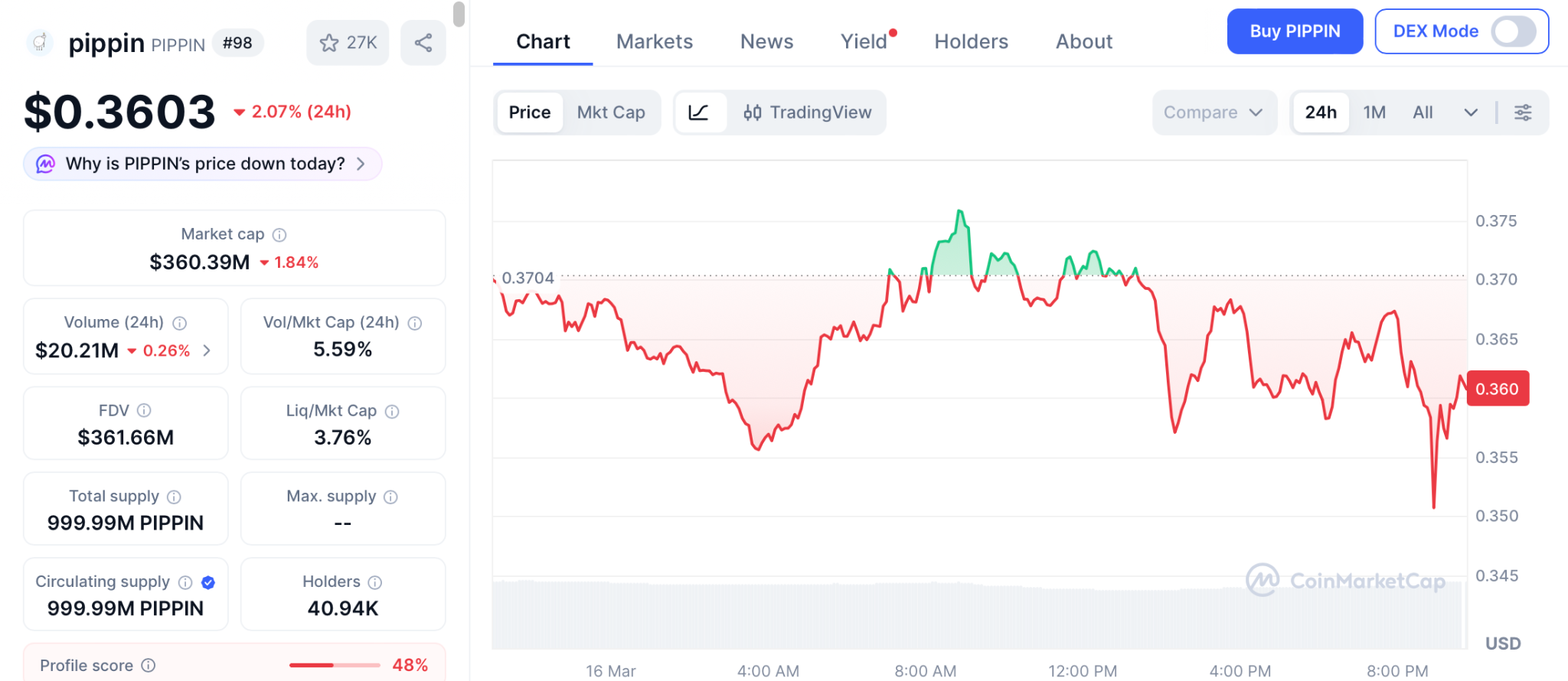
If AI agent tokens dominate the next cycle, Pippin could surge further from current levels.
Conclusion
Ethereum being undervalued according to multiple models is solid news for portfolio stability. But the next crypto to explode is not coming from a $200 billion market cap asset where even optimistic targets produce single digit multiples. You missed PEPE when the cofounder launched it from nothing into $7 billion. You missed DOGE before it became a household name. You missed SHIB before it minted millionaires.
Pepeto at $0.000000186 with $7.99 million raised, SolidProof verification, and three infrastructure products approaching launch is that same entry point. The presale is still open, and the only question is whether you commit now or let another opportunity pass.
Click To Visit Pepeto Website To Enter The Presale

FAQs
Why is Ethereum unlikely to deliver massive returns?
ETH sits at a $200 billion market cap. Even hitting the most bullish targets produces 3x to 4x. The next crypto to explode with 269x potential requires presale positioning like Pepeto with the PEPE cofounder.
What is the next big cryptocurrency for 2026?
Many traders are betting on Pepeto because the PEPE cofounder has already built $7 billion in value, SolidProof has verified every contract, and three meme economy products are approaching exchange listings.
What counts as a crypto with 269x potential in this market?
Low presale pricing, a proven founder, verified contracts, and real infrastructure. Pepeto at $0.000000186 with the PEPE cofounder and three products fits every criterion for the next crypto to explode.
Disclaimer: This is a Press Release provided by a third party who is responsible for the content. Please conduct your own research before taking any action based on the content.



Summary
- Coinglass data show about $2.056b in BTC longs at risk if price slips below roughly $70,346, versus $1.514b in shorts facing liquidation above $77,312.
- Over the last 24 hours, crypto liquidations hit $402m, with $80.7m in longs and $322m in shorts wiped out; Bitcoin alone saw $131m in positions forced out.
- BTC trades around $73,778 and ETH near $2,201, with crowded leverage and tight liquidation bands signaling that the next break could trigger a sharp, forced move.
Coinglass liquidation data is sketching out a brutal risk corridor for Bitcoin (BTC), with billions in leveraged positions sitting just above and below spot. According to figures summarized by Jinshi Finance, if BTC drops below roughly $70,346, cumulative long liquidations on major centralized exchanges would climb to around $2.056 billion. On the flip side, a squeeze above about $77,312 would put some $1.514 billion worth of short positions at risk of being wiped out.
That overhang comes after an already heavy flush in the last 24 hours. Across the crypto market, total liquidations reached about $402 million over the period, with roughly $80.6751 million in longs and $322 million in shorts forced out of their positions. For Bitcoin alone, longs lost around $20.3203 million versus approximately $111 million in short liquidations, while Ethereum traders saw about $16.483 million in long positions and $142 million in shorts liquidated. In total, 94,026 traders were liquidated, with the largest single order — on Bitfinex’s tBTCF0:USTF0 pair — clocking in near $6.9442 million.
Despite that, spot prices in majors remain elevated. Bitcoin is currently trading around $73,778, up about 5.8% over the last 24 hours, after ranging between roughly $69,460 and $73,770 on more than $55.4 billion in volume. Ethereum is changing hands near $2,201, higher by around 6.8% on the day, with a 24‑hour low of about $2,041.70 and high of $2,200.03, and turnover close to $27.76 billion. This combination — strong spot, heavy leverage, and tightly clustered liquidation bands — is exactly the kind of setup that tends to produce sharp, directional moves when one side finally loses its grip.
For now, the message from the derivatives tape is simple: positioning is crowded, and the next impulsive move will likely be amplified by forced deleveraging. Traders running size around these levels need to respect the liquidation heatmap as much as the chart. Real‑time stats for majors are available via crypto.news dashboards for Bitcoin and Ethereum. For more on how leverage has shaped recent swings, see earlier reporting on why Bitcoin briefly slid under $66K, the latest ETF‑driven flows into BTC, and Michael Saylor’s continued treasury‑backed accumulation of Bitcoin.
Crypto World
Institutional investors held firm through bitcoin’s downturn, Bitwise CIO Matt Hougan says


Institutional investors may be proving more resilient bitcoin holders than critics expected, according to Bitwise CIO Matt Hougan, who says ETF flow data suggests professional investors have largely held onto their positions during the crypto market’s steep decline.
“The best evidence we have is in the ETF market,” Hougan said. “Bitcoin ETFs accumulated roughly $60 billion in net flows from their launch in January 2024 through October 2025. Since October 2025, prices are down 50%, but we’ve seen less than $10 billion in outflows from ETFs.”
Bitcoin exchange-traded funds attracted roughly $60 billion in net inflows between their launch in January 2024 and October 2025, Hougan told CoinDesk. Since then, the cryptocurrency’s price has fallen about 50%, yet ETFs have seen less than $10 billion in outflows.
“In other words, despite a punishing bear market, professional investors have proven to be ‘diamond hands’ in bitcoin,” he said.Hougan’s Bitwise offers a suite of digital asset investment products, including the Bitwise Bitcoin ETF (BITB). BITB has just under $3 billion in assets under management. The leading spot bitcoin ETF, BlackRock’s iShares Bitcoin Trust (IBIT) has more than $55 billion in AUM.
Bitcoin remains a ‘non-consensus asset’
Hougan said the data challenge a common criticism that institutional investors, often considered more sensitive to macroeconomic shocks and liquidity cycles, could sell their bitcoin exposure quickly during periods of market stress. However, he added, the opposite dynamic may be at play currently.
“Despite its progress in recent years, bitcoin remains a non-consensus asset,” he said. “Institutional investors who buy bitcoin today are still sticking their neck out and standing out from their peers.”
That career risk means institutions allocating to bitcoin today tend to have unusually strong conviction in the asset, said the CIO at Bitwise, a San Francisco-based company with over $15 billion in client assets under management.
That career risk means institutions allocating to bitcoin today tend to have unusually strong conviction in the asset, said the CIO at Bitwise, a San Francisco-based company with over $15 billion in client assets under management.
“As a result, the institutional investors who decide to allocate have very high conviction,” Hougan said. “They are not 51% convinced bitcoin is a good idea; they are 80% or 90% convinced. Otherwise, they wouldn’t take the risk.”
Because of that dynamic, he said he believes institutional capital could remain “very sticky” even during volatile market cycles “for the foreseeable future.”
The $1 million BTC question
Hougan said the behavior of institutional investors during downturns strengthens his long-term $1 million bitcoin outlook, on which he doubled down in the interview.
“The wildest thing about my $1 million prediction is that it’s not wild at all,” Hougan said. “All you need for bitcoin to get to $1 million is for the global store of value market to continue to grow as it has for the past 20 years and for bitcoin to become a minor but material part of that market.”
For Hougan, the resilience of institutional investors through volatile market cycles is part of that broader maturation process.
“It just needs what’s been happening for the past 10-20 years to keep happening for the next 10 years, and we’ll get there,” he said.
Crypto World
Ethereum price prediction $2.8K as bulls defend key levels and $1.8B in long liquidations


Ethereum price prediction as bounce above key moving averages has traders watching a potential breakout toward the $2,800 area — but a dense liquidation pocket still hangs below the market.
Summary
- Ethereum has reclaimed the 20-day and 50-day EMAs, carving a symmetrical triangle that points toward a $2,800–$2,850 upside target if bulls hold momentum.
- Coinglass data show about $1.8b in long liquidations sitting below $2,174, while a move above $2,400 could trigger roughly $792m in short liquidations.
- ETH trades near $2,201 alongside a broader majors grind higher led by Bitcoin around $73,778, with leverage stacked on both sides and execution risk elevated.
Ethereum (ETH) price has reclaimed several important technical levels, with analysts now framing $2,800 as a realistic upside target if bulls can sustain momentum. Recent research summarized by Jinshi Finance notes that ETH has moved back above its 20‑day exponential moving average (EMA) near $2,072 and the 50‑day EMA around $2,210, breaking out of a prior bearish flag and carving out a symmetrical triangle structure. If that triangle resolves higher, the measured‑move projection points toward roughly $2,850, an area that also coincides with the 200‑day EMA and a major resistance band from earlier in the year.
Ethereum price prediction
On the downside, derivatives positioning is creating a clear line in the sand. Coinglass data cited in the same report show that if ETH drops below about $2,174, cumulative long liquidations across major centralized exchanges would reach roughly $1.817 billion, concentrated in highly levered perp and futures positions. In contrast, a break above the $2,400 area would flip the script, triggering an estimated $792 million in cumulative short liquidations, potentially adding fuel to any upside move toward that $2,800–$2,850 target. In other words, price is pinned between a sizeable long liquidation air pocket beneath and a stacked short liquidation zone above.
Spot and derivatives traders are already starting to position around that range. According to crypto.news price data, Ethereum is currently trading near $2,201, up about 6.8% over the last 24 hours, with a session range between roughly $2,041.70 and $2,200.03 and 24‑hour volume around $27.76 billion. Bitcoin, which still sets the broader risk tone, is hovering close to $73,778, up 5.8% on the day, with a 24‑hour low of $69,460 and high of $73,770 on turnover above $55.4 billion. These moves suggest the latest bid in ETH is not happening in isolation, but as part of a broader grind higher in majors following the recent Iran‑driven volatility.
For traders, the setup is binary and brutally clear: lose the $2,170–$2,200 zone and that $1.8 billion long‑liquidation overhang becomes a real risk; reclaim and hold above $2,400 and shorts may be forced to chase into a low‑liquidity move toward the 200‑day EMA. In this kind of structure, execution and sizing matter more than conviction — especially with leverage stacked on both sides of the book. Readers can monitor intraday levels on crypto.news dashboards for Ethereum and Bitcoin, and for further context on how derivatives positioning has been shaping recent moves, see our coverage of why Bitcoin slipped under $66K earlier in the cycle, the latest ETF‑driven flows into BTC, and Michael Saylor’s ongoing treasury‑backed Bitcoin accumulation.


XRP witnessed a second week of capital withdrawal, bucking the trend of broader digital asset gains.
Digital asset investment products attracted $1.06 billion in inflows last week, extending their streak to three consecutive weeks of positive flows. The inflows arrived during intense geopolitical tensions, which appear to have strengthened the perception of digital assets, especially Bitcoin, as a relatively safe haven compared with traditional markets.
Since the Iran crisis began, assets under management in digital asset exchange-traded products have climbed 9.4% and reached a total of $140 billion.
Capital Flow Amid Iran Crisis
According to the latest edition of CoinShares’ Digital Asset Fund Flows Weekly Report, roughly three-quarters of last week’s investment activity was captured by Bitcoin, which drew $793 million. Over a three-week period, cumulative allocations have reached $2.2 billion, which has narrowed the gap with the earlier five-week phase when about $3 billion left the sector. At the same time, short Bitcoin products added $8.1 million, which means that investors still hold mixed views.
Ethereum attracted $315 million last week, pushing its year-to-date performance toward a near-neutral level, which was supported in part by new US staking ETF launches. Other digital assets also received fresh capital. For instance, Solana added $9.1 million, Sui $3.1 million, and Chainlink $2.4 million. Multi-asset investment products drew an additional $2.5 million.
On the other hand, XRP appears to have bucked the trend as it suffered its second week of outflows of $76 million. Litecoin also saw a minor withdrawal of $0.3 million during the same period.
The US dominated regional activity and accounted for 96% of recent digital asset investments. Canada and Switzerland contributed $19.4 million and $10.4 million, respectively. Hong Kong also recorded $23.1 million, its largest weekly inflow since August 2025. Germany posted a $17.1 million outflow, which is its first weekly reduction of the year, while Sweden and the Netherlands experienced smaller outflows of $0.5 million and $0.2 million, respectively.
Rising Risk Appetite
Tensions in the Middle East continued to escalate. Amid these developments, BTC has reclaimed a major resistance level at 71,300. According to experts, this suggests that some risk capital is beginning to flow back into the market. However, liquidity remains concentrated between 72,700 and 74,000. In a statement to CryptoPotato, a Bitunix analyst explained,
You may also like:
“If prices stabilize above 71,300, the market could enter a new zone of liquidity competition in the short term. On the downside, support liquidity around 69,000 and 70,200 will be closely watched. With geopolitical uncertainty still elevated, the short-term structure of the crypto market continues to be driven primarily by shifts in risk appetite and the distribution of derivatives liquidity.”
Binance Free $600 (CryptoPotato Exclusive): Use this link to register a new account and receive $600 exclusive welcome offer on Binance (full details).
LIMITED OFFER for CryptoPotato readers at Bybit: Use this link to register and open a $500 FREE position on any coin!


Andreas Antonopoulos, author of Mastering Bitcoin and one of the longest-serving Bitcoin educators, announced on Patreon that he’ll no longer produce livestreams or new content for subscribers.
While his Patreon account will stay active to maintain his existing library of books, workshops, and videos, his team stated over the weekend, “For health reasons, Andreas will not be doing any more livestream Q&A or producing any new content.”
According to Antonopoulos, he’s suffering from debilitating migraines that have resisted many attempts at treatment.
Antonopoulos has previously disclosed chronic, severe migraines. Someone in the community speculated that the condition could be something like Familial Hemiplegic Migraine, a rare and inherited neurological disorder whose episodic symptoms mimic strokes, including loss of motor control and speech.
Although Antonopoulos hasn’t publicly confirmed that specific diagnosis, the announcement pauses a notable public career.
Antonopoulos tried to get people into bitcoin early
Antonopoulos, a British-Greek computer scientist born in 1972, first learned about bitcoin (BTC) in 2011 when a single coin traded for a few dollars.
By 2012, he’d quit his consulting job, abandoned a career at the research company he founded, and started speaking and writing about Bitcoin. BTC’s price was less than $15 in 2012.
A now-iconic video from the Bitcoin 2013 Conference in San Jose shows Antonopoulos explaining BTC to a nearly empty room. BTC at that time was worth roughly $120.
Read more: Bitcoin’s Lightning Network is now under surveillance by US authorities
In 2014, Antonopoulos authored Mastering Bitcoin (2014), an O’Reilly technical book that became foundational reading for Core developers.
He followed with the Internet of Money trilogy (2016, 2017, 2019), co-authored Mastering Ethereum (2018), and co-authored Mastering the Lightning Network (2021). He released all of them open-source on GitHub, free for anyone to read, teach, or share. His YouTube talks remain unmonetized and ad-free.
He co-hosted the Let’s Talk Bitcoin! podcast (now Speaking of Bitcoin) and taught at universities. He’s widely credited with coining the phrase, “not your keys, not your coins.”
Loyal fans
One episode defined Antonopoulos’s standing in the community. In December 2017, Roger Ver publicly mocked him for not being a BTC millionaire despite years of unpaid advocacy.
The community’s response was swift. Over a thousand people donated more than 100 BTC, worth over $1 million at the time.
In January 2026, just two months before his health announcement, the Human Rights Foundation named him the recipient of the Finney Freedom Prize for the 2016–2020 halving era.
The award recognized his contributions to Bitcoin and human rights.
Antonopoulos said he’d donate half the financial prize to Creative Commons, the nonprofit that licenses the open works he built.
Got a tip? Send us an email securely via Protos Leaks. For more informed news, follow us on X, Bluesky, and Google News, or subscribe to our YouTube channel.
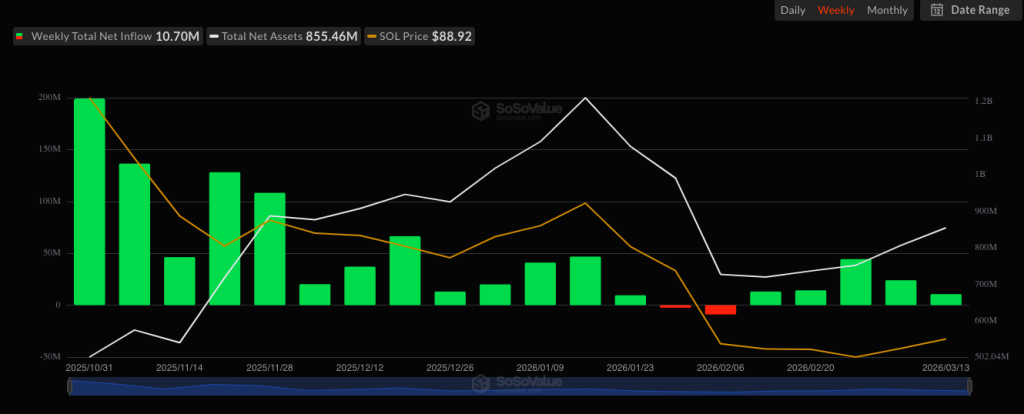
Solana (SOL) is trading at $93, marking a +7% surge since Sunday as buyers aggressively target the psychological $100 resistance level, buoyed by rising ETF demand.
This move is backed by $10.70 million in weekly net inflows into Solana investment products, signaling that the engine behind this rally is unmistakably institutional.

Open Interest Surge Signals Leveraged Conviction
The current SOL price analysis reveals a market structure dramatically different from the retail-driven pumps of previous cycles.
Institutional and retail demand are synchronizing, evidenced by a sharp rise in derivatives activity. According to CoinGlass data, Solana’s futures Open Interest (OI) spiked +11% in the last 24 hours alone, hitting a staggering $5.79 billion.
This buildup suggests traders are opening fresh long positions or significantly increasing leverage in anticipation of a breakout. The buying pressure has already claimed victims: the influx of capital wiped out millions in short positions as the price reclaimed the $90 mark.
Solana-specific investment vehicles recorded $7.60 million in inflows on Friday alone, pushing the weekly total to $10.70 million.
As buying pressure doubles across major exchanges, the divergence between price action and volume is closing, indicating sustainable momentum rather than a fleeting wick.
Discover: The best meme coins on Solana
Institutional Solana Demand: The ETF Catalyst
Institutional crypto appetite has evolved rapidly following the approval of Bitcoin, Ethereum and Solana ETF products, with asset managers now aiming to package high-throughput Layer-1s for Wall Street portfolios.
Launches from heavyweights like VanEck, 21Shares, and recently Canary Capital have fundamentally altered the long-term thesis for holders. Canary Capital’s filing is particularly notable for designating Marinade Finance as a staking provider, introducing a yield component that differentiates it from passive BTC products.
Just as Wall Street piled in after BlackRock’s Ethereum moves, the market is front-running a similar liquidity injection for Solana.
Can the Solana Price Clear $100? Bull Scenario
The technical setup for Solana hinges on a clean break of immediate resistance. The asset is currently compressing below $94, a level that has acted as a localized ceiling during this week’s grind upward.
If bulls can secure a daily close above $94, the probability of breaking the $100 psychological barrier becomes significantly higher.

Bull Scenario: A confirmed breakout above $100 would invalidate local bearish structures and open the door for a spring run toward $116.
Traders are also actively pricing in the upcoming Alpenglow upgrade, targeted for Q1, which promises sub-second finality. This technical improvement validates the “institutional grade” narrative, providing the fundamental justification needed to sustain price levels above $100.
Momentum indicators support this outlook, with the RSI showing room for expansion before hitting overbought territory, suggesting the current rally still has plenty of headroom.
Discover: The next crypto to explode
Downside Risk: If ETF Inflows Fail to Sustain Solana Rally
Despite the bullish ETF narrative, failure to breach resistance could trigger a sharp retracement. The 20-day Exponential Moving Average (EMA) at $88.63 currently serves as the first line of defense for the bulls.
In the bear scenario, if SOL faces rejection at $94 and loses the 20-day EMA support, the price action would likely test the critical $80 floor.
This level is defined by significant historical volume and psychological importance. A breakdown below $80 would negate the current accumulation thesis, potentially exposing the asset to a deeper correction targeting the $59-$64 range, where long-term value buyers have historically stepped in.
The post Solana Eyes Key $100 Resistance as Institutional ETF Demand Signals Accumulation Phase appeared first on Cryptonews.

Key Takeaways
- Clear Street analyst Owen Lau upgraded CRCL to Buy from Hold, increasing the price target from $92 to $136
- USDC circulation reached a new record of $79 billion after recovering from January’s $70 billion level
- Analyst identifies five key growth drivers: tokenized financial products, prediction market expansion, Middle East payment needs, AI agent infrastructure, and upcoming stablecoin regulation
- Year-to-date, CRCL shares are up 46%, though they remain 56% below the June 2025 high of $264
- Expected passage of the Digital Asset Market Clarity Act by summer’s end could trigger additional institutional investment
Shares of Circle Internet Group rallied 7.5% to $123.98 during Monday’s session after receiving a bullish upgrade from Clear Street, which elevated the stablecoin issuer to Buy and boosted its price target from $92 to $136.
The surge positions CRCL for its strongest closing price since October of last year, data from Dow Jones Market Data indicates.
Analyst Owen Lau at Clear Street outlined five distinct catalysts supporting the upgraded rating, emphasizing that each reflects genuine commercial adoption of USDC rather than speculative cryptocurrency trading.
Circulation of USDC has rebounded to a record $79 billion after sliding to approximately $70 billion in late January. This growth occurred despite the broader cryptocurrency market tumbling roughly 44% from October 2025 peaks.
“USDC market capitalization continued to trend higher, even as broader equity and crypto markets declined, suggesting demand was driven by transactional utility rather than speculative positioning,” Lau explained in his research note.
The ongoing Middle East conflict represents one significant demand driver. As traditional banking infrastructure and currency exchanges face disruption throughout the region, individuals have increasingly adopted USDC for remittance transactions and international payments — precisely the use case for which the stablecoin was originally designed.
Institutional Tokenization and Betting Platforms
Financial services firms continue accelerating their tokenization efforts — converting traditional assets into blockchain-based instruments — with USDC becoming a preferred settlement mechanism due to its regulatory framework and widespread platform integration.
Prediction markets contribute additional growth. Polymarket, which processed $22 billion in trading volume during the previous year and plans U.S. market entry, exclusively settles transactions in USDC. Increased activity on such platforms directly translates to higher USDC circulation.
The development of agentic AI represents a longer-horizon opportunity. The concept envisions autonomous AI agents executing tasks — arranging travel, executing contracts, processing purchases — without requiring human intervention. Such automated transactions demand digital payment infrastructure with 24/7 settlement capabilities. Circle is developing its Arc blockchain protocol specifically to support this emerging ecosystem.
“A central misperception among investors is conflating the fortunes of speculative crypto assets with the adoption trajectory of payment stablecoins,” Lau noted. “These are structurally distinct.”
Legislative Progress Expected
Clear Street anticipates a favorable regulatory development in coming months. The Digital Asset Market Clarity Act remains under negotiation, with the primary debate centered on whether stablecoin holders should receive yield on their holdings.
Given President Trump’s active engagement in pushing stakeholders toward resolution, Clear Street projects the Clarity Act will become law before summer concludes. The firm believes passage would remove a significant barrier to institutional capital allocation in digital assets.
“Our conversations with institutional allocators consistently highlight regulatory uncertainty as the primary barrier to increasing crypto exposure,” Lau stated.
The $136 valuation target applies a 30x EV/EBITDA multiple to Clear Street’s fiscal 2028 adjusted EBITDA projection of $1.132 billion, with an additional $2.3 billion in net cash incorporated.
CRCL experienced a dramatic decline from its $264 June 2025 peak to approximately $50 in February 2026 — representing an 81% drop — before staging a recovery exceeding 100%. The stock has gained 45.5% year-to-date and closed Monday’s session at $123.98.
Other Wall Street analysts maintain positive outlooks. Bernstein SocGen confirmed its Outperform rating, while Mizuho Securities lifted its price target to $120, highlighting that USDC transaction volume had exceeded competing stablecoin USDT for the first time since 2018.

What is meningitis and is it contagious? Signs and symptoms

Crypto wealth platform Abra to go public via $750 million SPAC deal

Mexico City sets world record for largest soccer class


-
 Tech5 days ago
A 1,300-Pound NASA Spacecraft To Re-Enter Earth’s Atmosphere
-
 Crypto World2 days ago
HYPE Token Enters Net Deflation as HyperCore Buybacks Outpace Staking Rewards
-

 Business6 days ago
ExxonMobil seeks to move corporate registration from New Jersey to Texas
-

 Fashion3 days ago
Weekend Open Thread: Addict Lip Glow
-

 Tech6 days ago
ChatGPT will now generate interactive visuals to help you with math and science concepts
-
Sports2 days ago
Why Duke and Michigan Are Dead Even Entering Selection Sunday
-

 NewsBeat5 days ago
Residents reaction as Shildon murder probe enters second day
-
 NewsBeat7 days ago
Pagazzi Lighting enters administration as 70 jobs lost and 11 stores close across Scotland
-

 Business5 days ago
Search Enters Sixth Week With New Leads in Tucson Abduction Case
-

 Business20 hours ago
Search for Savannah Guthrie’s Mother Enters Seventh Week with No Arrests
-

 Business2 days ago
US Airports Launch Donation Drives for Unpaid TSA Workers as Partial Government Shutdown Enters Fifth Week
-
Crypto World2 days ago
Coinbase and Bybit in Investment Talks: Could Bybit Finally Enter the US Crypto Market?
-

 NewsBeat5 days ago
I Entered The Manosphere. Nothing Could Prepare Me For What I Found.
-

 Business7 days ago
Search Enters 39th Day with FBI Tip Line Developments and No Major Breakthroughs
-

 Business2 days ago
Country star Brantley Gilbert enters growing non-alcoholic beer market
-

 Business5 hours ago
Australian shares drop as Iran war enters third week
-
 Crypto World6 days ago
Will Chainlink price reclaim $10 amid volatility squeeze?
-

 Sports5 days ago
PWHL, Senators discussing plan to keep Charge in Ottawa
-

 Crypto World5 hours ago
Crypto Lender BlockFills Enters Chapter 11 with Up to $500M in Liabilities
-

 Sports3 days ago
College Basketball Best Bets: Conference Tournament Semifinal Picks


You must be logged in to post a comment Login