

Crypto World
WLFI to Offer More Incentives for Token Holders Who Use USD1


Trump family-backed crypto venture World Liberty Financial (WLFI) has proposed new measures to boost participation in governance through a staking system and incentivize the use of its stablecoin USD1.
In its latest proposal on Wednesday, the team suggested governance votes should require holders to stake their tokens for at least 180 days to ensure “voting power is held by participants with long-term alignment to the protocol,” instead of “short-term holders or speculators.”
Stakers would earn an annual percentage rate of 2% provided they participate in at least two governance votes during the lock-up period. Governance power would be based on the amount staked and the time left in the lock-up. Users with locked tokens can continue to vote as usual.

Incentives for USD1 usage on the table too
WLFI has been trying to increase USD1 adoption since it launched through rewards programs and partnerships with institutional platforms and other protocols.
As part of the staking system, the WLFI team said users who stake their tokens would also gain “additional benefits for USD1 usage,” with USD1 deposits made on the trading and lending platform WLFI Markets attracting unspecified “incentives” from the DeFi protocol Dolomite.
At the same time, “Nodes,” holders with at least 10 million WLFI tokens, will gain access to providers who offer conversion of other stablecoins like USDC (USDC) and USDt (USDT) into USD1 at a 1:1 rate and can provide an off-ramp directly to fiat.
“Super Nodes,” or holders with more than 50 million WLFI tokens, will also have access to the feature.

For the vote to be valid, the WLFI team has set the bar at one billion voting tokens participating, with a majority voting in favor required for it to pass. CoinGecko lists over 27 billion WLFI tokens in circulation.
If approved, the rollout will be in three phases: starting with staking rewards and USD1 deposit incentives, followed by the 1:1 conversion feature and lastly partnership access and a revenue-sharing framework for “Super Nodes.”
Related: Trump crypto company says ‘coordinated attack‘ on stablecoin failed
Stablecoin market dominated by USDC and USDT
The total market capitalization for stablecoins is over $309 billion as of Thursday, according to DeFi aggregator DefiLlama. USDT has the largest market cap with over $183 billion and a market dominance of 59%.
Circle’s USDC is the second-largest stablecoin by market cap, with $75 billion. WLFI’s USD1 is the fifth-largest stablecoin with a $4.7 billion market cap.
Magazine: Bitcoin’s ‘biggest bull catalyst’ would be Saylor’s liquidation: Santiment founder



Three companies have added Strategy’s perpetual preferred equity, Stretch (STRC), to their balance sheets as the security returns to its $100 par value.
Strategy said Prevalon Energy and Anchorage Digital disclosed during presentations at Strategy World 2026 in Las Vegas that each company has allocated a portion of its corporate treasury to STRC, Strategy’s Variable Rate Series A Perpetual Stretch Preferred Stock, during the “Bitcoin for Corporations” track. In separate remarks at the conference, OranjeBTC, a Brazilian bitcoin treasury company also confirmed it has added STRC to its balance sheet.
According to STRC.live, STRC briefly touched par during Wednesday’s trading session. Based on trading volume, it is estimated that roughly 22 BTC were purchased through STRC activity. In pre market trading, STRC is again at $100.
STRC is a short duration, high yield credit instrument that ranks senior to MSTR common stock and offers an 11.25% annual dividend, distributed monthly.
The conference also featured additional announcements, including 21Shares bringing STRC exposure to Europe through the Strategy Yield ETP on Euronext Amsterdam.
Separately, Morgan Stanley plans to introduce bitcoin trading, lending, yield, and custody services, with Amy Oldenburg, Head of Digital Asset Strategy at Morgan Stanley, confirming the plans during a panel discussion with Strategy CEO Phong Le.
Bitcoin is trading above $68,000, while MSTR rose 9% on Wednesday and is slightly lower in Thursday pre market trading at around $135.
Crypto World
Wikipedia vs. On-Chain: Why Jimmy Wales’ Bitcoin Bubble Call Clashes With Polymarket Data
Wikipedia founder Jimmy Wales is calling Bitcoin a bubble again. In a recent tweet on X, Wales predicted the asset would collapse to $10,000 by 2050, dismissing the trillion-dollar network as a “complete failure” of a currency that serves no real human purpose.
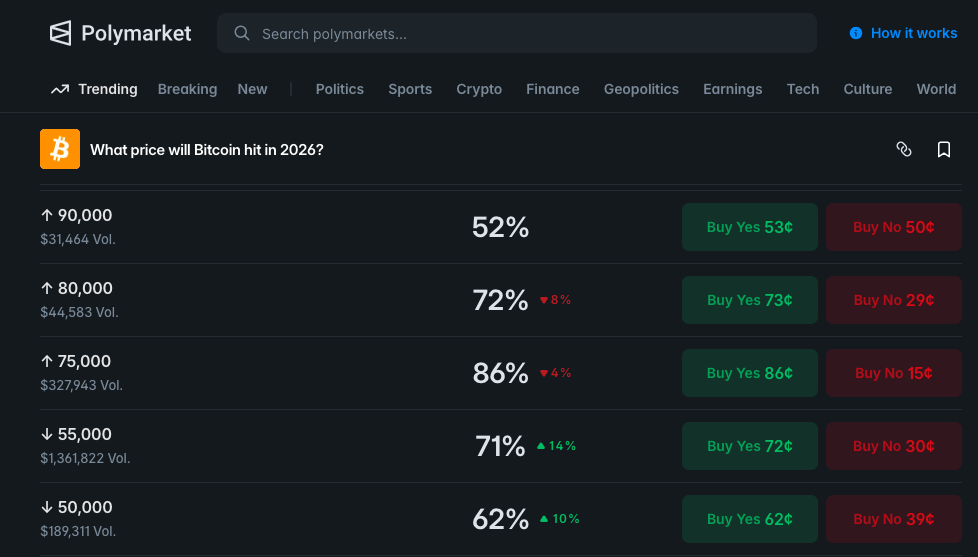
The market is taking the other side of that trade. Polymarket bettors and traders are currently pricing in a roughly 66% probability of continued upside, with millions in volume backing a bullish trajectory rather than a collapse. Smart money is betting on expansion, not extinction.
This creates a sharp divergence between a famous tech skeptic and the actual localized market sentiment driving price action.
Key Takeaways
- The Skeptic: Jimmy Wales predicts a crash to $10,000, calling the asset a failure.
- The Data: Prediction markets signal a 66% confidence in bullish continuation.
- The Divergence: On-chain volume and ETF flows contradict the “bubble” narrative.
The Bear Case: Wales Predicts Bitcoin Bubble Bursts to $10K
Wales’ argument is not new, but his timeline is specific. He posits that Bitcoin will slowly bleed out to $10,000 by 2050 as the “bubble” deflates relative to inflation and utility.
Speaking recently, he characterized the banking system’s engagement with crypto as predatory rather than supportive, suggesting institutions are merely extracting fees before the inevitable collapse.
This narrative echoes his past predictions that have largely failed to materialize. Yet, it resonates with a segment of the market concerned about sustainability.
Wales argues that without being an effective medium of exchange, the store-of-value proposition is hollow.
Discover: The best new crypto today
What Polymarket Is Actually Saying
Prediction markets offer a quantified rebuttal to opinion. On Polymarket, the leading decentralized prediction platform, the odds tell a story of confidence.
Contracts tracking Bitcoin’s price trajectory show a dominant preference for higher targets in 2024 and 2025.
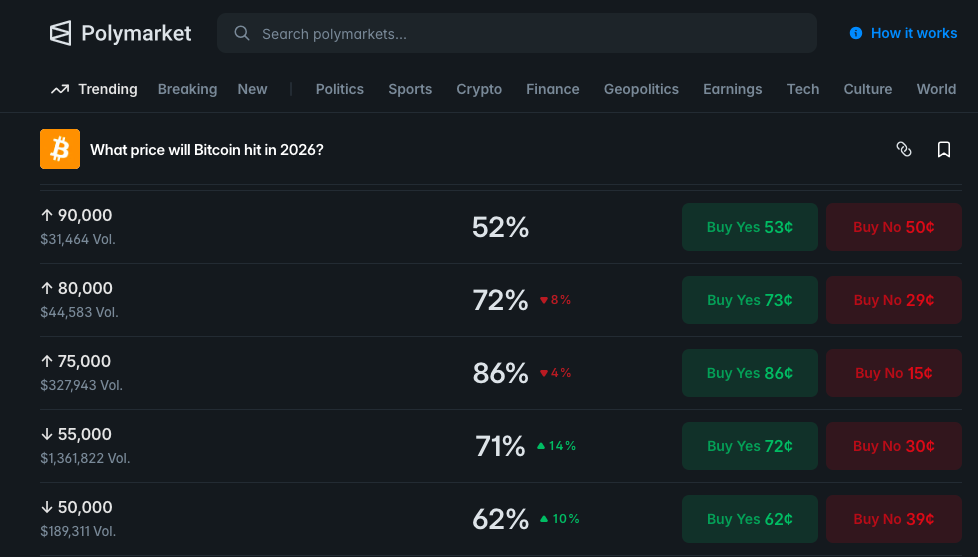
The majority of Polymarket bettors believe the bull case is remaining intact, although they have different ideas about where the ceiling might be.
A staggering 86% see bitcoin rising to $75,000 contrasting with 71% who see it falling down to $55,000, a level described as a plausible bear case by Standard Chartered and CryptoQuant analysts.
Additionally, institutions are still quietly doubling down on Bitcoin. Both Strategy and Metaplanet revealed they intend to keep adding to their BTC treasuries.
If Wales is right, the industry smart money is spectacularly wrong. But if the market is right, Wales is fighting a phenomenon fueled by many billions in institutional treasuries and ETF liquidity.
On-Chain Data: Accumulation or Distribution?
To settle the debate, Bitcoin analysis must turn to the blockchain itself. Current on-chain metrics show a stark difference from the 2017 or 2021 tops.
Exchange reserves are deepening their multi-year downtrend. Coins are moving off exchanges into cold storage, a signal that usually precedes supply shocks.
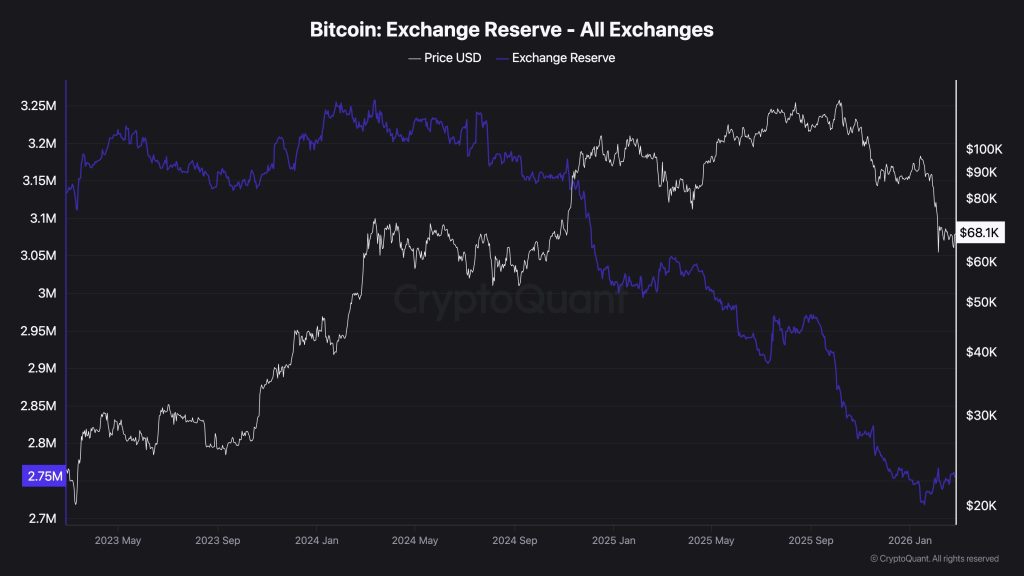
This accumulation is apparent globally. Whales are not distributing into this rally; they are buying the dips.
The recent defense of the $60,000 level proves this. When $370 million in long liquidations flushed the market, buyers stepped in immediately.
That is not the behavior of a popping bubble. It is the behavior of a market establishing a new fair value.
Will the Bitcoin Bubble Burst? The Million Dollar Question
The technical structure for Bitcoin remains constructively bullish as long as it doesn’t slip below the $60,000 support block. A move down to $55k opens the road to further new bottoms.
In the last 24 hours, Bitcoin rose 4% to trade near $68,200 at the time of writing. The next big milestone will be $75k, the preferred price target for most Polymarket bettors, and an indication of its psychological significance.
Clear that, and price discovery mode begins. However, if the broader crypto market weakens, a retest of $62,000 and the threat of a collapse down to $55k hang ominously over the industry.
Discover: The best pre-launch crypto sales
The post Wikipedia vs. On-Chain: Why Jimmy Wales’ Bitcoin Bubble Call Clashes With Polymarket Data appeared first on Cryptonews.


The Office of the Comptroller of the Currency (OCC) has unveiled a comprehensive proposal to implement the GENIUS Act, marking a significant step toward federally regulated stablecoin activity in the United States.
Summary
- The OCC has proposed detailed stablecoin regulations to implement the GENIUS Act, covering issuance, supervision, reserves, liquidity, and redemption requirements.
- A 60-day public comment period has been opened to refine the draft rules before finalization, with AML and sanctions provisions to be added later.
- The move marks a major regulatory milestone in bringing payment stablecoins under federal banking oversight following the GENIUS Act’s enactment.
New OCC stablecoin rule proposal seeks federal oversight
The notice of proposed rulemaking, issued on February 25, outlines how payment stablecoins can be issued, backed, supervised, and potentially revoked under federal banking oversight.
Under the draft rules, the OCC would regulate “permitted payment stablecoin issuers” including subsidiaries of national banks, federal qualified issuers, certain state qualified issuers, and foreign stablecoin issuers meeting specified requirements.
The proposal sets standards for reserve assets, mandatory redemption at par, liquidity and risk management, audits, supervisory examinations, custody, and application pathways laying the groundwork for stablecoins to operate within the traditional banking system.
The OCC has opened a 60-day public comment period to gather industry, stakeholder, and public feedback before finalizing the rules. Key aspects such as anti-money-laundering provisions, Bank Secrecy Act requirements, and sanctions rules will be addressed separately in coordination with the U.S. Department of the Treasury.
Comptroller Jonathan V. Gould described the proposed framework as designed to help the stablecoin sector “flourish in a safe and sound manner,” while providing clarity and regulatory certainty for issuers operating under federal supervision.
The GENIUS Act, enacted in July 2025, created a federal regulatory structure for payment stablecoins after years of debate over how to integrate digital assets into U.S. financial law.
The OCC’s proposal represents a landmark effort to translate that statute into enforceable federal rules, potentially shaping how banks, nonbanks, and foreign firms issue and manage stablecoins in the years ahead.

Colgate-Palmolive (CL) stock is rising fast and it got a gold star as its Relative Strength (RS) Rating climbed from 64 on Monday to 73 on Tuesday. The upgraded rating shows that Colgate stock topped 73% of all other stocks for price performance this past year. Colgate Stock Racing Higher This Year The upgrade comes as Colgate-Palmolive rises at a…
The dollar is trading mixed against the major currencies as investors await important macroeconomic releases and foreign policy signals. Market participants remain cautious ahead of upcoming US data, as well as potential statements following contacts between Washington and Beijing. The trade negotiations factor and the prospect of a meeting between Donald Trump and the Chinese leader remain in focus, as any signs of progress or escalation could influence demand for safe-haven assets and the dollar’s trajectory.
Upcoming macroeconomic releases and developments in the US–China trade agenda will be decisive: either the dollar maintains its advantage and continues to strengthen, or the market shifts into a deeper correction from current levels.
USD/JPY
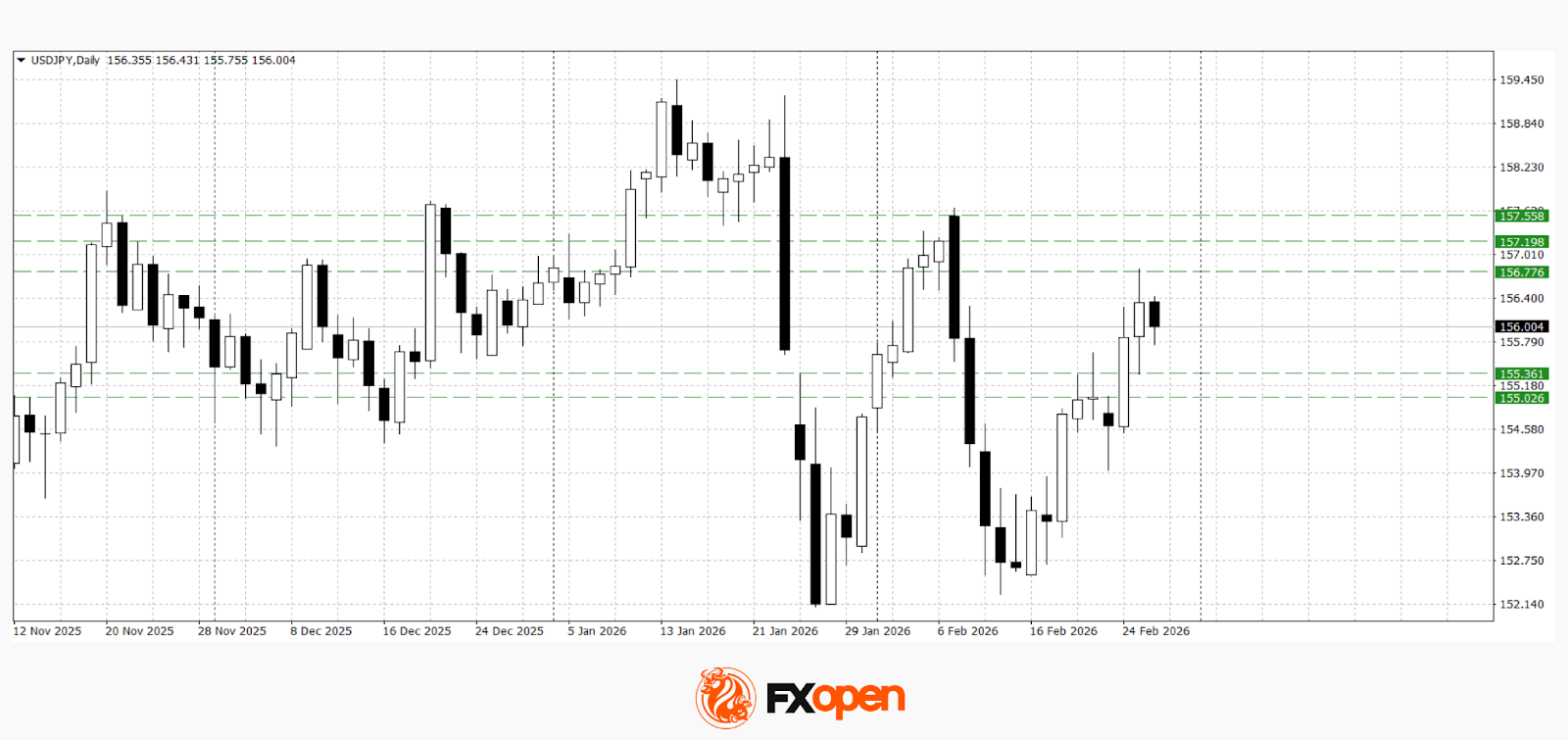
The USD/JPY pair showed a strong upward impulse at the start of the week and moved closer to recent highs. The rally reflects steady demand for the dollar and relative weakness of the yen amid stable expectations regarding Federal Reserve policy and the accommodative stance of the Bank of Japan. Additional support for the dollar comes from expectations surrounding US economic data, which may confirm the resilience of the American economy.
Should the data come in strong, the move towards fresh highs may continue, while weaker figures could trigger profit-taking and a short-term correction.
Key events for USD/JPY:
- Today at 15:30 (GMT+2): US initial jobless claims;
- Today at 17:00 (GMT+2): Speech by Federal Open Market Committee (FOMC) member Michelle Bowman;
- Tomorrow at 01:30 (GMT+2): Tokyo core Consumer Price Index (CPI), Japan.
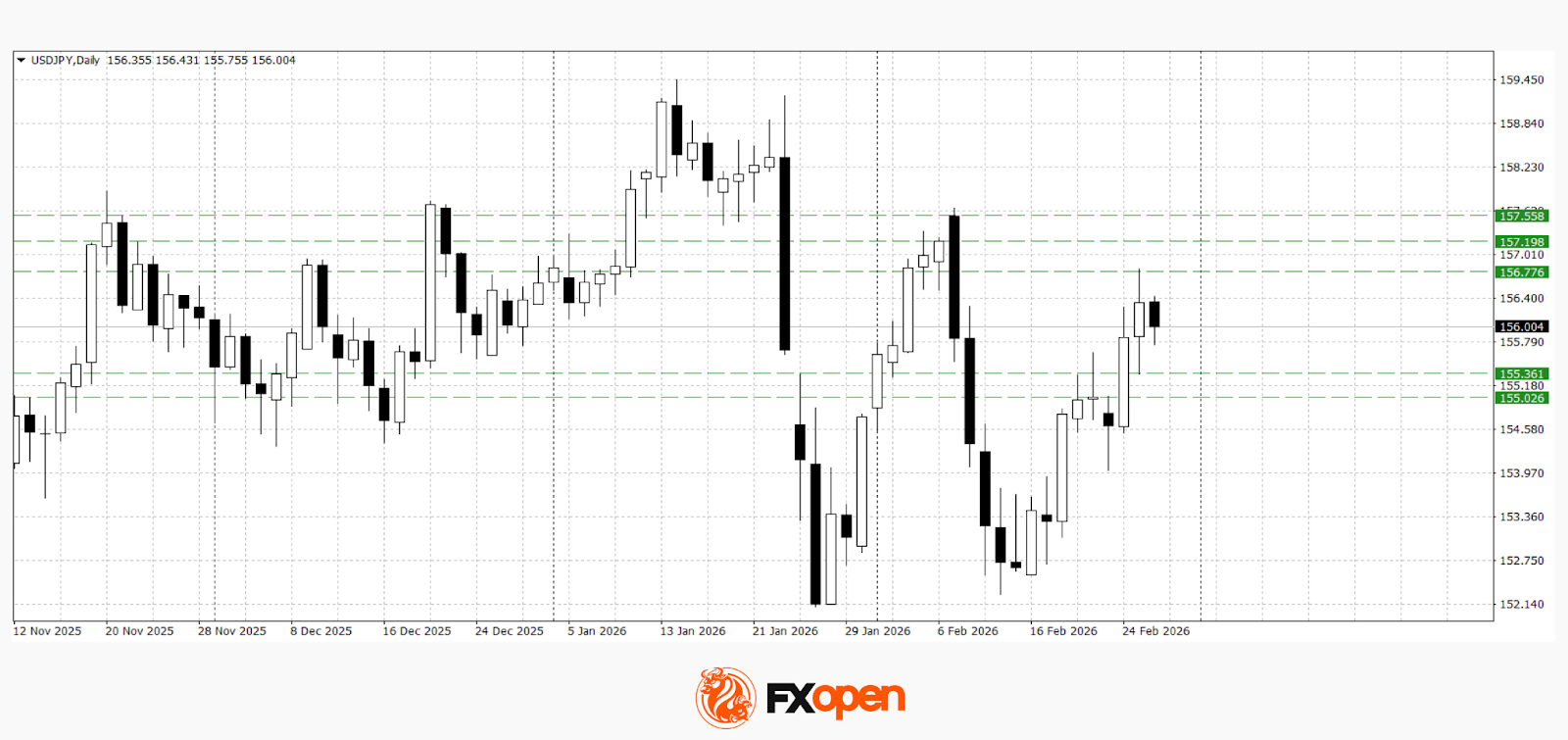
USD/CAD
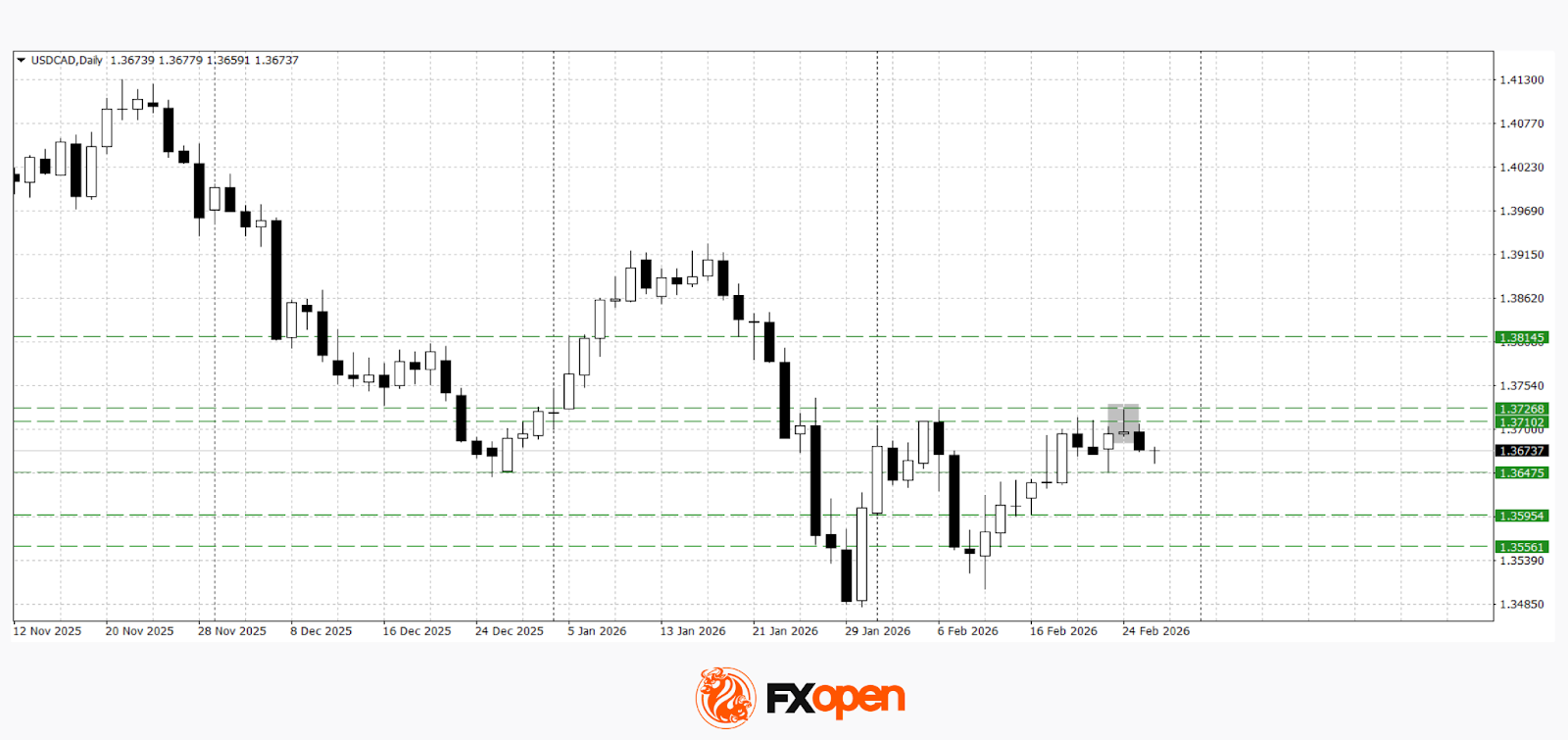
The USD/CAD pair remains in a sideways phase. The pair tested the upper boundary of the range but encountered resistance and shifted into a moderate pullback. Technical analysis suggests a possible move towards the lower boundary of the medium-term range, as a “doji” reversal pattern has formed on the daily timeframe.
A confident break and consolidation above 1.3730 could allow the upward momentum to resume.
Key events for USD/CAD:
- Today at 15:30 (GMT+2): Canadian wholesale sales;
- Tomorrow at 15:30 (GMT+2): Canada GDP (q/q);
- Tomorrow at 15:30 (GMT+2): US Producer Price Index (PPI).
Trade over 50 forex markets 24 hours a day with FXOpen. Take advantage of low commissions, deep liquidity, and spreads from 0.0 pips (additional fees may apply). Open your FXOpen account now or learn more about trading forex with FXOpen.
This article represents the opinion of the Companies operating under the FXOpen brand only. It is not to be construed as an offer, solicitation, or recommendation with respect to products and services provided by the Companies operating under the FXOpen brand, nor is it to be considered financial advice.


Crypto exchange Gate has secured a Payment Institution license in Malta, a license under the European Union’s PSD2 framework, giving the crypto exchange a regulated foothold to offer payment services across the bloc alongside its existing crypto permissions.
The company said Thursday that its Malta-based entity, Gate Technology, received the license from the Malta Financial Services Authority (MFSA). Gate said the approval supports its strategy of linking traditional payment infrastructure with Web3 services in Europe.
The authorization adds payment capabilities to Gate’s existing EU crypto permissions. On Oct. 1, 2025, Gate announced that it had obtained a license under the EU’s Markets in Crypto-Assets Regulation, allowing it to provide exchange and custody services across member states.
EU crypto companies offering payment services in stablecoins must hold either a Payment Institution or an Electronic Money Institution authorization. With PSD2 approval, Gate can passport regulated payment services across the bloc, expanding beyond trading into fiat and stablecoin payment infrastructure.
Gate says its flagship exchange serves more than 49 million users globally, though it does not publicly disclose a breakdown of users in the EU.
Payments authorization expands EU scope
Under PSD2 rules, licensed institutions may execute payment transactions, facilitate credit transfers and direct debits, and maintain payment accounts across the EU.
According to the MFSA’s public authorization catalogue, Gate Technology is permitted to provide payment services as defined under Malta’s Financial Institutions Act, including enabling cash to be placed on and withdrawn from payment accounts and carrying out all operations required to operate the accounts.
Gate CEO Giovanni Cunti said the license positions the company to deliver compliant payment solutions to institutional and retail clients.
The MFSA listing confirms that the approval extends beyond crypto custody and exchange services to regulated account and transaction functionality.
However, Gate did not specify which payment products will launch first or when expanded EU services will roll out.
Cointelegraph reached out to Gate for more information but had not received a response by publication.
Related: Deutsche Bank-backed AllUnity launches Swiss franc stablecoin CHFAU
Part of broader EU compliance trend
Gate’s approval follows a similar move by another major exchange. On Feb. 16, OKX obtained a Malta Payment Institution license to support products including OKX Pay and the OKX Card.
Under MiCA, crypto-asset service providers integrating stablecoin payments into regulated financial rails must align with EU payments law. As a result, Payment Institution approvals are increasingly becoming a prerequisite for exchanges seeking to offer euro-denominated payment flows alongside crypto trading.
Magazine: Hong Kong stablecoins in Q1, BitConnect kidnapping arrests: Asia Express
Bitcoin’s (BTC) latest recovery has lifted sentiment across crypto markets, with traders pointing to renewed momentum after weeks of choppy price action.
However, the rebound has also revived something else: fresh allegations against Jane Street, a global quantitative trading firm and major liquidity provider. But how much of the circulating narrative is supported by evidence, and how much remains speculative? As the theory resurfaces, separating verifiable facts from online conjecture has become essential.
Jane Street’s Alleged 10 AM Bitcoin Sell-Off: Manipulation Theory or Market Myth?
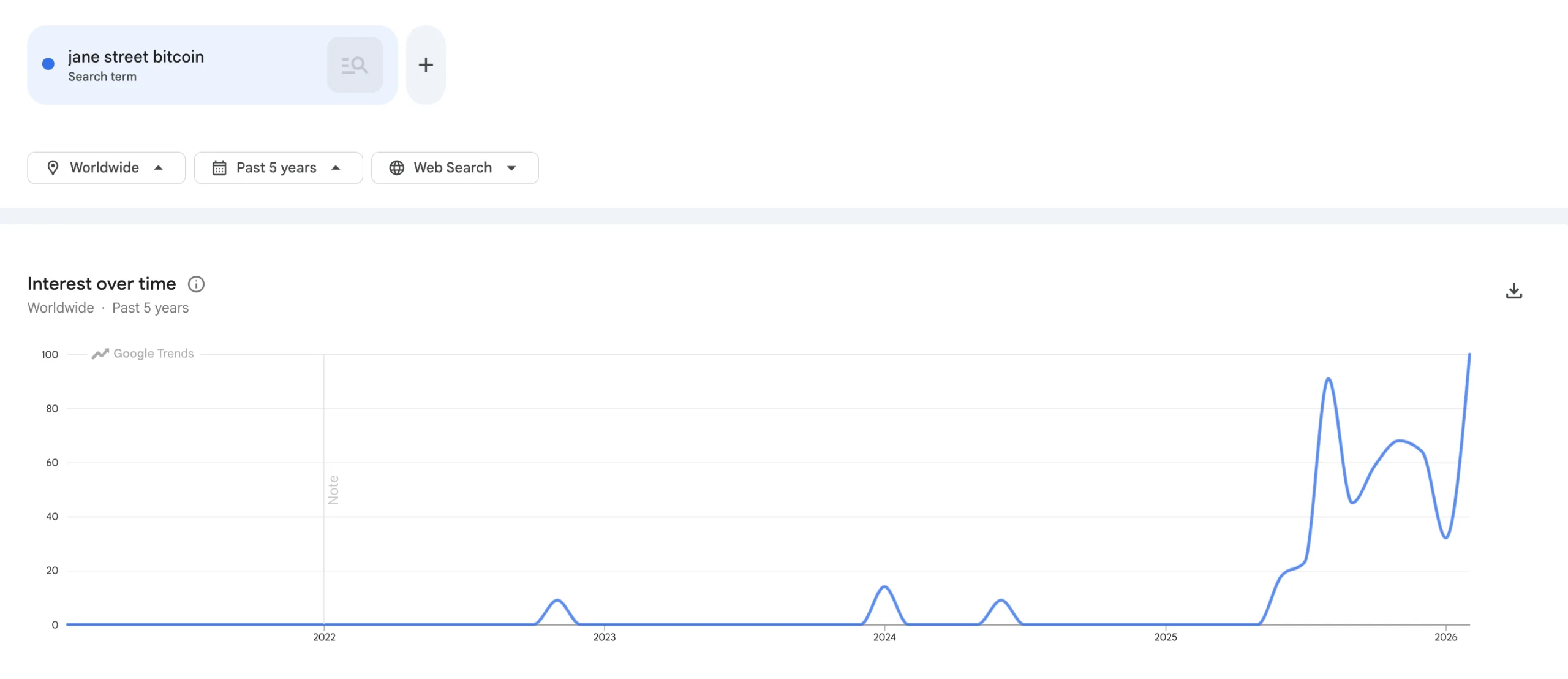
Jane Street is dominating Crypto Twitter discussions, and the surge in attention extends beyond social media. Google Trends data shows that search interest for “Jane Street Bitcoin” recently reached an all-time high. This indicates a sharp rise in public curiosity.
Follow us on X to get the latest news as it happens
What is driving this renewed focus? A simple search on X reveals numerous posts linking Jane Street to Bitcoin’s price action. At the center of the discussion are allegations of a so-called 10 AM Eastern Time Bitcoin sell-off pattern.
Since 2024, Zero Hedge has repeatedly pointed to what it describes as a recurring pattern. According to him, Bitcoin often experiences a sharp decline around 10 AM ET. Jane Street is frequently named in connection with the theory.
Similar allegations surfaced in December 2025.
“Jane Street is one of the largest high-frequency trading firms in the world. They have the speed and liquidity to move markets for a few minutes. The behavior looks simple: 1. Dump BTC at the open. 2. Push the price into liquidity pockets. 3. Re-enter lower. 4. Repeat daily,” Bull Theory posted.
At the time, BeInCrypto reported that no regulator, exchange, or independent data source had confirmed any coordinated activity. Notably, new allegations against Jane Street surfaced recently after Terraform Labs’ administrator sued the trading firm.
“Who crashed Luna and UST to 0 and brought down the entire crypto market in 2022? Jane Street. The same Jane Street accused of ‘10AM manipulation’ also front-ran the 2022 Terra collapse,” Ash Crypto said.
Jane Street has denied any wrongdoing and stated that it intends to defend itself in court. Nonetheless, some analysts started making connections between the lawsuit’s timing and Bitcoin’s price.
Several commentators on X have alleged that the legal action against Jane Street may have paused the supposed 10 AM sell-offs. According to this narrative, the absence of the previously observed intraday declines allowed Bitcoin’s price to climb over the past two days.
In a detailed post, Justin Bechler suggested that the alleged “daily flash crashes” had previously stopped after the Terraform Labs lawsuit filings became public early last year.
However, he claims the 10 AM pattern later resumed in Q3 2025. By December, he said, the intraday declines had returned with full force.
“Basically, the 10 am dumps stopped the moment Jane Street had lawyers looking over its shoulder, and started again when the heat died down,” he wrote. “Bitcoin should be at least $150,000 right now, and everyone knows it. Yesterday, a federal lawsuit was filed in Manhattan that explains exactly why it isn’t.”
Bechler further noted that Jane Street disclosed a large IBIT position in its Q4 2025 13F filing. It also sharply increased its MicroStrategy holdings.
“This looks like bullish accumulation if you don’t understand what Jane Street actually is. Jane Street is one of only four firms authorized to conduct in-kind creations and redemptions for IBIT. The others are Virtu Americas, JP Morgan Securities, and Marex. Jane Street is also an authorized participant for Fidelity’s and WisdomTree’s Bitcoin ETFs,” he said.
According to him, this role gives the firm “direct access to the mechanism that connects ETF share prices to actual Bitcoin.” Bechler stated that Jane Street can transfer Bitcoin in and out of the ETF structure, arbitrage price differences between the fund and the spot market, and hold inventory positions on a scale far beyond that of a typical market participant.
He also added that a 13F only shows long stock positions but does not require disclosure of options, futures, or swaps.
“When Jane Street reports holding $790 million in IBIT shares, the filing tells you nothing about whether those shares are hedged by puts, offset by short futures, or wrapped in a collar that makes the firm’s net Bitcoin exposure zero or even negative,” he remarked.
He noted that the public only sees what appears to be an accumulation. In reality, the position could represent a significant short exposure that resembles a long, since the offsetting leg of the trade remains hidden under current disclosure rules.
A Form 13F, he added, is merely a snapshot of one side of the balance sheet. The other side is not visible to anyone outside the firm.
“If the firm holds $790 million in IBIT shares and offsets that position with $790 million in put options or short futures, the net exposure is zero. If the derivative book exceeds the equity position, the net exposure is negative, meaning Jane Street profits when Bitcoin’s price falls. In either scenario, the firm has every incentive to use its privileged position as authorized participant to suppress the spot price, trigger liquidations, and harvest the spread,” Bechler commented.
The Counterarguments: Volatility, Not Villainy
Not everyone is convinced. Several analysts pushed back, arguing the 10 AM pattern is overstated. Julio Moreno, Head of Research at CryptoQuant, directly questioned the narrative.
He noted that the mechanics described, buying Bitcoin on the spot market and selling futures, are not unusual. According to Moreno, this is “what any other delta neutral fund does.”
Moreno also pointed to the lack of a broader market context in the discussion. He stressed that overall Bitcoin spot demand growth has been collapsing since early October 2025, a trend he described as an obvious driver of the price decline.
Benjamin Cowen, CEO of Into The Cryptoverse, also weighed in. He argued that Bitcoin has historically rallied into early March during every midterm year. He added that each market cycle tends to produce its own narrative to explain price movements.
“Bitcoin price action is not a manipulated conspiracy,” he wrote.
Furthermore, Jeff Park, chief investment officer at ProCap and an adviser to Bitwise, suggested that the debate reflects a misunderstanding of how ETF plumbing actually works.
He mentioned that the focus on individual firms, such as Jane Street, overlooks the structural mechanics governing all Authorized Participants (APs) within the Bitcoin ETF framework.
Users on X also began pointing out that Jane Street appeared to have deleted every post from its account following the lawsuit. This further fueled speculation online.
However, that claim was quickly debunked. Economist Alex Krüger clarified that Jane Street had no posts on its X account to begin with.
“The amount of fake news and false narratives spread around in crypto is truly remarkable. Jane Street had no posts to delete. Can corroborate that on the Wayback Machine,” he posted.
Why the 10 AM Jane Street sell-off Theory Resonates
Retail traders have watched Bitcoin shrug off bullish developments, including MicroStrategy purchases and a favorable regulatory environment, while price action remained weak and sentiment slid into extreme fear. In that context, a simple and identifiable explanation can be compelling.
The apparent pause in the alleged 10 AM pattern following a high-profile lawsuit fits neatly into a correlation-as-causation narrative that often gains traction on Crypto Twitter.
However, correlation does not constitute proof. For now, the 10 AM theory remains merely an allegation, not a fact.
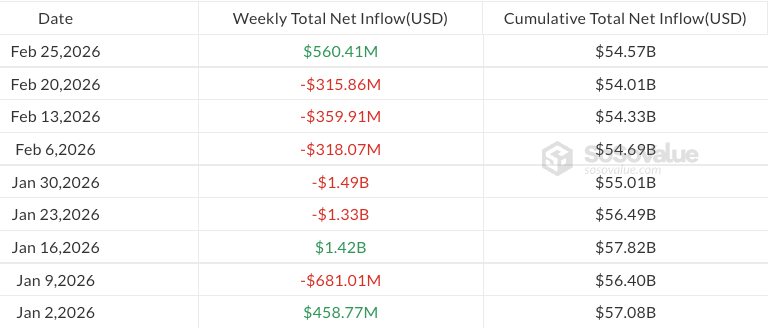
US spot Bitcoin funds extended their rebound Wednesday as BTC reclaimed $68,000, pulling in $506.5 million in inflows, the largest daily total since Feb. 2.
Bitcoin (BTC) exchange-traded funds (ETFs) are nearing a potential first week of inflows after five weeks of net outflows totaling $3.8 billion, with weekly inflows now at $560.4 million, according to SoSoValue data.
The gains mark two consecutive days of inflows, hinting at a possible upside following a massive February sell-off that wiped out $20 billion in net assets.

BlackRock’s IBIT leads inflows with $297 million as ETF trading rebounds
BlackRock’s iShares Bitcoin Trust ETF (IBIT) saw the largest share of inflows yesterday, attracting $297.4 million, according to Farside data.
The Bitwise Bitcoin ETF (BITB) and the Fidelity Wise Origin Bitcoin Fund (FBTC) followed with $39.4 million and $30.1 million in inflows, respectively.

Reflecting the recovering interest, ETF trading volumes rebounded above $4.3 billion, the highest level since Feb. 9.
Jane Street’s ETF controversy adds to mounting “paper Bitcoin” concerns
The renewed buying comes as some investors continue to debate how market structure affects Bitcoin price discovery, including the role of large market-making firms like Jane Street and authorized participants (APs) that help create and redeem ETF shares.
In rumors circulating on X following a recent lawsuit filed by Terraform Labs administrator Todd Snyder, Jane Street has been accused of influencing prices through derivatives exposure to BTC and market manipulation.
“The answer is trickier than the question,” Bitwise advisor Jeff Park noted in an X post on Wednesday, adding. “But it’s also more structurally unsettling than the conspiracy theory itself — and once you understand the actual mechanics, you won’t be able to unsee them,” he added.

“The short answer is that no AP explicitly suppresses Bitcoin price,” Park said, stressing that it’s rather the integrity of the price discovery mechanism that the AP structure can suppress.
“Those are not the same thing—but the second is arguably more consequential than the first,” he added.
Some analysts noted that selling pressure on Bitcoin has persisted since October 2025, raising doubts about the impact of individual players.
Related: ‘Bitcoin scarcity is dead’: Crypto executives push back on viral claim
Concerns over “paper Bitcoin,” in which firms trade without acquiring actual crypto, have lingered since early February, when The Kendall Report highlighted ETFs as a contributor.
The debate intensified recently after a mishap at South Korea’s Bithumb exchange, which mistakenly distributed 620,000 BTC it did not hold, underscoring ongoing questions about transparency and market integrity.
Magazine: Bitdeer sells all Bitcoin, Metaplanet rejects misconduct claims: Asia Express


WLFI proposes 180-day staking, ~2% APR to align governance and USD1 arbitrage.
Summary
- Unlocked WLFI must be staked at least 180 days to vote.
- Node (10m WLFI) and Super Node (50m WLFI) tiers add OTC USD1 access, incentives.
- Target ~2% APR from treasury; 7-day vote, 1b WLFI quorum for approval.
World Liberty Financial (WLFI) has introduced a governance reform proposal that would require token holders to stake their assets to participate in voting, according to a proposal document released by the organization.
The WLFI Governance Staking System proposes linking influence and rewards to token lock-up duration, representing a potential shift in how governance power is distributed within the WLFI ecosystem, the document stated.
Under the proposal, holders of unlocked WLFI tokens would be required to stake their tokens for a minimum of 180 days to vote on governance matters. Voting power would be calculated using a square root formula that factors in both the amount of tokens locked and the remaining duration of the lock-up, according to the proposal.
Participants who stake their tokens and vote at least twice during their lock period would be eligible for a base reward of approximately 2% annual percentage rate, funded directly from the WLFI treasury, the proposal stated.
The proposal introduces two participation tiers for large stakeholders. The Node Tier would require a minimum stake of 10 million WLFI tokens and provide access to over-the-counter conversion pathways for stablecoins such as USDT and USDC into USD1, along with additional rewards tied to conversion volume, according to the document.
The Super Node Tier would require a minimum stake of 50 million WLFI tokens and provide priority access to the WLFI team for partnership discussions and potential economic incentives, the proposal stated.
According to the proposal document, the system aims to redirect arbitrage value back into the ecosystem. The proposal states that institutional market makers captured a significant portion of arbitrage opportunities during the expansion of the USD1 stablecoin.
The proposal is open for a seven-day community vote and requires a minimum quorum of 1 billion eligible voting tokens to pass. If approved, implementation would roll out in three phases, beginning with the activation of governance staking for all holders of unlocked WLFI tokens, according to the proposal.


- Centrifuge price exploded by more than 180% to hit highs of $0.25.
- The sharp rise followed as news of CFG trading going live on Upbit.
- Profit-taking threatens to wipe out all the intraday gains as the price hovers near $0.16.
Centrifuge (CFG) has surged dramatically in the past 24 hours, posting gains of over 180% amid excitement over its listing on South Korea’s largest crypto exchange, Upbit.
Notably, the rally aligns with broader market gains, as Bitcoin climbed about 7% to near $70,000 before settling around $68k as of writing.
Several top altcoins also posted positive moves, including Ethereum’s uptick to above $2,000 despite continued selling by co-founder Vitalik Buterin.
On-chain data shows whale accumulation is picking up and could surge as price breaks above the $2k level.
CFG is up amid this potential market bounce, with the Upbit listing a major catalyst.
However, the overall crypto market sentiment remains cautious, and profit-taking could see a sharp pullback for several altcoins.
Centrifuge price rockets on Upbit listing news
Upbit, South Korea’s leading crypto exchange, announced that trading support for CFG would go live on February 26, 2026, at 2 PM KST.
The exchange added spot pairs against KRW, BTC, and USDT, and revealed that deposits and withdrawals would be available shortly after the announcement.
Upbit boasts a massive user base and liquidity, and these factors have historically seen listed tokens pump hard.
CFG’s price rose sharply amid the potential flip in visibility and adoption.
The token’s value jumped from around $0.08 to over $0.25, with trading volume spiking over 4,000% to $79 million.
With assets like Polkadot, NEAR, and Uniswap trending among the top 10 gainers, it’s Centrifuge’s vertical jump that stood out.
CFG market cap ballooned past $120 million before slipping lower as prices retreated from the intraday highs.
Centrifuge price forecast
Centrifuge is a crypto project focused on tokenizing real-world assets (RWAs), a market that’s attracting huge attention.
The CFG token powers governance on the platform, allowing holders to participate in protocol decisions.
Despite market potential, its price has largely followed the bearish trend across crypto.
A short-term upside tied to Upbit’s liquidity influx helped bulls revisit prices last seen in October 2025.
If Korean inflows persist, buyers could test higher resistances around $0.30 and move to $0.40.

However, broader profit deals have already seen CFG pull back, currently trading near $0.16.
The MACD suggests bullish sentiment, but an extended RSI signals overbought risks.
If prices fall below the 50-day and 100-day simple moving average lines, the nosedive could accelerate to $0.10 or lower.

Kanye West’s Wife’s Style Slammed By Potential Juror In Mansion Trial

Work starts on first phase of development at Ravenscraig Enterprise Park to create new commercial premises

Royal Mail bosses to be called to Parliament over letter delivery failures

Smart energy pays enters the US market, targeting scalable financial infrastructure

Why Israel is blocking foreign journalists from entering

Bitcoin: We’re Entering The Most Dangerous Phase

Ripple XRP IM SHAKING $2000 INCOMING THEY CONFIRMED IT!!!

( Expired )** Incred Money Free Gold & Silver Offer || Get Free Gold & Silver from INCRED Money App

Xii English top Selected mcq “Money Madness” Board Exam 2026, #chseodisha #hksir #mychseclass
-

 Video6 days ago
XRP News: XRP Just Entered a New Phase (Almost Nobody Noticed)
-

 Politics4 days ago
Baftas 2026: Awards Nominations, Presenters And Performers
-

 Fashion6 days ago
Weekend Open Thread: Boden – Corporette.com
-

 Sports3 days ago
Women’s college basketball rankings: Iowa reenters top 10, Auriemma makes history
-

 Politics3 days ago
Nick Reiner Enters Plea In Deaths Of Parents Rob And Michele
-

 Crypto World2 days ago
XRP price enters “dead zone” as Binance leverage hits lows
-

 Business4 days ago
Mattel’s American Girl brand turns 40, dolls enter a new era
-

 Business2 days ago
True Citrus debuts functional drink mix collection
-

 Business4 days ago
Law enforcement kills armed man seeking to enter Trump’s Mar-a-Lago resort, officials say
-

 Tech2 days ago
Unsurprisingly, Apple's board gets what it wants in 2026 shareholder meeting
-

 NewsBeat10 hours ago
Cuba says its forces have killed four on US-registered speedboat | World News
-
 NewsBeat12 hours ago
Manchester Central Mosque issues statement as it imposes new measures ‘with immediate effect’ after armed men enter
-
 NewsBeat3 days ago
‘Hourly’ method from gastroenterologist ‘helps reduce air travel bloating’
-

 Tech4 days ago
Anthropic-Backed Group Enters NY-12 AI PAC Fight
-

 NewsBeat4 days ago
Armed man killed after entering secure perimeter of Mar-a-Lago, Secret Service says
-

 Politics4 days ago
Maine has a long track record of electing moderates. Enter Graham Platner.
-

 Business6 hours ago
Discord Pushes Implementation of Global Age Checks to Second Half of 2026
-
 NewsBeat2 days ago
Police latest as search for missing woman enters day nine
-

 Crypto World2 days ago
Entering new markets without increasing payment costs
-
 Sports3 days ago
2026 NFL mock draft: WRs fly off the board in first round entering combine week