
Crypto World
‘wrench attacks’ jumped 75% in 2026



In 2025, crypto crime took a violent turn.
Physical attacks aimed at stealing cryptocurrencies, known as “wrench attacks,” jumped 75% from the previous year, with 72 confirmed incidents worldwide, according to a new report by CertiK.
The report marks last year as a turning point, where physical violence became a core threat to crypto holders.
Wrench attacks in this context describe scenarios where victims are coerced, often through the use of violence, into handing over private keys. The report documented a 250% increase in physical assaults, including home invasions, kidnappings, and even murder.
Europe now accounts for over 40% of all such incidents globally, up from 22% in 2024 according to the report. France led with 19 reported attacks, more than double the count in the United States. CertiK attributes this spike to organized crime groups increasingly targeting known crypto holders across France, Spain, and Sweden.
In some cases, criminals forced entry into victims’ homes. In others, they targeted spouses, children, or elderly parents to compel cooperation. So-called “honey pot” schemes, where attackers build fake romantic relationships to stage assaults, also featured in the data.
Behind the violence are seemingly improvements in digital security, which ramp up hacking costs. Still, threatening someone with a weapon still works. The report calls this the “Technical Paradox”: stronger tech, but the same fragile human layer.
With over $40 million in confirmed losses, and likely far more unreported, CertiK warned that personal safety is now part of the crypto risk equation.
The cryptocurrency space has been working on solutions, which include insurance policies. Some well-known companies, including insurance giant Lloyd’s of London, have started offering their clients coverage that includes wrench attacks in it.

Crypto World
Justin Sun Accuses World Liberty Financial of Blacklisting His Wallet After $75 Million Investment

TLDR:
- Justin Sun, WLFI’s largest private investor with $75M in, claims his wallet was blacklisted without prior notice or disclosure.
- A hidden smart contract function allegedly gave World Liberty Financial unilateral power to freeze any token holder’s assets.
- Sun challenged WLFI’s governance votes, arguing key information was withheld and the team predetermined outcomes.
- Sun demanded the immediate unlocking of his tokens and called on WLFI to rebuild trust through full transparency and integrity.
World Liberty Financial is under scrutiny after its largest private investor raised serious allegations of misconduct. Justin Sun, founder of the TRON blockchain, invested over $75 million in the platform.
He claims the project used a hidden backdoor in its smart contract to blacklist his wallet. Sun says no investor was informed about this feature beforehand.
The situation raises pressing questions about transparency and investor protections in the decentralized finance space.
Sun Exposes a Hidden Blacklist Function in WLFI’s Smart Contract
Justin Sun went public with his allegations through a post on his official social media account. He stated that World Liberty Financial embedded a blacklisting function inside the WLFI token smart contract.
This function gave the company unilateral power to freeze any token holder’s access without notice. According to Sun, investors were never told about this capability before committing their capital.
Sun described the mechanism as a direct contradiction of the project’s stated mission. World Liberty Financial had publicly positioned itself as a decentralized finance platform promoting financial freedom.
A hidden freeze function, he argued, runs counter to everything decentralization stands for. He called it “a trap door marketed as an open door.”
In his post, Sun wrote that the function allows the company to “freeze, restrict, and effectively confiscate the property rights of any token holder, without notice, without cause, and without recourse.”
He identified himself as the first and single largest victim of this practice. His wallet was reportedly blacklisted back in 2025. He stated this violated basic investor rights and core blockchain principles.
Sun also challenged the governance votes the project used to justify its decisions. He argued that key information was withheld from participants and meaningful involvement was restricted.
The results, he claimed, were predetermined rather than genuinely community-driven. These votes, in his view, served the interests of the team — not the broader investor base.
Sun Demands Token Unlock and a Return to Transparency
Beyond his personal dispute, Sun raised wider concerns about the WLFI team’s overall conduct. He accused the team of extracting fees from users without proper community authorization.
He further claimed they treated the crypto community as a personal revenue source. None of these actions, he said, were approved through any fair governance process.
Sun was careful to separate his dispute from his broader political support. He reiterated his backing for President Trump’s crypto-friendly policy direction.
His grievance, he stressed, lies specifically with bad actors operating within the WLFI team. He maintained that their conduct has nothing to do with him or fellow investors who believed the project’s promises.
Sun called the team directly to reverse the blacklisting of his wallet. He also urged the project to adopt genuine transparency going forward.
He wrote: “Unlock the tokens and uphold transparency for the community. Let’s build with integrity, not misconduct.” As of publishing, World Liberty Financial had not issued any public response to his allegations.

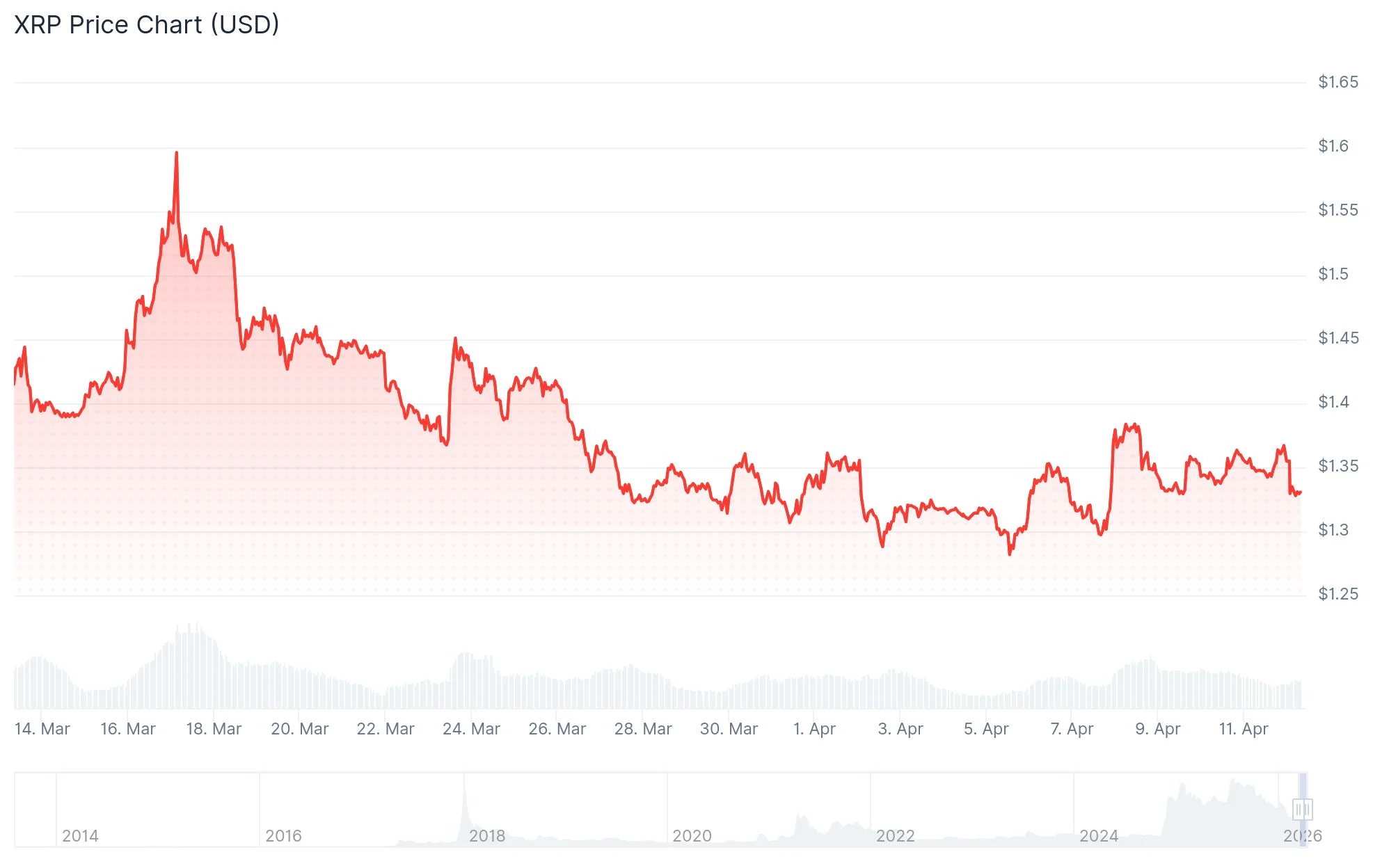
Quick Overview
- XRP is currently valued at approximately $1.33 with an $81.6B market capitalization; Solana sits at roughly $82.29 with a $47.3B market cap
- While Ripple’s SEC legal battle has concluded, a $125M penalty and restrictions on institutional token sales persist
- Major corporations including Mastercard, Worldpay, and Western Union have already adopted Solana’s Developer Platform
- XRP concentrates on international payment solutions; Solana operates across payments, digital currencies, asset tokenization, and blockchain development infrastructure
- Solana’s token circulation nears its maximum supply, creating a more transparent valuation framework compared to XRP
Among major cryptocurrencies beyond Bitcoin and Ethereum, XRP and Solana stand out as two of the most closely monitored digital assets. While both command significant market attention, their investment narratives diverge considerably.
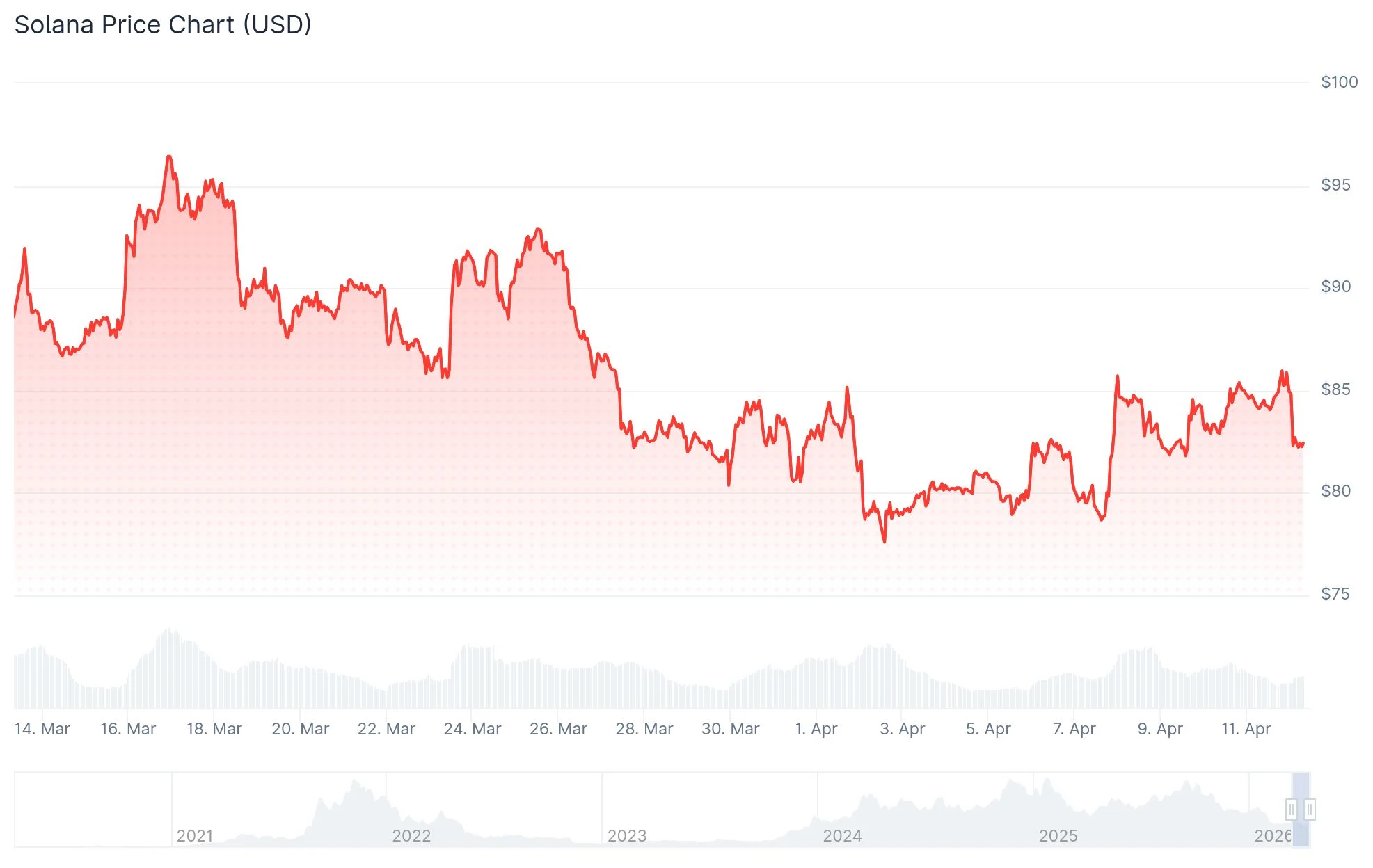
Data from CoinGecko shows XRP hovering around $1.33 with a market capitalization approaching $81.6 billion. Meanwhile, Solana trades near $82.29 with a market cap of approximately $47.3 billion. XRP currently maintains the larger market valuation between the two.
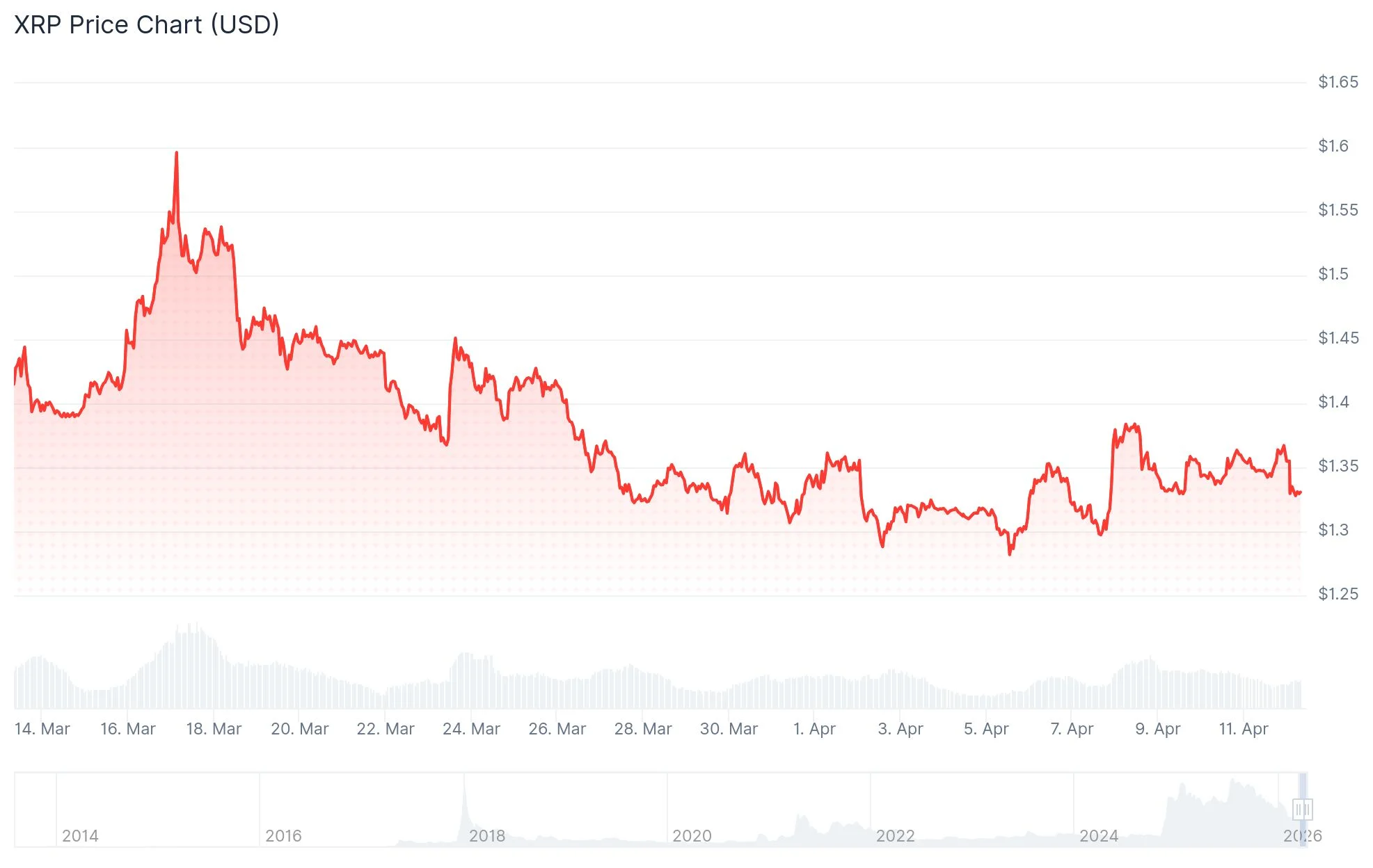
This substantial market cap difference carries investment implications. XRP’s larger valuation suggests Solana could have greater upside potential if network adoption continues accelerating.
XRP’s value proposition centers on facilitating international payments and Ripple’s expansion into financial infrastructure. According to Reuters, Ripple’s extended legal dispute with the SEC has essentially concluded.
Yet the matter isn’t entirely settled. A $125 million penalty stands, and Ripple continues operating under an injunction affecting institutional XRP transactions.
This creates a nuanced environment for XRP as we progress through the latter half of 2026. While regulatory headwinds have diminished compared to the lawsuit’s peak, the token’s price trajectory remains largely dependent on Ripple-driven adoption initiatives.
Solana’s Multi-Faceted Ecosystem Strategy
Solana distinguishes itself through diversification across numerous blockchain applications. The network operates in payment processing, stablecoin infrastructure, tokenized securities, blockchain development tools, and enterprise solutions.
Solana’s March 2026 ecosystem report unveiled the Solana Developer Platform launch. Among the platform’s inaugural corporate adopters are Mastercard, Worldpay, and Western Union.
This type of institutional engagement spanning diverse industries differs significantly from XRP’s payment-centric approach. Multi-vertical platforms typically attract investment capital from varied sources over extended periods.
Token Supply and Valuation Models
XRP operates with a predetermined ceiling of 100 billion tokens, though only approximately 61 billion are presently in circulation. This substantial difference between circulating and maximum supply remains a point of ongoing investor scrutiny.
Solana features roughly 570 million tokens circulating from a total supply approaching 574.5 million. This tight margin means its current market price more accurately represents its fully diluted valuation.
Solana does implement continuous token issuance through its staking mechanism, which investors should factor into their analysis. XRP doesn’t face similar ongoing token creation.
Solana also exhibits higher price volatility between the two assets. Conservative investors seeking stability may find this characteristic unappealing.
Investors prioritizing straightforward narratives will appreciate XRP’s focused approach, widespread exchange availability, and improved regulatory standing compared to previous years.
Conversely, investors targeting growth opportunities and ecosystem expansion will find Solana’s diversified adoption strategy and corporate partnerships more compelling as of mid-2026.
The addition of Mastercard, Worldpay, and Western Union to the Solana Developer Platform during its initial phase represents the most significant institutional development between these two assets in recent months.
Investment Takeaway
Both XRP and Solana have secured their positions among premier cryptocurrency assets. XRP benefits from reduced legal uncertainty and dedicated institutional backing. Solana offers broader platform capabilities, prominent corporate partnerships, and expanding ecosystem activity. The optimal choice depends on whether investors prefer a concentrated payment-focused position or a diversified blockchain platform approach.
TLDR:
- Covenant AI’s exit from Bittensor’s top subnets triggered a sharp $TAO price drop near $265.
- Co-founder Jacob Steeves denied centralization claims but apologized for losses suffered by holders.
- Community miners are reviving subnets 3, 39, and 81 using open-source code after Covenant’s departure.
- The Locked Stake upgrade would tie subnet ownership to time-locked $TAO to ensure team commitment.
Bittensor co-founder Jacob Steeves issued a public apology on April 11 after Covenant AI’s exit sent $TAO prices sharply lower.
Covenant AI had operated three of the network’s top-performing subnets, including Templar for large-model AI training.
The firm accused Steeves of centralizing control through emission suspensions and timed token sales. Steeves denied the claims but acknowledged the financial harm to $TAO holders. The token has since stabilized near $265 as community miners work to revive the affected subnets.
Covenant AI’s Departure and the Accusations That Followed
Covenant AI operated subnets 3, 39, and 81, which ranked among Bittensor’s most active and recognized nodes. The firm’s sudden exit left miners and investors without clear direction on those critical subnets. Its departure marked one of the most disruptive events in Bittensor’s recent history.
Samuel Dare, a central figure at Covenant AI, was identified by Steeves as the source of the conflict. Dare allegedly took deliberate steps to cause maximum harm to the protocol and its wider community. The accusations made against both parties quickly drew attention across the crypto space.
The specific claims against Steeves included suspending subnet emissions and conducting timed token sales. These actions, Covenant AI argued, contradicted Bittensor’s core permissionless and decentralized design. Steeves rejected all allegations and addressed them across multiple posts on X.
The exit triggered a sharp price drop in $TAO, rattling confidence among long-term holders and active miners. Community members quickly turned to the open-source codebase to assess how subnet operations could continue. The episode exposed real vulnerabilities in how subnet ownership and commitment are currently structured.
Steeves Issues Personal Apology to $TAO Holders
Steeves addressed $TAO holders directly, acknowledging the financial and emotional damage caused by the crisis. He described the events as deeply personal, calling Dare a former trusted colleague and friend. His statement was candid and notably free of corporate deflection.
Steeves wrote that those one helps most can sometimes inflict the greatest harm. He connected the betrayal to broader human failures that inevitably arise within open, permissionless systems. Despite that, he stated he could not regret building Bittensor on principles of radical openness.
Community miners moved quickly, organizing to restart the three suspended subnets using publicly available code.
Former Covenant AI team members were reportedly in discussions to help continue the original work. The open-source foundation of those subnets made a technical recovery genuinely possible.
Locked Stake Proposal Aims to Prevent Future Subnet Exits
Steeves proposed a protocol-level upgrade called Locked Stake to close accountability gaps in subnet ownership. The feature would tie subnet control to time-locked $TAO, making team commitment verifiable on-chain. Ironically, it was reportedly one of the last initiatives Dare worked on before leaving.
Under the proposal, subnet owners would signal long-term conviction through the duration of their token lock. Investors would gain greater predictability before committing capital to any team’s subnet. Teams with longer lock periods would effectively compete on commitment, not just technical performance.
Steeves acknowledged that failing to implement the upgrade sooner was a genuine error on his part. He suggested earlier adoption might have prevented the current breakdown entirely. A detailed community discussion is planned for the upcoming Thursday call on the Bittensor Discord.
The proposal targets one of crypto’s oldest unsolved problems: measuring team commitment in open systems without relying on legal contracts.
Steeves argued that legal accountability is too slow and too corruptible for the pace of modern AI development. A cryptographic solution, he maintained, is the only credible path forward for decentralized AI networks.
TLDR
- SpaceX maintains custody of 8,285 BTC valued at roughly $603 million through Coinbase Prime
- Financial performance reversed from $8 billion in gains to a $5 billion deficit in 2025
- Annual revenue reached $18.5 billion, though xAI integration expenses exceeded income
- The bitcoin treasury has stayed static since the middle of 2024
- SpaceX ranks as the fourth-biggest corporate entity holding bitcoin publicly
According to The Information’s Friday report, SpaceX recorded approximately $5 billion in losses for 2025. This represents a dramatic shift from the company’s roughly $8 billion in profits during the previous year.
https://x.com/blckchaindaily/status/2043174140723798502?s=20
The revenue picture tells a different story. SpaceX generated $18.5 billion in 2025, representing growth from the estimated $15 billion to $16 billion recorded in 2024. However, operational expenses related to absorbing xAI—Elon Musk’s AI venture purchased in February 2025—exceeded total income.
Yet throughout this financial turbulence, SpaceX left its bitcoin reserve completely untouched. Blockchain analytics platform Arkham Intelligence confirms the company maintains 8,285 BTC stored with Coinbase Prime, currently valued at approximately $603 million.
The most recent wallet activity occurred roughly four months ago during an internal reorganization. Two separate transactions—614 BTC and 1,021 BTC respectively—transferred between wallets controlled by SpaceX. Zero bitcoin entered the market.
The dollar value of SpaceX’s position exceeded $1.6 billion when Bitcoin reached its peak in October 2025. The actual BTC quantity has remained unchanged since mid-2024.
This positions SpaceX as the fourth-largest publicly known corporate bitcoin treasury, trailing only Strategy, Marathon Digital, and Riot Platforms.
A Big Asset on a Stressed Balance Sheet
For an organization gearing up for public markets while absorbing a $5 billion deficit, maintaining over $600 million in a high-volatility asset represents a deliberate strategic decision. SpaceX has shown no indication of liquidating this position to strengthen its financial position.
Reports from CoinDesk last month confirmed SpaceX submitted IPO documentation. Once these filings become accessible to the public, the bitcoin treasury will appear in official financial disclosures for the first time.
This timing coincides with updated FASB accounting standards implemented in late 2025. These regulations require companies to value cryptocurrency holdings at current market rates, meaning Bitcoin’s price fluctuations will directly impact SpaceX’s reported financial performance.
What the IPO Filing Could Mean for Bitcoin Disclosure
After SpaceX completes its public offering, the bitcoin position will face identical examination as every other asset on the balance sheet. Market participants and financial analysts will monitor this holding through regular quarterly reports.
Maintaining the position through a $5 billion loss indicates leadership considers bitcoin a strategic treasury reserve rather than a speculative investment.
SpaceX enters a selective but expanding group of corporations adopting this bitcoin treasury approach. While Strategy maintains the dominant position by substantial margin, SpaceX’s $603 million holding establishes it as a significant participant in this emerging category.
Arkham’s blockchain tracking reveals no recent withdrawals. Current on-chain verification confirms SpaceX’s complete 8,285 BTC position remains undisturbed.
Crypto World
Hyperliquid (HYPE) ETF Inches Closer as Bitwise Files Key Amendment and Hayes Adds to Position
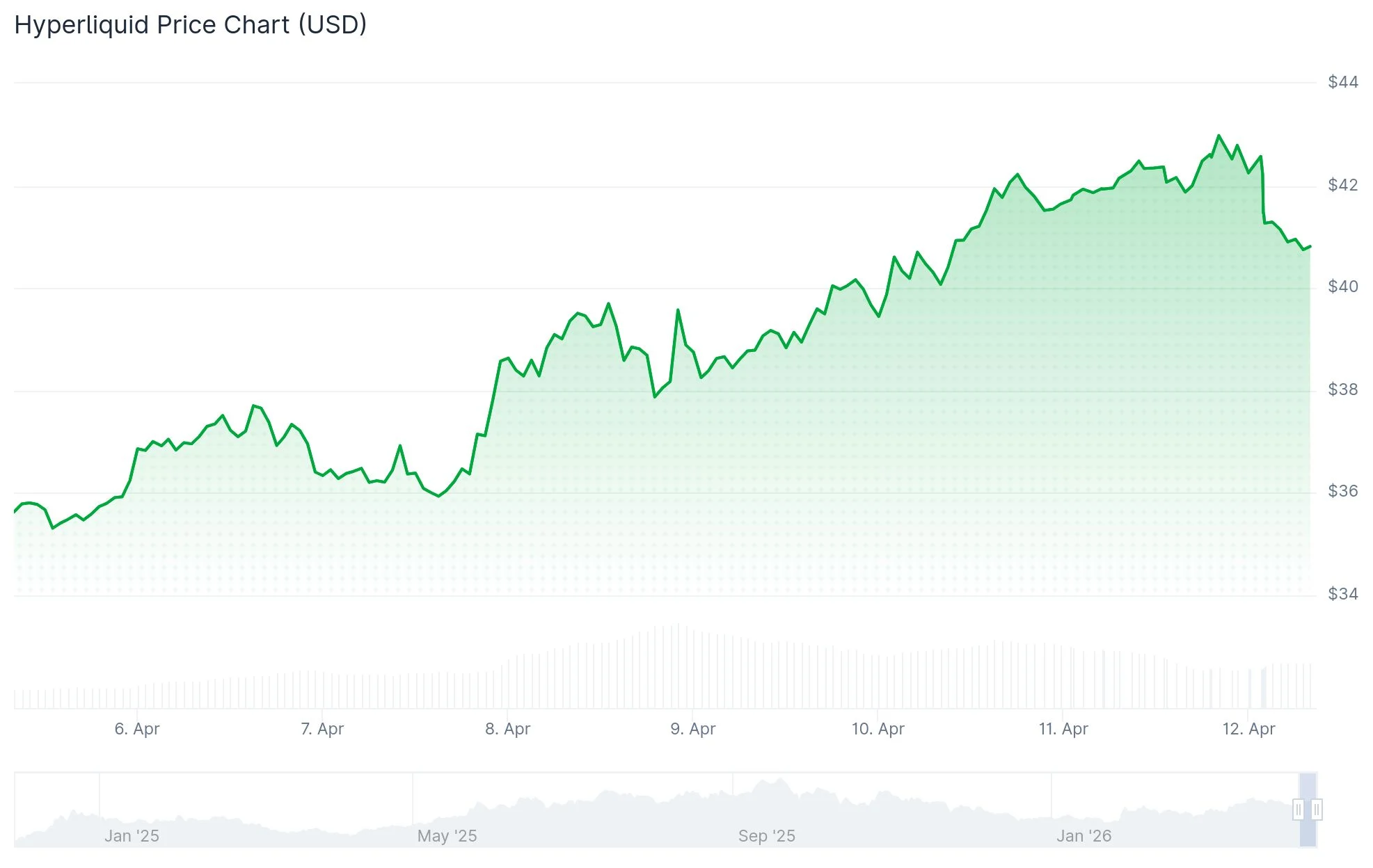
Key Highlights
- Bitwise submitted its second amendment for a Hyperliquid ETF, revealing the ticker symbol $BHYP and a management fee of 0.67%.
- Eric Balchunas from Bloomberg ETF analysis indicated these additions usually precede an imminent product rollout.
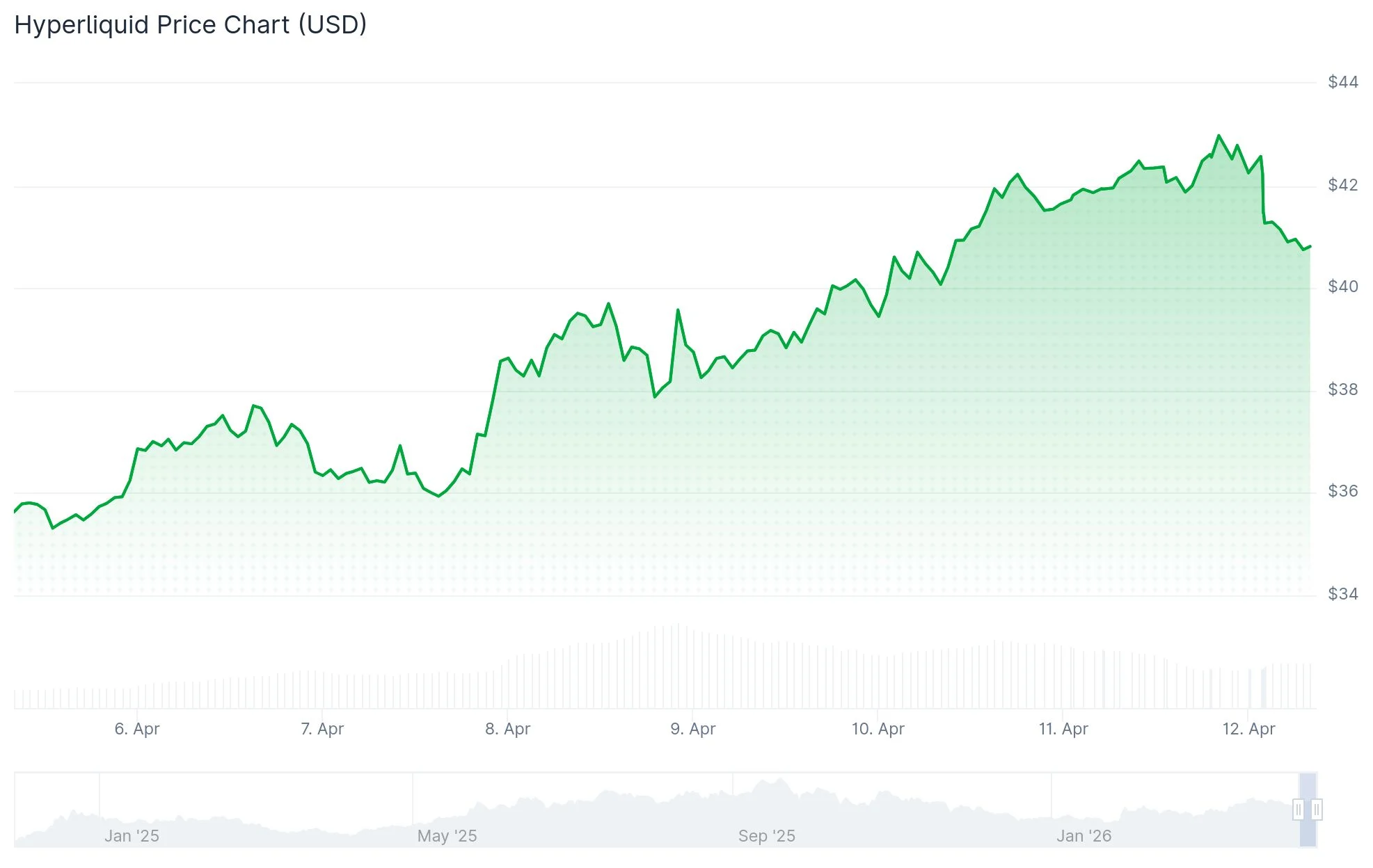
- HYPE has surged approximately 65% year-to-date in 2026, currently priced near $41.96, with a 12-month gain of about 182%.
- BitMEX co-founder Arthur Hayes acquired 26,022 HYPE tokens valued at over $1 million, marking his first buy in nearly three months.
- The Hyperliquid platform entered the top 10 derivatives exchanges by volume in early April, recording $492.7 billion in Q1 trading activity.
Bitwise Asset Management has submitted an updated amendment to the US Securities and Exchange Commission for its proposed Hyperliquid spot exchange-traded fund. The latest filing discloses the ticker symbol $BHYP alongside a management fee structure of 0.67%, equivalent to 67 basis points.
Eric Balchunas, a senior ETF analyst at Bloomberg, highlighted the amendment on X, explaining that including such specifics generally indicates an imminent product debut. He pointed out that HYPE has appreciated 200% annually and suggested Bitwise appears eager to capitalize on current market conditions.
Bitwise became the initial asset manager to file for a Hyperliquid ETF with the SEC back in September 2025. The firm now competes with Grayscale, which submitted its application in late March 2026, and 21Shares, which followed one month after Bitwise’s original filing.
Upon regulatory approval, the ETF would list on the NYSE Arca platform, offering investors direct exposure to HYPE’s spot market price. Bitwise has also suggested in a previous amendment that the fund could potentially enhance returns through HYPE staking mechanisms—a feature that neither Grayscale nor 21Shares has proposed.
Hayes Adds Over $1 Million to HYPE Holdings
Blockchain monitoring service Lookonchain revealed that Arthur Hayes, BitMEX’s co-founder and former chief executive, purchased 26,022 HYPE tokens worth just above $1 million on April 11. This transaction marked his first acquisition of the token in almost three months.
Hayes’ total holdings now stand at 247,344 HYPE, valued at roughly $10.44 million, reflecting an unrealized profit of approximately $2.5 million.
The purchase occurred as HYPE regained ground above the $40 threshold. The token had declined below $27 toward the end of February following geopolitical tensions in Iran, subsequently rallied to $44 in mid-March, retreated to $34, and rebounded to approximately $42 when Hayes executed his buy.
In a post on X, Bloomberg’s Balchunas stated: “Bitwise w another update to Hyperliquid ETF includes ticker $BHYP and fee 67bps. Typically that means launch soon. HYPE is up 200% in past yr so they prob trying to strike while iron hot.”
Token Performance and Exchange Metrics
Data from CoinGecko indicates that HYPE is currently trading near $41.96, representing an approximate 65% increase since the beginning of 2026 and a gain of roughly 182% over the trailing 12-month period.
CoinGlass, a blockchain analytics service, reported in early April that Hyperliquid had secured a position among the top 10 cryptocurrency derivatives exchanges by trading volume. Throughout the first quarter of 2026, Hyperliquid facilitated $492.7 billion in trading volume, positioning it in ninth place, trailing Coinbase by approximately $90 billion.
As of April 11, 2026, HYPE was valued at approximately $41.96 based on CoinGecko pricing data.
Key Highlights
- Chainalysis estimates stablecoin transaction volumes may reach $719 trillion by 2035 based on organic expansion alone
- Under favorable macroeconomic conditions, transaction volumes could soar to $1.5 quadrillion — a dramatic increase from 2024’s $28 trillion
- Treasury Secretary Scott Bessent is pressing Congress to advance the Clarity Act, legislation designed to establish crypto market structure
- An intergenerational transfer of wealth totaling up to $100 trillion toward younger, crypto-savvy demographics could generate $508 trillion in yearly stablecoin activity
- Expanding retail merchant acceptance for stablecoin payments could contribute an additional $232 trillion to annual transaction volumes
A groundbreaking analysis from Chainalysis suggests stablecoin transaction activity could skyrocket from last year’s $28 trillion to an astonishing $1.5 quadrillion within the next decade. This forecast has captured the attention of senior U.S. government officials and financial policymakers.
Treasury Secretary Scott Bessent published a compelling opinion piece in the Wall Street Journal, directly challenging Congress to take immediate action. His message centered on the urgent need to approve the Clarity Act, legislation currently under review by the Senate banking committee.
“The U.S. didn’t become the world’s financial center by hesitating in moments of technological change,” Bessent emphasized. He stressed that enacting this legislation would guarantee “the next generation of financial innovation is built on American rails.”
According to reports, the Senate banking committee intends to schedule a hearing and vote on the Clarity Act by the close of April. Bessent characterized Senate floor availability as “scarce” and emphasized the critical nature of immediate legislative movement.
The comprehensive Chainalysis analysis, entitled “The New Rails: How Digital Assets Are Reshaping the Foundations of Finance,” received its initial preview on April 8. The research positions stablecoins as transformative settlement infrastructure capable of revolutionizing international payments, cross-border remittances, and enterprise treasury management.
According to Chainalysis projections, natural market evolution alone will push stablecoin volumes to $719 trillion by 2035. Should broader economic catalysts materialize, the total could climb toward $1.5 quadrillion.
Even the conservative baseline figure represents an extraordinary expansion from present-day metrics. The $28 trillion in stablecoin volume recorded last year pales in comparison to what industry researchers now consider achievable.
Wealth Migration Across Generations
A primary catalyst identified in the research involves a historic redistribution of wealth across age demographics. As much as $100 trillion in assets are anticipated to transition from Baby Boomers and older generations to Millennials and Gen Z cohorts — populations characterized as inherently comfortable with cryptocurrency.
Chainalysis calculates this demographic shift could independently contribute $508 trillion to yearly stablecoin transaction activity by 2035. Younger capital holders demonstrate significantly higher propensity to utilize blockchain-powered financial infrastructure instead of conventional banking channels.
As this wealth migration unfolds, financial liquidity may increasingly flow toward decentralized, on-chain platforms rather than traditional financial intermediaries.
Retail Integration Drives Mainstream Adoption
The second critical growth engine involves widespread merchant integration. Chainalysis forecasts that stablecoin acceptance at retail checkout systems could inject $232 trillion into annual transaction volumes by 2035.
As stablecoins penetrate everyday commerce, established payment processors may encounter intensifying competitive pressure. When deployed at scale, blockchain-based payment systems have potential to compress profit margins for traditional payment intermediaries.
Chainalysis also notes that Bitcoin and the wider cryptocurrency ecosystem stand to gain substantial benefits from expanded stablecoin utilization.
The Clarity Act builds upon groundwork established by the previously enacted Genius Act, which Bessent referenced as demonstration that meaningful regulatory advancement remains achievable.
The Senate is expected to conduct its vote on the Clarity Act before April 2026 concludes.
Key Takeaways
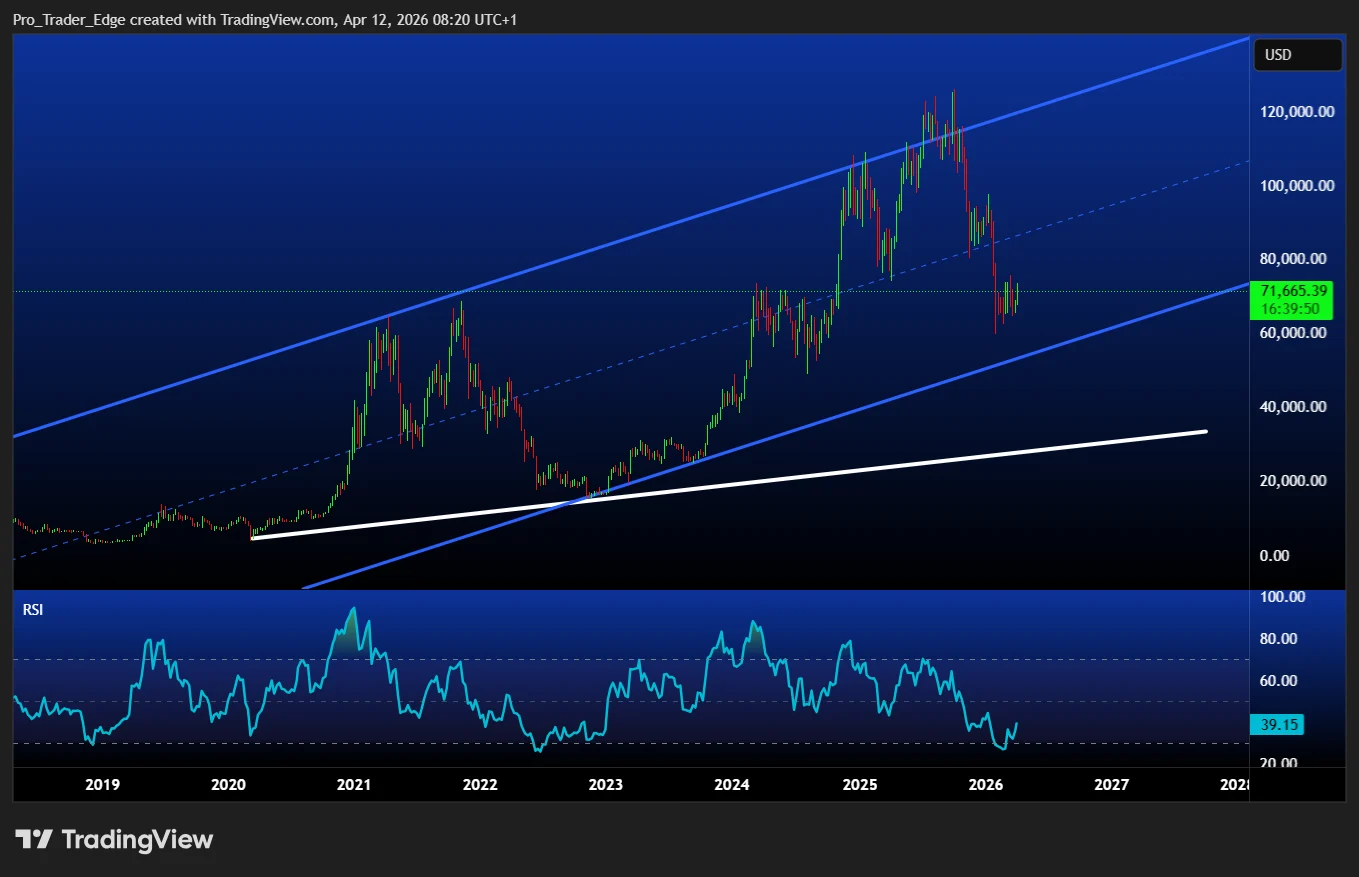
- Historical Bitcoin bear markets have witnessed declines ranging from 77% to 85% from their peaks; applying similar metrics to the 2025 high of $126,198 suggests potential lows between $19,000 and $29,000.
- Market experts believe the current downturn resembles a mid-cycle correction rather than the beginning of a prolonged bear market phase.
- The primary support zone is projected between $58,000 and $68,000, though a more aggressive selloff could push prices down to $48,000–$58,000.
- Historical cycle analysis suggests Bitcoin typically reaches its trough approximately 12–13 months following peak valuations, indicating a potential October–November 2026 timeframe — though current technical indicators don’t strongly validate this projection.
- Confirmation signals for a genuine bottom include robust weekly candle closes, successful reclamation of resistance zones, and bullish reversal in weekly RSI readings.
On October 6, 2025, Bitcoin reached its record peak of $126,198, as tracked by CoinGlass data. The cryptocurrency has since retreated to approximately $71,000, prompting the perennial market question: are we witnessing a standard pullback or the onset of a deeper bear phase?
Looking at previous cycles provides valuable perspective. Bitcoin experienced an 85% crash from its 2013 top, an 84% plunge from its 2017 summit, and a 77% drawdown from its 2021 high. Applying comparable percentage drops to the $126,198 peak would theoretically bring Bitcoin down to a range of $19,000 to $29,000 under worst-case conditions.
However, weekly chart technicals indicate this cycle might deviate from that trajectory. The long-term ascending channel structure remains unbroken. The present price action appears more consistent with a rejection near the upper boundary of this formation rather than a complete structural collapse into multi-year bearish territory.
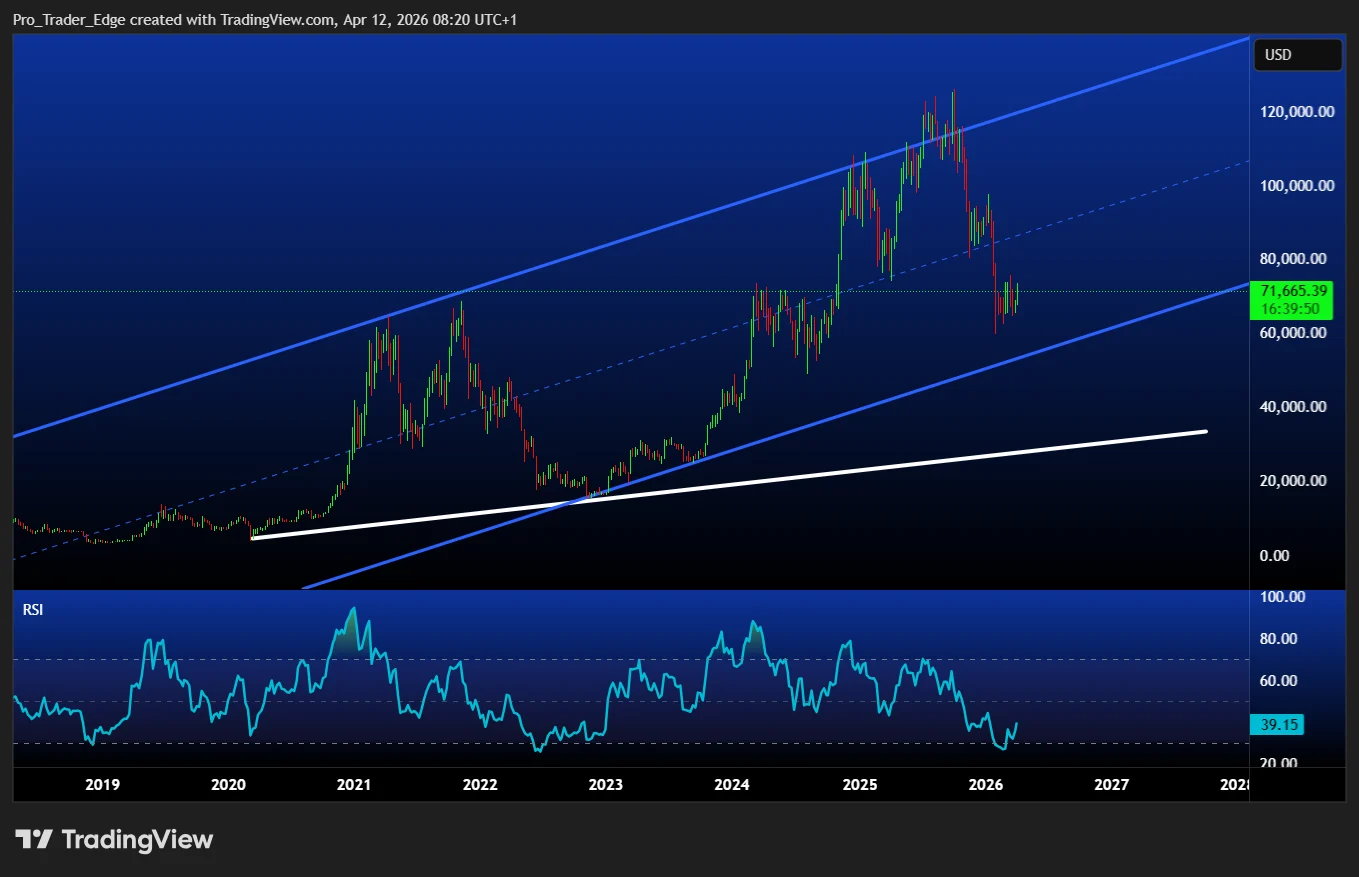
Nevertheless, market analysts don’t consider the bottom to be established yet. The weekly RSI indicator continues showing weakness without signs of momentum reversal. The market structure appears compromised but hasn’t reached complete capitulation levels.
Projected Support Zones
Based on current chart structure, the most probable support area sits between $58,000 and $68,000. This range would constitute approximately a 46% to 54% retracement from the October 2025 all-time high.
A more severe capitulation scenario could drive prices into the $48,000 to $58,000 territory — representing a 54% to 62% correction. While both outcomes would be substantial, they remain considerably less severe than the 80%-plus collapses witnessed in previous bear cycles.
There’s also a bullish alternative scenario. Should demand resurge rapidly, a shallower bottom formation between $68,000 and $74,000 remains within the realm of possibility.
Historical cycle patterns show Bitcoin typically establishes its bottom roughly 12 to 13 months following the preceding cycle peak. Extrapolating this timeline from the October 2025 high suggests a potential low forming around October to November 2026 if that truly marked the cycle culmination.
Current Technical Picture
That said, present chart characteristics don’t strongly resemble a completed parabolic blow-off followed by total collapse. The structure appears more aligned with a significant retracement within an overarching uptrend that maintains its integrity.
If this interpretation proves accurate, the bottom formation may materialize within weeks to several months rather than extending into late 2026.
Technical confirmation indicators that would validate a genuine bottom include strong weekly candle closes, successful recapture of nearby resistance thresholds, and upward inflection in weekly RSI momentum. Currently, none of these confirmation signals have materialized.
Bitcoin trading at $71,000 offers better value relative to recent highs, but analysts haven’t identified a clear, high-probability bottom formation at this juncture.
Conclusion
Traders and investors searching for a market bottom should approach this using price zones rather than precise single targets. The optimistic scenario points to a shallow low around $68,000–$74,000. The baseline expectation centers on $58,000–$68,000. Should prices breach below $48,000, the market dynamics would begin resembling a genuine bear market rather than a cyclical correction phase.
Crypto World
Stablecoin Volume Could Hit $719 Trillion by 2035 as Generational Wealth Shift Looms, Chainalysis Projects
TLDR:
- Chainalysis projects stablecoin real economic volume could grow from $28T in 2025 to $719T by 2035.
- A $100 trillion wealth transfer from Boomers to crypto-native Millennials and Gen Z begins around 2028.
- Point-of-sale stablecoin saturation could add $232 trillion in annual transaction volumes alone by 2035.
- Stablecoin networks may match Visa and Mastercard off-chain transaction volumes between 2031 and 2039.
Stablecoins processed $28 trillion in real economic volume in 2025, according to a new Chainalysis report. By 2035, that figure could reach $719 trillion through organic growth alone.
Under additional macro catalysts, volumes may approach $1.5 quadrillion. The report points to a $100 trillion generational wealth transfer and growing merchant adoption as major drivers.
These trends are reshaping how traditional financial institutions think about payment infrastructure and on-chain financial activity.
A $100 Trillion Wealth Shift Could Accelerate Stablecoin Adoption
Starting around 2028, a major capital shift is expected across North America and Europe. Millennials and Gen Z are set to become the dominant adult financial actors during this period.
A 2025 Gemini survey found nearly half of these generations have held or currently hold crypto. This demographic transition will reshape where financial activity flows over the next decade.
Merrill Lynch estimates up to $100 trillion in wealth will move from Boomers to younger generations by 2048. Chainalysis projects this shift alone could add $508 trillion to annual stablecoin volumes by 2035.
The report states that “between 2028 and 2048, an estimated $100 trillion in wealth will likely move from Boomers to Millennials and Gen Z — generations far more likely to use crypto as a default financial tool.” Traditional institutions that miss this shift may see capital migrate toward on-chain ecosystems.
The adjusted stablecoin volume metric used in the report filters out bot activity, MEV transfers, and liquidity provisioning. It captures only organic economic activity, including payments, remittances, and settlement.
This metric grew at a 133% compound annual growth rate since 2023, reaching $28 trillion. The baseline trajectory supports the $719 trillion projection without factoring in any additional macro catalysts.
Beyond direct payments, the wealth transfer is expected to drive adoption across other on-chain products. These include tokenized real-world assets, prediction markets, and hybrid TradFi-crypto instruments.
For traditional institutions, serving crypto-native clients is becoming a core competitive priority. Firms that build on-chain infrastructure early are better positioned to retain the incoming capital flow.
Stablecoin Networks Are Closing the Gap With Visa and Mastercard
Stablecoins settle in seconds, operate continuously, and move across borders without correspondent banking friction.
Unlike legacy payment rails, they remove intermediaries and reduce reconciliation costs. These advantages have already driven adoption in remittances, B2B payments, and treasury operations. The structural cost benefits are becoming harder for legacy financial institutions to overlook as adoption grows.
If current transaction count growth continues, stablecoin networks could match Visa and Mastercard volumes between 2031 and 2039.
Adoption curves in payment networks are rarely linear, however. On-chain transaction counts could intersect with legacy volumes before the 2030s, the report notes.
Chainalysis estimates point-of-sale saturation alone could add $232 trillion to annual stablecoin volumes by 2035, adding that “for incumbents like Visa and Mastercard, this isn’t a distant threat — it’s a countdown.”
Stripe’s acquisition of Bridge and Mastercard’s partnership with BVNK signal the direction payments infrastructure is taking. These strategic moves show stablecoins are transitioning from niche transfers to core payment rails.
Institutions are moving from regulatory positioning to active development and execution. According to Chainalysis, “the institutions that build for this reality now will be positioned to define it, while those that wait may find themselves settling transactions on someone else’s rails.”
Stablecoin-linked cards are beginning to compete with traditional payment products on fees, speed, and rewards. Consumers will increasingly weigh on-chain rails against legacy options on transactional terms.
The GENIUS Act has added regulatory momentum to stablecoin adoption in the United States. For incumbents, the window to build on-chain capabilities before disruption accelerates is narrowing quickly.
Key Takeaways
- Dynamix Corporation and The Ether Machine have abandoned their $1.6 billion SPAC merger arrangement
- Adverse market conditions were cited by both parties as the primary factor behind the cancellation
- A $50 million breakup fee will be paid to Dynamix within a two-week period
- The transaction was designed to bring The Ether Machine to Nasdaq with the ETHM ticker symbol
- Dynamix must secure an alternative merger partner by November 22, 2026 or face liquidation
A cryptocurrency treasury company holding more than $1 billion worth of ether has terminated its planned public market debut. The Ether Machine and special purpose acquisition company Dynamix Corporation officially ended their $1.6 billion merger arrangement on April 8, 2026.
According to joint statements from both entities, the Business Combination Agreement was terminated by “mutual agreement.” Both parties attributed the decision to challenging market dynamics.
Originally unveiled in July 2025, the transaction would have enabled The Ether Machine to secure a Nasdaq listing through a reverse merger with Dynamix, trading under the ETHM ticker.
The Ether Machine operates as an Ethereum treasury and yield generation platform. Its holdings include 496,712 ETH valued at over $1.1 billion, with revenue generated through staking operations and DeFi strategies.
The proposed deal stood out for its substantial scale. It featured a $1.5 billion fully committed PIPE financing arrangement, marking the largest all-common-stock capital raise in this category since 2021.
Upon completion, the merged entity would have controlled in excess of 400,000 ETH. A significant portion of these digital assets came from co-founder Andrew Keys, who previously held a key position at Consensys.
$50 Million Breakup Fee Headed to Dynamix
Under the termination terms, an entity associated with The Ether Machine is obligated to transfer $50 million to Dynamix within 15 days. This payment structure is documented in an SEC 8-K filing.
The $50 million sum represents a substantial amount when compared to Dynamix’s approximate $232 million market capitalization. The filing does not explicitly identify which specific party will make the payment.
The cancellation also voids associated agreements, including Sponsor Support and Subscription Agreements. Both organizations executed mutual release provisions and non-disparagement clauses addressing potential shareholder legal actions.
Dynamix’s Next Steps and Timeline
Dynamix’s SPAC journey continues. The company retains until November 22, 2026 to identify and execute an alternative business combination.
Should Dynamix prove unable to finalize a new transaction before this deadline, the company faces mandatory dissolution, public share redemption, and liquidation procedures.
The deal’s failure arrives during a period of weak performance for ether prices. Appetite for cryptocurrency-related SPAC transactions has diminished considerably.
Nonetheless, the Ethereum treasury sector continues to show vitality. Currently, 10 Ethereum treasury firms collectively control more than 6 million ETH, representing a combined value approaching $14 billion.
The sector leader is Tom Lee’s Bitmine, which recently achieved uplisting to the New York Stock Exchange. The company’s board simultaneously expanded its share buyback program from $1 billion to $4 billion.
Neither The Ether Machine nor Dynamix provided statements when contacted for this report.
Key Takeaways
- Iranian and U.S. representatives convened in Pakistan’s capital on April 11–12 for direct diplomatic discussions following weeks of military tensions
- No agreement was secured after approximately 21 hours of intensive negotiations, Vice President JD Vance announced
- Tehran’s unwillingness to abandon nuclear weapons development emerged as the primary obstacle to a settlement
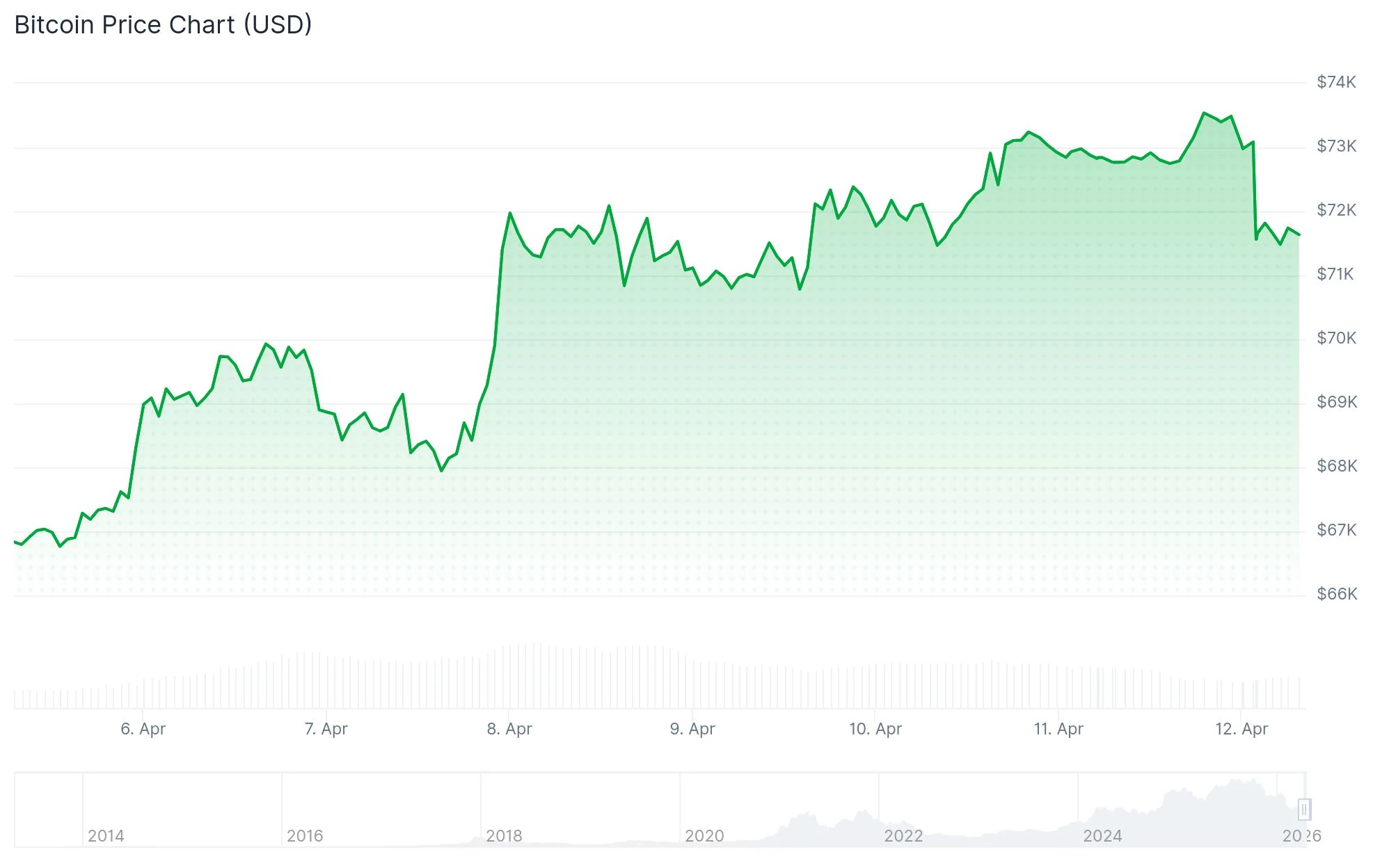
- Bitcoin experienced a 2% decline to approximately $71,500 in the aftermath of the failed negotiations
- XRP decreased 1.69% to $1.33, while Ethereum slipped 1.26% to $2,216, with cryptocurrency markets broadly declining 1–3%
High-ranking officials from Washington and Tehran convened in Pakistan’s capital on April 11 for their first direct, senior-level diplomatic engagement in decades. These discussions came after weeks of military confrontation that erupted on February 27, when the United States and Israel executed joint military operations dubbed “Operation Epic Fury,” striking Iranian military installations and nuclear facilities. The operations resulted in the death of Supreme Leader Ali Khamenei.
The military escalation sent shockwaves through global energy markets and international financial systems. Critical maritime passages near the Strait of Hormuz, responsible for significant portions of worldwide petroleum transport, experienced disruptions due to the intensifying conflict.
Pakistan assumed a crucial intermediary position, providing neutral ground for both parties. While previous ceasefire initiatives had temporarily de-escalated tensions, no permanent resolution had materialized prior to these diplomatic sessions.
Before negotiations commenced, Tehran reportedly pursued sanctions removal, unfreezing of financial assets, and security assurances. Washington maintained firm positions regarding restrictions on Iran’s nuclear capabilities and maintaining freedom of navigation through strategic waterways.
Esmaeil Baqaei, Iran’s Foreign Ministry spokesperson, characterized the 24-hour discussion period as addressing the Strait of Hormuz situation, nuclear program concerns, compensation for war damages, sanctions removal, and complete conflict resolution. He indicated that results would hinge on “the seriousness and good faith of the opposing side.”
Baqaei further urged Washington to refrain from “excessive demands and unlawful requests” while honoring Iran’s “legitimate rights and interests.”
Diplomatic Efforts Conclude Without Agreement
Following approximately 21 hours of intensive discussions, Vice President JD Vance announced at a media briefing that negotiators failed to reach a settlement.
“The bad news is that we have not reached an agreement,” Vance stated. He noted that the U.S. had presented its position comprehensively throughout the talks.
According to Vance, the fundamental obstacle centered on Iran’s refusal to pledge abandonment of nuclear weapons ambitions. “The simple fact is that we need to see an affirmative commitment that they will not seek a nuclear weapon,” he explained.
The American delegation departed Pakistan without securing any agreement. The trajectory of the conflict remains uncertain moving forward.
Cryptocurrency Markets Decline Following Failed Talks
Digital asset markets responded swiftly after Vance’s public statement. Bitcoin declined to approximately $71,500, representing a roughly 2% daily loss.
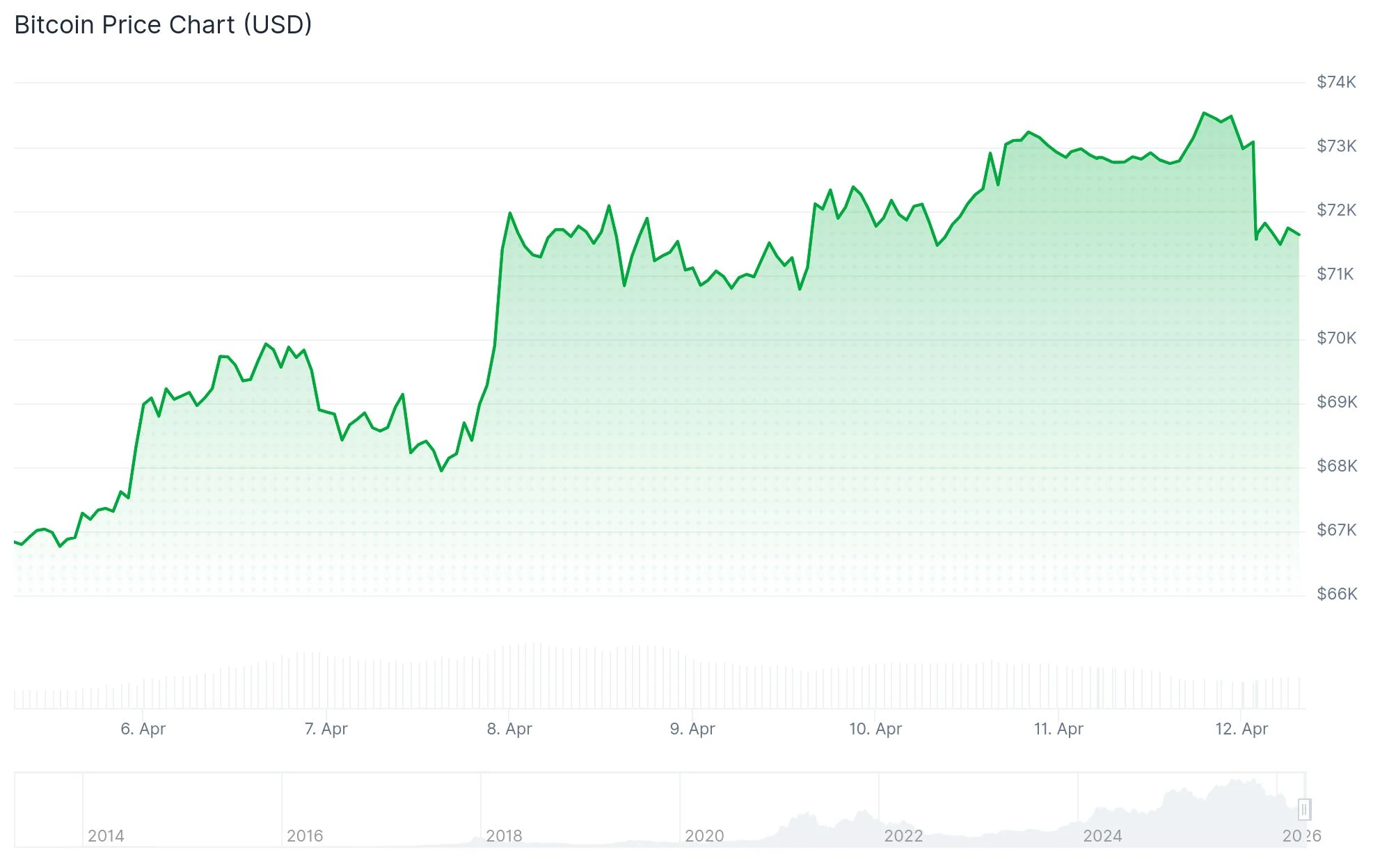
Short-term trading charts revealed a pronounced selloff directly correlated with news reports about the diplomatic impasse.
XRP retreated 1.69% to $1.33. Ethereum declined approximately 1.26% to $2,216. Comprehensive losses throughout cryptocurrency markets spanned from 1% to 3%.
As of April 12, the standoff between Washington and Tehran persists without resolution.

#36 What lessons have you learned from the financial setback or mistake?

The famous Cambridge clock that crowds swarm to

Microsoft: Azure Is Booming, But OpenAI And Copilot Are Quietly Capping The Upside


-

 Business6 days ago
Three Gulf funds agree to back Paramount’s $81 billion takeover of Warner, WSJ reports
-

 Politics2 days ago
US brings back mandatory military draft registration
-

 Fashion2 days ago
Weekend Open Thread: Veronica Beard
-

 Tech4 days ago
How Long Can You Drive With Expired Registration? What Florida Law Says
-

 Business7 days ago
No Jackpot Winner, Prize to Climb to $231 Million
-

 Fashion6 days ago
Massimo Dutti Offers Inspiration for Your Summer Mood Board
-
 Sports2 days ago
Man United discover Nico Schlotterbeck transfer fee as defender reaches Dortmund agreement
-

 Crypto World3 days ago
Canary Capital Files SEC Registration for PEPE ETF
-

 Fashion5 days ago
Let’s Discuss: DEI in 2026
-

 Business2 days ago
Tesla Model Y Tops China Auto Sales in March 2026 With 39,827 Registrations, Beating Cheaper EVs and Gas Cars
-

 Crypto World4 days ago
Bitcoin recovers as US and Iran Agree a Ceasefire Deal
-

 Politics2 days ago
Malcolm In The Middle OG Turned Down ‘Buckets Of Money’ To Appear In Reboot
-

 Business2 days ago
OpenAI Halts Stargate UK Data Centre Project Over Energy Costs and Copyright Row
-

 Business17 hours ago
Ireland Fuel Protests Enter Day 5 as Blockades Spark Shortages and Government Prepares Support Package
-

 Tech6 days ago
Italian court says Netflix must refund customers up to $576 over price hikes
-

 Tech6 days ago
Gamer Restores the Original PlayStation Portal From Two Decades Ago
-

 Tech6 days ago
Samsung just gave up on its own Messages app
-

 Tech6 days ago
Haier is betting big that your next TV purchase will be one of these
-

 Tech6 days ago
The Xiaomi 17 Ultra has some impressive add-ons that make snapping photos really fun
-

 Tech6 days ago
Save $130 on the Samsung Galaxy Watch 8 Classic: rotating bezel, sleep coaching, and running coach for $369
You must be logged in to post a comment Login