
Crypto World
XRP Bulls Defend Key Level as Analyst Envisions Another 100% Rally


The price rally initiated by the cross-border token in mid-August was halted at $1.70, and the subsequent correction drove it south hard to under $1.35. However, the asset managed to rebound swiftly and now sits above a key support level at $1.40.
This has provided additional fuel to popular bullish analysts such as EGRAG CRYPTO to map out XRP’s next move, which could take it north by almost 100%.
Is $2.70 on the Map for XRP?
The token’s recovery coincided with a substantial increase in trading activity as the spot volume across major exchanges skyrocketed to its highest level since February in late August. Binance alone handled almost $7.3 billion in XRP spot trades, followed by South Korea’s Upbit ($4.7 billion) and Bithumb with $2.6 billion.
EGRAG argued that XRP is now attempting to establish a bullish continuation pattern after recovering from the recent pullback that drove it from $1.70 to $1.33 in just over a week. The key here will be whether buyers can reclaim the resistance area that has repeatedly capped the asset’s breakout attempts.
If XRP is finally successful, it could aim at $2.70, said EGRAG, which would be a 100% move from the recent lows. However, there are still several hurdles in place.
The first major resistance level stands at $1.50, followed by the next at $1.60. Only if XRP is able to decisively close above both on the daily, it would have the opportunity to target the psychological $2.00. If it doesn’t, it can rely again on the $1.25-$1.30 support, which was already tested successfully recently.
Demand Still Present
Aside from the hurdles, there are some encouraging signs behind the latest leg up. Perhaps the most notable comes from the ETF inflows, as the financial products registered their best week in 2026 at the end of August, attracting over $110 million. The cumulative net inflows consequently tapped a new all-time high of $1.66 billion. Although the trend cooled in the past week, the funds still closed in the green as they have done for the past two months straight.
Ripple whales have also been on a substantial accumulation spree lately. Although these positive developments do not guarantee that EGRAG’s $2.70 target will materialize, they show that demand is still present despite the underlying asset’s rejection at $1.70. However, before it aims at $2.70, XRP would have to overcome other key resistance lines, with the first located at $1.50.
The post XRP Bulls Defend Key Level as Analyst Envisions Another 100% Rally appeared first on CryptoPotato.

Crypto World
CoinRabbit Wins “Best Crypto Lending Platform 2026” Award from International Business Magazine

[PRESS RELEASE – Toronto, Canada, September 4th, 2026]
CoinRabbit has been named Best Crypto Lending Platform 2026 by International Business Magazine, highlighting a lending product that has issued more than $1.45 billion in loans since 2020.
About the International Business Magazine Award
The International Business Magazine Awards recognize companies and executives making a significant impact across global industries. The selection process combines public nominations with jury review, with nominees assessed on their work, progress, and contribution to their respective industries.
For CoinRabbit, the award comes at an important stage in the company’s development. It is moving beyond borrowing against crypto and building a broader ecosystem for managing digital-asset capital.
Why CoinRabbit Was Named the Best Crypto Lending Platform
The Best Crypto Lending Platform 2026 award recognizes the work CoinRabbit has put into its ecosystem. The platform provides borrowers with fast access to liquidity and confidence that their funds remain secure. CoinRabbit maintains a clear no-rehypothecation policy, giving clients greater certainty that their collateral is not being reused or lent out elsewhere.
That focus on a predictable borrowing experience has remained central as CoinRabbit has expanded the product. There is no traditional credit check because crypto collateral does the underwriting, and the lending process takes about 10 minutes whether a client is borrowing a few hundred dollars or managing a six-figure position.
The award jury also highlighted CoinRabbit’s Private Program as a high-touch approach for clients with significant balances. Designed for portfolios of $500,000 and above, it offers a more personalized way to manage assets around each client’s financial goals, liquidity needs, and timing. As part of CoinRabbit’s broader digital-asset ecosystem, the program gives clients a more private banking-style experience.
Capital Preservation at the Core
CoinRabbit is expanding into capital management, but lending remains at the core of the business. By giving clients access to liquidity without a need to sell their crypto, it helps preserve capital and keep assets invested for the long term.
Walter Barrett, Chief Strategy & Growth Officer at CoinRabbit, commented:
“We’ve spent years building and refining the product, and it’s rewarding to see that work recognized. At the same time, CoinRabbit is becoming more than just a lending platform. With the Private Program, we’re bringing a private credit approach to managing crypto. Clients can work directly with a success manager to find the right strategy for their needs, with a more tailored way to build crypto capital. We also continue to improve the core lending product, keeping it simple. For us, the goal is to make both sides of the business stronger as we grow.”
As CoinRabbit evolves, capital preservation remains a central idea behind the company’s products and services.
About CoinRabbit
CoinRabbit is a crypto asset management platform built for long-term capital preservation. It provides flexible liquidity management across multiple environments. Instant payments and lending, yield and trading products, and also the Private Program are available from a single platform. Since 2020, CoinRabbit has maintained a 100% capital reserve model, ensuring that client assets are fully reserved and never rehypothecated.
The post CoinRabbit Wins “Best Crypto Lending Platform 2026” Award from International Business Magazine appeared first on CryptoPotato.
Crypto World
Southeast Asia’s crypto funding rebounds to $680 million as investors focus on mature firms


Blockchain investment in Southeast Asia in 2026 has been led by crypto financial services, though funding remains heavily concentrated in Singapore and a handful of companies.
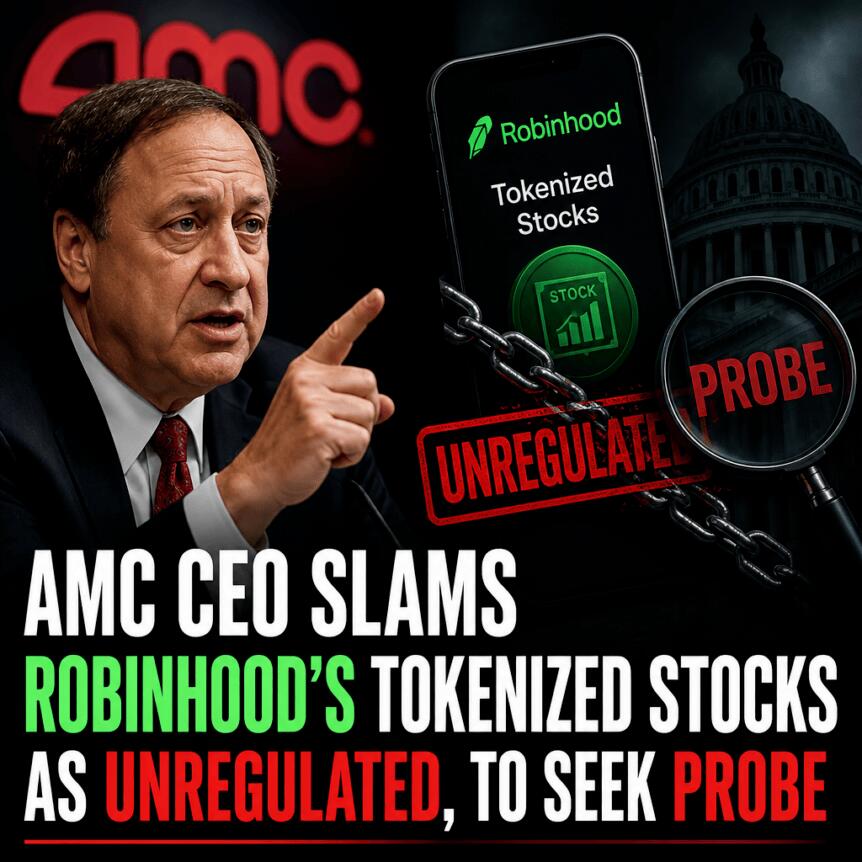
AMC Entertainment CEO Adam Aron has publicly challenged Robinhood’s tokenized stock offerings, calling them “outrageous” and stating AMC has no affiliation with the platform’s products. Aron said Robinhood will face an investigation by outside securities counsel.
Aron’s comments add to a growing wave of attention directed at tokenized stock products—blockchain-based instruments designed to track the value of traditional equities. The dispute arrives amid earlier disruptions where crypto platforms pulled back from tokenized IPO campaigns, underscoring how legal and operational questions continue to surround the sector.
Key takeaways
- Adam Aron says AMC has no affiliation with Robinhood’s tokenized stock offerings and called them “outrageous.”
- Aron said Robinhood will request scrutiny from its outside securities counsel and suggested restrictions may apply to US and other investors.
- Robinhood’s tokenized stock offerings are described as not registered under US securities laws, according to Aron’s remarks.
- The broader scrutiny of tokenized stocks follows recent cancellations tied to tokenized IPO access, including SpaceX-related campaigns.
Aron challenges Robinhood’s tokenized AMC exposure
In a Friday post on X, Adam Aron criticized Robinhood’s tokenized stock offering that provides economic exposure to AMC shares. Aron said the company has “no affiliation” with the product and characterized the offering as “outrageous.” He added that Robinhood’s outside securities counsel would investigate the matter.
Aron also indicated that the tokens may not be available to US investors and that they are subject to restrictions in other jurisdictions, citing Canada, Switzerland and the UK.
The remarks are notable not only for their directness, but because they frame the dispute as a regulatory and compliance issue rather than a simple branding or commercial disagreement. If tokenized securities are marketed or structured in ways that investors perceive as linked to the underlying issuer, those concerns can quickly escalate.
For context, tokenized stock products typically aim to mirror the price movement of conventional equities through blockchain-based representations. However, Aron’s comments highlight how questions about registration status, investor eligibility, and issuer affiliation can become central to the legality and reputational impact of these offerings.
Robinhood responds by seeking specifics
Robinhood co-founder and CEO Vlad Tenev responded on X, asking Aron to share his exact concerns tied to the tokenized offering. The platform did not issue a broader public statement in response to the criticism.
Cointelegraph reported that it reached out to Robinhood for comment regarding both Aron’s claims and the regulatory status of its tokenized stock offerings.
That back-and-forth illustrates a recurring tension in tokenized securities: traditional executives may view such instruments as potentially misleading or insufficiently authorized, while token issuers and platforms often argue they are structured under specific legal frameworks. The next step—whether Aron’s concerns translate into formal findings or enforcement action—will likely determine how far this dispute spreads.
Tokenized stock scrutiny follows past operational pullbacks
The Aron–Robinhood episode arrives as tokenized stocks have faced renewed scrutiny in the wake of earlier market disruptions. Earlier in June, some crypto exchanges canceled their tokenized SpaceX IPO allocations and promised refunds.
According to Cointelegraph reporting referenced in the article, platforms including Bybit, Binance, Bitget Wallet and MEXC canceled their tokenized SpaceX IPO campaigns after SpaceX went public on the Nasdaq. Several participants blamed the inability of Kraken-owned xStocks to deliver the underlying assets.
While that SpaceX incident was framed around delivery and execution—rather than issuer affiliation—the underlying theme is similar: tokenized offerings depend on complex relationships between blockchain intermediaries and traditional market infrastructure. When any link breaks, user trust and regulatory scrutiny tend to intensify.
In that light, Aron’s insistence on no affiliation and his emphasis on securities counsel investigation reflect how tokenized products can trigger fast-moving reactions from the companies whose stock they reference, even if platforms believe the economic exposure is properly handled.
Robinhood’s tokenization push has expanded beyond debt-like instruments
Robinhood’s tokenized equities initiative did not appear overnight. The first generation of Robinhood stock tokens launched in July 2026 as tokenized debt securities issued by Jersey-based Robinhood Assets, distributed as ERC-20 tokens. Those tokens were designed to provide economic exposure to underlying assets such as US stocks and exchange-traded funds.
Robinhood has also been building infrastructure to support tokenized assets. In February, the company launched a public testnet for Robinhood Chain, an Ethereum layer-2 network built using Arbitrum technology intended to host tokenized assets.
Further expansion has been reported in prior coverage. In October 2025, Robinhood shared plans to tokenize nearly 500 US stocks and ETFs on Arbitrum. And in July 2026, Bernstein analysts raised their price target on Robinhood Markets, arguing that a next phase of growth would be driven by tokenized equities and prediction markets rather than traditional crypto trading.
Taken together, the sector-wide moment suggests that tokenized securities are moving from experimental phases toward broader rollout—while regulators, issuers, and exchanges continue to test how these products should be structured, marketed, and delivered.
For investors and market participants, Aron’s comments serve as a reminder that tokenization does not eliminate the legal and compliance layers that govern securities markets. Even if a platform believes a product is compliant under one framework, issuer objections can still raise practical questions about authorization, disclosures, and eligibility for different investor regions.
Readers should watch whether Robinhood clarifies the precise legal basis for its tokenized stock offerings, and whether Aron’s complaint leads to formal regulatory engagement or other enforcement steps. Just as importantly, the industry will be looking for whether prior delivery-related issues in tokenized IPO campaigns repeat in other tokenized equity products—or whether platforms tighten operational and compliance controls to reduce the risk of abrupt cancellations.

South Korea’s Financial Services Commission (FSC) has outlined a three-phase plan to build the legal and technical foundation for issuing tokenized securities covering assets such as stocks, bonds, and funds. The roadmap is designed to bring tokenization into the country’s existing capital markets framework rather than treating it as a separate, unregulated activity.
In a press release published Friday, the FSC said tokenized securities will gain formal legal recognition as digitized forms of securities once an update to the Act on Electronic Registration of Stocks and Bonds takes effect on Feb. 4, 2027. The implementation schedule is closely tied to a broader roll-out of amended capital markets and electronic securities laws.
Key takeaways
- Legal status begins Feb. 4, 2027, when an amendment to the Act on Electronic Registration of Stocks and Bonds takes effect for tokenized securities.
- Phase 1 (from recognition) covers institutional money market funds, bonds, unlisted stocks, and fractional investment securities.
- Phase 2 broadens scope by extending tokenization to all publicly offered securities.
- Phase 3 targets onchain settlement by pursuing onchain payments linked to stablecoins.
- The FSC will coordinate with the Korea Securities Depository (KSD) to build the necessary tokenization infrastructure.
What South Korea’s FSC is changing in 2027
The FSC’s roadmap hinges on a legal shift: tokenized securities will be treated as digitized versions of traditional securities under South Korea’s electronic registration framework. According to the FSC, the change is expected to take effect on Feb. 4, 2027, after the relevant statutory update becomes operational.
Once this happens, tokenized instruments will not merely be “technology-layered securities.” Instead, they will be recognized within the legal system governing stock and bond registration—an important distinction for issuers, investors, and intermediaries who need clarity on rights, governance, and compliance.
For market participants, legal recognition is often the prerequisite for scalable issuance and broader participation. Without it, tokenized products typically face uncertainty around transferability, custody, and the enforcement of investor protections. The FSC’s plan aims to close those gaps by integrating tokenized securities into the capital markets regime.
Phase 1: recognition for a limited set of products
In the first stage, the FSC said tokenized securities will receive legal recognition across several categories, including institutional money market funds, bonds, unlisted stocks, and fractional investment securities. This sequencing matters because it starts with markets where regulators can more directly define operational boundaries while the infrastructure and oversight processes are still being established.
The FSC also tied the roadmap to the planned implementation of two legislative components: an amended Capital Markets Act and an Electronic Securities Act, which together form what the FSC describes as the country’s first tokenized securities framework. Earlier in the process, the FSC had indicated it was preparing detailed tokenized securities rules aimed at bringing tokenized securities under South Korea’s capital markets framework in 2027, an approach noted in earlier reporting (see Cointelegraph coverage of the regulator’s May statements).
The practical question for Phase 1 participants will be how tokenization is handled end-to-end—issuance, registration, transfers, and custody—especially for instruments like fractional investment securities where the unit of ownership may differ from legacy models.
Phase 2 and Phase 3: expanding issuance and testing new payment rails
Phase two of the FSC roadmap is set to expand tokenization to all publicly offered securities. This is a significant step up from the Phase 1 list because it implies broader availability of tokenized products to retail and institutional participants under the same umbrella rules.
However, the FSC did not assign a specific public date for the transition to Phase 2 in the press release. Instead, it said it will determine the timing after submitting and refining subordinate regulations.
The third phase introduces an additional technological ambition: onchain payments linked to stablecoins. In other words, the FSC is not only aiming to tokenize the asset layer (securities issuance and ownership records), but also to modernize parts of the settlement process. Stablecoins are referenced here as the linkage for onchain payment settlement, reflecting the regulator’s attempt to align tokenized securities workflows with digital payment mechanisms.
That said, major implementation details—such as which stablecoin frameworks (if any) would be considered, how payment flows would be controlled, and what oversight would apply—are not specified in the release. Market watchers will likely focus on the subordinate rule revisions that the FSC plans to propose after consultation with relevant stakeholders.
Regulatory coordination and what investors should monitor next
The FSC said it will work with the Korea Securities Depository (KSD) to develop the necessary tokenization infrastructure before the roadmap’s initiation. That coordination is a practical signal: tokenized securities can only scale if the core market plumbing—especially registration and transfer processes—is adapted to handle tokenized formats reliably.
Following the roadmap announcement, the FSC also indicated it plans to propose revisions to relevant subordinate regulations by the end of September and then decide the timeline for phases two and three. For investors and platform builders, that regulatory and technical rulemaking period is likely to be the most consequential window for understanding how compliance will work in practice.
It’s also worth placing the roadmap in the context of South Korea’s wider regulatory movement around tokenized assets. In May, the FSC said it would release detailed tokenized securities rules in 2027 to bring tokenized securities under the capital markets framework, according to earlier coverage (see Cointelegraph). Separately, in April, South Korea’s Ministry of Economy and Finance announced a pilot project involving tokenized deposits to execute government operational spending, with a full rollout targeted for the fourth quarter of 2026 (see Cointelegraph).
Taken together, the developments point to a regulator that is treating tokenization as a structured modernization of finance—starting with legal recognition, then expanding product coverage, and finally testing settlement innovations that could connect onchain activity with regulated payment processes.
For now, the key watchpoints are the end-of-September subordinate regulation revisions, the precise operational requirements that will govern tokenization infrastructure with KSD, and how Phase 3 will handle stablecoin-linked onchain payments in a way that preserves investor protections and settlement finality.

Bitcoin surged and cryptocurrency stocks soared Thursday after Federal Reserve Gov. Christopher Waller hinted at a wait-and-see approach for September’s interest rate decision. Crypto short liquidations gained steam Thursday as the price of bitcoin rose, adding more fuel to the rally. Circle led gains for crypto stocks while spot bitcoin ETFs trended toward buy points. Fed Governor Waller while speaking…
Copyright ©2026 Investor’s Business Daily, LLC. All rights reserved. 87990cbe856818d5eddac44c7b1cdeb8

The National Sheriffs’ Association (NSA) has withdrawn its earlier opposition to the Digital Asset Market Clarity (CLARITY) Act, saying in a Thursday letter that its stance is now “neutral.” The development comes ahead of a potential Senate vote later this month when Congress returns to session.
In the letter to Senate Majority Leader John Thune and Minority Leader Chuck Schumer, the NSA pointed to the complexity of the legislative process and the “significant work undertaken” by lawmakers, the Administration, and stakeholders to address “legal, regulatory, and enforcement considerations” tied to the bill. NSA leadership said the group believes it is more constructive to let the legislative process continue as Congress seeks to build a clearer regulatory structure for digital assets.
Key takeaways
- The NSA has changed its position on the CLARITY Act from opposition to “neutral,” signaling less resistance to the bill’s advancement.
- The association’s earlier concern centered on amendments that would exempt crypto mixers from multiple registration requirements.
- House passage in July 2025 has been followed by multiple Senate hurdles, including committee progress and continued debate among lawmakers and stakeholders.
- Senate leaders have taken procedural steps toward a vote, with Thune filing a motion to hold cloture after senators return.
NSA shifts from opposition to neutrality
The NSA’s updated position was articulated by NSA president Troy Wellman alongside CEO and executive director Justin Smith. They said the association is no longer pushing against the measure at this stage, arguing that the most appropriate path is to “step back” and allow Congress to proceed to establish “a clear, effective, and much needed regulatory framework.”
This change represents a notable recalibration from the NSA’s earlier messaging. Previously, the group had expressed “significant concerns” about specific CLARITY provisions—particularly amendments involving crypto mixers and how they could affect registration obligations.
What the NSA previously objected to: crypto mixer exemptions
According to the NSA’s earlier letter, the association’s opposition was driven by provisions it believed could limit law enforcement tools used to trace illicit activity and recover victims’ funds. In that prior stance, the NSA argued that exempting crypto mixers from many registration requirements could “[impair] law enforcement’s ability to trace transactions and digital assets, and recover victims’ money.”
In July, Sheriff Jim Skinner—speaking in a video posted by the NSA—also criticized the framing of the bill, stating, “The CLARITY Act protects the crypto industry, not the public.” Earlier coverage and the Senate Banking Committee correspondence cited by the NSA indicate that mixer-related language was at the heart of the dispute.
While the Thursday letter does not detail which provisions have been addressed or how the group views the bill’s current draft, the shift to neutrality suggests the NSA is at least willing to allow continued consideration rather than maintain active resistance.
CLARITY’s path through Congress remains contested
The CLARITY Act passed the US House of Representatives in July 2025 and has encountered obstacles since being sent to the Senate. While Senate committees—including the agriculture and banking committees—passed versions of the bill in 2026, the measure has continued to face pushback and uncertainty from multiple groups and lawmakers.
Debates described around the legislation have reportedly included issues beyond enforcement logistics, such as stablecoin-related rewards, tokenized equities, and concerns about potential conflicts of interest involving President Donald Trump and his family. These sticking points have kept the bill from reaching a final, unified Senate outcome even after committee progress.
As Congress nears its return to session, procedural moves have also signaled an effort to bring the bill to the floor. Before going on break, Thune reportedly filed a motion to hold a cloture vote on the measure on Sept. 15 once senators return from state work periods—an action that typically aims to limit extended debate and move legislation forward.
Regulators signal they could act even without legislation
Even as CLARITY awaits a Senate path to final passage, US regulators have indicated that crypto oversight may not wait indefinitely for congressional action. Earlier reporting noted that Trump publicly pushed for passage alongside the heads of the Securities and Exchange Commission (SEC) and the Commodity Futures Trading Commission (CFTC), as well as representatives from digital asset companies.
According to earlier coverage, SEC Chair Paul Atkins and CFTC Chair Michael Selig—both nominated by Trump—have signaled that their agencies would continue efforts to address crypto regulation if Congress is unable to pass a market structure bill.
This matters for market participants because it reframes timing and certainty. A shift in the NSA’s position reduces one vocal source of resistance, but it does not remove other policy debates reportedly surrounding stablecoin rewards, tokenized assets, and broader governance concerns. Meanwhile, regulator willingness to proceed without CLARITY could mean the industry faces parallel developments: legislative negotiations in the Senate alongside rulemaking and enforcement direction from the agencies.
As the Senate calendar firms up, readers should watch whether the bill’s most contested provisions—particularly those tied to enforcement and registration—change between committee language and the final text heading to a vote, and whether additional stakeholders follow the NSA’s example by shifting their stance ahead of the chamber’s next steps.
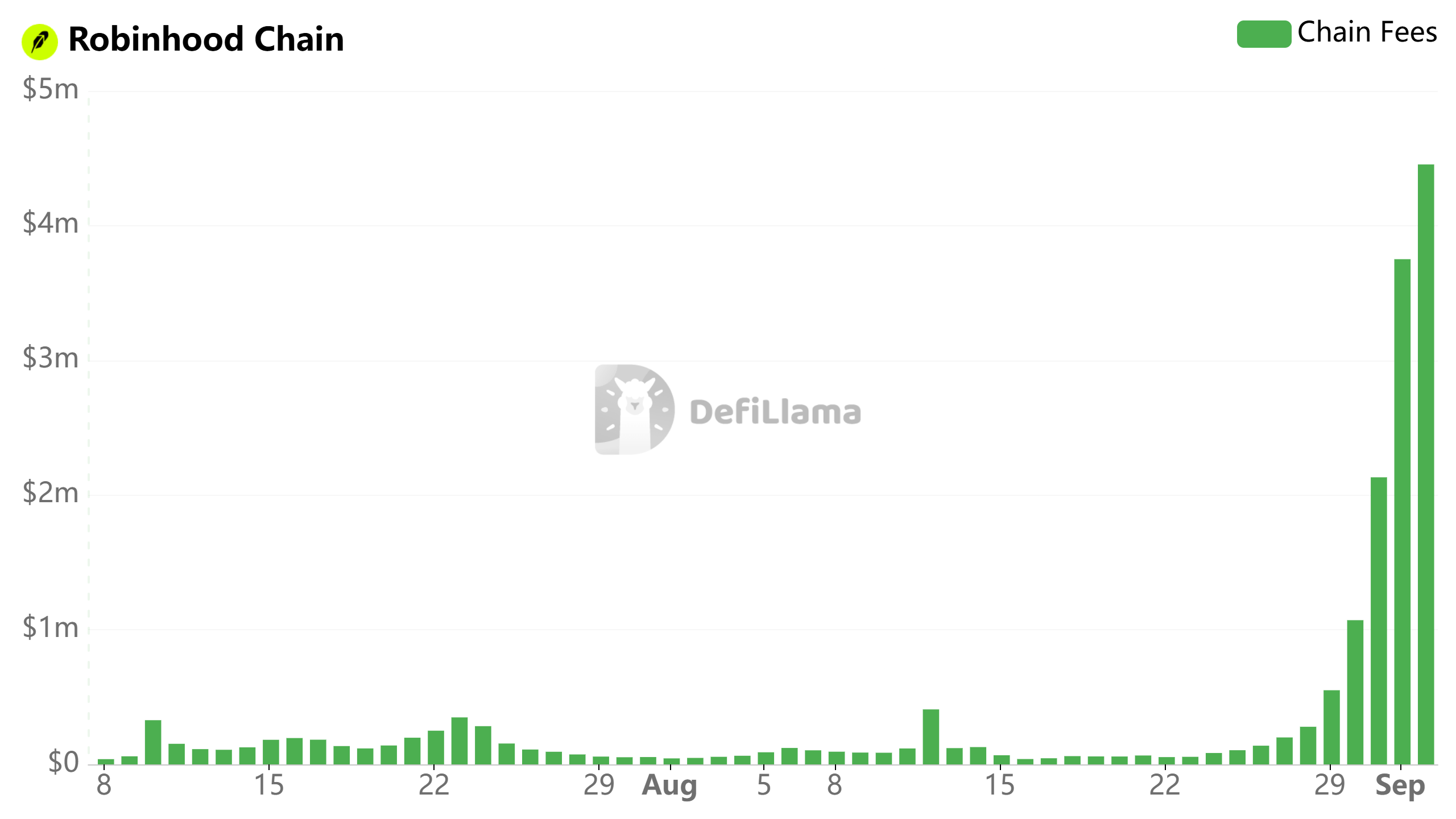
Arbitrum (ARB) price has climbed 90% from the record low it set in June. The rally accelerated after Robinhood Chain fees reached an all-time high of $4.45 million on Sept. 2.
ARB trades near $0.1316 after a 50% weekly gain, according to BeInCrypto data. Meanwhile, the network that settles those Robinhood Chain transactions earned almost nothing over the same period.
Robinhood Chain Fees Hit a Record $4.45 Million
Between August 31 and September 1, Robinhood Chain generated over $10 million in fees, with a 109% increase across sessions.

Through most of August, daily fees stayed below $400,000. The current pace therefore sits more than 10 times above the previous peak.
Robinhood launched the network on Arbitrum in July, and Uniswap routes the majority of its trading volume.
Under the Arbitrum Expansion Program, Orbit chains return 8% of revenue to ArbitrumDAO and 2% to a developer guild. Applying that 8% share suggests roughly $320,000 reached the DAO on Sept. 2 alone.
Arbitrum One Earns in a Day What Robinhood Chain Makes in Minutes
The contrast with Arbitrum One is stark. The network processed 1.94 million transactions over 24 hours, yet collected just 5.8 ether (ETH) in fees, worth roughly $14,000.

Robinhood Chain therefore out-earned Arbitrum One by about 320 times on Sept. 2.
Put differently, the younger network matches Arbitrum One’s entire daily fee income in under five minutes.
Average transaction costs have fallen to $0.007, and Blockscout showed no pending transactions. Block times of 0.242 seconds leave ample spare capacity for further Orbit chains.
Capital has not followed the activity, however. Total value locked (TVL) sits near $1.37 billion, roughly two-thirds below its October 2025 peak above $4 billion.

The Foundation reported $6.19 million in total income for the first half of 2026, alongside 97% gross margins. At its Sept. 2 pace, Robinhood Chain would match that figure in about 19 days.
Arbitrum Price Analysis Points to $0.1495
Arbitrum remains in a bullish structure, but momentum is cooling after the sharp rally. ARB is trading around $0.132, after pulling back from the recent high near $0.145.
The first major resistance is around $0.140–$0.145. A clean break above that area could open the way toward $0.150.
On the downside, the nearest support sits around $0.125–$0.127, close to the 20-period EMA. If that level fails, the stronger support zone is around $0.110–$0.114, where the 50-period EMA and previous breakout area meet.
The broader trend still looks healthy. The shorter moving averages remain above the longer ones, while RSI has cooled to around 62 after previously entering overbought territory. That gives ARB some room to move higher again.
For now, the chart looks more like consolidation after a strong breakout than a trend reversal.

Two September dates could still test the rally. Roughly 92.6 million ARB unlock on Sept. 16, and Robinhood’s 90-day gas subsidy expires later that month.
Whether the fee growth outlasts that subsidy will decide if the Arbitrum price holds its gains or retraces toward $0.1193.
The post Robinhood Chain Brings Arbitrum Token Back from the Dead. ARB is Up 90% appeared first on BeInCrypto.
Chipmaker Ambarella (AMBA) late Thursday narrowly beat analyst estimates for its fiscal second quarter and matched views with its sales forecast for fiscal Q3. AMBA stock rose in extended trading. The Santa Clara, Calif.-based maker of edge AI chips earned an adjusted 18 cents a share on sales of $108.1 million in the quarter ended July 31. Analysts surveyed by…
Copyright ©2026 Investor’s Business Daily, LLC. All rights reserved. 87990cbe856818d5eddac44c7b1cdeb8
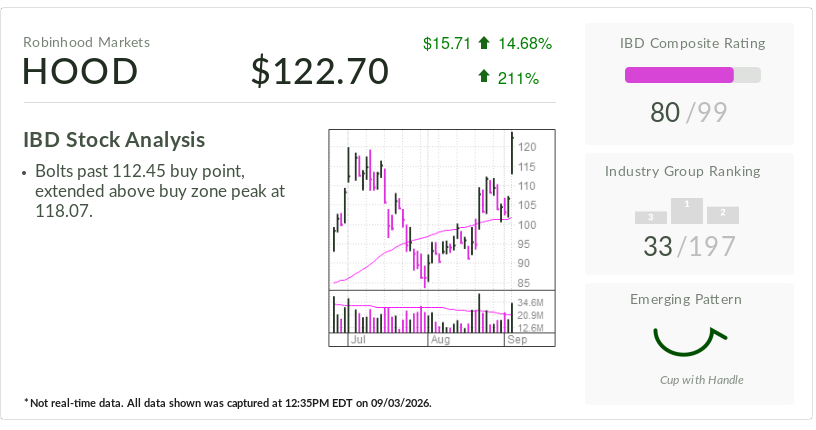
Robinhood Markets Robinhood Markets HOOD $ 123.52 $1.20 0.96% 48% IBD Stock Analysis Bolts past 112.45 buy point, extended above buy zone peak at 118.07. IBD Composite Rating 92/99 Industry Group Ranking 8/197 Emerging Pattern Cup with Handle Cup with Handle A positive chart pattern named such because it resembles the outline of a coffee cup with a handle. The…
Copyright ©2026 Investor’s Business Daily, LLC. All rights reserved. 87990cbe856818d5eddac44c7b1cdeb8
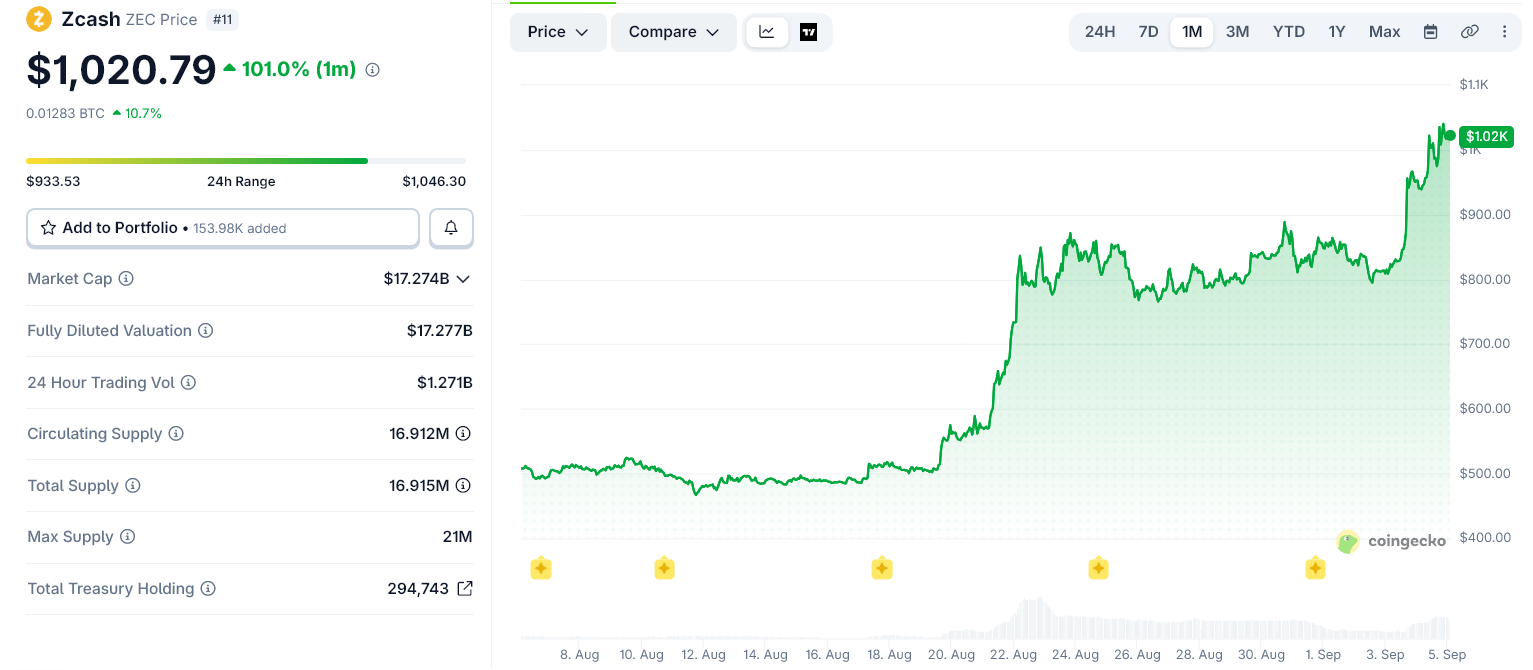
Zcash is seemingly winning this bullish cycle in the crypto market. ZEC is up nearly 100% over the past month, crossing $1,000 for the first time in almost a decade.
ZEC briefly climbed above $1,045 on Friday. The move pushed its market value to roughly $17 billion and brought the privacy coin back to four figures for the first time since the chaotic opening days of trading in 2016.
Those early prices came when very little ZEC was circulating, making them poor comparisons with today’s market. So, how far will Zcash go in this cycle?

Why Zcash Suddenly Exploded
Several forces have converged behind the rally.
Grayscale launched its US-listed Zcash ETF in late August, opening ZEC exposure to traditional investors through brokerage accounts. The fund has since attracted fresh inflows while holding more than 400,000 ZEC.
Meanwhile, demand for privacy-focused cryptocurrencies has returned. More ZEC is moving into shielded pools, while recent technical upgrades have made private transactions faster.
The latest leg higher also had help from derivatives traders.
Roughly $34.5 million in ZEC short positions were liquidated during the breakout. Traders betting against Zcash were forced to buy back their positions as prices rose, adding fuel to the move.
However, leverage has continued building after the squeeze. Total ZEC open interest has climbed toward $2.4 billion, up sharply from around $1.6 billion days earlier.
That makes what happens around $1,000 especially important.

Can Zcash Hold $1,000?
The short-term chart still favors buyers.
On the one-hour chart, ZEC’s 20-period exponential moving average has risen to roughly $1,000. That means the psychological price level now lines up with a widely watched short-term trend indicator.
The first important zone sits between roughly $985 and $1,005.
If ZEC falls into that area and buyers repeatedly push it back above $1,000, the breakout begins to look more durable. A move through the recent $1,045-$1,055 high could then open another attempt at $1,100.
However, momentum is already stretched.

ZEC’s daily Relative Strength Index is close to 80, a level commonly associated with an overheated market. The four-hour RSI is around 70.
That does not automatically mean the rally is ending. Strong markets can remain overbought for long periods. It does mean traders should expect sharper swings.
If $1,000 fails, the next major test sits around $935-$955. Several short-term moving averages converge in that region, making it the clearest area where buyers could attempt to form another higher low.
A deeper fall toward $900 would weaken the structure further. Below roughly $850, ZEC would return toward the area where its latest breakout began.
For now, the larger trend remains firmly upward. ZEC trades well above its major daily moving averages, while each recent correction has produced a higher low.
The bigger risk comes from leverage.
Open interest has surged alongside price. If funding rates also become heavily positive, too many traders may end up crowded into leveraged long positions. That could turn a routine pullback into a rapid liquidation event.
So $1,000 matters twice: as a psychological milestone and as the first serious test of whether this rally can build a stable base after an explosive run.
The post Zcash Hits $1,000 for the First Time in a Decade. How Far Can It Go? appeared first on BeInCrypto.

Wallace & Gromit Creator Reveals Dog Character Was Originally A Cat

Alex Dunne Claims Third on Monza Formula 2 Grid

Skyworth C2 Canvas Art TV Takes on Samsung The Frame With a Brighter QD Mini LED Screen





-
 Crypto World16 hours ago
Bitcoin price stalls near $82K as key resistance holds
-

 Politics16 hours ago
Best Gaming Laptops, CPUs, TVs, And Keyboards To Upgrade Your Set Up For GTA VI
-

 Tech17 hours ago
The Birds Outside, Drawn For You Automatically
-

 Crypto World20 hours ago
IMF Says El Salvador’s Post-Review Bitcoin Purchases Used No Public Funds
-
 Crypto World16 hours ago
U.S. added stronger than expected 162,000 jobs in August as labor market bounced back
-

 Sports20 hours ago
Alexandre Pato consortium’s Northampton Town investment approved
-

 Sports15 hours ago
Golden Eaglets Drawn in Group B for 2026 WAFU B U17 Championship
-

 Sports20 hours ago
Commanders’ Chig Okonkwo is a top breakout fantasy football candidate
-
 Crypto World15 hours ago
XRP price breaks falling channel as bulls target $1.53
-

 Politics22 hours ago
A new European chapter for Gibraltar
-

 Politics18 hours ago
The House | Bin the lectures, bring gossip and be ready to banter: how the new PM should prepare for his Trump encounter
-

 Politics15 hours ago
How To Avoid Winter Colds: 4 Everyday Habits That Spread Germs, Says Pharmacist
-

 Crypto World15 hours ago
From warning to listing: UK’s largest retail investment platform opens access to crypto ETNs
-

 Tech17 hours ago
A Worthy Android Ereader, With Some Tradeoffs
-

 Crypto World16 hours ago
FinCEN flags $12.7B tied to Southeast Asia crypto investment scams
-

 Crypto World15 hours ago
Trezor Data Breach Impacts 67,000 More US Customers
-

 Politics20 hours ago
33 Cosy Autumn Home Decor Ideas: Blankets, Pumpkin Decorations, And Candles
-

 Sports21 hours ago
Seven wickets in 21 balls: Sri Lanka’s Chamari Athapaththu scripts history with record-breaking spell
-

 Tech16 hours ago
How To Edit Claude’s Memory
-

 Tech15 hours ago
beyerdynamic AVENTHO Y Debuts at IFA 2026 and Makes Wireless Headphones Less Disposable
You must be logged in to post a comment Login