

Crypto World
XRP price breaks key barrier as AI payments cross 1 million

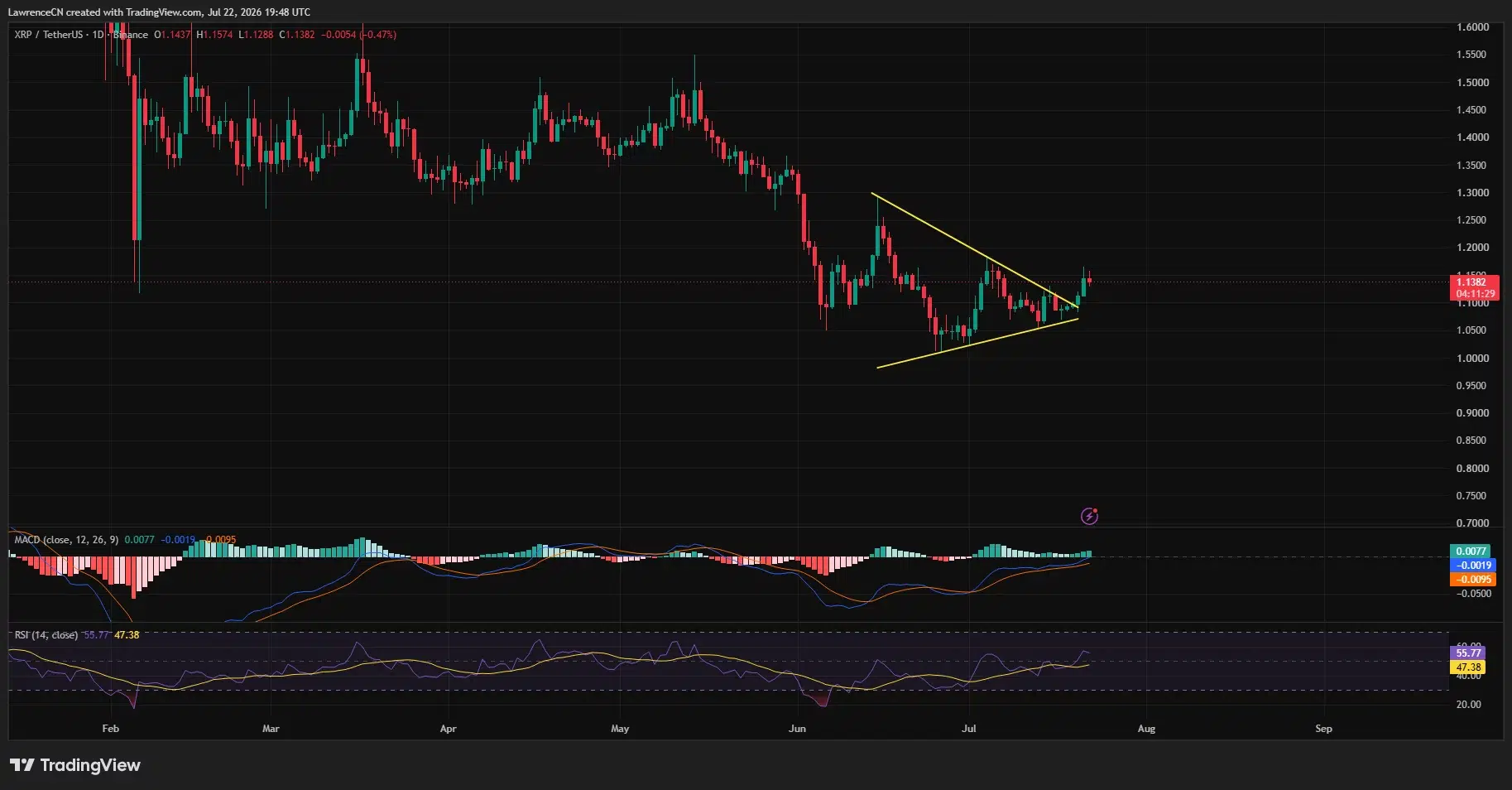
XRP price has climbed nearly 4% to a two-week high of $1.1574 as Bitcoin’s return above $65,000, whale accumulation and fresh ETF inflows have supported its latest recovery.
Summary
- XRP price reached $1.1574 after breaking above a daily symmetrical triangle.
- Whale wallets raised their holdings by 2.8% as smaller balances declined.
- XRP ETFs added $5.66 million while XRPL agentic transactions crossed 1 million.
According to data from crypto.news, XRP (XRP) price was trading near $1.14 at the time of writing, up about 2% over the past seven days, with its market value standing above $71 billion. The token had eased from its session high after sellers returned around $1.16, but prices remained above a recently broken daily resistance line.
Alongside the improvement in crypto sentiment, activity tied to artificial intelligence has supplied a network-level catalyst. XRP Ledger has processed more than 1 million agentic transactions, according to RippleX engineering head J. Ayo Akinyele, as developers test autonomous payments for data, application programming interfaces and computing services.
Agentic payments allow AI-powered software to complete transactions based on programmed instructions without requiring a person to approve each transfer. XRP Ledger can settle these payments in three to five seconds while offering predictable transaction costs, Akinyele told FinanceFeeds.
Commenting on the milestone, Akinyele projected that the transaction count could rise considerably as developers improve the tools available to autonomous agents.
“I think we’ll blast through 10 million and may even get to 100 million within the next couple of years.”
The forecast remains a projection rather than a measure of future XRP demand. Investors would still need to assess whether developers continue building agent-based services, whether those applications attract regular users and how much XRP or Ripple USD they use for settlement.
Whale buying and ETF inflows support the recovery
Santiment data showed that wallets holding between 100,000 and 100 million XRP increased their combined balances by 2.8% during the past five weeks. Over the same period, balances held by wallets containing less than 0.1 XRP fell by 5.2%.
According to Santiment, the opposing trends indicate that whale and shark wallets accumulated tokens while very small holders reduced their exposure. The analytics firm linked the change in holdings to XRP’s rebound toward $1.16, although its data does not establish that large-wallet buying alone caused the price increase.
Demand has also continued through U.S.-listed spot XRP exchange-traded funds. SoSoValue data showed the products attracted $5.66 million in net inflows on July 21, lifting their cumulative intake to about $1.49 billion.
Franklin Templeton’s XRPZ accounted for the entire daily addition, while the other listed products reported no net movement. Trading value across the funds reached $19.16 million during the session, and their combined net assets stood at approximately $1.06 billion, equal to about 1.48% of XRP’s market capitalization.
Among individual products, Bitwise managed the largest pool of assets at $333.50 million, according to the same dataset. The figures show that regulated funds continued receiving capital during XRP’s recovery, but daily flows can vary and do not guarantee sustained price gains.
Daily breakout keeps $1.20 within reach
On the daily chart, XRP has broken above the upper boundary of a symmetrical triangle that formed after its June decline. Price also moved through the descending trendline connecting the June and July swing highs before reaching $1.1574.
Daily momentum has improved with the breakout. The chart’s relative strength index stood at 55.77, above its moving average of 47.38 and below the overbought threshold of 70. Its moving average convergence divergence histogram had turned positive at 0.0077, while the MACD line was rising toward a possible move above the signal line.
The 4-hour chart, however, showed momentum cooling after XRP’s rejection from $1.1574. The latest candle traded near $1.1385, placing the token just above the Murrey Math trading-range ceiling at $1.1353 and the major support and resistance pivot at $1.123.
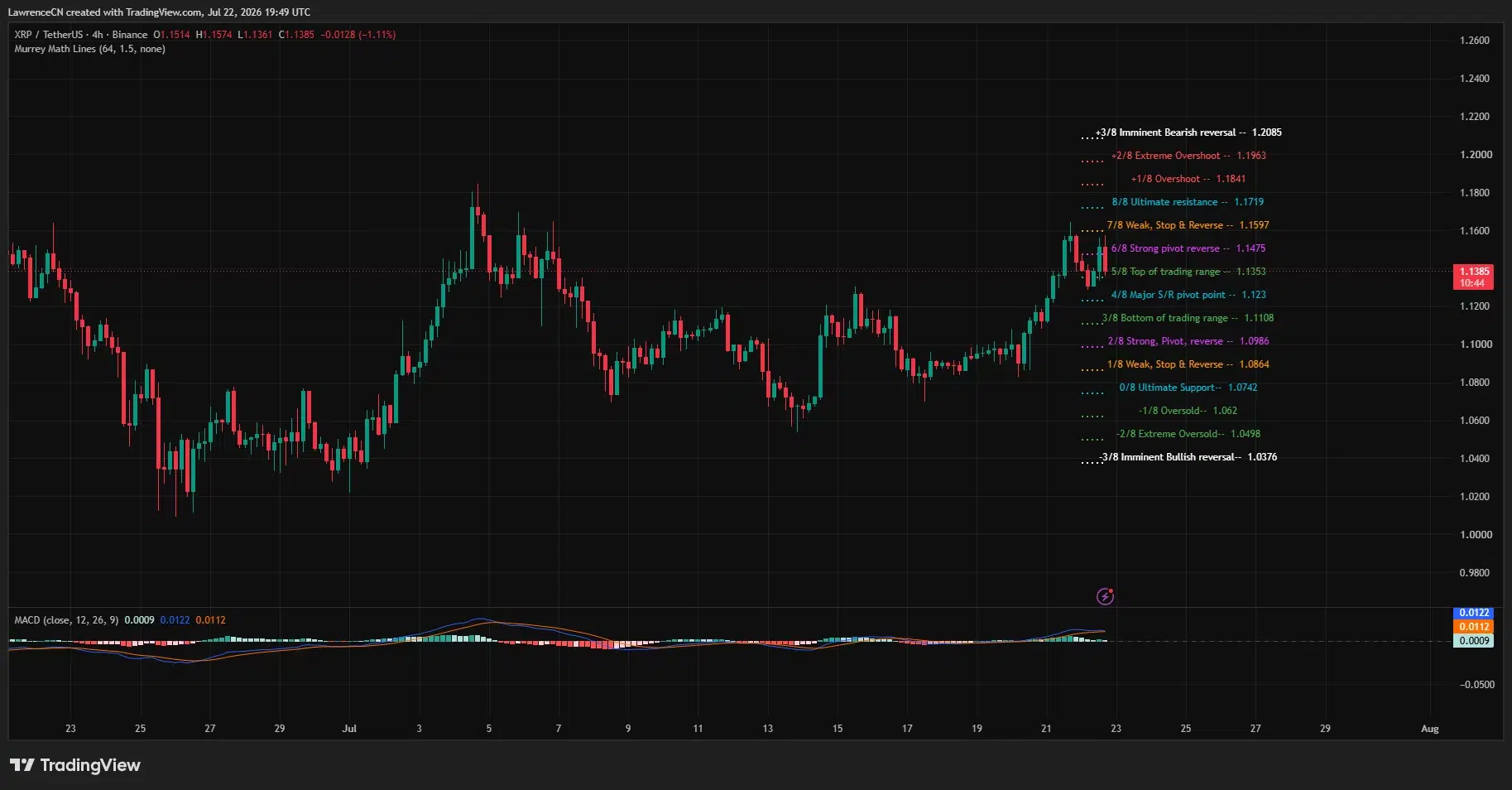
A recovery above the 4-hour strong pivot at $1.1475 would give buyers another chance to challenge $1.1597. The supplied chart places the following resistance levels at $1.1719 and $1.1841, with $1.1963 sitting just below the psychological $1.20 barrier.
4-hour MACD readings remained positive, although the shrinking histogram showed that upward momentum had slowed after the latest advance. This setup leaves buyers needing to defend the breakout instead of relying solely on the earlier impulse.
If XRP closes back below $1.123, the 4-hour chart identifies $1.1106 and $1.0986 as the next support levels. A deeper decline could expose $1.0864 and the ultimate support line at $1.0742, weakening the daily triangle breakout despite continued whale accumulation and ETF demand.
Disclosure: This article does not represent investment advice. The content and materials featured on this page are for educational purposes only.

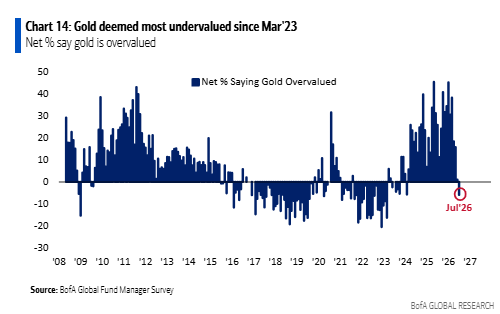
Fund managers now see gold (XAU) as the most undervalued asset since March 2023, according to Bank of America’s July survey. The reading arrives as the metal bounces 3.5% in two days from the $3,900-$4,000 support zone.
The last time the survey flipped this way, gold traded below $2,000 and then rallied to $5,598 in January. Whether history repeats may depend on the Federal Reserve and a possible US-Iran truce.
Fund Managers Flip on Gold for the First Time Since March 2023
The July edition of the BofA Global Fund Manager Survey polled 181 institutional managers overseeing $484 billion in assets. A net 6% of them now call gold undervalued, the first negative overvaluation reading in more than three years.
The shift is dramatic. Through 2025 and early 2026, the same survey showed extreme readings, with a net 40% or more of managers calling gold overvalued near the January peak.

Sentiment has reset after a brutal repricing. Gold trades about 26% below its record, a drawdown that already pushed the metal into bear market territory earlier this month.
The market data account Barchart highlighted the signal on X, noting that gold is now the most undervalued in more than three years. In March 2023, an identical setup preceded a rally that nearly tripled the price.
Cash Levels Trigger a Sell Signal Everywhere Except Gold
The valuation call stands out because managers are anything but cautious elsewhere. Average cash levels dropped from 4.1% to 3.6% of assets, as first reported by analizy.pl. Any reading at or below 4% triggers the contrarian sell signal under BofA’s Cash Rule.
Positioning looks stretched across risk assets. A record 82% of respondents named long semiconductor stocks the most crowded trade, while 45% called an AI bubble the biggest tail risk. Meanwhile, 83% expect no Fed hike before the November midterm elections.

Gold sits at the opposite extreme, unloved and uncrowded. If the cash signal precedes an equity correction, only the major asset managers that consider cheap could become the natural rotation targets.
One caveat matters. The survey ran from July 2 to 9, before the ceasefire collapse sent oil above $90 and revived the hawkish Fed chorus. Managers’ average year-end oil forecast of $71 already looks stale.
XAU Bounces From $3,900 Support, but the Trendline Caps the Recovery
The daily chart shows the sentiment reset coinciding with a technical reaction. Gold gained 1.74% on Wednesday to $4,148, its highest close since July 7, after defending the $3,900-$4,000 support zone.
That green zone corresponds to the long-term 0.5 Fibonacci retracement at $3,943. Buyers stepped in exactly where the golden ratio suggested they should, echoing levels flagged in a previous gold outlook.

Momentum is quietly improving. The daily RSI is trending higher to 52, back in the neutral zone after weeks of suppressed readings. A similar recovery recently powered a breakout in silver.
However, the long-term structure remains bearish. The price still trades below the descending trendline drawn from the $5,598 all-time high, which now converges near current levels.
The first barrier is the trendline itself. Beyond it, the $4,300-$4,400 resistance zone coincides with the 0.382 Fibonacci retracement at $4,334, roughly 4% to 6% above the current price.
Rejection at the trendline would expose the 0.618 golden pocket at $3,552, about 14% below the current price. Next week’s Fed decision, with markets pricing roughly 60% odds of a September hike, and the proposed 10-day US-Iran truce stand as the nearest catalysts.
Fund managers have marked gold as cheap. Now the chart must decide whether they are early or simply wrong.
The post Gold Most Undervalued in 3 Years, Fund Managers Say. Is the Bottom In? appeared first on BeInCrypto.
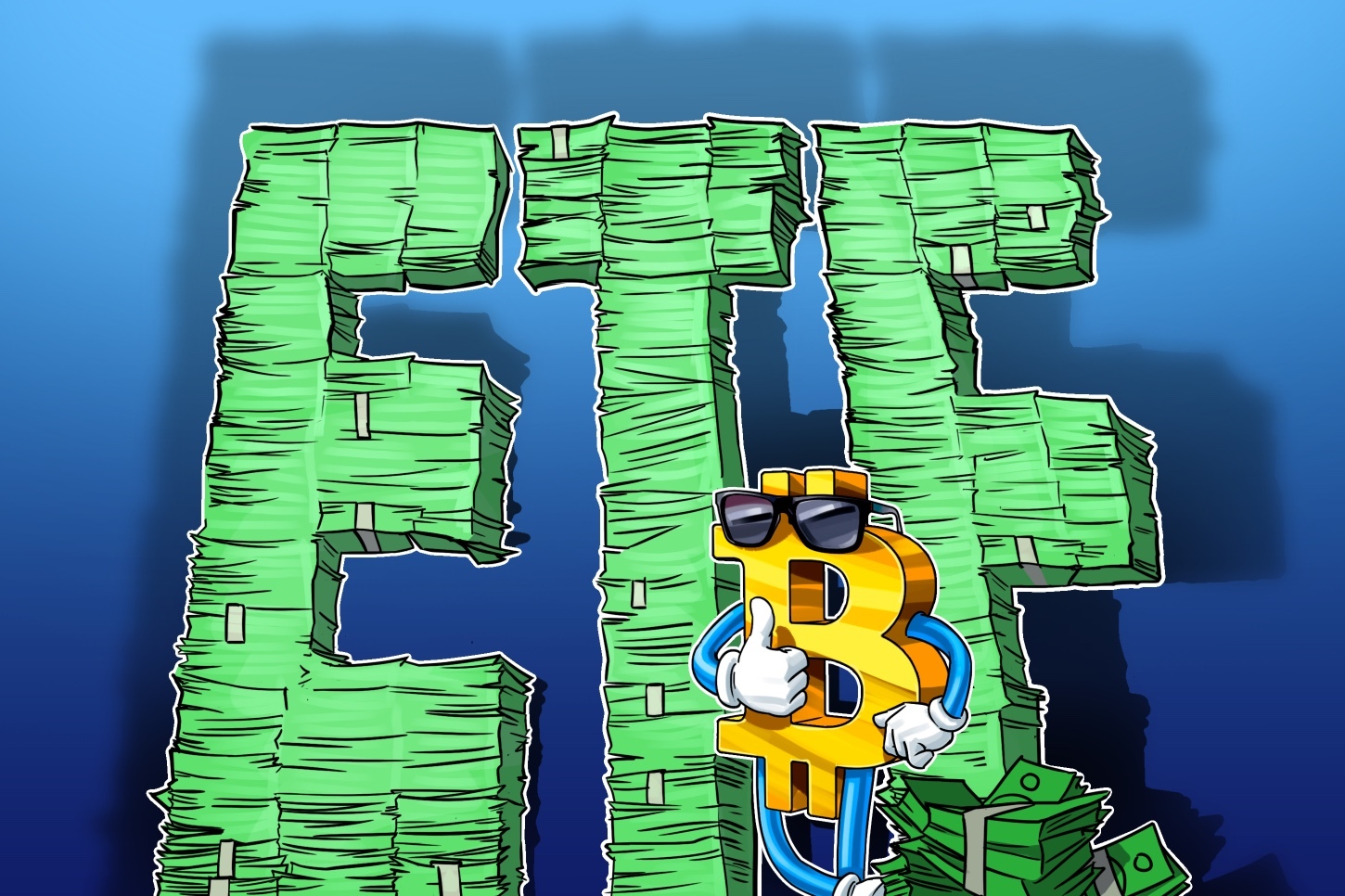
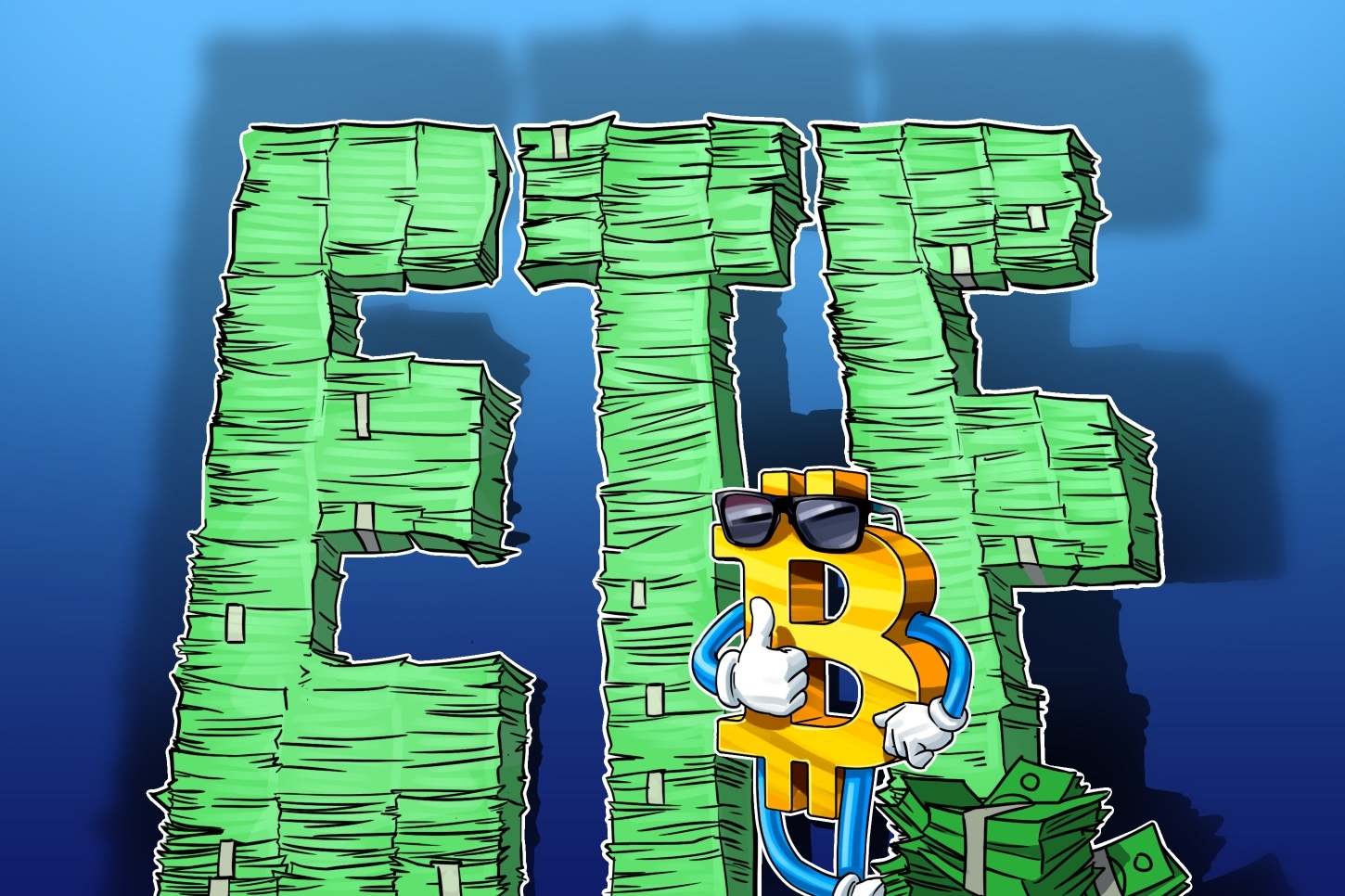
US spot Bitcoin ETFs extended their inflow streak to six sessions, bringing in about $930 million while remaining down $4.84 billion on a net basis year to date.


Foundry USA asked its mining customers to signal their support for BIP-110, an actively debated proposal seeking to shrink the amount of data that can be stored in a Bitcoin transaction.
South Korea’s major crypto exchanges have seen their trading activity fall sharply over the past year as the country’s stock market surged, suggesting retail speculative interest may be shifting toward equities, Cointelegraph analysis shows.
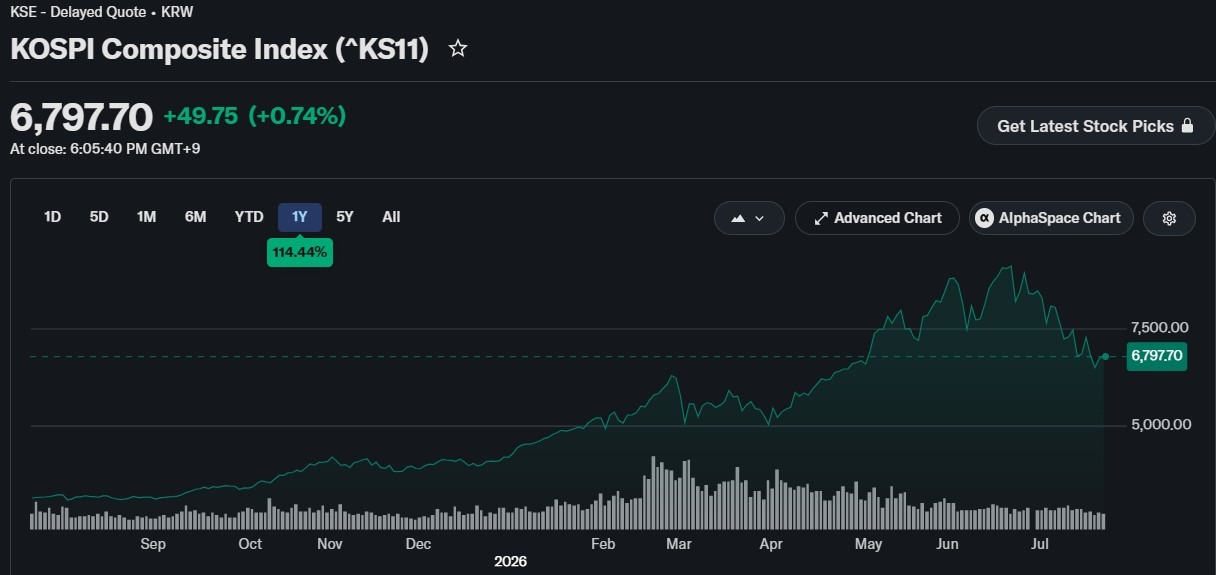
The Korea Composite Stock Price Index (KOSPI) benchmark more than doubled over the period, while volumes across the country’s largest won-based crypto platforms contracted.
Cointelegraph reviewed CoinGecko’s historical 24-hour volume readings for Upbit, Bithumb, Coinone, Korbit and Gopax, comparing seven-day periods in July 2025 and July 2026.
After calculating the average daily volume and year-over-year percentage change, Cointelegraph took the simple, unweighted average of the five declines, producing an average drop of about 77%. This gives each exchange equal weight regardless of trading volume. However, on a combined basis, average daily volume fell about 89%, to $305 million from $2.82 billion in the comparable July 2025 period.
ZDNet Korea separately reported that daily volume across the five exchanges was down 88% year-on-year on Monday. It said weaker fee income had pushed some platforms to sell crypto holdings, including Korbit, which raised about 1.6 billion won (about $1 million) by selling 15 Bitcoin (BTC) and 60 Ether (ETH).
South Korea is one of crypto’s most active retail markets, with exchanges relying heavily on trading fees. A sustained preference for equities could weaken crypto liquidity and squeeze smaller platforms, reshaping how local investors allocate capital between speculative assets.
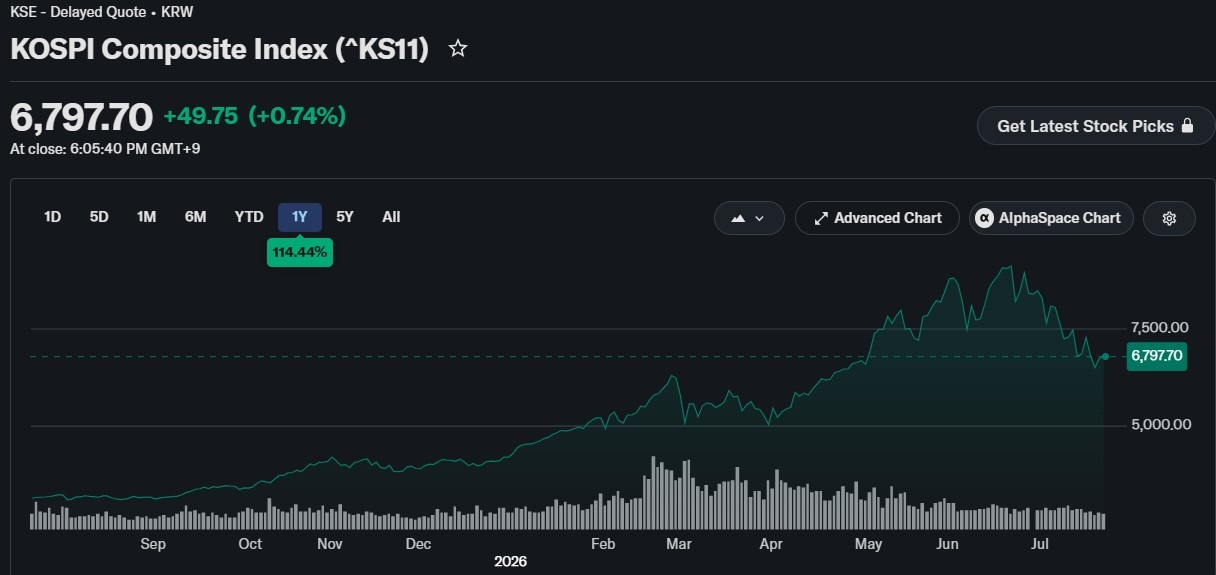
Korea Composite Stock Price Index’s one-year chart. Source: Yahoo Finance
South Korea’s KOSPI rose 114.44% over the 12 months to July 22, according to Yahoo Finance data, even after retreating from its peak in June. The rally contrasts with shrinking activity on won-based crypto exchanges, suggesting retail investor attention is shifting toward equities.
Retail fatigue gives institutions room to step in
A Tiger Research report published on CoinGecko and updated on April 17 said that South Korea’s falling crypto activity reflects more than weaker prices. The report said recycled narratives and projects that failed to deliver contributed to investor fatigue, while the KOSPI rally gave retail traders more places to pursue returns.
Tiger Research said the widening gap between equity turnover and crypto volume did not necessarily mean that Koreans had lost interest in crypto, but rather that investors had more alternatives.
Related: South Korea eyes September launch for second phase of CBDC pilot: Report
The report described the market as in structural transition with retail investors stepping back while institutions move in. Banks and financial groups were positioning around won-denominated stablecoins, tokenized real-world assets (RWAs) and exchange investments even before legislation was finalized.
Tiger said institutional activity could be a healthy replacement for some of the retreating retail participation, although institutions were still finding their footing.
Magazine: Inside the ‘fake police raid’ that forced a $1M Bitcoin transfer
The merged CLARITY Act runs on one invented term: the ancillary asset, a token sold with a securities offering that is not itself a security. Here is where the concept came from, exactly how it works, why a16z tried to kill it, and what it means for every token you hold.
Summary
- An ancillary asset is the CLARITY framework’s central category: an intangible, commercially fungible asset, distributed in connection with the purchase and sale of a security through an investment-contract arrangement, that is not itself a security.
- The definitional cut is what the token does not give you: no debt or equity claim, no dividends or interest, no liquidation rights. A token conferring those rights is simply a security; a network token without them can be ancillary.
- The concept resolves crypto’s founding legal paradox, that a token sale can be a securities transaction while the token itself, trading later on secondary markets, functions as a commodity. The transaction gets securities treatment; the asset does not.
- Originators owe tailored disclosures while an asset’s value depends on their efforts, ending at maturity, and the merged Senate draft adds a clause deeming tokens that anchored a listed ETP on January 1, 2026 non-ancillary and non-securities outright.
- The category is contested at the root: Andreessen Horowitz publicly urged the Senate to scrap it, warning it creates a loophole-prone middle ground, which makes the term both the bill’s foundation and its most attacked idea.
Every regulatory regime ends up resting on one definition, and the definition is usually invented for the purpose. Securities law rests on the investment contract, four words from a 1946 orange-grove case that have governed a century of capital formation. Banking law rests on the deposit. The framework Congress is currently trying to pass for crypto rests on a term almost nobody outside a Senate office had used before 2022: the ancillary asset. It appears throughout the merged CLARITY Act draft now awaiting a floor vote, it decides which tokens escape the SEC and when, and its grandfather clause quietly settles the legal status of XRP, Solana, and Dogecoin by reference to their own ETFs. It is also, remarkably for a bill’s load-bearing concept, a term the industry’s most powerful venture firm formally asked the Senate to delete. Understanding the ancillary asset is understanding what American crypto law is about to become, and this guide builds the concept from the ground up: the paradox it solves, the mechanics it runs on, the fight over whether it should exist, and what it means practically for tokens and their holders.
The paradox the term was invented to solve
Start with the problem, because the ancillary asset is unintelligible without it.
American securities law asks one question of any fundraising arrangement: is it an investment contract, meaning an investment of money in a common enterprise with an expectation of profits from the efforts of others, the Howey test. Token sales usually are. A team raises money by selling tokens, buyers expect the team’s work to make the tokens valuable, and every element of Howey is satisfied; courts have said so repeatedly. The trouble begins one step later. The token itself, once issued, circulating on exchanges among strangers, is just an entry on a ledger. It carries no claim against the team, pays nothing, promises nothing. Is that object a security forever, because it was born in a securities transaction?
For a decade, American law had no stable answer, and the instability was the industry’s defining legal condition. The SEC’s enforcement-era position treated the token as inseparable from its offering, effectively a security in perpetuity; the industry argued tokens mature into commodities as networks decentralize; courts split, most famously in the Ripple litigation, where the same token was found to be sold as a security to institutions and as not-a-security on exchanges. The result was a classification that depended on the transaction, the buyer, and the judge, which is no classification at all.
The ancillary asset is the legislative answer, and its logic is surgical: separate the transaction from the thing. The fundraising arrangement, the investment contract, remains a security and gets securities treatment. The asset delivered through it, if it grants the buyer none of a security’s actual rights, is designated something else, ancillary to the securities transaction instead of the subject of it, with its own disclosure regime and its own path out of SEC jurisdiction entirely. One sale, two legal objects. The paradox does not get resolved so much as legislated into architecture.
The definition, clause by clause
The term’s formal definition has evolved across drafts, but its working structure has held stable since its first appearance, and each clause does specific work.
An ancillary asset is, first, an intangible, commercially fungible asset. Fungibility excludes NFTs and one-off instruments; intangibility excludes tokenized claims on physical things. It is, second, offered, sold, or otherwise distributed in connection with the purchase and sale of a security through an arrangement constituting an investment contract. This is the birth criterion: the category only exists downstream of a securities transaction, which is why the term is ancillary, the asset rides alongside the security rather than being one. Third, and decisively, the definition excludes any asset that provides the holder debt or equity interests, liquidation rights, interest or dividend payments, or other financial claims against the issuer. This is the functional test, and it is the clause that does the sorting: a token that pays you, or gives you a claim on a company’s assets or profits, is not ancillary, it is simply a security wearing a costume. A network token, useful for gas, staking, or access, conveying no claim against anyone, can qualify.
Around the definition, the framework builds three mechanisms. The first is disclosure: while an ancillary asset’s value depends on the entrepreneurial or managerial efforts of an originator, that originator owes periodic, tailored disclosures, a lighter, crypto-specific regime covering the network, the token’s economics, and insider holdings, with the SEC directed to issue guidance for shared-responsibility cases. The obligation is tied to dependence, not to time: it ends when the network matures past reliance on the originator, which connects the category to the bill’s maturity and self-certification machinery. The second is the capital-raising exemption: offerings of ancillary assets under a size cap, $75 million in the current architecture, can proceed on an offering statement covering the blockchain, source code, consensus mechanism, and insider positions, rather than full securities registration, which is the provision that would actually reopen compliant token fundraising in the United States. The third is the escape hatch that made January’s headlines: the merged draft deems a token non-ancillary, and not a security at all, if units of it were the principal asset of an exchange-traded product listed on a national securities exchange on January 1, 2026. Read against the ETF calendar, that clause statutorily classifies XRP, SOL, DOGE, and the rest of the late-2025 ETF class, no Howey analysis required. The SEC’s own product approvals became the legislature’s taxonomy.
One more mechanism deserves its place in the map before the criticism, because it shows the category working as a system, not just a definition: the interaction between ancillary status and trading venues. Under the framework’s architecture, an ancillary asset is not merely exempt from securities registration; it is affirmatively tradable on CFTC-registered digital commodity exchanges once the venue completes its own certification that the asset meets the statutory requirements, the listing-side counterpart to the issuer-side process. That two-key design, the asset’s status plus the venue’s certification, is what converts an abstract classification into an operating market: an exchange can read the definition, document its analysis, list the asset, and carry regulatory responsibility for the judgment, which is precisely the risk allocation exchanges have operated under in derivatives for decades and have never had for spot crypto. It also explains a quiet commercial consequence the classification debates skip: under the framework, listing decisions, which today are exercises in enforcement-risk management conducted by legal departments reading tea leaves, become documented compliance judgments with statutory criteria, faster, cheaper, and portable across venues. The years when an American exchange’s listing of a mid-cap token was itself legal news would end, not because scrutiny disappears, but because the scrutiny acquires a text.
The case against the category
The ancillary asset’s most important critic is not a consumer advocate. It is Andreessen Horowitz, the venture firm with more capital deployed in crypto than almost any institution on earth, and its formal letter to the Senate Banking Committee is the sharpest statement of the case that the bill’s foundation is a mistake.
The firm’s argument runs in three steps. First, incoherence: the category defines a class of assets that are simultaneously not-quite-securities while arising from arrangements that satisfy Howey, a middle object that, a16z warned, invites legal conflict instead of settling it, because litigants and future commissions can argue endlessly about which side of the hybrid governs. Second, the loophole risk: a definitional category keyed to what rights a token formally grants can be gamed by structuring, a token engineered to avoid the enumerated rights while economically replicating them, weakening investor protections precisely where they matter. Third, the alternative: rather than inventing a new object, the firm urged a control-based decentralization framework, classification turning on whether any party retains unilateral authority, operational, economic, or governance, over the system, applied through the existing Howey lens, which, in the letter’s words, “should not be abandoned.”
The counterargument, which carried the drafting, is practical. Control-based tests are exactly what a decade of case-by-case chaos looked like: fact-intensive, litigated asset by asset, resolvable only in hindsight. A definitional category, whatever its edge cases, is administrable, an issuer can read the rights its token grants and know its classification, and the disclosure-while-dependent regime addresses the investor-protection gap directly, not through classification fights. The two positions are less opposed than they appear, since the bill’s maturity machinery imports decentralization analysis anyway; the dispute is about which concept sits at the foundation and which serves as the test. But holders should register the meta-fact: the load-bearing term of the American crypto framework is one the industry’s own leading investor argued should not exist, which is a useful calibration for how settled this architecture actually is.
The Ripple shadow over the definition
The ancillary asset was not drafted in a vacuum, and its clearest intellectual ancestor is worth naming, because the category is, in large part, the Ripple ruling converted into statute, with the ruling’s problems inherited alongside its insight.
Judge Analisa Torres’s 2023 decision in the SEC’s case against Ripple reached a conclusion that scandalized securities traditionalists and delighted the industry: the same token, XRP, was sold as a security in Ripple’s institutional sales, where buyers invested with expectations pinned to the company’s efforts, and was not a security in programmatic exchange sales, where anonymous buyers on order books had no idea whose efforts they were relying on. The transaction, not the token, carried the classification. Critics called the result incoherent, an asset flickering between legal categories depending on the checkout counter, and a different judge in a parallel case rejected the reasoning outright, which left the doctrine split exactly where doctrine is most expensive to split: at the foundation.
Read the ancillary asset against that history and its purpose sharpens. The category takes the Torres insight, securities law attaches to investment arrangements, not to the objects passing through them, and stabilizes it: instead of a token being a security in some sales and not others, the framework declares the fundraising arrangement a security always, the qualifying token a security never, and bridges the investor-protection gap with the originator disclosure regime that operates while dependence lasts. The flickering stops. What the buyer on the exchange gets is not a judicial finding about their particular transaction but a statutory status attached to the asset class itself, knowable in advance, which is the entire practical difference between a legal system and a litigation lottery.
But the inheritance runs both ways, and honesty requires the second half. The Torres framework’s unresolved question, what protects the exchange buyer who is economically just as dependent on the founding team as the institutional buyer, is also the ancillary asset’s unresolved question, and it is precisely the gap a16z’s letter aimed at. The framework’s answer, disclosure-while-dependent plus the maturity endpoint, is a real answer, and whether it is a sufficient one will not be known until the first cycle of ancillary offerings produces its first failures, its first disclosure fights, and its first buyers arguing that the tailored regime told them less than a registration statement would have. The category resolves the classification war on the industry’s preferred terms. The investor-protection war it merely reschedules, with better-defined battle lines, which, in fairness, is more than any court managed in a decade.
What it means in practice
For anyone holding or building with tokens, the category’s consequences sort into three practical layers.
For the grandfathered class, the effect is immediate and total. Tokens that anchored listed ETPs on the January 2026 snapshot date exit the analysis entirely, non-ancillary, non-securities, CFTC-side by statute, which converts the ETF approvals of late 2025 into permanent legal settlements and explains why institutional research now treats the bill’s passage as those assets’ true classification event.
For newer and future tokens, the category defines the compliant lifecycle: launch through an exempt ancillary-asset offering with its tailored offering statement, disclose while the network depends on the founding team, certify maturity when it no longer does, and graduate to digital-commodity status. That path’s existence is the bill’s actual product, the first legal route from token launch to commodity status ever written into American law, and its costs, disclosure obligations from day one, decentralization decisions made early and documented, are the price. Teams that structured tokens to dodge securities law will instead structure them to fit the ancillary definition, which is the same activity pointed at a clearer target.
And for the disputes that will inevitably continue, the category relocates them. The old fight, is this token a security, becomes three narrower ones: does this token grant a disqualifying right, has this network matured past its originator, and does this certification survive challenge. Those are the battlegrounds the definition creates, they are where the next decade’s crypto securities litigation will live if the bill passes, and knowing the term means being able to read them. The word is new, invented, and contested. It is also, pending sixty votes, about to be the most important noun in the asset class.
A closing note on the vocabulary wars, because readers will encounter the category under competing names and should not be confused by them. The merged framework actually deploys a small family of terms: the digital commodity, the mature network’s asset under CFTC oversight; the investment contract asset, the token still attached to its securities transaction; the ancillary asset, the bridge state between them; and the non-ancillary asset, the grandfather clause’s creation, a token that skips the bridge entirely because its ETP listing settled its status by snapshot. Different drafts have shuffled which term carries which weight, the House text leaned on digital commodity where the Senate architecture leans on ancillary asset, and coverage that mixes the two bills’ vocabularies produces most of the public confusion about what the framework does. The practical decoder: ask of any token where it sits in the lifecycle. Born in a fundraising arrangement and still team-dependent: investment contract plus ancillary asset, disclosure owed. Matured past dependence, certified: digital commodity, CFTC-side. ETP-listed on the snapshot date: non-ancillary, classification settled by statute. Never sold through an investment contract at all, the Bitcoin case: never in the securities analysis to begin with, a digital commodity by nature, not by graduation. Four positions, one map, and every asset in the market lands on exactly one of them, which, whatever else is said about the framework, is one more position than the old regime could assign with confidence to anything.
Disclaimer: This article is for information and educational purposes only and does not constitute financial, investment, or legal advice. It describes draft legislation whose definitions and provisions can change before enactment, and no classification discussed here is final until a law passes and takes effect. Always do your own research. Information is accurate as of July 21, 2026.
Frequently Asked Questions
What is an ancillary asset in one sentence?
It is a fungible, intangible digital asset distributed in connection with a securities offering, an investment contract, that is not itself a security because it grants the holder no debt, equity, dividend, interest, or liquidation rights against the issuer, and is therefore regulated separately from the transaction that created it.
Where did the term come from?
It originated in the Lummis-Gillibrand Responsible Financial Innovation Act drafts, was carried into the Senate Banking Committee’s 2025 discussion draft building on the House-passed CLARITY Act, and sits at the center of the merged Senate text now awaiting a floor vote. The concept was invented to resolve the paradox that token sales can be securities transactions while the tokens themselves function as commodities.
How is an ancillary asset different from a security?
By the rights it grants. A security gives its holder financial claims, equity, debt, dividends, interest, liquidation rights, against an issuer. An ancillary asset gives none of those; its value comes from network use and market demand. A token that grants any of the enumerated claims falls outside the category and is treated as a security regardless of what it is called.
What obligations do ancillary assets carry?
Disclosure while dependent. The originator, the party whose efforts the asset’s value depends on, owes periodic tailored disclosures covering the network, token economics, and insider holdings, with SEC guidance for shared-responsibility cases. The obligation ends when the network matures past dependence on the originator, which connects to the bill’s maturity certification process. Offerings under the size cap can proceed on a streamlined offering statement instead of full registration.
Is it true the bill makes XRP and Solana non-securities?
Effectively, yes. The merged draft deems a token non-ancillary, and not a security, if units of it were the principal asset of an exchange-traded product listed on a national securities exchange on January 1, 2026. The spot ETFs approved for XRP, SOL, DOGE and others in late 2025 meet that test, so passage would settle their status statutorily, without further litigation.
Why did Andreessen Horowitz oppose the category?
In a formal letter to the Senate Banking Committee, a16z argued the ancillary asset creates an incoherent middle object, not quite a security while arising from Howey-satisfying arrangements, that invites loopholes and legal conflict, and urged a control-based decentralization framework applied through the existing Howey test instead. The committee kept the category, judging a definitional approach more administrable than case-by-case control analysis.
Does the category apply to NFTs or tokenized real-world assets?
Generally no. The definition requires commercial fungibility, which excludes NFTs, and intangibility, which excludes tokens representing ownership of physical or traditional financial assets. Tokenized securities remain securities. The category targets network tokens, the fungible assets that power blockchains, which are precisely the objects the old framework classified worst.
What should token holders take from all this?
Three things. If a token you hold anchored a listed ETP on the snapshot date, the bill would settle its legal status permanently. For other tokens, classification will turn on the rights the token grants and the network’s maturity, both knowable from public facts. And the framework remains a draft: the category’s final shape, and whether it becomes law at all, depends on a Senate vote that has not happened. This is educational information, not legal or investment advice.
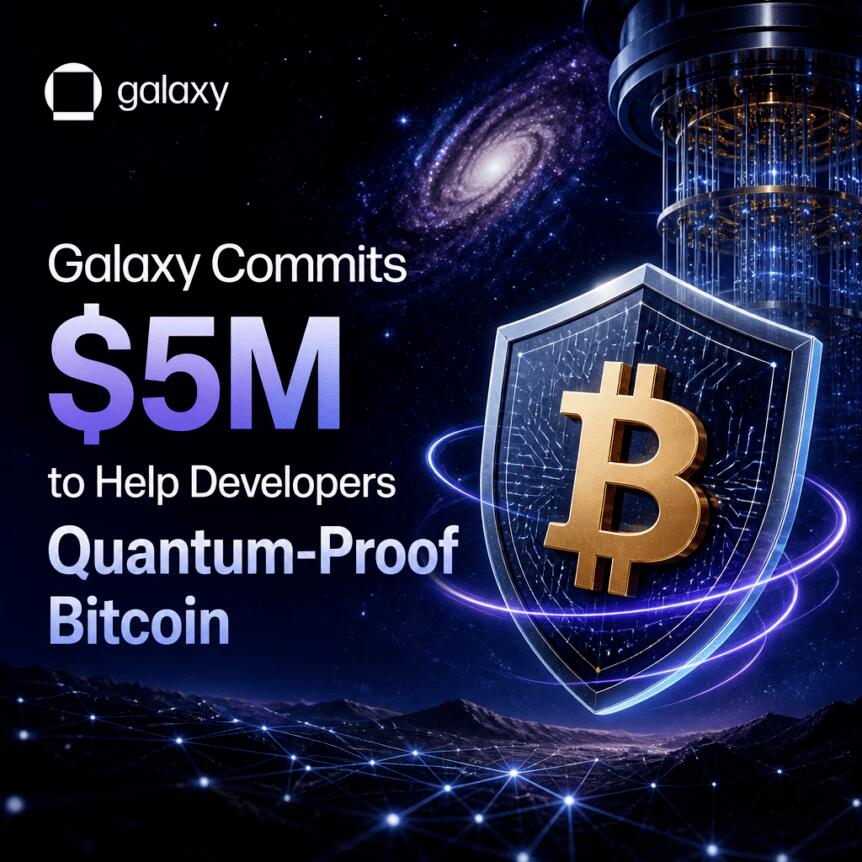
Galaxy Digital has launched a new push to accelerate post-quantum security work for Bitcoin, pledging up to $5 million in grants for open-source developers. The initiative is designed to support research and engineering across quantum-resistant upgrades, including cryptography research, migration tooling, and formal security reviews.
Alongside the funding, the company announced the formation of a quantum advisory council as part of its Bitcoin Quantum Readiness Initiative. Galaxy said Tuesday that the council will bring together researchers with backgrounds spanning cryptography, applied security, and academic computing—an attempt to turn abstract “quantum risk” discussions into concrete development roadmaps.
Key takeaways
- Galaxy Digital is offering up to $5 million in open-source grants aimed at post-quantum cryptography work for Bitcoin-related systems.
- The grant scope covers more than algorithms, including Bitcoin signature schemes, wallet/custodian migration tools, and security audits.
- A new quantum advisory council under the Bitcoin Quantum Readiness Initiative includes researchers from the University of Calgary, MIT, and Boston University.
- Market debate over timelines remains unsettled, with some executives arguing there’s decades before a meaningful threat while other research emphasizes preparation windows.
- Existing standards momentum matters because NIST has already published post-quantum encryption standards that could inform future Bitcoin migrations.
What Galaxy Digital is funding
Galaxy’s announcement ties its grant program to practical components of a potential Bitcoin post-quantum transition. According to the company’s statement, the funding will support “quantum-resistant upgrade proposals” and post-quantum cryptography research, with additional emphasis on Bitcoin signature schemes.
The proposal also explicitly targets the implementation layer that many teams often treat as an afterthought: wallet and custodian migration tooling. That matters because even when a cryptographic replacement is theoretically possible, moving users, keys, and custody infrastructure to new standards typically requires careful engineering, operational planning, and risk-managed rollouts.
Galaxy also said the grants include support for formal security audits—an area that can be decisive for institutional adoption, especially when new cryptographic constructions may be unfamiliar to auditors or deployed systems.
Who is on Galaxy’s quantum advisory council
Galaxy Digital’s Quantum Readiness Initiative adds an advisory layer through a council that includes Barry Sanders, professor and scientific director of Quantum City at the University of Calgary; Damien Bérubé, an MIT Sea Grant Knauss fellow; and Eran Tromer, professor of computer science at Boston University.
While advisory councils don’t directly change Bitcoin protocol code, they can influence which research paths are prioritized, how proposals are evaluated, and what “readiness” criteria developers should meet. For builders, that can reduce uncertainty by clarifying the kinds of cryptographic schemes and migration methods most likely to survive scrutiny.
Galaxy’s earlier announcement of the Bitcoin Quantum Readiness Initiative provides the broader context for this step: the new grants and council are positioned as ways to convert readiness planning into deliverables that can be used by open-source contributors.
https://www.galaxy.com/newsroom/galaxy-launches-bitcoin-quantum-readiness-initiative
How much Bitcoin could be exposed?
Concerns about quantum risk have sharpened around how future quantum computers could affect cryptographic systems currently used to secure Bitcoin. Analytics provider Glassnode has argued that a sizable portion of Bitcoin’s supply could be exposed if “cryptographically relevant” quantum computers emerge.
As reported by Glassnode via a Cointelegraph-linked analysis, around 30% of Bitcoin’s supply could be at risk. Glassnode’s breakdown further distinguishes between coins it considers “structurally unsafe” (about 10% of supply due to output type) and “operationally unsafe” (about 20% of supply tied to key or address management practices).
That split matters for investors and developers because it suggests two different problem categories. “Structural” concerns relate to the cryptographic assumptions embedded at the protocol or script level, while “operational” concerns point to practices that exchanges, custodians, and wallet operators can potentially adjust faster than they can rewrite protocol fundamentals.
The timeline fight: “decades” vs “years”
Perhaps the biggest unresolved question behind any post-quantum plan is timing. The community’s debate remains active, with different researchers and executives placing drastically different weights on when quantum capabilities could become dangerous to today’s signature schemes and related cryptographic assumptions.
Blockstream CEO Adam Back argued in November 2025 that Bitcoin faces no “meaningful quantum threat” for at least the next 20 to 40 years. He framed this as sufficient runway for adoption of post-quantum cryptography standards approved by the US National Institute of Standards and Technology (NIST).
At the same time, other research emphasizes a shorter preparation horizon. NIST released its first set of finalized post-quantum encryption standards for key establishment and digital signatures in August 2024, including algorithms that could support future migrations across industries and potentially Bitcoin-related upgrades.
NIST’s standardization is important to the debate because it reduces the “unknown unknowns” around what algorithms might be considered credible at the cryptographic policy level.
Beyond general standards, practical migration proposals are already circulating. In December 2025, Blockstream Research published a paper proposing a hash-based signature scheme as a “promising path for securing Bitcoin in a post-quantum world.” The proposal, as described in coverage, targets replacing Bitcoin’s ECDSA and Schnorr signatures with a scheme designed so that security relies solely on cryptographic hash functions.
And while Back’s long timeline suggests extensive lead time, Bernstein has argued for a shorter window: in an April report referenced in coverage, Bernstein suggested Bitcoin “has about three to five years to prepare” for a post-quantum security upgrade.
Why this matters now even if the threat is distant
Even if quantum breakthroughs are decades away—as some industry leaders expect—the hard part is rarely the cryptography alone. It’s the migration: coordinating changes across wallets, custodians, infrastructure providers, developer ecosystems, and the security processes that institutions use to deploy and maintain cryptographic systems.
Galaxy’s grant design reflects that reality. By funding not only quantum-resistant proposals but also wallet and custodian migration tooling and formal audits, the program acknowledges that “readiness” is an engineering and operational challenge, not just a theoretical one.
For Bitcoin holders, the near-term takeaway is less about expecting immediate protocol changes and more about watching whether the community converges on migration paths that can be implemented safely and iteratively—without forcing rushed transitions if timelines shift.
Readers should watch how Galaxy’s grants translate into concrete open-source deliverables—especially any proposals that connect signature-layer changes to realistic wallet and custody migration plans—and whether ongoing research narrows the gap between long-range quantum timelines and shorter “prepare now” arguments.
Dinari, an issuer of tokenized U.S. equities, and tZERO Group, a blockchain-based financial infrastructure provider, said Wednesday they are partnering to build an operating framework that would let broker-dealers offer tokenized U.S. stocks. The companies described the effort as a "strategic… Read the full story at The Defiant
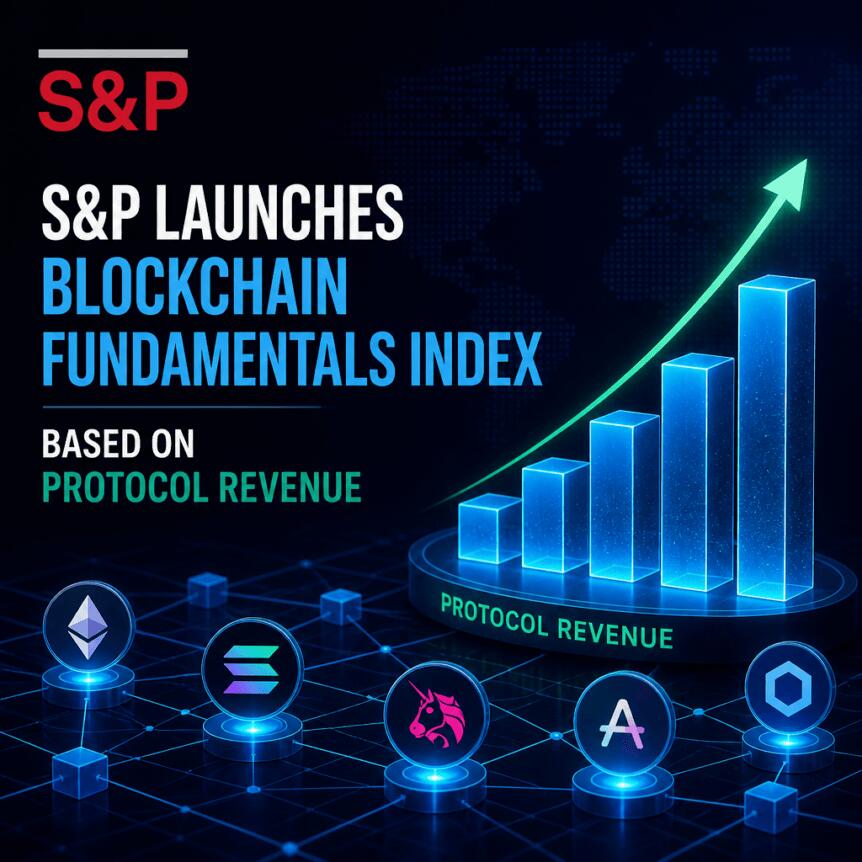
S&P Dow Jones Indices and Pantera Capital have launched a new rules-based digital asset index designed to evaluate blockchain networks and protocols using protocol revenue rather than token prices or pure market capitalization. The move signals a continued shift toward “productive activity” metrics as institutional players look for benchmarks that better reflect real-world usage.
In an announcement on July 21, the firms said the index is intended for institutional allocation and could be used as the basis for investment products or as a reference portfolio for actively managed strategies. The methodology also aims to help investors distinguish established on-chain business activity from more speculative exposure.
Key takeaways
- Protocol revenue is central: networks are selected and ranked based on aggregate protocol revenue over the prior two quarters.
- Liquidity and size gates apply: eligibility requires minimum thresholds for protocol revenue, market capitalization, and liquidity.
- Concentration is controlled: the largest holding is capped at 35%, while most other constituents are capped at 20%.
- Quarterly rebalancing: the index is recalculated and rebalanced on a quarterly schedule.
- Bitcoin and XRP are not included at launch: per S&P’s methodology discussion, BTC and XRP are the largest non-constituents versus the S&P Cryptocurrency Broad Digital Asset Index.
A revenue-based benchmark for “productive” blockchain activity
Traditional crypto benchmarks often track assets using market capitalization or token price movements. By contrast, S&P and Pantera’s index focuses on protocol revenue to measure how much economic value is being generated by the networks and the applications built on them. The firms draw from the S&P Cryptocurrency Broad Digital Asset Index, but filter the eligible universe using minimum thresholds for protocol revenue, market capitalization, and liquidity.
After networks pass the eligibility requirements, they are ranked by aggregate protocol revenue across the previous two quarters. Weighting then uses adjusted market capitalization, subject to portfolio construction rules. According to S&P, the framework is designed to emphasize established blockchain activity and reduce reliance on exposure that may be driven mainly by speculation.
This distinction matters for investors because protocol revenue is intended to function as a proxy for sustained usage and monetization, whereas market cap and token price can reflect expectations and sentiment even when on-chain monetization is weaker. The index’s quarterly rebalancing also means the benchmark can respond to changes in protocol performance over time, rather than remaining tied to a static basket.
Initial constituents and what’s different versus a broad benchmark
The index launched with 18 constituents. In S&P Dow Jones Indices’ Indexology blog post, the five largest holdings at launch were Ether (ETH), BNB (BNB), Solana (SOL), TRON (TRX), and Hyperliquid (HYPE).
The blog post also highlights a key selection contrast: Bitcoin (BTC) and XRP (XRP) were identified as the largest non-constituents compared with the S&P Cryptocurrency Broad Digital Asset Index. That outcome is consistent with a methodology that prioritizes protocol revenue-based eligibility and ranking. In other words, assets can be large by market cap yet still fail to become constituents if they do not meet the index’s revenue criteria as defined under the benchmark rules.
For allocators, this is one of the index’s most practically important implications. A revenue-driven selection mechanism changes not only what investors own, but also what risks the benchmark is implicitly targeting—shifting away from pure token beta toward networks whose protocol economics are feeding the index construction process.
Why institutions are pushing beyond market-cap indexes
The launch comes as the broader industry continues to develop institutional-grade crypto benchmarks. These efforts are unfolding alongside traditional finance firms expanding crypto capabilities and the growing adoption of tokenized assets, which increases demand for standardized measurement frameworks.
In the US, ETF and index activity has accelerated. Hashdex launched the Nasdaq Crypto Index US ETF on Feb. 14, 2025, which was described as the first multi-asset spot crypto exchange-traded fund in the United States. Franklin Templeton followed six days later with the Franklin Crypto Index ETF, tracking Bitcoin and Ether through the US CF Institutional Digital Asset Index, which is market capitalization-weighted.
Other benchmark approaches have also emerged. In April, MarketVector Indexes and Coinbase Asset Management launched the Coinbase Store of Value Index, which combines Bitcoin with tokenized gold using an inverse-volatility weighting model—an example of how benchmark design can shift exposure toward different portfolio goals.
Market participants have argued that as crypto ecosystems evolve, diversification across networks and strategies may become more operationally attractive. Earlier coverage referenced Bitwise chief investment officer Matt Hougan stating that crypto index funds are expected to be a major theme in 2026 as investor needs grow and the market becomes more complex. The core rationale, as described, is that it is increasingly difficult to predict which blockchain networks will prove durable winners, making diversified index solutions a pragmatic way to obtain broad exposure.
S&P’s latest step in digital asset benchmark expansion
Beyond this new product, S&P Dow Jones Indices has been broadening its digital asset benchmark footprint. Last October, S&P introduced the S&P Digital Markets 50 Index, which combines 15 cryptocurrencies with 35 publicly traded companies tied to the crypto ecosystem. That earlier index illustrates how S&P is experimenting with different ways to connect crypto exposure to both on-chain activity and publicly traded crypto-adjacent equities.
With the new protocol-revenue index, the emphasis is narrower and more specific: measure blockchain networks through the economics of their protocols. Investors watching for benchmark evolution should pay attention to whether revenue-based methodologies gain traction in index-tracked products, and how issuers translate those rules into investable strategies—particularly in terms of transparency around revenue estimation and how methodology changes affect index constituents over time.
Next, investors and portfolio managers will likely focus on how the benchmark performs as protocols’ monetization trends shift quarter to quarter, and whether the revenue-based framework attracts liquidity and product sponsorship comparable to traditional market-cap indexes.
Coinbase has opened SUI staking with a one-token minimum and estimated annual rewards of 1.4% to 3.3% as Sui tests resistance near $0.78.
Summary
- Coinbase has introduced SUI staking with estimated annual rewards of 1.4% to 3.3%.
- SUI is testing $0.78 resistance, with a confirmed breakout targeting roughly $0.91.
- Sui’s Hashi testnet lets over 25 partners test Bitcoin-backed financial applications.
Coinbase announced the rollout on July 22, giving eligible customers a way to stake SUI and collect rewards without moving their tokens away from the exchange. The company presented the service as a direct account feature, although access depends on the customer’s location.
You can now stake SUI – directly on Coinbase.
Instant rewards, accumulated straight to your account. Less time spent searching, and more time spent earning. pic.twitter.com/7PdKdUJ4MH
— Coinbase 🛡️ (@coinbase) July 22, 2026
“You can now stake SUI — directly on Coinbase,” the exchange wrote in its announcement, adding that rewards accumulate in customer accounts.
Eligible users can begin with as little as 1 SUI, according to Coinbase. Estimated returns range between 1.4% and 3.3% per year, but the exchange’s quoted rate may change because staking returns depend on network conditions and other factors.
Rather than following a weekly or monthly payment schedule, Coinbase will distribute SUI rewards after each 24-hour network epoch. The exchange will also add those rewards to the customer’s staked balance through automatic compounding, allowing later payouts to accrue on the updated amount.
Regional restrictions still apply to the product. Coinbase noted that staking is unavailable in some jurisdictions and described the published return range as an estimate rather than a guaranteed yield. The company also stated that its announcement did not constitute investment advice or a recommendation to buy or sell SUI.
Staking access adds a fresh SUI catalyst
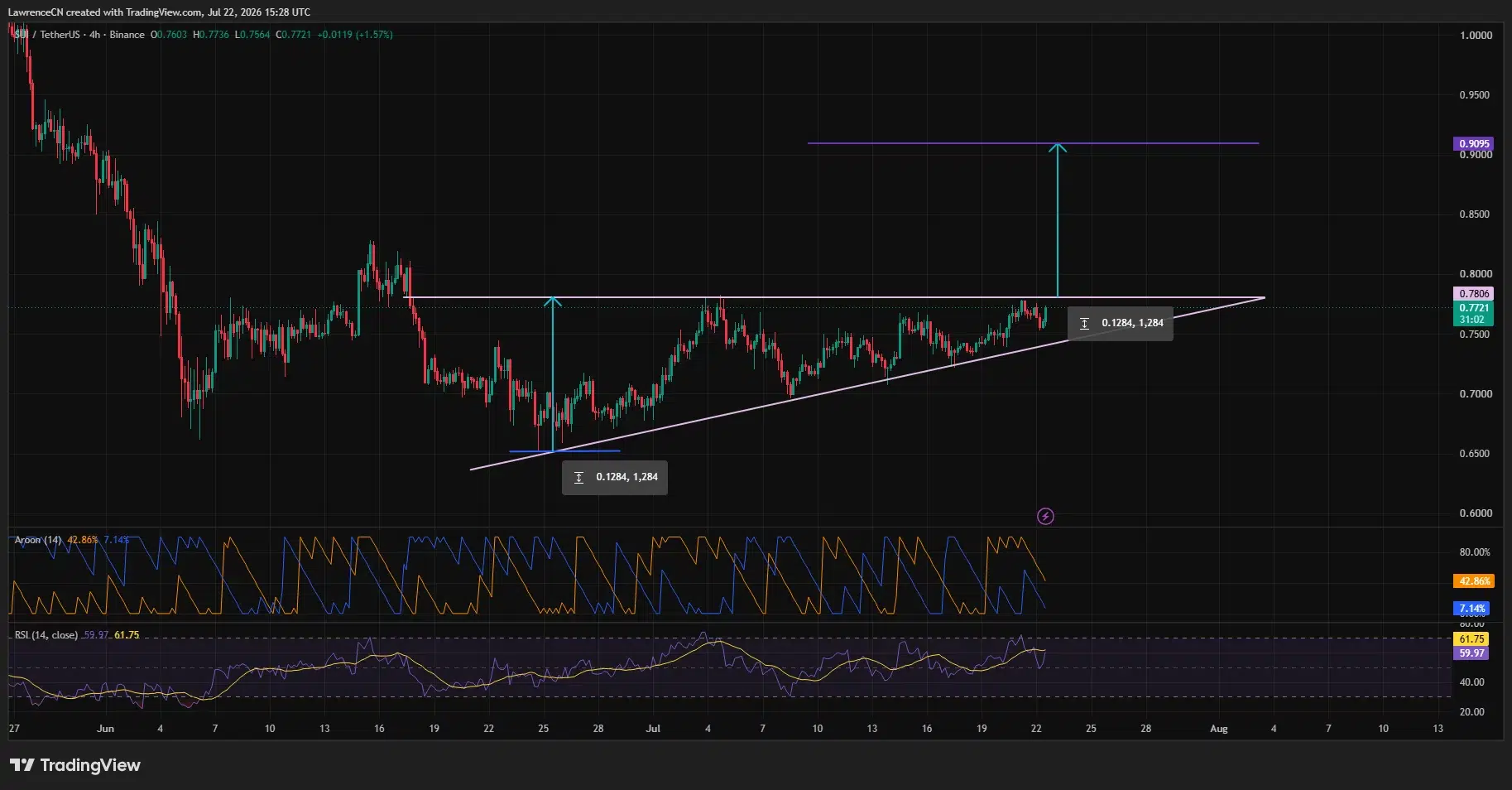
SUI traded near $0.772 on Binance when the supplied TradingView charts were captured on July 22, placing the token just below a resistance area that has rejected several advances since June.
On the 4-hour chart, SUI has formed a series of higher lows against horizontal resistance near $0.7806. This structure resembles an ascending triangle, with its rising trendline extending from the late-June low near $0.65 toward the current price.
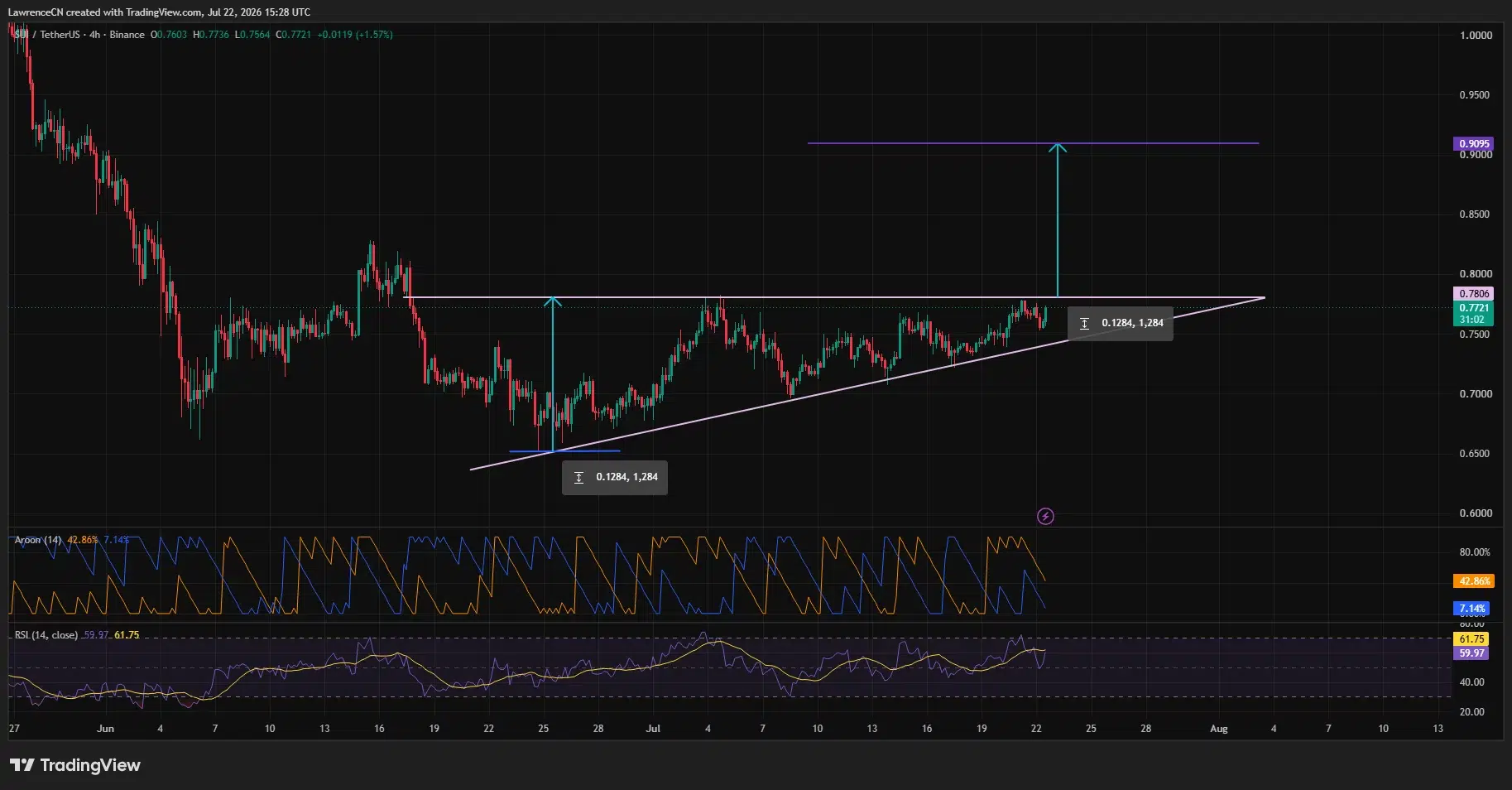
A 4-hour close above $0.7806 would confirm the breakout only if buying activity follows, according to the chart structure. The pattern’s measured move points toward approximately $0.9095, representing a potential increase of about 16.7% from the breakout line rather than a guaranteed target.
Momentum readings offer mixed but generally constructive signals. The 4-hour relative strength index stood at 59.97, below its signal average of 61.75 and well short of the usual overbought threshold at 70. SUI therefore retains room to advance, although the slight RSI slowdown shows that buyers have not yet secured the breakout.
The Aroon indicator provided a more cautious reading, with Aroon Down at 42.86% and Aroon Up at 7.14%. Under that indicator, the higher downside reading suggests that recent upward momentum has weakened even as price continues to hold its rising support line.
Daily indicators present a firmer accumulation picture. The supplied chart shows the MACD line at 0.0063, above the signal line at 0.0040, while the positive histogram was beginning to expand. Chaikin Money Flow stood at 0.10, indicating that buying pressure exceeded selling pressure during the measured period.
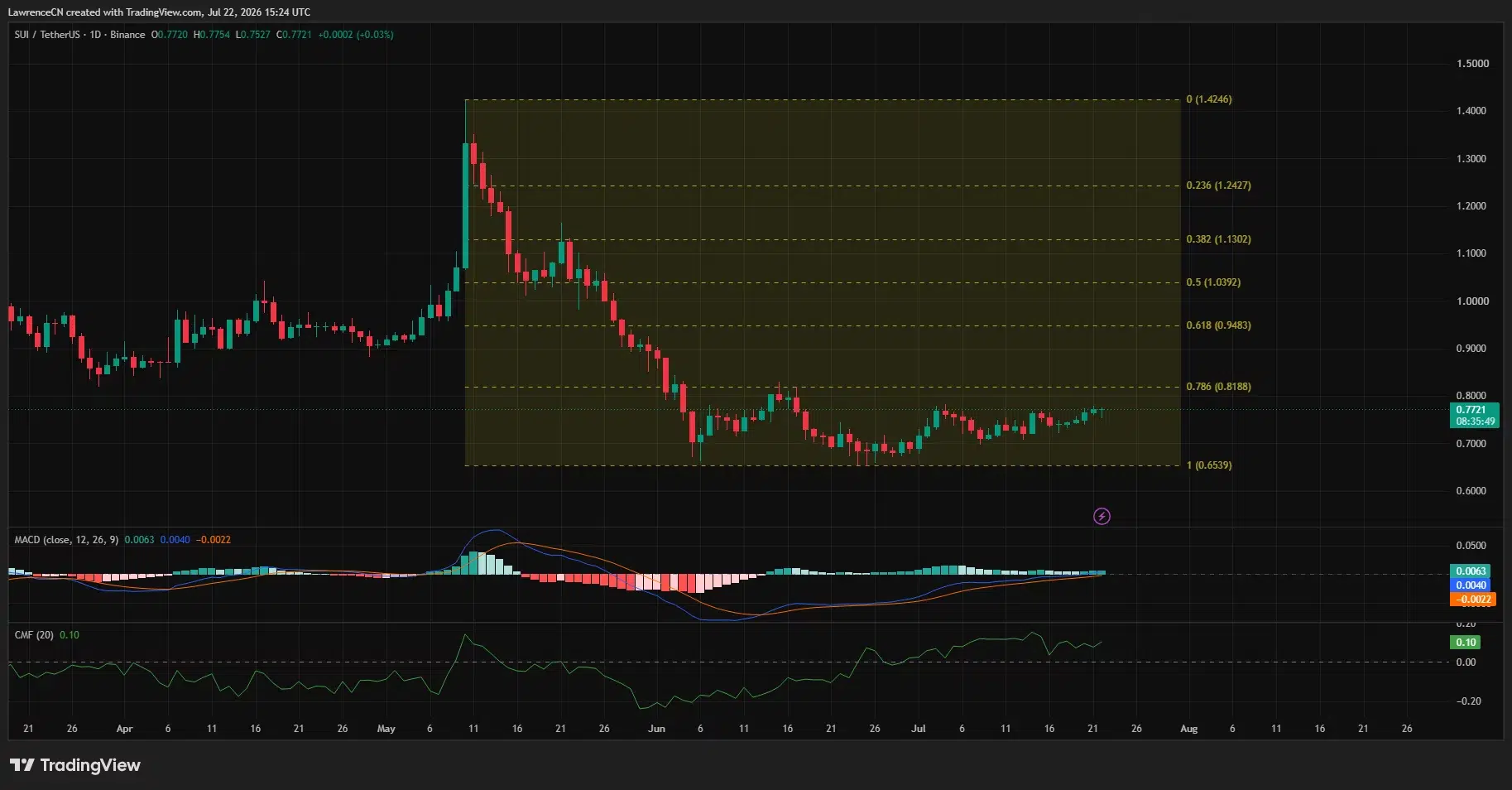
SUI must first clear $0.8188, the 78.6% Fibonacci retracement of its decline from $1.4246 to $0.6539, before the daily chart can support a larger recovery. Above that barrier, the displayed Fibonacci levels place the next resistance zones at $0.9483 and $1.0392.
Failure to break the $0.78–$0.82 area would keep SUI inside its current consolidation. Based on the charts, the rising 4-hour trendline provides initial dynamic support near $0.74, while the daily swing low at $0.6539 remains the main downside level.
Hashi testnet expands Bitcoin activity on Sui
Arriving alongside the Coinbase rollout, Sui’s Hashi testnet has given developers, institutions, custodians and infrastructure providers a place to test Bitcoin-backed financial applications before a mainnet release. The Sui Foundation stated that more than 25 ecosystem partners had joined the testing phase.
Hashi combines Sui’s network with a security system known as the Guardian Layer, according to the foundation. The protocol is designed to give participants additional control over Bitcoin used as collateral while keeping transactions transparent and programmable onchain.
Through the testnet, participating firms can experiment with BTC-backed lending, credit products and yield strategies without deploying those services on the final network. The Sui Foundation also identified Wave Digital Assets as a launch partner involved in the institutional testing effort.
Coinbase’s staking release also arrived on the day the exchange and the U.S. Securities and Exchange Commission ended a long-running Freedom of Information Act dispute. As reported by crypto.news earlier today, the SEC agreed to pay Coinbase $150,000 as part of the settlement.
Coinbase shares did not follow the positive product news during the session. According to Yahoo Finance data, COIN fell 3.65% to $169.42 intraday, separating the stock’s performance from SUI’s attempt to break its short-term resistance.
Disclosure: This article does not represent investment advice. The content and materials featured on this page are for educational purposes only.


The UK Treasury has set Q1 2027 for its first tokenized sovereign bond transaction, but the project has remained dependent on finding a workable method to settle its cash leg on-chain.
Summary
- The UK plans to issue its first tokenized sovereign bond by Q1 2027.
- Missing on-chain cash infrastructure remains the main barrier to institutional settlement.
- Regulators are exploring stablecoins, tokenized deposits and central bank money for payments.
CoinDesk reported that the missing payment mechanism has held back institutional use of digital bonds for almost seven years, even as governments and financial firms have built platforms for issuing tokenized securities.
Known as the Digital Gilt Instrument, or DIGIT, the pilot will test whether distributed ledger technology can reduce costs and improve the operation of UK capital markets. HM Treasury first announced the project in 2024 before selecting HSBC’s Orion platform through a competitive process in February 2026.
According to a July 16 Treasury update, HSBC received Gate 2 approval under the Digital Securities Sandbox on July 13. The decision made HSBC the first sandbox participant cleared to provide live digital securities depository services.
The first DIGIT transaction will take place on HSBC Orion by the end of the first quarter of 2027, subject to the pilot meeting its remaining conditions. Chancellor Rachel Reeves also instructed the Treasury to prepare for possible additional issuances if the initial transaction succeeds.
HSBC’s platform had supported more than $3.5 billion of digital bond issuance across sovereign, central bank, corporate and financial institution markets as of February, the bank told Reuters. HM Treasury has separately appointed law firm Ashurst LLP to provide legal services for the pilot.
The government also plans to list the bond through the London Stock Exchange Group. Reuters reported that the UK wants to become the first major advanced economy to issue a digital sovereign bond, placing DIGIT ahead of similar work among other G7 members.
On-chain cash remains the missing market rail
Although the UK has selected an issuance platform, industry participants told CoinDesk that technical infrastructure alone cannot support a functioning tokenized debt market. Investors must also have a regulated way to exchange cash and securities on the same or connected digital networks.
Current options remain limited by the absence of common on-chain payment standards, established sterling stablecoins and final regulatory rules, according to CoinDesk. Without a dependable cash asset, institutions may still need to move money through conventional banking systems, reducing the settlement benefits offered by tokenized bonds.
Varun Paul, Fireblocks’ global business lead for central banks and financial market infrastructure, told CoinDesk that natively digital bonds could permit instant settlement and allow collateral to move between venues without delays tied to existing systems.
The Bank of England and Financial Conduct Authority have acknowledged the cash-settlement problem. In a joint paper on tokenization, the authorities committed to helping identify settlement options for DIGIT while considering whether the instrument could qualify as collateral in the Bank’s monetary operations.
Bank of England Governor Andrew Bailey also said the central bank would work to make the digital gilt eligible for use as collateral in its market operations, according to Reuters. The Bank plans to upgrade the securities and collateral system supporting those operations in 2027, which could eventually allow direct connections to tokenized asset ledgers.
For settlement in central bank money, the Bank has targeted 2028 for a synchronization service linking digital ledgers with sterling held through its real-time gross settlement system. Its May consultation said the service should allow the asset and payment sides of a transaction to settle at the same time.
Because that system is scheduled to arrive after DIGIT’s first transaction, private settlement assets could play an earlier role. The Bank and FCA said they were working to permit regulated sterling and foreign-currency stablecoins in the Digital Securities Sandbox alongside tokenized deposits.
DIGIT could draw new demand for UK debt
Despite recent changes in Britain’s political leadership, Paul expects the digital gilt program to retain sufficient institutional support from HM Treasury, the Bank of England and the FCA.
“I expect that there is sufficient momentum behind this,” Paul told CoinDesk, adding that the project could support demand for UK government debt.
The potential demand comes as the UK carries almost £3 trillion in outstanding public debt, according to Office for National Statistics figures cited by CoinDesk. Paul argued that placing sovereign debt on-chain would change how capital moves through financial markets rather than merely replacing existing back-office records.
Separate work by the Bank of England could also expand the payment options available to tokenized markets. During City Week 2026, Deputy Governor Sarah Breeden outlined a system in which traditional deposits, tokenized bank deposits, regulated stablecoins and a possible digital pound could operate together.
Breeden said distributed ledger technology could reduce costs, while smart contracts could automate conditional payments and post-trade processes such as collateral transfers and coupon payments. Under the Bank’s model, atomic settlement would allow money and securities to move simultaneously, limiting the risk that one side of a transaction completes without the other.
The Bank is also considering longer operating hours for its RTGS and CHAPS systems, including movement toward near-continuous settlement. Its joint paper with the FCA said extended hours would support digital asset ledgers that can operate around the clock.
While DIGIT’s first sale will test only one sovereign bond, the Treasury has already linked further issuance to the pilot’s success. Progress beyond that transaction will depend on whether regulators, banks and payment providers can connect tokenized securities with reliable sterling settlement before the Q1 2027 deadline.

Gold Most Undervalued in 3 Years, Fund Managers Say. Is the Bottom In?

Taylor Frankie Paul on Dealing With Hate Amid Custody Drama

six in ten SMEs cut innovation spend


-
 NewsBeat6 days ago
London Mayor Sadiq Khan handed a peerage by Keir Starmer alongside 15 other Labour figures… just days before the PM leaves No10
-

 Fashion5 days ago
Weekend Open Thread – Corporette.com
-

 Politics5 days ago
The House | The City of London can help the new chancellor deliver growth in every postcode
-
 Crypto World6 days ago
Two July Windows Left: The CLARITY Act’s Senate Fight and What Failure Means
-

 Crypto World5 days ago
Ripple Payments Joins MiCA With 14 Firms, Does It Mean Anything For XRP?
-

 Business7 days ago
Nvidia Stock Slips After Big Tuesday Rally as Huang Confirms Vera Rubin Chip Is Now in Production Today
-

 Politics4 days ago
Democrats look to World Cup watch parties to register thousands of voters
-

 Crypto World5 days ago
Ripple wins EU-wide access as ESMA adds it to MiCA register
-

 Crypto World2 days ago
Grayscale Files For Worldcoin ETF, WLD Registers Sharp Rise
-

 NewsBeat3 days ago
Unregistered fitter used Gas Safe logo on business flyers
-

 Tech2 days ago
Sail Virtually Aboard The “Itanic” With IA-64 Emulator
-

 Crypto World6 days ago
Injective Submits SEC Transfer-Agent Registration to Onchain Ownership Records
-

 Business7 days ago
Palantir Shares Rise After Expanded Nvidia Partnership and Fresh Analyst Upgrades Ahead of Earnings Day
-
 Tech2 days ago
Turtle Beach Command Series KB7 review: a nifty screen-equipped gaming keyboard
-

 NewsBeat6 days ago
Registration is now open for March for Men with Kev 2026
-
 Business22 hours ago
New Jersey voter registration controversy explained: How 6,600 noncitizens got on the rolls, and what happens next
-
 Crypto World6 days ago
Claude Fable 5 Slips to Second in AI Coding Leaderboard
-

 News Videos6 days ago
Money | Class 12 Economics | CBSE Board Exam 2026-27
-

 Business6 days ago
Banco Bilbao Vizcaya Argentaria, S.A. (BBVA) Discusses Global Macro Environment and Economic Outlook for Core Markets Transcript
-

 Crypto World5 days ago
Kaspersky exposes OkoBot’s 20-module crypto wallet attack
You must be logged in to post a comment Login