

Crypto World
XRP price eyes breakout as golden cross, whale accumulation and XRPL activity surge


- XRP holds above the $1.13 breakout level.
- Whale selling drops as large holders increase accumulation.
- XRPL daily payments surpass 500,000 transactions.
XRP recently moved above the $1.13 level, a price zone that many traders had been watching as a major resistance area.
Holding above this level has shifted attention toward higher resistance levels, with market analyst Dark Defender identifying $1.22, or approximately $1.2269, as the next upside target using Elliott Wave analysis and Fibonacci extension levels.
XRP a clear break and expected to complete the 5 Wave structure we set on 30 Jun. I will add it as a second post for you to check!
$1.13 is the KEY. $1.22 is in sight. (NFA)
Enjoy your day!#XRPArmy #ripple pic.twitter.com/gPCyQQgfzO
— Dark Defender (@DefendDark) July 21, 2026
Dark Defender’s analysis suggests that maintaining support above the breakout zone remains critical for the bullish structure to stay intact.
A sustained move above the current range would strengthen the technical setup, while a drop back below the breakout level could trigger another test of lower support.
Golden cross and breakout strengthen XRP’s technical picture
Another development attracting attention is the appearance of a golden cross, a chart pattern that occurs when a shorter-term moving average crosses above a longer-term moving average.

This signal has historically been associated with improving medium-term momentum.
Although a golden cross does not guarantee higher prices, it is widely regarded as one of the stronger confirmation signals when it appears alongside a confirmed breakout.
The combination of a resistance breakout and a golden cross has created a stronger technical backdrop than either signal would have provided independently.
Focus is now on whether XRP can build enough momentum to challenge the next resistance area identified by Dark Defender.
Whale accumulation replaces heavy selling pressure
On-chain data has also shown a noticeable change in the behaviour of large XRP holders.
Recent blockchain metrics indicate that whale selling pressure has dropped to its lowest level recorded since 2025.
Earlier in the year, hundreds of millions of XRP were regularly transferred by large holders to exchanges, increasing potential selling pressure.
Those exchange inflows have since declined sharply, suggesting that major holders are becoming less active sellers.
At the same time, blockchain data points to accelerating whale accumulation, indicating that some large investors are increasing their XRP positions instead of reducing them.
Normally, buying activity from large wallets reduces immediate selling pressure on the market.
Even so, whale accumulation alone does not determine future price direction. A sustained rally still depends on broader market demand and continued buying interest across both institutional and retail participants.
XRPL network activity reaches important milestone
Beyond price action, the XRP Ledger has also recorded stronger network usage.
Daily payment activity on the XRPL recently climbed above 500,000 transactions, marking one of the strongest levels of network utilisation in recent months.

Payment volume is one of the key indicators used to measure blockchain activity because it reflects how frequently the network is being used for transfers and settlement.
The increase in payment activity comes alongside growing development across the XRPL ecosystem, including projects focused on integrating artificial intelligence with blockchain infrastructure.
While these initiatives are still developing, they point to broader activity taking place beyond simple token trading.



MARA Holdings said Thursday it signed a definitive agreement with HIF to acquire a powered land site of more than 1,200 acres in Matagorda County, Texas, in a post on its official X account. The site will carry up to 1 gigawatt of grid capacity by October 2027 and up to 2 gigawatts by April 2028,… Read the full story at The Defiant

Bitcoin is approaching a key technical level after recording its third consecutive weekly gain. The asset closed last week at around $65,000, rising 1.7% over the period and extending its three-week advance to 11.5%. It also remained above the $61,360 demand zone despite broader market volatility.
Following this sustained recovery, attention has shifted to the $68,000 resistance level. According to the recent Bitfinex report, this level could determine Bitcoin’s next short-term direction. The analysts identified a key reaction zone between $67,900 and $68,300, where the short-term holder realized price and the second-quarter opening level have converged.
Why the $68,000 Level Matters
Bitfinex analysts say many holders who bought near the key reaction range may choose to sell once they recover their original positions. That behavior has created selling pressure during similar retests, making the coming move important for Bitcoin’s short-term direction.
A decisive breakout above the resistance zone would require sustained buying in the spot market rather than speculative activity. Otherwise, BTC could face another rejection and revisit lower support levels established during the recent recovery.
Current institutional demand may play a key role in determining that outcome. Notably, U.S. spot Bitcoin exchange-traded funds have shifted from sustained outflows to a more balanced flow pattern. However, Bitfinex analysts say fresh demand still depends heavily on BlackRock’s IBIT fund.
A More Supportive Macro Backdrop
Bitcoin has also captured a larger share of total cryptocurrency spot trading volume in recent sessions. Analysts said this trend appears to reflect a defensive move away from altcoins rather than a broad return of confidence across the digital asset market.
Beyond crypto market dynamics, the broader macroeconomic environment has also become more supportive. June inflation in the United States recorded its first negative monthly reading in six years. Lower energy prices contributed to the decline, while weakness in the housing sector continued through lower building permits and higher inventories.
Despite those signs of slowing activity, consumer spending and business investment have remained resilient. That combination has kept second-quarter economic growth estimates near 2.5%, creating a missed outlook for the Federal Reserve while supporting risk assets like Bitcoin.
The post Bitcoin’s Next Big Move Hinges on Break Above This Key Level: Bitfinex appeared first on CryptoPotato.


S&P Dow Jones Indices and Pantera Capital have launched an 18-asset crypto index that excludes Bitcoin and ranks eligible blockchain networks by the protocol revenue generated during the previous two quarters.
Summary
- S&P and Pantera launched an 18-asset crypto index based on protocol revenue.
- Bitcoin and XRP failed to qualify under the benchmark’s revenue-focused selection rules.
- Ether, BNB, Solana, TRON and Hyperliquid hold the five largest positions.
According to a joint announcement from the companies, the S&P Pantera Digital Asset Index is designed to measure established network activity instead of relying only on token prices or market capitalization. The benchmark may support investment products, institutional allocations, and actively managed digital asset portfolios.
Bitcoin and XRP are the largest assets from the S&P Cryptocurrency Broad Digital Asset Index that failed to enter the new benchmark, S&P Dow Jones Indices wrote in an Indexology blog post. Their absence comes from the index’s revenue requirements rather than their market value, liquidity, or name recognition.
S&P Dow Jones Indices CEO Kathy Clay told CNBC that Bitcoin did not qualify because it is not a revenue-generating protocol under the index’s rules.
“Bitcoin is not in there because it’s really not one of those revenue-generating protocols that we think belongs in this index and meets all of the criteria.”
Unlike smart-contract platforms, Bitcoin rewards miners with newly issued coins and transaction fees for securing its network. S&P’s methodology, however, focuses on revenue linked to activity across protocols and applications, which favors blockchains that collect fees from transactions, trading and other services.
Clay told CNBC that S&P wanted to apply principles used in traditional equity indexes to digital assets by measuring factors that matter to professional investors. The approach creates a benchmark centered on the economic activity of blockchain networks rather than the size of their tokens alone.
Protocol revenue determines which crypto assets qualify
Drawn from the S&P Cryptocurrency Broad Digital Asset Index, the eligible universe must first pass minimum requirements for protocol revenue, market capitalization and liquidity, according to the companies. Assets that clear those screens are ranked by their total protocol revenue across the two most recent quarters.
Adjusted market capitalization then determines the weight of each qualifying asset. Under the index rules, the largest constituent cannot exceed 35%, while the other holdings are generally limited to 20%.
Quarterly rebalancing allows the benchmark to add, remove or resize constituents as their revenue, liquidity and market value change. As a result, an asset’s position depends on continued network use as well as its ability to meet the index’s trading requirements.
Ether, BNB, Solana, TRON and Hyperliquid’s HYPE token hold the five largest positions at launch, according to S&P’s Indexology post. Each asset represents a network that collects revenue from transactions or applications operating through its infrastructure.
By comparison, many crypto benchmarks give Bitcoin their largest allocation because they use market capitalization as the main weighting measure. Bitcoin represented about 57% of the total cryptocurrency market when the index was introduced, according to CoinGecko data cited by Investopedia.
The Nasdaq CME Crypto Index assigned Bitcoin a weighting of nearly 77%, while Ether held about 13%, Investopedia reported. The FTSE Digital Asset All Cap Index also placed roughly 75% of its weight in Bitcoin, showing how market-cap-based methods can concentrate portfolios in the largest asset.
S&P’s new benchmark does not remove market capitalization from the calculation completely. Instead, the methodology uses revenue to decide which assets qualify and how they rank before adjusted market value sets their final weights.
Pantera Capital’s participation also connects the index with a crypto-focused investment manager that has backed blockchain projects and digital assets. Under the joint framework, S&P provides its index construction and governance experience while Pantera contributes knowledge of blockchain networks and their economic models.
Fund providers are expanding multi-asset crypto exposure
The revenue-based index follows S&P Dow Jones Indices’ launch of the S&P Digital Markets 50 Index in October 2025. That benchmark combines 15 cryptocurrencies with 35 publicly traded companies involved in digital asset infrastructure and services, according to S&P’s index description.
Hashdex has also expanded index-based crypto investing through the Nasdaq Crypto Index US ETF. The manager says the fund uses eligibility checks covering market size, liquidity, custody and U.S. regulatory requirements before assets can enter its benchmark.
Franklin Templeton entered the category in February 2025 with its Franklin Crypto Index ETF, or EZPZ. At launch, the fund tracked Bitcoin and Ether through the CF Institutional Digital Asset Index, according to the firm’s launch announcement.
Franklin later expanded the fund’s underlying index to include XRP, Solana, Dogecoin, Cardano, Stellar and Chainlink alongside Bitcoin and Ether, according to the manager’s current product information. The additions show how rules-based crypto funds can change their holdings when more assets meet regulatory and investment requirements.
MarketVector Indexes and Coinbase Asset Management took another route in April by introducing the Coinbase Store of Value Index. Their benchmark combines Bitcoin with tokenized gold and applies inverse-volatility weighting, giving less weight to the asset showing higher price swings.
Bitwise chief investment officer Matt Hougan predicted in December that crypto index funds would become important during 2026 because the market was growing more complex and its use cases were multiplying. In a Bitwise investment memo, Hougan argued that diversified funds could help investors gain exposure without having to identify every eventual winner.
The S&P Pantera index applies that diversification idea to revenue-producing networks, leaving the market’s largest cryptocurrency outside the benchmark while giving leading positions to blockchains with measurable fee activity.
The most reliable way to earn online in 2026 remains straightforward: sell a useful skill to a real employer or client. Offers built around effortless clicks, guaranteed crypto returns or payments required before work begins carry a high risk of fraud.
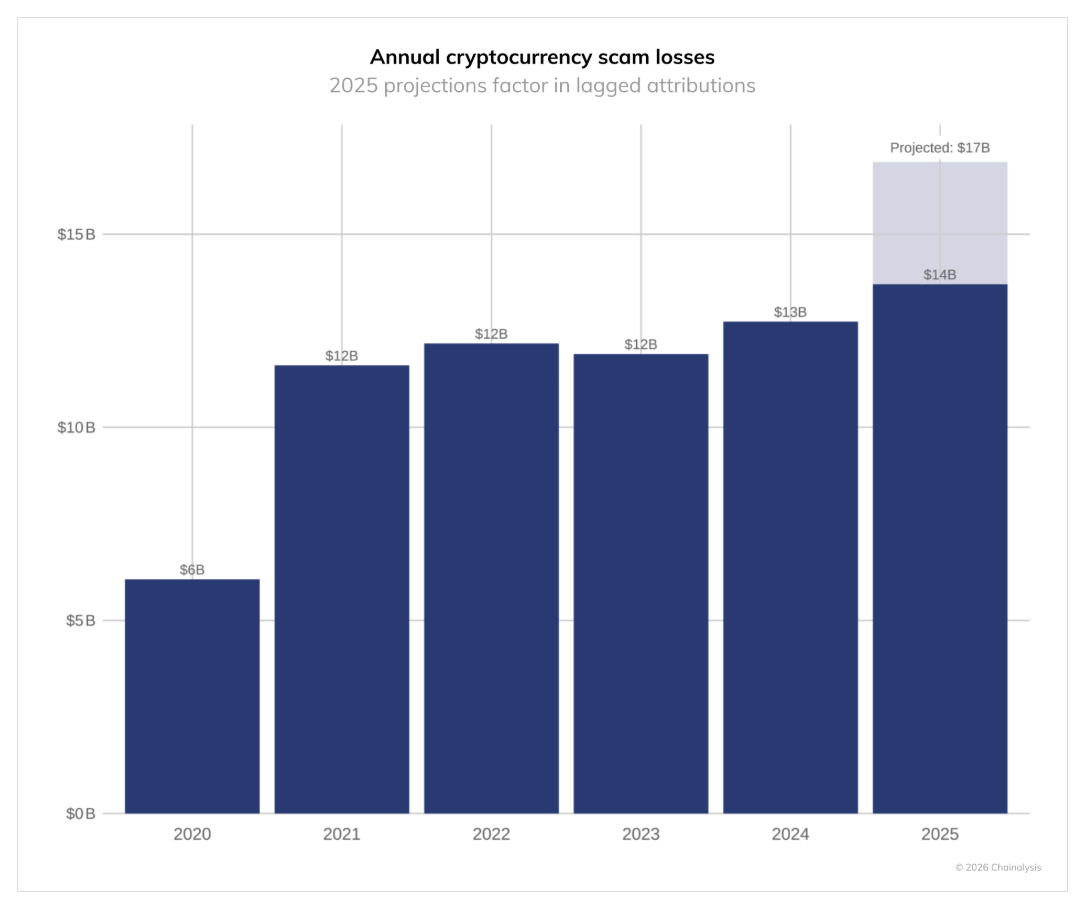
The scale of that risk keeps growing. Chainalysis estimates that crypto scams received at least $14 billion on-chain in 2025. The final figure could exceed $17 billion as researchers identify more illicit wallets.
Meanwhile, the FBI recorded more than one million internet-crime complaints and nearly $21 billion in reported losses during the year.

Real Work Still Beats “Easy Money”
Against that backdrop, Russian crypto commentators Konstantin “CryptoDed” Koshelev and Alexey Ten draw a clear line between working in crypto and trying to extract free money from it. Their Telegram channels appear to be their main public profiles.
Koshelev says people can enter the industry without buying tokens.
“But this would be earning money through work, not trading,” he said.
He pointed to software development, social media, community management and influencer relations as possible routes.
Available hiring data broadly supports him. Bitvocation tracked 1,801 Bitcoin-sector job listings in 2025. It found that 74% were non-developer roles, while 45% offered remote work.
Marketing manager was among the leading non-technical jobs.

However, the data comes from a specialist Bitcoin jobs platform. It provides a useful snapshot rather than a complete measure of employment across the wider crypto industry.
Ten made a similar point. He said legitimate opportunities exist in community work, business development, marketing, content, research and customer support.
The Scam Often Starts With a Message
Ten also warned that people should be highly suspicious when strangers contact them with ways to make money. His claim that 99% of such offers are scams cannot be verified as a literal statistic. However, the direction of his warning matches official fraud guidance.
The FBI says crypto job scams often start through social media, text messages, WhatsApp or Telegram. Fraudsters pose as recruiters and offer simple online tasks.
Victims later discover that they must deposit their own money, usually in crypto, to continue working or withdraw their supposed earnings.

The US Federal Trade Commission received around 20,000 reports of these “task scams” during the first half of 2024. That was four times the total reported during all of 2023.
Overall job-scam losses exceeded $220 million during those six months.
The problem has continued. Nearly 30% of people who reported losing money to scams in 2025 said the contact began on social media. Those cases produced $2.1 billion in reported losses.
Airdrops are Real, Reliable Income Is Not
Airdrops and bounties sit in a greyer area. They are real promotional tools used by crypto projects, but they do not provide predictable income.
Research covering the Hop Protocol and LayerZero found widespread efforts by airdrop hunters to manipulate eligibility using multiple identities. Participants can spend time and transaction fees and still receive little or nothing.

Ten said the safer route is to work inside the industry rather than depend on airdrops or repeatedly chase new projects.
Koshelev offered similar advice. He said his regular work produces the cash flow that he later uses for investing.
For a beginner, the practical route is narrow. Choose one skill businesses already pay for, create examples of your work and apply through company career pages or established professional networks.
A crypto role should pay you for work. Any “job” that asks you to deposit funds, connect a wallet to an unknown site or pay to unlock earnings should be treated as a scam.
The post How People Really Make Money Online in 2026 and Where Scams Start appeared first on BeInCrypto.
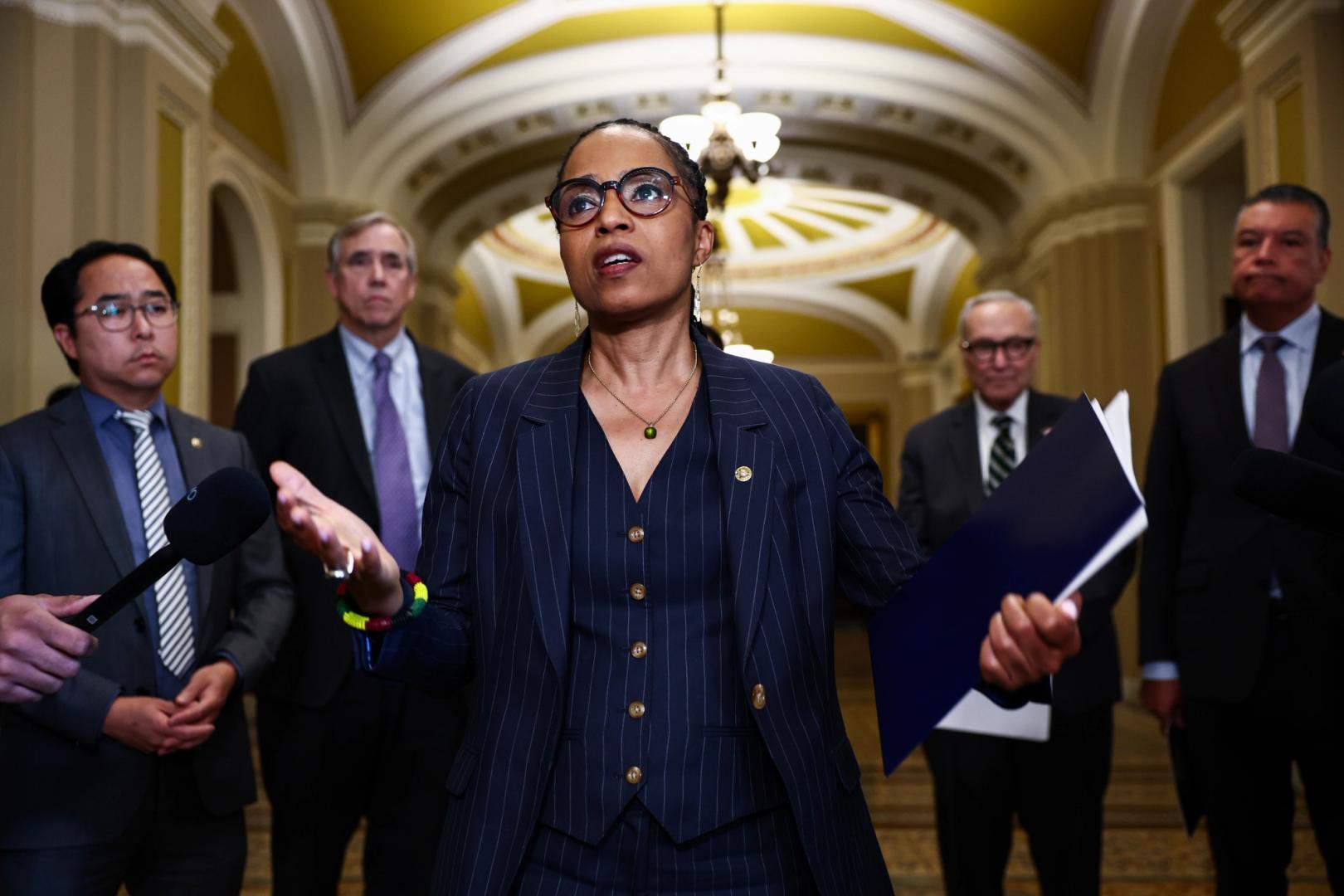
The newest draft of the crypto market structure bill “falls short” of where it needs to be on ethics and other provisions, a group of U.S. Senate Democrats said Wednesday.
Senators Angela Alsobrooks, Cory Booker, Catherine Cortez Masto, Ruben Gallego, John Hickenlooper, Mark Warner and Raphael Warnock — a core group of negotiators that would likely be needed to advance the bill — said in a joint statement shared with CoinDesk that they would keep working with their Republican counterparts on the Digital Asset Market Clarity Act (Clarity Act) but that it needed more work on various outstanding issues, including how the bill addresses illicit finance and consumer protections.
Alsobrooks and Gallego were the only lawmakers to vote for the Clarity Act in committee, while several others on the statement have expressed support for the bill in the past.
“The Republican-proposed text of the CLARITY Act as it currently stands falls short,” the statement said. “Key provisions including those addressing ethics for elected officials, consumer protection, illicit finance, conflicts of interest and market integrity must be strengthened.”
Crypto World
No One Will Sell Oil If We Can’t: Bitcoin and Crude React Instantly As Iran Draws New Red Line
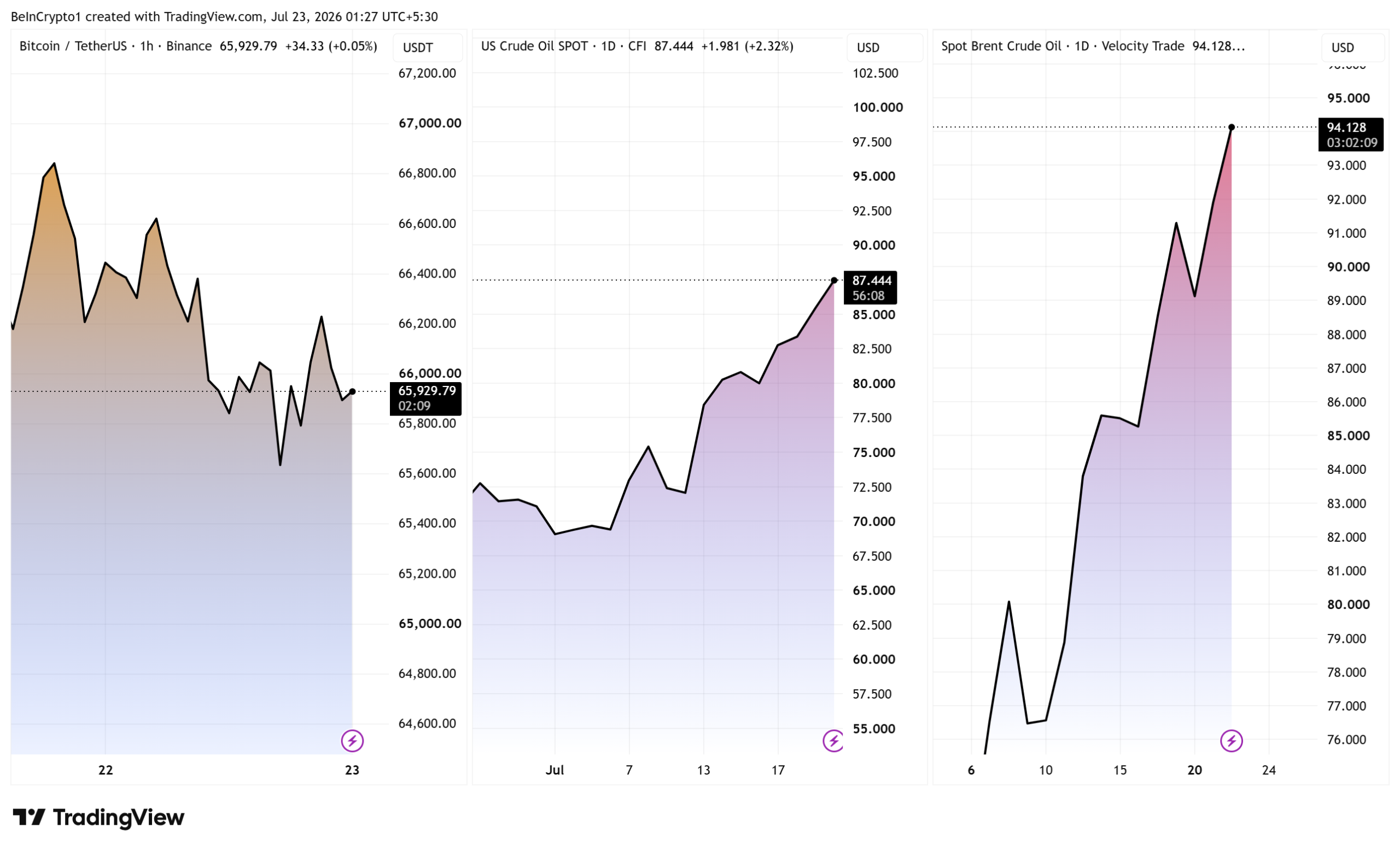
Iran has a blunt new warning for the world. If it cannot sell its oil, it says no one else in the region will either. The threat lifted crude prices on Wednesday and pulled Bitcoin (BTC) back below $66,000.
The reason it matters comes down to one narrow waterway. Most Gulf oil ships out through the Strait of Hormuz. Traders now fear Iran could choke off that route.

Iran’s Oil Threat Revives Hormuz Fears
Two Iranian officials spoke on the same day. Foreign Minister Seyed Abbas Araghchi promised revenge for any attack.
“Our defense doctrine is clear: eye for an eye. Any aggression against Iran, including our infrastructure, will compel a powerful and decisive response. Those who contribute to such aggression, whatever the kind of support, will also be considered as legitimate targets,” Seyed Abbas Araghchi, Iran’s Foreign Minister articulated.
Follow us on X to get the latest news as it happens
Parliament Speaker Mohammad Bagher Ghalibaf was blunter about oil.
“In a region where we do not sell oil, no one will sell oil. If our security is not ensured, no infrastructure will be safe … the situation of the strait will not return to pre-war conditions,” the Iran Parliament Speaker reiterated.
Why do these words move markets? The Strait of Hormuz is the world’s most important oil route. About one in five barrels of the world’s oil passes through it, according to the EIA, the U.S. energy agency.
Iran leans on that route too. It ships around 1.5 million barrels of oil a day, almost all to China. So its threat cuts both ways.
Iran has made this threat before, during sanctions fights in 2011 and 2012. It never actually closed the strait. Even so, the risk alone pushes prices up, as it did when oil topped $90 last week.
Oil Climbs While Bitcoin Slips
Oil rose fast. West Texas Intermediate (WTI) crude gained about 2.25% to near $89. Brent, the global benchmark, traded close to $96, according to TradingView. Both had fallen earlier in the week on fresh ceasefire hopes.
Bitcoin went the other way. The top cryptocurrency traded just below $66,000. It was down about 0.4% on the day after giving back earlier gains.

The link is simple. Costlier oil can push inflation higher. That can keep the Federal Reserve from cutting interest rates, which hurts riskier assets like Bitcoin. The same thing happened when Trump declared a US-Iran truce deal dead in early July.
What happens next depends on Washington and whether the ceasefire holds. So far, Bitcoin has not been the safe haven some hoped. More fighting would test it again.
The post No One Will Sell Oil If We Can’t: Bitcoin and Crude React Instantly As Iran Draws New Red Line appeared first on BeInCrypto.

S&P Dow Jones Indices and Pantera Capital have launched a new rules-based digital asset index designed to measure protocol activity using blockchain revenue rather than token prices or pure market-cap rankings. The move signals a broader push in crypto benchmark design: shifting from “token-driven” to “product-driven” metrics that aim to capture which networks are generating sustained economic usage.
According to a joint announcement from the firms, the index’s starting point is the S&P Cryptocurrency Broad Digital Asset Index, but it filters and ranks only networks that clear minimum thresholds for protocol revenue, market capitalization, and liquidity. Networks that qualify are then ranked by aggregate protocol revenue over the prior two quarters and weighted using adjusted market capitalization, with portfolio concentration controls including a 35% cap on the largest holding and generally 20% caps on the rest. The index is rebalanced quarterly and is positioned for institutional allocation, potentially serving as a reference for investment products and actively managed digital asset portfolios.
Key takeaways
- S&P Dow Jones Indices and Pantera Capital created an index that prioritizes protocol revenue—attempting to reflect real network activity beyond token price movements.
- The methodology screens for protocol revenue, market capitalization, and liquidity before ranking networks by revenue over the previous two quarters.
- Weights are derived from adjusted market capitalization, with concentration limits (35% for the top holding and generally 20% for others) and quarterly rebalancing.
- The index launched with 18 constituents, topped by Ether, BNB, Solana, TRON, and Hyperliquid.
- The launch adds to S&P’s expanding suite of digital-asset benchmarks and aligns with a wider industry trend toward institution-oriented crypto indices.
A benchmark built on protocol revenue
The core difference between this new product and many traditional crypto indexes is its selection logic. Rather than treating the market as a direct proxy for network value, the S&P Pantera Digital Asset Index is built to distinguish established blockchain activity from speculative exposure by focusing on protocol revenue generation.
In practical terms, the index starts from the S&P Cryptocurrency Broad Digital Asset Index universe, then applies eligibility thresholds for protocol revenue, market capitalization, and liquidity. Only networks that meet those requirements proceed to the ranking stage. The ranking itself uses aggregate protocol revenue over the prior two quarters, which helps smooth short-term spikes in activity while still tying inclusion to measurable economic output.
The weighting approach then blends that revenue filter with market-scale considerations: after ranking, constituents are weighted by adjusted market capitalization. The index’s structure includes explicit limits to reduce the risk of any single network dominating performance—an important feature for institutional users accustomed to diversified benchmark behavior.
For readers, the key implication is that this index may behave differently than market-cap-led benchmarks during periods when token prices and on-chain economics diverge. By construction, the methodology aims to reduce reliance on token market sentiment as the primary inclusion and weighting driver.
What the initial portfolio looks like
At launch, the index included 18 constituents. S&P Dow Jones Indices’ Indexology blog post, published alongside the rollout, listed Ether (ETH), BNB (BNB), Solana (SOL), TRON (TRX), and Hyperliquid (HYPE) as the five largest holdings.
That same blog post compared the new revenue-based selection against the S&P Cryptocurrency Broad Digital Asset Index and identified Bitcoin (BTC) and XRP (XRP) as the largest non-constituents under the new framework. The contrast highlights the asymmetry created by protocol-revenue methodology: even when a token is highly liquid or widely traded, it may be excluded if it does not meet the index’s protocol revenue criteria and related eligibility thresholds.
In other words, this benchmark is not attempting to replicate “the biggest coins by market size.” Instead, it is explicitly designed around a different question: which blockchain networks generate enough protocol revenue—relative to their market presence—to qualify for institutional-style basket inclusion.
Institutional use cases and the ETF backdrop
In its announcement, S&P positioned the index for institutional allocation and noted that it may serve as the basis for investment products or act as a reference benchmark for actively managed portfolios. While the filing does not automatically mean a spot ETF or any particular product will follow, it does reflect the growing role of index providers in turning crypto market theory into investable benchmarks.
This launch arrives as major market participants continue building multi-asset and rules-based frameworks that can be used by asset managers operating under traditional risk and governance expectations.
Cointelegraph previously reported that Hashdex launched the Nasdaq Crypto Index US ETF on Feb. 14, 2025, described as the first multi-asset spot crypto exchange-traded fund in the United States. Shortly afterward, Franklin Templeton introduced the Franklin Crypto Index ETF on Feb. 20, 2025, tracking Bitcoin and Ether via the US CF Institutional Digital Asset Index, which is market-cap weighted.
The sector’s “index first” momentum has also extended beyond the strict boundaries of spot crypto. Earlier reporting cited MarketVector Indexes and Coinbase Asset Management launching the Coinbase Store of Value Index in April, a benchmark combining Bitcoin and tokenized gold using an inverse-volatility weighting model—an example of how crypto benchmarks are increasingly packaged alongside traditional diversifiers.
Separately, Cointelegraph noted remarks from Bitwise chief investment officer Matt Hougan arguing that crypto index funds would be “a big deal in 2026” as the market grows more complex and investors seek broader exposure rather than trying to predict which networks become long-term winners. While Hougan’s comments were framed as forward-looking, they map closely to the rationale behind S&P and Pantera’s protocol-revenue approach: diversification is easier to justify when the benchmark rules are transparent and grounded in a defined economic metric.
S&P’s expanding crypto benchmark lineup
This new index is also part of a wider pattern inside S&P Dow Jones Indices: the provider has been building digital-asset benchmark offerings intended to translate crypto performance into familiar institutional product structures.
In October, S&P Dow Jones Indices introduced the S&P Digital Markets 50 Index, a composite that combines 15 cryptocurrencies with 35 publicly traded companies tied to the crypto ecosystem. The contrast with the new revenue-based index is instructive. The Digital Markets 50 Index uses a cross-asset structure spanning token networks and equity exposure, while the S&P Pantera Digital Asset Index focuses on network economic activity and liquidity criteria—narrowing the lens from “crypto as an industry” to “crypto as protocol usage.”
Both initiatives reflect the same broad direction: building benchmarks that can support institutional research, portfolio construction, and eventually product engineering.
Looking ahead, investors and index users will likely focus on two practical questions: how the protocol revenue thresholds and revenue-based ranking hold up as network economics evolve, and whether future constituents shift meaningfully as quarterly rebalancing updates the revenue inputs. The index’s concentration caps should help manage risk, but the biggest watch item will be whether the revenue filter consistently separates durable network activity from short-lived speculative cycles.
PayPal USD is now issued natively on Polygon and integrated into the network's Open Money Stack, Polygon's official account said Thursday. Paxos, the stablecoin's issuer, confirmed the move the same day. "PYUSD, the OCC-regulated stablecoin issued by Paxos, is now available on [Polygon] and the… Read the full story at The Defiant
Crypto World
US Federal Officials Barred Until 2029 from Issuing or Sponsoring Tokens under CLARITY’s Proposed Ethics Rules
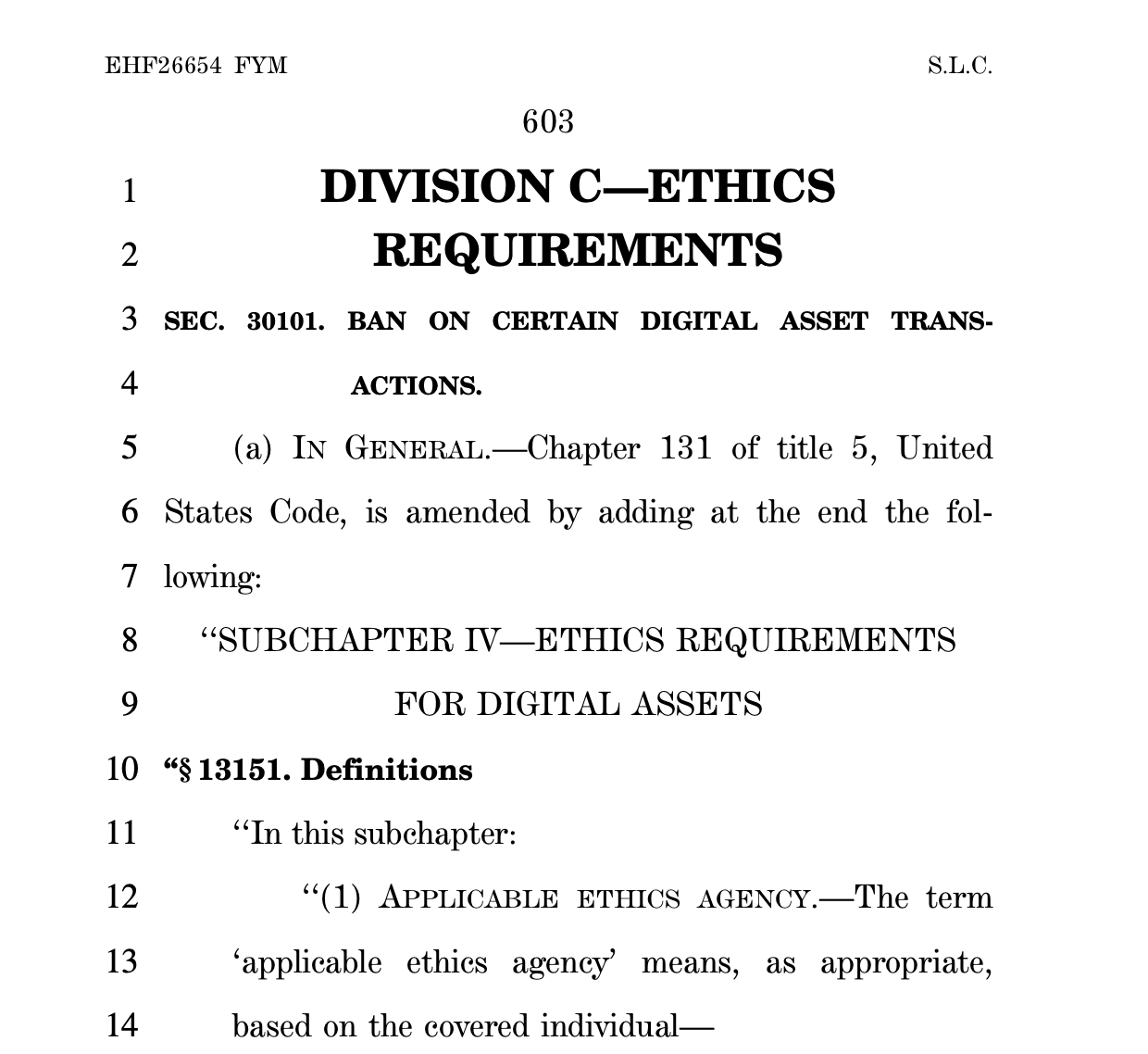
Senate Republicans have released the proposed text for the Digital Asset Market Clarity (CLARITY) Act, including language on ethics that would bar all US federal officials — including President Donald Trump — from issuing or sponsoring any digital asset.
In the 616-page text of the CLARITY Act made public on Wednesday, US lawmakers included language that the White House described as the “most comprehensive and wide-ranging ethics provision in history.“ The bill said all public officials, employees and their spouses would be barred from issuing or sponsoring digital assets and crypto platforms would similarly be blocked from listing assets issued or sponsored by federal officials.
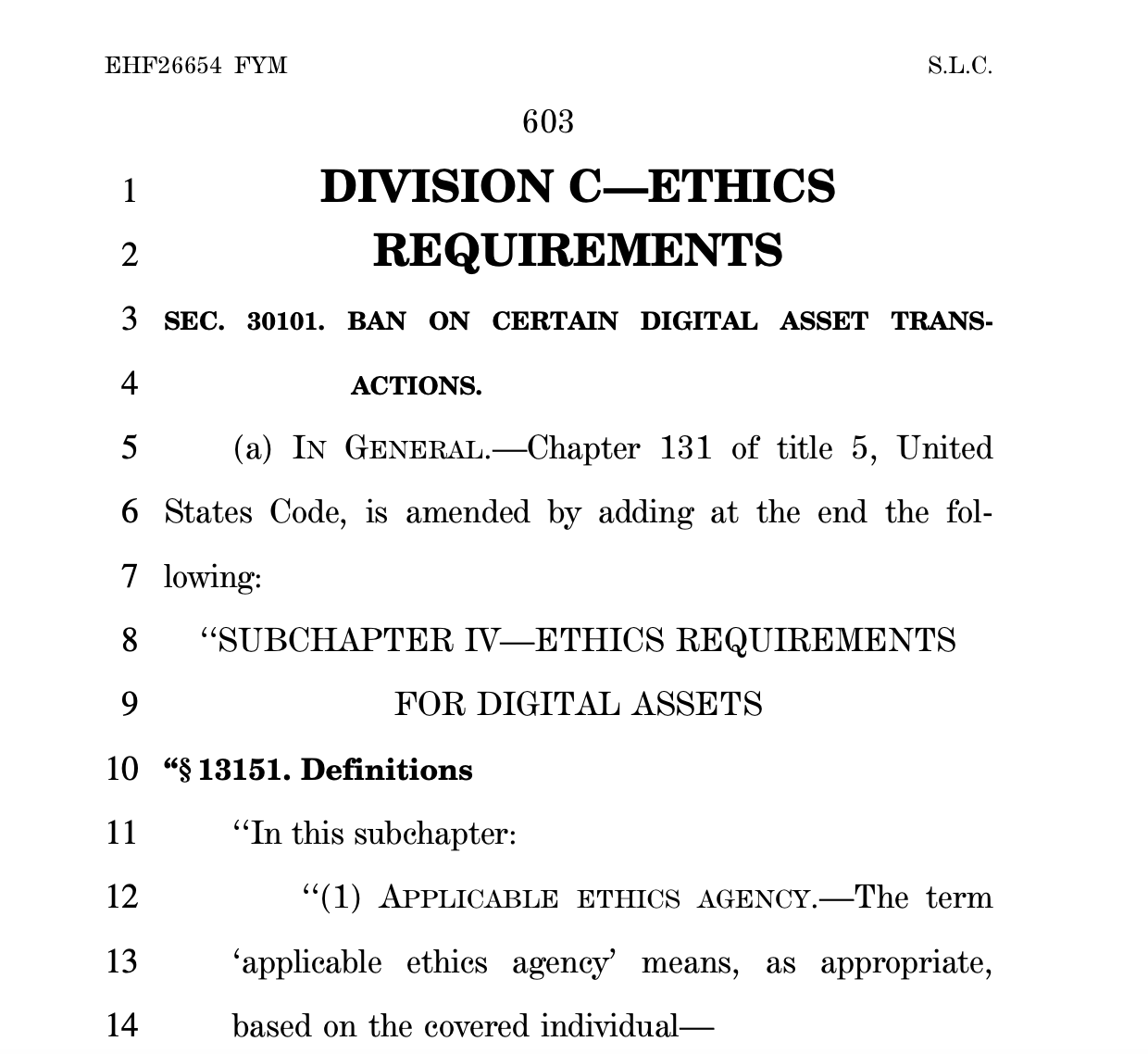
Text of CLARITY Act released on Wednesday. Source: Cynthia Lummis
According to Senator Cynthia Lummis, one of the bill’s chief advocates, the ethics provisions would also apply to Trump, who faces significant pushback from lawmakers over earning more than $1.4 billion in 2025 from his crypto ventures. The ban on public officials would only be temporary, expiring on Jan. 20, 2029 — the day Trump’s second term as president will end.
The US Attorney General will largely be responsible for enforcing the ban rather than state authorities. As of Wednesday, Trump’s former personal attorney and acting AG Todd Blanche was awaiting a Senate confirmation vote to head the Justice Department.
“I wouldn’t support the bill if that’s the language,” said Senator Angela Alsobrooks in a Tuesday statement to Politico on having the DoJ behind enforcement of ethics. “But we’ll keep working from that floor to reach an agreement that holds us all accountable.”
The CLARITY Act, which awaits a potential vote in the Senate before returning to the House of Representatives and possibly Trump’s desk, still needs support from several Democratic lawmakers to meet a 60-vote threshold. Many Democrats have explicitly said that they will not vote for any bill without strong ethics language to address what some have called the president’s “crypto corruption.”
Will enough Democrats sign onto the bill?
Notably, CLARITY’s ethics provisions did not appear to include children of public officials in its temporary ban. All three of Trump’s sons are co-founders of his family’s World Liberty Financial crypto business, and two launched a Bitcoin (BTC) mining company, American Bitcoin.
“This bill applies one ethics standard to everyone, including the President of the United States, and backs it up with real enforcement, real penalties, and a Department of Justice mandate to act,” said Lummis on behalf of the US Senate Banking Committee’s subcommittee on digital assets. “This is not talk.”
Related: Nigerian president signs order on approach to crypto regulation, taxes
Senate Majority Leader John Thune reportedly plans to put CLARITY up for a vote on the Senate floor sometime next week regardless of whether it has enough support from Democrats to pass. The chamber only has a few weeks to hold a vote before it breaks for state work periods.
“[E]thics is far from the only thing at stake,“ said Solana Policy Institute President Kristin Smith in reaction to the CLARITY text. “The Senate has added a full disclosure regime, an entire illicit finance section, and improved spot market regulation […] The Senate has a real chance to pass durable, bipartisan market structure legislation.“
Magazine: The digital euro: Surveillance money, or a better alternative to cash?

Movement Labs has filed for Chapter 11 insolvency protection in the U.S. Bankruptcy Court of Delaware.
This follows months of controversy and a token scandal that left the network dealing with major financial issues.
Movement’s Bankruptcy Timeline
In its bankruptcy filing, the company said it has under 1,000 creditors, between $100,000 and $500,000 in assets, and more than $1 million in liabilities. The largest unsecured claim, worth more than $1.6 million, belongs to former co-founder Ruhikesh Manche. Other major creditors are the Delaware Division of Revenue and Anchorage Digital.
The firm’s problems started in December 2024, after it launched its MOVE token. But shortly after its debut on Binance, some $66 million worth of the tokens were dumped onto the market as part of a market-making deal with Rentech. This sudden increase in supply led to its price tumbling and wiped out billions of dollars in value within days.
Binance later banned Rentech for misconduct, accusing it of selling the entire stash just one day after the listing while placing very few buy orders. According to the exchange, the market maker earned a profit of $38 million before it removed it from its platform on March 18.
Movement then launched a token buyback program in response to repurchase MOVE tokens and restore liquidity to the ecosystem. It also contracted Groom Lake to review its deal with Rentech, after which it was discovered that it had ties to the Chinese market maker Web3Port, ultimately leading to the dismissal of Manche over the scandal.
Per the bankruptcy filing, the first creditor hearing is scheduled for August 20.
From $141M to $8 in Daily Fees
Interestingly, Movement had raised a total of $141.4 million across several funding rounds, including a Series A led by Polychain Capital. On paper, that level of funding should have provided the project with some financial stability, but the network’s on-chain activity tells a different story.
DeFiLlama data shows its daily app revenue has been less than $800 since November 2025. The project’s chain fees have also stayed in the single digits for months, with returns for the last 24 hours at just $8 per the same source.
MOVE hit a new all-time low on July 20, after a stormy few months where it went from about $0.041 in January to $0.01043 two days ago. At the time of writing, it had moved less than 2% from the all-time low, with its new level representing a plunge of over 99% from its all-time high of $1.45, according to CoinGecko data. Meanwhile, the network’s Total Value locked (TVL) sits at roughly $133 million.
Movement was originally made to link blockchains built on its Move programming language with Ethereum. But the layer-2 network announced in June that it would be pivoting toward cross-border payments, remittances, and dollar-saving products.
The post $141M Fundraise to $8 Daily Fees: Movement Labs Files for Bankruptcy appeared first on CryptoPotato.

Sal Stewart’s HR helps Reds defeat Mariners

Valve engineer hints the Steam Machine could cost more

Cleaning expert’s cheap hack to keep maggots out of your bin


-
 NewsBeat6 days ago
London Mayor Sadiq Khan handed a peerage by Keir Starmer alongside 15 other Labour figures… just days before the PM leaves No10
-

 Fashion5 days ago
Weekend Open Thread – Corporette.com
-

 Politics5 days ago
The House | The City of London can help the new chancellor deliver growth in every postcode
-
 Crypto World6 days ago
Two July Windows Left: The CLARITY Act’s Senate Fight and What Failure Means
-

 Crypto World7 days ago
CFTC blocks Kalshi from unwinding Michigan trades after court order
-

 Crypto World5 days ago
Ripple Payments Joins MiCA With 14 Firms, Does It Mean Anything For XRP?
-

 Business7 days ago
Nvidia Stock Slips After Big Tuesday Rally as Huang Confirms Vera Rubin Chip Is Now in Production Today
-

 Politics3 days ago
Democrats look to World Cup watch parties to register thousands of voters
-

 Crypto World5 days ago
Ripple wins EU-wide access as ESMA adds it to MiCA register
-

 Crypto World2 days ago
Grayscale Files For Worldcoin ETF, WLD Registers Sharp Rise
-

 NewsBeat3 days ago
Unregistered fitter used Gas Safe logo on business flyers
-

 Crypto World6 days ago
Injective Submits SEC Transfer-Agent Registration to Onchain Ownership Records
-

 Tech2 days ago
Sail Virtually Aboard The “Itanic” With IA-64 Emulator
-

 Business7 days ago
Palantir Shares Rise After Expanded Nvidia Partnership and Fresh Analyst Upgrades Ahead of Earnings Day
-
 Tech2 days ago
Turtle Beach Command Series KB7 review: a nifty screen-equipped gaming keyboard
-

 NewsBeat5 days ago
Registration is now open for March for Men with Kev 2026
-
 Business19 hours ago
New Jersey voter registration controversy explained: How 6,600 noncitizens got on the rolls, and what happens next
-

 News Videos6 days ago
Money | Class 12 Economics | CBSE Board Exam 2026-27
-
 Crypto World6 days ago
Claude Fable 5 Slips to Second in AI Coding Leaderboard
-

 Business6 days ago
Banco Bilbao Vizcaya Argentaria, S.A. (BBVA) Discusses Global Macro Environment and Economic Outlook for Core Markets Transcript
You must be logged in to post a comment Login