

Crypto World
XRP Price Prediction: Binance Reserve Hits 6 Months Low

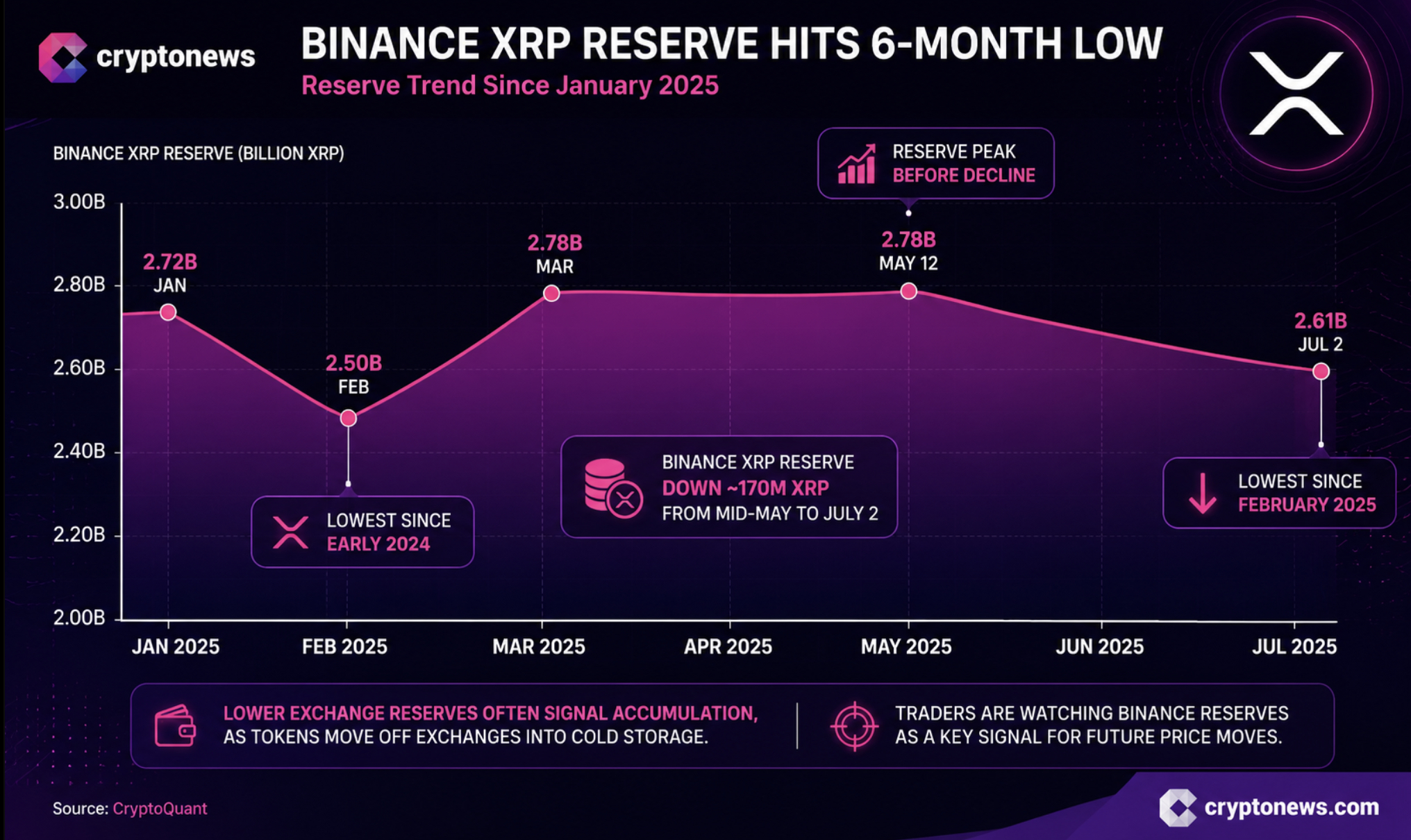
Binance’s XRP reserve just hit its lowest level since February as its price prediction turns slightly bullish. XRP price is hovering near $1.11 after gaining about 4% over the past 24 hours. That bounce ended several sluggish sessions, but the next move still needs proof.
According to CryptoQuant contributor Arab Chain, Binance’s XRP holdings have dropped to roughly 2.61 billion tokens, the lowest level in six months. Even better for bulls, meaningful inflows have yet to refill those reserves since early July. Coins leaving exchanges often hint at accumulation, although the market does not always reward patience immediately.

That said, XRP slipped toward $1.06 while reserves kept shrinking. In other words, weak sentiment and thin liquidity outweighed the bullish on-chain signal. Now that buyers have returned, those reserve trends may finally matter. Markets love showing up late to the party, but they usually bring plenty of noise.
Meanwhile, the Binance CVD Confirmation Score remains at negative 6.93 million, showing sellers have controlled order flow since XRP traded above $2.00 earlier this year. For now, Binance reserve data remains a closely watched signal as traders look for the next decisive move.
Discover: The Best Crypto to Diversify Your Portfolio
XRP Price Prediction: Break $1.15 and Reverse The Slide?
Technically, the $1.06 to $1.07 zone has continued to attract buyers, helping absorb the latest pullback. Immediate resistance remains between $1.12 and $1.15, where previous rallies have repeatedly stalled. That makes this area the first real test if buyers want to keep control.
The Binance CVD Confirmation Score remains at negative 6.93 million, showing sellers have dominated order flow since XRP traded above $2.00 earlier this year. A convincing break above $1.15 needs more than a single green candle. It also needs sustained buying pressure to shift the market’s balance.

If buyers defend current support and reclaim $1.15, momentum could extend toward the $1.30 to $1.40 region. Otherwise, XRP may continue moving between $1.07 and $1.12 while traders wait for the next catalyst. A daily close below $1.06 would weaken the setup and could expose the $0.95 to $1.00 area.
Despite the recent recovery, XRP still trades about 70% below its all-time high near $3.65. That leaves plenty of room for upside, but patience remains part of the game.
Trade XRP on BYBIT now, and Don’t Miss Out on Our $1,000 USDT Airdrop
LiquidChain Targets Early-Mover Upside as XRP Tests Key Resistance
XRP’s rebound is real, but the ceiling from $1.12 to $1.15 is equally real, and with a market cap already in the tens of billions, even a clean breakout delivers percentage gains that dwarf what early-stage infrastructure plays can offer. That asymmetry is exactly where traders rotating for higher upside exposure have been looking.
LiquidChain ($LIQUID) is a Layer 3 infrastructure project with a specific structural angle: it fuses Bitcoin, Ethereum, and Solana liquidity into a single execution environment. Liquid uses one deployment, three ecosystems.
An L3 crafted by LiquidChain? — LiquidChain (@getliquidchain) July 6, 2026
That is the most powerful type of Magic.  ⟁https://t.co/vqvBcdSQYC pic.twitter.com/7Rwd3fVOGc
The architecture centers on a Unified Liquidity Layer, Single-Step Execution, and Verifiable Settlement, targeting the fragmentation problem that still costs DeFi users real money on every cross-chain interaction.
The presale is currently priced at $0.0148, with $900K raised to date. LiquidChain has continued attracting capital even through recent macro-driven volatility, which says something about conviction at this stage.
Research LiquidChain here before the next pricing tier moves.
Discover: The Best Token Presales
The post XRP Price Prediction: Binance Reserve Hits 6 Months Low appeared first on Cryptonews.

Robinhood Chain’s explosive launch this month has reignited one of Ethereum’s longest-running debates: Do successful layer-2 networks increase demand for ETH, the asset, or do the new entrants capture all of the value for themselves?
The retail brokerage’s Arbitrum-based Ethereum L2 has become one of Ethereum’s busiest rollups since its launch on July 1.
More than $141 million in Ether was bridged onto the chain in its first two weeks. DeFiLlama data shows more than half a million wallets now hold ETH on the network, and a memecoin frenzy saw Robinhood Chain surge past the Ethereum L1 and Coinbase’s Base L2 in 24-hour DEX trading volume.
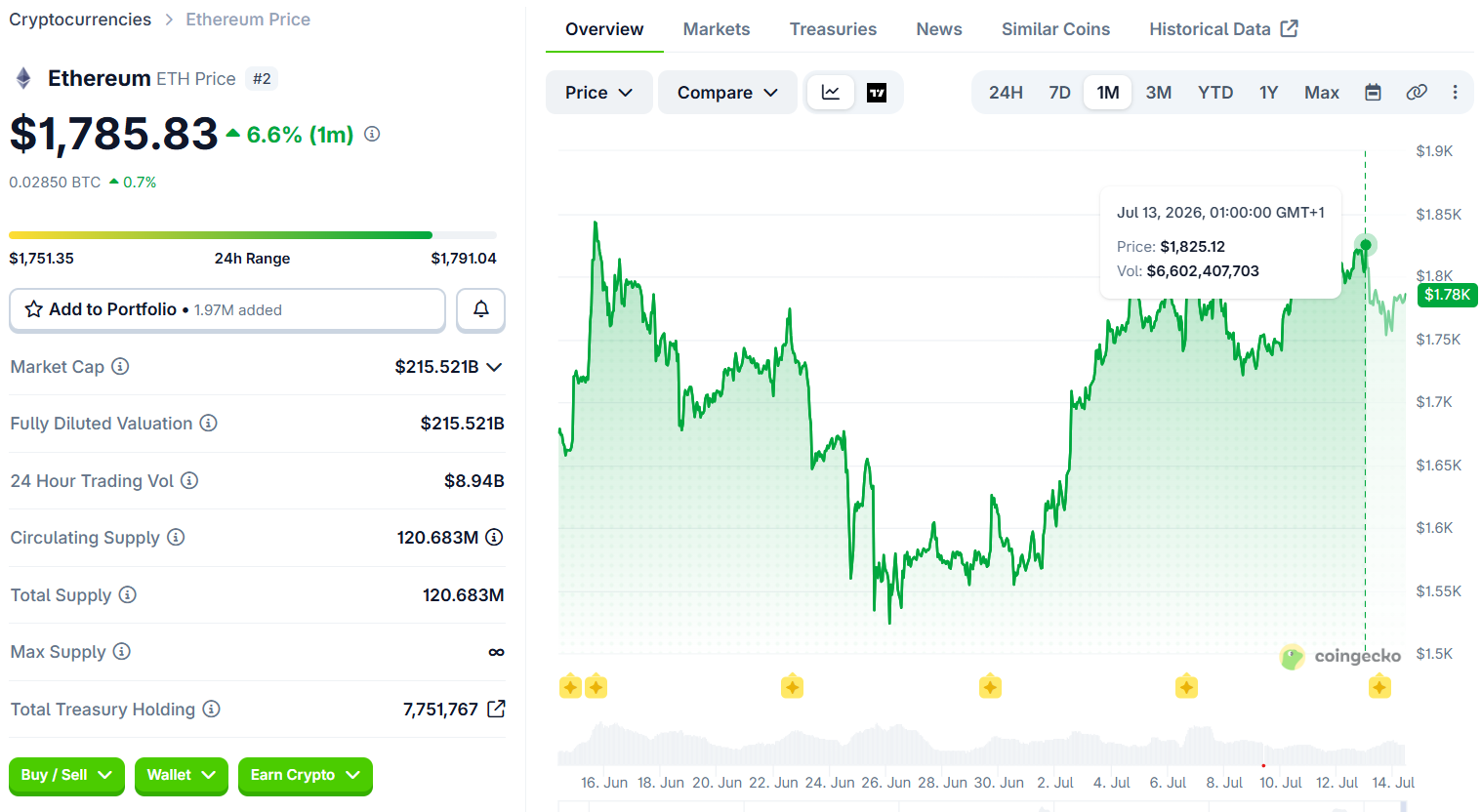
Ether has pumped on the news, gaining around 15% from $1,582 on July 1 to $1,825 by July 13, according to Coingecko data, following a wave of bullish comments.
World Liberty Financial’s Eric Trump posted on July 11, “ETH is pumping hard! Great to see!” while Tom Lee, chairman of BitMine Immersion Technologies, argued the launch reinforces the thesis that “ETH is money,” pointing to the asset’s role as the chain’s native gas token and the L2’s finality on Ethereum’s mainnet.
Ethereum investors have heard similar arguments before.
Related: Robinhood L2 sparks ETH optimism, Saylor ‘muddies waters.’ Hodler’s Digest, July 5-12, 2026
Arbitrum, Optimism and Base each drove waves of users and activity onto Ethereum’s L2 ecosystem, but failed to move the needle meaningfully in Ether’s price, as most of the economic activity remained on the rollups themselves.
Robinhood Chain’s launch is arguably different. Unlike previous rollups built by crypto-native firms, the network was developed by a publicly listed retail brokerage with tens of millions of customers to support tokenized stocks and other real-world assets.
Within days of launch, it already accounted for 6.9% of all tokenized stockholders, according to data from Token Terminal.
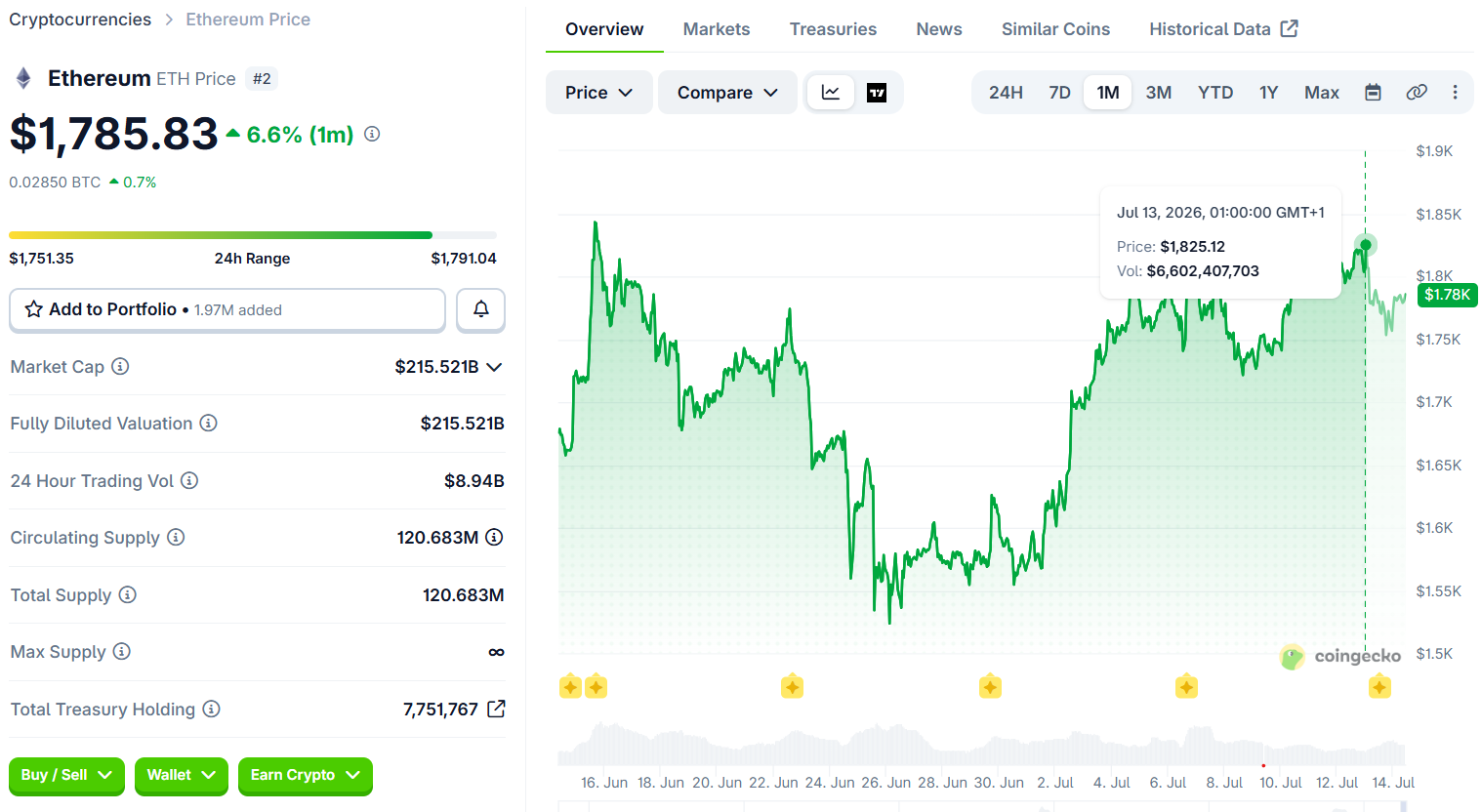
Ether price response to Robinhood Chain’s launch. Source Coingecko
And, if Robinhood’s model succeeds, it could encourage banks, brokers and asset managers to build L2s of their own, and cement Ethereum as the default blockchain for TradFi. Deutsche Bank is already in the process of building a ZK-powered Ethereum L2 called DAMA 2, focused on institutional finance.
Why Robinhood could be a turning point
Ethereum’s L2 networks use rollup technology to process transactions away from Ethereum’s main chain and periodically settle them back to the network. Robinhood Chain uses Arbitrum technology and is compatible with Ethereum’s wider ecosystem.
But what has caught the industry’s attention isn’t the technology itself, as much as who is using it.
“It’s a real milestone,” Alex Gluchowski, founder and chief executive of Matter Labs, the developer behind Ethereum L2 zkSync, told Cointelegraph.
“It shows Ethereum L2s have gone from something crypto-native teams experiment with to infrastructure a regulated, publicly listed company will run its business on.”
Rather than building a blockchain from scratch, as Stripe has opted to do with Tempo, Robinhood chose to tailor an Ethereum rollup to its own needs “for privacy, compliance and performance, while still inheriting Ethereum’s security and connecting to its liquidity,” he added.
Max Shannon, senior research analyst at Bitwise, told Cointelegraph that Robinhood Chain’s success is more significant than previous L2 deployments.
“It represents the growth of the Ethereum ecosystem, particularly among major institutions,” he said. “It also arrives at a time when Ethereum has more broadly repositioned itself toward institutions through Eth Labs and Ethereum Institutional.”
Does Robinhood Chain change the investment case for ETH?
For Shannon, Robinhood’s launch strengthens the investment case for Ethereum because it reinforces the network’s position as the leading blockchain for institutional adoption.
He said ETH has the “network characteristics” to become the reserve asset for a growing network of institutional L2s. But like many, he believes Ethereum’s tokenomics need to be improved so that increased network activity is reflected more clearly in demand for ETH.
Ethereum has been criticized frequently for its decision to lower fees for L2s as a way to spark adoption and gain network effects. Ark Invest’s Lorenzo Valente posted on July 14 that Robinhood Chain had generated $816,000 in revenue since launch, with Arbitrum taking a 10% cut, but only 0.15% of the total being paid back to Ethereum.
“If your thesis is ‘ETH is money,’ Robinhood building here is ultra bullish. More activity, more ETH collateral, more lindyness. If your thesis is ‘ETH is a revenue generating asset,’ this is the ultra-bear case.”
GrowThePie said that Valente’s figures for Eth’s share of the revenue were off by a factor of four and argued “0.6% of revenue is the correct figure.” But even the higher figure is not a meaningful driver of revenue to the L1. Robinhood Chain generated more gas fees than any other L2 in the past week, but Ethereum only saw $4,400 of that.
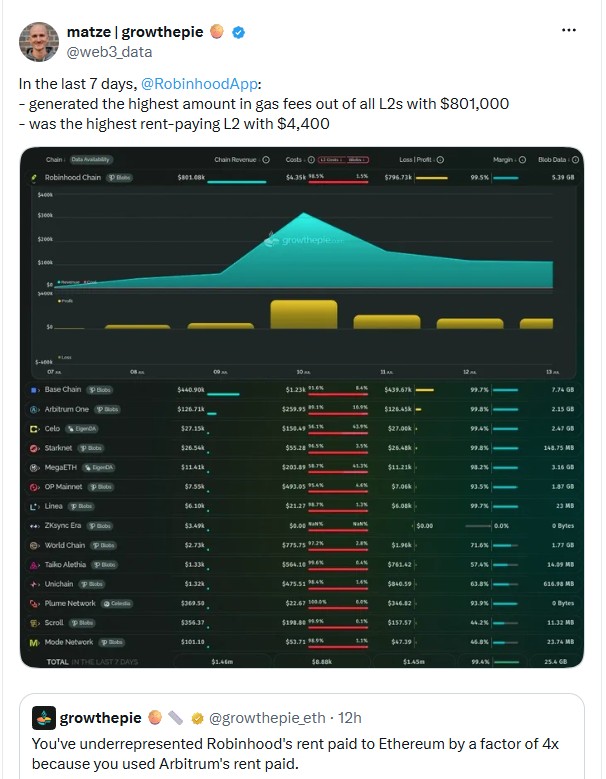
Source: Matze, GrowThePie
Gluchowski said ETH’s appreciation would not be based on fee revenue, but would likely come from becoming widely accepted money throughout the L2 ecosystems.
“People might pay fees in stablecoins or never think about gas at all,” he said. “But as more value settles through Ethereum, ETH starts to look less like a fee token and more like a base monetary asset for this system.”
Related: Robinhood says its AI agent feature will ‘soon’ be assisting crypto traders
Even ETH bears like Mike Dudas from 6th Man Ventures, have described Robinhood Chain as “the single most bullish thing I’ve seen in eth-land in years.”
But after Dudas saw Valente’s post, he added the proviso that “Eth cooked unless ‘eth is money’ takes off or the price of l1 settlement increases.”
The value accrual question remains
While Robinhood’s success may have bolstered the case for Ethereum’s scaling strategy, it has yet to settle one of the network’s biggest unanswered questions: how does growing L2 activity ultimately translate into value for ETH?
Shannon said that recent upgrades like Fusaka have improved Ethereum’s scaling capabilities, but despite transaction activity reaching record levels, demand has yet to translate into meaningfully higher fees or increased ETH burn.
“Robinhood will not solve this problem,” Shannon said, and the collective growth of L2s will likely not either… It requires a wholesale change in developer mindset and in ETH’s token economics.”
Another uncertainty is how much ETH institutional users will actually hold directly. As tokenized stocks and other RWAs increasingly trade against stablecoins, many users may rarely interact with ETH, even though it underpins the network behind the scenes.
Robinhood may have shown that a major financial institution is willing to build on Ethereum’s infrastructure, but whether that ultimately translates into stronger demand for ETH remains to be seen.
Magazine Ethereum’s much-hated staking ‘tax’ may already be obsolete
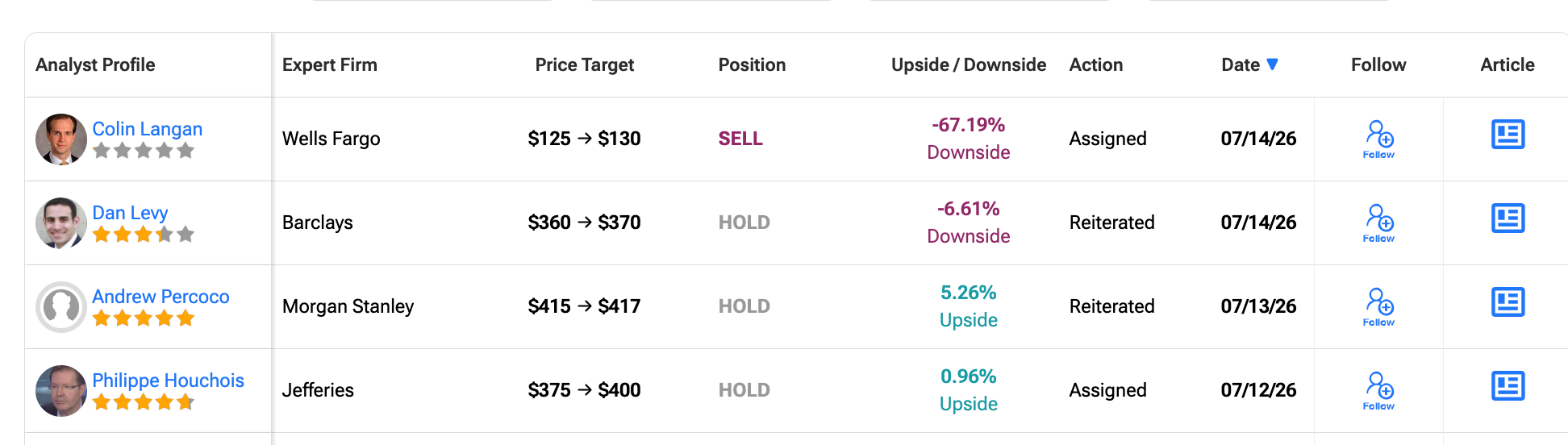
Wells Fargo just raised its price target on Tesla stock (NASDAQ: TSLA), yet told clients to keep selling. The bank now values the shares at $130, still far below the roughly $396 where they trade.
The takeaway is simple. Even with the higher target, that $130 call still points to a roughly 67% drop, because the price already banks on a future the business has not delivered yet.
A Higher Tesla Stock Target That Still Says Sell
Analyst Colin Langan lifted his target to $130 from $125 on July 14, while still keeping an Underweight rating, which is Wells Fargo’s version of a sell. From near $396, that $130 target points to about 67% downside. In plain terms, he still expects the stock to fall, just not quite as far as before.
Want more insights like this? Sign up for Editor Harsh Notariya’s Daily Newsletter here.
Langan is also the most bearish voice on the stock. Most rivals, by contrast, sit at hold, with Barclays at $370 (still down from the current level), Jefferies at $400, and Morgan Stanley at $417, as several banks lifted their price targets into earnings. That still leaves Wells Fargo as the clear outlier.

Each of those firms nudged its target higher ahead of the July 22 earnings, yet none flipped to a buy.
The debate is about how much downside, not how much upside, which is why Tesla is one of the most closely watched US stocks this month. That stance stands out, because Tesla just posted its best sales quarter ever.
Why Record Deliveries Did Not Change the Call
The $5 bump came from volume. Tesla posted a record delivery quarter, about 480,126 cars, roughly 18% above forecasts, so analysts nudged their near-term estimates higher.
Meanwhile, it also built 451,758 vehicles and deployed 13.5 gigawatt-hours of energy storage, as the company posted record second-quarter deliveries.
Profit is the problem, though. Wells Fargo thinks all those extra cars will barely lift earnings. It expects results roughly in line with forecasts on July 22, because price cuts and higher costs for memory chips, copper, and lithium eat up the gains from selling more cars. In fact, Langan warned that rising input costs could keep squeezing profits even as sales grow.
As a result, the delivery beat earned only a small estimate lift, while the expected margin squeeze keeps fair value far below the price.

Put simply, Tesla is selling more cars than ever, yet earning less on each one. And if today’s profit cannot justify the price, the next question is what can. The sentiment around this has been evident as TSLA is already down almost 10%, year-to-date.
The Valuation Trap and a Weak Tape
At about $396, Tesla trades near 360 times earnings, a level that only makes sense if its robotaxi and self-driving bets pay off. That story, not car sales, is the wider Wall Street thesis now carrying the stock.
That gap is why the bank can raise its target and still say sell. A slightly better outlook lifts fair value a little, but the price sits so far above it that the risk and reward still point down. The stock is down about 10% this year and trades below its $498 peak, yet still holds one of the richest valuations in the market.
Meanwhile, the tape is not confirming that bet. Chaikin Money Flow (CMF), a gauge of institutional buying versus selling pressure, just turned negative. It is the fourth dip below zero in under two months, which suggests big money stays unconvinced.

The next test comes on July 22, when Tesla reports earnings and offers fresh detail on robotaxi progress. A strong update could flip sentiment fast. Yet, until margins recover, Wells Fargo’s math says Tesla stock is running well ahead of the business behind it.
The post Wells Fargo Raised Its Tesla Stock Target, but Still Sees a 67% Drop appeared first on BeInCrypto.


Base creator Jesse Pollak has acknowledged that the network’s multi-year bet on onchain social products did not deliver the expected growth and has redirected Base toward trading, payments, and AI-powered financial infrastructure.
Summary
- Jesse Pollak admitted Base’s onchain social strategy failed to drive expected crypto adoption.
- Base will prioritize trading, stablecoin payments, and AI agent infrastructure through 2026.
- JPMorgan warned growing USDC revenue sharing could pressure Coinbase and Circle profits.
Base returns to infrastructure after social experiment falls short
According to a post published by Jesse Pollak on Wednesday, the first quarter of 2026 became a turning point after Base spent nearly two years betting that developers and social applications would drive the next stage of crypto adoption.
While developers helped expand sectors such as stablecoins, perpetual futures, and prediction markets, Pollak said products including Farcaster, Zora, mini apps, and creator coins did not become the growth engines Base had expected.
Accepting responsibility for the outcome, Pollak wrote that he had been wrong about the strategy, while adding that it remains uncertain whether the approach failed because of poor timing or because the underlying thesis was incorrect.
The reassessment also came with organizational changes. Pollak said he has handed responsibility for the Base App back to Coinbase so he can concentrate on developing the Base blockchain itself. Crypto investor Jordan Fish, better known as Cobie, will oversee the app’s next phase within Coinbase.
Coinbase strengthened its relationship with Cobie last year through two transactions worth $400 million. Those deals included the $375 million acquisition of Echo, his onchain fundraising platform, along with a separate $25 million purchase of an NFT tied to the return of his UpOnly podcast.
Pollak also acknowledged that Base lost ground in several product categories while focusing heavily on social experiences. Although the network supported trading applications such as Avantis and Limitless, he said those platforms remained smaller than competing services, while Base also needed stronger tokenization tools and enterprise payment infrastructure.
Trading, payments and AI become Base’s priorities
Having stepped away from daily work on the Base App, Pollak said his attention has returned to the blockchain itself, where he has worked on upgrades including Azul, Beryl, B20, privacy improvements, and ledger development.
Looking ahead, Pollak said Base will concentrate on three priorities throughout 2026: trading, payments, and AI agents. Under the trading strategy, the network plans to support more onchain assets, including tokenized stocks, meme tokens, and application tokens.
Payments will focus on expanding stablecoin use for consumers and businesses, while AI infrastructure will target software-based economic systems that require programmable digital money.
Pollak has previously argued that AI agents represent an important use case for crypto because autonomous software can move funds through APIs and smart contracts without traditional payment systems. He added that developers will continue receiving support through initiatives including Base Layer, Base Batches, the Base Ecosystem Fund, and distribution across Coinbase and the Base App.
Pollak also said Base has recorded quarterly growth in decentralized exchange market share and payment volume, although he did not disclose supporting figures.
The renewed focus on payments comes as stablecoin economics face increasing competitive pressure across the industry. As crypto.news previously reported, JPMorgan lowered its earnings forecasts for Coinbase and Circle after a revised USDC revenue-sharing agreement with Hyperliquid.
According to the bank, the agreement could reduce the long-term profitability of the stablecoin business because issuers may have to share a larger portion of reserve income with distribution partners to expand adoption. Although separate from Base’s product roadmap, the development highlights the increasingly competitive environment surrounding blockchain payment infrastructure.
Closing his update, Pollak said Base intends to become the blockchain where global financial activity settles over the coming decades, describing that objective as the network’s long-term direction.
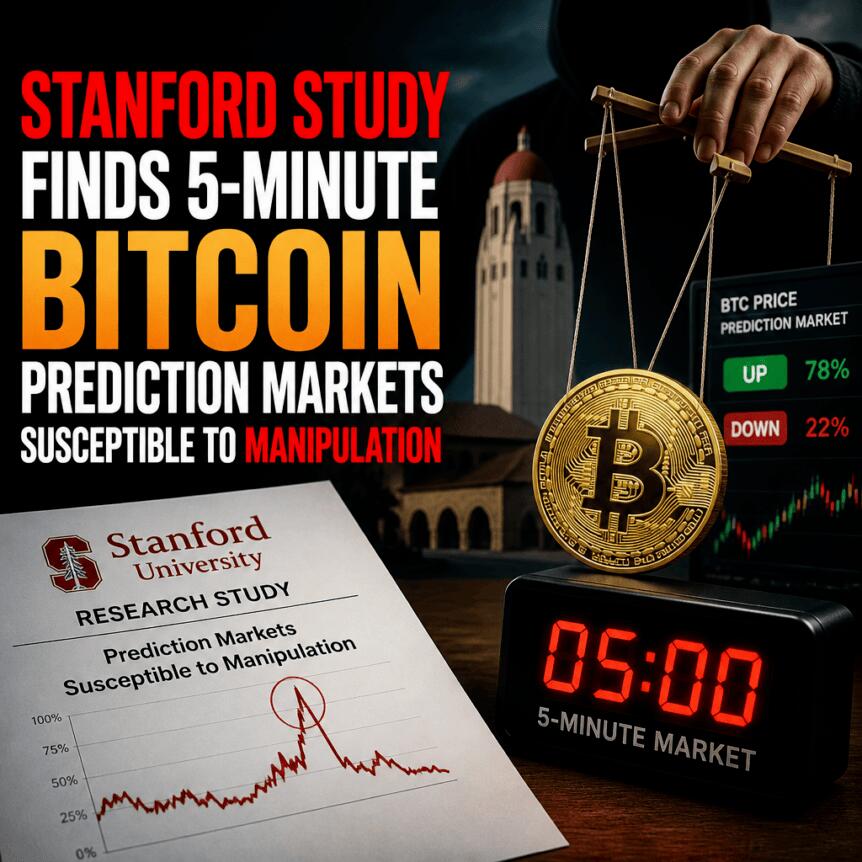
Prediction markets are attracting mainstream attention—and they’re also raising new questions about how their mechanics can shape market behavior. A new research paper from Stanford University and Singapore Management University argues that Polymarket’s short-horizon Bitcoin contracts can create incentives for sophisticated traders to manipulate spot prices around settlement, at a potential cost to retail participants.
The study focuses on Polymarket wagers that settle after five minutes based on Bitcoin’s price relative to a fixed threshold. Because settlement depends on Chainlink price feeds tied to the end-of-window spot price, the authors say traders can profit by influencing the spot market immediately before the contract resolves.
Key takeaways
- Settlement based on a five-minute spot price can encourage end-of-window price manipulation.
- Researchers observed larger order-flow spikes shortly before settlement and quick price reversals after.
- The paper estimates about $1.28 million may have shifted from ordinary traders to manipulators during the sample period.
- Extending the contract window from five minutes to 15 minutes significantly reduced the effect.
- The findings highlight why contract design matters, not just whether prediction markets exist.
How five-minute Bitcoin contracts can change incentives
The paper analyzes Polymarket contracts where traders bet whether Bitcoin’s price will finish above or below a predetermined level after five minutes. Settlement is determined using Chainlink price feeds that reflect the Bitcoin price at the end of each trading window.
According to the researchers, this structure can produce a specific incentive: if the settlement price effectively “locks in” at the end of a short period, participants have a reason to influence market conditions right before that moment. In short-horizon settings, even small price moves can determine outcomes, making it easier for sophisticated traders to attempt to steer the spot price toward a preferred settlement level.
What the researchers found in Polymarket activity
To test the claim, the authors compared trading activity before and after Polymarket introduced these five-minute Bitcoin contracts in July 2024. They report sharp increases in Bitcoin spot-market order flow just before settlement, followed by rapid price reversals.
The paper interprets this pattern as consistent with settlement-price manipulation: order-flow concentrates near the settlement boundary, and spot prices then unwind quickly after resolution—suggesting the pre-settlement movement may not persist beyond the contract’s settlement point.
Quantitatively, the study estimates the behavior transferred approximately $1.28 million from ordinary traders to manipulators during the sampled period. The researchers also argue that the mechanism is sensitive to the timing of settlement: when contract durations were extended from five minutes to 15 minutes, the manipulation effect was largely eliminated.
Manipulation isn’t “inherent”—settlement design may be the lever
A central point of the paper is that its results do not imply prediction markets are intrinsically vulnerable to manipulation. Instead, the authors argue that design choices—particularly how settlement prices are produced—can materially affect the risk.
Beyond lengthening contract windows, the researchers point to alternative settlement methods that could reduce incentives to tamper with the precise end-of-window price. They specifically mention approaches such as using time-weighted average prices (TWAP) rather than a single end-point spot price, which would make it harder to profit from last-moment spot moves.
For market participants, the practical takeaway is straightforward: the shorter the window and the more settlement hinges on an exact spot read at a specific timestamp, the greater the potential payoff to short-term steering. Conversely, smoother pricing references and longer resolution horizons can dampen that incentive structure.
Broader implications as prediction markets expand
The paper’s relevance may extend beyond crypto-native venues. It notes that traditional trading venues have proposed “event contracts” tied to asset prices—signaling that settlement mechanics will matter even as prediction markets move into more regulated environments.
That expansion is already happening alongside intense legal scrutiny in the United States. Cointelegraph previously reported that several US states have challenged prediction-market companies including Kalshi and Polymarket, while the Commodity Futures Trading Commission has argued that federally regulated event contracts fall under its “exclusive jurisdiction” rather than state gambling laws. The dispute is now moving through federal courts, with observers noting that conflicting appellate decisions could ultimately lead to a role for the US Supreme Court in determining whether states or the CFTC have primary authority.
At the same time, activity continues to grow. Prediction markets recorded record trading volumes in June, fueled by the expanded 2026 FIFA World Cup. According to DefiLlama data cited in the original reporting, Kalshi processed about $9.4 billion in trading volume during June, while Polymarket International handled roughly $4.3 billion.
World Cup winner markets have since generated more than $5.4 billion in combined trading volume, with Polymarket processing about $4.25 billion and Kalshi about $1.2 billion, based on data from the platforms at the time of writing.
As market interest accelerates—especially in short-duration contracts—the paper’s message becomes more urgent: regulators and designers may need to focus on settlement architecture, not just on categorizing whether prediction markets should be permitted.
For traders and builders, the next thing to watch is whether venues adjust contract durations, adopt averaging-based settlement (like TWAP), or otherwise change pricing feeds to reduce manipulation incentives—particularly as more prediction markets emerge with quickly resolving, price-linked settlement rules.

The United States has frozen more than $130 million in crypto assets linked to Iran as hostilities in the Middle East continue to intensify.
US Treasury Secretary Scott Bessent took to X to confirm that the Treasury Department’s Office of Foreign Assets Control (OFAC) sanctioned multiple crypto wallets tied to the Central Bank of Iran.
Escalating Hostilities
Bessent said the action is part of the Treasury’s broader effort to disrupt and degrade Iran’s illicit financial activities. He added,
“We will continue to aggressively follow the money and deny the Iranian regime access to the proceeds of its illicit revenue schemes.”
In a separate post, blockchain investigator Specter reported that stablecoin issuer Tether froze four TRON wallets holding approximately $131 million in USDT. According to Specter, most of the funds in those wallets were traced to withdrawals from payment service provider DTC Pay and crypto exchange Bitso before being frozen. Specter later said the wallets are linked to OFAC-sanctioned entities, including the Islamic Revolutionary Guard Corps (IRGC) and the Central Bank of the Islamic Republic of Iran (Bank Markazi Jomhouri Islami Iran).
The enforcement action comes as the situation between the US and Iran has significantly deteriorated following the collapse of their ceasefire. The US military said it has reimposed its naval blockade of Iranian ports after previously enforcing it between April and June. The development came as US forces carried out a fourth consecutive day of strikes on Iranian targets. Meanwhile, Iran’s army said it launched drone attacks on Jordan’s Al-Azraq military base as part of the seventh phase of “Operation Lightning.”
According to a statement carried by the state-run Islamic Republic of Iran Broadcasting (IRIB), the operation targeted facilities including locations housing F-18 fighter jets, accommodation buildings, and a large equipment shed. The latest military actions coincided with renewed warnings from Donald Trump, who said in a television interview that the US would target bridges and power plants next week unless Tehran returns to the negotiating table.
Crypto Crackdown on Iran
The latest freeze comes just months after another major crackdown. In April, Tether froze more than $344 million in USDT at the request of US authorities.
The US Treasury also sanctioned Iran’s largest crypto exchange, Nobitex, along with Wallex, Bitpin, and Ramzinex, as part of the Trump administration’s Economic Fury campaign last month. US officials alleged that the exchanges helped Iran evade sanctions, process transactions linked to the Islamic Revolutionary Guard Corps (IRGC), and move funds through digital assets.
Treasury also claimed Nobitex handled more than half of Iran’s crypto inflows in 2025 and helped the Central Bank of Iran access hundreds of millions of dollars in stablecoins.
The post Iran-Linked Crypto Hit With $131M Freeze Amid Renewed US Military Campaign appeared first on CryptoPotato.


A sitting US president is set to appear on an American coin for the first time in 100 years. Treasury Secretary Scott Bessent said Wednesday that the US Mint will begin producing a $1 gold coin featuring President Donald Trump. The coin will mark 250 years since American independence.
The Treasury and US Mint have not yet said when the coin will go on sale. They have also not announced its price or how many coins will be produced.
What the Trump Gold Coin Design Shows
Bessent shared the design on X. The obverse pairs a portrait of President Donald Trump with the inscriptions “Liberty,” “In God We Trust,” and “1776-2026.” The reverse carries the Great Seal of the United States with a heraldic eagle.
The artwork has a longer history than Wednesday’s reveal suggests. US Treasurer Brandon Beach confirmed the first drafts in October 2025. One early reverse showed Trump raising his fist beside the words “FIGHT, FIGHT, FIGHT.” The final design drops that image of the eagle.
The $1 piece is also distinct from a separate 24-karat gold commemorative approved in March.
Trump appointed the approving panel, the US Commission of Fine Arts, earlier this year. That coin depicts Trump leaning on a desk and will be limited to a run of potentially three inches wide.
Legal Questions Over a Sitting President on US Currency
An 1866 law bars living people from appearing on US currency. Only one president has appeared on a coin while in office. Calvin Coolidge shared the 1926 half dollar with George Washington, a coin Congress authorized to help fund Philadelphia’s Sesquicentennial Exposition.
The administration leans on the Circulating Collectible Coin Redesign Act of 2020. Trump signed the bipartisan law on January 13, 2021, one week before leaving office. It lets the Treasury mint $1 coins with Semiquincentennial designs, but only during 2026.
The same statute bars any portrait of a person, living or dead, on the reverse of covered coins. The new design sidesteps that clause by placing Trump on the obverse and the eagle on the back. Legal experts have pointed to the clause and to the 1866 ban in questioning the coin’s legality.
Treasury officials have made no secret of the intent behind the design.
“As we approach our 250th birthday, we are thrilled to prepare coins that represent the enduring spirit of our country and democracy, and there is no profile more emblematic for the front of such coins than that of our serving President, Donald J. Trump,” said Beach.
Follow us on X to get the latest news as it happens
Opponents see the coin differently. They argue it politicizes currency and breaks with tradition. The coin adds to a string of recent Trump policy moves that have divided markets and lawmakers this month.
What Collectors Should Watch Next
The statute treats the coins as legal tender and authorizes proof and uncirculated versions. It also directs the Federal Reserve and Treasury to keep supplies available for commerce and collectors. However, the Mint has not confirmed mintage, pricing, or a release date.
The issuance window itself is narrow. The law permits these dollars only during 2026, with designs reverting in 2027. That built-in time limit will cap supply regardless of the mintage of the Mint sets. Federal law also bars the sale of any of the coins at a net cost to the government.
The reveal lands weeks after Bessent showed a $250 bill bearing Trump’s image. On the same day as the coin announcement, his Treasury also froze Iranian crypto assets worth over $130 million.
Trump’s likeness already circulates in digital assets, where his meme coin faces scrutiny in Congress after a reported $636 million windfall. Physical gold, by contrast, lagged US stocks as a hedge during this year’s US-Iran conflict.
Whether the coin becomes pocket change or a low-mintage trophy now rests on those unpublished details. The Mint’s product schedule in the coming weeks should settle the question.
The post Trump’s $1 Gold Coin Is Coming for America’s 250th Birthday appeared first on BeInCrypto.


Ostium has halted trading after an exploit tied to a compromised oracle signer key drained nearly $18 million USDC from its liquidity vault, according to blockchain security firm Blockaid.
Summary
- Blockaid linked Ostium’s $18 million exploit to a compromised oracle signer key.
- The attacker drained up to 28% of the protocol’s $63 million liquidity vault.
- Ostium halted trading as investigators probe the oracle-based attack.
Blockaid reported that the attacker gained control of an oracle signer private key, allowing them to bypass the protocol’s verification process and submit future-dated price reports that favored their trades. Using a registered PriceUpKeep forwarder, the attacker repeatedly opened and closed positions through delegated actions, extracting profits without taking genuine market risk.
The security firm said the exploit triggered around 20 trading loops that steadily drained funds from Ostium’s main vault. On-chain records show the attacker withdrew between $11.86 million and $18 million USDC, equal to roughly 28% of the protocol’s $63 million total value locked at the time of the incident. The primary exploit transaction can be verified on Arbiscan.
Ostium, which operates on Arbitrum, offers decentralized perpetual trading for tokenized real-world assets, including equities, commodities, foreign exchange markets and stock indices.
Oracle key compromise enabled repeated profit extraction
Instead of exploiting a flaw in smart contract code, the attacker abused trusted oracle infrastructure after obtaining a valid signer key. According to Blockaid, the manipulated oracle reports allowed favorable prices to pass protocol checks, making each trade appear legitimate while transferring losses to the liquidity vault.
The incident has renewed attention on oracle security as decentralized finance protocols increasingly depend on external data feeds for pricing. Blockaid attributed the exploit to compromised signing credentials rather than a pricing error or market manipulation through normal trading activity.
The protocol has since paused trading while the investigation continues. Users have been advised to follow Ostium’s official communication channels for updates on withdrawals and any further recovery measures.
Institutional backing failed to prevent another security setback
Before the exploit, Ostium had raised about $27.8 million from investors including General Catalyst, Jump Crypto, Coinbase Ventures, Wintermute and GSR. The incident occurred despite the project’s institutional backing and multiple security audits, highlighting that infrastructure outside audited smart contracts can still become a critical point of failure.
The attack also adds to a series of recent security incidents affecting crypto platforms. Earlier this month, crypto.news reported that Ctrl Wallet announced it would permanently shut down after a separate security exploit affecting some Cardano wallets.
The company gave users until Aug. 3 to move their crypto assets before wallet functions, including sending, receiving and swapping, are disabled, leaving only recovery phrase exports available.
Elsewhere in the Arbitrum ecosystem, Secret Network recently proposed migrating its SCRT token from Cosmos to Arbitrum, citing security concerns, weaker liquidity and aging code on its current network. The proposal includes a one-time Sept. 1 snapshot that would distribute a new ERC-20 SCRT token on Arbitrum to eligible native and staked SCRT holders.
As projects continue expanding onto Arbitrum, the Ostium exploit demonstrates that securing oracle infrastructure remains as important as auditing smart contracts. According to Blockaid’s findings, a single compromised signer key was enough to bypass trusted price verification and inflict multimillion-dollar losses within hours.
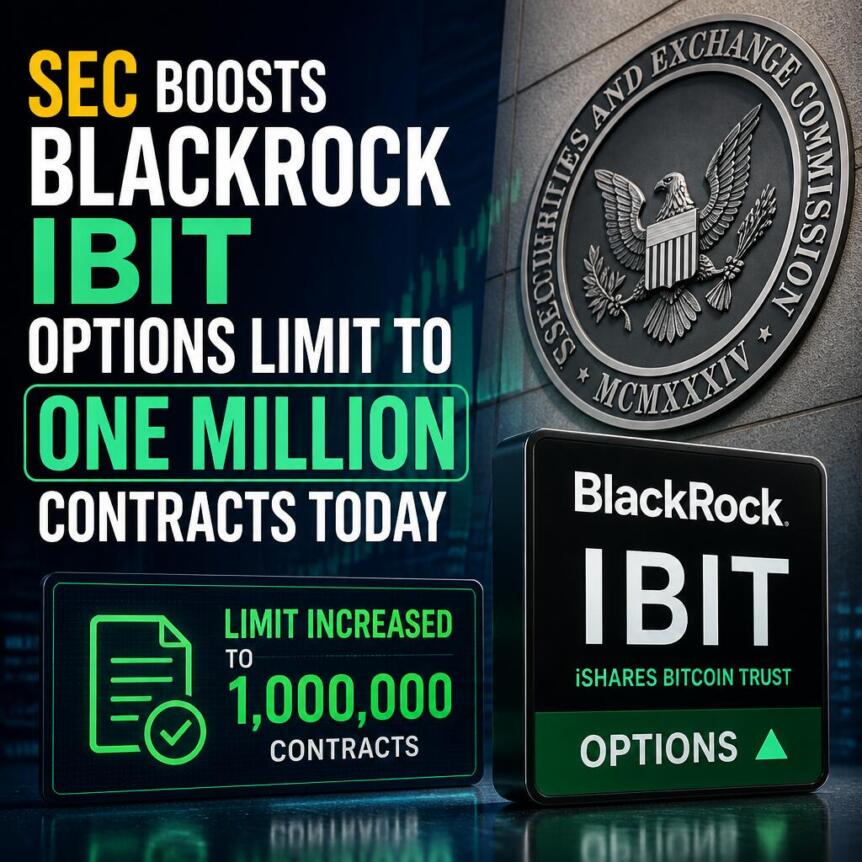
The US Securities and Exchange Commission approved a rule change that expands options limits for BlackRock’s Bitcoin ETF, IBIT. The decision raises the contract limit from 250,000 to one million contracts. Consequently, the change supports growing trading activity and strengthens the Bitcoin ETF market structure.
US Sec Expands BlackRock Bitcoin ETF Options Capacity
The US Securities and Exchange Commission approved a proposal filed by NYSE Arca for IBIT options. The approval became effective immediately under the existing regulatory framework. Meanwhile, the regulator continues accepting public comments on the rule change.
The updated rule increases position and exercise limits from 250,000 contracts to one million contracts. Therefore, the new threshold reflects stronger trading activity across the BlackRock Bitcoin ETF market. It also aligns the exchange with recent changes adopted by other major options venues.
NYSE Arca submitted the proposal under Section 19(b)(1) of the Securities Exchange Act and Rule 19b-4. The exchange explained that current market conditions justify the expanded contract limit. As a result, the revised cap supports larger trading strategies without reaching previous restrictions.
The exchange also noted continued growth in options activity linked to the iShares Bitcoin Trust ETF. Larger limits provide market participants with greater flexibility during active trading sessions. In addition, market makers can manage positions more efficiently under the revised framework.
Nasdaq ISE, Nasdaq PHLX, and BOX Exchange already support similar position limits for comparable products. Therefore, the latest approval creates greater consistency across regulated options markets. The decision also reflects the continued expansion of exchange-traded Bitcoin investment products.
The BlackRock Bitcoin ETF has recorded strong trading activity since its launch. Its options market has also expanded alongside increasing demand for listed Bitcoin products. Consequently, the updated limits better align with the ETF’s current trading volume and liquidity.
BlackRock Earnings Support Broader Market Momentum
The regulatory approval followed BlackRock’s second-quarter fiscal 2026 earnings announcement. The company reported a 31% year-over-year increase in quarterly revenue. It also announced plans to increase its quarterly share repurchase target to $550 million.
The earnings report highlighted continued business expansion across BlackRock’s investment platform. Strong financial performance added further attention to the firm’s Bitcoin ETF business. Meanwhile, IBIT remained among the firm’s closely followed exchange-traded products.
Higher options limits allow larger institutional trading strategies within existing exchange rules. Consequently, professional market participants can execute broader hedging and portfolio management activities. The expanded capacity also supports more efficient options market operations.
The updated limits may also improve overall liquidity within the BlackRock Bitcoin ETF options market. Better liquidity generally supports tighter pricing and smoother trade execution. Therefore, larger position limits can contribute to stronger market efficiency over time.
The approval also reflects broader development across the regulated digital asset investment sector. Bitcoin ETFs continue attracting significant trading activity across major US exchanges. As a result, exchanges have adjusted market rules to accommodate growing participation.
Bitcoin ETF Market Continues To Mature
The latest decision adds another milestone to the evolution of regulated Bitcoin investment products. Exchange operators have steadily updated trading frameworks as market activity expanded. Consequently, regulatory adjustments now follow increasing demand for listed Bitcoin products.
BlackRock also remained active across broader digital asset initiatives beyond exchange-traded funds. The company recently joined an industry initiative exploring tokenized stocks and US Treasury securities. That effort includes several major financial institutions participating through the DTCC testing program.
Traditional financial firms continue expanding blockchain-related projects alongside regulated investment products. At the same time, digital asset infrastructure continues to develop across multiple market segments. These parallel developments support broader integration between traditional finance and blockchain technology.
The BlackRock Bitcoin ETF has maintained steady market attention, as evidenced by both trading activity and fund flows. Expanding options limits provide additional operational capacity for larger market participants. Therefore, the latest SEC approval strengthens the infrastructure supporting regulated Bitcoin ETF trading.
The approval also demonstrates how exchanges continue adapting existing market rules to changing trading conditions. Growing product adoption has encouraged exchanges to modernize options frameworks for digital asset funds. As a result, the regulated Bitcoin ETF market continues advancing through incremental structural improvements.
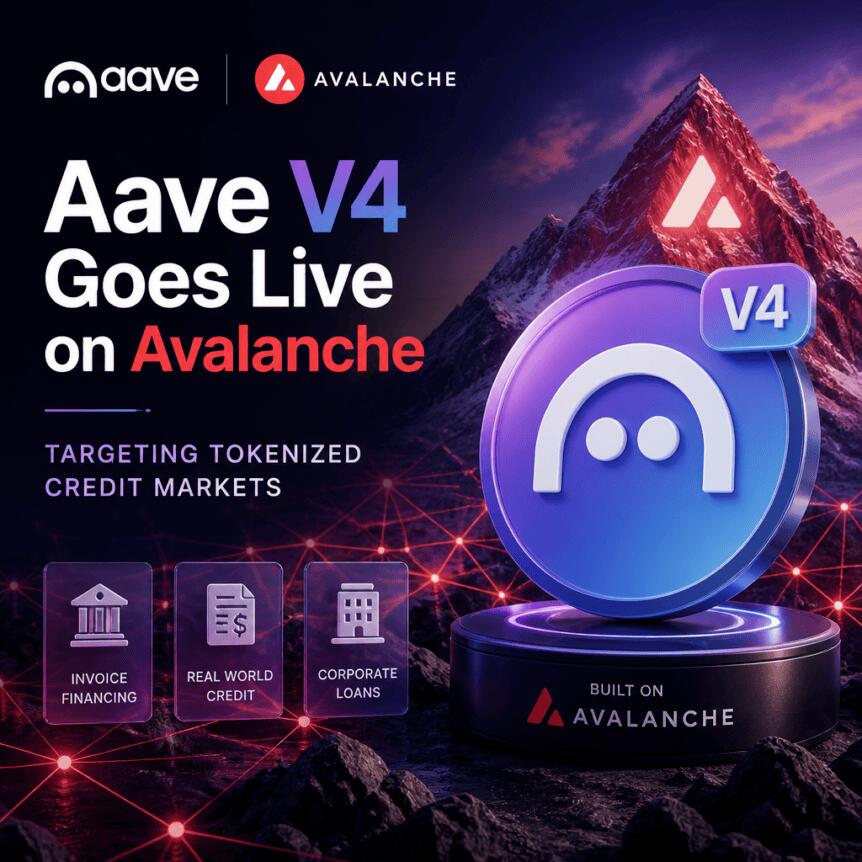
Aave has deployed its V4 lending infrastructure on Avalanche, extending the protocol’s newest market architecture beyond Ethereum for the first time. The move is positioned as a foundation for lending pools that can be tailored to different collateral types—potentially including tokenized real-world assets—while still benefiting from shared liquidity across the Aave network.
Announced as the start of a broader rollout, the Avalanche launch introduces Aave V4’s “Hub & Spoke” model. In this setup, specialized lending markets can set their own collateral requirements and risk parameters, but draw on liquidity routed through Aave’s overarching infrastructure.
Key takeaways
- Aave V4 is now live on Avalanche, representing the protocol’s first expansion of its latest lending framework beyond Ethereum.
- The Hub & Spoke architecture lets new lending markets define custom collateral rules and risk settings without fragmenting liquidity.
- Aave says one of the early Avalanche markets is planned to support borrowing against tokenized assets.
- Aave is the largest decentralized lending protocol by total value locked, with nearly $14 billion across 23 blockchains, per DeFiLlama data.
Why Aave’s Hub & Spoke design matters on Avalanche
The core promise of Aave V4’s Hub & Spoke approach is flexibility: different lending markets can be configured for distinct collateral profiles while remaining connected to a common liquidity backbone. For users, that can mean a wider selection of supported collateral types and potentially more tailored risk controls. For builders and market creators, the model is designed to make it easier to launch specialized credit markets without starting from scratch on liquidity and protocol-level plumbing.
According to Aave, the architecture is intended to support a broader range of collateral than earlier protocol iterations. While Aave has long relied on established DeFi-native assets, the V4 approach is explicitly oriented toward accommodating more complex collateral arrangements—an area that has become increasingly important as tokenized financial assets move closer to mainstream on-chain use.
Tokenized assets as collateral: from concept to configured markets
Aave says that, among the first markets planned on Avalanche, it will support borrowing against tokenized assets. The protocol also indicates that future specialized markets on Avalanche could extend to tokenized categories such as US Treasurys, money market fund shares, private credit, and corporate bonds—each with customized collateral requirements and risk parameters.
That framing reflects a larger shift in the way tokenized real-world assets are being used. Rather than limiting tokenization to settlement or trading, institutions and blockchain infrastructure providers are increasingly focused on collateral use cases—where tokenized holdings can back borrowing and liquidity strategies in both traditional and decentralized finance.
For example, Cointelegraph previously reported that Franklin Templeton partnered with Binance in February to enable institutions to use tokenized money market fund shares as off-exchange collateral, while keeping the underlying assets in regulated custody. In the following month, Nasdaq announced plans to integrate its collateral management tooling with Talos’ digital asset infrastructure to streamline institutional workflows for managing tokenized collateral, combining collateral management, risk monitoring, and trade surveillance.
Other infrastructure firms are also aiming at the “operational layer” required for real-world asset collateral. In May, DTCC said it would integrate Chainlink technology into its tokenized collateral platform to support near real-time movement, valuation, and settlement ahead of a planned launch in the fourth quarter.
A broader institutional push meets DeFi lending demand
Aave’s Avalanche deployment arrives as the institutional ecosystem around tokenized assets keeps expanding. The latest wave is not only about issuance or custody, but about creating systems that can actually support borrowing, valuation updates, and risk controls in a way that financial institutions find usable.
More recently, Grove announced a $500 million warehouse lending facility with Galaxy Digital to finance institutional crypto-backed loans using blockchain-based infrastructure. While not directly tied to Aave V4, the move fits the same direction: institutions are building facilities and partnerships that rely on tokenized or blockchain-based infrastructure for collateral-backed lending.
At the same time, the category of tokenized real-world assets continues to grow. According to RWA.xyz, more than $34 billion worth of real-world assets are currently tokenized on public blockchains, up from about $12.8 billion a year earlier—an expansion that suggests collateral-backed DeFi markets may have more potential counterparties as the supply of tokenized assets increases.
What investors and users should watch next
With V4 now launched on Avalanche, the next questions are less about whether tokenized collateral is possible and more about how quickly specific markets go live and what collateral configuration details look like in practice. Readers should watch for Aave’s early Avalanche market rollout, signals about supported collateral types, and how the Hub & Spoke model performs as more specialized lending pools are introduced.
DeFi lending has historically been constrained by which assets can be supported efficiently and how risk parameters are enforced. Aave V4’s architecture is designed to reduce those barriers—so the key test will be whether tokenized collateral markets can scale with appropriate risk controls without sacrificing liquidity.


BlackRock’s iShares Bitcoin Trust has secured a major regulatory win after the U.S. Securities and Exchange Commission approved a fourfold increase in the ETF’s options position limit from 250,000 to 1 million contracts.
Summary
- SEC has approved raising IBIT options limits from 250,000 to 1 million contracts.
- NYSE Arca says the higher cap matches strong trading demand and improves liquidity.
- The approval comes after BlackRock reported 31% year-over-year revenue growth in Q2.
According to a notice published by the U.S. Securities and Exchange Commission, a rule change submitted by NYSE Arca has become effective immediately, allowing the exchange to raise the position and exercise limits for options linked to the iShares Bitcoin Trust ETF.
The regulator said the filing was made under Section 19(b)(1) of the Securities Exchange Act and Rule 19b-4 while continuing to seek public comments on the proposal.
The approval gives traders access to significantly larger options positions tied to the world’s largest spot Bitcoin ETF by assets. It also arrives as institutional interest in U.S. spot Bitcoin ETFs continues to grow, with IBIT remaining one of the strongest-performing funds in the category over recent months.
NYSE Arca says trading growth justified the increase
NYSE Arca stated in its filing that the previous 250,000-contract limit no longer matched trading activity in IBIT options. The exchange argued that increasing the cap to 1 million contracts would better accommodate current market demand while allowing market makers to manage inventory and hedge positions more effectively.
The exchange also noted that the revised limit is consistent with similar changes already recognized for competing options venues, including Nasdaq ISE, Nasdaq PHLX, and BOX Exchange. By aligning the limits across exchanges, NYSE Arca said participants would be able to trade under a more consistent regulatory framework.
Although the SEC allowed the proposal to take effect immediately, the agency said it will continue accepting public feedback before reaching a final conclusion on the filing.
For institutional investors, the higher ceiling removes a practical restriction that could limit large hedging or trading strategies. According to NYSE Arca’s filing, expanding the available contract limit should support smoother options trading without forcing large participants to divide positions because of exchange-imposed caps.
BlackRock earnings add to positive momentum
The regulatory decision has arrived shortly after BlackRock released its fiscal second-quarter 2026 earnings. The asset manager reported a 31% year-over-year increase in revenue and announced plans to raise its quarterly share repurchase target to $550 million, adding another positive development for the firm’s investment business.
At the same time, IBIT has remained in focus after recording strong investor inflows over the past week, reinforcing its position as one of the largest spot Bitcoin exchange-traded funds in the U.S. market.
BlackRock has also expanded its presence beyond crypto ETFs. Earlier this week, the firm joined the Depository Trust & Clearing Corporation tokenization pilot alongside JPMorgan Chase and Goldman Sachs to explore blockchain-based settlement for stocks and U.S. Treasuries.
While traditional exchanges continue expanding Bitcoin ETF derivatives, tokenized equity trading is also gaining traction on blockchain-based platforms, giving crypto investors additional ways to access equity exposure.
The SEC’s latest approval applies specifically to regulated options listed on NYSE Arca and does not affect trading rules for tokenized securities.

Drunk lorry driver six times over limit spotted weaving across lanes on busy A-road

Trump’s image set for new $1 gold coin celebrating America’s 250th anniversary

Is Robinhood Chain’s Success Bullish or Bearish for ETH?

No Jackpot Winner as $257 Million Prize Rolls Over to $269 Million Monday Draw

Renter of Home in Anne Heche Crash Denies Settlement With Son

Weekend Open Thread: Staud – Corporette.com

Powerful Money Prayer | Pray for Financial Miracle, Debt Freedom & Unexpected Blessings

Financial freedom start kahan se karein?Beginner roadmap in #finance #financialfreedom #moneymindset

CI BECCANO MANGIARE AL SUPERMERCATO #streamhouse #money #teknoyd #memes #troll #ussa
-

 Fashion6 days ago
Loro Piana Fall 2026 Enters Houston’s Art Scene
-

 Fashion5 days ago
Weekend Open Thread: Nutriplenish Leave-In Conditioner
-
 Sports6 days ago
2026 Genesis Scottish Open Thursday TV coverage: Round 1
-

 Sports6 days ago
Super Eagles star Moses Simon opens up on Liverpool transfer regret
-

 Tech6 days ago
Character.AI enters the microdrama arena with its own productions, but there’s a twist
-

 Politics9 hours ago
Young campaigners urge incoming PM to act on outdoor junk food ads
-

 News Videos1 day ago
XRP BOMBSHELL… XRP OMBOARDED FOR TRANSACTIONS!!!
-

 Tech2 days ago
Get Your ESP32 Sunny Side Up With This Solar Dev Board
-

 Tech1 day ago
Dark Secrets Emerge When Jailbreaking LLMs
-

 News Videos7 days ago
Crypto Just Entered Its Most Important 6-Month Candle (Could Decide Everything!)
-

 Tech6 days ago
Level Infinite Launches Gangstar Mirage City in India with Pre-Registrations
-
 NewsBeat6 days ago
Major update after Huntingdon train attack as man enters plea
-

 News Videos2 days ago
how to make coin bank box with cardboard #scienceproject #money #diy #shorts
-
 Entertainment4 hours ago
Disney’s Most Ambitious Failed Star Wars Attraction Is Coming to SDCC
-
 Tech2 days ago
Cloudflare Precursor Watches Your Mouse and Keyboard To Decide If You Are Human
-

 Tech7 days ago
Entra passkey enrollment vishing targets Microsoft 365 users
-
 Entertainment3 hours ago
Vicki Gunvalson Defends Discussing Heather Dubrow’s Money
-
 Crypto World7 days ago
DeFi Dashboard Zapper to Shut Down After 7 Years
-
Crypto World1 day ago
Ripple, Coinbase, Circle Join Linux x402 Foundation to Help Shape AI Payments
-
 Crypto World7 days ago
Mark Cuban-Backed DeFi Dashboard Zapper Shuts Down After 7 Years
You must be logged in to post a comment Login