
Crypto World
XRP Price Prediction: Ripple Leads Crypto Inflows as Market Recovers

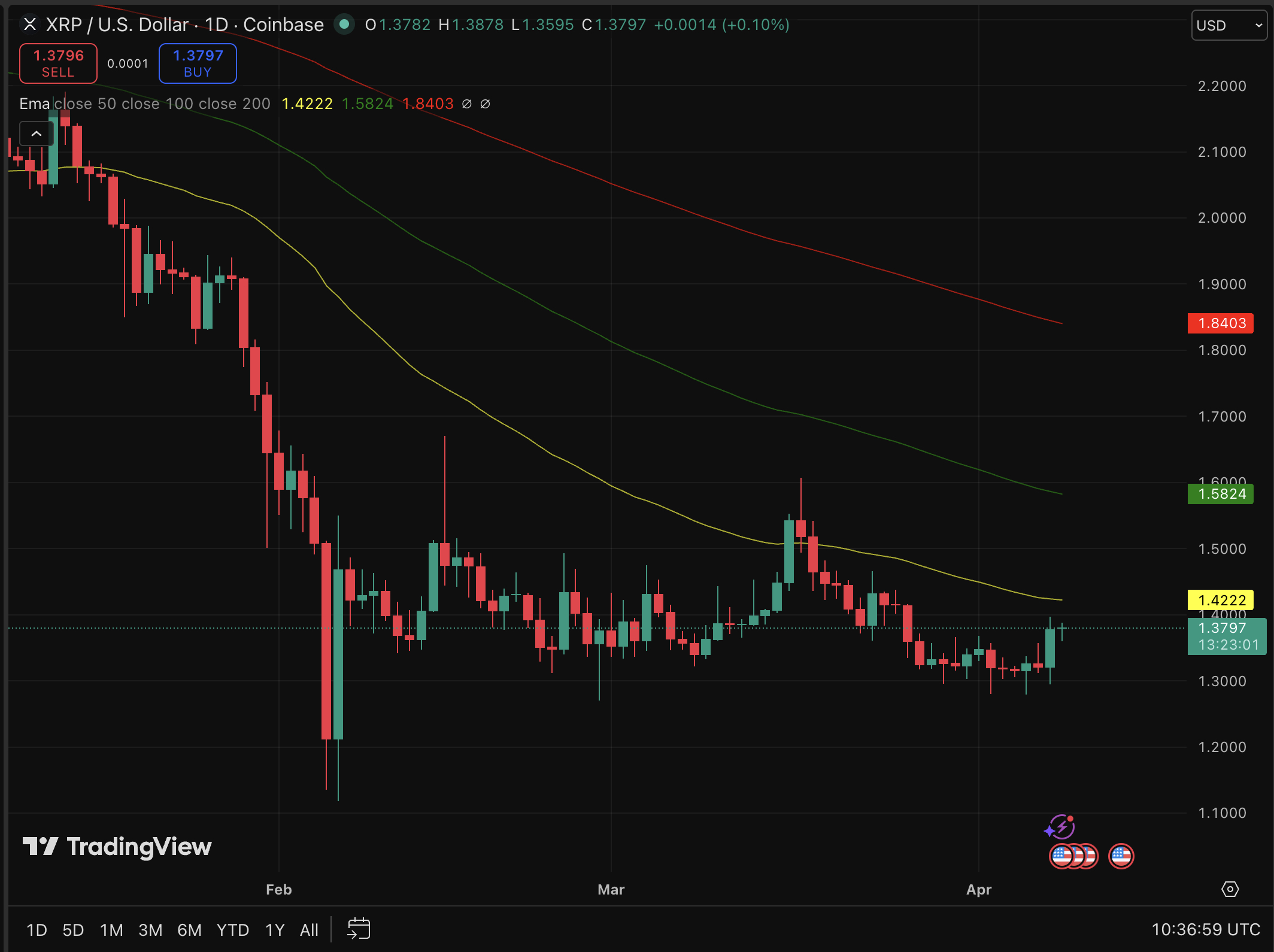
Institutional money is rotating back in, and XRP is leading the rallies. XRP recorded $119.6 million in weekly fund inflows for the period ending last week, its strongest weekly haul since mid-December 2025, which occurred when XRP price prediction was running at rock bottom.
That single figure puts XRP ahead of every other digital asset for the week, including Bitcoin. The broader crypto market pulled in $224 million total, reversing a stretch of notable outflows and signaling a clear sentiment shift among institutional allocators.
Regulatory clarity and XRP’s entrenched position in cross-border payment infrastructure appear to be the twin catalysts. With macro conditions still turbulent, the price setup deserves a closer look.
Discover: The best crypto to diversify your portfolio with
XRP Price Prediction: $2.00 Before Year-End?
XRP’s 4.6–5.0% daily gain lands it at the $1.37–$1.38 range, but the technical picture remains cautious. The asset is holding above its short-term 10-day and 20-day exponential moving averages, a tentative green flag.
The problem? It still trades below the 50-, 100-, and 200-day EMAs, keeping the broader trend firmly in bearish territory. The 14-day RSI sits at 39.43, neutral but leaning toward oversold, which historically creates room for further upside before momentum stalls.
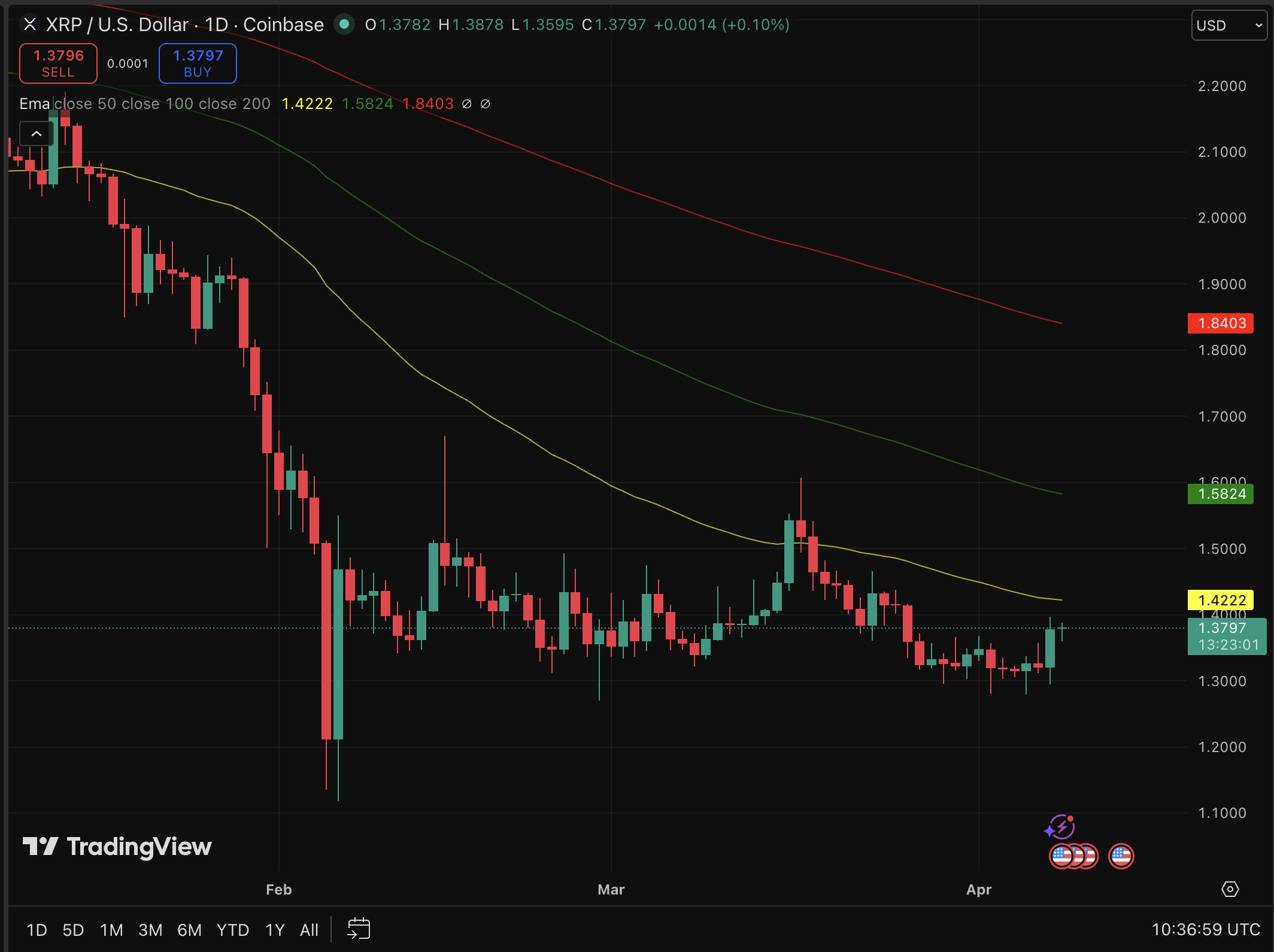
Support levels are stacked at $1.31, $1.29, and $1.27, with resistance clustered at $1.4, the exact range XRP is currently testing. A clean breakout above $1.38 with volume would open the door toward $1.50 and potentially $1.70 on a momentum extension.
The inflow data is bullish. The chart structure is still mending. Those two realities coexist, and neither cancels the other out.
Discover: The best pre-launch token sales
Bitcoin Hyper Targets Early Mover Upside as XRP Tests Key Resistance
XRP’s 50% projected upside is compelling, but at a $84B+ market cap, the runway to 10x returns requires a very specific set of conditions to align perfectly. Traders hunting asymmetric early-stage exposure are looking elsewhere without abandoning the Bitcoin ecosystem entirely.
Bitcoin Hyper ($HYPER) is positioned as the first Bitcoin Layer 2 with Solana Virtual Machine (SVM) integration, a combination that delivers sub-second transaction finality while inheriting Bitcoin’s security layer. The project targets Bitcoin’s three structural weaknesses directly: slow transactions, high fees, and the near-total absence of programmability.
The presale has raised $32 million at a current token price of $0.0136, with staking rewards already live for early participants. The Decentralized Canonical Bridge enables direct BTC transfers into the ecosystem, removing friction that has historically limited Bitcoin DeFi adoption.
The post XRP Price Prediction: Ripple Leads Crypto Inflows as Market Recovers appeared first on Cryptonews.


Standard Chartered is planning to reabsorb the client-facing custody operations of Zodia Custody into the digital assets division of its Corporate and Investment Bank (CIB).
The restructuring, which could be announced as early as this month, would leave Zodia operating only as a standalone Software-as-a-Service (SaaS) platform for custody technology, according to Bloomberg sources familiar with the matter.
From Incubation to Independence to Reabsorption
Standard Chartered established Zodia Custody in late 2020 through its innovation arm SC Ventures, alongside Northern Trust.
The custodian later attracted minority investors, including SBI Holdings, National Australia Bank, and Emirates NBD. It now employs around 150 people across seven offices globally.
Zodia had been gaining traction. In January 2026, it became the first custodian to support AUDM, an Australian dollar stablecoin.
The following month, it launched Zodia Switch, enabling clients to swap assets directly within the custody platform without external pre-funding.
However, Standard Chartered launched its own Luxembourg-based digital asset custody last year and rolled out institutional crypto trading separately.
The overlap between parent and subsidiary made a restructuring likely.
It remains unclear whether Standard Chartered has consulted Zodia’s minority shareholders.
Banks Are Pulling Custody In-House
The digital asset custody market currently exceeds $1 trillion and is projected to reach $7 trillion by 2035 at a compound annual growth rate of roughly 23.7%.
According to the 2026 EY-Parthenon survey, 73% of institutional investors plan to increase digital asset allocations this year.
That growing demand is pulling banks deeper into direct custody. State Street and BNY Mellon have scaled internal digital custody divisions.
Morgan Stanley filed for a dedicated national trust bank charter in February to custody and stake crypto assets under federal supervision.
Analysts see the restructuring as a turning point, with some arguing that when a Tier-1 global bank moves crypto custody into its investment bank, it stops being a contest between crypto and TradFi and becomes crypto embedded inside TradFi.
Zodia was originally built as a standalone vehicle to test the waters safely, and its reabsorption only happens when the parent sees digital assets as real, fee-generating capital markets business.
Meanwhile, others suggest a wider pattern of traditional banks pulling digital asset functions from experimental ventures into core regulated operations, noting that running parallel services was simply inefficient.
“…The suits finally realized running the same thing twice is inefficient. Revolutionary,” one user stated.
What This Says About Crypto Custody Independence
The answer appears increasingly clear. Independence for bank-backed custodians served a specific purpose during the experimental phase of 2020-2023, when regulatory uncertainty made arm’s-length structures necessary.
Now that frameworks like MiCA in Europe and the GENIUS Act in the US have reduced that friction, banks no longer need buffer entities to engage with digital assets.
“This mirrors a wider trend of traditional banks pulling digital asset functions from experimental ventures into core regulated ops – driven by frameworks like MiCA and VARA,” the user added.
Zodia’s hybrid outcome is telling. The technology retains standalone value as SaaS, but the actual safekeeping of client assets, the highest-trust and highest-margin piece of the value chain, moves back onto the parent bank’s books.
That distinction reveals what banks truly want to own versus what they are willing to license out.
Crypto-native custodians like Coinbase Custody, BitGo, and Fireblocks still hold nearly half the global market.
Can they defend that share against a banking sector now determined to bring custody in-house?
The post Standard Chartered is Taking Over Full Crypto Custody Platform Zodia appeared first on BeInCrypto.
The Federal Deposit Insurance Corporation a proposed rule that would establish a framework for stablecoin issuers supervised by the FDIC.
The Federal Deposit Insurance Corporation proposed new rules on Tuesday to oversee stablecoins issued through the banking system under the GENIUS Act. The FDIC board of directors voted to advance the proposal, which sets parameters for how stablecoins may be issued and managed by regulated depository institutions.
The proposal represents the FDIC’s formal regulatory framework for stablecoin operations within the traditional banking sector. Details on specific requirements and implementation timelines were included in the Tuesday statement.
Sources: FDIC
This article was generated automatically by The Defiant’s AI news system from publicly available sources.


Polymarket has acquired Brahma to enhance its DeFi infrastructure and trading performance capabilities.
Polymarket has acquired Brahma, a DeFi infrastructure provider, to strengthen its platform’s trading performance and underlying infrastructure. The acquisition was announced on April 8, 2026, and aims to bolster Polymarket’s capabilities in the decentralized finance ecosystem.
Brahma’s integration into Polymarket is expected to enhance the prediction market platform’s technical infrastructure and user experience. The deal represents continued consolidation in the DeFi sector as platforms seek to improve their competitive positioning.
Source: Polymarket
This article was generated automatically by The Defiant’s AI news system from publicly available sources.
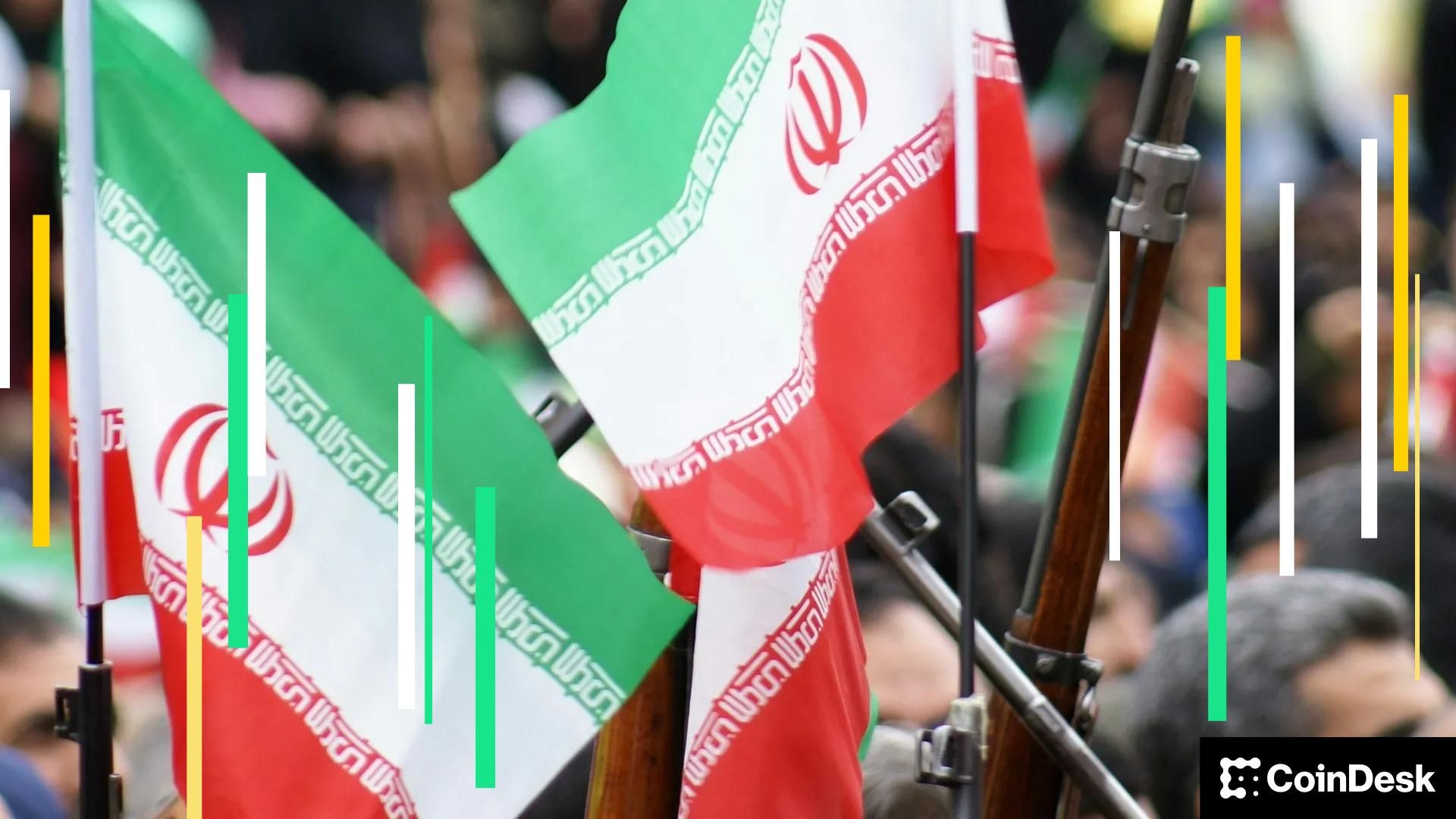
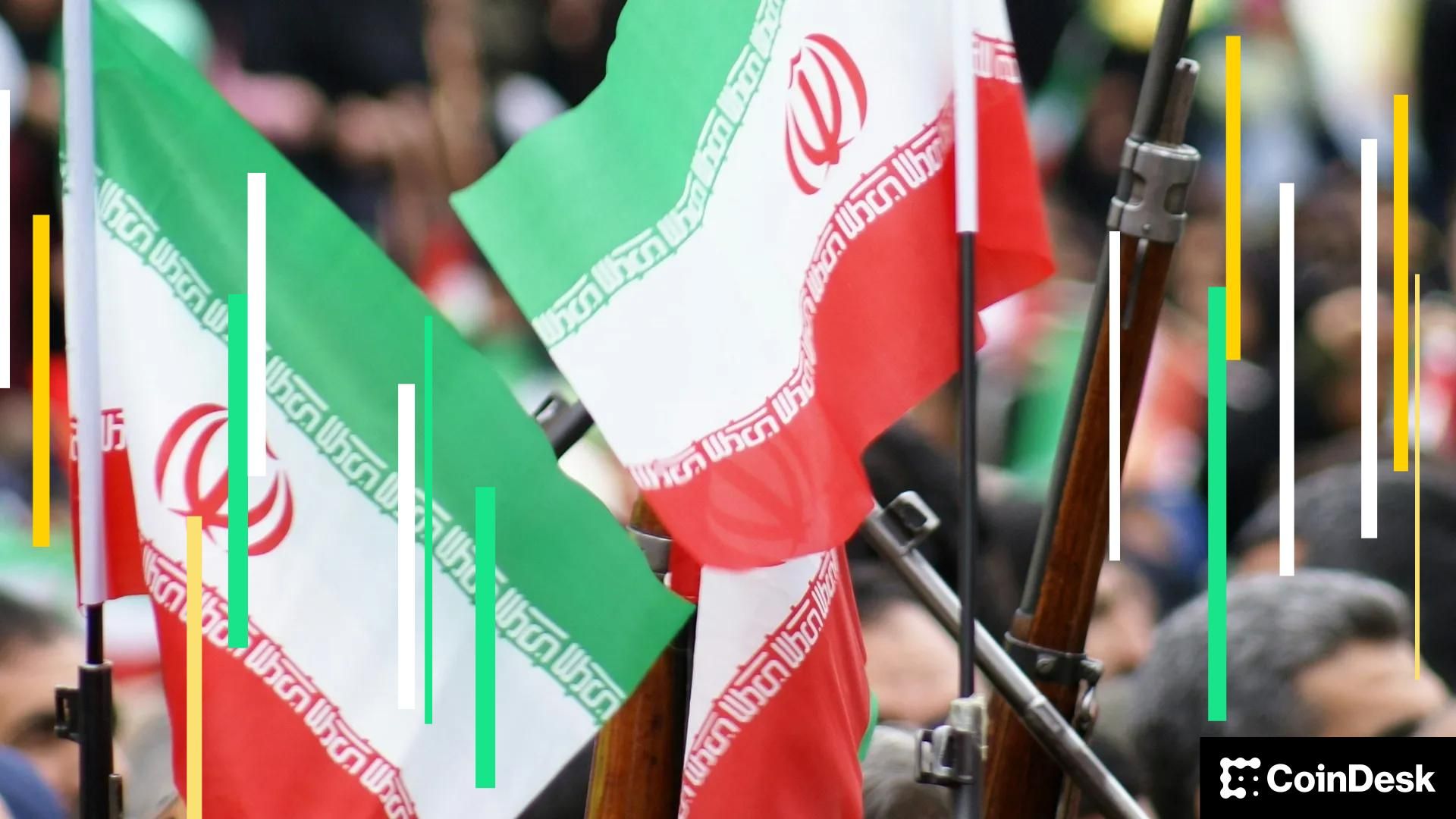
Iran will collect crypto payments as transit fees from oil tankers passing through the Strait of Hormuz during the two‑week ceasefire with the U.S., an industry official told FT.
Hamid Hosseini, spokesperson for Iran’s Oil, Gas and Petrochemical Products Exporters’ Union, said that crypto-denominated tolls will be charged for fully loaded vessels as the nation seeks to “monitor what goes in and out of the strait to ensure these two weeks aren’t used for transferring weapons.”
Hosseini’s comments signal Tehran’s willingness to use cryptocurrency for toll payments, highlighting the expanding real‑world use cases of digital assets in high-stakes geopolitical developments.
This isn’t new — nations at odds with the U.S. or its allies have long turned to crypto as a way to bypass traditional banking channels that leave a paper trail. Russia has indeed used cryptocurrency as part of broader efforts to evade Western sanctions, and in Iran’s case, Tehran is exploring digital payments as it looks to unlock funds for rebuilding the war-destroyed infrastructure.
The proposed framework will require tankers to notify cargo details to Iranian authorities via email, and the toll will reportedly be calculated at $1 per barrel of oil. Authorities will then instruct on how to settle the fee in digital assets, with officials citing bitcoin as a potential payment method.
Hosseini suggested that empty tankers would transit without charge, but fully laden vessels must comply with the reporting and crypto payment process before being cleared for passage.
“Once the email arrives and Iran completes its assessment, vessels are given a few seconds to pay in Bitcoin, ensuring they can’t be traced or confiscated due to sanctions,” he said.
The comments also indicated Tehran may direct traffic along the northern route of the Strait close to its coastline, a move that could raise questions about whether Western and Gulf‑linked shipping firms are prepared to navigate the risky Iranian waters.
Crypto World
Deposit Flight Concerns Over Stablecoin Yield Are ‘Quantitatively Small’: White House Report
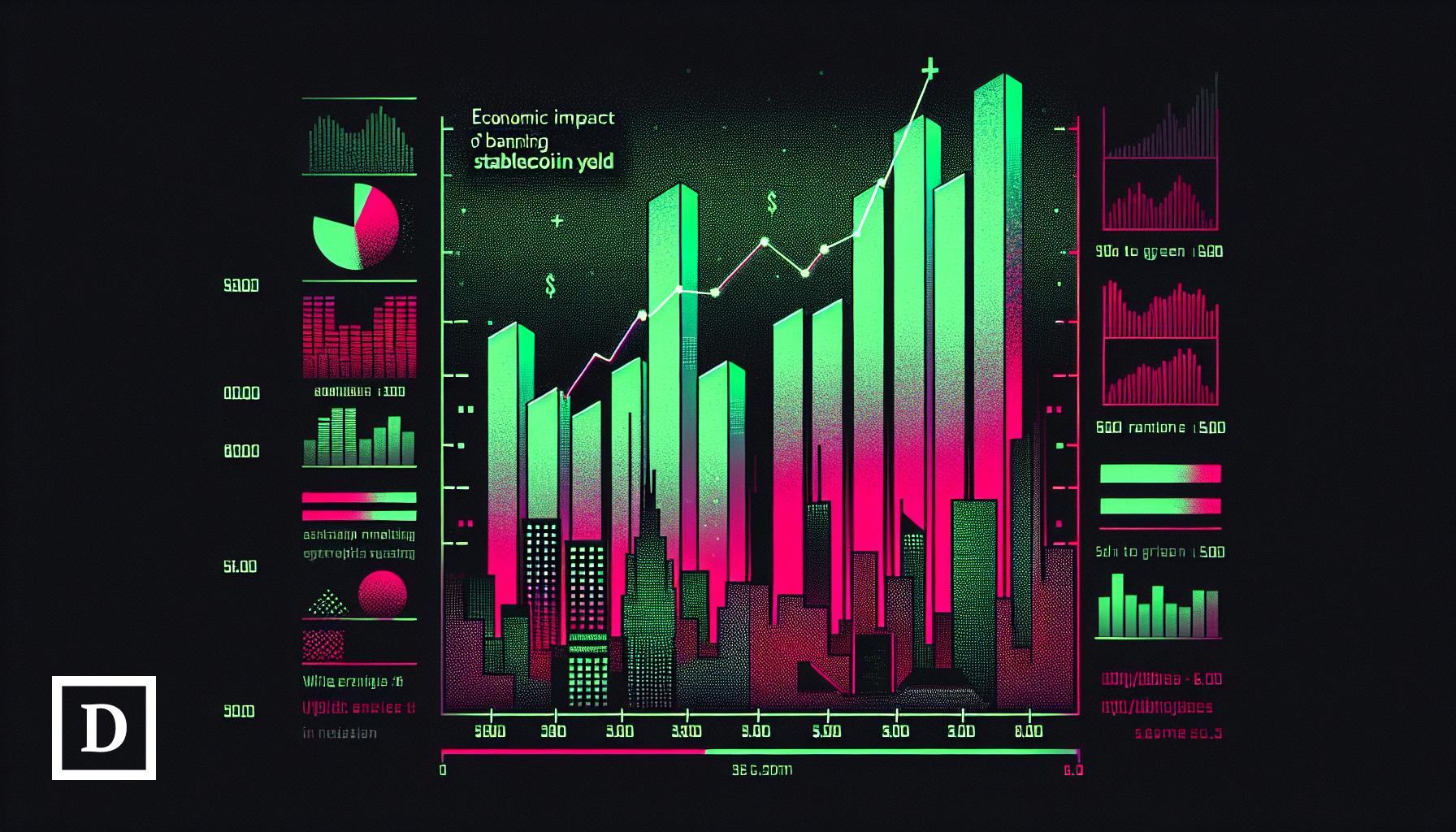
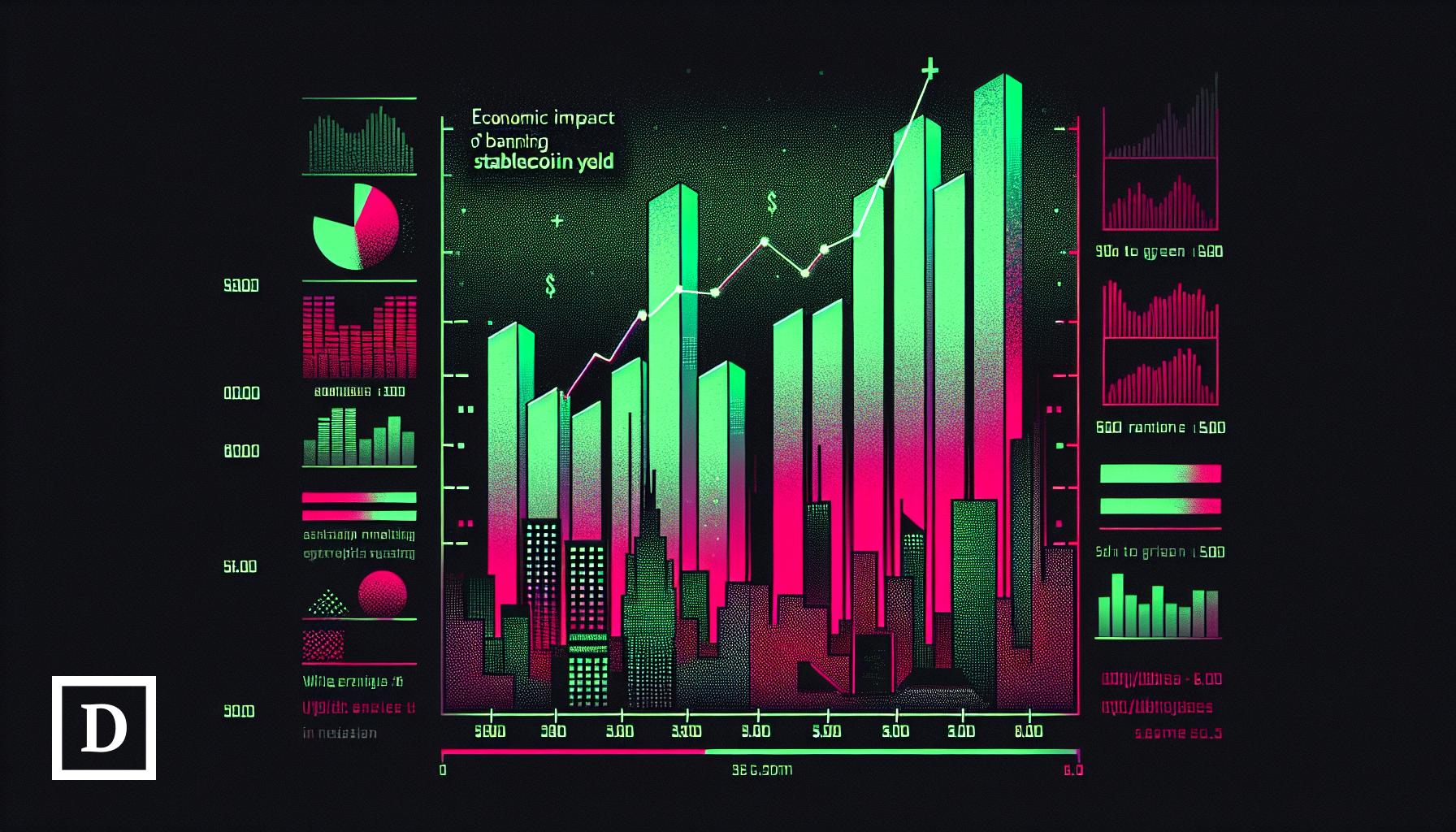
A White House Council of Economic Advisers study released Wednesday concludes that banning stablecoin yield would have minimal impact on bank lending and would harm consumers.
The White House Council of Economic Advisers released a study Wednesday examining stablecoin yield and its impact on deposit flight and bank lending. The report finds that eliminating stablecoin yield would increase bank lending by just 0.02%—approximately $2.1 billion—while resulting in a net welfare loss to consumers. The findings directly contradict concerns from some Senate Banking lawmakers who had pressed the White House to release the report.
The report concludes that deposit flight concerns related to stablecoin yield are “quantitatively small,” noting that most stablecoin reserves remain within the banking system with only a limited share removed from lending activity. The executive summary states: “a yield prohibition would do very little to protect bank lending, while forgoing the consumer benefits of competitive returns on stablecoin holdings.”
Sources: White House
This article was generated automatically by The Defiant’s AI news system from publicly available sources.
Standard Chartered PLC is reportedly seeking to fully acquire Zodia Custody Ltd. to merge it with one of its digital asset divisions, sources close to the matter told Bloomberg on Wednesday.
The ‘restructuring’ plan, which could come as soon as this month, contemplates merging Zodia’s crypto custody business into one of the investment bank’s divisions that provides similar services, the sources told Bloomberg.
The sources also said Standard Chartered is considering allowing Zodia Custody to continue operating as a separate software-as-a-service (SAAS) business for cryptocurrency custody.
The people close to the negotiations, according to Bloomberg, did not clarify whether Standard Chartered has approached Zodia Custody’s minority shareholders, which include Northern Trust Corp., Emirates NBD Bank PJSC, National Australia Bank Ltd. and SBI Holdings Inc.
Emirates NBD and Northern Trust declined to comment, while SBI Holdings and NAB did not immediately respond to requests for comment, Bloomberg wrote.
Standard Chartered told CoinDesk it would not comment on the news of the potential takeover. Zodia did not immediately respond to a request for confirmation.
Standard Chartered has expanded its digital asset footprint in recent years. The bank launched its own digital asset custody services out of Luxembourg in January last year and introduced crypto trading for institutional clients last summer, becoming one of the first global banks to offer spot bitcoin and ether trading.
Banks have ramped up their digital asset activities as regulatory clarity improves in key regions such as the U.S. and Europe. Crypto custody in particular has become a competitive battleground, with firms including State Street, BNY Mellon and Morgan Stanley expanding their presence, with Morgan Stanley recently naming Coinbase and BNY Mellon as custodians for a proposed bitcoin ETF.
Zodia, which was aimed at financial institutions and began custodianship of emeralds in June 2025, raised $18.5 million in a Series A funding round in July of last year to expand and develop its stablecoin payment services.
The firm was originally established in 2020 as a joint venture between Standard Chartered and Northern Trust and has since raised external capital multiple times. Zodia Custody employs around 150 people across seven offices in London, Dublin, Luxembourg, Singapore, the UAE, Sydney and Hong Kong.
Crypto World
Zcash Price Surges Over 30% in 24 Hours as Grayscale Accumulates $46 Million in Shielded ZEC
The Zcash price surged over 30% in 24 hours after the Grayscale Zcash Trust reportedly accumulated approximately $46 million in shielded ZEC, triggering the sharpest single-day rally the privacy coin has seen in weeks and pushing daily trading volume past…
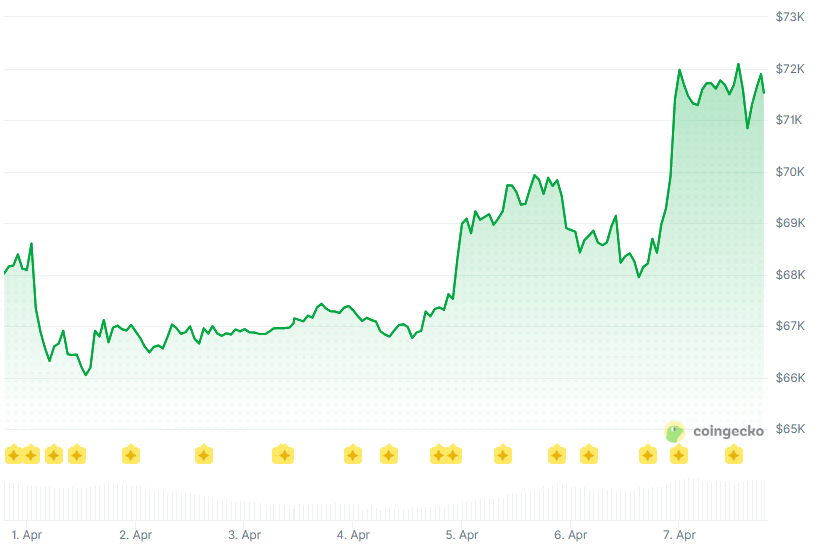
Bitcoin touched a three-week high above $72,700 while $470 million in short positions were liquidated as geopolitical tensions eased.
Crypto markets rallied sharply on Wednesday as a surprise two-week ceasefire between the U.S. and Iran sent Bitcoin to its highest level since mid-March.
Bitcoin is changing hands at $71,638, up 4.3% over the past 24 hours, according to CoinGecko. Ethereum climbed 6% to $2,220, while the total crypto market capitalization rose nearly 4% to $2.51 trillion.

Ceasefire Sparks Short Squeeze
The rally kicked off on Tuesday evening after President Trump announced a conditional two-week ceasefire with Iran, agreeing to suspend military operations for two weeks pending further negotiations. Pakistan’s Prime Minister Shehbaz Sharif brokered the deal, with formal peace talks scheduled to begin Friday in Islamabad.
CoinGlass data showed approximately $654 million in crypto futures positions were liquidated over 24 hours, with bearish short bets accounting for roughly $470 million of the total.
The Crypto Fear and Greed Index recovered to 17, up from a low of 9 earlier in the week, but it remains deep in “extreme fear” territory.
Oil markets moved sharply in the opposite direction. WTI crude dropped to roughly $94 per barrel from Tuesday’s highs above $112, as the ceasefire raised hopes that the Strait of Hormuz would reopen to tanker traffic.
Altcoins Outperform
Altcoins broadly outpaced Bitcoin on the day. Zcash (ZEC) led the charge, surging 23% to $332.
AI-sector tokens also posted strong gains: Render climbed 8% to $2.04, Bittensor’s TAO rose 7% to $332, and NEAR Protocol gained 8% to $1.34. Internet Computer climbed 9% to $2.50.
Among large caps, Avalanche gained 6.5% to $9.19, Sui rose 6% to $0.92, Solana added 5% to $84, and XRP gained 4% to $1.35.
Morgan Stanley Launches Bitcoin ETF
Morgan Stanley’s spot Bitcoin ETF began trading on NYSE Arca on Wednesday under the ticker MSBT, making the bank the first major U.S. institution to issue a spot Bitcoin ETF under its own name.
The fund carries a 0.14% annual fee, undercutting BlackRock’s IBIT at 0.25% and every other spot Bitcoin ETF currently on the market. Coinbase provides BTC custody, while BNY Mellon handles cash custody and administration.
The debut comes on the heels of strong demand for existing ETFs.SoSoValue data showed U.S. spot Bitcoin ETFs pulled in $471 million in net inflows on April 6, the largest single-day intake since late February. Spot Ethereum ETFs attracted $120 million, reversing prior outflows.
Looking Ahead
Despite the sharp bounce, Bitcoin remains trapped in a multi-month range, trading between support at $62,000 and resistance at $75,000 since early February, a range defined largely by the geopolitical overhang from the Iran conflict.
Whether the rally continues depends on the ceasefire’s durability. Iran confirmed the two-week pause but cautioned that reopening the Strait of Hormuz faces “technical limitations” and requires coordination with its military. The country’s Supreme National Security Council stressed the agreement does not imply an end to the broader conflict.


Bitcoin has pulled above $70,000 on news of the Iran ceasefire, but the rally is, for now, fairly cautious.
There may be good reasons for that.
One of the more reliable signals for gauging where bitcoin may be headed comes from tracking margin long positions on Bitfinex. These positions, which reflect bullish bets funded with borrowed capital, still remain elevated at 80,057 BTC, around the highest level in more than two years, according to TradingView data.
The data suggests these long positions are not being unwound despite the price being more than 15% higher since bottoming at $60,000 two months ago. This suggests that, in aggregate, market participants may not view the recent rally as sufficient confirmation that risks have fully subsided.
Historically, Bitfinex margin long positions have functioned as a contrarian indicator. They tend to build during periods of market stress and are reduced as prices rise. For example, long positions were sharply reduced near local bottoms during the yen carry trade unwind in August 2024, when bitcoin fell to $49,000, and again in April 2025 amid tariff tensions under President Trump, when bitcoin dropped to $76,000.
Muted U.S. institutional demand
At the same time, the Coinbase Bitcoin Premium Index is fluctuating between a premium and a discount, pointing to a lack of consistent buying pressure from U.S. investors.
The index, which tracks the price difference between bitcoin on Coinbase and the broader global market, is often used as a proxy for institutional demand.
Its indecisive positioning suggests that U.S. flows are not strongly supporting the rally, raising questions about the move’s sustainability.
Muted rally for crypto stocks
Underscoring the caution, crypto-related stocks are all firmly in the green on Wednesday, but the gains are rather modest given how far they’ve been punished previously.
Among the names: Coinbase (COIN) is up 1.5%, Circle (CRCL) 0.6%, Galaxy Digital (GLXY) 0.6% and Strategy (MSTR) 3%.
Broader risk markets are showing no such caution: the Nasdaq is higher by 2.5% and S&P 500 by 2%.
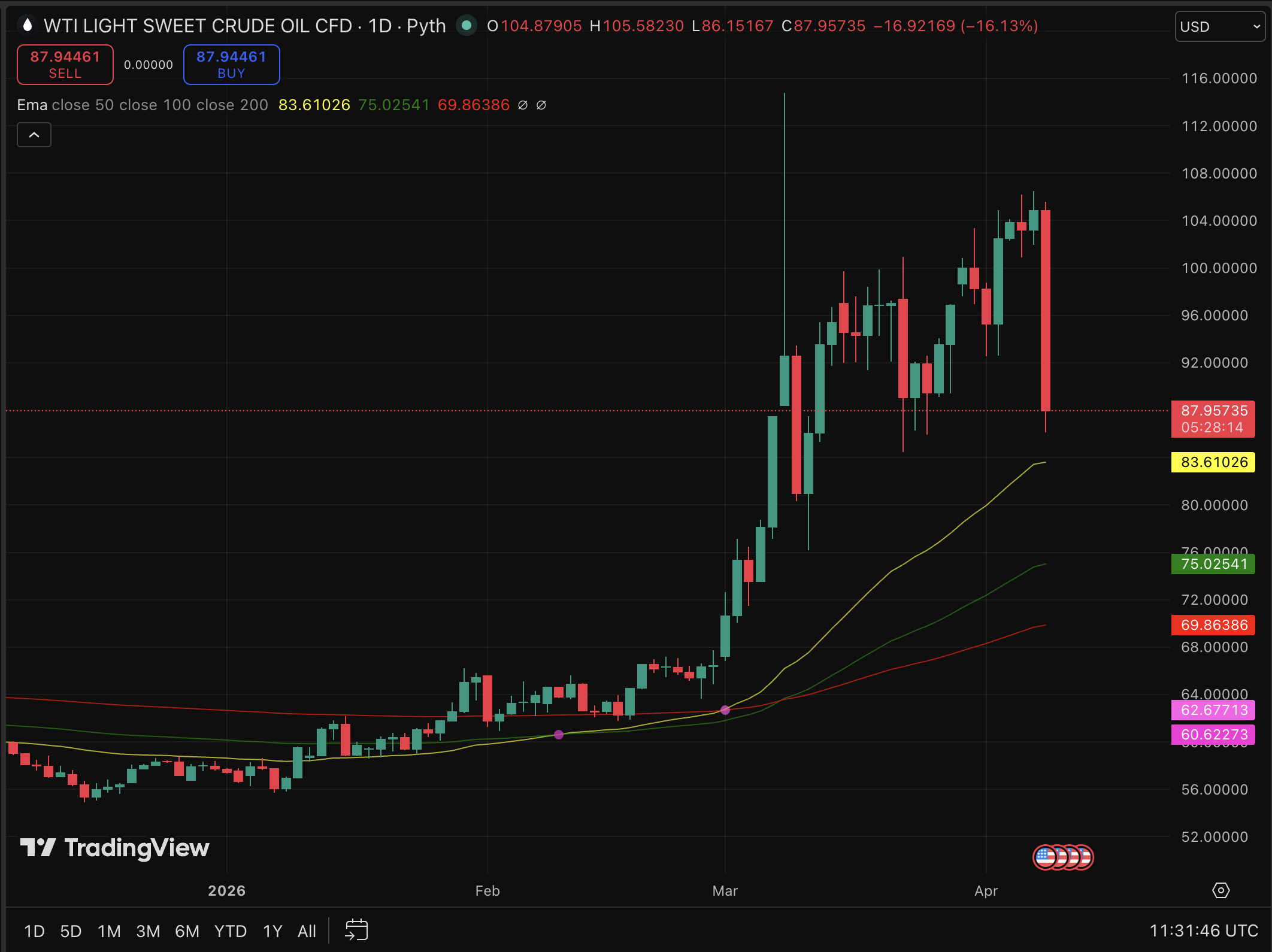
Markets are repricing risk following a ceasefire agreement between the US, Israel, and Iran, and the moves are significant. BTC USD is holding just below $72,000 price level, while gold presses the $4,800 resistance level. One number that matters most is crude oil. It is down over 16% this week and is reshaping macro expectations across every major asset class.
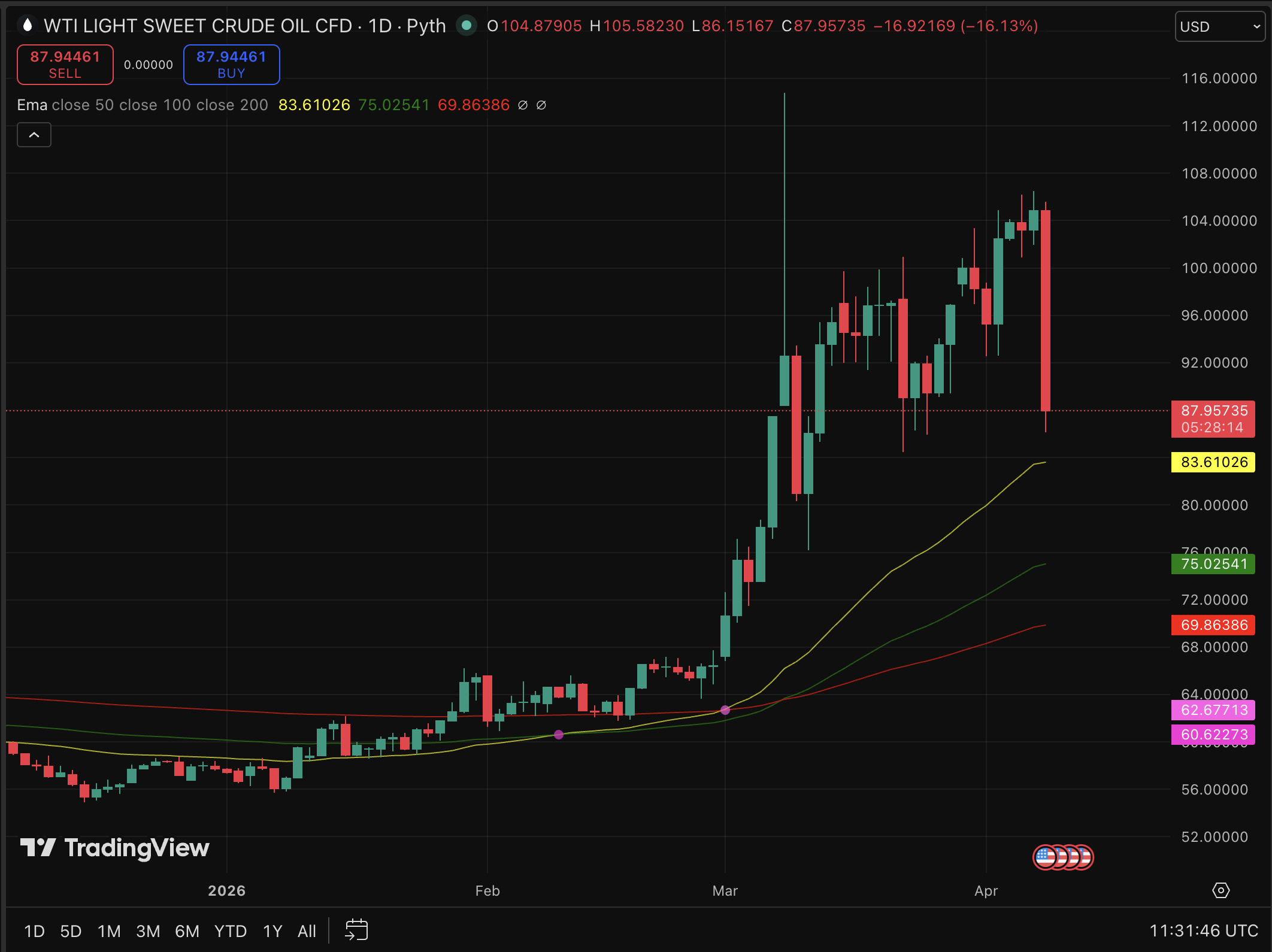
The reopening of the Strait of Hormuz triggered the repricing. Dubai’s Financial Market index spiked as much as 10% at the open, global equities gained over 3%, and the US dollar weakened more than 1%, all within the same session.
The risk premium built into gold and BTC during peak tension is unwinding fast, but unevenly. The pause is real.
Discover: The best pre-launch token sales
Can BTC USD Price Break $75,000 as Geopolitical Risk Unwinds?
Bitcoin is trading below $72,000, capped at a level that has functioned as both psychological resistance and a technical ceiling since the latest escalation cycle began. Volume context is thin, and consolidation patterns on the BTC USD chart suggest the market is waiting for confirmation rather than positioning aggressively in either direction.
— BSCN (@BSCNews) April 7, 2026
 BULLISH: BITCOIN RECLAIMS $70K!
The market seems to be pricing in a ceasefire/extension tonight as oil prices drop and $BTC, $GOLD, and equities rise. pic.twitter.com/SA7VxdR1jz
The $75,000 level is the line to break. Above it, momentum indicators could flip bullish quickly, given how compressed this range has become. Below $68,000, a level that has absorbed selling pressure repeatedly, the broader recovery thesis weakens materially.
Technical analysis on BTC/USD points to structural factors supporting recovery, alongside one clear risk: another leg lower remains possible before any sustained breakout.
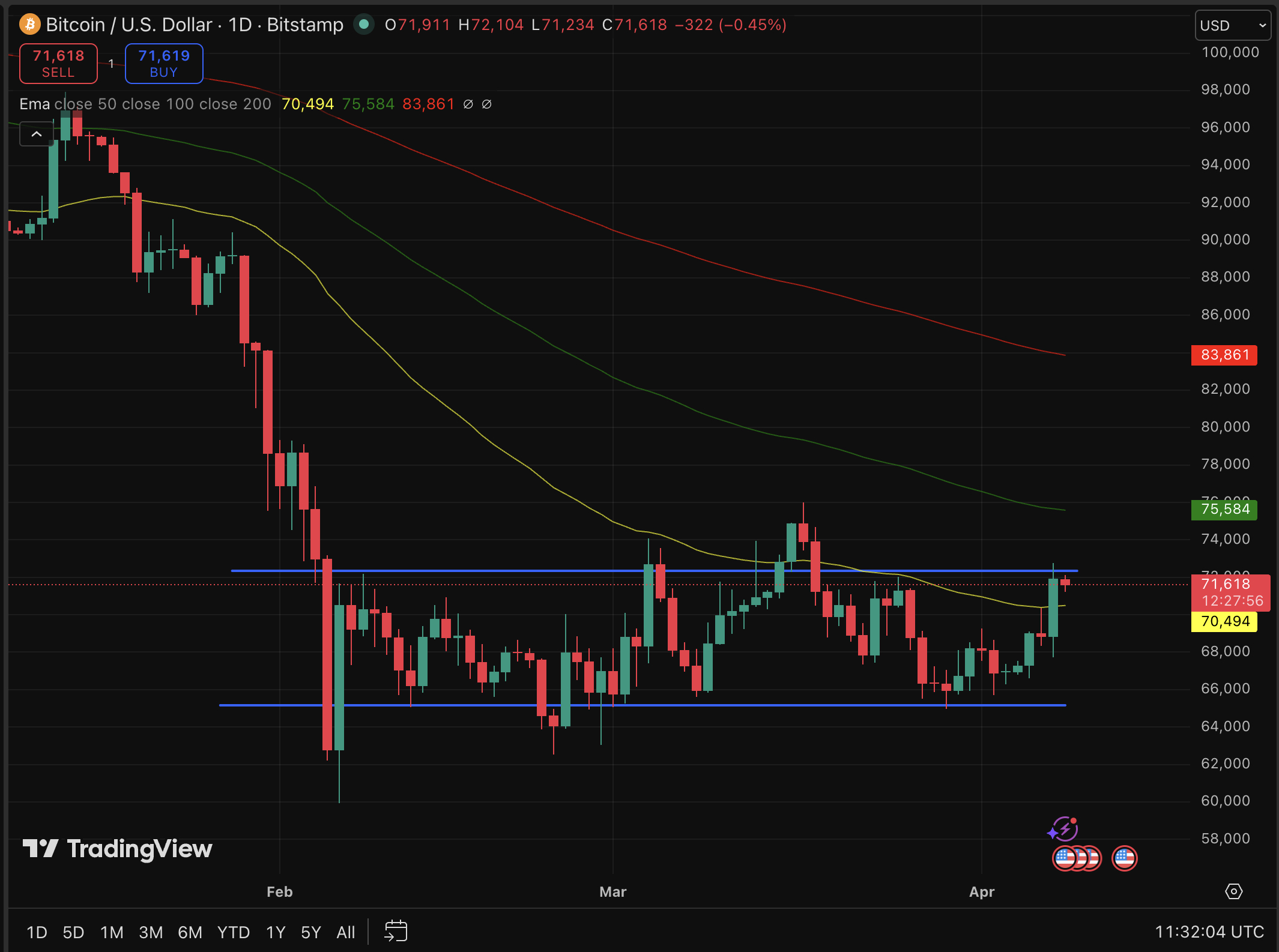
For us, we want CPI to print soft Friday, the ceasefire narrative to hold, and Bitcoin to clear $75,000 with volume.
Gold testing $4,800 resistance simultaneously complicates the read. Bitcoin’s decoupling from traditional safe-haven dynamics in war-driven macro environments remains incomplete, which means gold’s next move likely provides the cleaner signal for BTC directional bias in the sessions ahead.
Discover: The best crypto to diversify your portfolio with
Bitcoin Hyper: BTC Eco Play With Early-Mover Upside
Bitcoin below $72,000 with a ceiling firmly in place is a frustrating setup for spot holders; the upside exists, but so does the wait. That gap between conviction and near-term price action is exactly where early-stage infrastructure plays attract serious attention.
Bitcoin Hyper ($HYPER) is positioning as the first-ever Bitcoin Layer 2 with Solana Virtual Machine (SVM) integration, a direct attack on Bitcoin’s three core limitations: slow transactions, high fees, and the absence of programmable smart contracts.
The presale has raised more than $32 million at a current price of $0.0136, with staking live and drawing significant participation. The SVM integration is the differentiator: delivering sub-Solana latency on Bitcoin’s security layer is something only a few Layer 2 projects have attempted, let alone shipped.
For traders watching Bitcoin consolidate below resistance while seeking asymmetric exposure to the broader ecosystem, the infrastructure layer is worth examining.
Research Bitcoin Hyper before the next presale stage moves the entry price.
The post BTC USD and Gold Price Outlook: The War Pause, De-escalation, and Prediction appeared first on Cryptonews.

The Masters’ new ‘rules guy’ has quiet role but big job

10 Secrets to Achieve Financial Success
Dominion Energy amends credit agreements to extend maturities


-

 NewsBeat6 days ago
Steven Gerrard disagrees with Gary Neville over ‘shock’ Chelsea and Arsenal claim | Football
-

 Business6 days ago
No Jackpot Winner and $194 Million Prize Rolls Over
-

 Fashion5 days ago
Weekend Open Thread: Spanx – Corporette.com
-

 Crypto World7 days ago
Gold Price Prediction: Worst Month in 17 Years fo Save Haven Rock
-

 Business5 days ago
Expert Picks for Every Need
-

 Business3 days ago
Three Gulf funds agree to back Paramount’s $81 billion takeover of Warner, WSJ reports
-

 Sports4 days ago
India men’s 4x400m and mixed 4x100m relay teams register big progress | Other Sports News
-

 Business7 days ago
Login and Checkout Issues Spark Merchant Frustration
-

 Tech22 hours ago
How Long Can You Drive With Expired Registration? What Florida Law Says
-
Business3 days ago
No Jackpot Winner, Prize to Climb to $231 Million
-

 Tech6 days ago
Commonwealth Fusion Systems leans on magnets for near-term revenue
-

 Fashion2 days ago
Massimo Dutti Offers Inspiration for Your Summer Mood Board
-

 Crypto World7 days ago
Ripple rolls out enterprise crypto treasury platform for corporates
-

 Fashion1 day ago
Let’s Discuss: DEI in 2026
-
Politics5 days ago
Wings Over Scotland | The quality of mercy
-
 Sports7 days ago
Steal Gary Woodland’s subtle power move for longer drives
-

 Business4 days ago
Akebia Therapeutics, Inc. (AKBA) Discusses Pipeline Progress and Strategic Focus on Kidney Disease Treatments at R&D Day – Slideshow
-
Sports7 days ago
Tom Pelissero Drives the Final Nail in the Coffin
-
 Tech7 days ago
Battery Tester Outperforms Cheaper Options
-

 Tech7 days ago
Following Artemis II’s Journey Around The Moon
You must be logged in to post a comment Login