NASA is going back to the Moon! We’ll follow the crew of Artemis II every step of the way.
Day 1 – Liftoff!
After resolving a last-minute communications issue with the Flight Termination System (FTS), the Artemis II Space Launch System (SLS) rocket lifted off from Launch Complex 39B at NASA’s Kennedy Space Center in Florida at 6:35 PM EDT.
Main engine cutoff (MECO) for the SLS rocket occurred at 6:43 PM, placing the Orion spacecraft and crew members Reid Wiseman, Victor Glover, Christina Koch, and Jeremy Hansen safely into orbit around the Earth. Just before 7:00 PM, all four solar array “wings” were successfully deployed from the European Service Module.
Advertisement
The next major milestones are the perigee and apogee raise maneuvers — two engine burns which will put the Orion spacecraft into a higher orbit, necessary for the eventual trans-lunar injection (TLI) burn which will put the vehicle on course for the Moon.
A man accused of stealing hard drives containing unreleased Beyonce music, tour plans, and other materials from a rental car in Atlanta has pleaded guilty and accepted a five-year sentence, including two years in custody. Slashdot Bruce66423 shares a report from The Guardian: Kelvin Evans was by the Atlanta police department in September in connection to a July 2025 car robbery where two suitcases containing Beyonce music and tour plans were stolen from a rental car. […] According to a July police report, Beyonce choreographer Christopher Grant and dancer Diandre Blue called 911 to report a theft from their rental vehicle, a 2024 Jeep Wagoneer, before Beyonce’s Cowboy Carter tour dates in Atlanta. An October indictment stated that Evans entered the car on July 8 “with the intent to commit theft.”
The stolen hard drives contained “watermarked music, some unreleased music, footage plans for the show and past and future set list,” according to a police report. Clothing, designer sunglasses, laptops and AirPods headphones were also stolen, Grant and Blue said. Local law enforcement searched for the location of one of the stolen laptops and the AirPods to try and locate the property. One police officer wrote in the report: “I conducted a suspicious stop in the area, due to the information that was relayed to me. There were several cars in the area also that the AirPods were pinging to in that area also. After further investigation, a silver [redacted], which had traveled into zone 5 was moving at the same time as the tracking on the AirPods.”
Evans was arrested several weeks after Grant and Blue filed a report, and was publicly named as the suspect in September. He was released on a $20,000 bond a month later. At the time of his arrest, Atlanta police said that the stolen property had not been recovered. It is unclear whether it has since been found.
Bruce66423 commented: “Just for stealing a couple of suitcases from a car. Funny how the elite punish those who inconvenience them. Can you imagine an ordinary victim see their offender get that sort of sentence?”
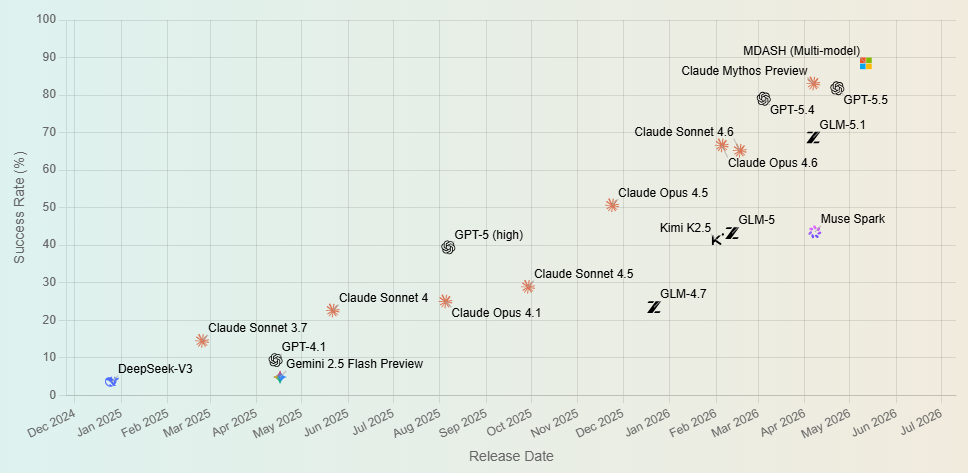
CyberGym benchmark scores over time, showing the rapid improvement in AI vulnerability discovery capabilities. Microsoft’s multi-model MDASH system (top right) tops the leaderboard at 88.4%. (CyberGym / UC Berkeley)
Mythos has been MDASH’d.
A new AI-powered system from Microsoft surpassed a headline-grabbing rival from Anthropic on a leading cybersecurity benchmark, using more than 100 specialized AI agents working together across multiple AI models to find real-world software vulnerabilities.
Microsoft’s system, codenamed MDASH, was introduced this week alongside the disclosure of 16 new vulnerabilities it found in different versions of Windows, including four “critical” remote code execution flaws fixed in this month’s Patch Tuesday release.
The company, which has faced persistent criticism over security lapses, is betting that multiple models can discover vulnerabilities at a pace that individual models can’t match.
MDASH, derived from the term “multi-model agentic scanning harness,” works by running specialized AI agents through a staged pipeline. Different agents scan code for potential vulnerabilities, then a separate set of agents debate whether each finding is real and exploitable, and a final stage constructs proof-of-concept attacks to confirm the bugs exist.
Advertisement
By comparison, Anthropic’s Mythos, which raised concerns over its ability to find and exploit software vulnerabilities when it was previewed earlier this year, is a single AI model running inside an agent framework. Anthropic restricted its release to a handful of companies through a consortium called Project Glasswing, which includes Microsoft.
OpenAI’s GPT-5.5 and others on the leaderboard are also single-model systems.
MDASH scored 88.45% on the CyberGym benchmark, a test developed by UC Berkeley researchers that measures how well AI systems can reproduce real-world vulnerabilities across 1,507 tasks drawn from 188 open-source software projects.
Mythos Preview was second at 83.1%, followed by GPT-5.5 at 81.8%.
Advertisement
The benchmark gives each system a description of a known vulnerability and an unpatched codebase, and measures whether it can produce a working attack that triggers the bug.
The scores on the CyberGym leaderboard are self-reported by the companies, including Anthropic’s Mythos result. The benchmark code is public, but no independent party has verified any of the scores. Also, benchmark results don’t necessarily reflect real-world performance.
The results also highlight growing concerns about AI’s use as an offensive hacking tool. The same capabilities that allow AI to find vulnerabilities in friendly hands can be used to discover them for exploitation by attackers. Microsoft said MDASH is being used internally by its security engineering teams and will be entering a limited private preview with customers.
Microsoft is telling customers to expect bigger Patch Tuesdays going forward as AI accelerates the discovery of vulnerabilities.
The Iran-linked hacking group MuddyWater (a.k.a. Seedworm, Static Kitten) launched a broad cyber-espionage campaign targeting at least nine high-profile organizations across multiple sectors and countries.
Among the victims are a major South Korean electronics manufacturer, government agencies, an international airport in the Middle East, industrial manufacturers in Asia, and educational institutions.
Researchers at Symantec say that the threat actor “spent a week inside the network of a major South Korean electronics manufacturer in February 2026.”
Symantec’s Threat Hunter Team believes the attacker was intelligence-driven, focusing on industrial and intellectual property theft, government espionage, and access to downstream customers or corporate networks.
Advertisement
Fortemedia and SentinelOne abuse
Seedworm’s campaign relied heavily on DLL sideloading, a common technique in which legitimate, signed software loads malicious DLLs.
Two of the binaries leveraged in the attack are ‘fmapp.exe,’ a legitimate Foremedia audio utility, and ‘sentinelmemoryscanner.exe,’ a legitimate SentinelOne component.
The malicious DLLs (fmapp.dll and sentinelagentcore.dll) contained ChromElevator, a commodity post-exploitation tool that steals data stored in Chrome-based browsers.
Symantec also found that PowerShell, used in previous Seedworm attacks, was still heavily used in the recent incidents, although the payloads were controlled through Node.js loaders rather than directly.
Advertisement
PowerShell was used to capture screenshots, conduct reconnaissance, fetch additional payloads, establish persistence, steal credentials, and create SOCKS5 tunnels.
Attack on a Korean firm
According to Symantec’s observations, the attack on the South Korean electronics manufacturer lasted between February 20 and 27. The researchers did not disclose the name of the targeted organization.
In the first stage, Seedworm performed host and domain reconnaissance, followed by antivirus enumeration via WMI, screenshot capture, and the download of additional malware.
Credential theft occurred via fake Windows prompts, registry hive theft (SAM/SECURITY/SYSTEM), and Kerberos ticket abuse tools.
Advertisement
Persistence was established through registry modifications, beaconing occurred at 90-second intervals, and sideloaded binaries were repeatedly relaunched to maintain access.
“The cadence is again consistent with implant-driven activity rather than continuous operator presence,” the researchers said.
The attackers leveraged sendit.sh, a public file-sharing service for data exfiltration, likely to obscure the malicious activity and make it appear as normal traffic.
Overall, Symantec has found the latest Seedworm campaign notable for the threat actors’ geographic expansion, operational maturity, and the abuse of legitimate tools and services, which mark a shift toward quieter attacks.
Advertisement
AI chained four zero-days into one exploit that bypassed both renderer and OS sandboxes. A wave of new exploits is coming.
At the Autonomous Validation Summit (May 12 & 14), see how autonomous, context-rich validation finds what’s exploitable, proves controls hold, and closes the remediation loop.
Artificial intelligence has posed a multi-layered problem for Apple in recent years. We’re expecting to hear some big news at WWDC this year about how AI will be integrated into the company’s gadgets, but there are still other wrinkles still to be ironed out in its broader approach to the use of this influential technology. According to The Information, one of those challenges is the recent interest and development of agentic AI.
To date, Apple has not permitted vibe coding tools on the App Store because they would violate its policies. They could also potentially be used to create original apps for people who would have otherwise gotten software from the App Store, which could pose a threat to Apple’s revenue as well as creating a loophole for spreading malware or taking other malicious actions. But applying that same block more broadly to any agentic AI services, which can take active control over a device and its programs, could keep Apple out of the loop as those tools are generating a lot of interest among both developers and casual users. Apple is reportedly trying to maintain its control over the App Store, while capitalizing on the current buzz around AI agents.
“While details couldn’t be learned, its staffers are designing a system to adhere to its standards of privacy and security and prevent the more freewheeling behavior some users of agentic systems such as OpenClaw have experienced, where agents can go haywire and delete all of a user’s emails, according to the people briefed on the matter,” the article states.
Advertisement
It sounds like a high wire act for a company that has been struggling to keep pace with AI’s breakneck development. Add this to the long laundry list of information we’ll be curious to see addressed at next month’s keynote.
Netflix has more than 250 million monthly active users on its ad-supported tier. The figure, which was revealed during the company’s Upfront presentation, marks a huge spike for this subscription option. In 2024 the plan with ads had 70 million users and in 2025 it reached 94 million.
Starting next year, Netflix will also launch the ad-supported plan in 15 more countries: Austria, Belgium, Colombia, Denmark, Indonesia, Ireland, the Netherlands, New Zealand, Norway, Peru, Philippines, Poland, Sweden, Switzerland and Thailand.
The Basic with Ads tier of access started rolling out in 2022. It appears to be an increasingly popular option as Netflix, like most streaming services, has continued to get ever-more expensive. The company just upped all monthly subscription costs by a dollar earlier this year.
Advertisement
And of course, because this is 2026, the Upfront included plenty of talk about AI. Netflix started using the tech in its ads last year, and one of the new potential applications the company is testing will serve “personalized ad loads and frequency caps that dynamically adjust the ads our members see, based on their viewing behaviors.” Netflix is currently facing a lawsuit from Texas on claims that it illegally sells user data to ad tech companies, although the streaming service said the suit was “based on inaccurate and distorted information.”
Ukrainian developers claim the laser weapon costs far less than Western systems
The Trident laser reportedly damages aircraft optics, electronics, and structural components effectively
Ukrainian company Celebra Tech is putting the final touches on a Trident laser weapon which it claims can destroy drones, helicopters, and even missiles at significant distances.
The Trident burns through enemy optics and structural components from up to three miles away.
Western defense giants have spent enormous sums on similar technology, such as the £120 million DragonFire laser unveiled by Britain, yet Ukrainian developers claim their Trident system will cost a tiny fraction of that amount.
Latest Videos From
Advertisement
What the Trident Can Actually Do
Celebra Tech says its laser system can shoot down reconnaissance drones from up to 1.5 kilometers away.
FPV drones, which have become a major threat on the battlefield with an effective range of 800 to 900 meters, were destroyed by the system, which also damages optics, electronics, and wing bodies of larger aircraft.
Developers say the Trident can strike helicopters and airplanes at a distance of 5 kilometers.
At 10 kilometers away, the laser still retains enough power to blind enemy surveillance equipment.
Advertisement
Sign up to the TechRadar Pro newsletter to get all the top news, opinion, features and guidance your business needs to succeed!
The system has recently received new targeting features, including radar integration and automatic target tracking, and a re-guidance system now allows operators to correct the beam during active engagement.
Tested for combat
The company revealed that a prototype called the Trident-120 underwent combat testing in 2021 and 2022, when it resembled a light rifle in its physical form and handling.
Advertisement
The earlier prototype successfully struck the optoelectronic equipment of Ka-52 attack helicopters, and also damaged Orlan reconnaissance drones and Murom ground observation stations during those field tests.
“Today, we can shoot down planes at an altitude of over 2 km with this laser,” said Vadym Sukharevskiy, former commander of the Unmanned Systems Forces.
The company adds the Trident laser system is also suitable for demining contaminated areas, although this secondary function has not been demonstrated publicly or verified by external observers.
Advertisement
Celebra Tech has developed other products, including the Laurus-13F fiber-optic FPV drone, and says it is also working on bombers, electronic warfare equipment, and specialized software packages.
The company employs only about fifteen people to work on this laser development project, which seems remarkably small for such a technically ambitious weapon system.
For most of the stated destroy ranges, including the 5-kilometer anti-aircraft claim, no independent verification or third-party confirmation has ever been published.
The demining function mentioned by the manufacturer appears particularly far from proven operational capability based on available evidence.
Advertisement
A low-cost laser that solves every aerial threat remains an appealing idea, but without proper verification, it remains a theoretical project.
KitchenAid has released a smart thermometer, the first from the popular cooking brand. The single probe model will retail for $100 while the dual option will cost $200. Although a maximum temperature isn’t listed in the specs, the company says that the Smart Thermometer can be used for a range of processes, including grilling, roasting, smoking, air frying and stovetop cooking.
The probes are waterproof and dishwasher safe, and when fully charged, the battery life can top out at 24 hours, so you can keep tabs even on long projects like smoking a hefty brisket. The quick-charge option can boost the probe to an extra five hours of cooking from five minutes of charging.
The KitchenAid Smart Thermometer connects to the company’s app, which offers a graph view for visualizing the cooking process, a collection of up to 20 saved cooks, and timers or alerts. Notifications can let the cook know when it’s time to take different steps in a recipe based on temperature. The probes use Bluetooth, and the Range Extender Mode can stretch the device’s 285-foot range with a second internet-connected device if needed.
Advertisement
KitchenAid’s offering joins several other products on the market, some from grilling-focused specialists such as Meater and ThermoWorks, and others from similarly major kitchen brands like Whirlpool, which just so happens to own KitchenAid.
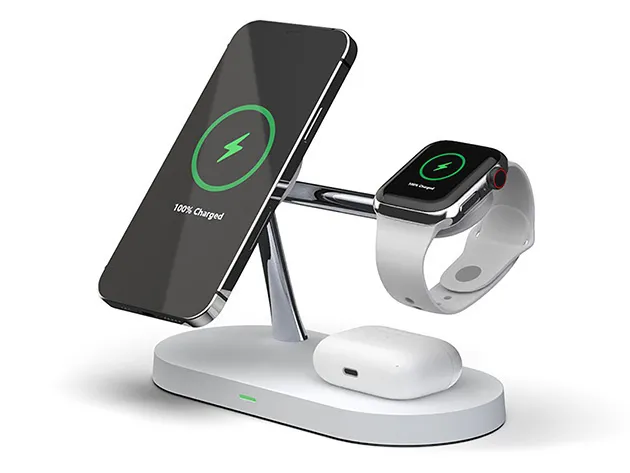
Simplify your daily charging experience and replace most of the chargers and cables on your desktop. The 5-in-1 Wireless & Wired Charging Station is a compact and powerful charging station to charge all your favorite gadgets at the same time, and can also double as a bedside lamp with 3 brightness levels. Having 3 wireless charging spots, and one USB-A port, it enables charging for up to 4 devices simultaneously, including iPhone, Apple Watch, AirPods Pro, AirPods with Wireless Charging Case, other Qi-compatible Android Phones, and Bluetooth earbuds. The Apple Watch Stand is for charging any Apple Watch from Series 1 to 9. Save your workspace and charge all your favorite techs in one elegant solution. It’s on sale for $40.
Note: The Techdirt Deals Store is powered and curated by StackSocial. A portion of all sales from Techdirt Deals helps support Techdirt. The products featured do not reflect endorsements by our editorial team.
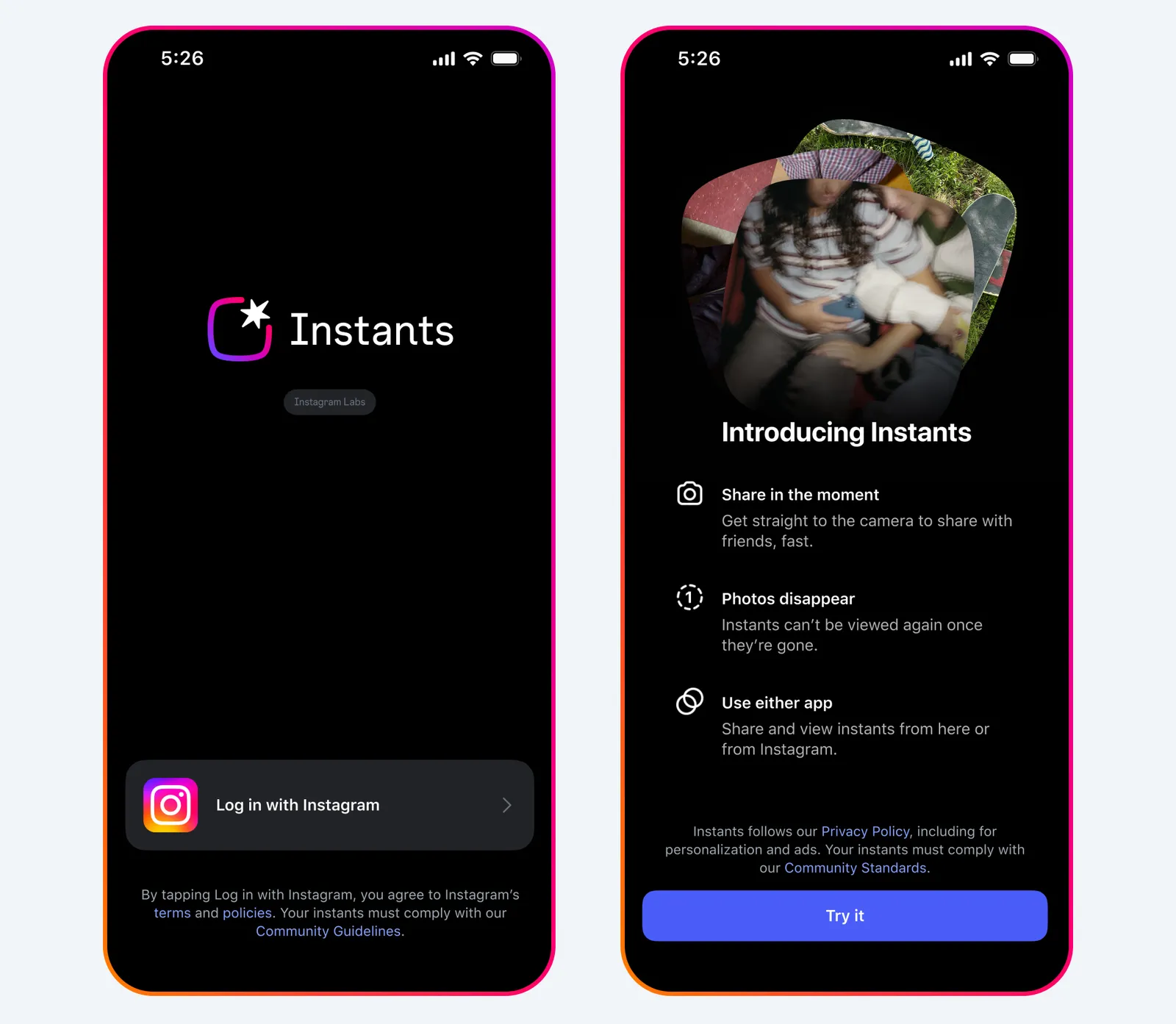
Meta launched a new app on Wednesday, called Instants, that integrates with existing Instagram accounts and allows users to send unedited, disappearing photos. Instants leans into the popularity of Instagram’s Stories feature and Close Friends lists, where users can selectively share images with a smaller audience.
Instants is available as a stand-alone app on iOS and Android in select countries, and it’s accessible through Instagram’s direct messaging tab.
The core of Instants, from its name to the bare-bones layout, is designed to evoke a sense of ephemerality. Yes, it’s a conceptual clone of Snapchat, with images that disappear after viewing, which can also be unsent before the person on the other end views them. (Instagram’s Stories feature, launched a decade ago, was also influenced by Snapchat.)
Unlike Snapchat, Instants is much more focused on capturing raw moments, like the once-viral BeReal app, and doesn’t allow any filters or retouching. That’s striking for a company that helped make sepia-toned filters like Valencia household names, and is hell-bent on adding generative AI to every other corner of its apps.
Advertisement
Courtesy of Meta
There’s one specific kind of raw image I fully believe adult users will be sharing with their Close Friends list through Instants: dick pics.
Instagram’s Close Friends feature, which arrived in 2018, earned a reputation as a way to share thirst traps. As a gay man living in San Francisco, I’m fully aware of what I’m going to see when someone adds me to their list and posts to Close Friends. No one’s posting full hog on main—that would be blocked by Meta—but there’s plenty of skin on display in those green bubbles.
Similar to Instagram, Instants is available to teenage users. Even so, content posted on either app may feel adult in nature. While Instagram’s community guidelines ban posting most kinds of nudity, with exceptions for sculptures and breastfeeding, in practice, the main feed on my Instagram is full of ass shots—nothing frontal. Images posted on Stories just to Close Friends lists, rather than being more publicly shared, often seem to avoid the stricter moderation rules. The Instants app is governed by the same guidelines as the main Instagram app.
Productivity software maker Notion is stepping into the agentic era.
In a live-streamed product announcement on Wednesday, the company, known best for its collaborative note-taking app, introduced a new developer platform that extends the capabilities of its custom AI agents, connects with external agents, and allows teams to build automated multi-step workflows that can pull in data from any database.
By building an orchestration layer — a system that coordinates AI work across multiple tools and data sources — Notion is positioning itself as more than a note-taker with AI features and instead as a hub where people and agents can collaborate across tools and databases.
In February, Notion first launched its Custom Agents — AI teammates that handle repetitive tasks, like answering frequently asked questions, compiling status updates, and automating workflows. Since then, Notion customers have built over one million agents, the company says.
Advertisement
However, these agents had limitations. They couldn’t connect with external data or use custom logic. External agents that companies used also didn’t have a way to connect with the Notion workspace. Teams had to work around these problems by using third-party automation platforms or writing their own scripts that run on their own infrastructure.
“It’s true that, historically, Notion hasn’t been the most developer-focused platform,” said Ivan Zhao, Notion co-founder and CEO, during the livestream. “But things are changing.”
Image Credits:Notion
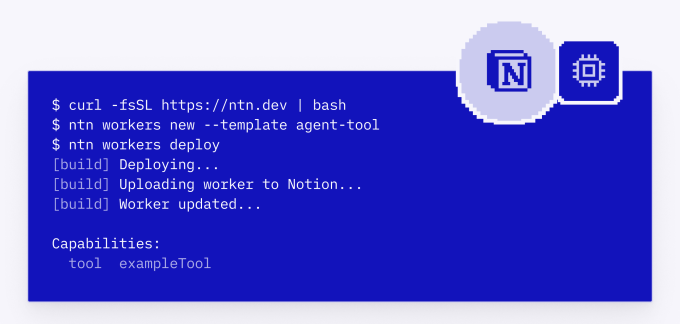
Now, Notion will allow teams to deploy their own custom code. With its new Workers, Notion’s cloud-based environment for running custom code, customers can write their logic and deploy it to a secure sandbox (an isolated environment that keeps the code from interfering with other systems). This allows teams to do things like sync their data into Notion, build custom tools, and trigger work with webhooks — which are automated signals that kick off actions when something happens in another app — without needing to rely on external infrastructure.
You don’t even have to write the code. The company points out that your preferred AI coding agent can do it for you.
The Workers will use the same credit system as Custom Agents, but Notion is making this free through August, so developers can experiment.
Advertisement
Syncing external data sources is also a part of the Notion Developer Platform. Powered by Workers, the database sync feature can pull in data from any database with an API. That means you could access data from places like Salesforce, Zendesk, Postgres, and others within your own Notion databases — and keep the data current.
Zhao noted that this means that Notion’s users can now “use your Notion database as a sheer canvas to power both your workflows and your agents.”
Image Credits:Notion
Workers can also build agent tools with custom logic, for those times when connecting with a third-party via MCP — short for Model Context Protocol, an emerging standard that lets AI tools connect to external data and services — isn’t enough.
Another addition allows Notion’s users to chat directly with external AI agents they use, assign them work, and track their progress, as if they were one of Notion’s own custom agents. At launch, Notion says that Claude Code, Cursor, Codex, and Decagon are supported partner agents, but it plans to add more.
There’s an External Agent API, too, if teams want to connect their own internal agents with Notion, like those they’ve built specifically for their company’s needs.
Advertisement
Image Credits:Notion
Developers and agents interact with Notion’s new Developer Platform via the Notion CLI, a command-line tool for developers, available on the company’s Business and Enterprise Plans.
The Developer Platform represents a shift in strategy for Notion as it becomes more of a programmable platform than just an application, setting it up to compete with other workflow automation platforms. As businesses increasingly look to automate knowledge work and build internal AI systems, a platform that ties together agents, custom code, and live data in one place starts to look less like a productivity app and more like core infrastructure.
It also follows the broader trend among AI companies, which have been moving beyond the AI chatbot to offer agentic tools that can take actions across different software platforms.
“Any data, any tool, any agent — that’s the big picture for the Notion Developer Platform,” Zhao said.
When you purchase through links in our articles, we may earn a small commission. This doesn’t affect our editorial independence.































































You must be logged in to post a comment Login