
Crypto World
XRP Sees Strong Institutional Momentum in 2026 Amid Price Lag


TLDR:
- Five XRP spot ETFs launched in the US, locking 769M tokens with zero net outflow days in month one.
- Goldman Sachs holds $153.8M in XRP ETFs, making it the top institutional holder across four funds.
- XRPL daily transactions hit 3 million on March 15, tripling from mid-2025 averages across key use cases.
- Ripple’s $50B private valuation and $500M funding round drew top Wall Street and crypto-native firms.
XRP has attracted notable institutional attention in 2026, with five spot ETFs now trading in the United States. Cumulative inflows reached $1.50 billion by early March.
The funds locked over 769 million XRP tokens across combined custody arrangements. JPMorgan forecasts first-year inflows between $4 billion and $8.4 billion. Despite these developments, XRP trades around $1.36, well below its July 2025 high of $3.65.
Institutional Adoption Drives ETF Growth
Goldman Sachs disclosed a $153.8 million spot XRP ETF position in its Q4 2025 13F filing. This makes Goldman the single largest known institutional holder of XRP ETFs.
The allocation spans Bitwise, Franklin Templeton’s XRPZ, Grayscale’s GXRP, and 21Shares’ TOXR. Together, these holdings account for roughly 73% of the top 30 institutional holdings combined.
Ripple entered 2026 at a $50 billion private valuation. This places it among the ten most valuable private companies globally.
It also stands as the only blockchain-focused firm in that group. The company holds more than 75 regulatory licenses worldwide and has logged over $95 billion in cumulative transaction volume.
A $500 million strategic funding round closed in November, drawing major names from traditional finance. Citadel Securities, Fortress, Pantera, Galaxy Digital, Brevan Howard, and Marshall Wace all participated.
On the same day, Ripple announced a partnership with Mastercard and Gemini. The collaboration focuses on stablecoin-powered credit card payments.
As noted by BSCNews, the registered zero net outflow days in the ETFs’ first month of trading. This points to sustained demand from institutional buyers. The consistency of inflows sets XRP apart from other digital assets in early 2026.
XRPL Network Activity and Technical Development
Daily transactions on the XRP Ledger reached 3 million on March 15. That figure represents a threefold increase from mid-2025 averages.
AMM pool activity, tokenized assets, and RLUSD-denominated settlement flows drove the growth. The ledger has now processed more than 4 billion transactions since inception.
Real-world asset tokenization on XRPL has grown to over $474 million. The represented value is approaching $1.5 billion.
This growth reflects broader adoption of the ledger for non-speculative financial use cases. It also positions XRPL as a settlement layer for institutional-grade transactions.
On the technical side, RippleX shipped a node stability patch on March 13. An AI-driven security overhaul followed on March 26.
A four-phase quantum-resistance roadmap targeting 2028 is also underway, with Phase 2 in progress. Lending Protocol and Single Asset Vaults are currently under amendment voting.
Standard Chartered’s Geoffrey Kendrick has forecast XRP reaching $8 in 2026. He cited ETF flows and regulatory clarity from the CLARITY Act as key drivers.
Ripple CEO Brad Garlinghouse has predicted XRP capturing 14% of SWIFT volume within five years. Price performance, however, remains the one area yet to reflect the broader momentum.



Hong Kong’s nascent stablecoin regime faced a fresh test as scammers impersonated the two newly licensed issuers ahead of their official product launches. Warnings issued by the Hong Kong Monetary Authority (HKMA), HSBC, and Anchorpoint Financial stated that tokens bearing the tickers HKDAP and HSBC have appeared on the market but are not connected to the licensed issuers.
Hong Kong began its stablecoin licensing regime in August 2025. Last month, the HKMA granted its first stablecoin issuer licenses, approving Anchorpoint Financial and HSBC under the new framework. The episode underscores the growing pains that accompany a regulated rollout of fiat-backed digital currencies in a major financial hub.
The HKMA emphasized that, at present, neither licensed issuer has published any regulated stablecoins. The authority’s warning was echoed by HSBC and Anchorpoint, who stressed that no stablecoins have been issued by either institution under the HKMA framework.
HSBC said in a statement that it “has not yet issued any stablecoins in Hong Kong,” adding that its planned Hong Kong dollar stablecoin will be available only through PayMe and the HSBC HK Mobile App when it launches in the second half of 2026. Anchorpoint likewise clarified that since receiving its license from the HKMA on April 10, it has not issued any tokens or products under the HKDAP name, and urged the public to verify information through official channels and to use regulated avenues when acquiring or using stablecoins.
The guidelines governing fiat-backed stablecoins in Hong Kong require issuers to obtain an HKMA license and adhere to rules around reserve backing, redemption rights, governance, and anti-money-laundering controls. The HKMA maintains enforcement powers that include fines, suspensions, and license revocations to ensure compliance with the regime.
The episode arrives as banks and other traditional financial players increasingly pivot toward stablecoins. In a notable move last week, Morgan Stanley’s investment management arm launched a “Stablecoin Reserves Portfolio,” allowing stablecoin issuers to park reserve funds in one of the bank’s money market funds and earn interest. Separately, Western Union has signaled a May rollout for its USD-backed stablecoin, USDPT, which will be built on Solana and issued by Anchorage Digital Bank. These developments illustrate growing institutional interest in reserve management and settlement rails for fiat-backed digital currencies.
Key takeaways
- Fake tokens with tickers HKDAP and HSBC appeared in the market, but neither is issued by the HKMA-licensed stablecoin issuers Anchorpoint Financial or HSBC.
- The HKMA, HSBC, and Anchorpoint Financial confirm that no regulated stablecoins have been issued to date; real launches are expected later, including HSBC’s HKD stablecoin planned for H2 2026.
- Hong Kong’s licensing regime requires reserve backing, redemption rights, governance, and AML controls, with the HKMA empowered to fine, suspend, or revoke licenses for non-compliance.
- Traditional banks are increasingly engaging with stablecoins, exemplified by Morgan Stanley’s reserve portfolio product and Western Union’s USDPT rollout plans with Anchorage Digital Bank.
Regulatory framework and the road ahead
The HKMA’s stance reflects a balancing act between fostering innovation and maintaining stringent oversight. The newly licensed issuers must meet a set of governance and reserve standards designed to ensure that each stablecoin is fully backed and redeemable under orderly conditions. The enforcement toolkit—ranging from fines to license revocation—signals that regulators intend to act decisively against misrepresentation or mismanagement in the stablecoin space.
For market participants, the latest warnings serve as a reminder to rely on official channels for information and to verify any claims about regulated products. Investors and users should monitor both issuers’ adherence to the HKMA framework and the public rollouts of the actual stablecoins when they become available via licensed channels.
Beyond Hong Kong, the momentum around stablecoins continues to attract traditional finance players. Morgan Stanley’s new reserve portfolio approach provides a pathway for issuers to optimize cash management, while Western Union’s USDPT project points to a broader trend of fiat-backed digital currencies integrating with existing payment rails. As the regulatory regime matures and real products begin to surface, observers will watch how reserve strategies, custody arrangements, and redemption mechanics evolve in practice.
Readers should stay tuned for updates on when the HKD stablecoin will actually launch in Hong Kong, how the public markets will verify legitimacy, and what additional licensing actions the HKMA may take as the regime scales.
Note: This reporting reflects information available from official statements and linked industry reports. Readers are encouraged to consult the cited sources for the most current developments.
Related coverage and sources: Hong Kong’s first stablecoin licenses issued, HSBC warns against fraudulent stablecoins, Anchorpoint alert on HKDAP, Morgan Stanley launches money-market fund for stablecoin issuers, Western Union targets May for USDPT rollout.


Roundhill Investments is set to launch the first U.S. exchange-traded funds (ETFs) tied to prediction markets next week, with two other asset managers preparing similar products.
According to a filing with the U.S. Securities and Exchange Commission (SEC), Roundhill will list six funds tied to whether Democrats or Republicans control the White House, Senate and House.
The launch is set for May 5, according to Bloomberg ETF analyst James Seyffart.
The funds are the Roundhill Democratic President ETF (BLUP), Republican President ETF (REDP), Democratic Senate ETF (BLUS), Republican Senate ETF (REDS), Democratic House ETF (BLUH) and Republican House ETF (REDH).
The House and Senate products are tied to who controls them after the Nov. 3, 2026, elections, while the presidential products point to the Nov. 7, 2028, race.
The funds gain exposure through swap agreements referencing binary event contracts traded on CFTC-regulated markets. These contracts settle at $1 if an outcome occurs and $0 if it does not.
The prospectus warns in capitalized text that if the targeted party does not win, “the fund will lose substantially all of its value.”
Roundhill won’t terminate the funds after settlement. Once the market prices a winner at above $0.995 or below $0.005 for five consecutive trading days, the fund treats the outcome as decided and rolls into the next cycle, the 2028 House and Senate exposure for the midterm funds, and the 2032 presidential race for BLUP and REDP.
The prospectus notes that if the market is later proved wrong, “there will be no recourse” for shareholders.
Bitwise and GraniteShares filed identical six-fund slates in February, with Bitwise using a “PredictionShares” brand. Their structures differ as Bitwise’s funds terminate shortly after each outcome is determined, while GraniteShares, like Roundhill, rolls into the next election.
Political event contracts are already traded on prediction markets such as Polymarket and Kalshi, but wrapping them in ETFs could expand access by allowing them to be held in ordinary brokerage accounts and some retirement accounts.
The push comes after the CFTC withdrew a Biden-era proposal in February that would have banned political event contracts, though state regulators in Massachusetts, New York, Nevada and elsewhere continue to challenge the underlying contracts in court.
Roundhill has also filed to list non-political prediction market ETFs tied to whether the U.S. will enter a recession, according to a filing flagged by Bloomberg ETF analyst Eric Balchunas.
Treasury management startup Stable Sea has integrated WisdomTree’s tokenized US Treasury money market fund into its platform, in a move aimed at helping businesses generate yield on idle cash.
On Wednesday, Stable Sea said the WisdomTree Government Money Market Digital Fund (WTGXX) is now available on its platform, allowing corporate clients to allocate excess cash to a government-backed fund rather than leaving it in low-yield bank accounts.
Stable Sea provides software that automatically reallocates — or “sweeps” — corporate cash balances into yield-bearing instruments. By integrating WTGXX, the company is extending that functionality to a tokenized fund that settles on blockchain infrastructure.
The product is aimed at businesses and corporate treasury teams seeking more efficient ways to manage liquidity and earn returns on cash reserves.
Companies access the fund through Stable Sea’s platform, which connects to existing financial systems. Clients are still required to complete onboarding and standard compliance checks, reflecting the regulated nature of the underlying fund.
WTGXX invests primarily in short-term US government securities, such as Treasury bills, and is structured as a money market fund. Its “tokenized” format means ownership shares are recorded onchain, which can enable faster settlement and more automated transactions compared to traditional fund infrastructure.
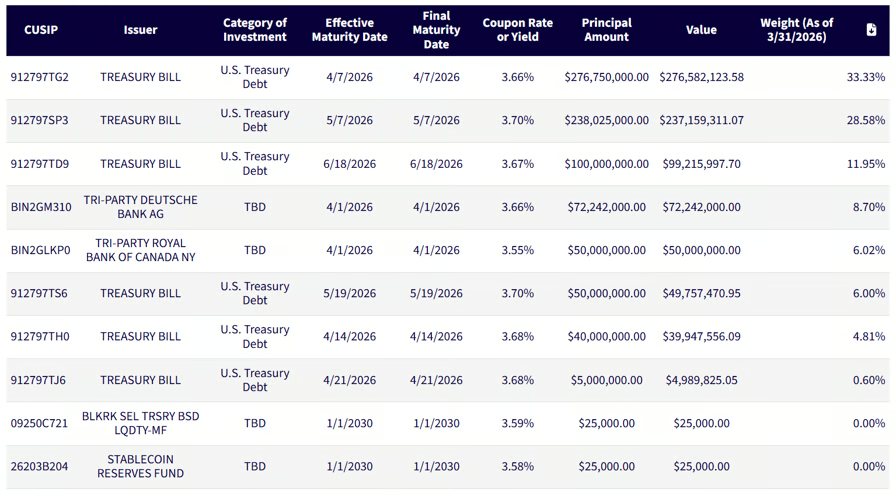
The fund had total assets of $857.64 million, as of April 28, and offered a daily yield of 3.43%, according to WisdomTree.
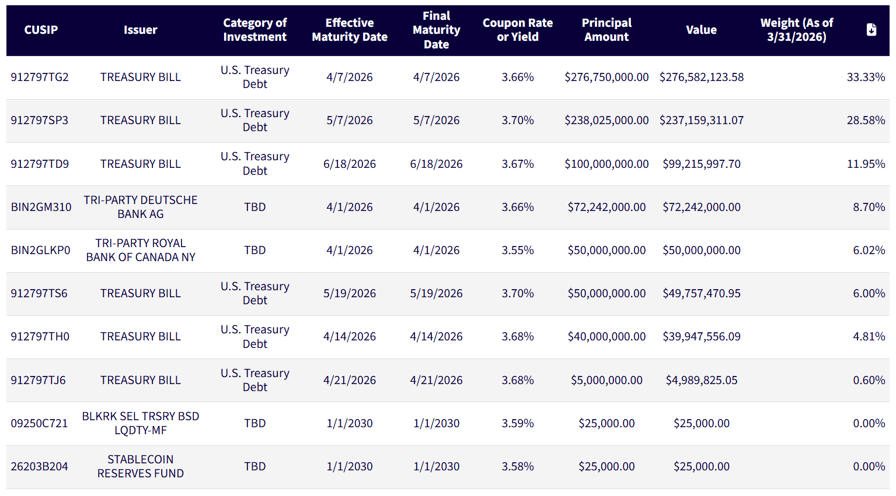
WGTXX’s primary holdings. Source: WisdomTree
Related: WisdomTree gets SEC approval for round-the-clock trading of tokenized MMF
Tokenized money market funds gain traction among institutions
Tokenized money market funds are seeing increased adoption as investors and institutions look for low-risk yield with greater operational flexibility. One of the key selling points is liquidity.
WisdomTree recently enabled 24/7 trading for its WTGXX fund after receiving approval from the US Securities and Exchange Commission, allowing investors to access and move funds outside traditional market hours.
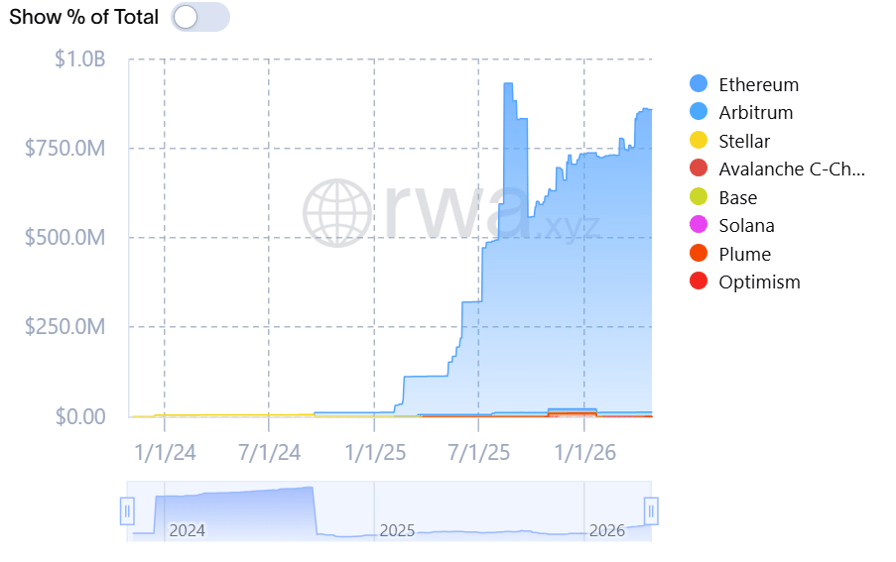
WGTXX has $857 million in total assets. Source: RWA.xyz
The use case is also expanding beyond cash management. Franklin Templeton and Binance have partnered to allow tokenized money market funds to be used as off-exchange collateral. Eligible institutions can pledge tokenized fund shares issued via Franklin Templeton’s Benji platform to support trading activity on Binance.
Standard Chartered this week launched a new framework that enables its institutional clients to use BlackRock’s tokenized short-term Treasurys fund as collateral for trading on crypto exchange OKX.
In an email to Cointelegraph following the launch, Richard Baker, CEO and founder of Tokenovate, said StanChart’s move “signals another instance of tokenization’s transition into the heart of core market infrastructure, elevating it from innovation to something structurally transformative.”
Other traditional finance players are entering the market as well. Northern Trust Asset Management recently launched a tokenized share class of its Treasury Instruments Portfolio, marking its entry into blockchain-based fund infrastructure.
Related: Visa adds Polygon, Base support as stablecoin settlement run rate hits $7B
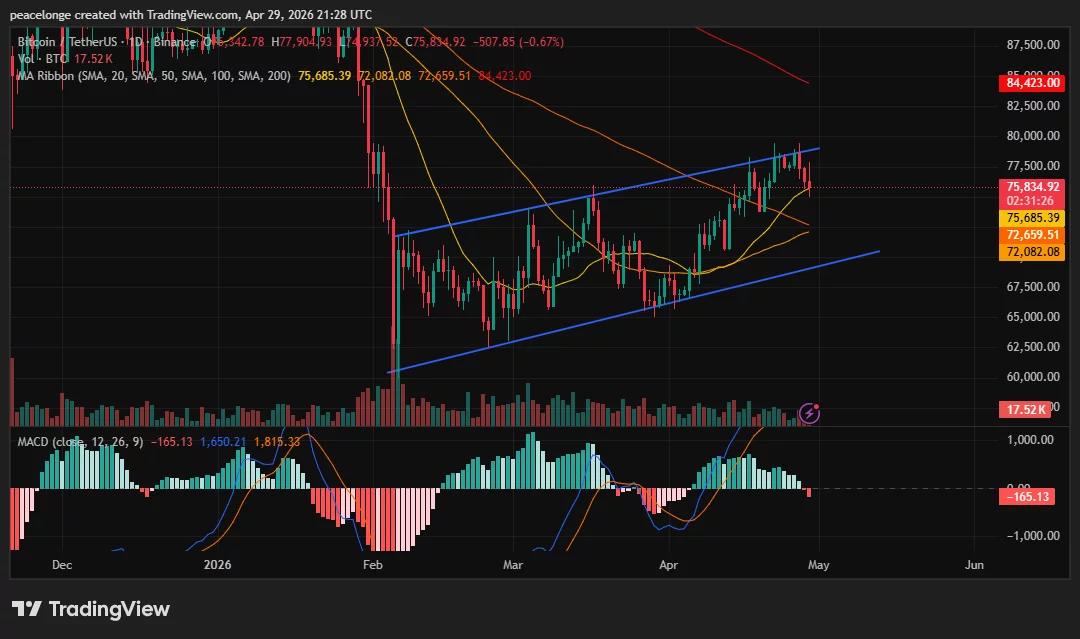
Bitcoin is pulling back from the upper boundary of its ascending channel on Powell’s final FOMC day, with a daily MACD bearish crossover now confirmed and price retreating toward key SMA support. This article breaks down what the daily chart signals, where price could head next, and why the Fed transition to incoming Chair Kevin Warsh adds a fresh layer of uncertainty.
Summary
- Bitcoin is trading at $75,834 on April 29, down 0.67% on the session, as a daily MACD bearish crossover confirms momentum is shifting.
- Price has pulled back from the ascending channel’s upper boundary and is now pressing the SMA 20 at $75,685 as immediate support.
- If the SMA 20 fails, the next floor sits at the SMA 50 near $72,082; a confirmed close above $80,000 invalidates the bearish setup.
Bitcoin (BTC) is trading at $75,834 on April 29, down 0.67% on the day, after touching a high of $77,904 before sellers reasserted control heading into the Federal Reserve’s rate decision. The pullback comes as Jerome Powell delivers his final FOMC press conference before his term ends on May 15, and as the daily MACD histogram flips negative for the first time in several weeks, signaling that the momentum driving April’s 21% recovery is beginning to wane.
Daily MACD bearish crossover at descending channel resistance
The daily chart shows Bitcoin navigating two overlapping structures. The ascending channel from the February lows near $59,000, defined by two parallel blue trendlines, remains intact and has framed the entire recovery through April. However, a broader descending channel formed by two red trendlines running from the February highs near $85,000 is capping the macro recovery, with the SMA 200 at $84,423 sitting inside that upper boundary as major overhead resistance.
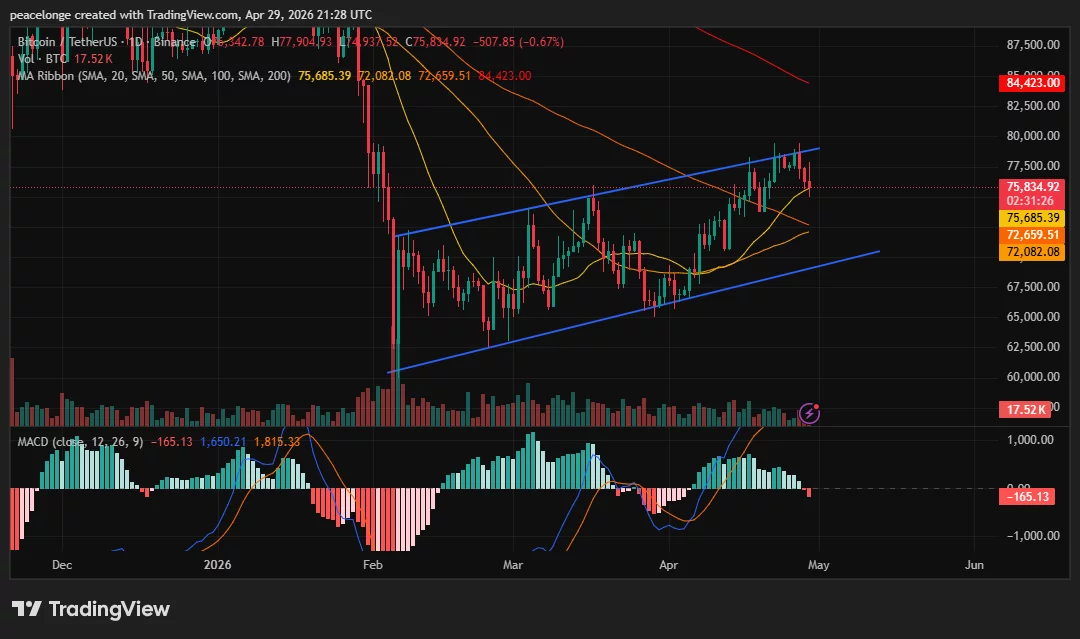
Price tested the upper region of the ascending channel near $78,000 on April 28, then retreated sharply, producing the current session’s high of $77,904 before sliding to $75,834 at the time of writing. The critical technical development on today’s daily chart is the MACD. The MACD line reads at 1,650.21, the signal line at 1,815.33, and the histogram at -165.13, confirming a bearish crossover on the daily timeframe. Crypto analyst Michael van de Poppe said on X that Bitcoin pullbacks ahead of and during FOMC events are typical, but cautioned that a close below $73,000 would signal a deeper correction rather than a routine reset.
Key levels: support, resistance, and price targets
The immediate support is the SMA 20 at $75,685, which price is currently pressing. A daily close below it removes the first dynamic buffer and brings the SMA 50 at $72,082 and the SMA 100 at $72,659 into focus, both of which converge in a tight cluster near the $72,000 to $73,000 zone that analysts identify as the lower boundary of the ascending channel. A confirmed close below $72,000 would break the ascending channel structure and open a retest of the $65,000 to $68,000 range, where heavy on-chain accumulation occurred throughout the Iran-driven correction in Q1 2026.
On the upside, $80,000 remains the primary resistance and the bull-case target that would invalidate the current bearish MACD reading. Above it, the SMA 200 at $84,423 and the upper boundary of the descending red channel represent the macro level bulls must clear for a confirmed structural trend reversal. A confirmed daily close above $80,000 on volume would shift the near-term bias back toward neutral.
ETF flows and derivatives context
According to data tracked by crypto.news, spot Bitcoin ETFs recorded $89.68 million in net outflows on April 28, breaking an eight-day inflow streak that had totalled $2.43 billion. Bitcoin fell after eight of the last nine FOMC meetings within 48 hours of the decision, per data published by Phemex, with the pattern driven by traders unwinding pre-event long positioning rather than by the rate decision itself. The current setup, where BTC entered the FOMC on a 21% April rally with the Fear and Greed Index near 40, closely mirrors prior setups that produced the sharpest post-meeting declines.
Powell’s exit and the Warsh uncertainty
This meeting carries an additional layer of uncertainty beyond the rate decision. Powell’s tenure ends May 15, with incoming Chair Kevin Warsh expected to preside over the June 16 to 17 FOMC meeting as his first. As crypto.news reported, institutional flows have proven sensitive to shifts in Fed communication tone throughout 2026, with oil prices near $105 per barrel adding further pressure on rate-cut expectations. Warsh’s hawkish reputation relative to Powell could shift the June dot plot in a direction that tightens the liquidity outlook for risk assets, making the 48-hour post-FOMC window on April 30 and May 1 the critical test for whether this pullback stabilises or extends toward $72,000.
If Bitcoin holds the SMA 20 at $75,685 and reclaims $77,500 on a daily close, the ascending channel remains intact and the bearish MACD crossover may prove to be a temporary signal. A close below $72,082 confirms a deeper correction is underway.


The Federal Trade Commission settlement decision also ordered Mashinsky to pay the commission $10 million.
U.S. District Judge Denise Cote on April 28 signed off on a $10 million settlement between the Federal Trade Commission and Alex Mashinsky, the founder of collapsed crypto lender Celsius Network, according to court documents.
The settlement permanently bans Mashinsky from promoting or operating any product or service involving the deposit, exchange, investment, or withdrawal of “assets” broadly, which could bar him from financial services beyond crypto.
The stipulated order enters a $4.72 billion monetary judgment against Mashinsky, though his actual cash payment to the FTC is capped at $10 million. That obligation will be considered satisfied if Mashinsky pays an equivalent amount to the Department of Justice under a separate forfeiture order tied to his criminal case, the court filing notes.
The order also permanently enjoins Mashinsky from misrepresenting any product or service he promotes.
The civil settlement follows Mashinsky’s sentencing last May, when a federal judge ordered him to serve 12 years in prison for fraud and market manipulation — specifically for artificially inflating the price of Celsius’s CEL token while secretly selling his own holdings.
Celsius froze customer withdrawals in June 2022, cratering crypto markets and trapping funds belonging to 1.7 million users before the platform filed for bankruptcy the following month, as The Defiant reported. A former partner had already alleged in 2022 that Celsius was operating a Ponzi scheme, with customer funds used to manipulate CEL’s price — accusations that ultimately proved accurate.
The $4.72 billion judgment reflects the full scope of harm to consumers, even if most of it remains uncollectable.
This article was written with the assistance of AI workflows. All our stories are curated, edited and fact-checked by a human.
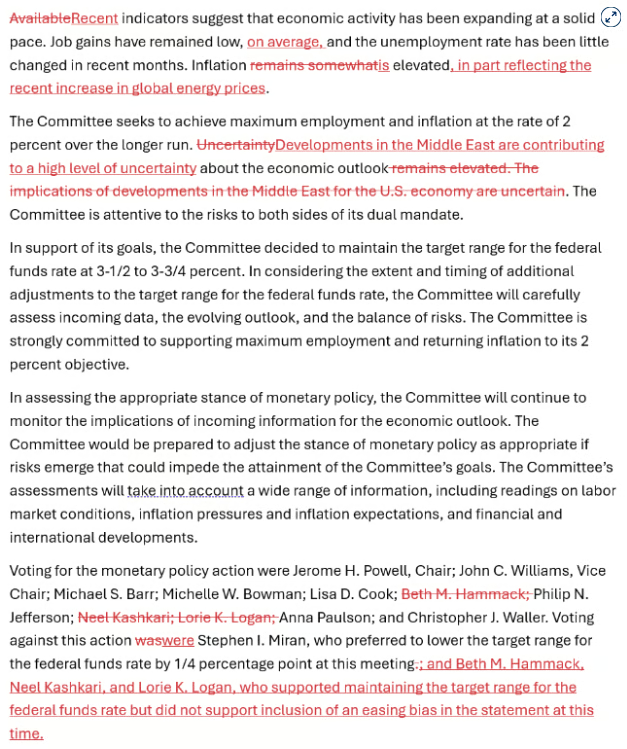
Bitcoin (BTC) extended its two-day decline on Wednesday after the Federal Open Market Committee (FOMC) minutes confirmed the Fed’s decision to hold “the target range for the federal funds rate at 3-½ to 3-¾ percent.”
While the Fed maintains its goal of achieving “maximum employment and inflation at the rate of 2 percent over the longer run,” the FOMC minutes cited the “developments in the Middle East” as factors fueling an environment of “uncertainty” and the Fed stressed its desire to maintain optionality as it evaluates the “risks to both sides of its dual mandate.”
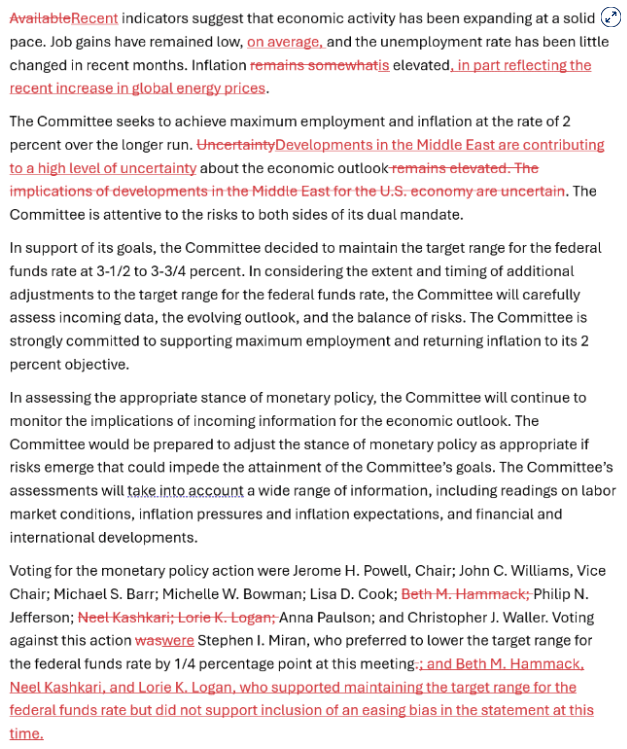
FOMC minutes with new statements in red. Source: CNBC
The Fed’s hold on rates aligned with market expectations, but Bitcoin remained fragile throughout Chairman Powell’s presser.
Hyblock CEO Shubh Varma described the price action as “the usual sell the news reaction after the FOMC,” but also noted that BTC “quickly recovered to pre-announcement levels within hours, showing strong underlying conviction.”
Adding data to back his market view, Varma said,
“The global bid ask ratio spiked to 0.3 (one of the highest readings), while open interest fell on the price drop. This is classic post-FOMC position squaring and stop-hunt behavior rather than conviction selling.”
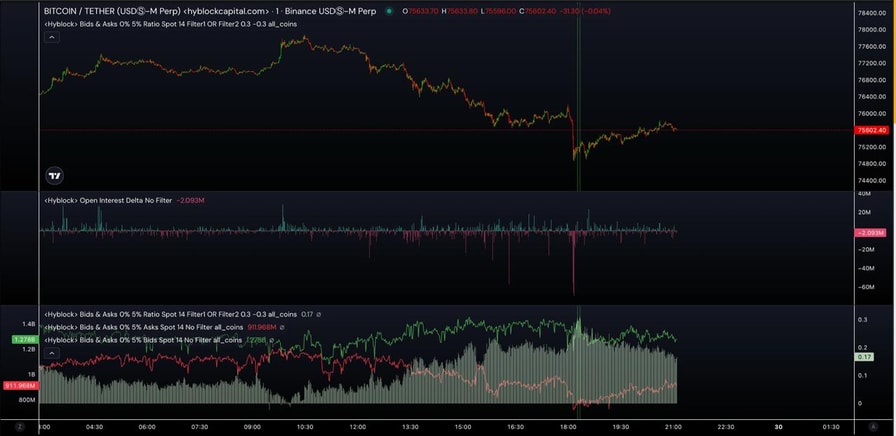
BTC/USDT global bid ask ratio. Source: Hyblock
Will support turn back into resistance?
After the FOMC minutes were published, BTC dropped to an intra-day low of $74,937, slightly below the 20-day simple moving average ($75,664) that some traders identified as critical to confirming BTC’s support-resistance flip.
As reported on Monday by Cointelegraph, following the break above the channel resistance on the daily chart, BTC required consecutive daily candle closes above the trendline, followed by a lower support restest in the $76,500 to $75,500 range.
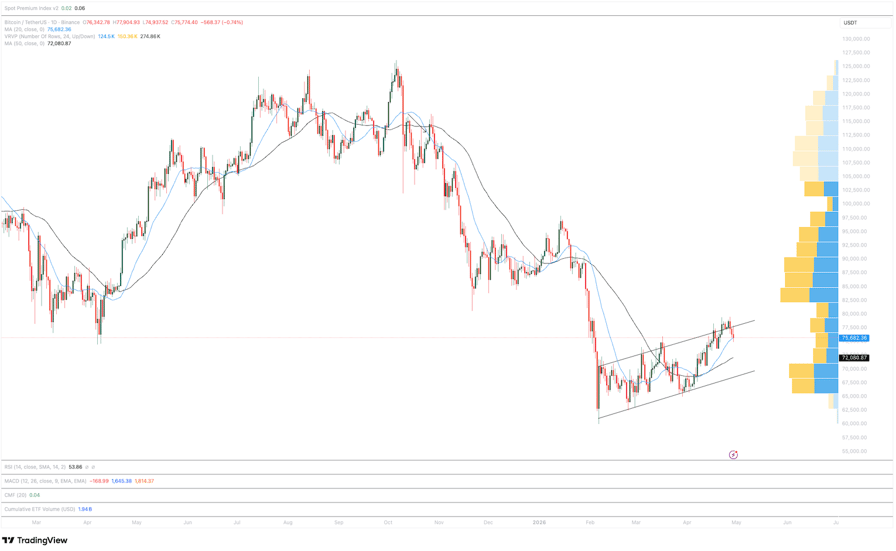
BTC/USDT 1-day chart. Source: TradingView
While all the above have happened, failure to recapture the 20-MA and close above the trendline resistance could be interpreted as a loss of momentum within the bull trend, opening the path for Bitcoin to test the downside boundary of the near-4-month-old channel.
Related: Bitcoin falls as traders cut risk ahead of FOMC: Will Tradfi, spot ETF volumes bolster $70K support?
Prior to the Chairman Powell’s presser, Glassnode analysts noticed that Bitcoin traders were adding bearish leverage, citing rising open interest after Tuesday’s rally to $79,000, funding remaining neutral and a divergence between the spot and futures market cumulative volume delta (CVD).
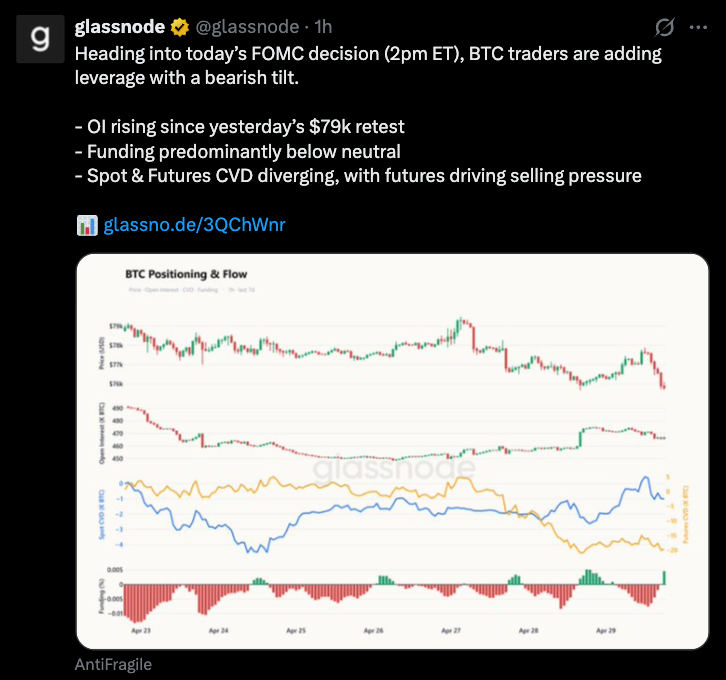
Bitcoin traders turn bearish ahead of FOMC minutes. Source: Glassnode / X
Additional analysis from Glassnode’s The Week Onchain report depicted Bitcoin’s price action as “trapped below market mean,” where $65,000 to $70,000 act as support, but weak demand prevents the formation of sustainable rallies.
According to the report, Bitcoin failed to overcome its True Market Mean at $79,000 and a surge in short-term holders’ profit taking, along with margin futures flipping net short, has sapped away Bitcoin’s shorter-term bullish momentum.
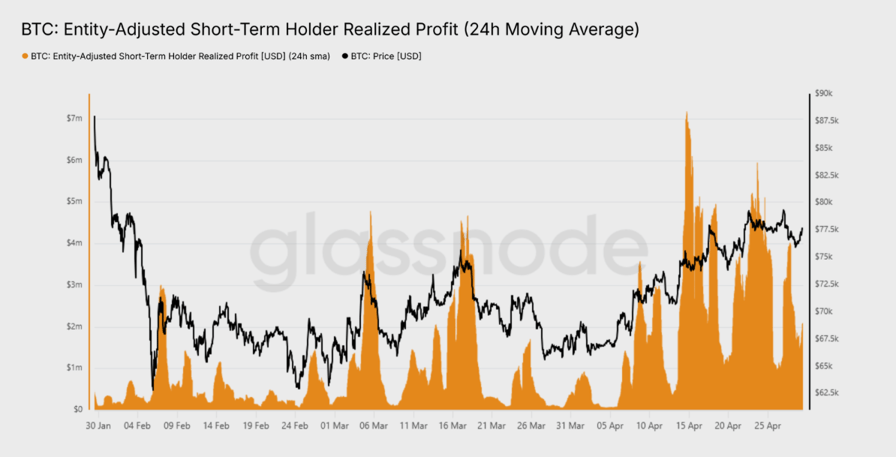
BTC entity-adjusted short-term holder realized profit. Source: Glassnode
While these factors increase Bitcoin’s sensitivity to a sharper downside move, the analysts said institutional flows into the spot BTC ETFs and rising CME open interest have helped to build a “dense accumulation cluster between $65K and $70K.”
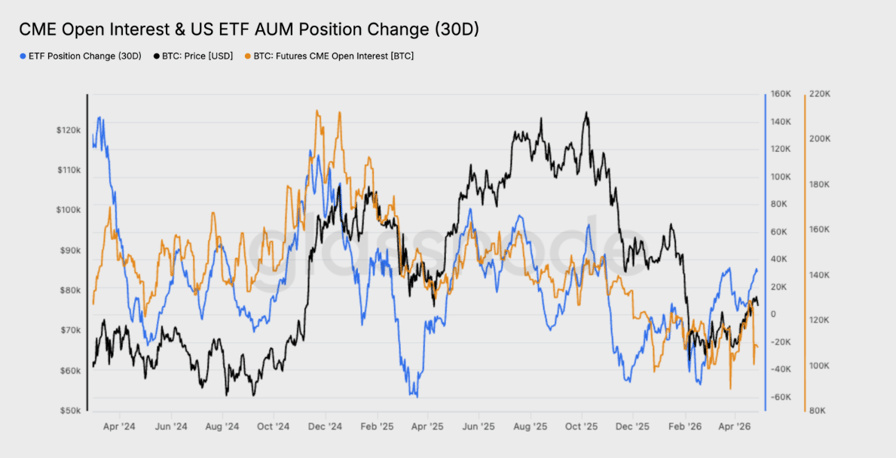
CME open interest, US spot ETF AUM position change. Source: Glassnode
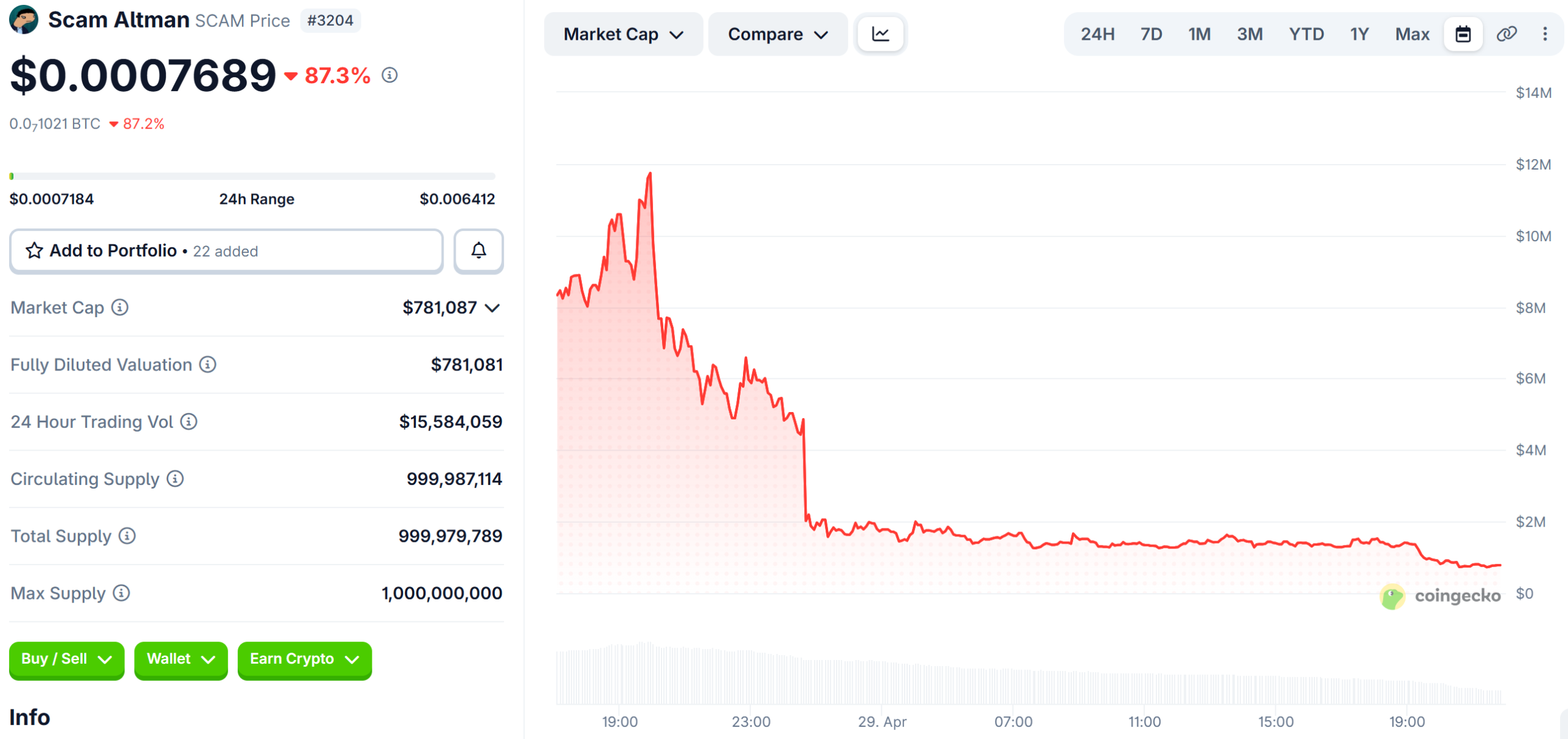
A single Solana wallet lost about $150,000 buying Scam Altman (SCAM) near the top of its launch. The trader sold close to the bottom after SCAM crashed 95% in 24 hours, on-chain analytics firm Bubblemaps reported.
The same address, tagged AuKRRB…L7sN, also dropped roughly $81,000 on UNC and $14,000 on ASTEROID in earlier trades. The three-token streak put combined realized losses at about $245,000 in a single week.
How the Scam Altman Trade Went Wrong
The Scam Altman token launched on Pump.fun this week as Elon Musk’s lawsuit against Sam Altman and OpenAI opened in federal court in Oakland.
Musk spent much of the morning calling the OpenAI chief “Scam” Altman across multiple X posts. Solana traders read the nickname as a tradable meme and raced to mint a token before competitors could.
Within eight hours, SCAM hit a market cap above $10 million on roughly $19.6 million of volume. The peak briefly approached $20 million before sellers stepped in.
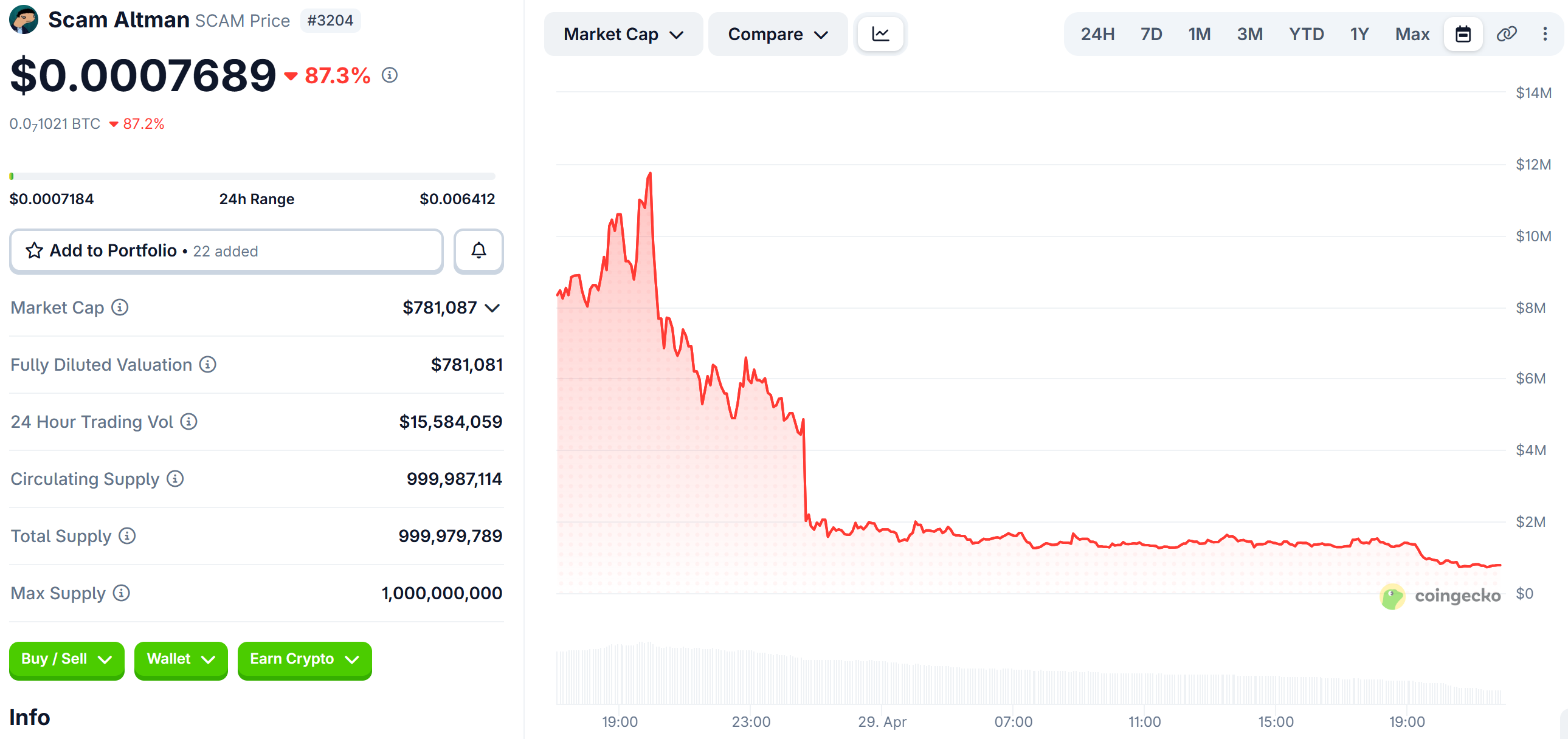
The reversal was equally fast. SCAM shed close to 88% of its value over the next 24 hours. The drop from the highlighted wallet’s entry to its exit reached about 95%.
What Bubblemaps Showed
Bubblemaps shared a post with a visualization of SCAM holders that flagged clusters of interconnected wallets. That pattern often signals insider distribution or coordinated buying on Solana meme coin launches.
The map placed wallet AuKRRB…L7sN inside an active buyer cluster near the top of the chart. Bubblemaps shared a direct map so traders could inspect the wallet relationships themselves.
The same trader’s earlier picks tell a similar story. Wallet AuKRRB…L7sN bought UNC and ASTEROID after each token had already pumped, suggesting late-entry timing on Solana tickers.
A Familiar Pump.fun Cycle
Tokens launched on Pump.fun rarely survive a full trading week. Galaxy Research has argued the meme coin economy rewards bots and snipers, while retail traders absorb most of the losses.
Industry compliance figures put Solana rug pull losses at roughly $500 million in 2024 alone.
SCAM followed the familiar template. A hype-driven launch attracted retail buyers, early holders distributed into the demand, and the chart collapsed within hours.
The token had no whitepaper, no team, and no product. Its only narrative was Musk’s recurring nickname for Sam Altman during the OpenAI trial.
Sam Altman’s existing crypto venture, Worldcoin (now rebranded as World), had no connection to SCAM. The meme coin was an unaffiliated joke trade riffing on the courtroom drama.
Whether SCAM stabilizes or fades will likely depend on how long the Musk and Altman feud dominates crypto X. For the trader behind AuKRRB…L7sN, the bill has already arrived.
The post Trader Loses $150,000 on Scam Altman Token After Elon Musk’s Tweet appeared first on BeInCrypto.

Gibraltar is moving to codify the use of tokenized fund shares within its financial framework, authorizing certain regulated funds to issue shares on distributed ledger technology (DLT) while preserving investor rights. The Protected Cell Companies (Amendment) Bill 2026 would recognize a share token holder as a shareholder with the same rights and obligations as holders of traditional cell shares, linking ownership to asset pools within protected cell companies.
According to Cointelegraph, the proposal would require approval from the Gibraltar Financial Services Commission and targets protected cell companies operating as experienced investor funds. It contemplates blockchain-based share registers for recording ownership, with tokenized shares legally equivalent to conventional share certificates.
Source: Gibraltarlaws.gov.gi
The framework imposes strict custody and transfer controls, restricting access to verified investors and allow-listed wallet addresses, while mandating disclosures on technology risks, cybersecurity, and recovery procedures. Companies would retain control over the underlying infrastructure, keeping the system within a regulated environment rather than an open, permissionless market.
Under the proposal, tokenized shares could be issued and transferred via smart contracts and cryptographic signatures, with blockchain records recognized as valid instruments for ownership, transfer, and recordkeeping under existing company law. The bill must advance through Gibraltar’s legislative process before it can take effect.
Related developments in the digital-asset regulation space have been highlighted by industry coverage, underscoring a broader shift toward integrating tokenized assets into regulated markets.
Source: Gibraltarlaws.gov.gi
Key takeaways
- The Protected Cell Companies (Amendment) Bill 2026 would permit tokenized fund shares to be issued on distributed ledger technology, with token holders treated as shareholders under existing rights and obligations.
- Approval from the Gibraltar Financial Services Commission is required, and the measure targets PCCs operating as experienced investor funds.
- Ownership records would be maintained on blockchain-based share registers, with tokenized shares legally equivalent to traditional share certificates.
- Custody and transfer rules would restrict activity to verified investors and allow-listed wallet addresses, alongside mandatory disclosures on technology risk, cybersecurity, and recovery procedures.
Gibraltar’s tokenization framework in context
The bill envisions tokenized shares that are issued and transferred using smart contracts and cryptographic signatures, with blockchain records recognized as valid under current company law. By keeping the underlying infrastructure within a regulated environment, the approach aims to balance innovation with supervisory oversight and investor protection. The measure would not create a permissionless market; rather, it anchors tokenized equity in a governance and custody framework that aligns with established fiduciary and regulatory norms.
As the legislative process advances, the emphasis on verified investor access and technology risk disclosures points to heightened KYC/AML compliance requirements for PCCs leveraging tokenized instruments. The Gibraltar FSC’s involvement signals a tailored, risk-based approach to tokenized fund governance that could influence similar regimes in other jurisdictions contemplating regulated token markets.
Global momentum: tokenized assets in regulated markets
Gibraltar’s contemplated framework sits within a growing global trend of tokenized assets moving from pilot programs to regulated market infrastructure. Several jurisdictions have advanced tokenized securities under robust legal and supervisory regimes:
- Switzerland: The regulator (FINMA) approved a crypto fund in 2021 for qualified investors and, in 2025, licensed its first distributed ledger technology trading facility to enable tokenized securities to be traded and settled on regulated infrastructure.
- Singapore: Project Guardian, initiated in 2022, tested tokenized assets in wholesale markets as part of a broader exploration of DLT-enabled capital markets.
- Hong Kong: Tokenized government bonds have been issued and expanded since 2023, reflecting active public-sector participation in tokenized finance.
- Global settlement infrastructure: In 2024, the World Bank issued a Swiss franc digital bond on Switzerland’s SIX Digital Exchange with settlement conducted via central bank digital currency, illustrating central-bank–aligned settlement for tokenized debt instruments.
- Canada: In March, a pilot successfully issued and settled its first tokenized bond on distributed ledger infrastructure, marking a notable cross-border development in tokenized sovereign-like debt instruments.
These cases collectively illustrate a shift toward regulated environments for tokenized securities and bonds, combining governance frameworks, custody controls, and supervisory oversight to mitigate risk while expanding access to digital-asset markets. Industry observers have highlighted the importance of aligning tokenized offerings with existing corporate and securities law, AML/KYC standards, and cross-border regulatory harmonization. The European Union’s MiCA framework and parallel U.S. regulatory conversations continue to shape how tokenized assets are treated across jurisdictions, with particular emphasis on licensing, disclosure, and custody arrangements intended to preserve financial stability and investor protection.
In the broader policy context, the ongoing evolution of tokenized asset markets is being tracked for potential implications on licensing regimes, banking integration, and cross-border settlement infrastructure. As Gibraltar demonstrates, regulators appear inclined to integrate tokenized instruments within familiar legal constructs, rather than create entirely new regimes for each innovation, thereby facilitating compliance, audits, and enforcement activities for market participants.
Closing perspective: As tokenization moves deeper into regulated markets, ongoing oversight and international coordination will be critical to address unresolved issues in custody, cyber risk, and cross-border transfer of tokenized assets.
Three meme coins delivered standout gains during April 2026. Dogecoin (DOGE) climbed 13.5%, Pudgy Penguins (PENGU) jumped 53%, and SkyAI rocketed 290% over the month.
The trio reflects three different meme coin strategies. DOGE represents the legacy heavyweight. PENGU is a mid-cap with strong community and intellectual property momentum. SkyAI is the high-velocity artificial intelligence narrative play with explosive price action.
Dogecoin (DOGE) Tests $0.082 Support With Compression Setup
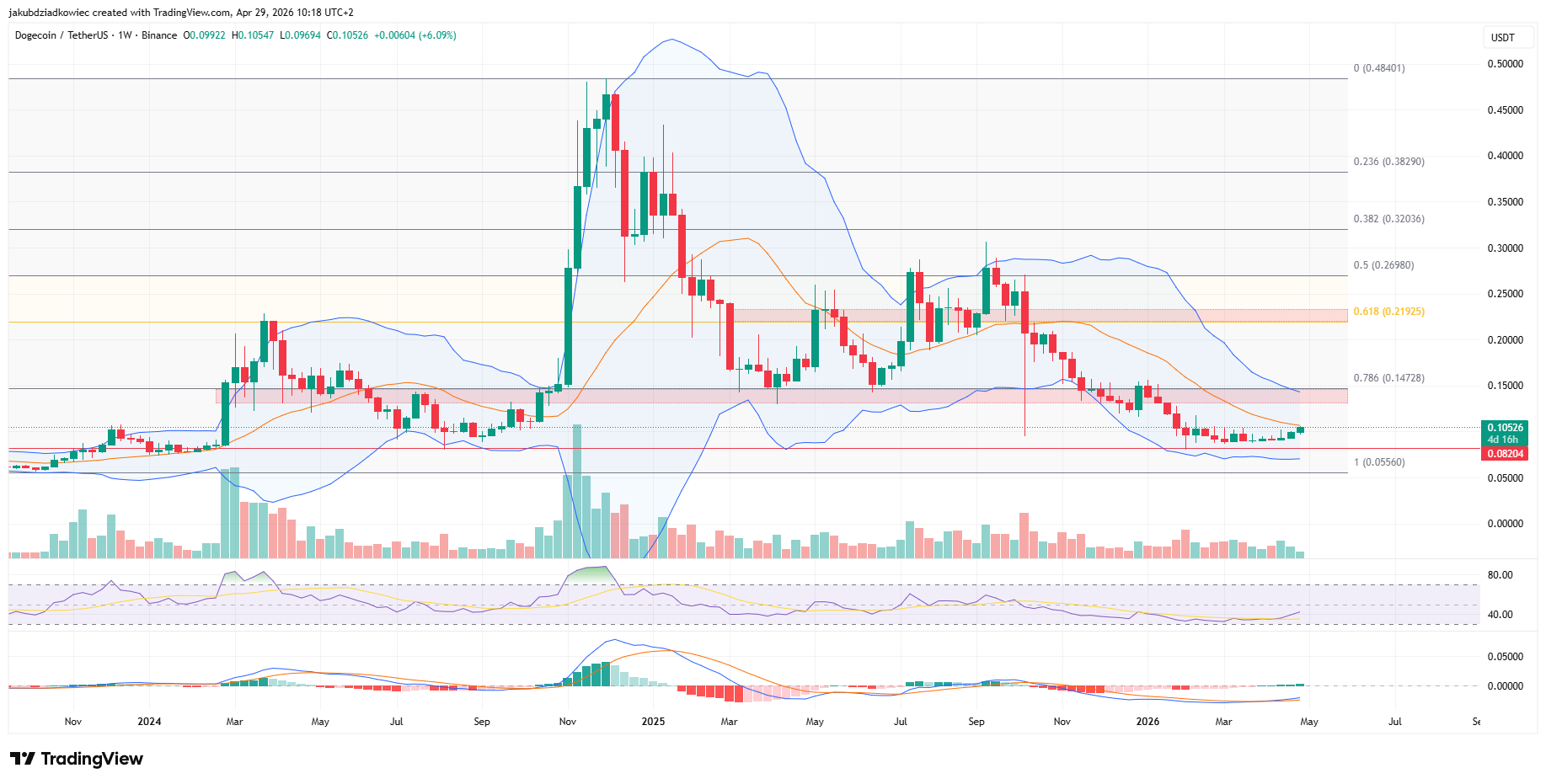
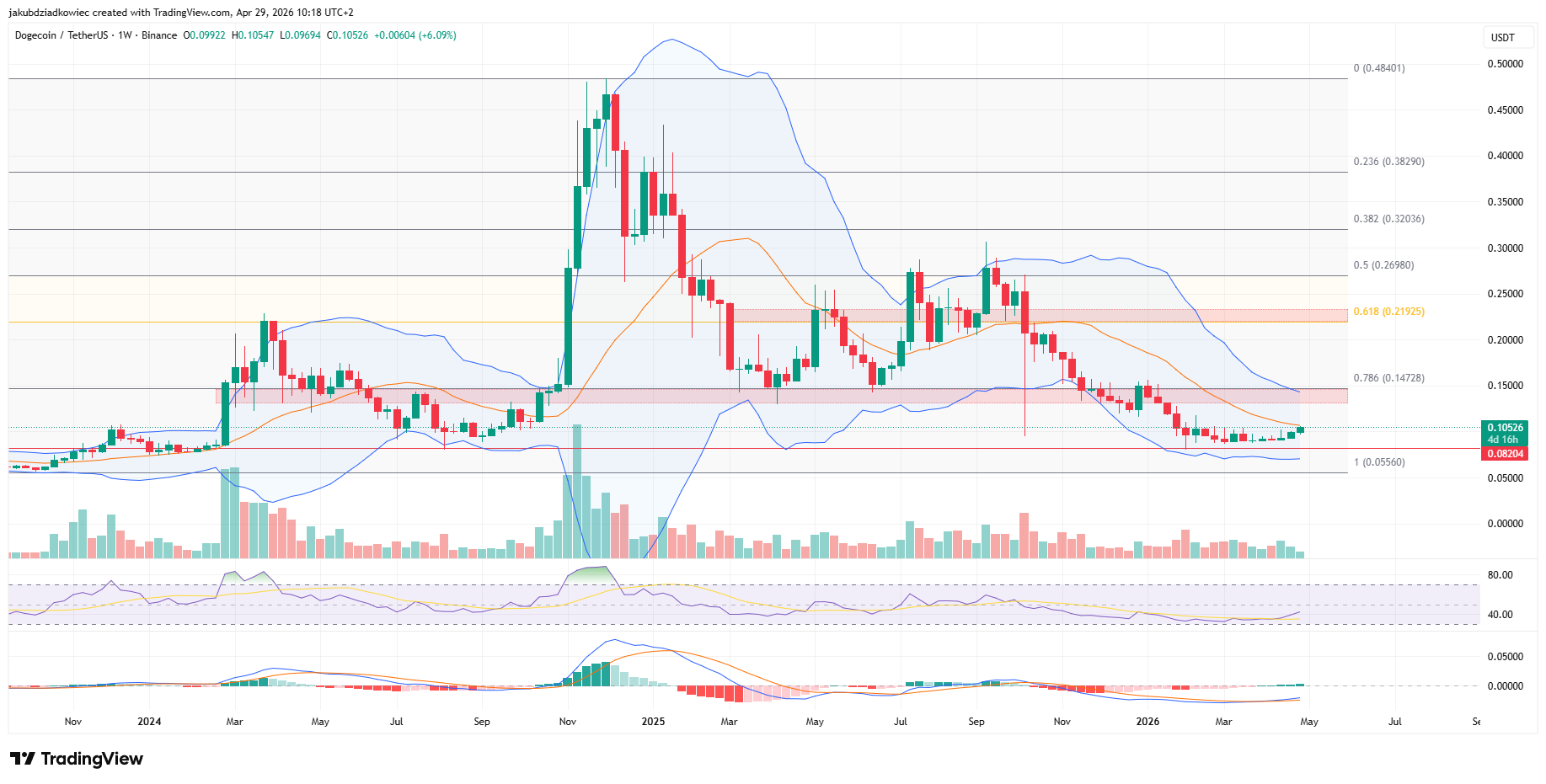
Dogecoin has traded in a downtrend since December 2024, with a secondary peak in September 2025. After several months of weakness, DOGE returned to test the $0.082 zone, which served as support during prior rallies.
The weekly chart now shows green Moving Average Convergence Divergence (MACD) readings and a rising Relative Strength Index (RSI). However, the RSI sits at 43, still below the 50 midline. Bollinger Bands have contracted alongside falling volume, a classic compression signal that often precedes a directional move.
Bulls would need to flip the $0.10 midline of the Bollinger Bands to confirm a trend change. Above that level, the next resistance sits at $0.14, which aligns with the upper Bollinger Band, the long-term resistance, and the 0.786 Fibonacci retracement. A higher target sits near $0.21 at the 0.618 Fibonacci retracement.
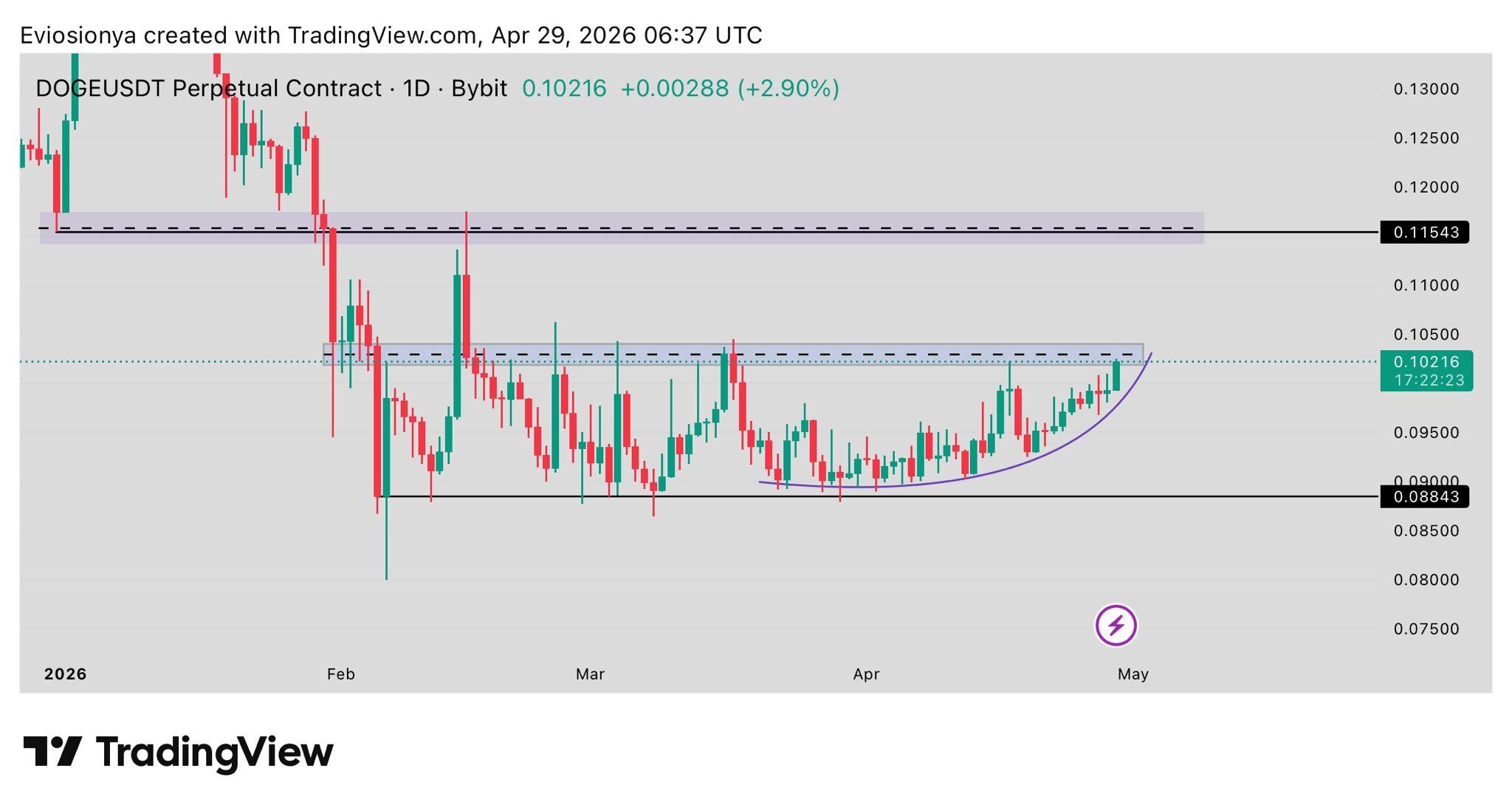
The daily chart adds a near-term layer. X user Eviosionya shared a DOGE/USDT daily chart on Bybit, asking whether a breakout could come “today.” Price at $0.10216 had curved up from a rounded base around $0.0884 and tagged the $0.10500 ceiling that capped April’s range.
A daily close above that ceiling would open a path back toward the $0.11543 supply zone, an outcome that would confirm the weekly compression setup outlined above.
“Breakout today?”
Pudgy Penguins (PENGU) Confirms Breakout, Eyes $0.013
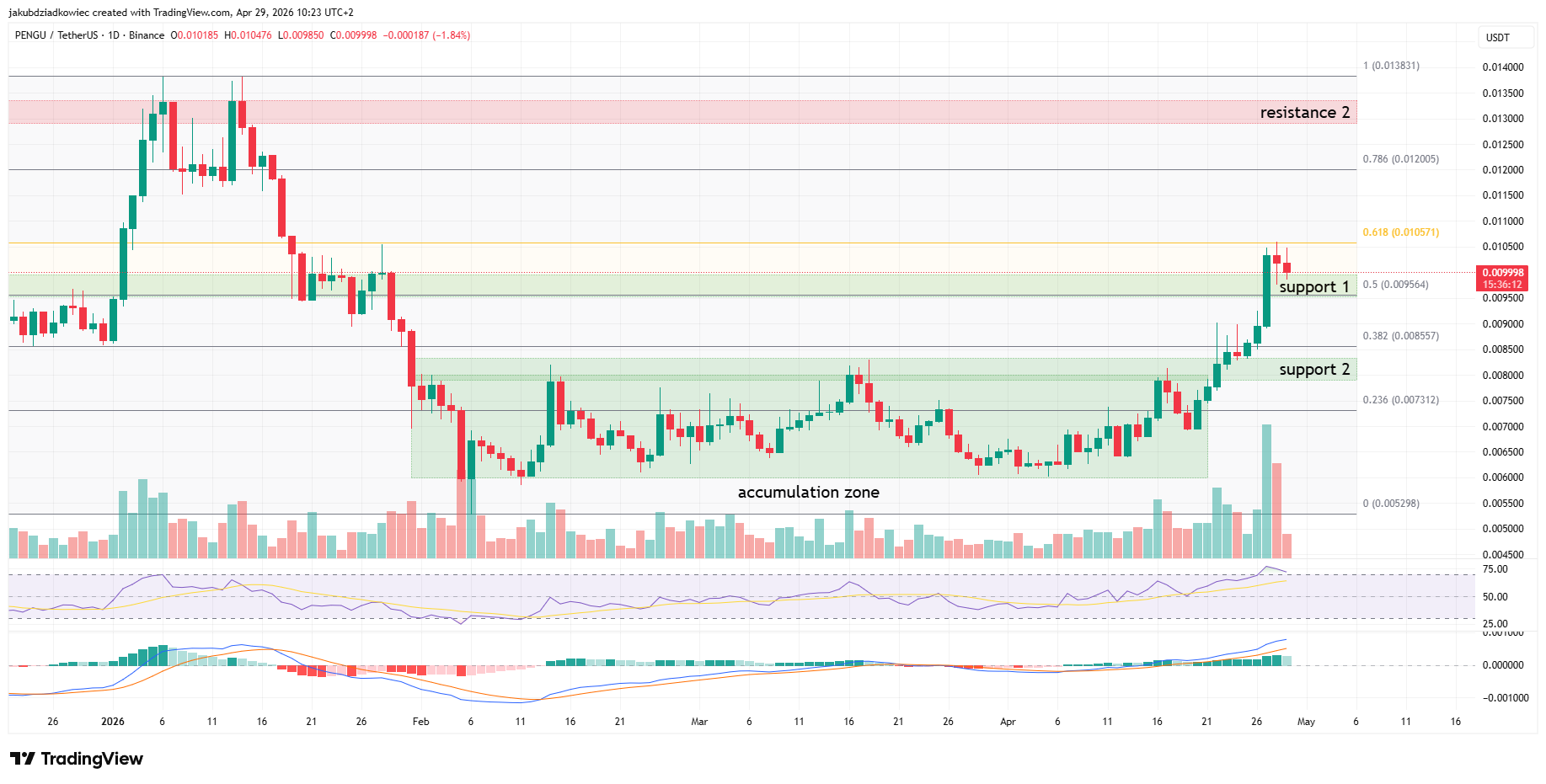
Pudgy Penguins printed a clean breakout on the daily chart. Price cleared a multi-month resistance and now retests it as support, marked as the green Support 1 zone near $0.01.
A successful retest opens the path to the next resistance at $0.013, which lines up with the 0.786 Fibonacci retracement and the prior swing highs from January.
The setup mirrors a pattern flagged in BeInCrypto’s previous PENGU technical analysis from April 23, when the token cleared $0.008 and used the same level as a launchpad.
If the pattern repeats, the 0.5 Fibonacci retracement at $0.0096 should hold as support, driving price into the next resistance area.
Volume printed a sharp spike during the breakout, and both the RSI and MACD remain in healthy bullish territory.
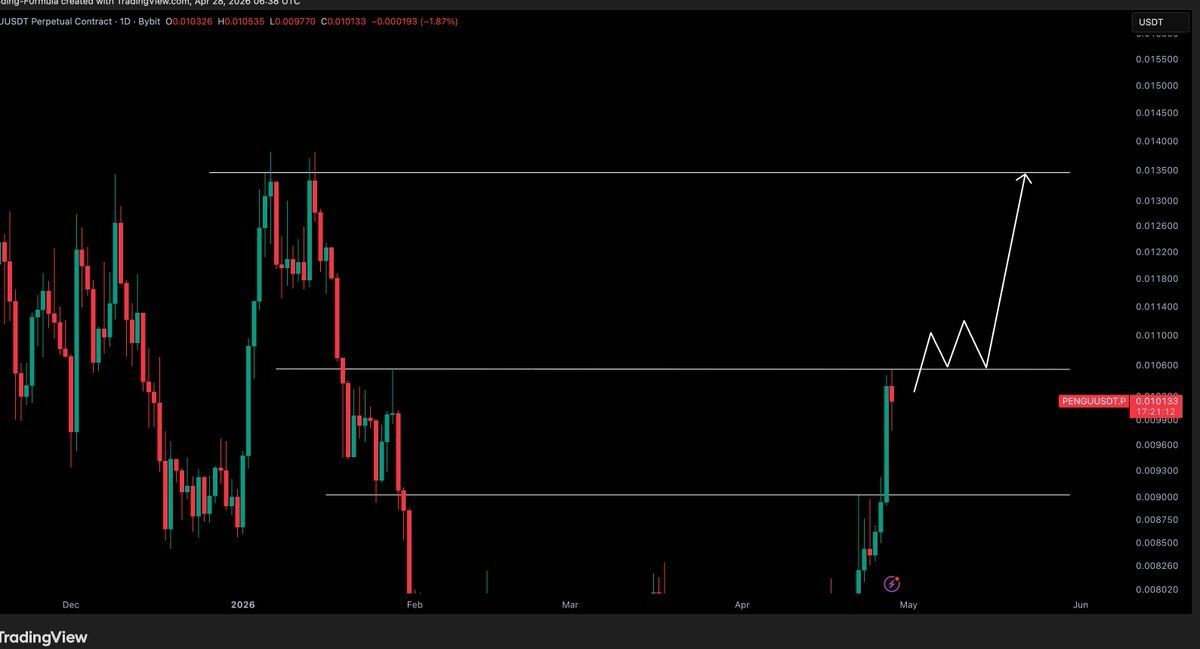
The bullish view found echo on X. CryptoTony shared a Bybit daily chart projecting a path back to the $0.0134 highs, calling PENGU one of the strongest altcoins on his radar.
“$PENGU / $USD – Update One of the strongest Altcoins at the moment. At resistance, but again if we can flip this level then this opens up a solid move to the next highs at $0.0134c?”
SkyAI Stretches Higher After 290% April Rally
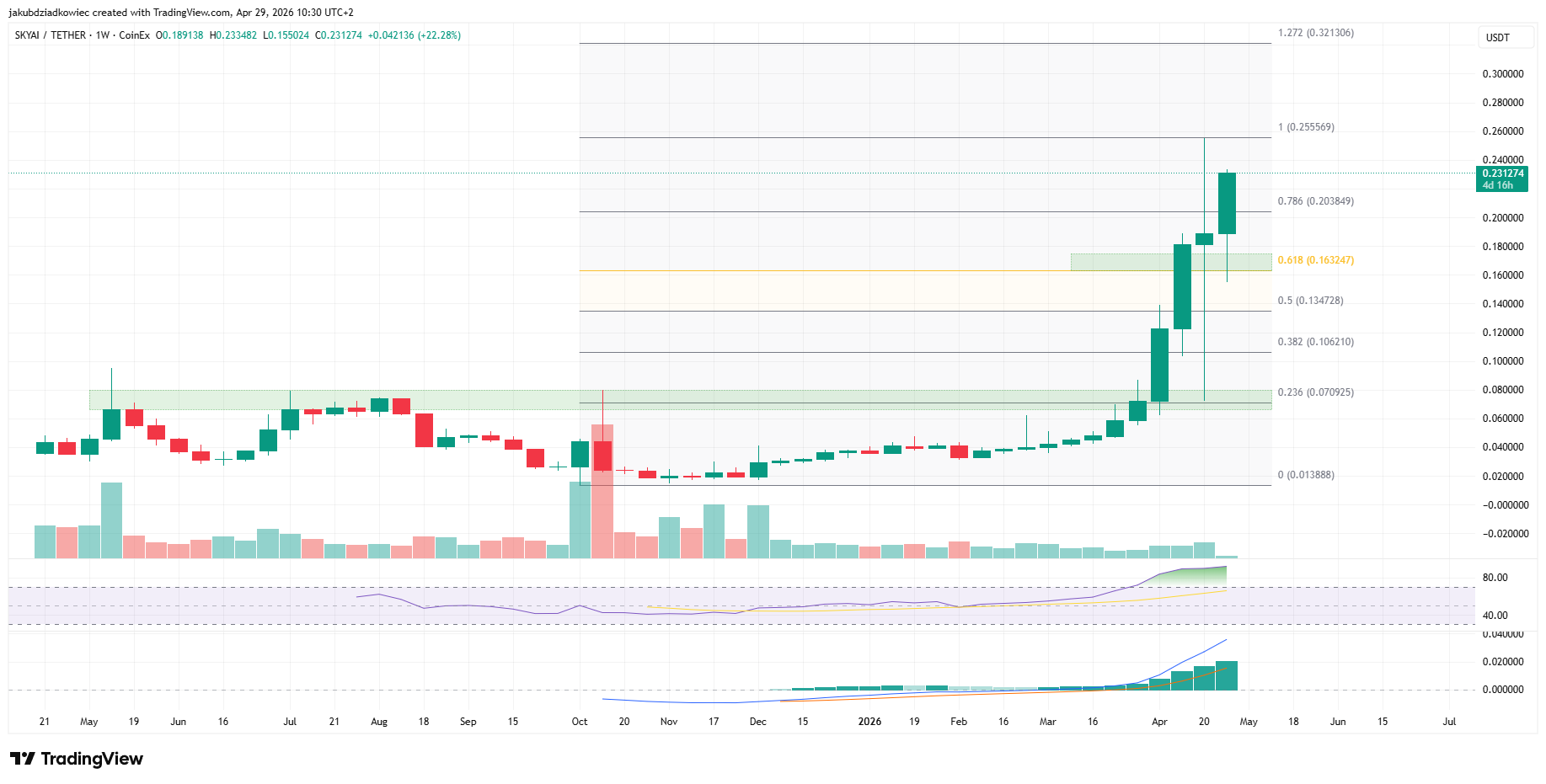
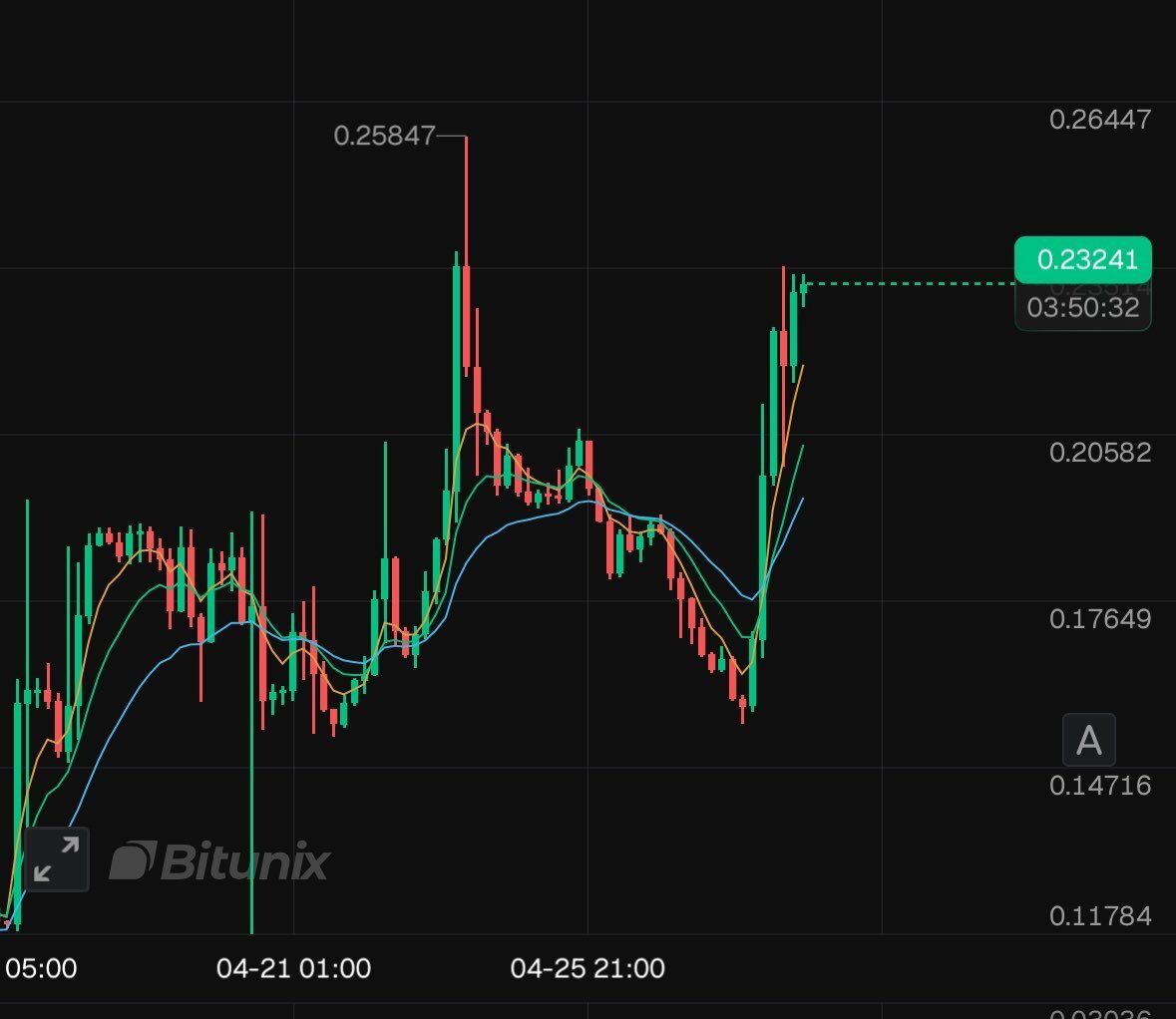
SkyAI has gone parabolic since February 2026. Recent weekly candles printed gains of 70%, 48%, 4%, and 22%, compounding into a roughly 290% advance over the month and placing the token among April’s top meme coin performers.
Such moves rarely sustain at the same pace, but the weekly structure still looks healthy rather than visibly exhausted.
Two support zones stand out. The immediate floor sits at the reversed 0.618 Fibonacci near $0.16. The stronger structural support sits at the reversed 0.236 Fibonacci near $0.07, a level that previously rejected the price three times before flipping into support. SkyAI tested it on April 20 and bounced.
If bulls clear the all-time high near $0.255, the next measured target is the 1.272 Fibonacci extension at $0.32.
A short-term warning came from X user CCally. The 4-hour chart shows SkyAI pushing into the $0.23 to $0.25 supply zone after a vertical impulse with no real pullback, a setup CCally flagged as potentially overextended and at risk of a sharp reversal.
“$SKYAI looking a bit tired up here big impulsive move straight into resistance + no real pullbacks… that’s where traps get set 4H pushing into previous supply around that 0.23–0.25 zone momentum still strong but you can feel it starting to stretch these vertical candles don’t last forever… they snap”
To Sum it Up
The three setups offer distinct risk profiles for May.
DOGE remains a slow-moving compression trade where a $0.10 reclaim is the key trigger and $0.14 the first measured target. PENGU trades on momentum, with the $0.01 retest holding the trend intact and $0.013 the obvious magnet.
SkyAI carries the highest reward and the highest risk, with bulls eyeing $0.32 if $0.16 holds, and a deeper retest of $0.07 possible if the parabolic structure cracks.
The post Top 3 Meme Coins to Watch in May 2026 appeared first on BeInCrypto.
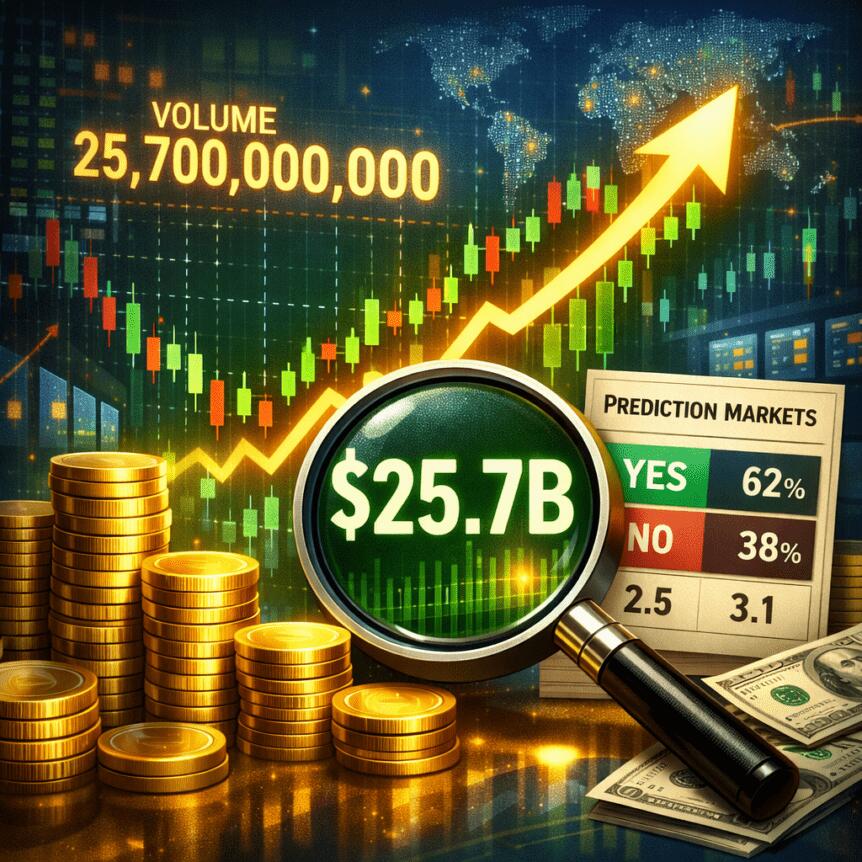
Prediction markets are emerging as one of the most active on-chain applications, driven by a surge in retail participation even as broader crypto markets stay muted. A joint report by Bitget Wallet and Polymarket shows March trading volumes in on-chain prediction markets at $25.7 billion, with more than 80% of users categorized as retail—defined as those trading less than $10,000.
These figures align with data from Dune Analytics, which pegged March trading volume at $23.7 billion, up from $1.9 billion a year earlier. More telling than the raw totals is a shift in user behavior: instead of chasing single, high-profile events, traders are returning more frequently and crossing multiple categories. Average active days per user nearly quadrupled in Q1, rising from 2.5 to 9.9, suggesting deeper and more consistent participation.
Key takeaways
- March on-chain prediction market volume reached $25.7 billion, with retail users comprising over 80% of participants.
- Dune Analytics tracks March volume at $23.7 billion, marking a sharp year-over-year increase from $1.9 billion.
- User engagement is increasing: average active days per user rose from 2.5 to 9.9 in the first quarter.
- Sports markets led activity at $10.1 billion in the quarter, while political markets accounted for about $5 billion.
- Industry projections point to rapid growth, with potential volumes of $240 billion annually in 2024 and longer-term upside toward trillions, supported by capital inflows to major platforms.
From episodic bets to a continuous forecast engine
The new findings depict prediction markets evolving beyond event-driven bets into an ongoing system for tracking real-world developments. This transition appears tightly correlated with how crypto wallets serve as primary access points for users, lowering barriers to entry and enabling broader participation across multiple market segments.
Sports betting, in particular, has become a cornerstone of activity. With a steady stream of global events, the sports category generated $10.1 billion in trading volume for the quarter. Political markets also sustained momentum, contributing $5 billion in the same period. The data imply a demand not just for gambling-style bets but for continuous hedging and information discovery tied to real-world outcomes.
Platform dynamics and access: Polygon, wallets, and the centralized-versus-decentralized debate
Among the leading platforms, Polymarket operates directly on-chain via the Polygon network, enabling users to place bets on real-world outcomes without intermediaries. This on-chain approach contrasts with centralized marketplaces such as Kalshi, highlighting a broader spectrum of architectures shaping the space. Polymarket’s Polygon-based model emphasizes user sovereignty and on-chain settlement, aligning with growing demand for transparent, auditable markets.
The sector’s governance and integrity frameworks have also come into sharper focus. Polymarket has recently updated its governance framework to address risks related to insider trading and market manipulation, reflecting a push toward stronger market integrity as the community scales. Regulatory dynamics, particularly growing acceptance from the U.S. Commodity Futures Trading Commission, have contributed to this momentum and are expected to influence how other platforms approach compliance and risk controls.
Regulatory momentum, capital inflows, and the race to scale
Regulatory clarity appears to be a meaningful tailwind for on-chain prediction markets. As authorities increasingly engage with the sector, platforms are pursuing stronger governance and transparency measures to align with potential safeguards around market integrity. In parallel, major players in the space have attracted substantial investment. Polymarket and Kalshi, two of the sector’s largest platforms, are reportedly raising significant capital at valuations exceeding $20 billion, underscoring confidence in the long-run viability of prediction markets as a crypto-native financial infrastructure.
The growth narrative is supported by projections from industry observers, who anticipate volumes reaching hundreds of billions annually in the near term. If the trajectory continues, prediction markets could become a persistent engine for on-chain activity, with wallets serving as the primary gateways for a broad user base that engages across sports, politics, economics, and beyond.
Implications for traders, builders, and the broader market
The reported shift toward higher-frequency participation has several practical implications. For traders, the expanding array of accessible, on-chain markets could improve liquidity and price discovery across more event categories. For developers and platform builders, the emphasis on governance and anti-manipulation mechanisms will shape product design, risk controls, and incentive structures as the market matures.
For investors, the growing demand for on-chain prediction markets may reflect a broader appetite for crypto-native information markets that combine financial payoff with real-world data. The sustained activity in sports and political markets suggests that the ecosystem is expanding beyond novelty use cases, potentially attracting new cohorts of users who perceive these markets as information tools as well as speculative venues.
Looking ahead, observers will be watching regulatory developments, platform governance enhancements, and continued evidence of user growth across more geographies and event types. The sector’s next milestones could include broader regulatory clarity, new funding rounds for leading platforms, and the emergence of additional use cases that leverage the on-chain trust model to deliver real-world forecasting insights.
Sources: Bitget Wallet and Polymarket joint report; Dune Analytics data on March trading volumes; platform governance updates and market coverage on Polymarket and Kalshi; regulatory context from the U.S. CFTC.

Full Show: Why Retirement Confidence Is Plunging & Fiduciary vs Financial Advisor
King would have probably helped with military strikes against Iran, says Trump

A son overlooked and a jailed tycoon: Inside Samsung's succession drama

Manchester United reach agreement with Casemiro over contract clause amid transfer speculation

US brings back mandatory military draft registration

Steven Gerrard disagrees with Gary Neville over ‘shock’ Chelsea and Arsenal claim | Football


-

 Tech2 days ago
Register Renaming | Hackaday
-

 Fashion5 days ago
Weekend Open Thread – Corporette.com
-
Crypto World4 days ago
Hyperliquid $HYPE Rally Builds Momentum as AI Sector Enters Prove-It Phase
-

 Business6 days ago
Patterson-UTI Energy, Inc. (PTEN) Q1 2026 Earnings Call Transcript
-
 Sports3 days ago
IPL 2026: Ruturaj Gaikwad registers slowest fifty of the season, enters all-time unwanted list | Cricket News
-

 Politics2 days ago
Drax board avoid their own AGM, accused of greenwashing & environmental racism
-

 NewsBeat4 days ago
LK Bennett closes all stores after entering administration
-

 Crypto World6 days ago
Michael Saylor says BTC winter is over. Market analyst disagrees, says bitcoin was in a pullback
-
 Sports7 days ago
Tim Bradley names the current best in the world: “Better than Inoue and Usyk”
-

 Fashion1 day ago
Kylie Jenner’s KHY Enters a New Era with ‘Born in LA’
-
Entertainment7 days ago
Michael B. Jordan and Austin Butler's “Miami Vice” movie will bring the action back to the '80s
-
 Entertainment4 days ago
Mariah Carey Slams Deposition Claims In Brother’s Lawsuit
-
Business7 days ago
Altimmune prices $225 million public offering at $3 per share
-
Entertainment7 days ago
Russell Brand Had Sex With 16 Year Old When He Was 30
-

 Tech2 days ago
Images of Samsung’s rumored smart glasses have leaked
-
Crypto World6 days ago
Is Algorand One of the Few Quantum-Resistant Blockchains? Here’s What the Data Shows
-

 Business1 day ago
Most Commercial Energy Audits Miss the Real Losses
-
 NewsBeat6 days ago
Trump threatens to review UK’s claim to Falkland Islands and punish Nato allies over Iran war disagreement
-

 Business7 days ago
SL Green Realty: Dividend Cut And Record Leasing Fuel Their Potential Recovery
-

 Sports7 days ago
2026 NFL Draft tonight: Time, TV channel, where to watch, order
You must be logged in to post a comment Login