Entertainment
10 Best Film Noir Movies That Are Pure Cinema, Ranked

Ah, film noir, that daring, brutal, and cleverly subversive genre. Taking inspiration from pulp crime books and the German Expressionist movement, noir’s sordid scenarios and pessimistic moods echo the character’s internalized conflicts as well as their world’s suffocating corruption. Human fallibility reigns supreme — hence the tough-talking detectives encased in swirling tobacco smoke, the conniving dames who beguile these brooding men, and the outsiders exiled to, and striving to survive, society’s fringes.
Luckily for audiences who couldn’t (and still can’t) get enough, the novelty of noir’s charms goes down like a smooth shot followed by a pleasantly fraught chaser of labyrinthine mysteries and tremendous pathos. From the style’s classic beginnings (which run gleefully defiant circles around the Hays Code’s regulations) to its neo-noir modernization, the conventions are an unflinching exercise in tone, material, and artistic experimentation. If any vintage examples warrant the term “absolute cinema,” it’s these 10 standard-setting gems.
10
‘Kiss Me Deadly’ (1955)


Mike Hammer’s (Ralph Meeker) investigation into the murder of Christina Bailey (Cloris Leachman), a hitchhiking stranger a group of men tortured to death, uncovers a conspiracy too immense for even an experienced private detective to fix. At first, the situation looks simple; numerous unscrupulous individuals are chasing after a mysterious suitcase. How unfortunate, then, that their target’s glowing contents (parodied in Quentin Tarantino‘s Pulp Fiction) unleash global annihilation.
Arriving at the tail end of the noir movement, director Robert Aldrich and writer A.I. Bezzerides adapt novelist Mickey Spillane‘s Kiss Me Deadly into an incendiary deep-dive into speculative sci-fi, nuclear paranoia, nihilistic despair, and narcissistic masculinity. Cinematographer Ernest Laszlo’s imposing canted angles squeeze the characters into tighter spaces and send them spiraling down nonsensically winding staircases; every visual sign points toward Kiss Me Deadly‘s petrifying ending, where self-serving people meddle with forces beyond their control and the world suffers for their negligence.
9
‘Leave Her to Heaven’ (1945)


Grieving her father’s recent death, socialite Ellen Berent (Gene Tierney) finds solace by falling for Richard Harland (Cornel Wilde) at first glance. The feeling’s mutual, given the effect Ellen’s intoxicating persona has on the men within her orbit. After a whirlwind romance, the newlyweds’ bliss vanishes inch by inch once Ellen’s all-consuming possessiveness perceives everyone in Richard’s life as a threat to her husband’s affections.
Nothing quite like Leave Her to Heaven exists within the Hollywood movie canon. Martin Scorsese hailed director John M. Stahl’s transgressive composite of noir, psychological thriller, and domestic melodrama as a personal favorite, and it’s a rule-breaking formal masterwork. Before Leon Shamroy‘s Oscar-winning cinematography, the genre’s ethical incertitude wasn’t bathed in luxurious Technicolor splendor. And unlike the black widows who spin their enticing webs for money or power, Ellen craves love no matter the cost. Tierney plays her mesmerizing beauty against type; her green eyes stare with blistering intensity, her frame as still and chilling as a coiled viper. Against saturated Southwest vistas and golden sunsets, the underrated performer delivers a femme fatale all-timer who’s simultaneously toxic and sympathetic.
8
‘The Big Heat’ (1953)

Beat cop and upstanding family man Dave Bannion (Glenn Ford) refuses to stop pursuing the truth behind a suspicious death, despite pressure from his superiors and the organized criminals who keep his city within a terrified choke hold. Following a personal tragedy, Bannion’s resolute principles devolve into a vigilante justice crusade.
Fritz Lang‘s directorial career helped define industry standards. Between Metropolis, M, and prior film noirs, he matched German Expressionist visuals with his recurring post-war fatalism regarding exploitative leadership and socioeconomic hierarchies. True to form, The Big Heat defines the phrase of staring into a bleak abyss that stares back. Cinematographer Charles Lang‘s symbolic styling is less metaphorical than Lang’s earlier work but just as effective. Stark close-ups, confined spaces, and precisely placed interplay between light and shadow emphasize Lang’s breathtakingly cruel treatise on self-destructive revenge, systemic corruption, police brutality, and sadistic violence against women.
7
‘Shadow of a Doubt’ (1943)

For the precocious Charlotte Newton (Teresa Wright), her uncle Charlie (Joseph Cotten) equals excitement. Named after the relative she idolizes, his exhilarating visits offer a reprieve from her monotonous small-town life. Yet her handsome uncle’s indulgent affection masks his identity as an infamous serial killer devoid of compassionate humanity. As Charlotte shifts from starry-eyed innocence to grieving resolve, her suspicions endanger her life.
Shadow of a Doubt distills Alfred Hitchcock‘s thematic and tension-driven essence into a trim 108 minutes. Charlotte’s traumatizing coming-of-age maturation hinges upon a young woman discovering the malicious predators lurking just past suburbia’s white picket fences, traditionally suave American masculinity, and even one’s dearest kin. Cinematographer Joseph A. Valentine underscores key emotions (claustrophobic threats, power imbalances, implied unconsummated incest) through classic techniques and subtle metaphors: fastidious zooms, lingering close-ups, Uncle Charlie’s imposing form towering above Charlotte, and the recurring imagery of couples sweeping across a dance floor like uncle and niece waltz around one another — first as seemingly entwined souls, then in a sinister duel.
6
‘The Maltese Falcon’ (1941)

Sam Spade (Humphrey Bogart) just wants to get paid, throw back an excessive amount of alcohol, and go home. He doesn’t even care about his detective partner’s (Jerome Cowan) murder. Nevertheless, the deadly event tosses the reluctant, but sharply curious, gumshoe into the path of three duplicitous gold-diggers. The trio seeks the Maltese Falcon, a legendary statuette artifact said to house an extraordinary treasure trove.
Future two-time Oscar winner John Huston commands The Maltese Falcon with such consummate authority, you’d never guess it’s his directorial debut. The definitive adaptation of Dashiell Hammett‘s novel either launched the noir template into widespread popularity or cemented its clarifying turning point. Everything one expects and desires from a mystery caper operates at an impeccable peak: character archetypes, cinematic atmosphere (cinematographer Arthur Edeson‘s velvet-rich shadows, disorienting compositions, a flowing seven-minute take), hard-boiled dialogue, and convoluted thrills. As for The Maltese Falcon‘s lightning-in-a-bottle cast, Bogart dazzles as a world-weary, deliciously cunning master of acidic one-liners. Set him loose against the slippery Mary Astor, Peter Lorre, and Sydney Greenstreet, and you have an uproariously entertaining fencing match between four onscreen titans.
5
‘In a Lonely Place’ (1950)

Failing screenwriter Dixon Steele’s (Humphrey Bogart) history of volatile rage makes him the primary suspect in a young woman’s (Martha Stewart) murder. His neighbor, Laurel Gray (Gloria Grahame), provides an alibi, and their blossoming romance reinvigorates Dixon’s creativity for the first time since World War II. Meanwhile, Laurel glimpses the softer, redeemed man her lover could become — until her fears about his capacity for violent physical abuse turn their engagement perilous.
Director Nicholas Ray and writer Andrew P. Solt‘s suspense thriller sheds all expectations. In a Lonely Place structures its central mystery around astonishingly mature emotional depth and profound uncertainty, but the focus shifts to a different kind of harrowing tragedy. Known for a tough-guy persona that often leaves his finer-tuned talents unsung, Bogart delivers his career-best performance as a haunted, self-sabotaging, and insecure leading man whose bloodthirsty inner demons are psychologically dissected rather than lauded. He inhabits a palpable vulnerability, like he’s peeling back his skin to reveal Dixon’s self-loathing bones.
4
‘Out of the Past’ (1947)

Accomplished criminal overlord Whit Sterling (Kirk Douglas) hires Jeff Bailey (Robert Mitchum) to retrieve Kathie Moffat (Jane Greer), the young woman who stole Sterling’s money and what little remains of his heart. Jeff knows better than to fall for an insidiously magnetic temptress, yet the detective plunges head-first into a dangerous affair regardless. Years later, Jeff lives under an assumed name, complete with a new profession and a good-girl-next-door lover (Virginia Huston) — all too aware he’s stealing moments until the living ghosts of his past inevitably corner him.
With Out of the Past, Jacques Tourneur demonstrates the same remarkable directorial mastery over art direction, intricate blocking, and melodically despondent atmosphere as his horror masterpieces (Cat People, I Walked With a Zombie). Likewise, older noir has rarely looked more exquisite than under Nicholas Musuraca‘s eye; his chiaroscuro perfection rivals fine art paintings with their contrast between sun-drenched panoramic countrysides and enclosed, menacing urban architecture. Not to be undone, Daniel Mainwaring‘s poetically brittle screenplay leaves a dozen figurative paper cuts. Although Out of the Past‘s winding plot can be an intimidating head-scratcher, one needn’t comprehend the ins-and-outs to be swept away by one of the genre’s defining zeniths.
3
‘Double Indemnity’ (1944)
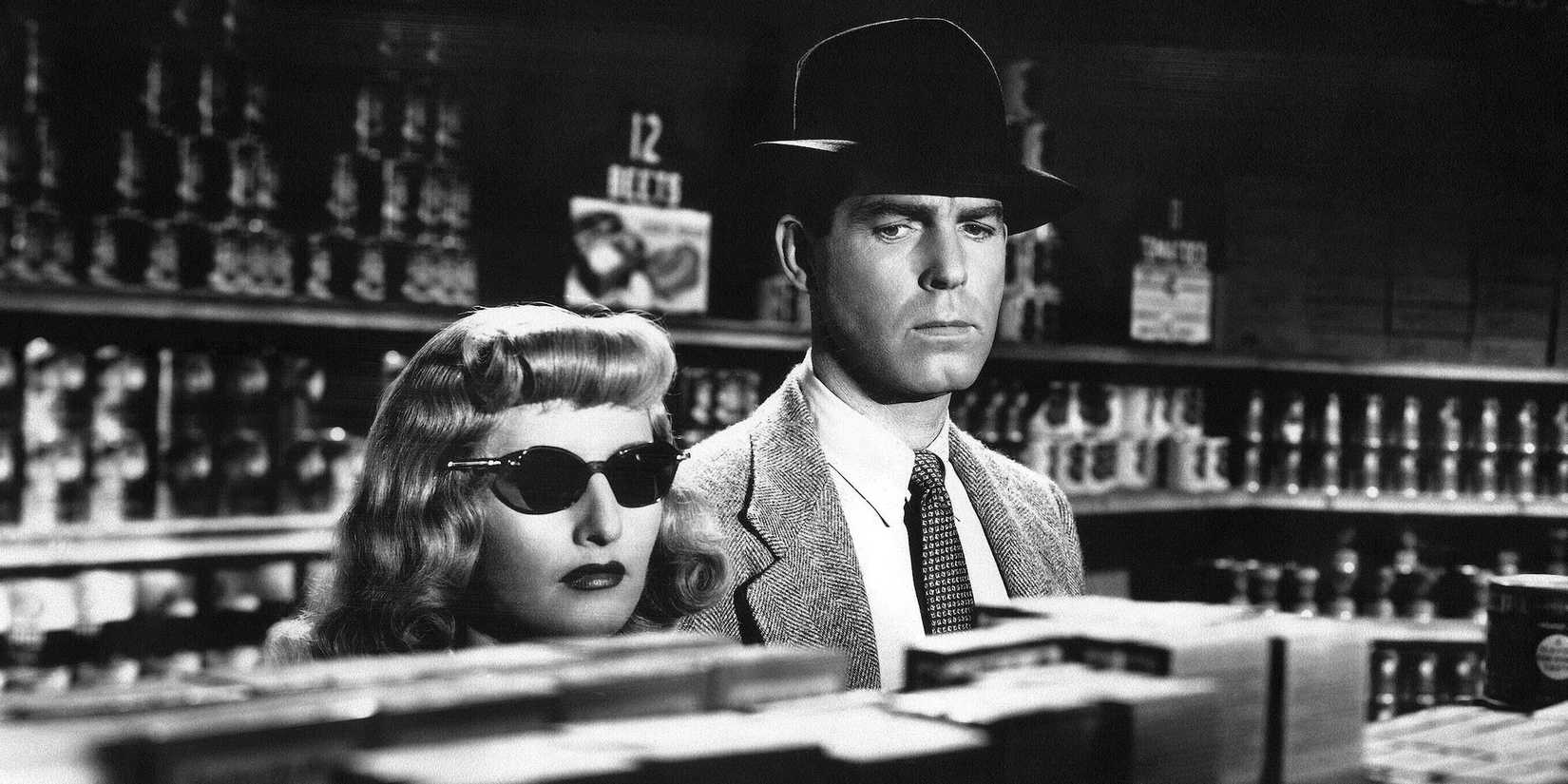
What happens when two amoral opportunists stumble into sexually charged intrigue? Cataclysmic results, of course. Phyllis Dietrichson (Barbara Stanwyck) coaxes insurance agent Walter Neff (Fred MacMurray) into helping her murder her boring husband (Tom Powers) so they can claim his life insurance policy. Craving the fortune and the alluring girl, Neff willingly obliges. However, Neff’s only friend, claims investigator Barton Keyes (Edward G. Robinson), zeroes in on the pair’s not-so perfect crime.
All superlatives for Billy Wilder‘s Double Indemnity are valid, whether those descriptors are “the quintessential noir” or “a perfect movie.” Double Indemnity‘s enduring legacy as a tense, intoxicating elixir without equal would be enough on its own, but Wilder’s first masterpiece arguably popularized the genre’s trademarks and originated the erotic thriller. Walter and Phyllis’ illicit dalliance manifests as sizzling verbal warfare, while the voyeuristic appeal for audiences emerges from watching terrible people indulging their worst impulses. A never better Stanwyck delivers the femme fatale to end all femme fatales — divinely calculating, enigmatic, and assured, strutting like a sultry panther with its claws extended, alternatively carnivorous and playing with her food. John Seitz’s camera either halos Phyllis in beautific light or drenches her in blood-curdling shadows.
2
‘Laura’ (1944)

In an ironic turn of events, detective Mark McPherson (Dana Andrews) becomes infatuated with a dead woman while investigating her murder. Without anyone to advocate on her behalf, business executive Laura Hunt (Gene Tierney) is memorialized through a single glamorous portrait and the biased recollections of enemies wearing friendly faces — specifically, Waldo Lydecker (Clifton Webb), Laura’s ostentatious and self-appointed mentor, her social-climbing fiancé (Vincent Price), and her disdainful aunt (Judith Anderson).
Laura brims with melancholic yearning, depraved perversion, class awareness, and the ways patriarchy crafts an idealized feminine image while oppressing the personality and agency behind the fantasy. For all this solemnity, Otto Preminger‘s disciplined director’s pacing, writers Jay Dratler, Samuel Hoffenstein, and Betty Reinhardt‘s silver-tongued wit, and the underhanded dexterity through which both parties choreograph the mid-way twist are second-to-none. Joseph LaShelle’s hypnotizing work behind the camera sparsely utilizes elongated shadows, preferring to glide through well-lit interiors and place the two-faced ensemble in allegorical profiles. As cinematic as movies come, Laura‘s another pristine triumph that dabbles in, but avoids adhering to, every whodunit rule.
1
‘The Third Man’ (1949)

American novelist Holly Martins (Joseph Cotton) plans to reunite with his old friend Harry Lime (Orson Welles) in Vienna. Upon arriving, Martins discovers Lime allegedly died in a car accident. The eyewitness testimonies, however, are too contradictory for either Martins or Lime’s loyal girlfriend, Anna Schmidt (Alida Valli), to ignore — while the truth about their shared acquaintance is darker than either bargained for.
Shot on location in an Austria freed from Nazi control but divided into four Allied occupation zones, Carol Reed‘s seminal philosophical thriller The Third Man roots itself in the fragile individual ethics and fractured geopolitical landscape of a Europe teetering on the cusp of the Cold War. Welles’ wily smirk personifies the film’s skein of skewering cynicism as much as Reed’s sublime proficiency, Graham Greene‘s crackling dialogue, and Robert Krasker’s baroque framing of the city’s crumbling architecture and scattered debris; the latter, in particular, evokes the scars only war can leave. An indelible and pivotal contribution to movie history, The Third Man remains as fresh and relevant as the day it first hit theaters.


You must be logged in to post a comment Login