Entertainment
10 Best Graphic Novels of All Time

Before jumping into a ranking of the best graphic novels of all time, it’s important to try to establish the difference between graphic novels and comic books. One way to do it fairly simply is by suggesting that graphic novels are like the movies of the comic world, and that comic book series – as in those that are published monthly – are kind of like the TV shows of the comic world.
Things get complicated when some issues of an ongoing series tell a standalone story, though, and then that story might be collected into a graphic novel. You’re not going to please everyone with any definition, and people might get very passionate about this. But if a comic tells a mostly self-contained story, and that story can be (and has been) collected in a single book, then it counts as a graphic novel for present purposes. If you disagree, uh, sorry, or whatever.
10
‘The Crow’ (1989)


The Crow is a story about revenge, to some extent, but it’s also probably more about angst and grief, at least in its original form. The movie version, which is probably a little more famous, does also convey those emotions, but it’s more coherent and straightforward, by design, so the revenge aspect of it all feels more pronounced. The graphic novel, on the other hand, is a good deal more emotionally intense and primal, for lack of a better word.
James O’Barr used it as a way to process the feelings he had after his fiancée died because of a drunk driver. He channeled that grief and anger into a story about a man who, alongside his fiancée, is murdered, and then he comes back from the dead to avenge both his own murder and that of his fiancée’s. It isn’t easy to follow, yet grief itself isn’t really all that coherent or understandable when you’re going through it. In that sense, and as something truly visceral/raw, The Crow succeeds immensely at achieving what it sets out to do.
9
‘From Hell’ (1989–1998)

The first graphic novel written by Alan Moore worthy of mention here is From Hell. Now, this one is pretty long, but it can still be compiled into a physical book, so it feels worth considering as a graphic novel. It was originally published over almost a decade, and is, overall, a very intense and oftentimes genuinely unpleasant story about the Jack the Ripper murders; one that suggests a conspiracy behind them that makes the already horrific killings feel even more difficult to grapple with.
This is one of the most graphic (in terms of violence) graphic novels ever published, and a strong stomach is pretty much required if you want to read it.
There are some interesting directions From Hell goes in, even beyond the historical speculation, and those parts are often the most effective and nightmarish. Speaking of nightmarish, this is one of the most graphic (in terms of violence) graphic novels ever published, and a strong stomach is pretty much required if you want to read it. It’s controversial and challenging for sure, but also very much powerful and unique.
8
‘Uzumaki’ (1998–1999)

The one manga that’s going to be included here is Uzumaki, and if you feel it shouldn’t be, because you think manga works are too different from graphic novels, then too bad. It’s the only manga here, so you’ve got nine other “actual” graphic novels to focus on. Nine out of ten ain’t too shabby. Anyway, this was published over the course of just over a year, originally, with 19 main chapters all up, but all of it can be condensed into a single book that’s a little over 600 pages in length all up.
Basically, Uzumaki is a work of psychological horror that focuses on a town that becomes cursed by spirals. People start to see spirals everywhere, and then this drives them mad, with lives constantly being ruined, and then it just keeps escalating from there. Reading it in whole, the pacing is a bit choppy and repetitive, but there is something inherently unsettling about the whole thing, and the artwork here is undeniably striking and nightmare-inducing… that feels like the most important thing, in terms of inspiring a visceral sort of horror, in all honesty.
7
‘Batman: Year One’ (1987)

It’s very nice of Batman: Year One to summarize what it’s about with the title alone. Like, this is focused on Batman just beyond his origin, capturing the first year or so of his time as the Caped Crusader. If you’re more knowledgeable about movies than comic books and graphic novels, like the person typing this, uh, may or may not also be, Batman: Year One was a big inspiration for the recent 2022 film, The Batman.
There, the origin story of Bruce Wayne/Batman was not focused on, but the Robert Pattinson Batman was someone who was just starting out, and that approach proved more interesting than doing yet another origin story. Batman: Year One is satisfying in a similar way, and is easily one of the best Batman-related graphic novels. Frank Miller was the writer behind this, and there is one other Batman graphic novel he did that’s worth mentioning, for present purposes… but more on that one in a bit.
6
‘Supergirl: Woman of Tomorrow’ (2021–2022)

Thank or blame Supergirl (2026) for putting the spotlight on Supergirl: Woman of Tomorrow, which was eight issues of Supergirl that formed its own arc, and so it’s being counted as a graphic novel here. That 2026 film, which was originally titled Supergirl: Woman of Tomorrow, did make a kind of half-hearted attempt to adapt the comic, and it wasn’t a total miss (like some people might have you believe)… but also, the graphic novel, in this instance, was better.
Much of it comes down to the visuals being a whole lot bolder and more eye-catching in the graphic novel, while the movie looked comparatively drab, outside a few shots here and there. Woman of Tomorrow, across its eight issues, tells a much more compelling story of revenge and redemption, and it’s understandable why it’s already become something of a modern classic, as far as comic books/graphic novels are concerned.
5
‘V for Vendetta’ (1982–1989)

Before From Hell, and another Alan Moore-related graphic novel that will be gotten to in a bit, there was V for Vendetta. This is pretty legendary as far as works of dystopian fiction go, with the setting being a futuristic England that’s in a pretty dire spot all around. Like, Children of Men bad, or maybe even a bit worse. But there is one revolutionary figure known only as “V” who might be able to make a difference, or maybe not. He very intentionally keeps things mysterious, to both his enemies and his (potential) allies.
This Alan Moore graphic novel got a movie adaptation, too, and that movie adaptation is liked by some, but it doesn’t quite hold a candle to the thrilling source material. Moore’s work is generally hard to adapt, and best appreciated in its original form. V for Vendetta is one of those stories where, if it didn’t age well, that’d probably be a sign that the world was headed in a good direction. But it’s about 40 years on, now, from when it was published, and V for Vendetta is, somewhat regrettably, still aging well, and still feeling relevant.
4
‘Persepolis’ (2000–2003)

If you ever ran into someone who thought great graphic novels didn’t deserve to be held in the same high regard as great novels, Persepolis would make for a pretty compelling work to use as a way to show such a person the error of their ways. This is an autobiographical graphic novel by Marjane Satrapi that also happens to be an all-time great coming-of-age book, graphic novel (in its presentation) or otherwise.
The central character here is named Marjane, after the author, and she navigates life in Iran during the 1980s, at the time of the Islamic Revolution, with later parts of the story taking place when she’s a young adult, during the 1990s. It’s about a girl, then a young woman, growing up during a dramatic time in 20th century history, with it being done in an authentic and ultimately moving way. It also inspired a notable – and pretty great – movie of the same name, which was released in 2007, and did an overall good job at translating the material of the graphic novel to the big screen.
3
‘The Dark Knight Returns’ (1986)

Frank Miller returns, here, and so does the Dark Knight, what with this being called The Dark Knight Returns and all. This was published the year before Batman: Year One, and can be contrasted with that graphic novel (or limited series, or whatever you want to call it) in the sense that The Dark Knight Returns is all about an aging Bruce Wayne/Batman doing his thing as he nears retirement, rather than being in, you know, his first year and stuff.
The Dark Knight Returns has not been directly adapted into a live-action film yet, but there are certainly elements here that proved influential for Christopher Nolan’s The Dark Knight Rises. The Dark Knight Returns is better as a graphic novel than that one is as a film, though, and there’s a solid argument to be made that it’s the ultimate – and most compelling – arc in the history of this particular series.
2
‘Maus’ (1980–1991)


Maus is not a particularly long story, but it was completed over a fairly lengthy amount of time, with all the chapters collected into one book ultimately being a graphic novel. It’s something of an autobiographical graphic novel, with author/artist Art Spiegelman putting himself into the work, and having it be about him speaking to his father, Vladek, about his experiences as a Jewish man in the lead-up to, duration of, and then aftermath of World War II.
It’s about the Holocaust, but also about the legacy of those who survived such an ordeal, all done in a brutally honest and sometimes startlingly introspective manner. Maus also makes the artistic decision to depict all its characters as different kinds of animals, depending on their race/affiliation during the war. But it’s still entirely realistic, since this artistic decision doesn’t make it fantastical or anything of the sort. It’s one of those works that’s hard to stop thinking about, once read, and it easily ranks among the most important – and artistically bold – graphic novels of all time.
1
‘Watchmen’ (1986–1987)

If you find subversive superhero stories a bit played out at this point, you can’t be entirely blamed. At least on the television side of things, it almost feels like there are more popular anti-superhero shows than actual superhero shows, thanks to the likes of The Boys and Invincible, to name just a couple. But 40 years ago, when Watchmen was first published, taking a grittier, darker, and more violent approach to comic book/superhero conventions felt a whole lot more groundbreaking.
Watchmen is definitive, in that regard, and essential for pushing superhero stuff forward considerably, in so many ways. There are adaptations of it, but there’s a uniquely apocalyptic and heavy-going feel to the original graphic novel (initially published in 12 issues throughout 1986 and 1987) that’s proven hard to capture in another medium. Even if you’re not usually wild about graphic novels, Watchmen is pretty much required reading. Putting it at #1 here feels equal parts predictable and well-deserved.

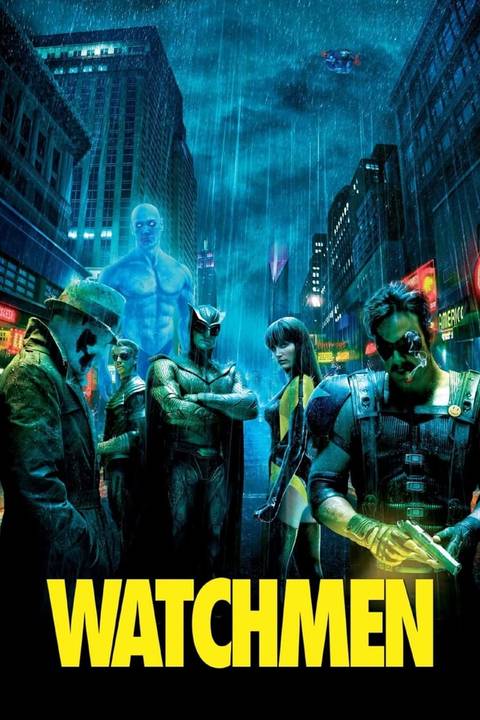
Watchmen
- Release Date
-
March 6, 2009
- Runtime
-
163 minutes
- Director
-
Zack Synder
- Writers
-
Alex Tse, David Hayter, Alan Moore, Dave Gibbons
You must be logged in to post a comment Login