Entertainment
10 Best John Wayne Westerns Ever

John Wayne is the definitive Western movie star, and probably still the actor who is most closely associated with the genre. That’s not to discount other actors from the Golden Age of Hollywood, such as Gregory Peck or Burt Lancaster, who also played many gunslingers, sheriffs, and cowboys; Clint Eastwood is also responsible for creating the modern “spaghetti Western” craze with his performance in “The Man With No Name” trilogy and the many Westerns he directed.
However, Wayne is synonymous with what a Western character feels like because of the groundbreaking work he did with director John Ford, with whom he formed one of the greatest actor-director partnerships in the history of cinema. Although he’s a more versatile actor than he is often given credit for, “The Duke” will forever be known as cinema’s greatest frontiersman. Here are the ten greatest John Wayne westerns, ranked.
10
‘Red River’ (1948)


Red River is one of the darkest Westerns that Wayne ever starred in because he was playing a more villainous character in a much bleaker story. As was the case with many of the films that he made with director Howard Hawks, Red River offered a more authentic depiction of the issues that arose during western expansion, and specifically the relationships between those who chose to live the lonely lives of cowboys.
Red River is a visual achievement first and foremost that features some of the most luscious cinematography of the ‘40s, but the film is best remembered for its famous ending, which saw Wayne going toe-to-toe with Montogmery Clift in a fiery confrontation. Although he is sometimes accused of always playing the same character in every movie, Wayne showed in the concluding moments of Red River that he had the ability to transform and subvert his persona.
9
‘True Grit’ (1969)

True Grit has what Wayne considered to be the single best performance of his career, and is also notably the film that finally earned him the Academy Award for Best Actor. Although he had previously been recognized with nominations for Best Actor for Sands of Iowa Jima and for Best Picture for The Alamo (which he both produced and directed), but True Grit finally gave the Oscars the opportunity to celebrate one of the most famous stars of all-time with a prize given to him by his peers.
True Girt was a perfect role for the end of Wayne’s career because Rooster Cogburn is an older, grizzled character who has come to regret some of the choices in his life. As emotional as the film’s ending was, True Grit also features a healthy amount of humor that showed Wayne’s comedic sensibilities.
8
‘The Shootist’ (1976)

The Shootist was the last film that Wayne ever made and remains one of his most underrated performances. Although it was the story of a grizzled, older gunslinger returning to his old line of work, The Shootist was much darker than True Grit; the film was directed by Don Siegel, a brilliant filmmaker who also helmed the first installment in the Dirty Harry franchise.
Wayne has great chemistry in The Shootist with a young Ron Howard, who plays a young man who is taken under the protagonist’s wing and taught to avoid the path of violence that had become so destructive for him. The film also featured a cameo from James Stewart as a doctor who attends to the wounds of Wayne’s character; it was a heartfelt way of paying tribute to the many films that the two men had starred in together, and because they developed a friendship in real life.
7
‘Stagecoach’ (1939)
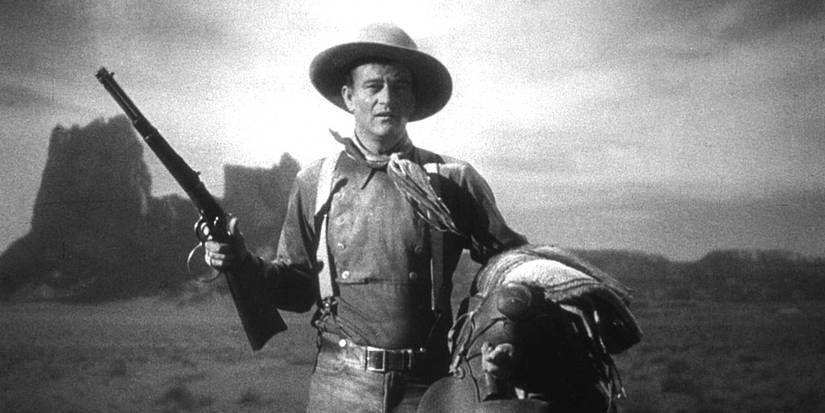
Stagecoach is the film that started it all for Wayne because it was the first film he made with Ford and is considered to be the first “modern” Western. The now iconic scene in which Wayne emerges as “The Frisco Kid” for the first time set the template for how to characterize a movie hero, and has served as an inspiration for such adventure films as Raiders of the Lost Ark and Big Trouble in Little China.
Stagecoach was ahead of its time in exploring how the Wild West drew in characters of different social classes, and what that meant for America during a checkered period in the nation’s history. It’s also one of the few action films from the era that holds up just as well today, as Ford’s techniques for creating suspense have stood the test of time.
6
‘3 Godfathers’ (1948)


3 Godfathers is one of Wayne’s most heartfelt and moving films, and it also doubles as a great Christmas classic. Loosely inspired by the story of the three wise men from the Bible, 3 Godfathers tells the story of three cowboys who become tasked with protecting the infant child of a woman who dies during childbirth.
3 Godfathers showed why Ford’s touch as a director was unparalleled, as he was able to tell a powerful story of faith, redemption, and harmony that didn’t feel saccharine. While it’s a film that is sentimental in a good way, 3 Godfathers still has the rip-roaring action that one would expect from one of Wayne’s pictures; while at the time it didn’t get the same awards traction as some of Ford’s other films, 3 Godfathers has aged well because of how well-rounded of an ensemble it has.
5
‘El Dorado’ (1966)

El Dorado is quite simply one of the coolest movies ever made because Howard Hawks was interested in making a “hangout” story that wasn’t as concerned with plot. Of all the co-stars that Wayne has had in his various films over the years, Robert Mitchum is perhaps the only one who could match him in terms of gravity and pure charisma. However, El Dorado also featured a breakthrough performance from a young James Caan six years before he would become renowned for his role as Sonny Corleone in The Godfather.
El Dorado was a decidedly old-fashioned Western that came out in an era in which revisionist and spaghetti films were beginning to take a hold of the genre, which made its traditionalist perspective feel like such a breath of fresh air in comparison. It also may, line for line, be the most quotable film Wayne has ever been in.
4
‘Hondo’ (1953)

Hondo was a groundbreaking Western in many ways because of its eye-popping visuals and stylized approach to the genre, as it even earned a select release in 3-D. The film also marked one of the rare occasions in which Wayne had a female co-star who was just as awe-inspiring as he was; Geraldine Page gave such a memorable, feisty performance that she actually earned an Academy Award nomination for Best Supporting Actress, an honor that is not often bestowed upon Westerns.
Wayne has the capability to be a compelling romantic lead, but most of his best love stories have been in non-Westerns like The Quiet Man. With Hondo, he was able to merge the two aspects of his career with a unique film that proved there were still ways to innovate with a genre that was just beginning to show its age for the first time in its history.
3
‘Rio Bravo’ (1959)

Rio Bravo is a bonafide classic that is well-respected among famous directors, as both John Carpenter and Quentin Tarantino count it among their favorite films of all-time. It’s another Western adventure that doubled as a “hangout film” because the most important aspect of Rio Bravo is the undeniable chemistry between Wayne, Dean Martin, and Ricky Nelson.
Rio Bravo was produced in response to High Noon, a film that Wayne and Hawks hated because it depicted the main character played by Gary Cooper as being sensitive and reticent to fulfill his responsibilities as a sheriff. High Noon is a masterpiece in its own right, but Rio Bravo’s depiction of three rugged, brave lawmen who survived against incredible odds was a fun alternative that became a great character study in its own right. Even before the terrific final shootout, Rio Bravo is a dialogue-driven story with the intimacy of a stage production.
2
‘The Man Who Shot Liberty Valance’ (1962)
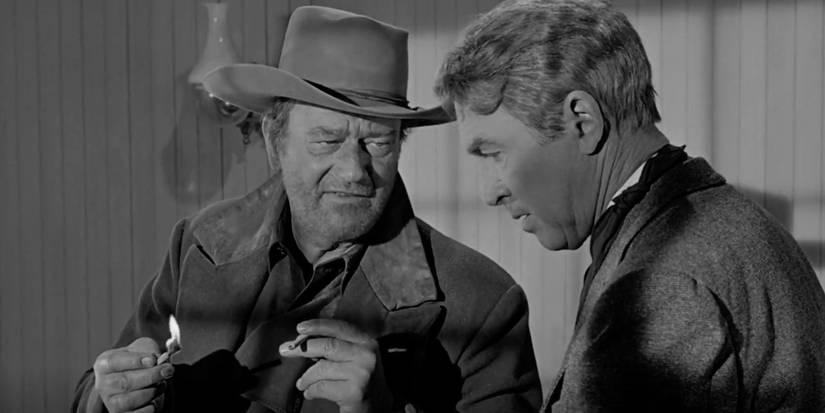
The Man Who Shot Liberty Vallance was a powerful response to the end of the Western era that reflected on the decline of gunslingers in favor of more traditionalist justice. Wayne starred as a no-nonsense lawman who is tasked with the protection of an idealistic politician, played by Jimmy Stewart, who has been tasked with helping a small town grow to be part of the established Union.
The Man Who Shot Liberty Valance examined why Western mythology had become engrained as part of American culture, and showed why these ideals are still clung on to by people who have abandoned the ways of the Wild West. The film’s shocking plot twist, and the iconic final line that accompanies it, were a thoughtful challenge to the history of Westerns that served as a great summation of the work that Wayne and Ford did together.
1
‘The Searchers’ (1956)

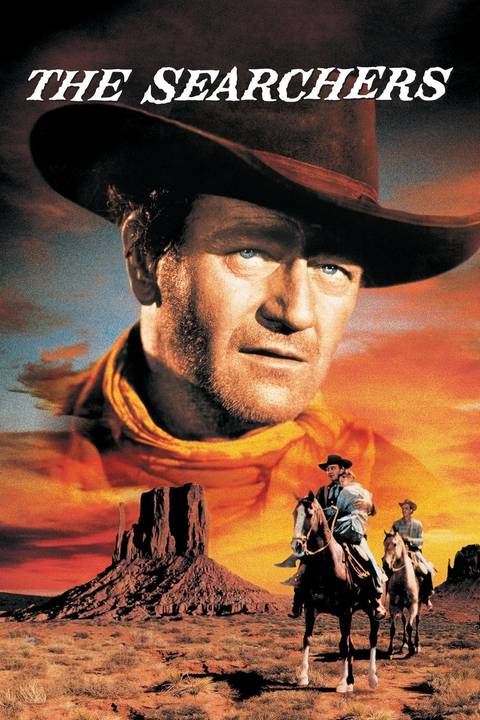
The Searchers is one of the greatest films ever made and features what is likely Wayne’s best character in Major Ethan Edwards, a former member of the Confederate Army that begins a ruthless search for the Native American tribe that kidnapped his niece (Natalie Wood). Although it starts off as a rip-roaring adventure with very clear morals, The Searchers becomes a dark character study because Ethan is an obsessive, dangerous psychopath who has used the disappearance of someone he cares about as an excuse to fulfill his violent fantasies of xenophobic conquest.
The Searchers was a condemnation of racism and manifest destiny that utilized Wayne’s star power to make a searing statement about how the cycle of violence continues. While the film is admired for its gorgeous visuals (including one of the best closing shots of all-time), it was Wayne’s performance that solidified its place in cinematic history.

- Release Date
-
May 26, 1956
- Runtime
-
119 minutes
- Director
-
John Ford
- Writers
-
Frank S. Nugent
- Producers
-
C.V. Whitney
-

-

Jeffrey Hunter
Martin Pawley
