Entertainment
10 Best Movie Endings of the 2000s, Ranked

The 2000s might’ve kicked off a new century, but openings are not the right topic for right now. Just the opposite: endings! Every movie needs an ending, and pretty much every good movie also needs a good ending, because it’s fairly rare to find a satisfying film that has a lackluster conclusion.
That’s certainly not a problem for any of the movies below, with some of them being great throughout and then that greatness continues through to the final scene, while others are generally good movies that get elevated thanks to how effectively they end. There is, inevitably, a need to go into spoiler territory when talking about movie endings, so consider that a pretty casual warning (none of these are new releases, after all, since the 2000s ended, like, about 17 years ago, at the time of writing).
10
‘There Will Be Blood’ (2007)


Punch-Drunk Love was a pretty great Paul Thomas Anderson movie from the 2000s, but There Will Be Blood is the best film of his, not just of the decade, but – some might argue – of his entire directorial career. It’s an epic that’s also very much just centered on one man, being lengthy with its runtime and grand with its visuals, but largely a psychological drama that’s quite intimate (and unsettling) as a character study.
Very slowly, and over many years, Daniel Plainview unravels psychologically, even as he keeps gaining wealth, property, and power. What do you know: it’s never enough. And he explodes at the very end of There Will Be Blood, and it’s at that point that you actually see quite a bit of the titular blood. Oh, not because he literally explodes, but because he beats Eli Sunday to death with a bowling pin. Somehow, it’s the only logical way this film could’ve ended, really.
9
‘Mulholland Drive’ (2001)

One of those “It makes sense once you’ve seen the movie a few times” endings, Mulholland Drive does admittedly conclude in a way that runs the risk of feeling nonsensical the first time around. There’s a switch made going into the final act that’s intentionally disorientating, and feels like a nightmare compared to some (not all) of what came before, but it works more once you catch on to the final act being more reality than nightmare.
There are reasons to consider Mulholland Drive David Lynch’s best film beyond the ending being striking, of course, but the ultimate conclusion does help quite a lot.
There are still surreal sights, including a tiny elderly couple, and still more to unpack beyond “much of the preceding movie was a dream,” but it’s all striking and leaves an impact, more confusing at first, and later deeply troubling and eerie. There are reasons to consider Mulholland Drive David Lynch’s best film beyond the ending being striking, of course, but the ultimate conclusion does help quite a lot in that regard.
8
‘Saw’ (2004)

Sure, Saw is not a perfect movie, and maybe you could even say the ending is imperfect if you want to argue it’s all a bit wild and implausible, but whatever. The ending is awesome. There’s a dead body in a room two men are trapped in the whole movie, and then it turns out the body is not dead, and it’s actually the guy who’s responsible for them being trapped. And he sits up as his whole scheme is unveiled; it’s great.
And it’s kind of silly. The ending to Saw is over-the-top, but it’s here on the basis of it being the right kind of over-the-top, whereas some of the sequels trying to outdo the twist ending here kind of face-planted, or went genuinely too far. There are still fun Saw movies released following the original, especially if you like your soap opera-esque storytelling accompanied by hyper-violence, for whatever reason, but Saw (2004) is still the best, and it’s also the film in the long-running series with the greatest ending.
7
‘Dancer in the Dark’ (2000)

Dancer in the Dark is easily up there among the heaviest musicals ever made, and the ending is a big reason for that. Not that the movie before the final scene is very cheery, but it’s the sort of miserable film where the predicament the main character’s in just gets worse and worse on a scene-by-scene basis, since she’s slowly losing her eyesight and then ends up committing a murder under circumstances that are not well expressed during her trial.
So, she ends up being sentenced to death, and the film slowly builds up to her execution, with the only glimmer of hope being that she successfully got her son an operation to prevent him from succumbing to blindness the way she has. Björk’s acting sells the horror and tragedy of the ending eerily well, as does the realistic and somewhat nauseous way the film’s shot. You almost feel like you’re really there, even though you probably don’t want to be.
6
‘Children of Men’ (2006)

There’s very little peace found throughout Children of Men, which is an overall relentless and unapologetically grim sci-fi/dystopian movie about a world where humanity is at risk of dying out because infertility is affecting the whole population. Yet somehow, a woman gets pregnant, and then she needs to be taken to (what’s purportedly) a safe location, so that no one shifty can get hold of her for their own gains.
It’s a film about saving everyone and everything, showcasing countless sacrifices and horrible things that happen along the way to achieving that goal, including almost every named character but the pregnant woman and her newborn baby dying. At the end of Children of Men, it is probably achieved. There’s some ambiguity, but it’s not really as frustrating because the peacefulness that comes alongside that slight uncertainty is just so welcome after a really brutal and high-intensity film. Also, that very last shot is undeniably visually striking (just like most of the film, really).
5
‘Gladiator’ (2000)

Moving fast for something so long, Gladiator is a real streamlined sort of epic that doesn’t really mess around when it comes to telling a story that’s equal parts straightforward and satisfying. There’s an emperor who’s murdered by his son, and then a general who’s betrayed and becomes a gladiatorial slave, and someone with nothing left but a desire to get revenge.
And so it’s not a surprise when he gets it at the end, and inspires the people of Rome to consider doing away with the Empire and becoming a Republic again (which doesn’t stick, come Gladiator II, but then again, does anyone really care about – or even remember – Gladiator II anymore?). It’s a crowd-pleasing sort of ending to a very crowd-pleasing and easy-to-like epic movie, with even the hero’s death being a moment of catharsis, since he believes in the afterlife and gets to see his murdered family again once arriving there.
4
‘Gangs of New York’ (2002)
In 2002, there was some controversy over the World Trade Center being visible in the final shot of Gangs of New York, but the decision to keep it in feels like the right one now. Martin Scorsese himself explained it well, saying: “The people in the film were part of the creation of that skyline, not the destruction of it. And if the skyline collapses, ultimately, they will build another one.”
And Gangs of New York is a movie about the history of New York City, mostly in terms of its violent past, with the ending montage showing the skyline growing with skyscrapers and all into what was almost the present-day, at the time of the film’s release. The movie itself is quite good before that point, but it’s a case of the ending being the most powerful moment of the thing, and elevating the overall film from good to great.
3
‘Oldboy’ (2003)


Sincerely containing one of the best plot twists in cinema history, Oldboy just ends in the most wildly uncomfortable of ways, but it inevitably makes a twisted sort of sense and feels logical. The main character has been on his own quest for revenge the whole movie, having been imprisoned by someone under mysterious circumstances for 15 years, but then he finds out the truth about why he was kept captive, and it’s a lot, to say the least.
He himself was a target of revenge for an old classmate, and there are some really twisted ways that classmate got vengeance, with the psychological toll ultimately being even ghastlier than the physical toll of the years of imprisonment. Oldboy is great all the way through, but it is one of those films where the ending more or less makes it legendary (well, that or the famed one-shot hallway fight sequence).
2
‘The Mist’ (2007)
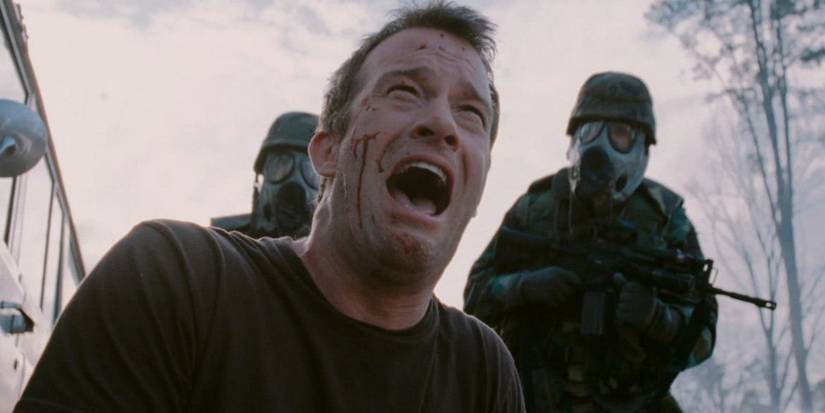
The Mist was a novella that appeared in Skeleton Crew, which was a short story compilation written by Stephen King (The Mist being a good deal longer than most of the other selections there). It’s one of a handful of stories where King tackles Lovecraftian horror, and he does it really well, with the premise involving a group of people trapped inside a small town’s supermarket after the titular mist falls over the town and brings with it countless strange creatures.
2007’s The Mist came out more than 20 years after the novella, so it was a fair time coming, considering some King adaptations are made not long after publication (see Christine, with the book and movie coming out the same year), but it was worthy of the original story. And, famously, it had a more devastating ending that trades in the unease of the novella’s more ambiguous ending for a full-blown tragic one that feels like it could well be the heaviest final movie scene of the 21st century so far.
1
‘The Lord of the Rings: The Return of the King’ (2003)

There was an overwhelming number of things to consider for the ending of The Lord of the Rings: The Return of the King. The source material has a series of endings that go on for much longer than the movie trilogy, which can make the stereotypical complaint about The Return of the King having “too many endings” sound more than a little ridiculous. After a novel that spans well over 1000 pages, there are an additional 100-ish pages of appendices, with much of the writing there feeling like a series of epilogues.
One feels J.R.R. Tolkien not wanting to bid the world and the characters farewell, and you can’t entirely blame him. So, Peter Jackson giving his adaptation a few scenes that feel like endings seems like showing restraint, in comparison. And what was picked here is pretty much perfect, with the final stretch of The Return of the King being both an incredible ending for the third movie in the trilogy, and a beyond fitting conclusion for that trilogy as a whole.
You must be logged in to post a comment Login