Entertainment
10 Essential Green Lantern Comics for Beginners

With Lanterns now charging full speed ahead on HBO, there’s no better time to dust off some issues of Green Lantern. The DC Comics hero originally appeared in the form of Alan Scott in All-American Comics #16 in 1940. Initially, there was no Green Lantern Corps, no alien threats, and no weakness to the color yellow. This Green Lantern had abilities based in magic, joined the Justice Society of America, and helped set the tone for DC’s future. But by the end of the next decade, the character was completely reinvented — and that re-imagining stuck.
Considering Lanterns follows only the Hal Jordan (Kyle Chandler) and John Stewart (Aaron Pierre) incarnations of the character, we’re sticking with their stories for this list of beginner essentials. Sure, Guy Gardner, Kyle Rayner, and Jessica Cruz all have their fair share of great adventures, but Hal and John are not only the most popular iterations of Green Lantern, but are arguably the most relevant at the moment. If you’re enjoying Lanterns and are looking for more, these are some great books to start with.
Showcase #22 (1959)


The Silver Age of Comics came about when several DC Comics heroes, like The Flash, Hawkman, and the Atom, were completely re-imagined in a world that moved away from straight fantasy in favor of science-fiction. Green Lantern got the same treatment in this 1959 issue of Showcase under the direction of writer John Broome and artist Gil Kane. This time around, test pilot Hal Jordan is chosen by the alien peacekeeper Abin Sur, who dies in a crash landing after first bequeathing his power ring and lantern to his successor.
Showcase #22 doesn’t just tell Hal’s initial origin story, but it also boasts his first adventures as Green Lantern. Here, we’re also introduced to his supporting cast, including on-again/off-again lover Carol Ferris and her father. This Showcase issue establishes all the ground rules for the Silver Age Green Lantern, including his traditional weakness towards the color yellow. It wouldn’t be long before Hal was established as one of DC’s most powerful characters.
Secret Origin (2008)

For the modern re-imagining of Hal Jordan’s origins as Green Lantern, there’s no better place to go than Green Lantern: Secret Origin. Penned by Geoff Johns with artwork by Ivan Reis, this retconned origin story takes Hal back to his roots. The core of the aforementioned comic book remains the same, but Johns layers in some additional worldbuilding and foreshadowing as we uncover the truth behind Abin Sur’s death, how Hal was trained by Sinestro, and what all of this has to do with the potential end of the world.
Secret Origin is a streamlined reworking of the most foundational moment in Hal Jordan’s life. It not only honors the stories that have come before (even Emerald Dawn, which was Hal’s longstanding origin following the Crisis on Infinite Earths), but better fits into the larger body of work by Johns, who basically rebuilt the Green Lantern brand from the ground up. For Hal’s beginnings in earnest, look no further than this comic that outshines even the best superhero origin story movies.
DC: The New Frontier (2004)
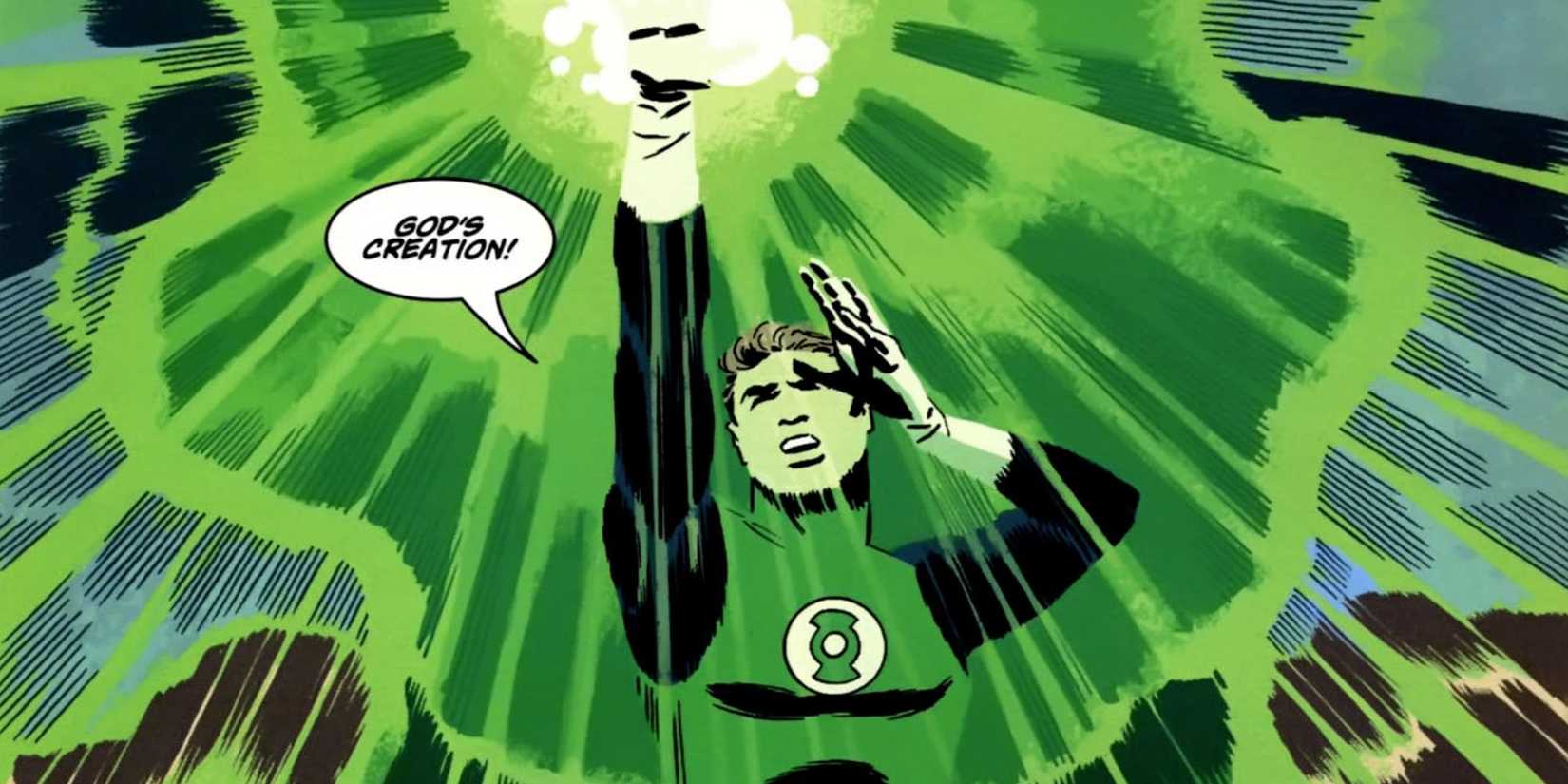
Okay, this is our last origin-related suggestion, but if you’ve never read DC: The New Frontier by Darwyn Cooke, then you’re seriously missing out. The New Frontier honors the Silver Age of DC Comics going back in the 1950s, combining different superhero origin stories (and that of the Justice League of America) into a single, streamlined narrative. Frankly, this is the tale that the modern DC Universe ought to have emulated, as it does wonders at establishing everyone from Batman, Superman, and Wonder Woman to The Flash, Martian Manhunter, and, yes, Green Lantern.
For many, The New Frontier offers the most definitive and old-school version of Hal Jordan. A pilot who served during the Korean War, Hal soon finds himself with the power of a Green Lantern, just in time to save the entire world from a powerful threat. It may not be a standalone Green Lantern story, but it is easily among the best. The series was later adapted into an animated film, Justice League: The New Frontier, which is arguably a near-perfect DC Comics adaptation.
Green Lantern #87 (1971)

While Hal Jordan may be the best and most important Green Lantern, even he needs a backup. In the early 1970s, Green Lantern #87 introduced the third man to sling the ring after Hal: John Stewart. When Hal’s previously chosen backup, Guy Gardner, is literally hit by a bus, the Guardians decide that Hal needs another potential replacement in case he is unable to fulfill his duties. They choose John Stewart, and though Hal takes some issue with it at first, they eventually come to terms.
Penned during Dennis O’Neil and Neal Adams‘ famous Green Lantern/Green Arrow run, John Stewart’s introduction is a bit dated compared to contemporary versions of the character, but it’s still the best place to start. While modern origin stories find alternative methods to give him the power ring (Secret Origins #9 from the New 52 era reveals that the Guardians chose him after first sending a Manhunter to his doorstep as a test), it was his first appearance that set the tone for the character in the years to come.
Mosaic (1992)

Eventually, John Stewart became the primary Green Lantern after Hal left the Corps behind. For some time in the ’80s and into the ’90s, John held the title. Eventually, John became the first human Guardian of the Universe. But after the events of Cosmic Odyssey and several issues of Green Lantern, he headlined his own new series titled Green Lantern: Mosaic — it’s a bit controversial, but vital to the character.
For 18 issues, writer Gerard Jones and primary artist Cully Hamner explored John’s PTSD after his failure to save the planet Xanshi. Now the caretaker of the Mosaic World created by a rogue Guardian utilizing species from various worlds, the false utopia wouldn’t have lasted long without John to oversee it — and, indeed, it didn’t last long anyway, though that was beyond John’s control. Mosaic challenged the hero in ways future stories often failed to, proving why he is one of Earth’s most notable Green Lanterns.
Emerald Twilight/New Dawn (1994)

When the folks at DC decided that Hal Jordan had served his usefulness as a superhero, writer Ron Marz and artist Darryl Banks (mostly) were handed the keys to the kingdom to break him down. Following The Return of Superman, Hal’s home of Coast City has been annihilated by the Cyborg-Superman and the alien warlord Mongul. This drove Hal over the edge as he attempted to do everything in his power to restore his home and those in it — only, the Green Lantern Corps stood against him.
In Emerald Twilight, Hal becomes the supervillain Parallax, a powerful DC villian who hoped to rewrite time to save Coast City. In the process of attaining this power, he strips John of his powers, destroys the entire Green Lantern Corps, and even kills Sinestro and Kilowog, among plenty of others. It’s a massacre, but it’s vital for one’s understanding of Hal Jordan’s redemption arc later on. The arc ends with the introduction of the last Green Lantern, the torchbearer named Kyle Rayner, who is further explored in New Dawn.
Rebirth (2004)

If Emerald Twilight was disappointing, we have good news for you. Over the next decade or so, DC crossovers like Zero Hour and Day of Judgment proved that there was still good within Hal Jordan, and writer Geoff Johns and artist Ethan Van Sciver proved as such with Green Lantern: Rebirth. Eventually, Green Arrow killed Parallax and Hal’s soul was then merged with the Spectre, DC’s Spirit of Vengeance, as a means of atonement. In Rebirth, Hal is finally resurrected and the mystery of Parallax is revealed.
With the help of Kyle Rayner and newly re-minted Green Lanterns John Stewart, Guy Gardner, and Kilowog, Hal returns from the grave, finds his old power ring, and faces Parallax — revealed to be the alien entity of fear behind the traditional Green Lantern weakness to the color yellow — redeeming himself and taking his place among Earth’s other Emerald Guardians. It’s a great story, and it kicked off Geoff Johns’ decade-long run on Green Lantern that completely redefined the mythos. This is one you simply must read before Lanterns concludes.
Sinestro Corps War (2007)

Speaking of Geoff Johns, you should probably read his entire Green Lantern chronology that spans from Rebirth to the entire fourth volume of Green Lantern that ran between 2005 and 2011 to the first 20 issues of the fifth volume (set during The New 52 era). However, if you don’t have time to devour the entire space epic (and it truly is epic), settle for one of the greatest DC Comics storylines of all time in Sinestro Corps War.
Here, Johns’ teams up with artist Dave Gibbons as the four Corpsmen of Earth (Hal, John, Guy, and Kyle) work alongside the recently re-established Green Lantern Corps to battle the resurrected Sinestro and his own, well, Sinestro Corps. It’s green versus yellow in a battle of the imagination, with willpower overcoming fear in front of the entire DCU. This thematic sequel to Rebirth re-establishes both the bond and the rivalry between Hal and Sinestro, and even challenges John, Guy, and Kyle’s own fears in the process.
Blackest Night (2009)

The third and final installment of Johns’ epic Green Lantern trilogy (though not the end of his epic run on the character), Blackest Night capitalizes on pop culture’s obsession with zombie media at the time by using the villainous Black Hand to resurrect all of DC’s most beloved dead characters as members of his nefarious Black Lantern Corps. Penned by Johns with artwork by Ivan Reis, Blackest Night is definitely a DC story we’d love to see adapted to the live-action DC Universe.
Blackest Night not only includes the eight-part miniseries itself, but also several issues of Green Lantern and Green Lantern Corps. These tie-ins challenged Hal Jordan’s own fears and doubts after watching his loved ones return and tormented John Stewart with the lives he was unable to save. It’s an exceptional DC crossover event centered entirely around the popularity of the Green Lantern comics at the time.
War Journal (2023)

Since Hal has had a lot of the spotlight here, let’s pivot a little to John with Green Lantern: War Journal. Here, writer Philip Kennedy Johnson and artist Montos present a largely standalone story that explores John’s complex background. After John retires due to the events of Dark Crisis, he finds himself back home caring for his mother, only to be pulled back into superheroics once again.
War Journal is perhaps not an essential Green Lantern read as far as the larger mythos are concerned, but it’s a detailed exploration of who John Stewart is that may just help readers to better understand the character. In 12 issues, John makes peace with his past and flies forward into his future as Green Lantern. If you liked this one, give John Stewart: The Emerald Knight a try as well. It may never be turned into a DC TV masterpiece, but if you’re looking for more John Stewart, it’s definitely the way to go.


You must be logged in to post a comment Login