Entertainment
10 Forgotten Sci-Fi Movies That Are Perfect From Start to Finish

Lots of science fiction movies slip through the cracks because they arrived at the wrong time, only finding audiences years or even decades later. Often, these are the films that took strange risks: paranoid identity puzzles, philosophical nightmares, low-budget cosmic mysteries, or surreal dystopias.
This list looks at some of these films, from neon-soaked cyberpunk thrillers to existential mind-benders. While the titles below aren’t that obscure, they’re still the kinds of movies that many sci-fi fans might not have gotten around to seeing yet. They provide fascinating, thought-provoking stories guaranteed to stay with the audience long after the screen fades to black.
‘The Face of Another’ (1966)


“Do you think a face is just something you wear?” This Japanese New Wave gem centers on a disfigured man (frequent Akira Kurosawa collaborator Tatsuya Nakadai) who undergoes an experimental procedure to receive a lifelike mask, allowing him to re-enter society. However, as he adopts a new face, he also adopts a new personality and a new identity, testing boundaries he never would have crossed before, including attempting to seduce his own wife (Machiko Kyō).
The sci-fi elements are minimal here, used more as a springboard for existential musings. Who are we without the face others recognize? How much of morality is tied to identity? On release, The Face of Another flopped internationally, with most critics finding it inferior to director Hiroshi Teshigahara‘s earlier effort, Woman in the Dunes. However, it rewards those who stick with it with a lot of food for thought.
‘Enemy Mine’ (1985)


“You are my enemy… but you are also my friend.” In this one, two soldiers from opposing species crash-land on a hostile planet and are forced to survive together. They are human pilot Davidge (Dennis Quaid) and his reptilian Drac enemy, Jeriba (Louis Gossett Jr.), and they must overcome mutual hatred if they hope to have any chance of enduring the planet’s harsh conditions. This quirky space-opera setup builds up into an entertaining story about friendship.
Enemy Mine was directed (of all people) by Das Boot‘s Wolfgang Petersen, and he gets ambitious with the themes, going way beyond your average ’80s sci-fi flick. The film delves surprisingly deep into Drac psychology and society, telling us a lot about their religion, family structures, and ideas about lineage and honor. Ideas aside, Petersen also serves up some wonderful practical effects here that give the movie some old-school charm.
‘The Hidden’ (1987)

“How do you like being human?” What if a violent criminal could jump from body to body, leaving a trail of chaos behind while wearing the faces of ordinary people? That’s the pulpy, kinetic premise of The Hidden, a movie that confidently blends sci-fi, action, thriller, and even touches of horror. Kyle MacLachlan and Michael Nouri lead the cast as the FBI agents tracking the killer, who turns out to be a parasitic alien that transfers between hosts.
The flick moves with relentless momentum from its opening scene, hitting us with one killer chase sequence after another. It becomes a tense cat-and-mouse game, with the entity constantly shifting identities, forcing the protagonists to think on their feet. It’s the kind of movie that should not work but does thanks to committed stars and some confident direction.
‘Cube’ (1997)
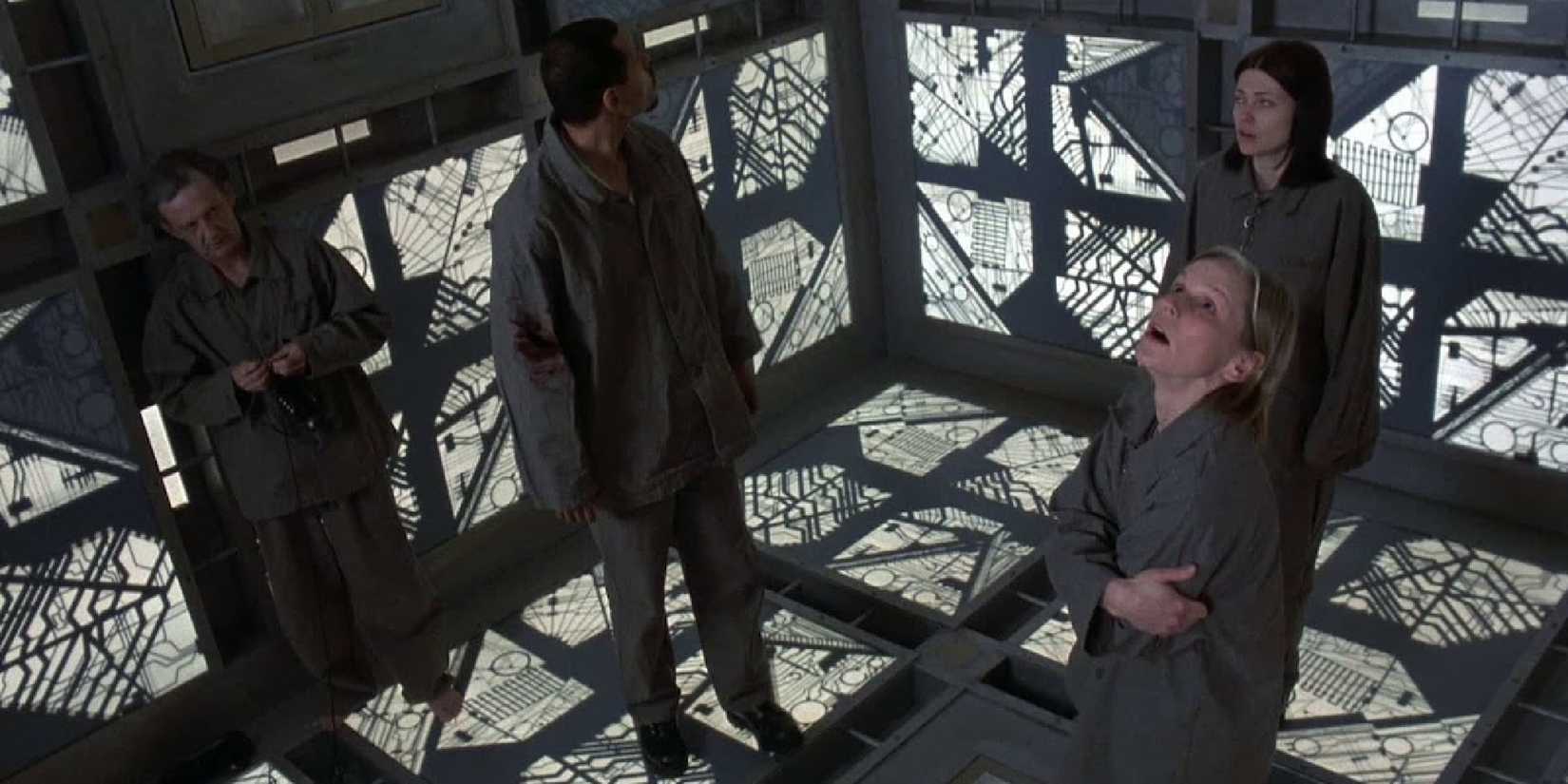
“There is no conspiracy. Nobody is in charge.” Another simple but juicy setup: a group of strangers wakes up inside a massive, maze-like structure made of interconnected cubes, many of which are rigged with deadly traps. The characters attempt to navigate the shifting labyrinth, but international tensions and eroding trust threaten to be almost as dangerous as the cube itself. This powerful concept keeps us hooked, proving good sci-fi doesn’t need elaborate effects.
Indeed, despite its tiny budget, the production design creates an iconic sci-fi setting using little more than a single modular cube room lit in different colors. That said, the real focus is on the characters and their psychology. Cube is a study in human dynamics under pressure. Each character represents different ways people respond to crisis: rationality, aggression, fear, compassion, selfishness and denial. They’re a microcosm of society facing calamity.
‘Mystery Men’ (1999)

“We’ve got a blind date with destiny… and it looks like she’s ordered the lobster.” The gleefully absurd Mystery Men tells the story of an incompetent team of second-tier superheroes who become their city’s last hope. These wannabe crimefighters (each with a barely useful power) include Shoveler (William H. Macy), whose weapon of choice is, you guessed it, a shovel; the Blue Raja (Hank Azaria), who throws cutlery; and Mr. Furious (Ben Stiller), who draws power from anger.
The movie flopped hard on release, bringing in just $33.5m against a $68m budget. However, that failure was partly because it was ahead of its time, satirizing comic book tropes long before the genre became dominant. Today, though, Mystery Men feels remarkably modern, and you can see traces of it in later genre comedies and unconventional superhero stories. A fun send-up of/love letter to the genre.
‘Seconds’ (1966)

“How many times have you wanted to start over?” This one has some parallels with The Face of Another, even coming out in the same year. Seconds follows Arthur Hamilton (John Randolph), a middle-aged banker who is secretly recruited by a mysterious organization offering clients a second chance at life. He becomes “Tony Wilson” (Rock Hudson), a younger, more artistically inclined version of himself, and is placed into a carefully constructed new existence.
At first, it feels liberating, but cracks begin to form almost immediately. The relationships are hollow, the experiences curated, and the protagonist’s sense of self grows increasingly unstable. Wish fulfillment curdles into existential horror. The visuals reflect sp, with stark and surreal black-and-white imagery and distorted wide-angle lenses. Many of Seconds‘ ideas ring even truer today in our world of online personas and social media performance.
‘The Faculty’ (1998)

“I always thought it would be the jocks or the popular girls who’d take over the world… but it’s the teachers.” This banger from Robert Rodriguez fuses teen drama with invasion horror, mostly pulling off its tonal balance through sheer confidence. In it, a bunch of high school students (played by the likes of Jordana Brewster, Elijah Wood, and Josh Hartnett) begin to suspect that their teachers are being taken over by a parasitic alien species.
The characters are forced to work together as the infection spreads, testing who is still human and who has already been replaced. It’s like Invasion of the Body Snatchers meets The Thing meets My So-Called Life. What makes the movie endure is its self-awareness. It clearly loves older sci-fi invasion films and constantly references them, but it never feels smug or cynical about its influences.
‘Dark City’ (1998)
“First, there was darkness. Then came the strangers.” Dark City, directed by The Crow‘s Alex Proyas, is one of the great sci-fi noirs. The underrated Rufus Sewell leads the cast as a man who wakes up with no memory, in a city that never sees daylight, pursued by mysterious figures who can reshape reality itself. Soon, both the police and the “Strangers” are hunting him for reasons that slowly begin to reveal themselves. Around him, the city shifts, buildings rearrange, identities blur, and memory becomes the key to understanding everything.
From here, the movie feels like a nightmare assembled from memories of classic detective stories, German Expressionism, dystopian sci-fi, Edward Hopper paintings, and psychological horror. The atmosphere is immersive, the visual design is creative and memorable, and the philosophical aspects get surprisingly deep. The protagonist’s journey becomes a search for authentic selfhood in a manipulated reality.
‘Strange Days’ (1995)

“This is life. It’s a piece of somebody’s life. Pure and uncut.” Ralph Fiennes turns in a typically strong lead performance here as Lenny Nero, a former cop turned dealer of memory recordings. This technology allows people to experience someone else’s life as if it were their own. However, he gets more than he bargained for after receiving a particularly disturbing clip that entangles him in a murder conspiracy.
Another case of a movie arriving before audiences were ready, Strange Days made a devastating loss at the box office, but it feels uncannily prophetic in hindsight. Long before conversations about social media addiction, doomscrolling, VR escapism, and livestream culture became mainstream, the film was already warning about a society obsessed with consuming reality secondhand instead of actually living it.
‘Coherence’ (2013)

“I think this night is not going the way it was supposed to.” Coherence is a poster child for economical filmmaking, creating a fantastic sci-fi tale with a small cast, a single location, an 89-minute runtime, and a micro budget. It’s about a group of friends who gather for a dinner party on the night a comet passes overhead, and slowly realize that reality itself is beginning to fracture. They discover that multiple versions of their house, and themselves, may be overlapping, with dark consequences.
The rules of the phenomenon are never fully explained, but they’re consistent enough to create a sense of escalating dread, and a big part of the fun is watching the characters try to figure out ways of enduring this ordeal. It all builds up to a brilliantly grim conclusion, the perfect payoff for everything that’s come before.
You must be logged in to post a comment Login