Entertainment
10 Greatest Action Movie Climaxes, Ranked

If there’s any genre seemingly predicated on building up to a exciting climax it’s action. They end with epic battles, explosive gunfights, nail-biting chases and the occasional special effects extravanganza. Action is all about tension and release, and there’s no better release than a climax. Forgive the crude metaphor, but its apt and action movies climax like no other genre can. At least the good ones do. Good action movies know when to hold back so that they don’t let their best action sequence occur too early in the runtime, or if they do, they at least know to climax with something smarter or more emotionally satisfying.
Not all of the best action movie climaxes represent the greatest or most memorable moments in their respective movies, but they all end them on a high note. They can wrap things up narratively or just kick some serious ass. Unsurprisingly, the best action climaxes all come from movies that are all basically classics across the board. It’s time to skip the foreplay and, like JD Vance when he sees a leather sectional, go straight to the climax with these ten action movies.
10
‘Mission: Impossible – Dead Reckoning’ (2023)

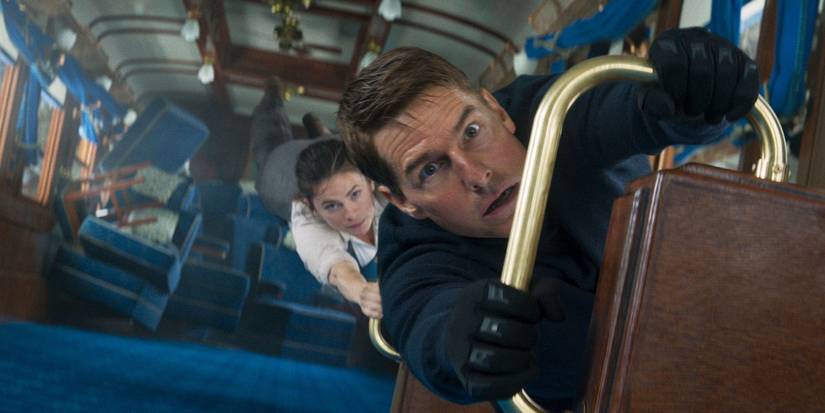
Several of the Mission: Impossible movies have incredible climaxes. Fallout has a heartstopping helicopter chase, Mission: Impossible II has some top tier John Woo ridiculousness, and The Final Reckoning is an all-timer of an aerial stunt show. The best climax of the entire franchise, though, is the extended train sequence from Dead Reckoning. Beginning with Tom Cruise jumping a motorcycle off a cliff, and finishing with a dangling train that bears more than a passing resemblance to a sequence from the video game Uncharted 2, Dead Reckoning showcases all the best elements that the Christopher McQuarrie era of the franchise is known for.
Serving as a convergence for plot threads and characters, the train climax sees characters new and old all vying to take posession of the cruciform key, the film’s MacGuffin that can also put a stop to the evil artificial intelligence known as the Entity. Grace (Hayley Atwell) is in disguise as the White Widow (Vanessa Kirby) making a deal with Kitteridge (Henry Czerny) while the villainous Gabriel (Esai Morales) is busy making bodies and Ethan Hunt (Cruise) parachutes in. It rides a razor’s edge of comprehension and tension, but McQuarrie has an undervalued understanding of action geography that makes the whole sequence work. It ends with literal cliffhanger before leading into a narrative one, and it’s an all around masterclass in action.
9
‘RoboCop’ (1987)


Paul Verhoeven’s hyperviolent satire RoboCop ends as many 80s action movies did. It has lots of blood, bullets and explosions and it takes place in an industrial setting. It also features a melting man who gets hit by a car and turned into a puddle, a villain who gets his jugular opened with a metal spike and Robo walking on water like mechanized Jesus. It’s the perfect summation of a film that fully engages with the excess of its era of action movies but does so with a subversive purpose. Every action fan has every moment of it permanently tattooed on their brain and if they were one of those who saw the movie at too young an age, it might have even been a totemic trauma point.
After having had the full Detroit police force unleashed on him by their corrupt corporate overlords, RoboCop (Peter Weller) takes refuge in the same steel mill where he died as a human. Along with his partner Lewis (Nancy Allen), he faces off against the criminals who once pumped him full of bullets and takes them out one by one in brutally violent, and darkly humorous, fashion. RoboCop is an action masterpiece of bloody brutally that climaxes with its most gruesome kill and its most satisfying villain execution.
8
‘The Matrix’ (1999)

The Matrix redefined the action genre at the end of the 20th century, combining a dozen disparate influences into one cohesive action whole that held heavy influence over the genre for the next decade. The film’s mix of kung-fu, gun-fu and bullet time effects made it stand out at the end of a decade defined by high concept action, and all three are well represented in its subway fight climax. If not the best one-on-one fight in a martial arts movie, it’s certainly one of the most indelible, and it remains just as effective over two decades later.
After having successfully saved Morpheus (Laurence FIshburne) from the clutches of Agent Smith (Hugo Weaving), Neo (Keanu Reeves) has to face off against the formidable Smith one on one. Their climactic fight features fisticuffs and wire work, all choreographed by the legendary Yuen Woo-Ping, who had directed and choreographed a number of high profile martial arts movies which caught the attention of the Wachowskis. More than just the technical proficiency of it, the climax of The Matrix is a pivotal moment in the character development of Neo and his fulfillment of his prophecy. The Matrix was a cultural phenomenon and its climax is the perfect coda to the 90s era of action movies.
7
‘Raiders of the Lost Ark’ (1981)


Raiders of the Lost Ark is basically a series of iconic scenes strung together. From the brilliant opening where Indiana Jones runs from boulder booby trap to the indelible final image where the Ark of the Covenant is locked away in a warehouse filled with other hidden artifacts, Steven Spielberg and George Lucas’ action-adventure classic fires on all cylinders. That applies to its climax as well, which manages to be just as thrilling and memorable even when it has its hero tied to a pole. It’s one of the most satisfying and visceral depictions of divine retribution ever put on film.
Bested by the Nazis in the race to take possession of the titular Ark, Jones (Harrison Ford) finds himself tied up alongside love interest Marion Ravenwood (Karen Allen) as the goose-stepping morons perform a ceremonial opening. Instead of unlimited power inside, they are confronted with vengeful spirits and the power of God, which promptly electrocutes, melts the faces off and blows up the heads of the villains in a spectacular effects display. The face-melting of the evil toady Toht (Ronald Lacey) is so violently gratifying that no villain death in any of the sequels has ever been able to measure up, which is a strong statement considering those villains suffered some memorable fates like death by crocodile, rapidly aging and disintegrating, and having their brain burst into flames from too much knowledge. The Indiana Jones franchise is weirdly yet awesomely violent and Raiders of the Lost Ark‘s is the best proof of that.
6
‘Mad Max 2’ (1981)

The same year that Spielberg release his adventure masterpiece, George Miller unleashed his apocalyptic action classic Mad Max 2 (known as The Road Warrior in the United States). Returning to the world he had created with his original Ozploitation action film, Miller used his bigger budget to expand the scope and scale of it. From a dystopic world on the brink to a full-throttle post-apocalyptic wasteland, Mad Max is bigger and better than its predecessor in every way, including its climax. It’s a white-knuckle car chase through the desert that became so iconic and beloved that Miller would essentially turn the sequence into one long movie for Mad Max: Fury Road.
Some years after seeking his revenge for the death of his wife and son, Max (Mel Gibson) now wanders the wasteland as a leather-clad gunslinger scavenging to survive. He finds a small oil refinery and strikes a deal with its occupants to help transport their oil out and away from a group of violent marauders, which leads to the climactic chase with Max behind the wheel of a tanker truck. The climax is a hair-raising mix of kinetic camerawork, fast-paced editing and insane stunts, one of which sent a stuntman twirling through and earned his a broken leg. Mad Max 2 climaxes with one of the greatest car chases in cinematic history and which only Miller himself has been able to top.
5
‘The Wild Bunch’ (1969)

Sam Peckinpah’s influence on the action genre cannot be overstated. His use of rapid editing, slow motion cinematography and brutal violence echoed through decades of filmmakers, with his influence directly impacting filmmakers like John Woo, Kathryn Bigelow and Michael Mann. His action scenes are some of the best of their respective eras, but none moreso than the climactic gunfight from his magnum opus revisionist Western The Wild Bunch. It’s a ballet of bullets and blood that contributed both to the film’s controversial status upon its initial release and its continued acclaim as an essential Western.
As a group of aging outlaws hang on to their old ways as the Old West disappears around them, they take up a job stealing guns for a ruthless Mexican General. After one of their own is taken captive by the General, the men decide to make one last stand against the corrupt leader and his armed forces. It’s four men against a hundred as bullets rip through bodies in visceral fashion. Peckinpah was insistent on showing the damage a bullet could do, and thus had special squibs made that packed a more bloody punch. He also made sure the sound effects for each gun was specific and distinct. It’s that attention to detail and emphasis on violence that makes the climax of The Wild Bunch still so effective. It’s the birth of the modern action movie shootout.
4
‘Police Story’ (1985)

Jackie Chan’s Police Story begins and ends with its best action scenes. The opening shanty town shootout turned destructive car chase is iconic, and the mall brawl finale is equally so. The entire film represents some of Chan’s finest action choreography and most intense stunt work. Police Story was made after Chan had a disappointing experience filming The Protector, which was a co-production between the United States and Hong Kong and meant to break the martial arts star into the American market. It failed and Chan was frustrated by the production hampering his ability to properly choreograph more complex stunts. That frustration funneled into a passion that is clear in every frame of Police Story all the way through it’s nerve shattering climax.
As the final confrontation between Sergeant Chan (Chan) and the dangerous crime lord he has spent the full runtime of the film trying to stop, the climax leaves no stone unturned, or glass pane unshattered, as the cops and criminals throw hands, feet, arms and legs at each other. It crescendos in a stunt with Chan sliding down several stories on metal pole covered in lights, which ended up giving the star second degree burns on his hand and a dislocated pelvis after landing. Chan repeatedly put his body in peril for the purposes of entertainment, and the climac of Police Story is one of the most viscerally exciting examples of it.
3
‘Terminator 2: Judgment Day’ (1991)
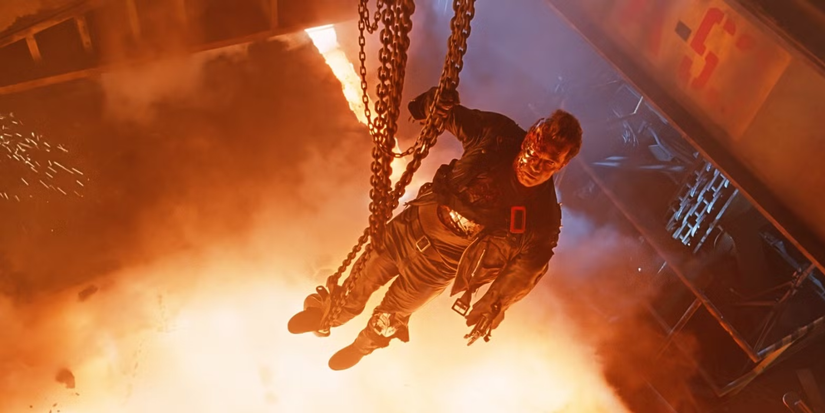
Terminator 2: Judgment Day is James Cameron’s action masterpiece. It’s setpieces are second to none but what is even more impressive is how fluidly its action escalates and organicalyl flows from one scene to the next. The final act of the film begins with the infiltration of Cyberdyne which becomes a police siege which turns into a chase sequence which leads directly into the action-packed climax. Cameron’s ability to build tension before releasing it in dramatic fashion. Terminator 2′s climax compounds itself with a series of confrontations that peaks with an emotional final moment.
Pursued by the T-1000 (Robert Patrick) into a steel mill, the T-800 (Arnold Schwarzenegger) uses liquid nitrogen, a bullet and a one liner to shatter the liquid metal menace, who then reforms to continue his attempt to kill John Connor (Edward Furlong). The action continues, using a dynamic mix of visual effects, twin doubles and stunt work to create a seamless sequence that ends with the T-1000 dropped into a vat of molten metal for an iconic villain death. That moment is then quickly followed by the T-800 being lowered himself into the vat, giving the most moving thumbs up in movie history as he melts away. It’s not subtle and maybe too sentimental for some, but it’s the perfect period for a film that wears its emotions on its sleeve, and the action that comes before it is immaculate.
2
‘Hard Boiled’ (1992)

Hard Boiled, John Woo’s Hong Kong swan song to the Heroic Bloodshed genre he helped create, ends with an extended sequence set in a hospital that is a ballistic masterpiece of sustained action. The film itself, a cops and criminals thriller, is itself constructed around its three massive action set pieces. It opens with a stunning teahouse shootout, has an explosive warehouse gunfight halfway through, and then culminates with the hospital that fills every floor with action. Woo’s hyper-stylized action has its origins in the slow-motion sequences of Sam Peckinpah, and its populated with characters influenced by the work of Jean-Pierre Melville. The director synthesized it all into something all his own that in turn influenced a whole new generation of action filmmakers, and Hard Boiled is his action masterwork.
After taking turns trading blows while trying to take down a Triad gang from outside and in, Inspector Tequila (Chow Yun-fat) and undercover cop Alan (Tony Leung Chiu-wai) find themselves trapped in the hospital with an army of Triad members after them, and a hundred innocent civilians in between. Woo is known for his balletic action punctuated by moments of slow motion but of equal note is simply how destructive his action is. There are few action directors who fill the frame with as much debris as Woo does, and its wall to wall in this climax, especially during the iconic three-minute tracking shot of non-stop action. It’s a relentless climax that has never been topped in terms of pure chaos.
1
‘Seven Samurai’ (1954)

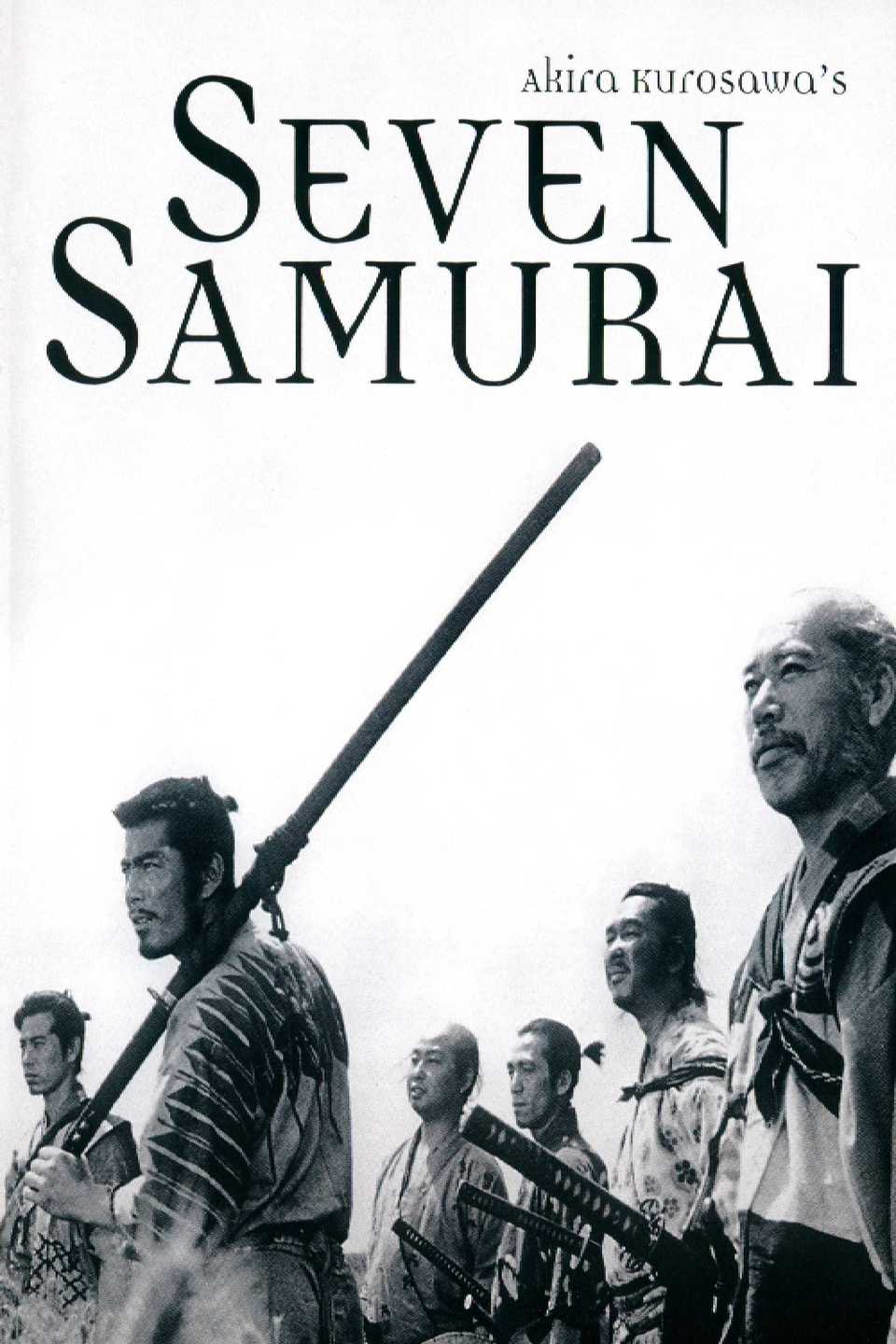
Equally as influential on Woo, and just about every other action director, is Akira Kurosawa. The legendary filmmaker’s impact on modern cinema is immeasurable and his contributions to the action genre are just as immense. His masterpiece Seven Samurai may very well be the greatest film ever made, but could also be called the first modern action film. It’s sword fights are still impressive despite the film’s age, and the climactic rain-soaked battle is a technical marvel of choreographed bloodshed. No matter how many technological advancements have come after or how more violent, more large-scale or more explosive action scenes have become, there is no bettering this climax by one of the greatest directors of all time.
Establishing the oft-repeated action movie trope of a team assembled for a mission, the seven titular samurai are hired to defend a village from violent bandits. Battle between the samurai and bandits ensues, and erupts in the film’s final assault that takes place in a torrential downpour. The bandits ride into the village on horseback and the samurai cut them down so the villagers can skewer them one by one. The shot selection and clarity of action is the kind of cinematic perfection that’s taught in every film school. Kurosaw used multiple camera set ups and telephoto lenses to precisely capture the choreographed battle, and it still has a gritty, messy authenticity to it that many lesser filmmakers have been unable to replicate. More than it’s mere minutes of chaos and killing, the climax is an emotional one driven by character, as the previously mocked aspirant samurai Kikuchiyo (Toshiro Mifune) deals the final blow as he succumbs to his own wounds, earning his place among the other warriors in their graves on a hill. It’s everything any action fan could want.

Seven Samurai
- Release Date
-
April 26, 1954
- Runtime
-
207 Minutes
- Director
-
Akira Kurosawa
- Writers
-
Akira Kurosawa


You must be logged in to post a comment Login