Entertainment
10 Greatest Hard Sci-Fi Movie Masterpieces of All Time

We all love a good old-fashioned space romp, or at least that’s the assumption we’re going to make for the purposes of this list. A grand adventure set out amongst the stars that tells physics and all other forms of science to hit the intergalactic highway, soft sci-fi has been one of the most predominant forms of science fiction since the genre began. As much fun as those soft kinds of sci-fi movies can be, though, there’s something special about their harder siblings.
Hard sci-fi is defined by its attention to detail and fidelity to accuracy. Now, no sci-fi movie is 100% scientifically accurate; in fact, it could be argued that many of the films that will make up this list barely cross the halfway point in terms of realism, but here we award points for trying. These are the movies that at least attempt to get the science right, just as long as it doesn’t get in the way of telling a good story. These are the ten greatest hard sci-fi movie masterpieces of all time, offering grounded takes on the genre that feel ambitious but refreshingly real.
10
‘Primer’ (2004)


Shane Carruth’s low-budget sci-fi film Primer is about as grounded as a film about time travel can get. While the central concept is still a fantastical invention, it is surrounded by realistic and highly technical scientific details that inform the grounded setting. Primer doesn’t have elaborate lab sets or depict time travel with any kind of elaborate CGI. It’s just two guys in a garage with a metal box.
In addition to writing and directing, Carruth also stars as Aaron, one-half of the duo who discovers the ability to travel back in time. Together, Aaron and Abe (David Sullivan) begin to experiment with time travel, going back in time and using future knowledge to their benefit. It doesn’t take long for the timelines to get complicated, and the men and their doppelgängers begin to turn on each other. Primer is a thought-provoking and intelligent sci-fi movie that far surpasses its limited budget with true ingenuity.


Robert Zemeckis is still one of the most technically proficient directors in Hollywood. His experience and innovation of cutting-edge technology have produced classics like the Back to the Future trilogy, Who Framed Roger Rabbit, and Death Becomes Her. Starting with Forrest Gump, Zemeckis began to find ways to integrate his technological interests into more grounded dramas. The underrated Contact, based on the novel by Carl Sagan, preceded the hard sci-fi trend in Hollywood by over a decade and allowed Zemeckis his first opportunity to tell a more grounded science-fiction story.
The film adaptation focuses on Dr. Ellie Arroway (Jodie Foster), who works for the SETI program. After she discovers a signal coming from the star Vega, Arroway finds herself in the middle of a mission to build a machine that will allow her to travel through wormholes in the hopes of making contact with those who sent the signal. Contact spends an inordinate amount of time dealing with the science of its story and the impact of discovering alien life has on civilization. It’s a more cerebral first contact film than something like Steven Spielberg‘s more fanciful Close Encounters of the Third Kind, which packs a more satisfying emotional punch.
8
‘Gattaca’ (1997)
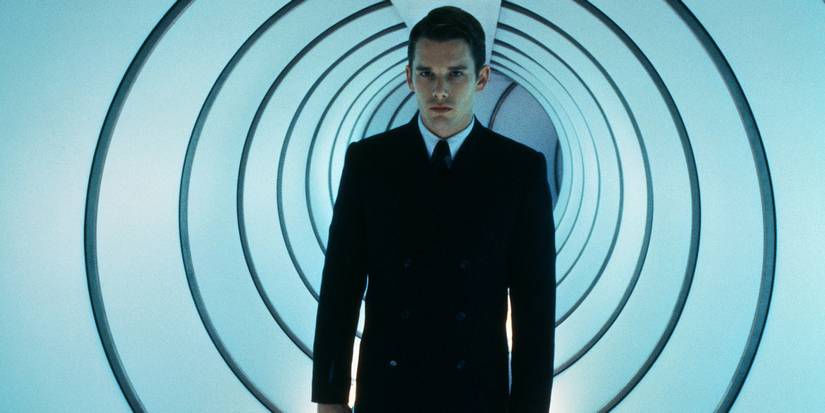
The social divisions we’ve created in our current society get an upgrade in Andrew Niccol‘s Gattaca, set in a near future where discrimination has been turned into a science thanks to widespread use of eugenics. Divisions are created not so much by race or economic status as they are between those born naturally and those designed to be genetically perfect. It’s a fascinating film filled with more ideas in single scenes than many Hollywood sci-fi films manage across their entire runtimes. Though it takes a more one-sided approach to the more complex bioethical issues at play, it’s undeniably compelling and accurate in its assumption that our technological capabilities will always outpace our morality.
Ethan Hawke plays Vincent, conceived naturally and thus considered an in-valid, preventing him from pursuing a career in space travel. He finds his way around his perceived genetic inferiority by using the genetic material of another man to receive a position on an upcoming spaceflight. While the social themes are given as much weight as the science behind them, Gattaca advances the conversation about the conflict where scientific advancement and social order meet. It’s only become more relevant as the fight to provide protection and prevent discrimination based on genetic conditions is in constant flux in the political system.
7
‘Interstellar’ (2014)

Originally developed by Steven Spielberg, based on an idea by theoretical physicist Kip Thorne in collaboration with producer Lynda Obst, Interstellar changed hands over to Christopher Nolan, who brought his ability to blend a blockbuster sensibility with more cerebral cinema to its sci-fi story of astronauts in search of a planet to replace Earth. The film finds balance in its human and scientific themes but, like much of Nolan’s directorial work, is at its best as a work of spectacle, much of which is grounded in hard sci-fi concepts.
In a future where Earth is suffering from major blights, and humanity is under threat of extinction, NASA sends Matthew McConaughey‘s Cooper on a mission to investigate the viability of several planets found through a wormhole. The mission takes on some thrilling twists and turns as Cooper and his crew face mile-high waves on one planet and human betrayal on another. Reviews at the time of release were slightly less enthused about the film’s attempts to combine its scientific craft thematically with its emotional character development, but it remains a sci-fi spectacle with few to rival it.
6
‘Gravity’ (2013)

Alfonso Cuarón‘s greatest sci-fi masterpiece is the dystopic thriller Children of Men, which is far more concerned with the social implications of its infertility plot than the scientific, but right behind it is the orbital survival thriller Gravity. With astounding visual effects and an adherence to depicting its space environment with a higher level of realism, the film captures the dichotomy between space’s inherent beauty and imminent danger. As with any hard sci-fi movie, Gravity diverts from reality in many instances in order to tell a more engaging story, but it is far from the fantastical visions of space Hollywood is known for.
Sandra Bullock and George Clooney co-star as two astronauts in orbit servicing the Hubble telescope, when some space debris comes hurtling toward them. With their shuttle destroyed, they must embark on a mission to reach the International Space Station in order to return to Earth safely. It’s a survival story of resilience and persistence, and Bullock anchors the film with her emotionally tethered lead performance. It’s all the more impressive considering the constraints of filming with so many visual effects. Almost all the environments in the movie are rendered with CGI, with the actors placed in complex rigs to simulate zero gravity and the lighting of space. It’s a technical masterpiece and one of the most enthralling hard sci-fi movies ever made.
5
‘Moon’ (2009)

A small-scale film made with a much lower budget than many of its hard sci-fi contemporaries, Duncan Jones‘ Moon is no less thematically dense or technically impressive. Set on the shoulders of lead actor Sam Rockwell, who spends a great deal of the time alone, the film is a lunar ser character study of humanity and identity. It’s a lesser-known film than many of its bigger-budget studio brethren and deserves a large audience to appreciate its unique mystery elements.
Rockwell plays Sam, the sole worker of a helium-3 mining facility on the moon. He’s nearing the end of his three-year contract when an accident leads to an unsettling discovery about himself and the work he’s been doing. It’s a twist that is only the beginning of the film’s existential nightmare created by corporate greed, giving Rockwell a fair amount of emotional real estate to work with in his performance. Moon is proof that amazing hard sci-fi movies can be made with modest budgets if they have good actors and clever concepts.
4
‘Ex Machina’ (2015)
Artificial Intelligence is on everyone’s mind right now, but it’s a concept that has been at the forefront of dozens of different sci-fi stories and films. As with any developing technology, much of the discourse surrounding A.I. in film has been of a skeptical and fearful nature, but some films have engaged with it in a more thoughtful manner, such as Alex Garland‘s directorial debut, Ex Machina. A moody chamber piece featuring only a handful of characters, Garland’s film questions not only the nature of consciousness and autonomy, but also the ethical implications of creation and control.
Domhnall Gleeson plays a socially-awkward programmer who has been chosen for a secretive visit to the home of his tech company’s CEO, played by Oscar Isaac. The CEO has developed and built an artificial lifeform named Ava (Alicia Vikander), whom he wants the programmer to interact with to determine if she is truly capable of independent thought. The dynamics between all three characters become increasingly strained as the CEO’s true colors begin to show, and Ava expresses a desire to be free of her captivity. Ex Machina explores profound ideas that only become more inescapably relevant as technology advances.
3
‘The Martian’ (2015)

Based on the acclaimed sci-fi novel by Andy Weir, The Martian is an incredibly entertaining film made all the more exciting by its reasonably realistic approach, which showcases the triumph of science and human collaboration. What could be dense explanations of highly technical information are made palatable for a general audience thanks to a sharp script by Drew Goddard and a talented cast led by a never more affable Matt Damon. Director Ridley Scott had previously helmed two of the greatest sci-fi films of all time, Alien and Blade Runner. With The Martian, he found an exciting new world to explore with a more emotional and humorous storyline grounded in believable science.
Damon plays astronaut and botanist Mark Watney, stranded on Mars after a destructive storm caused an evacuation of his team, who presumed he was dead after being struck by equipment. His survival then becomes dependent on ingenuity and persistence, as well as the combined efforts of NASA scientists back on Earth. The Martian quite faithfully adapts Weir’s funny and informative novel, and both aspects elevate each other instead of being incongruous. Along with the equally entertaining Project Hail Mary, Weir is two for two in having his novels adapted into hard sci-fi masterpieces.
2
‘Arrival’ (2016)
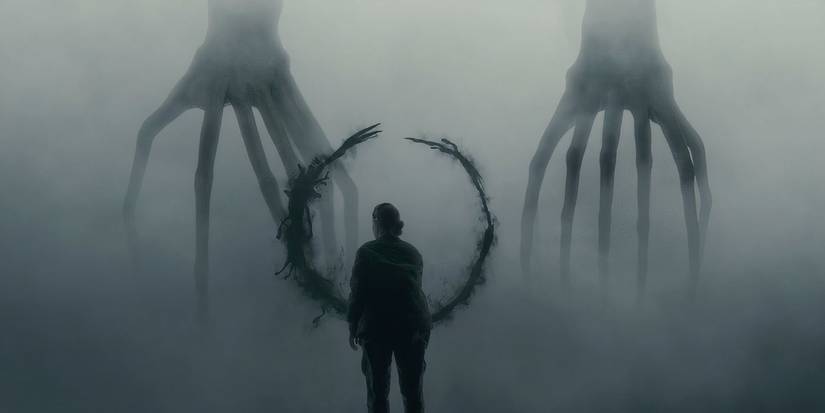
Like Scott, director Denis Villeneuve has explored sci-fi from several different angles, having helmed the impressive follow-up to Scott’s sci-fi noir in the legacy sequel Blade Runner 2049, and delivered epic space fantasies in his Dune adaptations. Before both of those, he directed the more grounded approach to humanity’s first contact with aliens in Arrival. It’s a sophisticated sci-fi that explores the perceptions of communication, the concepts of fate and determinism, and the intersection of love and grief. It’s a stellar example of ideas and emotions driving a sci-fi narrative over technology or action.
Based on the novella Story of Your Life by Ted Chiang, the film follows a linguist, played by Amy Adams, who is enlisted by the United States military to study and make contact with extraterrestrial lifeforms who have recently landed on Earth. The sudden appearance of these lifeforms around the world has caused international unease, with tensions rising over whether the use of preemptive force is warranted. The film focuses on the science of linguistics, and, according to several academics, does a reasonable job of accurately portraying it, emphasizing the importance and power of language through its impactful sci-fi storytelling.
1
‘2001: A Space Odyssey’ (1968)
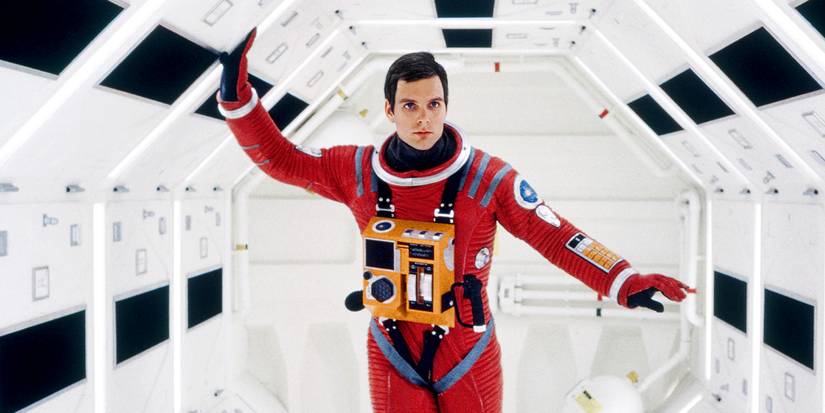
What other film could be the best of hard sci-fi than Stanley Kubrick‘s monumental, and monumentally influential, masterpiece 2001: A Space Odyssey? It’s the film that made quantum leaps forward in visual effects technology, presented a plausible vision of space travel on film a year before anyone had even landed on the Moon and which almost every sci-fi film since, soft or hard, owes a tremendous debt to. It was a Herculean effort by Kubrick and his crew, and the result still awes and astounds more than five decades after its release.
The film deals with artificial intelligence, human evolution, alien contact and space exploration in an epic journey across the stars as a group of astronauts investigates an alien monolith whose appearance has recurred through thousands of years of human history. That journey is placed in peril by HAL 9000, still the most iconic A.I. antagonist in film history, whose inability to reconcile its programming with the concept of deception causes it to become homicidal. After the defeat of HAL, the final surviving astronaut reaches the monolith and is shown the very fabric of the space-time continuum before experiencing a rapid evolution to a higher form of existence. Few sci-fi films have been able to properly contend with even one of the major ideas with as much complexity as Kubrick’s gem, and fewer still have been able to pull off as convincing a depiction of space travel with more advanced visual effects technology or higher budgets. It’s why it’s the greatest hard sci-fi masterpiece ever made.
You must be logged in to post a comment Login