Entertainment
10 Greatest Hidden-Gem War Masterpieces of the 21st Century, Ranked

A handful of 21st-century war movies usually dominate the conversation: Black Hawk Down, The Hurt Locker, Inglourious Basterds, Dunkirk. However, these obviously only scratch the surface of what the genre has to offer. There are countless compelling, lesser-known war movies from the last quarter-century that are worth seeking out.
The titles on this list span a range of styles and tones, all offering something of value to the ever-increasing war genre, whether that’s realism, insightful social commentary, great acting, or simply tense action set pieces. The best of them are defined by psychological realism and intellectual honesty, making them worthy of far more attention than they get.
10
‘Kajaki’ (2014)

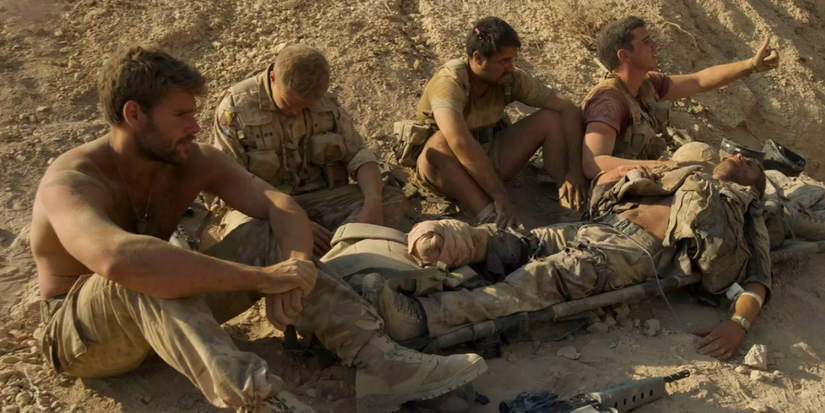
“Don’t move. Don’t even breathe.” This one didn’t get that much attention (it made only $34,000 at the box office), but it’s very solid. Kajaki (aka Kilo Two Bravo) recounts a true story from the war in Afghanistan, focusing on a British Army patrol stationed near the Kajaki Dam in Helmand Province. When one soldier accidentally steps on a landmine, the mission shifts instantly from routine patrol to desperate survival exercise. Further attempts to help trigger additional mines, and the group becomes trapped. The terrain around them is lethal. Enemy movement could spell doom.
It’s a war movie confined to a single, white-knuckle location. There are no firefights, no strategic victories, and no ideological speeches. Instead, the film focuses on pain management, improvised problem-solving, and psychological strain. The camera stays close, emphasizing sweat, fear, and exhaustion. The actors (particularly David Elliot) all rise to the occasion with restrained, believable performances.
9
‘The Siege of Jadotville’ (2016)
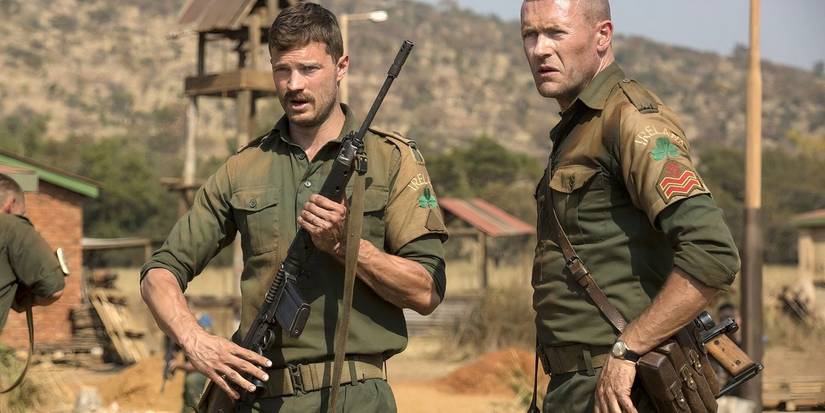
“We are not here to die. We are here to hold.” The Siege of Jadotville is another war movie closely based on actual events. Specifically, it dramatizes the real-life 1961 standoff during the Congo Crisis, where a small Irish UN battalion (led by Jamie Dornan‘s Patrick Quinlan) found itself surrounded by vastly superior Katangese forces. Cut off from reinforcements and political support, the soldiers must defend their position through cohesion and desperate ingenuity, discipline, and tactical intelligence.
The movie has a classic siege narrative structure, but unusually sharp themes of bureaucratic neglect and institutional indifference. Ammunition dwindles, communications fail, and moral clarity becomes dangerously abstract. In contrast to the deceitful, politically higher-ups, the soldiers on the ground are real professionals: methodical, cautious, and deeply aware of their limitations. While the dialogue is occasionally a little stiff, the movie compensates with tense drama and nail-biting set pieces.
8
‘’71’ (2014)
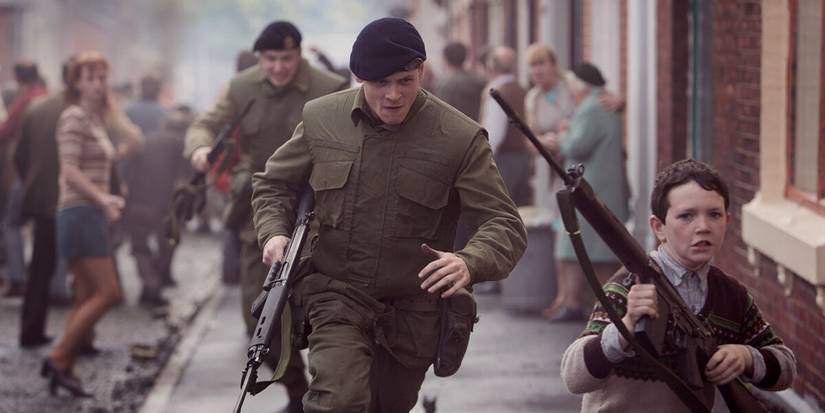
“Just survive the night.” ’71 follows a young British soldier (Jack O’Connell) accidentally separated from his unit during riots in Belfast at the height of the Troubles. Stranded overnight in hostile territory, he must navigate a labyrinth of sectarian violence, paramilitary factions, and covert intelligence operations, all while trying to avoid capture or death. The plot functions like a chase film driven by confusion. The protagonist doesn’t understand the political landscape he’s trapped in, and neither does the audience, deliberately so.
War is sheer disorientation here. Alliances shift constantly, and danger comes from every direction. There are no clear villains, no comforting moral frameworks. Everyone is compromised, exhausted, and acting out of partial information. The eye of the storm is O’Connell’s strong lead performance. Those who only know him from his brilliant villain performances in Sinners and 28 Years Later: The Bone Temple ought to check this movie out.
7
‘Lebanon’ (2009)


“I can’t see anything.” Lebanon is set almost entirely inside a single Israeli tank during the 1982 Lebanon War. Within that pressure cooker, four inexperienced soldiers attempt to survive their first mission, as mechanical failures, miscommunication, and mounting panic turn a routine operation into a psychological nightmare. The movie places us up close to them in their vehicle. The audience sees the outside world only through the tank’s gun sight, reducing civilians, enemies, and destruction to fragmented, horrifying glimpses.
This approach renders the war as pure sensory overload. Sweat, noise, and terror dominate. Claustrophobia is the reigning mood, as the armored vehicle increasingly feels less like a refuge and more like a tomb. This approach won the film a lot of critical acclaim, including a Golden Lion award at the Venice International Film Festival. Nevertheless, Lebanon was somewhat controversial in Israel itself for its seemingly overly negative vision of military service.
6
‘Defiance’ (2008)

“We choose to live.” Drawing on real events, Defiance tells the story of Jewish brothers (played by Daniel Craig and Liev Schreiber) who escape Nazi-occupied Eastern Europe and form a forest-based resistance community. They build shelters, secure food, and protect civilians while under constant threat. The narrative balances moments of action with long stretches of hardship, argument, and moral compromise. Leadership becomes a burden, not a reward, as the brothers must decide who to protect, who to exclude, and how much violence survival demands.
Defiance didn’t receive all that much attention on release, and reviews were fairly mixed, with some critics finding it a little heavy-handed and others calling out some historical inaccuracies. While it’s certainly not perfect, it’s definitely better than its detractors make out. Edward Zick‘s direction is clear and sturdy, and the performances by Craig and Schreiber do most of the heavy lifting.
5
‘The Keeping Room’ (2014)

“There are things worse than death.” The Keeping Room is set during the final days of the American Civil War, far from the battlefield and deep in its moral fallout. The story follows two Southern sisters (Brit Marling and Hailee Steinfeld) and a slave (Muna Otaru) left alone on a remote farm while the men are away fighting. When two rogue Union soldiers (Sam Worthington and Kyle Soller) arrive seeking shelter, the encounter quickly turns into a deadly standoff.
From here, the movie plays out as a tense chamber piece, stripping war down to its aftershocks. It treats armed conflict as something that corrodes from the edges inward, reaching even those who never pick up a weapon. In this, The Keeping Room seems to channel Don Siegel‘s classic film The Beguiled, but with a leaner, meaner, more violent edge. There are some narrative stumbles, to be sure, but the storytelling is economical, and the lead actresses are strong.
4
‘City of Life and Death’ (2009)

“We are all human.” City of Life and Death depicts the Nanjing Massacre during the Second Sino-Japanese War, focusing on civilians, soldiers, and occupiers trapped inside a city descending into atrocity. This incident is widely regarded as among the most horrific episodes of World War II, which is truly saying something. Rather than centering a single hero, the plot interweaves multiple perspectives, including Chinese civilians and conflicted Japanese soldiers.
The narrative is episodic and relentless. Scenes of survival, brutality, and moral collapse accumulate rather than resolve, creating an overwhelming sense of historical weight. The black-and-white cinematography drains the images of spectacle, forcing attention onto faces, bodies, and acts of cruelty stripped of cinematic comfort. That said, no movie could do justice to the terrible truth of this chapter in history, though City of Life and Death makes a worthy attempt. This is important, serious filmmaking.
3
‘Black Book’ (2006)

“War turns us all into liars.” Not to be confused with the hilarious British comedy series, Black Book is a powerful war thriller directed by Paul Verhoeven. It revolves around a Jewish singer (Carice van Houten) who survives a massacre and becomes involved with the Dutch resistance during World War II. Using her identity as both camouflage and weapon, she infiltrates Nazi ranks, navigating espionage, betrayal, and shifting loyalties as the war drags on. The character is well-written, compelling and real, and van Houten is terrific in the role.
The plot moves fluidly between thriller, melodrama, and moral inquiry. Alliances prove unstable, and the line between resistance and complicity blurs repeatedly. Even after liberation, the film refuses closure, showing how violence mutates rather than disappears. While occasionally a little melodramatic, Black Book remains fundamentally engaging throughout, never growing ponderous or becoming a dry history lesson.
2
‘U-571’ (2000)
“One mistake down here means we all die.” U-571 follows an American submarine crew tasked with capturing a German Enigma machine during World War II. When their mission goes catastrophically wrong, they find themselves trapped inside a damaged enemy submarine, hunted by German forces while struggling to stay alive underwater. Lieutenant Andrew Tyler (Matthew McConaughey) attempts to salvage the terrible situation, racing to repair the vessel’s damage and ward off their enemies.
Paying major homage to Das Boot, the movie uses its submarine setting to compress time and space, making every error feel fatal. The plot emphasizes procedural tension: every decision affects oxygen levels, hull integrity, and crew survival. There is little room for sentiment, only calculation under pressure. While a few characters are a little underwritten and some critics quibbled with the historical accuracy, the sheer tension and suspense of U-571 will appeal to a certain kind of viewer.
1
‘Waltz with Bashir’ (2008)

“I don’t remember anything.” Waltz with Bashir is an animated documentary exploring a filmmaker’s attempt to recover suppressed memories from his time as a soldier during the 1982 Lebanon War. It’s a psychological investigation rather than a historical one. As he interviews former comrades, fragments of memory surface, revealing complicity, denial, and trauma connected to the Sabra and Shatila massacre. Recollections prove unreliable, shaped by fear and self-protection.
The aesthetics complement this approach perfectly. The bold and heavy animation allows subjective experience to take precedence over factual reconstruction, making trauma visible rather than abstract. It also helps soften the edges of certain scenes, making them digestible rather than simply overwhelming. This approach was bold, innovative, and visually striking, but it also stirred some controversy. Afterwards, director Ari Folman would go on to more narratively ambitious projects like The Congress and Where Is Anne Frank, but, in many ways, Waltz with Bashir remains his defining achievement.
You must be logged in to post a comment Login