Entertainment
10 Greatest John le Carré Books, Ranked

Ian Fleming may have originated the genre, but John le Carré (real name David Cornwell) brought spy novels to new levels of realism, complexity, and relevance. He ditched the gadgets and derring-do, instead embracing blurred loyalties, inner turmoil, and disillusionment. In le Carré’s world, intelligence work is not a chess match between geniuses but a slow grind of paperwork, betrayal, ideological decay, and emotional damage.
In other words, le Carré’s novels dismantle the spy myth piece by piece, launching a new wave of titles that would come to define the genre for a world living through the Cold War and increasingly disenchanted with institutions. With this in mind, this list ranks the very best of them. The novels below represent his most powerful work, defined by rich commentary, careful plotting, and psychological depth.
10
‘A Murder of Quality’ (1962)


“Love is whatever you can still betray.” A Murder of Quality is le Carré’s second novel and one of his most deceptively quiet works. On the surface, it seems like a traditional English murder mystery, following George Smiley as he investigates a killing at an elite boys’ school. However, rather than serving up the espionage spectacle one might expect, the book places its focus on themes like class, cruelty, and institutional rot.
Le Carré uses the school as a microcosm of British society, exposing how privilege protects abuse and silences dissent. The murder itself becomes less important than the environment that enabled it. Here, Smiley isn’t a flashy spy or death-defying secret agent, but a moral observer, someone attuned to human weakness and social hypocrisy. A Murder of Quality fits all this into a breezy 189 pages, making it a fairly accessible starting point for those curious about le Carré’s work.
9
‘The Russia House’ (1989)

“The world is a fine place, and worth fighting for.” The Russia House is one of le Carré’s most humane novels, set during the thawing tensions of the late Cold War. The main character is “Barley” Blair, a British publisher drawn into intelligence work after receiving a manuscript from a Soviet scientist claiming to reveal the truth about Russia’s failing nuclear capabilities. The plot mechanics are fairly straightforward, but the book is elevated by a touching romantic storyline between Barley and a Russian woman.
Le Carré fans often cite this as the author’s funniest and most grounded book. The movie adaptation starring Sean Connery and Michelle Pfeiffer was well-received, too, for similar reasons. The Russia House is also interesting as a time capsule. It was published in 1989, capturing a moment of major historical transition, where old certainties were collapsing without being replaced by anything better.
8
‘The Night Manager’ (1993)

“There is no such thing as a private life.” The Night Manager was le Carré’s first true post-Cold War novel, exploring a much murkier world where loyalties and objectives were trickier to define. The novel follows a former soldier turned hotel night manager who is recruited to infiltrate the inner circle of an international arms dealer. On paper, this resembles a more conventional thriller, but le Carré subverts expectations at every turn. The arms dealer is not merely evil, but protected by governments, corporations, and intelligence agencies that benefit from his crimes.
In other words, corruption is the central theme in this one, with characters driven by self-interest rather than high-minded ideals or national power. As a result, the vibe is bleaker and more ambiguous than that of the novels that directly preceded it. There is suspense, but little satisfaction. Success feels temporary and compromised, failure systemic. A snapshot of unipolar malaise.
7
‘Smiley’s People’ (1979)
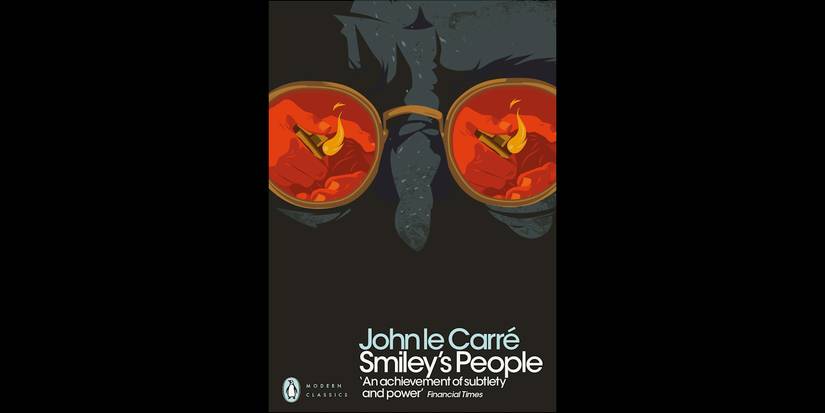
“Smiley never forgot.” Smiley’s People serves as the elegiac conclusion to George Smiley’s long conflict with his Soviet counterpart, Karla. It’s a tragedy about two men shaped (and ruined) by ideology. We follow Smiley as he reassembles old networks and forgotten contacts for one final reckoning. Unlike more action-driven spy novels, this book moves slowly, deliberately, mirroring Smiley’s age and weariness. The Cold War is no longer a battlefield or a stage for heroism, but a graveyard of broken lives.
The book is fittingly claustrophobic and intense, a fitting payoff to the “Karla Trilogy”. As a capstone for that story arc, Smiley’s People defines le Carré’s worldview: intelligence work destroys both sides, and understanding your enemy does not make their defeat feel like justice. The title refers to those who choose reality over ideology and humans over institutions. The novel’s quiet final scenes are especially devastating.
6
‘The Honourable Schoolboy’ (1977)

“We are not nice people.” Coming just before Smiley’s People in the Karla Trilogy, The Honourable Schoolboy is le Carré at his most sprawling and structurally ambitious. Picking up threads from Tinker Tailor Soldier Spy, this one chronicles British intelligence’s attempt to exploit Karla’s networks in Southeast Asia. The plot moves across continents, mixing espionage with journalism, politics, and, of course, personal obsession. The cast of characters is massive, with multiple narrative plates spinning at once.
The Honourable Schoolboy clocks in at a sturdy 533 pages, all of them crammed with events and details. Le Carré deliberately overwhelms the reader, reflecting the chaos and moral confusion of post-imperial intelligence work. It’s a picture of spycraft under pressure, where improvisation and sheer survival are the name of the game. The characters are fittingly layered and three-dimensional. The central figure, for example, a journalist-turned-agent, embodies divided loyalty and self-delusion.
5
‘The Little Drummer Girl’ (1983)

“She was acting even when she slept.” The Little Drummer Girl is le Carré’s most theatrical novel, both literally and metaphorically. It revolves around a young actress recruited by Israeli intelligence to infiltrate a Palestinian terrorist network. She is manipulated by a spymaster on a mission to find and kill a terrorist, but, while undercover, finds herself developing unexpected sympathies for the causes of those she is meant to be taking down. The protagonist’s empathy becomes both a liability and a weapon.
Le Carré refuses easy moral binaries, portraying both sides as capable of cruelty and conviction. The intelligence apparatus itself is shown as ruthlessly pragmatic, willing to sacrifice individuals for strategic gain. At the same time, Le Carré uses performance as a central metaphor, examining how identity is constructed, manipulated, and eventually erased. The lies are destabilizing, to the point that one either comes to believe them or collapses totally under their crushing weight.
4
‘The Constant Gardener’ (2001)

“Love is the only reason to lie.” Some readers will know The Constant Gardener from the 2005 movie version starring Ralph Fiennes and an Oscar-winning Rachel Weisz. Drawing on a real-life incident, it tells the story of a British diplomat investigating his activist wife’s murder in Kenya, uncovering a web of pharmaceutical exploitation and government complicity. Unlike the author’s Cold War novels, this book is driven by grief and love rather than professional duty.
The protagonist’s awakening is painful and belated, driven by guilt as much as justice. The tale is smart as well as suspenseful, shot through with passion, conspiracies, double crosses, deadly diseases, and conniving bureaucrats. However, Le Carré himself says that his fictionalized account is less shocking than the actual case that inspired it. In the afterword, he writes: “By comparison with the reality, my story [is] as tame as a holiday postcard.”
3
‘The Spy Who Came in from the Cold’ (1963)

“What do you think spies are? Priests?” The Spy Who Came in from the Cold is the novel that changed espionage fiction forever. In it, a British agent is sent on one last mission designed to appear as a defection, drawing him into a morally grotesque operation. What makes the novel revolutionary is its bleakness. Le Carré strips away any notion of honorable service, portraying intelligence work as indistinguishable from the brutality it claims to oppose.
The protagonist is exhausted, cynical, and ultimately disposable. While his superiors cloak his mission in ideals and altruism, all justified by the greater good, the reality is that his morally dubious work is corrosive to his soul. Here, the spy agencies of both East and West live in a moral void, each using the Cold War as an excuse to justify lies, violence, and betrayal. This approach was bold stuff for the early ’60s, carrying over well into the stellar film adaptation, too.
2
‘A Perfect Spy’ (1986)

“He was born a liar, and he never stopped.” A Perfect Spy is le Carré’s most personal and psychologically complex novel. Loosely inspired by his life, it centers on a lifelong intelligence operative whose career is shaped by his relationship with his charismatic, deceitful father. The plot moves between espionage missions and childhood memories. Long before deception became the protagonist’s profession, it was a survival skill in a turbulent household.
In other words, Le Carré dismantles the spy myth entirely here, presenting espionage as an extension of emotional damage rather than patriotic duty. The protagonist’s identity fractures under the weight of lies told for love and career alike. His story is dense, introspective, and deeply sad, offering no redemption, only understanding. Not for nothing, author Philip Roth declared A Perfect Spy “the best English novel since the war”, and le Carré himself said it was “the novel of mine that is closest to my heart.”
1
‘Tinker Tailor Soldier Spy’ (1974)

“A fanatic is always concealing a secret doubt.” Far and away the author’s most famous book, not least due to the fantastic 2011 movie adaptation. Tinker Tailor Soldier Spy is le Carré’s most intricate and intellectually demanding novel. It revolves around George Smiley’s investigation into a Soviet mole embedded at the highest levels of British intelligence, leading to a tense hunt through memory, interrogation, and Smiley’s quiet deduction. At the time, these ideas weren’t fantasy at all but a reflection of real events, specifically the defection to the Soviet Union by British spy Kim Philby.
The structure mirrors the process of intelligence analysis itself: fragmented, slow, and deeply uncertain. Every character is compromised, emotionally or morally. For this reason, the novel rewards patience, gradually revealing how betrayal corrodes institutions from within. Themes aside, Tinker Tailor Soldier Spy is simply well written, laden with sharp dialogue and juicy plot twists, and the character of Smiley is compelling throughout.
You must be logged in to post a comment Login