Entertainment
10 Greatest Neo-Noirs of the 2010s

The neo-noir film really had a decadently diverse decade-long moment, spanning 2010 to 2020 (after a glorious run in the 2000s). The updated version of the 1940s noir saw an eclectic array of movies unveiled that all did the form justice, and then some. While many of these great movies deviated from the standard structure of the noir, they all contributed something darkly satisfying to the genre.
Here is a vital collection of the best neo-noirs from the 2010s. Some of these feature truly tortured protagonists, like in You Were Never Really Here, and others lean heavily into the snide comedy of the form, as seen in The Nice Guys. Any way you slice it, these are noir gems that need another (smoldering) look.
10
‘Inherent Vice’ (2014)


Adapting a celebrated novel into a film can be quite challenging. It’s exceedingly difficult to cram all the action into a two-hour-long movie and really do the book justice. Yet, that didn’t deter Paul Thomas Anderson in the slightest from tackling Inherent Vice (he gave himself some wiggle room, as he added an extra half hour). This expansive neo-noir with a darkly comedic twist features some very odd sequences, but is quite engaging throughout.
The story, which adheres mostly to Thomas Pynchon’s literary source material of the same name, is centered on Larry “Doc” Sportello (Joaquin Phoenix, in a very different role than the one further down on this list), a pot-head private investigator living in Los Angeles during the revolutionary, drug-fueled 1970s. He investigates a case which involves the kidnapping of his free-loving ex, Shasta Fay Hepworth (Katherine Waterston), and her current, older lover Mickey Wolfmann (the always entertaining Eric Roberts), a wealthy real estate developer. The plot thickens as Doc has to contend with Christian F. “Bigfoot” Bjornsen (Josh Brolin), an old-school detective who abhors the hippy-dippy lifestyle. Things get even more complex as an underground crime syndicate is unearthed, and yet another missing (presumed dead) dude, musician Coy Harlingen (Owen Wilson), gets thrown into the mix. The dense, somewhat convoluted plot is in good hands with Anderson, who unabashedly loves to lean into the eccentric.
9
‘Bad Times at the El Royale’ (2018)

This 1969-set ensemble-period-piece neo-noir has got it all: a spicy mystery, an intriguing, state-straddling location, throwback aesthetics, and…a Hemsworth. Ambitiously written and directed by Drew Goddard, the story is a cleverly interwoven tapestry of crime-centered riddles. The mood, tone, and timber of this film are just right, as the ironically bold charm of the era is depicted in vivid detail.
The story takes place at the titular hotel, which is half in California, half in Nevada — which naturally leads to a lot of the fun. The narrative consists of several people’s perspectives: Dwight Broadbeck (Jon Hamm), a seemingly slick salesman who is really an FBI agent working undercover at the hotel, Father Daniel Flynn (Jeff Bridges), a priest afflicted with senility who is trying to uncover some hidden loot, Darlene Sweet (Cynthia Erivo), a crooner with professional and financial woes, and Emily Summerspring (Dakota Johnson), who’s fresh out of a zesty cult — led by Billy Lee, (a deranged Chris Hemsworth). It’s as fun as it sounds, and surprises at nearly every turn (with more good than bad times, cinematically).
8
‘Nocturnal Animals’ (2016)
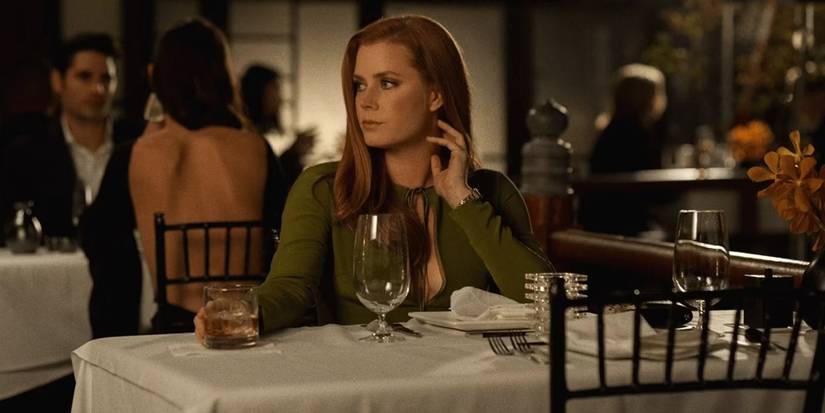
Art-within-art formats sometimes overwhelmingly succeed in film (and sometimes don’t). Here, in fashion maven/sometimes director Tom Ford’s sumptuous film Nocturnal Animals, the semi-true-story within the actual story device is employed to perfection. Ford also co-wrote the script, which is based on the novel Tony and Susan by Austin Wright — and while the movie definitely feels like a book, it is also very much alive, pulsating, and dangerous in tone.
The story focuses on a high-end art gallery owner, the mostly miserable Susan Morrow (played by the ‘is-she-ever-not-amazing?’ Amy Adams). A copy of a manuscript arrives at her luxurious home, and a curious Susan dives in. It’s written by Edward Sheffield (Jake Gyllenhaal), her scorned, volatile ex (depicted as Tony Hastings in the “book”). As she consumes the material, the live action plays out in her mind (with Adams’ lookalike Isla Fisher playing the distorted version of herself, Laura Hastings). It’s violent, brutal, and the symbolism is just as painfully felt as if the actions were real. It’s a neo-noir in an opaque sense, but still strikes all the thrilling cords one expects from the morally murky sub-genre.
7
‘In the Fade’ (2017)

More of a crime revenge story than anything else, In the Fade harkens back to some noirs of yore, where vengeance is at the forefront of the protagonist’s tortured mind. Directed and co-written by Fatih Akin, the film is an indictment of a corrupt legal system, and how the people’s lives affected by it become irrevocably damaged.
The tale begins with Katja (played with the utmost ferocity by Diane Kruger) losing her husband, Nuri Sekerci (Numan Acar), and little son — after some neo-Nazis blow up a building they are occupying in Germany. There is a maddening trial where all Katja experiences is injustice and a severe lack of closure. After the courtroom drama stuff is done, the film kicks into high gear, as Katja takes matters into her own, unapologetic hands — and that’s when things get really good. Revenge may be a dish best served cold, but it’s white-hot in this emotional film, and delivered with sublimely lethal skill.
6
‘Nightcrawler’ (2014)

Nightcrawler really pushes the boundary of “anti-hero” to its breaking point, so much so that the protagonist, Louis Bloom (a completely unhinged Jake Gyllenhaal), is more of a straight-up villain. Nevertheless, the film doesn’t suffer from this at all, as the viewer still roots for this borderline sociopath the whole way through…mostly.
The story of writer-director Dan Gilroy’s sleek, acerbic film is focused on a crime scene photographer (a “stringer.”) He’s a vulture of sorts, forever circling fresh accidents in hopes of capturing gruesome images. The problem is that his avaricious appetite for money and “fame” knows no limitations, and he begins to commit crimes that he can then take snapshots of. It’s a deviously clever way to earn a buck; as network news director Nina Romina (Rene Russo) says, “If it bleeds, it leads.” Gilroy’s morbidly fascinating film explicitly showcases a leech existing in the underground world of Los Angeles, and doesn’t shy away from the grime. A condemnation of the sensationalized way news is consumed, this neo-noir captures all the right sick beats.
5
‘You Were Never Really Here’ (2017)


You Were Never Really Here is more of an intense drama than a true crime thriller, but its nihilistic tone is steeped deep in the noirs of old. Director Lynne Ramsay handles the grim theme here with practiced finesse; he highlights the emotional tension when appropriate, and steps on the vengeance-fueled gas the rest of the film. It’s a bleak, heart-wrenching story, but it’s full of stunning images and exhilarating sequences.
Joaquin Phoenix gives one of the most real, painful, and best performances of his storied career. He plays Joe, a former FBI agent and Gulf War vet, who now works as a ruthless retriever of kidnapped kids. He’s given an assignment by the slick senator Albert Votto (Alex Manette) to find his missing daughter, Nina (Ekaterina Samsonov). All appears to go well…until it doesn’t. Turns out the whole thing was an extremely complicated set-up designed for devious political maneuverings. As poor Joe deals with PTSD from his scarred life, he does his best to save Nina and fight his own personal demons (all as he has to battle real-life ones). It’s a cruel world, and Joe is just trying his best to be good. Now that is a solid noir theme.
4
‘Looper’ (2012)

While this excellent genre-mash-up film leans heavily into the sci-fi realm, it’s a decidedly dark neo-noir thriller as well. Looper is the story of a hitman from the future who gets sent back in time, by organized crime figures, to eliminate targets…before they become a real problem (obviously borrowing a bit of time travel plotting from The Terminator). Things get somewhat sticky when this crafty gun for hire is sent back to take out one very specific target…himself.
Writer-director Rian Johnson’s film explores a very cool concept (“closing the loop,” as it were), but it’s oh so much more than that. The young hitman, Joe, is played by a well-oiled Joseph Gordon-Levitt — while the mature version of this character is portrayed by Bruce Willis, who was at the height of his “older action star” days. Some great turns by Piper Perabo, as the cabaret dancer/femme fatale, Suzie, and Emily Blunt as a fiercely protective mom, Sara, add to the overall quality of this well-designed head trip. By the time the climax arrives, there are so many twisty alleys that Joe has ventured down, it’s a miracle that he (and the audience) emerge with sanity intact.
3
‘The Nice Guys’ (2016)

Snappy dialogue has long been a staple of the classic noir, and screenwriter Shane Black is acutely aware of how much the well-placed one-liner can heighten a film. The Nice Guys, which is also directed by Black, is a highly entertaining private detective story, with a twist. Set in late 1970s Los Angeles, this slick film contains Black’s trademark quips and clever plot devices, but it also highlights the wild vibe of the times — all wrapped up in an intricately devised mystery.
The (ironically titled) story is centered on Holland March (Ryan Gosling, at his sarcastic best), a somewhat disreputable private investigator. After roughly scuffling with professional thug Jackson Healy (Russell Crowe, grumbling away nicely), Holland teams up with him in the search for a missing teen, Amelia (the refreshing Margaret Qualley). But wait, that’s not all; their story interlocks with the suspicious death of adult film star Misty Mountains (Murielle Telio). Everyone’s comedic chops are on full display here, even in the midst of this slightly morbid tale. Noir filmmakers of the past would be proud.
2
‘Sin City: A Dame to Kill For’ (2014)

If there is a better representation of a graphic novel in cinema, it must be hidden under a rock somewhere. Sin City presented one of the most uniquely inventive visual films ever, combining live action with an overlay of sleek animation. Beyond stylized, the use of black and white (a tasty throwback to noir classics), replete with all the shadowing that makes a noir great, with very strategic splashes of extremely vivid color, was an ingenious technique to employ. Beyond just the stunning images, the film as a whole is a remarkable achievement in cinema. Sin City: A Dame to Kill For picks up right where the original left off.
The multi-narrative story features four tales, all derived directly from Frank Miller’s beloved comics, that play out on their own and then intersect masterfully. The first, “A Dame to Kill For,” focuses on Dwight McCarthy (Josh Brolin) as a somewhat dense private dick who is led astray by the stunningly alluring Ava Lord (swoon, Eva Green, who maps out the blueprint for the ideal neo-femme-fatale). Next is “Nancy’s Last Dance,” where exotic dancer Nancy Callahan (Jessica Alba) seeks revenge against the dastardly Senator Roark (Powers Boothe) for the murder of her detective beau. “The Long Bad Night” sees Johnny (Joseph Gordon-Levitt, who seems to love noirs) try his luck against Roark in an underground poker match. Finally, the fourth story is about Marv (Mickey Rourke, finding strength again as a broken down brute) as he wakes with amnesia and basically just beats everyone up as he seeks answers. These stories either follow ones from the first film, or are prequels to them. All in all, a superbly crafted movie, with more dark pleasures than should be allowed.
1
‘Drive’ (2011)

Sometimes, less is more. That’s the case with the protagonist of Drive (Ryan Gosling), who utters a mere 891 words in the whole movie — proving that words can be hollow and body language can be awfully expressive. This apparently was a creative choice made between the director, Nicolas Winding Refn, and Gosling, who had just come off a dialogue-heavy film. The end result is a movie that really highlights what film is all about: stories told through images. Oh, and music, too, as this baby features one of the best synth-based soundtracks of all time.
Gosling is known only as “Driver,” a stuntman who leads an exciting life by day working in Hollywood — but, by night, he is employed as a getaway driver for criminals. As one would expect, something is bound to go wrong. Because Driver has a conscious, he elects to help his neighbor Irene (Carey Mulligan) and her little kid, and he acts as a driver for her freshly un-incarcerated husband, Standard (Oscar Isaac). Things go awry, and now Driver finds himself at the mercy of ruthless crime boss, Bernie Rose (Albert Brooks, playing wonderfully against his wryly good-hearted type here). This film is a true achievement in movie making because it not only keeps the viewer on the edge of their seat at pivotal moments, it also slows things down to a crawl, as Driver’s internal strife is silently conveyed. Laden with symbolism (just check out Driver’s “scorpion and frog” jacket), this film is layered with deep meanings — often counter to what is initially presented. Even Christina Hendricks, as the ostensible femme fatale, Blanche, is not what she seems. So hit the brakes and give this neo-noir classic a spin.


Drive
- Release Date
-
September 16, 2011
- Runtime
-
100 minutes
- Director
-
Nicolas Winding Refn
- Writers
-
Hossein Amini
You must be logged in to post a comment Login